
Fiber Advance Gunnies Weight Management Ingredients & Drug Interactions
What is this page for?
First and foremost: checking Fiber Advance Gunnies Weight Management against your medications. The heart of this page is the interaction checker and the full interaction report — how this product’s ingredients may interact with prescription and over-the-counter medicines you may be taking.
Around that, we add a pharmacist’s high-level view of the product as a whole — what’s inside, the evidence for its stated use, how transparent the label is, and what safety data exists — so you can see the full picture in one place. It’s educational information from our licensed clinical databases and the clinical staff at HelloPharmacist — not medical advice — and we don’t sell or endorse products. Our editorial policy
Fiber Advance Gunnies Weight Management is a dietary supplement by Fiber Advance with 3 active ingredients. Its ingredients are commonly taken for replacing fluids and electrolytes, preventing dehydration during exercise or illness, treating low blood sodium (under medical care).Based on those ingredients, 2,069 medications have a known interaction with it, the most serious rated moderate. The ingredients most likely to interact are Dietary Fiber, Sodium, Chromium. Use the checker below to test your specific medication, or read the full HelloPharmacist Interaction Report.
Check Your Meds Against Fiber Advance Gunnies Weight Management by Fiber Advance
Ask about any prescription or over-the-counter medication and we check it for interactions with Fiber Advance Gunnies Weight Management by Fiber Advance — and tell you which ingredient is responsible.
AI summaries are generated from our interaction database for education only — always confirm with your pharmacist. How we use AI
Ask the Pharmacist
A licensed pharmacist will answer your question by email — free, usually within 24 hours.
Got it — thank you!
A licensed pharmacist will answer within 24 hours. Keep an eye on your email (worth checking spam, just in case).
HelloPharmacist Scorecard of Fiber Advance Gunnies Weight Management by Fiber Advance
Our pharmacy team’s full take, with four database checks built into the cards below — a summary of what is known, not a grade of the product itself.
What’s inside
Full disclosure
The active ingredients are sodium, chromium, and soluble fiber. Sodium is an essential mineral, and in this product it is present as a supplement.
Chromium is a trace mineral. Soluble fiber is listed as an active ingredient, but we do not hold data on what it does in this product.
The inactive ingredients include chicory root fiber, cane sugar, citric acid, Lo Han fruit concentrate, natural flavors, black carrot juice extract, carnauba wax, maqui berry juice concentrate, sunflower oil, pectin, and sodium citrate. These are fillers and other non-active components that help make up the gummy.
Does it work?
Not established
For sodium, our data rates cystic fibrosis as Likely Effective and amphotericin B nephrotoxicity as Possibly Effective. Evidence is insufficient to rate it for bipolar disorder and congestive heart failure (CHF).
For chromium, our data rates chromium deficiency as Likely Effective and diabetes as Possibly Effective. It is rated Possibly Ineffective for prediabetes (impaired glucose tolerance), schizophrenia, and hypertension.
For soluble fiber, we hold no effectiveness ratings, so the evidence is not established in the data we hold.
How safe is it?
Well-documented data
Sodium is generally well tolerated in moderation, up to the Chronic Disease Risk Reduction (CDRR) intake level of 2.3 grams daily. Rare serious effects listed include worsened cardiovascular disease, hypertension, and kidney disease.
Too much sodium is linked to high blood pressure and heart strain. Chromium is generally well tolerated at typical supplement doses.
Common effects include stomach irritation, headaches, insomnia, irritability, and mood changes. Rare serious cases of kidney and liver damage, rhabdomyolysis, and low platelets have been reported.
Pregnancy data for sodium includes one Likely Safe and one Possibly Unsafe rating, so the safety data advises caution, and you should discuss pregnancy or breastfeeding with your doctor or pharmacist. Chromium is rated Likely Safe in pregnancy and lactation, and Possibly Safe in pregnancy.
We hold no pregnancy or lactation data for soluble fiber.
Meds to double-check
Moderate interaction found
Medication types to double-check before taking this product include diabetes drugs and insulin, antihypertensive drugs, corticosteroids, lithium, tolvaptan, sodium phosphates, didanosine, and levothyroxine, all rated Moderate. NSAIDs and aspirin are rated Minor.
Use the search tool on this page to check your exact medications, and confirm with your own doctor or pharmacist.
The bottom line
Scorecard at a glanceFully disclosed formula with no established evidence rating for its marketed use. Moderate medication interactions have been identified, and safety information is well characterized.
This gummy may suit someone looking for a product with sodium, chromium, and soluble fiber, but its weight management purpose is not supported by the effectiveness ratings we hold. People who take diabetes medicines, insulin, levothyroxine, antihypertensives, lithium, or who are pregnant should be especially careful.
Talk it over with your own doctor or pharmacist before you start.
Educational only — not medical advice; always confirm with your pharmacist. Our editorial policy · How we use AI
Assessment coverage: 3 of 3 active ingredients matched to our full ingredient reviews (monographs). Based on the product label dated Feb 23, 2025.
This Scorecard evaluates available label information, ingredient evidence, and known medication-safety considerations. It does not independently verify product identity, purity, potency, contamination, or manufacturing quality. How these ratings are computed
General information
Key facts about Fiber Advance Gunnies Weight Management, straight from the product label.
| Brand | Fiber Advance |
|---|---|
| Barcode (UPC) | 812785010439 |
| Net contents | 150 Vegetarian Gummy(ies) |
| Market status | On market |
| Date entered into DSLD | Feb 23, 2025 |
| DSLD ID | 323401 |
| Product type | Botanical With Nutrients |
| Supplement form | Gummy Or Jelly |
| Dietary claims / uses | Nutrient, All Other, Structure/Function |
| Intended target group(s) | Adult (18 - 50 Years), Gluten Free, Dairy Free |
Everything in this section is reproduced from the manufacturer’s own product label — it’s the label speaking, not HelloPharmacist. We show it so you can see exactly what the maker states; we don’t verify or endorse those statements.
Supplement Facts
The label details for Fiber Advance Gunnies Weight Management by Fiber Advance, sourced from the NIH Dietary Supplement Label Database.
Supplement Facts
| Ingredient | Amount | % DV |
|---|---|---|
| Calories | 25 Calorie(s) | -- |
| Total Carbohydrates | 9 Gram(s) | 3% |
| Sodium | 30 mg | 1% |
| Added Sugars | 1 Gram(s) | 2% |
| Total Sugars | 4 Gram(s) | -- |
| Dietary Fiber | 6 Gram(s) | 21% |
| Chromium | 200 mcg | 571% |
| Fiber, Soluble | 6 Gram(s) | -- |
Other ingredients: Chicory Root Fiber, Cane Sugar, Citric Acid, Lo Han fruit concentrate, Natural Flavors, black carrot juice extract, Carnauba Wax, Maqui berry juice concentrate, Sunflower Oil, Pectin, Sodium Citrate
Tap any ingredient to jump to its full detail below.
These statements are the manufacturer’s wording, reproduced from the product label — the label is saying it, not HelloPharmacist. We don’t verify or endorse them.
General Statements
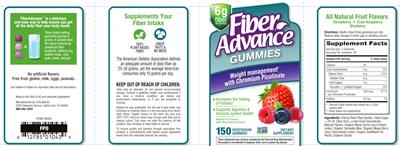
FiberAdvance is a delicious and easy way to help ensure you get all the daily fiber your body needs. Three great-tasting gummies provide 6 grams of soluble fiber, the same amount as powdered fiber products, without any watery mess. Just grab, chew, and go!
The American dietetic Association defines and adequate amount of daily fiber as 25-38 grams, yet the average American consumes only 15 grams per day.
Formulation
No artificial flavors. Free from gluten, milk, eggs, peanuts.
Made in the USA of US and imported ingredients
Supplements your fiber intake 100% plant-based fiber Great taste & no mess
Sealed for your protection. Do not use if seal under cap is broken or missing.
Gummy colors may change over time due to natural colors. This does not alter the potency of the product. Any clouding of clear bottle is normal. To ensure quality and potency through expiration, this product is manufactured with higher active ingredient levels than the indicated amount per serving.
Increases the feeling of fullness Supports digestive & immune system health
Non GMO Project Verified nongmoproject.org
Precautions
Keep out of reach of children.
Take only as directed. Do not exceed recommended dosage.
Consult a qualified health care professional if you have a medical condition, are taking any prescription medications, or if you are pregnant or nursing.
Storage
Keep in a dry area away from direct light. Store: Tightly closed; in the dark; dry and cool (45 degrees F - 75 degrees F).
Formula
Weight management with Chromium picolinate 6g Fiber per serving
Natural fruit flavors with other natural flavors
All natural fruit flavors Strawberry Cran-Raspberry Blueberry
Seals/Symbols
Non GMO Project Verified nongmoproject.org
FDA Disclaimer Statement
These statements have not been evaluated by the Food and Drug Administration. This product is not intended to diagnose, treat, cure or prevent any disease.
Suggested/Recommended/Usage/Directions
Directions: Adults chew three gummies per day. Reduce daily dosage if minor gas or bloating occurs.
Is this label outdated? Report a formula or label change and our pharmacy team will review it.
Fiber Advance Gunnies Weight Management by Fiber Advance label
The label scan from the NIH Dietary Supplement Label Database. Tap to enlarge.
Label images are published by the NIH Dietary Supplement Label Database for the version of this product on file. Always read your actual product label.
View the full label (PDF)The Ingredients in Fiber Advance Gunnies Weight Management by Fiber Advance
These are the 3 active ingredients this product is made of. Select any to open its full monograph.
Serving size3 Gummy(ies) Dosage formGummy Or Jelly Servings per container50 Amounts shown are per serving.
Most supplement products combine several ingredients, and a medication can interact with the product through any one of them. Each ingredient below shows whether it has known drug interactions.
Sodium
Interacts with205 drugs
Sodium is an essential mineral and electrolyte your body needs to balance fluids, support nerves, and help muscles work. Most people in modern diets g...
Sodium monograph & interactionsDietary Fiber
Interacts with2,025 drugs
Black psyllium is a soluble-fiber supplement made from the seeds of a Plantago plant, used mostly to ease constipation and support digestive health. I...
Dietary Fiber monograph & interactions- › Fiber, Soluble
Chromium
Interacts with178 drugs
Chromium is an essential trace mineral involved in how the body handles sugar and fat. Some studies suggest it may modestly help blood sugar control i...
Chromium monograph & interactionsOther (inactive) ingredients: Chicory Root Fiber, Cane Sugar, Citric Acid, Lo Han fruit concentrate, Natural Flavors, Black carrot juice extract, Carnauba Wax, Maqui berry juice concentrate, Sunflower Oil, Pectin, Sodium Citrate. These complete the product’s ingredient list but are not active constituents.
Fiber Advance Gunnies Weight Management by Fiber Advance Drug Interactions
HelloPharmacist Interaction Report
Fiber Advance Gunnies Weight Management can interact with medications through two of its three active ingredients, sodium and chromium.
The most serious interaction in our data is chromium with diabetes drugs and insulin. Together they may lower blood sugar further and raise the risk of low blood sugar (hypoglycemia), rated Moderate.
Read the full breakdown — every affected drug type, severity by severity
Sodium may weaken the effect of antihypertensive drugs used to control blood pressure (Moderate). It may also raise the risk of high blood sodium (hypernatremia) alongside corticosteroids, didanosine, sodium phosphates, tolvaptan, and other sodium-containing drugs (Moderate).
Sodium can change lithium levels too, and cutting sodium sharply may push lithium toward toxic levels (Moderate).
Chromium may bind levothyroxine in the gut and reduce how much is absorbed (Moderate). NSAIDs and aspirin may increase how much chromium your body absorbs (Minor).
Altogether, these interactions span 382 individual medications.
We could not check soluble fiber because we hold no interaction data for it. Search your exact medications with the tool on this page, and talk through your full list with your own doctor or pharmacist.
Check your own medications below · Editorial policy · How we use AI
Want to check YOUR meds against Fiber Advance Gunnies Weight Management?
Ask about interactions with your drugs in plain English — “Can I take it with lisinopril?” — and we find you the answer in seconds, ingredient by ingredient.
Go to the checkerIngredients driving the most interactions
Individual Drug Interactions
The ingredients in Fiber Advance Gunnies Weight Management interact with 2,069 drugs. Click any drug to see the details.
3 of the 3 ingredients in Fiber Advance Gunnies Weight Management interact with drugs. Each result below shows which ingredient is responsible. Dietary Fiber Sodium Chromium
AcarboseGlucobay, Prandase, Precose
How Acarbose interacts with Fiber Advance Gunnies Weight Management — through 2 ingredients. Tap an ingredient for the detail:
ChromiumAntidiabetes Drugs Moderate
Interaction Summary
Theoretically, chromium may have additive effects with antidiabetic agents and increase the risk of hypoglycemia.
Read the full Chromium + Acarbose interactionDietary FiberOral Drugs Minor
Interaction Summary
Theoretically, psyllium might increase, decrease, or have no effect on the absorption of oral drugs.
Read the full Dietary Fiber + Acarbose interactionAcebutololRhotral, Sectral
How Acebutolol interacts with Fiber Advance Gunnies Weight Management — through 2 ingredients. Tap an ingredient for the detail:
SodiumAntihypertensive Drugs Moderate
Interaction Summary
Theoretically, a high intake of dietary sodium might reduce the effectiveness of antihypertensive drugs.
Read the full Sodium + Acebutolol interactionDietary FiberOral Drugs Minor
Interaction Summary
Theoretically, psyllium might increase, decrease, or have no effect on the absorption of oral drugs.
Read the full Dietary Fiber + Acebutolol interactionAcetazolamideAk-Zol, Diamox
How Acetazolamide interacts with Fiber Advance Gunnies Weight Management — through 2 ingredients. Tap an ingredient for the detail:
SodiumAntihypertensive Drugs Moderate
Interaction Summary
Theoretically, a high intake of dietary sodium might reduce the effectiveness of antihypertensive drugs.
Read the full Sodium + Acetazolamide interactionDietary FiberOral Drugs Minor
Interaction Summary
Theoretically, psyllium might increase, decrease, or have no effect on the absorption of oral drugs.
Read the full Dietary Fiber + Acetazolamide interactionAcetohexamideDymelor
How Acetohexamide interacts with Fiber Advance Gunnies Weight Management — through 2 ingredients. Tap an ingredient for the detail:
ChromiumAntidiabetes Drugs Moderate
Interaction Summary
Theoretically, chromium may have additive effects with antidiabetic agents and increase the risk of hypoglycemia.
Read the full Chromium + Acetohexamide interactionDietary FiberOral Drugs Minor
Interaction Summary
Theoretically, psyllium might increase, decrease, or have no effect on the absorption of oral drugs.
Read the full Dietary Fiber + Acetohexamide interactionAlbiglutideTanzeum
How Albiglutide interacts with Fiber Advance Gunnies Weight Management — through 1 ingredient. Tap an ingredient for the detail:
ChromiumAntidiabetes Drugs Moderate
Interaction Summary
Theoretically, chromium may have additive effects with antidiabetic agents and increase the risk of hypoglycemia.
Read the full Chromium + Albiglutide interactionAliskirenTekturna
How Aliskiren interacts with Fiber Advance Gunnies Weight Management — through 2 ingredients. Tap an ingredient for the detail:
SodiumAntihypertensive Drugs Moderate
Interaction Summary
Theoretically, a high intake of dietary sodium might reduce the effectiveness of antihypertensive drugs.
Read the full Sodium + Aliskiren interactionDietary FiberOral Drugs Minor
Interaction Summary
Theoretically, psyllium might increase, decrease, or have no effect on the absorption of oral drugs.
Read the full Dietary Fiber + Aliskiren interactionAlogliptinNesina
How Alogliptin interacts with Fiber Advance Gunnies Weight Management — through 2 ingredients. Tap an ingredient for the detail:
ChromiumAntidiabetes Drugs Moderate
Interaction Summary
Theoretically, chromium may have additive effects with antidiabetic agents and increase the risk of hypoglycemia.
Read the full Chromium + Alogliptin interactionDietary FiberOral Drugs Minor
Interaction Summary
Theoretically, psyllium might increase, decrease, or have no effect on the absorption of oral drugs.
Read the full Dietary Fiber + Alogliptin interactionAlogliptin, MetforminKazano
How Alogliptin, Metformin interacts with Fiber Advance Gunnies Weight Management — through 2 ingredients. Tap an ingredient for the detail:
Dietary FiberMetformin (glucophage), Oral Drugs Moderate
Interaction Summary
Theoretically, black psyllium might increase the therapeutic and adverse effects of metformin.
Read the full Dietary Fiber + Alogliptin, Metformin interactionChromiumAntidiabetes Drugs Moderate
Interaction Summary
Theoretically, chromium may have additive effects with antidiabetic agents and increase the risk of hypoglycemia.
Read the full Chromium + Alogliptin, Metformin interactionAlogliptin, PioglitazoneOseni
How Alogliptin, Pioglitazone interacts with Fiber Advance Gunnies Weight Management — through 2 ingredients. Tap an ingredient for the detail:
ChromiumAntidiabetes Drugs Moderate
Interaction Summary
Theoretically, chromium may have additive effects with antidiabetic agents and increase the risk of hypoglycemia.
Read the full Chromium + Alogliptin, Pioglitazone interactionDietary FiberOral Drugs Minor
Interaction Summary
Theoretically, psyllium might increase, decrease, or have no effect on the absorption of oral drugs.
Read the full Dietary Fiber + Alogliptin, Pioglitazone interactionAmbrisentanLetairis, Volibris
How Ambrisentan interacts with Fiber Advance Gunnies Weight Management — through 2 ingredients. Tap an ingredient for the detail:
SodiumAntihypertensive Drugs Moderate
Interaction Summary
Theoretically, a high intake of dietary sodium might reduce the effectiveness of antihypertensive drugs.
Read the full Sodium + Ambrisentan interactionDietary FiberOral Drugs Minor
Interaction Summary
Theoretically, psyllium might increase, decrease, or have no effect on the absorption of oral drugs.
Read the full Dietary Fiber + Ambrisentan interactionAmilorideAmilamont, Midamor
How Amiloride interacts with Fiber Advance Gunnies Weight Management — through 2 ingredients. Tap an ingredient for the detail:
SodiumAntihypertensive Drugs Moderate
Interaction Summary
Theoretically, a high intake of dietary sodium might reduce the effectiveness of antihypertensive drugs.
Read the full Sodium + Amiloride interactionDietary FiberOral Drugs Minor
Interaction Summary
Theoretically, psyllium might increase, decrease, or have no effect on the absorption of oral drugs.
Read the full Dietary Fiber + Amiloride interactionAmiloride, HydrochlorothiazideAmil-Co, Amilzide, Moduret 25, Moduretic
How Amiloride, Hydrochlorothiazide interacts with Fiber Advance Gunnies Weight Management — through 2 ingredients. Tap an ingredient for the detail:
SodiumAntihypertensive Drugs Moderate
Interaction Summary
Theoretically, a high intake of dietary sodium might reduce the effectiveness of antihypertensive drugs.
Read the full Sodium + Amiloride, Hydrochlorothiazide interactionDietary FiberOral Drugs Minor
Interaction Summary
Theoretically, psyllium might increase, decrease, or have no effect on the absorption of oral drugs.
Read the full Dietary Fiber + Amiloride, Hydrochlorothiazide interactionAmlodipineNorliqva
How Amlodipine interacts with Fiber Advance Gunnies Weight Management — through 2 ingredients. Tap an ingredient for the detail:
SodiumAntihypertensive Drugs Moderate
Interaction Summary
Theoretically, a high intake of dietary sodium might reduce the effectiveness of antihypertensive drugs.
Read the full Sodium + Amlodipine interactionDietary FiberOral Drugs Minor
Interaction Summary
Theoretically, psyllium might increase, decrease, or have no effect on the absorption of oral drugs.
Read the full Dietary Fiber + Amlodipine interactionAmlodipine BenzoateKaterzia
How Amlodipine Benzoate interacts with Fiber Advance Gunnies Weight Management — through 2 ingredients. Tap an ingredient for the detail:
SodiumAntihypertensive Drugs Moderate
Interaction Summary
Theoretically, a high intake of dietary sodium might reduce the effectiveness of antihypertensive drugs.
Read the full Sodium + Amlodipine Benzoate interactionDietary FiberOral Drugs Minor
Interaction Summary
Theoretically, psyllium might increase, decrease, or have no effect on the absorption of oral drugs.
Read the full Dietary Fiber + Amlodipine Benzoate interactionAmlodipine BesilateIstin
How Amlodipine Besilate interacts with Fiber Advance Gunnies Weight Management — through 2 ingredients. Tap an ingredient for the detail:
SodiumAntihypertensive Drugs Moderate
Interaction Summary
Theoretically, a high intake of dietary sodium might reduce the effectiveness of antihypertensive drugs.
Read the full Sodium + Amlodipine Besilate interactionDietary FiberOral Drugs Minor
Interaction Summary
Theoretically, psyllium might increase, decrease, or have no effect on the absorption of oral drugs.
Read the full Dietary Fiber + Amlodipine Besilate interactionAmlodipine BesylateNorvasc
How Amlodipine Besylate interacts with Fiber Advance Gunnies Weight Management — through 2 ingredients. Tap an ingredient for the detail:
SodiumAntihypertensive Drugs Moderate
Interaction Summary
Theoretically, a high intake of dietary sodium might reduce the effectiveness of antihypertensive drugs.
Read the full Sodium + Amlodipine Besylate interactionDietary FiberOral Drugs Minor
Interaction Summary
Theoretically, psyllium might increase, decrease, or have no effect on the absorption of oral drugs.
Read the full Dietary Fiber + Amlodipine Besylate interactionAmlodipine Besylate, BenazeprilLotrel
How Amlodipine Besylate, Benazepril interacts with Fiber Advance Gunnies Weight Management — through 2 ingredients. Tap an ingredient for the detail:
SodiumAntihypertensive Drugs Moderate
Interaction Summary
Theoretically, a high intake of dietary sodium might reduce the effectiveness of antihypertensive drugs.
Read the full Sodium + Amlodipine Besylate, Benazepril interactionDietary FiberOral Drugs Minor
Interaction Summary
Theoretically, psyllium might increase, decrease, or have no effect on the absorption of oral drugs.
Read the full Dietary Fiber + Amlodipine Besylate, Benazepril interactionAmlodipine, CelecoxibConsensi
How Amlodipine, Celecoxib interacts with Fiber Advance Gunnies Weight Management — through 3 ingredients. Tap an ingredient for the detail:
SodiumAntihypertensive Drugs Moderate
Interaction Summary
Theoretically, a high intake of dietary sodium might reduce the effectiveness of antihypertensive drugs.
Read the full Sodium + Amlodipine, Celecoxib interactionChromiumNonsteroidal Anti-inflammatory Drugs (nsaids) Minor
Interaction Summary
NSAIDs might increase chromium levels in the body.
Read the full Chromium + Amlodipine, Celecoxib interactionDietary FiberOral Drugs Minor
Interaction Summary
Theoretically, psyllium might increase, decrease, or have no effect on the absorption of oral drugs.
Read the full Dietary Fiber + Amlodipine, Celecoxib interactionAmmonium ChlorideAmmonium Chloride
How Ammonium Chloride interacts with Fiber Advance Gunnies Weight Management — through 2 ingredients. Tap an ingredient for the detail:
SodiumAntihypertensive Drugs Moderate
Interaction Summary
Theoretically, a high intake of dietary sodium might reduce the effectiveness of antihypertensive drugs.
Read the full Sodium + Ammonium Chloride interactionDietary FiberOral Drugs Minor
Interaction Summary
Theoretically, psyllium might increase, decrease, or have no effect on the absorption of oral drugs.
Read the full Dietary Fiber + Ammonium Chloride interactionAntidiabetes, Dipeptidyl Peptidase-4 (dpp-iv) InhibitorGlyxambi
How Antidiabetes, Dipeptidyl Peptidase-4 (dpp-iv) Inhibitor interacts with Fiber Advance Gunnies Weight Management — through 2 ingredients. Tap an ingredient for the detail:
ChromiumAntidiabetes Drugs Moderate
Interaction Summary
Theoretically, chromium may have additive effects with antidiabetic agents and increase the risk of hypoglycemia.
Read the full Chromium + Antidiabetes, Dipeptidyl Peptidase-4 (dpp-iv) Inhibitor interactionDietary FiberOral Drugs Minor
Interaction Summary
Theoretically, psyllium might increase, decrease, or have no effect on the absorption of oral drugs.
Read the full Dietary Fiber + Antidiabetes, Dipeptidyl Peptidase-4 (dpp-iv) Inhibitor interactionAprocitentanTryvio
How Aprocitentan interacts with Fiber Advance Gunnies Weight Management — through 2 ingredients. Tap an ingredient for the detail:
SodiumAntihypertensive Drugs Moderate
Interaction Summary
Theoretically, a high intake of dietary sodium might reduce the effectiveness of antihypertensive drugs.
Read the full Sodium + Aprocitentan interactionDietary FiberOral Drugs Minor
Interaction Summary
Theoretically, psyllium might increase, decrease, or have no effect on the absorption of oral drugs.
Read the full Dietary Fiber + Aprocitentan interactionAtenololAtenix, Tenormin
How Atenolol interacts with Fiber Advance Gunnies Weight Management — through 2 ingredients. Tap an ingredient for the detail:
SodiumAntihypertensive Drugs Moderate
Interaction Summary
Theoretically, a high intake of dietary sodium might reduce the effectiveness of antihypertensive drugs.
Read the full Sodium + Atenolol interactionDietary FiberOral Drugs Minor
Interaction Summary
Theoretically, psyllium might increase, decrease, or have no effect on the absorption of oral drugs.
Read the full Dietary Fiber + Atenolol interactionAtenolol, ChlortalidoneAtenixCo, Tenoret 50, Totaretic
How Atenolol, Chlortalidone interacts with Fiber Advance Gunnies Weight Management — through 2 ingredients. Tap an ingredient for the detail:
SodiumAntihypertensive Drugs Moderate
Interaction Summary
Theoretically, a high intake of dietary sodium might reduce the effectiveness of antihypertensive drugs.
Read the full Sodium + Atenolol, Chlortalidone interactionDietary FiberOral Drugs Minor
Interaction Summary
Theoretically, psyllium might increase, decrease, or have no effect on the absorption of oral drugs.
Read the full Dietary Fiber + Atenolol, Chlortalidone interactionAtenolol, ChlorthalidoneTenoretic
How Atenolol, Chlorthalidone interacts with Fiber Advance Gunnies Weight Management — through 2 ingredients. Tap an ingredient for the detail:
SodiumAntihypertensive Drugs Moderate
Interaction Summary
Theoretically, a high intake of dietary sodium might reduce the effectiveness of antihypertensive drugs.
Read the full Sodium + Atenolol, Chlorthalidone interactionDietary FiberOral Drugs Minor
Interaction Summary
Theoretically, psyllium might increase, decrease, or have no effect on the absorption of oral drugs.
Read the full Dietary Fiber + Atenolol, Chlorthalidone interactionAzelastine Hydrochloride, Fluticasone PropionateDymista
How Azelastine Hydrochloride, Fluticasone Propionate interacts with Fiber Advance Gunnies Weight Management — through 2 ingredients. Tap an ingredient for the detail:
SodiumCorticosteroids Moderate
Interaction Summary
Concomitant use of mineralocorticoids and some glucocorticoids with sodium supplements might increase the risk of hypernatremia.
Read the full Sodium + Azelastine Hydrochloride, Fluticasone Propionate interactionDietary FiberOral Drugs Minor
Interaction Summary
Theoretically, psyllium might increase, decrease, or have no effect on the absorption of oral drugs.
Read the full Dietary Fiber + Azelastine Hydrochloride, Fluticasone Propionate interactionAzilsartanEdarbi
How Azilsartan interacts with Fiber Advance Gunnies Weight Management — through 2 ingredients. Tap an ingredient for the detail:
SodiumAntihypertensive Drugs Moderate
Interaction Summary
Theoretically, a high intake of dietary sodium might reduce the effectiveness of antihypertensive drugs.
Read the full Sodium + Azilsartan interactionDietary FiberOral Drugs Minor
Interaction Summary
Theoretically, psyllium might increase, decrease, or have no effect on the absorption of oral drugs.
Read the full Dietary Fiber + Azilsartan interactionAzilsartan, ChlorthalidoneEdarbyclor
How Azilsartan, Chlorthalidone interacts with Fiber Advance Gunnies Weight Management — through 2 ingredients. Tap an ingredient for the detail:
SodiumAntihypertensive Drugs Moderate
Interaction Summary
Theoretically, a high intake of dietary sodium might reduce the effectiveness of antihypertensive drugs.
Read the full Sodium + Azilsartan, Chlorthalidone interactionDietary FiberOral Drugs Minor
Interaction Summary
Theoretically, psyllium might increase, decrease, or have no effect on the absorption of oral drugs.
Read the full Dietary Fiber + Azilsartan, Chlorthalidone interactionBeclometasone DipropionateBecotide
How Beclometasone Dipropionate interacts with Fiber Advance Gunnies Weight Management — through 2 ingredients. Tap an ingredient for the detail:
SodiumCorticosteroids Moderate
Interaction Summary
Concomitant use of mineralocorticoids and some glucocorticoids with sodium supplements might increase the risk of hypernatremia.
Read the full Sodium + Beclometasone Dipropionate interactionDietary FiberOral Drugs Minor
Interaction Summary
Theoretically, psyllium might increase, decrease, or have no effect on the absorption of oral drugs.
Read the full Dietary Fiber + Beclometasone Dipropionate interactionBeclomethasoneBeclovent, Vanceril
How Beclomethasone interacts with Fiber Advance Gunnies Weight Management — through 2 ingredients. Tap an ingredient for the detail:
SodiumCorticosteroids Moderate
Interaction Summary
Concomitant use of mineralocorticoids and some glucocorticoids with sodium supplements might increase the risk of hypernatremia.
Read the full Sodium + Beclomethasone interactionDietary FiberOral Drugs Minor
Interaction Summary
Theoretically, psyllium might increase, decrease, or have no effect on the absorption of oral drugs.
Read the full Dietary Fiber + Beclomethasone interactionBeclomethasone DipropionateQNASL, Qvar
How Beclomethasone Dipropionate interacts with Fiber Advance Gunnies Weight Management — through 2 ingredients. Tap an ingredient for the detail:
SodiumCorticosteroids Moderate
Interaction Summary
Concomitant use of mineralocorticoids and some glucocorticoids with sodium supplements might increase the risk of hypernatremia.
Read the full Sodium + Beclomethasone Dipropionate interactionDietary FiberOral Drugs Minor
Interaction Summary
Theoretically, psyllium might increase, decrease, or have no effect on the absorption of oral drugs.
Read the full Dietary Fiber + Beclomethasone Dipropionate interactionEach ingredient & the kinds of drugs it affects
For each ingredient in Fiber Advance Gunnies Weight Management with known interactions, here are the types of medications they can affect. Open any type for the detail — or search your exact drug in the checker above.
Dietary Fiber
Carbamazepine (Tegretol)
Theoretically, black psyllium might reduce the effects of carbamazepine and increase the risk for convulsions.
Theoretically, black psyllium might reduce carbamazepine absorption. A preliminary study using blond psyllium reported decreased carbamazepine bioavailability due to binding of the drug to psyllium, as well as reduction of available fluid in the gut for dissolution of the drug. This interaction may also occur with black psyllium.
Lithium
Theoretically, taking black psyllium at the same time as lithium might reduce lithium absorption.
The fiber in black psyllium might reduce lithium absorption and plasma levels. Some case reports describe a reduction in plasma lithium levels with concomitant administration of blond psyllium. This was reversed when psyllium was stopped. This interaction may also occur with black psyllium.
Metformin (Glucophage)
Theoretically, black psyllium might increase the therapeutic and adverse effects of metformin.
Animal research shows that concurrent consumption of blond psyllium with metformin slows and increases the absorption of metformin. This interaction may also occur with black psyllium. To avoid changes in absorption, take psyllium 30-60 minutes after metformin.
Olanzapine (Zyprexa)
Theoretically, taking black psyllium at the same time as olanzapine might reduce olanzapine absorption.
The fiber in black psyllium might decrease the absorption of olanzapine. A single case report describes a reduction in the effectiveness of olanzapine when it was concomitantly administered with an unspecified type of psyllium 3 grams orally twice daily. This effect was reversed when psyllium was stopped.
Digoxin (Lanoxin)
Theoretically, taking black psyllium at the same time as digoxin might reduce digoxin absorption and decrease digoxin levels.
Psyllium might bind digoxin in the gut. However, some clinical evidence suggests that psyllium does not impact digoxin absorption.
Ethinyl Estradiol
Theoretically, taking black psyllium at the same time as ethinyl estradiol might alter levels of estradiol.
Concurrent use of blond psyllium with ethinyl estradiol results in a slight increase in the extent of ethinyl estradiol absorption and a slower rate of absorption. This is unlikely to be clinically significant.
Oral Drugs
Theoretically, psyllium might increase, decrease, or have no effect on the absorption of oral drugs.
Psyllium seems to have variable effects on drug absorption. To avoid changes in absorption, take psyllium 30-60 minutes after oral medications. Animal research shows that blond psyllium delays and increases the absorption of metformin and ethinyl estradiol. Case reports and animal research suggest that blond psyllium might reduce absorption of lithium, digoxin, olanzapine, and carbamazepine. Finally, some pharmacokinetic studies show that psyllium does not affect the absorption of levothyroxine or warfarin. Although many of these studies evaluated blond psyllium, the fiber content in black psyllium may have similar effects.
Sodium
Antihypertensive Drugs
Theoretically, a high intake of dietary sodium might reduce the effectiveness of antihypertensive drugs.
High intake of dietary sodium can increase systolic and diastolic blood pressure. Also, high intake of sodium may necessitate increased use of antihypertensive medications to achieve blood pressure control in some patients, such as those with chronic kidney disease.
Corticosteroids
Concomitant use of mineralocorticoids and some glucocorticoids with sodium supplements might increase the risk of hypernatremia.
Mineralocorticoids and some glucocorticoids (corticosteroids) cause sodium retention. This effect is dose-related and depends on mineralocorticoid potency. It is most common with hydrocortisone, cortisone, and fludrocortisone, followed by prednisone and prednisolone.
Didanosine (Videx)
Concomitant use of didanosine with additional sodium from dietary or supplemental sources may increase the risk of hypernatremia.
Didanosine formulations contain a significant amount of sodium.
Lithium
Altering dietary intake of sodium might alter the levels and clinical effects of lithium.
High sodium intake can reduce plasma concentrations of lithium by increasing lithium excretion. Reducing sodium intake can significantly increase plasma concentrations of lithium and cause lithium toxicity in patients being treated with lithium carbonate. Stabilizing sodium intake is shown to reduce the percentage of patients with lithium level fluctuations above 0.8 mEq/L. Patients taking lithium should avoid significant alterations in their dietary intake of sodium.
Sodium Phosphates
Theoretically, concomitant use of sodium phosphate with sodium supplements might increase the risk of hypernatremia.
Use of high doses (> 45 mL in 24 hours) of sodium phosphate, such as those used for bowel cleansing before surgery, can lead to serious electrolyte disturbances, including hypernatremia. The risk of hypernatremia is highest in the elderly and people with other risk factors for electrolyte disturbances.
Sodium-Containing Drugs
Concomitant use of sodium-containing drugs with additional sodium from dietary or supplemental sources may increase the risk of hypernatremia and long-term sodium-related complications.
The Chronic Disease Risk Reduction (CDRR) intake level of 2.3 grams of sodium daily indicates the intake at which it is believed that chronic disease risk increases for the apparently healthy population. Some medications contain high quantities of sodium. When used in conjunction with sodium supplements or high-sodium diets, the CDRR may be exceeded. Additionally, concomitant use may increase the risk for hypernatremia; this risk is highest in the elderly and people with other risk factors for electrolyte disturbances.
Tolvaptan (Samsca)
Theoretically, concomitant use of tolvaptan with sodium might increase the risk of hypernatremia.
Tolvaptan is a vasopressin receptor 2 antagonist that is used to increase sodium levels in patients with hyponatremia. Patients taking tolvaptan should use caution with the use of sodium salts such as sodium chloride.
Chromium
Antidiabetes Drugs
Theoretically, chromium may have additive effects with antidiabetic agents and increase the risk of hypoglycemia.
Some research shows that taking chromium might lower blood glucose levels, especially in patients with poorly controlled type 2 diabetes.
Insulin
Theoretically, concomitant use of chromium and insulin might increase the risk of hypoglycemia.
In clinical research, chromium has been shown to increase insulin sensitivity,
Levothyroxine (Synthroid, Others)
Chromium might bind levothyroxine in the intestinal tract and decrease levothyroxine absorption.
Clinical research in healthy volunteers shows that taking chromium picolinate 1000 mcg with levothyroxine 1 mg decreases serum levels of levothyroxine by 17% when compared to taking levothyroxine alone. Advise patients to take levothyroxine at least 30 minutes before or 3-4 hours after taking chromium.
Aspirin
Theoretically, aspirin might increase chromium absorption.
Animal research suggests that aspirin may increase chromium absorption and chromium levels in the blood.
Nonsteroidal Anti-Inflammatory Drugs (Nsaids)
NSAIDs might increase chromium levels in the body.
Drugs that are prostaglandin inhibitors, such as NSAIDs, seem to increase chromium absorption and retention.
Brand information
Manufacturer and brand details for Fiber Advance Gunnies Weight Management, from the product label.
Fiber Advance
See all Fiber Advance products- Name
- SCN BestCo
- Street Address
- 2200 Delaware Avenue
- City
- Santa Cruz
- State
- CA
- ZipCode
- 95060
- Phone Number
- 866-942-2429
Fiber Advance Gunnies Weight Management by Fiber Advance: Common Questions
Does Fiber Advance Gunnies Weight Management by Fiber Advance interact with any medications?
How can one product interact with so many drugs?
Where does this information come from?
Can I take this during pregnancy?
Is this gummy good for chromium deficiency?
What side effects can chromium cause?
Does sodium cause side effects?
Written and reviewed by the HelloPharmacist editorial staff. Our editorial policy
Not sure if Fiber Advance Gunnies Weight Management is safe with your meds?
Our pharmacists answer your medication & supplement questions — free.
Label information is sourced from the NIH Dietary Supplement Label Database and reflects the product version on file; always read your actual product label. This page is for education only and is not a substitute for professional medical advice. Confirm with your pharmacist or doctor before combining supplements and medications.
The Full Monographs Behind Fiber Advance Gunnies Weight Management’s Ingredients
Every ingredient we hold a full HelloPharmacist monograph for — uses, evidence, safety, and the complete interaction list.
Sodium
Interacts with 205 drugsSodium is an essential mineral and electrolyte your body needs to balance fluids, support nerves, and help muscles work. Most people in modern diets get more than enough—often too much—from...
Read the full Sodium monograph → Herb & supplement monographBlack Psyllium
Interacts with 2,025 drugsBlack psyllium is a soluble-fiber supplement made from the seeds of a Plantago plant, used mostly to ease constipation and support digestive health. It is best known and most studied for rel...
Read the full Black Psyllium monograph → Herb & supplement monographChromium
Interacts with 178 drugsChromium is an essential trace mineral involved in how the body handles sugar and fat. Some studies suggest it may modestly help blood sugar control in certain people with type 2 diabetes, b...
Read the full Chromium monograph →Sources & How We Checked
Fiber Advance Gunnies Weight Management's label data comes from the NIH Dietary Supplement Label Database; the ingredient interaction data is from the Natural Medicines database, reviewed by our pharmacists.
- NIH Dietary Supplement Label Database (DSLD) — The official product label on file for this supplement.
- Natural Medicines (Therapeutic Research Center) — Evidence-graded clinical reference behind the ingredient interaction data.
Content is written and reviewed by licensed HelloPharmacist pharmacists. See our data sources and editorial standards for how this information is built and checked.
The 111 references behind this product’s interaction data
Every citation that drives the interaction findings for this product’s ingredients, from the evidence-graded Natural Medicines (TRC Healthcare) database. Open an ingredient to browse its citations — links open the study on PubMed or the publisher’s site.
Sodium 40 references
- Garabedian-Ruffalo SM, Ruffalo RL. Drug and nutrient interactions. Am Fam Physician 1986;33:165-74.
- Food and Drug Administration Science Background: Safety of Sodium Phosphates Oral Solution. September 17, 2001. Available at: http://www.fda.gov/cder/drug/safety/sodiumphospate.htm
- Coton T, Mallaret C, Coilliot C, Carre D, Guisset M. Severe acute ulcerated gastritis induced by salt. Presse Med 2009;38(3):499-500. PubMed
- Frings-Meuthen P, Buehlmeier J, Baecker N, et al. High sodium chloride intake exacerbates immobilization-induced bone resorption and protein losses. J Appl Physiol 2011;111(2):537-542. PubMed
- Frings-Meuthen P, Baecker N, Heer M. Low-grade metabolic acidosis may be the cause of sodium chloride-induced exaggerated bone resorption. J Bone Miner Res 2008;23(4):517-524. PubMed
- Alam S, Johnson AG. A meta-analysis of randomised controlled trials (RCT) among healthy normotensive and essential hypertensive elderly patients to determine the effect of high salt (NaCl) diet of blood pressure. J Hum Hypertens 1999;13(6):367-74.
- Boudville N, Ward S, Benaroia M, House AA. Increased sodium intake correlates with greater use of antihypertensive agents by subjects with chronic kidney disease. Am J Hypertens 2005;18(10):1300-5. PubMed
- Bennett WM. Drug interactions and consequences of sodium restriction. Am J Clin Nutr 1997;65(2 Suppl):678S-681S. PubMed
- Okusa MD, Crystal LJ. Clinical manifestations and management of acute lithium intoxication. Am J Med 1994;97(4):383-9. PubMed
- Food and Nutrition Board, Institute of Medicine. Dietary reference intakes for water, potassium, sodium, chloride, and sulfate. Washington, DC: National Academy Press, 2005. Available at: http://www.nap.edu/openbook.php?record_id=10925. DOI
- D'Elia L, Rossi G, Ippolito R, Cappuccio FP, Strazzullo P. Habitual salt intake and risk of gastric cancer: a meta-analysis of prospective studies. Clin Nutr 2012;31(4):489-98. PubMed
- Goldsmith SR. Hyponatremia in heart failure: time for a trial. J Card Fail 2013;19(6):398-400. PubMed
- Willocks L, Brettle R, Keen J, Valentine C, Pinching AJ. Formulations of didanosine (ddI) and salt overload. Lancet 1992;339(8786):190.
- Chen L, Zhang Z, Chen W, Whelton PK, Appel LJ. Lower Sodium Intake and Risk of Headaches: Results From the Trial of Nonpharmacologic Interventions in the Elderly. Am J Public Health. 2016;106(7):1270-5. PubMed
- Cook NR, Appel LJ, Whelton PK. Lower levels of sodium intake and reduced cardiovascular risk. Circulation. 2014;129(9):981-9. PubMed
- Cook NR, Appel LJ, Whelton PK. Sodium Intake and All-Cause Mortality Over 20 Years in the Trials of Hypertension Prevention. J Am Coll Cardiol. 2016;68(15):1609-1617. PubMed
- Mente A, O'Donnell M, Rangarajan S, et al. Associations of urinary sodium excretion with cardiovascular events in individuals with and without hypertension: a pooled analysis of data from four studies. Lancet. 2016;388(10043):465-75. PubMed
- Moosavian SP, Haghighatdoost F, Surkan PJ, Azadbakht L. Salt and obesity: a systematic review and meta-analysis of observational studies. Int J Food Sci Nutr. 2017;68(3):265-277. PubMed
- O'Donnell M, Mente A, Rangarajan S, et al. Urinary sodium and potassium excretion, mortality, and cardiovascular events. N Engl J Med. 2014;371(7):612-23. DOI
- Poggio R, Gutierrez L, Matta MG, Elorriaga N, Irazola V, Rubinstein A. Daily sodium consumption and CVD mortality in the general population: systematic review and meta-analysis of prospective studies. Public Health Nutr. 2015;18(4):695-704. PubMed
- Stallings VA, Harrison M, Oria M; Committee to Review the Dietary Reference Intakes for Sodium and Potassium, Food and Nutrition Board, Health and Medicine Division, National Academies of Sciences, Engineering, and Medicine. Washington (DC): National Acad
- Mahtani KR, Heneghan C, Onakpoya I, et al. Reduced Salt Intake for Heart Failure: A Systematic Review. JAMA Intern Med. 2018 Dec 1;178(12):1693-1700. PubMed
- Yancy CW. Sodium Restriction in Heart Failure: Too Much Uncertainty-Do the Trials. JAMA Intern Med. 2018 Dec 1;178(12):1700-1701. PubMed
- He FJ, Campbell NRC, Ma Y, MacGregor GA, Cogswell ME, Cook NR. Errors in estimating usual sodium intake by the Kawasaki formula alter its relationship with mortality: implications for public health. Int J Epidemiol. 2018;47(6):1784-1795. PubMed
- Murthy K, Ondrey GJ, Malkani N, et al. THE EFFECTS OF HYPONATREMIA ON BONE DENSITY AND FRACTURES: A SYSTEMATIC REVIEW AND META-ANALYSIS. Endocr Pract. 2019;25(4):366-378. PubMed
- Messerli FH, Hofstetter L, Syrogiannouli L, et al. Sodium intake, life expectancy, and all-cause mortality. Eur Heart J 2021;42(21):2103-2112. PubMed
- Graudal NA, Hubeck-Graudal T, Jurgens G. Effects of low sodium diet versus high sodium diet on blood pressure, renin, aldosterone, catecholamines, cholesterol, and triglyceride. Cochrane Database Syst Rev 2020;12(12):CD004022. PubMed
- Giatti S, Santos RB, Aielo AN, et al. Association of sodium with obstructive sleep apnea. The ELSA-Brasil study. Ann Am Thorac Soc 2021;18(3):502-510. PubMed
- Nan X, Lu H, Wu J, et al. The interactive association between sodium intake, alcohol consumption and hypertension among elderly in northern China: a cross-sectional study. BMC Geriatr 2021;21(1):135. PubMed
- Kyozuka H, Fukusda T, Murata T, et al. Impact of preconception sodium intake on hypertensive disorders of pregnancy: The Japan Environment and Children's study. Pregnancy Hypertens 2021;23:66-72. PubMed
- Zhao L, Ogden CL, Yang Q, et al. Association of usual sodium intake with obesity among US children and adolescents, NHANES 2009-2016. Obesity (Silver Spring) 2021;29(3):587-594. PubMed
- Ma Y, He FJ, Sun Q, et al. 24-Hour urinary sodium and potassium excretion and cardiovascular risk. N Engl J Med 2022;386(3):252-263. PubMed
- Liu J, Yang X, Zhang P, et al. Association of urinary sodium excretion and left ventricular hypertrophy in people with type 2 diabetes mellitus: A cross-sectional study. Front Endocrinol (Lausanne) 2021;12:728493. PubMed
- Filippini T, Malavolti M, Whelton PK, Vinceti M. Sodium intake and risk of hypertension: A systematic review and dose-response meta-analysis of observational cohort studies. Curr Hypertens Rep 2022;24(5):133-144. PubMed
- Wang DD, Li Y, Nguyen XT, et al. Dietary sodium and potassium intake and risk of non-fatal cardiovascular diseases: The million veteran program. Nutrients 2022;14(5):1121. PubMed
- Kwak JH, Park CH, Eun CS, et al. The associations of dietary intake of high sodium and low zinc with gastric cancer mortality: A prospective cohort study in Korea. Nutr Cancer 2022;74(10):3501-3508. PubMed
- George S, Maiti R, Mishra BR, Jena M, Mohapatra D. Effect of regulated add-on sodium chloride intake on stabilization of serum lithium concentration in bipolar disorder: A randomized controlled trial. Bipolar Disord 2023;25(1):66-75. PubMed
- Zhou TL, Schütten MTJ, Kroon AA, et al. Urinary Sodium Excretion and Salt Intake Are Not Associated With Blood Pressure Variability in a White General Population. J Am Heart Assoc 2023;12(1):e026578. PubMed
- Gan L, Zhao B, Inoue-Choi M, et al. Sex-specific associations between sodium and potassium intake and overall and cause-specific mortality: a large prospective U.S. cohort study, systematic review, and updated meta-analysis of cohort studies. BMC Med 2024 PubMed
- Liu D, Tian Y, Wang R, et al. Sodium, potassium intake, and all-cause mortality: confusion and new findings. BMC Public Health 2024;24(1):180. PubMed
Black Psyllium 18 references
- McGuffin M, Hobbs C, Upton R, Goldberg A, eds. American Herbal Products Association's Botanical Safety Handbook. Boca Raton, FL: CRC Press, LLC 1997.
- Gruenwald J, Brendler T, Jaenicke C. PDR for Herbal Medicines. 1st ed. Montvale, NJ: Medical Economics Company, Inc., 1998.
- Covington TR, et al. Handbook of Nonprescription Drugs. 11th ed. Washington, DC: American Pharmaceutical Association, 1996.
- Etman M. Effect of a bulk forming laxative on the bioavailablility of carbamazepine in man. Drug Dev Ind Pharm 1995;21:1901-6.
- Perlman BB. Interaction between lithium salts and ispaghula husk. Lancet 1990;335:416.
- Vaswani SK, Hamilton RG, Valentine MD, Adkinson NF. Psyllium laxative-induced anaphylaxis, asthma, and rhinitis. Allergy 1996;51:266-8. PubMed
- Lantner RR, Espiritu BR, Zumerchik P, Tobin MC. Anaphylaxis following ingestion of a psyllium-containing cereal. JAMA 1990;264:2534-6. DOI
- Kaplan MJ. Anaphylactic reaction to "Heartwise." N Engl J Med 1990;323:1072-3. DOI
- Nordstrom M, Melander A, Robertsson E, Steen B. Influence of wheat bran and of a bulk-forming ispaghula cathartic on the bioavailability of digoxin in geriatric in-patients. Drug Nutr Interact 1987;5:67-9..
- Robinson DS, Benjamin DM, McCormack JJ. Interaction of warfarin and nonsystemic gastrointestinal drugs. Clin Pharmacol Ther 1971;12:491-5. PubMed
- Garcia JJ, Fernandez N, Diez MJ, et al. Influence of two dietary fibers in the oral bioavailability and other pharmacokinetic parameters of ethinyloestradiol. Contraception 2000;62:253-7. PubMed
- Fernandez N, Lopez C, Díez R, et al. Drug interactions with the dietary fiber Plantago ovata husk. Expert Opin Drug Metab Toxicol 2012;8(11):1377-86.
- Semen plantaginis in: WHO Monographs on Selected Medicinal Plants, volume 1. World Health Organization, Geneva, 1999. Available at http://apps.who.int/medicinedocs/en/d/Js2200e/. Accessed November 26, 1026.
- Code of Federal Regulations, Title 21 (21CFR 101.17). Food labeling warning, notice, and safe handling statements. Available at www.ecfr.gov/cgi-bin/text-idx?SID=20f647d3b74161501f46564b915b4048&mc=true&node=se21.2.101_117&rgn=div8. Accessed December 3, 2
- Code of Federal Regulations, Title 21 (21CFR 201.319). Specific labeling requirements - water-soluble gums, hydrophilic gums, and hydrophilic mucilloids. Available at www.accessdata.fda.gov/scripts/cdrh/cfdocs/cfcfr/CFRSearch.cfm?fr=201.319. Accessed Dece
- Diez R, Garcia JJ, Diez MJ, Sierra M, Sahagun AM, Fernandez N. Influence of Plantago ovata husk (dietary fiber) on the bioavailability and other pharmacokinetic parameters of metformin in diabetic rabbits. BMC Complement Altern Med. 2017 Jun 7;17(1):298. PubMed
- Chiu AC, Sherman SI. Effects of pharmacological fiber supplements on levothyroxine absorption. Thyroid. 1998;8(8):667-71. PubMed
- Merrick C, Madden CA, Capurso NA. A Case of Blunted Orally Disintegrating Olanzapine Effect Due to Coadministered Psyllium. J Clin Psychiatry 2021;82(2):20cr13633. PubMed
Chromium 53 references
- Cerulli J, Grabe DW, Gauthier I, et al. Chromium picolinate toxicity. Ann Pharmacother 1998;32:428-31. PubMed
- Urberg M, Zemel MB. Evidence for synergism between chromium and nicotinic acid in the control of glucose tolerance in elderly humans. Metabolism 1987;36:896-9. PubMed
- Mohamedshah FY, Moser-Veillon PB, Yamini S, et al. Distribution of a stable isotope of chromium (53Cr) in serum, urine, and breast milk in lactating women. Am J Clin Nutr 1998;67:1250-5. PubMed
- Wasser WG, Feldman NS, D'Agati VD. Chronic renal failure after ingestion of over-the-counter chromium picolinate. [letter]. Ann Intern Med 1997;126:410. PubMed
- Mertz W. Interaction of chromium with insulin: a progress report. Nutr Rev 1998;56:174-7. PubMed
- Anderson RA. Chromium, glucose intolerance and diabetes. J Am Coll Nutr 1998;17:548-55. PubMed
- McLeod MN, Gaynes BN, Golden RN. Chromium potentiation of antidepressant pharmacotherapy for dysthymic disorder in 5 patients. J Clin Psych 1999;60:237-40. PubMed
- Fowler JF Jr. Systemic contact dermatitis caused by oral chromium picolinate. Cutis 2000;65:116. DOI
- Trent LK, Thieding-Cancel D. Effects of chromium picolinate on body composition. J Sports Med Phys Fitness 1995;35:273-80.
- Food and Nutrition Board, Institute of Medicine. Dietary Reference Intakes for Vitamin A, Vitamin K, Arsenic, Boron, Chromium, Copper, Iodine, Iron, Manganese, Molybdenum, Nickel, Silicon, Vanadium, and Zinc. Washington, DC: National Academy Press, 2002.
- Rabinovitz H, Friedensohn A, Leibovitz A, et al. Effect of chromium supplementation on blood glucose and lipid levels in type 2 diabetes mellitus elderly patients. Int J Vitam Nutr Res 2004;74:178-82. PubMed
- Lanca S, Alves A, Vieira AI, et al. Chromium-induced toxic hepatitis. Eur J Intern Med 2002;13:518-20. PubMed
- Kockler DR, McCarthy MW, Lawson CL. Seizure activity and unresponsiveness after hydroxycut ingestion. Pharmacotherapy 2001;21:647-51.. PubMed
- Davidson JR, Abraham K, Connor KM, McLeod MN. Effectiveness of chromium in atypical depression: a placebo-controlled trial. Biol Psychiatry 2003;53:261-4.. PubMed
- Food Standards Agency. Medicines and Healthcare products Regulatory Agency (MHRA). Expert Group on Vitamins and Minerals. Available at: http://cot.food.gov.uk/sites/default/files/vitmin2003.pdf.
- Mouser JF, Hak EB, Helms RA, et al. Chromium and zinc concentrations in pediatric patients receiving long-term parenteral nutrition. Am J Health Syst Pharm 1999;56:1950-6. PubMed
- Stevens T, Qadri A, Zein NN. Two patients with acute liver injury associated with use of the herbal weight-loss supplement hydroxycut. Ann Intern Med 2005;142:477-8. PubMed
- Wani S, Weskamp C, Marple J, Spry L. Acute tubular necrosis associated with chromium picolinate-containing dietary supplement. Ann Pharmacother 2006;40:563-6. PubMed
- Kleefstra N, Houweling ST, Jansman FG, et al. Chromium treatment has no effect in patients with poorly controlled, insulin-treated type 2 diabetes in an obese Western population: a randomized, double-blind, placebo-controlled trial. Diabetes Care 2006;29: PubMed
- Martin J, Wang ZQ, Zhang XH, et al. Chromium picolinate supplementation attenuates body weight gain and increases insulin sensitivity in subjects with type 2 diabetes. Diabetes Care 2006;29:1826-32. PubMed
- Singer GM, Geohas J. The effect of chromium picolinate and biotin supplementation on glycemic control in poorly controlled patients with type 2 diabetes mellitus: a placebo-controlled, double-blinded, randomized trial. Diabetes Technol Ther 2006;8:636-43. PubMed
- John-Kalarickal J, Pearlman G, Carlson HE. New medications which decrease levothyroxine absorption. Thyroid 2007;17:763-5. PubMed
- Yazaki Y, Faridi Z, Ma Y, et al. A pilot study of chromium picolinate for weight loss. J Altern Complement Med 2010;16:291-9. PubMed
- Davis ML, Seaborn CD, and Stoecker BJ. Effects of over-the-counter drugs on chromium retention and urinary excretion in rats. Nutrition Research 1995;15(2):201-210.
- Young P, Turiansky G, Bonner M, and et al. Acute generalized exanthematous pustulosis induced by chromium picolinate. J.Am Acad.Dermatol. 1999;41(5 Pt 2):820-823. PubMed
- Gibb, H. J., Lees, P. S., Pinsky, P. F., and Rooney, B. C. Lung cancer among workers in chromium chemical production. Am J Ind.Med 2000;38(2):115-126. DOI
- Gibb, H. J., Lees, P. S., Pinsky, P. F., and Rooney, B. C. Clinical findings of irritation among chromium chemical production workers. Am J Ind.Med 2000;38(2):127-131. PubMed
- Pittler, M. H. and Ernst, E. Dietary supplements for body-weight reduction: a systematic review. Am.J.Clin Nutr. 2004;79(4):529-536. PubMed
- Pei, D., Hsieh, C. H., Hung, Y. J., Li, J. C., Lee, C. H., and Kuo, S. W. The influence of chromium chloride-containing milk to glycemic control of patients with type 2 diabetes mellitus: a randomized, double-blind, placebo-controlled trial. Metabolism 2 PubMed
- Hisatomi, K., Ishii, H., Hashiguchi, K., Seki, M., Ide, M., Sugiyama, K., Ishimoto, H., Nakayama, S., Mukae, H., and Kohno, S. Interstitial pneumonia caused by inhalation of fumes of nickel and chrome. Respirology. 2006;11(6):814-817. PubMed
- Kleefstra, N., Houweling, S. T., Bakker, S. J., Verhoeven, S., Gans, R. O., Meyboom-de Jong, B., and Bilo, H. J. Chromium treatment has no effect in patients with type 2 diabetes in a Western population: a randomized, double-blind, placebo-controlled tri DOI
- Parsons, A., Ingram, J., Inglis, J., Aveyard, P., Johnstone, E., Brown, K., Franklin, M., and Bermudez, I. A proof of concept randomised placebo controlled factorial trial to examine the efficacy of St John's wort for smoking cessation and chromium to pr
- Bagdon RE and Hazen RE. Skin permeation and cutaneous hypersensitivity as a basis for making risk assessments of chromium as a soil contaminant. Environ.Health Perspect. 1991;92:111-119. PubMed
- Bharmal, S. V., Moyes, V., Ahmed, S., and Grossman, A. Hypoglycaemia: possible mediation by chromium salt medication. Hormones.(Athens.) 2010;9(2):181-183. PubMed
- Krol, E., Krejpcio, Z., Byks, H., Bogdanski, P., and Pupek-Musialik, D. Effects of chromium brewer's yeast supplementation on body mass, blood carbohydrates, and lipids and minerals in type 2 diabetic patients. Biol.Trace Elem.Res. 2011;143(2):726-737.
- Unisa, S., Jagannath, P., Dhir, V., Khandelwal, C., Sarangi, L., and Roy, T. K. Population-based study to estimate prevalence and determine risk factors of gallbladder diseases in the rural Gangetic basin of North India. HPB (Oxford) 2011;13(2):117-125. PubMed
- Noda, S., Asano, Y., and Sato, S. Lichen planus in a patient with long-term exposure to chrome. Eur.J.Dermatol. 2011;21(3):417-418. PubMed
- Xiang, J., Sun, Z., and Huan, J. N. Intensive chromic acid burns and acute chromium poisoning with acute renal failure. Chin Med.J.(Engl.) 7-5-2011;124(13):2071-2073.
- Chhabra, D., Oda, K., Jagannath, P., Utsunomiya, H., Takekoshi, S., and Nimura, Y. Chronic heavy metal exposure and gallbladder cancer risk in India, a comparative study with Japan. Asian Pac.J.Cancer Prev. 2012;13(1):187-190. PubMed
- Huszonek, J. Over-the-counter chromium picolinate. Am J Psychiatry 1993;150(10):1560-1561. PubMed
- Bunner S and McGinnis R. Chromium-induced hypoglycemia. Psychosomatics 1998;39(3):298-299. PubMed
- Martin, W. R. and Fuller, R. E. Suspected chromium picolinate-induced rhabdomyolysis. Pharmacotherapy 1998;18(4):860-862. DOI
- Proctor, D. M., Fredrick, M. M., Scott, P. K., Paustenbach, D. J., and Finley, B. L. The prevalence of chromium allergy in the United States and its implications for setting soil cleanup: a cost-effectiveness case study. Regul.Toxicol Pharmacol 1998;28(1 PubMed
- De Marchi S, Cecchin E, De Marchi SU. Systemic allergic dermatitis resulting from oral administration of chromium with a food supplement. Contact Dermatitis 2014;70(2):123-5. PubMed
- Hedberg YS, Gumulka M, Lind ML, Matura M, Lidén C. Severe occupational chromium allergy despite cement legislation. Contact Dermatitis. 2014;70(5):321-3. PubMed
- Thyssen JP, Jellesen MS, Møller P, Menné T, Johansen JD. Allergic chromium dermatitis from wearing 'chromium-free' footwear. Contact Dermatitis 2014;70(3):185-7. PubMed
- Liu Y, Cotillard A, Vatier C, et al. A Dietary Supplement Containing Cinnamon, Chromium and Carnosine Decreases Fasting Plasma Glucose and Increases Lean Mass in Overweight or Obese Pre-Diabetic Subjects: A Randomized, Placebo-Controlled Trial. PLoS One.
- Jamilian M, Asemi Z. Chromium Supplementation and the Effects on Metabolic Status in Women with Polycystic Ovary Syndrome: A Randomized, Double-Blind, Placebo-Controlled Trial. Ann Nutr Metab. 2015;67(1):42-8. PubMed
- Guimarães MM, Carvalho AC, Silva MS. Effect of chromium supplementation on the glucose homeostasis and anthropometry of type 2 diabetic patients: Double blind, randomized clinical trial: Chromium, glucose homeostasis and anthropometry. J Trace Elem Med Bi PubMed
- Paiva AN, Lima JG, Medeiros AC, et al. Beneficial effects of oral chromium picolinate supplementation on glycemic control in patients with type 2 diabetes: A randomized clinical study. J Trace Elem Med Biol. 2015;32:66-72. PubMed
- Yin RV, Phung OJ. Effect of chromium supplementation on glycated hemoglobin and fasting plasma glucose in patients with diabetes mellitus. Nutr J. 2015;14:14. PubMed
- Jamilian M, Zadeh Modarres S, Amiri Siavashani M, et al. The influences of chromium supplementation on glycemic control, markers of cardio-metabolic risk, and oxidative stress in infertile polycystic ovary syndrome women candidate for in vitro fertilizati
- Alinaghi F, Thyssen JP, Zachariae C, Johansen JD. No immediate effect of regulatory reduction of chromium in leather among adult patients with chromium allergy. Contact Dermatitis 2021;85(5):514-522. PubMed
Parts of this content are provided by the Therapeutic Research Center, LLC.
DISCLAIMER: Currently this does not check for drug-drug interactions. This is not an all-inclusive comprehensive list of potential interactions and is for informational purposes only. Not all interactions are known or well-reported in the scientific literature, and new interactions are continually being reported. Input is needed from a qualified healthcare provider including a pharmacist before starting any therapy. Application of clinical judgment is necessary.
© 2021 Therapeutic Research Center, LLC