
GB-B Ingredients & Drug Interactions
by Pure Herbs
What is this page for?
First and foremost: checking GB-B against your medications. The heart of this page is the interaction checker and the full interaction report — how this product’s ingredients may interact with prescription and over-the-counter medicines you may be taking.
Around that, we add a pharmacist’s high-level view of the product as a whole — what’s inside, the evidence for its stated use, how transparent the label is, and what safety data exists — so you can see the full picture in one place. It’s educational information from our licensed clinical databases and the clinical staff at HelloPharmacist — not medical advice — and we don’t sell or endorse products. Our editorial policy
GB-B is a dietary supplement by Pure Herbs with 4 active ingredients. Its ingredients are commonly taken for digestive upset, antimicrobial support, blood sugar support.Based on those ingredients, 1,304 medications have a known interaction with it, the most serious rated moderate. The ingredients most likely to interact are Barberry Root Bark Extract, Bee Propolis Extract, Chicory Root Extract. Use the checker below to test your specific medication, or read the full HelloPharmacist Interaction Report.
Check Your Meds Against GB-B by Pure Herbs
Ask about any prescription or over-the-counter medication and we check it for interactions with GB-B by Pure Herbs — and tell you which ingredient is responsible.
AI summaries are generated from our interaction database for education only — always confirm with your pharmacist. How we use AI
Ask the Pharmacist
A licensed pharmacist will answer your question by email — free, usually within 24 hours.
Got it — thank you!
A licensed pharmacist will answer within 24 hours. Keep an eye on your email (worth checking spam, just in case).
HelloPharmacist Scorecard of GB-B by Pure Herbs
Our pharmacy team’s full take, with four database checks built into the cards below — a summary of what is known, not a grade of the product itself.
What’s inside
Low disclosure
GB-B contains four active ingredients. Chicory Root Extract and Culver's Root Root Extract (also called black root) are plant extracts traditionally used for digestive support.
Barberry Root Bark Extract is included in the blend, though we could not verify its specific interactions. Bee Propolis Extract is derived from bee products and is used in traditional herbal formulas.
The product contains no inactive fillers or other ingredients beyond these actives.
Does it work?
Moderate evidence
The evidence for this product's ingredients is limited. Bee Propolis Extract has some support for oral mouth sores (oral mucositis) and cold sores (herpes labialis), rated as possibly effective, and possibly effective for diabetes as well.
Chicory Root Extract, Culver's Root Root Extract, and Barberry Root Bark Extract all lack sufficient reliable evidence in our data to rate their effectiveness for any condition. If you're considering this product for a specific health goal, check with your pharmacist about what the current evidence shows.
How safe is it?
Well-documented data
Chicory Root Extract is generally well tolerated in food amounts but may cause gas, bloating, belching, and abdominal pain. People allergic to ragweed, daisies, chrysanthemums, and related plants may have allergic reactions to chicory.
Culver's Root Root Extract can cause abdominal pain or cramps, nausea, vomiting, headache, drowsiness, and in rare cases after large amounts, liver damage. Bee Propolis Extract is generally well tolerated short term; the most common side effect is mild headache (reported in around 7% of trial participants taking 250 mg twice daily for four months).
Allergic reactions are possible, especially in people sensitive to bee products — severe reactions are rare but have been reported. Barberry Root Bark Extract safety data are not on file.
Meds to double-check
Moderate interaction found
Before taking GB-B, double-check with your pharmacist if you take warfarin or other blood thinners (anticoagulants), antidiabetes medications, diuretics (water pills), or digoxin. These carry Moderate interactions documented in our data.
The bottom line
Scorecard at a glanceFormula with limited ingredient disclosure with some supporting evidence behind its ingredients' uses. Moderate medication interactions have been identified, and safety information is well characterized.
This product carries documented interactions with heart medications, blood thinners, water pills, blood sugar drugs, and many others metabolized by your liver. If you take any prescription medication, check it against the medication search tool on this page before you start.
Talk to your pharmacist or doctor — especially if you take warfarin, digoxin, diuretics, or antidiabetes medications.
Educational only — not medical advice; always confirm with your pharmacist. Our editorial policy · How we use AI
Assessment coverage: 4 of 4 active ingredients matched to our full ingredient reviews (monographs). Based on the product label dated Feb 23, 2025.
This Scorecard evaluates available label information, ingredient evidence, and known medication-safety considerations. It does not independently verify product identity, purity, potency, contamination, or manufacturing quality. How these ratings are computed
General information
Key facts about GB-B, straight from the product label.
| Brand | Pure Herbs |
|---|---|
| Net contents | 4 Fluid Ounce(s); 120 mL |
| Market status | On market |
| Date entered into DSLD | Feb 23, 2025 |
| DSLD ID | 327472 |
| Product type | Botanical |
| Supplement form | Liquid |
| Dietary claims / uses | All Other, Structure/Function |
| Intended target group(s) | Adult (18 - 50 Years), Women (not pregnant or lactating) |
Everything in this section is reproduced from the manufacturer’s own product label — it’s the label speaking, not HelloPharmacist. We show it so you can see exactly what the maker states; we don’t verify or endorse those statements.
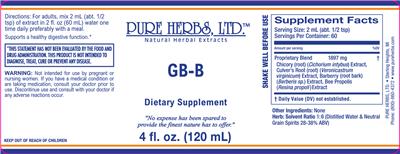
Supplement Facts
The label details for GB-B by Pure Herbs, sourced from the NIH Dietary Supplement Label Database.
Supplement Facts
| Ingredient | Amount | % DV |
|---|---|---|
| Proprietary Blend | 1897 mg | -- |
| Barberry Root Bark Extract | 0 NP | -- |
| Chicory Root Extract | 0 NP | -- |
| Culver's Root Root Extract | 0 NP | -- |
| Bee Propolis Extract | 0 NP | -- |
Tap any ingredient to jump to its full detail below.
These statements are the manufacturer’s wording, reproduced from the product label — the label is saying it, not HelloPharmacist. We don’t verify or endorse them.
Suggested/Recommended/Usage/Directions
Directions: For adults, mix 2 mL (abt. 1/2 tsp) of extract in 2 fl. oz (60 mL) water one time daily preferably with a meal.
Shake well before use
Formulation
Supports a healthy digestive function.
FDA Disclaimer Statement
This statement has not been evaluated by the Food and Drug Administration. This product is not intended to diagnose, treat, cure or prevent any disease.
Precautions
Warning: Not intended for use by pregnant or nursing women. If you have a medical condition or are taking medication, consult your doctor prior to use.
Discontinue use and consult with your doctor if any adverse reactions occur.
Keep out of reach of children
Brand IP Statement(s)
Pure Herbs, LTD. Natural Herbal Extracts
FDA Statement of Identity
Dietary Supplement
General Statements
"No expense has been spared to provide the finest nature has to offer."
Is this label outdated? Report a formula or label change and our pharmacy team will review it.
GB-B by Pure Herbs label
The label scan from the NIH Dietary Supplement Label Database. Tap to enlarge.
Label images are published by the NIH Dietary Supplement Label Database for the version of this product on file. Always read your actual product label.
View the full label (PDF)The Ingredients in GB-B by Pure Herbs
These are the 4 active ingredients this product is made of. Select any to open its full monograph.
Serving size2 mL Dosage formLiquid Servings per container60 Amounts shown are per serving.
Most supplement products combine several ingredients, and a medication can interact with the product through any one of them. Each ingredient below shows whether it has known drug interactions.
Proprietary Blend
GB-B by Pure Herbs Drug Interactions
HelloPharmacist Interaction Report
GB-B by Pure Herbs is a four-ingredient liquid that contains interactions with a substantial number of medications.
The most serious concern is Culver's Root (black root), which interacts with warfarin (Coumadin) — a blood thinner — at Moderate severity. Black root's laxative effects can trigger diarrhea, which increases how strongly warfarin works in your body, raising your bleeding risk.
Read the full breakdown — every affected drug type, severity by severity
Chicory Root Extract interacts with antidiabetes drugs (blood sugar medications) at Moderate severity; it may theoretically lower your blood sugar further and increase the risk of low blood sugar (hypoglycemia). Bee Propolis Extract carries Moderate interactions with a broad range of medications metabolized by your liver — including drugs broken down by CYP3A4, CYP2C9, CYP2C19, CYP2D6, CYP1A2, and CYP2E1 — as well as blood thinners (anticoagulants) and antiplatelet drugs, where high doses might theoretically raise drug levels or increase bleeding risk.
Propolis may also theoretically decrease warfarin's effectiveness.
Culver's Root also carries Moderate interactions with diuretics (water pills) — overuse might worsen potassium loss — and with digoxin (a heart medication), where it may reduce effectiveness. Barberry Root Bark Extract could not be checked; we hold no interaction data for it.
Altogether, these interactions span 1,039 individual medications. Run your exact prescriptions through the medication checker on this page before you start.
Check your own medications below · Editorial policy · How we use AI
Want to check YOUR meds against GB-B?
Ask about interactions with your drugs in plain English — “Can I take it with lisinopril?” — and we find you the answer in seconds, ingredient by ingredient.
Go to the checkerIngredients driving the most interactions
Individual Drug Interactions
The ingredients in GB-B interact with 1,304 drugs. Click any drug to see the details.
4 of the 4 ingredients in GB-B interact with drugs. Each result below shows which ingredient is responsible. Barberry Root Bark Extract Bee Propolis Extract Chicory Root Extract Culver's Root Root Extract
Alogliptin, PioglitazoneOseni
How Alogliptin, Pioglitazone interacts with GB-B — through 3 ingredients. Tap an ingredient for the detail:
Chicory Root ExtractAntidiabetes Drugs Moderate
Interaction Summary
Theoretically, chicory might increase the risk of hypoglycemia when taken with antidiabetes drugs.
Read the full Chicory Root Extract + Alogliptin, Pioglitazone interactionBee Propolis ExtractCytochrome P450 3a4 (cyp3a4) Substrates Moderate
Interaction Summary
Theoretically, high doses of propolis might increase blood levels of drugs metabolized by CYP3A4.
Read the full Bee Propolis Extract + Alogliptin, Pioglitazone interactionBarberry Root Bark ExtractAntidiabetes Drugs, Cytochrome P450 3a4 (cyp3a4) Substrates Moderate
Interaction Summary
Theoretically, taking European barberry with antidiabetes drugs might increase the risk of hypoglycemia.
Read the full Barberry Root Bark Extract + Alogliptin, Pioglitazone interactionAlpelisibPiqray
How Alpelisib interacts with GB-B — through 2 ingredients. Tap an ingredient for the detail:
Barberry Root Bark ExtractCytochrome P450 3a4 (cyp3a4) Substrates Moderate
Interaction Summary
Theoretically, European barberry might increase the levels and clinical effects of CYP3A4 substrates.
Read the full Barberry Root Bark Extract + Alpelisib interactionBee Propolis ExtractCytochrome P450 3a4 (cyp3a4) Substrates Moderate
Interaction Summary
Theoretically, high doses of propolis might increase blood levels of drugs metabolized by CYP3A4.
Read the full Bee Propolis Extract + Alpelisib interactionAlprazolamNiravam, Xanax
How Alprazolam interacts with GB-B — through 2 ingredients. Tap an ingredient for the detail:
Barberry Root Bark ExtractCns Depressants, Cytochrome P450 3a4 (cyp3a4) Substrates Moderate
Interaction Summary
Theoretically, concomitant use with drugs that have sedative properties may cause additive effects.
Read the full Barberry Root Bark Extract + Alprazolam interactionBee Propolis ExtractCytochrome P450 3a4 (cyp3a4) Substrates Moderate
Interaction Summary
Theoretically, high doses of propolis might increase blood levels of drugs metabolized by CYP3A4.
Read the full Bee Propolis Extract + Alprazolam interactionAlteplase, TpaActilyse, Activase
How Alteplase, Tpa interacts with GB-B — through 2 ingredients. Tap an ingredient for the detail:
Bee Propolis ExtractAnticoagulant/antiplatelet Drugs Moderate
Interaction Summary
Theoretically, propolis might increase the risk of bleeding when taken with antiplatelet or anticoagulant drugs.
Read the full Bee Propolis Extract + Alteplase, Tpa interactionBarberry Root Bark ExtractAnticoagulant/antiplatelet Drugs Moderate
Interaction Summary
Theoretically, European barberry may increase the risk of bleeding if used with anticoagulant or antiplatelet drugs.
Read the full Barberry Root Bark Extract + Alteplase, Tpa interactionAluminum Hydroxide, Aspirin, Codeine Phosphate, Magnesium HydroxideAscriptin Codeine #2
How Aluminum Hydroxide, Aspirin, Codeine Phosphate, Magnesium Hydroxide interacts with GB-B — through 2 ingredients. Tap an ingredient for the detail:
Barberry Root Bark ExtractAnticoagulant/antiplatelet Drugs, Cns Depressants Moderate
Interaction Summary
Theoretically, European barberry may increase the risk of bleeding if used with anticoagulant or antiplatelet drugs.
Read the full Barberry Root Bark Extract + Aluminum Hydroxide, Aspirin, Codeine Phosphate, Magnesium Hydroxide interactionBee Propolis ExtractCytochrome P450 2d6 (cyp2d6) Substrates, Anticoagulant/antiplatelet Drugs Moderate
Interaction Summary
Theoretically, high doses of propolis might increase blood levels of drugs metabolized by CYP2D6.
Read the full Bee Propolis Extract + Aluminum Hydroxide, Aspirin, Codeine Phosphate, Magnesium Hydroxide interactionAluminum Hydroxide, Aspirin, Magnesium HydroxideAscriptin
How Aluminum Hydroxide, Aspirin, Magnesium Hydroxide interacts with GB-B — through 2 ingredients. Tap an ingredient for the detail:
Bee Propolis ExtractAnticoagulant/antiplatelet Drugs Moderate
Interaction Summary
Theoretically, propolis might increase the risk of bleeding when taken with antiplatelet or anticoagulant drugs.
Read the full Bee Propolis Extract + Aluminum Hydroxide, Aspirin, Magnesium Hydroxide interactionBarberry Root Bark ExtractAnticoagulant/antiplatelet Drugs Moderate
Interaction Summary
Theoretically, European barberry may increase the risk of bleeding if used with anticoagulant or antiplatelet drugs.
Read the full Barberry Root Bark Extract + Aluminum Hydroxide, Aspirin, Magnesium Hydroxide interactionAmantadineGocovri, Osmolex ER, Symmetrel
How Amantadine interacts with GB-B — through 1 ingredient. Tap an ingredient for the detail:
Barberry Root Bark ExtractAnticholinergic Drugs Moderate
Interaction Summary
Theoretically, taking European barberry with anticholinergic drugs might cause additive effects.
Read the full Barberry Root Bark Extract + Amantadine interactionAmbenonium ChlorideMytelase
How Ambenonium Chloride interacts with GB-B — through 1 ingredient. Tap an ingredient for the detail:
Barberry Root Bark ExtractCholinergic Drugs Moderate
Interaction Summary
Theoretically, taking European barberry with cholinergic drugs might decrease the effects of cholinergic drugs.
Read the full Barberry Root Bark Extract + Ambenonium Chloride interactionAmbrisentanLetairis, Volibris
How Ambrisentan interacts with GB-B — through 2 ingredients. Tap an ingredient for the detail:
Barberry Root Bark ExtractCytochrome P450 3a4 (cyp3a4) Substrates, Antihypertensive Drugs Moderate
Interaction Summary
Theoretically, European barberry might increase the levels and clinical effects of CYP3A4 substrates.
Read the full Barberry Root Bark Extract + Ambrisentan interactionBee Propolis ExtractCytochrome P450 3a4 (cyp3a4) Substrates Moderate
Interaction Summary
Theoretically, high doses of propolis might increase blood levels of drugs metabolized by CYP3A4.
Read the full Bee Propolis Extract + Ambrisentan interactionAmifampridineRuzurgi
How Amifampridine interacts with GB-B — through 1 ingredient. Tap an ingredient for the detail:
Barberry Root Bark ExtractCholinergic Drugs Moderate
Interaction Summary
Theoretically, taking European barberry with cholinergic drugs might decrease the effects of cholinergic drugs.
Read the full Barberry Root Bark Extract + Amifampridine interactionAmifampridine PhosphateFirdapse
How Amifampridine Phosphate interacts with GB-B — through 1 ingredient. Tap an ingredient for the detail:
Barberry Root Bark ExtractCholinergic Drugs Moderate
Interaction Summary
Theoretically, taking European barberry with cholinergic drugs might decrease the effects of cholinergic drugs.
Read the full Barberry Root Bark Extract + Amifampridine Phosphate interactionAmilorideAmilamont, Midamor
How Amiloride interacts with GB-B — through 1 ingredient. Tap an ingredient for the detail:
Barberry Root Bark ExtractAntihypertensive Drugs Moderate
Interaction Summary
Theoretically, taking European barberry with antihypertensive drugs might increase the risk of hypotension.
Read the full Barberry Root Bark Extract + Amiloride interactionAmiloride, HydrochlorothiazideAmil-Co, Amilzide, Moduret 25, Moduretic
How Amiloride, Hydrochlorothiazide interacts with GB-B — through 2 ingredients. Tap an ingredient for the detail:
Barberry Root Bark ExtractAntihypertensive Drugs Moderate
Interaction Summary
Theoretically, taking European barberry with antihypertensive drugs might increase the risk of hypotension.
Read the full Barberry Root Bark Extract + Amiloride, Hydrochlorothiazide interactionCulver's Root Root ExtractDiuretic Drugs Moderate
Interaction Summary
Overuse of black root might compound diuretic-induced potassium loss.There is some concern that people taking black root along with potassium depleting diuretics might have an increased risk for hypokalemia.
Read the full Culver's Root Root Extract + Amiloride, Hydrochlorothiazide interactionAminoglutethimideCytadren
How Aminoglutethimide interacts with GB-B — through 1 ingredient. Tap an ingredient for the detail:
Barberry Root Bark ExtractAnticholinergic Drugs, Cns Depressants Moderate
Interaction Summary
Theoretically, taking European barberry with anticholinergic drugs might cause additive effects.
Read the full Barberry Root Bark Extract + Aminoglutethimide interactionAminophylline, Amobarbital, EphedrineAmesec
How Aminophylline, Amobarbital, Ephedrine interacts with GB-B — through 1 ingredient. Tap an ingredient for the detail:
Barberry Root Bark ExtractCns Depressants Moderate
Interaction Summary
Theoretically, concomitant use with drugs that have sedative properties may cause additive effects.
Read the full Barberry Root Bark Extract + Aminophylline, Amobarbital, Ephedrine interactionAmiodaroneCordarone, Pacerone
How Amiodarone interacts with GB-B — through 2 ingredients. Tap an ingredient for the detail:
Bee Propolis ExtractCytochrome P450 3a4 (cyp3a4) Substrates Moderate
Interaction Summary
Theoretically, high doses of propolis might increase blood levels of drugs metabolized by CYP3A4.
Read the full Bee Propolis Extract + Amiodarone interactionBarberry Root Bark ExtractCytochrome P450 3a4 (cyp3a4) Substrates Moderate
Interaction Summary
Theoretically, European barberry might increase the levels and clinical effects of CYP3A4 substrates.
Read the full Barberry Root Bark Extract + Amiodarone interactionAmitriptylineElavil
How Amitriptyline interacts with GB-B — through 2 ingredients. Tap an ingredient for the detail:
Barberry Root Bark ExtractCytochrome P450 3a4 (cyp3a4) Substrates, Anticholinergic Drugs +1 Moderate
Interaction Summary
Theoretically, European barberry might increase the levels and clinical effects of CYP3A4 substrates.
Read the full Barberry Root Bark Extract + Amitriptyline interactionBee Propolis ExtractCytochrome P450 2c19 (cyp2c19) Substrates, Cytochrome P450 2d6 (cyp2d6) Substrates +3 Moderate
Interaction Summary
Theoretically, high doses of propolis might increase blood levels of drugs metabolized by CYP2C19.
Read the full Bee Propolis Extract + Amitriptyline interactionAmitriptyline, ChlordiazepoxideLimbitrol DS
How Amitriptyline, Chlordiazepoxide interacts with GB-B — through 2 ingredients. Tap an ingredient for the detail:
Bee Propolis ExtractCytochrome P450 1a2 (cyp1a2) Substrates, Cytochrome P450 2c19 (cyp2c19) Substrates +3 Moderate
Interaction Summary
Theoretically, high doses of propolis might increase blood levels of drugs metabolized by CYP1A2.
Read the full Bee Propolis Extract + Amitriptyline, Chlordiazepoxide interactionBarberry Root Bark ExtractCytochrome P450 3a4 (cyp3a4) Substrates, Anticholinergic Drugs +1 Moderate
Interaction Summary
Theoretically, European barberry might increase the levels and clinical effects of CYP3A4 substrates.
Read the full Barberry Root Bark Extract + Amitriptyline, Chlordiazepoxide interactionAmitriptyline, PerphenazineEtrafon, Etrafon-A, Etrafon-Forte, Triavil
How Amitriptyline, Perphenazine interacts with GB-B — through 2 ingredients. Tap an ingredient for the detail:
Bee Propolis ExtractCytochrome P450 1a2 (cyp1a2) Substrates, Cytochrome P450 2c9 (cyp2c9) Substrates +3 Moderate
Interaction Summary
Theoretically, high doses of propolis might increase blood levels of drugs metabolized by CYP1A2.
Read the full Bee Propolis Extract + Amitriptyline, Perphenazine interactionBarberry Root Bark ExtractCns Depressants, Cytochrome P450 3a4 (cyp3a4) Substrates +1 Moderate
Interaction Summary
Theoretically, concomitant use with drugs that have sedative properties may cause additive effects.
Read the full Barberry Root Bark Extract + Amitriptyline, Perphenazine interactionAmlodipineNorliqva
How Amlodipine interacts with GB-B — through 2 ingredients. Tap an ingredient for the detail:
Barberry Root Bark ExtractAntihypertensive Drugs, Cytochrome P450 3a4 (cyp3a4) Substrates Moderate
Interaction Summary
Theoretically, taking European barberry with antihypertensive drugs might increase the risk of hypotension.
Read the full Barberry Root Bark Extract + Amlodipine interactionBee Propolis ExtractCytochrome P450 3a4 (cyp3a4) Substrates Moderate
Interaction Summary
Theoretically, high doses of propolis might increase blood levels of drugs metabolized by CYP3A4.
Read the full Bee Propolis Extract + Amlodipine interactionAmlodipine BenzoateKaterzia
How Amlodipine Benzoate interacts with GB-B — through 2 ingredients. Tap an ingredient for the detail:
Barberry Root Bark ExtractAntihypertensive Drugs, Cytochrome P450 3a4 (cyp3a4) Substrates Moderate
Interaction Summary
Theoretically, taking European barberry with antihypertensive drugs might increase the risk of hypotension.
Read the full Barberry Root Bark Extract + Amlodipine Benzoate interactionBee Propolis ExtractCytochrome P450 3a4 (cyp3a4) Substrates Moderate
Interaction Summary
Theoretically, high doses of propolis might increase blood levels of drugs metabolized by CYP3A4.
Read the full Bee Propolis Extract + Amlodipine Benzoate interactionAmlodipine BesilateIstin
How Amlodipine Besilate interacts with GB-B — through 2 ingredients. Tap an ingredient for the detail:
Barberry Root Bark ExtractAntihypertensive Drugs, Cytochrome P450 3a4 (cyp3a4) Substrates Moderate
Interaction Summary
Theoretically, taking European barberry with antihypertensive drugs might increase the risk of hypotension.
Read the full Barberry Root Bark Extract + Amlodipine Besilate interactionBee Propolis ExtractCytochrome P450 3a4 (cyp3a4) Substrates Moderate
Interaction Summary
Theoretically, high doses of propolis might increase blood levels of drugs metabolized by CYP3A4.
Read the full Bee Propolis Extract + Amlodipine Besilate interactionAmlodipine BesylateNorvasc
How Amlodipine Besylate interacts with GB-B — through 2 ingredients. Tap an ingredient for the detail:
Barberry Root Bark ExtractCytochrome P450 3a4 (cyp3a4) Substrates, Antihypertensive Drugs Moderate
Interaction Summary
Theoretically, European barberry might increase the levels and clinical effects of CYP3A4 substrates.
Read the full Barberry Root Bark Extract + Amlodipine Besylate interactionBee Propolis ExtractCytochrome P450 3a4 (cyp3a4) Substrates Moderate
Interaction Summary
Theoretically, high doses of propolis might increase blood levels of drugs metabolized by CYP3A4.
Read the full Bee Propolis Extract + Amlodipine Besylate interactionAmlodipine Besylate, BenazeprilLotrel
How Amlodipine Besylate, Benazepril interacts with GB-B — through 2 ingredients. Tap an ingredient for the detail:
Barberry Root Bark ExtractAntihypertensive Drugs, Cytochrome P450 3a4 (cyp3a4) Substrates Moderate
Interaction Summary
Theoretically, taking European barberry with antihypertensive drugs might increase the risk of hypotension.
Read the full Barberry Root Bark Extract + Amlodipine Besylate, Benazepril interactionBee Propolis ExtractCytochrome P450 3a4 (cyp3a4) Substrates Moderate
Interaction Summary
Theoretically, high doses of propolis might increase blood levels of drugs metabolized by CYP3A4.
Read the full Bee Propolis Extract + Amlodipine Besylate, Benazepril interactionAmlodipine, CelecoxibConsensi
How Amlodipine, Celecoxib interacts with GB-B — through 2 ingredients. Tap an ingredient for the detail:
Barberry Root Bark ExtractAntihypertensive Drugs, Cytochrome P450 3a4 (cyp3a4) Substrates Moderate
Interaction Summary
Theoretically, taking European barberry with antihypertensive drugs might increase the risk of hypotension.
Read the full Barberry Root Bark Extract + Amlodipine, Celecoxib interactionBee Propolis ExtractCytochrome P450 3a4 (cyp3a4) Substrates, Cytochrome P450 2c9 (cyp2c9) Substrates Moderate
Interaction Summary
Theoretically, high doses of propolis might increase blood levels of drugs metabolized by CYP3A4.
Read the full Bee Propolis Extract + Amlodipine, Celecoxib interactionAmmonium ChlorideAmmonium Chloride
How Ammonium Chloride interacts with GB-B — through 2 ingredients. Tap an ingredient for the detail:
Barberry Root Bark ExtractAntihypertensive Drugs Moderate
Interaction Summary
Theoretically, taking European barberry with antihypertensive drugs might increase the risk of hypotension.
Read the full Barberry Root Bark Extract + Ammonium Chloride interactionCulver's Root Root ExtractDiuretic Drugs Moderate
Interaction Summary
Overuse of black root might compound diuretic-induced potassium loss.There is some concern that people taking black root along with potassium depleting diuretics might have an increased risk for hypokalemia.
Read the full Culver's Root Root Extract + Ammonium Chloride interactionAmobarbitalAmytal
How Amobarbital interacts with GB-B — through 1 ingredient. Tap an ingredient for the detail:
Barberry Root Bark ExtractCns Depressants Moderate
Interaction Summary
Theoretically, concomitant use with drugs that have sedative properties may cause additive effects.
Read the full Barberry Root Bark Extract + Amobarbital interactionAmobarbital, Ephedrine SulfateEphedrine & Amytal
How Amobarbital, Ephedrine Sulfate interacts with GB-B — through 1 ingredient. Tap an ingredient for the detail:
Barberry Root Bark ExtractCns Depressants Moderate
Interaction Summary
Theoretically, concomitant use with drugs that have sedative properties may cause additive effects.
Read the full Barberry Root Bark Extract + Amobarbital, Ephedrine Sulfate interactionAmobarbital, SecobarbitalTuinal
How Amobarbital, Secobarbital interacts with GB-B — through 1 ingredient. Tap an ingredient for the detail:
Barberry Root Bark ExtractCns Depressants Moderate
Interaction Summary
Theoretically, concomitant use with drugs that have sedative properties may cause additive effects.
Read the full Barberry Root Bark Extract + Amobarbital, Secobarbital interactionAmoxicillin, Omeprazole Magnesium, RifabutinTalicia
How Amoxicillin, Omeprazole Magnesium, Rifabutin interacts with GB-B — through 2 ingredients. Tap an ingredient for the detail:
Barberry Root Bark ExtractCytochrome P450 3a4 (cyp3a4) Substrates Moderate
Interaction Summary
Theoretically, European barberry might increase the levels and clinical effects of CYP3A4 substrates.
Read the full Barberry Root Bark Extract + Amoxicillin, Omeprazole Magnesium, Rifabutin interactionBee Propolis ExtractCytochrome P450 3a4 (cyp3a4) Substrates, Cytochrome P450 2c19 (cyp2c19) Substrates +1 Moderate
Interaction Summary
Theoretically, high doses of propolis might increase blood levels of drugs metabolized by CYP3A4.
Read the full Bee Propolis Extract + Amoxicillin, Omeprazole Magnesium, Rifabutin interactionEach ingredient & the kinds of drugs it affects
For each ingredient in GB-B with known interactions, here are the types of medications they can affect. Open any type for the detail — or search your exact drug in the checker above.
Barberry Root Bark Extract
Anticholinergic Drugs
Theoretically, taking European barberry with anticholinergic drugs might cause additive effects.
In vitro evidence suggests that European barberry might have anticholinergic properties.
Anticoagulant/Antiplatelet Drugs
Theoretically, European barberry may increase the risk of bleeding if used with anticoagulant or antiplatelet drugs.
In vitro and animal evidence suggest that berberine, a constituent of European barberry, might inhibit platelet aggregation. Theoretically, European barberry might have a similar effect.
Antidiabetes Drugs
Theoretically, taking European barberry with antidiabetes drugs might increase the risk of hypoglycemia.
Preliminary clinical evidence suggests that European barberry juice reduces fasting glucose levels in patients with type 2 diabetes who are also taking antidiabetes drugs. Additionally, some animal studies show that berberine, a constituent of European barberry, has antiglycemic potential. Monitor blood glucose levels closely.
Antihypertensive Drugs
Theoretically, taking European barberry with antihypertensive drugs might increase the risk of hypotension.
Animal and human research suggests that European barberry extracts can have hypotensive effects.
Cholinergic Drugs
Theoretically, taking European barberry with cholinergic drugs might decrease the effects of cholinergic drugs.
In vitro evidence suggests that European barberry might have anticholinergic properties.
Cns Depressants
Theoretically, concomitant use with drugs that have sedative properties may cause additive effects.
Animal research suggests that berberine, a constituent of European barberry, might have sedative effects. Theoretically, European barberry might have a similar effect.
Cyclosporine (Neoral, Sandimmune)
Theoretically, concomitant use with cyclosporine may cause additive effects.
Berberine, a constituent of European barberry, can reduce the metabolism and increase serum levels of cyclosporine. This effect is attributed to the ability of berberine to inhibit cytochrome P450 3A4 (CYP3A4), which metabolizes cyclosporine. Theoretically, European barberry might have a similar effect.
Cytochrome P450 3A4 (Cyp3A4) Substrates
Theoretically, European barberry might increase the levels and clinical effects of CYP3A4 substrates.
There is very preliminary evidence suggesting that berberine, a constituent of European barberry, might inhibit the CYP3A4 enzyme. Theoretically, European barberry might have a similar effect.
Bee Propolis Extract
Anticoagulant/Antiplatelet Drugs
Theoretically, propolis might increase the risk of bleeding when taken with antiplatelet or anticoagulant drugs.
In vitro research shows that propolis water extract and the propolis constituent, caffeic acid phenethyl ester, can inhibit platelet aggregation. Additionally, evidence from an animal model shows that taking propolis in addition to warfarin decreases INR, suggesting that propolis can decrease the effectiveness of warfarin.
Cytochrome P450 1A2 (Cyp1A2) Substrates
Theoretically, high doses of propolis might increase blood levels of drugs metabolized by CYP1A2.
In vitro research shows that propolis extract can inhibit CYP1A2. However, animal research shows that propolis extract does not significantly affect CYP1A2 activity when administered to rats at doses up to 250 mg/kg. It is postulated that the constituents of propolis that inhibit CYP1A2 in vitro do not have significant effects in vivo due to low bioavailability and hepatic first-pass effect. This effect has not been reported in humans.
Cytochrome P450 2C19 (Cyp2C19) Substrates
Theoretically, high doses of propolis might increase blood levels of drugs metabolized by CYP2C19.
In vitro research shows that propolis extract can inhibit CYP2C19. However, animal research shows that propolis extract does not significantly affect CYP2C19 activity when administered to rats at doses up to 250 mg/kg. It is postulated that the constituents of propolis that inhibit CYP2C19 in vitro do not have significant effects in vivo due to low bioavailability and hepatic first-pass effect. This effect has not been reported in humans.
Cytochrome P450 2C9 (Cyp2C9) Substrates
Theoretically, high doses of propolis might increase blood levels of drugs metabolized by CYP2C9.
In vitro research shows that propolis extract can inhibit CYP2C9. However, animal research shows that propolis extract does not significantly affect CYP2C9 activity when administered to rats at doses up to 250 mg/kg. It is postulated that the constituents of propolis that inhibit CYP2C9 in vitro do not have significant effects in vivo due to low bioavailability and hepatic first-pass effect. This effect has not been reported in humans.
Cytochrome P450 2D6 (Cyp2D6) Substrates
Theoretically, high doses of propolis might increase blood levels of drugs metabolized by CYP2D6.
In vitro research shows that propolis extract can inhibit CYP2D6. However, animal research shows that propolis extract does not significantly affect CYP2D6 activity when administered to rats at doses up to 250 mg/kg. It is postulated that the constituents of propolis that inhibit CYP2D6 in vitro do not have significant effects in vivo due to low bioavailability and hepatic first-pass effect. This effect has not been reported in humans.
Cytochrome P450 2E1 (Cyp2E1) Substrates
Theoretically, propolis might increase levels of drugs metabolized by CYP2E1.
In vitro research shows that propolis can inhibit CYP2E1. This effect has not been reported in humans.
Cytochrome P450 3A4 (Cyp3A4) Substrates
Theoretically, high doses of propolis might increase blood levels of drugs metabolized by CYP3A4.
Some in vitro research shows that propolis extract can inhibit CYP3A4; however, other in vitro research shows that propolis has no effect on CYP3A4 activity. Furthermore, animal research shows that propolis extract does not significantly affect CYP3A4 activity when administered to rats at doses up to 250 mg/kg. It is postulated that the constituents of propolis that might in inhibit CYP3A4 in vitro do not have significant effects in vivo due to low bioavailability and hepatic first-pass effect. This effect has not been reported in humans.
Warfarin (Coumadin)
Theoretically, propolis might decrease the effectiveness of warfarin.
Animal research shows that taking propolis in addition to warfarin decreases the international normalized ratio (INR). This effect has not been reported in humans.
Chicory Root Extract
Antidiabetes Drugs
Theoretically, chicory might increase the risk of hypoglycemia when taken with antidiabetes drugs.
Animal and in vitro research shows that chicory extracts have antidiabetic effects.
Culver's Root Root Extract
Digoxin (Lanoxin)
Theoretically, the overuse or abuse of black root can increase the risk of adverse effects of cardiac glycoside drugs. Black root chemically binds with the glycosides while in the gastrointestinal (GI) tract, which may reduce their effectiveness if used concomitantly.
Diuretic Drugs
Overuse of black root might compound diuretic-induced potassium loss.There is some concern that people taking black root along with potassium depleting diuretics might have an increased risk for hypokalemia. Initiation of potassium supplementation or an increase in potassium supplement dose may be necessary for some patients. Some diuretics that can deplete potassium include chlorothiazide (Diuril), chlorthalidone (Thalitone), furosemide (Lasix), hydrochlorothiazide (HCTZ, Hydrodiuril, Microzide), and others.
Warfarin (Coumadin)
Black root has stimulant laxative effects. In some people black root can cause diarrhea. Diarrhea can increase the effects of warfarin, increase international normalized ratio (INR), and increase the risk of bleeding. Advise patients who take warfarin not to take excessive amounts of black root.
Brand information
Manufacturer and brand details for GB-B, from the product label.
Pure Herbs
See all Pure Herbs products- Name
- Pure Herbs, Ltd.
- City
- Sterling Heights
- State
- MI
- Phone Number
- (800) 860-4372
- Web Address
- www.pureherbs.com
GB-B by Pure Herbs: Common Questions
Does GB-B by Pure Herbs interact with any medications?
How can one product interact with so many drugs?
Where does this information come from?
Is it safe to take this during pregnancy?
Can I take this while breastfeeding?
What's the most common side effect?
Can someone allergic to bees take this?
Will this help with my digestive issues?
Does chicory lower blood sugar?
Written and reviewed by the HelloPharmacist editorial staff. Our editorial policy
Not sure if GB-B is safe with your meds?
Our pharmacists answer your medication & supplement questions — free.
Label information is sourced from the NIH Dietary Supplement Label Database and reflects the product version on file; always read your actual product label. This page is for education only and is not a substitute for professional medical advice. Confirm with your pharmacist or doctor before combining supplements and medications.
The Full Monographs Behind GB-B’s Ingredients
Every ingredient we hold a full HelloPharmacist monograph for — uses, evidence, safety, and the complete interaction list.
European Barberry
Interacts with 1,210 drugsEuropean barberry is a shrub whose root, bark, and berries contain berberine, a bitter plant alkaloid that has been studied mostly in isolated form. Some early research on berberine is promi...
Read the full European Barberry monograph → Herb & supplement monographChicory
Interacts with 86 drugsChicory is best known as a caffeine-free coffee substitute and as a source of inulin, a soluble prebiotic fiber that may support digestion and regularity. Strong human evidence for most othe...
Read the full Chicory monograph → Herb & supplement monographBlack Root
Interacts with 78 drugsBlack Root is a traditional North American herb that was historically used as a strong laxative and to support digestion and liver function. There is very little modern scientific evidence t...
Read the full Black Root monograph → Herb & supplement monographPropolis
Interacts with 921 drugsPropolis is a natural, resin-like substance made by bees that has antimicrobial and anti-inflammatory properties in lab studies. Early research suggests it may help with cold sores, mouth so...
Read the full Propolis monograph →Sources & How We Checked
GB-B's label data comes from the NIH Dietary Supplement Label Database; the ingredient interaction data is from the Natural Medicines database, reviewed by our pharmacists.
- NIH Dietary Supplement Label Database (DSLD) — The official product label on file for this supplement.
- Natural Medicines (Therapeutic Research Center) — Evidence-graded clinical reference behind the ingredient interaction data.
Content is written and reviewed by licensed HelloPharmacist pharmacists. See our data sources and editorial standards for how this information is built and checked.
The 51 references behind this product’s interaction data
Every citation that drives the interaction findings for this product’s ingredients, from the evidence-graded Natural Medicines (TRC Healthcare) database. Open an ingredient to browse its citations — links open the study on PubMed or the publisher’s site.
European Barberry 15 references
- Chan E. Displacement of bilirubin from albumin by berberine. Biol Neonate 1993;63:201-8. PubMed
- Wu X, Li Q, Xin H, Yu A, Zhong M. Effects of berberine on the blood concentration of cyclosporin A in renal transplanted recipients: clinical and pharmacokinetic study. Eur J Clin Pharmacol 2005;61:567-72. PubMed
- Shamsa F, Ahmadiani A, Khosrokhavar R. Antihistaminic and anticholinergic activity of barberry fruit (Berberis vulgaris) in the guinea-pig ileum. J Ethnopharmacol 1999;64:161-6. PubMed
- Fatehi M, Saleh TM, Fatehi-Hassanabad Z, et al. A pharmacological study on Berberis vulgaris fruit extract. J Ethnopharmacol 2005;102:46-52. PubMed
- Kostalova, D., Bukovsky, M., Koscova, H., and Kardosova, A. [Anticomplement activity of Mahonia aquifolium bisbenzylisoquinoline alkaloids and berberine extract]. Ceska.Slov.Farm 2001;50(6):286-289.
- Fatehi-Hassanabad, Z., Jafarzadeh, M., Tarhini, A., and Fatehi, M. The antihypertensive and vasodilator effects of aqueous extract from Berberis vulgaris fruit on hypertensive rats. Phytother Res 2005;19(3):222-225.
- Singh, J. and Kakkar, P. Antihyperglycemic and antioxidant effect of Berberis aristata root extract and its role in regulating carbohydrate metabolism in diabetic rats. J Ethnopharmacol. 5-4-2009;123(1):22-26. PubMed
- Shanbhag, S. M., Kulkarni, H. J., and Gaitonde, B. B. Pharmacological actions of berberine on the central nervous system. Jpn.J Pharmacol 1970;20(4):482-487. PubMed
- Wu, J. F. and Liu, T. P. [Effects of berberine on platelet aggregation and plasma levels of TXB2 and 6-keto-PGF1 alpha in rats with reversible middle cerebral artery occlusion]. Yao Xue.Xue.Bao. 1995;30(2):98-102.
- Xuan, B., Wang, W., and Li, D. X. Inhibitory effect of tetrahydroberberine on platelet aggregation and thrombosis. Zhongguo Yao Li Xue.Bao. 1994;15(2):133-135.
- Gao, C. R., Zhang, J. Q., and Huang, Q. L. [Experimental study on berberin raised insulin sensitivity in insulin resistance rat models]. Zhongguo Zhong.Xi.Yi.Jie.He.Za Zhi. 1997;17(3):162-164. DOI
- Sabir M and Bhide NK. Study of some pharmacological actions of berberine. Ind J Physiol & Pharmac 1971;15(3):111-132.
- Tripathi YB and Shukla SD. Berberis artistata inhibits PAF induced aggregation of rabbit platelets. Phytotherapy Research 1996;10:628-630.
- Lazavi F, Mirmiran P, Sohrab G, Nikpayam O, Angoorani P, Hedayati M. The barberry juice effects on metabolic factors and oxidative stress in patients with type 2 diabetes: A randomized clinical trial. Complement Ther Clin Pract. 2018;31:170-174. PubMed
- Philips CA, Theruvath AH, Ravindran R. Toxic hepatitis-associated aplastic anaemia after dual homeopathic remedies and Gymnema sylvestre use. BMJ Case Rep 2022;15(3):e247867. PubMed
Chicory 13 references
- Brinker F. Herb Contraindications and Drug Interactions. 2nd ed. Sandy, OR: Eclectic Medical Publications, 1998.
- Stone-Dorshow T, Levitt MD. Gaseous response to ingestion of a poorly absorbed fructo-oligosaccharide sweetener. Am J Clin Nutr 1987;46:61-5. PubMed
- Briet F, et al. Symptomatic response to varying levels of fructo-oligosaccharides consumed occasionally or regularly. Eur J Clin Nutr 1995;49:501-7.
- Bouhnik Y, Vahedi K, Achour L, et al. Short-chain fructo-oligosaccharide administration dose-dependently increases fecal bifidobacteria in healthy humans. J Nutr 1999;129:113-6. PubMed
- Cummings JH, Macfarlane GT, Englyst HN. Prebiotic digestion and fermentation. Am J Clin Nutr 2001;73:415S-420S. PubMed
- Cadot, P., Kochuyt, A. M., van Ree, R., and Ceuppens, J. L. Oral allergy syndrome to chicory associated with birch pollen allergy. Int.Arch.Allergy Immunol. 2003;131(1):19-24. PubMed
- Friis, B., Hjorth, N., Vail, J. T., Jr., and Mitchell, J. C. Occupational contact dermatitis from Cichorium (chicory, endive) and Lactuca (lettuce). Contact Dermatitis 1975;1(5):311-313.
- Nemery, B. and Demedts, M. Occupational asthma in a chicory grower. Lancet 3-25-1989;1(8639):672-673. PubMed
- Pirson F, Detry B, Pilette C. Occupational rhinoconjunctivitis and asthma caused by chicory and oral allergy syndrome associated with bet v 1-related protein. J Investig Allergol Clin Immunol 2009;19(4):306-10.
- Willi R, Pfab F, Huss-Marp J, et al. Contact anaphylaxis and protein contact dermatitis in a cook handling chicory leaves. Contact Dermatitis 2009;60(4):226-7. PubMed
- Street RA, Sidana J, Prinsloo G. Cichorium intybus: traditional uses, phytochemistry, pharmacology, and toxicology. Evid Based Complement Alternat Med 2013;2013:579319.
- Bonnema AL, Kolberg LW, Thomas W, Slavin JL. Gastrointestinal tolerance of chicory inulin products. J Am Diet Assoc 2010;110(6):865-8. PubMed
- Devi Kt R, Sivalingam N. Cichorium intybus attenuates Streptozotocin-induced pancreatic ß-cell damage by inhibiting NF-?B activation and oxidative stress. J Appl Biomed 2020;18(2-3):70-9. PubMed
Black Root 2 references
- Brinker F. Herb Contraindications and Drug Interactions. 2nd ed. Sandy, OR: Eclectic Medical Publications, 1998.
- Fetrow CW, Avila JR. Professional's Handbook of Complementary & Alternative Medicines. 1st ed. Springhouse, PA: Springhouse Corp., 1999.
Propolis 21 references
- Hay KD, Greig DE. Propolis allergy: a cause of oral mucositis with ulceration. Oral Surg Oral Med Oral Pathol 1990;70:584-6. PubMed
- Li YJ, Lin JL, Yang CW, Yu CC. Acute renal failure induced by a Brazilian variety of propolis. Am J Kidney Dis 2005;46:e125-9. PubMed
- Jensen CD, Andersen KE. Allergic contact dermatitis from cera alba (purified propolis) in a lip balm and candy. Contact Dermatitis 2006;55:312-3. PubMed
- Chen, T. G., Lee, J. J., Lin, K. H., Shen, C. H., Chou, D. S., and Sheu, J. R. Antiplatelet activity of caffeic acid phenethyl ester is mediated through a cyclic GMP-dependent pathway in human platelets. Chin J Physiol 6-30-2007;50(3):121-126.
- Hsu, C. Y., Chiang, W. C., Weng, T. I., Chen, W. J., and Yuan, A. Laryngeal edema and anaphalactic shock after topical propolis use for acute pharyngitis. Am J Emerg.Med 2004;22(5):432-433. PubMed
- Black, R. J. Vulval eczema associated with propolis sensitization from topical therapies treated successfully with pimecrolimus cream. Clin Exp.Dermatol. 2005;30(1):91-92. PubMed
- Matos D, Serrano P, Brandao FM. A case of allergic contact dermatitis caused by propolis-enriched honey. Contact Dermatitis 2015;72(1):59-60. PubMed
- Naramoto K, Kato M, Ichihara K. Effects of an ethanol extract of Brazilian green propolis on human cytochrome P450 enzyme activities in vitro. J Agric Food Chem 2014;62(46):11296-302. PubMed
- Nyman G, Hagvall L. A case of allergic contact cheilitis caused by propolis and honey. Contact Dermatitis 2016;74(3):186-7. PubMed
- Ryu CS, Oh SJ, Oh JM, et al. Inhibition of cytochrome P450 by propolis in human liver microsomes. Toxicol Res 2016;32(3):207-13. PubMed
- Akbay E, Özenirler Ç, Çelemli ÖG, Durukan AB, Onur MA, Sorkun K. Effects of propolis on warfarin efficacy. Kardiochir Torakochirurgia Pol. 2017;14(1):43-46. PubMed
- Lamoureux A, Meharon M, Durand AL, Darrigade AS, Doutre MS, Milpied B. A first case of erythema multiforme-like contact dermatitis caused by propolis. Contact Dermatitis. 2017;77(4):263-264. PubMed
- Piredda M, Facchinetti G, Biagioli V, et al. Propolis in the prevention of oral mucositis in breast cancer patients receiving adjuvant chemotherapy: A pilot randomised controlled trial. Eur J Cancer Care (Engl). 2017;26(6). PubMed
- Zhang YX, Yang TT, Xia L, Zhang WF, Wang JF, Wu YP. Inhibitory Effect of Propolis on Platelet Aggregation In Vitro. J Healthc Eng. 2017;2017:3050895. PubMed
- Nyman GSA, Tang M, Inerot A, Osmancevic A, Malmberg P, Hagvall L. Contact allergy to beeswax and propolis among patients with cheilitis or facial dermatitis. Contact Dermatitis 2019;81(2):110-6. PubMed
- Igarashi G, Segawa T, Akiyama N, et al. Efficacy of Brazilian propolis supplementation for japanese lactating women for atopic sensitization and nonspecific symptoms in their offspring: a randomized, double-blind, placebo-controlled trial. Evid Based Comp PubMed
- Soleimani D, Rezaie M, Rajabzadeh F, et al. Protective effects of propolis on hepatic steatosis and fibrosis among patients with nonalcoholic fatty liver disease (NAFLD) evaluated by real-time two-dimensional shear wave elastography: a randomized clinical
- D'Ercole MC. Prolonged use of propolis can increase liver enzymes. J Gastrointestin Liver Dis 2020;29(3):468-9. PubMed
- Cho E, Lee JD, Cho SH. Systemic contact dermatitis from propolis ingestion. Ann Dermatol. 2011;23(1):85-88. PubMed
- Hallajzadeh J, Milajerdi A, Amirani E, Attari VE, Maghsoudi H, Mirhashemi SM. Effects of propolis supplementation on glycemic status, lipid profiles, inflammation and oxidative stress, liver enzymes, and body weight: a systematic review and meta-analysis
- Gheflati A, Dehnavi Z, Ghannadzadeh Yazdi A, Khorasanchi Z, Raeisi-Dehkordi H, Ranjbar G. The effects of propolis supplementation on metabolic parameters: a systematic review and meta-analysis of randomized controlled clinical trials. Avicenna J Phytomed
Parts of this content are provided by the Therapeutic Research Center, LLC.
DISCLAIMER: Currently this does not check for drug-drug interactions. This is not an all-inclusive comprehensive list of potential interactions and is for informational purposes only. Not all interactions are known or well-reported in the scientific literature, and new interactions are continually being reported. Input is needed from a qualified healthcare provider including a pharmacist before starting any therapy. Application of clinical judgment is necessary.
© 2021 Therapeutic Research Center, LLC