
A.C.S. by Pure Herbs Ingredients, Side Effects and Drug Interactions
Dietary Supplement Capsule Botanical

Medically reviewed by Dr. Brian Staiger, PharmD, BCPS
Also reviewed by the HelloPharmacist Editorial Team
Updated Details about this page
- Label on file from the NIH Dietary Supplement Label Database, dated Feb 23, 2025.
- The interaction, evidence and safety records come from the Natural Medicines database, which we license, read against this label by our own system; the pharmacy team’s sections are written from those records.
- Dr. Brian Staiger, PharmD, BCPS, is a clinical pharmacist and pharmacotherapy specialist.
- Editorial policy Our sources
AI is used only to summarize verified clinical information, never the open internet. Our AI policy
Summary: The HelloPharmacist Team’s Take
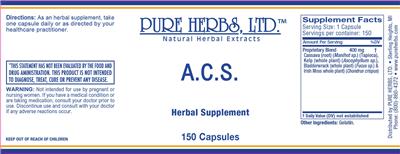
- Form
- Capsule
- Serving Size
- 1 Capsule
- Servings
- 150 per container
- Container Holds
- 150 Capsules
What’s in it, whether it interacts with your drugs, its side effects, whether it works, and what our pharmacists would want you to know before you start it.
- What is A.C.S.?A supplement from Pure Herbs with four active ingredients, in capsule form.
- Active Ingredients CassavaKelpBladderwrackIrish Moss Four active ingredients. Each one can interact with drugs or cause side effects on its own, so we check every one. The full Supplement Facts
- Drug Interactions 893 drugs have a documented interaction with this supplement; the most serious is rated moderate. Of those, 596 are single drugs and 297 are combination products (two or more drugs in one), each listed under its own name. Ask your pharmacist first if you take a drug in any of these categories, the most serious of the 9 on record:
- Moderate · 16 drugs
- Antithyroid DrugsModerate · 5 drugs
- Amiodarone (Cordarone)Moderate · 1 drug
- Moderate · 1 drug
- Possible Side EffectsBloating 2 ingredientsStomach upset 2 ingredientsChanges in thyroid functionDigestive upsetMetallic tasteDigestive changes +4 moreReported for three of its four active ingredients. Not studied in this exact product.
- Well documented Why
Does A.C.S. work?
The label names no use we can gradeIts label does not say what it is for, so there is nothing to grade it against.
What the research says- Low Why
- AllergensNone of its ingredient names point to a major food allergen, and the label text we have carries no allergen statement
Who Might Consider It
- Our data does not establish a benefit for any use of A.C.S., so the real question is whether its risks are worth it for you.
Who Should Be Careful
- People with thyroid disease, kidney disease, seafood or iodine allergies, or who are pregnant or breastfeeding should be especially careful, and so should anyone taking thyroid, antithyroid, amiodarone, or lithium medicines.
- Talk it over with your own doctor or pharmacist before you decide.
More Before You Take It Show both answersHide Pregnancy and Breastfeeding The Label’s Directions
-
Pregnant or breastfeeding?
- Pregnancy Cassava
- ! When used orally as a food, especially in large quantities.
- Breastfeeding Cassava
- ! When used orally in food amounts, especially in large quantities.
- Pregnancy and Breastfeeding Fucus Vesiculosus
- ! When used orally because it may contain iodine and heavy metals; avoid using.
- Pregnancy and Breastfeeding Ascophyllum Nodosum
- Insufficient reliable information available; avoid using amounts greater than those found in food.
-
How does the label say to take it?
“Directions: As an herbal supplement, take one capsule daily or as directed by your healthcare practitioner.”
The maker’s words. Your pharmacist or doctor may advise differently.
Everything the label says
From the label dated Feb 23, 2025: all four of its active ingredients were checked against our records. A summary of what is known, not a grade or a test of the product. How these ratings are computed
Ask Anything About This Supplement
Name a drug you take, or ask about side effects, ingredients or pregnancy.
AI answers come from this label and our own records, never the open internet. AI can make mistakes, so always check with your doctor or pharmacist. How we use AI
Ask the Pharmacist
A licensed pharmacist will answer your question by email — free, usually within 24 hours.
Got it — thank you!
A licensed pharmacist will answer within 24 hours. Keep an eye on your email (worth checking spam, just in case).
What’s Inside A.C.S. by Pure Herbs
Four Active Ingredients, Each Checked on Its Own
A supplement is often several ingredients in one bottle, and each one can interact with drugs or cause side effects on its own. We check every one of them against our records.
The label gives an exact amount for 0 of its 4 active ingredients. Four are inside one proprietary blend, “Proprietary Blend”, and the label gives one total for it, not how much of each ingredient is in it.
- 0 state an exact amount
- 4 have no amount of their own
- Proprietary Blend 400 mg in total · 4 ingredients, no amount for each
This rates what the label tells you, not the quality of the product.
Supplement Facts
| Amount Per Serving | % Daily Value | |
|---|---|---|
| Proprietary Blend | 400 mg | † |
| Cassava | † | |
| Kelp | † | |
| Bladderwrack | † | |
| Irish Moss | † | |
Other ingredients: Gelatin
† Daily Value not established.
Daily Values for adults and children 4 or more years of age.
As the label prints it, from the NIH Dietary Supplement Label Database.
Each Ingredient and Its Drug Interactions
Tap one for more about it and its full guide. A drug can interact with this supplement through any one of them.
A.C.S. is a capsule from the Pure Herbs brand.
- Our data does not spell out each ingredient's role beyond the uses covered in the effectiveness ratings.
- The seaweed ingredients are the source of the iodine that drives most of the interaction and safety concerns for this product.
-
Proprietary Blend 400 mg Its listed active ingredients are a proprietary blend, Irish moss (also called sea moss), bladderwrack (Fucus vesiculosus), cassava, and kelp (Ascophyllum nodosum). The proprietary blend is a container whose components are listed individually, and we do not hold a separate interaction profile for the blend itself. Four ingredients inside it, each checked on its own
- Cassava 16 drugs
- Kelp 22 drugs
- Bladderwrack 893 drugs
- Irish Moss 22 drugs
Other Ingredients (Inactive)
The capsule or tablet itself, fillers, coatings and flavors. Not part of the drug interaction check; the allergen check below reads them.
- Gelatin
Allergens in A.C.S.
None of its ingredient names point to a major food allergen, and the label text we have carries no allergen statement.
Named on this label
- Gelatin (animal-derived)In the ingredients: Gelatin
Not named in the ingredients
- Milk
- Egg
- Fish
- Shellfish
- Tree nuts
- Peanuts
- Wheat or other gluten grains
- Soy
- Sesame
From the label text and ingredient names on file; we do not test products. With a serious allergy, check your bottle and ask the maker or your pharmacist.
What the Label Says
The maker’s own words, from the label. We do not verify or endorse them.
- Brand IP Statement(s)
-
“Pure Herbs, Ltd. Natural Herbal Extracts”
- FDA Statement of Identity
-
“Herbal Supplement”
The A.C.S. Label on File
The label scan on file at the NIH Dietary Supplement Label Database, dated February 2025. Always read the label on the bottle you have.
Product Facts
- Brand
- Pure Herbs
- Net contents
- 150 Capsules
- Market status
- On market
- Date entered into DSLD
- Feb 23, 2025
- DSLD ID
- 327236
- Product type
- Botanical
- Supplement form
- Capsule
- Dietary claims / uses
- All Other, Structure/Function
- Intended target group(s)
- Adult (18 - 50 Years), Women (not pregnant or lactating)
Is this label outdated? Report a formula or label change and our pharmacy team will review it.
A.C.S. by Pure Herbs Side Effects
Why this rating?
We look for three kinds of safety information on each ingredient: side effects reported in studies, a pregnancy and breastfeeding rating, and a safety write-up from our pharmacy team. All three are on file for each of the four ingredients we could check.
So this rates how much is known, not whether A.C.S. is right for you.
Reported with four of its ingredients
- Most often
- Bloating, stomach upset, changes in thyroid function, digestive upset, metallic taste and digestive changes
- !Rare but serious
- Thyroid cancer See details
HelloPharmacist Team Summary of Side Effects
You may notice digestive changes first, such as an upset stomach, bloating, or loose stools, and the loose stools are linked to the fiber-like compounds in sea moss.
- A metallic taste and increased saliva have also been reported with bladderwrack.
- The more serious concern is thyroid change from too much iodine, which can bring neck swelling (goiter) or symptoms of an overactive or underactive thyroid, and allergic reactions are possible in people sensitive to iodine or seafood.
- If you notice neck swelling, thyroid symptoms, or any allergic reaction while taking A.C.S., call your doctor right away.
- If you have a thyroid condition, kidney disease, a seafood or iodine allergy, are pregnant or breastfeeding, or are scheduled for surgery or thyroid testing, talk with your own doctor or pharmacist before starting.
Side Effects, Ingredient by Ingredient
A supplement’s side effects come from its ingredients. Here is what is reported with each one.
Ascophyllum Nodosum
Most reported
- Stomach upset
- Bloating
- Digestive changes
Fucus Vesiculosus
Most reported
- Changes in thyroid function
- Metallic taste
- Increased saliva
- Stomach upset
Sea Moss
Most reported
- Digestive upset
- Bloating
- Loose stools
- Partly due to its fiber-like compounds
Cassava has side-effect reports on file, but no list of the most common ones. Read them in the Cassava guide
A.C.S. Warnings: Who Should Be Careful
A.C.S. has four active ingredients, and each can carry warnings of its own. We checked all four, and each warning below names the ingredient it comes from. If any of these apply to you, talk to your doctor or pharmacist before you start it.
- Cassava2 warnings below
- Ascophyllum Nodosum3 warnings below
- Fucus Vesiculosus3 warnings below
- Sea Moss2 warnings below
-
Bleeding Problems or Surgery
- Fucus VesiculosusPeople with kidney disease, those allergic to iodine or seafood, and anyone scheduled for surgery or thyroid testing should also be cautious.
-
Kidney Disease or Kidney Stones
- Ascophyllum NodosumTalk to your pharmacist or doctor before starting, especially if you have a thyroid condition, kidney disease, or take any medicines.
-
Thyroid Conditions
- CassavaAnyone with a thyroid condition or a nutritionally limited diet should be especially cautious, and should speak with a doctor or pharmacist before using cassava products.
- Ascophyllum NodosumToo much iodine may trigger or worsen thyroid problems, including both underactive and overactive thyroid.
- Ascophyllum NodosumPeople with thyroid disease should be especially careful.
- Fucus VesiculosusDifferent products can contain very different amounts, and too much iodine can cause both underactive (hypothyroid) and overactive (hyperthyroid) thyroid problems.
Show 2 more
- Fucus VesiculosusPeople with any thyroid condition should avoid it unless a doctor specifically advises otherwise.
- Sea MossPeople with thyroid disease should be especially careful and check with their doctor first.
-
Other Cautions
- CassavaPeople who rely heavily on cassava as their main food, without enough protein or variety, may be at higher risk of harm from cyanide exposure over time.
- Sea MossSea moss is generally seen as a food, but its variable iodine and possible heavy-metal content warrant caution.
-
What the Label Warns
- “Warning: Not intended for use by pregnant or nursing women. If you have a medical condition or are taking medication, consult your doctor prior to use.”
- “Discontinue use and consult with your doctor if any adverse reactions occur.”
- “Keep out of reach of children”
The maker’s wording, from the product label.
-
Pregnant or Breastfeeding
Each ingredient’s rating for pregnancy and for breastfeeding, and what it covers.
Pregnancy
-
When used orally as a food, especially in large quantities.
Animal research suggests that consuming milled cassava powder as 80% of the diet during the first 15 days of pregnancy can cause teratogenic effects, including intrauterine growth restriction, limb defects, and abnormally small brain (microencephaly).
Also, epidemiological evidence suggests that pregnant women who regularly consume dietary cassava in the form of gari during pregnancy have higher levels of thiocyanate, which has negative effects on fetal birthweight, compared to those who do not consume cassava.
1 more rating for Cassava used another way
This supplement is taken by mouth. This rating is for Cassava given another way.
-
When applied intravaginally.
Inserting 2-3 cm of cassava stalk into the vagina has been used to induce abortion and labor.
Breastfeeding
-
When used orally in food amounts, especially in large quantities.
Excess consumption of cassava during lactation may increase the risk of exposing the infant to thiocyanate, which can negatively affect thyroid function in the infant.
Pregnancy and Breastfeeding The record rates both the same
-
When used orally because it may contain iodine and heavy metals; avoid using.
Show 2 more ingredients
Pregnancy and Breastfeeding The record rates both the same
-
Insufficient reliable information available; avoid using amounts greater than those found in food.
Pregnancy and Breastfeeding The record rates both the same
-
When used in food amounts.
There is insufficient reliable information available about the safety of using larger amounts; avoid using.
Our pharmacy team’s notes
- Sea MossSea moss is listed as likely safe in pregnancy and lactation, yet a separate safety note advises avoiding it during pregnancy because iodine and contaminant levels are unpredictable.
- Pregnancy and lactation guidance differs across the ingredients.
- Bladderwrack and cassava are both rated possibly unsafe in pregnancy and lactation, which means they are best avoided.
Ratings and the words beside them are from the Natural Medicines database, which we license.
-
Rare but Serious Side Effects
-
!
Cassava
The most serious risk comes from cyanide exposure in raw or poorly processed cassava.
-
!
Ascophyllum Nodosum
Allergic reactions to seaweed are also possible.
-
!
Fucus Vesiculosus
Allergic reactions are possible, particularly in people sensitive to iodine or seafood.
Orally: Thyroid cancer.
-
!
Sea Moss
More serious problems are usually tied to excess iodine, which can cause thyroid changes, neck swelling (goiter), a metallic taste, or symptoms of an overactive or underactive thyroid.
When to get help: a serious allergic reaction, with trouble breathing or swelling of the face, lips or throat, needs emergency care: call 911. For any other side effect that worries you, call your doctor or pharmacist.
These reports describe each ingredient, not studies of this exact product. Not medical advice: a side effect you notice after starting a supplement is worth a word with your pharmacist or doctor.
A.C.S. by Pure Herbs Drug Interactions
We checked all four active ingredients in this supplement against every drug in our records. A drug can interact with it through any one of them.
A moderate interaction on record
2 of 3, on a scale from Minor or none to Major.Why this rating?
We rate this by the most serious interaction on record, not by how many there are. For Fucus Vesiculosus, Cassava, Ascophyllum Nodosum and Sea Moss, the most serious is rated moderate, which means it calls for caution, and sometimes monitoring or a change in timing or dose. Some involve kinds of drugs where a small change can matter, such as blood thinners and lithium.
894 drugs are on the full list. What matters is whether one you take is on it, so check yours with the interaction checker on this page.
All four of its active ingredients have drug interactions on record: Cassava, Ascophyllum Nodosum, Fucus Vesiculosus and Sea Moss.
- Interacts with
- 16 drugs
- Most serious
- Moderate
- Cassava's thyroid effects are rated Moderate as well.
- Interacts with
- 893 drugs
- Most serious
- Moderate
- Lithium (a mood-stabilizing medicine) is also rated Moderate, based on one reported case of an overactive thyroid in a patient taking bladderwrack with lithium.
- Interacts with
- 22 drugs
- Most serious
- Moderate
- Most of its records involve Thyroid Hormone, Antithyroid Drugs and Amiodarone (Cordarone).
- Interacts with
- 22 drugs
- Most serious
- Moderate
- Most of its records involve Thyroid Hormone, Antithyroid Drugs and Amiodarone (Cordarone).
From the HelloPharmacist Team
The big picture, once every ingredient is counted together.
- A.C.S. by Pure Herbs has documented interactions with medications, and they come mainly from iodine.
- Irish moss, bladderwrack, kelp, and cassava each have at least an interaction.
- The most serious interactions on record are rated Moderate, the highest rating for this product: iodine from bladderwrack, kelp, or Irish moss may alter the effects of antithyroid drugs (medicines that calm an overactive thyroid).
Summarized by the HelloPharmacist pharmacy team from the interaction records below. How it is written How we use AI
Why A.C.S. Interacts, Ingredient by Ingredient
A product interacts through its ingredients. Each card: how many drugs, the most serious rating, and the kinds of drugs it affects most (tap a kind for what it means).
The ingredients driving the most interactions
-
Bladderwrack 893 drugs
Most serious: Moderate9 interaction records on file
The kinds of drugs it affects most
- 645 drugs
- 193 drugs
- 122 drugs
- 112 drugs
Every Fucus Vesiculosus drug interaction, 9 records The Fucus Vesiculosus records cite 15 references, listed in the Fucus Vesiculosus guide.
-
Kelp 22 drugs
Most serious: Moderate3 interaction records on file
The kinds of drugs it affects most
- 16 drugs
- Antithyroid Drugs 5 drugs
- Amiodarone (Cordarone) 1 drug
Every Ascophyllum Nodosum drug interaction, 3 records The Ascophyllum Nodosum records cite 5 references, listed in the Ascophyllum Nodosum guide.
-
Irish Moss 22 drugs
Most serious: Moderate3 interaction records on file
The kinds of drugs it affects most
- 16 drugs
- Antithyroid Drugs 5 drugs
- Amiodarone (Cordarone) 1 drug
Every Sea Moss drug interaction, 3 records The Sea Moss records cite 3 references, listed in the Sea Moss guide.
-
Cassava 16 drugs
Most serious: Moderate1 interaction record on file
The kinds of drugs it affects most
- 16 drugs
Every Cassava drug interaction, 1 record The Cassava records cite 30 references, listed in the Cassava guide.
The Breakdown by Severity
Each drug counted once, at its most serious rating. Tap a tile to list those drugs.
Find Your Drug
Type a drug or brand name to see whether it is on the list.
- Only drugs with a documented interaction are listed, the most serious first.
- A drug with no known interaction is not listed, but searching its name tells you so.
- Open a drug to see which ingredient is responsible. Of those, 596 are single drugs and 297 are combination products (two or more drugs in one), each listed under its own name.
-
LevothyroxineEltroxin, Estre, Euthyrox, Levo-T, Levolet and 6 more Moderate
The 4 ingredients responsible:
-
Kelp Moderate Levothyroxine is in the Thyroid Hormone category.
Due to its iodine content, Ascophyllum nodosum might alter the effects of thyroid hormone.
The full Kelp + Levothyroxine interaction -
Bladderwrack Moderate Levothyroxine is in the Thyroid Hormone category.
Due to its iodine content, Fucus vesiculosus might alter the effects of thyroid hormone.
The full Bladderwrack + Levothyroxine interaction -
Irish Moss Moderate Levothyroxine is in the Thyroid Hormone category.
Due to its iodine content, sea moss might alter the effects of thyroid hormone.
The full Irish Moss + Levothyroxine interaction -
Cassava Moderate Levothyroxine is in the Thyroid Hormone category.
Evidence from human and animal research suggests that cassava root has marked antithyroid effects, particularly if poorly processed or if consumed as part of a protein-deficient diet.
The full Cassava + Levothyroxine interaction
-
-
Levothyroxine SodiumErmez, Thyquidity, Tirosint-Sol Moderate
The 4 ingredients responsible:
-
Irish Moss Moderate Levothyroxine Sodium is in the Thyroid Hormone category.
Due to its iodine content, sea moss might alter the effects of thyroid hormone.
The full Irish Moss + Levothyroxine Sodium interaction -
Kelp Moderate Levothyroxine Sodium is in the Thyroid Hormone category.
Due to its iodine content, Ascophyllum nodosum might alter the effects of thyroid hormone.
The full Kelp + Levothyroxine Sodium interaction -
Cassava Moderate Levothyroxine Sodium is in the Thyroid Hormone category.
Evidence from human and animal research suggests that cassava root has marked antithyroid effects, particularly if poorly processed or if consumed as part of a protein-deficient diet.
The full Cassava + Levothyroxine Sodium interaction -
Bladderwrack Moderate Levothyroxine Sodium is in the Thyroid Hormone category.
Due to its iodine content, Fucus vesiculosus might alter the effects of thyroid hormone.
The full Bladderwrack + Levothyroxine Sodium interaction
-
-
Thyroid HormoneEtwon Moderate
The 4 ingredients responsible:
-
Kelp Moderate
Due to its iodine content, Ascophyllum nodosum might alter the effects of thyroid hormone.
The full Kelp + Thyroid Hormone interaction -
Irish Moss Moderate
Due to its iodine content, sea moss might alter the effects of thyroid hormone.
The full Irish Moss + Thyroid Hormone interaction -
Bladderwrack Moderate
Due to its iodine content, Fucus vesiculosus might alter the effects of thyroid hormone.
The full Bladderwrack + Thyroid Hormone interaction -
Cassava Moderate
Evidence from human and animal research suggests that cassava root has marked antithyroid effects, particularly if poorly processed or if consumed as part of a protein-deficient diet.
The full Cassava + Thyroid Hormone interaction
-
-
Lithium Carbonate (prescription Drug)Eskalith, Lithium Carbonate Moderate
The ingredient responsible:
-
Bladderwrack Moderate
Concomitant use of Fucus vesiculosus and lithium has resulted in hyperthyroidism.
The full Bladderwrack + Lithium Carbonate (prescription Drug) interaction
-
-
MethimazoleTapazole Moderate
The 3 ingredients responsible:
-
Irish Moss Moderate Methimazole is in the Antithyroid Drugs category.
Due to its iodine content, sea moss might alter the effects of antithyroid drugs.
The full Irish Moss + Methimazole interaction -
Bladderwrack Moderate Methimazole is in the Antithyroid Drugs category.
Due to its iodine content, Fucus vesiculosus might alter the effects of antithyroid drugs.
The full Bladderwrack + Methimazole interaction -
Kelp Moderate Methimazole is in the Antithyroid Drugs category.
Due to its iodine content, Ascophyllum nodosum might alter the effects of antithyroid drugs.
The full Kelp + Methimazole interaction
-
-
Desiccated Thyroid Extract (prescription Drug)Nature-Throid, Thyrar Moderate
The 4 ingredients responsible:
-
Kelp Moderate Desiccated Thyroid Extract (prescription Drug) is in the Thyroid Hormone category.
Due to its iodine content, Ascophyllum nodosum might alter the effects of thyroid hormone.
The full Kelp + Desiccated Thyroid Extract (prescription Drug) interaction -
Bladderwrack Moderate Desiccated Thyroid Extract (prescription Drug) is in the Thyroid Hormone category.
Due to its iodine content, Fucus vesiculosus might alter the effects of thyroid hormone.
The full Bladderwrack + Desiccated Thyroid Extract (prescription Drug) interaction -
Irish Moss Moderate Desiccated Thyroid Extract (prescription Drug) is in the Thyroid Hormone category.
Due to its iodine content, sea moss might alter the effects of thyroid hormone.
The full Irish Moss + Desiccated Thyroid Extract (prescription Drug) interaction -
Cassava Moderate Desiccated Thyroid Extract (prescription Drug) is in the Thyroid Hormone category.
Evidence from human and animal research suggests that cassava root has marked antithyroid effects, particularly if poorly processed or if consumed as part of a protein-deficient diet.
The full Cassava + Desiccated Thyroid Extract (prescription Drug) interaction
-
-
DextrothyroxineCholoxin Moderate
The 4 ingredients responsible:
-
Cassava Moderate Dextrothyroxine is in the Thyroid Hormone category.
Evidence from human and animal research suggests that cassava root has marked antithyroid effects, particularly if poorly processed or if consumed as part of a protein-deficient diet.
The full Cassava + Dextrothyroxine interaction -
Kelp Moderate Dextrothyroxine is in the Thyroid Hormone category.
Due to its iodine content, Ascophyllum nodosum might alter the effects of thyroid hormone.
The full Kelp + Dextrothyroxine interaction -
Bladderwrack Moderate Dextrothyroxine is in the Thyroid Hormone category.
Due to its iodine content, Fucus vesiculosus might alter the effects of thyroid hormone.
The full Bladderwrack + Dextrothyroxine interaction -
Irish Moss Moderate Dextrothyroxine is in the Thyroid Hormone category.
Due to its iodine content, sea moss might alter the effects of thyroid hormone.
The full Irish Moss + Dextrothyroxine interaction
-
-
Desiccated Thyroid ExtractWesthroid, WP Thyroid Moderate
The 4 ingredients responsible:
-
Cassava Moderate Desiccated Thyroid Extract is in the Thyroid Hormone category.
Evidence from human and animal research suggests that cassava root has marked antithyroid effects, particularly if poorly processed or if consumed as part of a protein-deficient diet.
The full Cassava + Desiccated Thyroid Extract interaction -
Bladderwrack Moderate Desiccated Thyroid Extract is in the Thyroid Hormone category.
Due to its iodine content, Fucus vesiculosus might alter the effects of thyroid hormone.
The full Bladderwrack + Desiccated Thyroid Extract interaction -
Irish Moss Moderate Desiccated Thyroid Extract is in the Thyroid Hormone category.
Due to its iodine content, sea moss might alter the effects of thyroid hormone.
The full Irish Moss + Desiccated Thyroid Extract interaction -
Kelp Moderate Desiccated Thyroid Extract is in the Thyroid Hormone category.
Due to its iodine content, Ascophyllum nodosum might alter the effects of thyroid hormone.
The full Kelp + Desiccated Thyroid Extract interaction
-
-
AmiodaroneCordarone, Pacerone Moderate
The 3 ingredients responsible:
-
Bladderwrack Moderate Amiodarone is in these Cytochrome P450 2C8 (CYP2C8) Substrates, Cytochrome P450 3A4 (CYP3A4) Substrates categories.
Theoretically, concomitant use of Fucus vesiculosus with CYP2C8 substrates might increase the risk for adverse effects.
The full Bladderwrack + Amiodarone interaction -
Kelp Moderate
Theoretically, combining Ascophyllum nodosum with amiodarone might cause excessively high iodine levels.
The full Kelp + Amiodarone interaction -
Irish Moss Moderate
Theoretically, combining sea moss with amiodarone might cause excessively high iodine levels.
The full Irish Moss + Amiodarone interaction
-
-
Conjugated EstrogensCenestin, Enjuvia, Premarin, Premarin Vaginal Cream Moderate
The 4 ingredients responsible:
-
Bladderwrack Moderate Conjugated Estrogens is in these Cytochrome P450 3A4 (CYP3A4) Substrates, Thyroid Hormone categories.
Theoretically, concomitant use of Fucus vesiculosus with CYP3A4 substrates might increase the risk for adverse effects.
The full Bladderwrack + Conjugated Estrogens interaction -
Irish Moss Moderate Conjugated Estrogens is in the Thyroid Hormone category.
Due to its iodine content, sea moss might alter the effects of thyroid hormone.
The full Irish Moss + Conjugated Estrogens interaction -
Kelp Moderate Conjugated Estrogens is in the Thyroid Hormone category.
Due to its iodine content, Ascophyllum nodosum might alter the effects of thyroid hormone.
The full Kelp + Conjugated Estrogens interaction -
Cassava Moderate Conjugated Estrogens is in the Thyroid Hormone category.
Evidence from human and animal research suggests that cassava root has marked antithyroid effects, particularly if poorly processed or if consumed as part of a protein-deficient diet.
The full Cassava + Conjugated Estrogens interaction
-
-
LiotrixEuthroid 1, Euthroid 1/2, Euthroid 3 Moderate
The 4 ingredients responsible:
-
Cassava Moderate Liotrix is in the Thyroid Hormone category.
Evidence from human and animal research suggests that cassava root has marked antithyroid effects, particularly if poorly processed or if consumed as part of a protein-deficient diet.
The full Cassava + Liotrix interaction -
Kelp Moderate Liotrix is in the Thyroid Hormone category.
Due to its iodine content, Ascophyllum nodosum might alter the effects of thyroid hormone.
The full Kelp + Liotrix interaction -
Bladderwrack Moderate Liotrix is in the Thyroid Hormone category.
Due to its iodine content, Fucus vesiculosus might alter the effects of thyroid hormone.
The full Bladderwrack + Liotrix interaction -
Irish Moss Moderate Liotrix is in the Thyroid Hormone category.
Due to its iodine content, sea moss might alter the effects of thyroid hormone.
The full Irish Moss + Liotrix interaction
-
-
Potassium Iodide (prescription Drug)Thyro-Block Moderate
The 3 ingredients responsible:
-
Bladderwrack Moderate Potassium Iodide (prescription Drug) is in the Antithyroid Drugs category.
Due to its iodine content, Fucus vesiculosus might alter the effects of antithyroid drugs.
The full Bladderwrack + Potassium Iodide (prescription Drug) interaction -
Irish Moss Moderate Potassium Iodide (prescription Drug) is in the Antithyroid Drugs category.
Due to its iodine content, sea moss might alter the effects of antithyroid drugs.
The full Irish Moss + Potassium Iodide (prescription Drug) interaction -
Kelp Moderate Potassium Iodide (prescription Drug) is in the Antithyroid Drugs category.
Due to its iodine content, Ascophyllum nodosum might alter the effects of antithyroid drugs.
The full Kelp + Potassium Iodide (prescription Drug) interaction
-
-
Testosterone UndecanoateAndriol, Aveed, Jatenzo, Kyzatrex Moderate
The 4 ingredients responsible:
-
Bladderwrack Moderate Testosterone Undecanoate is in these Cytochrome P450 3A4 (CYP3A4) Substrates, Thyroid Hormone categories.
Theoretically, concomitant use of Fucus vesiculosus with CYP3A4 substrates might increase the risk for adverse effects.
The full Bladderwrack + Testosterone Undecanoate interaction -
Irish Moss Moderate Testosterone Undecanoate is in the Thyroid Hormone category.
Due to its iodine content, sea moss might alter the effects of thyroid hormone.
The full Irish Moss + Testosterone Undecanoate interaction -
Cassava Moderate Testosterone Undecanoate is in the Thyroid Hormone category.
Evidence from human and animal research suggests that cassava root has marked antithyroid effects, particularly if poorly processed or if consumed as part of a protein-deficient diet.
The full Cassava + Testosterone Undecanoate interaction -
Kelp Moderate Testosterone Undecanoate is in the Thyroid Hormone category.
Due to its iodine content, Ascophyllum nodosum might alter the effects of thyroid hormone.
The full Kelp + Testosterone Undecanoate interaction
-
-
Human Chorionic Gonadotropin (hcg)Pregnyl Moderate
The 4 ingredients responsible:
-
Kelp Moderate Human Chorionic Gonadotropin (hcg) is in the Thyroid Hormone category.
Due to its iodine content, Ascophyllum nodosum might alter the effects of thyroid hormone.
The full Kelp + Human Chorionic Gonadotropin (hcg) interaction -
Cassava Moderate Human Chorionic Gonadotropin (hcg) is in the Thyroid Hormone category.
Evidence from human and animal research suggests that cassava root has marked antithyroid effects, particularly if poorly processed or if consumed as part of a protein-deficient diet.
The full Cassava + Human Chorionic Gonadotropin (hcg) interaction -
Bladderwrack Moderate Human Chorionic Gonadotropin (hcg) is in the Thyroid Hormone category.
Due to its iodine content, Fucus vesiculosus might alter the effects of thyroid hormone.
The full Bladderwrack + Human Chorionic Gonadotropin (hcg) interaction -
Irish Moss Moderate Human Chorionic Gonadotropin (hcg) is in the Thyroid Hormone category.
Due to its iodine content, sea moss might alter the effects of thyroid hormone.
The full Irish Moss + Human Chorionic Gonadotropin (hcg) interaction
-
-
LiothyronineCytomel Moderate
The 4 ingredients responsible:
-
Kelp Moderate Liothyronine is in the Thyroid Hormone category.
Due to its iodine content, Ascophyllum nodosum might alter the effects of thyroid hormone.
The full Kelp + Liothyronine interaction -
Bladderwrack Moderate Liothyronine is in the Thyroid Hormone category.
Due to its iodine content, Fucus vesiculosus might alter the effects of thyroid hormone.
The full Bladderwrack + Liothyronine interaction -
Irish Moss Moderate Liothyronine is in the Thyroid Hormone category.
Due to its iodine content, sea moss might alter the effects of thyroid hormone.
The full Irish Moss + Liothyronine interaction -
Cassava Moderate Liothyronine is in the Thyroid Hormone category.
Evidence from human and animal research suggests that cassava root has marked antithyroid effects, particularly if poorly processed or if consumed as part of a protein-deficient diet.
The full Cassava + Liothyronine interaction
-
-
ThyroglobulinProloid Moderate
The 4 ingredients responsible:
-
Cassava Moderate Thyroglobulin is in the Thyroid Hormone category.
Evidence from human and animal research suggests that cassava root has marked antithyroid effects, particularly if poorly processed or if consumed as part of a protein-deficient diet.
The full Cassava + Thyroglobulin interaction -
Kelp Moderate Thyroglobulin is in the Thyroid Hormone category.
Due to its iodine content, Ascophyllum nodosum might alter the effects of thyroid hormone.
The full Kelp + Thyroglobulin interaction -
Irish Moss Moderate Thyroglobulin is in the Thyroid Hormone category.
Due to its iodine content, sea moss might alter the effects of thyroid hormone.
The full Irish Moss + Thyroglobulin interaction -
Bladderwrack Moderate Thyroglobulin is in the Thyroid Hormone category.
Due to its iodine content, Fucus vesiculosus might alter the effects of thyroid hormone.
The full Bladderwrack + Thyroglobulin interaction
-
-
CarbimazoleNeo-Mercazole Moderate
The 3 ingredients responsible:
-
Bladderwrack Moderate Carbimazole is in the Antithyroid Drugs category.
Due to its iodine content, Fucus vesiculosus might alter the effects of antithyroid drugs.
The full Bladderwrack + Carbimazole interaction -
Kelp Moderate Carbimazole is in the Antithyroid Drugs category.
Due to its iodine content, Ascophyllum nodosum might alter the effects of antithyroid drugs.
The full Kelp + Carbimazole interaction -
Irish Moss Moderate Carbimazole is in the Antithyroid Drugs category.
Due to its iodine content, sea moss might alter the effects of antithyroid drugs.
The full Irish Moss + Carbimazole interaction
-
-
Liotrix, T4/t3Euthroid 2 Moderate
The 4 ingredients responsible:
-
Kelp Moderate Liotrix, T4/t3 is in the Thyroid Hormone category.
Due to its iodine content, Ascophyllum nodosum might alter the effects of thyroid hormone.
The full Kelp + Liotrix, T4/t3 interaction -
Bladderwrack Moderate Liotrix, T4/t3 is in the Thyroid Hormone category.
Due to its iodine content, Fucus vesiculosus might alter the effects of thyroid hormone.
The full Bladderwrack + Liotrix, T4/t3 interaction -
Irish Moss Moderate Liotrix, T4/t3 is in the Thyroid Hormone category.
Due to its iodine content, sea moss might alter the effects of thyroid hormone.
The full Irish Moss + Liotrix, T4/t3 interaction -
Cassava Moderate Liotrix, T4/t3 is in the Thyroid Hormone category.
Evidence from human and animal research suggests that cassava root has marked antithyroid effects, particularly if poorly processed or if consumed as part of a protein-deficient diet.
The full Cassava + Liotrix, T4/t3 interaction
-
-
Methenamine MandelateMandelamine, Methimazole Moderate
The 3 ingredients responsible:
-
Bladderwrack Moderate Methenamine Mandelate is in the Antithyroid Drugs category.
Due to its iodine content, Fucus vesiculosus might alter the effects of antithyroid drugs.
The full Bladderwrack + Methenamine Mandelate interaction -
Kelp Moderate Methenamine Mandelate is in the Antithyroid Drugs category.
Due to its iodine content, Ascophyllum nodosum might alter the effects of antithyroid drugs.
The full Kelp + Methenamine Mandelate interaction -
Irish Moss Moderate Methenamine Mandelate is in the Antithyroid Drugs category.
Due to its iodine content, sea moss might alter the effects of antithyroid drugs.
The full Irish Moss + Methenamine Mandelate interaction
-
-
MenotropinsMenopur, Repronex Moderate
The 4 ingredients responsible:
-
Irish Moss Moderate Menotropins is in the Thyroid Hormone category.
Due to its iodine content, sea moss might alter the effects of thyroid hormone.
The full Irish Moss + Menotropins interaction -
Bladderwrack Moderate Menotropins is in the Thyroid Hormone category.
Due to its iodine content, Fucus vesiculosus might alter the effects of thyroid hormone.
The full Bladderwrack + Menotropins interaction -
Cassava Moderate Menotropins is in the Thyroid Hormone category.
Evidence from human and animal research suggests that cassava root has marked antithyroid effects, particularly if poorly processed or if consumed as part of a protein-deficient diet.
The full Cassava + Menotropins interaction -
Kelp Moderate Menotropins is in the Thyroid Hormone category.
Due to its iodine content, Ascophyllum nodosum might alter the effects of thyroid hormone.
The full Kelp + Menotropins interaction
-
-
OspemifeneOsphena Moderate
The 4 ingredients responsible:
-
Bladderwrack Moderate Ospemifene is in these Cytochrome P450 3A4 (CYP3A4) Substrates, Thyroid Hormone categories.
Theoretically, concomitant use of Fucus vesiculosus with CYP3A4 substrates might increase the risk for adverse effects.
The full Bladderwrack + Ospemifene interaction -
Irish Moss Moderate Ospemifene is in the Thyroid Hormone category.
Due to its iodine content, sea moss might alter the effects of thyroid hormone.
The full Irish Moss + Ospemifene interaction -
Kelp Moderate Ospemifene is in the Thyroid Hormone category.
Due to its iodine content, Ascophyllum nodosum might alter the effects of thyroid hormone.
The full Kelp + Ospemifene interaction -
Cassava Moderate Ospemifene is in the Thyroid Hormone category.
Evidence from human and animal research suggests that cassava root has marked antithyroid effects, particularly if poorly processed or if consumed as part of a protein-deficient diet.
The full Cassava + Ospemifene interaction
-
-
Levothyroxine and LiothyronineArmour Thyroid Moderate
The 4 ingredients responsible:
-
Kelp Moderate Levothyroxine and Liothyronine is in the Thyroid Hormone category.
Due to its iodine content, Ascophyllum nodosum might alter the effects of thyroid hormone.
The full Kelp + Levothyroxine and Liothyronine interaction -
Cassava Moderate Levothyroxine and Liothyronine is in the Thyroid Hormone category.
Evidence from human and animal research suggests that cassava root has marked antithyroid effects, particularly if poorly processed or if consumed as part of a protein-deficient diet.
The full Cassava + Levothyroxine and Liothyronine interaction -
Bladderwrack Moderate Levothyroxine and Liothyronine is in the Thyroid Hormone category.
Due to its iodine content, Fucus vesiculosus might alter the effects of thyroid hormone.
The full Bladderwrack + Levothyroxine and Liothyronine interaction -
Irish Moss Moderate Levothyroxine and Liothyronine is in the Thyroid Hormone category.
Due to its iodine content, sea moss might alter the effects of thyroid hormone.
The full Irish Moss + Levothyroxine and Liothyronine interaction
-
-
Propylthiouracil and PtuPropylthiouracil Moderate
The 3 ingredients responsible:
-
Irish Moss Moderate Propylthiouracil and Ptu is in the Antithyroid Drugs category.
Due to its iodine content, sea moss might alter the effects of antithyroid drugs.
The full Irish Moss + Propylthiouracil and Ptu interaction -
Kelp Moderate Propylthiouracil and Ptu is in the Antithyroid Drugs category.
Due to its iodine content, Ascophyllum nodosum might alter the effects of antithyroid drugs.
The full Kelp + Propylthiouracil and Ptu interaction -
Bladderwrack Moderate Propylthiouracil and Ptu is in the Antithyroid Drugs category.
Due to its iodine content, Fucus vesiculosus might alter the effects of antithyroid drugs.
The full Bladderwrack + Propylthiouracil and Ptu interaction
-
-
ApixabanEliquis Minor
The ingredient responsible:
-
Bladderwrack Minor Apixaban is in these Cytochrome P450 3A4 (CYP3A4) Substrates, Anticoagulant/Antiplatelet Drugs categories.
Theoretically, concomitant use of Fucus vesiculosus with CYP3A4 substrates might increase the risk for adverse effects.
The full Bladderwrack + Apixaban interaction
-
-
WarfarinWarfarin Minor
The ingredient responsible:
-
Bladderwrack Minor Warfarin is in these Anticoagulant/Antiplatelet Drugs, Cytochrome P450 2C8 (CYP2C8) Substrates, Cytochrome P450 2C9 (CYP2C9) Substrates and 1 more categories.
Theoretically, taking Fucus vesiculosus with antiplatelet or anticoagulant drugs might increase the risk of bruising and bleeding.
The full Bladderwrack + Warfarin interaction
-
-
AmlodipineNorliqva Minor
The ingredient responsible:
-
Bladderwrack Minor Amlodipine is in the Cytochrome P450 3A4 (CYP3A4) Substrates category.
Theoretically, concomitant use of Fucus vesiculosus with CYP3A4 substrates might increase the risk for adverse effects.
The full Bladderwrack + Amlodipine interaction
-
-
SertralineZoloft Minor
The ingredient responsible:
-
Bladderwrack Minor Sertraline is in the Cytochrome P450 3A4 (CYP3A4) Substrates category.
Theoretically, concomitant use of Fucus vesiculosus with CYP3A4 substrates might increase the risk for adverse effects.
The full Bladderwrack + Sertraline interaction
-
-
ClopidogrelPlavix Minor
The ingredient responsible:
-
Bladderwrack Minor Clopidogrel is in these Cytochrome P450 3A4 (CYP3A4) Substrates, Cytochrome P450 2C9 (CYP2C9) Substrates, Anticoagulant/Antiplatelet Drugs categories.
Theoretically, concomitant use of Fucus vesiculosus with CYP3A4 substrates might increase the risk for adverse effects.
The full Bladderwrack + Clopidogrel interaction
-
-
EscitalopramLexapro Minor
The ingredient responsible:
-
Bladderwrack Minor Escitalopram is in the Cytochrome P450 3A4 (CYP3A4) Substrates category.
Theoretically, concomitant use of Fucus vesiculosus with CYP3A4 substrates might increase the risk for adverse effects.
The full Bladderwrack + Escitalopram interaction
-
-
AspirinAngettes 75, ASA, Asaphen, Aspirin, Caprin and 9 more Minor
The ingredient responsible:
-
Bladderwrack Minor Aspirin is in the Anticoagulant/Antiplatelet Drugs category.
Theoretically, taking Fucus vesiculosus with antiplatelet or anticoagulant drugs might increase the risk of bruising and bleeding.
The full Bladderwrack + Aspirin interaction
-
Does It Work? A.C.S. by Pure Herbs
How it rates in the research so far, then each ingredient on its own. A grade is the research so far, never an endorsement.
Why this rating?
Its label does not say what it is for, so there is nothing to grade it against.
Our pharmacy team’s notes on this supplement
- Every effectiveness rating we have for these ingredients is Insufficient Reliable Evidence To Rate, which means the evidence isn't established.
- Cassava is rated for diabetes and diarrhea-related dehydration, and kelp for impaired glucose tolerance (prediabetes), obesity, reflux (GERD), iodine deficiency, and inflammatory bowel disease.
- Nothing shows that A.C.S. works for any of these uses.
The Evidence, Ingredient by Ingredient
Each card holds our notes on one ingredient, then its uses graded effective, likely effective or possibly effective.
Cassava
From our Cassava guide
- Cassava is mainly used as a food and source of energy.
- As a dietary staple, its value comes from its carbohydrates rather than from any specific medicinal effect.
No use is graded effective, likely effective or possibly effective for it yet.
Every graded use, in the Cassava guideAscophyllum Nodosum
From our Ascophyllum Nodosum guide
- Ascophyllum nodosum is marketed for several health goals, but the human evidence behind most claims is limited or preliminary.
No use is graded effective, likely effective or possibly effective for it yet.
Every graded use, in the Ascophyllum Nodosum guideFucus Vesiculosus
Our pharmacy team’s notes on Fucus Vesiculosus
- Bladderwrack is rated for aging skin, cardiovascular disease, constipation, diarrhea, and dyspepsia.
No use is graded effective, likely effective or possibly effective for it yet.
Every graded use, in the Fucus Vesiculosus guideSea Moss
Our pharmacy team’s notes on Sea Moss
- Sea moss is rated for fatigue, muscle strength, chronic pain, quality of life, and iodine deficiency.
No use is graded effective, likely effective or possibly effective for it yet.
Every graded use, in the Sea Moss guideThe grades are the Natural Medicines database’s, which we license; tap a grade for what it means. They are about each ingredient, not this exact product.
About Pure Herbs
Manufacturer and brand details for A.C.S., from the product label.
Pure Herbs has 634 products in our supplement database, all of them on the market, with labels on file since 2017. Our database is built from the NIH’s Dietary Supplement Label Database and our pharmacy team’s own additions, so it covers the labels filed there, not every product the brand sells.
- Name
- Pure Herbs, Ltd.
- City
- Sterling Heights
- State
- MI
- Phone Number
- (800) 860-4372
- Web Address
- www.pureherbs.com
A.C.S. by Pure Herbs: Common Questions
Does A.C.S. by Pure Herbs interact with any drugs?
What are the side effects of A.C.S. by Pure Herbs?
Who should be careful taking A.C.S. by Pure Herbs?
Can A.C.S. by Pure Herbs affect the kidneys?
How can A.C.S. by Pure Herbs interact with so many drugs?
Where does the information about A.C.S. by Pure Herbs come from?
Does A.C.S. by Pure Herbs help with fatigue or chronic pain?
Is A.C.S. by Pure Herbs okay during pregnancy?
Will A.C.S. by Pure Herbs upset my stomach?
Written and reviewed by the HelloPharmacist Editorial Team. Our editorial policy
Still Have a Question About A.C.S.?
Our pharmacists answer drug and supplement questions, free, by email.
Label information is sourced from the NIH Dietary Supplement Label Database and reflects the product version on file; always read your actual product label. This page is for education only and is not a substitute for professional medical advice. Confirm with your pharmacist or doctor before combining supplements and drugs.
Who Reviews This Page
The pharmacist behind it, and how it is checked.
Dr. Brian Staiger, PharmD, BCPS
Clinical pharmacist and founder of HelloPharmacist
A licensed pharmacist for more than 13 years, he built the system behind this page: it reads the label on file, matches each active ingredient to its record in the Natural Medicines database, checks those records against every drug we cover, and our pharmacy team writes the take and the interaction summary from those records.
- 13+ Years in PharmacyRetail and clinical pharmacy, medication safety and healthcare administration.
- Board Certified (BCPS)A pharmacotherapy specialist, certified by the Board of Pharmacy Specialties.
- Herbalist TrainingCertificates in medical ethnobotany, for the herbs and supplements people take.
Where This Page Comes From
A.C.S.’s label data comes from the NIH Dietary Supplement Label Database; the ingredient interaction data is from the Natural Medicines database, reviewed by our pharmacists.
- NIH Dietary Supplement Label Database (DSLD)
- The official product label on file for this supplement.
- Natural Medicines (Therapeutic Research Center)
- The evidence-graded clinical reference behind the ingredient interaction, evidence and safety records, which we license.
- HelloPharmacist Editorial Team
- Content is reviewed by the HelloPharmacist Editorial Team, the pharmacists on our staff and those we contract. See our data sources and editorial standards for how this information is built and checked.
- The Pharmacy Team’s Take and Summaries
- Generated from HelloPharmacist’s pharmacist-curated databases and editorial rules. Clinical methodology reviewed by Dr. Brian Staiger, PharmD, BCPS. Last generated Oct 31, 2026. How we use AI
- The ratings in the Quick Summary
- They summarize available label information, ingredient evidence and known drug-safety records: a summary of what is known, not a grade of the product itself. They do not verify product identity, purity, potency, contamination or manufacturing quality. How these ratings are computed
The References Behind the Interaction Records
Every citation the ingredients’ records rest on is listed in that ingredient’s guide, in context: Cassava, 30 references; Ascophyllum Nodosum, 5 references; Fucus Vesiculosus, 15 references; Sea Moss, 3 references .
Parts of this content are provided by the Therapeutic Research Center, LLC.
DISCLAIMER: Currently this does not check for drug-drug interactions. This is not an all-inclusive comprehensive list of potential interactions and is for informational purposes only. Not all interactions are known or well-reported in the scientific literature, and new interactions are continually being reported. Input is needed from a qualified healthcare provider including a pharmacist before starting any therapy. Application of clinical judgment is necessary.
© 2021 Therapeutic Research Center, LLC
Keep Exploring
- Supplement interaction checkerCheck any supplement or product against your drugs
- Drug–drug interactionsCheck two or more of your drugs against each other
- Browse drugs A to ZEvery drug we have checked against herbs and supplements
- NDC and pricing lookupFind a drug’s NDCs, packaging and costs
- Ask a pharmacistA free, personal answer from our licensed team