
Ginger Root Extract by Nutricost Ingredients, Side Effects and Drug Interactions
Dietary Supplement Capsule Botanical
UPC 7 02669 93511 1 Match it to the barcode on your bottle

Medically reviewed by Dr. Brian Staiger, PharmD, BCPS
Also reviewed by the HelloPharmacist Editorial Team
Updated Details about this page
- Label on file from the NIH Dietary Supplement Label Database, dated Jul 25, 2024.
- The interaction, evidence and safety records come from the Natural Medicines database, which we license, read against this label by our own system; the pharmacy team’s sections are written from those records.
- Dr. Brian Staiger, PharmD, BCPS, is a clinical pharmacist and pharmacotherapy specialist.
- Editorial policy Our sources
AI is used only to summarize verified clinical information, never the open internet. Our AI policy
Summary: The HelloPharmacist Team’s Take
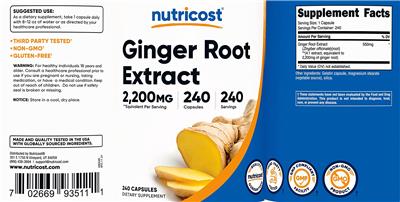
This summary is for Ginger Root Extract by Nutricost
- Form
- Capsule
- Serving Size
- 1 Capsule
- Servings
- 240 per container
- Container Holds
- 240 Capsules
- What is Ginger Root Extract?A single-ingredient supplement from Nutricost, in capsule form.
- Active Ingredients Ginger Root Extract 550 mg One active ingredient. We check it for drug interactions and side effects. The full Supplement Facts
- Drug Interactions 1,008 drugs have a documented interaction with this supplement; the most serious is rated moderate. Of those, 654 are single drugs and 354 are combination products (two or more drugs in one), each listed under its own name. Ask your pharmacist first if you take a drug in any of these categories, the most serious of the 14 on record:
- Moderate · 645 drugs
- Moderate · 202 drugs
- Moderate · 122 drugs
- Moderate · 86 drugs
- Possible Side EffectsHeartburnStomach discomfortGasBurping From its one active ingredient, Ginger. Not studied in this exact product.
- Well documented Why
Does Ginger Root Extract work?
It is not marketed for one specific use, so this is what Ginger has been studied for, strongest research first:
- Pregnancy-induced nausea and vomiting
These grades are for the ingredient, not this exact product, and never a promise it will work for you.
What the research says- AllergensNone of its ingredient names point to a major food allergen
- Barcode (UPC)7 02669 93511 1Match it to the barcode on your bottle to be sure this is your product. Not your product? Search for it here
Who Might Consider It
- People who want it for osteoarthritis, dysmenorrhea or pregnancy-induced nausea and vomiting: the uses with research behind them. See each grade
- You might consider this product if you are looking for a ginger supplement and want to understand its evidence for nausea, menstrual cramps, or osteoarthritis.
Who Should Be Careful
- If you take blood thinners, antidiabetes medications, blood pressure medications such as losartan or nifedipine, or drugs processed by the liver's CYP3A4 or P-gp systems, be careful and review the interactions above.
- Talk it over with your own doctor or pharmacist before starting, especially if you are pregnant, breastfeeding, or have a bleeding disorder or gallstones.
More Before You Take It Show all three answersHide Its Ginger Root Extract Amount vs. Other Supplements Pregnancy and Breastfeeding The Label’s Directions
-
How does its Ginger Root Extract amount compare with other supplements?
- Ginger Root Extract550 mgMore than 9 in 10 of the 192 recent Ginger products in our database that state an amount; 50 mg is the most common.
A label’s amount is what the product holds, not a recommended dose.
See the Ginger Root Extract comparison -
Pregnant or breastfeeding?
- Pregnancy
- When consumed in the amounts typically found in foods.
- When used for medicinal purposes.
- Breastfeeding
- When consumed in the amounts typically found in foods.
-
How does the label say to take it?
“Suggested use: As a dietary supplement, take 1 capsule daily with 8-12 oz of water or as directed by your healthcare professional.”
The maker’s words. Your pharmacist or doctor may advise differently.
Everything the label says
From the label dated Jul 25, 2024: its one active ingredient was checked against our records. A summary of what is known, not a grade or a test of the product. How these ratings are computed
Ask Anything About This Supplement
Name a drug you take, or ask about side effects, ingredients or pregnancy.
There’s a lot of information about this supplement on this page! Ask anything in plain English for a quick answer drawn from it.
AI answers come from this label and our own records, never the open internet. AI can make mistakes, so always check with your doctor or pharmacist. How we use AI
Ask the Pharmacist
A licensed pharmacist will answer your question by email — free, as soon as they can.
Got it — thank you!
A licensed pharmacist will answer as soon as they can. Keep an eye on your email (worth checking spam, just in case).
What’s Inside Ginger Root Extract by Nutricost
One Active Ingredient: Ginger Root Extract
Why this rating?
The label gives the exact amount of its one active ingredient, so you know how much you get in each serving. This rates what the label tells you, not the quality of the product.
Supplement Facts
| Amount Per Serving | % Daily Value | |
|---|---|---|
| Ginger Root Extract | 550 mg | † |
Other ingredients: Gelatin, Magnesium Stearate, Silica
† Daily Value not established.
Daily Values for adults and children 4 or more years of age.
As the label prints it, from the NIH Dietary Supplement Label Database.
Each Ingredient and Its Drug Interactions
Tap one for more about it and its full guide.
-
Ginger Root Extract 550 mg Interacts with 1,008 drugs
Ginger is a widely used culinary spice with a long history in traditional medicine, and it has the strongest evidence for helping with nausea and vomiting, including from motion sickness, pregnancy, and chemotherapy.
- It is generally safe in food and supplement amounts for most people, though it may cause mild stomach upset.
- Talk with your pharmacist or doctor before using ginger supplements, especially if you are pregnant, have a bleeding disorder, or take other medicines.
The full Ginger guide: uses, dosage and safety Every Ginger drug interaction
How Much Ginger Is in It, Compared With Other Supplements
Each bar is an amount that other recent supplements list for the same ingredient. The taller the bar, the more of them state it.
-
550 mg in a serving of this product
More than 9 in 10 products
- Most common amount
- 50 mg (about 13 in 100 products)
- Most products state
- 10.5 mg to 500 mg
- Compared with
- 192 recent products
Other Ingredients (Inactive)
The capsule or tablet itself, fillers, coatings and flavors. Not part of the drug interaction check; the allergen check below reads them.
- Gelatin
- Magnesium Stearate
- Silica
Allergens in Ginger Root Extract
None of its ingredient names point to a major food allergen.
Named on this label
- Gelatin (animal-derived)In the ingredients: Gelatin
Not named in the ingredients
- Milk
- Egg
- Fish
- Shellfish
- Tree nuts
- Peanuts
- Wheat or other gluten grains
- Soy
- Sesame
- Made without, the label says“Non-GMO · Gluten-free”
From the label text and ingredient names on file; we do not test products. With a serious allergy, check your bottle and ask the maker or your pharmacist.
What the Label Says
The maker’s own words, from the label. We do not verify or endorse them.
- Formulation
-
“Third party tested”
“Non-GMO Gluten-free”
3 more from the label
“Made and quality tested in the USA with globally sourced ingredients.”
“Non-GMO product”
“Ginger Root Extract 2,200 mg equivalent per serving”
- Storage
-
“Notice: Store in a cool, dry place.”
- FDA Statement of Identity
-
“Dietary Supplement”
- Seals and symbols
-
“Nutricost Quality Guaranteed Third Party Tested GMP GMP Compliant Facility”
The Ginger Root Extract Label on File
The label scan on file at the NIH Dietary Supplement Label Database, dated July 2024. Always read the label on the bottle you have.
Product Facts
- Brand
- Nutricost
- Barcode (UPC)
- 702669935111
- Net contents
- 240 Capsules
- Market status
- On market
- Date entered into DSLD
- Jul 25, 2024
- DSLD ID
- 306222
- Product type
- Botanical
- Supplement form
- Capsule
- Dietary claims / uses
- All Other, Structure/Function
- Intended target group(s)
- Adult (18 - 50 Years), Gluten Free
Is this label outdated? Report a formula or label change and our pharmacy team will review it.
HelloPharmacist Score Ginger Root Extract by Nutricost
Up to 10 points for research, amount, label and outside testing. Not a safety rating. How this one adds up
for osteoarthritis
It is not marketed for one specific use. Some research suggests ginger may help with osteoarthritis, its best-researched use.
- Research4 of 5 points
- Amount1 of 2 points
- Label2 of 2 points
- Outside testing0 of 1 point
for dysmenorrhea
Some research suggests ginger may help with dysmenorrhea. It is not marketed for this.
- Research4 of 5 points
- Amount1 of 2 points
- Label2 of 2 points
- Outside testing0 of 1 point
for pregnancy-induced nausea and vomiting
Some research suggests ginger may help with pregnancy-induced nausea and vomiting. It is not marketed for this.
- Research4 of 5 points
- Amount1 of 2 points
- Label2 of 2 points
- Outside testing0 of 1 point
for exercise-induced muscle soreness
The research suggests ginger does not help with exercise-induced muscle soreness. It is not marketed for this.
- Research0 of 5 points
- Amount1 of 2 points
- Label2 of 2 points
- Outside testing0 of 1 point
for motion sickness
The research suggests ginger does not help with motion sickness. It is not marketed for this.
- Research0 of 5 points
- Amount1 of 2 points
- Label2 of 2 points
- Outside testing0 of 1 point
Moderate drug interactions. The score does not count drug interactions. Check them against any drugs you take. See them
What Are You Taking It For?
Tap a reason and the score changes to match. Each one uses this product’s own amount, label and testing.
There is too little research to score ginger for diabetes, obesity, high cholesterol, high blood pressure, athletic performance, back pain, upper respiratory tract infection (URTI) and rheumatoid arthritis (RA), so they are not in the list.
How It Earns Its 7
Score: 7 out of 10. Preliminary for osteoarthritis.
Some research on ginger for osteoarthritis.
Graded “Possibly Effective” in the Natural Medicines database, which we license. With no one use named, research counts for at most 4 of 5 points: at least half of its active ingredients (1 of 1) have research behind them.
4 of 5 points
Amount
Its 550 mg is more than 9 in 10 of the 192 ginger products in our database that state an amount, which mostly hold 10.5 mg to 500 mg.
1 of 2 points
Label
It states the amount of its one active ingredient.
2 of 2 points
Outside testing
Its label says it is tested by an outside lab but names no testing program, so there is nothing to look up.
0 of 1 point
Some research on ginger for dysmenorrhea.
Graded “Possibly Effective” in the Natural Medicines database, which we license.
4 of 5 points
Amount
Its 550 mg is more than 9 in 10 of the 192 ginger products in our database that state an amount, which mostly hold 10.5 mg to 500 mg.
1 of 2 points
Label
It states the amount of its one active ingredient.
2 of 2 points
Outside testing
Its label says it is tested by an outside lab but names no testing program, so there is nothing to look up.
0 of 1 point
Some research on ginger for pregnancy-induced nausea and vomiting.
Graded “Possibly Effective” in the Natural Medicines database, which we license.
4 of 5 points
Amount
Its 550 mg is more than 9 in 10 of the 192 ginger products in our database that state an amount, which mostly hold 10.5 mg to 500 mg.
1 of 2 points
Label
It states the amount of its one active ingredient.
2 of 2 points
Outside testing
Its label says it is tested by an outside lab but names no testing program, so there is nothing to look up.
0 of 1 point
Research leans against it on ginger for exercise-induced muscle soreness.
Graded “Possibly Ineffective” in the Natural Medicines database, which we license.
0 of 5 points
Amount
Its 550 mg is more than 9 in 10 of the 192 ginger products in our database that state an amount, which mostly hold 10.5 mg to 500 mg.
1 of 2 points
Label
It states the amount of its one active ingredient.
2 of 2 points
Outside testing
Its label says it is tested by an outside lab but names no testing program, so there is nothing to look up.
0 of 1 point
Research leans against it on ginger for motion sickness.
Graded “Possibly Ineffective” in the Natural Medicines database, which we license.
0 of 5 points
Amount
Its 550 mg is more than 9 in 10 of the 192 ginger products in our database that state an amount, which mostly hold 10.5 mg to 500 mg.
1 of 2 points
Label
It states the amount of its one active ingredient.
2 of 2 points
Outside testing
Its label says it is tested by an outside lab but names no testing program, so there is nothing to look up.
0 of 1 point
Where It Sits on the Ginger Shelf
The 76 ginger products we have scored so far, lined up by their scores. The dark bottle is this one. Each bottle stands for up to 2 products. Tap a score to see the products on it.
18 ginger products score 8 out of 10
- Super Gingerols by SuperSmart
- Fermented Ginger 400 mg by Solaray
- Clean Tox Lemon Ginger Flavor by Arbonne
- Organic Ginger Freeze Dried Juice Powder by Materia Organica
- Organic Ginger Extract Powder 5% Gingerols by Materia Organica
- Ginger Root Extract Powder 500 mg by BulkSupplements.com
- Ginger Root Extract Powder 500 mg by BulkSupplements.com
- Ginger Root Extract by BulkSupplements.com
- Ginger Root Extract by BulkSupplements.com
- Ginger by Revive
- Clean Tox Lemon Ginger Flavor by Arbonne
- Ginger 395 mg by Eclectic Herb
And 6 more.
9 ginger products score 4 out of 10
- Prenatal DHA+ Ginger by Noor Vitamins
- Ginger Trips by Solaray
- 15 Day Colon Detox & Ginger by dr.bo
- Ginger Supreme by Harmony Nutraceuticals
- Ginger Root Extract 250 mg by NOW
- Ginger 450 by ProCaps
- Ginger Mint Tea by Nutrilite Organics
- Zingiber Off. Ginger by Wise Woman Herbals
- Ultimate Ginger Complex by Vitamer Laboratories
23 ginger products score 7 out of 10
- Ginger Root Extract by Nutricost this one
- Nauseprin by Approved Science
- Ginger Root 400 mg by Signature Supplements
- Ginger by Herb Pharm
- Core Ginger by Energetix
- Wild Ginger Sugar Free by Herbal Terra
- Ginger by Herbal Terra
- Wild Ginger Alcohol Free by Herbal Terra
- Ginger Alcohol Free by Herbal Terra
- Stomach Soothing Drops Ginger by Shaklee
- Morning Sickness Support by Approved Science
- Midol Supplements Peace Out PMS by Bayer
And 11 more.
18 ginger products score 3 out of 10
- Ginger 1100 mg by Solaray
- Ginger 1100 mg by Solaray
- Tummygummies Pineapple Ginger Gummies by Tummygummies
- Tummydrops Sweet Ginger Pear by Tummydrops
- Tummydrops Sweet Blackberry Ginger Flavor by Tummydrops
- Tummydrops Natural Ginger by Tummydrops
- Tummydrops Enchanted Spice Intense Ginger Flavor by Tummydrops
- Tummydrops Double Ginger Peach by Tummydrops
- Rhythm Chocolate Ginger Snap Flavor by The Functional Chocolate Company
- Organic Ginger Tea Bags by FGO (From Great Origins)
- Tummypops Organic Ginger Variety Pack by Tummydrops
- Tummydrops Strawberry Ginger Flavor by Tummydrops
And 6 more.
2 ginger products score 2 out of 10
- GutHealth Ginger by Arbonne
- GutHealth Ginger by Arbonne
4 ginger products score 6 out of 10
- Ginger Root 1,100 mg by Nature's Way
- Ginger Root 1100 mg by Nature's Way
- Ginger Root 1,100 mg by Nature's Way
- Ginger Root by Gaia Herbs
2 ginger products score 0 out of 10
- Multi Collagen Protein Gut Restore Lemon Ginger Flavor by Ancient Nutrition
- G.I. InnerCalm Lemon Ginger by Biocidin Botanicals
This One Next to Most Ginger Products
| What | This one | Most of the other 75 |
|---|---|---|
| What it is marketed for | No one use | Motion sickness (10 of 18) |
| How much ginger | 550 mg a serving | 60 mg to 850 mg |
| Form | Not named | Many forms |
| The label | Every amount stated | Every amount stated on 63 of 75 |
| Outside testing seal | None on file | 0 of 75 have one |
| Score | 7, Preliminary | 3 to 7 |
Ginger Root Extract by Nutricost Side Effects
Why this rating?
We look for three kinds of safety information on each ingredient: side effects reported in studies, a pregnancy and breastfeeding rating, and a safety write-up from our pharmacy team. All three are on file for Ginger.
So this rates how much is known, not whether Ginger Root Extract is right for you.
Reported with Ginger, its active ingredient
- Most often
- Heartburn, stomach discomfort, gas and burping
- !Rare but serious
- Reported with Ginger See details
HelloPharmacist Team Summary: Ginger Root Extract by Nutricost Side Effects
Most people tolerate ginger reasonably well, but you may notice heartburn, stomach discomfort, gas, or burping, especially at higher amounts.
- A rare allergic reaction is possible, so if you notice swelling, trouble breathing, or a severe rash, stop and call your doctor right away.
- Because ginger may slightly affect blood clotting, talk with your own doctor or pharmacist before starting if you have a bleeding disorder, are scheduled for surgery, or have gallstones.
Side Effects Reported With Ginger
Ginger Root Extract Warnings: Who Should Be Careful
These warnings are for Ginger, its one active ingredient. If any of these apply to you, talk to your doctor or pharmacist before you start it.
-
Bleeding Problems or Surgery
- Use extra caution if you have a bleeding disorder or are scheduled for surgery, since ginger may slightly affect blood clotting.
-
Gallbladder Problems
- People with gallstones should also check with a doctor, because ginger can increase the flow of bile.
-
What the Label Warns
- “Warning: For healthy individuals 18 years and older. Keep out of reach of children.”
- “Consult a healthcare professional prior to use if you are pregnant or nursing, taking medication, or have a medical condition.”
- “Do not use if safety seal is broken or missing.”
The maker’s wording, from the product label.
-
Pregnant or Breastfeeding
The rating for pregnancy and for breastfeeding, and what it covers.
Pregnancy
-
When consumed in the amounts typically found in foods.
Ginger is considered a first-line nonpharmacological treatment option for nausea in pregnancy by the American College of Obstetrics and Gynecology (ACOG).
However, it should not be used long-term or without medical supervision and close monitoring.
-
When used for medicinal purposes.
Despite some early reports of adverse effects and one observational study suggesting that taking dried ginger and other herbal supplements during the first 20 weeks of pregnancy marginally increased the chance of stillbirth, most research shows that ginger is unlikely to cause harm to the baby.
3 more points on this rating
- The risk for major malformations in infants of parents who took ginger when pregnant does not appear to be higher than the baseline rate of 1% to 3%.
- Also, other research suggests that ginger intake during various trimesters does not significantly affect the risk of spontaneous abortion, congenital malformations, stillbirth, perinatal death, preterm birth, low birth weight, or low Apgar scores.
- Ginger use has been associated with an increase in non-severe vaginal bleeding, including spotting, after week 17 of pregnancy.
Breastfeeding
-
When consumed in the amounts typically found in foods.
There is insufficient reliable information available about the safety of ginger when used for medicinal purposes; avoid amounts greater than those found in foods.
Our pharmacy team’s notes
- For pregnancy, ginger is rated Likely Safe and Possibly Safe, and as Likely Safe during breastfeeding (lactation).
Ratings and the words beside them are from the Natural Medicines database, which we license.
The full record, with its sources, in the Ginger guide -
Rare but Serious Side Effects
-
!
Ginger
Rarely, some people may have an allergic reaction.
A rare allergic reaction is possible, and mild irregular heartbeat (arrhythmia) was seen in one patient in a clinical trial.
When to get help: a serious allergic reaction, with trouble breathing or swelling of the face, lips or throat, needs emergency care: call 911. For any other side effect that worries you, call your doctor or pharmacist.
These reports describe each ingredient, not studies of this exact product. Not medical advice: a side effect you notice after starting a supplement is worth a word with your pharmacist or doctor.
Ginger Root Extract by Nutricost Drug Interactions
This supplement has one active ingredient, Ginger Root Extract, and we checked it against every drug in our records.
A moderate interaction on record
2 of 3, on a scale from Minor or none to Major.Why this rating?
We rate this by the most serious interaction on record, not by how many there are. For Ginger, the most serious is rated moderate, which means it calls for caution, and sometimes monitoring or a change in timing or dose. Some involve kinds of drugs where a small change can matter, such as blood thinners, transplant drugs and diabetes drugs.
1,009 drugs are on the full list. What matters is whether one you take is on it, so check yours with the interaction checker on this page.
Its one active ingredient has drug interactions on record: Ginger.
Ginger
- Interacts with
- 1,008 drugs
- Most serious
- Moderate
- Nutricost Ginger Root Extract has documented interactions with several medication types, all through its ginger root extract.
- The most serious one is with anticoagulant and antiplatelet drugs, the blood thinners (anticoagulants) and clot-preventing drugs (antiplatelets) such as warfarin.
- Ginger may slightly reduce clotting and increase the risk of bleeding when combined with them.
- The severity for this interaction is Moderate.
Show three more points
- The other affected drug types, roughly worst first, are: antidiabetes drugs, where ginger may increase the risk of low blood sugar (hypoglycemia) (Moderate); nifedipine, a blood pressure medication, where combined use may increase bleeding risk (Moderate); phenprocoumon, a warfarin-related blood thinner, where case reports describe raised INR readings (Moderate); losartan, a blood pressure medication, where ginger may raise drug levels and lower blood pressure, mainly shown in animal research (Moderate); and two groups of drugs processed by the body's transport and enzyme systems, CYP3A4 substrates and P-glycoprotein (P-gp) substrates, where ginger may change drug levels (both Moderate).
- Every ingredient in this product has documented interactions, so there is no interaction-free ingredient to note.
- To check your exact medications, use the search tool on this page.
The kinds of drugs it affects most
- 645 drugs
- 202 drugs
- 186 drugs
- 122 drugs
Every Ginger drug interaction, 14 records The Ginger records cite 65 references, listed in the Ginger guide.
Summarized by the HelloPharmacist pharmacy team from the interaction records below. How it is written How we use AI
The Breakdown by Severity
Each drug counted once, at its most serious rating. Tap a tile to list those drugs.
Find Your Drug
Type a drug or brand name to see whether it is on the list.
- Only drugs with a documented interaction are listed, the most serious first.
- A drug with no known interaction is not listed, but searching its name tells you so.
- Open a drug to see which ingredient is responsible. Of those, 654 are single drugs and 354 are combination products (two or more drugs in one), each listed under its own name.
-
PramlintideSymlin Moderate
The ingredient responsible:
-
Ginger Root Extract Moderate Pramlintide is in the Antidiabetes Drugs category.
Theoretically, taking ginger with antidiabetes drugs might increase the risk of hypoglycemia.
The full Ginger Root Extract + Pramlintide interaction
-
-
LoperamideImodium, Loperamide Moderate
The ingredient responsible:
-
Ginger Root Extract Moderate Loperamide is in the P-glycoprotein Substrates category.
Ginger might increase the absorption and blood levels of P-glycoprotein (P-gp) substrates.
The full Ginger Root Extract + Loperamide interaction
-
-
Diclofenac EpolamineFlector, Licart Moderate
The ingredient responsible:
-
Ginger Root Extract Moderate Diclofenac Epolamine is in these Anticoagulant/Antiplatelet Drugs, Cytochrome P450 2C9 (CYP2C9) Substrates categories.
Ginger may have antiplatelet effects and may increase the risk of bleeding if used with anticoagulant or antiplatelet drugs.
The full Ginger Root Extract + Diclofenac Epolamine interaction
-
-
DanaparoidOrgaran Moderate
The ingredient responsible:
-
Ginger Root Extract Moderate Danaparoid is in the Anticoagulant/Antiplatelet Drugs category.
Ginger may have antiplatelet effects and may increase the risk of bleeding if used with anticoagulant or antiplatelet drugs.
The full Ginger Root Extract + Danaparoid interaction
-
-
SitagliptinJanuvia, Zituvio Moderate
The ingredient responsible:
-
Ginger Root Extract Moderate Sitagliptin is in the Antidiabetes Drugs category.
Theoretically, taking ginger with antidiabetes drugs might increase the risk of hypoglycemia.
The full Ginger Root Extract + Sitagliptin interaction
-
-
Conjugated EstrogensCenestin, Enjuvia, Premarin, Premarin Vaginal Cream Moderate
The ingredient responsible:
-
Ginger Root Extract Moderate Conjugated Estrogens is in these Cytochrome P450 3A4 (CYP3A4) Substrates, P-glycoprotein Substrates categories.
Ginger might increase or decrease the levels of CYP3A4 substrates.
The full Ginger Root Extract + Conjugated Estrogens interaction
-
-
ImatinibGleevec Moderate
The ingredient responsible:
-
Ginger Root Extract Moderate Imatinib is in the Cytochrome P450 3A4 (CYP3A4) Substrates category.
Ginger might increase or decrease the levels of CYP3A4 substrates.
The full Ginger Root Extract + Imatinib interaction
-
-
RimegepantNurtec ODT Moderate
The ingredient responsible:
-
Ginger Root Extract Moderate Rimegepant is in these Cytochrome P450 3A4 (CYP3A4) Substrates, P-glycoprotein Substrates categories.
Ginger might increase or decrease the levels of CYP3A4 substrates.
The full Ginger Root Extract + Rimegepant interaction
-
-
Amlodipine BesilateIstin Moderate
The ingredient responsible:
-
Ginger Root Extract Moderate Amlodipine Besilate is in these Calcium Channel Blockers, Cytochrome P450 3A4 (CYP3A4) Substrates categories.
Theoretically, taking ginger with calcium channel blockers might increase the risk of hypotension.
The full Ginger Root Extract + Amlodipine Besilate interaction
-
-
Insulin AspartFiasp Moderate
The ingredient responsible:
-
Ginger Root Extract Moderate Insulin Aspart is in the Antidiabetes Drugs category.
Theoretically, taking ginger with antidiabetes drugs might increase the risk of hypoglycemia.
The full Ginger Root Extract + Insulin Aspart interaction
-
-
IbrutinibImbruvica Moderate
The ingredient responsible:
-
Ginger Root Extract Moderate Ibrutinib is in these Cytochrome P450 3A4 (CYP3A4) Substrates, Anticoagulant/Antiplatelet Drugs categories.
Ginger might increase or decrease the levels of CYP3A4 substrates.
The full Ginger Root Extract + Ibrutinib interaction
-
-
TelithromycinKetek Moderate
The ingredient responsible:
-
Ginger Root Extract Moderate Telithromycin is in the Cytochrome P450 3A4 (CYP3A4) Substrates category.
Ginger might increase or decrease the levels of CYP3A4 substrates.
The full Ginger Root Extract + Telithromycin interaction
-
-
ExemestaneAromasin Moderate
The ingredient responsible:
-
Ginger Root Extract Moderate Exemestane is in the Cytochrome P450 3A4 (CYP3A4) Substrates category.
Ginger might increase or decrease the levels of CYP3A4 substrates.
The full Ginger Root Extract + Exemestane interaction
-
-
ChlorpheniramineChlor-Trimeton, Teldrin Moderate
The ingredient responsible:
-
Ginger Root Extract Moderate Chlorpheniramine is in the Cytochrome P450 3A4 (CYP3A4) Substrates category.
Ginger might increase or decrease the levels of CYP3A4 substrates.
The full Ginger Root Extract + Chlorpheniramine interaction
-
-
LansoprazolePrevacid Moderate
The ingredient responsible:
-
Ginger Root Extract Moderate Lansoprazole is in the Cytochrome P450 3A4 (CYP3A4) Substrates category.
Ginger might increase or decrease the levels of CYP3A4 substrates.
The full Ginger Root Extract + Lansoprazole interaction
-
-
FexofenadineAllegra Moderate
The ingredient responsible:
-
Ginger Root Extract Moderate Fexofenadine is in these P-glycoprotein Substrates, Cytochrome P450 3A4 (CYP3A4) Substrates categories.
Ginger might increase the absorption and blood levels of P-glycoprotein (P-gp) substrates.
The full Ginger Root Extract + Fexofenadine interaction
-
-
BexaroteneTargretin Moderate
The ingredient responsible:
-
Ginger Root Extract Moderate Bexarotene is in the Cytochrome P450 3A4 (CYP3A4) Substrates category.
Ginger might increase or decrease the levels of CYP3A4 substrates.
The full Ginger Root Extract + Bexarotene interaction
-
-
RanitidineRanit, Ranitidine injection, Zantac, Zantac 150, Zantac 150 EFFER and 5 more Moderate
The ingredient responsible:
-
Ginger Root Extract Moderate Ranitidine is in the P-glycoprotein Substrates category.
Ginger might increase the absorption and blood levels of P-glycoprotein (P-gp) substrates.
The full Ginger Root Extract + Ranitidine interaction
-
-
ItraconazoleSporanox, Sporanox Injection, Tolsura Moderate
The ingredient responsible:
-
Ginger Root Extract Moderate Itraconazole is in these P-glycoprotein Substrates, Cytochrome P450 3A4 (CYP3A4) Substrates categories.
Ginger might increase the absorption and blood levels of P-glycoprotein (P-gp) substrates.
The full Ginger Root Extract + Itraconazole interaction
-
-
Zolpidem TartrateAmbien Moderate
The ingredient responsible:
-
Ginger Root Extract Moderate Zolpidem Tartrate is in the Cytochrome P450 3A4 (CYP3A4) Substrates category.
Ginger might increase or decrease the levels of CYP3A4 substrates.
The full Ginger Root Extract + Zolpidem Tartrate interaction
-
-
LiraglutideVictoza Moderate
The ingredient responsible:
-
Ginger Root Extract Moderate Liraglutide is in the Antidiabetes Drugs category.
Theoretically, taking ginger with antidiabetes drugs might increase the risk of hypoglycemia.
The full Ginger Root Extract + Liraglutide interaction
-
-
Lercanidipine HydrochlorideZanidip Moderate
The ingredient responsible:
-
Ginger Root Extract Moderate Lercanidipine Hydrochloride is in these Calcium Channel Blockers, Cytochrome P450 3A4 (CYP3A4) Substrates categories.
Theoretically, taking ginger with calcium channel blockers might increase the risk of hypotension.
The full Ginger Root Extract + Lercanidipine Hydrochloride interaction
-
-
ChlorpropamideChlorpropam, Diabinese Moderate
The ingredient responsible:
-
Ginger Root Extract Moderate Chlorpropamide is in the Antidiabetes Drugs category.
Theoretically, taking ginger with antidiabetes drugs might increase the risk of hypoglycemia.
The full Ginger Root Extract + Chlorpropamide interaction
-
-
EtoricoxibArcoxia Moderate
The ingredient responsible:
-
Ginger Root Extract Moderate Etoricoxib is in the Cytochrome P450 3A4 (CYP3A4) Substrates category.
Ginger might increase or decrease the levels of CYP3A4 substrates.
The full Ginger Root Extract + Etoricoxib interaction
-
-
RamelteonRozerem Moderate
The ingredient responsible:
-
Ginger Root Extract Moderate Ramelteon is in these Cytochrome P450 3A4 (CYP3A4) Substrates, Cytochrome P450 1A2 (CYP1A2) Substrates, Cytochrome P450 2C9 (CYP2C9) Substrates categories.
Ginger might increase or decrease the levels of CYP3A4 substrates.
The full Ginger Root Extract + Ramelteon interaction
-
-
TobutamideMobenol Moderate
The ingredient responsible:
-
Ginger Root Extract Moderate Tobutamide is in the Antidiabetes Drugs category.
Theoretically, taking ginger with antidiabetes drugs might increase the risk of hypoglycemia.
The full Ginger Root Extract + Tobutamide interaction
-
-
CiclesonideAlvesco, Omnaris, Zetonna Moderate
The ingredient responsible:
-
Ginger Root Extract Moderate Ciclesonide is in the Cytochrome P450 3A4 (CYP3A4) Substrates category.
Ginger might increase or decrease the levels of CYP3A4 substrates.
The full Ginger Root Extract + Ciclesonide interaction
-
-
DalteparinFragmin Moderate
The ingredient responsible:
-
Ginger Root Extract Moderate Dalteparin is in the Anticoagulant/Antiplatelet Drugs category.
Ginger may have antiplatelet effects and may increase the risk of bleeding if used with anticoagulant or antiplatelet drugs.
The full Ginger Root Extract + Dalteparin interaction
-
-
SorafenibNexavar Moderate
The ingredient responsible:
-
Ginger Root Extract Moderate Sorafenib is in these Cytochrome P450 3A4 (CYP3A4) Substrates, Anticoagulant/Antiplatelet Drugs categories.
Ginger might increase or decrease the levels of CYP3A4 substrates.
The full Ginger Root Extract + Sorafenib interaction
-
-
DienogestVisanne Moderate
The ingredient responsible:
-
Ginger Root Extract Moderate Dienogest is in the Cytochrome P450 3A4 (CYP3A4) Substrates category.
Ginger might increase or decrease the levels of CYP3A4 substrates.
The full Ginger Root Extract + Dienogest interaction
-
Does It Work? Ginger Root Extract by Nutricost
What the research says so far. A grade is the research so far, never an endorsement.
HelloPharmacist Team Summary: Does Ginger Root Extract by Nutricost Work?
Ginger root extract is rated possibly effective for pregnancy-induced nausea and vomiting, dysmenorrhea (painful menstrual cramps), and osteoarthritis.
- It is rated possibly ineffective for exercise-induced muscle soreness and for chemotherapy-induced nausea and vomiting (CINV).
- These ratings mean the evidence is limited, so results may vary.
What the Research Says About Ginger
Its uses graded effective, likely effective or possibly effective:
Research suggests a benefit for
- Osteoarthritis, dysmenorrhea and pregnancy-induced nausea and vomiting
The grades are the Natural Medicines database’s, which we license; tap a grade for what it means. They are about each ingredient, not this exact product.
About Nutricost
Manufacturer and brand details for Ginger Root Extract, from the product label.
Nutricost has 355 products in our supplement database, all of them on the market, with labels on file since 2017. Our database is built from the NIH’s Dietary Supplement Label Database and our pharmacy team’s own additions, so it covers the labels filed there, not every product the brand sells.
- Name
- Nutricost
- Street Address
- 351 E 1750 N
- City
- Vineyard
- State
- UT
- ZipCode
- 84059
- Phone Number
- (866) 438-3694
- Web Address
- www.nutricost.com
Ginger Root Extract by Nutricost: Common Questions
Does Ginger Root Extract by Nutricost interact with any drugs?
What are the side effects of Ginger Root Extract by Nutricost?
Who should be careful taking Ginger Root Extract by Nutricost?
Does Ginger Root Extract by Nutricost contain any common allergens?
Is Ginger Root Extract by Nutricost gluten free?
How can Ginger Root Extract by Nutricost interact with so many drugs?
Where does the information about Ginger Root Extract by Nutricost come from?
Does Ginger Root Extract by Nutricost help with morning sickness?
Is Ginger Root Extract by Nutricost safe to take during pregnancy?
Does Ginger Root Extract by Nutricost help with muscle soreness after exercise?
What is in Ginger Root Extract by Nutricost besides ginger?
Written and reviewed by the HelloPharmacist Editorial Team. Our editorial policy
Still Have a Question About Ginger Root Extract?
Our pharmacists answer drug and supplement questions, free, by email.
Label information is sourced from the NIH Dietary Supplement Label Database and reflects the product version on file; always read your actual product label. This page is for education only and is not a substitute for professional medical advice. Confirm with your pharmacist or doctor before combining supplements and drugs.
Who Reviews This Page
The pharmacist behind it, and how it is checked.
Dr. Brian Staiger, PharmD, BCPS
Clinical pharmacist and founder of HelloPharmacist
A licensed pharmacist for more than 13 years, he built the system behind this page: it reads the label on file, matches each active ingredient to its record in the Natural Medicines database, checks those records against every drug we cover, and our pharmacy team writes the take and the interaction summary from those records.
- 13+ Years in PharmacyRetail and clinical pharmacy, medication safety and healthcare administration.
- Board Certified (BCPS)A pharmacotherapy specialist, certified by the Board of Pharmacy Specialties.
- Herbalist TrainingCertificates in medical ethnobotany, for the herbs and supplements people take.
Where This Page Comes From
Ginger Root Extract’s label data comes from the NIH Dietary Supplement Label Database; the ingredient interaction data is from the Natural Medicines database, reviewed by our pharmacists.
- NIH Dietary Supplement Label Database (DSLD)
- The official product label on file for this supplement.
- Natural Medicines (Therapeutic Research Center)
- The evidence-graded clinical reference behind the ingredient interaction, evidence and safety records, which we license.
- HelloPharmacist Editorial Team
- Content is reviewed by the HelloPharmacist Editorial Team, the pharmacists on our staff and those we contract. See our data sources and editorial standards for how this information is built and checked.
- The Pharmacy Team’s Take and Summaries
- Generated from HelloPharmacist’s pharmacist-curated databases and editorial rules. Clinical methodology reviewed by Dr. Brian Staiger, PharmD, BCPS. Last generated Oct 30, 2026. How we use AI
- The ratings in the Quick Summary
- They summarize available label information, ingredient evidence and known drug-safety records: a summary of what is known, not a grade of the product itself. They do not verify product identity, purity, potency, contamination or manufacturing quality. How these ratings are computed
The References Behind the Interaction Records
Every citation the ingredients’ records rest on is listed in that ingredient’s guide, in context: Ginger, 65 references .
Parts of this content are provided by the Therapeutic Research Center, LLC.
DISCLAIMER: Currently this does not check for drug-drug interactions. This is not an all-inclusive comprehensive list of potential interactions and is for informational purposes only. Not all interactions are known or well-reported in the scientific literature, and new interactions are continually being reported. Input is needed from a qualified healthcare provider including a pharmacist before starting any therapy. Application of clinical judgment is necessary.
© 2021 Therapeutic Research Center, LLC
Keep Exploring
- Supplement interaction checkerCheck any supplement or product against your drugs
- Drug–drug interactionsCheck two or more of your drugs against each other
- Browse drugs A to ZEvery drug we have checked against herbs and supplements
- NDC and pricing lookupFind a drug’s NDCs, packaging and costs
- Ask a pharmacistA free, personal answer from our licensed team