
Glutamine Ingredients & Drug Interactions
What is this page for?
First and foremost: checking Glutamine against your medications. The heart of this page is the interaction checker and the full interaction report — how this product’s ingredients may interact with prescription and over-the-counter medicines you may be taking.
Around that, we add a pharmacist’s high-level view of the product as a whole — what’s inside, the evidence for its stated use, how transparent the label is, and what safety data exists — so you can see the full picture in one place. It’s educational information from our licensed clinical databases and the clinical staff at HelloPharmacist — not medical advice — and we don’t sell or endorse products. Our editorial policy
Glutamine is a dietary supplement by Core Nutritionals with 1 active ingredient. Its ingredients are commonly taken for muscle recovery and sports performance, gut health and 'leaky gut', recovery from severe illness or injury.Based on those ingredients, 50 medications have a known interaction with it, the most serious rated moderate. The ingredients most likely to interact are L-Glutamine. Use the checker below to test your specific medication, or read the full HelloPharmacist Interaction Report.
Check Your Meds Against Glutamine by Core Nutritionals
Ask about any prescription or over-the-counter medication and we check it for interactions with Glutamine by Core Nutritionals — and tell you which ingredient is responsible.
AI summaries are generated from our interaction database for education only — always confirm with your pharmacist. How we use AI
Ask the Pharmacist
A licensed pharmacist will answer your question by email — free, usually within 24 hours.
Got it — thank you!
A licensed pharmacist will answer within 24 hours. Keep an eye on your email (worth checking spam, just in case).
HelloPharmacist Scorecard of Glutamine by Core Nutritionals
Our pharmacy team’s full take, with four database checks built into the cards below — a summary of what is known, not a grade of the product itself.
What’s inside
Full disclosure
This is a single-ingredient product: L-glutamine, an amino acid your body makes naturally and uses for immune function, gut health, and muscle recovery. The powder form lets you mix it into drinks or food at whatever dose works for you.
There are no inactive ingredients listed.
Does it work?
Moderate evidence
Glutamine is effective for sickle cell disease. It's possibly effective for HIV/AIDS-related wasting, recovery after surgery, and critical illness from trauma.
Evidence for other uses hasn't been established in the data we hold.
How safe is it?
Well-documented data
Glutamine is generally well tolerated in healthy adults. The most common side effects when taken by mouth are belching, bloating, constipation, diarrhea, flatulence, nausea, vomiting, headache, and gastrointestinal pain — especially at higher doses (10–30 grams daily).
Dizziness and mania or hypomania have been reported rarely, mostly in people with bipolar disorder or at very high doses. If you have kidney or liver disease, use glutamine only under medical supervision.
There isn't enough safety data to recommend it during pregnancy or breastfeeding unless your doctor advises it — talk with them about whether it's right for you.
Meds to double-check
Moderate interaction found
If you take anticonvulsants (seizure medications), double-check with your doctor or pharmacist before adding glutamine — the interaction is theoretical but documented in our data and hasn't yet been seen in humans.
The bottom line
Scorecard at a glanceFully disclosed formula with some supporting evidence for its stated purpose. Moderate medication interactions have been identified, and safety information is well characterized.
Glutamine may help with sickle cell disease and possibly with recovery from surgery or critical illness. If you take anticonvulsant (seizure) medications, check with your doctor or pharmacist before starting it.
It's generally well tolerated but can cause digestive upset, especially at high doses. Talk it over with your own healthcare provider to see if it fits your situation.
Educational only — not medical advice; always confirm with your pharmacist. Our editorial policy · How we use AI
Assessment coverage: 1 of 1 active ingredient matched to our full ingredient reviews (monographs). Based on the product label dated Oct 24, 2023.
This Scorecard evaluates available label information, ingredient evidence, and known medication-safety considerations. It does not independently verify product identity, purity, potency, contamination, or manufacturing quality. How these ratings are computed
General information
Key facts about Glutamine, straight from the product label.
| Brand | Core Nutritionals |
|---|---|
| Barcode (UPC) | 672975315351 |
| Net contents | 10.6 Oz(s); 300 Gram(s) |
| Market status | On market |
| Date entered into DSLD | Oct 24, 2023 |
| DSLD ID | 297987 |
| Product type | Amino Acid/protein |
| Supplement form | Powder |
| Dietary claims / uses | All Other, Structure/Function |
| Intended target group(s) | Adult (18 - 50 Years), Women (not pregnant or lactating) |
Everything in this section is reproduced from the manufacturer’s own product label — it’s the label speaking, not HelloPharmacist. We show it so you can see exactly what the maker states; we don’t verify or endorse those statements.
Supplement Facts
The label details for Glutamine by Core Nutritionals, sourced from the NIH Dietary Supplement Label Database.
Supplement Facts
| Ingredient | Amount | % DV |
|---|---|---|
| L-Glutamine | 5000 mg | -- |
Tap any ingredient to jump to its full detail below.
These statements are the manufacturer’s wording, reproduced from the product label — the label is saying it, not HelloPharmacist. We don’t verify or endorse them.
Precautions
Warning: This product is only intended to be consumed by healthy individuals 18 years of age or older.
This product is not recommended for pregnant or nursing women. Before using this product, consult with your physician, especially if you are taking any prescription or over the counter medication or if you have any preexisting medical condition including but not limited to: high or low blood pressure, cardiac arrhythmia, stroke, heart, liver, kidney or thyroid disease, seizure disorder, psychiatric disease, diabetes, difficulty urinating due to prostate enlargement or if you are taking a MAOI (Monoamine Oxidase Inhibitor) or any other medication.
Immediately discontinue use and consult your health care professional if you experience any adverse reaction to this product. Discontinue use 2 weeks prior to surgery. Do not exceed recommended serving. Do not use if safety seal is broken or missing.
Keep out of the reach of children.
Warning: Consuming this product can expose you to chemicals including lead, which is known to the State of California to cause cancer. For more information, go to www.P65Warnings.ca.gov.
Storage
Store in a cool, dry place. Protect from heat, light and moisture. Store at 10-25 Degrees C (50-77 Degrees F).
Suggested/Recommended/Usage/Directions
Directions: Take 1 scoop (5000 mg) immediately before and after your workout. An additional serving can be taken before bed. Take 1 scoop in the morning and 1 scoop before bed on your non-training days.
Brand IP Statement(s)
Core Nutritionals Crush It!
FDA Disclaimer Statement
These statements have not been evaluated by the Food and Drug Administration. This product is not intended to diagnose, treat, cure, or prevent any disease.
Formulation
Recover Repair Restore
Manufactured in a U.S. cGMP Facility.
FDA Statement of Identity
Dietary Supplement
Is this label outdated? Report a formula or label change and our pharmacy team will review it.
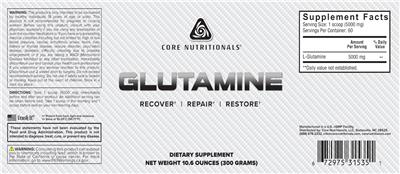
Glutamine by Core Nutritionals label
The label scan from the NIH Dietary Supplement Label Database. Tap to enlarge.
Label images are published by the NIH Dietary Supplement Label Database for the version of this product on file. Always read your actual product label.
View the full label (PDF)The Ingredients in Glutamine by Core Nutritionals
This is the 1 active ingredient this product is made of. Select it to open its full monograph.
Serving size5000 mg Dosage formPowder Servings per container60 Amounts shown are per serving.
L-Glutamine
Interacts with50 drugs
Glutamine is the most abundant amino acid in the body and is usually made in your muscles. A prescription form is FDA-approved to help reduce sickle c...
L-Glutamine monograph & interactionsGlutamine by Core Nutritionals Drug Interactions
HelloPharmacist Interaction Report
Core Nutritionals Glutamine contains L-glutamine, which has documented interactions with anticonvulsant medications (seizure drugs).
The concern is theoretical: glutamine is broken down in your body into glutamate, an excitatory neurotransmitter that might work against how anticonvulsants prevent seizures. However, this interaction hasn't been reported in humans yet — we only have the mechanism in animal or lab data.
Read the full breakdown — every affected drug type, severity by severity
Although the interaction is only Moderate in severity and hasn't occurred in real patients, anticonvulsants are medications where any interference matters. If you take seizure medications, check with your doctor or pharmacist before starting glutamine.
Altogether, these interactions span 50 individual medications. No other drug interactions are documented for glutamine in our data.
Use the medication checker on this page to verify your exact prescriptions.
Check your own medications below · Editorial policy · How we use AI
Want to check YOUR meds against Glutamine?
Ask about interactions with your drugs in plain English — “Can I take it with lisinopril?” — and we find you the answer in seconds, ingredient by ingredient.
Go to the checkerIngredients driving the most interactions
Individual Drug Interactions
The ingredients in Glutamine interact with 50 drugs. Click any drug to see the details.
1 of the 1 ingredient in Glutamine interact with drugs. Each result below shows which ingredient is responsible. L-Glutamine
AcetazolamideAk-Zol, Diamox
How Acetazolamide interacts with Glutamine — through 1 ingredient. Tap an ingredient for the detail:
L-glutamineAnticonvulsants Moderate
Interaction Summary
Theoretically, glutamine might antagonize the effects of anticonvulsant medications.
Read the full L-glutamine + Acetazolamide interactionAminophylline, Amobarbital, EphedrineAmesec
How Aminophylline, Amobarbital, Ephedrine interacts with Glutamine — through 1 ingredient. Tap an ingredient for the detail:
L-glutamineAnticonvulsants Moderate
Interaction Summary
Theoretically, glutamine might antagonize the effects of anticonvulsant medications.
Read the full L-glutamine + Aminophylline, Amobarbital, Ephedrine interactionAmobarbitalAmytal
How Amobarbital interacts with Glutamine — through 1 ingredient. Tap an ingredient for the detail:
L-glutamineAnticonvulsants Moderate
Interaction Summary
Theoretically, glutamine might antagonize the effects of anticonvulsant medications.
Read the full L-glutamine + Amobarbital interactionAmobarbital, Ephedrine SulfateEphedrine & Amytal
How Amobarbital, Ephedrine Sulfate interacts with Glutamine — through 1 ingredient. Tap an ingredient for the detail:
L-glutamineAnticonvulsants Moderate
Interaction Summary
Theoretically, glutamine might antagonize the effects of anticonvulsant medications.
Read the full L-glutamine + Amobarbital, Ephedrine Sulfate interactionAmobarbital, SecobarbitalTuinal
How Amobarbital, Secobarbital interacts with Glutamine — through 1 ingredient. Tap an ingredient for the detail:
L-glutamineAnticonvulsants Moderate
Interaction Summary
Theoretically, glutamine might antagonize the effects of anticonvulsant medications.
Read the full L-glutamine + Amobarbital, Secobarbital interactionAprobarbital, Butabarbital, PhenobarbitalTriple Barbital
How Aprobarbital, Butabarbital, Phenobarbital interacts with Glutamine — through 1 ingredient. Tap an ingredient for the detail:
L-glutamineAnticonvulsants Moderate
Interaction Summary
Theoretically, glutamine might antagonize the effects of anticonvulsant medications.
Read the full L-glutamine + Aprobarbital, Butabarbital, Phenobarbital interactionBelladonna, Caffeine, Ergotamine, PentobarbitalMicomp PB
How Belladonna, Caffeine, Ergotamine, Pentobarbital interacts with Glutamine — through 1 ingredient. Tap an ingredient for the detail:
L-glutamineAnticonvulsants Moderate
Interaction Summary
Theoretically, glutamine might antagonize the effects of anticonvulsant medications.
Read the full L-glutamine + Belladonna, Caffeine, Ergotamine, Pentobarbital interactionBelladonna, PhenobarbitalBellophen, Susano
How Belladonna, Phenobarbital interacts with Glutamine — through 1 ingredient. Tap an ingredient for the detail:
L-glutamineAnticonvulsants Moderate
Interaction Summary
Theoretically, glutamine might antagonize the effects of anticonvulsant medications.
Read the full L-glutamine + Belladonna, Phenobarbital interactionBellafoline, Caffeine, Ergotamine Tartrate, PentobarbitalCafergot PB
How Bellafoline, Caffeine, Ergotamine Tartrate, Pentobarbital interacts with Glutamine — through 1 ingredient. Tap an ingredient for the detail:
L-glutamineAnticonvulsants Moderate
Interaction Summary
Theoretically, glutamine might antagonize the effects of anticonvulsant medications.
Read the full L-glutamine + Bellafoline, Caffeine, Ergotamine Tartrate, Pentobarbital interactionButalbital, Phenobarbital, SecobarbitalTribarb
How Butalbital, Phenobarbital, Secobarbital interacts with Glutamine — through 1 ingredient. Tap an ingredient for the detail:
L-glutamineAnticonvulsants Moderate
Interaction Summary
Theoretically, glutamine might antagonize the effects of anticonvulsant medications.
Read the full L-glutamine + Butalbital, Phenobarbital, Secobarbital interactionCarbamazepineCarbatrol, Carnexiv, Equetro, Tegretol, Tegretol XR
How Carbamazepine interacts with Glutamine — through 1 ingredient. Tap an ingredient for the detail:
L-glutamineAnticonvulsants Moderate
Interaction Summary
Theoretically, glutamine might antagonize the effects of anticonvulsant medications.
Read the full L-glutamine + Carbamazepine interactionCenobamateXcopri
How Cenobamate interacts with Glutamine — through 1 ingredient. Tap an ingredient for the detail:
L-glutamineAnticonvulsants Moderate
Interaction Summary
Theoretically, glutamine might antagonize the effects of anticonvulsant medications.
Read the full L-glutamine + Cenobamate interactionClobazamFrisium, Onfi, Sympazan
How Clobazam interacts with Glutamine — through 1 ingredient. Tap an ingredient for the detail:
L-glutamineAnticonvulsants Moderate
Interaction Summary
Theoretically, glutamine might antagonize the effects of anticonvulsant medications.
Read the full L-glutamine + Clobazam interactionClonazepamCeberclon, Klonopin, Rivotril
How Clonazepam interacts with Glutamine — through 1 ingredient. Tap an ingredient for the detail:
L-glutamineAnticonvulsants Moderate
Interaction Summary
Theoretically, glutamine might antagonize the effects of anticonvulsant medications.
Read the full L-glutamine + Clonazepam interactionClorazepateTranxene, Tranxene SD, Tranxene T-Tab
How Clorazepate interacts with Glutamine — through 1 ingredient. Tap an ingredient for the detail:
L-glutamineAnticonvulsants Moderate
Interaction Summary
Theoretically, glutamine might antagonize the effects of anticonvulsant medications.
Read the full L-glutamine + Clorazepate interactionDiazepamDiastat AcuDial, Valium, Valium injection, Valtoco
How Diazepam interacts with Glutamine — through 1 ingredient. Tap an ingredient for the detail:
L-glutamineAnticonvulsants Moderate
Interaction Summary
Theoretically, glutamine might antagonize the effects of anticonvulsant medications.
Read the full L-glutamine + Diazepam interactionDivalproex SodiumDepakote
How Divalproex Sodium interacts with Glutamine — through 1 ingredient. Tap an ingredient for the detail:
L-glutamineAnticonvulsants Moderate
Interaction Summary
Theoretically, glutamine might antagonize the effects of anticonvulsant medications.
Read the full L-glutamine + Divalproex Sodium interactionEphedrine, Phenobarbital, TheophyllineTedral
How Ephedrine, Phenobarbital, Theophylline interacts with Glutamine — through 1 ingredient. Tap an ingredient for the detail:
L-glutamineAnticonvulsants Moderate
Interaction Summary
Theoretically, glutamine might antagonize the effects of anticonvulsant medications.
Read the full L-glutamine + Ephedrine, Phenobarbital, Theophylline interactionEthosuximideZarontin
How Ethosuximide interacts with Glutamine — through 1 ingredient. Tap an ingredient for the detail:
L-glutamineAnticonvulsants Moderate
Interaction Summary
Theoretically, glutamine might antagonize the effects of anticonvulsant medications.
Read the full L-glutamine + Ethosuximide interactionEthotoinPaganone
How Ethotoin interacts with Glutamine — through 1 ingredient. Tap an ingredient for the detail:
L-glutamineAnticonvulsants Moderate
Interaction Summary
Theoretically, glutamine might antagonize the effects of anticonvulsant medications.
Read the full L-glutamine + Ethotoin interactionFelbamateFelbatol
How Felbamate interacts with Glutamine — through 1 ingredient. Tap an ingredient for the detail:
L-glutamineAnticonvulsants Moderate
Interaction Summary
Theoretically, glutamine might antagonize the effects of anticonvulsant medications.
Read the full L-glutamine + Felbamate interactionFosphenytoinCerebyx
How Fosphenytoin interacts with Glutamine — through 1 ingredient. Tap an ingredient for the detail:
L-glutamineAnticonvulsants Moderate
Interaction Summary
Theoretically, glutamine might antagonize the effects of anticonvulsant medications.
Read the full L-glutamine + Fosphenytoin interactionFosphenytoin SodiumSesquient
How Fosphenytoin Sodium interacts with Glutamine — through 1 ingredient. Tap an ingredient for the detail:
L-glutamineAnticonvulsants Moderate
Interaction Summary
Theoretically, glutamine might antagonize the effects of anticonvulsant medications.
Read the full L-glutamine + Fosphenytoin Sodium interactionGabapentinGralise, Neurontin
How Gabapentin interacts with Glutamine — through 1 ingredient. Tap an ingredient for the detail:
L-glutamineAnticonvulsants Moderate
Interaction Summary
Theoretically, glutamine might antagonize the effects of anticonvulsant medications.
Read the full L-glutamine + Gabapentin interactionGabapentin EnacarbilHorizant
How Gabapentin Enacarbil interacts with Glutamine — through 1 ingredient. Tap an ingredient for the detail:
L-glutamineAnticonvulsants Moderate
Interaction Summary
Theoretically, glutamine might antagonize the effects of anticonvulsant medications.
Read the full L-glutamine + Gabapentin Enacarbil interactionLamotrigineLamictal
How Lamotrigine interacts with Glutamine — through 1 ingredient. Tap an ingredient for the detail:
L-glutamineAnticonvulsants Moderate
Interaction Summary
Theoretically, glutamine might antagonize the effects of anticonvulsant medications.
Read the full L-glutamine + Lamotrigine interactionLevetiracetamElepsia XR, Keppra, Spritam
How Levetiracetam interacts with Glutamine — through 1 ingredient. Tap an ingredient for the detail:
L-glutamineAnticonvulsants Moderate
Interaction Summary
Theoretically, glutamine might antagonize the effects of anticonvulsant medications.
Read the full L-glutamine + Levetiracetam interactionLorazepamAtivan
How Lorazepam interacts with Glutamine — through 1 ingredient. Tap an ingredient for the detail:
L-glutamineAnticonvulsants Moderate
Interaction Summary
Theoretically, glutamine might antagonize the effects of anticonvulsant medications.
Read the full L-glutamine + Lorazepam interactionMagnesium Sulfate (prescription Drug)Bilagog, Magnesium Sulfate
How Magnesium Sulfate (prescription Drug) interacts with Glutamine — through 1 ingredient. Tap an ingredient for the detail:
L-glutamineAnticonvulsants Moderate
Interaction Summary
Theoretically, glutamine might antagonize the effects of anticonvulsant medications.
Read the full L-glutamine + Magnesium Sulfate (prescription Drug) interactionMephenytoinMesantoin
How Mephenytoin interacts with Glutamine — through 1 ingredient. Tap an ingredient for the detail:
L-glutamineAnticonvulsants Moderate
Interaction Summary
Theoretically, glutamine might antagonize the effects of anticonvulsant medications.
Read the full L-glutamine + Mephenytoin interactionEach ingredient & the kinds of drugs it affects
For each ingredient in Glutamine with known interactions, here are the types of medications it can affect. Open any type for the detail — or search your exact drug in the checker above.
L-Glutamine
Anticonvulsants
Theoretically, glutamine might antagonize the effects of anticonvulsant medications.
Glutamine is metabolized to the excitatory neurotransmitter glutamate. Glutamate might have antagonistic effects with anticonvulsant drugs. However, this interaction has not yet been reported in humans.
Brand information
Manufacturer and brand details for Glutamine, from the product label.
Core Nutritionals
See all Core Nutritionals products- Name
- Core Nutritionals, LLC
- City
- Statesville
- State
- NC
- ZipCode
- 28625
- Phone Number
- (888) 978-2332
- Web Address
- corenutritionals.com
Glutamine by Core Nutritionals: Common Questions
Does Glutamine by Core Nutritionals interact with any medications?
How can one product interact with so many drugs?
Where does this information come from?
What is L-glutamine and what does it do?
What are the side effects?
Is it safe to take while pregnant or breastfeeding?
Can I take it if I have kidney or liver disease?
How much should I take?
Does it really work for sickle cell disease?
Written and reviewed by the HelloPharmacist editorial staff. Our editorial policy
Not sure if Glutamine is safe with your meds?
Our pharmacists answer your medication & supplement questions — free.
Label information is sourced from the NIH Dietary Supplement Label Database and reflects the product version on file; always read your actual product label. This page is for education only and is not a substitute for professional medical advice. Confirm with your pharmacist or doctor before combining supplements and medications.
The Full Monographs Behind Glutamine’s Ingredients
Every ingredient we hold a full HelloPharmacist monograph for — uses, evidence, safety, and the complete interaction list.
Sources & How We Checked
Glutamine's label data comes from the NIH Dietary Supplement Label Database; the ingredient interaction data is from the Natural Medicines database, reviewed by our pharmacists.
- NIH Dietary Supplement Label Database (DSLD) — The official product label on file for this supplement.
- Natural Medicines (Therapeutic Research Center) — Evidence-graded clinical reference behind the ingredient interaction data.
Content is written and reviewed by licensed HelloPharmacist pharmacists. See our data sources and editorial standards for how this information is built and checked.
The 11 references behind this product’s interaction data
Every citation that drives the interaction findings for this product’s ingredients, from the evidence-graded Natural Medicines (TRC Healthcare) database. Open an ingredient to browse its citations — links open the study on PubMed or the publisher’s site.
Glutamine 11 references
- Miller AL. Therapeutic considerations of L-glutamine: a review of the literature. Altern Med Rev 1999;4:239-48..
- Bozzetti F, Biganzoli L, Gavazzi C, et al. Glutamine supplementation in cancer patients receiving chemotherapy: a double-blind randomized study. Nutrition 1997;13:748-51.. PubMed
- Mebane AH. L-Glutamine and mania. Am J Psychiatry 984;141:1302-3.
- Meldrum BS. Glutamate as a neurotransmitter in the brain: review of physiology and pathology. J Nutr 2000;130:1007S-15S.. PubMed
- Garlick PJ. Assessment of the safety of glutamine and other amino acids. J Nutr 2001;131:2556S-61S.. PubMed
- Chapman AG. Glutamate and epilepsy. J Nutr 2000;130:1043S-5S.. PubMed
- Ziegler TR. Glutamine supplementation in cancer patients receiving bone marrow transplantation and high dose chemotherapy. J Nutr 2001;131:2578S-84S.. PubMed
- Laviano A, Molfino A, Lacaria MT, Canelli A, De Leo S, Preziosa I, Rossi Fanelli F. Glutamine supplementation favors weight loss in nondieting obese female patients. A pilot study. Eur J Clin Nutr. 2014 Nov;68(11):1264-6. PubMed
- Endari (l-glutamine) [package insert]. Torrance, CA: Emmaus Medical,Inc; 2017.
- Niihara Y, Miller ST, Kanter J, et al. A Phase 3 Trial of l-Glutamine in Sickle Cell Disease. N Engl J Med 2018;379(3):226-35. doi: 10.1056/NEJMoa1715971.
- Ogden HB, Child RB, Fallowfield JL, et al. Gastrointestinal Tolerance of Low, Medium and High Dose Acute Oral l-Glutamine Supplementation in Healthy Adults: A Pilot Study. Nutrients. 2020;12(10):2953. PubMed
Parts of this content are provided by the Therapeutic Research Center, LLC.
DISCLAIMER: Currently this does not check for drug-drug interactions. This is not an all-inclusive comprehensive list of potential interactions and is for informational purposes only. Not all interactions are known or well-reported in the scientific literature, and new interactions are continually being reported. Input is needed from a qualified healthcare provider including a pharmacist before starting any therapy. Application of clinical judgment is necessary.
© 2021 Therapeutic Research Center, LLC