
GlyphoDetox Ingredients & Drug Interactions
by ecoNugenics
What is this page for?
First and foremost: checking GlyphoDetox against your medications. The heart of this page is the interaction checker and the full interaction report — how this product’s ingredients may interact with prescription and over-the-counter medicines you may be taking.
Around that, we add a pharmacist’s high-level view of the product as a whole — what’s inside, the evidence for its stated use, how transparent the label is, and what safety data exists — so you can see the full picture in one place. It’s educational information from our licensed clinical databases and the clinical staff at HelloPharmacist — not medical advice — and we don’t sell or endorse products. Our editorial policy
GlyphoDetox is a dietary supplement by ecoNugenics with 6 active ingredients. Its ingredients are commonly taken for sleep quality and insomnia, relaxation, cognitive function.Based on those ingredients, 2,120 medications have a known interaction with it, the most serious rated moderate. The ingredients most likely to interact are Algimate, Fulvic Acid, Citrus Pectin. Use the checker below to test your specific medication, or read the full HelloPharmacist Interaction Report.
Check Your Meds Against GlyphoDetox by ecoNugenics
Ask about any prescription or over-the-counter medication and we check it for interactions with GlyphoDetox by ecoNugenics — and tell you which ingredient is responsible.
AI summaries are generated from our interaction database for education only — always confirm with your pharmacist. How we use AI
Ask the Pharmacist
A licensed pharmacist will answer your question by email — free, usually within 24 hours.
Got it — thank you!
A licensed pharmacist will answer within 24 hours. Keep an eye on your email (worth checking spam, just in case).
HelloPharmacist Scorecard of GlyphoDetox by ecoNugenics
Our pharmacy team’s full take, with four database checks built into the cards below — a summary of what is known, not a grade of the product itself.
What’s inside
Low disclosure
GlyphoDetox contains 6 active ingredients. Glycine is an amino acid; iodine supports thyroid function; citrus pectin is a soluble fiber from citrus fruit; fulvic acid is a compound derived from soil organic matter; organic Icelandic kelp (Ascophyllum nodosum) is a seaweed; and alginate (algin) is a thickener derived from brown algae.
The product also contains several inactive ingredients—hypromellose, water, silicon dioxide, stearic acid, and microcrystalline cellulose—which serve as capsule materials and stabilizers.
Does it work?
Strong evidence
The evidence for most ingredients in this product is sparse. Glycine is possibly effective for schizophrenia, but the other conditions it's studied for lack reliable evidence.
Iodine is likely effective for radiation exposure and iodine deficiency, and possibly effective for oral mucositis and periodontitis. Citrus pectin is possibly effective for high cholesterol but lacks evidence for blood sugar control.
Fulvic acid, kelp, and alginate all lack established evidence for the conditions they're associated with in our data.
How safe is it?
Well-documented data
Glycine is generally well tolerated at typical doses, though long-term safety data are limited; rare side effects include mild sedation, soft stools, nausea, and headache. Iodine is safe in normal dietary amounts but high doses can cause thyroid problems, acnelike skin lesions (iododerma), or allergic reactions; adequate iodine matters in pregnancy, but avoid high-dose products.
Citrus pectin from food and typical supplement amounts is generally well tolerated, with rare side effects like gas and loose stools; allergic reactions are rare but possible. Fulvic acid appears well tolerated short-term but has limited human safety data; diarrhea, headache, and sore throat have been reported.
Kelp is generally used in foods but its iodine content and possible heavy metal contamination warrant caution. Alginate is generally well tolerated in food amounts.
Meds to double-check
Moderate interaction found
Before you take this product, double-check if you're on clozapine (Clozaril) for schizophrenia, any thyroid medication or antithyroid drug, amiodarone (Cordarone), lithium, lovastatin (Mevacor), digoxin (Lanoxin), tetracycline antibiotics, blood thinners (anticoagulants or antiplatelet drugs), or immunosuppressants. Use our medication checker on this page to verify your specific drugs.
The bottom line
Scorecard at a glanceFormula with limited ingredient disclosure with clinical evidence supporting its stated purpose. Moderate medication interactions have been identified, and safety information is well characterized.
GlyphoDetox is a multi-ingredient supplement with limited evidence for its intended uses. If you take thyroid medication, antithyroid drugs, blood thinners, heart medications, tetracycline antibiotics, or clozapine for schizophrenia, check your exact medications with our interaction tool before starting.
Talk to your pharmacist or doctor about whether this product is right for you.
Educational only — not medical advice; always confirm with your pharmacist. Our editorial policy · How we use AI
Assessment coverage: 6 of 6 active ingredients matched to our full ingredient reviews (monographs). Based on the product label dated Feb 23, 2025.
This Scorecard evaluates available label information, ingredient evidence, and known medication-safety considerations. It does not independently verify product identity, purity, potency, contamination, or manufacturing quality. How these ratings are computed
General information
Key facts about GlyphoDetox, straight from the product label.
| Brand | ecoNugenics |
|---|---|
| Barcode (UPC) | 892985000324 |
| Net contents | 60 Vegetarian Capsule(s) |
| Market status | On market |
| Date entered into DSLD | Feb 23, 2025 |
| DSLD ID | 322597 |
| Product type | Other Combinations |
| Supplement form | Capsule |
| Dietary claims / uses | All Other, Structure/Function |
| Intended target group(s) | Vegan, Vegetarian, Adult (18 - 50 Years), Gluten Free, Dairy Free |
Everything in this section is reproduced from the manufacturer’s own product label — it’s the label speaking, not HelloPharmacist. We show it so you can see exactly what the maker states; we don’t verify or endorse those statements.
Supplement Facts
The label details for GlyphoDetox by ecoNugenics, sourced from the NIH Dietary Supplement Label Database.
Supplement Facts
| Ingredient | Amount | % DV |
|---|---|---|
| Glycine | 500 mg | -- |
| Iodine | 325 mcg | -- |
| Citrus Pectin | 0 NP | -- |
| Fulvic Acid | 0 NP | -- |
| organic Icelandic Kelp | 0 NP | -- |
| Algimate | 0 NP | -- |
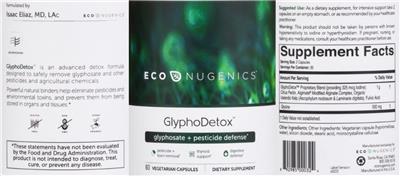
| GlyphoDetox Proprietary Blend | 1 Gram(s) | -- |
Other ingredients: Hypromellose, Water, Silicon Dioxide, Stearic Acid, Microcrystalline Cellulose
Tap any ingredient to jump to its full detail below.
These statements are the manufacturer’s wording, reproduced from the product label — the label is saying it, not HelloPharmacist. We don’t verify or endorse them.
General Statements
Formulated by Isaac Eliaz, MD, LAc
Formulation
Detoxification
GlyphoDetox is an advanced detox formula designed to safely remove glyphosate and other pesticides and agricultural chemicals. Powerful natural binders help eliminate pesticides and environmental toxins, and prevent them from being stored in organs and tissues.
Gluten free Non GMO
Vegan Friendly
Glyphosate + pesticide defense Pesticide + toxin removal Thyroid support Digestive defense
Manufactured in the U.S.A.
FDA Disclaimer Statement
These statements have not been evaluated by the Food and Drug Administration. This product is not intended to diagnose, treat, cure, or prevent any disease.
FDA Statement of Identity
Dietary Supplement
Suggested/Recommended/Usage/Directions
Suggested Use: As a dietary supplement, for intensive support take 2 capsules on an empty stomach, or as recommended by your healthcare practitioner.
Precautions
Warning: This product should not be taken by persons with known hypersensitivity to iodine or hyperthyroidism.
If pregnant, nursing, or taking any medications, consult your healthcare practitioner before use.
Is this label outdated? Report a formula or label change and our pharmacy team will review it.
GlyphoDetox by ecoNugenics label
The label scan from the NIH Dietary Supplement Label Database. Tap to enlarge.
Label images are published by the NIH Dietary Supplement Label Database for the version of this product on file. Always read your actual product label.
View the full label (PDF)The Ingredients in GlyphoDetox by ecoNugenics
These are the 6 active ingredients this product is made of. Select any to open its full monograph.
Serving size2 Capsule(s) Dosage formCapsule Servings per container30 Amounts shown are per serving.
Most supplement products combine several ingredients, and a medication can interact with the product through any one of them. Each ingredient below shows whether it has known drug interactions.
Glycine
Interacts with1 drug
Glycine is a non-essential amino acid your body makes on its own and that also appears in protein-rich foods. It is most studied for improving sleep q...
Glycine monograph & interactionsGlyphoDetox Proprietary Blend
Other (inactive) ingredients: Hypromellose, Water, Silicon Dioxide, Stearic Acid, Microcrystalline Cellulose. These complete the product’s ingredient list but are not active constituents.
GlyphoDetox by ecoNugenics Drug Interactions
HelloPharmacist Interaction Report
GlyphoDetox by ecoNugenics contains several ingredients with documented interactions with medications.
The most serious interaction is with clozapine (Clozaril), an antipsychotic: glycine in this product may worsen schizophrenia symptoms when added to clozapine therapy, though the exact mechanism isn't clear.
Read the full breakdown — every affected drug type, severity by severity
Iodine and kelp (which contains iodine) interact with thyroid-related drugs. Both can alter the effects of antithyroid drugs and thyroid hormone replacement, and combining them with lithium or amiodarone may cause dangerously high iodine levels or worsen thyroid function.
Pectin may reduce absorption of certain cholesterol and heart medications (lovastatin and digoxin) and tetracycline antibiotics. Fulvic acid may theoretically decrease the effectiveness of blood thinners (anticoagulants/antiplatelet drugs), lower immunosuppressant effectiveness, and interfere with thyroid hormone therapy.
Alginate (algin) may alter absorption of oral drugs in general, though this is rated as a minor concern. Altogether, these interactions span 2,098 individual medications.
Please check your exact medications with the search tool on this page before starting.
Check your own medications below · Editorial policy · How we use AI
Want to check YOUR meds against GlyphoDetox?
Ask about interactions with your drugs in plain English — “Can I take it with lisinopril?” — and we find you the answer in seconds, ingredient by ingredient.
Go to the checkerIngredients driving the most interactions
Individual Drug Interactions
The ingredients in GlyphoDetox interact with 2,120 drugs. Click any drug to see the details.
6 of the 6 ingredients in GlyphoDetox interact with drugs. Each result below shows which ingredient is responsible. Algimate Fulvic Acid Citrus Pectin organic Icelandic Kelp Iodine Glycine
6-mercaptopurinePurinethol
How 6-mercaptopurine interacts with GlyphoDetox — through 2 ingredients. Tap an ingredient for the detail:
Fulvic AcidImmunosuppressants Moderate
Interaction Summary
Theoretically, taking fulvic acid might decrease the effects of immunosuppressive therapy.
Read the full Fulvic Acid + 6-mercaptopurine interactionAlgimateOral Drugs Minor
Interaction Summary
Theoretically, algin can alter the absorption of oral drugs.
Read the full Algimate + 6-mercaptopurine interactionAbciximabReoPro
How Abciximab interacts with GlyphoDetox — through 2 ingredients. Tap an ingredient for the detail:
Fulvic AcidAnticoagulant/antiplatelet Drugs Moderate
Interaction Summary
Theoretically, taking fulvic acid may decrease the effectiveness of anticoagulant and antiplatelet drugs.
Read the full Fulvic Acid + Abciximab interactionAlgimateOral Drugs Minor
Interaction Summary
Theoretically, algin can alter the absorption of oral drugs.
Read the full Algimate + Abciximab interactionAbrocitinibCibinqo
How Abrocitinib interacts with GlyphoDetox — through 2 ingredients. Tap an ingredient for the detail:
Fulvic AcidAnticoagulant/antiplatelet Drugs, Immunosuppressants Moderate
Interaction Summary
Theoretically, taking fulvic acid may decrease the effectiveness of anticoagulant and antiplatelet drugs.
Read the full Fulvic Acid + Abrocitinib interactionAlgimateOral Drugs Minor
Interaction Summary
Theoretically, algin can alter the absorption of oral drugs.
Read the full Algimate + Abrocitinib interactionAcenocoumarolSintrom
How Acenocoumarol interacts with GlyphoDetox — through 2 ingredients. Tap an ingredient for the detail:
Fulvic AcidAnticoagulant/antiplatelet Drugs Moderate
Interaction Summary
Theoretically, taking fulvic acid may decrease the effectiveness of anticoagulant and antiplatelet drugs.
Read the full Fulvic Acid + Acenocoumarol interactionAlgimateOral Drugs Minor
Interaction Summary
Theoretically, algin can alter the absorption of oral drugs.
Read the full Algimate + Acenocoumarol interactionAcetaminophen, AspirinGemnisyn
How Acetaminophen, Aspirin interacts with GlyphoDetox — through 2 ingredients. Tap an ingredient for the detail:
Fulvic AcidAnticoagulant/antiplatelet Drugs Moderate
Interaction Summary
Theoretically, taking fulvic acid may decrease the effectiveness of anticoagulant and antiplatelet drugs.
Read the full Fulvic Acid + Acetaminophen, Aspirin interactionAlgimateOral Drugs Minor
Interaction Summary
Theoretically, algin can alter the absorption of oral drugs.
Read the full Algimate + Acetaminophen, Aspirin interactionAcetaminophen, Aspirin, CaffeineExcedrin, Excedrin Extra Strength, Excedrin Migraine
How Acetaminophen, Aspirin, Caffeine interacts with GlyphoDetox — through 2 ingredients. Tap an ingredient for the detail:
Fulvic AcidAnticoagulant/antiplatelet Drugs Moderate
Interaction Summary
Theoretically, taking fulvic acid may decrease the effectiveness of anticoagulant and antiplatelet drugs.
Read the full Fulvic Acid + Acetaminophen, Aspirin, Caffeine interactionAlgimateOral Drugs Minor
Interaction Summary
Theoretically, algin can alter the absorption of oral drugs.
Read the full Algimate + Acetaminophen, Aspirin, Caffeine interactionAcetaminophen, IbuprofenCombogesic
How Acetaminophen, Ibuprofen interacts with GlyphoDetox — through 2 ingredients. Tap an ingredient for the detail:
Fulvic AcidAnticoagulant/antiplatelet Drugs Moderate
Interaction Summary
Theoretically, taking fulvic acid may decrease the effectiveness of anticoagulant and antiplatelet drugs.
Read the full Fulvic Acid + Acetaminophen, Ibuprofen interactionAlgimateOral Drugs Minor
Interaction Summary
Theoretically, algin can alter the absorption of oral drugs.
Read the full Algimate + Acetaminophen, Ibuprofen interactionAcetylsalicylic AcidEntrophen
How Acetylsalicylic Acid interacts with GlyphoDetox — through 2 ingredients. Tap an ingredient for the detail:
Fulvic AcidAnticoagulant/antiplatelet Drugs Moderate
Interaction Summary
Theoretically, taking fulvic acid may decrease the effectiveness of anticoagulant and antiplatelet drugs.
Read the full Fulvic Acid + Acetylsalicylic Acid interactionAlgimateOral Drugs Minor
Interaction Summary
Theoretically, algin can alter the absorption of oral drugs.
Read the full Algimate + Acetylsalicylic Acid interactionAdalimumabHumira
How Adalimumab interacts with GlyphoDetox — through 1 ingredient. Tap an ingredient for the detail:
Fulvic AcidImmunosuppressants Moderate
Interaction Summary
Theoretically, taking fulvic acid might decrease the effects of immunosuppressive therapy.
Read the full Fulvic Acid + Adalimumab interactionAdalimumab-adazHyrimoz
How Adalimumab-adaz interacts with GlyphoDetox — through 1 ingredient. Tap an ingredient for the detail:
Fulvic AcidImmunosuppressants Moderate
Interaction Summary
Theoretically, taking fulvic acid might decrease the effects of immunosuppressive therapy.
Read the full Fulvic Acid + Adalimumab-adaz interactionAdalimumab-adbmCyltezo
How Adalimumab-adbm interacts with GlyphoDetox — through 1 ingredient. Tap an ingredient for the detail:
Fulvic AcidImmunosuppressants Moderate
Interaction Summary
Theoretically, taking fulvic acid might decrease the effects of immunosuppressive therapy.
Read the full Fulvic Acid + Adalimumab-adbm interactionAdalimumab-afzbAbrilada
How Adalimumab-afzb interacts with GlyphoDetox — through 1 ingredient. Tap an ingredient for the detail:
Fulvic AcidImmunosuppressants Moderate
Interaction Summary
Theoretically, taking fulvic acid might decrease the effects of immunosuppressive therapy.
Read the full Fulvic Acid + Adalimumab-afzb interactionAdalimumab-attoAmjevita
How Adalimumab-atto interacts with GlyphoDetox — through 1 ingredient. Tap an ingredient for the detail:
Fulvic AcidImmunosuppressants Moderate
Interaction Summary
Theoretically, taking fulvic acid might decrease the effects of immunosuppressive therapy.
Read the full Fulvic Acid + Adalimumab-atto interactionAdalimumab-bwwdHadlima
How Adalimumab-bwwd interacts with GlyphoDetox — through 2 ingredients. Tap an ingredient for the detail:
Fulvic AcidImmunosuppressants Moderate
Interaction Summary
Theoretically, taking fulvic acid might decrease the effects of immunosuppressive therapy.
Read the full Fulvic Acid + Adalimumab-bwwd interactionAlgimateOral Drugs Minor
Interaction Summary
Theoretically, algin can alter the absorption of oral drugs.
Read the full Algimate + Adalimumab-bwwd interactionAdalimumab-fkjpHulio
How Adalimumab-fkjp interacts with GlyphoDetox — through 1 ingredient. Tap an ingredient for the detail:
Fulvic AcidImmunosuppressants Moderate
Interaction Summary
Theoretically, taking fulvic acid might decrease the effects of immunosuppressive therapy.
Read the full Fulvic Acid + Adalimumab-fkjp interactionAlefaceptAmevive
How Alefacept interacts with GlyphoDetox — through 1 ingredient. Tap an ingredient for the detail:
Fulvic AcidImmunosuppressants Moderate
Interaction Summary
Theoretically, taking fulvic acid might decrease the effects of immunosuppressive therapy.
Read the full Fulvic Acid + Alefacept interactionAlemtuzumabCampath
How Alemtuzumab interacts with GlyphoDetox — through 2 ingredients. Tap an ingredient for the detail:
Fulvic AcidImmunosuppressants Moderate
Interaction Summary
Theoretically, taking fulvic acid might decrease the effects of immunosuppressive therapy.
Read the full Fulvic Acid + Alemtuzumab interactionAlgimateOral Drugs Minor
Interaction Summary
Theoretically, algin can alter the absorption of oral drugs.
Read the full Algimate + Alemtuzumab interactionAlteplase, TpaActilyse, Activase
How Alteplase, Tpa interacts with GlyphoDetox — through 2 ingredients. Tap an ingredient for the detail:
Fulvic AcidAnticoagulant/antiplatelet Drugs Moderate
Interaction Summary
Theoretically, taking fulvic acid may decrease the effectiveness of anticoagulant and antiplatelet drugs.
Read the full Fulvic Acid + Alteplase, Tpa interactionAlgimateOral Drugs Minor
Interaction Summary
Theoretically, algin can alter the absorption of oral drugs.
Read the full Algimate + Alteplase, Tpa interactionAluminum Hydroxide, Aspirin, Codeine Phosphate, Magnesium HydroxideAscriptin Codeine #2
How Aluminum Hydroxide, Aspirin, Codeine Phosphate, Magnesium Hydroxide interacts with GlyphoDetox — through 2 ingredients. Tap an ingredient for the detail:
Fulvic AcidAnticoagulant/antiplatelet Drugs Moderate
Interaction Summary
Theoretically, taking fulvic acid may decrease the effectiveness of anticoagulant and antiplatelet drugs.
Read the full Fulvic Acid + Aluminum Hydroxide, Aspirin, Codeine Phosphate, Magnesium Hydroxide interactionAlgimateOral Drugs Minor
Interaction Summary
Theoretically, algin can alter the absorption of oral drugs.
Read the full Algimate + Aluminum Hydroxide, Aspirin, Codeine Phosphate, Magnesium Hydroxide interactionAluminum Hydroxide, Aspirin, Magnesium HydroxideAscriptin
How Aluminum Hydroxide, Aspirin, Magnesium Hydroxide interacts with GlyphoDetox — through 2 ingredients. Tap an ingredient for the detail:
Fulvic AcidAnticoagulant/antiplatelet Drugs Moderate
Interaction Summary
Theoretically, taking fulvic acid may decrease the effectiveness of anticoagulant and antiplatelet drugs.
Read the full Fulvic Acid + Aluminum Hydroxide, Aspirin, Magnesium Hydroxide interactionAlgimateOral Drugs Minor
Interaction Summary
Theoretically, algin can alter the absorption of oral drugs.
Read the full Algimate + Aluminum Hydroxide, Aspirin, Magnesium Hydroxide interactionAmiodaroneCordarone, Pacerone
How Amiodarone interacts with GlyphoDetox — through 3 ingredients. Tap an ingredient for the detail:
IodineAmiodarone (cordarone) Moderate
Interaction Summary
Combining iodine with amiodarone might cause excessively high iodine levels.
Read the full Iodine + Amiodarone interactionOrganic Icelandic KelpAmiodarone (cordarone) Moderate
Interaction Summary
Theoretically, combining Ascophyllum nodosum with amiodarone might cause excessively high iodine levels.
Read the full Organic Icelandic Kelp + Amiodarone interactionAlgimateOral Drugs Minor
Interaction Summary
Theoretically, algin can alter the absorption of oral drugs.
Read the full Algimate + Amiodarone interactionAmphotericin, TetracyclineMysteclin-F
How Amphotericin, Tetracycline interacts with GlyphoDetox — through 2 ingredients. Tap an ingredient for the detail:
Citrus PectinTetracycline Antibiotics Moderate
Interaction Summary
Theoretically, pectin might reduce the absorption of tetracycline antibiotics, potentially decreasing their effectiveness.
Read the full Citrus Pectin + Amphotericin, Tetracycline interactionAlgimateOral Drugs Minor
Interaction Summary
Theoretically, algin can alter the absorption of oral drugs.
Read the full Algimate + Amphotericin, Tetracycline interactionAnacaulase-bcdbNexoBrid
How Anacaulase-bcdb interacts with GlyphoDetox — through 1 ingredient. Tap an ingredient for the detail:
Fulvic AcidAnticoagulant/antiplatelet Drugs Moderate
Interaction Summary
Theoretically, taking fulvic acid may decrease the effectiveness of anticoagulant and antiplatelet drugs.
Read the full Fulvic Acid + Anacaulase-bcdb interactionAnagrelideAgrylin
How Anagrelide interacts with GlyphoDetox — through 2 ingredients. Tap an ingredient for the detail:
Fulvic AcidAnticoagulant/antiplatelet Drugs Moderate
Interaction Summary
Theoretically, taking fulvic acid may decrease the effectiveness of anticoagulant and antiplatelet drugs.
Read the full Fulvic Acid + Anagrelide interactionAlgimateOral Drugs Minor
Interaction Summary
Theoretically, algin can alter the absorption of oral drugs.
Read the full Algimate + Anagrelide interactionAnifrolumab-fniaSaphnelo
How Anifrolumab-fnia interacts with GlyphoDetox — through 1 ingredient. Tap an ingredient for the detail:
Fulvic AcidImmunosuppressants Moderate
Interaction Summary
Theoretically, taking fulvic acid might decrease the effects of immunosuppressive therapy.
Read the full Fulvic Acid + Anifrolumab-fnia interactionAnisindioneMiradon
How Anisindione interacts with GlyphoDetox — through 2 ingredients. Tap an ingredient for the detail:
Fulvic AcidAnticoagulant/antiplatelet Drugs Moderate
Interaction Summary
Theoretically, taking fulvic acid may decrease the effectiveness of anticoagulant and antiplatelet drugs.
Read the full Fulvic Acid + Anisindione interactionAlgimateOral Drugs Minor
Interaction Summary
Theoretically, algin can alter the absorption of oral drugs.
Read the full Algimate + Anisindione interactionAntithrombin IiiThrombate III
How Antithrombin Iii interacts with GlyphoDetox — through 2 ingredients. Tap an ingredient for the detail:
Fulvic AcidAnticoagulant/antiplatelet Drugs Moderate
Interaction Summary
Theoretically, taking fulvic acid may decrease the effectiveness of anticoagulant and antiplatelet drugs.
Read the full Fulvic Acid + Antithrombin Iii interactionAlgimateOral Drugs Minor
Interaction Summary
Theoretically, algin can alter the absorption of oral drugs.
Read the full Algimate + Antithrombin Iii interactionAntithymocyte GlobulinThymoglobulin
How Antithymocyte Globulin interacts with GlyphoDetox — through 1 ingredient. Tap an ingredient for the detail:
Fulvic AcidImmunosuppressants Moderate
Interaction Summary
Theoretically, taking fulvic acid might decrease the effects of immunosuppressive therapy.
Read the full Fulvic Acid + Antithymocyte Globulin interactionApixabanEliquis
How Apixaban interacts with GlyphoDetox — through 2 ingredients. Tap an ingredient for the detail:
Fulvic AcidAnticoagulant/antiplatelet Drugs Moderate
Interaction Summary
Theoretically, taking fulvic acid may decrease the effectiveness of anticoagulant and antiplatelet drugs.
Read the full Fulvic Acid + Apixaban interactionAlgimateOral Drugs Minor
Interaction Summary
Theoretically, algin can alter the absorption of oral drugs.
Read the full Algimate + Apixaban interactionArgatrobanArgatroban
How Argatroban interacts with GlyphoDetox — through 2 ingredients. Tap an ingredient for the detail:
Fulvic AcidAnticoagulant/antiplatelet Drugs Moderate
Interaction Summary
Theoretically, taking fulvic acid may decrease the effectiveness of anticoagulant and antiplatelet drugs.
Read the full Fulvic Acid + Argatroban interactionAlgimateOral Drugs Minor
Interaction Summary
Theoretically, algin can alter the absorption of oral drugs.
Read the full Algimate + Argatroban interactionEach ingredient & the kinds of drugs it affects
For each ingredient in GlyphoDetox with known interactions, here are the types of medications they can affect. Open any type for the detail — or search your exact drug in the checker above.
Algimate
Oral Drugs
Theoretically, algin can alter the absorption of oral drugs. Laboratory research shows that algin, when consumed as part of the diet or used as a thickening agent in infant formula, reduces the absorption of certain minerals. Also, algin has been used as a tablet binder and disintegrant to enhance drug bioavailability. To avoid changes in absorption, take algin 30-60 minutes after oral medications.
Fulvic Acid
Anticoagulant/Antiplatelet Drugs
Theoretically, taking fulvic acid may decrease the effectiveness of anticoagulant and antiplatelet drugs.
In vitro evidence shows that fulvic acid, formed from the oxidation and polymerization of protocatechuic acid, can shorten prothrombin time in human plasma, increasing the risk of clot formation.
Immunosuppressants
Theoretically, taking fulvic acid might decrease the effects of immunosuppressive therapy.
Animal research shows that fulvic acid stimulates immune function.
Thyroid Hormone
Theoretically, taking fulvic acid with thyroid hormone therapy might interfere with the ability to normalize thyroid function.
Animal research shows that fulvic acid increases the plasma level of thyroid-stimulating hormone (TSH) and decreases the thyroxine (T4):triiodothyronine (T3) ratio.
Citrus Pectin
Digoxin (Lanoxin)
Theoretically, pectin might reduce the absorption of digoxin, potentially decreasing its effectiveness.
A small clinical study shows that taking digoxin with a kaolin-pectin suspension reduces the absorption of digoxin by about 62%. It is unclear if these effects are due to pectin, kaolin, or the combination.
Lovastatin (Mevacor)
Theoretically, pectin might reduce the absorption of lovastatin, potentially decreasing its effectiveness.
Case reports suggest that concomitant use of pectin and lovastatin might reduce the cholesterol-lowering effect of lovastatin, possibly due to reduced intestinal absorption of lovastatin.
Tetracycline Antibiotics
Theoretically, pectin might reduce the absorption of tetracycline antibiotics, potentially decreasing their effectiveness.
A small clinical study shows that taking tetracycline with bismuth subsalicylate in a kaolin-pectin suspension reduces the absorption of tetracycline by about 34%. It is unclear if these effects are due to pectin, kaolin, bismuth subsalicylate, or the combination.
organic Icelandic Kelp
Amiodarone (Cordarone)
Theoretically, combining Ascophyllum nodosum with amiodarone might cause excessively high iodine levels.
Ascophyllum nodosum contains iodine, although the bioavailability of iodine from Ascophyllum nodosum is lower than that of potassium iodide. Amiodarone contains 37.3% iodine and can increase iodine levels. Concomitant use might increase the risk of having excessive iodine levels and adversely affecting thyroid function. Monitor thyroid function.
Antithyroid Drugs
Due to its iodine content, Ascophyllum nodosum might alter the effects of antithyroid drugs.
Ascophyllum nodosum contains iodine, although the bioavailability of iodine from Ascophyllum nodosum is lower than that of potassium iodide. Iodine in high doses has been reported to cause both hyperthyroidism and hypothyroidism, depending on the individual's past medical history. Taking Ascophyllum nodosum while using antithyroid drugs could alter the effects of the antithyroid drugs.
Thyroid Hormone
Due to its iodine content, Ascophyllum nodosum might alter the effects of thyroid hormone.
Ascophyllum nodosum contains iodine, although the bioavailability of iodine from Ascophyllum nodosum is lower than that of potassium iodide. Iodine in high doses has been reported to cause both hyperthyroidism and hypothyroidism, depending on the individual's past medical history. Taking Ascophyllum nodosum while using thyroid hormone could alter the effects of thyroid hormone.
Iodine
Amiodarone (Cordarone)
Combining iodine with amiodarone might cause excessively high iodine levels.
Amiodarone contains 37.3% iodine and can increase iodine levels. Concomitant use with iodine might increase the risk of having excessive iodine levels and adversely affecting thyroid function. Monitor thyroid function.
Antithyroid Drugs
Iodine might alter the effects of antithyroid drugs.
Iodine in high doses has been reported to cause both hyperthyroidism and hypothyroidism, depending on the individual's past medical history. Taking iodine while using antithyroid drugs could alter the effects of the antithyroid drugs.
Lithium
Combining iodine with lithium might have additive hypothyroid effects.
Lithium can inhibit thyroid function. Several case reports suggest that concomitant use of lithium and potassium iodide can reduce thyroid function in otherwise healthy adults. Monitor thyroid function.
Glycine
Clozapine (Clozaril)
Theoretically, glycine might decrease the effectiveness of clozapine.
One small clinical study in patients with schizophrenia shows that adding glycine to clozapine therapy worsens symptoms of schizophrenia when compared with clozapine alone. The mechanism of this interaction is unclear.
Brand information
Manufacturer and brand details for GlyphoDetox, from the product label.
ecoNugenics
See all ecoNugenics products- Name
- EcoNugenics
- City
- Santa Rosa
- State
- CA
- Phone Number
- 800.308.5518
- Web Address
- econugenics.com
GlyphoDetox by ecoNugenics: Common Questions
Does GlyphoDetox by ecoNugenics interact with any medications?
How can one product interact with so many drugs?
Where does this information come from?
Can I take this if I'm pregnant?
Is this safe while breastfeeding?
What side effects might I experience?
Does this product actually work for glyphosate detox?
Why does this product contain both iodine and kelp if kelp also has iodine?
Written and reviewed by the HelloPharmacist editorial staff. Our editorial policy
Not sure if GlyphoDetox is safe with your meds?
Our pharmacists answer your medication & supplement questions — free.
Label information is sourced from the NIH Dietary Supplement Label Database and reflects the product version on file; always read your actual product label. This page is for education only and is not a substitute for professional medical advice. Confirm with your pharmacist or doctor before combining supplements and medications.
The Full Monographs Behind GlyphoDetox’s Ingredients
Every ingredient we hold a full HelloPharmacist monograph for — uses, evidence, safety, and the complete interaction list.
Glycine
Interacts with 1 drugGlycine is a non-essential amino acid your body makes on its own and that also appears in protein-rich foods. It is most studied for improving sleep quality, where early research is promisin...
Read the full Glycine monograph → Herb & supplement monographIodine
Interacts with 7 drugsIodine is an essential mineral your body needs to make thyroid hormones, and most people get enough from iodized salt, dairy, and seafood. Supplements help when you are truly deficient, but...
Read the full Iodine monograph → Herb & supplement monographPectin
Interacts with 23 drugsPectin is a natural soluble fiber found in fruits like apples and citrus, and it is widely used in foods and as a fiber supplement. It may modestly help with cholesterol, blood sugar, and di...
Read the full Pectin monograph → Herb & supplement monographFulvic Acid
Interacts with 257 drugsFulvic acid is a natural compound formed when plants and microbes break down in soil, and it is sold as a supplement for energy, gut, and overall wellness. Human research is very limited, so...
Read the full Fulvic Acid monograph → Herb & supplement monographAscophyllum Nodosum
Interacts with 22 drugsAscophyllum nodosum (often sold as bladderwrack or brown seaweed) is a nutrient-rich algae that people use for weight, blood sugar, and thyroid support, but solid human evidence is limited f...
Read the full Ascophyllum Nodosum monograph → Herb & supplement monographAlgin
Interacts with 2,022 drugsAlgin (alginate) is a fiber-like substance from brown seaweed that is widely used as a thickener, gel, and binder in foods and medicines. Its best-known medical use is in heartburn products,...
Read the full Algin monograph →Sources & How We Checked
GlyphoDetox's label data comes from the NIH Dietary Supplement Label Database; the ingredient interaction data is from the Natural Medicines database, reviewed by our pharmacists.
- NIH Dietary Supplement Label Database (DSLD) — The official product label on file for this supplement.
- Natural Medicines (Therapeutic Research Center) — Evidence-graded clinical reference behind the ingredient interaction data.
Content is written and reviewed by licensed HelloPharmacist pharmacists. See our data sources and editorial standards for how this information is built and checked.
The 53 references behind this product’s interaction data
Every citation that drives the interaction findings for this product’s ingredients, from the evidence-graded Natural Medicines (TRC Healthcare) database. Open an ingredient to browse its citations — links open the study on PubMed or the publisher’s site.
Glycine 5 references
- Heresco-Levy U, Javitt DC, Ermilov M, et al. Efficacy of high-dose glycine in the treatment of enduring negative symptoms of schizophrenia. Arch Gen Psychiatry 1999;56:29-36.. PubMed
- Potkin SG, Jin Y, Bunney BG, Costa J, Gulasekaram B. Effect of clozapine and adjunctive high-dose glycine in treatment-resistant schizophrenia. Am J Psychiatry 1999;156:145-7.. PubMed
- Gusev EI, Skvortsova VI, Dambinova SA, et al. Neuroprotective effects of glycine for therapy of acute ischaemic stroke. Cerebrovasc Dis 2000;10:49-60. PubMed
- Inagawa K, Kawai N, Ono K, Sukegawa E, Tsubuku S, Takahashi M. Assessment of acute adverse effects of glycine ingestion at a high dose in human volunteers. Seikatsu Eisei. 2006; 50:27-32.
- Woods SW, Walsh BC, Hawkins KA, Miller TJ, Saksa JR, D'Souza DC, Pearlson GD, Javitt DC, McGlashan TH, Krystal JH. Glycine treatment of the risk syndrome for psychosis: report of two pilot studies. Eur Neuropsychopharmacol. 2013 Aug;23(8):931-40. PubMed
Iodine 26 references
- McEvoy GK, ed. AHFS Drug Information. Bethesda, MD: American Society of Health-System Pharmacists, 1998.
- Goodman GA, Rall TW, Nies AS, Taylor P. The Pharmacological Basis of Therapeutics, 9th ed.
- Ghent WR, Eskin BA, Low DA, Hill LP. Iodine replacement in fibrocystic disease of the breast. Can J Surg 1993;36:453-60.
- Potassium iodide for nuclear exposure. Pharmacist's Letter/Prescriber's Letter 2001;17(12):171214.
- Food and Nutrition Board, Institute of Medicine. Dietary Reference Intakes for Vitamin A, Vitamin K, Arsenic, Boron, Chromium, Copper, Iodine, Iron, Manganese, Molybdenum, Nickel, Silicon, Vanadium, and Zinc. Washington, DC: National Academy Press, 2002.
- Cabezas C, Bustamante B, Holgado W, Begue RE. Treatment of cutaneous sporotrichosis with one daily dose of potassium iodide. Pediatr Infect Dis J 1996;15:352-4. PubMed
- Sterling JB, Heymann WR. Potassium iodide in dermatology: a 19th century drug for the 21st century-uses, pharmacology, adverse effects, and contraindications. J Am Acad Dermatol 2000;43:691-7. PubMed
- Yarrington CD, Pearce EN. Dietary iodine in pregnancy and postpartum. Clin Obstet Gynecol 2011;54:459-70. PubMed
- Goel, S., Mandhani, A., Srivastava, A., Kapoor, R., Gogoi, S., Kumar, A., and Bhandari, M. Is povidone iodine an alternative to silver nitrate for renal pelvic instillation sclerotherapy in chyluria? BJU.Int 2004;94(7):1082-1085. PubMed
- Teng, W., Shan, Z., Teng, X., Guan, H., Li, Y., Teng, D., Jin, Y., Yu, X., Fan, C., Chong, W., Yang, F., Dai, H., Yu, Y., Li, J., Chen, Y., Zhao, D., Shi, X., Hu, F., Mao, J., Gu, X., Yang, R., Tong, Y., Wang, W., Gao, T., and Li, C. Effect of iodine int
- Crawford, B. A., Cowell, C. T., Emder, P. J., Learoyd, D. L., Chua, E. L., Sinn, J., and Jack, M. M. Iodine toxicity from soy milk and seaweed ingestion is associated with serious thyroid dysfunction. Med J Aust. 10-4-2010;193(7):413-415. PubMed
- Ohkuma, M. Molluscum contagiosum treated with iodine solution and salicylic acid plaster. Int J Dermatol. 1990;29(6):443-445. PubMed
- Connelly KJ, Boston BA, Pearce EN, Sesser D, Snyder D, Braverman LE, Pino S, LaFranchi SH. Congenital hypothyroidism caused by excess prenatal maternal iodine ingestion. J Pediatr. 2012 Oct;161(4):760-2. PubMed
- Kasahara T, Narumi S, Okasora K, Takaya R, Tamai H, Hasegawa T. Delayed onset congenital hypothyroidism in a patient with DUOX2 mutations and maternal iodine excess. Am J Med Genet A. 2013 Jan;161A(1):214-7.
- Murcia M, Rebagliato M, Iñiguez C, Lopez-Espinosa MJ, Estarlich M, Plaza B, Barona-Vilar C, Espada M, Vioque J, Ballester F. Effect of iodine supplementation during pregnancy on infant neurodevelopment at 1 year of age. Am J Epidemiol. 2011 Apr 1;173(7):8 PubMed
- Sang Z, Wang PP, Yao Z, Shen J, Halfyard B, Tan L, Zhao N, Wu Y, Gao S, Tan J, Liu J, Chen Z, Zhang W. Exploration of the safe upper level of iodine intake in euthyroid Chinese adults: a randomized double-blind trial. Am J Clin Nutr. 2012 Feb;95(2):367-73 PubMed
- Speeckaert MM, Speeckaert R, Wierckx K, Delanghe JR, Kaufman JM. Value and pitfalls in iodine fortification and supplementation in the 21st century. Br J Nutr. 2011 Oct;106(7):964-73. PubMed
- Yun SE, Kang Y, Bae EJ, Hwang K, Jang HN, Cho HS, Chang SH, Park DJ. Iodine-induced thyrotoxic hypokalemic paralysis after ingestion of Salicornia herbace. Ren Fail. 2014 Apr;36(3):461-3.
- Iodine Hypersensitivity. Pharmacist's Letter/Prescriber's Letter 2011; 27(5):270504.
- Hammel JA, Selby JC. Pustular eruption in a patient with cancer treated with complementary and alternative medicine. JAMA Dermatology 2017 October; E1. doi: 10.1001/jamadermatol.2017.3749. [Epub ahead of print] PubMed
- Gil GS, Smith BW, Guerra JR, Williams WT. Acute Delirium in a Hypothyroid Patient Precipitated by Iodine Supplements Use. Am J Ther. 2018;25(6):e717-e718. PubMed
- Hamby T, Kunnel N, Dallas JS, Wilson DP. Maternal iodine excess: an uncommon cause of acquired neonatal hypothyroidism. J Pediatr Endocrinol Metab. 2018;31(9):1061-1064. PubMed
- Censi S, Watutantrige-Fernando S, Groccia G, et al. The Effects of Iodine Supplementation in Pregnancy on Iodine Status, Thyroglobulin Levels and Thyroid Function Parameters: Results from a Randomized Controlled Clinical Trial in a Mild-to-Moderate Iodine
- Rovner MS, Wolf BJ, Rubin M, et al. Instillation of 5% Povidone-Iodine Ophthalmic Drops Decreases the Respiratory Rate in Children Undergoing Strabismus Surgery: A Randomized Controlled Trial. J Pediatr Ophthalmol Strabismus. 2019;56(6):378-382. PubMed
- Guenezan J, Garcia M, Strasters D, et al. Povidone Iodine Mouthwash, Gargle, and Nasal Spray to Reduce Nasopharyngeal Viral Load in Patients With COVID-19: A Randomized Clinical Trial. JAMA Otolaryngol Head Neck Surg. 2021;147(4):400-401. PubMed
- Li F, Wan S, Zhang L, et al. A Meta-Analysis of the Effect of Iodine Excess on the Intellectual Development of Children in Areas with High Iodine Levels in their Drinking Water. Biol Trace Elem Res 2022;200(4):1580-1590. PubMed
Pectin 11 references
- Jaakkola MS, et al. Asthma caused by occupational exposure to pectin. J Allergy Clin Immunol 1997;100:575-6. PubMed
- Westphal W, et al. [Exogenous allergic asthma following pectin exposure-a new occupational allergen]. Pneumologie 1990;44(Suppl 1):337-8.
- Baldwin JL, et al. Pectin-induced occupational asthma. Chest 1993;104:1936-7. PubMed
- Cohen AJ, Forse MS, Tarlo SM. Occupational asthma caused by pectin inhalation during the manufacture of jam. Chest 1993;103:309-11.
- Kraut A, et al. Christmas candy maker's asthma. IgG4-mediated pectin allergy. Chest 1992;102:1605-7. PubMed
- Richter WO, Jacob BG, Schwandt P. Interaction between fibre and lovastatin. Lancet 1991;338:706.
- Albert KS, Ayres JW, DiSanto AR, et al. Influence of kaolin-pectin suspension on digoxin bioavailability. J Pharm Sci 1978;67:1582-6. PubMed
- Albert KS, Welch RD, DeSante KA, et al. Decreased tetracycline bioavailability caused by a bismuth subsalicylate antidiarrheal mixture. J Pharm Sci 1979;68:586-8. PubMed
- Electronic Code of Federal Regulations. Title 21. Part 182 -- Substances Generally Recognized As Safe. Available at: https://www.accessdata.fda.gov/scripts/cdrh/cfdocs/cfcfr/CFRSearch.cfm?CFRPart=182
- Federal Register April 17,2003. Anti-Diarrheal Products for over-the-counter human use; final monograph. Available at: http://www.fda.gov/OHRMS/DOCKETS/98fr/03-9380.pdf (Accessed 27 December 2004).
- Washio K, Nakamura M, Sato N, et al. Anaphylaxis in a pectin- and cashew nut-allergic child caused by a citrus bath. Allergol Int 2022;71(1):155-157. PubMed
Fulvic Acid 3 references
- Lu, FJ. Arsenic as a promoter in the effect of humic substances on plasma prothrombin time in vitro. Thromb Res 6-15-1990;58(6):537-541. PubMed
- Vucskits, AV, Hullar, I, Bersenyi, A, Andrasofszky, E, Kulcsar, M, Szabo, J. Effect of fulvic and humic acids on performance, immune response and thyroid function in rats. J Anim Physiol Anim Nutr (Berl) 2010;94(6):721-728. PubMed
- Gandy JJ, Meeding JP, Snyman JR, et al. Phase 1 clinical study of the acute and subacute safety and proof-of-concept efficacy of carbohydrate-derived fulvic acid. Clin Pharmacol. 2012;4:7-11. PubMed
Ascophyllum Nodosum 5 references
- Food and Nutrition Board, Institute of Medicine. Dietary Reference Intakes for Vitamin A, Vitamin K, Arsenic, Boron, Chromium, Copper, Iodine, Iron, Manganese, Molybdenum, Nickel, Silicon, Vanadium, and Zinc. Washington, DC: National Academy Press, 2002.
- Sterling JB, Heymann WR. Potassium iodide in dermatology: a 19th century drug for the 21st century-uses, pharmacology, adverse effects, and contraindications. J Am Acad Dermatol 2000;43:691-7. PubMed
- Combet E, Ma ZF, Cousins F, et al. Low-level seaweed supplementation improves iodine status in iodine-insufficient women. Br J Nutr 2014;112:753-61. PubMed
- Simmons-Boyce JL, Purcell SL, Nelson CM, MacKinnon SL. Dietary Ascophyllum nodosum increases urinary excretion of tricarboxylic acid cycle intermediates in male Sprague-dawley rats. J Nutr 2009;139:1487-94. PubMed
- Sorge US, Henriksen M, Bastan A, et al. Short communication: Iodine concentrations in serum, milk, and tears after feeding Ascophyllum nodosum to dairy cows-A pilot study. J Dairy Sci 2016;99:8472-6. PubMed
Algin 3 references
- Harmuth-Hoene, A. E. and Schelenz, R. Effect of dietary fiber on mineral absorption in growing rats. J Nutr 1980;110(9):1774-1784. PubMed
- Bosscher D, Van Caillie-Bertrand M, Deelstra H. Effect of thickening agents, based on soluble dietary fiber, on the availability of calcium, iron, and zinc from infant formulas. Nutrition. 2001;17(7-8):614-8. PubMed
- Beneke CE, Viljoen AM, Hamman JH. Polymeric plant-derived excipients in drug delivery. Molecules. 2009;14(7):2602-20. PubMed
Parts of this content are provided by the Therapeutic Research Center, LLC.
DISCLAIMER: Currently this does not check for drug-drug interactions. This is not an all-inclusive comprehensive list of potential interactions and is for informational purposes only. Not all interactions are known or well-reported in the scientific literature, and new interactions are continually being reported. Input is needed from a qualified healthcare provider including a pharmacist before starting any therapy. Application of clinical judgment is necessary.
© 2021 Therapeutic Research Center, LLC