
Melatonin 10 by GNC Ingredients, Side Effects and Drug Interactions
Dietary Supplement Tablet or Pill Non-nutrient/non-botanical
UPC 0 48107 10699 7 Match it to the barcode on your bottle

Medically reviewed by Dr. Brian Staiger, PharmD, BCPS
Also reviewed by the HelloPharmacist Editorial Team
Updated Details about this page
- Label on file from the NIH Dietary Supplement Label Database, dated Mar 23, 2012.
- The interaction, evidence and safety records come from the Natural Medicines database, which we license, read against this label by our own system; the pharmacy team’s sections are written from those records.
- Dr. Brian Staiger, PharmD, BCPS, is a clinical pharmacist and pharmacotherapy specialist.
- Editorial policy Our sources
AI is used only to summarize verified clinical information, never the open internet. Our AI policy
Summary: The HelloPharmacist Team’s Take
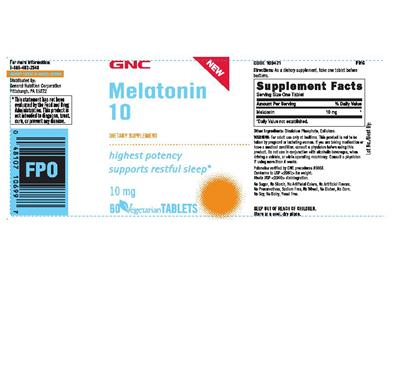
- Form
- Tablet or Pill
- Serving Size
- 1 Tablet
- Container Holds
- 60 Vegetarian Tablets
- Status
- No longer sold, per the NIH record
What’s in it, whether it interacts with your drugs, its side effects, whether it works, and what our pharmacists would want you to know before you start it.
- What is Melatonin 10?A single-ingredient supplement from GNC, in tablet form.
- Active Ingredients Melatonin 10 mg One active ingredient. We check it for drug interactions and side effects. The full Supplement Facts
- Drug Interactions 1,463 drugs have a documented interaction with this supplement; the most serious is rated moderate. Of those, 1,017 are single drugs and 446 are combination products (two or more drugs in one), each listed under its own name. Ask your pharmacist first if you take a drug in any of these categories, the most serious of the 18 on record:
- Moderate · 418 drugs
- Moderate · 248 drugs
- Moderate · 186 drugs
- Moderate · 172 drugs
- Possible Side EffectsDaytime drowsiness or grogginessHeadacheDizzinessNausea From its one active ingredient, Melatonin. Not studied in this exact product.
- Well documented Why
Does Melatonin 10 work?
How It Is Marketed
To support restful sleep
From the claims on the product’s label.
The Closest Use the Research Grades
Delayed sleep phase syndrome (DSPS)
Good studies support it.
Melatonin has research behind other uses too:
- Non-24-hour sleep wake disorder
These grades are for the ingredient, not this exact product, and never a promise it will work for you.
And 4 more graded uses, in what the research says- Full Why
- AllergensNone of its ingredient names point to a major food allergen
- Barcode (UPC)0 48107 10699 7Match it to the barcode on your bottle to be sure this is your product. Not your product? Search for it here
Who Might Consider It
- People who want it to support restful sleep, which is how it is marketed. The closest use the research grades is delayed sleep phase syndrome (DSPS), rated Likely Effective.
- People who want it for non-24-hour sleep wake disorder, hypertension or another graded use: the other uses with research behind them. See each grade
More Before You Take It Show all three answersHide Its Melatonin Amount vs. Other Supplements Pregnancy and Breastfeeding The Label’s Directions
-
How does its Melatonin amount compare with other supplements?
- Melatonin10 mgMore than most of the 548 recent Melatonin products in our database that state an amount; 3 mg is the most common.
A label’s amount is what the product holds, not a recommended dose.
See the Melatonin comparison -
Pregnant or breastfeeding?
- Pregnancy
- ! When used orally or parenterally in high doses or with frequent use.
- Breastfeeding
- Insufficient reliable information available; avoid using.
-
How does the label say to take it?
“Directions: As a dietary supplement, take one tablet before bedtime.”
The maker’s words. Your pharmacist or doctor may advise differently.
Everything the label says
From the label dated Mar 23, 2012: its one active ingredient was checked against our records. A summary of what is known, not a grade or a test of the product. How these ratings are computed
Ask Anything About This Supplement
Name a drug you take, or ask about side effects, ingredients or pregnancy.
AI answers come from this label and our own records, never the open internet. AI can make mistakes, so always check with your doctor or pharmacist. How we use AI
Ask the Pharmacist
A licensed pharmacist will answer your question by email — free, usually within 24 hours.
Got it — thank you!
A licensed pharmacist will answer within 24 hours. Keep an eye on your email (worth checking spam, just in case).
What’s Inside Melatonin 10 by GNC
One Active Ingredient: Melatonin
Everything this page says about drug interactions and side effects comes from what is known about Melatonin.
Why this rating?
The label gives the exact amount of its one active ingredient, so you know how much you get in each serving. This rates what the label tells you, not the quality of the product.
Supplement Facts
| Amount Per Serving | % Daily Value | |
|---|---|---|
| Melatonin | 10 mg | † |
Other ingredients: Dicalcium Phosphate, Cellulose
† Daily Value not established.
Daily Values for adults and children 4 or more years of age.
As the label prints it, from the NIH Dietary Supplement Label Database.
Each Ingredient and Its Drug Interactions
Tap one for more about it and its full guide.
-
Melatonin 10 mg Interacts with 1,463 drugs
Melatonin is a hormone your body makes naturally to help control your sleep-wake cycle, and the supplement form is widely used to help with sleep timing problems and jet lag.
- The evidence is strongest for certain circadian (body-clock) disorders and is more mixed for everyday insomnia.
- It is generally well tolerated for short-term use, but talk with your pharmacist or doctor before starting, especially for children or during pregnancy.
The full Melatonin guide: uses, dosage and safety Every Melatonin drug interaction
How Much Melatonin Is in It, Compared With Other Supplements
Each bar is an amount that other recent supplements list for the same ingredient. The taller the bar, the more of them state it.
-
10 mg in a serving of this product
More than most products
- Most common amount
- 3 mg (about 28 in 100 products)
- Most products state
- 1 mg to 10 mg
- Compared with
- 548 recent products
Other Ingredients (Inactive)
The capsule or tablet itself, fillers, coatings and flavors. Not part of the drug interaction check; the allergen check below reads them.
- Dicalcium Phosphate
- Cellulose
Allergens in Melatonin 10
None of its ingredient names point to a major food allergen.
Not named in the ingredients
- Milk
- Egg
- Fish
- Shellfish
- Tree nuts
- Peanuts
- Wheat or other gluten grains
- Soy
- Sesame
- Made without, the label says“No Sugar, No Starch, No Artificial Colors, No Artificial Flavors, No Preservatives, Sodium Free, No Wheat, No Gluten, No Corn, No Soy, No Dairy, Yeast Free.”
From the label text and ingredient names on file; we do not test products. With a serious allergy, check your bottle and ask the maker or your pharmacist.
What the Label Says
The maker’s own words, from the label. We do not verify or endorse them.
- Storage
-
“Store in a cool, dry place.”
- General statements
-
“NEW”
“highest potency supports restful sleep*”
3 more from the label
“10 mg”
“Lot No./Best By:”
“Potencies verified by GNC procedures #5008. Conforms to <2091> for weight. Meets USP <2040> disintegration.”
- FDA Statement of Identity
-
“DIETARY SUPPLEMENT”
- General
-
“CODE 109421 FMG”
The Melatonin 10 Label on File
The label scan on file at the NIH Dietary Supplement Label Database, dated March 2012. Always read the label on the bottle you have.
Product Facts
- Brand
- GNC
- Barcode (UPC)
- 048107106997
- Net contents
- 60 Vegetarian Tablets
- Market status
- Off market
- Date entered into DSLD
- Mar 23, 2012
- DSLD ID
- 7081
- Product type
- Non-nutrient/non-botanical
- Supplement form
- Tablet or Pill
- Dietary claims / uses
- All Other, Structure/Function
- Intended target group(s)
- Adult (18 - 50 Years), Gluten Free, Dairy Free, Sugar Free
Is this label outdated? Report a formula or label change and our pharmacy team will review it.
Melatonin 10 by GNC Side Effects
Why this rating?
We look for three kinds of safety information on each ingredient: side effects reported in studies, a pregnancy and breastfeeding rating, and a safety write-up from our pharmacy team. All three are on file for Melatonin.
So this rates how much is known, not whether Melatonin 10 is right for you.
Reported with Melatonin, its active ingredient
- Most often
- Daytime drowsiness or grogginess, headache, dizziness and nausea
- !Rare but serious
- Reported with Melatonin See details
Side Effects Reported With Melatonin
Melatonin 10 Warnings: Who Should Be Careful
These warnings are for Melatonin, its one active ingredient. If any of these apply to you, talk to your doctor or pharmacist before you start it.
-
Autoimmune Conditions
- Talk with a healthcare provider before giving melatonin to a child or teen, and before using it if you have a seizure disorder, an autoimmune condition, depression, or other ongoing health problems.
-
Children
- Because it is a hormone, some experts have raised questions about effects on hormones and development, especially in children.
-
What the Label Warns
- “KEEP OUT OF REACH OF CHILDREN.”
- “WARNING: For adult use only at bedtime.”
- “This product is not to be taken by pregnant or lactating women. If you are taking medication or have a medical condition, consult a physician before using this product.”
- “Do not use this product in conjunction with alcoholic beverages, when driving a vehicle, or while operating machinery. Consult a physician if using more than 4 weeks.”
The maker’s wording, from the product label.
-
Pregnant or Breastfeeding
The rating for pregnancy and for breastfeeding, and what it covers.
Pregnancy
-
When used orally or parenterally in high doses or with frequent use.
High doses of melatonin 75-300 mg daily seem to inhibit ovulation, causing a contraceptive effect.
6 more points on this rating
- Advise pregnant patients and patients wishing to become pregnant to avoid using melatonin frequently or in high doses.
- There is insufficient reliable information available about the safety of melatonin in lower doses during pregnancy.
- Some research shows that taking melatonin 2 mg daily does not affect anterior pituitary hormone levels in females who are not pregnant; this suggests that low doses may not have a contraceptive effect.
- Other research shows that taking melatonin 3 mg daily during the follicle stimulating stage of in vitro fertilization does not negatively impact pregnancy rates.
- However, it is not known if melatonin is safe for use throughout pregnancy.
- Until more is known about the safety of melatonin, avoid using during pregnancy.
Breastfeeding
-
Insufficient reliable information available; avoid using.
Ratings and the words beside them are from the Natural Medicines database, which we license.
The full record, with its sources, in the Melatonin guide -
Rare but Serious Side Effects
-
!
Melatonin
Serious side effects are rare.
Orally: There is concern that melatonin may increase the risk for seizure.
When to get help: a serious allergic reaction, with trouble breathing or swelling of the face, lips or throat, needs emergency care: call 911. For any other side effect that worries you, call your doctor or pharmacist.
These reports describe each ingredient, not studies of this exact product. Not medical advice: a side effect you notice after starting a supplement is worth a word with your pharmacist or doctor.
Melatonin 10 by GNC Drug Interactions
This supplement has one active ingredient, Melatonin, and we checked it against every drug in our records.
A moderate interaction on record
2 of 3, on a scale from Minor or none to Major.Why this rating?
We rate this by the most serious interaction on record, not by how many there are. For Melatonin, the most serious is rated moderate, which means it calls for caution, and sometimes monitoring or a change in timing or dose. Some involve kinds of drugs where a small change can matter, such as blood thinners, seizure drugs and transplant drugs.
1,464 drugs are on the full list. What matters is whether one you take is on it, so check yours with the interaction checker on this page.
Its one active ingredient has drug interactions on record: Melatonin.
Melatonin
- Interacts with
- 1,463 drugs
- Most serious
- Moderate
The kinds of drugs it affects most
- 645 drugs
- 418 drugs
- 248 drugs
- 193 drugs
Every Melatonin drug interaction, 18 records The Melatonin records cite 119 references, listed in the Melatonin guide.
The Breakdown by Severity
Each drug counted once, at its most serious rating. Tap a tile to list those drugs.
Find Your Drug
Type a drug or brand name to see whether it is on the list.
- Only drugs with a documented interaction are listed, the most serious first.
- A drug with no known interaction is not listed, but searching its name tells you so.
- Open a drug to see which ingredient is responsible. Of those, 1,017 are single drugs and 446 are combination products (two or more drugs in one), each listed under its own name.
-
PrimidoneMysoline Moderate
The ingredient responsible:
-
Melatonin Moderate Primidone is in these Anticonvulsants, CNS Depressants categories.
Theoretically, melatonin may reduce the effects of anticonvulsants.
The full Melatonin + Primidone interaction
-
-
MoxifloxacinAvelox Moderate
The ingredient responsible:
-
Melatonin Moderate Moxifloxacin is in the Seizure Threshold Lowering Drugs category.
Theoretically, taking melatonin with drugs that lower the seizure threshold might increase the risk of seizure activity.
The full Melatonin + Moxifloxacin interaction
-
-
CenobamateXcopri Moderate
The ingredient responsible:
-
Melatonin Moderate Cenobamate is in these Anticonvulsants, CNS Depressants categories.
Theoretically, melatonin may reduce the effects of anticonvulsants.
The full Melatonin + Cenobamate interaction
-
-
LidocaineDilocaine, Duo-Trach Kit, Lidoderm, Lidoject-1, Lidoject-2 and 5 more Moderate
The ingredient responsible:
-
Melatonin Moderate Lidocaine is in these Cytochrome P450 2D6 (CYP2D6) Substrates, Cytochrome P450 3A4 (CYP3A4) Substrates, Seizure Threshold Lowering Drugs categories.
Theoretically, melatonin might increase levels of drugs metabolized by CYP2D6.
The full Melatonin + Lidocaine interaction
-
-
Buprenorphine/naloxoneSuboxone Moderate
The ingredient responsible:
-
Melatonin Moderate Buprenorphine/naloxone is in these Seizure Threshold Lowering Drugs, Cytochrome P450 3A4 (CYP3A4) Substrates, CNS Depressants categories.
Theoretically, taking melatonin with drugs that lower the seizure threshold might increase the risk of seizure activity.
The full Melatonin + Buprenorphine/naloxone interaction
-
-
NelarabineAtriance Moderate
The ingredient responsible:
-
Melatonin Moderate Nelarabine is in these Immunosuppressants, CNS Depressants, Seizure Threshold Lowering Drugs categories.
Theoretically, melatonin might interfere with immunosuppressive therapy.
The full Melatonin + Nelarabine interaction
-
-
ChlorpheniramineChlor-Trimeton, Teldrin Moderate
The ingredient responsible:
-
Melatonin Moderate Chlorpheniramine is in these Seizure Threshold Lowering Drugs, Cytochrome P450 3A4 (CYP3A4) Substrates categories.
Theoretically, taking melatonin with drugs that lower the seizure threshold might increase the risk of seizure activity.
The full Melatonin + Chlorpheniramine interaction
-
-
QuinethazoneHydromox Moderate
The ingredient responsible:
-
Melatonin Moderate Quinethazone is in the Antihypertensive Drugs category.
Theoretically, taking melatonin with antihypertensive drugs might increase the risk of hypotension or hypertension.
The full Melatonin + Quinethazone interaction
-
-
Mefenamic AcidPonstel Moderate
The ingredient responsible:
-
Melatonin Moderate Mefenamic Acid is in the Seizure Threshold Lowering Drugs category.
Theoretically, taking melatonin with drugs that lower the seizure threshold might increase the risk of seizure activity.
The full Melatonin + Mefenamic Acid interaction
-
-
TiclopidineTiclid, Ticlopidine Moderate
The ingredient responsible:
-
Melatonin Moderate Ticlopidine is in the Anticoagulant/Antiplatelet Drugs category.
Theoretically, melatonin may have anticoagulant effects and may increase the risk of bleeding if used with anticoagulant or antiplatelet drugs.
The full Melatonin + Ticlopidine interaction
-
-
AgomelatineValdoxan Moderate
The ingredient responsible:
-
Melatonin Moderate Agomelatine is in these Cytochrome P450 1A2 (CYP1A2) Substrates, Cytochrome P450 2C19 (CYP2C19) Substrates categories.
Theoretically, melatonin might increase levels of drugs metabolized by CYP1A2.
The full Melatonin + Agomelatine interaction
-
-
SiponimodMayzent Moderate
The ingredient responsible:
-
Melatonin Moderate Siponimod is in these Cytochrome P450 3A4 (CYP3A4) Substrates, Immunosuppressants categories.
Theoretically, melatonin might increase levels of drugs metabolized by CYP3A4.
The full Melatonin + Siponimod interaction
-
-
CefazolinAncef Moderate
The ingredient responsible:
-
Melatonin Moderate Cefazolin is in the Seizure Threshold Lowering Drugs category.
Theoretically, taking melatonin with drugs that lower the seizure threshold might increase the risk of seizure activity.
The full Melatonin + Cefazolin interaction
-
-
CeliprololCelicard Moderate
The ingredient responsible:
-
Melatonin Moderate Celiprolol is in the Antihypertensive Drugs category.
Theoretically, taking melatonin with antihypertensive drugs might increase the risk of hypotension or hypertension.
The full Melatonin + Celiprolol interaction
-
-
Inhaled InsulinExubera Moderate
The ingredient responsible:
-
Melatonin Moderate Inhaled Insulin is in the Antidiabetes Drugs category.
Theoretically, taking melatonin with antidiabetes drugs might increase the risk of hypoglycemia.
The full Melatonin + Inhaled Insulin interaction
-
-
MidazolamNayzilam, Seizalam, Versed Moderate
The ingredient responsible:
-
Melatonin Moderate Midazolam is in these Cytochrome P450 3A4 (CYP3A4) Substrates, CNS Depressants categories.
Theoretically, melatonin might increase levels of drugs metabolized by CYP3A4.
The full Melatonin + Midazolam interaction
-
-
PhenacemidePhenurone Moderate
The ingredient responsible:
-
Melatonin Moderate Phenacemide is in these Anticonvulsants, CNS Depressants categories.
Theoretically, melatonin may reduce the effects of anticonvulsants.
The full Melatonin + Phenacemide interaction
-
-
StreptokinaseKabikinase, Streptase Moderate
The ingredient responsible:
-
Melatonin Moderate Streptokinase is in the Anticoagulant/Antiplatelet Drugs category.
Theoretically, melatonin may have anticoagulant effects and may increase the risk of bleeding if used with anticoagulant or antiplatelet drugs.
The full Melatonin + Streptokinase interaction
-
-
VildagliptinGalvus Moderate
The ingredient responsible:
-
Melatonin Moderate Vildagliptin is in the Antidiabetes Drugs category.
Theoretically, taking melatonin with antidiabetes drugs might increase the risk of hypoglycemia.
The full Melatonin + Vildagliptin interaction
-
-
Dasiglucagon HydrochlorideZegalogue Moderate
The ingredient responsible:
-
Melatonin Moderate Dasiglucagon Hydrochloride is in the Antidiabetes Drugs category.
Theoretically, taking melatonin with antidiabetes drugs might increase the risk of hypoglycemia.
The full Melatonin + Dasiglucagon Hydrochloride interaction
-
-
RiociguatAdempas Moderate
The ingredient responsible:
-
Melatonin Moderate Riociguat is in these Cytochrome P450 3A4 (CYP3A4) Substrates, Antihypertensive Drugs categories.
Theoretically, melatonin might increase levels of drugs metabolized by CYP3A4.
The full Melatonin + Riociguat interaction
-
-
MoexiprilUnivasc Moderate
The ingredient responsible:
-
Melatonin Moderate Moexipril is in the Antihypertensive Drugs category.
Theoretically, taking melatonin with antihypertensive drugs might increase the risk of hypotension or hypertension.
The full Melatonin + Moexipril interaction
-
-
Treprostinil (oral)Orenitram, Remodulin Moderate
The ingredient responsible:
-
Melatonin Moderate Treprostinil (oral) is in these Anticoagulant/Antiplatelet Drugs, Antihypertensive Drugs categories.
Theoretically, melatonin may have anticoagulant effects and may increase the risk of bleeding if used with anticoagulant or antiplatelet drugs.
The full Melatonin + Treprostinil (oral) interaction
-
-
SirolimusRapamune Moderate
The ingredient responsible:
-
Melatonin Moderate Sirolimus is in these Immunosuppressants, Cytochrome P450 3A4 (CYP3A4) Substrates categories.
Theoretically, melatonin might interfere with immunosuppressive therapy.
The full Melatonin + Sirolimus interaction
-
-
GuanfacineTenex Moderate
The ingredient responsible:
-
Melatonin Moderate Guanfacine is in the Antihypertensive Drugs category.
Theoretically, taking melatonin with antihypertensive drugs might increase the risk of hypotension or hypertension.
The full Melatonin + Guanfacine interaction
-
-
CyproheptadinePeriactin Moderate
The ingredient responsible:
-
Melatonin Moderate Cyproheptadine is in the Seizure Threshold Lowering Drugs category.
Theoretically, taking melatonin with drugs that lower the seizure threshold might increase the risk of seizure activity.
The full Melatonin + Cyproheptadine interaction
-
-
RituximabRituxan Moderate
The ingredient responsible:
-
Melatonin Moderate Rituximab is in the Immunosuppressants category.
Theoretically, melatonin might interfere with immunosuppressive therapy.
The full Melatonin + Rituximab interaction
-
-
IoversolOptiray Moderate
The ingredient responsible:
-
Melatonin Moderate Ioversol is in the Seizure Threshold Lowering Drugs category.
Theoretically, taking melatonin with drugs that lower the seizure threshold might increase the risk of seizure activity.
The full Melatonin + Ioversol interaction
-
-
IloprostAurlumyn, Ventavis Moderate
The ingredient responsible:
-
Melatonin Moderate Iloprost is in these Anticoagulant/Antiplatelet Drugs, Antihypertensive Drugs categories.
Theoretically, melatonin may have anticoagulant effects and may increase the risk of bleeding if used with anticoagulant or antiplatelet drugs.
The full Melatonin + Iloprost interaction
-
-
UrokinaseAbbokinase Moderate
The ingredient responsible:
-
Melatonin Moderate Urokinase is in the Anticoagulant/Antiplatelet Drugs category.
Theoretically, melatonin may have anticoagulant effects and may increase the risk of bleeding if used with anticoagulant or antiplatelet drugs.
The full Melatonin + Urokinase interaction
-
Does It Work? Melatonin 10 by GNC
What the research says so far. A grade is the research so far, never an endorsement.
How It Is Marketed
To support restful sleep
From the claims on the product’s label.
Closest match for what it is marketed for
Melatonin for delayed sleep phase syndrome (DSPS)
Good studies support it.
One use we did not count
- Postoperative sleep disturbance: it is treated by a doctor or in a hospital.
What the Research Says About Melatonin
Its uses graded effective, likely effective or possibly effective:
Research suggests a benefit for
- Delayed sleep phase syndrome (DSPS) (the use on its label) and non-24-hour sleep wake disorder
- Hypertension, temporomandibular disorders (TMD), thrombocytopenia, jet lag and beta blocker-induced insomnia
Not counted here: one graded use is for Melatonin injected or put on the skin (sunburn), not for a product like this one. Three more are for conditions treated by a doctor or in a hospital (pre-procedural anxiety, emergence delirium and pre-procedural sedation).
Every graded use, in the Melatonin guideThe grades are the Natural Medicines database’s, which we license; tap a grade for what it means. They are about each ingredient, not this exact product.
About GNC
Manufacturer and brand details for Melatonin 10, from the product label.
GNC has 680 products in our supplement database, 300 of them on the market, with labels on file since 2011. Our database is built from the NIH’s Dietary Supplement Label Database and our pharmacy team’s own additions, so it covers the labels filed there, not every product the brand sells.
- Phone Number
- 1-888-462-2548
Melatonin 10 by GNC: Common Questions
Does Melatonin 10 by GNC interact with any drugs?
What are the side effects of Melatonin 10 by GNC?
Who should be careful taking Melatonin 10 by GNC?
Can Melatonin 10 by GNC affect the liver?
Does Melatonin 10 by GNC contain any common allergens?
Is Melatonin 10 by GNC gluten free?
How can Melatonin 10 by GNC interact with so many drugs?
Where does the information about Melatonin 10 by GNC come from?
Written and reviewed by the HelloPharmacist Editorial Team. Our editorial policy
Still Have a Question About Melatonin 10?
Our pharmacists answer drug and supplement questions, free, by email.
Label information is sourced from the NIH Dietary Supplement Label Database and reflects the product version on file; always read your actual product label. This page is for education only and is not a substitute for professional medical advice. Confirm with your pharmacist or doctor before combining supplements and drugs.
Who Reviews This Page
The pharmacist behind it, and how it is checked.
Dr. Brian Staiger, PharmD, BCPS
Clinical pharmacist and founder of HelloPharmacist
A licensed pharmacist for more than 13 years, he built the system behind this page: it reads the label on file, matches each active ingredient to its record in the Natural Medicines database, checks those records against every drug we cover, and our pharmacy team writes the take and the interaction summary from those records.
- 13+ Years in PharmacyRetail and clinical pharmacy, medication safety and healthcare administration.
- Board Certified (BCPS)A pharmacotherapy specialist, certified by the Board of Pharmacy Specialties.
- Herbalist TrainingCertificates in medical ethnobotany, for the herbs and supplements people take.
Where This Page Comes From
Melatonin 10’s label data comes from the NIH Dietary Supplement Label Database; the ingredient interaction data is from the Natural Medicines database, reviewed by our pharmacists.
- NIH Dietary Supplement Label Database (DSLD)
- The official product label on file for this supplement.
- Natural Medicines (Therapeutic Research Center)
- The evidence-graded clinical reference behind the ingredient interaction, evidence and safety records, which we license.
- HelloPharmacist Editorial Team
- Content is reviewed by the HelloPharmacist Editorial Team, the pharmacists on our staff and those we contract. See our data sources and editorial standards for how this information is built and checked.
- The ratings in the Quick Summary
- They summarize available label information, ingredient evidence and known drug-safety records: a summary of what is known, not a grade of the product itself. They do not verify product identity, purity, potency, contamination or manufacturing quality. How these ratings are computed
The References Behind the Interaction Records
Every citation the ingredients’ records rest on is listed in that ingredient’s guide, in context: Melatonin, 119 references .
Parts of this content are provided by the Therapeutic Research Center, LLC.
DISCLAIMER: Currently this does not check for drug-drug interactions. This is not an all-inclusive comprehensive list of potential interactions and is for informational purposes only. Not all interactions are known or well-reported in the scientific literature, and new interactions are continually being reported. Input is needed from a qualified healthcare provider including a pharmacist before starting any therapy. Application of clinical judgment is necessary.
© 2021 Therapeutic Research Center, LLC
Keep Exploring
- Supplement interaction checkerCheck any supplement or product against your drugs
- Drug–drug interactionsCheck two or more of your drugs against each other
- Browse drugs A to ZEvery drug we have checked against herbs and supplements
- NDC and pricing lookupFind a drug’s NDCs, packaging and costs
- Ask a pharmacistA free, personal answer from our licensed team