
Men's Quantum Fuel Ingredients & Drug Interactions
What is this page for?
First and foremost: checking Men's Quantum Fuel against your medications. The heart of this page is the interaction checker and the full interaction report — how this product’s ingredients may interact with prescription and over-the-counter medicines you may be taking.
Around that, we add a pharmacist’s high-level view of the product as a whole — what’s inside, the evidence for its stated use, how transparent the label is, and what safety data exists — so you can see the full picture in one place. It’s educational information from our licensed clinical databases and the clinical staff at HelloPharmacist — not medical advice — and we don’t sell or endorse products. Our editorial policy
Men's Quantum Fuel is a dietary supplement by Quantum Nutrition Labs with 3 active ingredients. Its ingredients are commonly taken for low testosterone or low libido in men, male fertility support, athletic performance and muscle strength.Based on those ingredients, 1,480 medications have a known interaction with it, the most serious rated major. The ingredients most likely to interact are LJ100, Cordyceps Performance Blend, Saw Palmetto Power Matrix. Use the checker below to test your specific medication, or read the full HelloPharmacist Interaction Report.
Check Your Meds Against Men's Quantum Fuel by Quantum Nutrition Labs
Ask about any prescription or over-the-counter medication and we check it for interactions with Men's Quantum Fuel by Quantum Nutrition Labs — and tell you which ingredient is responsible.
AI summaries are generated from our interaction database for education only — always confirm with your pharmacist. How we use AI
Ask the Pharmacist
A licensed pharmacist will answer your question by email — free, usually within 24 hours.
Got it — thank you!
A licensed pharmacist will answer within 24 hours. Keep an eye on your email (worth checking spam, just in case).
HelloPharmacist Scorecard of Men's Quantum Fuel by Quantum Nutrition Labs
Our pharmacy team’s full take, with four database checks built into the cards below — a summary of what is known, not a grade of the product itself.
What’s inside
Low disclosure
Men's Quantum Fuel contains 10 active ingredients. Cayenne (capsicum) is included for its warming properties.
Maca is a root traditionally used in supplement formulas. Turmeric brings curcumin, a compound studied for various health areas.
American ginseng, reishi mushroom, and cordyceps are traditional ingredients used in wellness blends. Saw palmetto is included in a proprietary blend.
Cacao adds cocoa extract (which contains caffeine). LJ100 is a standardized extract of eurycoma longifolia root.
Olive rounds out the formula. The product also contains cellulose and water as inactive ingredients.
Does it work?
Not established
The evidence for these ingredients is mixed. Cayenne is likely effective for nerve pain after shingles (postherpetic neuralgia) and diabetic nerve pain, and possibly effective for cluster headache, back pain, and nausea after surgery.
Maca, turmeric, American ginseng, reishi, saw palmetto, LJ100, olive, and cordyceps all show insufficient evidence or lack strong clinical backing for most of the conditions they're used for — though turmeric is possibly effective for depression, high cholesterol, hay fever, and indigestion, cacao is possibly effective for heart disease, and LJ100 is possibly effective for sexual desire. For most other uses listed in the research, the evidence simply isn't established in the data we hold.
How safe is it?
Well-documented data
Cayenne is generally well tolerated in food amounts but can cause burning and irritation, and medicinal doses aren't well studied. Maca may cause stomach pain if consumed fresh or uncooked; supplement safety long-term hasn't been studied.
Turmeric is generally safe as food but concentrated supplements may cause constipation, indigestion, or diarrhea, and rare cases of liver damage have been reported with long-term use. American ginseng is generally well tolerated short-term but may cause headache and quality varies.
Reishi mushroom is generally well tolerated but may cause dizziness, dry mouth, itching, nausea, or rash. Saw palmetto is well tolerated but may rarely cause a rash or heart effects.
Cacao contains caffeine and typically causes minor digestive symptoms. LJ100 is generally tolerated short-term but may carry testosterone-related risks if levels rise too high.
Cordyceps is generally well tolerated but rare liver inflammation has been reported. Olive is very safe in food and oil form.
Meds to double-check
Major interaction found
Before taking this product, double-check with your doctor or pharmacist if you take: warfarin or other blood thinners and antiplatelet drugs (major risk); chemotherapy drugs, immunosuppressants, diabetes medications, or blood pressure drugs (moderate risk across multiple ingredients); or theophylline, aspirin, antidepressants (particularly MAOIs), estrogens, contraceptives, or quinolone antibiotics (moderate risk from specific ingredients). No interactions are documented for the olive leaf extract we could check, but that absence isn't a guarantee none exist.
The bottom line
Scorecard at a glanceFormula with limited ingredient disclosure with no established evidence rating for its marketed use. Major medication interactions have been identified, and safety information is well characterized.
This is a complex multi-ingredient formula with real medication interactions, most notably with blood thinners, diabetes drugs, chemotherapy, and blood pressure medications. If you take any prescription medications—especially for heart, blood clotting, cancer, diabetes, or mood—talk it over with your doctor or pharmacist before starting.
The ingredients are generally well tolerated in supplement doses, but long-term safety data is sparse for most of them. This product isn't right for everyone, so personalized guidance from your own healthcare provider is essential.
Educational only — not medical advice; always confirm with your pharmacist. Our editorial policy · How we use AI
Assessment coverage: 10 of 10 active ingredients matched to our full ingredient reviews (monographs). Based on the product label dated Jun 20, 2024.
This Scorecard evaluates available label information, ingredient evidence, and known medication-safety considerations. It does not independently verify product identity, purity, potency, contamination, or manufacturing quality. How these ratings are computed
General information
Key facts about Men's Quantum Fuel, straight from the product label.
| Brand | Quantum Nutrition Labs |
|---|---|
| Barcode (UPC) | 807735120917 |
| Net contents | 45 Plant-Source Capsule(s) |
| Market status | On market |
| Date entered into DSLD | Jun 20, 2024 |
| DSLD ID | 302380 |
| Product type | Botanical |
| Supplement form | Capsule |
| Dietary claims / uses | All Other, Structure/Function |
| Intended target group(s) | Adult Male (18-50 Years) |
Everything in this section is reproduced from the manufacturer’s own product label — it’s the label speaking, not HelloPharmacist. We show it so you can see exactly what the maker states; we don’t verify or endorse those statements.
Supplement Facts
The label details for Men's Quantum Fuel by Quantum Nutrition Labs, sourced from the NIH Dietary Supplement Label Database.
Supplement Facts
| Ingredient | Amount | % DV |
|---|---|---|
| Cayenne | 0 NP | -- |
| Maca | 0 NP | -- |
| Turmeric | 0 NP | -- |
| American Ginseng | 0 NP | -- |
| Reishi | 0 NP | -- |
| Saw Palmetto | 0 NP | -- |
| Cacao | 0 NP | -- |
| LJ100 | 100 mg | -- |
| Olive | 0 NP | -- |
| Cordyceps Performance Blend | 460 mg | -- |
| Cordyceps sinensis Mycelia Extract, Fermented | 0 NP | -- |
| Saw Palmetto Power Matrix | 300 mg | -- |
Other ingredients: Cellulose, Water
Tap any ingredient to jump to its full detail below.
These statements are the manufacturer’s wording, reproduced from the product label — the label is saying it, not HelloPharmacist. We don’t verify or endorse them.
Suggested/Recommended/Usage/Directions
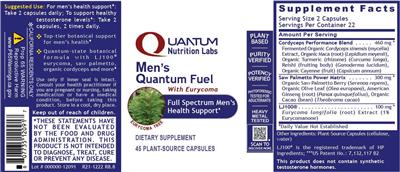
Suggested use: For men's health support: Take 2 capsules daily; To support healthy testosterone levels: Take 2 capsules, 2 times daily.
Precautions
California residents only Prop 65 warning Reproductive harm www.P65warnings.ca.gov
Use only if inner seal is intact.
Consult your health practitioner if you are pregnant or nursing, taking medication or have a medical condition, before taking this product.
Keep out of reach of children.
Formula
Top-tier botanical support for men's health Quantum-state botanical formula with LJ100 eurycoma, saw Palmetto, organic Cordyceps and more
Men's Quantum Fuel with Eurycoma Eurycoma tree
Full spectrum men's health support
Storage
Store in a cool, dry place.
FDA Disclaimer Statement
These statements have not been evaluated by the Food and Drug Administration. This product is not intended to diagnose, treat, cure or prevent any disease.
FDA Statement of Identity
Dietary Supplement
Formulation
Plant based Purity verified Potency verified
This product does not contain synthetic testosterone hormones.
Phytoforensic tested for adulterants Heavy metal tested
General Statements
Scan to discover more
Brand IP Statement(s)
LJ100 is the registered trademark of HP Ingredients, US Paten No.: 7,132,117 B2
Is this label outdated? Report a formula or label change and our pharmacy team will review it.
Men's Quantum Fuel by Quantum Nutrition Labs label
The label scan from the NIH Dietary Supplement Label Database. Tap to enlarge.
Label images are published by the NIH Dietary Supplement Label Database for the version of this product on file. Always read your actual product label.
View the full label (PDF)The Ingredients in Men's Quantum Fuel by Quantum Nutrition Labs
These are the 3 active ingredients this product is made of. Select any to open its full monograph.
Serving size2 Capsule(s) Dosage formCapsule Servings per container22 Amounts shown are per serving.
Most supplement products combine several ingredients, and a medication can interact with the product through any one of them. Each ingredient below shows whether it has known drug interactions.
LJ100
Interacts with249 drugs
Eurycoma longifolia (tongkat ali) is a Southeast Asian herb most popular for supporting testosterone, libido, and male fertility, with some small huma...
LJ100 monograph & interactionsCordyceps Performance Blend
Interacts with249 drugs
Cordyceps is a fungus used in traditional Chinese medicine for energy, exercise performance, and lung and immune support. Human research is limited an...
Cordyceps Performance Blend monograph & interactionsSaw Palmetto Power Matrix
Interacts with174 drugs
Saw palmetto is a plant extract most often used for urinary symptoms linked to an enlarged prostate (BPH). The best research suggests it works no bett...
Saw Palmetto Power Matrix monograph & interactions- › American Ginseng
- › Saw Palmetto
- › Cacao
- › Olive
Other (inactive) ingredients: Cellulose, Water. These complete the product’s ingredient list but are not active constituents.
Men's Quantum Fuel by Quantum Nutrition Labs Drug Interactions
HelloPharmacist Interaction Report
Men's Quantum Fuel by Quantum Nutrition Labs contains several ingredients that interact with medications: cayenne, turmeric, American ginseng, reishi, saw palmetto, cacao, LJ100 (eurycoma), and cordyceps.
The most serious documented interaction is American ginseng with warfarin (a blood thinner), which can reduce warfarin's effectiveness and increase clotting risk — this is a Major severity concern.
Read the full breakdown — every affected drug type, severity by severity
Cayenne interacts with blood thinners and antiplatelet drugs (moderate risk of bleeding), diabetes medications (risk of low blood sugar), theophylline, aspirin, and some blood pressure and antibiotic medications. Turmeric has moderate interactions with several chemotherapy drugs, tacrolimus (an immunosuppressant), tamoxifen (a cancer drug), sulfasalazine, methotrexate, tramadol, and certain drug transporters.
American ginseng also affects diabetes drugs, immunosuppressants, and monoamine oxidase inhibitors (MAOIs). Reishi interacts with blood pressure medications, blood thinners, and diabetes drugs.
Saw palmetto may reduce the effectiveness of estrogens and contraceptives, and raises bleeding risk with anticoagulants. Cacao contains caffeine and interacts with ephedrine, dipyridamole, barbiturates, quinolone antibiotics, beta-agonists, flutamide, disulfiram, and blood pressure medications.
LJ100 (eurycoma) reduces propranolol levels and theoretically affects certain liver enzymes and testosterone. Cordyceps may increase bleeding risk with anticoagulants and antiplatelet drugs and could interfere with immunosuppressants.
Altogether, these interactions span 1,481 individual medications. We could not check olive leaf for interactions — no data is on file for it.
Run your exact medications through the checker below before starting this product.
Check your own medications below · Editorial policy · How we use AI
Want to check YOUR meds against Men's Quantum Fuel?
Ask about interactions with your drugs in plain English — “Can I take it with lisinopril?” — and we find you the answer in seconds, ingredient by ingredient.
Go to the checkerIngredients driving the most interactions
Individual Drug Interactions
The ingredients in Men's Quantum Fuel interact with 1,480 drugs. Click any drug to see the details.
3 of the 3 ingredients in Men's Quantum Fuel interact with drugs. Each result below shows which ingredient is responsible. LJ100 Cordyceps Performance Blend Saw Palmetto Power Matrix
WarfarinWarfarin
How Warfarin interacts with Men's Quantum Fuel — through 8 ingredients. Tap an ingredient for the detail:
American GinsengWarfarin (coumadin) Major
Interaction Summary
American ginseng seems to decrease the effectiveness of warfarin therapy.
Read the full American Ginseng + Warfarin interactionCordyceps Sinensis Mycelia Extract, FermentedAnticoagulant/antiplatelet Drugs Moderate
Interaction Summary
Theoretically, cordyceps may increase the risk of bleeding when used with antiplatelet or anticoagulant drugs.
Read the full Cordyceps Sinensis Mycelia Extract, Fermented + Warfarin interactionTurmericCytochrome P450 3a4 (cyp3a4) Substrates, Cytochrome P450 1a2 (cyp1a2) Substrates +2 Moderate
Interaction Summary
Turmeric might increase or decrease levels of drugs metabolized by CYP3A4.
Read the full Turmeric + Warfarin interactionCacaoAnticoagulant/antiplatelet Drugs Moderate
Interaction Summary
Theoretically, cocoa may increase the risk of bleeding if used with anticoagulant or antiplatelet drugs.
Read the full Cacao + Warfarin interactionReishiAnticoagulant/antiplatelet Drugs Moderate
Interaction Summary
Theoretically, high doses of reishi mushroom might increase the risk of bleeding.
Read the full Reishi + Warfarin interactionCayenneAnticoagulant/antiplatelet Drugs Moderate
Interaction Summary
Theoretically, capsicum may increase the risk of bleeding if used with anticoagulant or antiplatelet drugs.
Read the full Cayenne + Warfarin interactionSaw Palmetto Power MatrixAnticoagulant/antiplatelet Drugs Moderate
Interaction Summary
Saw palmetto might increase the risk of bleeding with anticoagulant or antiplatelet drugs.
Read the full Saw Palmetto Power Matrix + Warfarin interactionLj100Cytochrome P450 1a2 (cyp1a2) Substrates, Cytochrome P450 2c19 (cyp2c19) Substrates Minor
Interaction Summary
Theoretically, Eurycoma longifolia might increase levels CYP1A2 substrates.
Read the full Lj100 + Warfarin interactionWarfarin SodiumCoumadin, Panwarfin, Sofarin
How Warfarin Sodium interacts with Men's Quantum Fuel — through 8 ingredients. Tap an ingredient for the detail:
American GinsengWarfarin (coumadin) Major
Interaction Summary
American ginseng seems to decrease the effectiveness of warfarin therapy.
Read the full American Ginseng + Warfarin Sodium interactionSaw Palmetto Power MatrixAnticoagulant/antiplatelet Drugs Moderate
Interaction Summary
Saw palmetto might increase the risk of bleeding with anticoagulant or antiplatelet drugs.
Read the full Saw Palmetto Power Matrix + Warfarin Sodium interactionCayenneAnticoagulant/antiplatelet Drugs Moderate
Interaction Summary
Theoretically, capsicum may increase the risk of bleeding if used with anticoagulant or antiplatelet drugs.
Read the full Cayenne + Warfarin Sodium interactionTurmericCytochrome P450 1a2 (cyp1a2) Substrates, Cytochrome P450 3a4 (cyp3a4) Substrates +2 Moderate
Interaction Summary
Theoretically, turmeric might increase levels of drugs metabolized by CYP1A2.
Read the full Turmeric + Warfarin Sodium interactionCordyceps Sinensis Mycelia Extract, FermentedAnticoagulant/antiplatelet Drugs Moderate
Interaction Summary
Theoretically, cordyceps may increase the risk of bleeding when used with antiplatelet or anticoagulant drugs.
Read the full Cordyceps Sinensis Mycelia Extract, Fermented + Warfarin Sodium interactionCacaoAnticoagulant/antiplatelet Drugs Moderate
Interaction Summary
Theoretically, cocoa may increase the risk of bleeding if used with anticoagulant or antiplatelet drugs.
Read the full Cacao + Warfarin Sodium interactionReishiAnticoagulant/antiplatelet Drugs Moderate
Interaction Summary
Theoretically, high doses of reishi mushroom might increase the risk of bleeding.
Read the full Reishi + Warfarin Sodium interactionLj100Cytochrome P450 1a2 (cyp1a2) Substrates, Cytochrome P450 2c19 (cyp2c19) Substrates Minor
Interaction Summary
Theoretically, Eurycoma longifolia might increase levels CYP1A2 substrates.
Read the full Lj100 + Warfarin Sodium interaction6-mercaptopurinePurinethol
How 6-mercaptopurine interacts with Men's Quantum Fuel — through 3 ingredients. Tap an ingredient for the detail:
American GinsengImmunosuppressants Moderate
Interaction Summary
Theoretically, American ginseng use might interfere with immunosuppressive therapy.
Read the full American Ginseng + 6-mercaptopurine interactionTurmericHepatotoxic Drugs Moderate
Interaction Summary
Theoretically, turmeric might increase the risk of liver damage when taken with hepatotoxic drugs.
Read the full Turmeric + 6-mercaptopurine interactionCordyceps Sinensis Mycelia Extract, FermentedImmunosuppressants Moderate
Interaction Summary
Theoretically, concurrent use of cordyceps might interfere with immunosuppressive therapy.
Read the full Cordyceps Sinensis Mycelia Extract, Fermented + 6-mercaptopurine interactionAdo-trastuzumab EmtansineKadcyla
How Ado-trastuzumab Emtansine interacts with Men's Quantum Fuel — through 1 ingredient. Tap an ingredient for the detail:
TurmericCytochrome P450 3a4 (cyp3a4) Substrates Moderate
Interaction Summary
Turmeric might increase or decrease levels of drugs metabolized by CYP3A4.
Read the full Turmeric + Ado-trastuzumab Emtansine interactionAbacavir Sulfate, Dolutegravir, LamivudineTriumeq
How Abacavir Sulfate, Dolutegravir, Lamivudine interacts with Men's Quantum Fuel — through 1 ingredient. Tap an ingredient for the detail:
TurmericHepatotoxic Drugs Moderate
Interaction Summary
Theoretically, turmeric might increase the risk of liver damage when taken with hepatotoxic drugs.
Read the full Turmeric + Abacavir Sulfate, Dolutegravir, Lamivudine interactionAbacavir, LamivudineEpzicom
How Abacavir, Lamivudine interacts with Men's Quantum Fuel — through 1 ingredient. Tap an ingredient for the detail:
TurmericHepatotoxic Drugs Moderate
Interaction Summary
Theoretically, turmeric might increase the risk of liver damage when taken with hepatotoxic drugs.
Read the full Turmeric + Abacavir, Lamivudine interactionAbametapirXeglyze
How Abametapir interacts with Men's Quantum Fuel — through 1 ingredient. Tap an ingredient for the detail:
CacaoCytochrome P450 1a2 (cyp1a2) Inhibitors Moderate
Interaction Summary
Theoretically, concomitant use might increase the levels and adverse effects of caffeine.
Read the full Cacao + Abametapir interactionAbciximabReoPro
How Abciximab interacts with Men's Quantum Fuel — through 6 ingredients. Tap an ingredient for the detail:
Saw Palmetto Power MatrixAnticoagulant/antiplatelet Drugs Moderate
Interaction Summary
Saw palmetto might increase the risk of bleeding with anticoagulant or antiplatelet drugs.
Read the full Saw Palmetto Power Matrix + Abciximab interactionCayenneAnticoagulant/antiplatelet Drugs Moderate
Interaction Summary
Theoretically, capsicum may increase the risk of bleeding if used with anticoagulant or antiplatelet drugs.
Read the full Cayenne + Abciximab interactionCacaoAnticoagulant/antiplatelet Drugs Moderate
Interaction Summary
Theoretically, cocoa may increase the risk of bleeding if used with anticoagulant or antiplatelet drugs.
Read the full Cacao + Abciximab interactionTurmericAnticoagulant/antiplatelet Drugs Moderate
Interaction Summary
Turmeric may have antiplatelet effects and may increase the risk of bleeding if used with anticoagulant or antiplatelet drugs.
Read the full Turmeric + Abciximab interactionReishiAnticoagulant/antiplatelet Drugs Moderate
Interaction Summary
Theoretically, high doses of reishi mushroom might increase the risk of bleeding.
Read the full Reishi + Abciximab interactionCordyceps Sinensis Mycelia Extract, FermentedAnticoagulant/antiplatelet Drugs Moderate
Interaction Summary
Theoretically, cordyceps may increase the risk of bleeding when used with antiplatelet or anticoagulant drugs.
Read the full Cordyceps Sinensis Mycelia Extract, Fermented + Abciximab interactionAbemaciclibVerzenio
How Abemaciclib interacts with Men's Quantum Fuel — through 1 ingredient. Tap an ingredient for the detail:
TurmericCytochrome P450 3a4 (cyp3a4) Substrates Moderate
Interaction Summary
Turmeric might increase or decrease levels of drugs metabolized by CYP3A4.
Read the full Turmeric + Abemaciclib interactionAbiraterone
How Abiraterone interacts with Men's Quantum Fuel — through 2 ingredients. Tap an ingredient for the detail:
TurmericHepatotoxic Drugs, Cytochrome P450 3a4 (cyp3a4) Substrates Moderate
Interaction Summary
Theoretically, turmeric might increase the risk of liver damage when taken with hepatotoxic drugs.
Read the full Turmeric + Abiraterone interactionCacaoCytochrome P450 1a2 (cyp1a2) Inhibitors Moderate
Interaction Summary
Theoretically, concomitant use might increase the levels and adverse effects of caffeine.
Read the full Cacao + Abiraterone interactionAbiraterone AcetateYonsa, Zytiga
How Abiraterone Acetate interacts with Men's Quantum Fuel — through 1 ingredient. Tap an ingredient for the detail:
TurmericHepatotoxic Drugs, Cytochrome P450 3a4 (cyp3a4) Substrates Moderate
Interaction Summary
Theoretically, turmeric might increase the risk of liver damage when taken with hepatotoxic drugs.
Read the full Turmeric + Abiraterone Acetate interactionAbrocitinibCibinqo
How Abrocitinib interacts with Men's Quantum Fuel — through 8 ingredients. Tap an ingredient for the detail:
Cordyceps Sinensis Mycelia Extract, FermentedAnticoagulant/antiplatelet Drugs, Immunosuppressants Moderate
Interaction Summary
Theoretically, cordyceps may increase the risk of bleeding when used with antiplatelet or anticoagulant drugs.
Read the full Cordyceps Sinensis Mycelia Extract, Fermented + Abrocitinib interactionReishiAnticoagulant/antiplatelet Drugs Moderate
Interaction Summary
Theoretically, high doses of reishi mushroom might increase the risk of bleeding.
Read the full Reishi + Abrocitinib interactionSaw Palmetto Power MatrixAnticoagulant/antiplatelet Drugs Moderate
Interaction Summary
Saw palmetto might increase the risk of bleeding with anticoagulant or antiplatelet drugs.
Read the full Saw Palmetto Power Matrix + Abrocitinib interactionCayenneAnticoagulant/antiplatelet Drugs Moderate
Interaction Summary
Theoretically, capsicum may increase the risk of bleeding if used with anticoagulant or antiplatelet drugs.
Read the full Cayenne + Abrocitinib interactionAmerican GinsengImmunosuppressants Moderate
Interaction Summary
Theoretically, American ginseng use might interfere with immunosuppressive therapy.
Read the full American Ginseng + Abrocitinib interactionCacaoAnticoagulant/antiplatelet Drugs Moderate
Interaction Summary
Theoretically, cocoa may increase the risk of bleeding if used with anticoagulant or antiplatelet drugs.
Read the full Cacao + Abrocitinib interactionTurmericAnticoagulant/antiplatelet Drugs Moderate
Interaction Summary
Turmeric may have antiplatelet effects and may increase the risk of bleeding if used with anticoagulant or antiplatelet drugs.
Read the full Turmeric + Abrocitinib interactionLj100Cytochrome P450 2c19 (cyp2c19) Substrates Minor
Interaction Summary
Theoretically, Eurycoma longifolia might increase levels of CYP2C19 substrates.
Read the full Lj100 + Abrocitinib interactionAcalabrutinibCalquence
How Acalabrutinib interacts with Men's Quantum Fuel — through 1 ingredient. Tap an ingredient for the detail:
TurmericP-glycoprotein Substrates, Cytochrome P450 3a4 (cyp3a4) Substrates Moderate
Interaction Summary
Theoretically, turmeric might increase the absorption of P-glycoprotein substrates.
Read the full Turmeric + Acalabrutinib interactionAcarboseGlucobay, Prandase, Precose
How Acarbose interacts with Men's Quantum Fuel — through 4 ingredients. Tap an ingredient for the detail:
TurmericHepatotoxic Drugs, Antidiabetes Drugs Moderate
Interaction Summary
Theoretically, turmeric might increase the risk of liver damage when taken with hepatotoxic drugs.
Read the full Turmeric + Acarbose interactionAmerican GinsengAntidiabetes Drugs Moderate
Interaction Summary
Theoretically, taking American ginseng with antidiabetes drugs might increase the risk of hypoglycemia.
Read the full American Ginseng + Acarbose interactionCayenneAntidiabetes Drugs Moderate
Interaction Summary
Theoretically, taking capsicum with antidiabetes drugs might increase the risk of hypoglycemia.
Read the full Cayenne + Acarbose interactionReishiAntidiabetes Drugs Moderate
Interaction Summary
Theoretically, reishi mushroom might have additive effects with antidiabetes drugs.
Read the full Reishi + Acarbose interactionAcebutololRhotral, Sectral
How Acebutolol interacts with Men's Quantum Fuel — through 3 ingredients. Tap an ingredient for the detail:
TurmericHepatotoxic Drugs Moderate
Interaction Summary
Theoretically, turmeric might increase the risk of liver damage when taken with hepatotoxic drugs.
Read the full Turmeric + Acebutolol interactionCacaoAntihypertensive Drugs Moderate
Interaction Summary
Theoretically, taking cocoa with antihypertensive drugs might increase the risk of hypotension.
Read the full Cacao + Acebutolol interactionReishiAntihypertensive Drugs Moderate
Interaction Summary
Theoretically, concurrent use of reishi mushroom with antihypertensive drugs might increase the risk of hypotension.
Read the full Reishi + Acebutolol interactionAcenocoumarolSintrom
How Acenocoumarol interacts with Men's Quantum Fuel — through 6 ingredients. Tap an ingredient for the detail:
CacaoAnticoagulant/antiplatelet Drugs Moderate
Interaction Summary
Theoretically, cocoa may increase the risk of bleeding if used with anticoagulant or antiplatelet drugs.
Read the full Cacao + Acenocoumarol interactionTurmericAnticoagulant/antiplatelet Drugs Moderate
Interaction Summary
Turmeric may have antiplatelet effects and may increase the risk of bleeding if used with anticoagulant or antiplatelet drugs.
Read the full Turmeric + Acenocoumarol interactionReishiAnticoagulant/antiplatelet Drugs Moderate
Interaction Summary
Theoretically, high doses of reishi mushroom might increase the risk of bleeding.
Read the full Reishi + Acenocoumarol interactionCayenneAnticoagulant/antiplatelet Drugs Moderate
Interaction Summary
Theoretically, capsicum may increase the risk of bleeding if used with anticoagulant or antiplatelet drugs.
Read the full Cayenne + Acenocoumarol interactionSaw Palmetto Power MatrixAnticoagulant/antiplatelet Drugs Moderate
Interaction Summary
Saw palmetto might increase the risk of bleeding with anticoagulant or antiplatelet drugs.
Read the full Saw Palmetto Power Matrix + Acenocoumarol interactionCordyceps Sinensis Mycelia Extract, FermentedAnticoagulant/antiplatelet Drugs Moderate
Interaction Summary
Theoretically, cordyceps may increase the risk of bleeding when used with antiplatelet or anticoagulant drugs.
Read the full Cordyceps Sinensis Mycelia Extract, Fermented + Acenocoumarol interactionAcetaminophenChildren's Tylenol, Children's Tylenol Meltaways, Tylenol, Tylenol Ex Strength
How Acetaminophen interacts with Men's Quantum Fuel — through 2 ingredients. Tap an ingredient for the detail:
TurmericHepatotoxic Drugs, Cytochrome P450 1a2 (cyp1a2) Substrates Moderate
Interaction Summary
Theoretically, turmeric might increase the risk of liver damage when taken with hepatotoxic drugs.
Read the full Turmeric + Acetaminophen interactionLj100Cytochrome P450 1a2 (cyp1a2) Substrates Minor
Interaction Summary
Theoretically, Eurycoma longifolia might increase levels CYP1A2 substrates.
Read the full Lj100 + Acetaminophen interactionAcetaminophen, AspirinGemnisyn
How Acetaminophen, Aspirin interacts with Men's Quantum Fuel — through 7 ingredients. Tap an ingredient for the detail:
Saw Palmetto Power MatrixAnticoagulant/antiplatelet Drugs Moderate
Interaction Summary
Saw palmetto might increase the risk of bleeding with anticoagulant or antiplatelet drugs.
Read the full Saw Palmetto Power Matrix + Acetaminophen, Aspirin interactionCayenneAnticoagulant/antiplatelet Drugs, Aspirin Moderate
Interaction Summary
Theoretically, capsicum may increase the risk of bleeding if used with anticoagulant or antiplatelet drugs.
Read the full Cayenne + Acetaminophen, Aspirin interactionReishiAnticoagulant/antiplatelet Drugs Moderate
Interaction Summary
Theoretically, high doses of reishi mushroom might increase the risk of bleeding.
Read the full Reishi + Acetaminophen, Aspirin interactionTurmericAnticoagulant/antiplatelet Drugs, Cytochrome P450 1a2 (cyp1a2) Substrates +1 Moderate
Interaction Summary
Turmeric may have antiplatelet effects and may increase the risk of bleeding if used with anticoagulant or antiplatelet drugs.
Read the full Turmeric + Acetaminophen, Aspirin interactionCacaoAnticoagulant/antiplatelet Drugs Moderate
Interaction Summary
Theoretically, cocoa may increase the risk of bleeding if used with anticoagulant or antiplatelet drugs.
Read the full Cacao + Acetaminophen, Aspirin interactionCordyceps Sinensis Mycelia Extract, FermentedAnticoagulant/antiplatelet Drugs Moderate
Interaction Summary
Theoretically, cordyceps may increase the risk of bleeding when used with antiplatelet or anticoagulant drugs.
Read the full Cordyceps Sinensis Mycelia Extract, Fermented + Acetaminophen, Aspirin interactionLj100Cytochrome P450 1a2 (cyp1a2) Substrates Minor
Interaction Summary
Theoretically, Eurycoma longifolia might increase levels CYP1A2 substrates.
Read the full Lj100 + Acetaminophen, Aspirin interactionAcetaminophen, Aspirin, CaffeineExcedrin, Excedrin Extra Strength, Excedrin Migraine
How Acetaminophen, Aspirin, Caffeine interacts with Men's Quantum Fuel — through 7 ingredients. Tap an ingredient for the detail:
TurmericHepatotoxic Drugs, Cytochrome P450 1a2 (cyp1a2) Substrates +2 Moderate
Interaction Summary
Theoretically, turmeric might increase the risk of liver damage when taken with hepatotoxic drugs.
Read the full Turmeric + Acetaminophen, Aspirin, Caffeine interactionCordyceps Sinensis Mycelia Extract, FermentedAnticoagulant/antiplatelet Drugs Moderate
Interaction Summary
Theoretically, cordyceps may increase the risk of bleeding when used with antiplatelet or anticoagulant drugs.
Read the full Cordyceps Sinensis Mycelia Extract, Fermented + Acetaminophen, Aspirin, Caffeine interactionCayenneAspirin, Anticoagulant/antiplatelet Drugs Moderate
Interaction Summary
Theoretically, taking capsicum with aspirin might reduce the bioavailability of aspirin.
Read the full Cayenne + Acetaminophen, Aspirin, Caffeine interactionSaw Palmetto Power MatrixAnticoagulant/antiplatelet Drugs Moderate
Interaction Summary
Saw palmetto might increase the risk of bleeding with anticoagulant or antiplatelet drugs.
Read the full Saw Palmetto Power Matrix + Acetaminophen, Aspirin, Caffeine interactionCacaoAnticoagulant/antiplatelet Drugs, Stimulant Drugs Moderate
Interaction Summary
Theoretically, cocoa may increase the risk of bleeding if used with anticoagulant or antiplatelet drugs.
Read the full Cacao + Acetaminophen, Aspirin, Caffeine interactionReishiAnticoagulant/antiplatelet Drugs Moderate
Interaction Summary
Theoretically, high doses of reishi mushroom might increase the risk of bleeding.
Read the full Reishi + Acetaminophen, Aspirin, Caffeine interactionLj100Cytochrome P450 1a2 (cyp1a2) Substrates Minor
Interaction Summary
Theoretically, Eurycoma longifolia might increase levels CYP1A2 substrates.
Read the full Lj100 + Acetaminophen, Aspirin, Caffeine interactionAcetaminophen, Brompheniramine, PhenylpropanolamineDimetapp Cold and Flu
How Acetaminophen, Brompheniramine, Phenylpropanolamine interacts with Men's Quantum Fuel — through 3 ingredients. Tap an ingredient for the detail:
CacaoPhenylpropanolamine, Stimulant Drugs Moderate
Interaction Summary
Theoretically, phenylpropanolamine might increase the risk of hypertension, as well as the levels and adverse effects of caffeine.
Read the full Cacao + Acetaminophen, Brompheniramine, Phenylpropanolamine interactionTurmericHepatotoxic Drugs, Cytochrome P450 1a2 (cyp1a2) Substrates Moderate
Interaction Summary
Theoretically, turmeric might increase the risk of liver damage when taken with hepatotoxic drugs.
Read the full Turmeric + Acetaminophen, Brompheniramine, Phenylpropanolamine interactionLj100Cytochrome P450 1a2 (cyp1a2) Substrates Minor
Interaction Summary
Theoretically, Eurycoma longifolia might increase levels CYP1A2 substrates.
Read the full Lj100 + Acetaminophen, Brompheniramine, Phenylpropanolamine interactionAcetaminophen, ButalbitalAxocet, Bancap, Bucet, Butex Forte, Esgic CF, Orbivan CF +5 more
How Acetaminophen, Butalbital interacts with Men's Quantum Fuel — through 2 ingredients. Tap an ingredient for the detail:
TurmericCytochrome P450 1a2 (cyp1a2) Substrates, Hepatotoxic Drugs Moderate
Interaction Summary
Theoretically, turmeric might increase levels of drugs metabolized by CYP1A2.
Read the full Turmeric + Acetaminophen, Butalbital interactionLj100Cytochrome P450 1a2 (cyp1a2) Substrates Minor
Interaction Summary
Theoretically, Eurycoma longifolia might increase levels CYP1A2 substrates.
Read the full Lj100 + Acetaminophen, Butalbital interactionAcetaminophen, Butalbital, CaffeineEsgic, Esgic Plus, Fiogesic, Fioricet, Repan, Tecnal +1 more
How Acetaminophen, Butalbital, Caffeine interacts with Men's Quantum Fuel — through 3 ingredients. Tap an ingredient for the detail:
TurmericHepatotoxic Drugs, Cytochrome P450 3a4 (cyp3a4) Substrates +1 Moderate
Interaction Summary
Theoretically, turmeric might increase the risk of liver damage when taken with hepatotoxic drugs.
Read the full Turmeric + Acetaminophen, Butalbital, Caffeine interactionCacaoStimulant Drugs Moderate
Interaction Summary
Theoretically, concomitant use might increase stimulant adverse effects.
Read the full Cacao + Acetaminophen, Butalbital, Caffeine interactionLj100Cytochrome P450 1a2 (cyp1a2) Substrates Minor
Interaction Summary
Theoretically, Eurycoma longifolia might increase levels CYP1A2 substrates.
Read the full Lj100 + Acetaminophen, Butalbital, Caffeine interactionAcetaminophen, Butalbital, Caffeine, CodeineEsgic with Codeine, Fioricet w/ Codeine
How Acetaminophen, Butalbital, Caffeine, Codeine interacts with Men's Quantum Fuel — through 3 ingredients. Tap an ingredient for the detail:
TurmericCytochrome P450 1a2 (cyp1a2) Substrates, Hepatotoxic Drugs +1 Moderate
Interaction Summary
Theoretically, turmeric might increase levels of drugs metabolized by CYP1A2.
Read the full Turmeric + Acetaminophen, Butalbital, Caffeine, Codeine interactionCacaoStimulant Drugs Moderate
Interaction Summary
Theoretically, concomitant use might increase stimulant adverse effects.
Read the full Cacao + Acetaminophen, Butalbital, Caffeine, Codeine interactionLj100Cytochrome P450 1a2 (cyp1a2) Substrates Minor
Interaction Summary
Theoretically, Eurycoma longifolia might increase levels CYP1A2 substrates.
Read the full Lj100 + Acetaminophen, Butalbital, Caffeine, Codeine interactionAcetaminophen, Butalbital, CodeineBancap w/ Codeine
How Acetaminophen, Butalbital, Codeine interacts with Men's Quantum Fuel — through 2 ingredients. Tap an ingredient for the detail:
TurmericCytochrome P450 1a2 (cyp1a2) Substrates, Hepatotoxic Drugs Moderate
Interaction Summary
Theoretically, turmeric might increase levels of drugs metabolized by CYP1A2.
Read the full Turmeric + Acetaminophen, Butalbital, Codeine interactionLj100Cytochrome P450 1a2 (cyp1a2) Substrates Minor
Interaction Summary
Theoretically, Eurycoma longifolia might increase levels CYP1A2 substrates.
Read the full Lj100 + Acetaminophen, Butalbital, Codeine interactionAcetaminophen, Butalbital, Codeine PhosphatePhrenilin #3
How Acetaminophen, Butalbital, Codeine Phosphate interacts with Men's Quantum Fuel — through 2 ingredients. Tap an ingredient for the detail:
TurmericHepatotoxic Drugs, Cytochrome P450 1a2 (cyp1a2) Substrates Moderate
Interaction Summary
Theoretically, turmeric might increase the risk of liver damage when taken with hepatotoxic drugs.
Read the full Turmeric + Acetaminophen, Butalbital, Codeine Phosphate interactionLj100Cytochrome P450 1a2 (cyp1a2) Substrates Minor
Interaction Summary
Theoretically, Eurycoma longifolia might increase levels CYP1A2 substrates.
Read the full Lj100 + Acetaminophen, Butalbital, Codeine Phosphate interactionAcetaminophen, Caffeine, Chlorpheniramine, Hydrocodone, PhenylephrineHycomine Compound
How Acetaminophen, Caffeine, Chlorpheniramine, Hydrocodone, Phenylephrine interacts with Men's Quantum Fuel — through 3 ingredients. Tap an ingredient for the detail:
CacaoStimulant Drugs Moderate
Interaction Summary
Theoretically, concomitant use might increase stimulant adverse effects.
Read the full Cacao + Acetaminophen, Caffeine, Chlorpheniramine, Hydrocodone, Phenylephrine interactionTurmericCytochrome P450 1a2 (cyp1a2) Substrates, Cytochrome P450 3a4 (cyp3a4) Substrates +1 Moderate
Interaction Summary
Theoretically, turmeric might increase levels of drugs metabolized by CYP1A2.
Read the full Turmeric + Acetaminophen, Caffeine, Chlorpheniramine, Hydrocodone, Phenylephrine interactionLj100Cytochrome P450 1a2 (cyp1a2) Substrates Minor
Interaction Summary
Theoretically, Eurycoma longifolia might increase levels CYP1A2 substrates.
Read the full Lj100 + Acetaminophen, Caffeine, Chlorpheniramine, Hydrocodone, Phenylephrine interactionAcetaminophen, Caffeine, CodeineGesic C15, Gesic C30, Gesic C8, Lenoltec 1, Lenoltec 2, Lenoltec 3 +1 more
How Acetaminophen, Caffeine, Codeine interacts with Men's Quantum Fuel — through 3 ingredients. Tap an ingredient for the detail:
TurmericHepatotoxic Drugs, Cytochrome P450 1a2 (cyp1a2) Substrates +1 Moderate
Interaction Summary
Theoretically, turmeric might increase the risk of liver damage when taken with hepatotoxic drugs.
Read the full Turmeric + Acetaminophen, Caffeine, Codeine interactionCacaoStimulant Drugs Moderate
Interaction Summary
Theoretically, concomitant use might increase stimulant adverse effects.
Read the full Cacao + Acetaminophen, Caffeine, Codeine interactionLj100Cytochrome P450 1a2 (cyp1a2) Substrates Minor
Interaction Summary
Theoretically, Eurycoma longifolia might increase levels CYP1A2 substrates.
Read the full Lj100 + Acetaminophen, Caffeine, Codeine interactionAcetaminophen, Caffeine, Codeine, SalicylamideCodalan No.1, Codalan No.2, Codalan No.3
How Acetaminophen, Caffeine, Codeine, Salicylamide interacts with Men's Quantum Fuel — through 3 ingredients. Tap an ingredient for the detail:
CacaoStimulant Drugs Moderate
Interaction Summary
Theoretically, concomitant use might increase stimulant adverse effects.
Read the full Cacao + Acetaminophen, Caffeine, Codeine, Salicylamide interactionTurmericHepatotoxic Drugs, Cytochrome P450 3a4 (cyp3a4) Substrates +1 Moderate
Interaction Summary
Theoretically, turmeric might increase the risk of liver damage when taken with hepatotoxic drugs.
Read the full Turmeric + Acetaminophen, Caffeine, Codeine, Salicylamide interactionLj100Cytochrome P450 1a2 (cyp1a2) Substrates Minor
Interaction Summary
Theoretically, Eurycoma longifolia might increase levels CYP1A2 substrates.
Read the full Lj100 + Acetaminophen, Caffeine, Codeine, Salicylamide interactionAcetaminophen, Caffeine, DihydrocodeineDHC Plus, Panlor DC, Panlor SS
How Acetaminophen, Caffeine, Dihydrocodeine interacts with Men's Quantum Fuel — through 3 ingredients. Tap an ingredient for the detail:
CacaoStimulant Drugs Moderate
Interaction Summary
Theoretically, concomitant use might increase stimulant adverse effects.
Read the full Cacao + Acetaminophen, Caffeine, Dihydrocodeine interactionTurmericCytochrome P450 1a2 (cyp1a2) Substrates, Hepatotoxic Drugs +1 Moderate
Interaction Summary
Theoretically, turmeric might increase levels of drugs metabolized by CYP1A2.
Read the full Turmeric + Acetaminophen, Caffeine, Dihydrocodeine interactionLj100Cytochrome P450 1a2 (cyp1a2) Substrates Minor
Interaction Summary
Theoretically, Eurycoma longifolia might increase levels CYP1A2 substrates.
Read the full Lj100 + Acetaminophen, Caffeine, Dihydrocodeine interactionAcetaminophen, Caffeine, IsomethepteneMigralam
How Acetaminophen, Caffeine, Isometheptene interacts with Men's Quantum Fuel — through 3 ingredients. Tap an ingredient for the detail:
TurmericCytochrome P450 3a4 (cyp3a4) Substrates, Hepatotoxic Drugs +1 Moderate
Interaction Summary
Turmeric might increase or decrease levels of drugs metabolized by CYP3A4.
Read the full Turmeric + Acetaminophen, Caffeine, Isometheptene interactionCacaoStimulant Drugs Moderate
Interaction Summary
Theoretically, concomitant use might increase stimulant adverse effects.
Read the full Cacao + Acetaminophen, Caffeine, Isometheptene interactionLj100Cytochrome P450 1a2 (cyp1a2) Substrates Minor
Interaction Summary
Theoretically, Eurycoma longifolia might increase levels CYP1A2 substrates.
Read the full Lj100 + Acetaminophen, Caffeine, Isometheptene interactionEach ingredient & the kinds of drugs it affects
For each ingredient in Men's Quantum Fuel with known interactions, here are the types of medications they can affect. Open any type for the detail — or search your exact drug in the checker above.
LJ100
Propranolol (Inderal)
Eurycoma longifolia can reduce the levels and clinical effects of propranolol.
A small clinical study in healthy persons shows that taking a single dose of a water-based Eurycoma longifolia extract 200 mg, in combination with a single dose of propranolol 80 mg, reduces the propranolol area under the curve (AUC) by 29%, reduces the peak concentration by 42%, and increases time to peak concentration by 86% when compared with control. Since the elimination half-life of propranolol did not change, it seems that Eurycoma longifolia alters the kinetics of propranolol by decreasing its absorption in the gut, and not by altering its metabolism. It is not known if separating administration will prevent this interaction.
Cytochrome P450 1A2 (Cyp1A2) Substrates
Theoretically, Eurycoma longifolia might increase levels CYP1A2 substrates.
In vitro research suggests that methanolic Eurycoma longifolia root extract weakly inhibits CYP1A2 enzymes. This effect has not been reported in humans.
Cytochrome P450 2A6 (Cyp2A6) Substrates
Theoretically, Eurycoma longifolia might increase levels of CYP2A6 substrates.
In vitro research suggests that methanolic Eurycoma longifolia root extract weakly inhibits CYP2A6 enzymes. This effect has not been reported in humans.
Cytochrome P450 2C19 (Cyp2C19) Substrates
Theoretically, Eurycoma longifolia might increase levels of CYP2C19 substrates.
In vitro research suggests that methanolic Eurycoma longifolia root extract weakly inhibits CYP2C19 enzymes. This effect has not been reported in humans.
Testosterone
Theoretically, Eurycoma longifolia may further increase levels of testosterone.
A clinical study in aging males with testosterone levels below 300 ng/dL shows that taking a specific water extract of Eurycoma longifolia roots (Physta; Biotropics Malaysia) 100-200 mg daily with breakfast for 12 weeks increases total testosterone levels by 8% to 11% when compared with placebo. It is unclear whether this increase would occur in individuals with normal testosterone levels.
Cordyceps Performance Blend
Anticoagulant/Antiplatelet Drugs
Theoretically, cordyceps may increase the risk of bleeding when used with antiplatelet or anticoagulant drugs.
In vitro and animal research suggests that cordyceps extract inhibits platelet aggregation and function. However, this interaction has not been reported in humans.
Immunosuppressants
Theoretically, concurrent use of cordyceps might interfere with immunosuppressive therapy.
Animal and in vitro research suggests that cordyceps stimulates the immune system. However, limited clinical research suggests that taking cordyceps may lower the necessary therapeutic dose of the immunosuppressant cyclosporine, which suggests that cordyceps may have an immunosuppressive effect.
Testosterone
Theoretically, concurrent use of cordyceps and testosterone might have additive effects.
Animal research suggests that cordyceps can increase testosterone levels. The clinical significance of this finding is unclear.
Saw Palmetto Power Matrix
Anticoagulant/Antiplatelet Drugs
Saw palmetto might increase the risk of bleeding with anticoagulant or antiplatelet drugs.
Saw palmetto is reported to prolong bleeding time. Theoretically, it might increase the risk of bleeding when used concomitantly with anticoagulant or antiplatelet drugs.
Contraceptive Drugs
Saw palmetto might reduce the effectiveness of contraceptive drugs.
Saw palmetto might have antiestrogenic effects. Theoretically, it might interfere with contraceptive drugs taken concomitantly.
Estrogens
Saw palmetto might reduce the effectiveness of estrogens.
Saw palmetto might have antiestrogenic effects. Theoretically, it might interfere with estrogens taken concomitantly.
Brand information
Manufacturer and brand details for Men's Quantum Fuel, from the product label.
Men's Quantum Fuel by Quantum Nutrition Labs: Common Questions
Does Men's Quantum Fuel by Quantum Nutrition Labs interact with any medications?
How can one product interact with so many drugs?
Where does this information come from?
Is this safe to take if I'm on blood thinners like warfarin?
Does cayenne actually help with pain?
Can I take this if I'm on diabetes medication?
Is turmeric in this product safe for my liver?
What does cacao do in a men's supplement?
Can I take this while pregnant or breastfeeding?
Written and reviewed by the HelloPharmacist editorial staff. Our editorial policy
Not sure if Men's Quantum Fuel is safe with your meds?
Our pharmacists answer your medication & supplement questions — free.
Label information is sourced from the NIH Dietary Supplement Label Database and reflects the product version on file; always read your actual product label. This page is for education only and is not a substitute for professional medical advice. Confirm with your pharmacist or doctor before combining supplements and medications.
The Full Monographs Behind Men's Quantum Fuel’s Ingredients
Every ingredient we hold a full HelloPharmacist monograph for — uses, evidence, safety, and the complete interaction list.
Eurycoma Longifolia
Interacts with 249 drugsEurycoma longifolia (tongkat ali) is a Southeast Asian herb most popular for supporting testosterone, libido, and male fertility, with some small human studies suggesting possible benefits....
Read the full Eurycoma Longifolia monograph → Herb & supplement monographCordyceps
Interacts with 249 drugsCordyceps is a fungus used in traditional Chinese medicine for energy, exercise performance, and lung and immune support. Human research is limited and mostly low quality, so its benefits ar...
Read the full Cordyceps monograph → Herb & supplement monographCapsicum
Interacts with 239 drugsCapsicum (chili pepper) contains capsaicin, which is best known and best studied as a topical treatment for certain types of pain. Topical capsaicin products are supported by reasonable evid...
Read the full Capsicum monograph → Herb & supplement monographMaca
Maca is a nutrient-rich Andean root often used for energy, libido, and menopause symptoms. Early studies suggest it may modestly help sexual desire and some menopause symptoms, but the evide...
Read the full Maca monograph → Herb & supplement monographTurmeric
Interacts with 1,134 drugsTurmeric is a popular spice whose main active compounds, curcuminoids, are studied mostly for inflammation and joint pain. Some research is promising, but quality is mixed and curcumin is po...
Read the full Turmeric monograph → Herb & supplement monographReishi Mushroom
Interacts with 375 drugsReishi is a traditional Asian mushroom widely used to support the immune system and overall wellness. Human evidence for most of its claimed benefits is limited or low-quality, so it should...
Read the full Reishi Mushroom monograph → Herb & supplement monographSaw Palmetto
Interacts with 174 drugsSaw palmetto is a plant extract most often used for urinary symptoms linked to an enlarged prostate (BPH). The best research suggests it works no better than a placebo for most men, though i...
Read the full Saw Palmetto monograph → Herb & supplement monographAmerican Ginseng
Interacts with 217 drugsAmerican ginseng is an herbal root used as an 'adaptogen' to support energy, stress, immune function, and blood sugar. Some uses—such as reducing the chance or length of colds and modestly l...
Read the full American Ginseng monograph → Herb & supplement monographCocoa
Interacts with 661 drugsCocoa is rich in plant compounds called flavanols that may modestly support blood vessel function and blood pressure, but most chocolate products are high in sugar, fat, and calories, which...
Read the full Cocoa monograph → Herb & supplement monographOlive
Olive comes from the same tree that gives us olives and olive oil, and its leaf and fruit contain antioxidant compounds like oleuropein and hydroxytyrosol. Olive oil as part of a Mediterrane...
Read the full Olive monograph →Sources & How We Checked
Men's Quantum Fuel's label data comes from the NIH Dietary Supplement Label Database; the ingredient interaction data is from the Natural Medicines database, reviewed by our pharmacists.
- NIH Dietary Supplement Label Database (DSLD) — The official product label on file for this supplement.
- Natural Medicines (Therapeutic Research Center) — Evidence-graded clinical reference behind the ingredient interaction data.
Content is written and reviewed by licensed HelloPharmacist pharmacists. See our data sources and editorial standards for how this information is built and checked.
The 382 references behind this product’s interaction data
Every citation that drives the interaction findings for this product’s ingredients, from the evidence-graded Natural Medicines (TRC Healthcare) database. Open an ingredient to browse its citations — links open the study on PubMed or the publisher’s site.
Capsicum 89 references
- Covington TR, et al. Handbook of Nonprescription Drugs. 11th ed. Washington, DC: American Pharmaceutical Association, 1996.
- Cooper RL, Cooper MM. Red pepper-induced dermatitis in breast-fed infants. Dermatol 1996;93:61-2. PubMed
- Millqvist E. Cough provocation with capsaicin is an objective way to test sensory hyperreactivity in patients with asthma-like symptoms. Allergy 2000;55:546-50. DOI
- Locock RA. Capsicum. Can Pharm J 1985;118:517-9.
- Mason L, Moore RA, Derry S, et al. Systematic review of topical capsaicin for the treatment of chronic pain. BMJ 2004;328:991. PubMed
- Schmulson MJ, Valdovinos MA, Milke P. Chili pepper and rectal hyperalgesia in irritable bowel syndrome. Am J Gastroenterol 2003;98:1214-5. PubMed
- Surh YJ, Lee SS. Capsaicin in hot chili pepper: carcinogen, co-carcinogen or anticarcinogen? Food Chem Toxicol 1996;34:313-6. PubMed
- Bouraoui A, Brazier JL, Zouaghi H, Rousseau M. Theophylline pharmacokinetics and metabolism in rabbits following single and repeated administration of Capsicum fruit. Eur J Drug Metab Pharmacokinet 1995;20:173-8.
- Hogaboam CM, Wallace JL. Inhibition of platelet aggregation by capsaicin. An effect unrelated to actions on sensory afferent neurons. Eur J Pharmacol 1991;202:129-31. PubMed
- Wang JP, Hsu MF, Teng CM. Antiplatelet effect of capsaicin. Thromb Res 1984;36:497-507. PubMed
- Williams SR, Clark RF, Dunford JV. Contact dermatitis associated with capsaicin: Hunan hand syndrome. Ann Emerg Med 1995;25:713-5. PubMed
- Zollman TM, Bragg RM, Harrison DA. Clinical effects of oleoresin capsicum (pepper spray) on the human cornea and conjunctiva. Ophthalmology 2000;107:2186-9. PubMed
- Bortolotti M, Coccia G, Grossi G, Miglioli M. The treatment of functional dyspepsia with red pepper. Aliment Pharmacol Ther 2002;16:1075-82. PubMed
- Hakas JF Jr. Topical capsaicin induces cough in patient receiving ACE inhibitor. Ann Allergy 1990;65:322-3.
- Rapoport AM, Bigal ME, Tepper SJ, Sheftell FD. Intranasal medications for the treatment of migraine and cluster headache. CNS Drugs 2004;18:671-85. PubMed
- Stjarne P, Rinder J, Heden-Blomquist E, et al. Capsaicin desensitization of the nasal mucosa reduces symptoms upon allergen challenge in patients with allergic rhinitis. Acta Otolaryngol 1998;118:235-9. PubMed
- Levy RL. Intranasal capsaicin for acute abortive treatment of migraine without aura. Headache 1995;35:277.
- Fusco BM, Marabini S, Maggi CA, et al. Preventative effect of repeated nasal applications of capsaicin in cluster headache. Pain 1994;59:321-5. PubMed
- Sicuteri F, Fusco BM, Marabini S, et al. Beneficial effect of capsaicin application to the nasal mucosa in cluster headache. Clin J Pain 1989;5:49-53. PubMed
- Marabini S, Ciabatti PG, Polli G, et al. Beneficial effects of intranasal applications of capsaicin in patients with vasomotor rhinitis. Eur Arch Otorhinolaryngol 1991;248:191-4. PubMed
- Frerick H, Keitel W, Kuhn U, et al. Topical treatment of chronic low back pain with a capsicum plaster. Pain 2003;106:59-64. PubMed
- Keitel W, Frerick H, Kuhn U, et al. Capsicum pain plaster in chronic non-specific low back pain. Arzneimittelforschung 2001;51:896-903. PubMed
- Shalansky S, Lynd L, Richardson K, et al. Risk of warfarin-related bleeding events and supratherapeutic international normalized ratios associated with complementary and alternative medicine: a longitudinal analysis. Pharmacotherapy. 2007;27:1237-47. PubMed
- Sumano-López H, Gutiérrez-Olvera L, Aguilera-Jiménez R, et al. Administration of ciprofloxacin and capsaicin in rats to achieve higher maximal serum concentrations. Arzneimittelforschung. 2007;57(5):286-90. PubMed
- Wanwimolruk S, Nyika S, Kepple M, et al. Effects of capsaicin on the pharmacokinetics of antipyrine, theophylline and quinine in rats. J Pharm Pharmacol. 1993;45(7):618-21. PubMed
- Cruz L, Castañeda-Hernández G, Navarrete A. Ingestion of chilli pepper (Capsicum annuum) reduces salicylate bioavailability after oral asprin administration in the rat. Can J Physiol Pharmacol.
- Rodriguez-Stanley, S., Collings, K. L., Robinson, M., Owen, W., and Miner, P. B., Jr. The effects of capsaicin on reflux, gastric emptying and dyspepsia. Aliment.Pharmacol.Ther. 2000;14(1):129-134. PubMed
- Brown, L., Takeuchi, D., and Challoner, K. Corneal abrasions associated with pepper spray exposure. Am.J.Emerg.Med. 2000;18(3):271-272. PubMed
- Vesaluoma, M., Muller, L., Gallar, J., Lambiase, A., Moilanen, J., Hack, T., Belmonte, C., and Tervo, T. Effects of oleoresin capsicum pepper spray on human corneal morphology and sensitivity. Invest Ophthalmol.Vis.Sci. 2000;41(8):2138-2147.
- Stam, C., Bonnet, M. S., and van Haselen, R. A. The efficacy and safety of a homeopathic gel in the treatment of acute low back pain: a multi-centre, randomised, double-blind comparative clinical trial. Br Homeopath J 2001;90(1):21-28. PubMed
- Olajos, E. J. and Salem, H. Riot control agents: pharmacology, toxicology, biochemistry and chemistry. J.Appl.Toxicol. 2001;21(5):355-391. PubMed
- Fett, D. D. Botanical briefs: Capsicum peppers. Cutis 2003;72(1):21-23.
- McCarthy, G. M. and McCarty, D. J. Effect of topical capsaicin in the therapy of painful osteoarthritis of the hands. J.Rheumatol. 1992;19(4):604-607.
- Chaiyata, P., Puttadechakum, S., and Komindr, S. Effect of chili pepper (Capsicum frutescens) ingestion on plasma glucose response and metabolic rate in Thai women. J.Med.Assoc.Thai. 2003;86(9):854-860.
- Petruzzi, M., Lauritano, D., De Benedittis, M., Baldoni, M., and Serpico, R. Systemic capsaicin for burning mouth syndrome: short-term results of a pilot study. J.Oral Pathol.Med. 2004;33(2):111-114. PubMed
- Misra, M. N., Pullani, A. J., and Mohamed, Z. U. Prevention of PONV by acustimulation with capsicum plaster is comparable to ondansetron after middle ear surgery: [La prevention des NVPO par acustimulation avec un emplatre de Capsicum est comparable a ce PubMed
- Milke, P., Diaz, A., Valdovinos, M. A., and Moran, S. Gastroesophageal reflux in healthy subjects induced by two different species of chilli (Capsicum annum). Dig.Dis. 2006;24(1-2):184-188.
- de Jong, N. W., van der Steen, J. J., Smeekens, C. C., Blacquiere, T., Mulder, P. G., van Wijk, R. G., and de Groot, H. Honeybee interference as a novel aid to reduce pollen exposure and nasal symptoms among greenhouse workers allergic to sweet bell pepp
- Final report on the safety assessment of capsicum annuum extract, capsicum annuum fruit extract, capsicum annuum resin, capsicum annuum fruit powder, capsicum frutescens fruit, capsicum frutescens fruit extract, capsicum frutescens resin, and capsaicin.
- Tandan, R., Lewis, G. A., Krusinski, P. B., Badger, G. B., and Fries, T. J. Topical capsaicin in painful diabetic neuropathy. Controlled study with long-term follow-up. Diabetes Care 1992;15(1):8-14. PubMed
- Gupta, P. J. Red hot chilli consumption is harmful in patients operated for anal fissure - a randomized, double-blind, controlled study. Dig.Surg. 2007;24(5):354-357. PubMed
- Patane, S., Marte, F., Di Bella, G., Cerrito, M., and Coglitore, S. Capsaicin, arterial hypertensive crisis and acute myocardial infarction associated with high levels of thyroid stimulating hormone. Int.J Cardiol. 5-1-2009;134(1):130-132. PubMed
- Gupta, P. J. Consumption of red-hot chili pepper increases symptoms in patients with acute anal fissures. A prospective, randomized, placebo-controlled, double blind, crossover trial. Arq Gastroenterol. 2008;45(2):124-127. PubMed
- Gupta, P. J. Consumption of red-hot chili pepper increases symptoms in patients with acute anal fissures. Ann.Ital.Chir 2008;79(5):347-351.
- Patane, S., Marte, F., La Rosa, F. C., and La, Rocca R. Capsaicin and arterial hypertensive crisis. Int J Cardiol. 10-8-2010;144(2):e26-e27. PubMed
- Chaiyasit, K., Khovidhunkit, W., and Wittayalertpanya, S. Pharmacokinetic and the effect of capsaicin in Capsicum frutescens on decreasing plasma glucose level. J Med.Assoc.Thai. 2009;92(1):108-113.
- Blanc, P., Liu, D., Juarez, C., and Boushey, H. A. Cough in hot pepper workers. Chest 1991;99(1):27-32. PubMed
- Akcay, A. B., Ozcan, T., Seyis, S., and Acele, A. Coronary vasospasm and acute myocardial infarction induced by a topical capsaicin patch. Turk.Kardiyol.Dern.Ars 2009;37(7):497-500.
- van Boxel, O. S., ter Linde, J. J., Siersema, P. D., and Smout, A. J. Role of chemical stimulation of the duodenum in dyspeptic symptom generation. Am J Gastroenterol. 2010;105(4):803-811. PubMed
- Niemcunowicz-Janica, A., Ptaszynska-Sarosiek, I., and Wardaszka, Z. [Sudden death caused by an oleoresin capsicum spray]. Arch.Med.Sadowej.Kryminol. 2009;59(3):252-254.
- Reuter, J., Merfort, I., and Schempp, C. M. Botanicals in dermatology: an evidence-based review. Am J Clin Dermatol 2010;11(4):247-267. PubMed
- McCormack, P. L. Capsaicin dermal patch: in non-diabetic peripheral neuropathic pain. Drugs 10-1-2010;70(14):1831-1842. PubMed
- Bortolotti, M. and Porta, S. Effect of red pepper on symptoms of irritable bowel syndrome: preliminary study. Dig.Dis.Sci 2011;56(11):3288-3295. PubMed
- Webster, L. R., Peppin, J. F., Murphy, F. T., Lu, B., Tobias, J. K., and Vanhove, G. F. Efficacy, safety, and tolerability of NGX-4010, capsaicin 8% patch, in an open-label study of patients with peripheral neuropathic pain. Diabetes Res Clin Pract. 2011 PubMed
- Gerber, S., Frueh, B. E., and Tappeiner, C. Conjunctival proliferation after a mild pepper spray injury in a young child. Cornea 2011;30(9):1042-1044. PubMed
- Lim, L. G., Tay, H., and Ho, K. Y. Curry induces acid reflux and symptoms in gastroesophageal reflux disease. Dig.Dis.Sci 2011;56(12):3546-3550. PubMed
- Ludy, M. J., Moore, G. E., and Mattes, R. D. The effects of capsaicin and capsiate on energy balance: critical review and meta-analyses of studies in humans. Chem Senses 2012;37(2):103-121. PubMed
- Sayin, M. R., Karabag, T., Dogan, S. M., Akpinar, I., and Aydin, M. A case of acute myocardial infarction due to the use of cayenne pepper pills. Wien.Klin.Wochenschr. 2012;124(7-8):285-287. PubMed
- Bley, K., Boorman, G., Mohammad, B., McKenzie, D., and Babbar, S. A comprehensive review of the carcinogenic and anticarcinogenic potential of capsaicin. Toxicol.Pathol. 2012;40(6):847-873. PubMed
- Derry, S. and Moore, R. A. Topical capsaicin (low concentration) for chronic neuropathic pain in adults. Cochrane.Database.Syst.Rev. 2012;9:CD010111. PubMed
- Tominack, R. L. and Spyker, D. A. Capsicum and capsaicin--a review: case report of the use of hot peppers in child abuse. J.Toxicol.Clin.Toxicol. 1987;25(7):591-601. PubMed
- Schuurs, A. H., Abraham-Inpijn, L., van Straalen, J. P., and Sastrowijoto, S. H. An unusual case of black teeth. Oral Surg.Oral Med.Oral Pathol. 1987;64(4):427-431. PubMed
- Kumar, N., Vij, J. C., Sarin, S. K., and Anand, B. S. Do chillies influence healing of duodenal ulcer? Br.Med.J.(Clin.Res.Ed) 6-16-1984;288(6433):1803-1804. PubMed
- Steffee, C. H., Lantz, P. E., Flannagan, L. M., Thompson, R. L., and Jason, D. R. Oleoresin capsicum (pepper) spray and "in-custody deaths". Am.J.Forensic Med.Pathol. 1995;16(3):185-192. PubMed
- Knight, T. E. and Hayashi, T. Solar (brachioradial) pruritus--response to capsaicin cream. Int.J.Dermatol. 1994;33(3):206-209. DOI
- Watson, W. A., Stremel, K. R., and Westdorp, E. J. Oleoresin capsicum (Cap-Stun) toxicity from aerosol exposure. Ann.Pharmacother. 1996;30(7-8):733-735. PubMed
- Busker, R. W. and van Helden, H. P. Toxicologic evaluation of pepper spray as a possible weapon for the Dutch police force: risk assessment and efficacy. Am.J.Forensic Med.Pathol. 1998;19(4):309-316. PubMed
- Sausenthaler, S., Koletzko, S., Schaaf, B., Lehmann, I., Borte, M., Herbarth, O., von Berg, A., Wichmann, H. E., and Heinrich, J. Maternal diet during pregnancy in relation to eczema and allergic sensitization in the offspring at 2 y of age. Am J Clin Nu PubMed
- Bleuel I, Zinkernagel M, Tschopp M, Tappeiner C. Association of bilateral acute anterior uveitis with a capsaicin patch. Ocul Immunol Inflamm 2013;21(5):394-5. PubMed
- Casanueva B, Rodero B, Quintial C, Llorca J, González-Gay MA. Short-term efficacy of topical capsaicin therapy in severely affected fibromyalgia patients. Rheumatol Int 2013;33(10):2665-70. PubMed
- Copeland S, Nugent K. Persistent respiratory symptoms following prolonged capsaicin exposure. Int J Occup Environ Med. 2013;4(4):211-5.
- García-Menaya JM, Cordobés -Durán C, Bobadilla-González P, et al. Anaphylactic reaction to bell pepper (Capsicum annuum) in a patient with a latex-fruit syndrome. Allergol Immunopathol (Madr). 2014;42(3):263-5. PubMed
- Kim DH, Yoon KB, Park S, et al. Comparison of NSAID patch given as monotherapy and NSAID patch in combination with transcutaneous electric nerve stimulation, a heating pad, or topical capsaicin in the treatment of patients with myofascial pain syndrome o
- Kulkantrakorn K, Lorsuwansiri C, Meesawatsom P. 0.025% capsaicin gel for the treatment of painful diabetic neuropathy: a randomized, double-blind, crossover, placebo-controlled trial. Pain Pract. 2013;13(6):497-503. PubMed
- Pabalan N, Jarjanazi H, Ozcelik H. The impact of capsaicin intake on risk of developing gastric cancers: a meta-analysis. J Gastrointest Cancer. 2014;45(3):334-41. PubMed
- Sandor B, Papp J, Mozsik G, et al. Orally given gastroprotective capsaicin does not modify aspirin-induced platelet aggregation in healthy male volunteers (human phase I examination). Acta Physiol Hung. 2014 Dec;101(4):429-37. PubMed
- Van Nooten F, Treur M, Pantiri K, Stoker M, Charokopou M. Capsaicin 8% patch versus oral neuropathic pain medications for the treatment of painful diabetic peripheral neuropathy: a systematic literature review and network meta-analysis. Clin Ther. 2017 Ap PubMed
- Simpson DM, Robinson-Papp J, Van J, et al. Capsaicin 8% patch in painful diabetic peripheral neuropathy: a randomized, double-blind, placebo-controlled study. J Pain. 2017 Jan;18(1):42-53. PubMed
- Campbell CM, Diamond E, Schmidt WK, et al. A randomized, double-blind, placebo-controlled trial of injected capsaicin for pain in Morton's neuroma. Pain. 2016 Jun;157(6):1297-304. PubMed
- Jorgensen MR, Pedersen AM. Analgesic effect of topical oral capsaicin gel in burning mouth syndrome. Acta Odontol Scand. 2017 Mar;75(2):130-6.
- Yuan LJ, Qin Y, Wang L, et al. Capsaicin-containing chili improved postprandial hyperglycemia, hyperinsulinemia, and fasting lipid disorders in women with gestational diabetes mellitus and lowered the incidence of large-for-gestational-age newborns. Clin PubMed
- Dean DJ, Sabagha N, Rose K, et al. A pilot trial of topical capsaicin cream for treatment of cannabinoid hyperemesis syndrome. Acad Emerg Med. 2020;27(11):1166-1172. PubMed
- Jang HH, Lee J, Lee SH, Lee YM. Effects of Capsicum annuum supplementation on the components of metabolic syndrome: a systematic review and meta-analysis. Sci Rep. 2020;10(1):20912. PubMed
- Joseph MSc A, John PhD F, Thomas MSc JV, Sivadasan SDP, Maliakel PhD B, Mohan PhD R, I M K. Influence of a novel food-grade formulation of red chili extract (Capsicum annum) on overweight subjects: Randomized, double-blinded, placebo-controlled study. J D
- Kocak AO, Dogruyol S, Akbas I, et al. Comparison of topical capsaicin and topical piroxicam in the treatment of acute trauma-induced pain: A randomized double-blind trial. Am J Emerg Med. 2020;38(9):1767-1771. PubMed
- Lassen CL, Meyer K, Bredthauer A, Klier TW. Facial and oral cross-contamination of a 3-year-old child with high concentration capsaicin: A case report. A A Pract. 2020;14(9):e01258. PubMed
- Predel HG, Ebel-Bitoun C, Peil B, Weiser TW, Lange R. Efficacy and safety of diclofenac?+?capsaicin gel in patients with acute back/neck pain: A multicenter randomized controlled study. Pain Ther. 2020;9(1):279-296. PubMed
- Umigai N, Kozai Y, Saito T, Takara T. Effects of paprika carotenoid supplementation on bone turnover in postmenopausal women: a randomized, double-blind, placebo-controlled, parallel-group comparison study. Food Nutr Res. 2020;64. PubMed
- Trin K, Perino J, Allouchery M, Géniaux H, Miremont G, Salvo F. Second-degree burn induced by high-concentration topical capsaicin with mobility sequelae: A case report. Pain Pract 2023;23(2):216-219. PubMed
Maca 1 reference
- Valerio, L. G., Jr. and Gonzales, G. F. Toxicological aspects of the South American herbs cat's claw (Uncaria tomentosa) and Maca (Lepidium meyenii) : a critical synopsis. Toxicol.Rev 2005;24(1):11-35. PubMed
Turmeric 102 references
- McGuffin M, Hobbs C, Upton R, Goldberg A, eds. American Herbal Products Association's Botanical Safety Handbook. Boca Raton, FL: CRC Press, LLC 1997.
- Sharma RA, McLelland HR, Hill KA, et al. Pharmacodynamic and pharmacokinetic study of oral Curcuma extract in patients with colorectal cancer. Clin Cancer Res 2001;7:1894-900..
- Shah BH, Nawaz Z, Pertani SA. Inhibitory effect of curcumin, a food spice from turmeric, on platelet-activating factor- and arachidonic acid-mediated platelet aggregation through inhibition of thromboxane formation and Ca2+ signaling. Biochem Pharmacol 1 PubMed
- Hata M, Sasaki E, Ota M, et al . Allergic contact dermatitis from curcumin (turmeric). Contact Dermatitis 1997;36:107-8. PubMed
- Kuttan R, Sudheeran PC, Josph CD. Turmeric and curcumin as topical agents in cancer therapy. Tumori 1987;73:29-31.. PubMed
- Thapliyal R, Deshpande SS, Maru GB. Mechanism(s) of turmeric-mediated protective effects against benzo(a)pyrene-derived DNA adducts. Cancer Lett 2002;175:79-88. PubMed
- Lee SW, Nah SS, Byon JS, et al. Transient complete atrioventricular block associated with curcumin intake. Int J Cardiol 2011;150:e50-2. PubMed
- Kuptniratsaikul V, Thanakhumtorn S, Chinswangwatanakul P, et al. Efficacy and safety of Curcuma domestica extracts in patients with knee osteoarthritis. J Altern Complement Med 2009;15:891-7.
- Carroll RE, Benya RV, Turgeon DK, et al. Phase IIa clinical trial of curcumin for the prevention of colorectal neoplasia. Cancer Prev Res (Phila) 2011;4:354-64. PubMed
- Junyaprasert, V. B., Soonthornchareonnon, N., Thongpraditchote, S., Murakami, T., and Takano, M. Inhibitory effect of Thai plant extracts on P-glycoprotein mediated efflux. Phytother.Res 2006;20(1):79-81. PubMed
- Ampasavate, C., Sotanaphun, U., Phattanawasin, P., and Piyapolrungroj, N. Effects of Curcuma spp. on P-glycoprotein function. Phytomedicine. 2010;17(7):506-512. PubMed
- Hou, X. L., Takahashi, K., Tanaka, K., Tougou, K., Qiu, F., Komatsu, K., Takahashi, K., and Azuma, J. Curcuma drugs and curcumin regulate the expression and function of P-gp in Caco-2 cells in completely opposite ways. Int.J Pharm 6-24-2008;358(1-2):224-2 PubMed
- Choi, B. H., Kim, C. G., Lim, Y., Shin, S. Y., and Lee, Y. H. Curcumin down-regulates the multidrug-resistance mdr1b gene by inhibiting the PI3K/Akt/NF kappa B pathway. Cancer Lett. 1-18-2008;259(1):111-118.
- Zhang, W., Tan, T. M., and Lim, L. Y. Impact of curcumin-induced changes in P-glycoprotein and CYP3A expression on the pharmacokinetics of peroral celiprolol and midazolam in rats. Drug Metab Dispos. 2007;35(1):110-115. PubMed
- Limtrakul, P., Chearwae, W., Shukla, S., Phisalphong, C., and Ambudkar, S. V. Modulation of function of three ABC drug transporters, P-glycoprotein (ABCB1), mitoxantrone resistance protein (ABCG2) and multidrug resistance protein 1 (ABCC1) by tetrahydrocu
- Holland, M. L., Panetta, J. A., Hoskins, J. M., Bebawy, M., Roufogalis, B. D., Allen, J. D., and Arnold, J. C. The effects of cannabinoids on P-glycoprotein transport and expression in multidrug resistant cells. Biochem.Pharmacol 4-14-2006;71(8):1146-1154 PubMed
- Tang, X. Q., Bi, H., Feng, J. Q., and Cao, J. G. Effect of curcumin on multidrug resistance in resistant human gastric carcinoma cell line SGC7901/VCR. Acta Pharmacol Sin. 2005;26(8):1009-1016. PubMed
- Nabekura, T., Kamiyama, S., and Kitagawa, S. Effects of dietary chemopreventive phytochemicals on P-glycoprotein function. Biochem.Biophys.Res Commun. 2-18-2005;327(3):866-870. PubMed
- Romiti, N., Tongiani, R., Cervelli, F., and Chieli, E. Effects of curcumin on P-glycoprotein in primary cultures of rat hepatocytes. Life Sci. 1998;62(25):2349-2358. PubMed
- Yue, G. G., Cheng, S. W., Yu, H., Xu, Z. S., Lee, J. K., Hon, P. M., Lee, M. Y., Kennelly, E. J., Deng, G., Yeung, S. K., Cassileth, B. R., Fung, K. P., Leung, P. C., and Lau, C. B. The role of turmerones on curcumin transportation and P-glycoprotein acti
- Shenouda, N. S., Zhou, C., Browning, J. D., Ansell, P. J., Sakla, M. S., Lubahn, D. B., and MacDonald, R. S. Phytoestrogens in common herbs regulate prostate cancer cell growth in vitro. Nutr.Cancer 2004;49(2):200-208. PubMed
- Appiah-Opong, R., Commandeur, J. N., Vugt-Lussenburg, B., and Vermeulen, N. P. Inhibition of human recombinant cytochrome P450s by curcumin and curcumin decomposition products. Toxicology 6-3-2007;235(1-2):83-91. PubMed
- Hou, X. L., Takahashi, K., Kinoshita, N., Qiu, F., Tanaka, K., Komatsu, K., Takahashi, K., and Azuma, J. Possible inhibitory mechanism of Curcuma drugs on CYP3A4 in 1alpha,25 dihydroxyvitamin D3 treated Caco-2 cells. Int.J Pharm 6-7-2007;337(1-2):169-177.
- Valentine, S. P., Le Nedelec, M. J., Menzies, A. R., Scandlyn, M. J., Goodin, M. G., and Rosengren, R. J. Curcumin modulates drug metabolizing enzymes in the female Swiss Webster mouse. Life Sci. 4-11-2006;78(20):2391-2398. PubMed
- Price, R. J., Scott, M. P., Giddings, A. M., Walters, D. G., Stierum, R. H., Meredith, C., and Lake, B. G. Effect of butylated hydroxytoluene, curcumin, propyl gallate and thiabendazole on cytochrome P450 forms in cultured human hepatocytes. Xenobiotica 2 PubMed
- Ganta, S., Devalapally, H., and Amiji, M. Curcumin enhances oral bioavailability and anti-tumor therapeutic efficacy of paclitaxel upon administration in nanoemulsion formulation. J Pharm Sci 2010;99(11):4630-4641. PubMed
- Lamb, S. R. and Wilkinson, S. M. Contact allergy to tetrahydrocurcumin. Contact Dermatitis 2003;48(4):227. PubMed
- Joshi, J., Ghaisas, S., Vaidya, A., Vaidya, R., Kamat, D. V., Bhagwat, A. N., and Bhide, S. Early human safety study of turmeric oil (Curcuma longa oil) administered orally in healthy volunteers. J Assoc.Physicians India 2003;51:1055-1060.
- Mahesh, T., Balasubashini, M. S., and Menon, V. P. Effect of photo-irradiated curcumin treatment against oxidative stress in streptozotocin-induced diabetic rats. J Med.Food 2005;8(2):251-255. PubMed
- Thompson, D. A. and Tan, B. B. Tetrahydracurcumin-related allergic contact dermatitis. Contact Dermatitis 2006;55(4):254-255. PubMed
- Patumraj, S., Wongeakin, N., Sridulyakul, P., Jariyapongskul, A., Futrakul, N., and Bunnag, S. Combined effects of curcumin and vitamin C to protect endothelial dysfunction in the iris tissue of STZ-induced diabetic rats. Clin Hemorheol.Microcirc. 2006;3
- Liddle, M., Hull, C., Liu, C., and Powell, D. Contact urticaria from curcumin. Dermatitis 2006;17(4):196-197. PubMed
- Juan, H., Terhaag, B., Cong, Z., Bi-Kui, Z., Rong-Hua, Z., Feng, W., Fen-Li, S., Juan, S., Jing, T., and Wen-Xing, P. Unexpected effect of concomitantly administered curcumin on the pharmacokinetics of talinolol in healthy Chinese volunteers. Eur.J Clin PubMed
- Murugan, P. and Pari, L. Influence of tetrahydrocurcumin on erythrocyte membrane bound enzymes and antioxidant status in experimental type 2 diabetic rats. J Ethnopharmacol. 9-25-2007;113(3):479-486. PubMed
- Seo, K. I., Choi, M. S., Jung, U. J., Kim, H. J., Yeo, J., Jeon, S. M., and Lee, M. K. Effect of curcumin supplementation on blood glucose, plasma insulin, and glucose homeostasis related enzyme activities in diabetic db/db mice. Mol.Nutr.Food Res 2008;5
- Weisberg, S. P., Leibel, R., and Tortoriello, D. V. Dietary curcumin significantly improves obesity-associated inflammation and diabetes in mouse models of diabesity. Endocrinology 2008;149(7):3549-3558. PubMed
- Jain, S. K., Rains, J., Croad, J., Larson, B., and Jones, K. Curcumin supplementation lowers TNF-alpha, IL-6, IL-8, and MCP-1 secretion in high glucose-treated cultured monocytes and blood levels of TNF-alpha, IL-6, MCP-1, glucose, and glycosylated hemog
- Yu, Y., Hu, S. K., and Yan, H. [The study of insulin resistance and leptin resistance on the model of simplicity obesity rats by curcumin]. Zhonghua Yu Fang Yi.Xue.Za Zhi. 2008;42(11):818-822.
- Pavithra, B. H., Prakash, N., and Jayakumar, K. Modification of pharmacokinetics of norfloxacin following oral administration of curcumin in rabbits. J Vet.Sci. 2009;10(4):293-297. PubMed
- Yan, Y. D., Kim, D. H., Sung, J. H., Yong, C. S., and Choi, H. G. Enhanced oral bioavailability of docetaxel in rats by four consecutive days of pre-treatment with curcumin. Int J Pharm 10-31-2010;399(1-2):116-120. PubMed
- Epelbaum, R., Schaffer, M., Vizel, B., Badmaev, V., and Bar-Sela, G. Curcumin and gemcitabine in patients with advanced pancreatic cancer. Nutr Cancer 2010;62(8):1137-1141. PubMed
- Madkor, H. R., Mansour, S. W., and Ramadan, G. Modulatory effects of garlic, ginger, turmeric and their mixture on hyperglycaemia, dyslipidaemia and oxidative stress in streptozotocin-nicotinamide diabetic rats. Br J Nutr 2011;105(8):1210-1217. PubMed
- Pungcharoenkul, K. and Thongnopnua, P. Effect of different curcuminoid supplement dosages on total in vivo antioxidant capacity and cholesterol levels of healthy human subjects. Phytother Res 2011;25(11):1721-1726.
- Kusuhara, H., Furuie, H., Inano, A., Sunagawa, A., Yamada, S., Wu, C., Fukizawa, S., Morimoto, N., Ieiri, I., Morishita, M., Sumita, K., Mayahara, H., Fujita, T., Maeda, K., and Sugiyama, Y. Pharmacokinetic interaction study of sulphasalazine in healthy
- Mohammadi, A., Sahebkar, A., Iranshahi, M., Amini, M., Khojasteh, R., Ghayour-Mobarhan, M., and Ferns, G. A. Effects of supplementation with curcuminoids on dyslipidemia in obese patients: a randomized crossover trial. Phytother Res 2013;27(3):374-379. PubMed
- Chuengsamarn, S., Rattanamongkolgul, S., Luechapudiporn, R., Phisalaphong, C., and Jirawatnotai, S. Curcumin extract for prevention of type 2 diabetes. Diabetes Care 2012;35(11):2121-2127. PubMed
- Goh, C. L. and Ng, S. K. Allergic contact dermatitis to Curcuma longa (turmeric). Contact Dermatitis 1987;17(3):186. PubMed
- Srivastava, R., Puri, V., Srimal, R. C., and Dhawan, B. N. Effect of curcumin on platelet aggregation and vascular prostacyclin synthesis. Arzneimittelforschung. 1986;36(4):715-717.
- Srinivasan, M. Effect of curcumin on blood sugar as seen in a diabetic subject. Indian J Med Sci 1972;26(4):269-270.
- Srivastava, K. C., Bordia, A., and Verma, S. K. Curcumin, a major component of food spice turmeric (Curcuma longa) inhibits aggregation and alters eicosanoid metabolism in human blood platelets. Prostaglandins Leukot.Essent.Fatty Acids 1995;52(4):223-227 PubMed
- Oetari, S., Sudibyo, M., Commandeur, J. N., Samhoedi, R., and Vermeulen, N. P. Effects of curcumin on cytochrome P450 and glutathione S-transferase activities in rat liver. Biochem Pharmacol 1-12-1996;51(1):39-45. PubMed
- Kiec-Swierczynska, M. and Krecisz, B. Occupational allergic contact dermatitis due to curcumin food colour in a pasta factory worker. Contact Dermatitis 1998;39(1):30-31. PubMed
- Van Dau N, Ngoc Ham N, Huy Khac D, and et al. The effects of a traditional drug, tumeric (Curcuma longa), and placebo on the healing of duodenal ulcer. Phytomed 1998;5(1):29-34.
- Daveluy A, Géniaux H, Thibaud L, Mallaret M, Miremont-Salamé G, Haramburu F. Probable interaction between an oral vitamin K antagonist and turmeric (Curcuma longa). Therapie. 2014 Nov-Dec;69(6):519-20. PubMed
- Kuptniratsaikul V, Dajpratham P, Taechaarpornkul W, Buntragulpoontawee M, Lukkanapichonchut P, Chootip C, Saengsuwan J, Tantayakom K, Laongpech S. Efficacy and safety of Curcuma domestica extracts compared with ibuprofen in patients with knee osteoarthrit
- Madhu K, Chanda K, Saji MJ. Safety and efficacy of Curcuma longa extract in the treatment of painful knee osteoarthritis: a randomized placebo-controlled trial. Inflammopharmacology 2013;21(2):129-36. PubMed
- Mali AM, Behal R, Gilda SS. Comparative evaluation of 0.1% turmeric mouthwash with 0.2% chlorhexidine gluconate in prevention of plaque and gingivitis: A clinical and microbiological study. J Indian Soc Periodontol 2012;16(3):386-91. PubMed
- Sanmukhani J, Satodia V, Trivedi J, Patel T, Tiwari D, Panchal B, Goel A, Tripathi CB. Efficacy and safety of curcumin in major depressive disorder: a randomized controlled trial. Phytother Res 2014;28(4):579-85. PubMed
- Nayeri A, Wu S, Adams E, et al. Acute Calcineurin Inhibitor Nephrotoxicity Secondary to Turmeric Intake: A Case Report. Transplant Proc. 2017;49(1):198-200. PubMed
- Mitchell TM. Correspondence re: Somasundaram et al., Dietary curcumin inhibits chemotherapy-induced apoptosis in models of human breast cancer. Cancer Res. 2003;63(16):5165-6; author reply 5166-7.
- Somasundaram S, Edmund NA, Moore DT, Small GW, Shi YY, Orlowski RZ. Dietary curcumin inhibits chemotherapy-induced apoptosis in models of human breast cancer. Cancer Res. 2002;62(13):3868-75.
- Haroyan A, Mukuchyan V, Mkrtchyan N, et al. Efficacy and safety of curcumin and its combination with boswellic acid in osteoarthritis: a comparative, randomized, double-blind, placebo-controlled study. BMC Complement Altern Med. 2018;18(1):7. PubMed
- Al-Karawi D, Al Mamoori DA, Tayyar Y. The role of curcumin administration in patients with major depressive disorder: Mini meta-analysis of clinical trials. Phytother Res. 2016;30(2):175-83. PubMed
- Neerati P, Devde R, Gangi AK. Evaluation of the effect of curcumin capsules on glyburide therapy in patients with type-2 diabetes mellitus. Phytother Res. 2014;28(12):1796-800. PubMed
- Simental-Mendía LE, Pirro M, Gotto AM Jr, et al. Lipid-modifying activity of curcuminoids: A systematic review and meta-analysis of randomized controlled trials. Crit Rev Food Sci Nutr. 2017:1-10. PubMed
- Fung FY, Wong WH, Ang SK, et al. A randomized, double-blind, placebo- controlled study on the anti-haemostatic effects of Curcuma longa, Angelica sinensis and Panax ginseng. Phytomedicine. 2017;32:88-96. PubMed
- Small GW, Siddarth P, Li Z, et al. Memory and brain amyloid and tau effects of a bioavailable form of curcumin in non-demented adults: A double-blind, placebo-controlled 18-month trial. Am J Geriatr Psychiatry. 2018;26(3):266-277.
- Cruz-Correa M, Hylind LM, Marrero JH, et al. Efficacy and safety of curcumin in treatment of intestinal adenomas in patients with familial adenomatous polyposis. Gastroenterology. 2018 May 23. Pii:S0016-5085(18)34564-5. [Epub ahead of print] PubMed
- Rahmani S, Asgary S, Askari G, et al. Treatment of non-alcoholic fatty liver disease with curcumin: a randomized placebo-controlled trial. Phytother Res. 2016 Sep;30(9):1540-8. PubMed
- Lopez-Villafuerte L, CLores KH. Contact dermatitis caused by turmeric in a massage oil. Contact Dermatitis. 2016 Jul;75(1):52-3. PubMed
- Lukefahr AL, McEvoy S, Alfafara C, Funk JL. Drug-induced autoimmune hepatitis associated with turmeric dietary supplement use. BMJ Case Rep. 2018. pii: bcr-2018-224611. PubMed
- Medsafe Safety Communication- Turmeric/Curcumin Interaction with Warfarin. April 30, 2018. Accessed at: https://medsafe.govt.nz/safety/EWS/2018/Turmeric.asp.
- Imam Z, Khasawneh M, Jomaa D, Iftikhar H, Sayedahmad Z. Drug induced liver injury attributed to a curcumin supplement. Case Rep Gastrointest Med 2019 Oct 20;2019:6029403. doi: 10.1155/2019/6029403. PubMed
- Chand S, Hair C, Beswick L. A rare case of turmeric-induced hepatotoxicity. Intern Med J. 2020;50(2):258-259. PubMed
- Jiang N, Zhang M, Meng X, Sun B. Effects of Curcumin on the Pharmacokinetics of Amlodipine in Rats and Its Potential Mechanism. Pharm Biol. 2020;58(1):465-468. PubMed
- Lee BS, Bhatia T, Chaya CT, Wen R, Taira MT, Lim BS. Autoimmune Hepatitis Associated With Turmeric Consumption. ACG Case Rep J. 2020;7(3):e00320. PubMed
- Lombardi N, Crescioli G, Maggini V, et al. Acute liver injury following turmeric use in Tuscany: an analysis of the Italian Phytovigilance database and systematic review of case reports. Br J Clin Pharmacol. 2020. PubMed
- Suhail FK, Masood U, Sharma A, John S, Dhamoon A. Turmeric supplement induced hepatotoxicity: a rare complication of a poorly regulated substance. Clin Toxicol (Phila). 2020;58(3):216-217. PubMed
- Nakagawa Y, Mukai S, Yamada S, et al. The efficacy and safety of highly-bioavailable curcumin for treating knee osteoarthritis: a 6-month open-labeled prospective study. Clin Med Insights Arthritis Musculoskelet Disord. 2020;13:1179544120948471. PubMed
- Shafabakhsh R, Asemi Z, Reiner Z, Soleimani A, Aghadavod E, Bahmani F. The effects of nano-curcumin on metabolic status in patients with diabetes on hemodialysis, a randomized, double blind, placebo-controlled trial. Iran J Kidney Dis. 2020;14(4):290-9.
- Allegri P, Rosa R, Masala A, et al. Clinical effectiveness of a new oral curcumin formulation in acute non-infectious uveitic macular edema: a 12-month observational study. Eur Rev Med Pharmacol Sci 2022;26(1):46-53.
- Tsai IC, Hsu CW, Chang CH, Tseng PT, Chang KV. The effect of curcumin differs on individual cognitive domains across different patient populations: A systematic review and meta-analysis. Pharmaceuticals (Basel) 2021;14(12):1235. PubMed
- Alam MA, Bin Jardan YA, Raish M, Al-Mohizea AM, Ahad A, Al-Jenoobi FI. Herb-drug interaction: Pharmacokinetics and pharmacodynamics of anti-hypertensive drug amlodipine besylate in presence of lepidium sativum and curcuma longa. Xenobiotica 2022;1-9.
- Sohal A, Alhankawi D, Sandhu S, Chintanaboina J. Turmeric-induced hepatotoxicity: Report of 2 cases. Int Med Case Rep J 2021;14:849-852. PubMed
- Hussaarts KGAM, Hurkmans DP, Oomen-de Hoop E, et al. Impact of curcumin (with or without piperine) on the pharmacokinetics of tamoxifen. Cancers (Basel). 2019;11(3):403. PubMed
- Kalluru H, Mallayasamy SR, Kondaveeti SS, Chandrasekhar V, Kalachaveedu M. Effect of turmeric supplementation on the pharmacokinetics of paclitaxel in breast cancer patients: A study with population pharmacokinetics approach. Phytother Res 2022;36(4):1761 PubMed
- 109288 Halegoua-DeMarzio D, Navarro V, Ahmad J, et al. Liver injury associated with turmeric-A growing problem: Ten cases from the drug-induced liver injury network [DILIN]. Am J Med. 2022:S0002-9343(22)00740-9. PubMed
- Arzallus T, Izagirre A, Castiella A, Torrente S, Garmendia M, Zapata EM. Drug induced autoimmune hepatitis after turmeric intake. Gastroenterol Hepatol 2023. PubMed
- Gilad O, Rosner G, Ivancovsky-Wajcman D, et al. Efficacy of wholistic turmeric supplement on adenomatous polyps in patients with familial adenomatous polyposis-A randomized, double-blinded, placebo-controlled study. Genes (Basel) 2022;13(12):2182. PubMed
- Ahad A, Raish M, Abdelrahman IA, et al. Changes in pharmacokinetics and pharmacodynamics of losartan in experimental diseased rats treated with Curcuma longa and Lepidium sativum. Pharmaceuticals (Basel) 2022;16(1):33. PubMed
- Haron MH, Dale O, Martin K, et al. Evaluation of the Herb-Drug Interaction Potential of Commonly Used Botanicals on the US Market with Regard to PXR- and AhR-Mediated Influences on CYP3A4 and CYP1A2. J Diet Suppl 2022. PubMed
- Pochet S, Lechon AS, Lescrainier C, et al. Herb-anticancer drug interactions in real life based on VigiBase, the WHO global database. Sci Rep 2022;12(1):14178. PubMed
- Kou H, Huang L, Jin M, He Q, Zhang R, Ma J. Effect of curcumin on rheumatoid arthritis: a systematic review and meta-analysis. Front Immunol 2023;14:1121655. PubMed
- Qiu L, Gao C, Wang H, et al. Effects of dietary polyphenol curcumin supplementation on metabolic, inflammatory, and oxidative stress indices in patients with metabolic syndrome: a systematic review and meta-analysis of randomized controlled trials. Front PubMed
- Sato T, Yagi A, Yamauchi M, et al. The use of an antioxidant enables accurate evaluation of the interaction of curcumin on organic anion-transporting polypeptides 4C1 by preventing auto-oxidation. Int J Mol Sci 2024;25(2):991. PubMed
- Washington O, Robinson E, Simh D, et al. Oxalate nephropathy and chronic turmeric supplementation: a case report. J Bras Nefrol 2024;46(1):99-106. PubMed
- Munshi R, Karande-Patil S, Kumbhar D, Deshmukh A, Hingorani L. A randomized, controlled, comparative, proof-of-concept study to evaluate the efficacy and safety of Nisha-Amalaki capsules in prediabetic patients for preventing progression to diabetes. J Ay PubMed
- Sharifi Razavi A, Mohajerani F, Niksolat F, Karimi N. Efficacy of topical curcumin on mild to moderate carpal tunnel syndrome: a randomized double-blind, placebo-controlled clinical trial. Pain Med 2024;25(5):327-333. PubMed
- Yaikwawong M, Jansarikit L, Jirawatnotai S, Chuengsamarn S. Curcumin Reduces Depression in Obese Patients with Type 2 Diabetes: A Randomized Controlled Trial. Nutrients 2024;16(15):2414. PubMed
- Tehrani SD, Hosseini A, Shahzamani M, et al. Evaluation of the effectiveness of curcumin and piperine co-supplementation on inflammatory factors, cardiac biomarkers, atrial fibrillation, and clinical outcomes after coronary artery bypass graft surgery. Cl PubMed
- Yaikwawong M, Jansarikit L, Jirawatnotai S, Chuengsamarn S. The Effect of Curcumin on Reducing Atherogenic Risks in Obese Patients with Type 2 Diabetes: A Randomized Controlled Trial. Nutrients 2024;16(15):2441. PubMed
- Dibaei M, Hosseini A, Lavasani H, Kiani-Dehkordi B, Rouini M. Assessment of metabolic interaction between curcumin and tramadol using the isolated perfused rat liver. Heliyon 2024;10(15):e35070. PubMed
American Ginseng 12 references
- Shader RI, Greenblatt DJ. Phenelzine and the dream machine-ramblings and reflections. J Clin Psychopharmacol 1985;5:65. PubMed
- Jones BD, Runikis AM. Interaction of ginseng with phenelzine. J Clin Psychopharmacol 1987;7:201-2. PubMed
- Janetzky K, Morreale AP. Probable interaction between warfarin and ginseng. Am J Health Syst Pharm 1997;54:692-3. PubMed
- Vuksan V, Sievenpiper JL, Koo VY, et al. American ginseng (Panax quinquefolius L) reduces postprandial glycemia in nondiabetic subjects and subjects with type 2 diabetes mellitus. Arch Intern Med 2000;160:1009-13. PubMed
- Vuksan V, Stavro MP, Sievenpiper JL, et al. Similar postprandial glycemic reductions with escalation of dose and administration time of American ginseng in type 2 diabetes. Diabetes Care 2000;23:1221-6. PubMed
- Chan LY, Chiu PY, Lau TK. An in-vitro study of ginsenoside Rb(1)-induced teratogenicity using a whole rat embryo culture model. Hum Reprod 2003;18:2166-8..
- McElhaney JE, Gravenstein S, Cole SK, et al. A Placebo-Controlled Trial of a Proprietary Extract of North American Ginseng (CVT-E002) to Prevent Acute Respiratory Illness in Institutionalized Older Adults. J Am Geriatr Soc 2004;52:13-9. PubMed
- Yuan CS, Wei G, Dey L, et al. American ginseng reduces warfarin's effect in healthy patients: a randomized, controlled trial. Ann Intern Med 2004;141:23-7.
- Predy GN, Goel V, Lovlin R, et al. Efficacy of an extract of North American ginseng containing poly-furanosyl-pyranosyl-saccharides for preventing upper respiratory tract infections: a randomized controlled trial. CMAJ 2005;173:1043-8.. PubMed
- McElhaney JE, Goel V, Toane B, et al. Efficacy of COLD-fX in the prevention of respiratory symptoms in community-dwelling adults: a randomized, double-blinded, placebo controlled trial. J Altern Complement Med 2006;12:153-7. PubMed
- Predy GN, Goel V, Lovlin RE, et al. Immune modulating effects of daily supplementation of COLD-fX (a proprietary extract of North American ginseng) in healthy adults. J Clin Biochem Nutr 2006;39:162-167. DOI
- Stavro PM, Woo M, Leiter LA, et al. Long-term intake of North American ginseng has no effect on 24-hour blood pressure and renal function. Hypertension 2006;47(4):791-6. PubMed
Reishi Mushroom 17 references
- McGuffin M, Hobbs C, Upton R, Goldberg A, eds. American Herbal Products Association's Botanical Safety Handbook. Boca Raton, FL: CRC Press, LLC 1997.
- Tao J, Feng KY. Experimental and clinical studies on inhibitory effect of ganoderma lucidum on platelet aggregation. J Tongji Med Univ 1990;10:240-3. PubMed
- Singh AB, Gupta SK, Pereira BM, Prakash D. Sensitization to Ganoderma lucidum in patients with respiratory allergy in India. Clin Exp Allergy 1995;25:440-7.
- Lee SY, Rhee HM. Cardiovascular effects of mycelium extract of Ganoderma lucidum: inhibition of sympathetic outflow as a mechanism of its hypotensive action. Chem Pharm Bull (Tokyo) 1990;38:1359-64. PubMed
- Kwok Y, Ng KFJ, Li, CCF, et al. A prospective, randomized, double-blind, placebo-controlled study of the platelet and global hemostatic effects of Ganoderma lucidum (Ling-Zhi) in healthy volunteers. Anesth Analg 2005;101:423-6. PubMed
- Wanmuang, H., Leopairut, J., Kositchaiwat, C., Wananukul, W., and Bunyaratvej, S. Fatal fulminant hepatitis associated with Ganoderma lucidum (Lingzhi) mushroom powder. J Med Assoc Thai. 2007;90(1):179-181.
- Seto, S. W., Lam, T. Y., Tam, H. L., Au, A. L., Chan, S. W., Wu, J. H., Yu, P. H., Leung, G. P., Ngai, S. M., Yeung, J. H., Leung, P. S., Lee, S. M., and Kwan, Y. W. Novel hypoglycemic effects of Ganoderma lucidum water-extract in obese/diabetic (+db/+db
- Chu, T. T., Benzie, I. F., Lam, C. W., Fok, B. S., Lee, K. K., and Tomlinson, B. Study of potential cardioprotective effects of Ganoderma lucidum (Lingzhi): results of a controlled human intervention trial. Br.J.Nutr. 2012;107(7):1017-1027.
- Jin, X., Ruiz, Beguerie J., Sze, D. M., and Chan, G. C. Ganoderma lucidum (Reishi mushroom) for cancer treatment. Cochrane.Database.Syst.Rev. 2012;6:CD007731.
- Kabir, Y., Kimura, S., and Tamura, T. Dietary effect of Ganoderma lucidum mushroom on blood pressure and lipid levels in spontaneously hypertensive rats (SHR). J Nutr Sci Vitaminol.(Tokyo) 1988;34(4):433-438. PubMed
- Kanmatsuse, K., Kajiwara, N., Hayashi, K., Shimogaichi, S., Fukinbara, I., Ishikawa, H., and Tamura, T. [Studies on Ganoderma lucidum. I. Efficacy against hypertension and side effects]. Yakugaku Zasshi 1985;105(10):942-947. PubMed
- Gao, Y., Lan, J., Dai, X., Ye, J., and Zhou, S. A Phase I/II Study of Ling Zhi Mushroom Ganoderma lucidum(W.Curt: Fr.) Lloyd (Aphyllophoromycetideae) Extract in Patients with Type II Diabetes Mellitus. International Journal of Medicinal Mushrooms 2004;6. DOI
- Jin H, Zhang G, Cao X, and et al. Treatment of hypertension by linzhi combined with hypotensor and its effects on arterial, arteriolar and capillary pressure and microcirculation. In: Niimi H, Xiu RJ, Sawada T, and et al. Microcirculatory Approach to Asi
- Klupp NL, Chang D, Hawke F, Kiat H, Cao H, Grant SJ, Bensoussan A. Ganoderma lucidum mushroom for the treatment of cardiovascular risk factors. Cochrane Database Syst Rev. 2015 Feb 17;2:CD007259. PubMed
- Zhao H, Zhang Q, Zhao L, Huang X, Wang J, Kang X. Spore Powder of Ganoderma lucidum Improves Cancer-Related Fatigue in Breast Cancer Patients Undergoing Endocrine Therapy: A Pilot Clinical Trial. Evid Based Complement Alternat Med. 2012;2012:809614.
- Pazzi F, Adsuar JC, Domínguez-Muñoz FJ, García-Gordillo MA, Gusi N, Collado-Mateo D. Ganoderma lucidum effects on mood and health-related quality of life in women with fibromyalgia. Healthcare (Basel) 2020;8(4):520. PubMed
- Kogure T, Koiwai A, Fukushi D, et al. Hypereosinophilia with hepatic nodule formation caused by Ganoderma lucidum. Intern Med 2021;60(24):3897-3903.
Saw Palmetto 22 references
- Wilt TJ, Ishani A, Stark G, et al. Saw palmetto extracts for treatment of benign prostatic hyperplasia: a systematic review. JAMA 1998;280:1604-9. PubMed
- Carraro JC, Raynaud JP, Koch G, et al. Comparison of phytotherapy (Permixon) with finasteride in the treatment of benign prostate hyperplasia: a randomized international study of 1,098 patients. Prostate 1996;29:231-40. DOI
- Di Silverio F, D'Eramo G, Lubrano C, et al. Evidence that Serenoa repens extract displays an antiestrogenic activity in prostatic tissue of benign prostatic hypertrophy patients. Eur Urol 1992;21:309-14. PubMed
- Stepanov VN, Siniakova LA, Sarrazin B, Raynaud JP. Efficacy and tolerability of the lipidosterolic extract of Serenoa repens (Permixon) in benign prostatic hyperplasia: a double-blind comparison of two dosage regimens. Adv Ther 1999;16:231-41.
- Cheema P, El-Mefty O, Jazieh AR. Intraoperative haemorrhage associated with the use of extract of Saw Palmetto herb: a case report and review of literature. J Intern Med 2001;250:167-9. PubMed
- Jibrin I, Erinle A, Saidi A, Aliyu ZY. Saw palmetto-induced pancreatitis. South Med J 2006;99:611-2. PubMed
- Prager N, Bickett K, French N, Marcovici G. A randomized, double-blind, placebo-controlled trial to determine the effectiveness of botanically derived inhibitors of 5-alpha-reductase in the treatment of androgenetic alopecia. J Altern Complement Med 2002
- Avins AL, Bent S, Staccone S, et al. A detailed safety assessment of a saw palmetto extract. Complement Ther Med 2008;16:147-54. PubMed
- Morgia, G., Mucciardi, G., Gali, A., Madonia, M., Marchese, F., Di, Benedetto A., Romano, G., Bonvissuto, G., Castelli, T., Macchione, L., and Magno, C. Treatment of chronic prostatitis/chronic pelvic pain syndrome category IIIA with Serenoa repens plus
- Aliaev, IuG, Vinarov, A. Z., Lokshin, K. L., and Spivak, L. G. [Efficiency and safety of prostamol-Uno in patients with chronic abacterial prostatitis]. Urologiia. 2006;(1):47-50.
- Agbabiaka, T. B., Pittler, M. H., Wider, B., and Ernst, E. Serenoa repens (saw palmetto): a systematic review of adverse events. Drug Saf 2009;32(8):637-647. PubMed
- Wargo, K. A., Allman, E., and Ibrahim, F. A possible case of saw palmetto-induced pancreatitis. South.Med.J. 2010;103(7):683-685. PubMed
- Lapi, F., Gallo, E., Giocaliere, E., Vietri, M., Baronti, R., Pieraccini, G., Tafi, A., Menniti-Ippolito, F., Mugelli, A., Firenzuoli, F., and Vannacci, A. Acute liver damage due to Serenoa repens: a case report. Br.J.Clin.Pharmacol. 2010;69(5):558-560.
- Mantovani, F. Serenoa repens in benign prostatic hypertrophy: analysis of 2 Italian studies. Minerva Urol.Nefrol. 2010;62(4):335-340.
- Hanaka, M., Yoshii, C., Yatera, K., Ito, C., Chojin, Y., Nagata, S., Yamasaki, K., Nishida, C., Kawanami, T., Kawanami, Y., Ishimoto, H., and Mukae, H. [A case of rhabdomyolysis caused by saw palmetto of healthy foods]. J.UOEH. 6-1-2012;34(2):193-199. PubMed
- Miroddi, M., Carni, A., Mannucci, C., Moleti, M., Navarra, M., and Calapai, G. Hot flashes in a young girl: a wake-up call concerning Serenoa repens use in children. Pediatrics 2012;130(5):e1374-e1376.
- Braeckman J. The extract of Serenoa repens in the treatment of benign prostatic hyperplasia: a multicenter open study. Current Therapeutic Research 1994;55(7):776-785. DOI
- Jipescu D, Patel A, Bohra H, Pientka A. Rare case of saw palmetto induced heart block. JACC 2017;69(11) supplement:2310.
- Morabito P, Miroddi M, Giovinazzo S, Spina E, Calapai G. Serenoa repens as an endocrine disruptor in a 10-year-Old young girl: a new case report. Pharmacology. 2015;96(1-2):41-3. doi: 10.1159/000431327.
- Gammoudi R, Ameur K, Ouni B, et al. Fixed drug eruption to Serenoa repens: first case report and consideration of the use of herbal medicine. Dermatol Ther 2020 Aug 29:e14247.
- Paulis G, Paulis A, Perletti G. Serenoa repens and its effects on male sexual function. A systematic review and meta-analysis of clinical trials. Arch Ital Urol Androl 2021;93(4):475-480. PubMed
- Venkateswaran S, Declet-Bauzo R, Shodeinde M, Gilford P. Postoperative Retroperitoneal Hematoma: A Case of Saw Palmetto and the Importance of Primary Care Intervention. HCA Healthc J Med 2020;1(5):279-282. PubMed
Cocoa 119 references
- The Review of Natural Products by Facts and Comparisons. St. Louis, MO: Wolters Kluwer Co., 1999.
- Leung AY, Foster S. Encyclopedia of Common Natural Ingredients Used in Food, Drugs and Cosmetics. 2nd ed. New York, NY: John Wiley & Sons, 1996.
- McEvoy GK, ed. AHFS Drug Information. Bethesda, MD: American Society of Health-System Pharmacists, 1998.
- Burnham TH, ed. Drug Facts and Comparisons, Updated Monthly. Facts and Comparisons, St. Louis, MO.
- Harder S, Fuhr U, Staib AH, Wolff T. Ciprofloxacin-caffeine: a drug interaction established using in vivo and in vitro investigations. Am J Med 1989;87:89S-91S. PubMed
- Carbo M, Segura J, De la Torre R, et al. Effect of quinolones on caffeine disposition. Clin Pharmacol Ther 1989;45:234-40. PubMed
- Healy DP, Polk RE, Kanawati L, et al. Interaction between oral ciprofloxacin and caffeine in normal volunteers. Antimicrob Agents Chemother 1989;33:474-8. PubMed
- Mester R, Toren P, Mizrachi I, et al. Caffeine withdrawal increases lithium blood levels. Biol Psychiatry 1995;37:348-50. PubMed
- Jefferson JW. Lithium tremor and caffeine intake: two cases of drinking less and shaking more. J Clin Psychiatry 1988;49:72-3.
- Joeres R, Klinker H, Heusler H, et al. Influence of mexiletine on caffeine elimination. Pharmacol Ther 1987;33:163-9. PubMed
- Vahedi K, Domingo V, Amarenco P, Bousser MG. Ischemic stroke in a sportsman who consumed MaHuang extract and creatine monohydrate for bodybuilding. J Neurol Neurosurg Psychiatr 2000;68:112-3.
- Baron AM, Donnerstein RL, Samson RA, et al. Hemodynamic and electrophysiologic effects of acute chocolate ingestion in young adults. Am J Cardiol 1999;84:370-3. PubMed
- Friedman G. Diet and the irritable bowel syndrome. Gastroenterol Clin North Am 1991;20:313-24. DOI
- The National Toxicology Program (NTP). Caffeine. Center for the Evaluation of Risks to Human Reproduction (CERHR). Available at: http://cerhr.niehs.nih.gov/common/caffeine.html.
- Pollock BG, Wylie M, Stack JA, et al. Inhibition of caffeine metabolism by estrogen replacement therapy in postmenopausal women. J Clin Pharmacol 1999;39:936-40. PubMed
- Peirce A. The American Pharmaceutical Association Practical Guide to Natural Medicines. New York, NY: William Morrow and Co., 1999.
- Weisburger JH. Tea and health: the underlying mechanisms. Proc Soc Exp Biol Med 1999;220:271-5. PubMed
- Briggs GB, Freeman RK, Yaffe SJ. Drugs in Pregnancy and Lactation. 5th ed. Philadelphia, PA: Lippincott Williams & Wilkins; 1998.
- Hagg S, Spigset O, Mjorndal T, Dahlqvist R. Effect of caffeine on clozapine pharmacokinetics in healthy volunteers. Br J Clin Pharmacol 2000;49:59-63. PubMed
- American Academy of Pediatrics. The transfer of drugs and other chemicals into human milk. Pediatrics 2001;108:776-89. PubMed
- Dietrich R, Paglieroni TG, Wun T, et al. Cocoa inhibits platelet activation and function. Am J Clin Nutr 2000;72:30-5. PubMed
- Sinclair CJ, Geiger JD. Caffeine use in sports. A pharmacological review. J Sports Med Phys Fitness 2000;40:71-9.
- Haller CA, Benowitz NL. Adverse cardiovascular and central nervous system events associated with dietary supplements containing ephedra alkaloids. N Engl J Med 2000;343:1833-8. PubMed
- Kockler DR, McCarthy MW, Lawson CL. Seizure activity and unresponsiveness after hydroxycut ingestion. Pharmacotherapy 2001;21:647-51.. PubMed
- Nix D, Zelenitsky S, Symonds W, et al. The effect of fluconazole on the pharmacokinetics of caffeine in young and elderly subjects. Clin Pharmacol Ther 1992;51:183. DOI
- Nawrot P, Jordan S, Eastwood J, et al. Effects of caffeine on human health. Food Addit Contam 2003;20:1-30. PubMed
- Abernethy DR, Todd EL. Impairment of caffeine clearance by chronic use of low-dose oestrogen-containing oral contraceptives. Eur J Clin Pharmacol 1985;28:425-8. PubMed
- Brown NJ, Ryder D, Branch RA. A pharmacodynamic interaction between caffeine and phenylpropanolamine. Clin Pharmacol Ther 1991;50:363-71. PubMed
- Sanderink GJ, Bournique B, Stevens J, et al. Involvement of human CYP1A isoenzymes in the metabolism and drug interactions of riluzole in vitro. Pharmacol Exp Ther 1997;282:1465-72. DOI
- Wahllander A, Paumgartner G. Effect of ketoconazole and terbinafine on the pharmacokinetics of caffeine in healthy volunteers. Eur J Clin Pharmacol 1989;37:279-83. PubMed
- Carrillo JA, Benitez J. Clinically significant pharmacokinetic interactions between dietary caffeine and medications. Clin Pharmacokinet 2000;39:127-53. PubMed
- Underwood DA. Which medications should be held before a pharmacologic or exercise stress test? Cleve Clin J Med 2002;69:449-50. PubMed
- Aqel RA, Zoghbi GJ, Trimm JR, et al. Effect of caffeine administered intravenously on intracoronary-administered adenosine-induced coronary hemodynamics in patients with coronary artery disease. Am J Cardiol 2004;93:343-6. PubMed
- Zheng XM, Williams RC. Serum caffeine levels after 24-hour abstention: clinical implications on dipyridamole (201)Tl myocardial perfusion imaging. J Nucl Med Technol 2002;30:123-7.
- Institute of Medicine. Caffeine for the Sustainment of Mental Task Performance: Formulations for Military Operations. Washington, DC: National Academy Press, 2001. Available at: http://books.nap.edu/books/0309082587/html/index.html. DOI
- Beach CA, Mays DC, Guiler RC, et al. Inhibition of elimination of caffeine by disulfiram in normal subjects and recovering alcoholics. Clin Pharmacol Ther 1986;39:265-70. PubMed
- Vlachopoulos C, Aznaouridis K, Alexopoulos N, et al. Effect of dark chocolate on arterial function in healthy individuals. Am J Hypertens 2005;18:785-91.. PubMed
- Taubert D, Berkels R, Roesen R, Klaus W. Chocolate and blood pressure in elderly individuals with isolated systolic hypertension. JAMA 2003;290:1029-30.. PubMed
- Forrest WH Jr, Bellville JW, Brown BW Jr. The interaction of caffeine with pentobarbital as a nighttime hypnotic. Anesthesiology 1972;36:37-41. PubMed
- Lake CR, Rosenberg DB, Gallant S, et al. Phenylpropanolamine increases plasma caffeine levels. Clin Pharmacol Ther 1990;47:675-85. PubMed
- Grassi D, Necozione S, Lippi C, et al. Cocoa reduces blood pressure and insulin resistance and improves endothelium-dependent vasodilation in hypertensives. Hypertension 2005;46:398-405. PubMed
- Taubert D, Roesen R, Schomig E. Effect of cocoa and tea intake on blood pressure: a meta-analysis. Arch Intern Med 2007;167:626-34. PubMed
- Taubert D, Roesen R, Lehmann C, et al. Effects of low habitual cocoa intake on blood pressure and bioactive nitric oxide: a randomized controlled trial. JAMA 2007;298:49-60. PubMed
- Weng X, Odouli R, Li DK. Maternal caffeine consumption during pregnancy and the risk of miscarriage: a prospective cohort study. Am J Obstet Gynecol 2008;198:279.e1-8. PubMed
- Flammer AJ, Hermann F, Sudano I, et al. Dark chocolate improves coronary vasomotion and reduces platelet reactivity. Circulation 2007;116:2376-82. PubMed
- Hooper L, Kay C, Abdelhamid A, et al. Effects of chocolate, cocoa, and flavan-3-ols on cardiovascular health: a systematic review and meta-analysis of randomized trials. Am J Clin Nutr 2012;95:740-51. PubMed
- Desideri G, Kwik-Uribe C, Grassi D, et al. Benefits in cognitive function, blood pressure, and insulin resistance through cocoa flavanol consumption in elderly subjects with mild cognitive impairment: the Cocoa, Cognition, and Aging (CoCoA) study. Hyperte PubMed
- Shet, M. S., McPhaul, M., Fisher, C. W., Stallings, N. R., and Estabrook, R. W. Metabolism of the antiandrogenic drug (Flutamide) by human CYP1A2. Drug Metab Dispos. 1997;25(11):1298-1303.
- Kot, M. and Daniel, W. A. Effect of diethyldithiocarbamate (DDC) and ticlopidine on CYP1A2 activity and caffeine metabolism: an in vitro comparative study with human cDNA-expressed CYP1A2 and liver microsomes. Pharmacol Rep. 2009;61(6):1216-1220. PubMed
- Gasior, M., Borowicz, K., Buszewicz, G., Kleinrok, Z., and Czuczwar, S. J. Anticonvulsant activity of phenobarbital and valproate against maximal electroshock in mice during chronic treatment with caffeine and caffeine discontinuation. Epilepsia 1996;37(3 PubMed
- Jankiewicz, K., Chroscinska-Krawczyk, M., Blaszczyk, B., and Czuczwar, S. J. [Caffeine and antiepileptic drugs: experimental and clinical data]. Przegl.Lek. 2007;64(11):965-967.
- Chroscinska-Krawczyk, M., Jargiello-Baszak, M., Walek, M., Tylus, B., and Czuczwar, S. J. Caffeine and the anticonvulsant potency of antiepileptic drugs: experimental and clinical data. Pharmacol.Rep. 2011;63(1):12-18. PubMed
- Mohiuddin, M., Azam, A. T., Amran, M. S., and Hossain, M. A. In vive effects of gliclazide and metformin on the plasma concentration of caffeine in healthy rats. Pak.J Biol Sci 5-1-2009;12(9):734-737.
- Mays, D. C., Camisa, C., Cheney, P., Pacula, C. M., Nawoot, S., and Gerber, N. Methoxsalen is a potent inhibitor of the metabolism of caffeine in humans. Clin.Pharmacol.Ther. 1987;42(6):621-626. PubMed
- Wojcikowski, J. and Daniel, W. A. Perazine at therapeutic drug concentrations inhibits human cytochrome P450 isoenzyme 1A2 (CYP1A2) and caffeine metabolism--an in vitro study. Pharmacol Rep. 2009;61(5):851-858. PubMed
- Daniel, W. A., Syrek, M., Rylko, Z., and Kot, M. Effects of phenothiazine neuroleptics on the rate of caffeine demethylation and hydroxylation in the rat liver. Pol.J Pharmacol 2001;53(6):615-621.
- Norager, C. B., Jensen, M. B., Weimann, A., and Madsen, M. R. Metabolic effects of caffeine ingestion and physical work in 75-year old citizens. A randomized, double-blind, placebo-controlled, cross-over study. Clin Endocrinol (Oxf) 2006;65(2):223-228. PubMed
- Wang, X. and Yeung, J. H. Effects of the aqueous extract from Salvia miltiorrhiza Bunge on caffeine pharmacokinetics and liver microsomal CYP1A2 activity in humans and rats. J Pharm Pharmacol 2010;62(8):1077-1083.
- Zubair, M. H., Zubair, M. H., Zubair, M. N., Zubair, M. M., Aftab, T., and Asad, F. Augmentation of anti-platelet effects of aspirin. J Pak Med.Assoc. 2011;61(3):304-307.
- Kot M, Daniel WA. Caffeine as a marker substrate for testing cytochrome P450 activity in human and rat. Pharmacol Rep 2008;60:789-97.
- Kjaerstad MB, Nielsen F, Nohr-Jensen L, et al. Systemic uptake of miconazole during vaginal suppository use and effect on CYP1A2 and CYP3A4 associated enzyme activities in women. Eur J Clin Pharmacol 2010;66:1189-97. PubMed
- Goh BC, Reddy NJ, Dandamudi UB, et al. An evaluation of the drug interaction potential of pazopanib, an oral vascular endothelial growth factor receptor tyrosine kinase inhibitor, using a modified Cooperstown 5+1 cocktail in patients with advanced solid t
- Chen Y, Kang Z, Yan J, et al. Liu wei di huang wan, a well-known traditional Chinese medicine induces CYP1A2 while suppressing CYP2A6 and N-acetyltransferase 2 acivities in man. J Ethnopharmacol 2010;132:213-8.
- Suzuki S, Murayama Y, Sugiyama E, et al. Estimating pediatric doses of drugs metabolized by cytochrome P450 (CYP) isozymes, based on physiological liver development and serum protein levels. Yakugaku Zasshi 2010;130:613-20. PubMed
- Chien CF, Wu YT, Lee WC, et al. Herb-drug interaction of Andrographis paniculata extract and andrographolide on the pharmacokinetics of theophylline in rats. Chem Biol Interact 2010;184:458-65. PubMed
- Mills BM, Zaya MJ, Walters RR, et al. Current cytochrome P450 phenotyping methods applied to metabolic drug -drug interaction prediction in dogs. Drug Metab Dispos 2010;38:396-404. PubMed
- Turpault S, Brian W, Van Horn R, et al. Pharmacokinetic assessment of a five-probe cocktail for CYPs 1A2, 2C9, 2C19, 2D6, and 3A. Br J Clin Pharmacol 2009;68:928-35. PubMed
- Filimonova AA, Ziganshina LE, Ziganshin AU, Chichirov AA. On the possibility of patient phenotyping on the basis of cytochrome p-450 1A2 isoenzyme activity using caffeine as the test substrate. Eksp Klin Farmakol 2009;72:61-5.
- Jenkins J, Williams D, Deng Y, et al. Eltrombopag, an oral thrombopoietin receptor agonist, has no impact on the pharmacokinetic profile of probe drugs for cytochrome P450 isoenzymes CYP3A4, CYP1A2, CYP2C9 and CYP2C19 in healthy men: a cocktail analysis.
- Smits, P., Temme, L., and Thien, T. The cardiovascular interaction between caffeine and nicotine in humans. Clin Pharmacol Ther 1993;54(2):194-204. PubMed
- Chroscinska-Krawczyk, M., Ratnaraj, N., Patsalos, P. N., and Czuczwar, S. J. Effect of caffeine on the anticonvulsant effects of oxcarbazepine, lamotrigine and tiagabine in a mouse model of generalized tonic-clonic seizures. Pharmacol Rep. 2009;61(5):819 PubMed
- Simmonds, M. J., Minahan, C. L., and Sabapathy, S. Caffeine improves supramaximal cycling but not the rate of anaerobic energy release. Eur.J Appl Physiol 2010;109(2):287-295. PubMed
- Rigato, I., Blarasin, L., and Kette, F. Severe hypokalemia in 2 young bicycle riders due to massive caffeine intake. Clin J Sport Med. 2010;20(2):128-130. PubMed
- Ernest, D., Chia, M., and Corallo, C. E. Profound hypokalaemia due to Nurofen Plus and Red Bull misuse. Crit Care Resusc. 2010;12(2):109-110. DOI
- Clausen, T. Hormonal and pharmacological modification of plasma potassium homeostasis. Fundam.Clin Pharmacol 2010;24(5):595-605. PubMed
- Perera, V., Gross, A. S., and McLachlan, A. J. Caffeine and paraxanthine HPLC assay for CYP1A2 phenotype assessment using saliva and plasma. Biomed.Chromatogr. 2010;24(10):1136-1144. PubMed
- Lee, A. and Storey, D. M. Comparative gastrointestinal tolerance of sucrose, lactitol, or D-tagatose in chocolate. Regul.Toxicol.Pharmacol. 1999;29(2 Pt 2):S78-S82.
- Rein, D., Paglieroni, T. G., Wun, T., Pearson, D. A., Schmitz, H. H., Gosselin, R., and Keen, C. L. Cocoa inhibits platelet activation and function. Am J Clin Nutr 2000;72(1):30-35. PubMed
- Todd, S., Corsnitz, D., Ray, S., and Nassar, J. Outpatient laparoscopic Nissen fundoplication. AORN J 2002;75(5):956, 959-4. PubMed
- Pearson, D. A., Paglieroni, T. G., Rein, D., Wun, T., Schramm, D. D., Wang, J. F., Holt, R. R., Gosselin, R., Schmitz, H. H., and Keen, C. L. The effects of flavanol-rich cocoa and aspirin on ex vivo platelet function. Thromb.Res 5-15-2002;106(4-5):191-1 PubMed
- Murphy, K. J., Chronopoulos, A. K., Singh, I., Francis, M. A., Moriarty, H., Pike, M. J., Turner, A. H., Mann, N. J., and Sinclair, A. J. Dietary flavanols and procyanidin oligomers from cocoa (Theobroma cacao) inhibit platelet function. Am J Clin Nutr 2 PubMed
- Innes, A. J., Kennedy, G., McLaren, M., Bancroft, A. J., and Belch, J. J. Dark chocolate inhibits platelet aggregation in healthy volunteers. Platelets. 2003;14(5):325-327. PubMed
- Castell, D. O., Murray, J. A., Tutuian, R., Orlando, R. C., and Arnold, R. Review article: the pathophysiology of gastro-oesophageal reflux disease - oesophageal manifestations. Aliment.Pharmacol.Ther. 2004;20 Suppl 9:14-25. PubMed
- Zumbe, A. and Brinkworth, R. A. Comparative studies of gastrointestinal tolerance and acceptability of milk chocolate containing either sucrose, isomalt or sorbitol in healthy consumers and type II diabetics. Z.Ernahrungswiss. 1992;31(1):40-48. PubMed
- Hermann, F., Spieker, L. E., Ruschitzka, F., Sudano, I., Hermann, M., Binggeli, C., Luscher, T. F., Riesen, W., Noll, G., and Corti, R. Dark chocolate improves endothelial and platelet function. Heart 2006;92(1):119-120.
- Kaltenbach, T., Crockett, S., and Gerson, L. B. Are lifestyle measures effective in patients with gastroesophageal reflux disease? An evidence-based approach. Arch.Intern.Med 5-8-2006;166(9):965-971. PubMed
- Heptinstall, S., May, J., Fox, S., Kwik-Uribe, C., and Zhao, L. Cocoa flavanols and platelet and leukocyte function: recent in vitro and ex vivo studies in healthy adults. J Cardiovasc.Pharmacol. 2006;47 Suppl 2:S197-S205. PubMed
- Feldens, C. A., Vitolo, M. R., and Drachler, Mde L. A randomized trial of the effectiveness of home visits in preventing early childhood caries. Community Dent Oral Epidemiol 2007;35(3):215-223. PubMed
- Kannayiram, A., Rezaie, A., and Hadi, S. Chocolate-induced prolonged angiooedema in an elderly patient. Age Ageing 2008;37(4):479-480. PubMed
- Hooper, L., Kroon, P. A., Rimm, E. B., Cohn, J. S., Harvey, I., Le Cornu, K. A., Ryder, J. J., Hall, W. L., and Cassidy, A. Flavonoids, flavonoid-rich foods, and cardiovascular risk: a meta-analysis of randomized controlled trials. Am J Clin Nutr 2008;88 PubMed
- Hamed, M. S., Gambert, S., Bliden, K. P., Bailon, O., Singla, A., Antonino, M. J., Hamed, F., Tantry, U. S., and Gurbel, P. A. Dark chocolate effect on platelet activity, C-reactive protein and lipid profile: a pilot study. South.Med J 2008;101(12):1203- PubMed
- Patane, S., Marte, F., La Rosa, F. C., and Rocca, R. L. Atrial fibrillation associated with chocolate intake abuse and chronic salbutamol inhalation abuse. Int J Cardiol. 1-24-2009; PubMed
- Ried, K., Frank, O. R., and Stocks, N. P. Dark chocolate or tomato extract for prehypertension: a randomised controlled trial. BMC.Complement Altern.Med. 2009;9:22. PubMed
- Desch, S., Schmidt, J., Kobler, D., Sonnabend, M., Eitel, I., Sareban, M., Rahimi, K., Schuler, G., and Thiele, H. Effect of cocoa products on blood pressure: systematic review and meta-analysis. Am J Hypertens. 2010;23(1):97-103. PubMed
- Davison, K., Berry, N. M., Misan, G., Coates, A. M., Buckley, J. D., and Howe, P. R. Dose-related effects of flavanol-rich cocoa on blood pressure. J Hum Hypertens. 2010;24(9):568-576. PubMed
- Desch, S., Kobler, D., Schmidt, J., Sonnabend, M., Adams, V., Sareban, M., Eitel, I., Bluher, M., Schuler, G., and Thiele, H. Low vs. higher-dose dark chocolate and blood pressure in cardiovascular high-risk patients. Am J Hypertens. 2010;23(6):694-700. PubMed
- Ried, K., Sullivan, T., Fakler, P., Frank, O. R., and Stocks, N. P. Does chocolate reduce blood pressure? A meta-analysis. BMC.Med 2010;8:39. PubMed
- van den Bogaard, B., Draijer, R., Westerhof, B. E., van den Meiracker, A. H., van Montfrans, G. A., and van den Born, B. J. Effects on Peripheral and Central Blood Pressure of Cocoa With Natural or High-Dose Theobromine. A Randomized, Double-Blind Crosso DOI
- Persson, I. A., Persson, K., Hagg, S., and Andersson, R. G. Effects of cocoa extract and dark chocolate on angiotensin-converting enzyme and nitric oxide in human endothelial cells and healthy volunteers--a nutrigenomics perspective. J Cardiovasc.Pharmac PubMed
- Khan, N., Monagas, M., Andres-Lacueva, C., Casas, R., Urpi-Sarda, M., Lamuela-Raventos, R. M., and Estruch, R. Regular consumption of cocoa powder with milk increases HDL cholesterol and reduces oxidized LDL levels in subjects at high-risk of cardiovascu
- Listl, S. Family composition and children's dental health behavior: evidence from Germany. J Public Health Dent. 2011;71(2):91-101. PubMed
- Shrime, M. G., Bauer, S. R., McDonald, A. C., Chowdhury, N. H., Coltart, C. E., and Ding, E. L. Flavonoid-rich cocoa consumption affects multiple cardiovascular risk factors in a meta-analysis of short-term studies. J Nutr 2011;141(11):1982-1988. PubMed
- Sudarma, V., Sukmaniah, S., and Siregar, P. Effect of dark chocolate on nitric oxide serum levels and blood pressure in prehypertension subjects. Acta Med.Indones. 2011;43(4):224-228.
- Flammer, A. J., Sudano, I., Wolfrum, M., Thomas, R., Enseleit, F., Periat, D., Kaiser, P., Hirt, A., Hermann, M., Serafini, M., Leveques, A., Luscher, T. F., Ruschitzka, F., Noll, G., and Corti, R. Cardiovascular effects of flavanol-rich chocolate in pat
- Wolz, M., Schleiffer, C., Klingelhofer, L., Schneider, C., Proft, F., Schwanebeck, U., Reichmann, H., Riederer, P., and Storch, A. Comparison of chocolate to cacao-free white chocolate in Parkinson's disease: a single-dose, investigator-blinded, placebo-
- Ried, K., Sullivan, T. R., Fakler, P., Frank, O. R., and Stocks, N. P. Effect of cocoa on blood pressure. Cochrane.Database.Syst.Rev. 2012;8:CD008893. PubMed
- Rossner, S. Chocolate--divine food, fattening junk or nutritious supplementation? Eur.J Clin.Nutr. 1997;51(6):341-345. PubMed
- Storey, D. M., Koutsou, G. A., Lee, A., Zumbe, A., Olivier, P., Le Bot, Y., and Flourie, B. Tolerance and breath hydrogen excretion following ingestion of maltitol incorporated at two levels into milk chocolate consumed by healthy young adults with and w
- Izzo, A. A. and Ernst, E. Interactions between herbal medicines and prescribed drugs: an updated systematic review. Drugs 2009;69(13):1777-1798. PubMed
- Ottaviani JI, Balz M, Kimball J, et al. Safety and efficacy of cocoa fl avanol intake in healthy adults: a randomized, controlled, double-masked trial. Am J Clin Nutr 2015;102(6):1425-35.
- Wikoff D, Welsh BT, Henderson R, et al. Systematic review of the potential adverse effects of caffeine consumption in healthy adults, pregnant women, adolescents, and children. Food Chem Toxicol 2017;109:585-648. PubMed
- United States Department of Agriculture Research Service. National Nutrient Database for Standard Reference. Basic Report: 19165, Cocoa, dry powder, unsweetened. https://ndb.nal.usda.gov/ndb/foods/show/19165. Updated April 2018. Accessed September 16, 20
- Jafarnejad S, Salek M, Clark CCT. Cocoa consumption and blood pressure in middle-aged and elderly subjects: a meta-analysis. Curr Hypertens Rep. 2020;22(1):1. PubMed
- Balayssac-Siransy E, Ouattara S, Boka KJM, et al. Dose-effect relation between regular consumption of 100% cocoa powder and blood pressure in young, healthy black Africans. Physiol Rep 2021;9(20):e15070. PubMed
- Gleason JL, Sundaram R, Mitro SD, et al. Association of maternal caffeine consumption during pregnancy with child growth. JAMA Netw Open. 2022;5(10):e2239609. PubMed
- Devi P, Bajala V, Garg VK, Mor S, Ravindra K. Heavy metal content in various types of candies and their daily dietary intake by children. Environ Monit Assess. 2016;188(2):86. PubMed
- Abt E, Robin LP. Perspective on cadmium and lead in cocoa and chocolate. J Agric Food Chem. 2020;68(46):13008-13015. PubMed
- Consumer Reports. Lead and cadmium could be in your dark chocolate. December 2022. Available at: https://www.consumerreports.org/health/food-safety/lead-and-cadmium-in-dark-chocolate-a8480295550/. Accessed February 1, 2023.
- Seecheran NA, Sukha D, Grimaldos K, et al. Effect of cocoa (Theobroma cacao L.) on platelet function testing profiles in patients with coronary artery disease: ECLAIR pilot study. Open Heart 2022;9(2):e002066.
Eurycoma Longifolia 4 references
- Salman SA, Amrah S, Wahab MS, et al. Modification of propranolol's bioavailability by Eurycoma longifolia water-based extract. J Clin Pharm Ther 2010;35:691-6. PubMed
- Tambi MI, Imran MK, Henkel RR. Standardised water-soluble extract of Eurycoma longifolia, Tongkat ali, as testosterone booster for managing men with late-onset hypogonadism? Andrologia 2011 Jun 15. doi: 10.1111/j.1439-0272.2011.01168.x. [Epub ahead of pri PubMed
- Han YM, Kim IS, Rehman SU, Choe K, Yoo HH. In vitro evaluation of the effects of Eurycoma longifolia extract on CYP-mediated drug metabolism. Evid Based Complement Alternat Med 2015;2015:631329.
- Chinnappan SM, George A, Pandey P, Narke G, Choudhary YK. Effect of Eurycoma longifolia standardised aqueous root extract-Physta ® on testosterone levels and quality of life in ageing male subjects: a randomised, double-blind, placebo-controlled multicent
Olive 2 references
- Liccardi G, D'Amato M, D'Amato G. Oleaceae pollinosis: a review. Int Arch Allergy Immunol 1996;111:210-7. PubMed
- Somerville V, Moore R, Braakhuis A. The effect of olive leaf extract on upper respiratory illness in high school athletes: A randomised control trial. Nutrients. 2019;11(2). pii: E358. PubMed
Cordyceps 14 references
- Zhu JS, Halpern GM, Jones K. The scientific rediscovery of an ancient Chinese herbal medicine: Cordyceps sinensis: part I. J Altern Complement Med 1998;4:289-303.
- Zhu JS, Halpern GM, Jones K. The scientific rediscovery of a precious ancient Chinese herbal regimen: Cordyceps sinensis: part II. J Altern Complement Med 1998;4:429-57.
- Chen YJ, Shiao MS, Lee SS, Wang SY. Effect of Cordyceps sinensis on the proliferation and differentiation of human leukemic U937 cells. Life Sci 1997;60:2349-59. PubMed
- Zhao Y. [Inhibitory effects of alcoholic extract of Cordyceps sinensis on abdominal aortic thrombus formation in rabbits]. Chung Hua I Hsueh Tsa Chih (Taipei) 1991;71:612-5, 42.
- Chen GZ, Chen GL, Sun T, et al. Effects of Cordyceps sinensis on murine T lymphocyte subsets. Chin Med J (English) 1991;104:4-8.
- Zhu XY, Yu HY. [Immunosuppressive effect of cultured Cordyceps sinensis on cellular immune response]. Chung Hsi I Chieh Ho Tsa Chih 1990;10:485-7, 454.
- Hsu, C. C., Huang, Y. L., Tsai, S. J., Sheu, C. C., and Huang, B. M. In vivo and in vitro stimulatory effects of Cordyceps sinensis on testosterone production in mouse Leydig cells. Life Sci 9-5-2003;73(16):2127-2136. PubMed
- Ikumoto, T., Sasaki, S., Namba, H., Toyama, R., Moritoki, H., and Mouri, T. [Physiologically active compounds in the extracts from tochukaso and cultured mycelia of Cordyceps and Isaria]. Yakugaku Zasshi 1991;111(9):504-509. PubMed
- Wu, T. N., Yang, K. C., Wang, C. M., Lai, J. S., Ko, K. N., Chang, P. Y., and Liou, S. H. Lead poisoning caused by contaminated Cordyceps, a Chinese herbal medicine: two case reports. Sci.Total Environ. 4-5-1996;182(1-3):193-195. PubMed
- Hong T, Zhang M, Fan J. Cordyceps sinensis (a traditional Chinese medicine) for kidney transplant recipients (Review). Cochrane Database Syst Rev. 2015;(10):CD009698. doi: 10.1002/14651858.CD009698.pub2.
- Zhang HW, Lin ZX, Tung YS, Kwan TH, Mok CK, Leung C, Chan LS. Cordyceps sinensis (a traditional Chinese medicine) for treating chronic kidney disease (Review). Cochrane Database Syst Rev. 2014;(12):CD008353. doi: 10.1002/14651858.CD008353.pub2. PubMed
- Bee Yean O, Zoriah A. Efficacy of Cordyceps sinensis as an adjunctive treatment in hemodialysis patients: a systematic review and Meta-analysis. J Tradit Chin Med. 2019;39(1):1-14.
- Thurian D, Montani M, Stickel F. Drug-induced, mixed-type hepatitis following ingestion of Cordyceps sinensis. Int J Clin Pharmacol Ther 2022;60(2):115-120. PubMed
- Yu X, Mao Y, Shergis JL, et al. Effectiveness and safety of oral Cordyceps sinensis on stable COPD of GOLD stages 2-3: Systematic review and meta-analysis. Evid Based Complement Alternat Med. 2019;2019:4903671.
Parts of this content are provided by the Therapeutic Research Center, LLC.
DISCLAIMER: Currently this does not check for drug-drug interactions. This is not an all-inclusive comprehensive list of potential interactions and is for informational purposes only. Not all interactions are known or well-reported in the scientific literature, and new interactions are continually being reported. Input is needed from a qualified healthcare provider including a pharmacist before starting any therapy. Application of clinical judgment is necessary.
© 2021 Therapeutic Research Center, LLC