
NiaCel 400 Ingredients & Drug Interactions
by Thorne
What is this page for?
First and foremost: checking NiaCel 400 against your medications. The heart of this page is the interaction checker and the full interaction report — how this product’s ingredients may interact with prescription and over-the-counter medicines you may be taking.
Around that, we add a pharmacist’s high-level view of the product as a whole — what’s inside, the evidence for its stated use, how transparent the label is, and what safety data exists — so you can see the full picture in one place. It’s educational information from our licensed clinical databases and the clinical staff at HelloPharmacist — not medical advice — and we don’t sell or endorse products. Our editorial policy
NiaCel 400 is a dietary supplement by Thorne with 2 active ingredients. Its ingredients are commonly taken for healthy aging, boosting cellular energy, supporting metabolism.Based on those ingredients, 172 medications have a known interaction with it, the most serious rated minor. The ingredients most likely to interact are Nicotinamide Riboside Hydrogen Malate. Use the checker below to test your specific medication, or read the full HelloPharmacist Interaction Report.
Check Your Meds Against NiaCel 400 by Thorne
Ask about any prescription or over-the-counter medication and we check it for interactions with NiaCel 400 by Thorne — and tell you which ingredient is responsible.
AI summaries are generated from our interaction database for education only — always confirm with your pharmacist. How we use AI
Ask the Pharmacist
A licensed pharmacist will answer your question by email — free, usually within 24 hours.
Got it — thank you!
A licensed pharmacist will answer within 24 hours. Keep an eye on your email (worth checking spam, just in case).
HelloPharmacist Scorecard of NiaCel 400 by Thorne
Our pharmacy team’s full take, with four database checks built into the cards below — a summary of what is known, not a grade of the product itself.
What’s inside
Full disclosure
NiaCel 400 contains two active ingredients. Nicotinamide riboside hydrogen malate is a compound meant to support cellular energy and NAD+ levels in your body — research has looked at it for cognition, eye health, heart function, and metabolic support, though evidence for these uses is still limited.
Betaine anhydrous is an amino acid compound that's been shown to help with homocystinuria (a metabolic disorder involving high homocysteine) and may support liver and cardiovascular health. The capsule also contains inactive ingredients: hypromellose, calcium laurate, microcrystalline cellulose, and silicon dioxide — these are fillers and binders that hold the capsule together and have no therapeutic role.
Does it work?
Moderate evidence
The evidence for nicotinamide riboside in NiaCel 400 is limited. Our data shows insufficient reliable evidence to rate it for age-related cognitive decline, macular degeneration, Alzheimer's disease, athletic performance, fatty liver disease, or heart failure — meaning the research so far isn't strong enough to say whether it works for these.
Betaine anhydrous is effective for homocystinuria (a rare genetic disorder affecting amino acid metabolism) and possibly effective for elevated homocysteine levels in general. For fatty liver disease, colorectal polyps, depression, and reflux, the evidence is still insufficient to rate.
If you're considering this supplement for a specific health goal, ask your doctor or pharmacist whether the evidence supports its use for your situation.
How safe is it?
Well-documented data
Nicotinamide riboside appears generally well tolerated in short-term studies, but long-term safety isn't fully known. The most common side effects are bloating, muscle pain, nausea, itching, sweating, and changes in bowel movements — usually mild and temporary.
Rare reports include leg cramps and mild muscle soreness in some trial participants. Betaine anhydrous is generally well tolerated at studied doses, though it can cause body odor, nausea, vomiting, gas or stomach discomfort, diarrhea, and rarely elevated cholesterol.
Cerebral edema (swelling in the brain) has been reported very rarely. Because safety data during pregnancy and breastfeeding is limited, the facts advise against use in both cases — talk with your doctor or pharmacist about whether this product is right for you if you're pregnant, planning to become pregnant, or breastfeeding.
Meds to double-check
Minor interactions only
If you take blood pressure medications (antihypertensives), mention NiaCel 400 to your doctor or pharmacist before you start — nicotinamide riboside may add to their blood pressure-lowering effect. No other medication interactions are documented for the ingredients we could check.
The bottom line
Scorecard at a glanceFully disclosed formula with some supporting evidence for its stated purpose. Only minor medication interactions are documented, and safety information is well characterized.
NiaCel 400 may appeal to people looking for cellular energy support and homocysteine management, but the evidence for the nicotinamide riboside portion is still incomplete. If you take blood pressure medication, check with your doctor or pharmacist first — there's a theoretical risk of adding to your drug's effect.
Pregnancy and breastfeeding are reasons to avoid it unless your healthcare provider advises otherwise.
Educational only — not medical advice; always confirm with your pharmacist. Our editorial policy · How we use AI
Assessment coverage: 2 of 2 active ingredients matched to our full ingredient reviews (monographs). Based on the product label dated Jan 23, 2025.
This Scorecard evaluates available label information, ingredient evidence, and known medication-safety considerations. It does not independently verify product identity, purity, potency, contamination, or manufacturing quality. How these ratings are computed
General information
Key facts about NiaCel 400, straight from the product label.
| Brand | Thorne |
|---|---|
| Barcode (UPC) | 693749012085 |
| Net contents | 60 Capsule(s) |
| Market status | On market |
| Date entered into DSLD | Jan 23, 2025 |
| DSLD ID | 323125 |
| Product type | Other Combinations |
| Supplement form | Capsule |
| Dietary claims / uses | All Other, Structure/Function |
| Intended target group(s) | Adult (18 - 50 Years), Gluten Free |
Everything in this section is reproduced from the manufacturer’s own product label — it’s the label speaking, not HelloPharmacist. We show it so you can see exactly what the maker states; we don’t verify or endorse those statements.
Supplement Facts
The label details for NiaCel 400 by Thorne, sourced from the NIH Dietary Supplement Label Database.
Supplement Facts
| Ingredient | Amount | % DV |
|---|---|---|
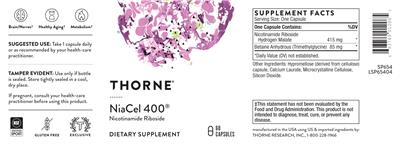
| Nicotinamide Riboside Hydrogen Malate | 415 mg | -- |
| Betaine Anhydrous | 85 mg | -- |
Other ingredients: Hypromellose, Calcium Laurate, Microcrystalline Cellulose, Silicon Dioxide
Tap any ingredient to jump to its full detail below.
These statements are the manufacturer’s wording, reproduced from the product label — the label is saying it, not HelloPharmacist. We don’t verify or endorse them.
Formulation
Brain/Nerves Healthy Aging Metabolism
Gluten free
Suggested/Recommended/Usage/Directions
Suggested use: Take 1 capsule daily or as recommended by your health-care practitioner.
Precautions
Tamper Evident: Use only if bottle is sealed.
If pregnant, consult your health-care practitioner before using this product.
Storage
Store tightly sealed in a cool, dry place.
Seals/Symbols
NSF Certified Sport
General Statements
T Exclusive
Formula
Nicotinamide Riboside
FDA Statement of Identity
Dietary Supplement
FDA Disclaimer Statement
This statement has not been evaluated by the Food and Drug Administration. This product is not intended to diagnose, treat, cure, or prevent any disease.
Is this label outdated? Report a formula or label change and our pharmacy team will review it.
NiaCel 400 by Thorne label
The label scan from the NIH Dietary Supplement Label Database. Tap to enlarge.
Label images are published by the NIH Dietary Supplement Label Database for the version of this product on file. Always read your actual product label.
View the full label (PDF)The Ingredients in NiaCel 400 by Thorne
These are the 2 active ingredients this product is made of. Select any to open its full monograph.
Serving size1 Capsule(s) Dosage formCapsule Servings per container60 Amounts shown are per serving.
Most supplement products combine several ingredients, and a medication can interact with the product through any one of them. Each ingredient below shows whether it has known drug interactions.
Nicotinamide Riboside Hydrogen Malate
Interacts with172 drugs
Nicotinamide riboside (NR) is a form of vitamin B3 that the body converts into NAD+, a molecule involved in cellular energy and repair. Early human st...
Nicotinamide Riboside Hydrogen Malate monograph & interactionsBetaine Anhydrous
No knowninteractions
Betaine anhydrous (also called trimethylglycine) is a compound found in foods like beets, spinach, and whole grains, and is sold as a supplement and a...
Betaine Anhydrous monograph & interactionsOther (inactive) ingredients: Hypromellose, Calcium Laurate, Microcrystalline Cellulose, Silicon Dioxide. These complete the product’s ingredient list but are not active constituents.
NiaCel 400 by Thorne Drug Interactions
HelloPharmacist Interaction Report
NiaCel 400 by Thorne contains nicotinamide riboside, which has documented interactions with one medication type.
The main concern is with blood pressure medications (antihypertensives) — nicotinamide riboside may add to their effect and theoretically increase the risk of low blood pressure (hypotension), though this is rated Minor severity. The betaine anhydrous in this product has no interactions documented in our data.
Read the full breakdown — every affected drug type, severity by severity
Although the interaction with blood pressure drugs is classified as Minor, if you take any medication to manage blood pressure, run it through the checker below or talk it over with your doctor or pharmacist before starting NiaCel 400. Altogether, these interactions span 172 individual medications.
Check your own medications below · Editorial policy · How we use AI
Want to check YOUR meds against NiaCel 400?
Ask about interactions with your drugs in plain English — “Can I take it with lisinopril?” — and we find you the answer in seconds, ingredient by ingredient.
Go to the checkerIngredients driving the most interactions
Individual Drug Interactions
The ingredients in NiaCel 400 interact with 172 drugs. Click any drug to see the details.
1 of the 2 ingredients in NiaCel 400 interact with drugs. Each result below shows which ingredient is responsible. Nicotinamide Riboside Hydrogen Malate
AcebutololRhotral, Sectral
How Acebutolol interacts with NiaCel 400 — through 1 ingredient. Tap an ingredient for the detail:
Nicotinamide Riboside Hydrogen MalateAntihypertensive Drugs Minor
Interaction Summary
Theoretically, nicotinamide riboside may have additive effects with antihypertensive drugs, potentially increasing the risk for hypotension.
Read the full Nicotinamide Riboside Hydrogen Malate + Acebutolol interactionAcetazolamideAk-Zol, Diamox
How Acetazolamide interacts with NiaCel 400 — through 1 ingredient. Tap an ingredient for the detail:
Nicotinamide Riboside Hydrogen MalateAntihypertensive Drugs Minor
Interaction Summary
Theoretically, nicotinamide riboside may have additive effects with antihypertensive drugs, potentially increasing the risk for hypotension.
Read the full Nicotinamide Riboside Hydrogen Malate + Acetazolamide interactionAliskirenTekturna
How Aliskiren interacts with NiaCel 400 — through 1 ingredient. Tap an ingredient for the detail:
Nicotinamide Riboside Hydrogen MalateAntihypertensive Drugs Minor
Interaction Summary
Theoretically, nicotinamide riboside may have additive effects with antihypertensive drugs, potentially increasing the risk for hypotension.
Read the full Nicotinamide Riboside Hydrogen Malate + Aliskiren interactionAmbrisentanLetairis, Volibris
How Ambrisentan interacts with NiaCel 400 — through 1 ingredient. Tap an ingredient for the detail:
Nicotinamide Riboside Hydrogen MalateAntihypertensive Drugs Minor
Interaction Summary
Theoretically, nicotinamide riboside may have additive effects with antihypertensive drugs, potentially increasing the risk for hypotension.
Read the full Nicotinamide Riboside Hydrogen Malate + Ambrisentan interactionAmilorideAmilamont, Midamor
How Amiloride interacts with NiaCel 400 — through 1 ingredient. Tap an ingredient for the detail:
Nicotinamide Riboside Hydrogen MalateAntihypertensive Drugs Minor
Interaction Summary
Theoretically, nicotinamide riboside may have additive effects with antihypertensive drugs, potentially increasing the risk for hypotension.
Read the full Nicotinamide Riboside Hydrogen Malate + Amiloride interactionAmiloride, HydrochlorothiazideAmil-Co, Amilzide, Moduret 25, Moduretic
How Amiloride, Hydrochlorothiazide interacts with NiaCel 400 — through 1 ingredient. Tap an ingredient for the detail:
Nicotinamide Riboside Hydrogen MalateAntihypertensive Drugs Minor
Interaction Summary
Theoretically, nicotinamide riboside may have additive effects with antihypertensive drugs, potentially increasing the risk for hypotension.
Read the full Nicotinamide Riboside Hydrogen Malate + Amiloride, Hydrochlorothiazide interactionAmlodipineNorliqva
How Amlodipine interacts with NiaCel 400 — through 1 ingredient. Tap an ingredient for the detail:
Nicotinamide Riboside Hydrogen MalateAntihypertensive Drugs Minor
Interaction Summary
Theoretically, nicotinamide riboside may have additive effects with antihypertensive drugs, potentially increasing the risk for hypotension.
Read the full Nicotinamide Riboside Hydrogen Malate + Amlodipine interactionAmlodipine BenzoateKaterzia
How Amlodipine Benzoate interacts with NiaCel 400 — through 1 ingredient. Tap an ingredient for the detail:
Nicotinamide Riboside Hydrogen MalateAntihypertensive Drugs Minor
Interaction Summary
Theoretically, nicotinamide riboside may have additive effects with antihypertensive drugs, potentially increasing the risk for hypotension.
Read the full Nicotinamide Riboside Hydrogen Malate + Amlodipine Benzoate interactionAmlodipine BesilateIstin
How Amlodipine Besilate interacts with NiaCel 400 — through 1 ingredient. Tap an ingredient for the detail:
Nicotinamide Riboside Hydrogen MalateAntihypertensive Drugs Minor
Interaction Summary
Theoretically, nicotinamide riboside may have additive effects with antihypertensive drugs, potentially increasing the risk for hypotension.
Read the full Nicotinamide Riboside Hydrogen Malate + Amlodipine Besilate interactionAmlodipine BesylateNorvasc
How Amlodipine Besylate interacts with NiaCel 400 — through 1 ingredient. Tap an ingredient for the detail:
Nicotinamide Riboside Hydrogen MalateAntihypertensive Drugs Minor
Interaction Summary
Theoretically, nicotinamide riboside may have additive effects with antihypertensive drugs, potentially increasing the risk for hypotension.
Read the full Nicotinamide Riboside Hydrogen Malate + Amlodipine Besylate interactionAmlodipine Besylate, BenazeprilLotrel
How Amlodipine Besylate, Benazepril interacts with NiaCel 400 — through 1 ingredient. Tap an ingredient for the detail:
Nicotinamide Riboside Hydrogen MalateAntihypertensive Drugs Minor
Interaction Summary
Theoretically, nicotinamide riboside may have additive effects with antihypertensive drugs, potentially increasing the risk for hypotension.
Read the full Nicotinamide Riboside Hydrogen Malate + Amlodipine Besylate, Benazepril interactionAmlodipine, CelecoxibConsensi
How Amlodipine, Celecoxib interacts with NiaCel 400 — through 1 ingredient. Tap an ingredient for the detail:
Nicotinamide Riboside Hydrogen MalateAntihypertensive Drugs Minor
Interaction Summary
Theoretically, nicotinamide riboside may have additive effects with antihypertensive drugs, potentially increasing the risk for hypotension.
Read the full Nicotinamide Riboside Hydrogen Malate + Amlodipine, Celecoxib interactionAmmonium ChlorideAmmonium Chloride
How Ammonium Chloride interacts with NiaCel 400 — through 1 ingredient. Tap an ingredient for the detail:
Nicotinamide Riboside Hydrogen MalateAntihypertensive Drugs Minor
Interaction Summary
Theoretically, nicotinamide riboside may have additive effects with antihypertensive drugs, potentially increasing the risk for hypotension.
Read the full Nicotinamide Riboside Hydrogen Malate + Ammonium Chloride interactionAprocitentanTryvio
How Aprocitentan interacts with NiaCel 400 — through 1 ingredient. Tap an ingredient for the detail:
Nicotinamide Riboside Hydrogen MalateAntihypertensive Drugs Minor
Interaction Summary
Theoretically, nicotinamide riboside may have additive effects with antihypertensive drugs, potentially increasing the risk for hypotension.
Read the full Nicotinamide Riboside Hydrogen Malate + Aprocitentan interactionAtenololAtenix, Tenormin
How Atenolol interacts with NiaCel 400 — through 1 ingredient. Tap an ingredient for the detail:
Nicotinamide Riboside Hydrogen MalateAntihypertensive Drugs Minor
Interaction Summary
Theoretically, nicotinamide riboside may have additive effects with antihypertensive drugs, potentially increasing the risk for hypotension.
Read the full Nicotinamide Riboside Hydrogen Malate + Atenolol interactionAtenolol, ChlortalidoneAtenixCo, Tenoret 50, Totaretic
How Atenolol, Chlortalidone interacts with NiaCel 400 — through 1 ingredient. Tap an ingredient for the detail:
Nicotinamide Riboside Hydrogen MalateAntihypertensive Drugs Minor
Interaction Summary
Theoretically, nicotinamide riboside may have additive effects with antihypertensive drugs, potentially increasing the risk for hypotension.
Read the full Nicotinamide Riboside Hydrogen Malate + Atenolol, Chlortalidone interactionAtenolol, ChlorthalidoneTenoretic
How Atenolol, Chlorthalidone interacts with NiaCel 400 — through 1 ingredient. Tap an ingredient for the detail:
Nicotinamide Riboside Hydrogen MalateAntihypertensive Drugs Minor
Interaction Summary
Theoretically, nicotinamide riboside may have additive effects with antihypertensive drugs, potentially increasing the risk for hypotension.
Read the full Nicotinamide Riboside Hydrogen Malate + Atenolol, Chlorthalidone interactionAzilsartanEdarbi
How Azilsartan interacts with NiaCel 400 — through 1 ingredient. Tap an ingredient for the detail:
Nicotinamide Riboside Hydrogen MalateAntihypertensive Drugs Minor
Interaction Summary
Theoretically, nicotinamide riboside may have additive effects with antihypertensive drugs, potentially increasing the risk for hypotension.
Read the full Nicotinamide Riboside Hydrogen Malate + Azilsartan interactionAzilsartan, ChlorthalidoneEdarbyclor
How Azilsartan, Chlorthalidone interacts with NiaCel 400 — through 1 ingredient. Tap an ingredient for the detail:
Nicotinamide Riboside Hydrogen MalateAntihypertensive Drugs Minor
Interaction Summary
Theoretically, nicotinamide riboside may have additive effects with antihypertensive drugs, potentially increasing the risk for hypotension.
Read the full Nicotinamide Riboside Hydrogen Malate + Azilsartan, Chlorthalidone interactionBenazeprilLotensin
How Benazepril interacts with NiaCel 400 — through 1 ingredient. Tap an ingredient for the detail:
Nicotinamide Riboside Hydrogen MalateAntihypertensive Drugs Minor
Interaction Summary
Theoretically, nicotinamide riboside may have additive effects with antihypertensive drugs, potentially increasing the risk for hypotension.
Read the full Nicotinamide Riboside Hydrogen Malate + Benazepril interactionBenazepril, HydrochlorothiazideLotensin HCT
How Benazepril, Hydrochlorothiazide interacts with NiaCel 400 — through 1 ingredient. Tap an ingredient for the detail:
Nicotinamide Riboside Hydrogen MalateAntihypertensive Drugs Minor
Interaction Summary
Theoretically, nicotinamide riboside may have additive effects with antihypertensive drugs, potentially increasing the risk for hypotension.
Read the full Nicotinamide Riboside Hydrogen Malate + Benazepril, Hydrochlorothiazide interactionBendroflumethiazideAprinox, Naturetin, Neo-NaClex
How Bendroflumethiazide interacts with NiaCel 400 — through 1 ingredient. Tap an ingredient for the detail:
Nicotinamide Riboside Hydrogen MalateAntihypertensive Drugs Minor
Interaction Summary
Theoretically, nicotinamide riboside may have additive effects with antihypertensive drugs, potentially increasing the risk for hypotension.
Read the full Nicotinamide Riboside Hydrogen Malate + Bendroflumethiazide interactionBendroflumethiazide, NadololCorzide
How Bendroflumethiazide, Nadolol interacts with NiaCel 400 — through 1 ingredient. Tap an ingredient for the detail:
Nicotinamide Riboside Hydrogen MalateAntihypertensive Drugs Minor
Interaction Summary
Theoretically, nicotinamide riboside may have additive effects with antihypertensive drugs, potentially increasing the risk for hypotension.
Read the full Nicotinamide Riboside Hydrogen Malate + Bendroflumethiazide, Nadolol interactionBendroflumethiazide, Rauwolfia SerpentinaRauzide
How Bendroflumethiazide, Rauwolfia Serpentina interacts with NiaCel 400 — through 1 ingredient. Tap an ingredient for the detail:
Nicotinamide Riboside Hydrogen MalateAntihypertensive Drugs Minor
Interaction Summary
Theoretically, nicotinamide riboside may have additive effects with antihypertensive drugs, potentially increasing the risk for hypotension.
Read the full Nicotinamide Riboside Hydrogen Malate + Bendroflumethiazide, Rauwolfia Serpentina interactionBenzthiazideExna
How Benzthiazide interacts with NiaCel 400 — through 1 ingredient. Tap an ingredient for the detail:
Nicotinamide Riboside Hydrogen MalateAntihypertensive Drugs Minor
Interaction Summary
Theoretically, nicotinamide riboside may have additive effects with antihypertensive drugs, potentially increasing the risk for hypotension.
Read the full Nicotinamide Riboside Hydrogen Malate + Benzthiazide interactionBetaxololBetoptic, Kerlone
How Betaxolol interacts with NiaCel 400 — through 1 ingredient. Tap an ingredient for the detail:
Nicotinamide Riboside Hydrogen MalateAntihypertensive Drugs Minor
Interaction Summary
Theoretically, nicotinamide riboside may have additive effects with antihypertensive drugs, potentially increasing the risk for hypotension.
Read the full Nicotinamide Riboside Hydrogen Malate + Betaxolol interactionBisoprololZebeta
How Bisoprolol interacts with NiaCel 400 — through 1 ingredient. Tap an ingredient for the detail:
Nicotinamide Riboside Hydrogen MalateAntihypertensive Drugs Minor
Interaction Summary
Theoretically, nicotinamide riboside may have additive effects with antihypertensive drugs, potentially increasing the risk for hypotension.
Read the full Nicotinamide Riboside Hydrogen Malate + Bisoprolol interactionBisoprolol, HydrochlorothiazideZiac
How Bisoprolol, Hydrochlorothiazide interacts with NiaCel 400 — through 1 ingredient. Tap an ingredient for the detail:
Nicotinamide Riboside Hydrogen MalateAntihypertensive Drugs Minor
Interaction Summary
Theoretically, nicotinamide riboside may have additive effects with antihypertensive drugs, potentially increasing the risk for hypotension.
Read the full Nicotinamide Riboside Hydrogen Malate + Bisoprolol, Hydrochlorothiazide interactionBosentanTracleer
How Bosentan interacts with NiaCel 400 — through 1 ingredient. Tap an ingredient for the detail:
Nicotinamide Riboside Hydrogen MalateAntihypertensive Drugs Minor
Interaction Summary
Theoretically, nicotinamide riboside may have additive effects with antihypertensive drugs, potentially increasing the risk for hypotension.
Read the full Nicotinamide Riboside Hydrogen Malate + Bosentan interactionBumetanideBurinex
How Bumetanide interacts with NiaCel 400 — through 1 ingredient. Tap an ingredient for the detail:
Nicotinamide Riboside Hydrogen MalateAntihypertensive Drugs Minor
Interaction Summary
Theoretically, nicotinamide riboside may have additive effects with antihypertensive drugs, potentially increasing the risk for hypotension.
Read the full Nicotinamide Riboside Hydrogen Malate + Bumetanide interactionEach ingredient & the kinds of drugs it affects
For each ingredient in NiaCel 400 with known interactions, here are the types of medications it can affect. Open any type for the detail — or search your exact drug in the checker above.
Nicotinamide Riboside Hydrogen Malate
Antihypertensive Drugs
Theoretically, nicotinamide riboside may have additive effects with antihypertensive drugs, potentially increasing the risk for hypotension.
One small clinical study suggests that nicotinamide riboside can modestly reduce blood pressure in hypertensive patients. However, other clinical research did not find a reduction in blood pressure when compared with control.
Brand information
Manufacturer and brand details for NiaCel 400, from the product label.
NiaCel 400 by Thorne: Common Questions
Does NiaCel 400 by Thorne interact with any medications?
How can one product interact with so many drugs?
Where does this information come from?
What does nicotinamide riboside actually do?
Is it safe to take NiaCel 400 long-term?
Can I take this if I'm pregnant or breastfeeding?
What are the most common side effects?
Does this product contain fillers?
Is betaine anhydrous effective for anything?
Written and reviewed by the HelloPharmacist editorial staff. Our editorial policy
Not sure if NiaCel 400 is safe with your meds?
Our pharmacists answer your medication & supplement questions — free.
Label information is sourced from the NIH Dietary Supplement Label Database and reflects the product version on file; always read your actual product label. This page is for education only and is not a substitute for professional medical advice. Confirm with your pharmacist or doctor before combining supplements and medications.
The Full Monographs Behind NiaCel 400’s Ingredients
Every ingredient we hold a full HelloPharmacist monograph for — uses, evidence, safety, and the complete interaction list.
Nicotinamide Riboside
Interacts with 172 drugsNicotinamide riboside (NR) is a form of vitamin B3 that the body converts into NAD+, a molecule involved in cellular energy and repair. Early human studies show it can reliably raise NAD+ le...
Read the full Nicotinamide Riboside monograph → Herb & supplement monographBetaine Anhydrous
Betaine anhydrous (also called trimethylglycine) is a compound found in foods like beets, spinach, and whole grains, and is sold as a supplement and as a prescription medicine for a rare gen...
Read the full Betaine Anhydrous monograph →Sources & How We Checked
NiaCel 400's label data comes from the NIH Dietary Supplement Label Database; the ingredient interaction data is from the Natural Medicines database, reviewed by our pharmacists.
- NIH Dietary Supplement Label Database (DSLD) — The official product label on file for this supplement.
- Natural Medicines (Therapeutic Research Center) — Evidence-graded clinical reference behind the ingredient interaction data.
Content is written and reviewed by licensed HelloPharmacist pharmacists. See our data sources and editorial standards for how this information is built and checked.
The 18 references behind this product’s interaction data
Every citation that drives the interaction findings for this product’s ingredients, from the evidence-graded Natural Medicines (TRC Healthcare) database. Open an ingredient to browse its citations — links open the study on PubMed or the publisher’s site.
Nicotinamide Riboside 7 references
- Martens CR, Denman BA, Mazzo MR, et al. Chronic nicotinamide riboside supplementation is well-tolerated and elevates NAD+ in healthy middle-aged and older adults. Nat Commun 2018;9(1):1286. PubMed
- Dollerup OL, Christensen B, Svart M, et al. A randomized placebo-controlled clinical trial of nicotinamide riboside in obese men: safety, insulin-sensitivity, and lipid-mobilizing effects. Am J Clin Nutr 2018;108(2):343-53. PubMed
- Dellinger RW, Santos SR, Morris M, et al. Repeat dose NRPT (nicotinamide riboside and pterostilbene) increases NAD+ levels in humans safety and sustainably: a randomized, double-blind, placebo-controlled study. NPJ J Aging Mech Dis 2017;3:17.
- Conze D, Brenner C, Kruger CL. Safety and metabolism of long-term administration of NIAGEN (nicotinamide riboside chloride) in a randomized, double-blind, placebo-controlled clinical trial of healthy overweight adults. Sci Rep 2019;9(1):9772. PubMed
- Remie CME, Roumans KHM, Moonen MPB, et al. Nicotinamide riboside supplementation alters body composition and skeletal muscle acetylcarnitine concentrations in healthy obese humans. Am J Clin Nutr. 2020;112(2):413-426. PubMed
- Turck D, Castenmiller J, de Henauw S, et al. Safety of nicotinamide riboside chloride as a novel food pursuant to Regulation (EU) 2015/2283 and bioavailability of nicotinamide from this source, in the context of Directive 2002/46/EC. EFSA J. 2019;17(8):e0
- EFSA Panel on Nutrition, Novel Foods and Food Allergens (NDA), Turck D, et al. Extension of use of nicotinamide riboside chloride as a novel food pursuant to Regulation (EU) 2015/2283. EFSA J 2021;19(11):e06843.
See these in context on the Nicotinamide Riboside monograph →
Betaine Anhydrous 11 references
- Cystadane (betaine anhydrous for oral solution) Package insert. Orphan Medical, Inc. Minnetonka, MN. November 2005.
- Abdelmalek MF, Angulo P, Jorgensen RA, et al. Betaine, a promising new agent for patients with nonalcoholic steatohepatitis: results of a pilot study. Am J Gastroenterol 2001;96:2711-7.. PubMed
- Schwab U, Torronen A, Toppinen L, et al. Betaine supplementation decreases plasma homocysteine concentrations but does not affect body weight, body composition, or resting energy expenditure in human subjects. Am J Clin Nutr 2002;76:961-7. PubMed
- McGregor DO, Dellow WJ, Robson RA, et al. Betaine supplementation decreases post-methionine hyperhomocysteinemia in chronic renal failure. Kidney Int 2002;61:1040-6. PubMed
- Olthof MR, van Vliet T, Verhoef P, et al. Effect of homocysteine-lowering nutrients on blood lipids: results from four randomised, placebo-controlled studies in healthy humans. PloS Med 2005;2:e135. PubMed
- Knopman, D. and Patterson, M. An open-label, 24-week pilot study of the methyl donor betaine in Alzheimer disease patients. Alzheimer Dis.Assoc.Disord. 2001;15(3):162-165. PubMed
- Moat, S. J., Madhavan, A., Taylor, S. Y., Payne, N., Allen, R. H., Stabler, S. P., Goodfellow, J., McDowell, I. F., Lewis, M. J., and Lang, D. High- but not low-dose folic acid improves endothelial function in coronary artery disease. Eur J Clin Invest 2 PubMed
- Abdelmalek, M. F., Sanderson, S. O., Angulo, P., Soldevila-Pico, C., Liu, C., Peter, J., Keach, J., Cave, M., Chen, T., McClain, C. J., and Lindor, K. D. Betaine for nonalcoholic fatty liver disease: results of a randomized placebo-controlled trial. Hepa PubMed
- Ashtary-Larky D, Bagheri R, Ghanavati M, et al. Effects of betaine supplementation on cardiovascular markers: a systematic review and meta-analysis. Crit Rev Food Sci Nutr. 2021 Mar 25:1-18. PubMed
- Zawieja EE, Zawieja B, Chmurzynska A. Betaine supplementation moderately increases total cholesterol levels: a systematic review and meta-analysis. J Diet Suppl. 2021;18(1):105-117. PubMed
- Imbard A, Toumazi A, Magréault S, et al. Efficacy and pharmacokinetics of betaine in CBS and cblC deficiencies: a cross-over randomized controlled trial. Orphanet J Rare Dis 2022;17(1):417. PubMed
Parts of this content are provided by the Therapeutic Research Center, LLC.
DISCLAIMER: Currently this does not check for drug-drug interactions. This is not an all-inclusive comprehensive list of potential interactions and is for informational purposes only. Not all interactions are known or well-reported in the scientific literature, and new interactions are continually being reported. Input is needed from a qualified healthcare provider including a pharmacist before starting any therapy. Application of clinical judgment is necessary.
© 2021 Therapeutic Research Center, LLC