
Prostate Complex Ingredients & Drug Interactions
What is this page for?
First and foremost: checking Prostate Complex against your medications. The heart of this page is the interaction checker and the full interaction report — how this product’s ingredients may interact with prescription and over-the-counter medicines you may be taking.
Around that, we add a pharmacist’s high-level view of the product as a whole — what’s inside, the evidence for its stated use, how transparent the label is, and what safety data exists — so you can see the full picture in one place. It’s educational information from our licensed clinical databases and the clinical staff at HelloPharmacist — not medical advice — and we don’t sell or endorse products. Our editorial policy
Prostate Complex is a dietary supplement by Professional Botanicals with 14 active ingredients. Its ingredients are commonly taken for sports and exercise support, blood sugar balance, general amino acid supplementation.Based on those ingredients, 1,516 medications have a known interaction with it, the most serious rated moderate. The ingredients most likely to interact are Eleuthero, Cat's Claw, Bee Propolis. Use the checker below to test your specific medication, or read the full HelloPharmacist Interaction Report.
Check Your Meds Against Prostate Complex by Professional Botanicals
Ask about any prescription or over-the-counter medication and we check it for interactions with Prostate Complex by Professional Botanicals — and tell you which ingredient is responsible.
AI summaries are generated from our interaction database for education only — always confirm with your pharmacist. How we use AI
Ask the Pharmacist
A licensed pharmacist will answer your question by email — free, usually within 24 hours.
Got it — thank you!
A licensed pharmacist will answer within 24 hours. Keep an eye on your email (worth checking spam, just in case).
HelloPharmacist Scorecard of Prostate Complex by Professional Botanicals
Our pharmacy team’s full take, with four database checks built into the cards below — a summary of what is known, not a grade of the product itself.
What’s inside
Low disclosure
Prostate Complex contains 22 ingredients total, including both active botanical extracts and some digestive enzymes. The active ingredients are a mix of plant extracts (eleuthero, lycopene, ashwagandha, gynostemma, cordyceps, rhodiola, reishi, saw palmetto, sandalwood, bee propolis, echinacea, cat's claw, and pygeum) plus amino acids (L-alanine, L-glycine, and L-glutamic acid hydrochloride) and digestive enzymes (amylase, protease, lipase, and cellulase).
Several of the ingredients are grouped in proprietary blends, so exact amounts of each aren't disclosed. The product also contains inactive ingredients — magnesium stearate, cellulose, and water — as fillers and binders to make the capsules.
Does it work?
Strong evidence
Effectiveness data varies widely across these ingredients. Saw palmetto shows possibly ineffective evidence for benign prostatic hyperplasia (BPH), the condition this product targets.
Pygeum, another ingredient in the formula, is rated likely effective for BPH, so there's some support there. Lycopene is possibly effective for prostate cancer but possibly ineffective for bladder cancer and diabetes.
Ashwagandha is possibly effective for insomnia and anxiety. Bee propolis is possibly effective for oral sores and herpes labialis.
For most of the other ingredients — including eleuthero, cordyceps, rhodiola, reishi, echinacea, cat's claw, and gynostemma — the evidence we hold is insufficient to rate them for most conditions. Glycine, L-alanine, and sandalwood similarly lack strong evidence in our data.
How safe is it?
Well-documented data
Most ingredients in this formula are generally well tolerated short-term, but long-term safety data are limited for many of them. Common side effects across the ingredients include digestive upset (diarrhea, nausea, abdominal discomfort), headache, and dizziness.
Ashwagandha and echinacea carry rare but serious risks: ashwagandha has been linked to acute liver failure and hepatic encephalopathy, and echinacea to hepatitis. Bee propolis can trigger allergic reactions in people sensitive to bee products.
Ashwagandha traditionally may carry risk of miscarriage and is best avoided in pregnancy; saw palmetto is rated likely unsafe in pregnancy. Eleuthero, cordyceps, rhodiola, reishi, gynostemma, sandalwood, and cat's claw are all best avoided during pregnancy and breastfeeding due to insufficient safety data.
For echinacea and bee propolis, pregnancy and breastfeeding data aren't on file. Glycine, L-alanine, amylase, cellulase, L-glutamic acid, and watermelon have no pregnancy/lactation information on file.
Meds to double-check
Moderate interaction found
Before you take this, double-check with your pharmacist if you're on blood thinners (anticoagulants or antiplatelet drugs), diabetes medications, blood pressure medications, clozapine, immunosuppressants, or thyroid hormones. Eleuthero and echinacea also interact with several liver-metabolism drug families — if you take medications metabolized by CYP1A2, CYP2C9, CYP2D6, CYP3A4, or P-glycoprotein substrates, ask your pharmacist to check.
Ashwagandha and bee propolis have similar metabolic effects.
The bottom line
Scorecard at a glanceFormula with limited ingredient disclosure with clinical evidence supporting its stated purpose. Moderate medication interactions have been identified, and safety information is well characterized.
This product combines botanical extracts often marketed for prostate health, though evidence for most is limited. If you're on blood thinners, diabetes medications, blood pressure medications, immunosuppressants, or antipsychotics — especially clozapine — you need to talk with your pharmacist before starting it.
Anyone pregnant or breastfeeding should avoid it. Even if none of those apply, check your specific medications with the tool on this page.
Educational only — not medical advice; always confirm with your pharmacist. Our editorial policy · How we use AI
Assessment coverage: 18 of 22 active ingredients matched to our full ingredient reviews (monographs). Based on the product label dated May 23, 2024.
This Scorecard evaluates available label information, ingredient evidence, and known medication-safety considerations. It does not independently verify product identity, purity, potency, contamination, or manufacturing quality. How these ratings are computed
General information
Key facts about Prostate Complex, straight from the product label.
| Brand | Professional Botanicals |
|---|---|
| Barcode (UPC) | 898175001898 |
| Net contents | 60 Veg. Capsule(s) |
| Market status | On market |
| Date entered into DSLD | May 23, 2024 |
| DSLD ID | 308963 |
| Product type | Other Combinations |
| Supplement form | Capsule |
| Dietary claims / uses | Nutrient, All Other, Structure/Function |
| Intended target group(s) | Adult Male (18-50 Years), Seniors/Mature (>50 Years) - Men ONLY, Gluten Free |
Everything in this section is reproduced from the manufacturer’s own product label — it’s the label speaking, not HelloPharmacist. We show it so you can see exactly what the maker states; we don’t verify or endorse those statements.
Supplement Facts
The label details for Prostate Complex by Professional Botanicals, sourced from the NIH Dietary Supplement Label Database.
Supplement Facts
| Ingredient | Amount | % DV |
|---|---|---|
| Proprietary Blend | 900 mg | -- |
| L-Alanine | 0 NP | -- |
| L-Glycine | 0 NP | -- |
| Amylase | 0 NP | -- |
| Protease | 0 NP | -- |
| Lipase | 0 NP | -- |
| Cellulase | 0 NP | -- |
| L-Glutamic Acid Hydrochloride | 0 NP | -- |
| Eleuthero | 0 NP | -- |
| Lycopene | 0 NP | -- |
| Ashwagandha | 0 NP | -- |
| AdPT | 0 NP | -- |
| Gynostemma | 0 NP | -- |
| EDS | 0 NP | -- |
| Cordyceps | 0 NP | -- |
| Rhodiola | 0 NP | -- |
| Reishi | 0 NP | -- |
| Eleuthero | 0 NP | -- |
| Saw Palmetto | 0 NP | -- |
| Sandalwood | 0 NP | -- |
| Bee Propolis | 0 NP | -- |
| Echinacea angustifolia | 0 NP | -- |
| Cat's Claw | 0 NP | -- |
| Pygeum | 0 NP | -- |
| Watermelon | 0 NP | -- |
Other ingredients: Magnesium Stearate, Cellulose, Water
Tap any ingredient to jump to its full detail below.
These statements are the manufacturer’s wording, reproduced from the product label — the label is saying it, not HelloPharmacist. We don’t verify or endorse them.
Formula
Designed with a special blend of amino acids and natural herbs in a unique formula to support healthy prostate function.
EDS: Added enzymes for better absorption & breakdown. AdPT: Adaptogenic herbs for energy production & adaptation.
Suggested/Recommended/Usage/Directions
Dosage: Two capsules two to three times a day, or as directed.
Formulation
Gluten free Non GMO No fillers 3x tested
Premium quality
FDA Disclaimer Statement
These statements have not been evaluated by the Food and Drug Administration. This product is not intended to diagnose, treat, cure, or prevent any disease.
Seals/Symbols
Made in USA
General Statements
2 Please recycle
Brand IP Statement(s)
Professional Botanicals est. 1980
FDA Statement of Identity
Dietary Supplement
Is this label outdated? Report a formula or label change and our pharmacy team will review it.
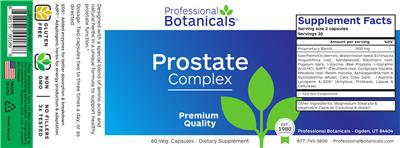
Prostate Complex by Professional Botanicals label
The label scan from the NIH Dietary Supplement Label Database. Tap to enlarge.
Label images are published by the NIH Dietary Supplement Label Database for the version of this product on file. Always read your actual product label.
View the full label (PDF)The Ingredients in Prostate Complex by Professional Botanicals
These are the 14 active ingredients this product is made of. Select any to open its full monograph.
Serving size2 Capsule(s) Dosage formCapsule Servings per container30 Amounts shown are per serving.
Most supplement products combine several ingredients, and a medication can interact with the product through any one of them. Each ingredient below shows whether it has known drug interactions.
Proprietary Blend
- › L-Alanine
- › L-Glycine
- › L-Glutamic Acid Hydrochloride
- › Eleuthero
- › Lycopene
- › AdPT
- › EDS
- › Saw Palmetto
- › Sandalwood
- › Bee Propolis
- › Echinacea angustifolia
- › Cat's Claw
- › Pygeum
- › Watermelon
Other (inactive) ingredients: Magnesium Stearate, Cellulose, Water. These complete the product’s ingredient list but are not active constituents.
Prostate Complex by Professional Botanicals Drug Interactions
HelloPharmacist Interaction Report
Prostate Complex by Professional Botanicals contains 22 ingredients, and several of them interact with medications.
The most serious interaction we've documented is Glycine with clozapine (Clozaril), an antipsychotic — glycine may worsen schizophrenia symptoms when added to clozapine therapy, though the exact mechanism isn't clear.
Read the full breakdown — every affected drug type, severity by severity
Beyond that, you'll want to watch for interactions with blood thinners (anticoagulants and antiplatelet drugs). Eleuthero, lycopene, jiaogulan, cordyceps, reishi, saw palmetto, bee propolis, and cat's claw all theoretically increase bleeding risk.
Saw palmetto is also documented to prolong bleeding time specifically. If you take warfarin (Coumadin) or any other blood thinner, this matters.
Several ingredients — eleuthero, ashwagandha, jiaogulan, cordyceps, and rhodiola — may lower blood sugar (hypoglycemia) when used with diabetes medications. Ashwagandha, eleuthero, cordyceps, and cat's claw could also interfere with drugs that suppress the immune system (immunosuppressants).
Ashwagandha and reishi may increase the effect of blood pressure medications, raising the risk of low blood pressure (hypotension). Additionally, eleuthero affects how your liver processes several drug families — CYP1A2, CYP2C9, and P-glycoprotein substrates — and can raise digoxin levels.
Ashwagandha, echinacea, and propolis also affect liver metabolism of various drugs. We could not check L-alanine, amylase, cellulase, L-glutamic acid hydrochloride, and watermelon — we hold no data for them.
Although no interactions are documented in our data for protease and lipase, you should still discuss this product with your pharmacist and run your exact medications through the checker on this page before starting. Altogether, these interactions span 1,494 individual medications.
Check your own medications below · Editorial policy · How we use AI
Want to check YOUR meds against Prostate Complex?
Ask about interactions with your drugs in plain English — “Can I take it with lisinopril?” — and we find you the answer in seconds, ingredient by ingredient.
Go to the checkerIngredients driving the most interactions
Individual Drug Interactions
The ingredients in Prostate Complex interact with 1,516 drugs. Click any drug to see the details.
8 of the 14 ingredients in Prostate Complex interact with drugs. Each result below shows which ingredient is responsible. Eleuthero Cat's Claw Bee Propolis Echinacea angustifolia Saw Palmetto Lycopene L-Glycine Sandalwood
Acetaminophen, Chlorpheniramine, Codeine, PhenylephrineColrex
How Acetaminophen, Chlorpheniramine, Codeine, Phenylephrine interacts with Prostate Complex — through 6 ingredients. Tap an ingredient for the detail:
EleutheroCytochrome P450 1a2 (cyp1a2) Substrates, Cytochrome P450 3a4 (cyp3a4) Substrates +1 Moderate
Interaction Summary
Theoretically, eleuthero might increase levels of drugs metabolized by CYP1A2.
Read the full Eleuthero + Acetaminophen, Chlorpheniramine, Codeine, Phenylephrine interactionAshwagandhaHepatotoxic Drugs, Cns Depressants +3 Moderate
Interaction Summary
Theoretically, taking ashwagandha with hepatotoxic drugs might increase the risk of liver damage.
Read the full Ashwagandha + Acetaminophen, Chlorpheniramine, Codeine, Phenylephrine interactionEchinacea AngustifoliaCytochrome P450 1a2 (cyp1a2) Substrates, Cytochrome P450 3a4 (cyp3a4) Substrates Moderate
Interaction Summary
Echinacea might inhibit the metabolism of CYP1A2 and increase plasma levels of some drugs.
Read the full Echinacea Angustifolia + Acetaminophen, Chlorpheniramine, Codeine, Phenylephrine interactionBee PropolisCytochrome P450 2e1 (cyp2e1) Substrates, Cytochrome P450 1a2 (cyp1a2) Substrates +2 Moderate
Interaction Summary
Theoretically, propolis might increase levels of drugs metabolized by CYP2E1.
Read the full Bee Propolis + Acetaminophen, Chlorpheniramine, Codeine, Phenylephrine interactionCat's ClawCytochrome P450 3a4 (cyp3a4) Substrates Moderate
Interaction Summary
Theoretically, cat's claw might increase or decrease the levels and effects of drugs metabolized by CYP3A4.
Read the full Cat's Claw + Acetaminophen, Chlorpheniramine, Codeine, Phenylephrine interactionRhodiolaCns Depressants, Cytochrome P450 1a2 (cyp1a2) Substrates +1 Minor
Interaction Summary
Theoretically, rhodiola might increase the risk of adverse effects when taken with CNS depressants.
Read the full Rhodiola + Acetaminophen, Chlorpheniramine, Codeine, Phenylephrine interactionAcetaminophen, Chlorpheniramine, DextromethorphanCoricidin II Extra Strength Cold and Flu
How Acetaminophen, Chlorpheniramine, Dextromethorphan interacts with Prostate Complex — through 6 ingredients. Tap an ingredient for the detail:
Bee PropolisCytochrome P450 2d6 (cyp2d6) Substrates, Cytochrome P450 3a4 (cyp3a4) Substrates +2 Moderate
Interaction Summary
Theoretically, high doses of propolis might increase blood levels of drugs metabolized by CYP2D6.
Read the full Bee Propolis + Acetaminophen, Chlorpheniramine, Dextromethorphan interactionAshwagandhaCytochrome P450 1a2 (cyp1a2) Substrates, Hepatotoxic Drugs +2 Moderate
Interaction Summary
Theoretically, ashwagandha might decrease the levels and clinical effects of CYP1A2 substrates.
Read the full Ashwagandha + Acetaminophen, Chlorpheniramine, Dextromethorphan interactionEleutheroCytochrome P450 3a4 (cyp3a4) Substrates, Cytochrome P450 2d6 (cyp2d6) Substrates +1 Moderate
Interaction Summary
Theoretically, eleuthero might increase levels of drugs metabolized by CYP3A4.
Read the full Eleuthero + Acetaminophen, Chlorpheniramine, Dextromethorphan interactionEchinacea AngustifoliaCytochrome P450 3a4 (cyp3a4) Substrates, Cytochrome P450 1a2 (cyp1a2) Substrates Moderate
Interaction Summary
Echinacea may induce hepatic CYP3A4 and inhibit intestinal CYP3A4.
Read the full Echinacea Angustifolia + Acetaminophen, Chlorpheniramine, Dextromethorphan interactionCat's ClawCytochrome P450 3a4 (cyp3a4) Substrates Moderate
Interaction Summary
Theoretically, cat's claw might increase or decrease the levels and effects of drugs metabolized by CYP3A4.
Read the full Cat's Claw + Acetaminophen, Chlorpheniramine, Dextromethorphan interactionRhodiolaCytochrome P450 1a2 (cyp1a2) Substrates, Cytochrome P450 3a4 (cyp3a4) Substrates Minor
Interaction Summary
Theoretically, rhodiola might increase levels of drugs metabolized by CYP1A2.
Read the full Rhodiola + Acetaminophen, Chlorpheniramine, Dextromethorphan interactionAcetaminophen, Chlorpheniramine, Dextromethorphan HydrobromideCoricidin HBP Maximum Strength Flu
How Acetaminophen, Chlorpheniramine, Dextromethorphan Hydrobromide interacts with Prostate Complex — through 6 ingredients. Tap an ingredient for the detail:
AshwagandhaCytochrome P450 3a4 (cyp3a4) Substrates, Serotonergic Drugs +2 Moderate
Interaction Summary
Theoretically, ashwagandha might decrease the levels and clinical effects of CYP3A4 substrates.
Read the full Ashwagandha + Acetaminophen, Chlorpheniramine, Dextromethorphan Hydrobromide interactionEchinacea AngustifoliaCytochrome P450 1a2 (cyp1a2) Substrates, Cytochrome P450 3a4 (cyp3a4) Substrates Moderate
Interaction Summary
Echinacea might inhibit the metabolism of CYP1A2 and increase plasma levels of some drugs.
Read the full Echinacea Angustifolia + Acetaminophen, Chlorpheniramine, Dextromethorphan Hydrobromide interactionEleutheroCytochrome P450 3a4 (cyp3a4) Substrates, Cytochrome P450 1a2 (cyp1a2) Substrates +1 Moderate
Interaction Summary
Theoretically, eleuthero might increase levels of drugs metabolized by CYP3A4.
Read the full Eleuthero + Acetaminophen, Chlorpheniramine, Dextromethorphan Hydrobromide interactionBee PropolisCytochrome P450 1a2 (cyp1a2) Substrates, Cytochrome P450 2d6 (cyp2d6) Substrates +2 Moderate
Interaction Summary
Theoretically, high doses of propolis might increase blood levels of drugs metabolized by CYP1A2.
Read the full Bee Propolis + Acetaminophen, Chlorpheniramine, Dextromethorphan Hydrobromide interactionCat's ClawCytochrome P450 3a4 (cyp3a4) Substrates Moderate
Interaction Summary
Theoretically, cat's claw might increase or decrease the levels and effects of drugs metabolized by CYP3A4.
Read the full Cat's Claw + Acetaminophen, Chlorpheniramine, Dextromethorphan Hydrobromide interactionRhodiolaCytochrome P450 3a4 (cyp3a4) Substrates, Cytochrome P450 1a2 (cyp1a2) Substrates Minor
Interaction Summary
Theoretically, rhodiola might increase levels of drugs metabolized by CYP3A4.
Read the full Rhodiola + Acetaminophen, Chlorpheniramine, Dextromethorphan Hydrobromide interactionAcetaminophen, Chlorpheniramine, Dextromethorphan, PhenylpropanolamineMulti Symptom Cold Relief
How Acetaminophen, Chlorpheniramine, Dextromethorphan, Phenylpropanolamine interacts with Prostate Complex — through 6 ingredients. Tap an ingredient for the detail:
Bee PropolisCytochrome P450 2e1 (cyp2e1) Substrates, Cytochrome P450 2d6 (cyp2d6) Substrates +2 Moderate
Interaction Summary
Theoretically, propolis might increase levels of drugs metabolized by CYP2E1.
Read the full Bee Propolis + Acetaminophen, Chlorpheniramine, Dextromethorphan, Phenylpropanolamine interactionCat's ClawCytochrome P450 3a4 (cyp3a4) Substrates Moderate
Interaction Summary
Theoretically, cat's claw might increase or decrease the levels and effects of drugs metabolized by CYP3A4.
Read the full Cat's Claw + Acetaminophen, Chlorpheniramine, Dextromethorphan, Phenylpropanolamine interactionAshwagandhaCytochrome P450 3a4 (cyp3a4) Substrates, Serotonergic Drugs +2 Moderate
Interaction Summary
Theoretically, ashwagandha might decrease the levels and clinical effects of CYP3A4 substrates.
Read the full Ashwagandha + Acetaminophen, Chlorpheniramine, Dextromethorphan, Phenylpropanolamine interactionEchinacea AngustifoliaCytochrome P450 1a2 (cyp1a2) Substrates, Cytochrome P450 3a4 (cyp3a4) Substrates Moderate
Interaction Summary
Echinacea might inhibit the metabolism of CYP1A2 and increase plasma levels of some drugs.
Read the full Echinacea Angustifolia + Acetaminophen, Chlorpheniramine, Dextromethorphan, Phenylpropanolamine interactionEleutheroCytochrome P450 2d6 (cyp2d6) Substrates, Cytochrome P450 1a2 (cyp1a2) Substrates +1 Moderate
Interaction Summary
Theoretically, eleuthero might increase levels of drugs metabolized by CYP2D6.
Read the full Eleuthero + Acetaminophen, Chlorpheniramine, Dextromethorphan, Phenylpropanolamine interactionRhodiolaCytochrome P450 1a2 (cyp1a2) Substrates, Cytochrome P450 3a4 (cyp3a4) Substrates Minor
Interaction Summary
Theoretically, rhodiola might increase levels of drugs metabolized by CYP1A2.
Read the full Rhodiola + Acetaminophen, Chlorpheniramine, Dextromethorphan, Phenylpropanolamine interactionAcetaminophen, Chlorpheniramine, Dextromethorphan, PseudoephedrineChildren's Tylenol Cold Plus Cough, Tylenol Cold Ex Strength
How Acetaminophen, Chlorpheniramine, Dextromethorphan, Pseudoephedrine interacts with Prostate Complex — through 6 ingredients. Tap an ingredient for the detail:
Bee PropolisCytochrome P450 3a4 (cyp3a4) Substrates, Cytochrome P450 1a2 (cyp1a2) Substrates +2 Moderate
Interaction Summary
Theoretically, high doses of propolis might increase blood levels of drugs metabolized by CYP3A4.
Read the full Bee Propolis + Acetaminophen, Chlorpheniramine, Dextromethorphan, Pseudoephedrine interactionCat's ClawCytochrome P450 3a4 (cyp3a4) Substrates Moderate
Interaction Summary
Theoretically, cat's claw might increase or decrease the levels and effects of drugs metabolized by CYP3A4.
Read the full Cat's Claw + Acetaminophen, Chlorpheniramine, Dextromethorphan, Pseudoephedrine interactionAshwagandhaCytochrome P450 1a2 (cyp1a2) Substrates, Hepatotoxic Drugs +2 Moderate
Interaction Summary
Theoretically, ashwagandha might decrease the levels and clinical effects of CYP1A2 substrates.
Read the full Ashwagandha + Acetaminophen, Chlorpheniramine, Dextromethorphan, Pseudoephedrine interactionEchinacea AngustifoliaCytochrome P450 1a2 (cyp1a2) Substrates, Cytochrome P450 3a4 (cyp3a4) Substrates Moderate
Interaction Summary
Echinacea might inhibit the metabolism of CYP1A2 and increase plasma levels of some drugs.
Read the full Echinacea Angustifolia + Acetaminophen, Chlorpheniramine, Dextromethorphan, Pseudoephedrine interactionEleutheroCytochrome P450 3a4 (cyp3a4) Substrates, Cytochrome P450 2d6 (cyp2d6) Substrates +1 Moderate
Interaction Summary
Theoretically, eleuthero might increase levels of drugs metabolized by CYP3A4.
Read the full Eleuthero + Acetaminophen, Chlorpheniramine, Dextromethorphan, Pseudoephedrine interactionRhodiolaCytochrome P450 3a4 (cyp3a4) Substrates, Cytochrome P450 1a2 (cyp1a2) Substrates Minor
Interaction Summary
Theoretically, rhodiola might increase levels of drugs metabolized by CYP3A4.
Read the full Rhodiola + Acetaminophen, Chlorpheniramine, Dextromethorphan, Pseudoephedrine interactionAcetaminophen, Chlorpheniramine, Guaifenesin, Phenylephrine, SalicylamideRhinogesic GG
How Acetaminophen, Chlorpheniramine, Guaifenesin, Phenylephrine, Salicylamide interacts with Prostate Complex — through 6 ingredients. Tap an ingredient for the detail:
EleutheroCytochrome P450 1a2 (cyp1a2) Substrates, Cytochrome P450 3a4 (cyp3a4) Substrates Moderate
Interaction Summary
Theoretically, eleuthero might increase levels of drugs metabolized by CYP1A2.
Read the full Eleuthero + Acetaminophen, Chlorpheniramine, Guaifenesin, Phenylephrine, Salicylamide interactionEchinacea AngustifoliaCytochrome P450 3a4 (cyp3a4) Substrates, Cytochrome P450 1a2 (cyp1a2) Substrates Moderate
Interaction Summary
Echinacea may induce hepatic CYP3A4 and inhibit intestinal CYP3A4.
Read the full Echinacea Angustifolia + Acetaminophen, Chlorpheniramine, Guaifenesin, Phenylephrine, Salicylamide interactionBee PropolisCytochrome P450 1a2 (cyp1a2) Substrates, Cytochrome P450 3a4 (cyp3a4) Substrates +1 Moderate
Interaction Summary
Theoretically, high doses of propolis might increase blood levels of drugs metabolized by CYP1A2.
Read the full Bee Propolis + Acetaminophen, Chlorpheniramine, Guaifenesin, Phenylephrine, Salicylamide interactionAshwagandhaHepatotoxic Drugs, Cytochrome P450 3a4 (cyp3a4) Substrates +2 Moderate
Interaction Summary
Theoretically, taking ashwagandha with hepatotoxic drugs might increase the risk of liver damage.
Read the full Ashwagandha + Acetaminophen, Chlorpheniramine, Guaifenesin, Phenylephrine, Salicylamide interactionCat's ClawCytochrome P450 3a4 (cyp3a4) Substrates Moderate
Interaction Summary
Theoretically, cat's claw might increase or decrease the levels and effects of drugs metabolized by CYP3A4.
Read the full Cat's Claw + Acetaminophen, Chlorpheniramine, Guaifenesin, Phenylephrine, Salicylamide interactionRhodiolaCytochrome P450 1a2 (cyp1a2) Substrates, Cytochrome P450 3a4 (cyp3a4) Substrates Minor
Interaction Summary
Theoretically, rhodiola might increase levels of drugs metabolized by CYP1A2.
Read the full Rhodiola + Acetaminophen, Chlorpheniramine, Guaifenesin, Phenylephrine, Salicylamide interactionAcetaminophen, Chlorpheniramine, PhenylephrineAlka-Seltzer PLUS, Histex SR, Protid
How Acetaminophen, Chlorpheniramine, Phenylephrine interacts with Prostate Complex — through 6 ingredients. Tap an ingredient for the detail:
AshwagandhaHepatotoxic Drugs, Cytochrome P450 1a2 (cyp1a2) Substrates +2 Moderate
Interaction Summary
Theoretically, taking ashwagandha with hepatotoxic drugs might increase the risk of liver damage.
Read the full Ashwagandha + Acetaminophen, Chlorpheniramine, Phenylephrine interactionEleutheroCytochrome P450 3a4 (cyp3a4) Substrates, Cytochrome P450 1a2 (cyp1a2) Substrates Moderate
Interaction Summary
Theoretically, eleuthero might increase levels of drugs metabolized by CYP3A4.
Read the full Eleuthero + Acetaminophen, Chlorpheniramine, Phenylephrine interactionBee PropolisCytochrome P450 3a4 (cyp3a4) Substrates, Cytochrome P450 1a2 (cyp1a2) Substrates +1 Moderate
Interaction Summary
Theoretically, high doses of propolis might increase blood levels of drugs metabolized by CYP3A4.
Read the full Bee Propolis + Acetaminophen, Chlorpheniramine, Phenylephrine interactionCat's ClawCytochrome P450 3a4 (cyp3a4) Substrates Moderate
Interaction Summary
Theoretically, cat's claw might increase or decrease the levels and effects of drugs metabolized by CYP3A4.
Read the full Cat's Claw + Acetaminophen, Chlorpheniramine, Phenylephrine interactionEchinacea AngustifoliaCytochrome P450 1a2 (cyp1a2) Substrates, Cytochrome P450 3a4 (cyp3a4) Substrates Moderate
Interaction Summary
Echinacea might inhibit the metabolism of CYP1A2 and increase plasma levels of some drugs.
Read the full Echinacea Angustifolia + Acetaminophen, Chlorpheniramine, Phenylephrine interactionRhodiolaCytochrome P450 1a2 (cyp1a2) Substrates, Cytochrome P450 3a4 (cyp3a4) Substrates Minor
Interaction Summary
Theoretically, rhodiola might increase levels of drugs metabolized by CYP1A2.
Read the full Rhodiola + Acetaminophen, Chlorpheniramine, Phenylephrine interactionAcetaminophen, Chlorpheniramine, Phenylephrine, SalicylamideRhinogesic, Rhinogesic JR
How Acetaminophen, Chlorpheniramine, Phenylephrine, Salicylamide interacts with Prostate Complex — through 6 ingredients. Tap an ingredient for the detail:
AshwagandhaSerotonergic Drugs, Hepatotoxic Drugs +2 Moderate
Interaction Summary
Some animal studies have reported that ashwagandha can enhance serotonergic transmission by altering certain serotonin (5-HT) receptors.
Read the full Ashwagandha + Acetaminophen, Chlorpheniramine, Phenylephrine, Salicylamide interactionEchinacea AngustifoliaCytochrome P450 1a2 (cyp1a2) Substrates, Cytochrome P450 3a4 (cyp3a4) Substrates Moderate
Interaction Summary
Echinacea might inhibit the metabolism of CYP1A2 and increase plasma levels of some drugs.
Read the full Echinacea Angustifolia + Acetaminophen, Chlorpheniramine, Phenylephrine, Salicylamide interactionEleutheroCytochrome P450 1a2 (cyp1a2) Substrates, Cytochrome P450 3a4 (cyp3a4) Substrates Moderate
Interaction Summary
Theoretically, eleuthero might increase levels of drugs metabolized by CYP1A2.
Read the full Eleuthero + Acetaminophen, Chlorpheniramine, Phenylephrine, Salicylamide interactionBee PropolisCytochrome P450 2e1 (cyp2e1) Substrates, Cytochrome P450 3a4 (cyp3a4) Substrates +1 Moderate
Interaction Summary
Theoretically, propolis might increase levels of drugs metabolized by CYP2E1.
Read the full Bee Propolis + Acetaminophen, Chlorpheniramine, Phenylephrine, Salicylamide interactionCat's ClawCytochrome P450 3a4 (cyp3a4) Substrates Moderate
Interaction Summary
Theoretically, cat's claw might increase or decrease the levels and effects of drugs metabolized by CYP3A4.
Read the full Cat's Claw + Acetaminophen, Chlorpheniramine, Phenylephrine, Salicylamide interactionRhodiolaCytochrome P450 1a2 (cyp1a2) Substrates, Cytochrome P450 3a4 (cyp3a4) Substrates Minor
Interaction Summary
Theoretically, rhodiola might increase levels of drugs metabolized by CYP1A2.
Read the full Rhodiola + Acetaminophen, Chlorpheniramine, Phenylephrine, Salicylamide interactionAcetaminophen, Chlorpheniramine, PhenylpropanolamineAlumadrine, Conex, Sinadrin Max Strength, Sinulin
How Acetaminophen, Chlorpheniramine, Phenylpropanolamine interacts with Prostate Complex — through 6 ingredients. Tap an ingredient for the detail:
Bee PropolisCytochrome P450 3a4 (cyp3a4) Substrates, Cytochrome P450 1a2 (cyp1a2) Substrates +1 Moderate
Interaction Summary
Theoretically, high doses of propolis might increase blood levels of drugs metabolized by CYP3A4.
Read the full Bee Propolis + Acetaminophen, Chlorpheniramine, Phenylpropanolamine interactionAshwagandhaHepatotoxic Drugs, Cytochrome P450 1a2 (cyp1a2) Substrates +2 Moderate
Interaction Summary
Theoretically, taking ashwagandha with hepatotoxic drugs might increase the risk of liver damage.
Read the full Ashwagandha + Acetaminophen, Chlorpheniramine, Phenylpropanolamine interactionEchinacea AngustifoliaCytochrome P450 1a2 (cyp1a2) Substrates, Cytochrome P450 3a4 (cyp3a4) Substrates Moderate
Interaction Summary
Echinacea might inhibit the metabolism of CYP1A2 and increase plasma levels of some drugs.
Read the full Echinacea Angustifolia + Acetaminophen, Chlorpheniramine, Phenylpropanolamine interactionEleutheroCytochrome P450 1a2 (cyp1a2) Substrates, Cytochrome P450 3a4 (cyp3a4) Substrates Moderate
Interaction Summary
Theoretically, eleuthero might increase levels of drugs metabolized by CYP1A2.
Read the full Eleuthero + Acetaminophen, Chlorpheniramine, Phenylpropanolamine interactionCat's ClawCytochrome P450 3a4 (cyp3a4) Substrates Moderate
Interaction Summary
Theoretically, cat's claw might increase or decrease the levels and effects of drugs metabolized by CYP3A4.
Read the full Cat's Claw + Acetaminophen, Chlorpheniramine, Phenylpropanolamine interactionRhodiolaCytochrome P450 1a2 (cyp1a2) Substrates, Cytochrome P450 3a4 (cyp3a4) Substrates Minor
Interaction Summary
Theoretically, rhodiola might increase levels of drugs metabolized by CYP1A2.
Read the full Rhodiola + Acetaminophen, Chlorpheniramine, Phenylpropanolamine interactionAcetaminophen, Chlorpheniramine, Phenylpropanolamine, OpiumHista-Derfule
How Acetaminophen, Chlorpheniramine, Phenylpropanolamine, Opium interacts with Prostate Complex — through 6 ingredients. Tap an ingredient for the detail:
Cat's ClawCytochrome P450 3a4 (cyp3a4) Substrates Moderate
Interaction Summary
Theoretically, cat's claw might increase or decrease the levels and effects of drugs metabolized by CYP3A4.
Read the full Cat's Claw + Acetaminophen, Chlorpheniramine, Phenylpropanolamine, Opium interactionBee PropolisCytochrome P450 2e1 (cyp2e1) Substrates, Cytochrome P450 1a2 (cyp1a2) Substrates +1 Moderate
Interaction Summary
Theoretically, propolis might increase levels of drugs metabolized by CYP2E1.
Read the full Bee Propolis + Acetaminophen, Chlorpheniramine, Phenylpropanolamine, Opium interactionAshwagandhaCytochrome P450 3a4 (cyp3a4) Substrates, Serotonergic Drugs +3 Moderate
Interaction Summary
Theoretically, ashwagandha might decrease the levels and clinical effects of CYP3A4 substrates.
Read the full Ashwagandha + Acetaminophen, Chlorpheniramine, Phenylpropanolamine, Opium interactionEchinacea AngustifoliaCytochrome P450 1a2 (cyp1a2) Substrates, Cytochrome P450 3a4 (cyp3a4) Substrates Moderate
Interaction Summary
Echinacea might inhibit the metabolism of CYP1A2 and increase plasma levels of some drugs.
Read the full Echinacea Angustifolia + Acetaminophen, Chlorpheniramine, Phenylpropanolamine, Opium interactionEleutheroCytochrome P450 3a4 (cyp3a4) Substrates, Cytochrome P450 1a2 (cyp1a2) Substrates Moderate
Interaction Summary
Theoretically, eleuthero might increase levels of drugs metabolized by CYP3A4.
Read the full Eleuthero + Acetaminophen, Chlorpheniramine, Phenylpropanolamine, Opium interactionRhodiolaCns Depressants, Cytochrome P450 3a4 (cyp3a4) Substrates +1 Minor
Interaction Summary
Theoretically, rhodiola might increase the risk of adverse effects when taken with CNS depressants.
Read the full Rhodiola + Acetaminophen, Chlorpheniramine, Phenylpropanolamine, Opium interactionAcetaminophen, Chlorpheniramine, Phenylpropanolamine, PhenyltoloxamineNorel Plus
How Acetaminophen, Chlorpheniramine, Phenylpropanolamine, Phenyltoloxamine interacts with Prostate Complex — through 6 ingredients. Tap an ingredient for the detail:
EleutheroCytochrome P450 1a2 (cyp1a2) Substrates, Cytochrome P450 3a4 (cyp3a4) Substrates Moderate
Interaction Summary
Theoretically, eleuthero might increase levels of drugs metabolized by CYP1A2.
Read the full Eleuthero + Acetaminophen, Chlorpheniramine, Phenylpropanolamine, Phenyltoloxamine interactionBee PropolisCytochrome P450 3a4 (cyp3a4) Substrates, Cytochrome P450 1a2 (cyp1a2) Substrates +1 Moderate
Interaction Summary
Theoretically, high doses of propolis might increase blood levels of drugs metabolized by CYP3A4.
Read the full Bee Propolis + Acetaminophen, Chlorpheniramine, Phenylpropanolamine, Phenyltoloxamine interactionCat's ClawCytochrome P450 3a4 (cyp3a4) Substrates Moderate
Interaction Summary
Theoretically, cat's claw might increase or decrease the levels and effects of drugs metabolized by CYP3A4.
Read the full Cat's Claw + Acetaminophen, Chlorpheniramine, Phenylpropanolamine, Phenyltoloxamine interactionAshwagandhaSerotonergic Drugs, Cytochrome P450 3a4 (cyp3a4) Substrates +2 Moderate
Interaction Summary
Some animal studies have reported that ashwagandha can enhance serotonergic transmission by altering certain serotonin (5-HT) receptors.
Read the full Ashwagandha + Acetaminophen, Chlorpheniramine, Phenylpropanolamine, Phenyltoloxamine interactionEchinacea AngustifoliaCytochrome P450 3a4 (cyp3a4) Substrates, Cytochrome P450 1a2 (cyp1a2) Substrates Moderate
Interaction Summary
Echinacea may induce hepatic CYP3A4 and inhibit intestinal CYP3A4.
Read the full Echinacea Angustifolia + Acetaminophen, Chlorpheniramine, Phenylpropanolamine, Phenyltoloxamine interactionRhodiolaCytochrome P450 1a2 (cyp1a2) Substrates, Cytochrome P450 3a4 (cyp3a4) Substrates Minor
Interaction Summary
Theoretically, rhodiola might increase levels of drugs metabolized by CYP1A2.
Read the full Rhodiola + Acetaminophen, Chlorpheniramine, Phenylpropanolamine, Phenyltoloxamine interactionAcetaminophen, Chlorpheniramine, PseudoephedrineAlka-Seltzer PLUS Liquid Gels, Children's Tylenol Cold, Codimal, Comtrex, Extra Strength Tylenol Allergy Sinus, Lorsin +3 more
How Acetaminophen, Chlorpheniramine, Pseudoephedrine interacts with Prostate Complex — through 6 ingredients. Tap an ingredient for the detail:
AshwagandhaHepatotoxic Drugs, Cytochrome P450 1a2 (cyp1a2) Substrates +2 Moderate
Interaction Summary
Theoretically, taking ashwagandha with hepatotoxic drugs might increase the risk of liver damage.
Read the full Ashwagandha + Acetaminophen, Chlorpheniramine, Pseudoephedrine interactionCat's ClawCytochrome P450 3a4 (cyp3a4) Substrates Moderate
Interaction Summary
Theoretically, cat's claw might increase or decrease the levels and effects of drugs metabolized by CYP3A4.
Read the full Cat's Claw + Acetaminophen, Chlorpheniramine, Pseudoephedrine interactionBee PropolisCytochrome P450 2e1 (cyp2e1) Substrates, Cytochrome P450 1a2 (cyp1a2) Substrates +1 Moderate
Interaction Summary
Theoretically, propolis might increase levels of drugs metabolized by CYP2E1.
Read the full Bee Propolis + Acetaminophen, Chlorpheniramine, Pseudoephedrine interactionEleutheroCytochrome P450 3a4 (cyp3a4) Substrates, Cytochrome P450 1a2 (cyp1a2) Substrates Moderate
Interaction Summary
Theoretically, eleuthero might increase levels of drugs metabolized by CYP3A4.
Read the full Eleuthero + Acetaminophen, Chlorpheniramine, Pseudoephedrine interactionEchinacea AngustifoliaCytochrome P450 1a2 (cyp1a2) Substrates, Cytochrome P450 3a4 (cyp3a4) Substrates Moderate
Interaction Summary
Echinacea might inhibit the metabolism of CYP1A2 and increase plasma levels of some drugs.
Read the full Echinacea Angustifolia + Acetaminophen, Chlorpheniramine, Pseudoephedrine interactionRhodiolaCytochrome P450 3a4 (cyp3a4) Substrates, Cytochrome P450 1a2 (cyp1a2) Substrates Minor
Interaction Summary
Theoretically, rhodiola might increase levels of drugs metabolized by CYP3A4.
Read the full Rhodiola + Acetaminophen, Chlorpheniramine, Pseudoephedrine interactionAcetaminophen, ChlorzoxazoneAcetazone Forte, Extra Strength Tylenol Aches & Strains, Parafon Forte
How Acetaminophen, Chlorzoxazone interacts with Prostate Complex — through 5 ingredients. Tap an ingredient for the detail:
Echinacea AngustifoliaCytochrome P450 1a2 (cyp1a2) Substrates Moderate
Interaction Summary
Echinacea might inhibit the metabolism of CYP1A2 and increase plasma levels of some drugs.
Read the full Echinacea Angustifolia + Acetaminophen, Chlorzoxazone interactionEleutheroCytochrome P450 1a2 (cyp1a2) Substrates Moderate
Interaction Summary
Theoretically, eleuthero might increase levels of drugs metabolized by CYP1A2.
Read the full Eleuthero + Acetaminophen, Chlorzoxazone interactionAshwagandhaCytochrome P450 1a2 (cyp1a2) Substrates, Hepatotoxic Drugs Moderate
Interaction Summary
Theoretically, ashwagandha might decrease the levels and clinical effects of CYP1A2 substrates.
Read the full Ashwagandha + Acetaminophen, Chlorzoxazone interactionBee PropolisCytochrome P450 2e1 (cyp2e1) Substrates, Cytochrome P450 1a2 (cyp1a2) Substrates Moderate
Interaction Summary
Theoretically, propolis might increase levels of drugs metabolized by CYP2E1.
Read the full Bee Propolis + Acetaminophen, Chlorzoxazone interactionRhodiolaCytochrome P450 1a2 (cyp1a2) Substrates Minor
Interaction Summary
Theoretically, rhodiola might increase levels of drugs metabolized by CYP1A2.
Read the full Rhodiola + Acetaminophen, Chlorzoxazone interactionAcetaminophen, Chlorzoxazone, CodeineAcetazone Forte C8, Parafon Forte C8
How Acetaminophen, Chlorzoxazone, Codeine interacts with Prostate Complex — through 5 ingredients. Tap an ingredient for the detail:
Bee PropolisCytochrome P450 1a2 (cyp1a2) Substrates, Cytochrome P450 2d6 (cyp2d6) Substrates +1 Moderate
Interaction Summary
Theoretically, high doses of propolis might increase blood levels of drugs metabolized by CYP1A2.
Read the full Bee Propolis + Acetaminophen, Chlorzoxazone, Codeine interactionAshwagandhaHepatotoxic Drugs, Cytochrome P450 1a2 (cyp1a2) Substrates +1 Moderate
Interaction Summary
Theoretically, taking ashwagandha with hepatotoxic drugs might increase the risk of liver damage.
Read the full Ashwagandha + Acetaminophen, Chlorzoxazone, Codeine interactionEchinacea AngustifoliaCytochrome P450 1a2 (cyp1a2) Substrates Moderate
Interaction Summary
Echinacea might inhibit the metabolism of CYP1A2 and increase plasma levels of some drugs.
Read the full Echinacea Angustifolia + Acetaminophen, Chlorzoxazone, Codeine interactionEleutheroCytochrome P450 1a2 (cyp1a2) Substrates, Cytochrome P450 2d6 (cyp2d6) Substrates Moderate
Interaction Summary
Theoretically, eleuthero might increase levels of drugs metabolized by CYP1A2.
Read the full Eleuthero + Acetaminophen, Chlorzoxazone, Codeine interactionRhodiolaCns Depressants, Cytochrome P450 1a2 (cyp1a2) Substrates Minor
Interaction Summary
Theoretically, rhodiola might increase the risk of adverse effects when taken with CNS depressants.
Read the full Rhodiola + Acetaminophen, Chlorzoxazone, Codeine interactionAcetaminophen, CodeineTylenol No.3, Tylenol w/ Codeine
How Acetaminophen, Codeine interacts with Prostate Complex — through 5 ingredients. Tap an ingredient for the detail:
Bee PropolisCytochrome P450 2e1 (cyp2e1) Substrates, Cytochrome P450 2d6 (cyp2d6) Substrates +1 Moderate
Interaction Summary
Theoretically, propolis might increase levels of drugs metabolized by CYP2E1.
Read the full Bee Propolis + Acetaminophen, Codeine interactionEchinacea AngustifoliaCytochrome P450 1a2 (cyp1a2) Substrates Moderate
Interaction Summary
Echinacea might inhibit the metabolism of CYP1A2 and increase plasma levels of some drugs.
Read the full Echinacea Angustifolia + Acetaminophen, Codeine interactionAshwagandhaCns Depressants, Hepatotoxic Drugs +1 Moderate
Interaction Summary
Theoretically, taking ashwagandha might increase the sedative effects of CNS depressants.
Read the full Ashwagandha + Acetaminophen, Codeine interactionEleutheroCytochrome P450 2d6 (cyp2d6) Substrates, Cytochrome P450 1a2 (cyp1a2) Substrates Moderate
Interaction Summary
Theoretically, eleuthero might increase levels of drugs metabolized by CYP2D6.
Read the full Eleuthero + Acetaminophen, Codeine interactionRhodiolaCns Depressants, Cytochrome P450 1a2 (cyp1a2) Substrates Minor
Interaction Summary
Theoretically, rhodiola might increase the risk of adverse effects when taken with CNS depressants.
Read the full Rhodiola + Acetaminophen, Codeine interactionAcetaminophen, Codeine, DoxylamineMersyndol
How Acetaminophen, Codeine, Doxylamine interacts with Prostate Complex — through 5 ingredients. Tap an ingredient for the detail:
EleutheroCytochrome P450 1a2 (cyp1a2) Substrates, Cytochrome P450 2d6 (cyp2d6) Substrates Moderate
Interaction Summary
Theoretically, eleuthero might increase levels of drugs metabolized by CYP1A2.
Read the full Eleuthero + Acetaminophen, Codeine, Doxylamine interactionBee PropolisCytochrome P450 1a2 (cyp1a2) Substrates, Cytochrome P450 2d6 (cyp2d6) Substrates +1 Moderate
Interaction Summary
Theoretically, high doses of propolis might increase blood levels of drugs metabolized by CYP1A2.
Read the full Bee Propolis + Acetaminophen, Codeine, Doxylamine interactionEchinacea AngustifoliaCytochrome P450 1a2 (cyp1a2) Substrates Moderate
Interaction Summary
Echinacea might inhibit the metabolism of CYP1A2 and increase plasma levels of some drugs.
Read the full Echinacea Angustifolia + Acetaminophen, Codeine, Doxylamine interactionAshwagandhaCytochrome P450 1a2 (cyp1a2) Substrates, Hepatotoxic Drugs +1 Moderate
Interaction Summary
Theoretically, ashwagandha might decrease the levels and clinical effects of CYP1A2 substrates.
Read the full Ashwagandha + Acetaminophen, Codeine, Doxylamine interactionRhodiolaCytochrome P450 1a2 (cyp1a2) Substrates, Cns Depressants Minor
Interaction Summary
Theoretically, rhodiola might increase levels of drugs metabolized by CYP1A2.
Read the full Rhodiola + Acetaminophen, Codeine, Doxylamine interactionAcetaminophen, Codeine, MethocarbamolAcetaminophen, Codeine, Methocarbamol, Robaxacet 8
How Acetaminophen, Codeine, Methocarbamol interacts with Prostate Complex — through 5 ingredients. Tap an ingredient for the detail:
AshwagandhaCns Depressants, Cytochrome P450 1a2 (cyp1a2) Substrates +1 Moderate
Interaction Summary
Theoretically, taking ashwagandha might increase the sedative effects of CNS depressants.
Read the full Ashwagandha + Acetaminophen, Codeine, Methocarbamol interactionBee PropolisCytochrome P450 2e1 (cyp2e1) Substrates, Cytochrome P450 2d6 (cyp2d6) Substrates +1 Moderate
Interaction Summary
Theoretically, propolis might increase levels of drugs metabolized by CYP2E1.
Read the full Bee Propolis + Acetaminophen, Codeine, Methocarbamol interactionEleutheroCytochrome P450 2d6 (cyp2d6) Substrates, Cytochrome P450 1a2 (cyp1a2) Substrates Moderate
Interaction Summary
Theoretically, eleuthero might increase levels of drugs metabolized by CYP2D6.
Read the full Eleuthero + Acetaminophen, Codeine, Methocarbamol interactionEchinacea AngustifoliaCytochrome P450 1a2 (cyp1a2) Substrates Moderate
Interaction Summary
Echinacea might inhibit the metabolism of CYP1A2 and increase plasma levels of some drugs.
Read the full Echinacea Angustifolia + Acetaminophen, Codeine, Methocarbamol interactionRhodiolaCns Depressants, Cytochrome P450 1a2 (cyp1a2) Substrates Minor
Interaction Summary
Theoretically, rhodiola might increase the risk of adverse effects when taken with CNS depressants.
Read the full Rhodiola + Acetaminophen, Codeine, Methocarbamol interactionAcetaminophen, Dexbrompheniramine, PseudoephedrineSinadrin Plus
How Acetaminophen, Dexbrompheniramine, Pseudoephedrine interacts with Prostate Complex — through 5 ingredients. Tap an ingredient for the detail:
Echinacea AngustifoliaCytochrome P450 1a2 (cyp1a2) Substrates Moderate
Interaction Summary
Echinacea might inhibit the metabolism of CYP1A2 and increase plasma levels of some drugs.
Read the full Echinacea Angustifolia + Acetaminophen, Dexbrompheniramine, Pseudoephedrine interactionEleutheroCytochrome P450 1a2 (cyp1a2) Substrates Moderate
Interaction Summary
Theoretically, eleuthero might increase levels of drugs metabolized by CYP1A2.
Read the full Eleuthero + Acetaminophen, Dexbrompheniramine, Pseudoephedrine interactionAshwagandhaCytochrome P450 1a2 (cyp1a2) Substrates, Hepatotoxic Drugs Moderate
Interaction Summary
Theoretically, ashwagandha might decrease the levels and clinical effects of CYP1A2 substrates.
Read the full Ashwagandha + Acetaminophen, Dexbrompheniramine, Pseudoephedrine interactionBee PropolisCytochrome P450 2e1 (cyp2e1) Substrates, Cytochrome P450 1a2 (cyp1a2) Substrates Moderate
Interaction Summary
Theoretically, propolis might increase levels of drugs metabolized by CYP2E1.
Read the full Bee Propolis + Acetaminophen, Dexbrompheniramine, Pseudoephedrine interactionRhodiolaCytochrome P450 1a2 (cyp1a2) Substrates Minor
Interaction Summary
Theoretically, rhodiola might increase levels of drugs metabolized by CYP1A2.
Read the full Rhodiola + Acetaminophen, Dexbrompheniramine, Pseudoephedrine interactionAcetaminophen, DextromethorphanTylenol Cough Ex Strength
How Acetaminophen, Dextromethorphan interacts with Prostate Complex — through 6 ingredients. Tap an ingredient for the detail:
Bee PropolisCytochrome P450 1a2 (cyp1a2) Substrates, Cytochrome P450 2d6 (cyp2d6) Substrates +2 Moderate
Interaction Summary
Theoretically, high doses of propolis might increase blood levels of drugs metabolized by CYP1A2.
Read the full Bee Propolis + Acetaminophen, Dextromethorphan interactionAshwagandhaCytochrome P450 1a2 (cyp1a2) Substrates, Hepatotoxic Drugs +2 Moderate
Interaction Summary
Theoretically, ashwagandha might decrease the levels and clinical effects of CYP1A2 substrates.
Read the full Ashwagandha + Acetaminophen, Dextromethorphan interactionEchinacea AngustifoliaCytochrome P450 1a2 (cyp1a2) Substrates, Cytochrome P450 3a4 (cyp3a4) Substrates Moderate
Interaction Summary
Echinacea might inhibit the metabolism of CYP1A2 and increase plasma levels of some drugs.
Read the full Echinacea Angustifolia + Acetaminophen, Dextromethorphan interactionEleutheroCytochrome P450 1a2 (cyp1a2) Substrates, Cytochrome P450 3a4 (cyp3a4) Substrates +1 Moderate
Interaction Summary
Theoretically, eleuthero might increase levels of drugs metabolized by CYP1A2.
Read the full Eleuthero + Acetaminophen, Dextromethorphan interactionCat's ClawCytochrome P450 3a4 (cyp3a4) Substrates Moderate
Interaction Summary
Theoretically, cat's claw might increase or decrease the levels and effects of drugs metabolized by CYP3A4.
Read the full Cat's Claw + Acetaminophen, Dextromethorphan interactionRhodiolaCytochrome P450 1a2 (cyp1a2) Substrates, Cytochrome P450 3a4 (cyp3a4) Substrates Minor
Interaction Summary
Theoretically, rhodiola might increase levels of drugs metabolized by CYP1A2.
Read the full Rhodiola + Acetaminophen, Dextromethorphan interactionAcetaminophen, Dextromethorphan, Doxylamine, PseudoephedrineVicks NyQuil
How Acetaminophen, Dextromethorphan, Doxylamine, Pseudoephedrine interacts with Prostate Complex — through 6 ingredients. Tap an ingredient for the detail:
AshwagandhaCytochrome P450 1a2 (cyp1a2) Substrates, Serotonergic Drugs +2 Moderate
Interaction Summary
Theoretically, ashwagandha might decrease the levels and clinical effects of CYP1A2 substrates.
Read the full Ashwagandha + Acetaminophen, Dextromethorphan, Doxylamine, Pseudoephedrine interactionBee PropolisCytochrome P450 2e1 (cyp2e1) Substrates, Cytochrome P450 3a4 (cyp3a4) Substrates +2 Moderate
Interaction Summary
Theoretically, propolis might increase levels of drugs metabolized by CYP2E1.
Read the full Bee Propolis + Acetaminophen, Dextromethorphan, Doxylamine, Pseudoephedrine interactionCat's ClawCytochrome P450 3a4 (cyp3a4) Substrates Moderate
Interaction Summary
Theoretically, cat's claw might increase or decrease the levels and effects of drugs metabolized by CYP3A4.
Read the full Cat's Claw + Acetaminophen, Dextromethorphan, Doxylamine, Pseudoephedrine interactionEchinacea AngustifoliaCytochrome P450 1a2 (cyp1a2) Substrates, Cytochrome P450 3a4 (cyp3a4) Substrates Moderate
Interaction Summary
Echinacea might inhibit the metabolism of CYP1A2 and increase plasma levels of some drugs.
Read the full Echinacea Angustifolia + Acetaminophen, Dextromethorphan, Doxylamine, Pseudoephedrine interactionEleutheroCytochrome P450 3a4 (cyp3a4) Substrates, Cytochrome P450 2d6 (cyp2d6) Substrates +1 Moderate
Interaction Summary
Theoretically, eleuthero might increase levels of drugs metabolized by CYP3A4.
Read the full Eleuthero + Acetaminophen, Dextromethorphan, Doxylamine, Pseudoephedrine interactionRhodiolaCytochrome P450 1a2 (cyp1a2) Substrates, Cytochrome P450 3a4 (cyp3a4) Substrates Minor
Interaction Summary
Theoretically, rhodiola might increase levels of drugs metabolized by CYP1A2.
Read the full Rhodiola + Acetaminophen, Dextromethorphan, Doxylamine, Pseudoephedrine interactionAcetaminophen, Dextromethorphan, Guaifenesin, PhenylephrineConar-A
How Acetaminophen, Dextromethorphan, Guaifenesin, Phenylephrine interacts with Prostate Complex — through 6 ingredients. Tap an ingredient for the detail:
Echinacea AngustifoliaCytochrome P450 3a4 (cyp3a4) Substrates, Cytochrome P450 1a2 (cyp1a2) Substrates Moderate
Interaction Summary
Echinacea may induce hepatic CYP3A4 and inhibit intestinal CYP3A4.
Read the full Echinacea Angustifolia + Acetaminophen, Dextromethorphan, Guaifenesin, Phenylephrine interactionEleutheroCytochrome P450 2d6 (cyp2d6) Substrates, Cytochrome P450 1a2 (cyp1a2) Substrates +1 Moderate
Interaction Summary
Theoretically, eleuthero might increase levels of drugs metabolized by CYP2D6.
Read the full Eleuthero + Acetaminophen, Dextromethorphan, Guaifenesin, Phenylephrine interactionBee PropolisCytochrome P450 1a2 (cyp1a2) Substrates, Cytochrome P450 3a4 (cyp3a4) Substrates +2 Moderate
Interaction Summary
Theoretically, high doses of propolis might increase blood levels of drugs metabolized by CYP1A2.
Read the full Bee Propolis + Acetaminophen, Dextromethorphan, Guaifenesin, Phenylephrine interactionAshwagandhaCytochrome P450 1a2 (cyp1a2) Substrates, Hepatotoxic Drugs +2 Moderate
Interaction Summary
Theoretically, ashwagandha might decrease the levels and clinical effects of CYP1A2 substrates.
Read the full Ashwagandha + Acetaminophen, Dextromethorphan, Guaifenesin, Phenylephrine interactionCat's ClawCytochrome P450 3a4 (cyp3a4) Substrates Moderate
Interaction Summary
Theoretically, cat's claw might increase or decrease the levels and effects of drugs metabolized by CYP3A4.
Read the full Cat's Claw + Acetaminophen, Dextromethorphan, Guaifenesin, Phenylephrine interactionRhodiolaCytochrome P450 3a4 (cyp3a4) Substrates, Cytochrome P450 1a2 (cyp1a2) Substrates Minor
Interaction Summary
Theoretically, rhodiola might increase levels of drugs metabolized by CYP3A4.
Read the full Rhodiola + Acetaminophen, Dextromethorphan, Guaifenesin, Phenylephrine interactionAcetaminophen, Dextromethorphan, Guaifenesin, PhenylpropanolamineAnatuss
How Acetaminophen, Dextromethorphan, Guaifenesin, Phenylpropanolamine interacts with Prostate Complex — through 6 ingredients. Tap an ingredient for the detail:
AshwagandhaHepatotoxic Drugs, Cytochrome P450 1a2 (cyp1a2) Substrates +2 Moderate
Interaction Summary
Theoretically, taking ashwagandha with hepatotoxic drugs might increase the risk of liver damage.
Read the full Ashwagandha + Acetaminophen, Dextromethorphan, Guaifenesin, Phenylpropanolamine interactionEleutheroCytochrome P450 1a2 (cyp1a2) Substrates, Cytochrome P450 2d6 (cyp2d6) Substrates +1 Moderate
Interaction Summary
Theoretically, eleuthero might increase levels of drugs metabolized by CYP1A2.
Read the full Eleuthero + Acetaminophen, Dextromethorphan, Guaifenesin, Phenylpropanolamine interactionBee PropolisCytochrome P450 1a2 (cyp1a2) Substrates, Cytochrome P450 3a4 (cyp3a4) Substrates +2 Moderate
Interaction Summary
Theoretically, high doses of propolis might increase blood levels of drugs metabolized by CYP1A2.
Read the full Bee Propolis + Acetaminophen, Dextromethorphan, Guaifenesin, Phenylpropanolamine interactionEchinacea AngustifoliaCytochrome P450 3a4 (cyp3a4) Substrates, Cytochrome P450 1a2 (cyp1a2) Substrates Moderate
Interaction Summary
Echinacea may induce hepatic CYP3A4 and inhibit intestinal CYP3A4.
Read the full Echinacea Angustifolia + Acetaminophen, Dextromethorphan, Guaifenesin, Phenylpropanolamine interactionCat's ClawCytochrome P450 3a4 (cyp3a4) Substrates Moderate
Interaction Summary
Theoretically, cat's claw might increase or decrease the levels and effects of drugs metabolized by CYP3A4.
Read the full Cat's Claw + Acetaminophen, Dextromethorphan, Guaifenesin, Phenylpropanolamine interactionRhodiolaCytochrome P450 1a2 (cyp1a2) Substrates, Cytochrome P450 3a4 (cyp3a4) Substrates Minor
Interaction Summary
Theoretically, rhodiola might increase levels of drugs metabolized by CYP1A2.
Read the full Rhodiola + Acetaminophen, Dextromethorphan, Guaifenesin, Phenylpropanolamine interactionAcetaminophen, Dextromethorphan, Guaifenesin, PseudoephedrineRobitussin Cold, Severe Cold, Suphedrine Cold/Cough
How Acetaminophen, Dextromethorphan, Guaifenesin, Pseudoephedrine interacts with Prostate Complex — through 6 ingredients. Tap an ingredient for the detail:
Bee PropolisCytochrome P450 2e1 (cyp2e1) Substrates, Cytochrome P450 1a2 (cyp1a2) Substrates +2 Moderate
Interaction Summary
Theoretically, propolis might increase levels of drugs metabolized by CYP2E1.
Read the full Bee Propolis + Acetaminophen, Dextromethorphan, Guaifenesin, Pseudoephedrine interactionCat's ClawCytochrome P450 3a4 (cyp3a4) Substrates Moderate
Interaction Summary
Theoretically, cat's claw might increase or decrease the levels and effects of drugs metabolized by CYP3A4.
Read the full Cat's Claw + Acetaminophen, Dextromethorphan, Guaifenesin, Pseudoephedrine interactionEchinacea AngustifoliaCytochrome P450 3a4 (cyp3a4) Substrates, Cytochrome P450 1a2 (cyp1a2) Substrates Moderate
Interaction Summary
Echinacea may induce hepatic CYP3A4 and inhibit intestinal CYP3A4.
Read the full Echinacea Angustifolia + Acetaminophen, Dextromethorphan, Guaifenesin, Pseudoephedrine interactionEleutheroCytochrome P450 2d6 (cyp2d6) Substrates, Cytochrome P450 1a2 (cyp1a2) Substrates +1 Moderate
Interaction Summary
Theoretically, eleuthero might increase levels of drugs metabolized by CYP2D6.
Read the full Eleuthero + Acetaminophen, Dextromethorphan, Guaifenesin, Pseudoephedrine interactionAshwagandhaCytochrome P450 1a2 (cyp1a2) Substrates, Cytochrome P450 3a4 (cyp3a4) Substrates +2 Moderate
Interaction Summary
Theoretically, ashwagandha might decrease the levels and clinical effects of CYP1A2 substrates.
Read the full Ashwagandha + Acetaminophen, Dextromethorphan, Guaifenesin, Pseudoephedrine interactionRhodiolaCytochrome P450 3a4 (cyp3a4) Substrates, Cytochrome P450 1a2 (cyp1a2) Substrates Minor
Interaction Summary
Theoretically, rhodiola might increase levels of drugs metabolized by CYP3A4.
Read the full Rhodiola + Acetaminophen, Dextromethorphan, Guaifenesin, Pseudoephedrine interactionAcetaminophen, Dextromethorphan, Phenylpropanolamine, PyrilamineTheracaps
How Acetaminophen, Dextromethorphan, Phenylpropanolamine, Pyrilamine interacts with Prostate Complex — through 6 ingredients. Tap an ingredient for the detail:
EleutheroCytochrome P450 1a2 (cyp1a2) Substrates, Cytochrome P450 3a4 (cyp3a4) Substrates +1 Moderate
Interaction Summary
Theoretically, eleuthero might increase levels of drugs metabolized by CYP1A2.
Read the full Eleuthero + Acetaminophen, Dextromethorphan, Phenylpropanolamine, Pyrilamine interactionBee PropolisCytochrome P450 2e1 (cyp2e1) Substrates, Cytochrome P450 1a2 (cyp1a2) Substrates +2 Moderate
Interaction Summary
Theoretically, propolis might increase levels of drugs metabolized by CYP2E1.
Read the full Bee Propolis + Acetaminophen, Dextromethorphan, Phenylpropanolamine, Pyrilamine interactionCat's ClawCytochrome P450 3a4 (cyp3a4) Substrates Moderate
Interaction Summary
Theoretically, cat's claw might increase or decrease the levels and effects of drugs metabolized by CYP3A4.
Read the full Cat's Claw + Acetaminophen, Dextromethorphan, Phenylpropanolamine, Pyrilamine interactionAshwagandhaHepatotoxic Drugs, Cytochrome P450 1a2 (cyp1a2) Substrates +2 Moderate
Interaction Summary
Theoretically, taking ashwagandha with hepatotoxic drugs might increase the risk of liver damage.
Read the full Ashwagandha + Acetaminophen, Dextromethorphan, Phenylpropanolamine, Pyrilamine interactionEchinacea AngustifoliaCytochrome P450 1a2 (cyp1a2) Substrates, Cytochrome P450 3a4 (cyp3a4) Substrates Moderate
Interaction Summary
Echinacea might inhibit the metabolism of CYP1A2 and increase plasma levels of some drugs.
Read the full Echinacea Angustifolia + Acetaminophen, Dextromethorphan, Phenylpropanolamine, Pyrilamine interactionRhodiolaCytochrome P450 3a4 (cyp3a4) Substrates, Cytochrome P450 1a2 (cyp1a2) Substrates Minor
Interaction Summary
Theoretically, rhodiola might increase levels of drugs metabolized by CYP3A4.
Read the full Rhodiola + Acetaminophen, Dextromethorphan, Phenylpropanolamine, Pyrilamine interactionAcetaminophen, Dextromethorphan, PseudoephedrineAlka-Seltzer PLUS Flu Liquid Gels, Non Aspirin Cold Caps, Tylenol Cold, Tylenol Flu Daytime Ex Strength, Tylenol Flu Ex Strength
How Acetaminophen, Dextromethorphan, Pseudoephedrine interacts with Prostate Complex — through 6 ingredients. Tap an ingredient for the detail:
AshwagandhaCytochrome P450 3a4 (cyp3a4) Substrates, Serotonergic Drugs +2 Moderate
Interaction Summary
Theoretically, ashwagandha might decrease the levels and clinical effects of CYP3A4 substrates.
Read the full Ashwagandha + Acetaminophen, Dextromethorphan, Pseudoephedrine interactionEchinacea AngustifoliaCytochrome P450 3a4 (cyp3a4) Substrates, Cytochrome P450 1a2 (cyp1a2) Substrates Moderate
Interaction Summary
Echinacea may induce hepatic CYP3A4 and inhibit intestinal CYP3A4.
Read the full Echinacea Angustifolia + Acetaminophen, Dextromethorphan, Pseudoephedrine interactionCat's ClawCytochrome P450 3a4 (cyp3a4) Substrates Moderate
Interaction Summary
Theoretically, cat's claw might increase or decrease the levels and effects of drugs metabolized by CYP3A4.
Read the full Cat's Claw + Acetaminophen, Dextromethorphan, Pseudoephedrine interactionBee PropolisCytochrome P450 2e1 (cyp2e1) Substrates, Cytochrome P450 3a4 (cyp3a4) Substrates +2 Moderate
Interaction Summary
Theoretically, propolis might increase levels of drugs metabolized by CYP2E1.
Read the full Bee Propolis + Acetaminophen, Dextromethorphan, Pseudoephedrine interactionEleutheroCytochrome P450 2d6 (cyp2d6) Substrates, Cytochrome P450 1a2 (cyp1a2) Substrates +1 Moderate
Interaction Summary
Theoretically, eleuthero might increase levels of drugs metabolized by CYP2D6.
Read the full Eleuthero + Acetaminophen, Dextromethorphan, Pseudoephedrine interactionRhodiolaCytochrome P450 3a4 (cyp3a4) Substrates, Cytochrome P450 1a2 (cyp1a2) Substrates Minor
Interaction Summary
Theoretically, rhodiola might increase levels of drugs metabolized by CYP3A4.
Read the full Rhodiola + Acetaminophen, Dextromethorphan, Pseudoephedrine interactionAcetaminophen, Dichloralantipyrine, IsomethepteneAmidrine, Midchlor, Migquin, Migratine
How Acetaminophen, Dichloralantipyrine, Isometheptene interacts with Prostate Complex — through 5 ingredients. Tap an ingredient for the detail:
Bee PropolisCytochrome P450 1a2 (cyp1a2) Substrates, Cytochrome P450 2e1 (cyp2e1) Substrates Moderate
Interaction Summary
Theoretically, high doses of propolis might increase blood levels of drugs metabolized by CYP1A2.
Read the full Bee Propolis + Acetaminophen, Dichloralantipyrine, Isometheptene interactionEchinacea AngustifoliaCytochrome P450 1a2 (cyp1a2) Substrates Moderate
Interaction Summary
Echinacea might inhibit the metabolism of CYP1A2 and increase plasma levels of some drugs.
Read the full Echinacea Angustifolia + Acetaminophen, Dichloralantipyrine, Isometheptene interactionEleutheroCytochrome P450 1a2 (cyp1a2) Substrates Moderate
Interaction Summary
Theoretically, eleuthero might increase levels of drugs metabolized by CYP1A2.
Read the full Eleuthero + Acetaminophen, Dichloralantipyrine, Isometheptene interactionAshwagandhaHepatotoxic Drugs, Cytochrome P450 1a2 (cyp1a2) Substrates +1 Moderate
Interaction Summary
Theoretically, taking ashwagandha with hepatotoxic drugs might increase the risk of liver damage.
Read the full Ashwagandha + Acetaminophen, Dichloralantipyrine, Isometheptene interactionRhodiolaCytochrome P450 1a2 (cyp1a2) Substrates, Cns Depressants Minor
Interaction Summary
Theoretically, rhodiola might increase levels of drugs metabolized by CYP1A2.
Read the full Rhodiola + Acetaminophen, Dichloralantipyrine, Isometheptene interactionAcetaminophen, Dichloralphenazone, IsomethepteneMidrin
How Acetaminophen, Dichloralphenazone, Isometheptene interacts with Prostate Complex — through 5 ingredients. Tap an ingredient for the detail:
AshwagandhaCns Depressants, Cytochrome P450 1a2 (cyp1a2) Substrates +1 Moderate
Interaction Summary
Theoretically, taking ashwagandha might increase the sedative effects of CNS depressants.
Read the full Ashwagandha + Acetaminophen, Dichloralphenazone, Isometheptene interactionBee PropolisCytochrome P450 2e1 (cyp2e1) Substrates, Cytochrome P450 1a2 (cyp1a2) Substrates Moderate
Interaction Summary
Theoretically, propolis might increase levels of drugs metabolized by CYP2E1.
Read the full Bee Propolis + Acetaminophen, Dichloralphenazone, Isometheptene interactionEleutheroCytochrome P450 1a2 (cyp1a2) Substrates Moderate
Interaction Summary
Theoretically, eleuthero might increase levels of drugs metabolized by CYP1A2.
Read the full Eleuthero + Acetaminophen, Dichloralphenazone, Isometheptene interactionEchinacea AngustifoliaCytochrome P450 1a2 (cyp1a2) Substrates Moderate
Interaction Summary
Echinacea might inhibit the metabolism of CYP1A2 and increase plasma levels of some drugs.
Read the full Echinacea Angustifolia + Acetaminophen, Dichloralphenazone, Isometheptene interactionRhodiolaCns Depressants, Cytochrome P450 1a2 (cyp1a2) Substrates Minor
Interaction Summary
Theoretically, rhodiola might increase the risk of adverse effects when taken with CNS depressants.
Read the full Rhodiola + Acetaminophen, Dichloralphenazone, Isometheptene interactionAcetaminophen, Dichlorophenazone, IsometheptaneIsocom
How Acetaminophen, Dichlorophenazone, Isometheptane interacts with Prostate Complex — through 5 ingredients. Tap an ingredient for the detail:
Bee PropolisCytochrome P450 2e1 (cyp2e1) Substrates, Cytochrome P450 1a2 (cyp1a2) Substrates Moderate
Interaction Summary
Theoretically, propolis might increase levels of drugs metabolized by CYP2E1.
Read the full Bee Propolis + Acetaminophen, Dichlorophenazone, Isometheptane interactionAshwagandhaCytochrome P450 1a2 (cyp1a2) Substrates, Cns Depressants +1 Moderate
Interaction Summary
Theoretically, ashwagandha might decrease the levels and clinical effects of CYP1A2 substrates.
Read the full Ashwagandha + Acetaminophen, Dichlorophenazone, Isometheptane interactionEchinacea AngustifoliaCytochrome P450 1a2 (cyp1a2) Substrates Moderate
Interaction Summary
Echinacea might inhibit the metabolism of CYP1A2 and increase plasma levels of some drugs.
Read the full Echinacea Angustifolia + Acetaminophen, Dichlorophenazone, Isometheptane interactionEleutheroCytochrome P450 1a2 (cyp1a2) Substrates Moderate
Interaction Summary
Theoretically, eleuthero might increase levels of drugs metabolized by CYP1A2.
Read the full Eleuthero + Acetaminophen, Dichlorophenazone, Isometheptane interactionRhodiolaCytochrome P450 1a2 (cyp1a2) Substrates, Cns Depressants Minor
Interaction Summary
Theoretically, rhodiola might increase levels of drugs metabolized by CYP1A2.
Read the full Rhodiola + Acetaminophen, Dichlorophenazone, Isometheptane interactionAcetaminophen, DiphenhydramineTylenol PM, Tylenol PM Ex Strength
How Acetaminophen, Diphenhydramine interacts with Prostate Complex — through 5 ingredients. Tap an ingredient for the detail:
EleutheroCytochrome P450 1a2 (cyp1a2) Substrates Moderate
Interaction Summary
Theoretically, eleuthero might increase levels of drugs metabolized by CYP1A2.
Read the full Eleuthero + Acetaminophen, Diphenhydramine interactionBee PropolisCytochrome P450 2e1 (cyp2e1) Substrates, Cytochrome P450 1a2 (cyp1a2) Substrates Moderate
Interaction Summary
Theoretically, propolis might increase levels of drugs metabolized by CYP2E1.
Read the full Bee Propolis + Acetaminophen, Diphenhydramine interactionAshwagandhaHepatotoxic Drugs, Cns Depressants +1 Moderate
Interaction Summary
Theoretically, taking ashwagandha with hepatotoxic drugs might increase the risk of liver damage.
Read the full Ashwagandha + Acetaminophen, Diphenhydramine interactionEchinacea AngustifoliaCytochrome P450 1a2 (cyp1a2) Substrates Moderate
Interaction Summary
Echinacea might inhibit the metabolism of CYP1A2 and increase plasma levels of some drugs.
Read the full Echinacea Angustifolia + Acetaminophen, Diphenhydramine interactionRhodiolaCytochrome P450 1a2 (cyp1a2) Substrates, Cns Depressants Minor
Interaction Summary
Theoretically, rhodiola might increase levels of drugs metabolized by CYP1A2.
Read the full Rhodiola + Acetaminophen, Diphenhydramine interactionAcetaminophen, Diphenhydramine, PseudoephedrineChildren's Tylenol Allergy, Cold Control, Contac Night Allergy Relief
How Acetaminophen, Diphenhydramine, Pseudoephedrine interacts with Prostate Complex — through 5 ingredients. Tap an ingredient for the detail:
Echinacea AngustifoliaCytochrome P450 1a2 (cyp1a2) Substrates Moderate
Interaction Summary
Echinacea might inhibit the metabolism of CYP1A2 and increase plasma levels of some drugs.
Read the full Echinacea Angustifolia + Acetaminophen, Diphenhydramine, Pseudoephedrine interactionBee PropolisCytochrome P450 2e1 (cyp2e1) Substrates, Cytochrome P450 1a2 (cyp1a2) Substrates Moderate
Interaction Summary
Theoretically, propolis might increase levels of drugs metabolized by CYP2E1.
Read the full Bee Propolis + Acetaminophen, Diphenhydramine, Pseudoephedrine interactionEleutheroCytochrome P450 1a2 (cyp1a2) Substrates Moderate
Interaction Summary
Theoretically, eleuthero might increase levels of drugs metabolized by CYP1A2.
Read the full Eleuthero + Acetaminophen, Diphenhydramine, Pseudoephedrine interactionAshwagandhaCns Depressants, Cytochrome P450 1a2 (cyp1a2) Substrates +1 Moderate
Interaction Summary
Theoretically, taking ashwagandha might increase the sedative effects of CNS depressants.
Read the full Ashwagandha + Acetaminophen, Diphenhydramine, Pseudoephedrine interactionRhodiolaCns Depressants, Cytochrome P450 1a2 (cyp1a2) Substrates Minor
Interaction Summary
Theoretically, rhodiola might increase the risk of adverse effects when taken with CNS depressants.
Read the full Rhodiola + Acetaminophen, Diphenhydramine, Pseudoephedrine interactionEach ingredient & the kinds of drugs it affects
For each ingredient in Prostate Complex with known interactions, here are the types of medications they can affect. Open any type for the detail — or search your exact drug in the checker above.
Eleuthero
Anticoagulant/Antiplatelet Drugs
Theoretically, eleuthero may have antiplatelet effects and may increase the risk of bleeding if used with anticoagulant or antiplatelet drugs.
In vitro and animal research shows that a constituent of eleuthero, dihydroxybenzoic acid, appears to inhibit platelet aggregation. Concomitant use with anticoagulant or antiplatelet drugs might increase the risk of bleeding. This effect has not been reported in humans.
Antidiabetes Drugs
Theoretically, eleuthero might have additive effects when used with antidiabetes drugs.
Animal research suggests that certain constituents of eleuthero have hypoglycemic activity in both healthy and diabetic animals. A small study in adults with type 2 diabetes also shows that taking eleuthero for 3 months can lower blood glucose levels. However, one very small study in healthy individuals shows that taking powdered eleuthero 3 grams, 40 minutes prior to a 75-gram oral glucose tolerance test, significantly increases postprandial blood glucose levels when compared with placebo. These contradictory findings might be due to patient-specific variability and variability in active ingredient ratios.
Cytochrome P450 1A2 (Cyp1A2) Substrates
Theoretically, eleuthero might increase levels of drugs metabolized by CYP1A2.
In vitro and animal research suggest that standardized extracts of eleuthero inhibit CYP1A2. This effect has not been reported in humans.
Cytochrome P450 2C9 (Cyp2C9) Substrates
Theoretically, eleuthero might increase levels of drugs metabolized by CYP2C9.
In vitro and animal research suggest that standardized extracts of eleuthero might inhibit CYP2C9. This effect has not been reported in humans.
Digoxin (Lanoxin)
Eleuthero might increase serum digoxin levels and increase the risk of side effects.
In one case report, a 74-year-old male who was stabilized on digoxin presented with an elevated serum digoxin level after starting an eleuthero supplement, without symptoms of toxicity. After stopping the supplement, serum digoxin levels returned to normal. It is not clear whether this was due to a pharmacokinetic interaction or to interference with the digoxin assay. Although the product was found to be free of digoxin and digitoxin, it was not tested for other contaminants.
Immunosuppressants
Theoretically, eleuthero might interfere with immunosuppressive drugs because of its immunostimulant activity.
Animal and in vitro research shows that eleuthero extracts have immunomodulatory effects, including increasing cellular and humoral activity.
P-Glycoprotein Substrates
Theoretically, eleuthero might increase levels of P-glycoprotein substrates.
In vitro research suggests that eleuthero can inhibit the multi-drug transporter protein, P-glycoprotein. However, it is too soon to tell if this is clinically important. This interaction has not been reported in humans.
Cytochrome P450 2D6 (Cyp2D6) Substrates
Theoretically, eleuthero might increase levels of drugs metabolized by CYP2D6.
In vitro and animal research suggest that standardized extracts of eleuthero might inhibit CYP2D6. However, research in healthy human volunteers has found that taking eleuthero 485 mg twice daily for 14 days does not inhibit CYP2D6 drug metabolism.
Cytochrome P450 3A4 (Cyp3A4) Substrates
Theoretically, eleuthero might increase levels of drugs metabolized by CYP3A4.
In vitro and animal research suggest that standardized extracts of eleuthero might inhibit CYP3A4. However, research in healthy human volunteers has found that taking eleuthero 485 mg twice daily for 14 days does not inhibit CYP3A4 drug metabolism.
Organic Anion-Transporting Polypeptide Substrates (Oatp)
Theoretically, eleuthero might decrease levels of drugs metabolized by OATP.
In vitro research suggests that eleuthero inhibits OATP2B1, which might reduce the bioavailability of oral drugs that are substrates of OATP2B1. Due to the weak inhibitory effect identified in this study, this interaction is not likely to be clinically significant.
Cat's Claw
Anticoagulant/Antiplatelet Drugs
Theoretically, cat's claw may increase the risk of bleeding if used with anticoagulant or antiplatelet drugs.
Cat's claw contains rhynchophylline and isorhynchophylline. Animal research suggests that these alkaloids can inhibit platelet aggregation. This interaction has not been reported in humans.
Antihypertensive Drugs
Theoretically, taking cat's claw with antihypertensive drugs might increase the risk of hypotension.
Cat's claw contains rhynchophylline. In vitro and animal research suggests that rhynchophylline can lower blood pressure. This interaction has not been reported in humans.
Calcium Channel Blockers
Theoretically, taking cat's claw with calcium channel blockers might increase the risk of hypotension.
Cat's claw contains various alkaloids, including rhynchophylline, isorhynchophylline, corynoxeine, and isocorynoxiene. Animal research suggests that these alkaloids can lower blood pressure by acting as calcium channel blockers. This interaction has not been reported in humans.
Cytochrome P450 3A4 (Cyp3A4) Substrates
Theoretically, cat's claw might increase or decrease the levels and effects of drugs metabolized by CYP3A4.
Cat's claw may affect the clearance of drugs metabolized by CYP3A4. In vitro research shows that cat's claw can inhibit CYP3A4 enzymes. In one case report, a patient taking cat's claw (at an unspecified dose) experienced increased serum levels of atazanavir, ritonavir, and saquinavir, all of which are CYP3A4 substrates. Levels returned to normal 15 days after discontinuation of the cat's claw supplement, suggesting inhibition of CYP3A4 by cat's claw. In contrast, animal research suggests that rhynchophylline, an alkaloid contained in cat's claw, induces CYP3A expression and accelerates the metabolism of nirmatrelvir, the active component in the nirmatrelvir/ritonavir combination product.
Immunosuppressants
Theoretically, cat's claw might interfere with immunosuppressive therapy.
In human and laboratory research, cat's claw has been shown to have immunostimulating activity. It stimulates phagocytosis and increases respiratory cellular activity and the mobility of leukocytes. Theoretically, this could interfere with the activity of immunosuppressant medications.
Nirmatrelvir/Ritonavir (Paxlovid)
Theoretically, cat's claw may decrease the levels of nirmatrelvir.
Cat's claw contains rhynchophylline. Animal research suggests that this alkaloid induces CYP3A expression, thereby accelerating the metabolism of nirmatrelvir, the active component in the nirmatrelvir/ritonavir combination product. This interaction has not been reported in humans.
Bee Propolis
Anticoagulant/Antiplatelet Drugs
Theoretically, propolis might increase the risk of bleeding when taken with antiplatelet or anticoagulant drugs.
In vitro research shows that propolis water extract and the propolis constituent, caffeic acid phenethyl ester, can inhibit platelet aggregation. Additionally, evidence from an animal model shows that taking propolis in addition to warfarin decreases INR, suggesting that propolis can decrease the effectiveness of warfarin.
Cytochrome P450 1A2 (Cyp1A2) Substrates
Theoretically, high doses of propolis might increase blood levels of drugs metabolized by CYP1A2.
In vitro research shows that propolis extract can inhibit CYP1A2. However, animal research shows that propolis extract does not significantly affect CYP1A2 activity when administered to rats at doses up to 250 mg/kg. It is postulated that the constituents of propolis that inhibit CYP1A2 in vitro do not have significant effects in vivo due to low bioavailability and hepatic first-pass effect. This effect has not been reported in humans.
Cytochrome P450 2C19 (Cyp2C19) Substrates
Theoretically, high doses of propolis might increase blood levels of drugs metabolized by CYP2C19.
In vitro research shows that propolis extract can inhibit CYP2C19. However, animal research shows that propolis extract does not significantly affect CYP2C19 activity when administered to rats at doses up to 250 mg/kg. It is postulated that the constituents of propolis that inhibit CYP2C19 in vitro do not have significant effects in vivo due to low bioavailability and hepatic first-pass effect. This effect has not been reported in humans.
Cytochrome P450 2C9 (Cyp2C9) Substrates
Theoretically, high doses of propolis might increase blood levels of drugs metabolized by CYP2C9.
In vitro research shows that propolis extract can inhibit CYP2C9. However, animal research shows that propolis extract does not significantly affect CYP2C9 activity when administered to rats at doses up to 250 mg/kg. It is postulated that the constituents of propolis that inhibit CYP2C9 in vitro do not have significant effects in vivo due to low bioavailability and hepatic first-pass effect. This effect has not been reported in humans.
Cytochrome P450 2D6 (Cyp2D6) Substrates
Theoretically, high doses of propolis might increase blood levels of drugs metabolized by CYP2D6.
In vitro research shows that propolis extract can inhibit CYP2D6. However, animal research shows that propolis extract does not significantly affect CYP2D6 activity when administered to rats at doses up to 250 mg/kg. It is postulated that the constituents of propolis that inhibit CYP2D6 in vitro do not have significant effects in vivo due to low bioavailability and hepatic first-pass effect. This effect has not been reported in humans.
Cytochrome P450 2E1 (Cyp2E1) Substrates
Theoretically, propolis might increase levels of drugs metabolized by CYP2E1.
In vitro research shows that propolis can inhibit CYP2E1. This effect has not been reported in humans.
Cytochrome P450 3A4 (Cyp3A4) Substrates
Theoretically, high doses of propolis might increase blood levels of drugs metabolized by CYP3A4.
Some in vitro research shows that propolis extract can inhibit CYP3A4; however, other in vitro research shows that propolis has no effect on CYP3A4 activity. Furthermore, animal research shows that propolis extract does not significantly affect CYP3A4 activity when administered to rats at doses up to 250 mg/kg. It is postulated that the constituents of propolis that might in inhibit CYP3A4 in vitro do not have significant effects in vivo due to low bioavailability and hepatic first-pass effect. This effect has not been reported in humans.
Warfarin (Coumadin)
Theoretically, propolis might decrease the effectiveness of warfarin.
Animal research shows that taking propolis in addition to warfarin decreases the international normalized ratio (INR). This effect has not been reported in humans.
Echinacea angustifolia
Caffeine
Echinacea can increase plasma levels of caffeine by inhibiting its metabolism.
Echinacea seems to increase plasma concentrations of caffeine by around 30%. This is likely due to inhibition of cytochrome P450 1A2 (CYP1A2) by echinacea.
Cytochrome P450 1A2 (Cyp1A2) Substrates
Echinacea might inhibit the metabolism of CYP1A2 and increase plasma levels of some drugs.
Echinacea appears to inhibit CYP1A2 enzymes in humans. Additionally, echinacea seems to increase plasma concentrations of caffeine, a CYP1A2 substrate, by around 30%. Theoretically, echinacea might increase levels of other drugs metabolized by CYP1A2.
Cytochrome P450 3A4 (Cyp3A4) Substrates
Echinacea may induce hepatic CYP3A4 and inhibit intestinal CYP3A4. This may increase or decrease levels of drugs metabolized by CYP3A4.
Several clinical trials have shown that taking echinacea for up to one month does not significantly affect the metabolism of various CYP3A4 substrates, including midazolam, docetaxel, etravirine, lopinavir-ritonavir, and darunavir-ritonavir. However, other clinical research shows that echinacea may increase the clearance of midazolam, suggesting that echinacea might induce CYP3A4. The discrepancy is thought to be due to differing effects of echinacea on intestinal versus hepatic CYP3A4 enzymes. Echinacea appears to induce hepatic CYP3A4 but inhibit intestinal CYP3A4. In some cases, these effects might cancel each other out, but in others, drug levels may be increased or decreased depending on the level of effect at hepatic and intestinal sites. The effect of echinacea on CYP3A4 activity may differ depending on the CYP3A4 substrate.
Etoposide (Vepesid)
Echinacea may increase levels of etoposide.
In one report, concomitant use of etoposide and echinacea was associated with more severe thrombocytopenia than the use of etoposide alone, suggesting inhibition of etoposide metabolism. Etoposide is a cytochrome P450 3A4 (CYP3A4) substrate. Echinacea has variable effects on CYP3A4, but some studies have reported inhibition of the enzyme.
Immunosuppressants
Echinacea has immunostimulant activity which may interfere with immunosuppressant therapy.
Theoretically, echinacea may interfere with immunosuppressant therapy because of its immunostimulant activity.
Darunavir (Prezista)
Theoretically, echinacea may interfere with the metabolism of darunavir; however, a small clinical study found no effect.
Darunavir is metabolized by cytochrome P450 3A4 (CYP3A4) and is administered with the CYP3A4 inhibitor ritonavir to increase its plasma concentrations. Echinacea has variable effects on CYP3A4, but administration of an E. purpurea root extract (Arkocapsulas Echinacea, Arkopharma) 500 mg four times daily for 14 days did not affect darunavir/ritonavir pharmacokinetics in 15 HIV-infected patients.
Dayquil Severe
Echinacea is reported to have varying effects on a number of Cytochrome P450 metabolizing enzymes in the liver, including CYP1A2 and CYP3A4, which play a role in acetaminophen and dextromethorphan metabolism (both contained in DayQuil Severe), respectively. Studies have reported both enzyme inhibition and induction, making it difficult to predict clinically significant drug interactions with reliability. Specific drug interaction studies reporting definitive results are rare, and potential drug interactions involving echinacea should likely be taken on a case-by-case basis. Based on what we know about how acetaminophen and dextromethorphan are metabolized, the risk of a clinically significant interaction between echinacea and DayQuil Severe is low.
Docetaxel (Taxotere)
Theoretically, echinacea may interfere with the metabolism of docetaxel; however, a small clinical study found no effect.
Docetaxel is metabolized by cytochrome P450 3A4 (CYP3A4). Echinacea has variable effects on CYP3A4, but taking E. purpurea whole plant extract (Echinaforce, A. Vogel Biopharma AG) 20 drops three times daily for 2 weeks did not alter the pharmacokinetics of docetaxel in one clinical study.
Etravirine (Intelence)
Theoretically, echinacea may interfere with the metabolism of etravirine; however, a small clinical study found no effect.
Etravirine is metabolized by cytochrome P450 3A4 (CYP3A4). Echinacea has variable effects on CYP3A4, but taking E. purpurea root extract (Arkocapsulas Echinacea, Arkopharma) 500 mg three times daily for 14 days did not alter the pharmacokinetics of etravirine in HIV-infected patients.
Lopinavir/Ritonavir (Kaletra)
Theoretically, echinacea may interfere with the metabolism of lopinavir; however, a small clinical study found no effect.
Lopinavir is metabolized by cytochrome P450 3A4 (CYP3A4) and is administered with the CYP3A4 inhibitor ritonavir to increase its plasma concentrations. Echinacea has variable effects on CYP3A4, but taking E. purpurea (Echinamide, Natural Factors Nutritional Products, Inc.) 500 mg three times daily for 14 days did not alter the pharmacokinetics of lopinavir/ritonavir in healthy volunteers.
Midazolam (Versed)
Theoretically, echinacea may increase the metabolism of intravenous midazolam.
Echinacea induces hepatic CYP3A4 and might decrease plasma levels of midazolam by about 20%, reducing the effectiveness of intravenous midazolam. Echinacea also appears to inhibit intestinal CYP3A4, which could theoretically increase the bioavailability of oral midazolam. This may cancel out the decrease in availability caused by induction of hepatic CYP3A4, such that overall plasma levels after oral administration of midazolam are not affected by echinacea.
Warfarin (Coumadin)
Echinacea seems to increase the clearance of warfarin, although the effect may not be clinically significant.
Preliminary clinical research in healthy male volunteers suggests that taking echinacea increases the clearance of the active S-isomer of warfarin after a single dose of warfarin, but there was not a clinically significant effect on the INR.
Saw Palmetto
Anticoagulant/Antiplatelet Drugs
Saw palmetto might increase the risk of bleeding with anticoagulant or antiplatelet drugs.
Saw palmetto is reported to prolong bleeding time. Theoretically, it might increase the risk of bleeding when used concomitantly with anticoagulant or antiplatelet drugs.
Contraceptive Drugs
Saw palmetto might reduce the effectiveness of contraceptive drugs.
Saw palmetto might have antiestrogenic effects. Theoretically, it might interfere with contraceptive drugs taken concomitantly.
Estrogens
Saw palmetto might reduce the effectiveness of estrogens.
Saw palmetto might have antiestrogenic effects. Theoretically, it might interfere with estrogens taken concomitantly.
Lycopene
Anticoagulant/Antiplatelet Drugs
Theoretically, taking lycopene with anticoagulant or antiplatelet drugs might increase the risk of bleeding.
In vitro research shows that lycopene has antiplatelet effects.
L-Glycine
Clozapine (Clozaril)
Theoretically, glycine might decrease the effectiveness of clozapine.
One small clinical study in patients with schizophrenia shows that adding glycine to clozapine therapy worsens symptoms of schizophrenia when compared with clozapine alone. The mechanism of this interaction is unclear.
Sandalwood
Lithium
Theoretically, taking white sandalwood might reduce lithium excretion and increase serum levels of lithium.
White sandalwood is thought to have diuretic properties, which may reduce lithium excretion. The dose of lithium might need to be decreased.
Brand information
Manufacturer and brand details for Prostate Complex, from the product label.
Professional Botanicals
See all Professional Botanicals products- Name
- Professional Botanicals
- City
- Ogden
- State
- UT
- ZipCode
- 84404
- Phone Number
- 877-745-0850
- Web Address
- ProfessionalBotanicals.com
Prostate Complex by Professional Botanicals: Common Questions
Does Prostate Complex by Professional Botanicals interact with any medications?
How can one product interact with so many drugs?
Where does this information come from?
Is this safe to take while pregnant?
What does pygeum do?
Can this affect my blood pressure?
Does this have fillers?
Will this interact with my blood thinner?
Is this safe if I have diabetes?
Written and reviewed by the HelloPharmacist editorial staff. Our editorial policy
Not sure if Prostate Complex is safe with your meds?
Our pharmacists answer your medication & supplement questions — free.
Label information is sourced from the NIH Dietary Supplement Label Database and reflects the product version on file; always read your actual product label. This page is for education only and is not a substitute for professional medical advice. Confirm with your pharmacist or doctor before combining supplements and medications.
The Full Monographs Behind Prostate Complex’s Ingredients
Every ingredient we hold a full HelloPharmacist monograph for — uses, evidence, safety, and the complete interaction list.
Alpha-alanine
Alpha-alanine (usually called alanine) is a non-essential amino acid your body can make on its own and that you also get from protein foods. Most people do not need a supplement, and strong...
Read the full Alpha-alanine monograph → Herb & supplement monographGlycine
Interacts with 1 drugGlycine is a non-essential amino acid your body makes on its own and that also appears in protein-rich foods. It is most studied for improving sleep quality, where early research is promisin...
Read the full Glycine monograph → Herb & supplement monographEleuthero
Interacts with 1,140 drugsEleuthero is an herb traditionally used as an 'adaptogen' to fight fatigue, boost energy, and help the body handle stress. The scientific evidence behind these uses is limited and mixed, so...
Read the full Eleuthero monograph → Herb & supplement monographLycopene
Interacts with 122 drugsLycopene is a red plant pigment and antioxidant found mainly in tomatoes and other red fruits. Eating lycopene-rich foods is linked with possible heart and prostate benefits, but evidence fr...
Read the full Lycopene monograph → Herb & supplement monographSaw Palmetto
Interacts with 174 drugsSaw palmetto is a plant extract most often used for urinary symptoms linked to an enlarged prostate (BPH). The best research suggests it works no better than a placebo for most men, though i...
Read the full Saw Palmetto monograph → Herb & supplement monographWhite Sandalwood
Interacts with 1 drugWhite sandalwood is a fragrant wood from the Santalum album tree, used for centuries in perfumes, incense, skincare, and traditional medicine. Most of its popular uses—like relaxation and sk...
Read the full White Sandalwood monograph → Herb & supplement monographPropolis
Interacts with 921 drugsPropolis is a natural, resin-like substance made by bees that has antimicrobial and anti-inflammatory properties in lab studies. Early research suggests it may help with cold sores, mouth so...
Read the full Propolis monograph → Herb & supplement monographEchinacea
Interacts with 816 drugsEchinacea is a popular herb taken to help prevent or shorten the common cold, but study results are mixed and the overall benefit appears small at best. It is generally well tolerated for sh...
Read the full Echinacea monograph → Herb & supplement monographCat's Claw
Interacts with 962 drugsCat's claw is a South American vine traditionally used for inflammation, joint pain, and immune support. Some small studies hint it may help with arthritis symptoms, but the overall evidence...
Read the full Cat's Claw monograph → Herb & supplement monographPygeum
Pygeum is an extract from the bark of the African cherry tree that is most often used to ease urinary symptoms linked to an enlarged prostate. Some studies suggest modest benefit for these s...
Read the full Pygeum monograph →Sources & How We Checked
Prostate Complex's label data comes from the NIH Dietary Supplement Label Database; the ingredient interaction data is from the Natural Medicines database, reviewed by our pharmacists.
- NIH Dietary Supplement Label Database (DSLD) — The official product label on file for this supplement.
- Natural Medicines (Therapeutic Research Center) — Evidence-graded clinical reference behind the ingredient interaction data.
Content is written and reviewed by licensed HelloPharmacist pharmacists. See our data sources and editorial standards for how this information is built and checked.
The 247 references behind this product’s interaction data
Every citation that drives the interaction findings for this product’s ingredients, from the evidence-graded Natural Medicines (TRC Healthcare) database. Open an ingredient to browse its citations — links open the study on PubMed or the publisher’s site.
Alpha-alanine 2 references
Glycine 5 references
- Heresco-Levy U, Javitt DC, Ermilov M, et al. Efficacy of high-dose glycine in the treatment of enduring negative symptoms of schizophrenia. Arch Gen Psychiatry 1999;56:29-36.. PubMed
- Potkin SG, Jin Y, Bunney BG, Costa J, Gulasekaram B. Effect of clozapine and adjunctive high-dose glycine in treatment-resistant schizophrenia. Am J Psychiatry 1999;156:145-7.. PubMed
- Gusev EI, Skvortsova VI, Dambinova SA, et al. Neuroprotective effects of glycine for therapy of acute ischaemic stroke. Cerebrovasc Dis 2000;10:49-60. PubMed
- Inagawa K, Kawai N, Ono K, Sukegawa E, Tsubuku S, Takahashi M. Assessment of acute adverse effects of glycine ingestion at a high dose in human volunteers. Seikatsu Eisei. 2006; 50:27-32.
- Woods SW, Walsh BC, Hawkins KA, Miller TJ, Saksa JR, D'Souza DC, Pearlson GD, Javitt DC, McGlashan TH, Krystal JH. Glycine treatment of the risk syndrome for psychosis: report of two pilot studies. Eur Neuropsychopharmacol. 2013 Aug;23(8):931-40. PubMed
Proteolytic Enzymes (proteases) 3 references
- Weeks JA, Harper RA, Simon RA, Burdick JD. Assessment of sensitization risk of a laundry pre-spotter containing protease. Cutan Ocul Toxicol. 2011;30(4):272-9. PubMed
- Marquès LI, Lara S, Abós T, Bartolomé B. Occupational rhinitis due to pepsin. J Investig Allergol Clin Immunol. 2006;16(2):136-7. DOI
- Cartier A, Malo JL, Pineau L, Dolovich J. Occupational asthma due to pepsin. J Allergy Clin Immunol. 1984;73(5 Pt 1):574-7. PubMed
See these in context on the Proteolytic Enzymes (proteases) monograph →
Lipase 1 reference
- Casper C, Hascoet JM, Ertl T, et al. Recombinant bile salt-stimulated lipase in preterm infant feeding: A randomized phase 3 study. PLoS One. 2016;11(5):e0156071. PubMed
Eleuthero 24 references
- McGuffin M, Hobbs C, Upton R, Goldberg A, eds. American Herbal Products Association's Botanical Safety Handbook. Boca Raton, FL: CRC Press, LLC 1997.
- McRae S. Elevated serum digoxin levels in a patient taking digoxin and Siberian ginseng. CMAJ 1996;155:293-5.
- Awang DVC. Siberian ginseng toxicity may be case of mistaken identity (letter). CMAJ 1996;155:1237.
- Mills S, Bone K. Principles and Practice of Phytotherapy. London: Churchill Livingstone, 2000.
- Harkey MR, Henderson GL, Zhou L, et al. Effects of Siberian ginseng (Eleutherococcus senticosus) on c-DNA-expressed P450 drug metabolizing enzymes. Alt Ther 2001;7:S14.
- Hikino H, Takahashi M, Otake K, Konno C. Isolation and hypoglycemic activity of eleutherans A, B, C, D, E, F, and G: glycans of Eleutherococcus senticosus roots. J Nat Prod 1986;49:293-7. PubMed
- Yun-Choi HS, Kim JH, Lee JR. Potential inhibitors of platelet aggregation from plant sources, III. J Nat Prod 1987;50:1059-64. PubMed
- Donovan JL, DeVane CL, Chavin KD, et al. Siberian Ginseng (Eleutheroccus senticosus) Effects on CYP2D6 and CYP3A4 Activity in Normal Volunteers. Drug Metab Dispos 2003;31:519-22.. PubMed
- Hartz AJ, Bentler S, Noyes R et al. Randomized controlled trial of Siberian ginseng for chronic fatigue. Psychol Med 2004;34:51-61. PubMed
- Sievenpiper JL, Arnason JT, Leiter LA, Vuksan V. Decreasing, null and increasing effects of eight popular types of ginseng on acute postprandial glycemic indices in healthy humans: the role of ginsenosides. J Am Coll Nutr 2004;23:248-58. PubMed
- Dasgupta A, Wu S, Actor J, et al. Effect of Asian and Siberian ginseng on serum digoxin measurement by five digoxin immunoassays. Significant variation in digoxin-like immunoreactivity among commercial ginsengs. Am J Clin Pathol 2003;119:298-303. DOI
- Takahashi T, Kaku T, Sato T, et al. Effects of Acanthopanax senticosus HARMS extract on drug transport in human intestinal cell line Caco-2. J Nat Med. 2010;64(1):55-62. PubMed
- Fuchikami H, Satoh H, Tsujimoto M, Ohdo S, Ohtani H, Sawada Y. Effects of herbal extracts on the function of human organic anion-transporting polypeptide OATP-B. Drug Metab Dispos 2006;34:577-82. PubMed
- Friedman, J. A., Taylor, S. A., McDermott, W., and Alikhani, P. Multifocal and recurrent subarachnoid hemorrhage due to an herbal supplement containing natural coumarins. Neurocrit.Care 2007;7(1):76-80. PubMed
- Molokovskii, D. S., Davydov, V. V., and Tiulenev, V. V. [The action of adaptogenic plant preparations in experimental alloxan diabetes]. Probl.Endokrinol.(Mosk) 1989;35(6):82-87.
- Schmolz, M. W., Sacher, F., and Aicher, B. The synthesis of Rantes, G-CSF, IL-4, IL-5, IL-6, IL-12 and IL-13 in human whole-blood cultures is modulated by an extract from Eleutherococcus senticosus L. roots. Phytother.Res 2001;15(3):268-270.
- Huang, D. B., Ran, R. Z., and Yu, Z. F. [Effect of Acanthopanax senticosus injection on the activities of human tumor necrosis factor and natural killer cell in blood in the patients with lung cancer]. Zhongguo Zhong.Yao Za Zhi. 2005;30(8):621-624.
- Niu, H. S., Hsu, F. L., Liu, I. M., and Cheng, J. T. Increase of beta-endorphin secretion by syringin, an active principle of Eleutherococcus senticosus, to produce antihyperglycemic action in type 1-like diabetic rats. Horm.Metab Res 2007;39(12):894-898
- Watanabe, K., Kamata, K., Sato, J., and Takahashi, T. Fundamental studies on the inhibitory action of Acanthopanax senticosus Harms on glucose absorption. J Ethnopharmacol. 10-28-2010;132(1):193-199. PubMed
- Bazaz'ian, G. G., Liapina, L. A., Pastorova, V. E., and Zvereva, E. G. [Effect of Eleutherococcus on the functional status of the anticoagulation system in older animals]. Fiziol.Zh.SSSR Im I.M.Sechenova 1987;73(10):1390-1395.
- Kaloeva, Z. D. [Effect of the glycosides of Eleutherococcus senticosus on the hemodynamic indices of children with hypotensive states]. Farmakol.Toksikol. 1986;49(5):73.
- Martinez, B. and Staba, E. J. The physiological effects of Aralia, Panax and Eleutherococcus on exercised rats. Jpn J Pharmacol 1984;35(2):79-85. DOI
- Medon, P. J., Thompson, E. B., and Farnsworth, N. R. Hypoglycemic effect and toxicity of Eleutherococcus senticosus following acute and chronic administration in mice. Zhongguo Yao Li Xue.Bao. 1981;2(4):281-285.
- Freye E, GLeske J. Siberian ginseng results in beneficial effects on glucose metabolism in diabetes type 2 patients: a double blind placebo-controlled study in comparison to panax ginseng. Int J Clin Nutr. 2013;1(1):11-17.
Lycopene 10 references
- Sharma, J. B., Kumar, A., Kumar, A., Malhotra, M., Arora, R., Prasad, S., and Batra, S. Effect of lycopene on pre-eclampsia and intra-uterine growth retardation in primigravidas. Int J Gynaecol.Obstet. 2003;81(3):257-262. PubMed
- Hsiao, G., Wang, Y., Tzu, N. H., Fong, T. H., Shen, M. Y., Lin, K. H., Chou, D. S., and Sheu, J. R. Inhibitory effects of lycopene on in vitro platelet activation and in vivo prevention of thrombus formation. J Lab Clin Med 2005;146(4):216-226. PubMed
- Clark, P. E., Hall, M. C., Borden, L. S., Jr., Miller, A. A., Hu, J. J., Lee, W. R., Stindt, D., D'Agostino, R., Jr., Lovato, J., Harmon, M., and Torti, F. M. Phase I-II prospective dose-escalating trial of lycopene in patients with biochemical relapse o
- O'Kennedy, N., Crosbie, L., Whelan, S., Luther, V., Horgan, G., Broom, J. I., Webb, D. J., and Duttaroy, A. K. Effects of tomato extract on platelet function: a double-blinded crossover study in healthy humans. Am.J.Clin.Nutr. 2006;84(3):561-569. PubMed
- Jatoi, A., Burch, P., Hillman, D., Vanyo, J. M., Dakhil, S., Nikcevich, D., Rowland, K., Morton, R., Flynn, P. J., Young, C., and Tan, W. A tomato-based, lycopene-containing intervention for androgen-independent prostate cancer: results of a Phase II stu
- Schwenke, C., Ubrig, B., Thurmann, P., Eggersmann, C., and Roth, S. Lycopene for advanced hormone refractory prostate cancer: a prospective, open phase II pilot study. J.Urol. 2009;181(3):1098-1103. PubMed
- Banerjee, S., Jeyaseelan, S., and Guleria, R. Trial of lycopene to prevent pre-eclampsia in healthy primigravidas: results show some adverse effects. J.Obstet.Gynaecol.Res. 2009;35(3):477-482. PubMed
- Haseen, F., Cantwell, M. M., O'Sullivan, J. M., and Murray, L. J. Is there a benefit from lycopene supplementation in men with prostate cancer? A systematic review. Prostate Cancer Prostatic.Dis. 2009;12(4):325-332. PubMed
- Ilic, D., Forbes, K. M., and Hassed, C. Lycopene for the prevention of prostate cancer. Cochrane.Database.Syst.Rev. 2011;(11):CD008007. PubMed
- Sawardekar SB, Patel TC, Uchil D. Comparative evaluation of antiplatelet effect of lycopene with aspirin and the effect of their combination on platelet aggregation: an in vitro study. Indian J Pharmacol 2016;48:26-31. PubMed
Ashwagandha 32 references
- McGuffin M, Hobbs C, Upton R, Goldberg A, eds. American Herbal Products Association's Botanical Safety Handbook. Boca Raton, FL: CRC Press, LLC 1997.
- Upton R, ed. Ashwagandha Root (Withania somnifera): Analytical, quality control, and therapuetic monograph. Santa Cruz, CA: American Herbal Pharmacopoeia 2000:1-25.
- Davis L, Kuttan G. Effect of Withania somnifera on cyclophosphamide-induced urotoxicity. Cancer Lett 2000;148:9-17. PubMed
- Davis L, Kuttan G. Suppressive effect of cyclophosphamide-induced toxicity by Withania somnifera extract in mice. J Ethnopharmacol 1998;62:209-14. PubMed
- Mishra LC, Singh BB, Dagenais S. Scientific basis for the therapeutic use of Withania somnifera (ashwagandha): a review. Altern Med Rev 2000;5:334-46. DOI
- Andallu B, Radhika B. Hypoglycemic, diuretic and hypocholesterolemic effect of winter cherry (Withania somnifera, Dunal) root. Indian J Exp Biol 2000;38:607-9.
- Kulkarni RR, Patki PS, Jog VP, et al. Treatment of osteoarthritis with a herbomineral formulation: a double-blind, placebo-controlled, cross-over study. J Ethnopharmacol 1991;33:91-5. PubMed
- Ahumada F, Aspee F, Wikman G, Hancke J. Withania somnifera exract. Its effects on arterial blood pressure in anaesthetized dogs. Phytother Res 1991;5:111-14.
- Panda S, Kar A. Withania somnifera and Bauhinia purpurea in the regulation of circulating thyroid hormone concentrations in female mice. J Ethnopharmacol 1999;67:233-39. PubMed
- Panda S, Kar A. Changes in thyroid hormone concentrations after administration of ashwagandha root extract to adult male mice. J Pharm Pharmacol 1998;50:1065-68. PubMed
- Sehgal, V. N., Verma, P., and Bhattacharya, S. N. Fixed-drug eruption caused by ashwagandha (Withania somnifera): a widely used Ayurvedic drug. Skinmed. 2012;10(1):48-49.
- Agnihotri AP, Sontakke SD, Thawani VR, Saoji A, Goswami VS. Effects of Withania somnifera in patients of schizophrenia: a randomized, double blind, placebo controlled pilot trial study. Indian J Pharmacol. 2013;45(4):417-8. PubMed
- Biswal BM, Sulaiman SA, Ismail HC, Zakaria H, Musa KI. Effect of Withania somnifera (Ashwagandha) on the development of chemotherapy-induced fatigue and quality of life in breast cancer patients. Integr Cancer Ther. 2013;12(4):312-22.
- Sharma AK, Basu I, Singh S. Efficacy and safety of Ashwagandha root extract in subclinical hypothyroid patients: a double-blind, randomized placebo-controlled trial. J Altern Complement Med. 2018 Mar;24(3):243-248. PubMed
- Durg S, Bavage S, Shivaram SB. Withania somnifera (Indian ginseng) in diabetes mellitus: A systematic review and meta-analysis of scientific evidence from experimental research to clinical application. Phytother Res. 2020;34(5):1041-1059.
- Björnsson HK, Björnsson ES, Avula B, et al. Ashwagandha-induced liver injury: A case series from Iceland and the US Drug-Induced Liver Injury Network. Liver Int. 2020;40(4):825-829. PubMed
- Tharakan A, Shukla H, Benny IR, Tharakan M, George L, Koshy S. Immunomodulatory Effect of Withania somnifera (Ashwagandha) Extract-A Randomized, Double-Blind, Placebo Controlled Trial with an Open Label Extension on Healthy Participants. J Clin Med 2021;1 PubMed
- Ireland PJ, Hardy T, Burt AD, Donnelly MC. Drug-induced hepatocellular injury due to herbal supplement ashwagandha. J R Coll Physicians Edinb. 2021;51(4):363-365. PubMed
- Kamal HI, Patel K, Brdak A, Heffernan J, Ahmad N. Ashwagandha as a unique cause of thyrotoxicosis presenting with supraventricular tachycardia. Cureus. 2022 Mar 25;14(3):e23494. PubMed
- Suryawanshi G, Abdallah M, Thomson M, Desai N, Chauhan A, Lim N. Ashwagandha-Associated Acute Liver Failure Requiring Liver Transplantation. Am J Ther 2023;30(1):e80-e83. PubMed
- Pusec CM, Wolsky R, Llerena C, Sura P. A Case of Supplement-Induced Hepatitis. Cureus 2022;14(10):e30433. PubMed
- Ajgaonkar A, Jain M, Debnath K. Efficacy and Safety of Ashwagandha (Withania somnifera) Root Extract for Improvement of Sexual Health in Healthy Women: A Prospective, Randomized, Placebo-Controlled Study. Cureus 2022;14(10):e30787. PubMed
- Haron MH, Dale O, Martin K, et al. Evaluation of the Herb-Drug Interaction Potential of Commonly Used Botanicals on the US Market with Regard to PXR- and AhR-Mediated Influences on CYP3A4 and CYP1A2. J Diet Suppl 2022. PubMed
- Lubarska M, Halasinski P, Hryhorowicz S, et al. Liver Dangers of Herbal Products: A Case Report of Ashwagandha-Induced Liver Injury. Int J Environ Res Public Health 2023;20(5):3921. PubMed
- Tóth M, Benedek AE, Longerich T, Seitz HK. Ashwagandha-induced acute liver injury: A case report. Clin Case Rep 2023;11(3):e7078.
- Bokan G, Glamocanin T, Mavija Z, et al. Herb-Induced Liver Injury by Ayurvedic Ashwagandha as Assessed for Causality by the Updated RUCAM: An Emerging Cause. Pharmaceuticals (Basel) 2023;16(8):1129. PubMed
- Patel PA, Sanborn E, Then R, Williams DM. Recurrent Reversible Cerebral Vasoconstriction Syndrome: A Report of Two Cases. Cureus 2023;15(8):e42992. PubMed
- Majeed M, Nagabhushanam K, Murali A, Vishwanathan DT, Mamidala RV, Mundkur L. A Standardized Withania somniferra (Linn.) Root Extract with Piperine Alleviates the Symptoms of Anxiety and Depression by Increasing Serotonin Levels: A Double-Blind, Randomize
- Philips CA, Valsan A, Theruvath AH, et al. Ashwagandha-induced liver injury-A case series from India and literature review. Hepatol Commun 2023;7(10):e0270. PubMed
- Hayashi M, Hamada H, Azuma SI, Hayashi K. Painless Thyroiditis by Withania somnifera (Ashwagandha). Cureus 2024;16(3):e55352. PubMed
- Vazirani S, Kothari A, Fujimoto J, Gomez M. Supplements Are Not a Synonym for Safe: Suspected Liver Injury From Ashwagandha. Fed Pract 2023;40(9):315-319. PubMed
- Patel M, Newell R, Hillier M, Ramalingam R. Herbal remedies as a potential cause of hypoadrenalism. Br J Hosp Med (Lond) 2024;85(6):1-4. PubMed
Jiaogulan 8 references
- The Review of Natural Products by Facts and Comparisons. St. Louis, MO: Wolters Kluwer Co., 1999.
- Tan H, Liu ZL, Liu MJ. [Antithrombotic effect of Gynostemma pentaphyllum]. Zhingguo Zhong Xi Yi Jie He Za Zhi 1993;13:278-80.
- Chan LY, Chiu PY, Lau TK. An in-vitro study of ginsenoside Rb(1)-induced teratogenicity using a whole rat embryo culture model. Hum Reprod 2003;18:2166-8..
- Huyen VT, Phan DV, Thang P, Hoa NK, Ostenson CG. Gynostemma pentaphyllum Tea Improves Insulin Sensitivity in Type 2 Diabetic Patients. J Nutr Metab. 2013;2013:765383. doi: 10.1155/2013/765383.
- Li Y, Lin W, Huang J, Xie Y, Ma W. Anti-cancer effects of Gynostemma pentaphyllum (Thunb.) Makino (Jiaogulan). Chin Med. 2016 Sep 27;11:43. Review. PubMed
- Huyen VT, Phan DV, Thang P, Ky PT, Hoa NK, Ostenson CG. Antidiabetic effect of add-on Gynostemma pentaphyllum extract therapy with sulfonylureas in type 2 diabetic patients. Evid Based Complement Alternat Med 2012; 452313.
- Huyen VT, Phan DV, Thang P, Hoa NK, Ostenson CG. Antidiabetic effect of Gynostemma pentaphyllum tea in randomly assigned type 2 diabetic patients. Horm Metab Res. 2010;42(5):353-7.
- Rao A, Clayton P, Briskey D. The effect of an orally-dosed Gynostemma pentaphyllum extract (ActivAMP®) on body composition in overweight, adult men and women: a double-blind, randomised, placebo-controlled study. J Hum Nutr Diet 2021.
Cordyceps 14 references
- Zhu JS, Halpern GM, Jones K. The scientific rediscovery of an ancient Chinese herbal medicine: Cordyceps sinensis: part I. J Altern Complement Med 1998;4:289-303.
- Zhu JS, Halpern GM, Jones K. The scientific rediscovery of a precious ancient Chinese herbal regimen: Cordyceps sinensis: part II. J Altern Complement Med 1998;4:429-57.
- Chen YJ, Shiao MS, Lee SS, Wang SY. Effect of Cordyceps sinensis on the proliferation and differentiation of human leukemic U937 cells. Life Sci 1997;60:2349-59. PubMed
- Zhao Y. [Inhibitory effects of alcoholic extract of Cordyceps sinensis on abdominal aortic thrombus formation in rabbits]. Chung Hua I Hsueh Tsa Chih (Taipei) 1991;71:612-5, 42.
- Chen GZ, Chen GL, Sun T, et al. Effects of Cordyceps sinensis on murine T lymphocyte subsets. Chin Med J (English) 1991;104:4-8.
- Zhu XY, Yu HY. [Immunosuppressive effect of cultured Cordyceps sinensis on cellular immune response]. Chung Hsi I Chieh Ho Tsa Chih 1990;10:485-7, 454.
- Hsu, C. C., Huang, Y. L., Tsai, S. J., Sheu, C. C., and Huang, B. M. In vivo and in vitro stimulatory effects of Cordyceps sinensis on testosterone production in mouse Leydig cells. Life Sci 9-5-2003;73(16):2127-2136. PubMed
- Ikumoto, T., Sasaki, S., Namba, H., Toyama, R., Moritoki, H., and Mouri, T. [Physiologically active compounds in the extracts from tochukaso and cultured mycelia of Cordyceps and Isaria]. Yakugaku Zasshi 1991;111(9):504-509. PubMed
- Wu, T. N., Yang, K. C., Wang, C. M., Lai, J. S., Ko, K. N., Chang, P. Y., and Liou, S. H. Lead poisoning caused by contaminated Cordyceps, a Chinese herbal medicine: two case reports. Sci.Total Environ. 4-5-1996;182(1-3):193-195. PubMed
- Hong T, Zhang M, Fan J. Cordyceps sinensis (a traditional Chinese medicine) for kidney transplant recipients (Review). Cochrane Database Syst Rev. 2015;(10):CD009698. doi: 10.1002/14651858.CD009698.pub2.
- Zhang HW, Lin ZX, Tung YS, Kwan TH, Mok CK, Leung C, Chan LS. Cordyceps sinensis (a traditional Chinese medicine) for treating chronic kidney disease (Review). Cochrane Database Syst Rev. 2014;(12):CD008353. doi: 10.1002/14651858.CD008353.pub2. PubMed
- Bee Yean O, Zoriah A. Efficacy of Cordyceps sinensis as an adjunctive treatment in hemodialysis patients: a systematic review and Meta-analysis. J Tradit Chin Med. 2019;39(1):1-14.
- Thurian D, Montani M, Stickel F. Drug-induced, mixed-type hepatitis following ingestion of Cordyceps sinensis. Int J Clin Pharmacol Ther 2022;60(2):115-120. PubMed
- Yu X, Mao Y, Shergis JL, et al. Effectiveness and safety of oral Cordyceps sinensis on stable COPD of GOLD stages 2-3: Systematic review and meta-analysis. Evid Based Complement Alternat Med. 2019;2019:4903671.
Rhodiola 13 references
- Kim SH, Hyun SH, Choung SY. Antioxidative effects of Cinnamomi cassiae and Rhodiola rosea extracts in liver of diabetic mice. Biofactors 2006;26:209-19.
- Kwon YI, Jang HD, Shetty K. Evaluation of Rhodiola crenulata and Rhodiola rosea for management of type II diabetes and hypertension. Asia Pac J Clin Nutr 2006;15:425-32.
- Bystritsky A, Kerwin L, Feusner JD. A pilot study of Rhodiola rosea (Rhodax) for generalized anxiety disorder (GAD). J Altern Complement Med 2008;14:175-80.
- Shevtsov VA, Zholus BI, Shervarly VI, et al. A randomized trial of two different doses of a SHR-5 Rhodiola rosea extract versus placebo and control of capacity for mental work. Phytomedicine 2003;10:95-105. PubMed
- Apostolidis E, Kwon YI, Shetty K. Potential of cranberry-based herbal synergies for diabetes and hypertension management. Asia Pac J Clin Nutr 2006;15:433-41.
- Hellum BH, Tosse A, Hoybakk K, et al. Potent in vitro inhibition of CYP3A4 and P-glycoprotein by Rhodiola rosea. Planta Med 2010;76:331-8.
- Skopriska-Rozewska E, Wojcik R, Siwicki AK, et al. The effect of Rhodiola quadrifida extracts on cellular immunity in mice and rats. Pol J Vet Sci 2008;11:105-11.
- Mishra KP, Chanda S, Shukla K, Ganju L. Adjuvant effect of aqueous extract of Rhodiola imbricate rhizome on the immune responses to tetanus toxoid and ovalbumin in rats. Immunopharmacol Immunotoxicol 2010;32:141-6.
- Li HX, Sze SC, Tong Y, Ng TB. Production of Th1- and Th2-dependent cytokines induced by the Chinese medicine herb, Rhodiola algida, on human peripheral blood monocytes. J Ethnopharmacol 2009;123:257-66. PubMed
- Mishra KP, Ganju L, Chanda S, et al. Aqueous extract of Rhodiola imbricate rhizome stimulates Toll-like receptor 4, granzyme-B and Th1 cytokines in vitro. Immunobiology 2009;214:27-31.
- Thu OK, Nilsen OG, Hellum B. In vitro inhibition of cytochrome P-450 activities and quantification of constituents in a selection of commercial Rhodiola rosea products. Pharm Bio. 2016 Dec;54(12):3249-3256.
- Thu OK, Spigset O, Nilsen OG, Hellum B. Effect of commercial Rhodiola rosea on CYP enzyme activity in humans. Eur J Clin Pharmacol. 2016 Mar;72(3):295-300. PubMed
- Woron J, Siwek M. Unwanted effects of psychotropic drug interactions with medicinal products and diet supplements containing plant extracts. Psychiatr Pol 2018;52(6):983-96. PubMed
Reishi Mushroom 17 references
- McGuffin M, Hobbs C, Upton R, Goldberg A, eds. American Herbal Products Association's Botanical Safety Handbook. Boca Raton, FL: CRC Press, LLC 1997.
- Tao J, Feng KY. Experimental and clinical studies on inhibitory effect of ganoderma lucidum on platelet aggregation. J Tongji Med Univ 1990;10:240-3. PubMed
- Singh AB, Gupta SK, Pereira BM, Prakash D. Sensitization to Ganoderma lucidum in patients with respiratory allergy in India. Clin Exp Allergy 1995;25:440-7.
- Lee SY, Rhee HM. Cardiovascular effects of mycelium extract of Ganoderma lucidum: inhibition of sympathetic outflow as a mechanism of its hypotensive action. Chem Pharm Bull (Tokyo) 1990;38:1359-64. PubMed
- Kwok Y, Ng KFJ, Li, CCF, et al. A prospective, randomized, double-blind, placebo-controlled study of the platelet and global hemostatic effects of Ganoderma lucidum (Ling-Zhi) in healthy volunteers. Anesth Analg 2005;101:423-6. PubMed
- Wanmuang, H., Leopairut, J., Kositchaiwat, C., Wananukul, W., and Bunyaratvej, S. Fatal fulminant hepatitis associated with Ganoderma lucidum (Lingzhi) mushroom powder. J Med Assoc Thai. 2007;90(1):179-181.
- Seto, S. W., Lam, T. Y., Tam, H. L., Au, A. L., Chan, S. W., Wu, J. H., Yu, P. H., Leung, G. P., Ngai, S. M., Yeung, J. H., Leung, P. S., Lee, S. M., and Kwan, Y. W. Novel hypoglycemic effects of Ganoderma lucidum water-extract in obese/diabetic (+db/+db
- Chu, T. T., Benzie, I. F., Lam, C. W., Fok, B. S., Lee, K. K., and Tomlinson, B. Study of potential cardioprotective effects of Ganoderma lucidum (Lingzhi): results of a controlled human intervention trial. Br.J.Nutr. 2012;107(7):1017-1027.
- Jin, X., Ruiz, Beguerie J., Sze, D. M., and Chan, G. C. Ganoderma lucidum (Reishi mushroom) for cancer treatment. Cochrane.Database.Syst.Rev. 2012;6:CD007731.
- Kabir, Y., Kimura, S., and Tamura, T. Dietary effect of Ganoderma lucidum mushroom on blood pressure and lipid levels in spontaneously hypertensive rats (SHR). J Nutr Sci Vitaminol.(Tokyo) 1988;34(4):433-438. PubMed
- Kanmatsuse, K., Kajiwara, N., Hayashi, K., Shimogaichi, S., Fukinbara, I., Ishikawa, H., and Tamura, T. [Studies on Ganoderma lucidum. I. Efficacy against hypertension and side effects]. Yakugaku Zasshi 1985;105(10):942-947. PubMed
- Gao, Y., Lan, J., Dai, X., Ye, J., and Zhou, S. A Phase I/II Study of Ling Zhi Mushroom Ganoderma lucidum(W.Curt: Fr.) Lloyd (Aphyllophoromycetideae) Extract in Patients with Type II Diabetes Mellitus. International Journal of Medicinal Mushrooms 2004;6. DOI
- Jin H, Zhang G, Cao X, and et al. Treatment of hypertension by linzhi combined with hypotensor and its effects on arterial, arteriolar and capillary pressure and microcirculation. In: Niimi H, Xiu RJ, Sawada T, and et al. Microcirculatory Approach to Asi
- Klupp NL, Chang D, Hawke F, Kiat H, Cao H, Grant SJ, Bensoussan A. Ganoderma lucidum mushroom for the treatment of cardiovascular risk factors. Cochrane Database Syst Rev. 2015 Feb 17;2:CD007259. PubMed
- Zhao H, Zhang Q, Zhao L, Huang X, Wang J, Kang X. Spore Powder of Ganoderma lucidum Improves Cancer-Related Fatigue in Breast Cancer Patients Undergoing Endocrine Therapy: A Pilot Clinical Trial. Evid Based Complement Alternat Med. 2012;2012:809614.
- Pazzi F, Adsuar JC, Domínguez-Muñoz FJ, García-Gordillo MA, Gusi N, Collado-Mateo D. Ganoderma lucidum effects on mood and health-related quality of life in women with fibromyalgia. Healthcare (Basel) 2020;8(4):520. PubMed
- Kogure T, Koiwai A, Fukushi D, et al. Hypereosinophilia with hepatic nodule formation caused by Ganoderma lucidum. Intern Med 2021;60(24):3897-3903.
Saw Palmetto 22 references
- Wilt TJ, Ishani A, Stark G, et al. Saw palmetto extracts for treatment of benign prostatic hyperplasia: a systematic review. JAMA 1998;280:1604-9. PubMed
- Carraro JC, Raynaud JP, Koch G, et al. Comparison of phytotherapy (Permixon) with finasteride in the treatment of benign prostate hyperplasia: a randomized international study of 1,098 patients. Prostate 1996;29:231-40. DOI
- Di Silverio F, D'Eramo G, Lubrano C, et al. Evidence that Serenoa repens extract displays an antiestrogenic activity in prostatic tissue of benign prostatic hypertrophy patients. Eur Urol 1992;21:309-14. PubMed
- Stepanov VN, Siniakova LA, Sarrazin B, Raynaud JP. Efficacy and tolerability of the lipidosterolic extract of Serenoa repens (Permixon) in benign prostatic hyperplasia: a double-blind comparison of two dosage regimens. Adv Ther 1999;16:231-41.
- Cheema P, El-Mefty O, Jazieh AR. Intraoperative haemorrhage associated with the use of extract of Saw Palmetto herb: a case report and review of literature. J Intern Med 2001;250:167-9. PubMed
- Jibrin I, Erinle A, Saidi A, Aliyu ZY. Saw palmetto-induced pancreatitis. South Med J 2006;99:611-2. PubMed
- Prager N, Bickett K, French N, Marcovici G. A randomized, double-blind, placebo-controlled trial to determine the effectiveness of botanically derived inhibitors of 5-alpha-reductase in the treatment of androgenetic alopecia. J Altern Complement Med 2002
- Avins AL, Bent S, Staccone S, et al. A detailed safety assessment of a saw palmetto extract. Complement Ther Med 2008;16:147-54. PubMed
- Morgia, G., Mucciardi, G., Gali, A., Madonia, M., Marchese, F., Di, Benedetto A., Romano, G., Bonvissuto, G., Castelli, T., Macchione, L., and Magno, C. Treatment of chronic prostatitis/chronic pelvic pain syndrome category IIIA with Serenoa repens plus
- Aliaev, IuG, Vinarov, A. Z., Lokshin, K. L., and Spivak, L. G. [Efficiency and safety of prostamol-Uno in patients with chronic abacterial prostatitis]. Urologiia. 2006;(1):47-50.
- Agbabiaka, T. B., Pittler, M. H., Wider, B., and Ernst, E. Serenoa repens (saw palmetto): a systematic review of adverse events. Drug Saf 2009;32(8):637-647. PubMed
- Wargo, K. A., Allman, E., and Ibrahim, F. A possible case of saw palmetto-induced pancreatitis. South.Med.J. 2010;103(7):683-685. PubMed
- Lapi, F., Gallo, E., Giocaliere, E., Vietri, M., Baronti, R., Pieraccini, G., Tafi, A., Menniti-Ippolito, F., Mugelli, A., Firenzuoli, F., and Vannacci, A. Acute liver damage due to Serenoa repens: a case report. Br.J.Clin.Pharmacol. 2010;69(5):558-560.
- Mantovani, F. Serenoa repens in benign prostatic hypertrophy: analysis of 2 Italian studies. Minerva Urol.Nefrol. 2010;62(4):335-340.
- Hanaka, M., Yoshii, C., Yatera, K., Ito, C., Chojin, Y., Nagata, S., Yamasaki, K., Nishida, C., Kawanami, T., Kawanami, Y., Ishimoto, H., and Mukae, H. [A case of rhabdomyolysis caused by saw palmetto of healthy foods]. J.UOEH. 6-1-2012;34(2):193-199. PubMed
- Miroddi, M., Carni, A., Mannucci, C., Moleti, M., Navarra, M., and Calapai, G. Hot flashes in a young girl: a wake-up call concerning Serenoa repens use in children. Pediatrics 2012;130(5):e1374-e1376.
- Braeckman J. The extract of Serenoa repens in the treatment of benign prostatic hyperplasia: a multicenter open study. Current Therapeutic Research 1994;55(7):776-785. DOI
- Jipescu D, Patel A, Bohra H, Pientka A. Rare case of saw palmetto induced heart block. JACC 2017;69(11) supplement:2310.
- Morabito P, Miroddi M, Giovinazzo S, Spina E, Calapai G. Serenoa repens as an endocrine disruptor in a 10-year-Old young girl: a new case report. Pharmacology. 2015;96(1-2):41-3. doi: 10.1159/000431327.
- Gammoudi R, Ameur K, Ouni B, et al. Fixed drug eruption to Serenoa repens: first case report and consideration of the use of herbal medicine. Dermatol Ther 2020 Aug 29:e14247.
- Paulis G, Paulis A, Perletti G. Serenoa repens and its effects on male sexual function. A systematic review and meta-analysis of clinical trials. Arch Ital Urol Androl 2021;93(4):475-480. PubMed
- Venkateswaran S, Declet-Bauzo R, Shodeinde M, Gilford P. Postoperative Retroperitoneal Hematoma: A Case of Saw Palmetto and the Importance of Primary Care Intervention. HCA Healthc J Med 2020;1(5):279-282. PubMed
White Sandalwood 5 references
- Gruenwald J, Brendler T, Jaenicke C. PDR for Herbal Medicines. 1st ed. Montvale, NJ: Medical Economics Company, Inc., 1998.
- Brinker F. Herb Contraindications and Drug Interactions. 2nd ed. Sandy, OR: Eclectic Medical Publications, 1998.
- Sharma, R., Bajaj, A. K., and Singh, K. G. Sandalwood dermatitis. Int J Dermatol 1987;26(9):597. PubMed
- Hayakawa, R., Matsunaga, K., and Arima, Y. Depigmented contact dermatitis due to incense. Contact Dermatitis 1987;16(5):272-274. PubMed
- Warshaw EM, Zug KA, Belsito DV, et al. Positive patch-test reactions to essential oils in consecutive patients from North America and Central Europe. Dermatitis. 2017;28(4):246-252. PubMed
Propolis 21 references
- Hay KD, Greig DE. Propolis allergy: a cause of oral mucositis with ulceration. Oral Surg Oral Med Oral Pathol 1990;70:584-6. PubMed
- Li YJ, Lin JL, Yang CW, Yu CC. Acute renal failure induced by a Brazilian variety of propolis. Am J Kidney Dis 2005;46:e125-9. PubMed
- Jensen CD, Andersen KE. Allergic contact dermatitis from cera alba (purified propolis) in a lip balm and candy. Contact Dermatitis 2006;55:312-3. PubMed
- Chen, T. G., Lee, J. J., Lin, K. H., Shen, C. H., Chou, D. S., and Sheu, J. R. Antiplatelet activity of caffeic acid phenethyl ester is mediated through a cyclic GMP-dependent pathway in human platelets. Chin J Physiol 6-30-2007;50(3):121-126.
- Hsu, C. Y., Chiang, W. C., Weng, T. I., Chen, W. J., and Yuan, A. Laryngeal edema and anaphalactic shock after topical propolis use for acute pharyngitis. Am J Emerg.Med 2004;22(5):432-433. PubMed
- Black, R. J. Vulval eczema associated with propolis sensitization from topical therapies treated successfully with pimecrolimus cream. Clin Exp.Dermatol. 2005;30(1):91-92. PubMed
- Matos D, Serrano P, Brandao FM. A case of allergic contact dermatitis caused by propolis-enriched honey. Contact Dermatitis 2015;72(1):59-60. PubMed
- Naramoto K, Kato M, Ichihara K. Effects of an ethanol extract of Brazilian green propolis on human cytochrome P450 enzyme activities in vitro. J Agric Food Chem 2014;62(46):11296-302. PubMed
- Nyman G, Hagvall L. A case of allergic contact cheilitis caused by propolis and honey. Contact Dermatitis 2016;74(3):186-7. PubMed
- Ryu CS, Oh SJ, Oh JM, et al. Inhibition of cytochrome P450 by propolis in human liver microsomes. Toxicol Res 2016;32(3):207-13. PubMed
- Akbay E, Özenirler Ç, Çelemli ÖG, Durukan AB, Onur MA, Sorkun K. Effects of propolis on warfarin efficacy. Kardiochir Torakochirurgia Pol. 2017;14(1):43-46. PubMed
- Lamoureux A, Meharon M, Durand AL, Darrigade AS, Doutre MS, Milpied B. A first case of erythema multiforme-like contact dermatitis caused by propolis. Contact Dermatitis. 2017;77(4):263-264. PubMed
- Piredda M, Facchinetti G, Biagioli V, et al. Propolis in the prevention of oral mucositis in breast cancer patients receiving adjuvant chemotherapy: A pilot randomised controlled trial. Eur J Cancer Care (Engl). 2017;26(6). PubMed
- Zhang YX, Yang TT, Xia L, Zhang WF, Wang JF, Wu YP. Inhibitory Effect of Propolis on Platelet Aggregation In Vitro. J Healthc Eng. 2017;2017:3050895. PubMed
- Nyman GSA, Tang M, Inerot A, Osmancevic A, Malmberg P, Hagvall L. Contact allergy to beeswax and propolis among patients with cheilitis or facial dermatitis. Contact Dermatitis 2019;81(2):110-6. PubMed
- Igarashi G, Segawa T, Akiyama N, et al. Efficacy of Brazilian propolis supplementation for japanese lactating women for atopic sensitization and nonspecific symptoms in their offspring: a randomized, double-blind, placebo-controlled trial. Evid Based Comp PubMed
- Soleimani D, Rezaie M, Rajabzadeh F, et al. Protective effects of propolis on hepatic steatosis and fibrosis among patients with nonalcoholic fatty liver disease (NAFLD) evaluated by real-time two-dimensional shear wave elastography: a randomized clinical
- D'Ercole MC. Prolonged use of propolis can increase liver enzymes. J Gastrointestin Liver Dis 2020;29(3):468-9. PubMed
- Cho E, Lee JD, Cho SH. Systemic contact dermatitis from propolis ingestion. Ann Dermatol. 2011;23(1):85-88. PubMed
- Hallajzadeh J, Milajerdi A, Amirani E, Attari VE, Maghsoudi H, Mirhashemi SM. Effects of propolis supplementation on glycemic status, lipid profiles, inflammation and oxidative stress, liver enzymes, and body weight: a systematic review and meta-analysis
- Gheflati A, Dehnavi Z, Ghannadzadeh Yazdi A, Khorasanchi Z, Raeisi-Dehkordi H, Ranjbar G. The effects of propolis supplementation on metabolic parameters: a systematic review and meta-analysis of randomized controlled clinical trials. Avicenna J Phytomed
Echinacea 51 references
- Mullins RJ. Echinacea-associated anaphylaxis. Med J Aust 1998;168:170-1. PubMed
- Mullins RJ. Allergic reactions to Echinacea. J Allergy Clin Immunol 2000;104:S340-341 (Abstract 1003).
- Chavez ML, Chavez PI. Echinacea. Hosp Pharm 1998;33:180-8.
- Grimm W, Muller HH. A randomized controlled trial of the effect of fluid extract of Echinacea purpurea on the incidence and severity of colds and respiratory infections. Am J Med 1999;106:138-43. PubMed
- Taylor JA, Weber W, Standish L, et al. Efficacy and safety of echinacea in treating upper respiratory tract infections in children: a randomized controlled trial. JAMA 2003;290:2824-30.. PubMed
- Luettig B, Steinmuller C, Gifford GE, et al. Macrophage activation by the polysaccharide arabinogalactan isolated from plant cell cultures of Echinacea purpurea. J Natl Cancer Inst 1989;81:669-75. PubMed
- Stimpel M, Proksch A, Wagner H, et al. Macrophage activation and induction of macrophage cytotoxicity by purified polysaccharide fractions from the plant Echinacea purpurea. Infect Immun 1984;46:845-9. PubMed
- Budzinski JW, Foster BC, Vandenhoek S, Arnason JT. An in vitro evaluation of human cytochrome P450 3A4 inhibition by selected commercial herbal extracts and tinctures. Phytomedicine 2000;7:273-82. PubMed
- Gallo M, Sarkar M, Au W, et al. Pregnancy outcome following gestational exposure to echinacea: A prospective controlled study. Arch Intern Med 2000;160:3141-3. PubMed
- Soon SL, Crawford RI. Recurrent erythema nodosum associated with echinacea herbal therapy. J Am Acad Dermatol 2001;44:298-9. PubMed
- Mullins RJ, Heddle R. Adverse reactions associated with echinacea: the Australian experience. Ann Allergy Asthma Immunol 2002;88:42-51. PubMed
- Logan JL, Ahmed J. Critical hypokalemic renal tubular acidosis due to Sjogren's syndrome: association with the purported immune stimulant echinacea. Clin Rheumatol 2003;22:158-9.
- Schulten B, Bulitta M, Ballering-Bruhl B, et al. Efficacy of Echinacea purpurea in patients with a common cold. A placebo-controlled, randomised, double-blind clinical trial. Arzneimittelforschung 2001;51:563-8.. PubMed
- Yale SH, Glurich I. Analysis of the inhibitory potential of Ginkgo biloba, Echinacea purpurea, and Serenoa repens on the metabolic activity of cytochrome P450 3A4, 2D6, and 2C9. J Altern Complement Med 2005;11:433-9.
- Yale SH, Liu K. Echinacea purpurea therapy for the treatment of the common cold: a randomized, double-blind, placebo-controlled clinical trial. Arch Intern Med 2004;164:1237-41. PubMed
- Gorski JC, Huang S, Zaheer NA, et al. The effect of echinacea (Echinacea purpurea root) on cytochrome P450 activity in vivo.Clin Pharmacol Ther 2003;73 (Abstract PDII-A-8):P94. PubMed
- Lee AN, Werth VP. Activation of autoimmunity following use of immunostimulatory herbal supplements. Arch Dermatol 2004;140:723-7. PubMed
- Goel V, Lovlin R, Barton R, et al. Efficacy of a standardized echinacea preparation (Echinilin) for the treatment of the common cold: a randomized, double-blind, placebo-controlled trial. J Clin Pharm Ther 2004;29:75-83.
- Barrett B. Medicinal properties of Echinacea: a critical review. Phytomedicine 2003;10:66-86. PubMed
- Huntley AL, Thompson Coon J, Ernst E. The safety of herbal medicinal products derived from Echinacea species: a systematic review. Drug Saf 2005;28:387-400. PubMed
- Turner RB, Bauer R, Woelkart K, et al. An evaluation of Echinacea angustifolia in experimental rhinovirus infections. N Engl J Med 2005;353:341-8.
- Gurley BJ, Gardner SF, Hubbard MA, et al. In vivo assessment of botanical supplementation on human cytochrome P450 phenotypes: Citrus aurantium, Echinacea purpurea, milk thistle, and saw palmetto. Clin Pharmacol Ther 2004;76:428-40. .
- Perri D, Dugoua JJ, Mills E, Koren G. Safety and efficacy of echinacea (Echinacea augustafolia, e. purpurea and e. pallida) during pregnancy and lactation. Can J Clin Pharmacol 2006;13:e262-7.
- Kocaman O, Hulagu S, Senturk O. Echinacea-induced severe acute hepatitis with features of cholestatic autoimmune hepatitis. Eur J Intern Med 2008;19:148. PubMed
- Barrett B, Brown R, Rakel D. et al. Echinacea for treating the common cold: a randomized trial. Ann Intern Med 2010;153:769-77. PubMed
- Press Release: Echinacea herbal products should not be used in children under 12 years old. Medicines and Healthcare Products Regulatory Agency (UK). August 20, 2012. Available at: www.mhra.gov.uk/NewsCentre/Pressreleases/CON180627. (Accessed 21 October
- Barrett B, Brown R, Rakel D, Rabago D, et al. Placebo effects and the common cold: a randomized controlled trial. Ann.Fam.Med 2011;9:312-22. PubMed
- Haller J, Freund, TF, Pelczer, KG, et al. The anxiolytic potential and psychotropic side effects of an echinacea preparation in laboratory animals and healthy volunteers. Phytother.Res. 2013;27:54-61.
- Grbic J, Wexler I, Celenti R, et al. A phase II trial of a transmucosal herbal patch for the treatment of gingivitis. J Am Dent.Assoc. 2011;142:1168-75. PubMed
- Schapowal A, Berger D, Klein P, et al. Echinacea/sage or chlorhexidine/lidocaine for treating acute sore throats: a randomized double-blind trial. Eur.J Med Res 9-1-2009;14:406-12. PubMed
- Bossaer JB and Odle BL. Probable etoposide interaction with Echinacea. J.Diet.Suppl 2012;9:90-5.
- Abdul MI, Jiang X, Williams KM, et al. Pharmacokinetic and pharmacodynamic interactions of echinacea and policosanol with warfarin in healthy subjects. Br J Clin.Pharmacol. 2010;69:508-15. PubMed
- Kemp, D. E. and Franco, K. N. Possible leukopenia associated with long-term use of echinacea. J Am Board Fam.Pract. 2002;15(5):417-419.
- Liatsos, G., Elefsiniotis, I., Todorova, R., and Moulakakis, A. Severe thrombotic thrombocytopenic purpura (TTP) induced or exacerbated by the immunostimulatory herb Echinacea. Am J Hematol. 2006;81(3):224.
- Penzak, S. R., Robertson, S. M., Hunt, J. D., Chairez, C., Malati, C. Y., Alfaro, R. M., Stevenson, J. M., and Kovacs, J. A. Echinacea purpurea significantly induces cytochrome P450 3A activity but does not alter lopinavir-ritonavir exposure in healthy s
- Maskatia, Z. K. and Baker, K. Hypereosinophilia associated with echinacea use. South.Med J 2010;103(11):1173-1174. PubMed
- Parnham MJ. Benefit-risk assessment of the squeezed sap of the purple coneflower (Echinacea purpurea) for long-term oral immunostimulation. Phytomed 1996;3:95-102. PubMed
- Schroder-Aasen T, Molden G, Nilsen OG. In vitro inhibition of CYP3A4 by the multiherbal commercial product Sambucus Force and its main constituents Echinacea purpurea and Sambucus nigra. Phytother Res 2012;26(11):1606-13.
- Moltó J, Valle M, Miranda C, et al. Herb-drug interaction between Echinacea purpurea and darunavir-ritonavir in HIV-infected patients. Antimicrob Agents Chemother 2011;55(1):326-30.
- Goey AK, Meijerman I, Rosing H, et al. The effect of Echinacea purpurea on the pharmacokinetics of docetaxel. Br J Clin Pharmacol 2013;76(3):467-74.
- Moltó J, Valle M, Miranda C, et al. Herb-drug interaction between Echinacea purpurea and etravirine in HIV-infected patients. Antimicrob Agents Chemother 2012;56(10):5328-31. PubMed
- Lawrenson JA, Walls T, Day AS. Echinacea-induced acute liver failure in a child. J Paediatr Child Health 2014;50(10):841.
- Hansen TS, Nilsen OG. In vitro CYP3A4 metabolism: inhibition by Echinacea purpurea and choice of substrate for the evaluation of herbal inhibition. Basic Clin Pharmacol Toxicol 2008;103:445-9.
- Gabranis I, Koufakis T1, Papakrivos I, Batala S. Echinacea-associated acute cholestatic hepatitis. J Postgrad Med. 2015;61(3):211-2. PubMed
- Jalloh MA, Gregory PJ, Hein D, et al. Dietary supplement interactions with antiretrovirals: a systematic review. Int J STD AIDS. 2017 Jan;28(1):4-15. PubMed
- Karsch-Völk M, Barrett B, Kiefer D, Bauer R, Ardjomand-Woelkart K, Linde K. Echinacea for preventing and treating the common cold. Cochrane Database Syst Rev.2014;(2):CD000530. doi: 10.1002/14651858.CD000530.pub3. PubMed
- Hoban CL, Byard RW, Musgrave IF. Analysis of spontaneous adverse drug reactions to echinacea, valerian, black cohosh and ginkgo in Australia from 2000 to 2015. J Integr Med. 2019;17(5):338-343. PubMed
- Ogal M, Johnston SL, Klein P, Schoop R. Echinacea reduces antibiotic usage in children through respiratory tract infection prevention: a randomized, blinded, controlled clinical trial. Eur J Med Res. 2021 Apr 8;26(1):33. PubMed
- Lopresti AL, Smith SJ. An investigation into the anxiety-relieving and mood-enhancing effects of Echinacea angustifolia (EP107 ™): A randomised, double-blind, placebo-controlled study. J Affect Disord 2021;293:229-237.
- Weishaupt R, Buchkov A, Kolev E, Klein P, Schoop R. Reduction of viral load in patients with acute sore throats: Results from an observational clinical trial with Echinacea / Salvia lozenges [published online ahead of print, 2023 Mar 8]. Complement Med Re
- Sumer J, Keckeis K, Scanferla G, et al. Novel Echinacea formulations for the treatment of acute respiratory tract infections in adults-A randomized blinded controlled trial. Front Med (Lausanne) 2023;10:948787. PubMed
Cat's Claw 16 references
- McGuffin M, Hobbs C, Upton R, Goldberg A, eds. American Herbal Products Association's Botanical Safety Handbook. Boca Raton, FL: CRC Press, LLC 1997.
- Budzinski JW, Foster BC, Vandenhoek S, Arnason JT. An in vitro evaluation of human cytochrome P450 3A4 inhibition by selected commercial herbal extracts and tinctures. Phytomedicine 2000;7:273-82. PubMed
- Sandoval M, Charbonnet RM, Okuhama NN, et al. Cat's claw inhibits TNFalpha production and scavenges free radicals: role in cytoprotection. Free Radic Biol Med 2000;29:71-78.
- Müller AC, Kanfer I. Potential pharmacokinetic interactions between antiretrovirals and medicinal plants used as complementary and African traditional medicines. Biopharm Drug Dispos. 2011;32(8):458-70. PubMed
- Sheng, Y., Bryngelsson, C., and Pero, R. W. Enhanced DNA repair, immune function and reduced toxicity of C-MED-100, a novel aqueous extract from Uncaria tomentosa. J Ethnopharmacol. 2000;69(2):115-126. PubMed
- Lamm, S., Sheng, Y., and Pero, R. W. Persistent response to pneumococcal vaccine in individuals supplemented with a novel water soluble extract of Uncaria tomentosa, C-Med-100. Phytomedicine 2001;8(4):267-274.
- Sheng, Y., Li, L., Holmgren, K., and Pero, R. W. DNA repair enhancement of aqueous extracts of Uncaria tomentosa in a human volunteer study. Phytomedicine 2001;8(4):275-282.
- Chen, C. X., Jin, R. M., Li, Y. K., Zhong, J., Yue, L., Chen, S. C., and Zhou, J. Y. Inhibitory effect of rhynchophylline on platelet aggregation and thrombosis. Zhongguo Yao Li Xue.Bao. 1992;13(2):126-130.
- Flythe, J. E., Rueda, J. F., Riscoe, M. K., and Watnick, S. Silicate nephrolithiasis after ingestion of supplements containing silica dioxide. Am.J.Kidney Dis. 2009;54(1):127-130. PubMed
- Zhou, J. and Zhou, S. Antihypertensive and neuroprotective activities of rhynchophylline: the role of rhynchophylline in neurotransmission and ion channel activity. J.Ethnopharmacol. 10-28-2010;132(1):15-27. PubMed
- Zhou, J. Y. and Zhou, S. W. Isorhynchophylline: A plant alkaloid with therapeutic potential for cardiovascular and central nervous system diseases. Fitoterapia 2012;83(4):617-626. PubMed
- Hemingway, S. R. and Phillipson, J. D. Proceedings: Alkaloids from S. American species of Uncaria (Rubiaceae). J.Pharm.Pharmacol. 1974;26 Suppl:113P.
- Hilepo, J. N., Bellucci, A. G., and Mossey, R. T. Acute renal failure caused by 'cat's claw' herbal remedy in a patient with systemic lupus erythematosus. Nephron 1997;77(3):361. PubMed
- De Paula LCL, Fonseca F, Perazzo F, et al. Uncaria tomentosa (cat's claw) improves quality of life in patients with advanced solid tumors. J Altern Complement Med. 2015;21(1):22-30.
- Portalatin G, Shettigar S, Carrion-Rodriguez A, et al. Ketogenic-Diet Shake Containing Uncaria tomentosa-Associated Acute Interstitial Nephritis. Case Rep Nephrol Dial 2022;12(3):219-225.
- Lei S, Guo A, Lu J, et al. Activation of PXR causes drug interactions with Paxlovid in transgenic mice. Acta Pharm Sin B 2023;13(11):4502-4510. PubMed
Pygeum 3 references
- Ishani A, MacDonald R, Nelson D, et al. Pygeum africanum for the treatment of patients with benign prostatic hyperplasia: a systematic review and quantitative meta-analysis. Am J Med 2000;109:654-64.. PubMed
- Wilt T, Ishani A, Mac Donald R, et al. Pygeum africanum for benign prostatic hyperplasia. Cochrane Database Syst Rev 2002;CD001044.. PubMed
- Andro M and Riffaud J. Pygeum africanum extract for the treatment of patients with benign prostatic hyperplasia: a review of 25 years of published experience. Curr Ther Res 1995;56(8):796-817. DOI
Parts of this content are provided by the Therapeutic Research Center, LLC.
DISCLAIMER: Currently this does not check for drug-drug interactions. This is not an all-inclusive comprehensive list of potential interactions and is for informational purposes only. Not all interactions are known or well-reported in the scientific literature, and new interactions are continually being reported. Input is needed from a qualified healthcare provider including a pharmacist before starting any therapy. Application of clinical judgment is necessary.
© 2021 Therapeutic Research Center, LLC