
Prostate Complex by Professional Botanicals Ingredients, Side Effects and Drug Interactions
Dietary Supplement Capsule Other Combinations
Prostate Complex by Professional Botanicals is a dietary supplement with 14 active ingredients: 8 plant ingredients such as Saw Palmetto, Watermelon and Echinacea angustifolia, 3 amino acids and 3 others. It is marketed for healthy prostate function support.
UPC 8 98175 00189 8 Match it to the barcode on your bottle

Medically reviewed by Dr. Brian Staiger, PharmD, BCPS
Also reviewed by the HelloPharmacist Editorial Team
Updated Details about this page
- Label on file from the NIH Dietary Supplement Label Database, dated May 23, 2024.
- The interaction, evidence and safety records come from the Natural Medicines database, which we license, read against this label by our own system; the pharmacy team’s sections are written from those records.
- Dr. Brian Staiger, PharmD, BCPS, is a clinical pharmacist and pharmacotherapy specialist.
- Editorial policy Our sources
AI is used only to summarize verified clinical information, never the open internet. Our AI policy
Summary: The HelloPharmacist Team’s Take
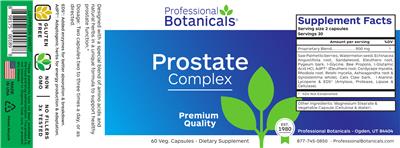
This summary is for Prostate Complex by Professional Botanicals
- Form
- Capsule
- Serving Size
- 2 Capsules
- Servings
- 30 per container
- Container Holds
- 60 Veg. Capsules
- What is Prostate Complex?A supplement from Professional Botanicals with 14 active ingredients, in capsule form.
- Active Ingredients 8 plant ingredients such as Saw Palmetto, Watermelon and Echinacea angustifolia, 3 amino acids and 3 others: Saw PalmettoWatermelonEchinacea angustifoliaSandalwoodEleutheroPygeumL-GlycineBee PropolisL-Glutamic Acid HydrochlorideAdPTCat's ClawL-Alanine 14 active ingredients. Each one can interact with drugs or cause side effects on its own, so we check every one. And 2 more, in the Supplement Facts
- Drug Interactions 1,516 drugs have a documented interaction with this supplement; the most serious is rated moderate. Of those, 1,073 are single drugs and 443 are combination products (two or more drugs in one), each listed under its own name. Based on the 12 of its 14 ingredients we could check. Ask your pharmacist first if you take a drug in any of these categories, the most serious of the 36 on record:
- Moderate · 645 drugs
- Moderate · 372 drugs
- Moderate · 248 drugs
- Moderate · 202 drugs
- Possible Side EffectsStomach upset 7 ingredientsNausea 6 ingredientsHeadache 3 ingredientsDizziness 2 ingredientsRednessTrouble sleeping +11 moreCombined from nine of its 14 active ingredients. Not studied in this exact product.
- Well documented Why
Does Prostate Complex work?
What It Is Marketed For
Healthy prostate function support
From the claims on the product’s label.
The Closest Use the Research Grades
Pygeum
Good studies support it.
Its ingredients have research behind other uses too:
- Transurethral resection of the prostate (TURP) Saw Palmetto
- Eleuthero
- Propolis
These grades are for each ingredient, not this exact product, and never a promise it will work for you.
What the research says- AllergensNone of its ingredient names point to a major food allergen
- Barcode (UPC)8 98175 00189 8Match it to the barcode on your bottle to be sure this is your product. Not your product? Search for it here
Who Might Consider It
- People looking for healthy prostate function support, which is what it is marketed for. The closest use the research grades is benign prostatic hyperplasia (BPH), rated Likely Effective.
- People who want it for transurethral resection of the prostate (TURP), genital herpes or diabetes: the other uses with research behind them. See each grade
- Prostate Complex may interest men looking into botanicals for prostate concerns, though the ratings for its key ingredients are mixed and several have insufficient data.
Who Should Be Careful
- If you take blood thinners, blood pressure or blood sugar medicines, sedatives, immunosuppressants, or thyroid hormone, be careful and talk it over with your own doctor or pharmacist first.
- If you are pregnant, breastfeeding, or have kidney or liver disease, get personalized advice from your own healthcare provider before using it.
More Before You Take It Show both answersHide Pregnancy and Breastfeeding The Label’s Directions
-
Pregnant or breastfeeding?
- Pregnancy and Breastfeeding Saw Palmetto
- ! When used orally.
- Pregnancy White Sandalwood
- ! When used orally in medicinal amounts; sandalwood is reported to have abortifacient effects; avoid using.
- Breastfeeding White Sandalwood
- Insufficient reliable information available; avoid using amounts greater than those found in foods.
- Pregnancy Cat's Claw
- ! When used orally.
- Breastfeeding Cat's Claw
- Insufficient reliable information available; avoid using.
-
How does the label say to take it?
“Dosage: Two capsules two to three times a day, or as directed.”
The maker’s words. Your pharmacist or doctor may advise differently.
Everything the label says
From the label dated May 23, 2024: 12 of its 14 active ingredients were checked against our records; the other two are not in them yet. A summary of what is known, not a grade or a test of the product. How these ratings are computed
Ask Anything About This Supplement
Name a drug you take, or ask about side effects, ingredients or pregnancy.
There’s a lot of information about this supplement on this page! Ask anything in plain English for a quick answer drawn from it.
AI answers come from this label and our own records, never the open internet. AI can make mistakes, so always check with your doctor or pharmacist. How we use AI
Ask the Pharmacist
A licensed pharmacist will answer your question by email — free, as soon as they can.
Got it — thank you!
A licensed pharmacist will answer as soon as they can. Keep an eye on your email (worth checking spam, just in case).
What’s Inside Prostate Complex by Professional Botanicals
14 Active Ingredients
In the order the label lists them, each with its own card below.
- Saw Palmetto
- Watermelon
- Echinacea angustifolia
- Sandalwood
- Eleuthero
- Pygeum
- L-Glycine
- Bee Propolis
- L-Glutamic Acid Hydrochloride
- AdPT
- Cat's Claw
- L-Alanine
And 2 more, each with its own card below.
The label gives an exact amount for 0 of its 14 active ingredients. 14 are inside one proprietary blend, “Proprietary Blend”, and the label gives one total for it, not how much of each ingredient is in it.
- 0 state an exact amount
- 14 have no amount of their own
- Proprietary Blend 900 mg in total · 14 ingredients, no amount for each
This rates what the label tells you, not the quality of the product.
Supplement Facts
| Amount Per Serving | % Daily Value | |
|---|---|---|
| Proprietary Blend | 900 mg | † |
| Saw Palmetto | † | |
| Watermelon | † | |
| Echinacea angustifolia | † | |
| Sandalwood | † | |
| Eleuthero | † | |
| Pygeum | † | |
| L-Glycine | † | |
| Bee Propolis | † | |
| L-Glutamic Acid Hydrochloride | † | |
| AdPT | † | |
| Eleuthero | † | |
| Cordyceps | † | |
| Rhodiola | † | |
| Reishi | † | |
| Ashwagandha | † | |
| Gynostemma | † | |
| Cat's Claw | † | |
| L-Alanine | † | |
| Lycopene | † | |
| EDS | † | |
| Amylase | † | |
| Protease | † | |
| Lipase | † | |
| Cellulase | † | |
Other ingredients: Magnesium Stearate, Cellulose, Water
† Daily Value not established.
Daily Values for adults and children 4 or more years of age.
As the label prints it, from the NIH Dietary Supplement Label Database.
Each Ingredient and Its Drug Interactions
Tap one for more about it and its full guide. A drug can interact with this supplement through any one of them.
Prostate Complex contains 22 ingredients in total.
- Its active ingredients include amino acids such as L-alanine, L-glycine, and L-glutamic acid hydrochloride, digestive enzymes (amylase, protease, lipase, and cellulase), and botanicals such as saw palmetto, pygeum, reishi, ashwagandha, and rhodiola.
-
Proprietary Blend 900 mg The label also includes three proprietary blends (Proprietary Blend, AdPT, and EDS), whose component ingredients are listed individually. 14 ingredients inside it, each checked on its own
- Saw Palmetto 174 drugs
- Watermelon
- Echinacea angustifolia 818 drugs
- Sandalwood 1 drug
- Eleuthero 1,141 drugs
- Pygeum
- L-Glycine 1 drug
- Bee Propolis 923 drugs
- L-Glutamic Acid Hydrochloride
- AdPT
- Cat's Claw 964 drugs
- L-Alanine
- Lycopene 122 drugs
- EDS
Other Ingredients (Inactive)
The capsule or tablet itself, fillers, coatings and flavors. Not part of the drug interaction check; the allergen check below reads them.
- Magnesium Stearate
- Cellulose
- Water
Allergens in Prostate Complex
None of its ingredient names point to a major food allergen.
Not named in the ingredients
- Milk
- Egg
- Fish
- Shellfish
- Tree nuts
- Peanuts
- Wheat or other gluten grains
- Soy
- Sesame
- Made without, the label says“Gluten free · Non GMO · No fillers 3x tested”
From the label text and ingredient names on file; we do not test products. With a serious allergy, check your bottle and ask the maker or your pharmacist.
What the Label Says
The maker’s own words, from the label. We do not verify or endorse them.
- Formulation
-
“Gluten free Non GMO No fillers 3x tested”
“Premium quality”
2 more from the label
“Designed with a special blend of amino acids and natural herbs in a unique formula to support healthy prostate function.”
“EDS: Added enzymes for better absorption & breakdown. AdPT: Adaptogenic herbs for energy production & adaptation.”
- Seals and symbols
-
“Made in USA”
- General statements
-
“2 Please recycle”
- Brand IP Statement(s)
-
“Professional Botanicals est. 1980”
- FDA Statement of Identity
-
“Dietary Supplement”
The Prostate Complex Label on File
The label scan on file at the NIH Dietary Supplement Label Database, dated May 2024. Always read the label on the bottle you have.
Product Facts
- Brand
- Professional Botanicals
- Barcode (UPC)
- 898175001898
- Net contents
- 60 Veg. Capsules
- Market status
- On market
- Date entered into DSLD
- May 23, 2024
- DSLD ID
- 308963
- Product type
- Other Combinations
- Supplement form
- Capsule
- Dietary claims / uses
- Nutrient, All Other, Structure/Function
- Intended target group(s)
- Adult Male (18-50 Years), Seniors/Mature (>50 Years) - Men ONLY, Gluten Free
Is this label outdated? Report a formula or label change and our pharmacy team will review it.
HelloPharmacist Score Prostate Complex by Professional Botanicals
Up to 10 points for research, amount, label and outside testing. Not a safety rating. How this one adds up
for benign prostatic hyperplasia (BPH)
It is marketed for healthy prostate function support. There is no graded research on that exact use, so we scored the closest one: good research suggests pygeum, one of its ingredients, helps with benign prostatic hyperplasia (BPH).
- Research3 of 5 points
- Amount0 of 2 points
- Label0 of 2 points
- Outside testing0 of 1 point
Moderate drug interactions. The score does not count drug interactions. Check them against any drugs you take. See them
How It Earns Its 3
Score: 3 out of 10. Supported for benign prostatic hyperplasia (BPH).
Good research on pygeum for benign prostatic hyperplasia (BPH).
Graded “Likely Effective” in the Natural Medicines database, which we license. A related use, not the one it is marketed for, counts for at most 3 of 5 research points.
3 of 5 points
Amount
The label does not say how much pygeum is in it.
0 of 2 points
Label
It states the amount of none of its 14 active ingredients; 14 are inside blends that give only a total.
0 of 2 points
Outside testing
We found no mark from an outside testing program, such as USP Verified or NSF Certified, on the label we have on file.
0 of 1 point
Prostate Complex by Professional Botanicals Side Effects
Why this rating?
We look for three kinds of safety information on each ingredient: side effects reported in studies, a pregnancy and breastfeeding rating, and a safety write-up from our pharmacy team. Of the 17 ingredients we could check, 16 have side-effect reports, all 17 have a pregnancy rating and all 17 have a safety write-up.
So this rates how much is known, not whether Prostate Complex is right for you.
Reported with ten of its ingredients
- Most often
- Stomach upset, nausea, headache, dizziness, redness and trouble sleeping
- !Rare but serious
- Acute kidney injury and severe allergic reactions in sensitive individuals See details
HelloPharmacist Team Summary: Prostate Complex by Professional Botanicals Side Effects
For many people, Prostate Complex is generally well tolerated, though its many ingredients make the picture more complicated.
- The side effects you are most likely to notice are upset stomach, nausea, and loose stools or diarrhea, which are reported for several of its digestive enzymes and botanicals.
- Drowsiness, dizziness, and trouble sleeping have also been reported, from ingredients like glycine, ashwagandha, rhodiola, and reishi, so see how it affects you before driving.
- Rare but serious reactions include allergic reactions and liver problems, so if you notice signs of either, call your doctor right away.
- If you are pregnant, breastfeeding, or manage diabetes, a bleeding disorder, or blood pressure, and you take any blood thinning or blood pressure medicine, talk it over with your own doctor or pharmacist before starting.
Side Effects, Ingredient by Ingredient
A supplement’s side effects come from its ingredients. Here is what is reported with each one.
Saw Palmetto
Most reported
- Stomach upset
- Nausea
- Dizziness
- Headache
Echinacea
Most reported
- Stomach upset
- Nausea
- Unpleasant taste
White Sandalwood
Most reported
- Redness
- Itching
- Rash
Eleuthero
Most reported
- Trouble sleeping
- Nervousness or feeling jittery
- Headache
- Stomach upset
Pygeum
Most reported
- Nausea
- Stomach upset
- Diarrhea
Glycine
Most reported
- Upset stomach
- Nausea
- Soft stools
- Drowsiness
Propolis
Most reported
- Mouth irritation or sores with lozenges, sprays, or mouthwashes
- Upset stomach
Cat's Claw
Most reported
- Headache
- Dizziness
- Nausea
- Upset stomach
Alpha-alanine
Most reported
- Nausea
- Loose stools
Lycopene has side-effect reports, but no list of the most common ones. Read them in the Lycopene guide
Prostate Complex Warnings: Who Should Be Careful
Prostate Complex has 14 active ingredients, and each can carry warnings of its own. We checked the ten in our ingredient guides, and each warning below names the ingredient it comes from. Watermelon, L-Glutamic Acid Hydrochloride and AdPT and one more are not in our guides yet, so ask your pharmacist about them. If any of these apply to you, talk to your doctor or pharmacist before you start it.
- Saw Palmetto1 warning below
- Echinacea3 warnings below
- White Sandalwood2 warnings below
- Eleuthero1 warning below
- Pygeum2 warnings below
- Glycine2 warnings below
- Propolis3 warnings below
- Cat's Claw3 warnings below
- Alpha-alanine3 warnings below
- Lycopene1 warning below
- WatermelonNot in our guides yet
- L-Glutamic Acid HydrochlorideNot in our guides yet
- AdPTNot in our guides yet
- EdsNot in our guides yet
-
Bleeding Problems or Surgery
- EleutheroUse caution or talk to your doctor first if you have high blood pressure, a heart condition, diabetes, a hormone-sensitive condition, an autoimmune disease, or a bleeding disorder, or if you are scheduled for surgery.
- Cat's ClawPeople with bleeding disorders, low blood pressure, or kidney problems should also use care.
- Cat's ClawAlways tell your pharmacist or doctor about any supplements you take, especially before surgery or if you have a chronic health condition.
- LycopenePeople with health conditions, those scheduled for surgery, and anyone taking medications should check with a pharmacist or doctor before starting a supplement.
-
Diabetes or Low Blood Sugar
- Alpha-alaninePeople with diabetes or blood sugar problems should be especially careful, since alanine can affect blood sugar and glucagon.
-
Liver Disease
- GlycinePeople with kidney or liver disease should be cautious and check with a doctor first, since these organs handle amino acids and protein.
- Alpha-alaninePeople with kidney or liver disease should talk to their doctor before taking any amino acid supplement, because these organs help process protein and amino acids.
-
Kidney Disease or Kidney Stones
- White SandalwoodPeople with kidney problems should be especially cautious, since some traditional uses involve the urinary tract.
-
Autoimmune Conditions
- EchinaceaPeople with autoimmune conditions or weakened immune systems should talk to their doctor before using echinacea, since its effects on the immune system are not well understood.
- Cat's ClawBecause it may affect the immune system, people with autoimmune conditions (such as lupus or multiple sclerosis) and those who have had an organ transplant should be especially cautious and check with their doctor first.
-
Allergies
- EchinaceaPeople with asthma or a history of allergies should be especially careful.
- PropolisPeople who are allergic to bees, bee stings, or other bee products (such as honey) may be more likely to react to propolis.
- PropolisIf you have asthma or known allergies, talk to your doctor or pharmacist before using propolis.
-
Children
- EchinaceaSafety in young children is also uncertain, so check with a pediatrician first.
- White SandalwoodAlways check with a pharmacist or doctor before using sandalwood as a remedy, and keep oils away from children and pets.
- PropolisSafety in young children has also not been well established, so check with a pediatrician first.
-
If You Take Other Drugs
- PygeumIf you have a chronic health condition or take prescription medicines, check with your pharmacist or doctor before starting pygeum.
- Alpha-alanineAs with any supplement, choose products from reputable brands and check with your pharmacist or doctor before starting, especially if you have a health condition or take medicines.
-
Other Cautions
- Saw PalmettoStill, it should be used with care, and you should talk to your doctor or pharmacist first.
- PygeumAnyone with urinary symptoms should be evaluated by a healthcare provider first, because conditions like prostate cancer can cause similar symptoms and need proper diagnosis.
- GlycineGetting glycine from normal foods is not a concern; this caution is about concentrated supplements.
-
Pregnant or Breastfeeding
Each ingredient’s rating for pregnancy and for breastfeeding, and what it covers.
Pregnancy and Breastfeeding The record rates both the same
-
When used orally.
Saw palmetto has hormonal activity; avoid using.
Pregnancy
-
When used orally in medicinal amounts; sandalwood is reported to have abortifacient effects; avoid using.
Breastfeeding
-
Insufficient reliable information available; avoid using amounts greater than those found in foods.
Show 8 more ingredients
Pregnancy
-
When used orally.
There is concern that cat's claw might be unsafe based on its traditional use as a contraceptive; avoid using.
Breastfeeding
-
Insufficient reliable information available; avoid using.
Pregnancy
-
When used orally, short-term.
There is preliminary evidence that mothers can safely use echinacea in the form of E. purpurea or E. angustifolia solid dosage forms, 250-1000 mg daily, or tinctures, up to 30 drops daily, for 5 days to 7 days during the first trimester without adversely affecting the fetus.
There is insufficient reliable information available about the safety of echinacea when used for longer than 7 days.
Breastfeeding
-
Insufficient reliable information available; avoid using.
Pregnancy and Breastfeeding The record rates both the same
-
Insufficient reliable information available; avoid using.
Pregnancy and Breastfeeding The record rates both the same
-
Insufficient reliable information available; avoid using.
Pregnancy and Breastfeeding The record rates both the same
-
Insufficient reliable information available; avoid using.
Pregnancy
-
Insufficient reliable information available; avoid using.
Breastfeeding
-
When used orally and appropriately during lactation.
Propolis 300 mg daily has been used for 4-10 months in one clinical study with no apparent adverse effects to nursing infants.
Pregnancy and Breastfeeding The record rates both the same
-
When used in amounts commonly found in foods.
There is insufficient reliable information available about the safety of using larger amounts as medicine during pregnancy or lactation.
Pregnancy
-
When consumed in amounts commonly found in foods.
There is insufficient reliable information available about the safety of lycopene supplements during pregnancy.
Small, low-quality clinical studies have shown conflicting results about the safety of using lycopene 2-4 mg daily during pregnancy.
Breastfeeding
-
When consumed in amounts commonly found in foods.
There is insufficient reliable information available about the safety of lycopene supplements during lactation; avoid using in amounts greater than those typically found in foods.
Our pharmacy team’s notes
- EchinaceaEchinacea is rated Possibly Safe in pregnancy.
- Lycopene is rated Likely Safe in pregnancy and lactation, and L-alanine is rated Likely Safe in pregnancy and lactation.
- Ashwagandha, eleuthero, rhodiola, reishi, cordyceps, protease, and pygeum carry avoid notes in pregnancy in their safety data.
- Saw palmetto and sandalwood are rated Likely Unsafe in pregnancy, and gynostemma and cat's claw are rated Possibly Unsafe.
Ratings and the words beside them are from the Natural Medicines database, which we license.
-
Rare but Serious Side Effects
-
!
Saw Palmetto
Rare reports have linked saw palmetto to liver or pancreas problems, though a direct cause is not well established.
-
!
Echinacea
The most important risk is an allergic reaction, which can include rash, itching, swelling, or trouble breathing.
Orally: Severe allergic reactions and hepatitis have been reported.
-
!
White Sandalwood
The most common side effect is skin irritation or allergic reactions, such as redness, itching, or rash, especially with undiluted essential oil.
Orally: Acute kidney injury.
-
!
Pygeum
Serious side effects appear to be uncommon, but because long-term and large studies are limited, the full safety picture is not fully known.
-
!
Glycine
Serious reactions appear to be rare.
-
!
Propolis
Most people who use propolis do not have serious problems.
Orally: Severe allergic reactions in sensitive individuals.
-
!
Cat's Claw
Rarely, more serious problems such as allergic reactions, kidney irritation, or changes in blood pressure have been reported.
-
!
Alpha-alanine
Serious side effects have not been well documented, but that is partly because high-quality safety studies are lacking.
-
!
Lycopene
Serious side effects are rare.
-
!
Our pharmacy team on Prostate Complex
Rare but serious problems are linked to allergic reactions and,, to liver problems with ashwagandha and reishi.
When to get help: a serious allergic reaction, with trouble breathing or swelling of the face, lips or throat, needs emergency care: call 911. For any other side effect that worries you, call your doctor or pharmacist.
These reports describe each ingredient, not studies of this exact product. Not medical advice: a side effect you notice after starting a supplement is worth a word with your pharmacist or doctor.
Prostate Complex by Professional Botanicals Drug Interactions
We checked all 14 active ingredients in this supplement against every drug in our records. A drug can interact with it through any one of them. Four of them are not in our interaction records yet.
A moderate interaction on record
2 of 3, on a scale from Minor or none to Major.Why this rating?
We rate this by the most serious interaction on record, not by how many there are. For White Sandalwood, Jiaogulan, Propolis, Cat's Claw and Lycopene, the most serious is rated moderate, which means it calls for caution, and sometimes monitoring or a change in timing or dose. Some involve kinds of drugs where a small change can matter, such as blood thinners, transplant drugs and diabetes drugs.
1,517 drugs are on the full list. What matters is whether one you take is on it, so check yours with the interaction checker on this page.
From the HelloPharmacist Team
Put every ingredient together and a few things stand out.
- Prostate Complex by Professional Botanicals does interact with some medications, through its glycine, eleuthero, lycopene, ashwagandha, gynostemma, cordyceps, rhodiola, reishi, saw palmetto, sandalwood, bee propolis, echinacea, and cat's claw content.
- The most serious interaction on record is Moderate: ashwagandha may increase the risk of liver damage when taken with hepatotoxic drugs (medicines that can harm the liver).
- Other drug types with Moderate interactions include blood thinners (anticoagulants and antiplatelet drugs), where eleuthero, lycopene, and saw palmetto may raise bleeding risk, and warfarin, where propolis may reduce its effect.
Eight of its 14 active ingredients have drug interactions on record. The ones below matter most.
- Interacts with
- 1,141 drugs
- Most serious
- Moderate
- Most of its records involve Cytochrome P450 3A4 (CYP3A4) Substrates, P-glycoprotein Substrates and Cytochrome P450 2D6 (CYP2D6) Substrates.
- Interacts with
- 964 drugs
- Most serious
- Moderate
- Most of its records involve Cytochrome P450 3A4 (CYP3A4) Substrates, Antihypertensive Drugs and Anticoagulant/Antiplatelet Drugs.
- Interacts with
- 923 drugs
- Most serious
- Moderate
- Most of its records involve Cytochrome P450 3A4 (CYP3A4) Substrates, Cytochrome P450 2D6 (CYP2D6) Substrates and Cytochrome P450 1A2 (CYP1A2) Substrates.
Show three more ingredients
- Interacts with
- 818 drugs
- Most serious
- Moderate
- Most of its records involve Cytochrome P450 3A4 (CYP3A4) Substrates, Cytochrome P450 1A2 (CYP1A2) Substrates and Immunosuppressants.
- Interacts with
- 174 drugs
- Most serious
- Moderate
- Most of its records involve Anticoagulant/Antiplatelet Drugs, Estrogens and Contraceptive Drugs.
- Interacts with
- 122 drugs
- Most serious
- Moderate
- Most of its records involve Anticoagulant/Antiplatelet Drugs.
And two more ingredients with records, each in the cards below.
Summarized by the HelloPharmacist pharmacy team from the interaction records below. How it is written How we use AI
Why Prostate Complex Interacts, Ingredient by Ingredient
A product interacts through its ingredients. Each card: how many drugs, the most serious rating, and the kinds of drugs it affects most (tap a kind for what it means).
The ingredients driving the most interactions
-
Eleuthero 1,141 drugs
Most serious: Moderate10 interaction records on file
The kinds of drugs it affects most
- 645 drugs
- 202 drugs
- 193 drugs
- 186 drugs
Every Eleuthero drug interaction, 10 records The Eleuthero records cite 24 references, listed in the Eleuthero guide.
-
Cat's Claw 964 drugs
Most serious: Moderate6 interaction records on file
The kinds of drugs it affects most
- 645 drugs
- 172 drugs
- 122 drugs
- 121 drugs
Every Cat's Claw drug interaction, 6 records The Cat's Claw records cite 16 references, listed in the Cat's Claw guide.
-
Bee Propolis 923 drugs
Most serious: Moderate8 interaction records on file
The kinds of drugs it affects most
- 645 drugs
- 193 drugs
- 186 drugs
- 122 drugs
Every Propolis drug interaction, 8 records The Propolis records cite 22 references, listed in the Propolis guide.
-
Echinacea angustifolia 818 drugs
Most serious: Moderate12 interaction records on file
The kinds of drugs it affects most
- 645 drugs
- 186 drugs
- 121 drugs
- 29 drugs
Every Echinacea drug interaction, 12 records The Echinacea records cite 51 references, listed in the Echinacea guide.
-
Saw Palmetto 174 drugs
Most serious: Moderate3 interaction records on file
The kinds of drugs it affects most
- 122 drugs
- 41 drugs
- 30 drugs
Every Saw Palmetto drug interaction, 3 records The Saw Palmetto records cite 22 references, listed in the Saw Palmetto guide.
-
Lycopene 122 drugs
Most serious: Moderate1 interaction record on file
The kinds of drugs it affects most
- 122 drugs
Every Lycopene drug interaction, 1 record The Lycopene records cite 10 references, listed in the Lycopene guide.
-
Sandalwood 1 drug
Most serious: Moderate1 interaction record on file
The kinds of drugs it affects most
- 1 drug
Every White Sandalwood drug interaction, 1 record The White Sandalwood records cite 5 references, listed in the White Sandalwood guide.
-
L-Glycine 1 drug
Most serious: Moderate1 interaction record on file
The kinds of drugs it affects most
- Clozapine (Clozaril) 1 drug
Every Glycine drug interaction, 1 record The Glycine records cite 5 references, listed in the Glycine guide.
The Breakdown by Severity
Each drug counted once, at its most serious rating. Tap a tile to list those drugs.
Find Your Drug
Type a drug or brand name to see whether it is on the list.
- Only drugs with a documented interaction are listed, the most serious first.
- A drug with no known interaction is not listed, but searching its name tells you so.
- Open a drug to see which ingredient is responsible. Of those, 1,073 are single drugs and 443 are combination products (two or more drugs in one), each listed under its own name.
-
Dextromethorphan Hbr and GuaifenesinPediatric Vicks Formula 44e Cough & Chest Congesti, Vicks Formula 44E Cough & Chest Congestion Relief Moderate
The 6 ingredients responsible:
-
Bee Propolis Moderate Dextromethorphan Hbr and Guaifenesin is in these Cytochrome P450 3A4 (CYP3A4) Substrates, Cytochrome P450 2D6 (CYP2D6) Substrates categories.
Theoretically, high doses of propolis might increase blood levels of drugs metabolized by CYP3A4.
The full Bee Propolis + Dextromethorphan Hbr and Guaifenesin interaction -
Echinacea Angustifolia Moderate Dextromethorphan Hbr and Guaifenesin is in the Cytochrome P450 3A4 (CYP3A4) Substrates category.
Echinacea may induce hepatic CYP3A4 and inhibit intestinal CYP3A4.
The full Echinacea Angustifolia + Dextromethorphan Hbr and Guaifenesin interaction -
Cat's Claw Moderate Dextromethorphan Hbr and Guaifenesin is in the Cytochrome P450 3A4 (CYP3A4) Substrates category.
Theoretically, cat's claw might increase or decrease the levels and effects of drugs metabolized by CYP3A4.
The full Cat's Claw + Dextromethorphan Hbr and Guaifenesin interaction -
Eleuthero Minor Dextromethorphan Hbr and Guaifenesin is in these Cytochrome P450 2D6 (CYP2D6) Substrates, Cytochrome P450 3A4 (CYP3A4) Substrates categories.
Theoretically, eleuthero might increase levels of drugs metabolized by CYP2D6.
The full Eleuthero + Dextromethorphan Hbr and Guaifenesin interaction -
Ashwagandha Minor Dextromethorphan Hbr and Guaifenesin is in these Cytochrome P450 3A4 (CYP3A4) Substrates, Serotonergic Drugs categories.
Theoretically, ashwagandha might decrease the levels and clinical effects of CYP3A4 substrates.
The full Ashwagandha + Dextromethorphan Hbr and Guaifenesin interaction -
Rhodiola Minor Dextromethorphan Hbr and Guaifenesin is in the Cytochrome P450 3A4 (CYP3A4) Substrates category.
Theoretically, rhodiola might increase levels of drugs metabolized by CYP3A4.
The full Rhodiola + Dextromethorphan Hbr and Guaifenesin interaction
-
-
Reserpine and TrichlormethiazideMetatensin #2, Metatensin #4, Naquival Moderate
The 4 ingredients responsible:
-
Reishi Moderate Reserpine and Trichlormethiazide is in the Antihypertensive Drugs category.
Theoretically, concurrent use of reishi mushroom with antihypertensive drugs might increase the risk of hypotension.
The full Reishi + Reserpine and Trichlormethiazide interaction -
Ashwagandha Moderate Reserpine and Trichlormethiazide is in the Antihypertensive Drugs category.
Theoretically, taking ashwagandha with antihypertensive drugs might increase the risk of hypotension.
The full Ashwagandha + Reserpine and Trichlormethiazide interaction -
Cat's Claw Moderate Reserpine and Trichlormethiazide is in the Antihypertensive Drugs category.
Theoretically, taking cat's claw with antihypertensive drugs might increase the risk of hypotension.
The full Cat's Claw + Reserpine and Trichlormethiazide interaction -
Rhodiola Moderate Reserpine and Trichlormethiazide is in the Antihypertensive Drugs category.
Theoretically, taking rhodiola with antihypertensive drugs might increase the risk of hypotension.
The full Rhodiola + Reserpine and Trichlormethiazide interaction
-
-
Guaifenesin, Hydrocodone Bitartrate, and Pseudoephedrine HydrochlorideHycofenix Moderate
The 6 ingredients responsible:
-
Ashwagandha Moderate Guaifenesin, Hydrocodone Bitartrate, and Pseudoephedrine Hydrochloride is in these CNS Depressants, Cytochrome P450 3A4 (CYP3A4) Substrates categories.
Theoretically, taking ashwagandha might increase the sedative effects of CNS depressants.
The full Ashwagandha + Guaifenesin, Hydrocodone Bitartrate, and Pseudoephedrine Hydrochloride interaction -
Echinacea Angustifolia Moderate Guaifenesin, Hydrocodone Bitartrate, and Pseudoephedrine Hydrochloride is in the Cytochrome P450 3A4 (CYP3A4) Substrates category.
Echinacea may induce hepatic CYP3A4 and inhibit intestinal CYP3A4.
The full Echinacea Angustifolia + Guaifenesin, Hydrocodone Bitartrate, and Pseudoephedrine Hydrochloride interaction -
Cat's Claw Moderate Guaifenesin, Hydrocodone Bitartrate, and Pseudoephedrine Hydrochloride is in the Cytochrome P450 3A4 (CYP3A4) Substrates category.
Theoretically, cat's claw might increase or decrease the levels and effects of drugs metabolized by CYP3A4.
The full Cat's Claw + Guaifenesin, Hydrocodone Bitartrate, and Pseudoephedrine Hydrochloride interaction -
Bee Propolis Moderate Guaifenesin, Hydrocodone Bitartrate, and Pseudoephedrine Hydrochloride is in these Cytochrome P450 3A4 (CYP3A4) Substrates, Cytochrome P450 2D6 (CYP2D6) Substrates categories.
Theoretically, high doses of propolis might increase blood levels of drugs metabolized by CYP3A4.
The full Bee Propolis + Guaifenesin, Hydrocodone Bitartrate, and Pseudoephedrine Hydrochloride interaction -
Rhodiola Minor Guaifenesin, Hydrocodone Bitartrate, and Pseudoephedrine Hydrochloride is in these CNS Depressants, Cytochrome P450 3A4 (CYP3A4) Substrates categories.
Theoretically, rhodiola might increase the risk of adverse effects when taken with CNS depressants.
The full Rhodiola + Guaifenesin, Hydrocodone Bitartrate, and Pseudoephedrine Hydrochloride interaction -
Eleuthero Minor Guaifenesin, Hydrocodone Bitartrate, and Pseudoephedrine Hydrochloride is in these Cytochrome P450 2D6 (CYP2D6) Substrates, Cytochrome P450 3A4 (CYP3A4) Substrates categories.
Theoretically, eleuthero might increase levels of drugs metabolized by CYP2D6.
The full Eleuthero + Guaifenesin, Hydrocodone Bitartrate, and Pseudoephedrine Hydrochloride interaction
-
-
Acetaminophen and ButalbitalAxocet, Bancap, Bucet, Butex Forte, Esgic CF and 6 more Moderate
The 5 ingredients responsible:
-
Eleuthero Moderate Acetaminophen and Butalbital is in the Cytochrome P450 1A2 (CYP1A2) Substrates category.
Theoretically, eleuthero might increase levels of drugs metabolized by CYP1A2.
The full Eleuthero + Acetaminophen and Butalbital interaction -
Bee Propolis Moderate Acetaminophen and Butalbital is in these Cytochrome P450 2E1 (CYP2E1) Substrates, Cytochrome P450 1A2 (CYP1A2) Substrates categories.
Theoretically, propolis might increase levels of drugs metabolized by CYP2E1.
The full Bee Propolis + Acetaminophen and Butalbital interaction -
Echinacea Angustifolia Moderate Acetaminophen and Butalbital is in the Cytochrome P450 1A2 (CYP1A2) Substrates category.
Echinacea might inhibit the metabolism of CYP1A2 and increase plasma levels of some drugs.
The full Echinacea Angustifolia + Acetaminophen and Butalbital interaction -
Ashwagandha Moderate Acetaminophen and Butalbital is in these Hepatotoxic Drugs, Cytochrome P450 1A2 (CYP1A2) Substrates categories.
Theoretically, taking ashwagandha with hepatotoxic drugs might increase the risk of liver damage.
The full Ashwagandha + Acetaminophen and Butalbital interaction -
Rhodiola Minor Acetaminophen and Butalbital is in the Cytochrome P450 1A2 (CYP1A2) Substrates category.
Theoretically, rhodiola might increase levels of drugs metabolized by CYP1A2.
The full Rhodiola + Acetaminophen and Butalbital interaction
-
-
Chlorpheniramine, Phenylephrine, and PhenylpropanolamineRutuss Moderate
The 6 ingredients responsible:
-
Cat's Claw Moderate Chlorpheniramine, Phenylephrine, and Phenylpropanolamine is in the Cytochrome P450 3A4 (CYP3A4) Substrates category.
Theoretically, cat's claw might increase or decrease the levels and effects of drugs metabolized by CYP3A4.
The full Cat's Claw + Chlorpheniramine, Phenylephrine, and Phenylpropanolamine interaction -
Bee Propolis Moderate Chlorpheniramine, Phenylephrine, and Phenylpropanolamine is in the Cytochrome P450 3A4 (CYP3A4) Substrates category.
Theoretically, high doses of propolis might increase blood levels of drugs metabolized by CYP3A4.
The full Bee Propolis + Chlorpheniramine, Phenylephrine, and Phenylpropanolamine interaction -
Echinacea Angustifolia Moderate Chlorpheniramine, Phenylephrine, and Phenylpropanolamine is in the Cytochrome P450 3A4 (CYP3A4) Substrates category.
Echinacea may induce hepatic CYP3A4 and inhibit intestinal CYP3A4.
The full Echinacea Angustifolia + Chlorpheniramine, Phenylephrine, and Phenylpropanolamine interaction -
Rhodiola Minor Chlorpheniramine, Phenylephrine, and Phenylpropanolamine is in the Cytochrome P450 3A4 (CYP3A4) Substrates category.
Theoretically, rhodiola might increase levels of drugs metabolized by CYP3A4.
The full Rhodiola + Chlorpheniramine, Phenylephrine, and Phenylpropanolamine interaction -
Eleuthero Minor Chlorpheniramine, Phenylephrine, and Phenylpropanolamine is in the Cytochrome P450 3A4 (CYP3A4) Substrates category.
Theoretically, eleuthero might increase levels of drugs metabolized by CYP3A4.
The full Eleuthero + Chlorpheniramine, Phenylephrine, and Phenylpropanolamine interaction -
Ashwagandha Minor Chlorpheniramine, Phenylephrine, and Phenylpropanolamine is in these Serotonergic Drugs, Cytochrome P450 3A4 (CYP3A4) Substrates categories.
Some animal studies have reported that ashwagandha can enhance serotonergic transmission by altering certain serotonin (5-HT) receptors.
The full Ashwagandha + Chlorpheniramine, Phenylephrine, and Phenylpropanolamine interaction
-
-
Macitentan and TadalafilOpsynvi Moderate
The 7 ingredients responsible:
-
Echinacea Angustifolia Moderate Macitentan and Tadalafil is in the Cytochrome P450 3A4 (CYP3A4) Substrates category.
Echinacea may induce hepatic CYP3A4 and inhibit intestinal CYP3A4.
The full Echinacea Angustifolia + Macitentan and Tadalafil interaction -
Eleuthero Moderate Macitentan and Tadalafil is in these Cytochrome P450 2C9 (CYP2C9) Substrates, Cytochrome P450 3A4 (CYP3A4) Substrates categories.
Theoretically, eleuthero might increase levels of drugs metabolized by CYP2C9.
The full Eleuthero + Macitentan and Tadalafil interaction -
Ashwagandha Moderate Macitentan and Tadalafil is in these Antihypertensive Drugs, Cytochrome P450 3A4 (CYP3A4) Substrates, Hepatotoxic Drugs categories.
Theoretically, taking ashwagandha with antihypertensive drugs might increase the risk of hypotension.
The full Ashwagandha + Macitentan and Tadalafil interaction -
Reishi Moderate Macitentan and Tadalafil is in the Antihypertensive Drugs category.
Theoretically, concurrent use of reishi mushroom with antihypertensive drugs might increase the risk of hypotension.
The full Reishi + Macitentan and Tadalafil interaction -
Rhodiola Moderate Macitentan and Tadalafil is in these Antihypertensive Drugs, Cytochrome P450 3A4 (CYP3A4) Substrates, Cytochrome P450 2C9 (CYP2C9) Substrates categories.
Theoretically, taking rhodiola with antihypertensive drugs might increase the risk of hypotension.
The full Rhodiola + Macitentan and Tadalafil interaction -
Bee Propolis Moderate Macitentan and Tadalafil is in these Cytochrome P450 3A4 (CYP3A4) Substrates, Cytochrome P450 2C9 (CYP2C9) Substrates categories.
Theoretically, high doses of propolis might increase blood levels of drugs metabolized by CYP3A4.
The full Bee Propolis + Macitentan and Tadalafil interaction -
Cat's Claw Moderate Macitentan and Tadalafil is in these Antihypertensive Drugs, Cytochrome P450 3A4 (CYP3A4) Substrates categories.
Theoretically, taking cat's claw with antihypertensive drugs might increase the risk of hypotension.
The full Cat's Claw + Macitentan and Tadalafil interaction
-
-
Chlorpheniramine and PseudoephedrineA.R.M., Anamine TD, Atrohist, Atrohist Ped, Brexin LA and 27 more Moderate
The 6 ingredients responsible:
-
Cat's Claw Moderate Chlorpheniramine and Pseudoephedrine is in the Cytochrome P450 3A4 (CYP3A4) Substrates category.
Theoretically, cat's claw might increase or decrease the levels and effects of drugs metabolized by CYP3A4.
The full Cat's Claw + Chlorpheniramine and Pseudoephedrine interaction -
Bee Propolis Moderate Chlorpheniramine and Pseudoephedrine is in the Cytochrome P450 3A4 (CYP3A4) Substrates category.
Theoretically, high doses of propolis might increase blood levels of drugs metabolized by CYP3A4.
The full Bee Propolis + Chlorpheniramine and Pseudoephedrine interaction -
Echinacea Angustifolia Moderate Chlorpheniramine and Pseudoephedrine is in the Cytochrome P450 3A4 (CYP3A4) Substrates category.
Echinacea may induce hepatic CYP3A4 and inhibit intestinal CYP3A4.
The full Echinacea Angustifolia + Chlorpheniramine and Pseudoephedrine interaction -
Ashwagandha Minor Chlorpheniramine and Pseudoephedrine is in these Cytochrome P450 3A4 (CYP3A4) Substrates, Serotonergic Drugs categories.
Theoretically, ashwagandha might decrease the levels and clinical effects of CYP3A4 substrates.
The full Ashwagandha + Chlorpheniramine and Pseudoephedrine interaction -
Eleuthero Minor Chlorpheniramine and Pseudoephedrine is in the Cytochrome P450 3A4 (CYP3A4) Substrates category.
Theoretically, eleuthero might increase levels of drugs metabolized by CYP3A4.
The full Eleuthero + Chlorpheniramine and Pseudoephedrine interaction -
Rhodiola Minor Chlorpheniramine and Pseudoephedrine is in the Cytochrome P450 3A4 (CYP3A4) Substrates category.
Theoretically, rhodiola might increase levels of drugs metabolized by CYP3A4.
The full Rhodiola + Chlorpheniramine and Pseudoephedrine interaction
-
-
Acetaminophen, Phenyltoloxamine, and SalicylamideLobac Moderate
The 5 ingredients responsible:
-
Eleuthero Moderate Acetaminophen, Phenyltoloxamine, and Salicylamide is in the Cytochrome P450 1A2 (CYP1A2) Substrates category.
Theoretically, eleuthero might increase levels of drugs metabolized by CYP1A2.
The full Eleuthero + Acetaminophen, Phenyltoloxamine, and Salicylamide interaction -
Bee Propolis Moderate Acetaminophen, Phenyltoloxamine, and Salicylamide is in these Cytochrome P450 2E1 (CYP2E1) Substrates, Cytochrome P450 1A2 (CYP1A2) Substrates categories.
Theoretically, propolis might increase levels of drugs metabolized by CYP2E1.
The full Bee Propolis + Acetaminophen, Phenyltoloxamine, and Salicylamide interaction -
Ashwagandha Moderate Acetaminophen, Phenyltoloxamine, and Salicylamide is in these Hepatotoxic Drugs, Cytochrome P450 1A2 (CYP1A2) Substrates categories.
Theoretically, taking ashwagandha with hepatotoxic drugs might increase the risk of liver damage.
The full Ashwagandha + Acetaminophen, Phenyltoloxamine, and Salicylamide interaction -
Echinacea Angustifolia Moderate Acetaminophen, Phenyltoloxamine, and Salicylamide is in the Cytochrome P450 1A2 (CYP1A2) Substrates category.
Echinacea might inhibit the metabolism of CYP1A2 and increase plasma levels of some drugs.
The full Echinacea Angustifolia + Acetaminophen, Phenyltoloxamine, and Salicylamide interaction -
Rhodiola Minor Acetaminophen, Phenyltoloxamine, and Salicylamide is in the Cytochrome P450 1A2 (CYP1A2) Substrates category.
Theoretically, rhodiola might increase levels of drugs metabolized by CYP1A2.
The full Rhodiola + Acetaminophen, Phenyltoloxamine, and Salicylamide interaction
-
-
Umeclidinium Bromide and Vilanterol TrifenatateAnoro Ellipta Moderate
The 6 ingredients responsible:
-
Cat's Claw Moderate Umeclidinium Bromide and Vilanterol Trifenatate is in the Cytochrome P450 3A4 (CYP3A4) Substrates category.
Theoretically, cat's claw might increase or decrease the levels and effects of drugs metabolized by CYP3A4.
The full Cat's Claw + Umeclidinium Bromide and Vilanterol Trifenatate interaction -
Bee Propolis Moderate Umeclidinium Bromide and Vilanterol Trifenatate is in the Cytochrome P450 3A4 (CYP3A4) Substrates category.
Theoretically, high doses of propolis might increase blood levels of drugs metabolized by CYP3A4.
The full Bee Propolis + Umeclidinium Bromide and Vilanterol Trifenatate interaction -
Echinacea Angustifolia Moderate Umeclidinium Bromide and Vilanterol Trifenatate is in the Cytochrome P450 3A4 (CYP3A4) Substrates category.
Echinacea may induce hepatic CYP3A4 and inhibit intestinal CYP3A4.
The full Echinacea Angustifolia + Umeclidinium Bromide and Vilanterol Trifenatate interaction -
Ashwagandha Minor Umeclidinium Bromide and Vilanterol Trifenatate is in the Cytochrome P450 3A4 (CYP3A4) Substrates category.
Theoretically, ashwagandha might decrease the levels and clinical effects of CYP3A4 substrates.
The full Ashwagandha + Umeclidinium Bromide and Vilanterol Trifenatate interaction -
Eleuthero Minor Umeclidinium Bromide and Vilanterol Trifenatate is in the Cytochrome P450 3A4 (CYP3A4) Substrates category.
Theoretically, eleuthero might increase levels of drugs metabolized by CYP3A4.
The full Eleuthero + Umeclidinium Bromide and Vilanterol Trifenatate interaction -
Rhodiola Minor Umeclidinium Bromide and Vilanterol Trifenatate is in the Cytochrome P450 3A4 (CYP3A4) Substrates category.
Theoretically, rhodiola might increase levels of drugs metabolized by CYP3A4.
The full Rhodiola + Umeclidinium Bromide and Vilanterol Trifenatate interaction
-
-
Mestranol and NorethindroneNecon 1/50, Nelova 1/50M, Norethin 1/50, Norethin 1/50M, Norinyl 1 50 21 Day and 3 more Moderate
The 7 ingredients responsible:
-
Ashwagandha Moderate Mestranol and Norethindrone is in these Hepatotoxic Drugs, Cytochrome P450 3A4 (CYP3A4) Substrates categories.
Theoretically, taking ashwagandha with hepatotoxic drugs might increase the risk of liver damage.
The full Ashwagandha + Mestranol and Norethindrone interaction -
Saw Palmetto Moderate Mestranol and Norethindrone is in the Contraceptive Drugs category.
Saw palmetto might reduce the effectiveness of contraceptive drugs.
The full Saw Palmetto + Mestranol and Norethindrone interaction -
Cat's Claw Moderate Mestranol and Norethindrone is in the Cytochrome P450 3A4 (CYP3A4) Substrates category.
Theoretically, cat's claw might increase or decrease the levels and effects of drugs metabolized by CYP3A4.
The full Cat's Claw + Mestranol and Norethindrone interaction -
Echinacea Angustifolia Moderate Mestranol and Norethindrone is in the Cytochrome P450 3A4 (CYP3A4) Substrates category.
Echinacea may induce hepatic CYP3A4 and inhibit intestinal CYP3A4.
The full Echinacea Angustifolia + Mestranol and Norethindrone interaction -
Bee Propolis Moderate Mestranol and Norethindrone is in the Cytochrome P450 3A4 (CYP3A4) Substrates category.
Theoretically, high doses of propolis might increase blood levels of drugs metabolized by CYP3A4.
The full Bee Propolis + Mestranol and Norethindrone interaction -
Rhodiola Minor Mestranol and Norethindrone is in the Cytochrome P450 3A4 (CYP3A4) Substrates category.
Theoretically, rhodiola might increase levels of drugs metabolized by CYP3A4.
The full Rhodiola + Mestranol and Norethindrone interaction -
Eleuthero Minor Mestranol and Norethindrone is in the Cytochrome P450 3A4 (CYP3A4) Substrates category.
Theoretically, eleuthero might increase levels of drugs metabolized by CYP3A4.
The full Eleuthero + Mestranol and Norethindrone interaction
-
-
Hydrochlorothiazide and TimololTimolide Moderate
The 6 ingredients responsible:
-
Cat's Claw Moderate Hydrochlorothiazide and Timolol is in the Antihypertensive Drugs category.
Theoretically, taking cat's claw with antihypertensive drugs might increase the risk of hypotension.
The full Cat's Claw + Hydrochlorothiazide and Timolol interaction -
Bee Propolis Moderate Hydrochlorothiazide and Timolol is in the Cytochrome P450 2D6 (CYP2D6) Substrates category.
Theoretically, high doses of propolis might increase blood levels of drugs metabolized by CYP2D6.
The full Bee Propolis + Hydrochlorothiazide and Timolol interaction -
Rhodiola Moderate Hydrochlorothiazide and Timolol is in the Antihypertensive Drugs category.
Theoretically, taking rhodiola with antihypertensive drugs might increase the risk of hypotension.
The full Rhodiola + Hydrochlorothiazide and Timolol interaction -
Ashwagandha Moderate Hydrochlorothiazide and Timolol is in the Antihypertensive Drugs category.
Theoretically, taking ashwagandha with antihypertensive drugs might increase the risk of hypotension.
The full Ashwagandha + Hydrochlorothiazide and Timolol interaction -
Reishi Moderate Hydrochlorothiazide and Timolol is in the Antihypertensive Drugs category.
Theoretically, concurrent use of reishi mushroom with antihypertensive drugs might increase the risk of hypotension.
The full Reishi + Hydrochlorothiazide and Timolol interaction -
Eleuthero Minor Hydrochlorothiazide and Timolol is in the Cytochrome P450 2D6 (CYP2D6) Substrates category.
Theoretically, eleuthero might increase levels of drugs metabolized by CYP2D6.
The full Eleuthero + Hydrochlorothiazide and Timolol interaction
-
-
Chlorpheniramine, Methscopolamine, and PseudoephedrineMescolor, Rescon-Mx, Xiral Moderate
The 6 ingredients responsible:
-
Cat's Claw Moderate Chlorpheniramine, Methscopolamine, and Pseudoephedrine is in the Cytochrome P450 3A4 (CYP3A4) Substrates category.
Theoretically, cat's claw might increase or decrease the levels and effects of drugs metabolized by CYP3A4.
The full Cat's Claw + Chlorpheniramine, Methscopolamine, and Pseudoephedrine interaction -
Echinacea Angustifolia Moderate Chlorpheniramine, Methscopolamine, and Pseudoephedrine is in the Cytochrome P450 3A4 (CYP3A4) Substrates category.
Echinacea may induce hepatic CYP3A4 and inhibit intestinal CYP3A4.
The full Echinacea Angustifolia + Chlorpheniramine, Methscopolamine, and Pseudoephedrine interaction -
Bee Propolis Moderate Chlorpheniramine, Methscopolamine, and Pseudoephedrine is in the Cytochrome P450 3A4 (CYP3A4) Substrates category.
Theoretically, high doses of propolis might increase blood levels of drugs metabolized by CYP3A4.
The full Bee Propolis + Chlorpheniramine, Methscopolamine, and Pseudoephedrine interaction -
Eleuthero Minor Chlorpheniramine, Methscopolamine, and Pseudoephedrine is in the Cytochrome P450 3A4 (CYP3A4) Substrates category.
Theoretically, eleuthero might increase levels of drugs metabolized by CYP3A4.
The full Eleuthero + Chlorpheniramine, Methscopolamine, and Pseudoephedrine interaction -
Rhodiola Minor Chlorpheniramine, Methscopolamine, and Pseudoephedrine is in the Cytochrome P450 3A4 (CYP3A4) Substrates category.
Theoretically, rhodiola might increase levels of drugs metabolized by CYP3A4.
The full Rhodiola + Chlorpheniramine, Methscopolamine, and Pseudoephedrine interaction -
Ashwagandha Minor Chlorpheniramine, Methscopolamine, and Pseudoephedrine is in these Serotonergic Drugs, Cytochrome P450 3A4 (CYP3A4) Substrates categories.
Some animal studies have reported that ashwagandha can enhance serotonergic transmission by altering certain serotonin (5-HT) receptors.
The full Ashwagandha + Chlorpheniramine, Methscopolamine, and Pseudoephedrine interaction
-
-
Ethinyl Estradiol and LevonogestrelLybrel Moderate
The 7 ingredients responsible:
-
Ashwagandha Moderate Ethinyl Estradiol and Levonogestrel is in these Cytochrome P450 1A2 (CYP1A2) Substrates, Cytochrome P450 3A4 (CYP3A4) Substrates, Hepatotoxic Drugs categories.
Theoretically, ashwagandha might decrease the levels and clinical effects of CYP1A2 substrates.
The full Ashwagandha + Ethinyl Estradiol and Levonogestrel interaction -
Eleuthero Moderate Ethinyl Estradiol and Levonogestrel is in these Cytochrome P450 3A4 (CYP3A4) Substrates, Cytochrome P450 1A2 (CYP1A2) Substrates, P-glycoprotein Substrates categories.
Theoretically, eleuthero might increase levels of drugs metabolized by CYP3A4.
The full Eleuthero + Ethinyl Estradiol and Levonogestrel interaction -
Bee Propolis Moderate Ethinyl Estradiol and Levonogestrel is in these Cytochrome P450 1A2 (CYP1A2) Substrates, Cytochrome P450 3A4 (CYP3A4) Substrates categories.
Theoretically, high doses of propolis might increase blood levels of drugs metabolized by CYP1A2.
The full Bee Propolis + Ethinyl Estradiol and Levonogestrel interaction -
Rhodiola Moderate Ethinyl Estradiol and Levonogestrel is in these Cytochrome P450 1A2 (CYP1A2) Substrates, Cytochrome P450 3A4 (CYP3A4) Substrates, P-glycoprotein Substrates categories.
Theoretically, rhodiola might increase levels of drugs metabolized by CYP1A2.
The full Rhodiola + Ethinyl Estradiol and Levonogestrel interaction -
Cat's Claw Moderate Ethinyl Estradiol and Levonogestrel is in the Cytochrome P450 3A4 (CYP3A4) Substrates category.
Theoretically, cat's claw might increase or decrease the levels and effects of drugs metabolized by CYP3A4.
The full Cat's Claw + Ethinyl Estradiol and Levonogestrel interaction -
Echinacea Angustifolia Moderate Ethinyl Estradiol and Levonogestrel is in these Cytochrome P450 3A4 (CYP3A4) Substrates, Cytochrome P450 1A2 (CYP1A2) Substrates categories.
Echinacea may induce hepatic CYP3A4 and inhibit intestinal CYP3A4.
The full Echinacea Angustifolia + Ethinyl Estradiol and Levonogestrel interaction -
Saw Palmetto Moderate Ethinyl Estradiol and Levonogestrel is in these Estrogens, Contraceptive Drugs categories.
Saw palmetto might reduce the effectiveness of estrogens.
The full Saw Palmetto + Ethinyl Estradiol and Levonogestrel interaction
-
-
Hydrochlorothiazide and MoexiprilUniretic Moderate
The 4 ingredients responsible:
-
Rhodiola Moderate Hydrochlorothiazide and Moexipril is in the Antihypertensive Drugs category.
Theoretically, taking rhodiola with antihypertensive drugs might increase the risk of hypotension.
The full Rhodiola + Hydrochlorothiazide and Moexipril interaction -
Cat's Claw Moderate Hydrochlorothiazide and Moexipril is in the Antihypertensive Drugs category.
Theoretically, taking cat's claw with antihypertensive drugs might increase the risk of hypotension.
The full Cat's Claw + Hydrochlorothiazide and Moexipril interaction -
Ashwagandha Moderate Hydrochlorothiazide and Moexipril is in the Antihypertensive Drugs category.
Theoretically, taking ashwagandha with antihypertensive drugs might increase the risk of hypotension.
The full Ashwagandha + Hydrochlorothiazide and Moexipril interaction -
Reishi Moderate Hydrochlorothiazide and Moexipril is in the Antihypertensive Drugs category.
Theoretically, concurrent use of reishi mushroom with antihypertensive drugs might increase the risk of hypotension.
The full Reishi + Hydrochlorothiazide and Moexipril interaction
-
-
Ergotamine, Belladonna, and PhenobarbitalBellamine, Bellaspas, Eperbel-S Moderate
The 6 ingredients responsible:
-
Ashwagandha Moderate Ergotamine, Belladonna, and Phenobarbital is in these CNS Depressants, Cytochrome P450 3A4 (CYP3A4) Substrates categories.
Theoretically, taking ashwagandha might increase the sedative effects of CNS depressants.
The full Ashwagandha + Ergotamine, Belladonna, and Phenobarbital interaction -
Bee Propolis Moderate Ergotamine, Belladonna, and Phenobarbital is in the Cytochrome P450 3A4 (CYP3A4) Substrates category.
Theoretically, high doses of propolis might increase blood levels of drugs metabolized by CYP3A4.
The full Bee Propolis + Ergotamine, Belladonna, and Phenobarbital interaction -
Echinacea Angustifolia Moderate Ergotamine, Belladonna, and Phenobarbital is in the Cytochrome P450 3A4 (CYP3A4) Substrates category.
Echinacea may induce hepatic CYP3A4 and inhibit intestinal CYP3A4.
The full Echinacea Angustifolia + Ergotamine, Belladonna, and Phenobarbital interaction -
Cat's Claw Moderate Ergotamine, Belladonna, and Phenobarbital is in the Cytochrome P450 3A4 (CYP3A4) Substrates category.
Theoretically, cat's claw might increase or decrease the levels and effects of drugs metabolized by CYP3A4.
The full Cat's Claw + Ergotamine, Belladonna, and Phenobarbital interaction -
Eleuthero Minor Ergotamine, Belladonna, and Phenobarbital is in the Cytochrome P450 3A4 (CYP3A4) Substrates category.
Theoretically, eleuthero might increase levels of drugs metabolized by CYP3A4.
The full Eleuthero + Ergotamine, Belladonna, and Phenobarbital interaction -
Rhodiola Minor Ergotamine, Belladonna, and Phenobarbital is in these Cytochrome P450 3A4 (CYP3A4) Substrates, CNS Depressants categories.
Theoretically, rhodiola might increase levels of drugs metabolized by CYP3A4.
The full Rhodiola + Ergotamine, Belladonna, and Phenobarbital interaction
-
-
Elagolix, Estradiol Norethindrone Acetate, and ElagolixOriahnn Moderate
The 6 ingredients responsible:
-
Cat's Claw Moderate Elagolix, Estradiol Norethindrone Acetate, and Elagolix is in the Cytochrome P450 3A4 (CYP3A4) Substrates category.
Theoretically, cat's claw might increase or decrease the levels and effects of drugs metabolized by CYP3A4.
The full Cat's Claw + Elagolix, Estradiol Norethindrone Acetate, and Elagolix interaction -
Eleuthero Moderate Elagolix, Estradiol Norethindrone Acetate, and Elagolix is in these Cytochrome P450 3A4 (CYP3A4) Substrates, P-glycoprotein Substrates categories.
Theoretically, eleuthero might increase levels of drugs metabolized by CYP3A4.
The full Eleuthero + Elagolix, Estradiol Norethindrone Acetate, and Elagolix interaction -
Rhodiola Moderate Elagolix, Estradiol Norethindrone Acetate, and Elagolix is in these P-glycoprotein Substrates, Cytochrome P450 3A4 (CYP3A4) Substrates categories.
Theoretically, rhodiola might increase levels of P-glycoprotein substrates.
The full Rhodiola + Elagolix, Estradiol Norethindrone Acetate, and Elagolix interaction -
Echinacea Angustifolia Moderate Elagolix, Estradiol Norethindrone Acetate, and Elagolix is in the Cytochrome P450 3A4 (CYP3A4) Substrates category.
Echinacea may induce hepatic CYP3A4 and inhibit intestinal CYP3A4.
The full Echinacea Angustifolia + Elagolix, Estradiol Norethindrone Acetate, and Elagolix interaction -
Bee Propolis Moderate Elagolix, Estradiol Norethindrone Acetate, and Elagolix is in the Cytochrome P450 3A4 (CYP3A4) Substrates category.
Theoretically, high doses of propolis might increase blood levels of drugs metabolized by CYP3A4.
The full Bee Propolis + Elagolix, Estradiol Norethindrone Acetate, and Elagolix interaction -
Ashwagandha Minor Elagolix, Estradiol Norethindrone Acetate, and Elagolix is in the Cytochrome P450 3A4 (CYP3A4) Substrates category.
Theoretically, ashwagandha might decrease the levels and clinical effects of CYP3A4 substrates.
The full Ashwagandha + Elagolix, Estradiol Norethindrone Acetate, and Elagolix interaction
-
-
Dyphylline, Ephedrine, Guaifenesin, and PhenobarbitalLufyllin-EPG Moderate
The 2 ingredients responsible:
-
Ashwagandha Moderate Dyphylline, Ephedrine, Guaifenesin, and Phenobarbital is in the CNS Depressants category.
Theoretically, taking ashwagandha might increase the sedative effects of CNS depressants.
The full Ashwagandha + Dyphylline, Ephedrine, Guaifenesin, and Phenobarbital interaction -
Rhodiola Minor Dyphylline, Ephedrine, Guaifenesin, and Phenobarbital is in the CNS Depressants category.
Theoretically, rhodiola might increase the risk of adverse effects when taken with CNS depressants.
The full Rhodiola + Dyphylline, Ephedrine, Guaifenesin, and Phenobarbital interaction
-
-
Hydrochlorothiazide and LabetalolTrandate HCT Moderate
The 4 ingredients responsible:
-
Cat's Claw Moderate Hydrochlorothiazide and Labetalol is in the Antihypertensive Drugs category.
Theoretically, taking cat's claw with antihypertensive drugs might increase the risk of hypotension.
The full Cat's Claw + Hydrochlorothiazide and Labetalol interaction -
Ashwagandha Moderate Hydrochlorothiazide and Labetalol is in these Hepatotoxic Drugs, Antihypertensive Drugs categories.
Theoretically, taking ashwagandha with hepatotoxic drugs might increase the risk of liver damage.
The full Ashwagandha + Hydrochlorothiazide and Labetalol interaction -
Reishi Moderate Hydrochlorothiazide and Labetalol is in the Antihypertensive Drugs category.
Theoretically, concurrent use of reishi mushroom with antihypertensive drugs might increase the risk of hypotension.
The full Reishi + Hydrochlorothiazide and Labetalol interaction -
Rhodiola Moderate Hydrochlorothiazide and Labetalol is in the Antihypertensive Drugs category.
Theoretically, taking rhodiola with antihypertensive drugs might increase the risk of hypotension.
The full Rhodiola + Hydrochlorothiazide and Labetalol interaction
-
-
Acetaminophen, Dichlorophenazone, and IsometheptaneIsocom Moderate
The 5 ingredients responsible:
-
Bee Propolis Moderate Acetaminophen, Dichlorophenazone, and Isometheptane is in these Cytochrome P450 2E1 (CYP2E1) Substrates, Cytochrome P450 1A2 (CYP1A2) Substrates categories.
Theoretically, propolis might increase levels of drugs metabolized by CYP2E1.
The full Bee Propolis + Acetaminophen, Dichlorophenazone, and Isometheptane interaction -
Ashwagandha Moderate Acetaminophen, Dichlorophenazone, and Isometheptane is in these CNS Depressants, Cytochrome P450 1A2 (CYP1A2) Substrates, Hepatotoxic Drugs categories.
Theoretically, taking ashwagandha might increase the sedative effects of CNS depressants.
The full Ashwagandha + Acetaminophen, Dichlorophenazone, and Isometheptane interaction -
Echinacea Angustifolia Moderate Acetaminophen, Dichlorophenazone, and Isometheptane is in the Cytochrome P450 1A2 (CYP1A2) Substrates category.
Echinacea might inhibit the metabolism of CYP1A2 and increase plasma levels of some drugs.
The full Echinacea Angustifolia + Acetaminophen, Dichlorophenazone, and Isometheptane interaction -
Eleuthero Moderate Acetaminophen, Dichlorophenazone, and Isometheptane is in the Cytochrome P450 1A2 (CYP1A2) Substrates category.
Theoretically, eleuthero might increase levels of drugs metabolized by CYP1A2.
The full Eleuthero + Acetaminophen, Dichlorophenazone, and Isometheptane interaction -
Rhodiola Minor Acetaminophen, Dichlorophenazone, and Isometheptane is in these Cytochrome P450 1A2 (CYP1A2) Substrates, CNS Depressants categories.
Theoretically, rhodiola might increase levels of drugs metabolized by CYP1A2.
The full Rhodiola + Acetaminophen, Dichlorophenazone, and Isometheptane interaction
-
-
Efavirenz, Lamivudine, and Tenofovir Disoproxil FumarateSymfi Moderate
The 6 ingredients responsible:
-
Bee Propolis Moderate Efavirenz, Lamivudine, and Tenofovir Disoproxil Fumarate is in the Cytochrome P450 3A4 (CYP3A4) Substrates category.
Theoretically, high doses of propolis might increase blood levels of drugs metabolized by CYP3A4.
The full Bee Propolis + Efavirenz, Lamivudine, and Tenofovir Disoproxil Fumarate interaction -
Echinacea Angustifolia Moderate Efavirenz, Lamivudine, and Tenofovir Disoproxil Fumarate is in the Cytochrome P450 3A4 (CYP3A4) Substrates category.
Echinacea may induce hepatic CYP3A4 and inhibit intestinal CYP3A4.
The full Echinacea Angustifolia + Efavirenz, Lamivudine, and Tenofovir Disoproxil Fumarate interaction -
Cat's Claw Moderate Efavirenz, Lamivudine, and Tenofovir Disoproxil Fumarate is in the Cytochrome P450 3A4 (CYP3A4) Substrates category.
Theoretically, cat's claw might increase or decrease the levels and effects of drugs metabolized by CYP3A4.
The full Cat's Claw + Efavirenz, Lamivudine, and Tenofovir Disoproxil Fumarate interaction -
Ashwagandha Minor Efavirenz, Lamivudine, and Tenofovir Disoproxil Fumarate is in the Cytochrome P450 3A4 (CYP3A4) Substrates category.
Theoretically, ashwagandha might decrease the levels and clinical effects of CYP3A4 substrates.
The full Ashwagandha + Efavirenz, Lamivudine, and Tenofovir Disoproxil Fumarate interaction -
Eleuthero Minor Efavirenz, Lamivudine, and Tenofovir Disoproxil Fumarate is in the Cytochrome P450 3A4 (CYP3A4) Substrates category.
Theoretically, eleuthero might increase levels of drugs metabolized by CYP3A4.
The full Eleuthero + Efavirenz, Lamivudine, and Tenofovir Disoproxil Fumarate interaction -
Rhodiola Minor Efavirenz, Lamivudine, and Tenofovir Disoproxil Fumarate is in the Cytochrome P450 3A4 (CYP3A4) Substrates category.
Theoretically, rhodiola might increase levels of drugs metabolized by CYP3A4.
The full Rhodiola + Efavirenz, Lamivudine, and Tenofovir Disoproxil Fumarate interaction
-
-
Camphor, Hyoscyamine, Passif, Phenobarbital, Scopolamine, and ValerianNevrotose #3 Moderate
The 2 ingredients responsible:
-
Ashwagandha Moderate Camphor, Hyoscyamine, Passif, Phenobarbital, Scopolamine, and Valerian is in the CNS Depressants category.
Theoretically, taking ashwagandha might increase the sedative effects of CNS depressants.
The full Ashwagandha + Camphor, Hyoscyamine, Passif, Phenobarbital, Scopolamine, and Valerian interaction -
Rhodiola Minor Camphor, Hyoscyamine, Passif, Phenobarbital, Scopolamine, and Valerian is in the CNS Depressants category.
Theoretically, rhodiola might increase the risk of adverse effects when taken with CNS depressants.
The full Rhodiola + Camphor, Hyoscyamine, Passif, Phenobarbital, Scopolamine, and Valerian interaction
-
-
Azelastine Hydrochloride and Fluticasone PropionateDymista Moderate
The 6 ingredients responsible:
-
Echinacea Angustifolia Moderate Azelastine Hydrochloride and Fluticasone Propionate is in the Cytochrome P450 3A4 (CYP3A4) Substrates category.
Echinacea may induce hepatic CYP3A4 and inhibit intestinal CYP3A4.
The full Echinacea Angustifolia + Azelastine Hydrochloride and Fluticasone Propionate interaction -
Bee Propolis Moderate Azelastine Hydrochloride and Fluticasone Propionate is in the Cytochrome P450 3A4 (CYP3A4) Substrates category.
Theoretically, high doses of propolis might increase blood levels of drugs metabolized by CYP3A4.
The full Bee Propolis + Azelastine Hydrochloride and Fluticasone Propionate interaction -
Cat's Claw Moderate Azelastine Hydrochloride and Fluticasone Propionate is in the Cytochrome P450 3A4 (CYP3A4) Substrates category.
Theoretically, cat's claw might increase or decrease the levels and effects of drugs metabolized by CYP3A4.
The full Cat's Claw + Azelastine Hydrochloride and Fluticasone Propionate interaction -
Rhodiola Minor Azelastine Hydrochloride and Fluticasone Propionate is in the Cytochrome P450 3A4 (CYP3A4) Substrates category.
Theoretically, rhodiola might increase levels of drugs metabolized by CYP3A4.
The full Rhodiola + Azelastine Hydrochloride and Fluticasone Propionate interaction -
Ashwagandha Minor Azelastine Hydrochloride and Fluticasone Propionate is in the Cytochrome P450 3A4 (CYP3A4) Substrates category.
Theoretically, ashwagandha might decrease the levels and clinical effects of CYP3A4 substrates.
The full Ashwagandha + Azelastine Hydrochloride and Fluticasone Propionate interaction -
Eleuthero Minor Azelastine Hydrochloride and Fluticasone Propionate is in the Cytochrome P450 3A4 (CYP3A4) Substrates category.
Theoretically, eleuthero might increase levels of drugs metabolized by CYP3A4.
The full Eleuthero + Azelastine Hydrochloride and Fluticasone Propionate interaction
-
-
Chlorpheniramine, Phenylephrine, and PhenyltoloxamineCom Time, Comhist, Comhist LA, Linhist LA, Q Hist LA Moderate
The 6 ingredients responsible:
-
Cat's Claw Moderate Chlorpheniramine, Phenylephrine, and Phenyltoloxamine is in the Cytochrome P450 3A4 (CYP3A4) Substrates category.
Theoretically, cat's claw might increase or decrease the levels and effects of drugs metabolized by CYP3A4.
The full Cat's Claw + Chlorpheniramine, Phenylephrine, and Phenyltoloxamine interaction -
Echinacea Angustifolia Moderate Chlorpheniramine, Phenylephrine, and Phenyltoloxamine is in the Cytochrome P450 3A4 (CYP3A4) Substrates category.
Echinacea may induce hepatic CYP3A4 and inhibit intestinal CYP3A4.
The full Echinacea Angustifolia + Chlorpheniramine, Phenylephrine, and Phenyltoloxamine interaction -
Bee Propolis Moderate Chlorpheniramine, Phenylephrine, and Phenyltoloxamine is in the Cytochrome P450 3A4 (CYP3A4) Substrates category.
Theoretically, high doses of propolis might increase blood levels of drugs metabolized by CYP3A4.
The full Bee Propolis + Chlorpheniramine, Phenylephrine, and Phenyltoloxamine interaction -
Rhodiola Minor Chlorpheniramine, Phenylephrine, and Phenyltoloxamine is in the Cytochrome P450 3A4 (CYP3A4) Substrates category.
Theoretically, rhodiola might increase levels of drugs metabolized by CYP3A4.
The full Rhodiola + Chlorpheniramine, Phenylephrine, and Phenyltoloxamine interaction -
Eleuthero Minor Chlorpheniramine, Phenylephrine, and Phenyltoloxamine is in the Cytochrome P450 3A4 (CYP3A4) Substrates category.
Theoretically, eleuthero might increase levels of drugs metabolized by CYP3A4.
The full Eleuthero + Chlorpheniramine, Phenylephrine, and Phenyltoloxamine interaction -
Ashwagandha Minor Chlorpheniramine, Phenylephrine, and Phenyltoloxamine is in these Serotonergic Drugs, Cytochrome P450 3A4 (CYP3A4) Substrates categories.
Some animal studies have reported that ashwagandha can enhance serotonergic transmission by altering certain serotonin (5-HT) receptors.
The full Ashwagandha + Chlorpheniramine, Phenylephrine, and Phenyltoloxamine interaction
-
-
Etonogestrel and Ethinyl EstradiolNuvaRing Moderate
The 7 ingredients responsible:
-
Bee Propolis Moderate Etonogestrel and Ethinyl Estradiol is in these Cytochrome P450 1A2 (CYP1A2) Substrates, Cytochrome P450 3A4 (CYP3A4) Substrates categories.
Theoretically, high doses of propolis might increase blood levels of drugs metabolized by CYP1A2.
The full Bee Propolis + Etonogestrel and Ethinyl Estradiol interaction -
Eleuthero Moderate Etonogestrel and Ethinyl Estradiol is in these Cytochrome P450 3A4 (CYP3A4) Substrates, P-glycoprotein Substrates, Cytochrome P450 1A2 (CYP1A2) Substrates categories.
Theoretically, eleuthero might increase levels of drugs metabolized by CYP3A4.
The full Eleuthero + Etonogestrel and Ethinyl Estradiol interaction -
Echinacea Angustifolia Moderate Etonogestrel and Ethinyl Estradiol is in these Cytochrome P450 1A2 (CYP1A2) Substrates, Cytochrome P450 3A4 (CYP3A4) Substrates categories.
Echinacea might inhibit the metabolism of CYP1A2 and increase plasma levels of some drugs.
The full Echinacea Angustifolia + Etonogestrel and Ethinyl Estradiol interaction -
Saw Palmetto Moderate Etonogestrel and Ethinyl Estradiol is in these Estrogens, Contraceptive Drugs categories.
Saw palmetto might reduce the effectiveness of estrogens.
The full Saw Palmetto + Etonogestrel and Ethinyl Estradiol interaction -
Rhodiola Moderate Etonogestrel and Ethinyl Estradiol is in these Cytochrome P450 3A4 (CYP3A4) Substrates, P-glycoprotein Substrates, Cytochrome P450 1A2 (CYP1A2) Substrates categories.
Theoretically, rhodiola might increase levels of drugs metabolized by CYP3A4.
The full Rhodiola + Etonogestrel and Ethinyl Estradiol interaction -
Cat's Claw Moderate Etonogestrel and Ethinyl Estradiol is in the Cytochrome P450 3A4 (CYP3A4) Substrates category.
Theoretically, cat's claw might increase or decrease the levels and effects of drugs metabolized by CYP3A4.
The full Cat's Claw + Etonogestrel and Ethinyl Estradiol interaction -
Ashwagandha Minor Etonogestrel and Ethinyl Estradiol is in these Cytochrome P450 1A2 (CYP1A2) Substrates, Cytochrome P450 3A4 (CYP3A4) Substrates categories.
Theoretically, ashwagandha might decrease the levels and clinical effects of CYP1A2 substrates.
The full Ashwagandha + Etonogestrel and Ethinyl Estradiol interaction
-
-
Acetaminophen and MethocarbamolRobaxacet Moderate
The 5 ingredients responsible:
-
Ashwagandha Moderate Acetaminophen and Methocarbamol is in these Hepatotoxic Drugs, Cytochrome P450 1A2 (CYP1A2) Substrates categories.
Theoretically, taking ashwagandha with hepatotoxic drugs might increase the risk of liver damage.
The full Ashwagandha + Acetaminophen and Methocarbamol interaction -
Echinacea Angustifolia Moderate Acetaminophen and Methocarbamol is in the Cytochrome P450 1A2 (CYP1A2) Substrates category.
Echinacea might inhibit the metabolism of CYP1A2 and increase plasma levels of some drugs.
The full Echinacea Angustifolia + Acetaminophen and Methocarbamol interaction -
Eleuthero Moderate Acetaminophen and Methocarbamol is in the Cytochrome P450 1A2 (CYP1A2) Substrates category.
Theoretically, eleuthero might increase levels of drugs metabolized by CYP1A2.
The full Eleuthero + Acetaminophen and Methocarbamol interaction -
Bee Propolis Moderate Acetaminophen and Methocarbamol is in these Cytochrome P450 2E1 (CYP2E1) Substrates, Cytochrome P450 1A2 (CYP1A2) Substrates categories.
Theoretically, propolis might increase levels of drugs metabolized by CYP2E1.
The full Bee Propolis + Acetaminophen and Methocarbamol interaction -
Rhodiola Minor Acetaminophen and Methocarbamol is in the Cytochrome P450 1A2 (CYP1A2) Substrates category.
Theoretically, rhodiola might increase levels of drugs metabolized by CYP1A2.
The full Rhodiola + Acetaminophen and Methocarbamol interaction
-
-
Dextromethorphan and GuaifenesinAmibid DM, Aquatab DM, Benylin Expectorant, Bidex DM, Fenesin DM and 18 more Moderate
The 6 ingredients responsible:
-
Cat's Claw Moderate Dextromethorphan and Guaifenesin is in the Cytochrome P450 3A4 (CYP3A4) Substrates category.
Theoretically, cat's claw might increase or decrease the levels and effects of drugs metabolized by CYP3A4.
The full Cat's Claw + Dextromethorphan and Guaifenesin interaction -
Bee Propolis Moderate Dextromethorphan and Guaifenesin is in these Cytochrome P450 3A4 (CYP3A4) Substrates, Cytochrome P450 2D6 (CYP2D6) Substrates categories.
Theoretically, high doses of propolis might increase blood levels of drugs metabolized by CYP3A4.
The full Bee Propolis + Dextromethorphan and Guaifenesin interaction -
Echinacea Angustifolia Moderate Dextromethorphan and Guaifenesin is in the Cytochrome P450 3A4 (CYP3A4) Substrates category.
Echinacea may induce hepatic CYP3A4 and inhibit intestinal CYP3A4.
The full Echinacea Angustifolia + Dextromethorphan and Guaifenesin interaction -
Eleuthero Minor Dextromethorphan and Guaifenesin is in these Cytochrome P450 2D6 (CYP2D6) Substrates, Cytochrome P450 3A4 (CYP3A4) Substrates categories.
Theoretically, eleuthero might increase levels of drugs metabolized by CYP2D6.
The full Eleuthero + Dextromethorphan and Guaifenesin interaction -
Rhodiola Minor Dextromethorphan and Guaifenesin is in the Cytochrome P450 3A4 (CYP3A4) Substrates category.
Theoretically, rhodiola might increase levels of drugs metabolized by CYP3A4.
The full Rhodiola + Dextromethorphan and Guaifenesin interaction -
Ashwagandha Minor Dextromethorphan and Guaifenesin is in these Serotonergic Drugs, Cytochrome P450 3A4 (CYP3A4) Substrates categories.
Some animal studies have reported that ashwagandha can enhance serotonergic transmission by altering certain serotonin (5-HT) receptors.
The full Ashwagandha + Dextromethorphan and Guaifenesin interaction
-
-
Guaifenesin, Hydrocodone, and PseudoephedrineEntuss-D, Tussi-Organidin DM NR Moderate
The 6 ingredients responsible:
-
Bee Propolis Moderate Guaifenesin, Hydrocodone, and Pseudoephedrine is in these Cytochrome P450 2D6 (CYP2D6) Substrates, Cytochrome P450 3A4 (CYP3A4) Substrates categories.
Theoretically, high doses of propolis might increase blood levels of drugs metabolized by CYP2D6.
The full Bee Propolis + Guaifenesin, Hydrocodone, and Pseudoephedrine interaction -
Ashwagandha Moderate Guaifenesin, Hydrocodone, and Pseudoephedrine is in these CNS Depressants, Cytochrome P450 3A4 (CYP3A4) Substrates categories.
Theoretically, taking ashwagandha might increase the sedative effects of CNS depressants.
The full Ashwagandha + Guaifenesin, Hydrocodone, and Pseudoephedrine interaction -
Echinacea Angustifolia Moderate Guaifenesin, Hydrocodone, and Pseudoephedrine is in the Cytochrome P450 3A4 (CYP3A4) Substrates category.
Echinacea may induce hepatic CYP3A4 and inhibit intestinal CYP3A4.
The full Echinacea Angustifolia + Guaifenesin, Hydrocodone, and Pseudoephedrine interaction -
Cat's Claw Moderate Guaifenesin, Hydrocodone, and Pseudoephedrine is in the Cytochrome P450 3A4 (CYP3A4) Substrates category.
Theoretically, cat's claw might increase or decrease the levels and effects of drugs metabolized by CYP3A4.
The full Cat's Claw + Guaifenesin, Hydrocodone, and Pseudoephedrine interaction -
Eleuthero Minor Guaifenesin, Hydrocodone, and Pseudoephedrine is in these Cytochrome P450 3A4 (CYP3A4) Substrates, Cytochrome P450 2D6 (CYP2D6) Substrates categories.
Theoretically, eleuthero might increase levels of drugs metabolized by CYP3A4.
The full Eleuthero + Guaifenesin, Hydrocodone, and Pseudoephedrine interaction -
Rhodiola Minor Guaifenesin, Hydrocodone, and Pseudoephedrine is in these CNS Depressants, Cytochrome P450 3A4 (CYP3A4) Substrates categories.
Theoretically, rhodiola might increase the risk of adverse effects when taken with CNS depressants.
The full Rhodiola + Guaifenesin, Hydrocodone, and Pseudoephedrine interaction
-
-
Vonoprazan, Amoxicillin, and ClarithromycinVoquezna Triple Moderate
The 6 ingredients responsible:
-
Cat's Claw Moderate Vonoprazan, Amoxicillin, and Clarithromycin is in the Cytochrome P450 3A4 (CYP3A4) Substrates category.
Theoretically, cat's claw might increase or decrease the levels and effects of drugs metabolized by CYP3A4.
The full Cat's Claw + Vonoprazan, Amoxicillin, and Clarithromycin interaction -
Bee Propolis Moderate Vonoprazan, Amoxicillin, and Clarithromycin is in the Cytochrome P450 3A4 (CYP3A4) Substrates category.
Theoretically, high doses of propolis might increase blood levels of drugs metabolized by CYP3A4.
The full Bee Propolis + Vonoprazan, Amoxicillin, and Clarithromycin interaction -
Echinacea Angustifolia Moderate Vonoprazan, Amoxicillin, and Clarithromycin is in the Cytochrome P450 3A4 (CYP3A4) Substrates category.
Echinacea may induce hepatic CYP3A4 and inhibit intestinal CYP3A4.
The full Echinacea Angustifolia + Vonoprazan, Amoxicillin, and Clarithromycin interaction -
Ashwagandha Moderate Vonoprazan, Amoxicillin, and Clarithromycin is in these Hepatotoxic Drugs, Cytochrome P450 3A4 (CYP3A4) Substrates categories.
Theoretically, taking ashwagandha with hepatotoxic drugs might increase the risk of liver damage.
The full Ashwagandha + Vonoprazan, Amoxicillin, and Clarithromycin interaction -
Rhodiola Minor Vonoprazan, Amoxicillin, and Clarithromycin is in the Cytochrome P450 3A4 (CYP3A4) Substrates category.
Theoretically, rhodiola might increase levels of drugs metabolized by CYP3A4.
The full Rhodiola + Vonoprazan, Amoxicillin, and Clarithromycin interaction -
Eleuthero Minor Vonoprazan, Amoxicillin, and Clarithromycin is in the Cytochrome P450 3A4 (CYP3A4) Substrates category.
Theoretically, eleuthero might increase levels of drugs metabolized by CYP3A4.
The full Eleuthero + Vonoprazan, Amoxicillin, and Clarithromycin interaction
-
-
Chlorpheniramine, Phenylephrine, Phenylpropanolamine, and PyrilamineHistalet Forte, Poly Hist Forte, Vanex Forte Moderate
The 6 ingredients responsible:
-
Echinacea Angustifolia Moderate Chlorpheniramine, Phenylephrine, Phenylpropanolamine, and Pyrilamine is in the Cytochrome P450 3A4 (CYP3A4) Substrates category.
Echinacea may induce hepatic CYP3A4 and inhibit intestinal CYP3A4.
The full Echinacea Angustifolia + Chlorpheniramine, Phenylephrine, Phenylpropanolamine, and Pyrilamine interaction -
Cat's Claw Moderate Chlorpheniramine, Phenylephrine, Phenylpropanolamine, and Pyrilamine is in the Cytochrome P450 3A4 (CYP3A4) Substrates category.
Theoretically, cat's claw might increase or decrease the levels and effects of drugs metabolized by CYP3A4.
The full Cat's Claw + Chlorpheniramine, Phenylephrine, Phenylpropanolamine, and Pyrilamine interaction -
Bee Propolis Moderate Chlorpheniramine, Phenylephrine, Phenylpropanolamine, and Pyrilamine is in the Cytochrome P450 3A4 (CYP3A4) Substrates category.
Theoretically, high doses of propolis might increase blood levels of drugs metabolized by CYP3A4.
The full Bee Propolis + Chlorpheniramine, Phenylephrine, Phenylpropanolamine, and Pyrilamine interaction -
Eleuthero Minor Chlorpheniramine, Phenylephrine, Phenylpropanolamine, and Pyrilamine is in the Cytochrome P450 3A4 (CYP3A4) Substrates category.
Theoretically, eleuthero might increase levels of drugs metabolized by CYP3A4.
The full Eleuthero + Chlorpheniramine, Phenylephrine, Phenylpropanolamine, and Pyrilamine interaction -
Ashwagandha Minor Chlorpheniramine, Phenylephrine, Phenylpropanolamine, and Pyrilamine is in these Cytochrome P450 3A4 (CYP3A4) Substrates, Serotonergic Drugs categories.
Theoretically, ashwagandha might decrease the levels and clinical effects of CYP3A4 substrates.
The full Ashwagandha + Chlorpheniramine, Phenylephrine, Phenylpropanolamine, and Pyrilamine interaction -
Rhodiola Minor Chlorpheniramine, Phenylephrine, Phenylpropanolamine, and Pyrilamine is in the Cytochrome P450 3A4 (CYP3A4) Substrates category.
Theoretically, rhodiola might increase levels of drugs metabolized by CYP3A4.
The full Rhodiola + Chlorpheniramine, Phenylephrine, Phenylpropanolamine, and Pyrilamine interaction
-
-
Fentanyl Citrate and Oral Transmucosal Fentanyl CitrateActiq Moderate
The 6 ingredients responsible:
-
Bee Propolis Moderate Fentanyl Citrate and Oral Transmucosal Fentanyl Citrate is in these Cytochrome P450 2D6 (CYP2D6) Substrates, Cytochrome P450 3A4 (CYP3A4) Substrates categories.
Theoretically, high doses of propolis might increase blood levels of drugs metabolized by CYP2D6.
The full Bee Propolis + Fentanyl Citrate and Oral Transmucosal Fentanyl Citrate interaction -
Ashwagandha Moderate Fentanyl Citrate and Oral Transmucosal Fentanyl Citrate is in these Serotonergic Drugs, Cytochrome P450 3A4 (CYP3A4) Substrates, CNS Depressants categories.
Some animal studies have reported that ashwagandha can enhance serotonergic transmission by altering certain serotonin (5-HT) receptors.
The full Ashwagandha + Fentanyl Citrate and Oral Transmucosal Fentanyl Citrate interaction -
Cat's Claw Moderate Fentanyl Citrate and Oral Transmucosal Fentanyl Citrate is in the Cytochrome P450 3A4 (CYP3A4) Substrates category.
Theoretically, cat's claw might increase or decrease the levels and effects of drugs metabolized by CYP3A4.
The full Cat's Claw + Fentanyl Citrate and Oral Transmucosal Fentanyl Citrate interaction -
Echinacea Angustifolia Moderate Fentanyl Citrate and Oral Transmucosal Fentanyl Citrate is in the Cytochrome P450 3A4 (CYP3A4) Substrates category.
Echinacea may induce hepatic CYP3A4 and inhibit intestinal CYP3A4.
The full Echinacea Angustifolia + Fentanyl Citrate and Oral Transmucosal Fentanyl Citrate interaction -
Rhodiola Minor Fentanyl Citrate and Oral Transmucosal Fentanyl Citrate is in these Cytochrome P450 3A4 (CYP3A4) Substrates, CNS Depressants categories.
Theoretically, rhodiola might increase levels of drugs metabolized by CYP3A4.
The full Rhodiola + Fentanyl Citrate and Oral Transmucosal Fentanyl Citrate interaction -
Eleuthero Minor Fentanyl Citrate and Oral Transmucosal Fentanyl Citrate is in these Cytochrome P450 3A4 (CYP3A4) Substrates, Cytochrome P450 2D6 (CYP2D6) Substrates categories.
Theoretically, eleuthero might increase levels of drugs metabolized by CYP3A4.
The full Eleuthero + Fentanyl Citrate and Oral Transmucosal Fentanyl Citrate interaction
-
Does It Work? Prostate Complex by Professional Botanicals
What the research says for what it is marketed for, then its ingredients’ other uses and each ingredient on its own. A grade is the research so far, never an endorsement.
What the Research Supports
First for what it is marketed for, then the other uses its ingredients are graded for, strongest research first.
Marketed for healthy prostate function support
- Pygeum
Other uses its ingredients are graded for
- Transurethral resection of the prostate (TURP) Saw Palmetto
- Eleuthero
- Propolis
HelloPharmacist Team Summary: Does Prostate Complex by Professional Botanicals Work?
For prostate concerns, the ratings are mixed.
- Pygeum is rated likely effective for benign prostatic hyperplasia (BPH, an enlarged prostate).
- Saw palmetto is rated possibly effective for transurethral resection of the prostate (a surgical procedure) but possibly ineffective for BPH itself.
- L-alanine, L-glycine, and reishi are rated insufficient reliable evidence to rate for BPH.
- Lipase, L-alanine, and several other ingredients have insufficient reliable evidence to rate for the conditions listed.
The Evidence, Ingredient by Ingredient
The detail behind the list above: our notes on each ingredient and its graded uses.
Saw Palmetto
From our Saw Palmetto guide
- The most studied use of saw palmetto is for benign prostatic hyperplasia (BPH), a common condition in which the prostate enlarges and causes urinary symptoms like a weak stream, dribbling, or needing to urinate often or at night.
Research suggests a benefit for
- Transurethral resection of the prostate (TURP)
Echinacea
From our Echinacea guide
- The most common reason people use echinacea is for the common cold and other upper respiratory infections.
- Research on this has been done for many years, but the results are mixed and not very strong.
No use is graded effective, likely effective or possibly effective for it yet.
Every graded use, in the Echinacea guideWhite Sandalwood
From our White Sandalwood guide
- People commonly use white sandalwood for relaxation, stress relief, soothing the skin, meditation, and as a traditional remedy for minor urinary discomfort.
- It is important to know that these uses come mostly from tradition and from laboratory or animal studies, not from large, high-quality human trials.
No use is graded effective, likely effective or possibly effective for it yet.
Every graded use, in the White Sandalwood guideEleuthero
From our Eleuthero guide
- Eleuthero is popular, but high-quality human evidence for most of its uses is limited and the results are mixed.
Research suggests a benefit for
- Genital herpes
Pygeum
From our Pygeum guide
- The most common reason people take pygeum is to ease the urinary symptoms of an enlarged prostate (BPH).
- These symptoms can include a weak urine stream, trouble starting to urinate, dribbling, and waking up at night to urinate.
Research suggests a benefit for
- Benign prostatic hyperplasia (BPH) (the use on its label)
Glycine
From our Glycine guide
- The most studied use of glycine is for sleep quality.
- A few small studies suggest that taking glycine before bed may help some people fall asleep more easily and feel less tired during the day.
Not counted here: one graded use is for a condition treated by a doctor or in a hospital (schizophrenia).
Every graded use, in the Glycine guidePropolis
From our Propolis guide
- Propolis is popular as a natural remedy, but for most uses the scientific evidence is limited or preliminary.
- Much of the research comes from laboratory or animal studies, or from small human trials.
Research suggests a benefit for
- Diabetes
Not counted here: one graded use is for Propolis injected or put on the skin (herpes labialis (cold sores)), not for a product like this one. One more is for a condition treated by a doctor or in a hospital (oral mucositis).
Every graded use, in the Propolis guideCat's Claw
From our Cat's Claw guide
- People use cat's claw for many reasons, but the scientific evidence is limited for nearly all of them.
No use is graded effective, likely effective or possibly effective for it yet.
Every graded use, in the Cat's Claw guideAlpha-alanine
From our Alpha-alanine guide
- Alanine is marketed for sports and exercise support, blood sugar balance, and general amino acid "topping up." It is important to be honest: the human evidence for these uses is limited, and for most claims there is not enough good research to say it works.
No use is graded effective, likely effective or possibly effective for it yet.
Every graded use, in the Alpha-alanine guideLycopene
From our Lycopene guide
- People most often use lycopene hoping to support heart health and prostate health, and as a general antioxidant.
- Population studies have linked diets high in tomatoes and lycopene with a lower risk of some chronic diseases, but these studies cannot prove that lycopene itself is the reason.
Not counted here: one graded use is for a condition treated by a doctor or in a hospital (prostate cancer).
Every graded use, in the Lycopene guideThe grades are the Natural Medicines database’s, which we license; tap a grade for what it means. They are about each ingredient, not this exact product.
About Professional Botanicals
Manufacturer and brand details for Prostate Complex, from the product label.
Professional Botanicals has 86 products in our supplement database, all of them on the market, with labels on file since 2019. Our database is built from the NIH’s Dietary Supplement Label Database and our pharmacy team’s own additions, so it covers the labels filed there, not every product the brand sells.
- Name
- Professional Botanicals
- City
- Ogden
- State
- UT
- ZipCode
- 84404
- Phone Number
- 877-745-0850
- Web Address
- ProfessionalBotanicals.com
Prostate Complex by Professional Botanicals: Common Questions
Does Prostate Complex by Professional Botanicals interact with any drugs?
What are the side effects of Prostate Complex by Professional Botanicals?
Who should be careful taking Prostate Complex by Professional Botanicals?
Can Prostate Complex by Professional Botanicals affect the liver?
Can Prostate Complex by Professional Botanicals affect the kidneys?
Does Prostate Complex by Professional Botanicals contain any common allergens?
Is Prostate Complex by Professional Botanicals gluten free?
How can Prostate Complex by Professional Botanicals interact with so many drugs?
Where does the information about Prostate Complex by Professional Botanicals come from?
Does pygeum work for an enlarged prostate?
Can I take Prostate Complex by Professional Botanicals during pregnancy?
Does ashwagandha help with sleep?
Does lycopene help with prostate cancer?
Written and reviewed by the HelloPharmacist Editorial Team. Our editorial policy
Still Have a Question About Prostate Complex?
Our pharmacists answer drug and supplement questions, free, by email.
Label information is sourced from the NIH Dietary Supplement Label Database and reflects the product version on file; always read your actual product label. This page is for education only and is not a substitute for professional medical advice. Confirm with your pharmacist or doctor before combining supplements and drugs.
Who Reviews This Page
The pharmacist behind it, and how it is checked.
Dr. Brian Staiger, PharmD, BCPS
Clinical pharmacist and founder of HelloPharmacist
A licensed pharmacist for more than 13 years, he built the system behind this page: it reads the label on file, matches each active ingredient to its record in the Natural Medicines database, checks those records against every drug we cover, and our pharmacy team writes the take and the interaction summary from those records.
- 13+ Years in PharmacyRetail and clinical pharmacy, medication safety and healthcare administration.
- Board Certified (BCPS)A pharmacotherapy specialist, certified by the Board of Pharmacy Specialties.
- Herbalist TrainingCertificates in medical ethnobotany, for the herbs and supplements people take.
Where This Page Comes From
Prostate Complex’s label data comes from the NIH Dietary Supplement Label Database; the ingredient interaction data is from the Natural Medicines database, reviewed by our pharmacists.
- NIH Dietary Supplement Label Database (DSLD)
- The official product label on file for this supplement.
- Natural Medicines (Therapeutic Research Center)
- The evidence-graded clinical reference behind the ingredient interaction, evidence and safety records, which we license.
- HelloPharmacist Editorial Team
- Content is reviewed by the HelloPharmacist Editorial Team, the pharmacists on our staff and those we contract. See our data sources and editorial standards for how this information is built and checked.
- The Pharmacy Team’s Take and Summaries
- Generated from HelloPharmacist’s pharmacist-curated databases and editorial rules. Clinical methodology reviewed by Dr. Brian Staiger, PharmD, BCPS. Last generated Oct 30, 2026. How we use AI
- The ratings in the Quick Summary
- They summarize available label information, ingredient evidence and known drug-safety records: a summary of what is known, not a grade of the product itself. They do not verify product identity, purity, potency, contamination or manufacturing quality. How these ratings are computed
The References Behind the Interaction Records
Every citation the ingredients’ records rest on is listed in that ingredient’s guide, in context: Saw Palmetto, 22 references; Echinacea, 51 references; White Sandalwood, 5 references; Eleuthero, 24 references; Pygeum, 3 references; Glycine, 5 references; Propolis, 22 references; Cordyceps, 14 references; Rhodiola, 13 references; Reishi Mushroom, 17 references; Ashwagandha, 32 references; Jiaogulan, 8 references; Cat's Claw, 16 references; Alpha-alanine, 2 references; Lycopene, 10 references; Proteolytic Enzymes (Proteases), 3 references; Lipase, 1 reference .
Parts of this content are provided by the Therapeutic Research Center, LLC.
DISCLAIMER: Currently this does not check for drug-drug interactions. This is not an all-inclusive comprehensive list of potential interactions and is for informational purposes only. Not all interactions are known or well-reported in the scientific literature, and new interactions are continually being reported. Input is needed from a qualified healthcare provider including a pharmacist before starting any therapy. Application of clinical judgment is necessary.
© 2021 Therapeutic Research Center, LLC
Keep Exploring
- Supplement interaction checkerCheck any supplement or product against your drugs
- Drug–drug interactionsCheck two or more of your drugs against each other
- Browse drugs A to ZEvery drug we have checked against herbs and supplements
- NDC and pricing lookupFind a drug’s NDCs, packaging and costs
- Ask a pharmacistA free, personal answer from our licensed team