
Protector 2000 Ingredients & Drug Interactions
by Ron Teeguarden's Dragon Herbs
What is this page for?
First and foremost: checking Protector 2000 against your medications. The heart of this page is the interaction checker and the full interaction report — how this product’s ingredients may interact with prescription and over-the-counter medicines you may be taking.
Around that, we add a pharmacist’s high-level view of the product as a whole — what’s inside, the evidence for its stated use, how transparent the label is, and what safety data exists — so you can see the full picture in one place. It’s educational information from our licensed clinical databases and the clinical staff at HelloPharmacist — not medical advice — and we don’t sell or endorse products. Our editorial policy
Protector 2000 is a dietary supplement by Ron Teeguarden's Dragon Herbs with 3 active ingredients. Its ingredients are commonly taken for immune support, general wellness and antioxidant, adjunct interest during cancer care.Based on those ingredients, 1,000 medications have a known interaction with it, the most serious rated major. The ingredients most likely to interact are Goji Berry Extract, Agaricus fruiting body extract. Use the checker below to test your specific medication, or read the full HelloPharmacist Interaction Report.
Check Your Meds Against Protector 2000 by Ron Teeguarden's Dragon Herbs
Ask about any prescription or over-the-counter medication and we check it for interactions with Protector 2000 by Ron Teeguarden's Dragon Herbs — and tell you which ingredient is responsible.
AI summaries are generated from our interaction database for education only — always confirm with your pharmacist. How we use AI
Ask the Pharmacist
A licensed pharmacist will answer your question by email — free, usually within 24 hours.
Got it — thank you!
A licensed pharmacist will answer within 24 hours. Keep an eye on your email (worth checking spam, just in case).
HelloPharmacist Scorecard of Protector 2000 by Ron Teeguarden's Dragon Herbs
Our pharmacy team’s full take, with four database checks built into the cards below — a summary of what is known, not a grade of the product itself.
What’s inside
Low disclosure
Protector 2000 contains three active ingredients. A proprietary extract formula provides the first component — its exact composition isn't broken down on the label.
The other two are agaricus mushroom fruiting body extract and cracked shell Duanwood reishi spores extract, both traditional mushroom ingredients, plus goji berry extract. The capsules also contain several inactive ingredients: pullulan polysaccharide (a plant-derived capsule material), rice powder, bamboo extract powder, and rice extract blend (all fillers and binders).
Does it work?
Not established
The evidence for what Protector 2000 does isn't established in our data. Agaricus mushroom is listed as having insufficient reliable evidence for hay fever, osteoporosis, cancer, heart disease, chemotherapy side effects, and Crohn's disease.
Goji berry likewise shows insufficient reliable evidence for sunburn, heart disease, high blood pressure, weight loss, and quality of life. The proprietary formula's effects aren't detailed in the ingredient list we have, so we cannot assess its effectiveness from the facts provided.
How safe is it?
Well-documented data
Agaricus mushroom is generally well tolerated as a food, but supplement safety and long-term effects aren't well established. The most common side effects are abdominal discomfort, diarrhea, and nausea.
Rare serious effects include allergic reactions, liver damage (hepatotoxicity), and a type of lung inflammation (interstitial lung disease). Three cases of severe liver damage have been reported in women with cancer taking agaricus supplements alongside chemotherapy.
Goji berry is generally safe as a food, but concentrated supplements have less safety data. Allergic reactions — ranging from rashes and swelling to anaphylaxis — have been reported.
A single case of autoimmune liver inflammation and one case of acute hepatitis have also been documented. During pregnancy, avoid agaricus mushroom supplement doses — there isn't enough safety data.
Goji berry should also be avoided in medicinal amounts during pregnancy due to limited data and traditional reports of effects on the uterus. While breastfeeding, agaricus mushroom isn't recommended due to insufficient safety data, and caution is advised with goji berry because reliable data on supplement use while breastfeeding is lacking.
Meds to double-check
Major interaction found
Check these medication types before starting: warfarin or other blood thinners (Major severity — goji can increase bleeding risk), then heart rhythm medications like flecainide (Moderate), blood pressure drugs (Moderate), diabetes medications (Moderate with agaricus, Minor with goji), and any drugs broken down by liver enzymes CYP2D6, CYP2C19, CYP2C9, or CYP3A4 (all Moderate with goji).
The bottom line
Scorecard at a glanceFormula with limited ingredient disclosure with no established evidence rating for its marketed use. Major medication interactions have been identified, and safety information is well characterized.
Protector 2000 is a traditional herbal blend, but it carries real interactions with blood thinners, heart medications, diabetes drugs, and blood pressure medications — and with liver enzymes that affect hundreds of prescription drugs. Before you start, check your exact medications with our tool on this page.
If you take warfarin, flecainide, or other blood pressure or diabetes drugs, talk to your pharmacist or doctor first.
Educational only — not medical advice; always confirm with your pharmacist. Our editorial policy · How we use AI
Assessment coverage: 2 of 3 active ingredients matched to our full ingredient reviews (monographs). Based on the product label dated Jul 25, 2024.
This Scorecard evaluates available label information, ingredient evidence, and known medication-safety considerations. It does not independently verify product identity, purity, potency, contamination, or manufacturing quality. How these ratings are computed
General information
Key facts about Protector 2000, straight from the product label.
| Brand | Ron Teeguarden's Dragon Herbs |
|---|---|
| Barcode (UPC) | 679372001931 |
| Net contents | 100 Vegetarian Capsule(s) |
| Market status | On market |
| Date entered into DSLD | Jul 25, 2024 |
| DSLD ID | 316929 |
| Product type | Botanical |
| Supplement form | Capsule |
| Dietary claims / uses | All Other, Structure/Function |
| Intended target group(s) | Adult (18 - 50 Years) |
Everything in this section is reproduced from the manufacturer’s own product label — it’s the label speaking, not HelloPharmacist. We show it so you can see exactly what the maker states; we don’t verify or endorse those statements.
Supplement Facts
The label details for Protector 2000 by Ron Teeguarden's Dragon Herbs, sourced from the NIH Dietary Supplement Label Database.
Supplement Facts
| Ingredient | Amount | % DV |
|---|---|---|
| Proprietary Extract Formula | 1500 mg | -- |
| Agaricus fruiting body extract | 0 NP | -- |
| Cracked Shell Duanwood Reishi Spores Extract | 0 NP | -- |
| Goji Berry Extract | 0 NP | -- |
Other ingredients: Pullulan Polysaccharide, Rice, Powder, Bamboo Extract, Powder, Rice extract Blend
Tap any ingredient to jump to its full detail below.
These statements are the manufacturer’s wording, reproduced from the product label — the label is saying it, not HelloPharmacist. We don’t verify or endorse them.
FDA Disclaimer Statement
These statements have not been evaluated by the Food and Drug Administration. This product is not intended to diagnose, treat, cure, or prevent any disease.
Formulation
Protector 2000 is an extraordinary combination of three of the most potent health products known to mankind. Potent immune and general health protection.
Pullulan caps - 100% natural, water-soluble polysaccharide produced through a fermentation process; vegetable origin; non-GMO; no starch, preservatives or chemical modifications; gluten free.
Brand IP Statement(s)
Ron Teeguarden's Dragon Herbs Health Deserves Cultivation
FDA Statement of Identity
Dietary Supplement
General Statements
Protector 2000 500 mg each
Suggested/Recommended/Usage/Directions
Directions: Take 3 capsules, 2 times per day or as directed by a healthcare professional.
Formula
Pullulan caps - 100% natural, water-soluble polysaccharide produced through a fermentation process; vegetable origin; non-GMO; no starch, preservatives or chemical modifications; gluten free.
Precautions
Keep out of the reach of children.
Is this label outdated? Report a formula or label change and our pharmacy team will review it.
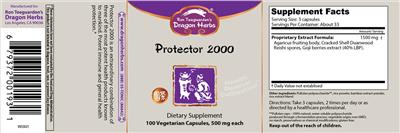
Protector 2000 by Ron Teeguarden's Dragon Herbs label
The label scan from the NIH Dietary Supplement Label Database. Tap to enlarge.
Label images are published by the NIH Dietary Supplement Label Database for the version of this product on file. Always read your actual product label.
View the full label (PDF)The Ingredients in Protector 2000 by Ron Teeguarden's Dragon Herbs
These are the 3 active ingredients this product is made of. Select any to open its full monograph.
Serving size3 Capsule(s) Dosage formCapsule Servings per container33 Amounts shown are per serving.
Most supplement products combine several ingredients, and a medication can interact with the product through any one of them. Each ingredient below shows whether it has known drug interactions.
Proprietary Extract Formula
- › Agaricus fruiting body extract
- › Cracked Shell Duanwood Reishi Spores Extract
- › Goji Berry Extract
Other (inactive) ingredients: Pullulan Polysaccharide, Rice, Powder, Bamboo Extract, Powder, Rice extract Blend. These complete the product’s ingredient list but are not active constituents.
Protector 2000 by Ron Teeguarden's Dragon Herbs Drug Interactions
HelloPharmacist Interaction Report
Protector 2000 by Ron Teeguarden's Dragon Herbs contains ingredients with documented interactions with medications.
The most serious concern is goji berry extract, which can significantly increase the effects of warfarin (a blood thinner used to prevent clots) and raise the risk of bleeding — at least five case reports document this when patients taking warfarin started drinking goji juice or concentrated goji tea.
Read the full breakdown — every affected drug type, severity by severity
Goji berry also interacts with several other drug types. It may slow how your body breaks down medications processed through liver enzymes (CYP2D6, CYP2C19, CYP2C9, and CYP3A4 substrates), which could raise their levels in your blood.
A case has been reported of a patient on flecainide (a heart rhythm medication) who developed toxicity after drinking concentrated goji juice. Goji may also lower blood pressure when taken with blood pressure medications, and theoretically could increase the blood-sugar-lowering effect of diabetes medications, though that hasn't been confirmed in humans.
Agaricus mushroom extract carries a moderate interaction with diabetes drugs — a small number of patients in one trial experienced low blood sugar (hypoglycemia) when taking the extract alongside their diabetes medication. We could not check interactions for cracked shell Duanwood reishi spores extract, as we hold no data for it.
Altogether, these interactions span 988 individual medications. Please use the medication checker on this page to look up your exact prescriptions before starting.
Check your own medications below · Editorial policy · How we use AI
Want to check YOUR meds against Protector 2000?
Ask about interactions with your drugs in plain English — “Can I take it with lisinopril?” — and we find you the answer in seconds, ingredient by ingredient.
Go to the checkerIngredients driving the most interactions
Individual Drug Interactions
The ingredients in Protector 2000 interact with 1,000 drugs. Click any drug to see the details.
2 of the 3 ingredients in Protector 2000 interact with drugs. Each result below shows which ingredient is responsible. Goji Berry Extract Agaricus fruiting body extract
AlmotriptanAlmogran, Axert
How Almotriptan interacts with Protector 2000 — through 1 ingredient. Tap an ingredient for the detail:
Goji Berry ExtractCytochrome P450 3a4 (cyp3a4) Substrates Moderate
Interaction Summary
Theoretically, goji berry might inhibit CYP3A4 and reduce metabolism of CYP3A4 substrates.
Read the full Goji Berry Extract + Almotriptan interactionAlogliptinNesina
How Alogliptin interacts with Protector 2000 — through 2 ingredients. Tap an ingredient for the detail:
Goji Berry ExtractCytochrome P450 3a4 (cyp3a4) Substrates, Antidiabetes Drugs Moderate
Interaction Summary
Theoretically, goji berry might inhibit CYP3A4 and reduce metabolism of CYP3A4 substrates.
Read the full Goji Berry Extract + Alogliptin interactionAgaricus Fruiting Body ExtractAntidiabetes Drugs Moderate
Interaction Summary
Theoretically, taking agaricus mushroom with antidiabetes drugs might increase the risk of hypoglycemia.
Read the full Agaricus Fruiting Body Extract + Alogliptin interactionAlogliptin, MetforminKazano
How Alogliptin, Metformin interacts with Protector 2000 — through 2 ingredients. Tap an ingredient for the detail:
Agaricus Fruiting Body ExtractAntidiabetes Drugs Moderate
Interaction Summary
Theoretically, taking agaricus mushroom with antidiabetes drugs might increase the risk of hypoglycemia.
Read the full Agaricus Fruiting Body Extract + Alogliptin, Metformin interactionGoji Berry ExtractAntidiabetes Drugs Minor
Interaction Summary
Theoretically, concomitant use of goji fruit polysaccharides or goji root bark with antidiabetes drugs might have additive effects.
Read the full Goji Berry Extract + Alogliptin, Metformin interactionAlogliptin, PioglitazoneOseni
How Alogliptin, Pioglitazone interacts with Protector 2000 — through 2 ingredients. Tap an ingredient for the detail:
Goji Berry ExtractAntidiabetes Drugs, Cytochrome P450 3a4 (cyp3a4) Substrates Moderate
Interaction Summary
Theoretically, concomitant use of goji fruit polysaccharides or goji root bark with antidiabetes drugs might have additive effects.
Read the full Goji Berry Extract + Alogliptin, Pioglitazone interactionAgaricus Fruiting Body ExtractAntidiabetes Drugs Moderate
Interaction Summary
Theoretically, taking agaricus mushroom with antidiabetes drugs might increase the risk of hypoglycemia.
Read the full Agaricus Fruiting Body Extract + Alogliptin, Pioglitazone interactionAlpelisibPiqray
How Alpelisib interacts with Protector 2000 — through 1 ingredient. Tap an ingredient for the detail:
Goji Berry ExtractCytochrome P450 3a4 (cyp3a4) Substrates Moderate
Interaction Summary
Theoretically, goji berry might inhibit CYP3A4 and reduce metabolism of CYP3A4 substrates.
Read the full Goji Berry Extract + Alpelisib interactionAlprazolamNiravam, Xanax
How Alprazolam interacts with Protector 2000 — through 1 ingredient. Tap an ingredient for the detail:
Goji Berry ExtractCytochrome P450 3a4 (cyp3a4) Substrates Moderate
Interaction Summary
Theoretically, goji berry might inhibit CYP3A4 and reduce metabolism of CYP3A4 substrates.
Read the full Goji Berry Extract + Alprazolam interactionAluminum Hydroxide, Aspirin, Codeine Phosphate, Magnesium HydroxideAscriptin Codeine #2
How Aluminum Hydroxide, Aspirin, Codeine Phosphate, Magnesium Hydroxide interacts with Protector 2000 — through 1 ingredient. Tap an ingredient for the detail:
Goji Berry ExtractCytochrome P450 2d6 (cyp2d6) Substrates Moderate
Interaction Summary
Theoretically, goji berry might inhibit CYP2D6 and reduce metabolism of CYP2D6 substrates.
Read the full Goji Berry Extract + Aluminum Hydroxide, Aspirin, Codeine Phosphate, Magnesium Hydroxide interactionAmbrisentanLetairis, Volibris
How Ambrisentan interacts with Protector 2000 — through 1 ingredient. Tap an ingredient for the detail:
Goji Berry ExtractAntihypertensive Drugs, Cytochrome P450 3a4 (cyp3a4) Substrates Moderate
Interaction Summary
Theoretically, concomitant use of goji root bark, but not goji fruit, with antihypertensive drugs might have additive effects.
Read the full Goji Berry Extract + Ambrisentan interactionAmilorideAmilamont, Midamor
How Amiloride interacts with Protector 2000 — through 1 ingredient. Tap an ingredient for the detail:
Goji Berry ExtractAntihypertensive Drugs Moderate
Interaction Summary
Theoretically, concomitant use of goji root bark, but not goji fruit, with antihypertensive drugs might have additive effects.
Read the full Goji Berry Extract + Amiloride interactionAmiloride, HydrochlorothiazideAmil-Co, Amilzide, Moduret 25, Moduretic
How Amiloride, Hydrochlorothiazide interacts with Protector 2000 — through 1 ingredient. Tap an ingredient for the detail:
Goji Berry ExtractAntihypertensive Drugs Moderate
Interaction Summary
Theoretically, concomitant use of goji root bark, but not goji fruit, with antihypertensive drugs might have additive effects.
Read the full Goji Berry Extract + Amiloride, Hydrochlorothiazide interactionAmiodaroneCordarone, Pacerone
How Amiodarone interacts with Protector 2000 — through 1 ingredient. Tap an ingredient for the detail:
Goji Berry ExtractCytochrome P450 3a4 (cyp3a4) Substrates Moderate
Interaction Summary
Theoretically, goji berry might inhibit CYP3A4 and reduce metabolism of CYP3A4 substrates.
Read the full Goji Berry Extract + Amiodarone interactionAmitriptylineElavil
How Amitriptyline interacts with Protector 2000 — through 1 ingredient. Tap an ingredient for the detail:
Goji Berry ExtractCytochrome P450 3a4 (cyp3a4) Substrates, Cytochrome P450 2d6 (cyp2d6) Substrates +2 Moderate
Interaction Summary
Theoretically, goji berry might inhibit CYP3A4 and reduce metabolism of CYP3A4 substrates.
Read the full Goji Berry Extract + Amitriptyline interactionAmitriptyline, ChlordiazepoxideLimbitrol DS
How Amitriptyline, Chlordiazepoxide interacts with Protector 2000 — through 1 ingredient. Tap an ingredient for the detail:
Goji Berry ExtractCytochrome P450 2c19 (cyp2c19) Substrates, Cytochrome P450 2c9 (cyp2c9) Substrates +2 Moderate
Interaction Summary
Theoretically, goji berry might inhibit CYP2C19 and reduce metabolism of CYP2C19 substrates.
Read the full Goji Berry Extract + Amitriptyline, Chlordiazepoxide interactionAmitriptyline, PerphenazineEtrafon, Etrafon-A, Etrafon-Forte, Triavil
How Amitriptyline, Perphenazine interacts with Protector 2000 — through 1 ingredient. Tap an ingredient for the detail:
Goji Berry ExtractCytochrome P450 2c9 (cyp2c9) Substrates, Cytochrome P450 3a4 (cyp3a4) Substrates +2 Moderate
Interaction Summary
Theoretically, goji berry might inhibit CYP2C9 and reduce metabolism of CYP2C9 substrates.
Read the full Goji Berry Extract + Amitriptyline, Perphenazine interactionAmlodipineNorliqva
How Amlodipine interacts with Protector 2000 — through 1 ingredient. Tap an ingredient for the detail:
Goji Berry ExtractCytochrome P450 3a4 (cyp3a4) Substrates, Antihypertensive Drugs Moderate
Interaction Summary
Theoretically, goji berry might inhibit CYP3A4 and reduce metabolism of CYP3A4 substrates.
Read the full Goji Berry Extract + Amlodipine interactionAmlodipine BenzoateKaterzia
How Amlodipine Benzoate interacts with Protector 2000 — through 1 ingredient. Tap an ingredient for the detail:
Goji Berry ExtractAntihypertensive Drugs, Cytochrome P450 3a4 (cyp3a4) Substrates Moderate
Interaction Summary
Theoretically, concomitant use of goji root bark, but not goji fruit, with antihypertensive drugs might have additive effects.
Read the full Goji Berry Extract + Amlodipine Benzoate interactionAmlodipine BesilateIstin
How Amlodipine Besilate interacts with Protector 2000 — through 1 ingredient. Tap an ingredient for the detail:
Goji Berry ExtractAntihypertensive Drugs, Cytochrome P450 3a4 (cyp3a4) Substrates Moderate
Interaction Summary
Theoretically, concomitant use of goji root bark, but not goji fruit, with antihypertensive drugs might have additive effects.
Read the full Goji Berry Extract + Amlodipine Besilate interactionAmlodipine BesylateNorvasc
How Amlodipine Besylate interacts with Protector 2000 — through 1 ingredient. Tap an ingredient for the detail:
Goji Berry ExtractCytochrome P450 3a4 (cyp3a4) Substrates, Antihypertensive Drugs Moderate
Interaction Summary
Theoretically, goji berry might inhibit CYP3A4 and reduce metabolism of CYP3A4 substrates.
Read the full Goji Berry Extract + Amlodipine Besylate interactionAmlodipine Besylate, BenazeprilLotrel
How Amlodipine Besylate, Benazepril interacts with Protector 2000 — through 1 ingredient. Tap an ingredient for the detail:
Goji Berry ExtractAntihypertensive Drugs, Cytochrome P450 3a4 (cyp3a4) Substrates Moderate
Interaction Summary
Theoretically, concomitant use of goji root bark, but not goji fruit, with antihypertensive drugs might have additive effects.
Read the full Goji Berry Extract + Amlodipine Besylate, Benazepril interactionAmlodipine, CelecoxibConsensi
How Amlodipine, Celecoxib interacts with Protector 2000 — through 1 ingredient. Tap an ingredient for the detail:
Goji Berry ExtractCytochrome P450 2c9 (cyp2c9) Substrates, Antihypertensive Drugs +1 Moderate
Interaction Summary
Theoretically, goji berry might inhibit CYP2C9 and reduce metabolism of CYP2C9 substrates.
Read the full Goji Berry Extract + Amlodipine, Celecoxib interactionAmmonium ChlorideAmmonium Chloride
How Ammonium Chloride interacts with Protector 2000 — through 1 ingredient. Tap an ingredient for the detail:
Goji Berry ExtractAntihypertensive Drugs Moderate
Interaction Summary
Theoretically, concomitant use of goji root bark, but not goji fruit, with antihypertensive drugs might have additive effects.
Read the full Goji Berry Extract + Ammonium Chloride interactionAmoxicillin, Omeprazole Magnesium, RifabutinTalicia
How Amoxicillin, Omeprazole Magnesium, Rifabutin interacts with Protector 2000 — through 1 ingredient. Tap an ingredient for the detail:
Goji Berry ExtractCytochrome P450 2c19 (cyp2c19) Substrates, Cytochrome P450 3a4 (cyp3a4) Substrates +1 Moderate
Interaction Summary
Theoretically, goji berry might inhibit CYP2C19 and reduce metabolism of CYP2C19 substrates.
Read the full Goji Berry Extract + Amoxicillin, Omeprazole Magnesium, Rifabutin interactionAmphetamineAdensys XR-ODT, Adzenys ER, Dyanavel XR, Mydayis
How Amphetamine interacts with Protector 2000 — through 1 ingredient. Tap an ingredient for the detail:
Goji Berry ExtractCytochrome P450 2d6 (cyp2d6) Substrates Moderate
Interaction Summary
Theoretically, goji berry might inhibit CYP2D6 and reduce metabolism of CYP2D6 substrates.
Read the full Goji Berry Extract + Amphetamine interactionAmphetamine Aspartate, Amphetamine Sulfate, Dextroamphetamine Saccharate, Dextroamphetamine SulfateAdderall, Adderall XR
How Amphetamine Aspartate, Amphetamine Sulfate, Dextroamphetamine Saccharate, Dextroamphetamine Sulfate interacts with Protector 2000 — through 1 ingredient. Tap an ingredient for the detail:
Goji Berry ExtractCytochrome P450 2d6 (cyp2d6) Substrates Moderate
Interaction Summary
Theoretically, goji berry might inhibit CYP2D6 and reduce metabolism of CYP2D6 substrates.
Read the full Goji Berry Extract + Amphetamine Aspartate, Amphetamine Sulfate, Dextroamphetamine Saccharate, Dextroamphetamine Sulfate interactionAmphetamine SulfateBenzedrine, Evekeo ODT
How Amphetamine Sulfate interacts with Protector 2000 — through 1 ingredient. Tap an ingredient for the detail:
Goji Berry ExtractCytochrome P450 2d6 (cyp2d6) Substrates Moderate
Interaction Summary
Theoretically, goji berry might inhibit CYP2D6 and reduce metabolism of CYP2D6 substrates.
Read the full Goji Berry Extract + Amphetamine Sulfate interactionAmprenavirAgenerase
How Amprenavir interacts with Protector 2000 — through 1 ingredient. Tap an ingredient for the detail:
Goji Berry ExtractCytochrome P450 3a4 (cyp3a4) Substrates Moderate
Interaction Summary
Theoretically, goji berry might inhibit CYP3A4 and reduce metabolism of CYP3A4 substrates.
Read the full Goji Berry Extract + Amprenavir interactionAntidiabetes, Dipeptidyl Peptidase-4 (dpp-iv) InhibitorGlyxambi
How Antidiabetes, Dipeptidyl Peptidase-4 (dpp-iv) Inhibitor interacts with Protector 2000 — through 2 ingredients. Tap an ingredient for the detail:
Agaricus Fruiting Body ExtractAntidiabetes Drugs Moderate
Interaction Summary
Theoretically, taking agaricus mushroom with antidiabetes drugs might increase the risk of hypoglycemia.
Read the full Agaricus Fruiting Body Extract + Antidiabetes, Dipeptidyl Peptidase-4 (dpp-iv) Inhibitor interactionGoji Berry ExtractAntidiabetes Drugs Minor
Interaction Summary
Theoretically, concomitant use of goji fruit polysaccharides or goji root bark with antidiabetes drugs might have additive effects.
Read the full Goji Berry Extract + Antidiabetes, Dipeptidyl Peptidase-4 (dpp-iv) Inhibitor interactionApalutamideErleada
How Apalutamide interacts with Protector 2000 — through 1 ingredient. Tap an ingredient for the detail:
Goji Berry ExtractCytochrome P450 3a4 (cyp3a4) Substrates Moderate
Interaction Summary
Theoretically, goji berry might inhibit CYP3A4 and reduce metabolism of CYP3A4 substrates.
Read the full Goji Berry Extract + Apalutamide interactionApixabanEliquis
How Apixaban interacts with Protector 2000 — through 1 ingredient. Tap an ingredient for the detail:
Goji Berry ExtractCytochrome P450 3a4 (cyp3a4) Substrates Moderate
Interaction Summary
Theoretically, goji berry might inhibit CYP3A4 and reduce metabolism of CYP3A4 substrates.
Read the full Goji Berry Extract + Apixaban interactionApremilastOtezla
How Apremilast interacts with Protector 2000 — through 1 ingredient. Tap an ingredient for the detail:
Goji Berry ExtractCytochrome P450 3a4 (cyp3a4) Substrates Moderate
Interaction Summary
Theoretically, goji berry might inhibit CYP3A4 and reduce metabolism of CYP3A4 substrates.
Read the full Goji Berry Extract + Apremilast interactionEach ingredient & the kinds of drugs it affects
For each ingredient in Protector 2000 with known interactions, here are the types of medications they can affect. Open any type for the detail — or search your exact drug in the checker above.
Goji Berry Extract
Warfarin (Coumadin)
Goji can increase the effects of warfarin and possibly increase the risk of bleeding.
There are at least 5 case reports of increased international normalized ratio (INR) in patients stabilized on warfarin who began drinking goji juice, concentrated goji tea, or goji wine. Goji may inhibit the metabolism of warfarin by cytochrome P450 2C9 (CYP2C9).
Antihypertensive Drugs
Theoretically, concomitant use of goji root bark, but not goji fruit, with antihypertensive drugs might have additive effects.
Animal and in vitro research suggest that goji root bark has hypotensive effects. However, goji fruit juice does not appear to reduce systolic or diastolic blood pressure in humans.
Cytochrome P450 2C19 (Cyp2C19) Substrates
Theoretically, goji berry might inhibit CYP2C19 and reduce metabolism of CYP2C19 substrates.
In vitro research shows that goji berry tincture and juice inhibit CYP2C19 enzymes. Concomitant use with goji may decrease metabolism and increase levels of CYP2C19 substrates. However, this has not been reported in humans.
Cytochrome P450 2C9 (Cyp2C9) Substrates
Theoretically, goji berry might inhibit CYP2C9 and reduce metabolism of CYP2C9 substrates.
In vitro research shows that goji berry tincture and juice inhibit CYP2C9 enzymes. Additionally, multiple case reports suggest that goji berry concentrated tea and juice inhibit the metabolism of warfarin, a CYP2C9 substrate. Concomitant use with goji may decrease metabolism and increase levels of CYP2C9 substrates.
Cytochrome P450 2D6 (Cyp2D6) Substrates
Theoretically, goji berry might inhibit CYP2D6 and reduce metabolism of CYP2D6 substrates.
In vitro research shows that goji berry juice inhibits CYP2D6 enzymes. Concomitant use with goji may decrease metabolism and increase levels of CYP2D6 substrates. However, this has not been reported in humans.
Cytochrome P450 3A4 (Cyp3A4) Substrates
Theoretically, goji berry might inhibit CYP3A4 and reduce metabolism of CYP3A4 substrates.
In vitro research shows that goji berry juice inhibits CYP3A4 enzymes. Concomitant use with goji may decrease metabolism and increase levels of CYP3A4 substrates. However, this has not been reported in humans.
Flecainide (Tambocor)
Theoretically, goji berry might increase the levels and clinical effects of flecainide.
In one case report, a 75-year-old patient stable on flecainide and warfarin presented to the emergency room with fainting and pleomorphic arrhythmia caused by flecainide toxicity. Flecainide toxicity was attributed to drinking 1-2 glasses of concentrated goji tea daily for 2 weeks. Theoretically, goji may have inhibited the cytochrome P450 2D6 (CYP2D6) metabolism of flecainide.
Antidiabetes Drugs
Theoretically, concomitant use of goji fruit polysaccharides or goji root bark with antidiabetes drugs might have additive effects.
Animal and in vitro research show that goji root bark and fruit polysaccharides might have hypoglycemic effects. However, clinical research has only shown that taking goji fruit polysaccharides with or without antidiabetes drugs modestly reduces postprandial glucose when compared with control, with no reports of hypoglycemia.
Agaricus fruiting body extract
Antidiabetes Drugs
Theoretically, taking agaricus mushroom with antidiabetes drugs might increase the risk of hypoglycemia.
In one clinical study in patients with type 2 diabetes who are stabilized on conventional oral hypoglycemic agents, 3 of 29 patients taking an agaricus mushroom extract 500 mg three times daily for 12 weeks reported hypoglycemia, compared to one of 29 patients in the placebo group.
Brand information
Manufacturer and brand details for Protector 2000, from the product label.
Ron Teeguarden's Dragon Herbs
See all Ron Teeguarden's Dragon Herbs products- Name
- Ron Teeguarden's Dragon Herbs
- City
- Los Angeles
- State
- CA
- ZipCode
- 90036
- Phone Number
- (888) 558-6642
- Web Address
- www.dragonherbs.com
Protector 2000 by Ron Teeguarden's Dragon Herbs: Common Questions
Does Protector 2000 by Ron Teeguarden's Dragon Herbs interact with any medications?
How can one product interact with so many drugs?
Where does this information come from?
Can I take Protector 2000 if I'm pregnant or breastfeeding?
What's the proprietary extract formula in this product?
What are the most common side effects?
Does this product actually work for anything?
Is there anything in this product besides the three active ingredients?
Written and reviewed by the HelloPharmacist editorial staff. Our editorial policy
Not sure if Protector 2000 is safe with your meds?
Our pharmacists answer your medication & supplement questions — free.
Label information is sourced from the NIH Dietary Supplement Label Database and reflects the product version on file; always read your actual product label. This page is for education only and is not a substitute for professional medical advice. Confirm with your pharmacist or doctor before combining supplements and medications.
The Full Monographs Behind Protector 2000’s Ingredients
Every ingredient we hold a full HelloPharmacist monograph for — uses, evidence, safety, and the complete interaction list.
Agaricus Mushroom
Interacts with 86 drugsAgaricus mushroom (often Agaricus blazei/subrufescens) is a culinary and medicinal mushroom studied mostly for possible immune and antioxidant effects. The human evidence is limited and not...
Read the full Agaricus Mushroom monograph → Herb & supplement monographGoji
Interacts with 1,000 drugsGoji berries are a nutritious fruit rich in antioxidants, vitamins, and plant polysaccharides, and they are safe for most people as a food. While they are popular for eye health, immune supp...
Read the full Goji monograph →Sources & How We Checked
Protector 2000's label data comes from the NIH Dietary Supplement Label Database; the ingredient interaction data is from the Natural Medicines database, reviewed by our pharmacists.
- NIH Dietary Supplement Label Database (DSLD) — The official product label on file for this supplement.
- Natural Medicines (Therapeutic Research Center) — Evidence-graded clinical reference behind the ingredient interaction data.
Content is written and reviewed by licensed HelloPharmacist pharmacists. See our data sources and editorial standards for how this information is built and checked.
The 19 references behind this product’s interaction data
Every citation that drives the interaction findings for this product’s ingredients, from the evidence-graded Natural Medicines (TRC Healthcare) database. Open an ingredient to browse its citations — links open the study on PubMed or the publisher’s site.
Agaricus Mushroom 5 references
- Hsu CH, Liao YL, Lin SC, et al. The mushroom Agaricus Blazei Murill in combination with metformin and gliclazide improves insulin resistance in type 2 diabetes: a randomized, double-blinded, and placebo-controlled clinical trial. J Altern Complement Med 2
- Mukai H, Watanabe T, Ando M, Katsumata N. An alternative medicine, Agaricus blazei, may have induced severe hepatic dysfunction in cancer patients. Jpn J Clin Oncol 2006;36:808-10. PubMed
- Ohno S, Sumiyoshi Y, Hashine K, et al. Phase I clinical study of the dietary supplement, Agaricus blazei Murill, in cancer patients in remission. Evid Based Complement Alternat Med 2011, doi 10.1155/2011/192381.
- Suehiro M, Katoh N, Kishimoto S. Chelitis due to Agaricus blazei Murill mushroom extract. Contact Dermatitis 2007;56(5):293-4.
- Iwai N, Okuda T, Sawada R, et al. Interstitial lung disease associated with Agaricus blazei Murill in a patient with pancreatic ductal adenocarcinoma receiving gemcitabine-based therapy. Case Rep Gastroenterol 2022;16(1):229-234.
Goji 14 references
- Huang KC. The Pharmacology of Chinese Herbs. 2nd ed. Boca Raton, FL: CRC Press, LLC 1999.
- Lam AY, Elmer GW, Mohutsky MA. Possible interaction between warfarin and Lycium Barbarum. Ann Pharmacother 2001;35:1199-201.
- Leung H, Hung A, Hui AC, Chan TY. Warfarin overdose due to the possible effects of Lycium barbarum L. Food Chem Toxicol 2008;46:1860-2. PubMed
- Amagase H, Nance DM. A randomized, double-blind, placebo-controlled, clinical study of the general effects of a standardized Lycium barbarum (goji) juice, GoChi. J Altern Complement Med 2008;14:403-12.
- Rivera, C. A., Ferro, C. L., Bursua, A. J., and Gerber, B. S. Probable interaction between Lycium barbarum (goji) and warfarin. Pharmacotherapy 2012;32(3):e50-e53.
- Monzon, Ballarin S., Lopez-Matas, M. A., Saenz, Abad D., Perez-Cinto, N., and Carnes, J. Anaphylaxis associated with the ingestion of Goji berries (Lycium barbarum). J.Investig.Allergol.Clin.Immunol. 2011;21(7):567-570.
- Franco, M., Monmany, J., Domingo, P., and Turbau, M. [Autoimmune hepatitis triggered by consumption of Goji berries]. Med.Clin.(Barc.) 9-22-2012;139(7):320-321.
- Jiménez-Encarnación E, Ríos G, Muñoz-Mirabal A, Vilá LM. Euforia-induced acute hepatitis in a patient with scleroderma. BMJ Case Rep 2012;2012. PubMed
- Larramendi CH, García-Abujeta JL, Vicario S, García-Endrino A, López-Matas MA, García-Sedeño MD, et al. Goji berries (Lycium barbarum): Risk of allergic reactions in individuals with food allergy. J Investig Allergol Clin Immunol. 2012;22(5):345-50.
- Cai H, Liu F, Zuo P, Huang G, Song Z, Wang T, et al. Practical application of antidiabetic efficacy of Lycium barbarum polysaccharide in patients with type 2 diabetes. Med Chem. 2015;11(4):383-90.
- Potterat O. Goji (Lycium barbarum and L. chinense): Phytochemistry, pharmacology and safety in the perspective of traditional uses and recent popularity. Planta Med 2010;76(1):7-19.
- Guzmán CE, Guzmán-Moreno CG, Assad-Morell JL, Edgar Francisco Carrizales-Sepúlveda EF. Flecainide toxicity associated with the use of goji berries: a case report. Eur Heart J Case Rep. 2021;5(6):ytab204. PubMed
- Liu R, Tam TW, Mao J, et al. In vitro activity of Lycium barbarum (Goji) against major human phase I metabolism enzymes. Complement Integr Med. 2016;13(3):257-265.
- Zhang J, Tian L, Xie B. Bleeding due to a probable interaction between warfarin and Gouqizi (Lycium Barbarum L.). Toxicol Rep. 2015;2:1209-1212. PubMed
Parts of this content are provided by the Therapeutic Research Center, LLC.
DISCLAIMER: Currently this does not check for drug-drug interactions. This is not an all-inclusive comprehensive list of potential interactions and is for informational purposes only. Not all interactions are known or well-reported in the scientific literature, and new interactions are continually being reported. Input is needed from a qualified healthcare provider including a pharmacist before starting any therapy. Application of clinical judgment is necessary.
© 2021 Therapeutic Research Center, LLC