
Q-Sorb Co Q-10 300 mg Ingredients & Drug Interactions
What is this page for?
First and foremost: checking Q-Sorb Co Q-10 300 mg against your medications. The heart of this page is the interaction checker and the full interaction report — how this product’s ingredients may interact with prescription and over-the-counter medicines you may be taking.
Around that, we add a pharmacist’s high-level view of the product as a whole — what’s inside, the evidence for its stated use, how transparent the label is, and what safety data exists — so you can see the full picture in one place. It’s educational information from our licensed clinical databases and the clinical staff at HelloPharmacist — not medical advice — and we don’t sell or endorse products. Our editorial policy
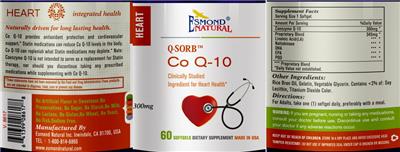
Q-Sorb Co Q-10 300 mg is a dietary supplement by Esmond Natural with 6 active ingredients. Its ingredients are commonly taken for heart and circulatory health, blood clot prevention, high blood pressure.Based on those ingredients, 313 medications have a known interaction with it, the most serious rated moderate. The ingredients most likely to interact are Nattokinase, Coenzyme Q-10. Use the checker below to test your specific medication, or read the full HelloPharmacist Interaction Report.
Check Your Meds Against Q-Sorb Co Q-10 300 mg by Esmond Natural
Ask about any prescription or over-the-counter medication and we check it for interactions with Q-Sorb Co Q-10 300 mg by Esmond Natural — and tell you which ingredient is responsible.
AI summaries are generated from our interaction database for education only — always confirm with your pharmacist. How we use AI
Ask the Pharmacist
A licensed pharmacist will answer your question by email — free, usually within 24 hours.
Got it — thank you!
A licensed pharmacist will answer within 24 hours. Keep an eye on your email (worth checking spam, just in case).
HelloPharmacist Scorecard of Q-Sorb Co Q-10 300 mg by Esmond Natural
Our pharmacy team’s full take, with four database checks built into the cards below — a summary of what is known, not a grade of the product itself.
What’s inside
Low disclosure
This softgel has 6 ingredients, 2 of which are active: Coenzyme Q-10 (300 mg per serving) and Nattokinase. Coenzyme Q-10 is an antioxidant your body makes naturally and uses for energy in cells.
Nattokinase is an enzyme derived from fermented soy that may support circulation. The remaining active ingredient, a proprietary blend, likely contains the other named components (Eicosapentaenoic Acid, Docosahexaenoic Acid, Pyrroloquinoline Quinone, and Linoleic Acid), though we don't have detailed breakdown of that blend.
The product also contains inactive ingredients — Rice Bran Oil, Gelatin, Glycerin, Soy Lecithin, and Titanium Dioxide — which are the capsule and delivery system.
Does it work?
Strong evidence
Coenzyme Q-10 is Likely Effective for treating Coenzyme Q-10 deficiency, and Possibly Effective for fibromyalgia, migraine headache, congestive heart failure, and diabetic neuropathy. Nattokinase's effectiveness is not well established — the evidence we hold rates it Insufficient Reliable Evidence To Rate for angina, atherosclerosis, cancer, and cardiovascular disease.
How safe is it?
Well-documented data
Coenzyme Q-10 is generally well tolerated by most adults. The most common side effects are gastrointestinal — appetite suppression, diarrhea, heartburn, nausea, and vomiting — though these occur in less than 1% of people taking it; dividing doses above 100 mg daily may help.
Headache, dizziness, and insomnia have been reported rarely, as have skin itching and allergic rash. Nattokinase is generally tolerated short-term, but because of its blood-thinning effect, caution is needed in people with bleeding risk.
During pregnancy, the safety data advises against nattokinase. There isn't enough data to know if CoQ-10 is safe in pregnancy — talk with your doctor about whether to use it.
For breastfeeding, safety data on CoQ-10 is limited, so check with your doctor; nattokinase should be avoided while breastfeeding.
Meds to double-check
Moderate interaction found
Check before taking this if you're on a blood thinner (anticoagulant) like warfarin — CoQ-10 might reduce its effectiveness. If you take aspirin or other antiplatelet drugs, Nattokinase increases bleeding risk, and there's a reported case of brain bleeding when the two were combined.
Blood pressure medications may have stronger effects when taken with this product. If you take chemotherapy drugs like cyclophosphamide, ask your oncologist before adding it.
The bottom line
Scorecard at a glanceFormula with limited ingredient disclosure with clinical evidence supporting its stated purpose. Moderate medication interactions have been identified, and safety information is well characterized.
This product is worth considering if you're interested in CoQ-10 for heart health or migraine support and don't take blood thinners or blood pressure medications. If you take warfarin, aspirin, other antiplatelet drugs, or any antihypertensive medication, check with your pharmacist before starting — the interactions here are real and could affect how your medications work.
Talk to your pharmacist about your full medication list.
Educational only — not medical advice; always confirm with your pharmacist. Our editorial policy · How we use AI
Assessment coverage: 2 of 6 active ingredients matched to our full ingredient reviews (monographs). Based on the product label dated Jun 25, 2025.
This Scorecard evaluates available label information, ingredient evidence, and known medication-safety considerations. It does not independently verify product identity, purity, potency, contamination, or manufacturing quality. How these ratings are computed
General information
Key facts about Q-Sorb Co Q-10 300 mg, straight from the product label.
| Brand | Esmond Natural |
|---|---|
| Barcode (UPC) | 641399086178 |
| Net contents | 60 Softgel(s) |
| Market status | On market |
| Date entered into DSLD | Jun 25, 2025 |
| DSLD ID | 334337 |
| Product type | Other Combinations |
| Supplement form | Softgel Capsule |
| Dietary claims / uses | All Other, Structure/Function |
| Intended target group(s) | Adult (18 - 50 Years), Gluten Free, Dairy Free, Sugar Free |
Everything in this section is reproduced from the manufacturer’s own product label — it’s the label speaking, not HelloPharmacist. We show it so you can see exactly what the maker states; we don’t verify or endorse those statements.
Supplement Facts
The label details for Q-Sorb Co Q-10 300 mg by Esmond Natural, sourced from the NIH Dietary Supplement Label Database.
Supplement Facts
| Ingredient | Amount | % DV |
|---|---|---|
| Eicosapentaenoic Acid | 0 NP | -- |
| Docosahexaenoic Acid | 0 NP | -- |
| Proprietary Blend | 345 mg | -- |
| Coenzyme Q-10 | 300 mg | -- |
| Nattokinase | 0 NP | -- |
| Pyrroloquinoline Quinone | 0 NP | -- |
| Linoleic Acid | 0 NP | -- |
Other ingredients: Rice Bran Oil, Gelatin, Glycerin, Soy Lecithin, Titanium Dioxide
Tap any ingredient to jump to its full detail below.
These statements are the manufacturer’s wording, reproduced from the product label — the label is saying it, not HelloPharmacist. We don’t verify or endorse them.
Formulation
Heart
Naturally driven for long lasting health.
No artificial flavor or sweetener, no preservatives, no sugar, no starch, no milk, no lactose, no gluten, no wheat, no yeast, no fish. Sodium free.
Clinically studied ingredient for heart health
Made in USA
General Statements
Integrated health
Formula
Co Q-10 provides antioxidant protection and cardiovascular support. Statin medications can reduce Co Q-10 levels in the body. Co Q-10 can replenish what statin medications may deplete.
Precautions
Note: Coenzyme Q-10 is not intended to serve as a replacement for statin therapy, nor should you discontinue taking any prescribed medications while supplementing with Co Q-10.
Warning: If you are pregnant, nursing or taking any medications, consult your doctor before use.
Discontinue use and consult your doctor if any adverse reactions occur.
Keep out of reach of children.
Tamper resistant: Do not use if imprinted seal under cap is broken or missing.
FDA Disclaimer Statement
These statements have not been evaluated by the Food and Drug Administration. This product is not intended to diagnose, treat, cure or prevent any disease.
FDA Statement of Identity
Dietary Supplement
Suggested/Recommended/Usage/Directions
Directions: For adults, take one (1) softgel daily, preferably with a meal.
Storage
Store in a dry place and avoid excessive heat.
Is this label outdated? Report a formula or label change and our pharmacy team will review it.
Q-Sorb Co Q-10 300 mg by Esmond Natural label
The label scan from the NIH Dietary Supplement Label Database. Tap to enlarge.
Label images are published by the NIH Dietary Supplement Label Database for the version of this product on file. Always read your actual product label.
View the full label (PDF)The Ingredients in Q-Sorb Co Q-10 300 mg by Esmond Natural
These are the 6 active ingredients this product is made of. Select any to open its full monograph.
Serving size1 Softgel(s) Dosage formSoftgel Capsule Servings per container60 Amounts shown are per serving.
Most supplement products combine several ingredients, and a medication can interact with the product through any one of them. Each ingredient below shows whether it has known drug interactions.
Proprietary Blend
- › Eicosapentaenoic Acid
- › Docosahexaenoic Acid
- › Nattokinase
- › Pyrroloquinoline Quinone
- › Linoleic Acid
Coenzyme Q-10
Interacts with198 drugs
CoQ10 is a vitamin-like substance your body makes naturally that helps cells produce energy and acts as an antioxidant. It is generally well tolerated...
Coenzyme Q-10 monograph & interactionsOther (inactive) ingredients: Rice Bran Oil, Gelatin, Glycerin, Soy Lecithin, Titanium Dioxide. These complete the product’s ingredient list but are not active constituents.
Q-Sorb Co Q-10 300 mg by Esmond Natural Drug Interactions
HelloPharmacist Interaction Report
Q-Sorb Co Q-10 300 mg by Esmond Natural contains two ingredients with documented interactions: Coenzyme Q-10 and Nattokinase.
The most serious concern is Nattokinase with blood thinners (anticoagulants) and antiplatelet drugs like aspirin — there's a case report of brain bleeding in someone who combined nattokinase with low-dose aspirin. This is a Moderate-severity interaction.
Read the full breakdown — every affected drug type, severity by severity
Coenzyme Q-10 can interfere with warfarin (Coumadin), a blood thinner, by reducing its effectiveness — four cases of this have been reported. It also theoretically might reduce how well certain chemotherapy drugs work by protecting cells from oxidative stress, particularly alkylating agents like cyclophosphamide.
Both are Moderate-severity concerns. Additionally, both ingredients may lower blood pressure when combined with blood pressure medications — a Minor-severity effect.
We couldn't check three other ingredients in this product: Eicosapentaenoic Acid, Docosahexaenoic Acid, Pyrroloquinoline Quinone, and Linoleic Acid. Altogether, these interactions span 311 individual medications.
Before you start, use the search tool below to check your exact medications against this product.
Check your own medications below · Editorial policy · How we use AI
Want to check YOUR meds against Q-Sorb Co Q-10 300 mg?
Ask about interactions with your drugs in plain English — “Can I take it with lisinopril?” — and we find you the answer in seconds, ingredient by ingredient.
Go to the checkerIngredients driving the most interactions
Individual Drug Interactions
The ingredients in Q-Sorb Co Q-10 300 mg interact with 313 drugs. Click any drug to see the details.
2 of the 6 ingredients in Q-Sorb Co Q-10 300 mg interact with drugs. Each result below shows which ingredient is responsible. Nattokinase Coenzyme Q-10
AbciximabReoPro
How Abciximab interacts with Q-Sorb Co Q-10 300 mg — through 1 ingredient. Tap an ingredient for the detail:
NattokinaseAnticoagulant/antiplatelet Drugs Moderate
Interaction Summary
Nattokinase might increase the risk of bleeding when used with anticoagulant/antiplatelet drugs.
Read the full Nattokinase + Abciximab interactionAbrocitinibCibinqo
How Abrocitinib interacts with Q-Sorb Co Q-10 300 mg — through 1 ingredient. Tap an ingredient for the detail:
NattokinaseAnticoagulant/antiplatelet Drugs Moderate
Interaction Summary
Nattokinase might increase the risk of bleeding when used with anticoagulant/antiplatelet drugs.
Read the full Nattokinase + Abrocitinib interactionAcebutololRhotral, Sectral
How Acebutolol interacts with Q-Sorb Co Q-10 300 mg — through 2 ingredients. Tap an ingredient for the detail:
NattokinaseAntihypertensive Drugs Moderate
Interaction Summary
Theoretically, nattokinase might increase the risk of hypotension when used with antihypertensive drugs.
Read the full Nattokinase + Acebutolol interactionCoenzyme Q-10Antihypertensive Drugs Minor
Interaction Summary
Theoretically, coenzyme Q10 might have additive effects with antihypertensive drugs.
Read the full Coenzyme Q-10 + Acebutolol interactionAcenocoumarolSintrom
How Acenocoumarol interacts with Q-Sorb Co Q-10 300 mg — through 1 ingredient. Tap an ingredient for the detail:
NattokinaseAnticoagulant/antiplatelet Drugs Moderate
Interaction Summary
Nattokinase might increase the risk of bleeding when used with anticoagulant/antiplatelet drugs.
Read the full Nattokinase + Acenocoumarol interactionAcetaminophen, AspirinGemnisyn
How Acetaminophen, Aspirin interacts with Q-Sorb Co Q-10 300 mg — through 1 ingredient. Tap an ingredient for the detail:
NattokinaseAnticoagulant/antiplatelet Drugs Moderate
Interaction Summary
Nattokinase might increase the risk of bleeding when used with anticoagulant/antiplatelet drugs.
Read the full Nattokinase + Acetaminophen, Aspirin interactionAcetaminophen, Aspirin, CaffeineExcedrin, Excedrin Extra Strength, Excedrin Migraine
How Acetaminophen, Aspirin, Caffeine interacts with Q-Sorb Co Q-10 300 mg — through 1 ingredient. Tap an ingredient for the detail:
NattokinaseAnticoagulant/antiplatelet Drugs Moderate
Interaction Summary
Nattokinase might increase the risk of bleeding when used with anticoagulant/antiplatelet drugs.
Read the full Nattokinase + Acetaminophen, Aspirin, Caffeine interactionAcetaminophen, IbuprofenCombogesic
How Acetaminophen, Ibuprofen interacts with Q-Sorb Co Q-10 300 mg — through 1 ingredient. Tap an ingredient for the detail:
NattokinaseAnticoagulant/antiplatelet Drugs Moderate
Interaction Summary
Nattokinase might increase the risk of bleeding when used with anticoagulant/antiplatelet drugs.
Read the full Nattokinase + Acetaminophen, Ibuprofen interactionAcetazolamideAk-Zol, Diamox
How Acetazolamide interacts with Q-Sorb Co Q-10 300 mg — through 2 ingredients. Tap an ingredient for the detail:
NattokinaseAntihypertensive Drugs Moderate
Interaction Summary
Theoretically, nattokinase might increase the risk of hypotension when used with antihypertensive drugs.
Read the full Nattokinase + Acetazolamide interactionCoenzyme Q-10Antihypertensive Drugs Minor
Interaction Summary
Theoretically, coenzyme Q10 might have additive effects with antihypertensive drugs.
Read the full Coenzyme Q-10 + Acetazolamide interactionAcetylsalicylic AcidEntrophen
How Acetylsalicylic Acid interacts with Q-Sorb Co Q-10 300 mg — through 1 ingredient. Tap an ingredient for the detail:
NattokinaseAnticoagulant/antiplatelet Drugs Moderate
Interaction Summary
Nattokinase might increase the risk of bleeding when used with anticoagulant/antiplatelet drugs.
Read the full Nattokinase + Acetylsalicylic Acid interactionAliskirenTekturna
How Aliskiren interacts with Q-Sorb Co Q-10 300 mg — through 2 ingredients. Tap an ingredient for the detail:
NattokinaseAntihypertensive Drugs Moderate
Interaction Summary
Theoretically, nattokinase might increase the risk of hypotension when used with antihypertensive drugs.
Read the full Nattokinase + Aliskiren interactionCoenzyme Q-10Antihypertensive Drugs Minor
Interaction Summary
Theoretically, coenzyme Q10 might have additive effects with antihypertensive drugs.
Read the full Coenzyme Q-10 + Aliskiren interactionAlteplase, TpaActilyse, Activase
How Alteplase, Tpa interacts with Q-Sorb Co Q-10 300 mg — through 1 ingredient. Tap an ingredient for the detail:
NattokinaseAnticoagulant/antiplatelet Drugs Moderate
Interaction Summary
Nattokinase might increase the risk of bleeding when used with anticoagulant/antiplatelet drugs.
Read the full Nattokinase + Alteplase, Tpa interactionAltretamineHexalen
How Altretamine interacts with Q-Sorb Co Q-10 300 mg — through 1 ingredient. Tap an ingredient for the detail:
Coenzyme Q-10Alkylating Agents Moderate
Interaction Summary
Coenzyme Q10 has antioxidant effects.
Read the full Coenzyme Q-10 + Altretamine interactionAluminum Hydroxide, Aspirin, Codeine Phosphate, Magnesium HydroxideAscriptin Codeine #2
How Aluminum Hydroxide, Aspirin, Codeine Phosphate, Magnesium Hydroxide interacts with Q-Sorb Co Q-10 300 mg — through 1 ingredient. Tap an ingredient for the detail:
NattokinaseAnticoagulant/antiplatelet Drugs Moderate
Interaction Summary
Nattokinase might increase the risk of bleeding when used with anticoagulant/antiplatelet drugs.
Read the full Nattokinase + Aluminum Hydroxide, Aspirin, Codeine Phosphate, Magnesium Hydroxide interactionAluminum Hydroxide, Aspirin, Magnesium HydroxideAscriptin
How Aluminum Hydroxide, Aspirin, Magnesium Hydroxide interacts with Q-Sorb Co Q-10 300 mg — through 1 ingredient. Tap an ingredient for the detail:
NattokinaseAnticoagulant/antiplatelet Drugs Moderate
Interaction Summary
Nattokinase might increase the risk of bleeding when used with anticoagulant/antiplatelet drugs.
Read the full Nattokinase + Aluminum Hydroxide, Aspirin, Magnesium Hydroxide interactionAmbrisentanLetairis, Volibris
How Ambrisentan interacts with Q-Sorb Co Q-10 300 mg — through 2 ingredients. Tap an ingredient for the detail:
NattokinaseAntihypertensive Drugs Moderate
Interaction Summary
Theoretically, nattokinase might increase the risk of hypotension when used with antihypertensive drugs.
Read the full Nattokinase + Ambrisentan interactionCoenzyme Q-10Antihypertensive Drugs Minor
Interaction Summary
Theoretically, coenzyme Q10 might have additive effects with antihypertensive drugs.
Read the full Coenzyme Q-10 + Ambrisentan interactionAmilorideAmilamont, Midamor
How Amiloride interacts with Q-Sorb Co Q-10 300 mg — through 2 ingredients. Tap an ingredient for the detail:
NattokinaseAntihypertensive Drugs Moderate
Interaction Summary
Theoretically, nattokinase might increase the risk of hypotension when used with antihypertensive drugs.
Read the full Nattokinase + Amiloride interactionCoenzyme Q-10Antihypertensive Drugs Minor
Interaction Summary
Theoretically, coenzyme Q10 might have additive effects with antihypertensive drugs.
Read the full Coenzyme Q-10 + Amiloride interactionAmiloride, HydrochlorothiazideAmil-Co, Amilzide, Moduret 25, Moduretic
How Amiloride, Hydrochlorothiazide interacts with Q-Sorb Co Q-10 300 mg — through 2 ingredients. Tap an ingredient for the detail:
NattokinaseAntihypertensive Drugs Moderate
Interaction Summary
Theoretically, nattokinase might increase the risk of hypotension when used with antihypertensive drugs.
Read the full Nattokinase + Amiloride, Hydrochlorothiazide interactionCoenzyme Q-10Antihypertensive Drugs Minor
Interaction Summary
Theoretically, coenzyme Q10 might have additive effects with antihypertensive drugs.
Read the full Coenzyme Q-10 + Amiloride, Hydrochlorothiazide interactionAmlodipineNorliqva
How Amlodipine interacts with Q-Sorb Co Q-10 300 mg — through 2 ingredients. Tap an ingredient for the detail:
NattokinaseAntihypertensive Drugs Moderate
Interaction Summary
Theoretically, nattokinase might increase the risk of hypotension when used with antihypertensive drugs.
Read the full Nattokinase + Amlodipine interactionCoenzyme Q-10Antihypertensive Drugs Minor
Interaction Summary
Theoretically, coenzyme Q10 might have additive effects with antihypertensive drugs.
Read the full Coenzyme Q-10 + Amlodipine interactionAmlodipine BenzoateKaterzia
How Amlodipine Benzoate interacts with Q-Sorb Co Q-10 300 mg — through 2 ingredients. Tap an ingredient for the detail:
NattokinaseAntihypertensive Drugs Moderate
Interaction Summary
Theoretically, nattokinase might increase the risk of hypotension when used with antihypertensive drugs.
Read the full Nattokinase + Amlodipine Benzoate interactionCoenzyme Q-10Antihypertensive Drugs Minor
Interaction Summary
Theoretically, coenzyme Q10 might have additive effects with antihypertensive drugs.
Read the full Coenzyme Q-10 + Amlodipine Benzoate interactionAmlodipine BesilateIstin
How Amlodipine Besilate interacts with Q-Sorb Co Q-10 300 mg — through 2 ingredients. Tap an ingredient for the detail:
NattokinaseAntihypertensive Drugs Moderate
Interaction Summary
Theoretically, nattokinase might increase the risk of hypotension when used with antihypertensive drugs.
Read the full Nattokinase + Amlodipine Besilate interactionCoenzyme Q-10Antihypertensive Drugs Minor
Interaction Summary
Theoretically, coenzyme Q10 might have additive effects with antihypertensive drugs.
Read the full Coenzyme Q-10 + Amlodipine Besilate interactionAmlodipine BesylateNorvasc
How Amlodipine Besylate interacts with Q-Sorb Co Q-10 300 mg — through 2 ingredients. Tap an ingredient for the detail:
NattokinaseAntihypertensive Drugs Moderate
Interaction Summary
Theoretically, nattokinase might increase the risk of hypotension when used with antihypertensive drugs.
Read the full Nattokinase + Amlodipine Besylate interactionCoenzyme Q-10Antihypertensive Drugs Minor
Interaction Summary
Theoretically, coenzyme Q10 might have additive effects with antihypertensive drugs.
Read the full Coenzyme Q-10 + Amlodipine Besylate interactionAmlodipine Besylate, BenazeprilLotrel
How Amlodipine Besylate, Benazepril interacts with Q-Sorb Co Q-10 300 mg — through 2 ingredients. Tap an ingredient for the detail:
NattokinaseAntihypertensive Drugs Moderate
Interaction Summary
Theoretically, nattokinase might increase the risk of hypotension when used with antihypertensive drugs.
Read the full Nattokinase + Amlodipine Besylate, Benazepril interactionCoenzyme Q-10Antihypertensive Drugs Minor
Interaction Summary
Theoretically, coenzyme Q10 might have additive effects with antihypertensive drugs.
Read the full Coenzyme Q-10 + Amlodipine Besylate, Benazepril interactionAmlodipine, CelecoxibConsensi
How Amlodipine, Celecoxib interacts with Q-Sorb Co Q-10 300 mg — through 2 ingredients. Tap an ingredient for the detail:
NattokinaseAntihypertensive Drugs Moderate
Interaction Summary
Theoretically, nattokinase might increase the risk of hypotension when used with antihypertensive drugs.
Read the full Nattokinase + Amlodipine, Celecoxib interactionCoenzyme Q-10Antihypertensive Drugs Minor
Interaction Summary
Theoretically, coenzyme Q10 might have additive effects with antihypertensive drugs.
Read the full Coenzyme Q-10 + Amlodipine, Celecoxib interactionAmmonium ChlorideAmmonium Chloride
How Ammonium Chloride interacts with Q-Sorb Co Q-10 300 mg — through 2 ingredients. Tap an ingredient for the detail:
NattokinaseAntihypertensive Drugs Moderate
Interaction Summary
Theoretically, nattokinase might increase the risk of hypotension when used with antihypertensive drugs.
Read the full Nattokinase + Ammonium Chloride interactionCoenzyme Q-10Antihypertensive Drugs Minor
Interaction Summary
Theoretically, coenzyme Q10 might have additive effects with antihypertensive drugs.
Read the full Coenzyme Q-10 + Ammonium Chloride interactionAnacaulase-bcdbNexoBrid
How Anacaulase-bcdb interacts with Q-Sorb Co Q-10 300 mg — through 1 ingredient. Tap an ingredient for the detail:
NattokinaseAnticoagulant/antiplatelet Drugs Moderate
Interaction Summary
Nattokinase might increase the risk of bleeding when used with anticoagulant/antiplatelet drugs.
Read the full Nattokinase + Anacaulase-bcdb interactionAnagrelideAgrylin
How Anagrelide interacts with Q-Sorb Co Q-10 300 mg — through 1 ingredient. Tap an ingredient for the detail:
NattokinaseAnticoagulant/antiplatelet Drugs Moderate
Interaction Summary
Nattokinase might increase the risk of bleeding when used with anticoagulant/antiplatelet drugs.
Read the full Nattokinase + Anagrelide interactionAnisindioneMiradon
How Anisindione interacts with Q-Sorb Co Q-10 300 mg — through 1 ingredient. Tap an ingredient for the detail:
NattokinaseAnticoagulant/antiplatelet Drugs Moderate
Interaction Summary
Nattokinase might increase the risk of bleeding when used with anticoagulant/antiplatelet drugs.
Read the full Nattokinase + Anisindione interactionAntithrombin IiiThrombate III
How Antithrombin Iii interacts with Q-Sorb Co Q-10 300 mg — through 1 ingredient. Tap an ingredient for the detail:
NattokinaseAnticoagulant/antiplatelet Drugs Moderate
Interaction Summary
Nattokinase might increase the risk of bleeding when used with anticoagulant/antiplatelet drugs.
Read the full Nattokinase + Antithrombin Iii interactionApixabanEliquis
How Apixaban interacts with Q-Sorb Co Q-10 300 mg — through 1 ingredient. Tap an ingredient for the detail:
NattokinaseAnticoagulant/antiplatelet Drugs Moderate
Interaction Summary
Nattokinase might increase the risk of bleeding when used with anticoagulant/antiplatelet drugs.
Read the full Nattokinase + Apixaban interactionAprocitentanTryvio
How Aprocitentan interacts with Q-Sorb Co Q-10 300 mg — through 2 ingredients. Tap an ingredient for the detail:
NattokinaseAntihypertensive Drugs Moderate
Interaction Summary
Theoretically, nattokinase might increase the risk of hypotension when used with antihypertensive drugs.
Read the full Nattokinase + Aprocitentan interactionCoenzyme Q-10Antihypertensive Drugs Minor
Interaction Summary
Theoretically, coenzyme Q10 might have additive effects with antihypertensive drugs.
Read the full Coenzyme Q-10 + Aprocitentan interactionEach ingredient & the kinds of drugs it affects
For each ingredient in Q-Sorb Co Q-10 300 mg with known interactions, here are the types of medications they can affect. Open any type for the detail — or search your exact drug in the checker above.
Nattokinase
Anticoagulant/Antiplatelet Drugs
Nattokinase might increase the risk of bleeding when used with anticoagulant/antiplatelet drugs.
Nattokinase has thrombolytic and anticoagulant effects. There is a case report of intracranial hemorrhage in a patient who added nattokinase to aspirin therapy.
Antihypertensive Drugs
Theoretically, nattokinase might increase the risk of hypotension when used with antihypertensive drugs.
Some clinical research suggests that nattokinase may reduce systolic and diastolic blood pressure.
Coenzyme Q-10
Alkylating Agents
Coenzyme Q10 has antioxidant effects. Theoretically, this may reduce the activity of chemotherapy drugs that generate free radicals.
Theoretically, antioxidants such as coenzyme Q10 might protect tumor cells from chemotherapeutic agents that work by inducing oxidative stress, such as alkylating agents (e.g., cyclophosphamide) and radiation therapy. The clinical importance of this interaction is unknown.
Warfarin (Coumadin)
Coenzyme Q10 is chemically similar to menaquinone and might have vitamin K-like procoagulant effects, which could decrease the effects of warfarin.
Concomitant use of coenzyme Q10 and warfarin might reduce the anticoagulant effects of warfarin. Four cases of decreased warfarin efficacy thought to be due to coenzyme Q10 have been reported. However, there is some preliminary clinical research that suggests coenzyme Q10 might not significantly decrease the effects of warfarin in patients who have a stable INR.
Antihypertensive Drugs
Theoretically, coenzyme Q10 might have additive effects with antihypertensive drugs.
Some clinical research shows that coenzyme Q10 can significantly lower blood pressure, although other studies have shown conflicting results.
Brand information
Manufacturer and brand details for Q-Sorb Co Q-10 300 mg, from the product label.
Esmond Natural
See all Esmond Natural products- Name
- Esmond Natural Inc.
- City
- Irwindale
- State
- CA
- ZipCode
- 91706
- Phone Number
- 1-800-814-6866
- Web Address
- www.esmondnatural.com
Q-Sorb Co Q-10 300 mg by Esmond Natural: Common Questions
Does Q-Sorb Co Q-10 300 mg by Esmond Natural interact with any medications?
How can one product interact with so many drugs?
Where does this information come from?
Can I take this if I'm on warfarin or another blood thinner?
What side effects might I get from the CoQ-10 in this?
Is this safe during pregnancy?
Will this work for heart health?
Should I avoid this if I take blood pressure medication?
Does this have natto in it, and could I have an allergic reaction?
Written and reviewed by the HelloPharmacist editorial staff. Our editorial policy
Not sure if Q-Sorb Co Q-10 300 mg is safe with your meds?
Our pharmacists answer your medication & supplement questions — free.
Label information is sourced from the NIH Dietary Supplement Label Database and reflects the product version on file; always read your actual product label. This page is for education only and is not a substitute for professional medical advice. Confirm with your pharmacist or doctor before combining supplements and medications.
The Full Monographs Behind Q-Sorb Co Q-10 300 mg’s Ingredients
Every ingredient we hold a full HelloPharmacist monograph for — uses, evidence, safety, and the complete interaction list.
Nattokinase
Interacts with 289 drugsNattokinase is an enzyme from the fermented soybean food natto that may have mild blood-thinning and blood-flow effects. Some small studies hint at benefits for blood pressure and circulatio...
Read the full Nattokinase monograph → Herb & supplement monographCoenzyme Q10
Interacts with 198 drugsCoQ10 is a vitamin-like substance your body makes naturally that helps cells produce energy and acts as an antioxidant. It is generally well tolerated and is most studied for heart condition...
Read the full Coenzyme Q10 monograph →Sources & How We Checked
Q-Sorb Co Q-10 300 mg's label data comes from the NIH Dietary Supplement Label Database; the ingredient interaction data is from the Natural Medicines database, reviewed by our pharmacists.
- NIH Dietary Supplement Label Database (DSLD) — The official product label on file for this supplement.
- Natural Medicines (Therapeutic Research Center) — Evidence-graded clinical reference behind the ingredient interaction data.
Content is written and reviewed by licensed HelloPharmacist pharmacists. See our data sources and editorial standards for how this information is built and checked.
The 49 references behind this product’s interaction data
Every citation that drives the interaction findings for this product’s ingredients, from the evidence-graded Natural Medicines (TRC Healthcare) database. Open an ingredient to browse its citations — links open the study on PubMed or the publisher’s site.
Coenzyme Q10 40 references
- Kamikawa T, Kobayashi A, Yamashita T, et al. Effects of coenzyme Q10 on exercise tolerance in chronic stable angina pectoris. Am J Cardiol 1985;56:247-51. PubMed
- Langsjoen P, Willis R, Folkers K. Treatment of essential hypertension with coenzyme Q10. Mol Aspects Med 1994;S265-72. PubMed
- Spigset O. Reduced effect of warfarin caused by ubidecarenone. Lancet 1994;334:1372-3. PubMed
- Singh RB, Niaz MA, Rastogi SS, et al. Effect of hydrosoluble coenzyme Q10 on blood pressures and insulin resistance in hypertensive patients with coronary artery disease. J Hum Hypertens 1999;13:203-8. PubMed
- Portakal O, Ozkaya O, Erden Inal M, et al. Coenzyme Q10 concentrations and antioxidant status in tissues of breast cancer patients. Clin Biochem 2000;33:279-84. PubMed
- Lund EL, Quistorff B, Spang-Thomsen M, Kristjansen PE. Effect of radiation therapy on small-cell lung cancer is reduced by ubiquinone intake. Folia Microbiol (Praha) 1998;43:505-6. PubMed
- Langsjoen PH, Langsjoen PH, Folkers K. Long-term efficacy and safety of coenzyme Q10 therapy for idiopathic dilated cardiomyopathy. Am J Cardiol 1990;65:521-3. PubMed
- Heck AM, DeWitt BA, Lukes AL. Potential interactions between alternative therapies and warfarin. Am J Health Syst Pharm 2000;57:1221-7. DOI
- Landbo C, Almdal TP. [Interaction between warfarin and coenzyme Q10]. Ugeskr Laeger 1998;160:3226-7.
- Baggio E, Gandini R, Plauncher AC, et al. Italian multicenter study on the safety and efficacy of coenzyme Q10 as adjunctive therapy in heart failure. CoQ10 Drug Surveillance Investigators. Mol Aspects Med 1994;15 Suppl:S287-94. PubMed
- Burke BE, Neuenschwander R, Olson RD. Randomized, double-blind, placebo-controlled trial of coenzyme Q10 in isolated systolic hypertension. South Med J 2001;94:1112-7. PubMed
- The Huntington Study Group. A randomized, placebo-controlled trial of coenzyme Q10 and remacemide in Huntington's disease. Neurology 2001;57:397-404.
- Hodgson JM, Watts GF, Playford DA, et al. Coenzyme Q10 improves blood pressure and glycaemic control: a controlled trial in subjects with type 2 diabetes. Eur J Clin Nutr 2002;56:1137-42. PubMed
- Singh RB, Neki NS, Kartikey K, et al. Effect of coenzyme Q10 on risk of atherosclerosis in patients with recent myocardial infarction. Mol Cell Biochem 2003;246:75-82. DOI
- Porterfield LM. Why did the response to warfarin change? RN 2000;63:107.
- Sandor PS, Di Clemente L, Coppola G, et al. Efficacy of coenzyme Q10 in migraine prophylaxis: A randomized controlled trial. Neurology 2005;64:713-5. PubMed
- Engelsen J, Nielsen JD, Winther K. Effect of coenzyme Q10 and Ginkgo biloba on warfarin dosage in stable, long-term warfarin treated outpatients. A randomised, double blind, placebo-crossover trial. Thromb Haemost 2002;87:1075-6. DOI
- Berman M, Erman A, Ben-Gal T, et al. Coenzyme Q10 in patients with end-stage heart failure awaiting cardiac transplantation: a randomized, placebo-controlled study. Clin Cardiol 2004;27:295–9. PubMed
- Storch A, Jost WH, Vieregge P, et al. Randomized, double-blind, placebo-controlled trial on symptomatic effects of coenzyme Q10 in Parkinson disease. Arch Neurol 2007;64:938-44. DOI
- Digiesi V, Cantini F, Oradei A, et al. Coenzyme Q10 in essential hypertension. Mol Aspects Med 1994;15 Suppl:s257-63. PubMed
- Yamagami T, Takagi M, Akagami H, et al. Effect of coenzyme Q10 on essential hypertension, a double blind controlled study. In: Folkers KA, Yamamura Y, eds. Biomedical and Clinical Aspects of Coenzyme Q, Vol. 5. Amsterdam: Elsevier Science Publications, 19
- Ho MJ, Bellusci A, Wright JM. Blood pressure lowering efficacy of coenzyme Q10 for primary hypertension (review). Cochrane Database Syst Rev 2009;(4):CD007435. PubMed
- Rosenfeldt, F. L., Haas, S. J., Krum, H., Hadj, A., Ng, K., Leong, J. Y., and Watts, G. F. Coenzyme Q10 in the treatment of hypertension: a meta-analysis of the clinical trials. J Hum.Hypertens. 2007;21(4):297-306. PubMed
- Stamelou, M., Reuss, A., Pilatus, U., Magerkurth, J., Niklowitz, P., Eggert, K. M., Krisp, A., Menke, T., Schade-Brittinger, C., Oertel, W. H., and Hoglinger, G. U. Short-term effects of coenzyme Q10 in progressive supranuclear palsy: a randomized, place DOI
- Keogh A, Fenton S, Leslie C, et al. Randomised double-blind, placebo-controlled trial of coenzyme Q, therapy in class II and III systolic heart failure. Heart Lung Circ. 2003;12:135-41.
- Gane, E. J., Weilert, F., Orr, D. W., Keogh, G. F., Gibson, M., Lockhart, M. M., Frampton, C. M., Taylor, K. M., Smith, R. A., and Murphy, M. P. The mitochondria-targeted anti-oxidant mitoquinone decreases liver damage in a phase II study of hepatitis C
- Lynch, D. R., Perlman, S. L., and Meier, T. A phase 3, double-blind, placebo-controlled trial of idebenone in friedreich ataxia. Arch Neurol. 2010;67(8):941-947. PubMed
- Young, J. M., Florkowski, C. M., Molyneux, S. L., McEwan, R. G., Frampton, C. M., Nicholls, M. G., Scott, R. S., and George, P. M. A randomized, double-blind, placebo-controlled crossover study of coenzyme Q10 therapy in hypertensive patients with the me
- Ishiyama, T., Morita, Y., Toyama, S., Yamagami, T., and Tsukamoto, N. A clinical study of the effect of coenzyme Q on congestive heart failure. Jpn.Heart J 1976;17(1):32-42. PubMed
- Matthews, P. M., Ford, B., Dandurand, R. J., Eidelman, D. H., O'Connor, D., Sherwin, A., Karpati, G., Andermann, F., and Arnold, D. L. Coenzyme Q10 with multiple vitamins is generally ineffective in treatment of mitochondrial disease. Neurology 1993;43(5
- Malm, C., Svensson, M., Sjoberg, B., Ekblom, B., and Sjodin, B. Supplementation with ubiquinone-10 causes cellular damage during intense exercise. Acta Physiol Scand. 1996;157(4):511-512. PubMed
- Singh, R. B., Wander, G. S., Rastogi, A., Shukla, P. K., Mittal, A., Sharma, J. P., Mehrotra, S. K., Kapoor, R., and Chopra, R. K. Randomized, double-blind placebo-controlled trial of coenzyme Q10 in patients with acute myocardial infarction. Cardiovasc. PubMed
- Digiesi V, Cantini F, and Brodbeck B. Effect of coenzyme Q10 on essential arterial hypertension. Current Therapeutic Research 1990;47(5):841-845.
- Parkinson Study Group QE3 Investigators, Beal MF, Oakes D, et al. A randomized clinical trial of high-dosage coenzyme Q10 in early Parkinson disease: no evidence of benefit. JAMA Neurol. 2014;71(5):543-52.
- Alehagen U, Johansson P, Bjornstedt M, et al. Cardiovascular mortality and N-terminal-proBNP reduced after combined selenium and coenzyme Q10 supplementation: A 5-year prospective randomized double-blind placebo-controlled trial among elderly Swedish citi
- Ho MJ, Li EC, Wright JM. Blood pressure lowering efficacy of coenzyme Q10 for primary hypertension. Cochrane Database Syst Rev. 2016 Mar 3;3:CD007435. doi: 10.1002/14651858.CD007435.pub3. PubMed
- Tabrizi R, Akbari M, Sharifi N, Lankarani KB, Moosazadeh M, Kolahdooz F, et al. The effects of coenzyme Q10 supplementation on blood pressures among patients with metabolic diseases: a systematic review and meta-analysis of randomized controlled trials. PubMed
- Tsai IC, Hsu CW, Chang CH, Tseng PT, Chang KV. Effectiveness of coenzyme Q10 supplementation for reducing fatigue: A systematic review and meta-analysis of randomized controlled trials. Front Pharmacol 2022;13:883251. PubMed
- Yaghini O, Hoseini N, Ghazavi MR, et al. A comparative study on the efficacy of coenzyme Q10 and amitriptyline in the prophylactic treatment of migraine headaches in children: A randomized controlled trial. Adv Biomed Res 2022;11:43. PubMed
- Hansen KS, Mogensen TH, Agergaard J, et al. High-dose coenzyme Q10 therapy versus placebo in patients with post COVID-19 condition: A randomized, phase 2, crossover trial. Lancet Reg Health Eur 2022. PubMed
Nattokinase 9 references
- Suzuki Y, Kondo K, Matsumoto Y, et al. Dietary supplementation of fermented soybean, natto, suppresses intimal thickening and modulates the lysis of mural thrombi after endothelial injury in rat femoral artery. Life Sci 2003;73:1289-98.. PubMed
- Sumi H, Hamada H, Nakanishi K, Hiratani H. Enchancement of fibrinolytic activity in plasma by oral administration of nattokinase. Acta Haematol 1990;84:139-43.
- Chang, Y. Y., Liu, J. S., Lai, S. L., Wu, H. S., and Lan, M. Y. Cerebellar hemorrhage provoked by combined use of nattokinase and aspirin in a patient with cerebral microbleeds. Intern Med 2008;47(5):467-469. PubMed
- Kim, J. Y., Gum, S. N., Paik, J. K., Lim, H. H., Kim, K. C., Ogasawara, K., Inoue, K., Park, S., Jang, Y., and Lee, J. H. Effects of nattokinase on blood pressure: a randomized, controlled trial. Hypertens.Res 2008;31(8):1583-1588. PubMed
- <p>Maruyama M, Sumi H (eds): Effect of natto diet on blood pressure, in Basic and Clinical Aspects of Japanese Traditional Food Natto II. Japan Technology Transfer Association (JTTAS), 1998, pp 1–3.</p>
- Kurosawa Y, Nirengi S, Homma T, et al. A single-dose of oral nattokinase potentiates thrombolysis and anti-coagulation profiles. Sci Rep 2015;5:11601. PubMed
- Ramachandran L, Aqeel A, Jafri A, Sidhu Y, Mohamed Djirdeh T. Nattokinase-associated hemoperitoneum in an elderly woman. Cureus 2021;13(12):e20074. PubMed
- Awatani-Yoshidome K, Hashimoto T, Satoh T. Anaphylaxis from nattokinase in a patient with fermented soybean (natto) allergy. Allergol Int 2022;71(1):153-4. PubMed
- Suzuki K, Nakamura M, Sato N, Futamura K, Matsunaga K, Yagami A. Nattokinase, a subtilisin family serine protease, is a novel allergen contained in the traditional Japanese fermented food natto. Allergol Int 2022.
Parts of this content are provided by the Therapeutic Research Center, LLC.
DISCLAIMER: Currently this does not check for drug-drug interactions. This is not an all-inclusive comprehensive list of potential interactions and is for informational purposes only. Not all interactions are known or well-reported in the scientific literature, and new interactions are continually being reported. Input is needed from a qualified healthcare provider including a pharmacist before starting any therapy. Application of clinical judgment is necessary.
© 2021 Therapeutic Research Center, LLC