
Qian Lie Xian Wan Ingredients & Drug Interactions
by E-Fong
What is this page for?
First and foremost: checking Qian Lie Xian Wan against your medications. The heart of this page is the interaction checker and the full interaction report — how this product’s ingredients may interact with prescription and over-the-counter medicines you may be taking.
Around that, we add a pharmacist’s high-level view of the product as a whole — what’s inside, the evidence for its stated use, how transparent the label is, and what safety data exists — so you can see the full picture in one place. It’s educational information from our licensed clinical databases and the clinical staff at HelloPharmacist — not medical advice — and we don’t sell or endorse products. Our editorial policy
Qian Lie Xian Wan is a dietary supplement by E-Fong with 12 active ingredients. Its ingredients are commonly taken for digestive complaints and diarrhea, inflammation and joint discomfort, stress and weight management (in combination products).Based on those ingredients, 1,561 medications have a known interaction with it, the most serious rated major. The ingredients most likely to interact are Polygonum multiflorum, Phellodendron chinense, Citrus aurantium. Use the checker below to test your specific medication, or read the full HelloPharmacist Interaction Report.
Check Your Meds Against Qian Lie Xian Wan by E-Fong
Ask about any prescription or over-the-counter medication and we check it for interactions with Qian Lie Xian Wan by E-Fong — and tell you which ingredient is responsible.
AI summaries are generated from our interaction database for education only — always confirm with your pharmacist. How we use AI
Ask the Pharmacist
A licensed pharmacist will answer your question by email — free, usually within 24 hours.
Got it — thank you!
A licensed pharmacist will answer within 24 hours. Keep an eye on your email (worth checking spam, just in case).
HelloPharmacist Scorecard of Qian Lie Xian Wan by E-Fong
Our pharmacy team’s full take, with four database checks built into the cards below — a summary of what is known, not a grade of the product itself.
What’s inside
Low disclosure
Qian Lie Xian Wan contains 12 ingredients, 11 of which are herbal extracts. The active ingredients include Phellodendron chinense, Rehmannia glutinosa, Salvia miltiorrhiza, Panax notoginseng, Taraxacum mongolicum, Prunella vulgaris, Lophatherum gracile, Hedyotis diffusa, Polygonum multiflorum (fo-ti), Coix lacryma-jobi (Job's tears), Polyporus umbellatus (poria mushroom), and Citrus aurantium (bitter orange).
There are no inactive ingredients listed.
Does it work?
Moderate evidence
The evidence for this product's claimed uses is limited. Rehmannia is rated Possibly Effective for chronic kidney disease; Panax notoginseng is rated Possibly Effective for angina and stroke; and Citrus aurantium has insufficient evidence for all listed conditions.
Most other ingredients—including Phellodendron, fo-ti, Job's tears, and poria mushroom—have insufficient reliable evidence to rate their effectiveness for their traditional uses. The data we hold does not establish that this combination works for its intended purposes.
How safe is it?
Well-documented data
This product carries several safety concerns. Fo-ti (Polygonum multiflorum) has been linked to approximately 450 documented cases of liver damage in the medical literature, ranging from hepatitis to cirrhosis, at various doses and durations—this is a serious risk.
Bitter orange can raise blood pressure and heart rate, especially when combined with caffeine or other stimulants. Panax notoginseng may cause nervousness, insomnia, dry mouth, nausea, and vomiting.
Phellodendron-containing products have been associated in one trial with reports of sexual dysfunction, shaking hands, numbness around the mouth, fatigue, headache, and heartburn, though it's unclear if phellodendron was responsible. Overall, human safety data for most of these herbs are limited, and this product is generally used short-term in traditional medicine only.
Meds to double-check
Major interaction found
Check with your pharmacist if you take any of the following: MAOIs (antidepressants), sedatives like midazolam, blood thinners (anticoagulants) or aspirin, blood pressure medications, diabetes drugs, drugs that slow heart rhythm (QT-prolonging medications), stimulant drugs, cough suppressants (dextromethorphan), or any drug processed by your liver's CYP enzymes. No interactions are documented for five of the twelve ingredients we could not check.
The bottom line
Scorecard at a glanceFormula with limited ingredient disclosure with some supporting evidence behind its ingredients' uses. Major medication interactions have been identified, and safety information is well characterized.
This is a traditional herbal formula with multiple serious drug interactions and limited evidence of effectiveness. If you take any prescription medications—particularly blood thinners, blood pressure drugs, diabetes medications, or sedatives—talk to your pharmacist before using it.
Pregnant women and those breastfeeding should avoid it; fo-ti in particular carries documented risk of liver injury. Use only under professional guidance.
Educational only — not medical advice; always confirm with your pharmacist. Our editorial policy · How we use AI
Assessment coverage: 7 of 12 active ingredients matched to our full ingredient reviews (monographs). Based on the product label dated Jun 25, 2025.
This Scorecard evaluates available label information, ingredient evidence, and known medication-safety considerations. It does not independently verify product identity, purity, potency, contamination, or manufacturing quality. How these ratings are computed
General information
Key facts about Qian Lie Xian Wan, straight from the product label.
| Brand | E-Fong |
|---|---|
| Barcode (UPC) | 6925496339134 |
| Net contents | 200 Pill(s) |
| Market status | On market |
| Date entered into DSLD | Jun 25, 2025 |
| DSLD ID | 331226 |
| Product type | Botanical |
| Supplement form | Tablet Or Pill |
| Dietary claims / uses | All Other |
| Intended target group(s) | Children 4 or More Years of Age, Adult (18 - 50 Years) |
Everything in this section is reproduced from the manufacturer’s own product label — it’s the label speaking, not HelloPharmacist. We show it so you can see exactly what the maker states; we don’t verify or endorse those statements.
Supplement Facts
The label details for Qian Lie Xian Wan by E-Fong, sourced from the NIH Dietary Supplement Label Database.
Supplement Facts
| Ingredient | Amount | % DV |
|---|---|---|
| Phellodendron chinense | 0 NP | -- |
| Rehmannia glutinosa | 0 NP | -- |
| Salvia miltiorrhiza | 0 NP | -- |
| Panax notoginseng | 0 NP | -- |
| Taraxacum mongolicum | 0 NP | -- |
| Prunella vulgaris | 0 NP | -- |
| Lophatherum gracile | 0 NP | -- |
| Hedyotis diffusa | 0 NP | -- |
| Polygonum multiflorum | 0 NP | -- |
| Coix lacryma-jobi | 0 NP | -- |
| Polyporus umbellatus | 0 NP | -- |
| Citrus aurantium | 0 NP | -- |
Tap any ingredient to jump to its full detail below.
These statements are the manufacturer’s wording, reproduced from the product label — the label is saying it, not HelloPharmacist. We don’t verify or endorse them.
Suggested/Recommended/Usage/Directions
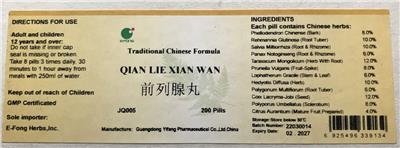
Directions for use Adult and children 12 years and over: Take 8 pills 3 times daily, 30 minutes to 1 hour away from meals with 250ml of water.
Precautions
Do not take if inner cap seal is missing or broken.
Keep out of reach of children.
Formulation
GMP Certified
Traditional Chinese Formula
Storage
Storage: Store below 30 degrees C
Is this label outdated? Report a formula or label change and our pharmacy team will review it.
Qian Lie Xian Wan by E-Fong label
The label scan from the NIH Dietary Supplement Label Database. Tap to enlarge.
Label images are published by the NIH Dietary Supplement Label Database for the version of this product on file. Always read your actual product label.
View the full label (PDF)The Ingredients in Qian Lie Xian Wan by E-Fong
These are the 12 active ingredients this product is made of. Select any to open its full monograph.
Serving size8 Pill(s) Dosage formTablet Or Pill Servings per container25 Amounts shown are per serving.
Most supplement products combine several ingredients, and a medication can interact with the product through any one of them. Each ingredient below shows whether it has known drug interactions.
Phellodendron chinense
Interacts with1,162 drugs
Phellodendron is a traditional Chinese medicine bark (Huang Bai) that contains berberine and other plant compounds with antimicrobial and anti-inflamm...
Phellodendron chinense monograph & interactionsRehmannia glutinosa
Interacts with258 drugs
Rehmannia is a root used for centuries in Traditional Chinese Medicine, often to 'tonify' the kidneys and support energy or blood health. Human eviden...
Rehmannia glutinosa monograph & interactionsSalvia miltiorrhiza
Panax notoginseng
Interacts with207 drugs
Panax notoginseng (sanqi or tienchi ginseng) is a traditional Chinese herb most often used to help with bleeding, bruising, and circulation. Human evi...
Panax notoginseng monograph & interactionsTaraxacum mongolicum
Prunella vulgaris
Lophatherum gracile
Hedyotis diffusa
Polygonum multiflorum
Interacts with1,259 drugs
Fo-ti (He Shou Wu) is a root used in traditional Chinese medicine, often promoted for healthy aging and hair. High-quality human evidence for these be...
Polygonum multiflorum monograph & interactionsCoix lacryma-jobi
Interacts with128 drugs
Job's Tears is a grain-like seed long used as a food and in traditional medicine, especially in East Asia. While it is generally safe as a food and is...
Coix lacryma-jobi monograph & interactionsPolyporus umbellatus
Interacts with417 drugs
Poria mushroom (Fu Ling) is a fungus long used in Traditional Chinese Medicine, mainly as a mild diuretic and digestive and calming aid. Modern scient...
Polyporus umbellatus monograph & interactionsCitrus aurantium
Interacts with959 drugs
Bitter orange is a citrus fruit whose extracts contain synephrine, a mild stimulant often added to weight-loss and energy supplements. Evidence that i...
Citrus aurantium monograph & interactionsQian Lie Xian Wan by E-Fong Drug Interactions
HelloPharmacist Interaction Report
Qian Lie Xian Wan by E-Fong contains several ingredients with documented interactions with medications.
The most serious concern is with Citrus aurantium (bitter orange), which carries a Major-severity interaction: it may increase blood levels of midazolam (a sedative), potentially raising the risk of serious adverse effects. Additionally, bitter orange interacts with MAOIs (a class of antidepressants), theoretically increasing the risk of dangerously high blood pressure.
Read the full breakdown — every affected drug type, severity by severity
Phellodendron (which contains berberine) has Moderate interactions with blood thinners and antiplatelet drugs—it may increase bleeding risk. It also interacts with blood pressure medications, diabetes drugs, and certain enzyme substrates (CYP2D6, CYP2C9, and CYP3A4), potentially raising drug levels or effects.
Rehmannia similarly interacts with blood pressure and diabetes medications. Panax notoginseng interacts with blood thinners like warfarin and aspirin, increasing bleeding risk, and with drugs processed by CYP1A2.
Polygonum multiflorum (fo-ti) has been linked to serious liver damage and carries multiple interactions, including with warfarin and other blood thinners. Coix lacryma-jobi (Job's tears) interacts with diabetes drugs and several other medications.
Polyporus umbellatus (poria mushroom) interacts with sedatives and cholinergic drugs. Citrus aurantium also interacts with QT-prolonging drugs, stimulants, and certain pain and cough medications.
We could not check interaction data for Salvia miltiorrhiza, Taraxacum mongolicum, Prunella vulgaris, Lophatherum gracile, and Hedyotis diffusa. Altogether, these interactions span 1,536 individual medications.
Before starting this product, use the medication checker below with your exact prescriptions—especially if you take blood thinners, blood pressure drugs, diabetes medications, sedatives, or antidepressants.
Check your own medications below · Editorial policy · How we use AI
Want to check YOUR meds against Qian Lie Xian Wan?
Ask about interactions with your drugs in plain English — “Can I take it with lisinopril?” — and we find you the answer in seconds, ingredient by ingredient.
Go to the checkerIngredients driving the most interactions
Individual Drug Interactions
The ingredients in Qian Lie Xian Wan interact with 1,561 drugs. Click any drug to see the details.
7 of the 12 ingredients in Qian Lie Xian Wan interact with drugs. Each result below shows which ingredient is responsible. Polygonum multiflorum Phellodendron chinense Citrus aurantium Polyporus umbellatus Rehmannia glutinosa Panax notoginseng Coix lacryma-jobi
AmphetamineAdensys XR-ODT, Adzenys ER, Dyanavel XR, Mydayis
How Amphetamine interacts with Qian Lie Xian Wan — through 3 ingredients. Tap an ingredient for the detail:
Citrus AurantiumCytochrome P450 2d6 (cyp2d6) Substrates, Monoamine Oxidase Inhibitors (maois) +1 Major
Interaction Summary
Theoretically, bitter orange might increase levels of drug metabolized by CYP2D6.
Read the full Citrus Aurantium + Amphetamine interactionPolygonum MultiflorumCytochrome P450 2d6 (cyp2d6) Substrates Moderate
Interaction Summary
Theoretically, fo-ti may increase the levels and clinical effects of drugs metabolized by CYP2D6.
Read the full Polygonum Multiflorum + Amphetamine interactionPhellodendron ChinenseCytochrome P450 2d6 (cyp2d6) Substrates Moderate
Interaction Summary
Theoretically, phellodendron might increase serum levels of drugs metabolized by CYP2D6.
Read the full Phellodendron Chinense + Amphetamine interactionIsocarboxazidMarplan
How Isocarboxazid interacts with Qian Lie Xian Wan — through 1 ingredient. Tap an ingredient for the detail:
Citrus AurantiumMonoamine Oxidase Inhibitors (maois) Major
Interaction Summary
Theoretically, taking MAOIs with synephrine-containing bitter orange preparations might increase the hypertensive effects of synephrine, potentially leading to hypertensive crisis.
Read the full Citrus Aurantium + Isocarboxazid interactionMidazolamNayzilam, Seizalam, Versed
How Midazolam interacts with Qian Lie Xian Wan — through 4 ingredients. Tap an ingredient for the detail:
Citrus AurantiumMidazolam (versed), Cytochrome P450 3a4 (cyp3a4) Substrates Major
Interaction Summary
Bitter orange might increase blood levels of midazolam.
Read the full Citrus Aurantium + Midazolam interactionPhellodendron ChinenseCytochrome P450 3a4 (cyp3a4) Substrates, Midazolam (versed) +1 Moderate
Interaction Summary
Theoretically, phellodendron might increase serum levels of drugs metabolized by CYP3A4.
Read the full Phellodendron Chinense + Midazolam interactionPolyporus UmbellatusCns Depressants Moderate
Interaction Summary
Theoretically, taking poria mushroom extract may enhance the therapeutic and adverse effects of sedatives.
Read the full Polyporus Umbellatus + Midazolam interactionPolygonum MultiflorumCytochrome P450 3a4 (cyp3a4) Substrates Moderate
Interaction Summary
Theoretically, fo-ti might increase the levels and clinical effects of drugs metabolized by CYP3A4.
Read the full Polygonum Multiflorum + Midazolam interactionMoclobemideManerix, Moclobemide
How Moclobemide interacts with Qian Lie Xian Wan — through 2 ingredients. Tap an ingredient for the detail:
Citrus AurantiumMonoamine Oxidase Inhibitors (maois) Major
Interaction Summary
Theoretically, taking MAOIs with synephrine-containing bitter orange preparations might increase the hypertensive effects of synephrine, potentially leading to hypertensive crisis.
Read the full Citrus Aurantium + Moclobemide interactionPolygonum MultiflorumCytochrome P450 2c19 (cyp2c19) Substrates Moderate
Interaction Summary
Theoretically, fo-ti may increase the levels and clinical effects of drugs metabolized by CYP2C19.
Read the full Polygonum Multiflorum + Moclobemide interactionOzanimod HydrochlorideZeposia
How Ozanimod Hydrochloride interacts with Qian Lie Xian Wan — through 2 ingredients. Tap an ingredient for the detail:
Citrus AurantiumMonoamine Oxidase Inhibitors (maois), Qt Interval-prolonging Drugs Major
Interaction Summary
Theoretically, taking MAOIs with synephrine-containing bitter orange preparations might increase the hypertensive effects of synephrine, potentially leading to hypertensive crisis.
Read the full Citrus Aurantium + Ozanimod Hydrochloride interactionPolygonum MultiflorumHepatotoxic Drugs, Cytochrome P450 2c8 (cyp2c8) Substrates Moderate
Interaction Summary
Theoretically, fo-ti might increase the risk of liver damage when taken with hepatotoxic drugs.
Read the full Polygonum Multiflorum + Ozanimod Hydrochloride interactionPhenelzine SulfateNardil
How Phenelzine Sulfate interacts with Qian Lie Xian Wan — through 3 ingredients. Tap an ingredient for the detail:
Citrus AurantiumMonoamine Oxidase Inhibitors (maois) Major
Interaction Summary
Theoretically, taking MAOIs with synephrine-containing bitter orange preparations might increase the hypertensive effects of synephrine, potentially leading to hypertensive crisis.
Read the full Citrus Aurantium + Phenelzine Sulfate interactionPhellodendron ChinenseCns Depressants Moderate
Interaction Summary
Theoretically, phellodendron might increase the sedative effects of CNS depressants.
Read the full Phellodendron Chinense + Phenelzine Sulfate interactionPolyporus UmbellatusCns Depressants Moderate
Interaction Summary
Theoretically, taking poria mushroom extract may enhance the therapeutic and adverse effects of sedatives.
Read the full Polyporus Umbellatus + Phenelzine Sulfate interactionRasagilineAzilect
How Rasagiline interacts with Qian Lie Xian Wan — through 3 ingredients. Tap an ingredient for the detail:
Citrus AurantiumMonoamine Oxidase Inhibitors (maois) Major
Interaction Summary
Theoretically, taking MAOIs with synephrine-containing bitter orange preparations might increase the hypertensive effects of synephrine, potentially leading to hypertensive crisis.
Read the full Citrus Aurantium + Rasagiline interactionPanax NotoginsengCytochrome P450 1a2 (cyp1a2) Substrates Moderate
Interaction Summary
Theoretically, taking Panax notoginseng might reduce the levels and clinical effects of CYP1A2 substrates.
Read the full Panax Notoginseng + Rasagiline interactionPolygonum MultiflorumCytochrome P450 1a2 (cyp1a2) Substrates Moderate
Interaction Summary
Theoretically, fo-ti might increase or decrease the levels and clinical effects of drugs metabolized by CYP1A2.
Read the full Polygonum Multiflorum + Rasagiline interactionSafinamide MesylateXadago
How Safinamide Mesylate interacts with Qian Lie Xian Wan — through 1 ingredient. Tap an ingredient for the detail:
Citrus AurantiumMonoamine Oxidase Inhibitors (maois) Major
Interaction Summary
Theoretically, taking MAOIs with synephrine-containing bitter orange preparations might increase the hypertensive effects of synephrine, potentially leading to hypertensive crisis.
Read the full Citrus Aurantium + Safinamide Mesylate interactionSelegilineCarbex, Eldepryl, Emsam, Zelapar
How Selegiline interacts with Qian Lie Xian Wan — through 1 ingredient. Tap an ingredient for the detail:
Citrus AurantiumMonoamine Oxidase Inhibitors (maois) Major
Interaction Summary
Theoretically, taking MAOIs with synephrine-containing bitter orange preparations might increase the hypertensive effects of synephrine, potentially leading to hypertensive crisis.
Read the full Citrus Aurantium + Selegiline interactionTranylcypromineParnate
How Tranylcypromine interacts with Qian Lie Xian Wan — through 1 ingredient. Tap an ingredient for the detail:
Citrus AurantiumMonoamine Oxidase Inhibitors (maois) Major
Interaction Summary
Theoretically, taking MAOIs with synephrine-containing bitter orange preparations might increase the hypertensive effects of synephrine, potentially leading to hypertensive crisis.
Read the full Citrus Aurantium + Tranylcypromine interaction6-mercaptopurinePurinethol
How 6-mercaptopurine interacts with Qian Lie Xian Wan — through 1 ingredient. Tap an ingredient for the detail:
Polygonum MultiflorumHepatotoxic Drugs Moderate
Interaction Summary
Theoretically, fo-ti might increase the risk of liver damage when taken with hepatotoxic drugs.
Read the full Polygonum Multiflorum + 6-mercaptopurine interactionAdo-trastuzumab EmtansineKadcyla
How Ado-trastuzumab Emtansine interacts with Qian Lie Xian Wan — through 3 ingredients. Tap an ingredient for the detail:
Polygonum MultiflorumCytochrome P450 3a4 (cyp3a4) Substrates Moderate
Interaction Summary
Theoretically, fo-ti might increase the levels and clinical effects of drugs metabolized by CYP3A4.
Read the full Polygonum Multiflorum + Ado-trastuzumab Emtansine interactionCitrus AurantiumCytochrome P450 3a4 (cyp3a4) Substrates Moderate
Interaction Summary
Bitter orange might increase levels of drugs metabolized by CYP3A4.
Read the full Citrus Aurantium + Ado-trastuzumab Emtansine interactionPhellodendron ChinenseCytochrome P450 3a4 (cyp3a4) Substrates Moderate
Interaction Summary
Theoretically, phellodendron might increase serum levels of drugs metabolized by CYP3A4.
Read the full Phellodendron Chinense + Ado-trastuzumab Emtansine interactionAbacavir Sulfate, Dolutegravir, LamivudineTriumeq
How Abacavir Sulfate, Dolutegravir, Lamivudine interacts with Qian Lie Xian Wan — through 1 ingredient. Tap an ingredient for the detail:
Polygonum MultiflorumHepatotoxic Drugs Moderate
Interaction Summary
Theoretically, fo-ti might increase the risk of liver damage when taken with hepatotoxic drugs.
Read the full Polygonum Multiflorum + Abacavir Sulfate, Dolutegravir, Lamivudine interactionAbacavir, LamivudineEpzicom
How Abacavir, Lamivudine interacts with Qian Lie Xian Wan — through 1 ingredient. Tap an ingredient for the detail:
Polygonum MultiflorumHepatotoxic Drugs Moderate
Interaction Summary
Theoretically, fo-ti might increase the risk of liver damage when taken with hepatotoxic drugs.
Read the full Polygonum Multiflorum + Abacavir, Lamivudine interactionAbciximabReoPro
How Abciximab interacts with Qian Lie Xian Wan — through 2 ingredients. Tap an ingredient for the detail:
Phellodendron ChinenseAnticoagulant/antiplatelet Drugs Moderate
Interaction Summary
Theoretically, phellodendron might increase the risk of bleeding when used with anticoagulant or antiplatelet drugs.
Read the full Phellodendron Chinense + Abciximab interactionPolygonum MultiflorumAnticoagulant/antiplatelet Drugs Moderate
Interaction Summary
Fo-ti has been linked to cases of acute liver failure which can decrease clotting factor production and increase the effects of anticoagulants.
Read the full Polygonum Multiflorum + Abciximab interactionAbemaciclibVerzenio
How Abemaciclib interacts with Qian Lie Xian Wan — through 3 ingredients. Tap an ingredient for the detail:
Polygonum MultiflorumCytochrome P450 3a4 (cyp3a4) Substrates Moderate
Interaction Summary
Theoretically, fo-ti might increase the levels and clinical effects of drugs metabolized by CYP3A4.
Read the full Polygonum Multiflorum + Abemaciclib interactionPhellodendron ChinenseCytochrome P450 3a4 (cyp3a4) Substrates Moderate
Interaction Summary
Theoretically, phellodendron might increase serum levels of drugs metabolized by CYP3A4.
Read the full Phellodendron Chinense + Abemaciclib interactionCitrus AurantiumCytochrome P450 3a4 (cyp3a4) Substrates Moderate
Interaction Summary
Bitter orange might increase levels of drugs metabolized by CYP3A4.
Read the full Citrus Aurantium + Abemaciclib interactionAbiraterone
How Abiraterone interacts with Qian Lie Xian Wan — through 3 ingredients. Tap an ingredient for the detail:
Citrus AurantiumCytochrome P450 3a4 (cyp3a4) Substrates Moderate
Interaction Summary
Bitter orange might increase levels of drugs metabolized by CYP3A4.
Read the full Citrus Aurantium + Abiraterone interactionPolygonum MultiflorumCytochrome P450 3a4 (cyp3a4) Substrates, Hepatotoxic Drugs Moderate
Interaction Summary
Theoretically, fo-ti might increase the levels and clinical effects of drugs metabolized by CYP3A4.
Read the full Polygonum Multiflorum + Abiraterone interactionPhellodendron ChinenseCytochrome P450 3a4 (cyp3a4) Substrates Moderate
Interaction Summary
Theoretically, phellodendron might increase serum levels of drugs metabolized by CYP3A4.
Read the full Phellodendron Chinense + Abiraterone interactionAbiraterone AcetateYonsa, Zytiga
How Abiraterone Acetate interacts with Qian Lie Xian Wan — through 3 ingredients. Tap an ingredient for the detail:
Phellodendron ChinenseCytochrome P450 3a4 (cyp3a4) Substrates Moderate
Interaction Summary
Theoretically, phellodendron might increase serum levels of drugs metabolized by CYP3A4.
Read the full Phellodendron Chinense + Abiraterone Acetate interactionPolygonum MultiflorumCytochrome P450 3a4 (cyp3a4) Substrates, Hepatotoxic Drugs Moderate
Interaction Summary
Theoretically, fo-ti might increase the levels and clinical effects of drugs metabolized by CYP3A4.
Read the full Polygonum Multiflorum + Abiraterone Acetate interactionCitrus AurantiumCytochrome P450 3a4 (cyp3a4) Substrates Moderate
Interaction Summary
Bitter orange might increase levels of drugs metabolized by CYP3A4.
Read the full Citrus Aurantium + Abiraterone Acetate interactionAbrocitinibCibinqo
How Abrocitinib interacts with Qian Lie Xian Wan — through 2 ingredients. Tap an ingredient for the detail:
Polygonum MultiflorumCytochrome P450 2c19 (cyp2c19) Substrates, Cytochrome P450 2c9 (cyp2c9) Substrates +1 Moderate
Interaction Summary
Theoretically, fo-ti may increase the levels and clinical effects of drugs metabolized by CYP2C19.
Read the full Polygonum Multiflorum + Abrocitinib interactionPhellodendron ChinenseAnticoagulant/antiplatelet Drugs, Cytochrome P450 2c9 (cyp2c9) Substrates Moderate
Interaction Summary
Theoretically, phellodendron might increase the risk of bleeding when used with anticoagulant or antiplatelet drugs.
Read the full Phellodendron Chinense + Abrocitinib interactionAcalabrutinibCalquence
How Acalabrutinib interacts with Qian Lie Xian Wan — through 3 ingredients. Tap an ingredient for the detail:
Phellodendron ChinenseCytochrome P450 3a4 (cyp3a4) Substrates Moderate
Interaction Summary
Theoretically, phellodendron might increase serum levels of drugs metabolized by CYP3A4.
Read the full Phellodendron Chinense + Acalabrutinib interactionPolygonum MultiflorumCytochrome P450 3a4 (cyp3a4) Substrates Moderate
Interaction Summary
Theoretically, fo-ti might increase the levels and clinical effects of drugs metabolized by CYP3A4.
Read the full Polygonum Multiflorum + Acalabrutinib interactionCitrus AurantiumCytochrome P450 3a4 (cyp3a4) Substrates Moderate
Interaction Summary
Bitter orange might increase levels of drugs metabolized by CYP3A4.
Read the full Citrus Aurantium + Acalabrutinib interactionAcarboseGlucobay, Prandase, Precose
How Acarbose interacts with Qian Lie Xian Wan — through 5 ingredients. Tap an ingredient for the detail:
Citrus AurantiumAntidiabetes Drugs Moderate
Interaction Summary
Theoretically, bitter orange might increase the risk of hypoglycemia when taken with antidiabetes drugs.
Read the full Citrus Aurantium + Acarbose interactionPhellodendron ChinenseAntidiabetes Drugs Moderate
Interaction Summary
Theoretically, phellodendron may increase the risk of hypoglycemia when taken with antidiabetes drugs.
Read the full Phellodendron Chinense + Acarbose interactionRehmannia GlutinosaAntidiabetes Drugs Moderate
Interaction Summary
Theoretically, rehmannia might increase the risk of hypoglycemia when taken with antidiabetes drugs.
Read the full Rehmannia Glutinosa + Acarbose interactionCoix Lacryma-jobiAntidiabetes Drugs Moderate
Interaction Summary
Preliminary evidence shows that constituents of Job's tears might have hypoglycemic effects.
Read the full Coix Lacryma-jobi + Acarbose interactionPolygonum MultiflorumHepatotoxic Drugs, Antidiabetes Drugs Moderate
Interaction Summary
Theoretically, fo-ti might increase the risk of liver damage when taken with hepatotoxic drugs.
Read the full Polygonum Multiflorum + Acarbose interactionAcebutololRhotral, Sectral
How Acebutolol interacts with Qian Lie Xian Wan — through 3 ingredients. Tap an ingredient for the detail:
Rehmannia GlutinosaAntihypertensive Drugs Moderate
Interaction Summary
Theoretically, rehmannia might increase the risk of hypotension when taken with antihypertensive drugs.
Read the full Rehmannia Glutinosa + Acebutolol interactionPhellodendron ChinenseAntihypertensive Drugs Moderate
Interaction Summary
Theoretically, phellodendron might have additive effects with antihypertensive drugs.
Read the full Phellodendron Chinense + Acebutolol interactionPolygonum MultiflorumHepatotoxic Drugs Moderate
Interaction Summary
Theoretically, fo-ti might increase the risk of liver damage when taken with hepatotoxic drugs.
Read the full Polygonum Multiflorum + Acebutolol interactionAcenocoumarolSintrom
How Acenocoumarol interacts with Qian Lie Xian Wan — through 2 ingredients. Tap an ingredient for the detail:
Phellodendron ChinenseAnticoagulant/antiplatelet Drugs Moderate
Interaction Summary
Theoretically, phellodendron might increase the risk of bleeding when used with anticoagulant or antiplatelet drugs.
Read the full Phellodendron Chinense + Acenocoumarol interactionPolygonum MultiflorumAnticoagulant/antiplatelet Drugs Moderate
Interaction Summary
Fo-ti has been linked to cases of acute liver failure which can decrease clotting factor production and increase the effects of anticoagulants.
Read the full Polygonum Multiflorum + Acenocoumarol interactionAcepromazineAtravet
How Acepromazine interacts with Qian Lie Xian Wan — through 2 ingredients. Tap an ingredient for the detail:
Polyporus UmbellatusCns Depressants, Anticholinergic Drugs Moderate
Interaction Summary
Theoretically, taking poria mushroom extract may enhance the therapeutic and adverse effects of sedatives.
Read the full Polyporus Umbellatus + Acepromazine interactionPhellodendron ChinenseCns Depressants Moderate
Interaction Summary
Theoretically, phellodendron might increase the sedative effects of CNS depressants.
Read the full Phellodendron Chinense + Acepromazine interactionAcetaminophenChildren's Tylenol, Children's Tylenol Meltaways, Tylenol, Tylenol Ex Strength
How Acetaminophen interacts with Qian Lie Xian Wan — through 2 ingredients. Tap an ingredient for the detail:
Panax NotoginsengCytochrome P450 1a2 (cyp1a2) Substrates Moderate
Interaction Summary
Theoretically, taking Panax notoginseng might reduce the levels and clinical effects of CYP1A2 substrates.
Read the full Panax Notoginseng + Acetaminophen interactionPolygonum MultiflorumHepatotoxic Drugs, Cytochrome P450 1a2 (cyp1a2) Substrates Moderate
Interaction Summary
Theoretically, fo-ti might increase the risk of liver damage when taken with hepatotoxic drugs.
Read the full Polygonum Multiflorum + Acetaminophen interactionAcetaminophen, AspirinGemnisyn
How Acetaminophen, Aspirin interacts with Qian Lie Xian Wan — through 3 ingredients. Tap an ingredient for the detail:
Polygonum MultiflorumCytochrome P450 1a2 (cyp1a2) Substrates, Hepatotoxic Drugs +1 Moderate
Interaction Summary
Theoretically, fo-ti might increase or decrease the levels and clinical effects of drugs metabolized by CYP1A2.
Read the full Polygonum Multiflorum + Acetaminophen, Aspirin interactionPhellodendron ChinenseAnticoagulant/antiplatelet Drugs Moderate
Interaction Summary
Theoretically, phellodendron might increase the risk of bleeding when used with anticoagulant or antiplatelet drugs.
Read the full Phellodendron Chinense + Acetaminophen, Aspirin interactionPanax NotoginsengCytochrome P450 1a2 (cyp1a2) Substrates, Aspirin Moderate
Interaction Summary
Theoretically, taking Panax notoginseng might reduce the levels and clinical effects of CYP1A2 substrates.
Read the full Panax Notoginseng + Acetaminophen, Aspirin interactionAcetaminophen, Aspirin, CaffeineExcedrin, Excedrin Extra Strength, Excedrin Migraine
How Acetaminophen, Aspirin, Caffeine interacts with Qian Lie Xian Wan — through 4 ingredients. Tap an ingredient for the detail:
Panax NotoginsengCaffeine, Cytochrome P450 1a2 (cyp1a2) Substrates +1 Moderate
Interaction Summary
Theoretically, taking Panax notoginseng may decrease the levels and clinical effects of caffeine.
Read the full Panax Notoginseng + Acetaminophen, Aspirin, Caffeine interactionPolygonum MultiflorumAnticoagulant/antiplatelet Drugs, Hepatotoxic Drugs +2 Moderate
Interaction Summary
Fo-ti has been linked to cases of acute liver failure which can decrease clotting factor production and increase the effects of anticoagulants.
Read the full Polygonum Multiflorum + Acetaminophen, Aspirin, Caffeine interactionCitrus AurantiumCytochrome P450 3a4 (cyp3a4) Substrates, Caffeine +1 Moderate
Interaction Summary
Bitter orange might increase levels of drugs metabolized by CYP3A4.
Read the full Citrus Aurantium + Acetaminophen, Aspirin, Caffeine interactionPhellodendron ChinenseAnticoagulant/antiplatelet Drugs, Cytochrome P450 3a4 (cyp3a4) Substrates Moderate
Interaction Summary
Theoretically, phellodendron might increase the risk of bleeding when used with anticoagulant or antiplatelet drugs.
Read the full Phellodendron Chinense + Acetaminophen, Aspirin, Caffeine interactionAcetaminophen, Brompheniramine, PhenylpropanolamineDimetapp Cold and Flu
How Acetaminophen, Brompheniramine, Phenylpropanolamine interacts with Qian Lie Xian Wan — through 3 ingredients. Tap an ingredient for the detail:
Polygonum MultiflorumHepatotoxic Drugs, Cytochrome P450 1a2 (cyp1a2) Substrates Moderate
Interaction Summary
Theoretically, fo-ti might increase the risk of liver damage when taken with hepatotoxic drugs.
Read the full Polygonum Multiflorum + Acetaminophen, Brompheniramine, Phenylpropanolamine interactionPanax NotoginsengCytochrome P450 1a2 (cyp1a2) Substrates Moderate
Interaction Summary
Theoretically, taking Panax notoginseng might reduce the levels and clinical effects of CYP1A2 substrates.
Read the full Panax Notoginseng + Acetaminophen, Brompheniramine, Phenylpropanolamine interactionCitrus AurantiumStimulant Drugs Moderate
Interaction Summary
Theoretically, bitter orange might increase the risk of hypertension and adverse cardiovascular effects when taken with stimulant drugs.
Read the full Citrus Aurantium + Acetaminophen, Brompheniramine, Phenylpropanolamine interactionAcetaminophen, ButalbitalAxocet, Bancap, Bucet, Butex Forte, Esgic CF, Orbivan CF +5 more
How Acetaminophen, Butalbital interacts with Qian Lie Xian Wan — through 2 ingredients. Tap an ingredient for the detail:
Polygonum MultiflorumCytochrome P450 1a2 (cyp1a2) Substrates, Hepatotoxic Drugs Moderate
Interaction Summary
Theoretically, fo-ti might increase or decrease the levels and clinical effects of drugs metabolized by CYP1A2.
Read the full Polygonum Multiflorum + Acetaminophen, Butalbital interactionPanax NotoginsengCytochrome P450 1a2 (cyp1a2) Substrates Moderate
Interaction Summary
Theoretically, taking Panax notoginseng might reduce the levels and clinical effects of CYP1A2 substrates.
Read the full Panax Notoginseng + Acetaminophen, Butalbital interactionAcetaminophen, Butalbital, CaffeineEsgic, Esgic Plus, Fiogesic, Fioricet, Repan, Tecnal +1 more
How Acetaminophen, Butalbital, Caffeine interacts with Qian Lie Xian Wan — through 4 ingredients. Tap an ingredient for the detail:
Panax NotoginsengCytochrome P450 1a2 (cyp1a2) Substrates, Caffeine Moderate
Interaction Summary
Theoretically, taking Panax notoginseng might reduce the levels and clinical effects of CYP1A2 substrates.
Read the full Panax Notoginseng + Acetaminophen, Butalbital, Caffeine interactionCitrus AurantiumStimulant Drugs, Caffeine +1 Moderate
Interaction Summary
Theoretically, bitter orange might increase the risk of hypertension and adverse cardiovascular effects when taken with stimulant drugs.
Read the full Citrus Aurantium + Acetaminophen, Butalbital, Caffeine interactionPhellodendron ChinenseCytochrome P450 3a4 (cyp3a4) Substrates Moderate
Interaction Summary
Theoretically, phellodendron might increase serum levels of drugs metabolized by CYP3A4.
Read the full Phellodendron Chinense + Acetaminophen, Butalbital, Caffeine interactionPolygonum MultiflorumHepatotoxic Drugs, Cytochrome P450 3a4 (cyp3a4) Substrates +1 Moderate
Interaction Summary
Theoretically, fo-ti might increase the risk of liver damage when taken with hepatotoxic drugs.
Read the full Polygonum Multiflorum + Acetaminophen, Butalbital, Caffeine interactionEach ingredient & the kinds of drugs it affects
For each ingredient in Qian Lie Xian Wan with known interactions, here are the types of medications they can affect. Open any type for the detail — or search your exact drug in the checker above.
Polygonum multiflorum
Anticoagulant/Antiplatelet Drugs
Fo-ti has been linked to cases of acute liver failure which can decrease clotting factor production and increase the effects of anticoagulants. In one case, a patient who had been stable on warfarin presented with acute hepatitis and an INR elevated to 14.98. The patient had been taking fo-ti for 90 days prior to admission. Discontinuation of warfarin and fo-ti lead to a decrease in the INR and full recovery. Theoretically, concomitant use of fo-ti with anticoagulant or antiplatelet drugs may increase the risk of bleeding in some patients. Until more is known, monitor patients taking fo-ti and drugs that affect bleeding.
Some of these drugs include aspirin, clopidogrel (Plavix), dalteparin (Fragmin), dipyridamole (Persantine), enoxaparin (Lovenox), heparin, ticlopidine (Ticlid), warfarin (Coumadin), and others.
Antidiabetes Drugs
Theoretically, fo-ti might increase the risk of hypoglycemia when taken with antidiabetes drugs.
Fo-ti reportedly has hypoglycemic effects.
Contraceptive Drugs
Theoretically, taking large amounts of fo-ti might interfere with contraceptive drugs due to competition for estrogen receptors.
In vitro research suggests that fo-ti extract has estrogenic activity.
Cytochrome P450 1A2 (Cyp1A2) Substrates
Theoretically, fo-ti might increase or decrease the levels and clinical effects of drugs metabolized by CYP1A2.
In vitro research suggests that fo-ti might inhibit CYP1A2. Additionally, in vitro research suggests that the degree of CYP1A2 inhibition depends on the type of fo-ti extract (i.e., the raw plant leads to greater inhibition than extensively processed extracts). However, in an animal study, an aqueous extract of fo-ti inhibited CYP1A2 while an alcoholic extract of fo-ti induced CYP1A2. Induction or inhibition of CYP1A2 by fo-ti has not been reported in humans.
Cytochrome P450 2B6 (Cyp2B6) Substrates
Theoretically, fo-ti might increase the levels and clinical effects of drugs metabolized by CYP2B6.
Animal research suggests that fo-ti might inhibit CYP2B6. One in vitro study suggests that the degree of CYP2B6 inhibition may depend on the type of fo-ti extract (i.e., the raw plant leads to greater inhibition than extensively processed extracts). However, this interaction has not been reported in humans.
Cytochrome P450 2C19 (Cyp2C19) Substrates
Theoretically, fo-ti may increase the levels and clinical effects of drugs metabolized by CYP2C19.
Animal and in vitro research suggests that fo-ti may inhibit CYP2C19. An in vitro study suggests that the degree of CYP2C19 inhibition may depend on the type of fo-ti extract (i.e., the raw plant leads to greater inhibition than extensively processed extracts). However, this interaction has not been reported in humans.
Cytochrome P450 2C8 (Cyp2C8) Substrates
Theoretically, fo-ti might increase the levels and clinical effects of drugs metabolized by CYP2C8.
In vitro research suggests that fo-ti might inhibit CYP2C8. However, this interaction has not been reported in humans.
Cytochrome P450 2C9 (Cyp2C9) Substrates
Theoretically, fo-ti may increase the levels and clinical effects of drugs metabolized by CYP2C9.
Animal and in vitro research suggests that fo-ti may inhibit CYP2C9. However, this interaction has not been reported in humans.
Cytochrome P450 2D6 (Cyp2D6) Substrates
Theoretically, fo-ti may increase the levels and clinical effects of drugs metabolized by CYP2D6.
Animal research suggests that fo-ti might inhibit CYP2D6. Additionally, an in vitro study suggests that the degree of CYP2D6 inhibition may depend on the type of fo-ti extract (i.e., the raw plant leads to greater inhibition than extensively processed extracts). However, this interaction has not been reported in humans.
Cytochrome P450 3A4 (Cyp3A4) Substrates
Theoretically, fo-ti might increase the levels and clinical effects of drugs metabolized by CYP3A4.
In vitro research suggests that fo-ti might inhibit CYP3A4. One in vitro study suggests that the degree of CYP3A4 inhibition may depend on the type of fo-ti extract (i.e., the raw plant leads to greater inhibition than extensively processed extracts). However, this evidence conflicts with animal research suggesting that fo-ti does not inhibit CYP3A4. This interaction has not been reported in humans.
Digoxin (Lanoxin)
Theoretically, fo-ti, particularly raw fo-ti root, might increase the risk of hypokalemia and cardiotoxicity when taken with digoxin.
Raw fo-ti root contains anthraquinone derivatives, which might have stimulant laxative effects. In vitro research shows that fermented and processed fo-ti root have reduced laxative effects compared with raw fo-ti root.
Diuretic Drugs
Theoretically, fo-ti, particularly raw fo-ti root, might increase the risk of hypokalemia when taken with diuretic drugs.
Raw fo-ti root contains anthraquinone derivatives, which might have stimulant laxative effects and compound diuretic-induced potassium loss. In vitro research shows that fermented and processed fo-ti root have reduced laxative effects compared with raw fo-ti root.
Estrogens
Theoretically, taking large amounts of fo-ti might interfere with hormone replacement therapy through competition for estrogen receptors.
In vitro research suggests that fo-ti extract has estrogenic activity.
Hepatotoxic Drugs
Theoretically, fo-ti might increase the risk of liver damage when taken with hepatotoxic drugs.
Fo-ti has been linked to liver damage in many reports.
Stimulant Laxatives
Theoretically, fo-ti, particularly raw fo-ti root, might increase the risk of fluid and electrolyte depletion when taken with stimulant laxatives.
Raw fo-ti root contains anthraquinone derivatives, which might have stimulant laxative effects. However, in vitro research shows that fermented and processed fo-ti root have reduced laxative effects compared with raw fo-ti root.
Sulindac (Clinoril)
Theoretically, fo-ti might increase or decrease the levels and clinical effects of sulindac.
Animal research suggests that the type of fo-ti extract might affect the levels of sulindac differently; the raw plant may increase levels, but processed parts may decrease levels. Induction or inhibition of CYP1A2 by fo-ti has not been reported in humans.
Warfarin (Coumadin)
Theoretically, fo-ti might increase the effects and adverse effects of warfarin.
Fo-ti may have stimulant laxative effects and cause diarrhea, especially when the raw or unprocessed fo-ti root is used. Diarrhea can increase the effects of warfarin, increase international normalized ratio (INR), and increase the risk of bleeding. Also, fo-ti has been linked to cases of acute liver failure which can decrease clotting factor production and increase the effects of warfarin. In one case, a patient who had been stable on warfarin presented with acute hepatitis and an INR elevated to 14.98. The patient had been taking fo-ti for 90 days prior to admission. Discontinuation of warfarin and fo-ti lead to a decrease in the INR and full recovery.
Phellodendron chinense
Anticoagulant/Antiplatelet Drugs
Theoretically, phellodendron might increase the risk of bleeding when used with anticoagulant or antiplatelet drugs.
Phellodendron contains berberine. In vitro and in vivo research suggest that berberine can inhibit platelet aggregation. Theoretically, phellodendron might also inhibit platelet aggregation.
Antidiabetes Drugs
Theoretically, phellodendron may increase the risk of hypoglycemia when taken with antidiabetes drugs.
Phellodendron contains berberine. Clinical research shows that berberine may lower blood glucose levels. Theoretically, phellodendron might also lower blood glucose levels.
Antihypertensive Drugs
Theoretically, phellodendron might have additive effects with antihypertensive drugs.
Phellodendron contains berberine. Animal research suggests that berberine can have hypotensive effects. Also, a clinical study suggests that taking berberine in combination with amlodipine can lower systolic and diastolic blood pressure when compared with amlodipine alone. Theoretically, phellodendron might also reduce blood pressure.
Cns Depressants
Theoretically, phellodendron might increase the sedative effects of CNS depressants.
Phellodendron contains berberine. Animal research suggests that berberine may have sedative effects. Theoretically, phellodendron might also have CNS depressants effects.
Cyclosporine (Neoral, Sandimmune)
Theoretically, phellodendron might increase blood levels of cyclosporine.
Phellodendron contains berberine. Preliminary clinical research shows that berberine can reduce metabolism of cyclosporine and increase serum levels, likely through inhibition of cytochrome P450 3A4 (CYP3A4), which metabolizes cyclosporine. Theoretically, phellodendron might also reduce the metabolism of cyclosporine.
Cytochrome P450 2C9 (Cyp2C9) Substrates
Theoretically, phellodendron might increase serum levels of drugs metabolized by CYP2C9.
Phellodendron contains berberine. Preliminary clinical research shows that berberine can inhibit CYP2C9. Theoretically, phellodendron might also inhibit CYP2C9.
Cytochrome P450 2D6 (Cyp2D6) Substrates
Theoretically, phellodendron might increase serum levels of drugs metabolized by CYP2D6.
Phellodendron contains berberine. In vitro research and preliminary clinical evidence show that berberine can inhibit CYP2D6. Theoretically, phellodendron might also inhibit CYP2D6.
Cytochrome P450 3A4 (Cyp3A4) Substrates
Theoretically, phellodendron might increase serum levels of drugs metabolized by CYP3A4.
Phellodendron contains berberine. In vitro research and preliminary clinical research show that berberine moderately inhibits CYP3A4. Theoretically, phellodendron might also inhibit CYP3A4.
Dextromethorphan (Robitussin Dm, Others)
Theoretically, phellodendron may increase serum levels of dextromethorphan.
Phellodendron contains berberine. Preliminary clinical research shows that berberine can inhibit cytochrome P450 2D6 (CYP2D6) activity and reduce the metabolism of dextromethorphan. Theoretically, phellodendron may also inhibit the metabolism of dextromethorphan.
Losartan (Cozaar)
Theoretically, phellodendron might reduce the therapeutic effects of losartan by decreasing its conversion to its active form.
Phellodendron contains berberine. Preliminary clinical research suggests that berberine can inhibit cytochrome P450 2C9 (CYP2C9) activity and reduce metabolism of losartan. Theoretically, phellodendron might also inhibit the metabolism of losartan.
Metformin (Glucophage)
Theoretically, phellodendron might increase the therapeutic and adverse effects of metformin.
Phellodendron contains berberine. In vitro and animal studies show that berberine can increase the systemic exposure and half-life of metformin, potentially increasing metformin's effects and side effects. This interaction seems to be most apparent when berberine is administered 2 hours prior to metformin. Taking berberine and metformin at the same time does not appear to increase systemic exposure to metformin. It is unclear if phellodendron might have this same effect.
Midazolam (Versed)
Theoretically, phellodendron might reduce metabolism of midazolam, which might increase the risk of severe adverse effects.
Phellodendron contains berberine. Preliminary clinical research shows that berberine can inhibit cytochrome P450 3A4 (CYP3A4) activity and reduce metabolism of midazolam. Theoretically, phellodendron might also inhibit the metabolism of midazolam.
Pentobarbital (Nembutal)
Theoretically, phellodendron might increase the sedative effect of pentobarbital.
Phellodendron contains berberine. Animal research shows that berberine can prolong pentobarbital-induced sleeping time. Theoretically, phellodendron might increase the sedative effects of pentobarbital.
Tacrolimus (Prograf)
Theoretically, phellodendron might increase blood levels of tacrolimus.
Phellodendron contains berberine. In a 16-year-old patient with idiopathic nephrotic syndrome who was being treated with tacrolimus 6.5 mg twice daily, intake of berberine 200 mg three times daily increased the blood concentration of tacrolimus from 8 to 22 ng/mL. Following a reduction of the tacrolimus dose to 3 mg daily, blood levels of tacrolimus decreased to 12 ng/mL. It is unclear if phellodendron might have this same effect.
Citrus aurantium
Midazolam (Versed)
Bitter orange might increase blood levels of midazolam.
One small clinical study shows that bitter orange juice can increase midazolam levels, likely through inhibition of cytochrome P450 3A4 (CYP3A4). Theoretically, bitter orange might increase the risk of midazolam-related adverse effects.
Monoamine Oxidase Inhibitors (Maois)
Theoretically, taking MAOIs with synephrine-containing bitter orange preparations might increase the hypertensive effects of synephrine, potentially leading to hypertensive crisis.
Bitter orange contains tyramine, octopamine, and synephrine, which are MAO substrates.
Antidiabetes Drugs
Theoretically, bitter orange might increase the risk of hypoglycemia when taken with antidiabetes drugs.
Some clinical research shows that drinking a tea containing bitter orange and Indian snakeroot reduces fasting and postprandial glucose levels in patients with type 2 diabetes who are using antidiabetes drugs. However, it is unclear if these effects are due to bitter orange, Indian snakeroot, or the combination. An animal study also shows that p-synephrine in combination with gliclazide , a sulfonylurea, causes an additional 20% to 44% decrease in glucose levels when compared with gliclazide alone.
Caffeine
Bitter orange might increase blood pressure and heart rate when taken with caffeine.
Small clinical studies show that taking bitter orange in combination with caffeine can increase blood pressure and heart rate in otherwise healthy normotensive adults. Theoretically, this might increase the risk of serious cardiovascular adverse effects.
Colchicine
Bitter orange might affect colchicine levels.
Colchicine is a substrate of P-glycoprotein and cytochrome P450 3A4 (CYP3A4). Bitter orange has been reported to inhibit CYP3A4 and increase levels of CYP3A4 substrates. However, one small clinical study in healthy adults shows that drinking bitter orange juice 240 mL twice daily for 4 days and taking a single dose of colchicine 0.6 mg on the 4th day decreases colchicine peak serum levels by 24%, time to peak serum level by 1 hour, and overall exposure to colchicine by 20%. The clinical significance of this finding is unclear.
Cytochrome P450 3A4 (Cyp3A4) Substrates
Bitter orange might increase levels of drugs metabolized by CYP3A4.
Small clinical studies suggest that single or multiple doses of freshly squeezed bitter orange juice 200-240 mL can inhibit CYP3A4 metabolism of drugs, causing increased drug levels and potentially increasing the risk of adverse effects. However, the extent of the effect of bitter orange on CYP3A4-mediated drug interactions is unknown. Some evidence suggests that bitter orange selectively inhibits intestinal CYP3A4, but not hepatic CYP3A4. Its effect on P-glycoprotein, which strongly overlaps with CYP3A4 interactions, is unclear. One small clinical study shows that drinking 8 ounces of freshly squeezed bitter orange juice has no effect on cyclosporine, which seems to be more dependent on hepatic CYP3A4 and P-glycoprotein than intestinal CYP3A4.
Dextromethorphan (Robitussin Dm, Others)
Bitter orange might increase blood levels of dextromethorphan.
One small clinical study shows that bitter orange juice increases dextromethorphan levels, likely through cytochrome P450 3A4 (CYP3A4) inhibition. Theoretically, bitter orange might increase the risk for dextromethorphan-related adverse effects.
Felodipine (Plendil)
Bitter orange might increase blood levels of felodipine.
One small clinical study shows that bitter orange juice increases felodipine levels, likely through cytochrome P450 3A4 (CYP3A4) inhibition. Theoretically, bitter orange might increase the risk for felodipine-related adverse effects.
Indinavir (Crixivan)
Bitter orange might increase blood levels of indinavir.
One small clinical study shows that bitter orange juice slightly increases indinavir levels, but this effect is likely to be clinically insignificant. Bitter orange selectively inhibits intestinal cytochrome P450 3A4 (CYP3A4); however, the metabolism of indinavir seems to be more dependent on hepatic CYP3A4. The effect of bitter orange on other protease inhibitors has not been studied.
Qt Interval-Prolonging Drugs
Theoretically, bitter orange might have an additive effect when combined with drugs that prolong the QT interval, potentially increasing the risk of ventricular arrhythmias.
One case report suggests that taking bitter orange in combination with other stimulants such as caffeine might prolong the QT interval in some patients.
Sildenafil (Viagra)
Bitter orange juice might increase blood levels of sildenafil.
A small clinical study in healthy adult males shows that drinking freshly squeezed bitter orange juice 250 mL daily for 3 days and taking a single dose of sildenafil 50 mg on the 3rd day increases the peak plasma concentration of sildenafil by 18% and the overall exposure to sildenafil by 44%. Theoretically, this may be due to inhibition of cytochrome P450 3A4 by bitter orange.
Stimulant Drugs
Theoretically, bitter orange might increase the risk of hypertension and adverse cardiovascular effects when taken with stimulant drugs.
Bitter orange appears to have stimulant effects.
Cytochrome P450 2D6 (Cyp2D6) Substrates
Theoretically, bitter orange might increase levels of drug metabolized by CYP2D6.
In vitro research shows that octopamine, a constituent of bitter orange, weakly inhibits CYP2D6 enzymes. This effect has not been reported in humans.
Polyporus umbellatus
Anticholinergic Drugs
Theoretically, poria mushroom might decrease the clinical effects of anticholinergic drugs.
In animal research, poria mushroom essential oil reduces acetylcholinesterase activity. This interaction has not been shown in humans.
Cholinergic Drugs
Theoretically, poria mushroom might have additive effects when used with cholinergic drugs.
In animal research, poria mushroom essential oil reduces acetylcholinesterase activity. This interaction has not been shown in humans.
Cns Depressants
Theoretically, taking poria mushroom extract may enhance the therapeutic and adverse effects of sedatives.
Animal research shows that poria mushroom extract has sedative properties. This interaction has not been shown in humans.
Rehmannia glutinosa
Antidiabetes Drugs
Theoretically, rehmannia might increase the risk of hypoglycemia when taken with antidiabetes drugs.
Animal research shows that rehmannia may have hypoglycemic effects.
Antihypertensive Drugs
Theoretically, rehmannia might increase the risk of hypotension when taken with antihypertensive drugs.
Animal research shows that rehmannia may have hypotensive effects. Laboratory research shows that formulations of dried and processed rehmannia root inhibit angiotensin-converting enzyme (ACE).
Panax notoginseng
Aspirin
Theoretically, taking Panax notoginseng concomitantly with aspirin may increase the risk of adverse effects from both products.
Animal research shows that taking Panax notoginseng extract with aspirin increases blood levels of salicylic acid by approximately 50% and blood levels of Panax notoginseng by 75% to 196%. This effect may be due to increased absorption of both products.
Caffeine
Theoretically, taking Panax notoginseng may decrease the levels and clinical effects of caffeine.
Animal research shows that administering Panax notoginseng intravenously for 7 days before intraperitoneal injection of caffeine can decrease maximal blood levels of caffeine by 37%. This interaction is attributed to the ability of Panax notoginseng to increase the activity of cytochrome P450 1A2 (CYP1A2) enzymes.
Cytochrome P450 1A2 (Cyp1A2) Substrates
Theoretically, taking Panax notoginseng might reduce the levels and clinical effects of CYP1A2 substrates.
Animal research shows that administering Panax notoginseng intravenously for 7 days before intraperitoneal injection of caffeine can decrease maximal blood levels of caffeine by 37%. This interaction was attributed to the ability of Panax notoginseng to increase the activity of CYP1A2.
Warfarin (Coumadin)
Theoretically, taking Panax notoginseng concomitantly with warfarin may increase the risk of bleeding.
Animal research shows that taking Panax notoginseng concomitantly with warfarin increases plasma warfarin levels, prothrombin time, and international normalized ratio when compared with control. In vitro research also suggests that Panax notoginseng may downregulate expression of cytochrome P450 3A4 enzymes, which may affect warfarin metabolism.
Coix lacryma-jobi
Antidiabetes Drugs
Preliminary evidence shows that constituents of Job's tears might have hypoglycemic effects. Theoretically, concomitant use with drugs that decrease blood glucose levels might increase the risk of hypoglycemia. Some antidiabetes drugs include glimepiride (Amaryl), glyburide (DiaBeta, Glynase PresTab, Micronase), insulin, pioglitazone (Actos), rosiglitazone (Avandia), chlorpropamide (Diabinese), glipizide (Glucotrol), tolbutamide (Orinase), and others.
Chlorzoxazone (Parafon Forte, Paraflex)
Animal research suggests that Job's tears might enhance absorption of chlorzoxazone in the small intestine. Single dose and short-term oral administration of Job's tears bran ethanolic extract along with oral administration of a five-drug cocktail containing chlorzoxazone increases chlorzoxazone peak plasma concentration and area under the plasma concentration-time curve (AUC) without altering major cytochrome P450 activities in the liver. This effect has not been reported in humans.
Dextromethorphan (Robitussin Dm, Others)
Animal research suggests that Job's tears might enhance absorption of dextromethorphan in the small intestine. Single dose oral administration of Job's tears bran ethanolic extract along with oral administration of a five-drug cocktail containing dextromethorphan increases dextromethorphan area under the plasma concentration-time curve (AUC) without altering major cytochrome P450 activities in the liver. This effect has not been reported in humans.
Diltiazem (Cardizem, Others)
Animal research suggests that Job's tears might enhance absorption of diltiazem in the small intestine. Single dose oral administration of Job's tears bran ethanolic extract along with oral administration of a five-drug cocktail containing diltiazem increases diltiazem peak plasma concentration and area under the plasma concentration-time curve (AUC) without altering major cytochrome P450 activities in the liver. This effect has not been reported in humans.
Theophylline
Animal research suggests that Job's tears might enhance absorption of theophylline in the small intestine. Single dose and short-term oral administration of Job's tears bran ethanolic extract along with oral administration of a five-drug cocktail containing theophylline increases theophylline peak plasma concentration and area under the plasma concentration-time curve (AUC) without altering major cytochrome P450 activities in the liver. This effect has not been reported in humans.
Brand information
Manufacturer and brand details for Qian Lie Xian Wan, from the product label.
Qian Lie Xian Wan by E-Fong: Common Questions
Does Qian Lie Xian Wan by E-Fong interact with any medications?
How can one product interact with so many drugs?
Where does this information come from?
Can I take this while pregnant?
Can I take this while breastfeeding?
What side effects have been reported?
Does this product actually work for what it claims?
Why is fo-ti (Polygonum multiflorum) in this formula?
Is bitter orange safe in this product?
Written and reviewed by the HelloPharmacist editorial staff. Our editorial policy
Not sure if Qian Lie Xian Wan is safe with your meds?
Our pharmacists answer your medication & supplement questions — free.
Label information is sourced from the NIH Dietary Supplement Label Database and reflects the product version on file; always read your actual product label. This page is for education only and is not a substitute for professional medical advice. Confirm with your pharmacist or doctor before combining supplements and medications.
The Full Monographs Behind Qian Lie Xian Wan’s Ingredients
Every ingredient we hold a full HelloPharmacist monograph for — uses, evidence, safety, and the complete interaction list.
Phellodendron
Interacts with 1,162 drugsPhellodendron is a traditional Chinese medicine bark (Huang Bai) that contains berberine and other plant compounds with antimicrobial and anti-inflammatory activity in lab studies. Human evi...
Read the full Phellodendron monograph → Herb & supplement monographRehmannia
Interacts with 258 drugsRehmannia is a root used for centuries in Traditional Chinese Medicine, often to 'tonify' the kidneys and support energy or blood health. Human evidence for most modern uses is limited, so i...
Read the full Rehmannia monograph → Herb & supplement monographPanax Notoginseng
Interacts with 207 drugsPanax notoginseng (sanqi or tienchi ginseng) is a traditional Chinese herb most often used to help with bleeding, bruising, and circulation. Human evidence for these uses is limited and most...
Read the full Panax Notoginseng monograph → Herb & supplement monographFo-ti
Interacts with 1,259 drugsFo-ti (He Shou Wu) is a root used in traditional Chinese medicine, often promoted for healthy aging and hair. High-quality human evidence for these benefits is limited, and processed Fo-ti h...
Read the full Fo-ti monograph → Herb & supplement monographJob's Tears
Interacts with 128 drugsJob's Tears is a grain-like seed long used as a food and in traditional medicine, especially in East Asia. While it is generally safe as a food and is being studied for possible effects on m...
Read the full Job's Tears monograph → Herb & supplement monographPoria Mushroom
Interacts with 417 drugsPoria mushroom (Fu Ling) is a fungus long used in Traditional Chinese Medicine, mainly as a mild diuretic and digestive and calming aid. Modern scientific evidence in humans is very limited,...
Read the full Poria Mushroom monograph → Herb & supplement monographBitter Orange
Interacts with 959 drugsBitter orange is a citrus fruit whose extracts contain synephrine, a mild stimulant often added to weight-loss and energy supplements. Evidence that it works for weight loss or performance i...
Read the full Bitter Orange monograph →Sources & How We Checked
Qian Lie Xian Wan's label data comes from the NIH Dietary Supplement Label Database; the ingredient interaction data is from the Natural Medicines database, reviewed by our pharmacists.
- NIH Dietary Supplement Label Database (DSLD) — The official product label on file for this supplement.
- Natural Medicines (Therapeutic Research Center) — Evidence-graded clinical reference behind the ingredient interaction data.
Content is written and reviewed by licensed HelloPharmacist pharmacists. See our data sources and editorial standards for how this information is built and checked.
The 121 references behind this product’s interaction data
Every citation that drives the interaction findings for this product’s ingredients, from the evidence-graded Natural Medicines (TRC Healthcare) database. Open an ingredient to browse its citations — links open the study on PubMed or the publisher’s site.
Phellodendron 22 references
- Chan E. Displacement of bilirubin from albumin by berberine. Biol Neonate 1993;63:201-8. PubMed
- Janbaz KH, Gilani AH. Studies on preventive and curative effects of berberine on chemical-induced hepatotoxicity in rodents. Fitoterapia 2000;71:25-33.. PubMed
- Wu X, Li Q, Xin H, Yu A, Zhong M. Effects of berberine on the blood concentration of cyclosporin A in renal transplanted recipients: clinical and pharmacokinetic study. Eur J Clin Pharmacol 2005;61:567-72. PubMed
- Garrison R, Chambliss WG. Effect of a proprietary Magnolia and Phellodendron extract on weight management: a pilot, double-blind, placebo-controlled clinical trial. Altern Ther Health Med 2006;12:50-4.
- Zhang Y, Li X, Zou D, et al. Treatment of type 2 diabetes and dyslipidemia with the natural plant alkaloid berberine. J Clin Endocrinol Metab 2008;93:2559-65. PubMed
- Budzinski JW, Foster BC, Vandenhoek S, Arnason JT. An in vitro evaluation of human cytochrome P450 3A4 inhibition by selected commercial herbal extracts and tinctures. Phytomedicine 2000;7:273-82. PubMed
- Chatterjee P, Franklin MR. Human cytochrome p450 inhibition and metabolic-intermediate complex formation by goldenseal extract and its methylenedioxyphenyl components. Drug Metab Dispos 2003;31:1391-7. PubMed
- Shanbhag, S. M., Kulkarni, H. J., and Gaitonde, B. B. Pharmacological actions of berberine on the central nervous system. Jpn.J Pharmacol 1970;20(4):482-487. PubMed
- Wu, J. F. and Liu, T. P. [Effects of berberine on platelet aggregation and plasma levels of TXB2 and 6-keto-PGF1 alpha in rats with reversible middle cerebral artery occlusion]. Yao Xue.Xue.Bao. 1995;30(2):98-102.
- Peng, W. H., Hsieh, M. T., and Wu, C. R. Effect of long-term administration of berberine on scopolamine-induced amnesia in rats. Jpn J Pharmacol 1997;74(3):261-266. DOI
- Sabir M and Bhide NK. Study of some pharmacological actions of berberine. Ind J Physiol & Pharmac 1971;15(3):111-132.
- Tripathi YB and Shukla SD. Berberis artistata inhibits PAF induced aggregation of rabbit platelets. Phytotherapy Research 1996;10:628-630.
- Yin, J., Xing, H., and Ye, J. Efficacy of berberine in patients with type 2 diabetes mellitus. Metabolism 2008;57(5):712-717. PubMed
- Zhang, H., Wei, J., Xue, R., Wu, J. D., Zhao, W., Wang, Z. Z., Wang, S. K., Zhou, Z. X., Song, D. Q., Wang, Y. M., Pan, H. N., Kong, W. J., and Jiang, J. D. Berberine lowers blood glucose in type 2 diabetes mellitus patients through increasing insulin re
- Guo, Y., Chen, Y., Tan, Z. R., Klaassen, C. D., and Zhou, H. H. Repeated administration of berberine inhibits cytochromes P450 in humans. Eur J Clin Pharmacol 2012;68(2):213-217. PubMed
- Wei, W., Zhao, H., Wang, A., Sui, M., Liang, K., Deng, H., Ma, Y., Zhang, Y., Zhang, H., and Guan, Y. A clinical study on the short-term effect of berberine in comparison to metformin on the metabolic characteristics of women with polycystic ovary syndro
- Hermann, R. and von, Richter O. Clinical evidence of herbal drugs as perpetrators of pharmacokinetic drug interactions. Planta Med 2012;78(13):1458-1477. PubMed
- Chun YT, Yip TT, Lau KL, and et al. A biochemical study on the hypotensive effect of berberine in rats. Gen Pharmac 1979;10:177-182. PubMed
- Hou Q, Han W, Fu X. Pharmacokinetic interaction between tacrolimus and berberine in a child with idiopathic nephrotic syndrome. Eur J Clin Pharmacol 2013;69(10):1861-2. PubMed
- Lan J, Zhao Y, Dong F, et al. Meta-analysis of the effect and safety of berberine in the treatment of type 2 diabetes mellitus, hyperlipemia and hypertension. J Ethnopharmacol. 2015;161:69-81. PubMed
- Kalman DS, Feldman S, Feldman R, et al. Effect of a proprietary magnolia and phellodendron extract on stress levels in healthy women: a pilot, double-blind, placebo-controlled clinical trial. Nutr J 2008;7:11.
- Lyu Y, Zhang Y, Yang M, et al. Pharmacokinetic interactions between metformin and berberine in rats: Role of oral administration sequences and microbiota. Life Sci. 2019;235:116818. PubMed
Rehmannia 3 references
- Zhang R, Zhou J, Jia Z, et al. Hypoglycemic effect of Rehmannia glutinosa oligosaccharide in hyperglycemic and alloxan-induced diabetic rats and its mechanism. J Ethnopharmacol 2004;90:39-43. PubMed
- Zhang RX, Li MX, Jia ZP. Rehmannia glutinosa: review of botany, chemistry and pharmacology. J Ethnopharmacol 2008;117(2):199-214. PubMed
- Chao CH, Hsu JL, Chen MF, et al. Anti-hypertensive effects of Radix Rehmanniae and its active ingredients. Nat Prod Res. 2020;34(11):1547-1552.
Panax Notoginseng 15 references
- Huang KC. The Pharmacology of Chinese Herbs. 2nd ed. New York, NY: CRC Press, LLC 1999:101-102.
- Bensky D, Gamble A, Kaptchuk T. Chinese Herbal Medicine Materia Medica. Seattle, WA: Eastland Press, 1996:359-60.
- Chan LY, Chiu PY, Lau TK. An in-vitro study of ginsenoside Rb(1)-induced teratogenicity using a whole rat embryo culture model. Hum Reprod 2003;18:2166-8..
- Du XF, Yin XP, Zhang GL, Shi HJ, Shao MH. Interstitial granulomatous drug reaction to a Chinese herb extract. Eur J Dermatol. 2012 May-Jun;22(3):419-20. PubMed
- Liu R, Qin M, Hang P, Liu Y, Zhang Z, Liu G. Effects of Panax notoginseng saponins on the activities of CYP1A2, CYP2C9, CYP2D6 and CYP3A4 in rats in vivo. Phytother Res. 2012 Aug;26(8):1113-8.
- Shang Q, Xu H, Liu Z, Chen K, Liu J. Oral Panax notoginseng Preparation for Coronary Heart Disease: A Systematic Review of Randomized Controlled Trials. Evid Based Complement Alternat Med. 2013;2013:940125.
- Tian Z, Pang H, Du S, Lu Y, Zhang L, Wu H, Guo S, Wang M, Zhang Q. Effect of Panax notoginseng saponins on the pharmacokinetics of aspirin in rats. J Chromatogr B Analyt Technol Biomed Life Sci. 2017 Jan 1;1040:136-143. PubMed
- Xu D, Huang P, Yu Z, Xing DH, Ouyang S, Xing G. Efficacy and Safety of Panax notoginseng Saponin Therapy for Acute Intracerebral Hemorrhage, Meta-Analysis, and Mini Review of Potential Mechanisms of Action. Front Neurol. 2015 Jan 7;5:274. PubMed
- Yang X, Xiong X, Wang J. Sanqi panax notoginseng injection for angina pectoris. Evid Based Complement Alternat Med. 2014;2014:963208. PubMed
- Yin Z, Ma L, Xu J, Xia J, Luo D. Pustular drug eruption due to Panax notoginseng saponins. Drug Des Devel Ther. 2014 Jul 16;8:957-61. PubMed
- Song H, Wang P, Liu J, Wang C. Panax notoginseng Preparations for Unstable Angina Pectoris: A Systematic Review and Meta-Analysis. Phytother Res. 2017 Jun 20.
- Tian Z, Pang H, Zhang Q, et al. Effect of aspirin on the pharmacokinetics and absorption of panax notoginsengsaponins. J Chromatogr B Analyt Technol Biomed Life Sci. 2018 Jan 2;1074-75.
- Li C, Xu T, Zhou P, et al. Post-marketing safety surveillance and re-evaluation of Xueshuantong injection. BMC Complement Altern Med. 2018;18(1):277. PubMed
- Liu L, Shen XJ, Xue LJ, Yao SK, Zhu JY. Submucosal hematoma with a wide range of lesions, severe condition and atypical clinical symptoms: A case report. World J Clin Cases 2021;9(20):5683-5688. PubMed
- Qian J, Chen W, Wu J, et al. Effects and Mechanism of Action of Panax notoginseng Saponins on the Pharmacokinetics of Warfarin. Eur J Drug Metab Pharmacokinet 2022;47(3):331-342. PubMed
Fo-ti 28 references
- Foster S, Tyler VE. Tyler's Honest Herbal: A Sensible Guide to the Use of Herbs and Related Remedies. 3rd ed., Binghamton, NY: Haworth Herbal Press, 1993.
- McGuffin M, Hobbs C, Upton R, Goldberg A, eds. American Herbal Products Association's Botanical Safety Handbook. Boca Raton, FL: CRC Press, LLC 1997.
- Brinker F. Herb Contraindications and Drug Interactions. 2nd ed. Sandy, OR: Eclectic Medical Publications, 1998.
- Covington TR, et al. Handbook of Nonprescription Drugs. 11th ed. Washington, DC: American Pharmaceutical Association, 1996.
- Park GJ, Mann SP, Ngu MC. Acute hepatitis induced by Shou-Wu-Pian, a herbal product derived from Polygonum multiflorum. J Gastroenterol Hepatol 2001;16:115-7.
- But PP, Tomlinson B, Lee KL. Hepatitis related to the Chinese medicine Shou-wu-pian manufactured from Polygonum multiflorum. Vet Hum Toxicol 1996;38:280-2.
- Oerter Klein KO, Janfaza M, Wong JA, Chang RJ. Estrogen bioactivity in Fo-Ti and other herbs used for their estrogen-like effects as determined by a recombinant cell bioassay. J Clin Endocrinol Metab 2003;88:4077-9.. PubMed
- Unger M, Frank A. Simultaneous determination of the inhibitory potency of herbal extracts on the activity of six major cytochrome P450 enzymes using liquid chromatography/mass spectrometry and automated online extraction. Rapid Commun Mass Spectrom 2004;1 PubMed
- UK Medicines and Healthcare Products Regulatory Agency. Polygonum multiflorum and liver reactions. April 2006. Available at: www.mhra.gov.uk/home/idcplg?IdcService= SS_GET_PAGE&useSecondary=true&ssDocName= CON2023590&ssTargetNodeId= 833 (Accessed 10 May 2
- Panis B, Wong DR, Hooymans PM, De Smet PA, Rosias PP. Recurrent toxic hepatitis in a Caucasian girl related to the use of Shou-Wu-Pian, a Chinese herbal preparation. J Pediatr Gastroenterol Nutr 2005;41:256-8. PubMed
- Mazzanti G, Battinelli L, Daniele C, et al. New case of acute hepatitis following the consumption of Shou Wu Pian, a Chinese herbal product derived from Polygonum multiflorum. Ann Intern Med 2004;140:E589-90.
- Cardenas A, Restrepo JC, Sierra F, Correa G. Acute hepatitis due to shen-min: a herbal product derived from Polygonum multiflorum. J Clin Gastroenterol 2006;40:629-32. PubMed
- Zhang CZ, Wang SX, Zhang Y, et al. In vitro estrogenic activities of Chinese medicinal plants traditionally used for the management of menopausal symptoms. J Ethnopharmacol 2005;98:295-300. PubMed
- Laird AR, Ramchandani N, deGoma EM, et al. Acute hepatitis associated with the use of an herbal supplement (Polygonum multiflorum) mimicking iron-overload syndrome. J Clin Gastroenterol 2008;42:861-2. PubMed
- Jung KA, Min HJ, Yoo SS, et al. Drug-Induced Liver Injury: Twenty Five Cases of Acute Hepatitis Following Ingestion of Polygonum multiflorum Thunb. Gut Liver 2011;5(4):493-9. PubMed
- Kang, S. C., Lee, C. M., Choi, H., Lee, J. H., Oh, J. S., Kwak, J. H., and Zee, O. P. Evaluation of oriental medicinal herbs for estrogenic and antiproliferative activities. Phytother Res 2006;20(11):1017-1019. PubMed
- Yuen, M. F., Tam, S., Fung, J., Wong, D. K., Wong, B. C., and Lai, C. L. Traditional Chinese medicine causing hepatotoxicity in patients with chronic hepatitis B infection: a 1-year prospective study. Aliment.Pharmacol.Ther 10-15-2006;24(8):1179-1186. PubMed
- Zhang, L., Yang, X., Sun, Z., and Qu, Y. [Retrospective study of adverse events of Polygonum multiflorum and risk control]. Zhongguo Zhong.Yao Za Zhi. 2009;34(13):1724-1729.
- Bae, S. H., Kim, D. H., Bae, Y. S., Lee, K. J., Kim, D. W., Yoon, J. B., Hong, J. H., and Kim, S. H. [Toxic hepatitis associated with Polygoni multiflori]. Korean J.Hepatol. 2010;16(2):182-186. PubMed
- Furukawa, M., Kasajima, S., Nakamura, Y., Shouzushima, M., Nagatani, N., Takinishi, A., Taguchi, A., Fujita, M., Niimi, A., Misaka, R., and Nagahara, H. Toxic hepatitis induced by show-wu-pian, a Chinese herbal preparation. Intern.Med. 2010;49(15):1537-1 PubMed
- McGuffin, M., Hobbs, C., Upton, R., and Goldberg, A. American Herbal Products Association's Botanical Safety Handbook. Boca Raton, FL: CRC Press, LLC;1997.
- Dong H, Slain D, Cheng J, Ma W, Liang W. Eighteen cases of liver injury following ingestion of Polygonum multiflorum. Complement Ther Med 2014;22(1):70-4. PubMed
- Lei X, Chen J, Ren J, et al. Liver damage associated with Polygonum multiflorum Thunb.: a systematic review of case reports and case series. Evid Based Complement Alternat Med 2015;2015:459749.
- Ma KF, Zhang XG, Jia HY. CYP1A2 polymorphism in Chinese patients with acute liver injury induced by Polygonum multiflorum. Genet Mol Res 2014;13(3):5637-43. PubMed
- Zhang Y, Ding T, Diao T, Deng M, Chen S. Effects of Polygonum multiflorum on the activity of cytochrome P450 isoforms in rats. Pharmazie 2015;70(1):47-54. DOI
- Yu J, Xie J, Mao XJ, et al. Comparison of laxative and antioxidant activities of raw, processed and fermented Polygoni multiflori radix. Chin J Nat Med 2012;10(1):63-7. DOI
- Shao YL, Ma CM, Wu JM, Guo FC, Zhang SC. Concurrent severe hepatotoxicity and agranulocytosis induced by Polygonum multiflorum: A case report. World J Clin Cases 2022;10(27):9921-9928.
- Xing Y, Yu Q, Zhou L, et al. Cytochrome P450-mediated herb-drug interaction (HDI) of Polygonum multiflorum Thunb. based on pharmacokinetic studies and in vitro inhibition assays. Phytomedicine 2023;112:154710. PubMed
Job's Tears 3 references
- Chiang W, Cheng C, Chiang M, Chung KT. Effects of dehulled adlay on the culture count of some microbiota and their metabolism in the gastrointestinal tract of rats. J Agric Food Chem 2000;48:829-32. PubMed
- Yu YM, Chang WC, Liu CS, Tsai CM. Effect of young barley leaf extract and adlay on plasma lipids and LDL oxidation in hyperlipidemic smokers. Biol Pharm Bull 2004;27:802-5. PubMed
- Yao HT, Lin JH, Liu YT, Li ML, Chiang W. Food-Drug Interaction between the Adlay Bran Oil and Drugs in Rats. Nutrients 2019;11(10):2473. PubMed
Poria Mushroom 3 references
- McGuffin M, Hobbs C, Upton R, Goldberg A, eds. American Herbal Products Association's Botanical Safety Handbook. Boca Raton, FL: CRC Press, LLC 1997.
- Kim H, Park I, Park K, Park S, Kim YI, Park BG. The positive effects of Poria cocos extract on quality of sleep in insomnia rat models. Int J Environ Res Public Health 2022;19(11):6629. PubMed
- Lv Q, Di X, Bian B, Li K, Guo J. Neuroprotective effects of Poria cocos (Agaricomycetes) essential oil on Aß1-40-induced learning and memory deficit in rats. Int J Med Mushrooms 2022;24(10):73-82.
Bitter Orange 47 references
- Penzak SR, Jann MW, Cold JA, et al. Seville (sour) orange juice: synephrine content and cardiovascular effects in normotensive adults. J Clin Pharmacol 2001;41:1059-63. PubMed
- Electronic Code of Federal Regulations. Title 21. Part 182 -- Substances Generally Recognized As Safe. Available at: https://www.accessdata.fda.gov/scripts/cdrh/cfdocs/cfcfr/CFRSearch.cfm?CFRPart=182
- Calapai G, Firenzuoli F, Saitta A, et al. Antiobesity and cardiovascular toxic effects of Citrus aurantium extracts in the rat: A preliminary report. Fitoterapia 1999;70:586-92. DOI
- Keogh AM, Baron DW. Sympathomimetic abuse and coronary artery spasm. Br Med J 1985;291:940.
- Malhotra S, Bailey DG, Paine MF, Watkins PB. Seville orange juice-felodipine interaction: comparison with dilute grapefruit juice and involvement of furocoumarins. Clin Pharmacol Ther 2001;69:14-23. PubMed
- Pellati F, Benvenuti S, Melegari M, Firenzuoli F. Determination of adrenergic agonists from extracts and herbal products of Citrus aurantium L. var. amara by LC. J Pharm Biomed Anal 2002;29:1113-9. . PubMed
- Colker CM, Kalman DS, Torina GC, et al. Effects of Citrus aurantium extract, caffeine, and St. John's wort on body fat loss, lipid levels, and mood states in overweight healthy adults. Curr Ther Res 1999;60:145-153. DOI
- Penzak SR, Acosta EP, Turner M, et al. Effect of Seville orange juice and grapefruit juice on indinavir pharmacokinetics. J Clin Pharmacol 2002;42:1165-70. PubMed
- Edwards DJ, Fitzsimmons ME, Schuetz EG, et al. 6',7'-Dihydroxybergamottin in grapefruit juice and Seville orange juice: effects on cyclosporine disposition, enterocyte CYP3A4, and P-glycoprotein. Clin Pharmacol Ther 1999;65:237-44. PubMed
- Di Marco MP, Edwards DJ, Wainer IW, Ducharme MP. The effect of grapefruit juice and seville orange juice on the pharmacokinetics of dextromethorphan: the role of gut CYP3A and P-glycoprotein. Life Sci 2002;71:1149-60. PubMed
- Visentin V, Morin N, Fontana E, et al. Dual action of octopamine on glucose transport into adipocytes: inhibition via beta3-adrenoceptor activation and stimulation via oxidation by amine oxidases. J Pharmacol Exp Ther 2001;299:96-104.
- Nykamp DL, Fackih MN, Compton AL. Possible association of acute lateral-wall myocardial infarction and bitter orange supplement. Ann Pharmacother 2004;38:812-6. PubMed
- Fugh-Berman A, Myers A. Citrus aurantium, an ingredient of dietary supplements marketed for weight loss: Current status of clinical and basic Research. Exp Biol Med 2004;229:698-704.
- Suzuki O, Matsumoto T, Oya M, Katsumata Y. Oxidation of synephrine by type A and type B monoamine oxidase. Experientia 1979;35:1283-4. PubMed
- Nasir JM, Durning SJ, Ferguson M, et al. Exercise-induced syncope associated with QT prolongation and ephedra-free Xenadrine. Mayo Clin Proc 2004;79:1059-62.. PubMed
- Firenzuoli F, Gori L, Galapai C. Adverse reaction to an adrenergic herbal extract (Citrus aurantium). Phytomedicine 2005;12:247-8. PubMed
- Bouchard NC, Howland MA, Greller HA, et al. Ischemic stroke associated with use of an ephedra-free dietary supplement containing synephrine. Mayo Clin Proc 2005;80:541-5. PubMed
- Haller CA, Benowitz NL, Jacob P 3rd. Hemodynamic effects of ephedra-free weight-loss supplements in humans. Am J Med 2005;118:998-1003.. PubMed
- Bui LT, Nguyen DT, Ambrose PJ. Blood pressure and heart rate effects following a single dose of bitter orange. Ann Pharmacother 2006;40:53-7. PubMed
- Min B, Cios D, Kluger J, White CM. Absence of QTc-interval-prolonging or hemodynamic effects of a single dose of bitter-orange extract in healthy subjects. Pharmacotherapy 2005;25:1719-24. PubMed
- Gange CA, Madias C, Felix-Getzik EM, et al. Variant angina associated with bitter orange in a dietary supplement. Mayo Clin Proc 2006;81:545-8. PubMed
- Jordan S, Murty M, Pilon K. Products containing bitter orange or synephrine: suspected cardiovascular adverse reactions. Canadian Adverse Reaction Newsletter 2004;14:3-4.
- Burke J, Seda G, Allen D, Knee TS. A case of severe exercise-induced rhabdomyolysis associated with a weight loss dietary supplement. Mil Med 2007;172:656-8. PubMed
- Gray, S. and Woolf, A. D. Citrus aurantium used for weight loss by an adolescent with anorexia nervosa. J Adolesc.Health 2005;37(5):414-415. PubMed
- Haller, C. A., Duan, M., Jacob, P., III, and Benowitz, N. Human pharmacology of a performance-enhancing dietary supplement under resting and exercise conditions. Br J Clin Pharmacol 2008;65(6):833-840. PubMed
- Thomas, J. E., Munir, J. A., McIntyre, P. Z., and Ferguson, M. A. STEMI in a 24-year-old man after use of a synephrine-containing dietary supplement: a case report and review of the literature. Tex.Heart Inst.J 2009;36(6):586-590.
- Campbell-Tofte, J. I., Molgaard, P., Josefsen, K., Abdallah, Z., Hansen, S. H., Cornett, C., Mu, H., Richter, E. A., Petersen, H. W., Norregaard, J. C., and Winther, K. Randomized and double-blinded pilot clinical study of the safety and anti-diabetic ef
- Seifert, J. G., Nelson, A., Devonish, J., Burke, E. R., and Stohs, S. J. Effect of acute administration of an herbal preparation on blood pressure and heart rate in humans. Int J Med Sci 2011;8(3):192-197. PubMed
- Stohs, S. J., Preuss, H. G., Keith, S. C., Keith, P. L., Miller, H., and Kaats, G. R. Effects of p-synephrine alone and in combination with selected bioflavonoids on resting metabolism, blood pressure, heart rate and self-reported mood changes. Int J Med
- Wason, S., DiGiacinto, J. L., and Davis, M. W. Effects of grapefruit and Seville orange juices on the pharmacokinetic properties of colchicine in healthy subjects. Clin Ther 2012;34(10):2161-2173. PubMed
- Kaats, G. R., Miller, H., Preuss, H. G., and Stohs, S. J. A 60day double-blind, placebo-controlled safety study involving Citrus aurantium (bitter orange) extract. Food Chem Toxicol. 2013;55:358-362.
- Calapai, G., Firenzuoli, F., Saitta, A., Squadrito, F. R., Arlotta, M., Costantino, G., and Inferrera, G. Antiobesity and cardiovascular toxic effects of Citrus aurantium extracts in the rat: a preliminary report. Fitoterapia 12-1-1999;70(6):586-592. DOI
- Colker, C., Kalman, D., and Torina, G. Effects of Citrus aurantium extract, caffeine, and St. John's Wort on body fat loss, lipid levels, and mood states in overweight healthy adults. Curr Ther Res 1999;60:145-153. DOI
- Shara M, Stohs SJ. Safety evaluation of Bitter orange extract (p-synephrine) in healthy volunteers. J.Amer.Coll.Nutr. 2011;30:358.
- Lynch B. Review of the safety of p-synephrine and caffeine. Intertek-Cantox Report, 2013;1-20.
- Smith TB, Staub BA, Natarajan GM, et al. Acute myocardial infarction associated with dietary supplements containing 1,3-dimethylamylamine and Citrus aurantium. Tex Heart Inst J 2014;41(1):70-2. PubMed
- Shara M, Stohs SJ, Mukattash TL. Cardiovascular safety of oral p-synephrine (bitter orange) in healthy subjects: a randomized placebo-controlled cross-over clinical trial. Phytother Res. 2016;30(5):842-7.
- Liu Y, Santillo MF. Cytochrome P450 2D6 and 3A4 enzyme inhibition by amine stimulants in dietary supplements. Drug Test Anal. 2016;8(3-4):307-10. PubMed
- Abdelkawy KS, Donia AM, Turner RB, Elbarbry F. Effects of Lemon and Seville Orange Juices on the Pharmacokinetic Properties of Sildenafil in Healthy Subjects. Drugs R D. 2016 Sep;16(3):271-278. PubMed
- Gutiérrez-Hellín J, Salinero JJ, Abían-Vicen J, Areces F, Lara B, Gallo C, et al. Acute consumption of p-synephrine does not enhance performance in sprint athletes.J. Appl Physiol Nutr Metab. 2016;41(1):63-9. doi: 10.1139/apnm-2015-0299.
- Jung YP, Earnest CP, Koozehchian M, et al. Effects of ingesting a pre-workout dietary supplement with and without synephrine for 8 weeks on training adaptations in resistance-trained males. J Int Soc Sports Nutr. 2017;3;14:1. doi: 10.1186/s12970-016-0158- PubMed
- Jung YP, Earnest CP, Koozehchian M, et al. Effects of acute ingestion of a pre-workout dietary supplement with and without synephrine on resting energy expenditure, cognitive function and exercise performance. J Int Soc Sports Nutr. 2017;14:3. doi: 10.118
- Vatsavai LK, Kilari EK. Interaction of p-synephrine on the pharmacodynamic and pharmacokinetics of gliclazide in animal models. J Ayurveda Integr Med 2017; S0975-9476(16)30487-9. doi: 10.1016/j.jaim.2017.04.010.
- Ratamess NA, Bush JA, Stohs SJ, et al. Acute cardiovascular effects of bitter orange extract (p-synephrine) consumed alone and in combination with caffeine in human subjects: A placebo-controlled, double-blind study. Phytother Res. 2018;32(1):94-102.
- Gutiérrez-Hellín J, Ruiz-Moreno C, Del Coso J. Acute p-synephrine ingestion increases whole-body fat oxidation during 1-h of cycling at Fatmax. Eur J Nutr. 2019 Nov 5. PubMed
- Karimzadeh Z, Azizzadeh Forouzi M, Tajadini H, Ahmadinejad M, Roy C, Dehghan M. Effects of lavender and Citrus aurantium on pain of conscious intensive care unit patients: a parallel randomized placebo-controlled trial. J Integr Med 2021:S2095-4964(21)000 PubMed
- Koncz D, Tóth B, Bahar MA, Roza O, Csupor D. The Safety and Efficacy of Citrus aurantium (Bitter Orange) Extracts and p-Synephrine: A Systematic Review and Meta-Analysis. Nutrients 2022;14(19):4019. PubMed
Parts of this content are provided by the Therapeutic Research Center, LLC.
DISCLAIMER: Currently this does not check for drug-drug interactions. This is not an all-inclusive comprehensive list of potential interactions and is for informational purposes only. Not all interactions are known or well-reported in the scientific literature, and new interactions are continually being reported. Input is needed from a qualified healthcare provider including a pharmacist before starting any therapy. Application of clinical judgment is necessary.
© 2021 Therapeutic Research Center, LLC