
Soothing Throat Spray Ingredients & Drug Interactions
by Herb Pharm
What is this page for?
First and foremost: checking Soothing Throat Spray against your medications. The heart of this page is the interaction checker and the full interaction report — how this product’s ingredients may interact with prescription and over-the-counter medicines you may be taking.
Around that, we add a pharmacist’s high-level view of the product as a whole — what’s inside, the evidence for its stated use, how transparent the label is, and what safety data exists — so you can see the full picture in one place. It’s educational information from our licensed clinical databases and the clinical staff at HelloPharmacist — not medical advice — and we don’t sell or endorse products. Our editorial policy
Soothing Throat Spray is a dietary supplement by Herb Pharm with 5 active ingredients. Its ingredients are commonly taken for coughs and colds, sore throat and congestion, digestive upset and gas.Based on those ingredients, 1,567 medications have a known interaction with it, the most serious rated major. The ingredients most likely to interact are Sage Aerial Parts Extract, St. John's Wort Flowering Top Extract, Fresh, Undried, Propolis Resin Extract. Use the checker below to test your specific medication, or read the full HelloPharmacist Interaction Report.
Check Your Meds Against Soothing Throat Spray by Herb Pharm
Ask about any prescription or over-the-counter medication and we check it for interactions with Soothing Throat Spray by Herb Pharm — and tell you which ingredient is responsible.
AI summaries are generated from our interaction database for education only — always confirm with your pharmacist. How we use AI
Ask the Pharmacist
A licensed pharmacist will answer your question by email — free, usually within 24 hours.
Got it — thank you!
A licensed pharmacist will answer within 24 hours. Keep an eye on your email (worth checking spam, just in case).
HelloPharmacist Scorecard of Soothing Throat Spray by Herb Pharm
Our pharmacy team’s full take, with four database checks built into the cards below — a summary of what is known, not a grade of the product itself.
What’s inside
Low disclosure
This 5-ingredient spray contains extracts of hyssop flowering tops, St. John's Wort (fresh, undried), echinacea root, sage, and propolis resin — all traditional throat-soothing botanicals.
The product is delivered in a liquid form with cane alcohol, distilled water, and glycerin as the inactive carrier ingredients.
Does it work?
Moderate evidence
The evidence for what this spray actually does is thin. Hyssop, St.
John's Wort, and echinacea all have insufficient reliable evidence for sore throat or respiratory tract infections — the conditions you'd most likely use a throat spray for. Sage shows possibly effective evidence for cognitive function and menopausal symptoms, not throat relief.
Propolis has possibly effective evidence for oral mucositis (inflamed mouth tissue) and cold sores, which are different from typical sore throat. None of the ingredients carry strong evidence backing the product's intended use.
How safe is it?
Well-documented data
St. John's Wort is generally well tolerated short-term but can cause diarrhea, dizziness, dry mouth, fatigue, headache, insomnia, and sun sensitivity.
Rare serious side effects include suicidal thoughts and psychosis. It may trigger hypomania or mania in people with depression or bipolar disorder.
Echinacea is generally well tolerated but can cause stomach upset, rashes, and rare severe allergic reactions — especially in people sensitive to ragweed. Sage extract sprayed in the mouth may cause mild throat dryness or burning.
Propolis is generally well tolerated but may cause headache; rare severe allergic reactions are possible in people sensitive to bee products. Hyssop in small amounts is likely low-risk, but the essential oil can be toxic.
Meds to double-check
Major interaction found
Before you start, check your medications against digoxin, seizure drugs (phenobarbital, phenytoin, mephenytoin), cancer medications (irinotecan, docetaxel), HIV protease inhibitors, and tacrolimus — St. John's Wort carries Major interactions with all of these.
Also check CYP1A2, CYP3A4, CYP2D6, CYP2C19, CYP2C9, and CYP2E1-metabolized drugs (Moderate interactions across echinacea, sage, and propolis), blood thinners or antiplatelet drugs (Moderate), and warfarin (Moderate, propolis only; Minor, echinacea only). If you take any of these, run them through the search tool.
The bottom line
Scorecard at a glanceFormula with limited ingredient disclosure with some supporting evidence for its stated purpose. Major medication interactions have been identified, and safety information is well characterized.
If you take digoxin, seizure preventers, cancer drugs, HIV medications, immunosuppressants, or warfarin, you need to check with your pharmacist before using this spray — St. John's Wort can seriously interfere with these.
If you're sensitive to ragweed or bee products, proceed carefully. The evidence that this spray actually relieves sore throats isn't established in our data.
Educational only — not medical advice; always confirm with your pharmacist. Our editorial policy · How we use AI
Assessment coverage: 5 of 5 active ingredients matched to our full ingredient reviews (monographs). Based on the product label dated Jun 25, 2025.
This Scorecard evaluates available label information, ingredient evidence, and known medication-safety considerations. It does not independently verify product identity, purity, potency, contamination, or manufacturing quality. How these ratings are computed
General information
Key facts about Soothing Throat Spray, straight from the product label.
| Brand | Herb Pharm |
|---|---|
| Barcode (UPC) | 090900000491 |
| Net contents | 1 Fluid Ounce(s); 30 mL |
| Market status | On market |
| Date entered into DSLD | Jun 25, 2025 |
| DSLD ID | 335851 |
| Product type | Botanical |
| Supplement form | Liquid |
| Dietary claims / uses | All Other, Structure/Function |
| Intended target group(s) | Adult (18 - 50 Years), Gluten Free |
Everything in this section is reproduced from the manufacturer’s own product label — it’s the label speaking, not HelloPharmacist. We show it so you can see exactly what the maker states; we don’t verify or endorse those statements.
Supplement Facts
The label details for Soothing Throat Spray by Herb Pharm, sourced from the NIH Dietary Supplement Label Database.
Supplement Facts
| Ingredient | Amount | % DV |
|---|---|---|
| Proprietary Extract Blend | 358 mg | -- |
| Hyssop Flowering Aerial Parts Extract | 0 NP | -- |
| St. John's Wort Flowering Top Extract, Fresh, Undried | 0 NP | -- |
| Echinacea root extract | 0 NP | -- |
| Sage Aerial Parts Extract | 0 NP | -- |
| Propolis Resin Extract | 0 NP | -- |
Other ingredients: Cane Alcohol, Water, Distilled, Glycerin
Tap any ingredient to jump to its full detail below.
These statements are the manufacturer’s wording, reproduced from the product label — the label is saying it, not HelloPharmacist. We don’t verify or endorse them.
Suggested/Recommended/Usage/Directions
Suggested use Shake well before using Adults: Spray 3 times (0.38 mL) directly in throat and swallow, 2 to 5 times per day.
Precautions
Avoid spraying into eyes.
Caution: Seek expert medical advice before taking during pregnancy or nursing or with medical drugs.
Do not administer to children under 5 years of age unless directed by a physician.
Propolis may rarely cause allergic reactions in certain individuals.
Keep out of the reach of children
Storage
Store away from heat & light
Formulation
Immune Support Active Responder
Gluten-free
FDA Statement of Identity
Herbal Supplement
FDA Disclaimer Statement
This statement has not been evaluated by the FDA. This product is not intended to diagnose, treat, cure or prevent any disease.
Is this label outdated? Report a formula or label change and our pharmacy team will review it.
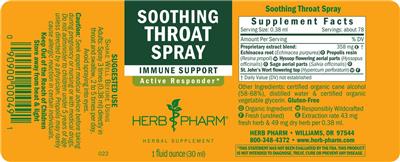
Soothing Throat Spray by Herb Pharm label
The label scan from the NIH Dietary Supplement Label Database. Tap to enlarge.
Label images are published by the NIH Dietary Supplement Label Database for the version of this product on file. Always read your actual product label.
View the full label (PDF)The Ingredients in Soothing Throat Spray by Herb Pharm
These are the 5 active ingredients this product is made of. Select any to open its full monograph.
Serving size0.38 mL Dosage formLiquid Servings per container78 Amounts shown are per serving.
Most supplement products combine several ingredients, and a medication can interact with the product through any one of them. Each ingredient below shows whether it has known drug interactions.
Proprietary Extract Blend
Other (inactive) ingredients: Cane Alcohol, Water, Distilled, Glycerin. These complete the product’s ingredient list but are not active constituents.
Soothing Throat Spray by Herb Pharm Drug Interactions
HelloPharmacist Interaction Report
Herb Pharm's Soothing Throat Spray contains several ingredients with documented interactions, and St.
John's Wort Flowering Top Extract is responsible for the most serious ones. St.
John's Wort carries Major-severity interactions with digoxin (a heart medication), seizure preventers (phenobarbital, phenytoin, mephenytoin), cancer drugs (irinotecan, docetaxel), HIV protease inhibitors, and tacrolimus (an immunosuppressant). It works by speeding up how your liver breaks down these medications, which can make them far less effective or cause treatment to fail.
Read the full breakdown — every affected drug type, severity by severity
Echinacea root extract has Moderate interactions with drugs metabolized by CYP1A2 and CYP3A4 enzymes, caffeine, and the blood thinner warfarin (Minor). Sage and propolis also interact with multiple enzyme-metabolized drugs at Moderate severity, and propolis theoretically affects blood thinners and antiplatelet drugs.
Hyssop has been checked and shows no documented interactions.
You'll want to run your exact medications through the search tool on this page before starting. Altogether, these interactions span 1,548 individual medications.
Check your own medications below · Editorial policy · How we use AI
Want to check YOUR meds against Soothing Throat Spray?
Ask about interactions with your drugs in plain English — “Can I take it with lisinopril?” — and we find you the answer in seconds, ingredient by ingredient.
Go to the checkerIngredients driving the most interactions
Individual Drug Interactions
The ingredients in Soothing Throat Spray interact with 1,567 drugs. Click any drug to see the details.
4 of the 5 ingredients in Soothing Throat Spray interact with drugs. Each result below shows which ingredient is responsible. Sage Aerial Parts Extract St. John's Wort Flowering Top Extract, Fresh, Undried Propolis Resin Extract Echinacea root extract
Ado-trastuzumab EmtansineKadcyla
How Ado-trastuzumab Emtansine interacts with Soothing Throat Spray — through 4 ingredients. Tap an ingredient for the detail:
St. John's Wort Flowering Top Extract, Fresh, UndriedCytochrome P450 3a4 (cyp3a4) Substrates Major
Echinacea Root ExtractCytochrome P450 3a4 (cyp3a4) Substrates Moderate
Interaction Summary
Echinacea may induce hepatic CYP3A4 and inhibit intestinal CYP3A4.
Read the full Echinacea Root Extract + Ado-trastuzumab Emtansine interactionSage Aerial Parts ExtractCytochrome P450 3a4 (cyp3a4) Substrates Moderate
Interaction Summary
Theoretically, sage might increase the levels and clinical effects of drugs metabolized by CYP3A4.
Read the full Sage Aerial Parts Extract + Ado-trastuzumab Emtansine interactionPropolis Resin ExtractCytochrome P450 3a4 (cyp3a4) Substrates Moderate
Interaction Summary
Theoretically, high doses of propolis might increase blood levels of drugs metabolized by CYP3A4.
Read the full Propolis Resin Extract + Ado-trastuzumab Emtansine interactionAbemaciclibVerzenio
How Abemaciclib interacts with Soothing Throat Spray — through 4 ingredients. Tap an ingredient for the detail:
St. John's Wort Flowering Top Extract, Fresh, UndriedCytochrome P450 3a4 (cyp3a4) Substrates Major
Interaction Summary
St.
Read the full St. John's Wort Flowering Top Extract, Fresh, Undried + Abemaciclib interactionEchinacea Root ExtractCytochrome P450 3a4 (cyp3a4) Substrates Moderate
Interaction Summary
Echinacea may induce hepatic CYP3A4 and inhibit intestinal CYP3A4.
Read the full Echinacea Root Extract + Abemaciclib interactionSage Aerial Parts ExtractCytochrome P450 3a4 (cyp3a4) Substrates Moderate
Interaction Summary
Theoretically, sage might increase the levels and clinical effects of drugs metabolized by CYP3A4.
Read the full Sage Aerial Parts Extract + Abemaciclib interactionPropolis Resin ExtractCytochrome P450 3a4 (cyp3a4) Substrates Moderate
Interaction Summary
Theoretically, high doses of propolis might increase blood levels of drugs metabolized by CYP3A4.
Read the full Propolis Resin Extract + Abemaciclib interactionAbiraterone
How Abiraterone interacts with Soothing Throat Spray — through 4 ingredients. Tap an ingredient for the detail:
St. John's Wort Flowering Top Extract, Fresh, UndriedCytochrome P450 3a4 (cyp3a4) Substrates Major
Interaction Summary
St.
Read the full St. John's Wort Flowering Top Extract, Fresh, Undried + Abiraterone interactionEchinacea Root ExtractCytochrome P450 3a4 (cyp3a4) Substrates Moderate
Interaction Summary
Echinacea may induce hepatic CYP3A4 and inhibit intestinal CYP3A4.
Read the full Echinacea Root Extract + Abiraterone interactionSage Aerial Parts ExtractCytochrome P450 3a4 (cyp3a4) Substrates Moderate
Interaction Summary
Theoretically, sage might increase the levels and clinical effects of drugs metabolized by CYP3A4.
Read the full Sage Aerial Parts Extract + Abiraterone interactionPropolis Resin ExtractCytochrome P450 3a4 (cyp3a4) Substrates Moderate
Interaction Summary
Theoretically, high doses of propolis might increase blood levels of drugs metabolized by CYP3A4.
Read the full Propolis Resin Extract + Abiraterone interactionAbiraterone AcetateYonsa, Zytiga
How Abiraterone Acetate interacts with Soothing Throat Spray — through 4 ingredients. Tap an ingredient for the detail:
St. John's Wort Flowering Top Extract, Fresh, UndriedCytochrome P450 3a4 (cyp3a4) Substrates Major
Sage Aerial Parts ExtractCytochrome P450 3a4 (cyp3a4) Substrates Moderate
Interaction Summary
Theoretically, sage might increase the levels and clinical effects of drugs metabolized by CYP3A4.
Read the full Sage Aerial Parts Extract + Abiraterone Acetate interactionEchinacea Root ExtractCytochrome P450 3a4 (cyp3a4) Substrates Moderate
Interaction Summary
Echinacea may induce hepatic CYP3A4 and inhibit intestinal CYP3A4.
Read the full Echinacea Root Extract + Abiraterone Acetate interactionPropolis Resin ExtractCytochrome P450 3a4 (cyp3a4) Substrates Moderate
Interaction Summary
Theoretically, high doses of propolis might increase blood levels of drugs metabolized by CYP3A4.
Read the full Propolis Resin Extract + Abiraterone Acetate interactionAcalabrutinibCalquence
How Acalabrutinib interacts with Soothing Throat Spray — through 4 ingredients. Tap an ingredient for the detail:
St. John's Wort Flowering Top Extract, Fresh, UndriedP-glycoprotein Substrates, Cytochrome P450 3a4 (cyp3a4) Substrates Major
Interaction Summary
St.
Read the full St. John's Wort Flowering Top Extract, Fresh, Undried + Acalabrutinib interactionSage Aerial Parts ExtractP-glycoprotein Substrates, Cytochrome P450 3a4 (cyp3a4) Substrates Moderate
Interaction Summary
Theoretically, sage might increase levels of drugs transported by P-glycoprotein.
Read the full Sage Aerial Parts Extract + Acalabrutinib interactionEchinacea Root ExtractCytochrome P450 3a4 (cyp3a4) Substrates Moderate
Interaction Summary
Echinacea may induce hepatic CYP3A4 and inhibit intestinal CYP3A4.
Read the full Echinacea Root Extract + Acalabrutinib interactionPropolis Resin ExtractCytochrome P450 3a4 (cyp3a4) Substrates Moderate
Interaction Summary
Theoretically, high doses of propolis might increase blood levels of drugs metabolized by CYP3A4.
Read the full Propolis Resin Extract + Acalabrutinib interactionAcetaminophen, Aspirin, CaffeineExcedrin, Excedrin Extra Strength, Excedrin Migraine
How Acetaminophen, Aspirin, Caffeine interacts with Soothing Throat Spray — through 4 ingredients. Tap an ingredient for the detail:
St. John's Wort Flowering Top Extract, Fresh, UndriedCytochrome P450 1a2 (cyp1a2) Substrates, Cytochrome P450 3a4 (cyp3a4) Substrates Major
Propolis Resin ExtractAnticoagulant/antiplatelet Drugs, Cytochrome P450 2e1 (cyp2e1) Substrates +2 Moderate
Interaction Summary
Theoretically, propolis might increase the risk of bleeding when taken with antiplatelet or anticoagulant drugs.
Read the full Propolis Resin Extract + Acetaminophen, Aspirin, Caffeine interactionSage Aerial Parts ExtractCytochrome P450 3a4 (cyp3a4) Substrates, Cytochrome P450 2e1 (cyp2e1) Substrates Moderate
Interaction Summary
Theoretically, sage might increase the levels and clinical effects of drugs metabolized by CYP3A4.
Read the full Sage Aerial Parts Extract + Acetaminophen, Aspirin, Caffeine interactionEchinacea Root ExtractCytochrome P450 1a2 (cyp1a2) Substrates, Caffeine +1 Moderate
Interaction Summary
Echinacea might inhibit the metabolism of CYP1A2 and increase plasma levels of some drugs.
Read the full Echinacea Root Extract + Acetaminophen, Aspirin, Caffeine interactionAcetaminophen, Butalbital, CaffeineEsgic, Esgic Plus, Fiogesic, Fioricet, Repan, Tecnal +1 more
How Acetaminophen, Butalbital, Caffeine interacts with Soothing Throat Spray — through 4 ingredients. Tap an ingredient for the detail:
St. John's Wort Flowering Top Extract, Fresh, UndriedCytochrome P450 1a2 (cyp1a2) Substrates, Cytochrome P450 3a4 (cyp3a4) Substrates Major
Propolis Resin ExtractCytochrome P450 2e1 (cyp2e1) Substrates, Cytochrome P450 1a2 (cyp1a2) Substrates +1 Moderate
Interaction Summary
Theoretically, propolis might increase levels of drugs metabolized by CYP2E1.
Read the full Propolis Resin Extract + Acetaminophen, Butalbital, Caffeine interactionSage Aerial Parts ExtractCytochrome P450 3a4 (cyp3a4) Substrates, Cytochrome P450 2e1 (cyp2e1) Substrates Moderate
Interaction Summary
Theoretically, sage might increase the levels and clinical effects of drugs metabolized by CYP3A4.
Read the full Sage Aerial Parts Extract + Acetaminophen, Butalbital, Caffeine interactionEchinacea Root ExtractCytochrome P450 1a2 (cyp1a2) Substrates, Cytochrome P450 3a4 (cyp3a4) Substrates +1 Moderate
Interaction Summary
Echinacea might inhibit the metabolism of CYP1A2 and increase plasma levels of some drugs.
Read the full Echinacea Root Extract + Acetaminophen, Butalbital, Caffeine interactionAcetaminophen, Butalbital, Caffeine, CodeineEsgic with Codeine, Fioricet w/ Codeine
How Acetaminophen, Butalbital, Caffeine, Codeine interacts with Soothing Throat Spray — through 4 ingredients. Tap an ingredient for the detail:
St. John's Wort Flowering Top Extract, Fresh, UndriedCytochrome P450 3a4 (cyp3a4) Substrates, Cytochrome P450 1a2 (cyp1a2) Substrates Major
Echinacea Root ExtractCaffeine, Cytochrome P450 3a4 (cyp3a4) Substrates +1 Moderate
Interaction Summary
Echinacea can increase plasma levels of caffeine by inhibiting its metabolism.
Read the full Echinacea Root Extract + Acetaminophen, Butalbital, Caffeine, Codeine interactionSage Aerial Parts ExtractCytochrome P450 2e1 (cyp2e1) Substrates, Cytochrome P450 3a4 (cyp3a4) Substrates +2 Moderate
Interaction Summary
Theoretically, sage might decrease the levels and clinical effects of drugs metabolized by CYP2E1.
Read the full Sage Aerial Parts Extract + Acetaminophen, Butalbital, Caffeine, Codeine interactionPropolis Resin ExtractCytochrome P450 2e1 (cyp2e1) Substrates, Cytochrome P450 3a4 (cyp3a4) Substrates +2 Moderate
Interaction Summary
Theoretically, propolis might increase levels of drugs metabolized by CYP2E1.
Read the full Propolis Resin Extract + Acetaminophen, Butalbital, Caffeine, Codeine interactionAcetaminophen, Caffeine, Chlorpheniramine, Hydrocodone, PhenylephrineHycomine Compound
How Acetaminophen, Caffeine, Chlorpheniramine, Hydrocodone, Phenylephrine interacts with Soothing Throat Spray — through 4 ingredients. Tap an ingredient for the detail:
St. John's Wort Flowering Top Extract, Fresh, UndriedCytochrome P450 1a2 (cyp1a2) Substrates, Cytochrome P450 3a4 (cyp3a4) Substrates +1 Major
Sage Aerial Parts ExtractCytochrome P450 2e1 (cyp2e1) Substrates, Anticholinergic Drugs +3 Moderate
Interaction Summary
Theoretically, sage might decrease the levels and clinical effects of drugs metabolized by CYP2E1.
Read the full Sage Aerial Parts Extract + Acetaminophen, Caffeine, Chlorpheniramine, Hydrocodone, Phenylephrine interactionEchinacea Root ExtractCytochrome P450 1a2 (cyp1a2) Substrates, Cytochrome P450 3a4 (cyp3a4) Substrates +1 Moderate
Interaction Summary
Echinacea might inhibit the metabolism of CYP1A2 and increase plasma levels of some drugs.
Read the full Echinacea Root Extract + Acetaminophen, Caffeine, Chlorpheniramine, Hydrocodone, Phenylephrine interactionPropolis Resin ExtractCytochrome P450 2e1 (cyp2e1) Substrates, Cytochrome P450 2d6 (cyp2d6) Substrates +2 Moderate
Interaction Summary
Theoretically, propolis might increase levels of drugs metabolized by CYP2E1.
Read the full Propolis Resin Extract + Acetaminophen, Caffeine, Chlorpheniramine, Hydrocodone, Phenylephrine interactionAcetaminophen, Caffeine, CodeineGesic C15, Gesic C30, Gesic C8, Lenoltec 1, Lenoltec 2, Lenoltec 3 +1 more
How Acetaminophen, Caffeine, Codeine interacts with Soothing Throat Spray — through 4 ingredients. Tap an ingredient for the detail:
St. John's Wort Flowering Top Extract, Fresh, UndriedCytochrome P450 1a2 (cyp1a2) Substrates, Cytochrome P450 3a4 (cyp3a4) Substrates Major
Propolis Resin ExtractCytochrome P450 1a2 (cyp1a2) Substrates, Cytochrome P450 2d6 (cyp2d6) Substrates +2 Moderate
Interaction Summary
Theoretically, high doses of propolis might increase blood levels of drugs metabolized by CYP1A2.
Read the full Propolis Resin Extract + Acetaminophen, Caffeine, Codeine interactionEchinacea Root ExtractCaffeine, Cytochrome P450 1a2 (cyp1a2) Substrates +1 Moderate
Interaction Summary
Echinacea can increase plasma levels of caffeine by inhibiting its metabolism.
Read the full Echinacea Root Extract + Acetaminophen, Caffeine, Codeine interactionSage Aerial Parts ExtractCytochrome P450 2e1 (cyp2e1) Substrates, Cytochrome P450 2d6 (cyp2d6) Substrates +2 Moderate
Interaction Summary
Theoretically, sage might decrease the levels and clinical effects of drugs metabolized by CYP2E1.
Read the full Sage Aerial Parts Extract + Acetaminophen, Caffeine, Codeine interactionAcetaminophen, Caffeine, Codeine, SalicylamideCodalan No.1, Codalan No.2, Codalan No.3
How Acetaminophen, Caffeine, Codeine, Salicylamide interacts with Soothing Throat Spray — through 4 ingredients. Tap an ingredient for the detail:
St. John's Wort Flowering Top Extract, Fresh, UndriedCytochrome P450 3a4 (cyp3a4) Substrates, Cytochrome P450 1a2 (cyp1a2) Substrates Major
Sage Aerial Parts ExtractCytochrome P450 3a4 (cyp3a4) Substrates, Cytochrome P450 2d6 (cyp2d6) Substrates +2 Moderate
Interaction Summary
Theoretically, sage might increase the levels and clinical effects of drugs metabolized by CYP3A4.
Read the full Sage Aerial Parts Extract + Acetaminophen, Caffeine, Codeine, Salicylamide interactionPropolis Resin ExtractCytochrome P450 2e1 (cyp2e1) Substrates, Cytochrome P450 3a4 (cyp3a4) Substrates +2 Moderate
Interaction Summary
Theoretically, propolis might increase levels of drugs metabolized by CYP2E1.
Read the full Propolis Resin Extract + Acetaminophen, Caffeine, Codeine, Salicylamide interactionEchinacea Root ExtractCytochrome P450 3a4 (cyp3a4) Substrates, Cytochrome P450 1a2 (cyp1a2) Substrates +1 Moderate
Interaction Summary
Echinacea may induce hepatic CYP3A4 and inhibit intestinal CYP3A4.
Read the full Echinacea Root Extract + Acetaminophen, Caffeine, Codeine, Salicylamide interactionAcetaminophen, Caffeine, DihydrocodeineDHC Plus, Panlor DC, Panlor SS
How Acetaminophen, Caffeine, Dihydrocodeine interacts with Soothing Throat Spray — through 4 ingredients. Tap an ingredient for the detail:
St. John's Wort Flowering Top Extract, Fresh, UndriedCytochrome P450 3a4 (cyp3a4) Substrates, Cytochrome P450 1a2 (cyp1a2) Substrates Major
Echinacea Root ExtractCaffeine, Cytochrome P450 1a2 (cyp1a2) Substrates +1 Moderate
Interaction Summary
Echinacea can increase plasma levels of caffeine by inhibiting its metabolism.
Read the full Echinacea Root Extract + Acetaminophen, Caffeine, Dihydrocodeine interactionSage Aerial Parts ExtractCytochrome P450 2e1 (cyp2e1) Substrates, Cns Depressants +2 Moderate
Interaction Summary
Theoretically, sage might decrease the levels and clinical effects of drugs metabolized by CYP2E1.
Read the full Sage Aerial Parts Extract + Acetaminophen, Caffeine, Dihydrocodeine interactionPropolis Resin ExtractCytochrome P450 2e1 (cyp2e1) Substrates, Cytochrome P450 2d6 (cyp2d6) Substrates +2 Moderate
Interaction Summary
Theoretically, propolis might increase levels of drugs metabolized by CYP2E1.
Read the full Propolis Resin Extract + Acetaminophen, Caffeine, Dihydrocodeine interactionAcetaminophen, Caffeine, IsomethepteneMigralam
How Acetaminophen, Caffeine, Isometheptene interacts with Soothing Throat Spray — through 4 ingredients. Tap an ingredient for the detail:
St. John's Wort Flowering Top Extract, Fresh, UndriedCytochrome P450 1a2 (cyp1a2) Substrates, Cytochrome P450 3a4 (cyp3a4) Substrates Major
Propolis Resin ExtractCytochrome P450 1a2 (cyp1a2) Substrates, Cytochrome P450 3a4 (cyp3a4) Substrates +1 Moderate
Interaction Summary
Theoretically, high doses of propolis might increase blood levels of drugs metabolized by CYP1A2.
Read the full Propolis Resin Extract + Acetaminophen, Caffeine, Isometheptene interactionEchinacea Root ExtractCytochrome P450 3a4 (cyp3a4) Substrates, Cytochrome P450 1a2 (cyp1a2) Substrates +1 Moderate
Interaction Summary
Echinacea may induce hepatic CYP3A4 and inhibit intestinal CYP3A4.
Read the full Echinacea Root Extract + Acetaminophen, Caffeine, Isometheptene interactionSage Aerial Parts ExtractCytochrome P450 2e1 (cyp2e1) Substrates, Cytochrome P450 3a4 (cyp3a4) Substrates Moderate
Interaction Summary
Theoretically, sage might decrease the levels and clinical effects of drugs metabolized by CYP2E1.
Read the full Sage Aerial Parts Extract + Acetaminophen, Caffeine, Isometheptene interactionAcetaminophen, Caffeine, PyrilamineMidol Max Strength Menstrual
How Acetaminophen, Caffeine, Pyrilamine interacts with Soothing Throat Spray — through 4 ingredients. Tap an ingredient for the detail:
St. John's Wort Flowering Top Extract, Fresh, UndriedCytochrome P450 3a4 (cyp3a4) Substrates, Cytochrome P450 1a2 (cyp1a2) Substrates Major
Sage Aerial Parts ExtractCytochrome P450 3a4 (cyp3a4) Substrates, Cytochrome P450 2e1 (cyp2e1) Substrates +1 Moderate
Interaction Summary
Theoretically, sage might increase the levels and clinical effects of drugs metabolized by CYP3A4.
Read the full Sage Aerial Parts Extract + Acetaminophen, Caffeine, Pyrilamine interactionPropolis Resin ExtractCytochrome P450 2e1 (cyp2e1) Substrates, Cytochrome P450 3a4 (cyp3a4) Substrates +1 Moderate
Interaction Summary
Theoretically, propolis might increase levels of drugs metabolized by CYP2E1.
Read the full Propolis Resin Extract + Acetaminophen, Caffeine, Pyrilamine interactionEchinacea Root ExtractCaffeine, Cytochrome P450 1a2 (cyp1a2) Substrates +1 Moderate
Interaction Summary
Echinacea can increase plasma levels of caffeine by inhibiting its metabolism.
Read the full Echinacea Root Extract + Acetaminophen, Caffeine, Pyrilamine interactionAcetaminophen, Chlorpheniramine Maleate, Dextromethorphan HbrVicks Formula 44M Cough, Cold & Flu Relief
How Acetaminophen, Chlorpheniramine Maleate, Dextromethorphan Hbr interacts with Soothing Throat Spray — through 4 ingredients. Tap an ingredient for the detail:
St. John's Wort Flowering Top Extract, Fresh, UndriedPhotosensitizing Drugs, Cytochrome P450 1a2 (cyp1a2) Substrates +2 Major
Interaction Summary
Theoretically, St.
Read the full St. John's Wort Flowering Top Extract, Fresh, Undried + Acetaminophen, Chlorpheniramine Maleate, Dextromethorphan Hbr interactionEchinacea Root ExtractCytochrome P450 1a2 (cyp1a2) Substrates, Cytochrome P450 3a4 (cyp3a4) Substrates Moderate
Interaction Summary
Echinacea might inhibit the metabolism of CYP1A2 and increase plasma levels of some drugs.
Read the full Echinacea Root Extract + Acetaminophen, Chlorpheniramine Maleate, Dextromethorphan Hbr interactionSage Aerial Parts ExtractAnticholinergic Drugs, Cytochrome P450 2e1 (cyp2e1) Substrates +2 Moderate
Interaction Summary
Theoretically, sage might decrease the clinical effects of anticholinergic drugs.
Read the full Sage Aerial Parts Extract + Acetaminophen, Chlorpheniramine Maleate, Dextromethorphan Hbr interactionPropolis Resin ExtractCytochrome P450 2e1 (cyp2e1) Substrates, Cytochrome P450 1a2 (cyp1a2) Substrates +2 Moderate
Interaction Summary
Theoretically, propolis might increase levels of drugs metabolized by CYP2E1.
Read the full Propolis Resin Extract + Acetaminophen, Chlorpheniramine Maleate, Dextromethorphan Hbr interactionAcetaminophen, Chlorpheniramine, Codeine, PhenylephrineColrex
How Acetaminophen, Chlorpheniramine, Codeine, Phenylephrine interacts with Soothing Throat Spray — through 4 ingredients. Tap an ingredient for the detail:
St. John's Wort Flowering Top Extract, Fresh, UndriedCytochrome P450 1a2 (cyp1a2) Substrates, Serotonergic Drugs +2 Major
Propolis Resin ExtractCytochrome P450 1a2 (cyp1a2) Substrates, Cytochrome P450 2d6 (cyp2d6) Substrates +2 Moderate
Interaction Summary
Theoretically, high doses of propolis might increase blood levels of drugs metabolized by CYP1A2.
Read the full Propolis Resin Extract + Acetaminophen, Chlorpheniramine, Codeine, Phenylephrine interactionSage Aerial Parts ExtractAnticholinergic Drugs, Cytochrome P450 2e1 (cyp2e1) Substrates +3 Moderate
Interaction Summary
Theoretically, sage might decrease the clinical effects of anticholinergic drugs.
Read the full Sage Aerial Parts Extract + Acetaminophen, Chlorpheniramine, Codeine, Phenylephrine interactionEchinacea Root ExtractCytochrome P450 3a4 (cyp3a4) Substrates, Cytochrome P450 1a2 (cyp1a2) Substrates Moderate
Interaction Summary
Echinacea may induce hepatic CYP3A4 and inhibit intestinal CYP3A4.
Read the full Echinacea Root Extract + Acetaminophen, Chlorpheniramine, Codeine, Phenylephrine interactionAcetaminophen, Chlorpheniramine, DextromethorphanCoricidin II Extra Strength Cold and Flu
How Acetaminophen, Chlorpheniramine, Dextromethorphan interacts with Soothing Throat Spray — through 4 ingredients. Tap an ingredient for the detail:
St. John's Wort Flowering Top Extract, Fresh, UndriedCytochrome P450 3a4 (cyp3a4) Substrates, Cytochrome P450 1a2 (cyp1a2) Substrates +2 Major
Sage Aerial Parts ExtractCytochrome P450 2d6 (cyp2d6) Substrates, Cytochrome P450 3a4 (cyp3a4) Substrates +2 Moderate
Interaction Summary
Theoretically, sage might increase the levels and clinical effects of drugs metabolized by CYP2D6.
Read the full Sage Aerial Parts Extract + Acetaminophen, Chlorpheniramine, Dextromethorphan interactionPropolis Resin ExtractCytochrome P450 2e1 (cyp2e1) Substrates, Cytochrome P450 3a4 (cyp3a4) Substrates +2 Moderate
Interaction Summary
Theoretically, propolis might increase levels of drugs metabolized by CYP2E1.
Read the full Propolis Resin Extract + Acetaminophen, Chlorpheniramine, Dextromethorphan interactionEchinacea Root ExtractCytochrome P450 3a4 (cyp3a4) Substrates, Cytochrome P450 1a2 (cyp1a2) Substrates Moderate
Interaction Summary
Echinacea may induce hepatic CYP3A4 and inhibit intestinal CYP3A4.
Read the full Echinacea Root Extract + Acetaminophen, Chlorpheniramine, Dextromethorphan interactionAcetaminophen, Chlorpheniramine, Dextromethorphan HydrobromideCoricidin HBP Maximum Strength Flu
How Acetaminophen, Chlorpheniramine, Dextromethorphan Hydrobromide interacts with Soothing Throat Spray — through 4 ingredients. Tap an ingredient for the detail:
St. John's Wort Flowering Top Extract, Fresh, UndriedPhotosensitizing Drugs, Cytochrome P450 3a4 (cyp3a4) Substrates +2 Major
Interaction Summary
Theoretically, St.
Read the full St. John's Wort Flowering Top Extract, Fresh, Undried + Acetaminophen, Chlorpheniramine, Dextromethorphan Hydrobromide interactionEchinacea Root ExtractCytochrome P450 1a2 (cyp1a2) Substrates, Cytochrome P450 3a4 (cyp3a4) Substrates Moderate
Interaction Summary
Echinacea might inhibit the metabolism of CYP1A2 and increase plasma levels of some drugs.
Read the full Echinacea Root Extract + Acetaminophen, Chlorpheniramine, Dextromethorphan Hydrobromide interactionSage Aerial Parts ExtractAnticholinergic Drugs, Cytochrome P450 2e1 (cyp2e1) Substrates +2 Moderate
Interaction Summary
Theoretically, sage might decrease the clinical effects of anticholinergic drugs.
Read the full Sage Aerial Parts Extract + Acetaminophen, Chlorpheniramine, Dextromethorphan Hydrobromide interactionPropolis Resin ExtractCytochrome P450 2e1 (cyp2e1) Substrates, Cytochrome P450 1a2 (cyp1a2) Substrates +2 Moderate
Interaction Summary
Theoretically, propolis might increase levels of drugs metabolized by CYP2E1.
Read the full Propolis Resin Extract + Acetaminophen, Chlorpheniramine, Dextromethorphan Hydrobromide interactionAcetaminophen, Chlorpheniramine, Dextromethorphan, PhenylpropanolamineMulti Symptom Cold Relief
How Acetaminophen, Chlorpheniramine, Dextromethorphan, Phenylpropanolamine interacts with Soothing Throat Spray — through 4 ingredients. Tap an ingredient for the detail:
St. John's Wort Flowering Top Extract, Fresh, UndriedCytochrome P450 1a2 (cyp1a2) Substrates, Photosensitizing Drugs +2 Major
Propolis Resin ExtractCytochrome P450 3a4 (cyp3a4) Substrates, Cytochrome P450 2d6 (cyp2d6) Substrates +2 Moderate
Interaction Summary
Theoretically, high doses of propolis might increase blood levels of drugs metabolized by CYP3A4.
Read the full Propolis Resin Extract + Acetaminophen, Chlorpheniramine, Dextromethorphan, Phenylpropanolamine interactionSage Aerial Parts ExtractAnticholinergic Drugs, Cytochrome P450 2e1 (cyp2e1) Substrates +2 Moderate
Interaction Summary
Theoretically, sage might decrease the clinical effects of anticholinergic drugs.
Read the full Sage Aerial Parts Extract + Acetaminophen, Chlorpheniramine, Dextromethorphan, Phenylpropanolamine interactionEchinacea Root ExtractCytochrome P450 3a4 (cyp3a4) Substrates, Cytochrome P450 1a2 (cyp1a2) Substrates Moderate
Interaction Summary
Echinacea may induce hepatic CYP3A4 and inhibit intestinal CYP3A4.
Read the full Echinacea Root Extract + Acetaminophen, Chlorpheniramine, Dextromethorphan, Phenylpropanolamine interactionAcetaminophen, Chlorpheniramine, Dextromethorphan, PseudoephedrineChildren's Tylenol Cold Plus Cough, Tylenol Cold Ex Strength
How Acetaminophen, Chlorpheniramine, Dextromethorphan, Pseudoephedrine interacts with Soothing Throat Spray — through 4 ingredients. Tap an ingredient for the detail:
St. John's Wort Flowering Top Extract, Fresh, UndriedSerotonergic Drugs, Photosensitizing Drugs +2 Major
Interaction Summary
Theoretically, St.
Read the full St. John's Wort Flowering Top Extract, Fresh, Undried + Acetaminophen, Chlorpheniramine, Dextromethorphan, Pseudoephedrine interactionPropolis Resin ExtractCytochrome P450 2e1 (cyp2e1) Substrates, Cytochrome P450 1a2 (cyp1a2) Substrates +2 Moderate
Interaction Summary
Theoretically, propolis might increase levels of drugs metabolized by CYP2E1.
Read the full Propolis Resin Extract + Acetaminophen, Chlorpheniramine, Dextromethorphan, Pseudoephedrine interactionSage Aerial Parts ExtractCytochrome P450 2d6 (cyp2d6) Substrates, Cytochrome P450 3a4 (cyp3a4) Substrates +2 Moderate
Interaction Summary
Theoretically, sage might increase the levels and clinical effects of drugs metabolized by CYP2D6.
Read the full Sage Aerial Parts Extract + Acetaminophen, Chlorpheniramine, Dextromethorphan, Pseudoephedrine interactionEchinacea Root ExtractCytochrome P450 1a2 (cyp1a2) Substrates, Cytochrome P450 3a4 (cyp3a4) Substrates Moderate
Interaction Summary
Echinacea might inhibit the metabolism of CYP1A2 and increase plasma levels of some drugs.
Read the full Echinacea Root Extract + Acetaminophen, Chlorpheniramine, Dextromethorphan, Pseudoephedrine interactionAcetaminophen, Chlorpheniramine, Guaifenesin, Phenylephrine, SalicylamideRhinogesic GG
How Acetaminophen, Chlorpheniramine, Guaifenesin, Phenylephrine, Salicylamide interacts with Soothing Throat Spray — through 4 ingredients. Tap an ingredient for the detail:
St. John's Wort Flowering Top Extract, Fresh, UndriedCytochrome P450 3a4 (cyp3a4) Substrates, Photosensitizing Drugs +2 Major
Echinacea Root ExtractCytochrome P450 1a2 (cyp1a2) Substrates, Cytochrome P450 3a4 (cyp3a4) Substrates Moderate
Interaction Summary
Echinacea might inhibit the metabolism of CYP1A2 and increase plasma levels of some drugs.
Read the full Echinacea Root Extract + Acetaminophen, Chlorpheniramine, Guaifenesin, Phenylephrine, Salicylamide interactionSage Aerial Parts ExtractCytochrome P450 2e1 (cyp2e1) Substrates, Anticholinergic Drugs +1 Moderate
Interaction Summary
Theoretically, sage might decrease the levels and clinical effects of drugs metabolized by CYP2E1.
Read the full Sage Aerial Parts Extract + Acetaminophen, Chlorpheniramine, Guaifenesin, Phenylephrine, Salicylamide interactionPropolis Resin ExtractCytochrome P450 2e1 (cyp2e1) Substrates, Cytochrome P450 3a4 (cyp3a4) Substrates +1 Moderate
Interaction Summary
Theoretically, propolis might increase levels of drugs metabolized by CYP2E1.
Read the full Propolis Resin Extract + Acetaminophen, Chlorpheniramine, Guaifenesin, Phenylephrine, Salicylamide interactionAcetaminophen, Chlorpheniramine, PhenylephrineAlka-Seltzer PLUS, Histex SR, Protid
How Acetaminophen, Chlorpheniramine, Phenylephrine interacts with Soothing Throat Spray — through 4 ingredients. Tap an ingredient for the detail:
St. John's Wort Flowering Top Extract, Fresh, UndriedSerotonergic Drugs, Cytochrome P450 3a4 (cyp3a4) Substrates +2 Major
Interaction Summary
Theoretically, St.
Read the full St. John's Wort Flowering Top Extract, Fresh, Undried + Acetaminophen, Chlorpheniramine, Phenylephrine interactionPropolis Resin ExtractCytochrome P450 1a2 (cyp1a2) Substrates, Cytochrome P450 3a4 (cyp3a4) Substrates +1 Moderate
Interaction Summary
Theoretically, high doses of propolis might increase blood levels of drugs metabolized by CYP1A2.
Read the full Propolis Resin Extract + Acetaminophen, Chlorpheniramine, Phenylephrine interactionSage Aerial Parts ExtractAnticholinergic Drugs, Cytochrome P450 2e1 (cyp2e1) Substrates +1 Moderate
Interaction Summary
Theoretically, sage might decrease the clinical effects of anticholinergic drugs.
Read the full Sage Aerial Parts Extract + Acetaminophen, Chlorpheniramine, Phenylephrine interactionEchinacea Root ExtractCytochrome P450 1a2 (cyp1a2) Substrates, Cytochrome P450 3a4 (cyp3a4) Substrates Moderate
Interaction Summary
Echinacea might inhibit the metabolism of CYP1A2 and increase plasma levels of some drugs.
Read the full Echinacea Root Extract + Acetaminophen, Chlorpheniramine, Phenylephrine interactionAcetaminophen, Chlorpheniramine, Phenylephrine, SalicylamideRhinogesic, Rhinogesic JR
How Acetaminophen, Chlorpheniramine, Phenylephrine, Salicylamide interacts with Soothing Throat Spray — through 4 ingredients. Tap an ingredient for the detail:
St. John's Wort Flowering Top Extract, Fresh, UndriedCytochrome P450 3a4 (cyp3a4) Substrates, Cytochrome P450 1a2 (cyp1a2) Substrates +2 Major
Propolis Resin ExtractCytochrome P450 2e1 (cyp2e1) Substrates, Cytochrome P450 1a2 (cyp1a2) Substrates +1 Moderate
Interaction Summary
Theoretically, propolis might increase levels of drugs metabolized by CYP2E1.
Read the full Propolis Resin Extract + Acetaminophen, Chlorpheniramine, Phenylephrine, Salicylamide interactionSage Aerial Parts ExtractCytochrome P450 3a4 (cyp3a4) Substrates, Cytochrome P450 2e1 (cyp2e1) Substrates +1 Moderate
Interaction Summary
Theoretically, sage might increase the levels and clinical effects of drugs metabolized by CYP3A4.
Read the full Sage Aerial Parts Extract + Acetaminophen, Chlorpheniramine, Phenylephrine, Salicylamide interactionEchinacea Root ExtractCytochrome P450 1a2 (cyp1a2) Substrates, Cytochrome P450 3a4 (cyp3a4) Substrates Moderate
Interaction Summary
Echinacea might inhibit the metabolism of CYP1A2 and increase plasma levels of some drugs.
Read the full Echinacea Root Extract + Acetaminophen, Chlorpheniramine, Phenylephrine, Salicylamide interactionAcetaminophen, Chlorpheniramine, PhenylpropanolamineAlumadrine, Conex, Sinadrin Max Strength, Sinulin
How Acetaminophen, Chlorpheniramine, Phenylpropanolamine interacts with Soothing Throat Spray — through 4 ingredients. Tap an ingredient for the detail:
St. John's Wort Flowering Top Extract, Fresh, UndriedCytochrome P450 1a2 (cyp1a2) Substrates, Cytochrome P450 3a4 (cyp3a4) Substrates +2 Major
Sage Aerial Parts ExtractCytochrome P450 2e1 (cyp2e1) Substrates, Anticholinergic Drugs +1 Moderate
Interaction Summary
Theoretically, sage might decrease the levels and clinical effects of drugs metabolized by CYP2E1.
Read the full Sage Aerial Parts Extract + Acetaminophen, Chlorpheniramine, Phenylpropanolamine interactionEchinacea Root ExtractCytochrome P450 1a2 (cyp1a2) Substrates, Cytochrome P450 3a4 (cyp3a4) Substrates Moderate
Interaction Summary
Echinacea might inhibit the metabolism of CYP1A2 and increase plasma levels of some drugs.
Read the full Echinacea Root Extract + Acetaminophen, Chlorpheniramine, Phenylpropanolamine interactionPropolis Resin ExtractCytochrome P450 2e1 (cyp2e1) Substrates, Cytochrome P450 3a4 (cyp3a4) Substrates +1 Moderate
Interaction Summary
Theoretically, propolis might increase levels of drugs metabolized by CYP2E1.
Read the full Propolis Resin Extract + Acetaminophen, Chlorpheniramine, Phenylpropanolamine interactionAcetaminophen, Chlorpheniramine, Phenylpropanolamine, OpiumHista-Derfule
How Acetaminophen, Chlorpheniramine, Phenylpropanolamine, Opium interacts with Soothing Throat Spray — through 4 ingredients. Tap an ingredient for the detail:
St. John's Wort Flowering Top Extract, Fresh, UndriedSerotonergic Drugs, Cytochrome P450 1a2 (cyp1a2) Substrates +2 Major
Interaction Summary
Theoretically, St.
Read the full St. John's Wort Flowering Top Extract, Fresh, Undried + Acetaminophen, Chlorpheniramine, Phenylpropanolamine, Opium interactionPropolis Resin ExtractCytochrome P450 1a2 (cyp1a2) Substrates, Cytochrome P450 3a4 (cyp3a4) Substrates +1 Moderate
Interaction Summary
Theoretically, high doses of propolis might increase blood levels of drugs metabolized by CYP1A2.
Read the full Propolis Resin Extract + Acetaminophen, Chlorpheniramine, Phenylpropanolamine, Opium interactionSage Aerial Parts ExtractAnticholinergic Drugs, Cytochrome P450 2e1 (cyp2e1) Substrates +2 Moderate
Interaction Summary
Theoretically, sage might decrease the clinical effects of anticholinergic drugs.
Read the full Sage Aerial Parts Extract + Acetaminophen, Chlorpheniramine, Phenylpropanolamine, Opium interactionEchinacea Root ExtractCytochrome P450 1a2 (cyp1a2) Substrates, Cytochrome P450 3a4 (cyp3a4) Substrates Moderate
Interaction Summary
Echinacea might inhibit the metabolism of CYP1A2 and increase plasma levels of some drugs.
Read the full Echinacea Root Extract + Acetaminophen, Chlorpheniramine, Phenylpropanolamine, Opium interactionAcetaminophen, Chlorpheniramine, Phenylpropanolamine, PhenyltoloxamineNorel Plus
How Acetaminophen, Chlorpheniramine, Phenylpropanolamine, Phenyltoloxamine interacts with Soothing Throat Spray — through 4 ingredients. Tap an ingredient for the detail:
St. John's Wort Flowering Top Extract, Fresh, UndriedCytochrome P450 3a4 (cyp3a4) Substrates, Cytochrome P450 1a2 (cyp1a2) Substrates +2 Major
Propolis Resin ExtractCytochrome P450 2e1 (cyp2e1) Substrates, Cytochrome P450 3a4 (cyp3a4) Substrates +1 Moderate
Interaction Summary
Theoretically, propolis might increase levels of drugs metabolized by CYP2E1.
Read the full Propolis Resin Extract + Acetaminophen, Chlorpheniramine, Phenylpropanolamine, Phenyltoloxamine interactionSage Aerial Parts ExtractCytochrome P450 3a4 (cyp3a4) Substrates, Anticholinergic Drugs +1 Moderate
Interaction Summary
Theoretically, sage might increase the levels and clinical effects of drugs metabolized by CYP3A4.
Read the full Sage Aerial Parts Extract + Acetaminophen, Chlorpheniramine, Phenylpropanolamine, Phenyltoloxamine interactionEchinacea Root ExtractCytochrome P450 3a4 (cyp3a4) Substrates, Cytochrome P450 1a2 (cyp1a2) Substrates Moderate
Interaction Summary
Echinacea may induce hepatic CYP3A4 and inhibit intestinal CYP3A4.
Read the full Echinacea Root Extract + Acetaminophen, Chlorpheniramine, Phenylpropanolamine, Phenyltoloxamine interactionAcetaminophen, Chlorpheniramine, PseudoephedrineAlka-Seltzer PLUS Liquid Gels, Children's Tylenol Cold, Codimal, Comtrex, Extra Strength Tylenol Allergy Sinus, Lorsin +3 more
How Acetaminophen, Chlorpheniramine, Pseudoephedrine interacts with Soothing Throat Spray — through 4 ingredients. Tap an ingredient for the detail:
St. John's Wort Flowering Top Extract, Fresh, UndriedSerotonergic Drugs, Photosensitizing Drugs +2 Major
Interaction Summary
Theoretically, St.
Read the full St. John's Wort Flowering Top Extract, Fresh, Undried + Acetaminophen, Chlorpheniramine, Pseudoephedrine interactionSage Aerial Parts ExtractCytochrome P450 2e1 (cyp2e1) Substrates, Anticholinergic Drugs +1 Moderate
Interaction Summary
Theoretically, sage might decrease the levels and clinical effects of drugs metabolized by CYP2E1.
Read the full Sage Aerial Parts Extract + Acetaminophen, Chlorpheniramine, Pseudoephedrine interactionEchinacea Root ExtractCytochrome P450 1a2 (cyp1a2) Substrates, Cytochrome P450 3a4 (cyp3a4) Substrates Moderate
Interaction Summary
Echinacea might inhibit the metabolism of CYP1A2 and increase plasma levels of some drugs.
Read the full Echinacea Root Extract + Acetaminophen, Chlorpheniramine, Pseudoephedrine interactionPropolis Resin ExtractCytochrome P450 2e1 (cyp2e1) Substrates, Cytochrome P450 1a2 (cyp1a2) Substrates +1 Moderate
Interaction Summary
Theoretically, propolis might increase levels of drugs metabolized by CYP2E1.
Read the full Propolis Resin Extract + Acetaminophen, Chlorpheniramine, Pseudoephedrine interactionAcetaminophen, DextromethorphanTylenol Cough Ex Strength
How Acetaminophen, Dextromethorphan interacts with Soothing Throat Spray — through 4 ingredients. Tap an ingredient for the detail:
St. John's Wort Flowering Top Extract, Fresh, UndriedCytochrome P450 3a4 (cyp3a4) Substrates, Serotonergic Drugs +1 Major
Propolis Resin ExtractCytochrome P450 1a2 (cyp1a2) Substrates, Cytochrome P450 2d6 (cyp2d6) Substrates +2 Moderate
Interaction Summary
Theoretically, high doses of propolis might increase blood levels of drugs metabolized by CYP1A2.
Read the full Propolis Resin Extract + Acetaminophen, Dextromethorphan interactionSage Aerial Parts ExtractCytochrome P450 2e1 (cyp2e1) Substrates, Cytochrome P450 2d6 (cyp2d6) Substrates +1 Moderate
Interaction Summary
Theoretically, sage might decrease the levels and clinical effects of drugs metabolized by CYP2E1.
Read the full Sage Aerial Parts Extract + Acetaminophen, Dextromethorphan interactionEchinacea Root ExtractCytochrome P450 1a2 (cyp1a2) Substrates, Cytochrome P450 3a4 (cyp3a4) Substrates Moderate
Interaction Summary
Echinacea might inhibit the metabolism of CYP1A2 and increase plasma levels of some drugs.
Read the full Echinacea Root Extract + Acetaminophen, Dextromethorphan interactionAcetaminophen, Dextromethorphan, Doxylamine, PseudoephedrineVicks NyQuil
How Acetaminophen, Dextromethorphan, Doxylamine, Pseudoephedrine interacts with Soothing Throat Spray — through 4 ingredients. Tap an ingredient for the detail:
St. John's Wort Flowering Top Extract, Fresh, UndriedCytochrome P450 3a4 (cyp3a4) Substrates, Cytochrome P450 1a2 (cyp1a2) Substrates +1 Major
Sage Aerial Parts ExtractCytochrome P450 3a4 (cyp3a4) Substrates, Cytochrome P450 2d6 (cyp2d6) Substrates +2 Moderate
Interaction Summary
Theoretically, sage might increase the levels and clinical effects of drugs metabolized by CYP3A4.
Read the full Sage Aerial Parts Extract + Acetaminophen, Dextromethorphan, Doxylamine, Pseudoephedrine interactionPropolis Resin ExtractCytochrome P450 2e1 (cyp2e1) Substrates, Cytochrome P450 3a4 (cyp3a4) Substrates +2 Moderate
Interaction Summary
Theoretically, propolis might increase levels of drugs metabolized by CYP2E1.
Read the full Propolis Resin Extract + Acetaminophen, Dextromethorphan, Doxylamine, Pseudoephedrine interactionEchinacea Root ExtractCytochrome P450 1a2 (cyp1a2) Substrates, Cytochrome P450 3a4 (cyp3a4) Substrates Moderate
Interaction Summary
Echinacea might inhibit the metabolism of CYP1A2 and increase plasma levels of some drugs.
Read the full Echinacea Root Extract + Acetaminophen, Dextromethorphan, Doxylamine, Pseudoephedrine interactionAcetaminophen, Dextromethorphan, Guaifenesin, PhenylephrineConar-A
How Acetaminophen, Dextromethorphan, Guaifenesin, Phenylephrine interacts with Soothing Throat Spray — through 4 ingredients. Tap an ingredient for the detail:
St. John's Wort Flowering Top Extract, Fresh, UndriedSerotonergic Drugs, Cytochrome P450 3a4 (cyp3a4) Substrates +1 Major
Interaction Summary
Theoretically, St.
Read the full St. John's Wort Flowering Top Extract, Fresh, Undried + Acetaminophen, Dextromethorphan, Guaifenesin, Phenylephrine interactionSage Aerial Parts ExtractCytochrome P450 2e1 (cyp2e1) Substrates, Cytochrome P450 2d6 (cyp2d6) Substrates +1 Moderate
Interaction Summary
Theoretically, sage might decrease the levels and clinical effects of drugs metabolized by CYP2E1.
Read the full Sage Aerial Parts Extract + Acetaminophen, Dextromethorphan, Guaifenesin, Phenylephrine interactionEchinacea Root ExtractCytochrome P450 1a2 (cyp1a2) Substrates, Cytochrome P450 3a4 (cyp3a4) Substrates Moderate
Interaction Summary
Echinacea might inhibit the metabolism of CYP1A2 and increase plasma levels of some drugs.
Read the full Echinacea Root Extract + Acetaminophen, Dextromethorphan, Guaifenesin, Phenylephrine interactionPropolis Resin ExtractCytochrome P450 2e1 (cyp2e1) Substrates, Cytochrome P450 1a2 (cyp1a2) Substrates +2 Moderate
Interaction Summary
Theoretically, propolis might increase levels of drugs metabolized by CYP2E1.
Read the full Propolis Resin Extract + Acetaminophen, Dextromethorphan, Guaifenesin, Phenylephrine interactionEach ingredient & the kinds of drugs it affects
For each ingredient in Soothing Throat Spray with known interactions, here are the types of medications they can affect. Open any type for the detail — or search your exact drug in the checker above.
Sage Aerial Parts Extract
Anticholinergic Drugs
Theoretically, sage might decrease the clinical effects of anticholinergic drugs.
In vitro evidence suggests that common sage (Salvia officinalis) and Spanish sage (Salvia lavandulaefolia) can inhibit acetylcholinesterase and might increase acetylcholine levels.
Anticonvulsants
Theoretically, sage might interfere with the clinical effects of anticonvulsant drugs.
Some species of sage can cause convulsions when consumed in large quantities.
Antidiabetes Drugs
Theoretically, taking sage with antidiabetes drugs might increase the risk of hypoglycemia.
In patients with polycystic ovary syndrome (PCOS) or inadequately controlled type 2 diabetes, common sage (Salvia officinalis) has demonstrated hypoglycemic activity. However, other clinical research in patients with inadequately controlled type 2 diabetes shows that common sage extract does not lower fasting blood glucose levels.
Antihypertensive Drugs
Theoretically, sage might increase or decrease the effects of antihypertensive drugs.
Animal research suggests that common sage (Salvia officinalis) can cause prolonged blood pressure reduction. However, clinical research suggests that Spanish sage (Salvia lavandulaefolia) can increase blood pressure in some people with hypertension. Until more is known, use with caution.
Benzodiazepines
Theoretically, taking sage might increase the sedative and adverse effects of benzodiazepines.
In vitro evidence suggests that certain components of common sage (Salvia officinalis) can bind to benzodiazepine receptors. This effect has not been reported in humans.
Cholinergic Drugs
Theoretically, sage might have additive effects when used with cholinergic drugs.
In vitro evidence suggests that common sage (Salvia officinalis) and Spanish sage (Salvia lavandulaefolia) can inhibit acetylcholinesterase and might increase acetylcholine levels.
Cns Depressants
Theoretically, taking sage might increase the sedative and adverse effects of CNS depressants.
Some constituents of sage have CNS depressant activity.
Cytochrome P450 2C19 (Cyp2C19) Substrates
Theoretically, sage might increase the levels and clinical effects of drugs metabolized by CYP2C19.
In vitro evidence suggests that aqueous extracts of sage can inhibit CYP2C19. So far, this interaction has not been reported in humans.
Cytochrome P450 2C9 (Cyp2C9) Substrates
Theoretically, sage might increase the levels and clinical effects of drugs metabolized by CYP2C9.
In vitro evidence suggests that aqueous extracts of sage can inhibit CYP2C9. So far, this interaction has not been reported in humans.
Cytochrome P450 2D6 (Cyp2D6) Substrates
Theoretically, sage might increase the levels and clinical effects of drugs metabolized by CYP2D6.
In vitro evidence suggests that aqueous extracts of sage can inhibit CYP2D6. So far, this interaction has not been reported in humans.
Cytochrome P450 2E1 (Cyp2E1) Substrates
Theoretically, sage might decrease the levels and clinical effects of drugs metabolized by CYP2E1.
Animal research suggests that drinking common sage (Salvia officinalis) tea increases the expression of CYP2E1. So far, this interaction has not been reported in humans.
Cytochrome P450 3A4 (Cyp3A4) Substrates
Theoretically, sage might increase the levels and clinical effects of drugs metabolized by CYP3A4.
In vitro evidence suggests that aqueous extracts of sage can inhibit CYP3A4. So far, this interaction has not been reported in humans.
Estrogens
Theoretically, sage might interfere with hormone therapy.
In vitro evidence suggests that geraniol, a constituent of Spanish sage (Salvia lavandulaefolia), exerts estrogenic activity. The clinical significance of this effect is unclear.
P-Glycoprotein Substrates
Theoretically, sage might increase levels of drugs transported by P-glycoprotein.
In vitro research suggests that common sage (Salvia officinalis) can inhibit the multi-drug transporter protein, P-glycoprotein. This effect has not been reported in humans.
St. John's Wort Flowering Top Extract, Fresh, Undried
Alprazolam (Xanax)
St. John's wort increases the clearance of alprazolam and decreases its effects.
Alprazolam, which is used as a probe for cytochrome P450 3A4 (CYP3A4) activity, has a two-fold increase in clearance when given with St. John's wort. St. John's wort reduces the half-life of alprazolam from 12.4 hours to 6 hours.
Contraceptive Drugs
St. John's wort increases the clearance of contraceptive drugs and reduces their clinical effects.
Females taking St. John's wort and oral contraceptives concurrently should use an additional or alternative form of birth control. St. John's wort can decrease norethindrone and ethinyl estradiol levels by 13% to 15%, resulting in breakthrough bleeding, irregular menstrual bleeding, or unplanned pregnancy. Bleeding irregularities usually occur within a week of starting St. John's wort and regular cycles usually return when St. John's wort is discontinued. Unplanned pregnancy has occurred with concurrent use of oral contraceptives and St. John's wort extract. St. John's wort is thought to induce the cytochrome P450 1A2 (CYP1A2), 2C9 (CYP2C9), and 3A4 (CYP3A4) enzymes, which are responsible for metabolism of progestins and estrogens in contraceptives.
Cyclosporine (Neoral, Sandimmune)
St. John's wort reduces the levels and clinical effects of cyclosporine.
Concomitant use can decrease plasma cyclosporine levels by 30% to 70%. Using St. John's wort with cyclosporine in patients with heart, kidney, or liver transplants can cause subtherapeutic cyclosporine levels and acute transplant rejection. This interaction has occurred with a St. John's wort extract standardized to 0.3% hypericin and dosed at 300-600 mg per day. Withdrawal of St. John's wort can result in a 64% increase in cyclosporine levels. St. John's wort induces cytochrome P450 3A4 (CYP3A4) and the multi-drug transporter, P-glycoprotein/MDR-1, which increases cyclosporine clearance.
Cytochrome P450 3A4 (Cyp3A4) Substrates
St. John's wort increases the metabolism and reduces the levels of CYP3A4 substrates.
St. John's wort induces CYP3A4 enzymes and increases metabolism of CYP3A4 substrates. Clinically significant interactions have been reported with St. John's wort products containing hyperforin 1 mg or more.
Digoxin (Lanoxin)
St. John's wort reduces the levels and clinical effects of digoxin.
St. John's wort can reduce the bioavailability, serum levels, and therapeutic effects of digoxin. Taking an extract of St. John's wort 900 mg, containing hyperforin 7.5 mg or more, daily for 10-14 days, can reduce serum digoxin levels by 25% in healthy people. St. John's wort is thought to affect the multidrug transporter, P-glycoprotein, which mediates the absorption and elimination of digoxin and other drugs. St. John's wort products providing less than 7.5 mg of hyperforin daily do not appear to affect digoxin levels.
Docetaxel (Taxotere)
St. John's wort reduces the levels and clinical effects of docetaxel.
Clinical research shows that taking a specific St. John's wort product (Hyperiplant, VSM) 300 mg three times daily for 14 days increases docetaxel clearance by about 14%, resulting in decreased plasma concentrations of docetaxel in cancer patients. This is most likely due to induction of cytochrome P450 3A4 (CYP3A4) by St. John's wort.
Imatinib (Gleevec)
St. John's wort reduces the levels and clinical effects of imatinib.
Taking St. John's wort 900 mg daily for 2 weeks reduces the bioavailability and half-life of a single dose of imatinib and decreases its serum levels by 30% in healthy volunteers. This is most likely due to induction of cytochrome P450 3A4 (CYP3A4) by St. John's wort, which increases clearance of imatinib.
Irinotecan (Camptosar)
St. John's wort reduces the levels and clinical effects of irinotecan.
St. John's wort 900 mg daily for 18 days decreases serum levels of irinotecan by at least 50%. Clearance of the active metabolite of irinotecan, SN-38, is also increased, resulting in a 42% decrease in the area under the concentration-time curve. This is thought to be due to induction of cytochrome P450 3A4 (CYP3A4) by St. John's wort.
Mephenytoin (Mesantoin)
St. John's wort reduces the levels and clinical effects of mephenytoin.
Preliminary clinical research in healthy males shows that taking St. John's wort for 14 days induces cytochrome P450 2C19 (CYP2C19) and significantly increases metabolism of mephenytoin (Mesantoin). In people with wild-type 2C19, metabolism was almost 4-fold greater in subjects who received St. John's wort compared to placebo. In contrast, patients with 2C19*2/*2 and *2/*3 genotypes did not demonstrate a similar increase in metabolism.
Non-Nucleoside Reverse Transcriptase Inhibitors (Nnrtis)
St. John's wort decreases the levels and clinical effects of NNRTIs.
St. John's wort increases the oral clearance of nevirapine (Viramune) by 35%. Subtherapeutic concentrations are associated with therapeutic failure, development of viral resistance, and development of drug class resistance. St. John's wort induces intestinal and hepatic cytochrome P450 3A4 (CYP3A4) and intestinal P-glycoprotein/MDR-1, a drug transporter.
Omeprazole (Prilosec)
St. John's wort decreases the levels and clinical effects of omeprazole.
Taking St. John's wort, 300 mg orally three times daily for 14 days, reduces serum concentrations of omeprazole by inducing its metabolism via cytochrome P450 (CYP) 2C19 and 3A4. The reduction of omeprazole serum levels is dependent on CYP2C19 genotype, with reductions up to 50% in extensive metabolizers and 38% in poor metabolizers.
Oxycodone (Oxycontin)
St. John's wort decreases the levels and clinical effects of oxycodone.
St. John's wort can increase oxycodone metabolism by inducing cytochrome P450 3A4 (CYP3A4), reducing plasma levels and analgesic activity.
P-Glycoprotein Substrates
St. John's wort decreases the levels and clinical effects of P-glycoprotein substrates.
St. John's wort induces P-glycoprotein. P-glycoprotein is a carrier mechanism responsible for transporting drugs and other substances across cell membranes. When P-glycoprotein is induced in the gastrointestinal (GI) tract, it can prevent the absorption of some medications. In addition, induction of p-glycoprotein can decrease entry of drugs into the central nervous system (CNS) and decrease access to other sites of action.
Phenobarbital (Luminal)
St. John's wort decreases the levels and clinical effects of phenobarbital.
St. John's wort may increase the metabolism of phenobarbital. Plasma concentrations of phenobarbital should be monitored carefully. The dose of phenobarbital may need to be increased when St. John's wort is started and decreased when it is stopped.
Phenprocoumon (Marcoumar, Others)
St. John's wort decreases the levels and clinical effects of phenprocoumon.
St. John's wort appears to increase the metabolism of phenprocoumon (an anticoagulant that is not available in the US) by increasing the activity of the cytochrome P450 2C9 (CYP2C9) enzyme. This may result in decreases in the anticoagulant effect and international normalized ratio (INR).
Phenytoin (Dilantin)
St. John's wort decreases the levels and clinical effects of phenytoin.
St. John's wort may increase the metabolism of phenytoin. Plasma concentrations of phenytoin should be monitored closely. The dose of phenytoin may need to be increased when St. John's wort is started and decreased when it is stopped.
Protease Inhibitors (Pis)
St. John's wort reduces the levels and clinical effects of PIs.
In healthy volunteers, St. John's wort can reduce the plasma concentrations of indinavir (Crixivan) by inducing cytochrome P450 3A4 (CYP3A4). This might result in treatment failure and viral resistance. St. John's wort also induces P-glycoprotein, which can result in decreased intracellular protease inhibitor concentrations and increased elimination.
Rivaroxaban (Xarelto)
St. John's wort decreases the levels and clinical effects of rivaroxaban.
A small pharmacokinetic study in healthy volunteers shows that taking a single dose of rivaroxaban 20 mg after using a specific St. John's wort extract (Jarsin, Vifor SA) 450 mg orally twice daily for 14 days reduces the bioavailability of rivaroxaban by 24% and reduces rivaroxaban's therapeutic inhibition of factor Xa by 20%.
Tacrolimus (Prograf)
St. John's wort decreases the levels and clinical effects of tacrolimus.
Taking a St. John's wort extract (Jarsin) 600 mg daily significantly decreases tacrolimus serum levels. Dose increases of 60% may be required to maintain therapeutic tacrolimus levels in patients taking St. John's wort. St. John's wort is thought to lower tacrolimus levels by inducing cytochrome P450 3A4 (CYP3A4) enzymes. A small clinical study in healthy adults also shows that taking St. John's wort 300 mg three times daily for 10 days decreases the total systemic exposure to tacrolimus by 27% and 33% after taking a single 5 mg dose of immediate-release or prolonged-release tacrolimus, respectively.
Warfarin (Coumadin)
St. John's wort decreases the levels and clinical effects of warfarin.
Taking St. John's wort significantly increases clearance of warfarin, including both its R- and S-isomers. This is likely due to induction of cytochrome P450 (CYP) 1A2 and CYP3A4. St. John's wort can also significantly decrease International Normalized Ratio (INR) in people taking warfarin. In addition, taking warfarin at the same time as St. John's wort might reduce warfarin bioavailability. When a dried extract is mixed with warfarin in an aqueous medium, up to 30% of warfarin is bound to particles, reducing its absorption.
Aminolevulinic Acid
St. John's wort might have additive phototoxic effects with aminolevulinic acid.
Concomitant use with St. John's wort extract may cause synergistic phototoxicity. Delta-aminolevulinic acid can cause a burning erythematous rash and severe swelling of the face, neck, and hands when taken with St. John's wort.
Bupropion (Wellbutrin)
St. John's wort might reduce the levels and effects of bupropion.
Clinical research shows that taking St. John's wort 325 mg three times daily for 14 days along with bupropion reduces the area under the concentration-time curve by approximately 14% and increases the clearance of bupropion by approximately 20%. This effect is attributed to the induction of cytochrome P450 2B6 (CYP2B6) by St. John's wort.
Clopidogrel (Plavix)
St. John's wort might increase the levels and effects of clopidogrel.
Taking St. John's wort with clopidogrel seems to increase the activity of clopidogrel. In clopidogrel non-responders, taking St. John's wort seems to induce metabolism of clopidogrel to its active metabolite by cytochrome P450 enzymes 3A4 and 2C19. This leads to increased antiplatelet activity. Theoretically, this might lead to an increased risk of bleeding in clopidogrel responders.
Clozapine (Clozaril)
St. John's wort might decrease the levels and clinical effects of clozapine.
A case report describes a female with schizophrenia controlled on clozapine who had a return of symptoms when she started taking St. John's wort. The plasma concentration of clozapine was reduced, likely because its clearance was increased due to induction of the cytochrome P450 enzymes 3A4, 1A2, 2C9, and 2C19 by St. John's wort.
Cytochrome P450 1A2 (Cyp1A2) Substrates
St. John's wort may increase the metabolism and reduce the levels of CYP1A2 substrates.
Clinical and in vitro research shows that St. John's wort induces CYP1A2, but to a lesser extent than CYP3A4.
Propolis Resin Extract
Anticoagulant/Antiplatelet Drugs
Theoretically, propolis might increase the risk of bleeding when taken with antiplatelet or anticoagulant drugs.
In vitro research shows that propolis water extract and the propolis constituent, caffeic acid phenethyl ester, can inhibit platelet aggregation. Additionally, evidence from an animal model shows that taking propolis in addition to warfarin decreases INR, suggesting that propolis can decrease the effectiveness of warfarin.
Cytochrome P450 1A2 (Cyp1A2) Substrates
Theoretically, high doses of propolis might increase blood levels of drugs metabolized by CYP1A2.
In vitro research shows that propolis extract can inhibit CYP1A2. However, animal research shows that propolis extract does not significantly affect CYP1A2 activity when administered to rats at doses up to 250 mg/kg. It is postulated that the constituents of propolis that inhibit CYP1A2 in vitro do not have significant effects in vivo due to low bioavailability and hepatic first-pass effect. This effect has not been reported in humans.
Cytochrome P450 2C19 (Cyp2C19) Substrates
Theoretically, high doses of propolis might increase blood levels of drugs metabolized by CYP2C19.
In vitro research shows that propolis extract can inhibit CYP2C19. However, animal research shows that propolis extract does not significantly affect CYP2C19 activity when administered to rats at doses up to 250 mg/kg. It is postulated that the constituents of propolis that inhibit CYP2C19 in vitro do not have significant effects in vivo due to low bioavailability and hepatic first-pass effect. This effect has not been reported in humans.
Cytochrome P450 2C9 (Cyp2C9) Substrates
Theoretically, high doses of propolis might increase blood levels of drugs metabolized by CYP2C9.
In vitro research shows that propolis extract can inhibit CYP2C9. However, animal research shows that propolis extract does not significantly affect CYP2C9 activity when administered to rats at doses up to 250 mg/kg. It is postulated that the constituents of propolis that inhibit CYP2C9 in vitro do not have significant effects in vivo due to low bioavailability and hepatic first-pass effect. This effect has not been reported in humans.
Cytochrome P450 2D6 (Cyp2D6) Substrates
Theoretically, high doses of propolis might increase blood levels of drugs metabolized by CYP2D6.
In vitro research shows that propolis extract can inhibit CYP2D6. However, animal research shows that propolis extract does not significantly affect CYP2D6 activity when administered to rats at doses up to 250 mg/kg. It is postulated that the constituents of propolis that inhibit CYP2D6 in vitro do not have significant effects in vivo due to low bioavailability and hepatic first-pass effect. This effect has not been reported in humans.
Cytochrome P450 2E1 (Cyp2E1) Substrates
Theoretically, propolis might increase levels of drugs metabolized by CYP2E1.
In vitro research shows that propolis can inhibit CYP2E1. This effect has not been reported in humans.
Cytochrome P450 3A4 (Cyp3A4) Substrates
Theoretically, high doses of propolis might increase blood levels of drugs metabolized by CYP3A4.
Some in vitro research shows that propolis extract can inhibit CYP3A4; however, other in vitro research shows that propolis has no effect on CYP3A4 activity. Furthermore, animal research shows that propolis extract does not significantly affect CYP3A4 activity when administered to rats at doses up to 250 mg/kg. It is postulated that the constituents of propolis that might in inhibit CYP3A4 in vitro do not have significant effects in vivo due to low bioavailability and hepatic first-pass effect. This effect has not been reported in humans.
Warfarin (Coumadin)
Theoretically, propolis might decrease the effectiveness of warfarin.
Animal research shows that taking propolis in addition to warfarin decreases the international normalized ratio (INR). This effect has not been reported in humans.
Echinacea root extract
Caffeine
Echinacea can increase plasma levels of caffeine by inhibiting its metabolism.
Echinacea seems to increase plasma concentrations of caffeine by around 30%. This is likely due to inhibition of cytochrome P450 1A2 (CYP1A2) by echinacea.
Cytochrome P450 1A2 (Cyp1A2) Substrates
Echinacea might inhibit the metabolism of CYP1A2 and increase plasma levels of some drugs.
Echinacea appears to inhibit CYP1A2 enzymes in humans. Additionally, echinacea seems to increase plasma concentrations of caffeine, a CYP1A2 substrate, by around 30%. Theoretically, echinacea might increase levels of other drugs metabolized by CYP1A2.
Cytochrome P450 3A4 (Cyp3A4) Substrates
Echinacea may induce hepatic CYP3A4 and inhibit intestinal CYP3A4. This may increase or decrease levels of drugs metabolized by CYP3A4.
Several clinical trials have shown that taking echinacea for up to one month does not significantly affect the metabolism of various CYP3A4 substrates, including midazolam, docetaxel, etravirine, lopinavir-ritonavir, and darunavir-ritonavir. However, other clinical research shows that echinacea may increase the clearance of midazolam, suggesting that echinacea might induce CYP3A4. The discrepancy is thought to be due to differing effects of echinacea on intestinal versus hepatic CYP3A4 enzymes. Echinacea appears to induce hepatic CYP3A4 but inhibit intestinal CYP3A4. In some cases, these effects might cancel each other out, but in others, drug levels may be increased or decreased depending on the level of effect at hepatic and intestinal sites. The effect of echinacea on CYP3A4 activity may differ depending on the CYP3A4 substrate.
Etoposide (Vepesid)
Echinacea may increase levels of etoposide.
In one report, concomitant use of etoposide and echinacea was associated with more severe thrombocytopenia than the use of etoposide alone, suggesting inhibition of etoposide metabolism. Etoposide is a cytochrome P450 3A4 (CYP3A4) substrate. Echinacea has variable effects on CYP3A4, but some studies have reported inhibition of the enzyme.
Immunosuppressants
Echinacea has immunostimulant activity which may interfere with immunosuppressant therapy.
Theoretically, echinacea may interfere with immunosuppressant therapy because of its immunostimulant activity.
Darunavir (Prezista)
Theoretically, echinacea may interfere with the metabolism of darunavir; however, a small clinical study found no effect.
Darunavir is metabolized by cytochrome P450 3A4 (CYP3A4) and is administered with the CYP3A4 inhibitor ritonavir to increase its plasma concentrations. Echinacea has variable effects on CYP3A4, but administration of an E. purpurea root extract (Arkocapsulas Echinacea, Arkopharma) 500 mg four times daily for 14 days did not affect darunavir/ritonavir pharmacokinetics in 15 HIV-infected patients.
Dayquil Severe
Echinacea is reported to have varying effects on a number of Cytochrome P450 metabolizing enzymes in the liver, including CYP1A2 and CYP3A4, which play a role in acetaminophen and dextromethorphan metabolism (both contained in DayQuil Severe), respectively. Studies have reported both enzyme inhibition and induction, making it difficult to predict clinically significant drug interactions with reliability. Specific drug interaction studies reporting definitive results are rare, and potential drug interactions involving echinacea should likely be taken on a case-by-case basis. Based on what we know about how acetaminophen and dextromethorphan are metabolized, the risk of a clinically significant interaction between echinacea and DayQuil Severe is low.
Docetaxel (Taxotere)
Theoretically, echinacea may interfere with the metabolism of docetaxel; however, a small clinical study found no effect.
Docetaxel is metabolized by cytochrome P450 3A4 (CYP3A4). Echinacea has variable effects on CYP3A4, but taking E. purpurea whole plant extract (Echinaforce, A. Vogel Biopharma AG) 20 drops three times daily for 2 weeks did not alter the pharmacokinetics of docetaxel in one clinical study.
Etravirine (Intelence)
Theoretically, echinacea may interfere with the metabolism of etravirine; however, a small clinical study found no effect.
Etravirine is metabolized by cytochrome P450 3A4 (CYP3A4). Echinacea has variable effects on CYP3A4, but taking E. purpurea root extract (Arkocapsulas Echinacea, Arkopharma) 500 mg three times daily for 14 days did not alter the pharmacokinetics of etravirine in HIV-infected patients.
Lopinavir/Ritonavir (Kaletra)
Theoretically, echinacea may interfere with the metabolism of lopinavir; however, a small clinical study found no effect.
Lopinavir is metabolized by cytochrome P450 3A4 (CYP3A4) and is administered with the CYP3A4 inhibitor ritonavir to increase its plasma concentrations. Echinacea has variable effects on CYP3A4, but taking E. purpurea (Echinamide, Natural Factors Nutritional Products, Inc.) 500 mg three times daily for 14 days did not alter the pharmacokinetics of lopinavir/ritonavir in healthy volunteers.
Midazolam (Versed)
Theoretically, echinacea may increase the metabolism of intravenous midazolam.
Echinacea induces hepatic CYP3A4 and might decrease plasma levels of midazolam by about 20%, reducing the effectiveness of intravenous midazolam. Echinacea also appears to inhibit intestinal CYP3A4, which could theoretically increase the bioavailability of oral midazolam. This may cancel out the decrease in availability caused by induction of hepatic CYP3A4, such that overall plasma levels after oral administration of midazolam are not affected by echinacea.
Warfarin (Coumadin)
Echinacea seems to increase the clearance of warfarin, although the effect may not be clinically significant.
Preliminary clinical research in healthy male volunteers suggests that taking echinacea increases the clearance of the active S-isomer of warfarin after a single dose of warfarin, but there was not a clinically significant effect on the INR.
Brand information
Manufacturer and brand details for Soothing Throat Spray, from the product label.
Herb Pharm
See all Herb Pharm products- Name
- Herb Pharm
- City
- Williams
- State
- OR
- ZipCode
- 97544
- Phone Number
- 800-348-4372
- Web Address
- www.herb-pharm.com
Soothing Throat Spray by Herb Pharm: Common Questions
Does Soothing Throat Spray by Herb Pharm interact with any medications?
How can one product interact with so many drugs?
Where does this information come from?
Is this safe to use while I'm pregnant?
Can I use this while breastfeeding?
Will this actually help my sore throat?
What's in this spray that makes it work?
Is St. John's Wort in this product concerning?
Can I use this if I'm allergic to ragweed or bee products?
Written and reviewed by the HelloPharmacist editorial staff. Our editorial policy
Not sure if Soothing Throat Spray is safe with your meds?
Our pharmacists answer your medication & supplement questions — free.
Label information is sourced from the NIH Dietary Supplement Label Database and reflects the product version on file; always read your actual product label. This page is for education only and is not a substitute for professional medical advice. Confirm with your pharmacist or doctor before combining supplements and medications.
The Full Monographs Behind Soothing Throat Spray’s Ingredients
Every ingredient we hold a full HelloPharmacist monograph for — uses, evidence, safety, and the complete interaction list.
Hyssop
Hyssop is a Mediterranean mint-family herb traditionally used for coughs, colds, and digestive complaints, but solid human evidence for these uses is lacking. The dried herb in tea is genera...
Read the full Hyssop monograph → Herb & supplement monographSt. John's Wort
Interacts with 1,143 drugsSt. John's wort is a well-studied herb most often used for mild to moderate depression, and some research suggests it may help with this. However, it has many serious interactions with presc...
Read the full St. John's Wort monograph → Herb & supplement monographEchinacea
Interacts with 818 drugsEchinacea is a popular herb taken to help prevent or shorten the common cold, but study results are mixed and the overall benefit appears small at best. It is generally well tolerated for sh...
Read the full Echinacea monograph → Herb & supplement monographSage
Interacts with 1,297 drugsSage is a common kitchen herb that is generally safe in food amounts and is traditionally used for sore throats, digestion, sweating, and memory. Some early research is encouraging for sore...
Read the full Sage monograph → Herb & supplement monographPropolis
Interacts with 923 drugsPropolis is a natural, resin-like substance made by bees that has antimicrobial and anti-inflammatory properties in lab studies. Early research suggests it may help with cold sores, mouth so...
Read the full Propolis monograph →Sources & How We Checked
Soothing Throat Spray's label data comes from the NIH Dietary Supplement Label Database; the ingredient interaction data is from the Natural Medicines database, reviewed by our pharmacists.
- NIH Dietary Supplement Label Database (DSLD) — The official product label on file for this supplement.
- Natural Medicines (Therapeutic Research Center) — Evidence-graded clinical reference behind the ingredient interaction data.
Content is written and reviewed by licensed HelloPharmacist pharmacists. See our data sources and editorial standards for how this information is built and checked.
The 252 references behind this product’s interaction data
Every citation that drives the interaction findings for this product’s ingredients, from the evidence-graded Natural Medicines (TRC Healthcare) database. Open an ingredient to browse its citations — links open the study on PubMed or the publisher’s site.
Hyssop 1 reference
- McGuffin M, Hobbs C, Upton R, Goldberg A, eds. American Herbal Products Association's Botanical Safety Handbook. Boca Raton, FL: CRC Press, LLC 1997.
St. John's Wort 152 references
- Miller LG. Herbal Medicinals: Selected clinical considerations focusing on known or potential drug-herb interactions. Arch Intern Med 1998;158:2200-11.
- Gulick RM, McAuliffe V, Holden-Wiltse J, et al. Phase I studies of hypericin, the active compound in St. John's Wort, as an antiretroviral agent in HIV-infected adults. AIDS Clinical Trials Group Protocols 150 and 258. Ann Intern Med 1999;130:510-4. PubMed
- O'Breasail AM, Argouarch S. Hypomania and St John's wort. Can J Psychiatry 1998;43:746-7.
- Johne A, Brockmoller J, Bauer S, et al. Pharmacokinetic interaction of digoxin with an herbal extract from St John's wort (Hypericum perforatum). Clin Pharmacol Ther 1999;66:338-45.
- Gordon JB. SSRIs and St. John's Wort: possible toxicity? Am Fam Physician 1998;57:950, 953.
- Golsch S, Vocks E, Rakoski J, et al. [Reversible increase in photosensitivity to UV-B caused by St. John's wort extract]. Hautarzt 1997;48:249-52.
- Bove GM. Acute neuropathy after exposure to sun in a patient treated with St. John's Wort. Lancet 1998;352:1121-2. PubMed
- Brockmoller J, Reum T, Bauer S, et al. Hypericin and pseudohypericin: pharmacokinetics and effects on photosensitivity in humans. Pharmacopsychiatry 1997;30:94-101. PubMed
- Upton R, ed. St. John's wort, Hypericum perforatum: Quality control, analytical and therapeutic monograph. Santa Cruz, CA: American Herbal Pharmacopoeia 1997;1-32.
- Muller WE, Singer A, Wonnemann M, et al. Hyperforin represents the neurotransmitter reuptake inhibiting constituent of hypericum extract. Pharmacopsychiatry 1998;31:16-21.
- Abul-Ezz SR, Barone GW, Gurley BJ, et al. Effect of herbal supplements on cyclosporine blood levels and associated acute rejection. Am Soc of Nephrol Ann Mtg, Toronto, CAN 2000;Oct. 11-16:abstract A3754.
- Piscitelli SC, Burstein AH, Chaitt D, et al. Indinavir concentrations and St John's wort. Lancet 2000;355:547-8. PubMed
- Yue QY, Bergquist C, Gerden B. Safety of St. John's wort (Hypericum perforatum). Lancet 2000;355:576-7. PubMed
- Ruschitzka F, Meier PJ, Turina M, et al. Acute heart transplant rejection due to Saint John's wort. Lancet 2000;355:548-9. PubMed
- Roberts JE, Wang RH, Tan IP, et al. Hypericin (active ingredient in St. John's wort) photo-oxidation of lens proteins. Photochem Photobiol 1999;69:42S.
- Gurley BJ, Barone GW. Herb-drug interaction involving St. John's wort and cyclosporine. AAPS Ann Mtg & Expo Indianapolis, IN:2000;Oct 29- Nov 2: presentation #3443.
- Durr D, Stieger B, Kullak-Ublick GA, et al. St. John's Wort induces intestinal P-glycoprotein/MDR1 and intestinal and hepatic CYP3A4. Clin Pharmacol Ther 2000;68:598-604. PubMed
- Lee A, Minhas R, Ito S, et al. Safety of St. John's wort during breastfeeding. Clin Pharmacol Ther 2000;67:130, abstract PII-64.
- Schneck C. St. John's wort and hypomania. J Clin Psychiatry 1998;59:689. PubMed
- Nierenberg AA, Burt T, Matthews J, et al. Mania associated with St. John's wort. Biol Psychiatry 1999;46:1707-8. PubMed
- Nebel A, Schneider BJ, Baker RA, et al. Potential metabolic interaction between St. John's wort and theophylline. Ann Pharmacother 1999;33:502. PubMed
- Moses EL, Mallinger AG. St. John's wort: Three cases of possible mania induction. J Clin Psychopharmacol 2000;20:115-7. PubMed
- Beckman SE, Sommi RW, Switzer J. Consumer use of St. John's wort: A survey of effectiveness, safety, and tolerability. Pharmacotherapy 2000;20:568-74.
- Peirce A. The American Pharmaceutical Association Practical Guide to Natural Medicines. New York, NY: William Morrow and Co., 1999.
- Mai I, Kruger H, Budde K, et al. Hazardous pharmacokinetic interaction of Saint John's wort (Hypericum perforatum) with the immunosuppressant cyclosporin. Int J Clin Pharmacol Ther 2000;38:500-2. PubMed
- Schempp CM, Muller K, Winghofer B, et al. Single-dose and steady-state administration of Hypericum perfotatum extract (St. John's wort) does not influence skin sensitivity to UV radiation, visible light, and solar-stimulated radiation. Arch Dermatol 2001;
- Schempp CM, Ludtke R, Winghofer B, Simon JC. Effect of topical application of hypericum perforatum extract on skin sensitivity to solar simulated radiation. Photodermatol Photoimmunol Photomed 2000;16:125-8.
- Jacobson JM, Feinman L, Liebes L, et al. Pharmacokinetics, safety, and antiviral effects of hypericin, a derivative of St. John's Wort plant, in patients with chronic hepatitis C virus infection. Antimicrob Agents Chemother 2001;45:517-24. PubMed
- Moschella C, Jaber BL. Interaction between cyclosporine and Hypericum perforatum (St. John's wort) after organ transplantation. Amer J Kidney Dis 2001;38:1105-7. PubMed
- Karliova M, Treichel U, Malago M, et al. Interaction of Hypericum perforatum (SJW) with cyclosporin A metabolism in a patient after liver transplantation. J Hepatol 2000;33:853-5.
- Mandelbaum A, Pertzborn F, Martin-Facklam M, Wiesel M. Unexplained decrease of cyclosporin trough levels in a compliant renal transplant patient. Nephrol Dial Transplant 2000;15:1473-4. PubMed
- Assalian P. Sildenafil for SJW-induced sexual dysfunction. J Sex Marital Ther 2000;26:357-8.
- de Maat M, Hoetelmans R, Mathot R, et al. Drug interaction between St. John's wort and nevirapine. AIDS 2001;15:420-1. PubMed
- Schrader E. Equivalence of St. John's wort extract (Ze 117) and fluoxetine: a randomized, controlled study in mild-moderate depression. Int Clin Psychopharmacol 2000;15:61-8.
- Ernst E, Rand JI, Barnes J, Stevinson C. Adverse effects profile of the herbal antidepressant St. John's wort (Hypericum perforatum L.). Eur J Clin Pharmacol 1998;54:589-94. PubMed
- Shelton RC, Keller MB, Gelenberg A, et al. Effectiveness of St. John's wort in major depression: A randomized, placebo-controlled trial. JAMA 2001;285:1978-86. DOI
- Breidenbach T, Hoffmann MW, Becker T, et al. Drug interaction of St. John's wort with cyclosporin. Lancet 2000;355:1912.
- Brown TM. Acute St. John's wort toxicity. Am J Emerg Med 2000;18:231-2. PubMed
- Kleber E, Obry T, Hippeli S, et al. Biochemical activities of extracts from Hypericum perforatum L. 1st Communication: inhibition of dopamine-beta-hydroxylase. Arzneimittelforschung 1999;49:106-9.
- Barone GW, Gurley BJ, Ketel BL, et al. Drug interaction between St. John's wort and cyclosporin. Ann Pharmacother 2000;34:1013-6.
- Cheng TO. St. John's wort interaction with digoxin [letter]. Arch Intern Med 2000;160:2548. PubMed
- Lane-Brown MM. Photosensitivity associated with herbal preparations of St. John's wort (Hypericum perforatum). Med J Aust 2000;172:302.
- Mathijssen RHJ, Verweij J, De Bruijn P, et al. Modulation of irinotecan (CPT-11) metabolism by St. John's wort in cancer patients. American Association for Cancer Research Annual Meeting, San Francisco, April 2002. Abstract 2443.
- Mai I, Bauer S, Krueger H, et al. Wechselwirkungen von Johaniskraut mit tacrolismus bei nierentransplantierten patienten. Symposium Phytopharmaka VII. Forschung und Klinische Anwendung, Berlin, October, 2001.
- Bhopal JS. St John's wort-induced sexual dysfunction. Can J Psychiatry 2001;46:456-457. PubMed
- Schulz V. Incidence and clinical relevance of the interactions and side effects of Hypericum preparations. Phytomedicine 2001;8:152-60.
- Gorski JC, Hamman MA, Wang Z, et al. The effect of St. John's wort on the efficacy of oral contraceptives (abstract MPI-80). Clin Pharmacol Ther 2001;71:P25.
- Hennessy M, Kelleher D, Spiers JP, et al. St Johns wort increases expression of P-glycoprotein: implications for drug interactions. Br J Clin Pharmacol 2002;53:75-82.
- Parker V, Wong AH, Boon HS, Seeman MV. Adverse reactions to St John's Wort. Can J Psychiatry 2001;46:77-9. PubMed
- Patel S, Robinson R, Burk M. Hypertensive crisis associated with St. John's Wort. Am J Med 2002;112:507-8. PubMed
- Singhal AB, Caviness VS, Begleiter AF, et al. Cerebral vasoconstriction and stroke after use of serotonergic drugs. Neurology 2002;58:130-3. PubMed
- Holme SA, Roberts DL. Erythroderma associated with St John's wort. Br J Dermatol 2000;143:1127-8. PubMed
- Irefin S, Sprung J. A possible cause of cardiovascular collapse during anesthesia: long-term use of St. John's Wort. J Clin Anesth 2000;12:498-9. PubMed
- Calapai G, Crupi A, Firenzuoli F, et al. Serotonin, norepinephrine and dopamine involvement in the antidepressant action of hypericum perforatum. Pharmacopsychiatry 2001;34:45-9. PubMed
- Henderson L, Yue QY, Bergquist C, et al. St John's wort (Hypericum perforatum): drug interactions and clinical outcomes. Br J Clin Pharmacol 2002;54:349-56..
- Mathijssen RH, Verweij J, de Bruijn P, et al. Effects of St. John's wort on irinotecan metabolism. J Natl Cancer Inst 2002;94:1247-9.. PubMed
- Ladner DP, Klein SD, Steiner RA, Walt H. Synergistic toxicity of delta-aminolaevulinic acid-induced protoporphyrin IX used for photodiagnosis and hypericum extract, a herbal antidepressant. Br J Dermatol 2001;144:916-8. PubMed
- Ernst E. St. John's Wort supplements endanger the success of organ transplantation. Arch Surg 2002;137:316-9. PubMed
- Wang Z, Hamman MA, Huang SM, et al. Effect of St. John's wort on the pharmacokinetics of fexofenadine. Clin Pharmacol Ther 2002;71:414-20.. PubMed
- Chan LY, Chiu PY, Lau TK. A study of hypericin-induced teratogenicity during organogenesis using a whole rat embryo culture model. Fertil Steril 2001;76:1073-4. PubMed
- Schwarz UI, Buschel B, Kirch W. Unwanted pregnancy on self-medication with St John's wort despite hormonal contraception. Br J Clin Pharmacol 2003;55:112-3. PubMed
- Logan JL, Ahmed J. Critical hypokalemic renal tubular acidosis due to Sjogren's syndrome: association with the purported immune stimulant echinacea. Clin Rheumatol 2003;22:158-9.
- Mai I, Stormer E, Bauer S, et al. Impact of St John's wort treatment on the pharmacokinetics of tacrolimus and mycophenolic acid in renal transplant patients. Nephrol Dial Transplant 2003;18:819-22.. PubMed
- Groning R, Breitkreutz J, Muller RS. Physico-chemical interactions between extracts of Hypericum perforatum L. and drugs. Eur J Pharm Biopharm 2003;56:231-6.. PubMed
- Sugimoto K, Ohmori M, Tsuruoka S, et al. Different effects of St John's wort on the pharmacokinetics of simvastatin and pravastatin. Clin Pharmacol Ther 2001;70:518-24.. DOI
- Bauer S, Stormer E, Johne A, et al. Alterations in cyclosporin A pharmacokinetics and metabolism during treatment with St John's wort in renal transplant patients. Br J Clin Pharmacol 2003;55:203-11.. PubMed
- Markowitz JS, Donovan JL, DeVane CL, et al. Effect of St. John's wort on drug metabolism by induction of cytochrome P450 3A4 enzyme. JAMA 2003;290:1500-4.. PubMed
- Hypericum Depression Trial Study Group. Effect of Hypericum perforatum (St. John's wort) in major depressive disorder: a randomized controlled trial. JAMA 2002;287:1807-14. PubMed
- Hammerness P, Basch E, Ulbricht C, et al. St. John's wort: a systematic review of adverse effects and drug interactions for the consultation psychiatrist. Psychosomatics 2003;44:271-82. PubMed
- Gurley BJ, Gardner SF, Hubbard MA, et al. Cytochrome P450 phenotypic ratios for predicting herb-drug interactions in humans. Clin Pharmacol Ther 2002;72:276-87.. PubMed
- Foster BC, Vandenhoek S, Hana J, et al. In vitro inhibition of human cytochrome P450-mediated metabolism of marker substrates by natural products. Phytomedicine 2003;10:334-42.. PubMed
- Kim RB. Drugs as P-glycoprotein substrates, inhibitors, and inducers. Drug Metab Rev 2002;34:47-54. PubMed
- Dean AJ, Moses GM, Vernon JM. Suspected withdrawal syndrome after cessation of St. John's wort. Ann Pharmacother 2003;37:150. PubMed
- Morimoto T, Kotegawa T, Tsutsumi K, et al. Effect of St. John's wort on the pharmacokinetics of theophylline in healthy volunteers. J Clin Pharmacol 2004;44:95-101. PubMed
- Pfrunder A, Schiesser M, Gerber S, et al. Interaction of St John's wort with low-dose oral contraceptive therapy: a randomized controlled trial. Br J Clin Pharmacol 2003;56:683-90. PubMed
- Hall SD, Wang Z, Huang SM, et al. The interaction between St John's wort and an oral contraceptive. Clin Pharmacol Ther 2003;74:525-35. PubMed
- Frye RF, Fitzgerald SM, Lagattuta TT, et al. Effect of St. John's wort on imatinib mesylate pharmacokinetics. Clin Pharmacol Ther 2004;76:323-9. PubMed
- Komoroski BJ, Zhang S, Cai H, et al. Induction and inhibition of cytochromes P450 by the St. John's wort constituent hyperforin in human hepatocyte cultures. Drug Metab Dispos 2004;32:512-8. PubMed
- Jiang X, Williams KM, Liauw WS, et al. Effect of St John's wort and ginseng on the pharmacokinetics and pharmacodynamics of warfarin in healthy subjects. Br J Clin Pharmacol 2004;57:592-9. PubMed
- Shimizu K, Nakamura M, Isse K, Nathan PJ. First-episode psychosis after taking an extract of Hypericum perforatum (St John's Wort). Hum Psychopharmacol 2004;19:275-6.
- Szegedi A, Kohnen R, Dienel A, Kieser M. Acute treatment of moderate to severe depression with hypericum extract WS 5570 (St John's wort): randomised controlled double blind non-inferiority trial versus paroxetine. BMJ 2005;330:503. PubMed
- Lau WC, Carville DGM, Guyer KE, et al. St. John's Wort Enhances the Platelet Inhibitory Effect of Clopidogrel in Clopidogrel "Resistant" Healthy Volunteers. American College of Cardiology Annual Meeting, Orlando, FL 2005: Presentation 1043-129.
- Murphy PA, Kern SE, Stanczyk FZ, Westhoff CL. Interaction of St. John's Wort with oral contraceptives: effects on the pharmacokinetics of norethindrone and ethinyl estradiol, ovarian activity and breakthrough bleeding. Contraception 2005;71:402-8. PubMed
- Linde K, Knuppel L. Large-scale observational studies of hypericum extracts in patients with depressive disorders - a systematic review. Phytomedicine 2005;12:148-57. PubMed
- Dasgupta A, Hovanetz M, Olsen M, et al. Drug-herb interaction: effect of St John's wort on bioavailability and metabolism of procainamide in mice. Arch Pathol Lab Med 2007;131:1094-8. PubMed
- Dugoua JJ, Mills E, Perri D, Koren G. Safety and efficacy of St. John's wort (hypericum) during pregnancy and lactation. Can J Clin Pharmacol 2006;13:e268-76.
- Jiang X, Blair EY, McLachlan AJ. Investigation of the effects of herbal medicines on warfarin response in healthy subjects: a population pharmacokinetic-pharmacodynamic modeling approach. J Clin Pharmacol 2006;46:1370-8. PubMed
- Niederhofer H. St. John's wort may diminish methylphenidate's efficacy in treating patients suffering from attention deficit hyperactivity disorder. Med Hypotheses 2007;68:1189. PubMed
- Bell EC, Ravis WR, Lloyd KB, Stokes TJ. Effects of St. John's wort supplementation on ibuprofen pharmacokinetics. Ann Pharmacother 2007;41:229-34. PubMed
- Booth JN, McGwin G. The association between self-reported cataracts and St. John's Wort. Curr Eye Res 2009;34:863-6. PubMed
- Samadi S, Khadivzadeh T, Emami A, et al. The effect of Hypericum perforatum on the wound healing and scar of cesarean. J Altern Complement Med 2010;16:113-7.
- Wang LS, Zhu B, Abd El-Aty A, et al. The influence of St. John's wort on CYP2C19 activity with respect to genotype. J Clin Pharmacol 2004;44:577-81. PubMed
- Weber W, Vander Stoep A, McCarty RL, et al. Hypericum perforatum (St John's wort) for attention-deficit/hyperactivity disorder in children and adolescents: a randomized controlled trial. JAMA 2008;299:2633-41. PubMed
- Lee, A., Minhas, R., Matsuda, N., Lam, M., and Ito, S. The safety of St. John's wort (Hypericum perforatum) during breastfeeding. J Clin Psychiatry 2003;64(8):966-968.
- Eich-Hochli, D., Oppliger, R., Golay, K. P., Baumann, P., and Eap, C. B. Methadone maintenance treatment and St. John's Wort - a case report. Pharmacopsychiatry 2003;36(1):35-37. PubMed
- Smith M, Lin KM, and Zheng YP. PIII-89 an open trial of nifedipine-herb interactions: Nifedipine with St. John's wort, ginseng or ginkgo biloba. Clin Pharm Ther 2001;69:P86.
- Kawaguchi, A., Ohmori, M., Tsuruoka, S., Nishiki, K., Harada, K., Miyamori, I., Yano, R., Nakamura, T., Masada, M., and Fujimura, A. Drug interaction between St John's Wort and quazepam. Br.J.Clin Pharmacol. 2004;58(4):403-410. PubMed
- Dresser, G. K., Schwarz, U. I., Wilkinson, G. R., and Kim, R. B. Coordinate induction of both cytochrome P4503A and MDR1 by St John's wort in healthy subjects. Clin Pharmacol Ther 2003;73(1):41-50. PubMed
- Patel, J., Buddha, B., Dey, S., Pal, D., and Mitra, A. K. In vitro interaction of the HIV protease inhibitor ritonavir with herbal constituents: changes in P-gp and CYP3A4 activity. Am.J.Ther. 2004;11(4):262-277. PubMed
- Xu, H., Williams, K. M., Liauw, W. S., Murray, M., Day, R. O., and McLachlan, A. J. Effects of St John's wort and CYP2C9 genotype on the pharmacokinetics and pharmacodynamics of gliclazide. Br.J.Pharmacol. 2008;153(7):1579-1586.
- Wang, L. S., Zhou, G., Zhu, B., Wu, J., Wang, J. G., Abd El-Aty, A. M., Li, T., Liu, J., Yang, T. L., Wang, D., Zhong, X. Y., and Zhou, H. H. St John's wort induces both cytochrome P450 3A4-catalyzed sulfoxidation and 2C19-dependent hydroxylation of omepr
- Hojo, Y., Echizenya, M., Ohkubo, T., and Shimizu, T. Drug interaction between St John's wort and zolpidem in healthy subjects. J.Clin.Pharm.Ther. 2011;36(6):711-715. PubMed
- Izzo, A. A. and Ernst, E. Interactions between herbal medicines and prescribed drugs: an updated systematic review. Drugs 2009;69(13):1777-1798. PubMed
- Barbenel, D. M., Yusufi, B., O'Shea, D., and Bench, C. J. Mania in a patient receiving testosterone replacement postorchidectomy taking St John's wort and sertraline. J Psychopharmacol 2000;14(1):84-86.
- Ratz, A. E., von Moos, M., and Drewe, J. [St. John's wort: a pharmaceutical with potentially dangerous interactions]. Schweiz Rundsch.Med Prax. 5-10-2001;90(19):843-849.
- Guzelcan, Y., Scholte, W. F., Assies, J., and Becker, H. E. [Mania during the use of a combination preparation with St. John's wort (Hypericum perforatum)]. Ned.Tijdschr.Geneeskd. 10-6-2001;145(40):1943-1945.
- van Gurp, G., Meterissian, G. B., Haiek, L. N., McCusker, J., and Bellavance, F. St John's wort or sertraline? Randomized controlled trial in primary care. Can Fam Physician 2002;48:905-912.
- Lecrubier, Y., Clerc, G., Didi, R., and Kieser, M. Efficacy of St. John's wort extract WS 5570 in major depression: a double-blind, placebo-controlled trial. Am J Psychiatry 2002;159(8):1361-1366. PubMed
- Schempp, C. M., Winghofer, B., Muller, K., Schulte-Monting, J., Mannel, M., Schopf, E., and Simon, J. C. Effect of oral administration of Hypericum perforatum extract (St. John's Wort) on skin erythema and pigmentation induced by UVB, UVA, visible light
- Zullino, D. and Borgeat, F. Hypertension induced by St. John's Wort - a case report. Pharmacopsychiatry 2003;36(1):32. PubMed
- Nanayakkara, P. W., Meijboom, M., and Schouten, J. A. [Suicidal and aggressive thoughts as a result of taking a Hypericum preparation (St. John's wort)]. Ned.Tijdschr.Geneeskd. 6-11-2005;149(24):1347-1349.
- Fava, M., Alpert, J., Nierenberg, A. A., Mischoulon, D., Otto, M. W., Zajecka, J., Murck, H., and Rosenbaum, J. F. A Double-blind, randomized trial of St John's wort, fluoxetine, and placebo in major depressive disorder. J.Clin.Psychopharmacol. 2005;25(5 PubMed
- Gastpar, M., Singer, A., and Zeller, K. Comparative efficacy and safety of a once-daily dosage of hypericum extract STW3-VI and citalopram in patients with moderate depression: a double-blind, randomised, multicentre, placebo-controlled study. Pharmacops PubMed
- Cappuzzo, K. A. Herbal product use in a patient with polypharmacy. Consult Pharm. 2006;21(11):911-915. PubMed
- Papakostas, G. I., Crawford, C. M., Scalia, M. J., and Fava, M. Timing of clinical improvement and symptom resolution in the treatment of major depressive disorder. A replication of findings with the use of a double-blind, placebo-controlled trial of Hyp DOI
- Sardella, A., Lodi, G., Demarosi, F., Tarozzi, M., Canegallo, L., and Carrassi, A. Hypericum perforatum extract in burning mouth syndrome: a randomized placebo-controlled study. J.Oral Pathol.Med. 2008;37(7):395-401.
- Etogo-Asse, F., Boemer, F., Sempoux, C., and Geubel, A. Acute hepatitis with prolonged cholestasis and disappearance of interlobular bile ducts following tibolone and Hypericum perforatum (St. John's wort). Case of drug interaction? Acta Gastroenterol.Be
- Andreescu, C., Mulsant, B. H., and Emanuel, J. E. Complementary and alternative medicine in the treatment of bipolar disorder--a review of the evidence. J.Affect.Disord. 2008;110(1-2):16-26. PubMed
- Kasper, S., Volz, H. P., Moller, H. J., Dienel, A., and Kieser, M. Continuation and long-term maintenance treatment with Hypericum extract WS 5570 after recovery from an acute episode of moderate depression--a double-blind, randomized, placebo controlled
- Al-Akoum, M., Maunsell, E., Verreault, R., Provencher, L., Otis, H., and Dodin, S. Effects of Hypericum perforatum (St. John's wort) on hot flashes and quality of life in perimenopausal women: a randomized pilot trial. Menopause. 2009;16(2):307-314. PubMed
- Brattstrom, A. Long-term effects of St. John's wort (Hypericum perforatum) treatment: a 1-year safety study in mild to moderate depression. Phytomedicine. 2009;16(4):277-283. PubMed
- Canning, S., Waterman, M., Orsi, N., Ayres, J., Simpson, N., and Dye, L. The efficacy of Hypericum perforatum (St John's wort) for the treatment of premenstrual syndrome: a randomized, double-blind, placebo-controlled trial. CNS.Drugs 2010;24(3):207-225. PubMed
- Van Strater, A. C. and Bogers, J. P. Interaction of St John's wort (Hypericum perforatum) with clozapine. Int.Clin.Psychopharmacol. 2012;27(2):121-124. PubMed
- Sultana D, Peindl KS Wisner KL. Rash associated with St. John's wort treatment in premenstrual dysphoric disorder. Arch Women Ment Health 2000;3:99-101. DOI
- Bernd A, Ramirez-Bosca A, Kippenberger S, and et al. Phototoxic effects of Hypericum extract in cultures of human keratinocytes compared with those of psoralen. Photochem Photobiol 1999;2(69):218-221.
- Woelk H, Burkard G, and Grunwald J. Nutzen und Risikobewertung des Hypericum-extraktes LI 160 auf der Basis einer Drug-Monitoring-Studie mit 3250 patienten. Nervenheilkunde 1993;12:308-313.
- Schakau D, Hiller K, Schultz-Zehden W, and et al. Risk/benefit profile of St.John's wort extract: STEI 300 in 2404 patients with various degrees of psychiatric disturbance. Psychopharmakotherapie 1996;3:116-122.
- Laird RD and Webb M. Psychotic episode during use of St John's wort. J Herbal Pharmacother 2001;1(2):81-87. DOI
- Schrader E, Meier B, and Brattstrom A. Hypericum treatment of mild-moderate depression in a placebo-controlled study. A prospective, double-blind, randomized, placebo-controlled, multicentre study. Human Psychopharm 1998;13:163-169. DOI
- Dolton MJ, Mikus G, Weiss J, et al. Understanding variability with voriconazole using a population pharmacokinetic approach: implications for optimal dosing. J Antimicrob Chemother 2014;69(6):1633-41. PubMed
- Goey AK, Meijerman I, Rosing H, et al. The effect of St John's wort on the pharmacokinetics of docetaxel. Clin Pharmacokinet 2014;53(1):103-10. PubMed
- Lei HP, Yu XY, Xie HT, et al. Effect of St. John's wort supplementation on the pharmacokinetics of bupropion in healthy male Chinese volunteers. Xenobiotica 2010;40(4):275-81. PubMed
- Gurok MG, Mermi O, Kilic F, et al. Psychotic episode induced by St. John's wort (Hypericum perforatum): a case report. J Mood Dis 2014;4(1):38-40. DOI
- Yildirim O, Canan F. A case of panic attack induced by St John's wort. Prim Care Companion CNS Disord 2013;15(1). pii: PCC.12l01453. PubMed
- Abdali K, Khajehei M, Tabatabaee HR. Effect of St John's wort on severity, frequency, and duration of hot flashes in premenopausal, perimenopausal and postmenopausal women: a randomized, double-blind, placebo-controlled study. Menopause 2010;17(2):326-31. PubMed
- Trana C, Toth G, Wijns W, Barbato E. St. John's Wort in patients non-responders to clopidogrel undergoing percutaneous coronary intervention: a single-center randomized open-label trial (St. John's Trial). J Cardiovasc Transl Res 2013;6(3):411-4. PubMed
- Agollo MC, Miszputen SJ, Diament J. Hypericum perforatum-induced hepatotoxicity with possible association with copaiba (copaifera langsdorffii desf): a case report. Einstein (Sao Paulo) 2014;12(3):355-7.
- Hohmann N, Maus A, CarlsA, Haefeli WE, Mikus G. St. John's wort treatment in women bears risks beyond pharmacokinetic drug interactions. Arch Toxico. 2016;90(4):1013-15. doi:10.1007/s00204-015-1532-7. PubMed
- Jackson A, D'Avolio A, Moyle G, et al. Pharmacokinetics of the co-administration of boceprevir and St. John's wort to male and female healthy volunteers. J Antimicrob Chemother 2014;69:1911-1915. PubMed
- Jones D. Tourian LT, Margolese H. Possible association of syndrome of Inappropriate secretion of antidiuretic hormone with St. John's wort use. J of Clin Psychopharmacol 2014:34(6):759-60. PubMed
- Soleymani S, Bahramsoltani R, Rahimi R, Abdollahi M. Clinical risks of St John's Wort (Hypericum perforatum) co-administration. Expert Opin Drug Metab Toxicol. 2017;13(10):1047-62.
- Chrubasik-Hausmann S, Vlachojannis J, McLachlan AJ. Understanding drug interactions with St John's wort (Hypericum perforatum L.): impact of hyperforin content. J Pharm Pharmacol. 2018.
- Market C, Kastner IM, Hellwig, et al. The effect of induction of CYP3A4 by St. John's wort on ambrisentan plasma kinetics in volunteers of known CY2C19 genotype. Basic & Clinical Pharmacology & Toxicology 2015;116:423-428.
- Loughren MJ, Kharasch ED, Kelton-Rehkopf MC, Syrjala KL, Shen DD. Influence of St. John's wort on intravenous fentanyl pharmacokinetics, pharmacodynamics, and clinical effects: a randomized clinical trial. Anesthesiology 2020;132(3):491-503. PubMed
- Scholz I, Liakoni E, Hammann F, et al. Effects of Hypericum perforatum (St. John's wort) on the pharmacokinetics and pharmacodynamics of rivaroxaban in humans. Br J Clin Pharmacol. 2020. doi: 10.1111/bcp.14553.
- Fisher KA, Patel P, Abualula S, Concepion L. St. John's Wort-Induced Supraventricular Tachycardia. Cureus. 2021 Apr 7;13(4):e14356. PubMed
- Schäfer W, Wentzell N, Schink T, Haug U. Characterization of pregnancies exposed to St. John's wort and their outcomes: A claims data analysis. Reprod Toxicol. 2021 Jun;102:90-97. PubMed
- Adibelli Z, Karacay I, Demir M, Duran C. St. John's Wort (Hypericum perforatum)-related acute kidney injury. Blood Purif. 2021 Aug 24:1-3. doi: 10.1159/000518349.
- Sarris J, Ravindran A, Yatham LN, et al. Clinician guidelines for the treatment of psychiatric disorders with nutraceuticals and phytoceuticals: The World Federation of Societies of Biological Psychiatry (WFSBP) and Canadian Network for Mood and Anxiety T
- Haron MH, Dale O, Martin K, et al. Evaluation of the Herb-Drug Interaction Potential of Commonly Used Botanicals on the US Market with Regard to PXR- and AhR-Mediated Influences on CYP3A4 and CYP1A2. J Diet Suppl 2022. PubMed
- Pochet S, Lechon AS, Lescrainier C, et al. Herb-anticancer drug interactions in real life based on VigiBase, the WHO global database. Sci Rep 2022;12(1):14178. PubMed
- Gümüs KS, Teegelbekkers A, Sauter M, et al. Effect of Tacrolimus Formulation (Prolonged-Release vs Immediate-Release) on Its Susceptibility to Drug-Drug Interactions with St. John's Wort. Clin Pharmacol Drug Dev 2024. PubMed
Echinacea 51 references
- Mullins RJ. Echinacea-associated anaphylaxis. Med J Aust 1998;168:170-1. PubMed
- Mullins RJ. Allergic reactions to Echinacea. J Allergy Clin Immunol 2000;104:S340-341 (Abstract 1003).
- Chavez ML, Chavez PI. Echinacea. Hosp Pharm 1998;33:180-8.
- Grimm W, Muller HH. A randomized controlled trial of the effect of fluid extract of Echinacea purpurea on the incidence and severity of colds and respiratory infections. Am J Med 1999;106:138-43. PubMed
- Taylor JA, Weber W, Standish L, et al. Efficacy and safety of echinacea in treating upper respiratory tract infections in children: a randomized controlled trial. JAMA 2003;290:2824-30.. PubMed
- Luettig B, Steinmuller C, Gifford GE, et al. Macrophage activation by the polysaccharide arabinogalactan isolated from plant cell cultures of Echinacea purpurea. J Natl Cancer Inst 1989;81:669-75. PubMed
- Stimpel M, Proksch A, Wagner H, et al. Macrophage activation and induction of macrophage cytotoxicity by purified polysaccharide fractions from the plant Echinacea purpurea. Infect Immun 1984;46:845-9. PubMed
- Budzinski JW, Foster BC, Vandenhoek S, Arnason JT. An in vitro evaluation of human cytochrome P450 3A4 inhibition by selected commercial herbal extracts and tinctures. Phytomedicine 2000;7:273-82. PubMed
- Gallo M, Sarkar M, Au W, et al. Pregnancy outcome following gestational exposure to echinacea: A prospective controlled study. Arch Intern Med 2000;160:3141-3. PubMed
- Soon SL, Crawford RI. Recurrent erythema nodosum associated with echinacea herbal therapy. J Am Acad Dermatol 2001;44:298-9. PubMed
- Mullins RJ, Heddle R. Adverse reactions associated with echinacea: the Australian experience. Ann Allergy Asthma Immunol 2002;88:42-51. PubMed
- Logan JL, Ahmed J. Critical hypokalemic renal tubular acidosis due to Sjogren's syndrome: association with the purported immune stimulant echinacea. Clin Rheumatol 2003;22:158-9.
- Schulten B, Bulitta M, Ballering-Bruhl B, et al. Efficacy of Echinacea purpurea in patients with a common cold. A placebo-controlled, randomised, double-blind clinical trial. Arzneimittelforschung 2001;51:563-8.. PubMed
- Yale SH, Glurich I. Analysis of the inhibitory potential of Ginkgo biloba, Echinacea purpurea, and Serenoa repens on the metabolic activity of cytochrome P450 3A4, 2D6, and 2C9. J Altern Complement Med 2005;11:433-9.
- Yale SH, Liu K. Echinacea purpurea therapy for the treatment of the common cold: a randomized, double-blind, placebo-controlled clinical trial. Arch Intern Med 2004;164:1237-41. PubMed
- Gorski JC, Huang S, Zaheer NA, et al. The effect of echinacea (Echinacea purpurea root) on cytochrome P450 activity in vivo.Clin Pharmacol Ther 2003;73 (Abstract PDII-A-8):P94. PubMed
- Lee AN, Werth VP. Activation of autoimmunity following use of immunostimulatory herbal supplements. Arch Dermatol 2004;140:723-7. PubMed
- Goel V, Lovlin R, Barton R, et al. Efficacy of a standardized echinacea preparation (Echinilin) for the treatment of the common cold: a randomized, double-blind, placebo-controlled trial. J Clin Pharm Ther 2004;29:75-83.
- Barrett B. Medicinal properties of Echinacea: a critical review. Phytomedicine 2003;10:66-86. PubMed
- Huntley AL, Thompson Coon J, Ernst E. The safety of herbal medicinal products derived from Echinacea species: a systematic review. Drug Saf 2005;28:387-400. PubMed
- Turner RB, Bauer R, Woelkart K, et al. An evaluation of Echinacea angustifolia in experimental rhinovirus infections. N Engl J Med 2005;353:341-8.
- Gurley BJ, Gardner SF, Hubbard MA, et al. In vivo assessment of botanical supplementation on human cytochrome P450 phenotypes: Citrus aurantium, Echinacea purpurea, milk thistle, and saw palmetto. Clin Pharmacol Ther 2004;76:428-40. .
- Perri D, Dugoua JJ, Mills E, Koren G. Safety and efficacy of echinacea (Echinacea augustafolia, e. purpurea and e. pallida) during pregnancy and lactation. Can J Clin Pharmacol 2006;13:e262-7.
- Kocaman O, Hulagu S, Senturk O. Echinacea-induced severe acute hepatitis with features of cholestatic autoimmune hepatitis. Eur J Intern Med 2008;19:148. PubMed
- Barrett B, Brown R, Rakel D. et al. Echinacea for treating the common cold: a randomized trial. Ann Intern Med 2010;153:769-77. PubMed
- Press Release: Echinacea herbal products should not be used in children under 12 years old. Medicines and Healthcare Products Regulatory Agency (UK). August 20, 2012. Available at: www.mhra.gov.uk/NewsCentre/Pressreleases/CON180627. (Accessed 21 October
- Barrett B, Brown R, Rakel D, Rabago D, et al. Placebo effects and the common cold: a randomized controlled trial. Ann.Fam.Med 2011;9:312-22. PubMed
- Haller J, Freund, TF, Pelczer, KG, et al. The anxiolytic potential and psychotropic side effects of an echinacea preparation in laboratory animals and healthy volunteers. Phytother.Res. 2013;27:54-61.
- Grbic J, Wexler I, Celenti R, et al. A phase II trial of a transmucosal herbal patch for the treatment of gingivitis. J Am Dent.Assoc. 2011;142:1168-75. PubMed
- Schapowal A, Berger D, Klein P, et al. Echinacea/sage or chlorhexidine/lidocaine for treating acute sore throats: a randomized double-blind trial. Eur.J Med Res 9-1-2009;14:406-12. PubMed
- Bossaer JB and Odle BL. Probable etoposide interaction with Echinacea. J.Diet.Suppl 2012;9:90-5.
- Abdul MI, Jiang X, Williams KM, et al. Pharmacokinetic and pharmacodynamic interactions of echinacea and policosanol with warfarin in healthy subjects. Br J Clin.Pharmacol. 2010;69:508-15. PubMed
- Kemp, D. E. and Franco, K. N. Possible leukopenia associated with long-term use of echinacea. J Am Board Fam.Pract. 2002;15(5):417-419.
- Liatsos, G., Elefsiniotis, I., Todorova, R., and Moulakakis, A. Severe thrombotic thrombocytopenic purpura (TTP) induced or exacerbated by the immunostimulatory herb Echinacea. Am J Hematol. 2006;81(3):224.
- Penzak, S. R., Robertson, S. M., Hunt, J. D., Chairez, C., Malati, C. Y., Alfaro, R. M., Stevenson, J. M., and Kovacs, J. A. Echinacea purpurea significantly induces cytochrome P450 3A activity but does not alter lopinavir-ritonavir exposure in healthy s
- Maskatia, Z. K. and Baker, K. Hypereosinophilia associated with echinacea use. South.Med J 2010;103(11):1173-1174. PubMed
- Parnham MJ. Benefit-risk assessment of the squeezed sap of the purple coneflower (Echinacea purpurea) for long-term oral immunostimulation. Phytomed 1996;3:95-102. PubMed
- Schroder-Aasen T, Molden G, Nilsen OG. In vitro inhibition of CYP3A4 by the multiherbal commercial product Sambucus Force and its main constituents Echinacea purpurea and Sambucus nigra. Phytother Res 2012;26(11):1606-13.
- Moltó J, Valle M, Miranda C, et al. Herb-drug interaction between Echinacea purpurea and darunavir-ritonavir in HIV-infected patients. Antimicrob Agents Chemother 2011;55(1):326-30.
- Goey AK, Meijerman I, Rosing H, et al. The effect of Echinacea purpurea on the pharmacokinetics of docetaxel. Br J Clin Pharmacol 2013;76(3):467-74.
- Moltó J, Valle M, Miranda C, et al. Herb-drug interaction between Echinacea purpurea and etravirine in HIV-infected patients. Antimicrob Agents Chemother 2012;56(10):5328-31. PubMed
- Lawrenson JA, Walls T, Day AS. Echinacea-induced acute liver failure in a child. J Paediatr Child Health 2014;50(10):841.
- Hansen TS, Nilsen OG. In vitro CYP3A4 metabolism: inhibition by Echinacea purpurea and choice of substrate for the evaluation of herbal inhibition. Basic Clin Pharmacol Toxicol 2008;103:445-9.
- Gabranis I, Koufakis T1, Papakrivos I, Batala S. Echinacea-associated acute cholestatic hepatitis. J Postgrad Med. 2015;61(3):211-2. PubMed
- Jalloh MA, Gregory PJ, Hein D, et al. Dietary supplement interactions with antiretrovirals: a systematic review. Int J STD AIDS. 2017 Jan;28(1):4-15. PubMed
- Karsch-Völk M, Barrett B, Kiefer D, Bauer R, Ardjomand-Woelkart K, Linde K. Echinacea for preventing and treating the common cold. Cochrane Database Syst Rev.2014;(2):CD000530. doi: 10.1002/14651858.CD000530.pub3. PubMed
- Hoban CL, Byard RW, Musgrave IF. Analysis of spontaneous adverse drug reactions to echinacea, valerian, black cohosh and ginkgo in Australia from 2000 to 2015. J Integr Med. 2019;17(5):338-343. PubMed
- Ogal M, Johnston SL, Klein P, Schoop R. Echinacea reduces antibiotic usage in children through respiratory tract infection prevention: a randomized, blinded, controlled clinical trial. Eur J Med Res. 2021 Apr 8;26(1):33. PubMed
- Lopresti AL, Smith SJ. An investigation into the anxiety-relieving and mood-enhancing effects of Echinacea angustifolia (EP107 ™): A randomised, double-blind, placebo-controlled study. J Affect Disord 2021;293:229-237.
- Weishaupt R, Buchkov A, Kolev E, Klein P, Schoop R. Reduction of viral load in patients with acute sore throats: Results from an observational clinical trial with Echinacea / Salvia lozenges [published online ahead of print, 2023 Mar 8]. Complement Med Re
- Sumer J, Keckeis K, Scanferla G, et al. Novel Echinacea formulations for the treatment of acute respiratory tract infections in adults-A randomized blinded controlled trial. Front Med (Lausanne) 2023;10:948787. PubMed
Sage 27 references
- Brinker F. Herb Contraindications and Drug Interactions. 2nd ed. Sandy, OR: Eclectic Medical Publications, 1998.
- Todorov S, Philianos S, Petkov V, et al. Experimental pharmacological study of three species from genus Salvia. Acta Physiol Pharmacol (Bulg) 1984;10:13-20.
- Perry NS, Bollen C, Perry EK, Ballard C. Salvia for dementia therapy: review of pharmacological activity and pilot tolerability clinical trial. Pharmacol Biochem Behav 2003;75:651-9.. PubMed
- Saller R, Buechi S, Meyrat R, Schmidhauser C. Combined herbal preparation for topical treatment of Herpes labialis. Forsch Komplementarmed Klass Naturheilkd 2001;8:373-82. PubMed
- Akhondzadeh S, Noroozian M, Mohammadi M, et al. Salvia officinalis extract in the treatment of patients with mild to moderate Alzheimer's disease: a double blind, randomized and placebo-controlled trial. J Clin Pharm Ther 2003;28:53-9.
- Perry NB, Anderson RE, Brennan NJ, et al. Essential oils from dalmatian sage (Salvia officinalis l.): variations among individuals, plant parts, seasons, and sites. J Agric Food Chem 1999;47:2048-54..
- Foster BC, Vandenhoek S, Hana J, et al. In vitro inhibition of human cytochrome P450-mediated metabolism of marker substrates by natural products. Phytomedicine 2003;10:334-42.. PubMed
- Burkhard PR, Burkhardt K, Haenggeli CA, Landis T. Plant-induced seizures: reappearance of an old problem. J Neurol 1999;246:667-70. PubMed
- Bommer S, Klein P, Suter A. First time proof of sage's tolerability and efficacy in menopausal women with hot flushes. Adv Ther 2011;28:490-500. PubMed
- Hellum BH, Nilsen OG. The in vitro inhibitory potential of trade herbal products on human CYP2D6-mediated metabolism and the influence of ethanol. Basic Clin Pharmacol Toxicol. 2007 Nov;101:350-8.
- Orhan, I., Kartal, M., Kan, Y., and Sener, B. Activity of essential oils and individual components against acetyl- and butyrylcholinesterase. Z.Naturforsch.C. 2008;63(7-8):547-553.
- Perry, N. S., Houghton, P. J., Theobald, A., Jenner, P., and Perry, E. K. In-vitro inhibition of human erythrocyte acetylcholinesterase by salvia lavandulaefolia essential oil and constituent terpenes. J Pharm Pharmacol 2000;52(7):895-902.
- Perry, N. S., Houghton, P. J., Sampson, J., Theobald, A. E., Hart, S., Lis-Balchin, M., Hoult, J. R., Evans, P., Jenner, P., Milligan, S., and Perry, E. K. In-vitro activity of S. lavandulaefolia (Spanish sage) relevant to treatment of Alzheimer's diseas
- Futrell, J. M. and Rietschel, R. L. Spice allergy evaluated by results of patch tests. Cutis 1993;52(5):288-290.
- Kavvadias, D., Monschein, V., Sand, P., Riederer, P., and Schreier, P. Constituents of sage (Salvia officinalis) with in vitro affinity to human brain benzodiazepine receptor. Planta Med. 2003;69(2):113-117.
- Savelev, S. U., Okello, E. J., and Perry, E. K. Butyryl- and acetyl-cholinesterase inhibitory activities in essential oils of Salvia species and their constituents. Phytother Res 2004;18(4):315-324.
- Kennedy, D. O., Pace, S., Haskell, C., Okello, E. J., Milne, A., and Scholey, A. B. Effects of cholinesterase inhibiting sage (Salvia officinalis) on mood, anxiety and performance on a psychological stressor battery. Neuropsychopharmacology 2006;31(4):84 PubMed
- Hubbert, M., Sievers, H., Lehnfeld, R., and Kehrl, W. Efficacy and tolerability of a spray with Salvia officinalis in the treatment of acute pharyngitis - a randomised, double-blind, placebo-controlled study with adaptive design and interim analysis. Eur
- Lima, C. F., Fernandes-Ferreira, M., and Pereira-Wilson, C. Drinking of Salvia officinalis tea increases CCl(4)-induced hepatotoxicity in mice. Food Chem.Toxicol. 2007;45(3):456-464.
- Hellum, B. H. and Nilsen, O. G. In vitro inhibition of CYP3A4 metabolism and P-glycoprotein-mediated transport by trade herbal products. Basic Clin Pharmacol Toxicol. 2008;102(5):466-475.
- Mayer, E., Gescheidt-Shoshany, H., and Weltfriend, S. Allergic contact dermatitis caused by Salvia officinalis extract. Contact Dermatitis 2011;64(4):237-238. PubMed
- Halicioglu, O., Astarcioglu, G., Yaprak, I., and Aydinlioglu, H. Toxicity of Salvia officinalis in a newborn and a child: an alarming report. Pediatr.Neurol. 2011;45(4):259-260. PubMed
- Sertoli, A., Fabbri, P., Campolmi, P., and Panconesi, E. Allergic contact dermatitis to Salvia Officinalis, Inula Viscosa and Conyza Bonariensis. Contact Dermatitis 1978;4(5):314-315.
- Vandecasteele K, Ost P, Oosterlinck W, et al. Evaluation of the efficacy and safety of Salvia officinalis in controlling hot flashes in prostate cancer patients treated with androgen deprivation. Phytother Res. 2012;26(2):208-13.
- Kianbakht S, Dabaghian FH. Improved glycemic control and lipid profile in hyperlipidemic type 2 diabetic patients consuming Salvia officinalis L. leaf extract: a randomized placebo. Controlled clinical trial. Complement Ther Med. 2013;21(5):441-6. PubMed
- Amini L, Mojab F, Jahanfar S, Sepidarkish M, Raoofi Z, Maleki-Hajiagha A. Efficacy of Salvia officinalis extract on the prevention of insulin resistance in euglycemic patients with polycystic ovary syndrome: A double-blinded placebo-controlled clinical tr
- Behradmanesh S, Derees F, Rafieian-Kopaei M. Effect of Salvia officinalis on diabetic patients. J Renal Inj Prev. 2013;2(2):51-4.
Propolis 21 references
- Hay KD, Greig DE. Propolis allergy: a cause of oral mucositis with ulceration. Oral Surg Oral Med Oral Pathol 1990;70:584-6. PubMed
- Li YJ, Lin JL, Yang CW, Yu CC. Acute renal failure induced by a Brazilian variety of propolis. Am J Kidney Dis 2005;46:e125-9. PubMed
- Jensen CD, Andersen KE. Allergic contact dermatitis from cera alba (purified propolis) in a lip balm and candy. Contact Dermatitis 2006;55:312-3. PubMed
- Chen, T. G., Lee, J. J., Lin, K. H., Shen, C. H., Chou, D. S., and Sheu, J. R. Antiplatelet activity of caffeic acid phenethyl ester is mediated through a cyclic GMP-dependent pathway in human platelets. Chin J Physiol 6-30-2007;50(3):121-126.
- Hsu, C. Y., Chiang, W. C., Weng, T. I., Chen, W. J., and Yuan, A. Laryngeal edema and anaphalactic shock after topical propolis use for acute pharyngitis. Am J Emerg.Med 2004;22(5):432-433. PubMed
- Black, R. J. Vulval eczema associated with propolis sensitization from topical therapies treated successfully with pimecrolimus cream. Clin Exp.Dermatol. 2005;30(1):91-92. PubMed
- Matos D, Serrano P, Brandao FM. A case of allergic contact dermatitis caused by propolis-enriched honey. Contact Dermatitis 2015;72(1):59-60. PubMed
- Naramoto K, Kato M, Ichihara K. Effects of an ethanol extract of Brazilian green propolis on human cytochrome P450 enzyme activities in vitro. J Agric Food Chem 2014;62(46):11296-302. PubMed
- Nyman G, Hagvall L. A case of allergic contact cheilitis caused by propolis and honey. Contact Dermatitis 2016;74(3):186-7. PubMed
- Ryu CS, Oh SJ, Oh JM, et al. Inhibition of cytochrome P450 by propolis in human liver microsomes. Toxicol Res 2016;32(3):207-13. PubMed
- Akbay E, Özenirler Ç, Çelemli ÖG, Durukan AB, Onur MA, Sorkun K. Effects of propolis on warfarin efficacy. Kardiochir Torakochirurgia Pol. 2017;14(1):43-46. PubMed
- Lamoureux A, Meharon M, Durand AL, Darrigade AS, Doutre MS, Milpied B. A first case of erythema multiforme-like contact dermatitis caused by propolis. Contact Dermatitis. 2017;77(4):263-264. PubMed
- Piredda M, Facchinetti G, Biagioli V, et al. Propolis in the prevention of oral mucositis in breast cancer patients receiving adjuvant chemotherapy: A pilot randomised controlled trial. Eur J Cancer Care (Engl). 2017;26(6). PubMed
- Zhang YX, Yang TT, Xia L, Zhang WF, Wang JF, Wu YP. Inhibitory Effect of Propolis on Platelet Aggregation In Vitro. J Healthc Eng. 2017;2017:3050895. PubMed
- Nyman GSA, Tang M, Inerot A, Osmancevic A, Malmberg P, Hagvall L. Contact allergy to beeswax and propolis among patients with cheilitis or facial dermatitis. Contact Dermatitis 2019;81(2):110-6. PubMed
- Igarashi G, Segawa T, Akiyama N, et al. Efficacy of Brazilian propolis supplementation for japanese lactating women for atopic sensitization and nonspecific symptoms in their offspring: a randomized, double-blind, placebo-controlled trial. Evid Based Comp PubMed
- Soleimani D, Rezaie M, Rajabzadeh F, et al. Protective effects of propolis on hepatic steatosis and fibrosis among patients with nonalcoholic fatty liver disease (NAFLD) evaluated by real-time two-dimensional shear wave elastography: a randomized clinical
- D'Ercole MC. Prolonged use of propolis can increase liver enzymes. J Gastrointestin Liver Dis 2020;29(3):468-9. PubMed
- Cho E, Lee JD, Cho SH. Systemic contact dermatitis from propolis ingestion. Ann Dermatol. 2011;23(1):85-88. PubMed
- Hallajzadeh J, Milajerdi A, Amirani E, Attari VE, Maghsoudi H, Mirhashemi SM. Effects of propolis supplementation on glycemic status, lipid profiles, inflammation and oxidative stress, liver enzymes, and body weight: a systematic review and meta-analysis
- Gheflati A, Dehnavi Z, Ghannadzadeh Yazdi A, Khorasanchi Z, Raeisi-Dehkordi H, Ranjbar G. The effects of propolis supplementation on metabolic parameters: a systematic review and meta-analysis of randomized controlled clinical trials. Avicenna J Phytomed
Parts of this content are provided by the Therapeutic Research Center, LLC.
DISCLAIMER: Currently this does not check for drug-drug interactions. This is not an all-inclusive comprehensive list of potential interactions and is for informational purposes only. Not all interactions are known or well-reported in the scientific literature, and new interactions are continually being reported. Input is needed from a qualified healthcare provider including a pharmacist before starting any therapy. Application of clinical judgment is necessary.
© 2021 Therapeutic Research Center, LLC