
Stress Relief Ingredients & Drug Interactions
What is this page for?
First and foremost: checking Stress Relief against your medications. The heart of this page is the interaction checker and the full interaction report — how this product’s ingredients may interact with prescription and over-the-counter medicines you may be taking.
Around that, we add a pharmacist’s high-level view of the product as a whole — what’s inside, the evidence for its stated use, how transparent the label is, and what safety data exists — so you can see the full picture in one place. It’s educational information from our licensed clinical databases and the clinical staff at HelloPharmacist — not medical advice — and we don’t sell or endorse products. Our editorial policy
Stress Relief is a dietary supplement by Ancient Nutrition with 7 active ingredients. Its ingredients are commonly taken for stress and anxiety, sleep problems, fatigue and low energy.Based on those ingredients, 1,600 medications have a known interaction with it, the most serious rated moderate. The ingredients most likely to interact are Ashwagandha Leaf, Root Extract, Rhodiola rosea, Fermented, Moringa, Fermented. Use the checker below to test your specific medication, or read the full HelloPharmacist Interaction Report.
Check Your Meds Against Stress Relief by Ancient Nutrition
Ask about any prescription or over-the-counter medication and we check it for interactions with Stress Relief by Ancient Nutrition — and tell you which ingredient is responsible.
AI summaries are generated from our interaction database for education only — always confirm with your pharmacist. How we use AI
Ask the Pharmacist
A licensed pharmacist will answer your question by email — free, usually within 24 hours.
Got it — thank you!
A licensed pharmacist will answer within 24 hours. Keep an eye on your email (worth checking spam, just in case).
HelloPharmacist Scorecard of Stress Relief by Ancient Nutrition
Our pharmacy team’s full take, with four database checks built into the cards below — a summary of what is known, not a grade of the product itself.
What’s inside
Low disclosure
This product contains 7 active ingredients. The star is ashwagandha leaf and root extract, a traditional herb used to support relaxation and sleep.
It also includes a fermented superfood blend—moringa, rhodiola rosea, and soursop—plus reishi mushroom, a fungus long valued in Eastern medicine for stress support. The formula rounds out with Bacillus subtilis, a beneficial bacterium sometimes used for digestive health.
The capsules contain pullulan (a plant-based binder), copernicia cerifera (a natural wax), and apple cider vinegar as inactive ingredients.
Does it work?
Moderate evidence
Ashwagandha is possibly effective for insomnia, anxiety, stress, and generalized anxiety disorder according to the research we hold. Reishi mushroom's evidence for stress-related conditions isn't established in our data.
Bacillus subtilis is possibly effective for antibiotic-associated diarrhea but shows insufficient evidence for most other uses we have on file. For the fermented ingredients—moringa, rhodiola, and soursop—we don't have established effectiveness ratings for stress or sleep in the data we hold.
If stress relief or sleep is your main goal, ashwagandha is the ingredient with the clearest research backing.
How safe is it?
Well-documented data
Ashwagandha is generally well tolerated short-term in healthy adults, though long-term safety data are limited. The most common side effects are mild—diarrhea, stomach upset, nausea, and vomiting—and don't typically occur at standard doses.
Serious adverse effects are rare but include liver damage and a reversible brain blood vessel condition (reversible cerebral vasoconstriction syndrome); ashwagandha should be avoided during pregnancy because it's traditionally thought to risk miscarriage, and avoided while breastfeeding due to insufficient safety data. Reishi is generally well tolerated short-term; common side effects include dizziness, dry mouth, itching, nausea, rash, and stomach upset.
Avoid reishi during pregnancy and breastfeeding—not enough safety data exist. Rhodiola is generally well tolerated for short-term use; side effects include dizziness and changes in saliva production.
Avoid during pregnancy and breastfeeding. Soursop (graviola) has limited human safety data and lab studies raise concerns about possible nerve toxicity with long-term use; it may cause nausea and stomach pain, and rarely movement disorders similar to Parkinson's disease.
Avoid during pregnancy and breastfeeding. Moringa leaf appears generally well tolerated as food, though transient diarrhea has been reported; avoid medicinal amounts of root and bark during pregnancy due to possible uterine stimulation, and use caution while breastfeeding.
Bacillus subtilis is generally well tolerated in healthy adults, though quality and safety vary by strain; headache and diarrhea have been reported rarely. Avoid unless a doctor advises otherwise due to limited safety data, and check with your doctor before use.
Meds to double-check
Moderate interaction found
Before taking this supplement, double-check your medications against CNS depressants and sedatives (including benzodiazepines), blood pressure medications, blood thinners and anti-clotting drugs, diabetes medications, thyroid hormone replacement, immunosuppressants, and anti-seizure drugs like carbamazepine. If you're on antibiotics, separate them from the Bacillus subtilis in this formula by several hours.
No interactions are documented for the passionfruit ingredient we could not check.
The bottom line
Scorecard at a glanceFormula with limited ingredient disclosure with some supporting evidence for its stated purpose. Moderate medication interactions have been identified, and safety information is well characterized.
This supplement is built mainly on ashwagandha, which has decent research for insomnia and anxiety. If you take any blood pressure medication, diabetes drug, benzodiazepine, sedative, or blood thinner, or if you're on thyroid hormone replacement or an anti-seizure medication, you need to check every ingredient against your specific prescriptions before you start.
Pregnant or breastfeeding? Skip this one—ashwagandha is considered unsafe in pregnancy.
Talk to your pharmacist about your medications and health history before adding it to your routine.
Educational only — not medical advice; always confirm with your pharmacist. Our editorial policy · How we use AI
Assessment coverage: 6 of 7 active ingredients matched to our full ingredient reviews (monographs). Based on the product label dated May 23, 2024.
This Scorecard evaluates available label information, ingredient evidence, and known medication-safety considerations. It does not independently verify product identity, purity, potency, contamination, or manufacturing quality. How these ratings are computed
General information
Key facts about Stress Relief, straight from the product label.
| Brand | Ancient Nutrition |
|---|---|
| Barcode (UPC) | 816401026552 |
| Net contents | 60 Capsule(s) |
| Market status | On market |
| Date entered into DSLD | May 23, 2024 |
| DSLD ID | 305815 |
| Product type | Other Combinations |
| Supplement form | Capsule |
| Dietary claims / uses | All Other, Structure/Function |
| Intended target group(s) | Adult (18 - 50 Years), Organic |
Everything in this section is reproduced from the manufacturer’s own product label — it’s the label speaking, not HelloPharmacist. We show it so you can see exactly what the maker states; we don’t verify or endorse those statements.
Supplement Facts
The label details for Stress Relief by Ancient Nutrition, sourced from the NIH Dietary Supplement Label Database.
Supplement Facts
| Ingredient | Amount | % DV |
|---|---|---|
| Ashwagandha Leaf, Root Extract | 0 NP | -- |
| Superfood Blend | 1.3 Gram(s) | -- |
| Bacillus subtilis AB22 | 2.15 mg | -- |
| Reishi Mushroom | 0 NP | -- |
| Passionfruit, Fermented | 0 NP | -- |
| Soursop, Fermented | 0 NP | -- |
| Rhodiola rosea, Fermented | 0 NP | -- |
| Moringa, Fermented | 0 NP | -- |
Other ingredients: Pullulan, Copernicia cerifera, Apple Cider Vinegar
Tap any ingredient to jump to its full detail below.
These statements are the manufacturer’s wording, reproduced from the product label — the label is saying it, not HelloPharmacist. We don’t verify or endorse them.
Formulation
USDA Organic Certified CCOF Organic Organic is Non-GMO & More
Color and odor may vary from lot to lot.
Certified organic by CCOF
Organic is Non-GMO & More
Seals/Symbols
USDA Organic Certified CCOF Organic Organic is Non-GMO & More
Certified B Corporation
Formula
Made with regenerative organic certified reishi, passionfruit and moringa
FDA Statement of Identity
Whole Food Dietary Supplement
Suggested/Recommended/Usage/Directions
Suggested use: Adults take 2 capsules per day.
Precautions
Produced on equipment that also processes peanuts, tree nuts, milk, soybean, wheat, sesame, shellfish, egg, fish. Warning: If you are pregnant, nursing, allergic, have a medical condition, or taking any medications, consult a doctor before using this or any other dietary supplement.
Warning: If you are pregnant, nursing, allergic, have a medical condition, or taking any medications, consult a doctor before using this or any other dietary supplement.
Do not use if inner safety seal is broken or missing.
Keep out of reach of children.
Notice: Use this product as a food supplement only. Do not use for weight reduction.
Storage
Store in a cool, dry place.
FDA Disclaimer Statement
These statements have not been evaluated by the Food and Drug Administration. This product is not intended to diagnose, treat, cure or prevent any disease.
General Statements
Biodegradable bottle
Is this label outdated? Report a formula or label change and our pharmacy team will review it.
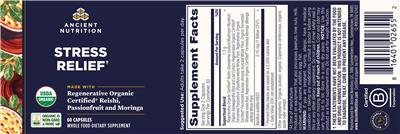
Stress Relief by Ancient Nutrition label
The label scan from the NIH Dietary Supplement Label Database. Tap to enlarge.
Label images are published by the NIH Dietary Supplement Label Database for the version of this product on file. Always read your actual product label.
View the full label (PDF)The Ingredients in Stress Relief by Ancient Nutrition
These are the 7 active ingredients this product is made of. Select any to open its full monograph.
Serving size2 Capsule(s) Dosage formCapsule Amounts shown are per serving.
Most supplement products combine several ingredients, and a medication can interact with the product through any one of them. Each ingredient below shows whether it has known drug interactions.
Superfood Blend
- › Ashwagandha Leaf, Root Extract
- › Reishi Mushroom
- › Passionfruit, Fermented
- › Soursop, Fermented
- › Rhodiola rosea, Fermented
- › Moringa, Fermented
Bacillus subtilis AB22
Interacts with182 drugs
Bacillus subtilis is a spore-forming probiotic bacterium found in soil and some fermented foods, and it is used mainly to support gut health and diges...
Bacillus subtilis AB22 monograph & interactionsOther (inactive) ingredients: Pullulan, Copernicia cerifera, Apple Cider Vinegar. These complete the product’s ingredient list but are not active constituents.
Stress Relief by Ancient Nutrition Drug Interactions
HelloPharmacist Interaction Report
Ancient Nutrition's Stress Relief contains seven ingredients, five of which have documented interactions with medications.
The most serious concern involves ashwagandha, which has multiple Moderate-severity interactions—particularly with CNS depressants (sedatives, barbiturates, anxiolytics), where ashwagandha's own sedative effects may add to the drug's impact and increase drowsiness or impairment.
Read the full breakdown — every affected drug type, severity by severity
Ashwagandha also interacts Moderately with antihypertensive drugs (blood pressure medications) by potentially lowering blood pressure further, and with benzodiazepines (anti-anxiety medications like Valium and Klonopin) by amplifying sedation. It may increase the risk of low blood sugar (hypoglycemia) when combined with diabetes medications, and theoretically could reduce the effectiveness of immunosuppressants or increase the risk of liver damage alongside hepatotoxic drugs.
A Minor interaction exists with certain drugs metabolized through the liver enzyme CYP1A2.
Rhodiola and moringa bring additional Moderate interactions: rhodiola with blood pressure medications, diabetes drugs, certain blood thinners and anti-clotting medications, and several enzyme-metabolized drugs; moringa with thyroid hormone replacement (levothyroxine) and several drug-metabolizing pathways. Reishi mushroom interacts Moderately with blood pressure and blood thinning medications.
Soursop (graviola) may reduce the effectiveness of carbamazepine (an anti-seizure drug). Bacillus subtilis may be killed by antibiotics if taken simultaneously.
We could not check passionfruit for interactions.
Altogether, these interactions span 1,578 individual medications. Before starting this supplement, use the interaction checker below with your exact prescription and over-the-counter medications.
Check your own medications below · Editorial policy · How we use AI
Want to check YOUR meds against Stress Relief?
Ask about interactions with your drugs in plain English — “Can I take it with lisinopril?” — and we find you the answer in seconds, ingredient by ingredient.
Go to the checkerIngredients driving the most interactions
Individual Drug Interactions
The ingredients in Stress Relief interact with 1,600 drugs. Click any drug to see the details.
6 of the 7 ingredients in Stress Relief interact with drugs. Each result below shows which ingredient is responsible. Ashwagandha Leaf, Root Extract Rhodiola rosea, Fermented Moringa, Fermented Reishi Mushroom Bacillus subtilis AB22 Soursop, Fermented
6-mercaptopurinePurinethol
How 6-mercaptopurine interacts with Stress Relief — through 2 ingredients. Tap an ingredient for the detail:
Ashwagandha Leaf, Root ExtractHepatotoxic Drugs, Immunosuppressants Moderate
Interaction Summary
Theoretically, taking ashwagandha with hepatotoxic drugs might increase the risk of liver damage.
Read the full Ashwagandha Leaf, Root Extract + 6-mercaptopurine interactionRhodiola Rosea, FermentedImmunosuppressants Moderate
Interaction Summary
Theoretically, rhodiola use might interfere with immunosuppressive therapy.
Read the full Rhodiola Rosea, Fermented + 6-mercaptopurine interactionAdo-trastuzumab EmtansineKadcyla
How Ado-trastuzumab Emtansine interacts with Stress Relief — through 3 ingredients. Tap an ingredient for the detail:
Moringa, FermentedCytochrome P450 3a4 (cyp3a4) Substrates Moderate
Interaction Summary
Theoretically, moringa might increase or decrease levels of CYP3A4 substrates.
Read the full Moringa, Fermented + Ado-trastuzumab Emtansine interactionRhodiola Rosea, FermentedCytochrome P450 3a4 (cyp3a4) Substrates Minor
Interaction Summary
Theoretically, rhodiola might increase levels of drugs metabolized by CYP3A4.
Read the full Rhodiola Rosea, Fermented + Ado-trastuzumab Emtansine interactionAshwagandha Leaf, Root ExtractCytochrome P450 3a4 (cyp3a4) Substrates Minor
Interaction Summary
Theoretically, ashwagandha might decrease the levels and clinical effects of CYP3A4 substrates.
Read the full Ashwagandha Leaf, Root Extract + Ado-trastuzumab Emtansine interactionAbacavir Sulfate, Dolutegravir, LamivudineTriumeq
How Abacavir Sulfate, Dolutegravir, Lamivudine interacts with Stress Relief — through 1 ingredient. Tap an ingredient for the detail:
Ashwagandha Leaf, Root ExtractHepatotoxic Drugs Moderate
Interaction Summary
Theoretically, taking ashwagandha with hepatotoxic drugs might increase the risk of liver damage.
Read the full Ashwagandha Leaf, Root Extract + Abacavir Sulfate, Dolutegravir, Lamivudine interactionAbacavir, LamivudineEpzicom
How Abacavir, Lamivudine interacts with Stress Relief — through 1 ingredient. Tap an ingredient for the detail:
Ashwagandha Leaf, Root ExtractHepatotoxic Drugs Moderate
Interaction Summary
Theoretically, taking ashwagandha with hepatotoxic drugs might increase the risk of liver damage.
Read the full Ashwagandha Leaf, Root Extract + Abacavir, Lamivudine interactionAbciximabReoPro
How Abciximab interacts with Stress Relief — through 1 ingredient. Tap an ingredient for the detail:
Reishi MushroomAnticoagulant/antiplatelet Drugs Moderate
Interaction Summary
Theoretically, high doses of reishi mushroom might increase the risk of bleeding.
Read the full Reishi Mushroom + Abciximab interactionAbemaciclibVerzenio
How Abemaciclib interacts with Stress Relief — through 3 ingredients. Tap an ingredient for the detail:
Moringa, FermentedCytochrome P450 3a4 (cyp3a4) Substrates Moderate
Interaction Summary
Theoretically, moringa might increase or decrease levels of CYP3A4 substrates.
Read the full Moringa, Fermented + Abemaciclib interactionAshwagandha Leaf, Root ExtractCytochrome P450 3a4 (cyp3a4) Substrates Minor
Interaction Summary
Theoretically, ashwagandha might decrease the levels and clinical effects of CYP3A4 substrates.
Read the full Ashwagandha Leaf, Root Extract + Abemaciclib interactionRhodiola Rosea, FermentedCytochrome P450 3a4 (cyp3a4) Substrates Minor
Interaction Summary
Theoretically, rhodiola might increase levels of drugs metabolized by CYP3A4.
Read the full Rhodiola Rosea, Fermented + Abemaciclib interactionAbiraterone
How Abiraterone interacts with Stress Relief — through 3 ingredients. Tap an ingredient for the detail:
Moringa, FermentedCytochrome P450 3a4 (cyp3a4) Substrates Moderate
Interaction Summary
Theoretically, moringa might increase or decrease levels of CYP3A4 substrates.
Read the full Moringa, Fermented + Abiraterone interactionAshwagandha Leaf, Root ExtractHepatotoxic Drugs, Cytochrome P450 3a4 (cyp3a4) Substrates Moderate
Interaction Summary
Theoretically, taking ashwagandha with hepatotoxic drugs might increase the risk of liver damage.
Read the full Ashwagandha Leaf, Root Extract + Abiraterone interactionRhodiola Rosea, FermentedCytochrome P450 3a4 (cyp3a4) Substrates Minor
Interaction Summary
Theoretically, rhodiola might increase levels of drugs metabolized by CYP3A4.
Read the full Rhodiola Rosea, Fermented + Abiraterone interactionAbiraterone AcetateYonsa, Zytiga
How Abiraterone Acetate interacts with Stress Relief — through 3 ingredients. Tap an ingredient for the detail:
Ashwagandha Leaf, Root ExtractCytochrome P450 3a4 (cyp3a4) Substrates, Hepatotoxic Drugs Moderate
Interaction Summary
Theoretically, ashwagandha might decrease the levels and clinical effects of CYP3A4 substrates.
Read the full Ashwagandha Leaf, Root Extract + Abiraterone Acetate interactionMoringa, FermentedCytochrome P450 3a4 (cyp3a4) Substrates Moderate
Interaction Summary
Theoretically, moringa might increase or decrease levels of CYP3A4 substrates.
Read the full Moringa, Fermented + Abiraterone Acetate interactionRhodiola Rosea, FermentedCytochrome P450 3a4 (cyp3a4) Substrates Minor
Interaction Summary
Theoretically, rhodiola might increase levels of drugs metabolized by CYP3A4.
Read the full Rhodiola Rosea, Fermented + Abiraterone Acetate interactionAbrocitinibCibinqo
How Abrocitinib interacts with Stress Relief — through 3 ingredients. Tap an ingredient for the detail:
Reishi MushroomAnticoagulant/antiplatelet Drugs Moderate
Interaction Summary
Theoretically, high doses of reishi mushroom might increase the risk of bleeding.
Read the full Reishi Mushroom + Abrocitinib interactionAshwagandha Leaf, Root ExtractImmunosuppressants Moderate
Interaction Summary
Theoretically, taking ashwagandha might decrease the effects of immunosuppressants.
Read the full Ashwagandha Leaf, Root Extract + Abrocitinib interactionRhodiola Rosea, FermentedImmunosuppressants, Cytochrome P450 2c9 (cyp2c9) Substrates Moderate
Interaction Summary
Theoretically, rhodiola use might interfere with immunosuppressive therapy.
Read the full Rhodiola Rosea, Fermented + Abrocitinib interactionAcalabrutinibCalquence
How Acalabrutinib interacts with Stress Relief — through 3 ingredients. Tap an ingredient for the detail:
Rhodiola Rosea, FermentedP-glycoprotein Substrates, Cytochrome P450 3a4 (cyp3a4) Substrates Moderate
Interaction Summary
Theoretically, rhodiola might increase levels of P-glycoprotein substrates.
Read the full Rhodiola Rosea, Fermented + Acalabrutinib interactionMoringa, FermentedP-glycoprotein Substrates, Cytochrome P450 3a4 (cyp3a4) Substrates Moderate
Interaction Summary
Theoretically, moringa leaf extract might increase the levels and clinical effects of P-glycoprotein substrates.
Read the full Moringa, Fermented + Acalabrutinib interactionAshwagandha Leaf, Root ExtractCytochrome P450 3a4 (cyp3a4) Substrates Minor
Interaction Summary
Theoretically, ashwagandha might decrease the levels and clinical effects of CYP3A4 substrates.
Read the full Ashwagandha Leaf, Root Extract + Acalabrutinib interactionAcarboseGlucobay, Prandase, Precose
How Acarbose interacts with Stress Relief — through 4 ingredients. Tap an ingredient for the detail:
Rhodiola Rosea, FermentedAntidiabetes Drugs Moderate
Interaction Summary
Theoretically, taking rhodiola with antidiabetes drugs might increase the risk of hypoglycemia.
Read the full Rhodiola Rosea, Fermented + Acarbose interactionReishi MushroomAntidiabetes Drugs Moderate
Interaction Summary
Theoretically, reishi mushroom might have additive effects with antidiabetes drugs.
Read the full Reishi Mushroom + Acarbose interactionAshwagandha Leaf, Root ExtractHepatotoxic Drugs, Antidiabetes Drugs Moderate
Interaction Summary
Theoretically, taking ashwagandha with hepatotoxic drugs might increase the risk of liver damage.
Read the full Ashwagandha Leaf, Root Extract + Acarbose interactionMoringa, FermentedAntidiabetes Drugs Minor
Interaction Summary
Theoretically, moringa might have additive effects when used with antidiabetes drugs; however, research is conflicting.
Read the full Moringa, Fermented + Acarbose interactionAcebutololRhotral, Sectral
How Acebutolol interacts with Stress Relief — through 3 ingredients. Tap an ingredient for the detail:
Ashwagandha Leaf, Root ExtractAntihypertensive Drugs, Hepatotoxic Drugs Moderate
Interaction Summary
Theoretically, taking ashwagandha with antihypertensive drugs might increase the risk of hypotension.
Read the full Ashwagandha Leaf, Root Extract + Acebutolol interactionReishi MushroomAntihypertensive Drugs Moderate
Interaction Summary
Theoretically, concurrent use of reishi mushroom with antihypertensive drugs might increase the risk of hypotension.
Read the full Reishi Mushroom + Acebutolol interactionRhodiola Rosea, FermentedAntihypertensive Drugs Moderate
Interaction Summary
Theoretically, taking rhodiola with antihypertensive drugs might increase the risk of hypotension.
Read the full Rhodiola Rosea, Fermented + Acebutolol interactionAcenocoumarolSintrom
How Acenocoumarol interacts with Stress Relief — through 1 ingredient. Tap an ingredient for the detail:
Reishi MushroomAnticoagulant/antiplatelet Drugs Moderate
Interaction Summary
Theoretically, high doses of reishi mushroom might increase the risk of bleeding.
Read the full Reishi Mushroom + Acenocoumarol interactionAcepromazineAtravet
How Acepromazine interacts with Stress Relief — through 2 ingredients. Tap an ingredient for the detail:
Ashwagandha Leaf, Root ExtractCns Depressants Moderate
Interaction Summary
Theoretically, taking ashwagandha might increase the sedative effects of CNS depressants.
Read the full Ashwagandha Leaf, Root Extract + Acepromazine interactionRhodiola Rosea, FermentedCns Depressants Minor
Interaction Summary
Theoretically, rhodiola might increase the risk of adverse effects when taken with CNS depressants.
Read the full Rhodiola Rosea, Fermented + Acepromazine interactionAcetaminophenChildren's Tylenol, Children's Tylenol Meltaways, Tylenol, Tylenol Ex Strength
How Acetaminophen interacts with Stress Relief — through 3 ingredients. Tap an ingredient for the detail:
Ashwagandha Leaf, Root ExtractCytochrome P450 1a2 (cyp1a2) Substrates, Hepatotoxic Drugs Moderate
Interaction Summary
Theoretically, ashwagandha might decrease the levels and clinical effects of CYP1A2 substrates.
Read the full Ashwagandha Leaf, Root Extract + Acetaminophen interactionRhodiola Rosea, FermentedCytochrome P450 1a2 (cyp1a2) Substrates Minor
Interaction Summary
Theoretically, rhodiola might increase levels of drugs metabolized by CYP1A2.
Read the full Rhodiola Rosea, Fermented + Acetaminophen interactionMoringa, FermentedCytochrome P450 1a2 (cyp1a2) Substrates Minor
Interaction Summary
Theoretically, moringa might decrease the levels and clinical effects of CYP1A2 substrates.
Read the full Moringa, Fermented + Acetaminophen interactionAcetaminophen, AspirinGemnisyn
How Acetaminophen, Aspirin interacts with Stress Relief — through 4 ingredients. Tap an ingredient for the detail:
Ashwagandha Leaf, Root ExtractHepatotoxic Drugs, Cytochrome P450 1a2 (cyp1a2) Substrates Moderate
Interaction Summary
Theoretically, taking ashwagandha with hepatotoxic drugs might increase the risk of liver damage.
Read the full Ashwagandha Leaf, Root Extract + Acetaminophen, Aspirin interactionReishi MushroomAnticoagulant/antiplatelet Drugs Moderate
Interaction Summary
Theoretically, high doses of reishi mushroom might increase the risk of bleeding.
Read the full Reishi Mushroom + Acetaminophen, Aspirin interactionRhodiola Rosea, FermentedCytochrome P450 1a2 (cyp1a2) Substrates Minor
Interaction Summary
Theoretically, rhodiola might increase levels of drugs metabolized by CYP1A2.
Read the full Rhodiola Rosea, Fermented + Acetaminophen, Aspirin interactionMoringa, FermentedCytochrome P450 1a2 (cyp1a2) Substrates Minor
Interaction Summary
Theoretically, moringa might decrease the levels and clinical effects of CYP1A2 substrates.
Read the full Moringa, Fermented + Acetaminophen, Aspirin interactionAcetaminophen, Aspirin, CaffeineExcedrin, Excedrin Extra Strength, Excedrin Migraine
How Acetaminophen, Aspirin, Caffeine interacts with Stress Relief — through 4 ingredients. Tap an ingredient for the detail:
Moringa, FermentedCytochrome P450 1a2 (cyp1a2) Substrates, Cytochrome P450 3a4 (cyp3a4) Substrates Moderate
Interaction Summary
Theoretically, moringa might decrease the levels and clinical effects of CYP1A2 substrates.
Read the full Moringa, Fermented + Acetaminophen, Aspirin, Caffeine interactionReishi MushroomAnticoagulant/antiplatelet Drugs Moderate
Interaction Summary
Theoretically, high doses of reishi mushroom might increase the risk of bleeding.
Read the full Reishi Mushroom + Acetaminophen, Aspirin, Caffeine interactionAshwagandha Leaf, Root ExtractCytochrome P450 1a2 (cyp1a2) Substrates, Hepatotoxic Drugs +1 Moderate
Interaction Summary
Theoretically, ashwagandha might decrease the levels and clinical effects of CYP1A2 substrates.
Read the full Ashwagandha Leaf, Root Extract + Acetaminophen, Aspirin, Caffeine interactionRhodiola Rosea, FermentedCytochrome P450 1a2 (cyp1a2) Substrates, Cytochrome P450 3a4 (cyp3a4) Substrates Minor
Interaction Summary
Theoretically, rhodiola might increase levels of drugs metabolized by CYP1A2.
Read the full Rhodiola Rosea, Fermented + Acetaminophen, Aspirin, Caffeine interactionAcetaminophen, Brompheniramine, PhenylpropanolamineDimetapp Cold and Flu
How Acetaminophen, Brompheniramine, Phenylpropanolamine interacts with Stress Relief — through 3 ingredients. Tap an ingredient for the detail:
Ashwagandha Leaf, Root ExtractHepatotoxic Drugs, Cytochrome P450 1a2 (cyp1a2) Substrates Moderate
Interaction Summary
Theoretically, taking ashwagandha with hepatotoxic drugs might increase the risk of liver damage.
Read the full Ashwagandha Leaf, Root Extract + Acetaminophen, Brompheniramine, Phenylpropanolamine interactionRhodiola Rosea, FermentedCytochrome P450 1a2 (cyp1a2) Substrates Minor
Interaction Summary
Theoretically, rhodiola might increase levels of drugs metabolized by CYP1A2.
Read the full Rhodiola Rosea, Fermented + Acetaminophen, Brompheniramine, Phenylpropanolamine interactionMoringa, FermentedCytochrome P450 1a2 (cyp1a2) Substrates Minor
Interaction Summary
Theoretically, moringa might decrease the levels and clinical effects of CYP1A2 substrates.
Read the full Moringa, Fermented + Acetaminophen, Brompheniramine, Phenylpropanolamine interactionAcetaminophen, ButalbitalAxocet, Bancap, Bucet, Butex Forte, Esgic CF, Orbivan CF +5 more
How Acetaminophen, Butalbital interacts with Stress Relief — through 3 ingredients. Tap an ingredient for the detail:
Ashwagandha Leaf, Root ExtractCytochrome P450 1a2 (cyp1a2) Substrates, Hepatotoxic Drugs Moderate
Interaction Summary
Theoretically, ashwagandha might decrease the levels and clinical effects of CYP1A2 substrates.
Read the full Ashwagandha Leaf, Root Extract + Acetaminophen, Butalbital interactionMoringa, FermentedCytochrome P450 1a2 (cyp1a2) Substrates Minor
Interaction Summary
Theoretically, moringa might decrease the levels and clinical effects of CYP1A2 substrates.
Read the full Moringa, Fermented + Acetaminophen, Butalbital interactionRhodiola Rosea, FermentedCytochrome P450 1a2 (cyp1a2) Substrates Minor
Interaction Summary
Theoretically, rhodiola might increase levels of drugs metabolized by CYP1A2.
Read the full Rhodiola Rosea, Fermented + Acetaminophen, Butalbital interactionAcetaminophen, Butalbital, CaffeineEsgic, Esgic Plus, Fiogesic, Fioricet, Repan, Tecnal +1 more
How Acetaminophen, Butalbital, Caffeine interacts with Stress Relief — through 3 ingredients. Tap an ingredient for the detail:
Ashwagandha Leaf, Root ExtractHepatotoxic Drugs, Cytochrome P450 1a2 (cyp1a2) Substrates +1 Moderate
Interaction Summary
Theoretically, taking ashwagandha with hepatotoxic drugs might increase the risk of liver damage.
Read the full Ashwagandha Leaf, Root Extract + Acetaminophen, Butalbital, Caffeine interactionMoringa, FermentedCytochrome P450 1a2 (cyp1a2) Substrates, Cytochrome P450 3a4 (cyp3a4) Substrates Moderate
Interaction Summary
Theoretically, moringa might decrease the levels and clinical effects of CYP1A2 substrates.
Read the full Moringa, Fermented + Acetaminophen, Butalbital, Caffeine interactionRhodiola Rosea, FermentedCytochrome P450 1a2 (cyp1a2) Substrates, Cytochrome P450 3a4 (cyp3a4) Substrates Minor
Interaction Summary
Theoretically, rhodiola might increase levels of drugs metabolized by CYP1A2.
Read the full Rhodiola Rosea, Fermented + Acetaminophen, Butalbital, Caffeine interactionAcetaminophen, Butalbital, Caffeine, CodeineEsgic with Codeine, Fioricet w/ Codeine
How Acetaminophen, Butalbital, Caffeine, Codeine interacts with Stress Relief — through 3 ingredients. Tap an ingredient for the detail:
Moringa, FermentedCytochrome P450 3a4 (cyp3a4) Substrates, Cytochrome P450 1a2 (cyp1a2) Substrates Moderate
Interaction Summary
Theoretically, moringa might increase or decrease levels of CYP3A4 substrates.
Read the full Moringa, Fermented + Acetaminophen, Butalbital, Caffeine, Codeine interactionAshwagandha Leaf, Root ExtractCytochrome P450 3a4 (cyp3a4) Substrates, Cytochrome P450 1a2 (cyp1a2) Substrates +2 Moderate
Interaction Summary
Theoretically, ashwagandha might decrease the levels and clinical effects of CYP3A4 substrates.
Read the full Ashwagandha Leaf, Root Extract + Acetaminophen, Butalbital, Caffeine, Codeine interactionRhodiola Rosea, FermentedCns Depressants, Cytochrome P450 3a4 (cyp3a4) Substrates +1 Minor
Interaction Summary
Theoretically, rhodiola might increase the risk of adverse effects when taken with CNS depressants.
Read the full Rhodiola Rosea, Fermented + Acetaminophen, Butalbital, Caffeine, Codeine interactionAcetaminophen, Butalbital, CodeineBancap w/ Codeine
How Acetaminophen, Butalbital, Codeine interacts with Stress Relief — through 3 ingredients. Tap an ingredient for the detail:
Ashwagandha Leaf, Root ExtractHepatotoxic Drugs, Cns Depressants +1 Moderate
Interaction Summary
Theoretically, taking ashwagandha with hepatotoxic drugs might increase the risk of liver damage.
Read the full Ashwagandha Leaf, Root Extract + Acetaminophen, Butalbital, Codeine interactionMoringa, FermentedCytochrome P450 1a2 (cyp1a2) Substrates Minor
Interaction Summary
Theoretically, moringa might decrease the levels and clinical effects of CYP1A2 substrates.
Read the full Moringa, Fermented + Acetaminophen, Butalbital, Codeine interactionRhodiola Rosea, FermentedCytochrome P450 1a2 (cyp1a2) Substrates, Cns Depressants Minor
Interaction Summary
Theoretically, rhodiola might increase levels of drugs metabolized by CYP1A2.
Read the full Rhodiola Rosea, Fermented + Acetaminophen, Butalbital, Codeine interactionAcetaminophen, Butalbital, Codeine PhosphatePhrenilin #3
How Acetaminophen, Butalbital, Codeine Phosphate interacts with Stress Relief — through 3 ingredients. Tap an ingredient for the detail:
Ashwagandha Leaf, Root ExtractCytochrome P450 1a2 (cyp1a2) Substrates, Cns Depressants +1 Moderate
Interaction Summary
Theoretically, ashwagandha might decrease the levels and clinical effects of CYP1A2 substrates.
Read the full Ashwagandha Leaf, Root Extract + Acetaminophen, Butalbital, Codeine Phosphate interactionRhodiola Rosea, FermentedCytochrome P450 1a2 (cyp1a2) Substrates, Cns Depressants Minor
Interaction Summary
Theoretically, rhodiola might increase levels of drugs metabolized by CYP1A2.
Read the full Rhodiola Rosea, Fermented + Acetaminophen, Butalbital, Codeine Phosphate interactionMoringa, FermentedCytochrome P450 1a2 (cyp1a2) Substrates Minor
Interaction Summary
Theoretically, moringa might decrease the levels and clinical effects of CYP1A2 substrates.
Read the full Moringa, Fermented + Acetaminophen, Butalbital, Codeine Phosphate interactionAcetaminophen, Caffeine, Chlorpheniramine, Hydrocodone, PhenylephrineHycomine Compound
How Acetaminophen, Caffeine, Chlorpheniramine, Hydrocodone, Phenylephrine interacts with Stress Relief — through 3 ingredients. Tap an ingredient for the detail:
Ashwagandha Leaf, Root ExtractCns Depressants, Cytochrome P450 1a2 (cyp1a2) Substrates +2 Moderate
Interaction Summary
Theoretically, taking ashwagandha might increase the sedative effects of CNS depressants.
Read the full Ashwagandha Leaf, Root Extract + Acetaminophen, Caffeine, Chlorpheniramine, Hydrocodone, Phenylephrine interactionMoringa, FermentedCytochrome P450 3a4 (cyp3a4) Substrates, Cytochrome P450 1a2 (cyp1a2) Substrates Moderate
Interaction Summary
Theoretically, moringa might increase or decrease levels of CYP3A4 substrates.
Read the full Moringa, Fermented + Acetaminophen, Caffeine, Chlorpheniramine, Hydrocodone, Phenylephrine interactionRhodiola Rosea, FermentedCns Depressants, Cytochrome P450 3a4 (cyp3a4) Substrates +1 Minor
Interaction Summary
Theoretically, rhodiola might increase the risk of adverse effects when taken with CNS depressants.
Read the full Rhodiola Rosea, Fermented + Acetaminophen, Caffeine, Chlorpheniramine, Hydrocodone, Phenylephrine interactionAcetaminophen, Caffeine, CodeineGesic C15, Gesic C30, Gesic C8, Lenoltec 1, Lenoltec 2, Lenoltec 3 +1 more
How Acetaminophen, Caffeine, Codeine interacts with Stress Relief — through 3 ingredients. Tap an ingredient for the detail:
Moringa, FermentedCytochrome P450 1a2 (cyp1a2) Substrates, Cytochrome P450 3a4 (cyp3a4) Substrates Moderate
Interaction Summary
Theoretically, moringa might decrease the levels and clinical effects of CYP1A2 substrates.
Read the full Moringa, Fermented + Acetaminophen, Caffeine, Codeine interactionAshwagandha Leaf, Root ExtractHepatotoxic Drugs, Cns Depressants +2 Moderate
Interaction Summary
Theoretically, taking ashwagandha with hepatotoxic drugs might increase the risk of liver damage.
Read the full Ashwagandha Leaf, Root Extract + Acetaminophen, Caffeine, Codeine interactionRhodiola Rosea, FermentedCytochrome P450 1a2 (cyp1a2) Substrates, Cns Depressants +1 Minor
Interaction Summary
Theoretically, rhodiola might increase levels of drugs metabolized by CYP1A2.
Read the full Rhodiola Rosea, Fermented + Acetaminophen, Caffeine, Codeine interactionAcetaminophen, Caffeine, Codeine, SalicylamideCodalan No.1, Codalan No.2, Codalan No.3
How Acetaminophen, Caffeine, Codeine, Salicylamide interacts with Stress Relief — through 3 ingredients. Tap an ingredient for the detail:
Ashwagandha Leaf, Root ExtractCytochrome P450 3a4 (cyp3a4) Substrates, Cytochrome P450 1a2 (cyp1a2) Substrates +2 Moderate
Interaction Summary
Theoretically, ashwagandha might decrease the levels and clinical effects of CYP3A4 substrates.
Read the full Ashwagandha Leaf, Root Extract + Acetaminophen, Caffeine, Codeine, Salicylamide interactionMoringa, FermentedCytochrome P450 3a4 (cyp3a4) Substrates, Cytochrome P450 1a2 (cyp1a2) Substrates Moderate
Interaction Summary
Theoretically, moringa might increase or decrease levels of CYP3A4 substrates.
Read the full Moringa, Fermented + Acetaminophen, Caffeine, Codeine, Salicylamide interactionRhodiola Rosea, FermentedCytochrome P450 3a4 (cyp3a4) Substrates, Cytochrome P450 1a2 (cyp1a2) Substrates +1 Minor
Interaction Summary
Theoretically, rhodiola might increase levels of drugs metabolized by CYP3A4.
Read the full Rhodiola Rosea, Fermented + Acetaminophen, Caffeine, Codeine, Salicylamide interactionAcetaminophen, Caffeine, DihydrocodeineDHC Plus, Panlor DC, Panlor SS
How Acetaminophen, Caffeine, Dihydrocodeine interacts with Stress Relief — through 3 ingredients. Tap an ingredient for the detail:
Ashwagandha Leaf, Root ExtractHepatotoxic Drugs, Cytochrome P450 1a2 (cyp1a2) Substrates +2 Moderate
Interaction Summary
Theoretically, taking ashwagandha with hepatotoxic drugs might increase the risk of liver damage.
Read the full Ashwagandha Leaf, Root Extract + Acetaminophen, Caffeine, Dihydrocodeine interactionMoringa, FermentedCytochrome P450 3a4 (cyp3a4) Substrates, Cytochrome P450 1a2 (cyp1a2) Substrates Moderate
Interaction Summary
Theoretically, moringa might increase or decrease levels of CYP3A4 substrates.
Read the full Moringa, Fermented + Acetaminophen, Caffeine, Dihydrocodeine interactionRhodiola Rosea, FermentedCytochrome P450 3a4 (cyp3a4) Substrates, Cytochrome P450 1a2 (cyp1a2) Substrates +1 Minor
Interaction Summary
Theoretically, rhodiola might increase levels of drugs metabolized by CYP3A4.
Read the full Rhodiola Rosea, Fermented + Acetaminophen, Caffeine, Dihydrocodeine interactionAcetaminophen, Caffeine, IsomethepteneMigralam
How Acetaminophen, Caffeine, Isometheptene interacts with Stress Relief — through 3 ingredients. Tap an ingredient for the detail:
Moringa, FermentedCytochrome P450 1a2 (cyp1a2) Substrates, Cytochrome P450 3a4 (cyp3a4) Substrates Moderate
Interaction Summary
Theoretically, moringa might decrease the levels and clinical effects of CYP1A2 substrates.
Read the full Moringa, Fermented + Acetaminophen, Caffeine, Isometheptene interactionAshwagandha Leaf, Root ExtractHepatotoxic Drugs, Cytochrome P450 1a2 (cyp1a2) Substrates +1 Moderate
Interaction Summary
Theoretically, taking ashwagandha with hepatotoxic drugs might increase the risk of liver damage.
Read the full Ashwagandha Leaf, Root Extract + Acetaminophen, Caffeine, Isometheptene interactionRhodiola Rosea, FermentedCytochrome P450 3a4 (cyp3a4) Substrates, Cytochrome P450 1a2 (cyp1a2) Substrates Minor
Interaction Summary
Theoretically, rhodiola might increase levels of drugs metabolized by CYP3A4.
Read the full Rhodiola Rosea, Fermented + Acetaminophen, Caffeine, Isometheptene interactionAcetaminophen, Caffeine, PyrilamineMidol Max Strength Menstrual
How Acetaminophen, Caffeine, Pyrilamine interacts with Stress Relief — through 3 ingredients. Tap an ingredient for the detail:
Ashwagandha Leaf, Root ExtractCytochrome P450 3a4 (cyp3a4) Substrates, Cytochrome P450 1a2 (cyp1a2) Substrates +1 Moderate
Interaction Summary
Theoretically, ashwagandha might decrease the levels and clinical effects of CYP3A4 substrates.
Read the full Ashwagandha Leaf, Root Extract + Acetaminophen, Caffeine, Pyrilamine interactionMoringa, FermentedCytochrome P450 3a4 (cyp3a4) Substrates, Cytochrome P450 1a2 (cyp1a2) Substrates Moderate
Interaction Summary
Theoretically, moringa might increase or decrease levels of CYP3A4 substrates.
Read the full Moringa, Fermented + Acetaminophen, Caffeine, Pyrilamine interactionRhodiola Rosea, FermentedCytochrome P450 1a2 (cyp1a2) Substrates, Cytochrome P450 3a4 (cyp3a4) Substrates Minor
Interaction Summary
Theoretically, rhodiola might increase levels of drugs metabolized by CYP1A2.
Read the full Rhodiola Rosea, Fermented + Acetaminophen, Caffeine, Pyrilamine interactionAcetaminophen, Chlorpheniramine Maleate, Dextromethorphan HbrVicks Formula 44M Cough, Cold & Flu Relief
How Acetaminophen, Chlorpheniramine Maleate, Dextromethorphan Hbr interacts with Stress Relief — through 3 ingredients. Tap an ingredient for the detail:
Ashwagandha Leaf, Root ExtractCytochrome P450 1a2 (cyp1a2) Substrates, Serotonergic Drugs +2 Moderate
Interaction Summary
Theoretically, ashwagandha might decrease the levels and clinical effects of CYP1A2 substrates.
Read the full Ashwagandha Leaf, Root Extract + Acetaminophen, Chlorpheniramine Maleate, Dextromethorphan Hbr interactionMoringa, FermentedCytochrome P450 3a4 (cyp3a4) Substrates, Cytochrome P450 1a2 (cyp1a2) Substrates Moderate
Interaction Summary
Theoretically, moringa might increase or decrease levels of CYP3A4 substrates.
Read the full Moringa, Fermented + Acetaminophen, Chlorpheniramine Maleate, Dextromethorphan Hbr interactionRhodiola Rosea, FermentedCytochrome P450 1a2 (cyp1a2) Substrates, Cytochrome P450 3a4 (cyp3a4) Substrates Minor
Interaction Summary
Theoretically, rhodiola might increase levels of drugs metabolized by CYP1A2.
Read the full Rhodiola Rosea, Fermented + Acetaminophen, Chlorpheniramine Maleate, Dextromethorphan Hbr interactionEach ingredient & the kinds of drugs it affects
For each ingredient in Stress Relief with known interactions, here are the types of medications they can affect. Open any type for the detail — or search your exact drug in the checker above.
Ashwagandha Leaf, Root Extract
Antidiabetes Drugs
Theoretically, taking ashwagandha with antidiabetes drugs might increase the risk of hypoglycemia.
There is preliminary clinical evidence suggesting that ashwagandha might lower blood glucose levels. Theoretically, ashwagandha might have additive effects when used with antidiabetes drugs and increase the risk of hypoglycemia.
Antihypertensive Drugs
Theoretically, taking ashwagandha with antihypertensive drugs might increase the risk of hypotension.
Animal research suggests that ashwagandha might lower systolic and diastolic blood pressure. Theoretically, ashwagandha might have additive effects when used with antihypertensive drugs and increase the risk of hypotension.
Benzodiazepines
Theoretically, taking ashwagandha might increase the sedative effects of benzodiazepines.
There is preliminary evidence that ashwagandha might have an additive effect with diazepam (Valium) and clonazepam (Klonopin). This may also occur with other benzodiazepines.
Cns Depressants
Theoretically, taking ashwagandha might increase the sedative effects of CNS depressants.
Ashwagandha seems to have sedative effects. Theoretically, this may potentiate the effects of barbiturates, other sedatives, and anxiolytics.
Hepatotoxic Drugs
Theoretically, taking ashwagandha with hepatotoxic drugs might increase the risk of liver damage.
Ashwagandha has been linked to cases of acute hepatitis, liver failure, hepatic encephalopathy, autoimmune hepatitis, the need for liver transplantation, and death due to liver failure.
Immunosuppressants
Theoretically, taking ashwagandha might decrease the effects of immunosuppressants.
Ashwagandha has demonstrated immunostimulant effects in humans. Animal research has shown that ashwagandha can attenuate the immunosuppression caused by cyclophosphamide.
Thyroid Hormone
Ashwagandha might increase the effects and adverse effects of thyroid hormone.
Concomitant use of ashwagandha with thyroid hormones may cause additive therapeutic and adverse effects. Preliminary clinical research and animal studies suggest that ashwagandha boosts thyroid hormone synthesis and secretion. In one clinical study, ashwagandha increased triiodothyronine (T3) and thyroxine (T4) levels by 41.5% and 19.6%, respectively, and reduced serum TSH levels by 17.4% from baseline in adults with subclinical hypothyroidism.
Cytochrome P450 1A2 (Cyp1A2) Substrates
Theoretically, ashwagandha might decrease the levels and clinical effects of CYP1A2 substrates.
In vitro research shows that ashwagandha extract induces CYP1A2 enzymes.
Cytochrome P450 3A4 (Cyp3A4) Substrates
Theoretically, ashwagandha might decrease the levels and clinical effects of CYP3A4 substrates.
In vitro research shows that ashwagandha extract induces CYP3A4 enzymes.
Serotonergic Drugs
Some animal studies have reported that ashwagandha can enhance serotonergic transmission by altering certain serotonin (5-HT) receptors. However, there is no evidence to suggest that ashwagandha increases the risk of serotonin-related effects, and there have been no published case reports of serotonin syndrome when combined with other serotonergic drugs. Nevertheless, due to the lack of extensive studies on the matter and the fact that ashwagandha appears to affect serotonergic pathways, it would be prudent to exercise caution when combining it with drugs that affect serotonin. [References: - Effects of Withania somnifera (Ashwaga ndha) on Stress and the Stress-Related Neuropsychiatric Disorders Anxiety, Depression, and Insomnia. Curr Neuropharmacol. 2021 Sep 14; 19: 1468–1495. - A Prospective, Randomized Double-Blind, Placebo-Controlled Study of Safety and Efficacy of a High-Concentration Full-Spectrum Extract of Ashwagandha Root in Reducing Stress and Anxiety in Adults. https://www.ncbi.nlm.nih.gov/pmc/articles/PMC3573577/]
Rhodiola rosea, Fermented
Antidiabetes Drugs
Theoretically, taking rhodiola with antidiabetes drugs might increase the risk of hypoglycemia.
In vitro and animal research shows that rhodiola extract can decrease blood glucose due to alpha-glucosidase activity.
Antihypertensive Drugs
Theoretically, taking rhodiola with antihypertensive drugs might increase the risk of hypotension.
In vitro and animal research shows that rhodiola extract inhibits angiotensin-converting enzyme (ACE) and might lower blood pressure.
Cytochrome P450 2C9 (Cyp2C9) Substrates
Theoretically, rhodiola might increase levels of drugs metabolized by CYP2C9.
In vitro research shows that rhodiola inhibits CYP2C9. This effect is highly variable and appears to be dependent on the rhodiola product studied. Also, a clinical study in healthy young males found that taking rhodiola extract 290 mg daily for 14 days reduces the metabolism of losartan, a CYP2C9 substrate, by 21% after 4 hours.
Immunosuppressants
Theoretically, rhodiola use might interfere with immunosuppressive therapy.
In vitro and animal research show that rhodiola has immunostimulatory effects.
Losartan (Cozaar)
Rhodiola might increase the levels and adverse effects of losartan.
A clinical study in healthy young males found that taking rhodiola extract 290 mg daily for 14 days reduces the metabolism of losartan, a CYP2C9 substrate, by 21% after 4 hours.
P-Glycoprotein Substrates
Theoretically, rhodiola might increase levels of P-glycoprotein substrates.
In vitro research shows that rhodiola inhibits P-glycoprotein. Theoretically, using rhodiola with P-glycoprotein substrates might increase drug levels and potentially increase the risk of adverse effects.
Antidepressant Drugs
Theoretically, rhodiola might increase the risk of adverse effects when taken with antidepressants.
A review of adverse event reports in Poland identified cases of tachyarrhythmias, myalgia, arthralgia, gum pain, restless leg syndrome, swallowing disorders, and changes in consciousness when rhodiola was taken in combination with paroxetine, escitalopram, fluoxetine, sertraline, trazodone, and/or duloxetine.
Cns Depressants
Theoretically, rhodiola might increase the risk of adverse effects when taken with CNS depressants.
A review of adverse event reports in Poland identified cases of excessive sedation, myoclonus, hypotension, and hallucinations when rhodiola was taken with haloperidol, diazepam, or alprazolam.
Cytochrome P450 1A2 (Cyp1A2) Substrates
Theoretically, rhodiola might increase levels of drugs metabolized by CYP1A2.
In vitro research shows that rhodiola inhibits CYP1A2. This effect is highly variable and appears to be dependent on the rhodiola product studied. However, a clinical study in healthy young males found that taking rhodiola extract 290 mg daily for 14 days does not inhibit the metabolism of caffeine, a CYP1A2 substrate.
Cytochrome P450 3A4 (Cyp3A4) Substrates
Theoretically, rhodiola might increase levels of drugs metabolized by CYP3A4.
In vitro research shows that rhodiola inhibits CYP3A4. This effect is highly variable and appears to be dependent on the rhodiola product studied. However, a clinical study in healthy young males found that taking rhodiola extract 290 mg daily for 14 days does not inhibit the metabolism of midazolam, a CYP3A4 substrate.
Moringa, Fermented
Cytochrome P450 3A4 (Cyp3A4) Substrates
Theoretically, moringa might increase or decrease levels of CYP3A4 substrates.
Some in vitro research suggests that moringa inhibits cytochrome P450 3A4 (CYP3A4). However, other in vitro research suggests that moringa extract induces CYP3A4 enzymes. A pharmacokinetic study in patients with HIV shows no change in the pharmacokinetics of nevirapine, which is partially metabolized by CYP3A4, when administered concomitantly with moringa leaf powder 1.85 grams daily for 14 days.
Levothyroxine (Synthroid, Others)
Theoretically, moringa leaf can antagonize the effects of levothyroxine.
Animal research suggests that moringa aqueous leaf extract might reduce serum triiodothyronine (T3) concentrations by inhibiting the peripheral conversion of thyroxine (T4) to T3.
P-Glycoprotein Substrates
Theoretically, moringa leaf extract might increase the levels and clinical effects of P-glycoprotein substrates.
In vitro research shows that moringa leaf extract inhibits renal P-glycoprotein transport activity. So far, this reaction has not been reported in humans.
Antidiabetes Drugs
Theoretically, moringa might have additive effects when used with antidiabetes drugs; however, research is conflicting.
Animal research shows that moringa can lower blood glucose levels. However, research in humans has not shown consistent blood glucose lowering effects.
Cytochrome P450 1A2 (Cyp1A2) Substrates
Theoretically, moringa might decrease the levels and clinical effects of CYP1A2 substrates.
In vitro research shows that moringa extract induces CYP1A2 enzymes.
Nevirapine (Viramune)
Moringa leaf is unlikely to have a clinically significant interaction with nevirapine.
Nevirapine is partially metabolized by cytochrome P450 3A4 (CYP3A4). In vitro evidence suggests that moringa inhibits CYP3A4. However, a pharmacokinetic study in patients with HIV shows no change in nevirapine pharmacokinetics when administered concomitantly with moringa leaf powder 1.85 grams daily for 14 days.
Reishi Mushroom
Anticoagulant/Antiplatelet Drugs
Theoretically, high doses of reishi mushroom might increase the risk of bleeding.
A dose of 1.5 grams daily of reishi mushroom does not seem to decrease platelet aggregation, but a higher dose of 3 grams daily does.
Antidiabetes Drugs
Theoretically, reishi mushroom might have additive effects with antidiabetes drugs.
Animal research suggests that reishi mushroom decreases blood sugar. However, in patients with type 2 diabetes, taking reishi mushroom does not reduce fasting glucose levels, and its effects on glycated hemoglobin are inconsistent.
Antihypertensive Drugs
Theoretically, concurrent use of reishi mushroom with antihypertensive drugs might increase the risk of hypotension.
Reishi mushroom has shown hypotensive activity in animal research. Clinical evidence suggests that reishi mushroom reduces blood pressure in some, but not all, patients with hypertension.
Bacillus subtilis AB22
Antibiotic Drugs
Theoretically, taking Bacillus subtilis with antibiotic drugs might decrease the effectiveness of B. subtilis.
Since B. subtilis preparations usually contain live and active organisms, simultaneously taking antibiotics might kill a significant number of the organisms. Tell patients to separate administration of antibiotics and B. subtilis preparations by at least 2 hours.
Soursop, Fermented
Carbamazepine (Tegretol)
Theoretically, graviola might decrease concentrations of carbamazepine when used concomitantly.
A study in rats shows that graviola extract reduces the area under the curve of carbamazepine by 46% and maximum concentration by 35% when compared with carbamazepine alone.
Brand information
Manufacturer and brand details for Stress Relief, from the product label.
Ancient Nutrition
See all Ancient Nutrition products- Name
- Ancient Nutrition, LLC
- Street Address
- 3480 Summertown Hwy
- City
- Summertown
- State
- TN
- ZipCode
- 38483
- Web Address
- www.AncientNutrition.com
Stress Relief by Ancient Nutrition: Common Questions
Does Stress Relief by Ancient Nutrition interact with any medications?
How can one product interact with so many drugs?
Where does this information come from?
Can I take this if I'm pregnant or breastfeeding?
Will this help me sleep?
What are the most common side effects?
Is it safe to take long-term?
What is Bacillus subtilis in here for?
Will this interact with my antibiotics?
Written and reviewed by the HelloPharmacist editorial staff. Our editorial policy
Not sure if Stress Relief is safe with your meds?
Our pharmacists answer your medication & supplement questions — free.
Label information is sourced from the NIH Dietary Supplement Label Database and reflects the product version on file; always read your actual product label. This page is for education only and is not a substitute for professional medical advice. Confirm with your pharmacist or doctor before combining supplements and medications.
The Full Monographs Behind Stress Relief’s Ingredients
Every ingredient we hold a full HelloPharmacist monograph for — uses, evidence, safety, and the complete interaction list.
Ashwagandha
Interacts with 1,372 drugsAshwagandha is an Ayurvedic herb most often taken to help with stress, anxiety, and sleep, and some small studies suggest it may help, though the evidence is still limited. It is generally w...
Read the full Ashwagandha monograph → Herb & supplement monographReishi Mushroom
Interacts with 375 drugsReishi is a traditional Asian mushroom widely used to support the immune system and overall wellness. Human evidence for most of its claimed benefits is limited or low-quality, so it should...
Read the full Reishi Mushroom monograph → Herb & supplement monographGraviola
Interacts with 1 drugGraviola (soursop) is a tropical fruit tree whose leaves, fruit, and bark are used in traditional medicine, especially in parts of South America, Africa, and Asia. Despite popular online cla...
Read the full Graviola monograph → Herb & supplement monographRhodiola
Interacts with 1,271 drugsRhodiola is an herb traditionally used to fight fatigue and help the body cope with stress. Some small studies suggest it may modestly reduce fatigue and improve mood, but the evidence is li...
Read the full Rhodiola monograph → Herb & supplement monographMoringa
Interacts with 869 drugsMoringa is a nutrient-rich plant whose leaves are widely used as a food and supplement, especially in parts of the world where malnutrition is common. Early research hints at possible benefi...
Read the full Moringa monograph → Herb & supplement monographBacillus Subtilis
Interacts with 182 drugsBacillus subtilis is a spore-forming probiotic bacterium found in soil and some fermented foods, and it is used mainly to support gut health and digestion. Early research is promising for ce...
Read the full Bacillus Subtilis monograph →Sources & How We Checked
Stress Relief's label data comes from the NIH Dietary Supplement Label Database; the ingredient interaction data is from the Natural Medicines database, reviewed by our pharmacists.
- NIH Dietary Supplement Label Database (DSLD) — The official product label on file for this supplement.
- Natural Medicines (Therapeutic Research Center) — Evidence-graded clinical reference behind the ingredient interaction data.
Content is written and reviewed by licensed HelloPharmacist pharmacists. See our data sources and editorial standards for how this information is built and checked.
The 99 references behind this product’s interaction data
Every citation that drives the interaction findings for this product’s ingredients, from the evidence-graded Natural Medicines (TRC Healthcare) database. Open an ingredient to browse its citations — links open the study on PubMed or the publisher’s site.
Ashwagandha 32 references
- McGuffin M, Hobbs C, Upton R, Goldberg A, eds. American Herbal Products Association's Botanical Safety Handbook. Boca Raton, FL: CRC Press, LLC 1997.
- Upton R, ed. Ashwagandha Root (Withania somnifera): Analytical, quality control, and therapuetic monograph. Santa Cruz, CA: American Herbal Pharmacopoeia 2000:1-25.
- Davis L, Kuttan G. Effect of Withania somnifera on cyclophosphamide-induced urotoxicity. Cancer Lett 2000;148:9-17. PubMed
- Davis L, Kuttan G. Suppressive effect of cyclophosphamide-induced toxicity by Withania somnifera extract in mice. J Ethnopharmacol 1998;62:209-14. PubMed
- Mishra LC, Singh BB, Dagenais S. Scientific basis for the therapeutic use of Withania somnifera (ashwagandha): a review. Altern Med Rev 2000;5:334-46. DOI
- Andallu B, Radhika B. Hypoglycemic, diuretic and hypocholesterolemic effect of winter cherry (Withania somnifera, Dunal) root. Indian J Exp Biol 2000;38:607-9.
- Kulkarni RR, Patki PS, Jog VP, et al. Treatment of osteoarthritis with a herbomineral formulation: a double-blind, placebo-controlled, cross-over study. J Ethnopharmacol 1991;33:91-5. PubMed
- Ahumada F, Aspee F, Wikman G, Hancke J. Withania somnifera exract. Its effects on arterial blood pressure in anaesthetized dogs. Phytother Res 1991;5:111-14.
- Panda S, Kar A. Withania somnifera and Bauhinia purpurea in the regulation of circulating thyroid hormone concentrations in female mice. J Ethnopharmacol 1999;67:233-39. PubMed
- Panda S, Kar A. Changes in thyroid hormone concentrations after administration of ashwagandha root extract to adult male mice. J Pharm Pharmacol 1998;50:1065-68. PubMed
- Sehgal, V. N., Verma, P., and Bhattacharya, S. N. Fixed-drug eruption caused by ashwagandha (Withania somnifera): a widely used Ayurvedic drug. Skinmed. 2012;10(1):48-49.
- Agnihotri AP, Sontakke SD, Thawani VR, Saoji A, Goswami VS. Effects of Withania somnifera in patients of schizophrenia: a randomized, double blind, placebo controlled pilot trial study. Indian J Pharmacol. 2013;45(4):417-8. PubMed
- Biswal BM, Sulaiman SA, Ismail HC, Zakaria H, Musa KI. Effect of Withania somnifera (Ashwagandha) on the development of chemotherapy-induced fatigue and quality of life in breast cancer patients. Integr Cancer Ther. 2013;12(4):312-22.
- Sharma AK, Basu I, Singh S. Efficacy and safety of Ashwagandha root extract in subclinical hypothyroid patients: a double-blind, randomized placebo-controlled trial. J Altern Complement Med. 2018 Mar;24(3):243-248. PubMed
- Durg S, Bavage S, Shivaram SB. Withania somnifera (Indian ginseng) in diabetes mellitus: A systematic review and meta-analysis of scientific evidence from experimental research to clinical application. Phytother Res. 2020;34(5):1041-1059.
- Björnsson HK, Björnsson ES, Avula B, et al. Ashwagandha-induced liver injury: A case series from Iceland and the US Drug-Induced Liver Injury Network. Liver Int. 2020;40(4):825-829. PubMed
- Tharakan A, Shukla H, Benny IR, Tharakan M, George L, Koshy S. Immunomodulatory Effect of Withania somnifera (Ashwagandha) Extract-A Randomized, Double-Blind, Placebo Controlled Trial with an Open Label Extension on Healthy Participants. J Clin Med 2021;1 PubMed
- Ireland PJ, Hardy T, Burt AD, Donnelly MC. Drug-induced hepatocellular injury due to herbal supplement ashwagandha. J R Coll Physicians Edinb. 2021;51(4):363-365. PubMed
- Kamal HI, Patel K, Brdak A, Heffernan J, Ahmad N. Ashwagandha as a unique cause of thyrotoxicosis presenting with supraventricular tachycardia. Cureus. 2022 Mar 25;14(3):e23494. PubMed
- Suryawanshi G, Abdallah M, Thomson M, Desai N, Chauhan A, Lim N. Ashwagandha-Associated Acute Liver Failure Requiring Liver Transplantation. Am J Ther 2023;30(1):e80-e83. PubMed
- Pusec CM, Wolsky R, Llerena C, Sura P. A Case of Supplement-Induced Hepatitis. Cureus 2022;14(10):e30433. PubMed
- Ajgaonkar A, Jain M, Debnath K. Efficacy and Safety of Ashwagandha (Withania somnifera) Root Extract for Improvement of Sexual Health in Healthy Women: A Prospective, Randomized, Placebo-Controlled Study. Cureus 2022;14(10):e30787. PubMed
- Haron MH, Dale O, Martin K, et al. Evaluation of the Herb-Drug Interaction Potential of Commonly Used Botanicals on the US Market with Regard to PXR- and AhR-Mediated Influences on CYP3A4 and CYP1A2. J Diet Suppl 2022. PubMed
- Lubarska M, Halasinski P, Hryhorowicz S, et al. Liver Dangers of Herbal Products: A Case Report of Ashwagandha-Induced Liver Injury. Int J Environ Res Public Health 2023;20(5):3921. PubMed
- Tóth M, Benedek AE, Longerich T, Seitz HK. Ashwagandha-induced acute liver injury: A case report. Clin Case Rep 2023;11(3):e7078.
- Bokan G, Glamocanin T, Mavija Z, et al. Herb-Induced Liver Injury by Ayurvedic Ashwagandha as Assessed for Causality by the Updated RUCAM: An Emerging Cause. Pharmaceuticals (Basel) 2023;16(8):1129. PubMed
- Patel PA, Sanborn E, Then R, Williams DM. Recurrent Reversible Cerebral Vasoconstriction Syndrome: A Report of Two Cases. Cureus 2023;15(8):e42992. PubMed
- Majeed M, Nagabhushanam K, Murali A, Vishwanathan DT, Mamidala RV, Mundkur L. A Standardized Withania somniferra (Linn.) Root Extract with Piperine Alleviates the Symptoms of Anxiety and Depression by Increasing Serotonin Levels: A Double-Blind, Randomize
- Philips CA, Valsan A, Theruvath AH, et al. Ashwagandha-induced liver injury-A case series from India and literature review. Hepatol Commun 2023;7(10):e0270. PubMed
- Hayashi M, Hamada H, Azuma SI, Hayashi K. Painless Thyroiditis by Withania somnifera (Ashwagandha). Cureus 2024;16(3):e55352. PubMed
- Vazirani S, Kothari A, Fujimoto J, Gomez M. Supplements Are Not a Synonym for Safe: Suspected Liver Injury From Ashwagandha. Fed Pract 2023;40(9):315-319. PubMed
- Patel M, Newell R, Hillier M, Ramalingam R. Herbal remedies as a potential cause of hypoadrenalism. Br J Hosp Med (Lond) 2024;85(6):1-4. PubMed
Bacillus Subtilis 10 references
- Pierce A. The American Pharmaceutical Association Practical Guide to Natural Medicines. New York: The Stonesong Press, 1999:19.
- Lampropoulos PK, Gkentzi D, Tzifas S, Dimitriou G. Neonatal sepsis due to Bacillus subtilis. Cureus 2021;13(9):e17692. PubMed
- La Jeon Y, Yang JJ, Kim MJ, et al. Combined Bacillus licheniformis and Bacillus subtilis infection in a patient with oesophageal perforation. J Med Microbiol 2012;61(Pt 12):1766-1769. PubMed
- Wallet F, Crunelle V, Roussel-Delvallez M, Fruchart A, Saunier P, Courcol RJ. Bacillus subtilis as a cause of cholangitis in polycystic kidney and liver disease. Am J Gastroenterol 1996;91(7):1477-8.
- Velasco E, Martins CA, Tabak D, Bouzas LF. "Bacillus subtilis" infection in a patient submitted to a bone marrow transplantation. Rev Paul Med 1992;110(3):116-7.
- Kato A, Yoshifuji A, Komori K, et al. A case of Bacillus subtilis var. natto bacteremia caused by ingestion of natto during COVID-19 treatment in a maintenance hemodialysis patient with multiple myeloma. J Infect Chemother 2022;28(8):1212-1215. PubMed
- Freedman KE, Hill JL, Wei Y, et al. Examining the gastrointestinal and immunomodulatory effects of the novel probiotic Bacillus subtilis DE111. Int J Mol Sci 2021;22(5):2453. PubMed
- Lefevre M, Racedo SM, Denayrolles M, et al. Safety assessment of Bacillus subtilis CU1 for use as a probiotic in humans. Regul Toxicol Pharmacol 2017;83:54-65. PubMed
- Hanifi A, Culpepper T, Mai V, et al. Evaluation of Bacillus subtilis R0179 on gastrointestinal viability and general wellness: a randomised, double-blind, placebo-controlled trial in healthy adults. Benef Microbes 2015;6(1):19-27. PubMed
- Tokano M, Tarumoto N, Imai K, et al. A case of bacterial meningitis caused by Bacillus subtilis var. natto. Intern Med. 2022. Epub ahead of print.
Reishi Mushroom 17 references
- McGuffin M, Hobbs C, Upton R, Goldberg A, eds. American Herbal Products Association's Botanical Safety Handbook. Boca Raton, FL: CRC Press, LLC 1997.
- Tao J, Feng KY. Experimental and clinical studies on inhibitory effect of ganoderma lucidum on platelet aggregation. J Tongji Med Univ 1990;10:240-3. PubMed
- Singh AB, Gupta SK, Pereira BM, Prakash D. Sensitization to Ganoderma lucidum in patients with respiratory allergy in India. Clin Exp Allergy 1995;25:440-7.
- Lee SY, Rhee HM. Cardiovascular effects of mycelium extract of Ganoderma lucidum: inhibition of sympathetic outflow as a mechanism of its hypotensive action. Chem Pharm Bull (Tokyo) 1990;38:1359-64. PubMed
- Kwok Y, Ng KFJ, Li, CCF, et al. A prospective, randomized, double-blind, placebo-controlled study of the platelet and global hemostatic effects of Ganoderma lucidum (Ling-Zhi) in healthy volunteers. Anesth Analg 2005;101:423-6. PubMed
- Wanmuang, H., Leopairut, J., Kositchaiwat, C., Wananukul, W., and Bunyaratvej, S. Fatal fulminant hepatitis associated with Ganoderma lucidum (Lingzhi) mushroom powder. J Med Assoc Thai. 2007;90(1):179-181.
- Seto, S. W., Lam, T. Y., Tam, H. L., Au, A. L., Chan, S. W., Wu, J. H., Yu, P. H., Leung, G. P., Ngai, S. M., Yeung, J. H., Leung, P. S., Lee, S. M., and Kwan, Y. W. Novel hypoglycemic effects of Ganoderma lucidum water-extract in obese/diabetic (+db/+db
- Chu, T. T., Benzie, I. F., Lam, C. W., Fok, B. S., Lee, K. K., and Tomlinson, B. Study of potential cardioprotective effects of Ganoderma lucidum (Lingzhi): results of a controlled human intervention trial. Br.J.Nutr. 2012;107(7):1017-1027.
- Jin, X., Ruiz, Beguerie J., Sze, D. M., and Chan, G. C. Ganoderma lucidum (Reishi mushroom) for cancer treatment. Cochrane.Database.Syst.Rev. 2012;6:CD007731.
- Kabir, Y., Kimura, S., and Tamura, T. Dietary effect of Ganoderma lucidum mushroom on blood pressure and lipid levels in spontaneously hypertensive rats (SHR). J Nutr Sci Vitaminol.(Tokyo) 1988;34(4):433-438. PubMed
- Kanmatsuse, K., Kajiwara, N., Hayashi, K., Shimogaichi, S., Fukinbara, I., Ishikawa, H., and Tamura, T. [Studies on Ganoderma lucidum. I. Efficacy against hypertension and side effects]. Yakugaku Zasshi 1985;105(10):942-947. PubMed
- Gao, Y., Lan, J., Dai, X., Ye, J., and Zhou, S. A Phase I/II Study of Ling Zhi Mushroom Ganoderma lucidum(W.Curt: Fr.) Lloyd (Aphyllophoromycetideae) Extract in Patients with Type II Diabetes Mellitus. International Journal of Medicinal Mushrooms 2004;6. DOI
- Jin H, Zhang G, Cao X, and et al. Treatment of hypertension by linzhi combined with hypotensor and its effects on arterial, arteriolar and capillary pressure and microcirculation. In: Niimi H, Xiu RJ, Sawada T, and et al. Microcirculatory Approach to Asi
- Klupp NL, Chang D, Hawke F, Kiat H, Cao H, Grant SJ, Bensoussan A. Ganoderma lucidum mushroom for the treatment of cardiovascular risk factors. Cochrane Database Syst Rev. 2015 Feb 17;2:CD007259. PubMed
- Zhao H, Zhang Q, Zhao L, Huang X, Wang J, Kang X. Spore Powder of Ganoderma lucidum Improves Cancer-Related Fatigue in Breast Cancer Patients Undergoing Endocrine Therapy: A Pilot Clinical Trial. Evid Based Complement Alternat Med. 2012;2012:809614.
- Pazzi F, Adsuar JC, Domínguez-Muñoz FJ, García-Gordillo MA, Gusi N, Collado-Mateo D. Ganoderma lucidum effects on mood and health-related quality of life in women with fibromyalgia. Healthcare (Basel) 2020;8(4):520. PubMed
- Kogure T, Koiwai A, Fukushi D, et al. Hypereosinophilia with hepatic nodule formation caused by Ganoderma lucidum. Intern Med 2021;60(24):3897-3903.
Graviola 4 references
- Caparros-Lefebvre D, Elbaz A. Possible relation of atypical parkinsonism in the French West Indies with consumption of tropical plants: a case-control study. Caribbean Parkinsonism Study Group. Lancet 1999;354:281-6. PubMed
- Gavamukulya Y, Wamunyokoli F, El-Shemy HA. Annona muricata: Is the natural therapy to most disease conditions including cancer growing in our backyard? A systematic review of its research history and future prospects. Asian Pac J Trop Med. 2017;10(9):835- PubMed
- Abu Soukhon AA, Abu-Qatouseh L, Mansoor K, et al. Cytotoxicity Activity of Graviola Fruit Extract with Carbamazepine and Valproic Acid Show Antagonistic and Indifferent Effects. Asian Pac J Cancer Prev 2023;24(6):1869-1875. PubMed
- Cleret de Langavant L, Roze E, Petit A, et al. Annonaceae Consumption Worsens Disease Severity and Cognitive Deficits in Degenerative Parkinsonism. Mov Disord 2022;37(12):2355-2366. PubMed
Rhodiola 13 references
- Kim SH, Hyun SH, Choung SY. Antioxidative effects of Cinnamomi cassiae and Rhodiola rosea extracts in liver of diabetic mice. Biofactors 2006;26:209-19.
- Kwon YI, Jang HD, Shetty K. Evaluation of Rhodiola crenulata and Rhodiola rosea for management of type II diabetes and hypertension. Asia Pac J Clin Nutr 2006;15:425-32.
- Bystritsky A, Kerwin L, Feusner JD. A pilot study of Rhodiola rosea (Rhodax) for generalized anxiety disorder (GAD). J Altern Complement Med 2008;14:175-80.
- Shevtsov VA, Zholus BI, Shervarly VI, et al. A randomized trial of two different doses of a SHR-5 Rhodiola rosea extract versus placebo and control of capacity for mental work. Phytomedicine 2003;10:95-105. PubMed
- Apostolidis E, Kwon YI, Shetty K. Potential of cranberry-based herbal synergies for diabetes and hypertension management. Asia Pac J Clin Nutr 2006;15:433-41.
- Hellum BH, Tosse A, Hoybakk K, et al. Potent in vitro inhibition of CYP3A4 and P-glycoprotein by Rhodiola rosea. Planta Med 2010;76:331-8.
- Skopriska-Rozewska E, Wojcik R, Siwicki AK, et al. The effect of Rhodiola quadrifida extracts on cellular immunity in mice and rats. Pol J Vet Sci 2008;11:105-11.
- Mishra KP, Chanda S, Shukla K, Ganju L. Adjuvant effect of aqueous extract of Rhodiola imbricate rhizome on the immune responses to tetanus toxoid and ovalbumin in rats. Immunopharmacol Immunotoxicol 2010;32:141-6.
- Li HX, Sze SC, Tong Y, Ng TB. Production of Th1- and Th2-dependent cytokines induced by the Chinese medicine herb, Rhodiola algida, on human peripheral blood monocytes. J Ethnopharmacol 2009;123:257-66. PubMed
- Mishra KP, Ganju L, Chanda S, et al. Aqueous extract of Rhodiola imbricate rhizome stimulates Toll-like receptor 4, granzyme-B and Th1 cytokines in vitro. Immunobiology 2009;214:27-31.
- Thu OK, Nilsen OG, Hellum B. In vitro inhibition of cytochrome P-450 activities and quantification of constituents in a selection of commercial Rhodiola rosea products. Pharm Bio. 2016 Dec;54(12):3249-3256.
- Thu OK, Spigset O, Nilsen OG, Hellum B. Effect of commercial Rhodiola rosea on CYP enzyme activity in humans. Eur J Clin Pharmacol. 2016 Mar;72(3):295-300. PubMed
- Woron J, Siwek M. Unwanted effects of psychotropic drug interactions with medicinal products and diet supplements containing plant extracts. Psychiatr Pol 2018;52(6):983-96. PubMed
Moringa 23 references
- Kar A, Choudhary BK, Bandyopadhyay NG. Comparative evaluation of hypoglycaemic activity of some Indian medicinal plants in alloxan diabetic rats. J Ethnopharmacol 2003;84:105-8. PubMed
- Tahiliani P, Kar A. Role of Moringa oleifera leaf extract in the regulation of thyroid hormone status in adult male and female rats. Pharmacol Res 2000;41:319-23. PubMed
- Jaiswal D, Kumar Rai P, Kumar A, et al. Effect of Moringa oleifera Lam. leaves aqueous extract therapy on hyperglycemic rats. J Ethnopharmcol 2009;123:392-6. PubMed
- Bour S, Visentin V, Prevot D, et al. Effects of oral administration of benzylamine on glucose tolerance and lipid metabolism in rats. J Physiol Biochem 2005;61:371-9. PubMed
- Iffiu-Soltesz Z, Wanecq E, Lomba A, et al. Chronic benzylamine administration in the drinking water improves glucose tolerance, reduces body weight gain and circulating cholesterol in high-fat diet-fed mice. Pharmacol Res 2010;61:355-63. PubMed
- Monera TG, Wolfe AR, Maponga CC, et al. Moringa oleifera leaf extracts inhibit 6beta-hydroxylation of testosterone by CYP3A4. J Infect Dev Ctries 2008;2:379-83.
- Estrella M, Mantaring J, David G, Taup M. A double blind, randomised controlled trial on the use of malunggay (Moringa oleifera) for augmentation of the volume of breastmilk among non-nursing mothers of preterm infants. Philipp J Pediatr 2000;49:3-6.
- Morton, J. F. The Horseradish Tree, Moringa Pterygosperma (Moringaceae) - a boon to arid lands? Economic Botany 1991;45:318-333. DOI
- Espinosa-Kuo CL. A Randomized Controlled Trial on the Use of Malunggay (Moringa oleifera) for Augmentation of the Volume of Breastmilk Among Mothers of Term Infants. Filipino Family Physician. 2005;43(1):26-33.
- King JS, Raguindin PFN, Dans LF. Moringa oleifera (Malunggay) as a Galactagogue for Breastfeeding Mothers: A Systematic Review and Meta-Analysis of Randomized Controlled Trials. Philipp J Pediatr 2013;61(2):34-42.
- Singh D, Choudhury S, Singh TU, Garg SK. Pharmacodynamics of uterotonic effect of Moringa oleifera flowers extract. J Vet Pharmcol Toxicol 2008;7(1-2):12-15.
- William F, Lakshminarayanan S, Chegu H. Effect of some Indian vegetables on the glucose and insulin response in diabetic subjects. International Journal of Food Sciences and Nutrition 1993;44(3): 191-195. DOI: 10.3109/09637489309017439 DOI
- Monera-Penduka TG, Maponga CC, Wolfe AR, Wiesner L, Morse GD, Nhachi CF. Effect of Moringa oleifera Lam. leaf powder on the pharmacokinetics of nevirapine in HIV-infected adults: a one sequence cross-over study. AIDS Res Ther. 2017;14:12. doi: 10.1186/s1 PubMed
- Witharana EWRA, Wijetunga WMGASTB, Wijesinghe SKJ. Stevens - Johnson syndrome (SJS) following murunga leaf (Moringa oleifera) consumption. Ceylon Med J 2018;63(4):188-9.
- Nur R, Demak IPK, Radhiah S, Rusydi M, Mantao E, Larasati RD. The effect of moringa leaf extracton increasing hemoglobin and bodyweight in post-disaster pregnant women. Enferm Clin. 2020;30 Suppl 4:79-82. DOI
- Taweerutchana R, Lumlerdkij N, Vannasaeng S, Akarasereenont P, Sriwijitkamol A. Effect of Moringa oleifera Leaf Capsules on Glycemic Control in Therapy-Naïve Type 2 Diabetes Patients: A Randomized Placebo Controlled Study. Evid Based Complement Alternat M
- Sumiaty, Tahir A, Burhanuddin B, Nurhaedar J, Veni H. The effect of moringa leaves on pregnancy on growth and morbidity of 6-11 month. Enferm Clin. 2020;30 Suppl 4:104-108. DOI
- Ulmy MN, Tahir A, Arsunan AA, Burhanuddin B, Veni H. Effect of moringa leaves during pregnancy on growth and morbidity in 0-5 months. Enferm Clin. 2020;30 Suppl 4:61-65. DOI
- Amaeze O, Marques ES, Wei W, et al. Evaluation of Nigerian Medicinal Plants Extract on Human P-glycoprotein and Cytochrome P450 Enzyme Induction: Implications for Herb-drug Interaction. Curr Drug Metab. 2021;22(14):1103-1113. PubMed
- Ebhohon E, Miller D. Moringa Oleifera leaf extract induced pulmonary embolism-a case report. Int J Emerg Med 2022;15(1):16. PubMed
- Basri H, Hadju V, Zulkifli A, Syam A, Indriasari R. Effect of Moringa oleifera supplementation during pregnancy on the prevention of stunted growth in children between the ages of 36 to 42 months. J Public Health Res 2021;10(2):2207.
- Haron MH, Dale O, Martin K, et al. Evaluation of the Herb-Drug Interaction Potential of Commonly Used Botanicals on the US Market with Regard to PXR- and AhR-Mediated Influences on CYP3A4 and CYP1A2. J Diet Suppl 2022. PubMed
- Amsler E, Mahevas T, Soria A, Barbaud A. Fixed food eruption to Moringa oleifera. Contact Dermatitis 2023;89(4):301-302.
Parts of this content are provided by the Therapeutic Research Center, LLC.
DISCLAIMER: Currently this does not check for drug-drug interactions. This is not an all-inclusive comprehensive list of potential interactions and is for informational purposes only. Not all interactions are known or well-reported in the scientific literature, and new interactions are continually being reported. Input is needed from a qualified healthcare provider including a pharmacist before starting any therapy. Application of clinical judgment is necessary.
© 2021 Therapeutic Research Center, LLC