
Strontium 300 mg Ingredients & Drug Interactions
by Klaire Labs
What is this page for?
First and foremost: checking Strontium 300 mg against your medications. The heart of this page is the interaction checker and the full interaction report — how this product’s ingredients may interact with prescription and over-the-counter medicines you may be taking.
Around that, we add a pharmacist’s high-level view of the product as a whole — what’s inside, the evidence for its stated use, how transparent the label is, and what safety data exists — so you can see the full picture in one place. It’s educational information from our licensed clinical databases and the clinical staff at HelloPharmacist — not medical advice — and we don’t sell or endorse products. Our editorial policy
Strontium 300 mg is a dietary supplement by Klaire Labs with 1 active ingredient. Its ingredients are commonly taken for bone health and osteoporosis, reducing fracture risk, tooth sensitivity (in some toothpastes).Based on those ingredients, 101 medications have a known interaction with it, the most serious rated moderate. The ingredients most likely to interact are Strontium. Use the checker below to test your specific medication, or read the full HelloPharmacist Interaction Report.
Check Your Meds Against Strontium 300 mg by Klaire Labs
Ask about any prescription or over-the-counter medication and we check it for interactions with Strontium 300 mg by Klaire Labs — and tell you which ingredient is responsible.
AI summaries are generated from our interaction database for education only — always confirm with your pharmacist. How we use AI
Ask the Pharmacist
A licensed pharmacist will answer your question by email — free, usually within 24 hours.
Got it — thank you!
A licensed pharmacist will answer within 24 hours. Keep an eye on your email (worth checking spam, just in case).
HelloPharmacist Scorecard of Strontium 300 mg by Klaire Labs
Our pharmacy team’s full take, with four database checks built into the cards below — a summary of what is known, not a grade of the product itself.
What’s inside
Full disclosure
This product contains one active ingredient: strontium at 300 mg per capsule. Strontium is a mineral that accumulates in bone and may support bone strength and help reduce bone pain.
The capsule also contains inactive ingredients (hydroxypropyl methylcellulose, water, ascorbyl palmitate, microcrystalline cellulose, and silicon dioxide) that serve as the capsule shell and stabilizers.
Does it work?
Strong evidence
Strontium is rated Effective for dental hypersensitivity and for pain from bony metastases (cancer spread to bone). It's rated Likely Effective for osteoporosis, Possibly Effective for osteoarthritis, and Possibly Effective as a prostate cancer support.
The evidence is strongest for dental sensitivity and bone pain; for bone health and other uses, the data is less robust.
How safe is it?
Well-documented data
Strontium, especially the ranelate form, carries cautions around heart and clotting risk that you should know about. The most common side effects are mild—diarrhea, nausea, headache, and skin irritation—and appear in people taking doses up to 2 grams daily long-term.
However, clinical trials show strontium ranelate increases the risk of blood clots (venous thromboembolism and pulmonary embolism) by about 50% versus placebo, and may raise the risk of heart attack by roughly 1.6-fold in people with osteoporosis. These serious effects are rare but documented.
Strontium safety has not been established in pregnancy, so it's best avoided. There isn't enough safety data for breastfeeding either—talk with your doctor or pharmacist about whether it's right for you if you're pregnant or nursing.
Meds to double-check
Moderate interaction found
Before you start strontium, check with your pharmacist if you take estrogens (including birth control), androgens or testosterone, antacids, quinolone antibiotics (like ciprofloxacin), or tetracycline antibiotics (like doxycycline). All interact at a Moderate level and may need timing adjustments to work safely and effectively.
The bottom line
Scorecard at a glanceFully disclosed formula with clinical evidence supporting its stated purpose. Moderate medication interactions have been identified, and safety information is well characterized.
Strontium may help with bone pain, dental sensitivity, and osteoporosis support, but it comes with documented risks of blood clots and heart problems that warrant a conversation with your doctor first. If you're on estrogens, androgens, antacids, or antibiotics, spacing and timing matter.
Your pharmacist can help you navigate the logistics and decide whether this is the right choice for you.
Educational only — not medical advice; always confirm with your pharmacist. Our editorial policy · How we use AI
Assessment coverage: 1 of 1 active ingredient matched to our full ingredient reviews (monographs). Based on the product label dated Dec 21, 2024.
This Scorecard evaluates available label information, ingredient evidence, and known medication-safety considerations. It does not independently verify product identity, purity, potency, contamination, or manufacturing quality. How these ratings are computed
General information
Key facts about Strontium 300 mg, straight from the product label.
| Brand | Klaire Labs |
|---|---|
| Barcode (UPC) | 828054001732 |
| Net contents | 100 Vegetarian Capsule(s) |
| Market status | On market |
| Date entered into DSLD | Dec 21, 2024 |
| DSLD ID | 322457 |
| Product type | Mineral |
| Supplement form | Capsule |
| Dietary claims / uses | Nutrient, All Other |
| Intended target group(s) | Adult (18 - 50 Years), Gluten Free, Dairy Free |
Everything in this section is reproduced from the manufacturer’s own product label — it’s the label speaking, not HelloPharmacist. We show it so you can see exactly what the maker states; we don’t verify or endorse those statements.
Supplement Facts
The label details for Strontium 300 mg by Klaire Labs, sourced from the NIH Dietary Supplement Label Database.
Supplement Facts
| Ingredient | Amount | % DV |
|---|---|---|
| Strontium | 300 mg | -- |
Other ingredients: Hydroxypropyl Methylcellulose, Water, Ascorbyl Palmitate, Microcrystalline Cellulose, Silicon Dioxide
Tap any ingredient to jump to its full detail below.
These statements are the manufacturer’s wording, reproduced from the product label — the label is saying it, not HelloPharmacist. We don’t verify or endorse them.
Formulation
Free of the following common allergens: milk/casein, eggs, fish, shellfish, tree nuts, peanuts, wheat, gluten, soybeans, and corn. Contains no artificial colors, flavors or preservatives.
Produced under a strict quality management system in compliance with Good Manufacturing Practices (GMPs) and third-party quality certifications.
Suggested/Recommended/Usage/Directions
Suggested Use: 1 capsule, 1 to 2 times daily with or between meals, away from calcium-containing food or supplements or as directed by a healthcare professional.
Formula
This product contains a stable form of strontium, an important mineral.
Precautions
Do not use if shrinkwrap is broken or missing.
Caution: If you are pregnant, nursing, have a medical condition, or taking prescription drugs, consult your physician before using this product.
Keep out of reach of children.
Storage
Store in a cool, dry place (59 degrees F - 85 degrees F) away from direct light.
FDA Statement of Identity
Mineral Supplement
General Statements
SFI
Is this label outdated? Report a formula or label change and our pharmacy team will review it.
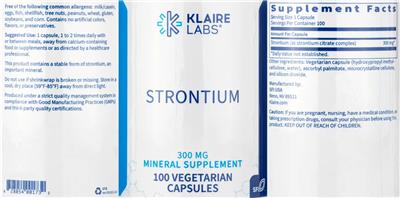
Strontium 300 mg by Klaire Labs label
The label scan from the NIH Dietary Supplement Label Database. Tap to enlarge.
Label images are published by the NIH Dietary Supplement Label Database for the version of this product on file. Always read your actual product label.
View the full label (PDF)The Ingredients in Strontium 300 mg by Klaire Labs
This is the 1 active ingredient this product is made of. Select it to open its full monograph.
Serving size1 Capsule(s) Dosage formCapsule Servings per container100 Amounts shown are per serving.
Strontium
Interacts with101 drugs
Strontium is a mineral that has been studied mainly for bone health and osteoporosis. The prescription form (strontium ranelate) showed benefit for fr...
Strontium monograph & interactionsOther (inactive) ingredients: Hydroxypropyl Methylcellulose, Water, Ascorbyl Palmitate, Microcrystalline Cellulose, Silicon Dioxide. These complete the product’s ingredient list but are not active constituents.
Strontium 300 mg by Klaire Labs Drug Interactions
HelloPharmacist Interaction Report
Strontium by Klaire Labs interacts with several common medication types, and the interactions are all Moderate in severity.
The most notable concern is with estrogens and androgens (like testosterone): these hormones may reduce how your body excretes strontium, potentially raising strontium levels and side effects in your body. A small study hints this could happen over 5–6 weeks of hormone use, though we don't yet know how clinically significant it is.
Read the full breakdown — every affected drug type, severity by severity
Antacids are another major concern. Aluminum or magnesium hydroxide can cut strontium absorption by about a fifth to a quarter; calcium in antacids is even more dramatic, reducing absorption by 60–70%.
If you take antacids, space them at least 2 hours away from your strontium dose.
Quinolone and tetracycline antibiotics (like ciprofloxacin or doxycycline) may also absorb poorly when strontium is present, because strontium can bind to them in your gut and block their uptake. Again, separate doses by at least 2 hours.
Altogether, these interactions span 101 individual medications. Use the medication checker on this page to look up your exact prescriptions.
Check your own medications below · Editorial policy · How we use AI
Want to check YOUR meds against Strontium 300 mg?
Ask about interactions with your drugs in plain English — “Can I take it with lisinopril?” — and we find you the answer in seconds, ingredient by ingredient.
Go to the checkerIngredients driving the most interactions
Individual Drug Interactions
The ingredients in Strontium 300 mg interact with 101 drugs. Click any drug to see the details.
1 of the 1 ingredient in Strontium 300 mg interact with drugs. Each result below shows which ingredient is responsible. Strontium
Alginic Acid, Aluminum HydroxideRafton
How Alginic Acid, Aluminum Hydroxide interacts with Strontium 300 mg — through 1 ingredient. Tap an ingredient for the detail:
StrontiumAntacids Moderate
Interaction Summary
Antacids can reduce the absorption of strontium, potentially decreasing its effectiveness.
Read the full Strontium + Alginic Acid, Aluminum Hydroxide interactionAluminum HydroxideAlu-Cap, Amphojel, Gaviscon
How Aluminum Hydroxide interacts with Strontium 300 mg — through 1 ingredient. Tap an ingredient for the detail:
StrontiumAntacids Moderate
Interaction Summary
Antacids can reduce the absorption of strontium, potentially decreasing its effectiveness.
Read the full Strontium + Aluminum Hydroxide interactionAluminum Hydroxide, Aspirin, Codeine Phosphate, Magnesium HydroxideAscriptin Codeine #2
How Aluminum Hydroxide, Aspirin, Codeine Phosphate, Magnesium Hydroxide interacts with Strontium 300 mg — through 1 ingredient. Tap an ingredient for the detail:
StrontiumAntacids Moderate
Interaction Summary
Antacids can reduce the absorption of strontium, potentially decreasing its effectiveness.
Read the full Strontium + Aluminum Hydroxide, Aspirin, Codeine Phosphate, Magnesium Hydroxide interactionAluminum Hydroxide, Aspirin, Magnesium HydroxideAscriptin
How Aluminum Hydroxide, Aspirin, Magnesium Hydroxide interacts with Strontium 300 mg — through 1 ingredient. Tap an ingredient for the detail:
StrontiumAntacids Moderate
Interaction Summary
Antacids can reduce the absorption of strontium, potentially decreasing its effectiveness.
Read the full Strontium + Aluminum Hydroxide, Aspirin, Magnesium Hydroxide interactionAluminum Hydroxide, Magnesium Hydroxide (otc Drug)Maalox, Mucogel
How Aluminum Hydroxide, Magnesium Hydroxide (otc Drug) interacts with Strontium 300 mg — through 1 ingredient. Tap an ingredient for the detail:
StrontiumAntacids Moderate
Interaction Summary
Antacids can reduce the absorption of strontium, potentially decreasing its effectiveness.
Read the full Strontium + Aluminum Hydroxide, Magnesium Hydroxide (otc Drug) interactionAluminum Hydroxide, Magnesium Hydroxide, Simethicone (otc Drug)Mylanta
How Aluminum Hydroxide, Magnesium Hydroxide, Simethicone (otc Drug) interacts with Strontium 300 mg — through 1 ingredient. Tap an ingredient for the detail:
StrontiumAntacids Moderate
Interaction Summary
Antacids can reduce the absorption of strontium, potentially decreasing its effectiveness.
Read the full Strontium + Aluminum Hydroxide, Magnesium Hydroxide, Simethicone (otc Drug) interactionAluminum, Magnesium (otc Drug)Almagel
How Aluminum, Magnesium (otc Drug) interacts with Strontium 300 mg — through 1 ingredient. Tap an ingredient for the detail:
StrontiumAntacids Moderate
Interaction Summary
Antacids can reduce the absorption of strontium, potentially decreasing its effectiveness.
Read the full Strontium + Aluminum, Magnesium (otc Drug) interactionAmphotericin, TetracyclineMysteclin-F
How Amphotericin, Tetracycline interacts with Strontium 300 mg — through 1 ingredient. Tap an ingredient for the detail:
StrontiumTetracycline Antibiotics Moderate
Interaction Summary
Theoretically, strontium might decrease the absorption of tetracycline antibiotics.
Read the full Strontium + Amphotericin, Tetracycline interactionAspirin, Aluminum Hydroxide, Codeine Phosphate, Magnesium HydroxideAscriptin Codeine #3
How Aspirin, Aluminum Hydroxide, Codeine Phosphate, Magnesium Hydroxide interacts with Strontium 300 mg — through 1 ingredient. Tap an ingredient for the detail:
StrontiumAntacids Moderate
Interaction Summary
Antacids can reduce the absorption of strontium, potentially decreasing its effectiveness.
Read the full Strontium + Aspirin, Aluminum Hydroxide, Codeine Phosphate, Magnesium Hydroxide interactionAspirin, Calcium Carbonate, Magnesium Carbonate, Magnesium OxideBufferin
How Aspirin, Calcium Carbonate, Magnesium Carbonate, Magnesium Oxide interacts with Strontium 300 mg — through 1 ingredient. Tap an ingredient for the detail:
StrontiumAntacids Moderate
Interaction Summary
Antacids can reduce the absorption of strontium, potentially decreasing its effectiveness.
Read the full Strontium + Aspirin, Calcium Carbonate, Magnesium Carbonate, Magnesium Oxide interactionAspirin, Citric Acid, Sodium BicarbonateAlka-Seltzer Pain Reliever and Antacid
How Aspirin, Citric Acid, Sodium Bicarbonate interacts with Strontium 300 mg — through 1 ingredient. Tap an ingredient for the detail:
StrontiumAntacids Moderate
Interaction Summary
Antacids can reduce the absorption of strontium, potentially decreasing its effectiveness.
Read the full Strontium + Aspirin, Citric Acid, Sodium Bicarbonate interactionBazedoxifene Acetate, Conjugated EstrogensDuavee
How Bazedoxifene Acetate, Conjugated Estrogens interacts with Strontium 300 mg — through 1 ingredient. Tap an ingredient for the detail:
StrontiumEstrogens Moderate
Interaction Summary
Theoretically, estrogens might reduce the excretion of strontium, potentially increasing its effects and adverse effects.
Read the full Strontium + Bazedoxifene Acetate, Conjugated Estrogens interactionBismuth Subcarbonate, Calcium Carbonate, OpiumDiabismul
How Bismuth Subcarbonate, Calcium Carbonate, Opium interacts with Strontium 300 mg — through 1 ingredient. Tap an ingredient for the detail:
StrontiumAntacids Moderate
Interaction Summary
Antacids can reduce the absorption of strontium, potentially decreasing its effectiveness.
Read the full Strontium + Bismuth Subcarbonate, Calcium Carbonate, Opium interactionBismuth Subsalicylate, Metronidazole, TetracyclineHelidac
How Bismuth Subsalicylate, Metronidazole, Tetracycline interacts with Strontium 300 mg — through 1 ingredient. Tap an ingredient for the detail:
StrontiumTetracycline Antibiotics Moderate
Interaction Summary
Theoretically, strontium might decrease the absorption of tetracycline antibiotics.
Read the full Strontium + Bismuth Subsalicylate, Metronidazole, Tetracycline interactionCalcium CarbonateAdcal, Adcal-D3, Calcichew, Os-Cal, Tums
How Calcium Carbonate interacts with Strontium 300 mg — through 1 ingredient. Tap an ingredient for the detail:
StrontiumAntacids Moderate
Interaction Summary
Antacids can reduce the absorption of strontium, potentially decreasing its effectiveness.
Read the full Strontium + Calcium Carbonate interactionChlortetracyclineAureomycin
How Chlortetracycline interacts with Strontium 300 mg — through 1 ingredient. Tap an ingredient for the detail:
StrontiumTetracycline Antibiotics Moderate
Interaction Summary
Theoretically, strontium might decrease the absorption of tetracycline antibiotics.
Read the full Strontium + Chlortetracycline interactionCinoxacinCinobac
How Cinoxacin interacts with Strontium 300 mg — through 1 ingredient. Tap an ingredient for the detail:
StrontiumQuinolone Antibiotics Moderate
Interaction Summary
Theoretically, strontium might decrease the absorption of quinolone antibiotics.
Read the full Strontium + Cinoxacin interactionCiprofloxacinCiloxan, Cipro, Cipro IV, Cipro XR, Ciprobay, Otiprio
How Ciprofloxacin interacts with Strontium 300 mg — through 1 ingredient. Tap an ingredient for the detail:
StrontiumQuinolone Antibiotics Moderate
Interaction Summary
Theoretically, strontium might decrease the absorption of quinolone antibiotics.
Read the full Strontium + Ciprofloxacin interactionClinafloxacinClinafloxacin
How Clinafloxacin interacts with Strontium 300 mg — through 1 ingredient. Tap an ingredient for the detail:
StrontiumQuinolone Antibiotics Moderate
Interaction Summary
Theoretically, strontium might decrease the absorption of quinolone antibiotics.
Read the full Strontium + Clinafloxacin interactionConjugated EstrogensCenestin, Enjuvia, Premarin, Premarin Vaginal Cream
How Conjugated Estrogens interacts with Strontium 300 mg — through 1 ingredient. Tap an ingredient for the detail:
StrontiumEstrogens Moderate
Interaction Summary
Theoretically, estrogens might reduce the excretion of strontium, potentially increasing its effects and adverse effects.
Read the full Strontium + Conjugated Estrogens interactionConjugated Estrogens, Medroxyprogesterone AcetatePremplus, Prempro
How Conjugated Estrogens, Medroxyprogesterone Acetate interacts with Strontium 300 mg — through 1 ingredient. Tap an ingredient for the detail:
StrontiumEstrogens Moderate
Interaction Summary
Theoretically, estrogens might reduce the excretion of strontium, potentially increasing its effects and adverse effects.
Read the full Strontium + Conjugated Estrogens, Medroxyprogesterone Acetate interactionConjugated Estrogens, MeprobamatePMB 200, PMB 400
How Conjugated Estrogens, Meprobamate interacts with Strontium 300 mg — through 1 ingredient. Tap an ingredient for the detail:
StrontiumEstrogens Moderate
Interaction Summary
Theoretically, estrogens might reduce the excretion of strontium, potentially increasing its effects and adverse effects.
Read the full Strontium + Conjugated Estrogens, Meprobamate interactionConjugated Estrogens, MethyltestosteronePremarin with Methyltestosterone
How Conjugated Estrogens, Methyltestosterone interacts with Strontium 300 mg — through 1 ingredient. Tap an ingredient for the detail:
StrontiumEstrogens, Androgens Moderate
Interaction Summary
Theoretically, estrogens might reduce the excretion of strontium, potentially increasing its effects and adverse effects.
Read the full Strontium + Conjugated Estrogens, Methyltestosterone interactionCyproterone Acetate, Ethinyl EstradiolDiane-35, Dianette
How Cyproterone Acetate, Ethinyl Estradiol interacts with Strontium 300 mg — through 1 ingredient. Tap an ingredient for the detail:
StrontiumEstrogens Moderate
Interaction Summary
Theoretically, estrogens might reduce the excretion of strontium, potentially increasing its effects and adverse effects.
Read the full Strontium + Cyproterone Acetate, Ethinyl Estradiol interactionDemeclocyclineDeclomycin
How Demeclocycline interacts with Strontium 300 mg — through 1 ingredient. Tap an ingredient for the detail:
StrontiumTetracycline Antibiotics Moderate
Interaction Summary
Theoretically, strontium might decrease the absorption of tetracycline antibiotics.
Read the full Strontium + Demeclocycline interactionDesogestrel, Ethinyl EstradiolDesogen, Marvelon, Marvelon 21, Marvelon 28, Mircette, Ortho-Cept +2 more
How Desogestrel, Ethinyl Estradiol interacts with Strontium 300 mg — through 1 ingredient. Tap an ingredient for the detail:
StrontiumEstrogens Moderate
Interaction Summary
Theoretically, estrogens might reduce the excretion of strontium, potentially increasing its effects and adverse effects.
Read the full Strontium + Desogestrel, Ethinyl Estradiol interactionDiethylstilbestrol, MethyltestosteroneTylosterone
How Diethylstilbestrol, Methyltestosterone interacts with Strontium 300 mg — through 1 ingredient. Tap an ingredient for the detail:
StrontiumAndrogens Moderate
Interaction Summary
Theoretically, androgens might reduce the excretion of strontium, potentially increasing its effects and adverse effects.
Read the full Strontium + Diethylstilbestrol, Methyltestosterone interactionDihydroxyaluminum Sodium CarbonateRolaids
How Dihydroxyaluminum Sodium Carbonate interacts with Strontium 300 mg — through 1 ingredient. Tap an ingredient for the detail:
StrontiumAntacids Moderate
Interaction Summary
Antacids can reduce the absorption of strontium, potentially decreasing its effectiveness.
Read the full Strontium + Dihydroxyaluminum Sodium Carbonate interactionDoripenemDoribax
How Doripenem interacts with Strontium 300 mg — through 1 ingredient. Tap an ingredient for the detail:
StrontiumQuinolone Antibiotics, Tetracycline Antibiotics Moderate
Interaction Summary
Theoretically, strontium might decrease the absorption of quinolone antibiotics.
Read the full Strontium + Doripenem interactionDoxycyclineDoryx, Doxy, Doxy-D, Doxycin, Doxycycline Injection, Doxylin +6 more
How Doxycycline interacts with Strontium 300 mg — through 1 ingredient. Tap an ingredient for the detail:
StrontiumTetracycline Antibiotics Moderate
Interaction Summary
Theoretically, strontium might decrease the absorption of tetracycline antibiotics.
Read the full Strontium + Doxycycline interactionEach ingredient & the kinds of drugs it affects
For each ingredient in Strontium 300 mg with known interactions, here are the types of medications it can affect. Open any type for the detail — or search your exact drug in the checker above.
Strontium
Androgens
Theoretically, androgens might reduce the excretion of strontium, potentially increasing its effects and adverse effects.
A small clinical study suggests that treatment with androgens such as testosterone, nandrolone, oxandrolone, and oxymetholone for 5-6 weeks might decrease urinary strontium excretion. The clinical significance of this interaction is unknown.
Antacids
Antacids can reduce the absorption of strontium, potentially decreasing its effectiveness.
Aluminum hydroxide and magnesium hydroxide can reduce absorption of strontium ranelate by 20% to 25%. Calcium can reduce its absorption to 60% to 70%. Avoid taking antacids within 2 hours of a dose of strontium ranelate. This interaction has also been reported with orally-administered radioactive strontium-85. It will likely also occur with other forms of strontium.
Estrogens
Theoretically, estrogens might reduce the excretion of strontium, potentially increasing its effects and adverse effects.
A small clinical study suggests that treatment with estrogens for 5-6 weeks might decrease urinary strontium excretion. The clinical significance of this interaction is unknown.
Quinolone Antibiotics
Theoretically, strontium might decrease the absorption of quinolone antibiotics.
Strontium is a divalent cation with similar properties to calcium. It is likely to form complexes with quinolones in the gastrointestinal (GI) tract, preventing absorption of the antibiotic. Recommend taking strontium supplements at least 2 hours before or after quinolones to avoid an interaction.
Tetracycline Antibiotics
Theoretically, strontium might decrease the absorption of tetracycline antibiotics.
Strontium is a divalent cation with similar properties to calcium. It is likely to form complexes with tetracyclines in the gastrointestinal (GI) tract, preventing absorption of the antibiotic. Recommend taking strontium supplements at least 2 hours before or after tetracyclines to avoid an interaction.
Brand information
Manufacturer and brand details for Strontium 300 mg, from the product label.
Klaire Labs
See all Klaire Labs products- Name
- SFI USA
- City
- Reno
- State
- NV
- ZipCode
- 89521
- Web Address
- Klaire.com
Strontium 300 mg by Klaire Labs: Common Questions
Does Strontium 300 mg by Klaire Labs interact with any medications?
How can one product interact with so many drugs?
Where does this information come from?
What is strontium used for?
Can I take strontium with my antacid?
What are the most common side effects?
Is strontium safe in pregnancy or while breastfeeding?
Are there serious risks I should know about?
Does strontium interact with antibiotics?
Written and reviewed by the HelloPharmacist editorial staff. Our editorial policy
Not sure if Strontium 300 mg is safe with your meds?
Our pharmacists answer your medication & supplement questions — free.
Label information is sourced from the NIH Dietary Supplement Label Database and reflects the product version on file; always read your actual product label. This page is for education only and is not a substitute for professional medical advice. Confirm with your pharmacist or doctor before combining supplements and medications.
The Full Monographs Behind Strontium 300 mg’s Ingredients
Every ingredient we hold a full HelloPharmacist monograph for — uses, evidence, safety, and the complete interaction list.
Sources & How We Checked
Strontium 300 mg's label data comes from the NIH Dietary Supplement Label Database; the ingredient interaction data is from the Natural Medicines database, reviewed by our pharmacists.
- NIH Dietary Supplement Label Database (DSLD) — The official product label on file for this supplement.
- Natural Medicines (Therapeutic Research Center) — Evidence-graded clinical reference behind the ingredient interaction data.
Content is written and reviewed by licensed HelloPharmacist pharmacists. See our data sources and editorial standards for how this information is built and checked.
The 22 references behind this product’s interaction data
Every citation that drives the interaction findings for this product’s ingredients, from the evidence-graded Natural Medicines (TRC Healthcare) database. Open an ingredient to browse its citations — links open the study on PubMed or the publisher’s site.
Strontium 22 references
- Martindale W. Martindale the Extra Pharmacopoeia. Pharmaceutical Press, 1999.
- Meunier PJ, Roux C, Seeman E, et al. The effects of strontium ranelate on the risk of vertebral fracture in women with postmenopausal osteoporosis. N Engl J Med 2004;350:459-68.. PubMed
- El-Hajj Fuleihan G. Strontium ranelate--a novel therapy for osteoporosis or a permutation of the same? N Engl J Med 2004;350:504-6. PubMed
- Verberckmoes SC, De Broe ME, D'Haese PC. Dose-dependent effects of strontium on osteoblast function and mineralization. Kidney Int 2003;64:534-43. . PubMed
- Meunier PJ, Slosman DO, Delmas PD, et al. Strontium ranelate: dose-dependent effects in established postmenopausal vertebral osteoporosis--a 2-year randomized placebo controlled trial. J Clin Endocrinol Metab 2002;87:2060-6.. DOI
- Brandi ML. New treatment strategies: ipriflavone, strontium, vitamin D metabolites and analogs. Am J Med 1993;95:69S-74S. . PubMed
- Eisenberg E. Effects of androgens, estrogens and corticoids on strontium kinetics in man. J Clin Endocrinol Metab 1966;26:566-72.
- Metastron prescribing information. Medi-Physics, Inc., Amersham Healthcare, Arlington Heights, IL, 1998. http://www.cancerpaintherapy.com/METATECHPAGE.htm. (Accessed 13 March 2004).
- Protelos European Summary of Product Characteristics. Les Laboratoires Servier, 2006. Available at: www.servier.com/pro/osteoporose/protelos/protelos_spc.asp. (Accessed 01 August 2006).
- US Department of Health and Human Services, Public Health Service. Agency for Toxic Substances and Disease Registry. Toxicological profile for strontium. April 2004. Available at: www.atsdr.cdc.gov/toxprofiles/tp159.pdf. (Accessed 8 August 2006).
- Apostolidis N, Paradellis T, Karydas A, et al. Calcium and strontium metabolic studies in patients on CAPD. Perit Dial Int 1998;18:410-4. DOI
- Ozgur S, Sumer H, Kocoglu G. Rickets and soil strontium. Arch Dis Child 1996;75:524-6. PubMed
- Schrooten I, Elseviers MM, Lamberts LV, et al. Increased serum strontium levels in dialysis patients: an epidemiological survey. Kidney Int 1999;56:1886-92. PubMed
- D'Haese PC, Couttenye MM, Lamberts LV, et al. Aluminum, iron, lead, cadmium, copper, zinc, chromium, magnesium, strontium, and calcium content in bone of end-stage renal failure patients. Clin Chem 1999;45:1548-56. DOI
- Pennington JA, Jones JW. Molybdenum, nickel, cobalt, vanadium, and strontium in total diets. J Am Diet Assoc 1987;87:1644-50. DOI
- O'Donnell S, Cranney A, Wells GA, et al. Strontium ranelate for preventing and treating postmenopausal osteoporosis. Cochrane Musculoskeletal Group. Cochrane Database Syst Rev 2006;(4):CD005326. PubMed
- Protelos European Public Assessment Report, Scientific Discussion. European Medicines Agency, 2005. Available at: www.emea.eu.int/humandocs/Humans/EPAR/protelos/protelos.htm. (Accessed 10 October 2006).
- Rousselet F, El Solh N, Maurat JP, et al. Strontium and calcium metabolism. Interaction of strontium and vitamin D. C R Seances Soc Biol Fil 1975;169:322-9.
- O'Donnell, S., Cranney, A., Wells, G. A., Adachi, J. D., and Reginster, J. Y. Strontium ranelate for preventing and treating postmenopausal osteoporosis. Cochrane.Database.Syst.Rev. 2006;3:CD005326. PubMed
- Rizzoli R, Chapurlat RD, Laroche JM, et al. Effects of strontium ranelate and alendronate on bone microstructure in women with osteoporosis. Results of a 2-year study. Osteoporosis Int. 2012. 23(1):305-315. doi: 10.1007/s00198-011-1758-z. PubMed
- Reginster JY, Kaufman JM, Goemaere S, et al. Maintenance of antifracture efficacy over 10 years with strontium ranelate in postmenopausal osteoporosis. Osteoporos Int. 2012;23(3):1115-1122. doi: 10.1007/s00198-011-1847-z. PubMed
- Protos [Product Information]. Available at: http://www.guildlink.com.au/gc/ws/servier/pi.cfm?product=sepproto. Accessed May 1, 2018.
Parts of this content are provided by the Therapeutic Research Center, LLC.
DISCLAIMER: Currently this does not check for drug-drug interactions. This is not an all-inclusive comprehensive list of potential interactions and is for informational purposes only. Not all interactions are known or well-reported in the scientific literature, and new interactions are continually being reported. Input is needed from a qualified healthcare provider including a pharmacist before starting any therapy. Application of clinical judgment is necessary.
© 2021 Therapeutic Research Center, LLC