
Wormwood Ingredients & Drug Interactions
What is this page for?
First and foremost: checking Wormwood against your medications. The heart of this page is the interaction checker and the full interaction report — how this product’s ingredients may interact with prescription and over-the-counter medicines you may be taking.
Around that, we add a pharmacist’s high-level view of the product as a whole — what’s inside, the evidence for its stated use, how transparent the label is, and what safety data exists — so you can see the full picture in one place. It’s educational information from our licensed clinical databases and the clinical staff at HelloPharmacist — not medical advice — and we don’t sell or endorse products. Our editorial policy
Wormwood is a dietary supplement by Red Moon Herbs with 1 active ingredient. Its ingredients are commonly taken for digestive upset and poor appetite, intestinal parasites, crohn's disease symptoms.Based on those ingredients, 50 medications have a known interaction with it, the most serious rated moderate. The ingredients most likely to interact are Wormwood Flowering Top Extract, Fresh. Use the checker below to test your specific medication, or read the full HelloPharmacist Interaction Report.
Check Your Meds Against Wormwood by Red Moon Herbs
Ask about any prescription or over-the-counter medication and we check it for interactions with Wormwood by Red Moon Herbs — and tell you which ingredient is responsible.
AI summaries are generated from our interaction database for education only — always confirm with your pharmacist. How we use AI
Ask the Pharmacist
A licensed pharmacist will answer your question by email — free, usually within 24 hours.
Got it — thank you!
A licensed pharmacist will answer within 24 hours. Keep an eye on your email (worth checking spam, just in case).
HelloPharmacist Scorecard of Wormwood by Red Moon Herbs
Our pharmacy team’s full take, with four database checks built into the cards below — a summary of what is known, not a grade of the product itself.
What’s inside
Low disclosure
This liquid contains one active ingredient: wormwood flowering top extract made from fresh plant material. The liquid itself is prepared with water and alcohol as inactive carriers.
Does it work?
Not established
The evidence for wormwood doesn't establish whether it works for any of the conditions listed — biliary disorders, Crohn disease, depression, dyspepsia (indigestion), and osteoarthritis all show insufficient reliable evidence to rate in our data.
How safe is it?
Well-documented data
Wormwood contains thujone, a neurotoxin, and the safety data raises real concerns. Short-term use of properly prepared products may be acceptable, but higher amounts can be toxic.
The most common side effects from the oil are muscle aches, nausea, and vomiting. Rare but serious effects include kidney damage, muscle breakdown, and seizures.
Chronic use — historically tied to absinthe consumption — has been linked to addiction, hallucinations, tremors, paralysis, and brain damage. The safety data advises against use during pregnancy because wormwood may stimulate the uterus.
There isn't enough safety information to know whether it's safe while breastfeeding, so it's best avoided then too.
Meds to double-check
Moderate interaction found
If you take anticonvulsant drugs (seizure medications), check with your pharmacist before using this product — wormwood may interfere with how they work. The thujone in wormwood can have seizure-triggering effects.
The bottom line
Scorecard at a glanceFormula with limited ingredient disclosure with no established evidence rating for its marketed use. Moderate medication interactions have been identified, and safety information is well characterized.
Wormwood is not well established for the conditions it's marketed for. If you take anticonvulsant medication, don't use this product without talking to your pharmacist or doctor first.
Even if you don't, the thujone content and potential for serious side effects — especially with chronic use — means you should have a conversation before starting.
Educational only — not medical advice; always confirm with your pharmacist. Our editorial policy · How we use AI
Assessment coverage: 1 of 1 active ingredient matched to our full ingredient reviews (monographs). Based on the product label dated Nov 22, 2024.
This Scorecard evaluates available label information, ingredient evidence, and known medication-safety considerations. It does not independently verify product identity, purity, potency, contamination, or manufacturing quality. How these ratings are computed
General information
Key facts about Wormwood, straight from the product label.
| Brand | Red Moon Herbs |
|---|---|
| Barcode (UPC) | 857999002450 |
| Net contents | 1 Fluid Ounce(s); 30 mL |
| Market status | On market |
| Date entered into DSLD | Nov 22, 2024 |
| DSLD ID | 319337 |
| Product type | Botanical |
| Supplement form | Liquid |
| Dietary claims / uses | All Other |
| Intended target group(s) | Adult (18 - 50 Years), Children (All), Infants/Baby (0 - 1 Year), Seniors/Mature (>50 Years) |
Everything in this section is reproduced from the manufacturer’s own product label — it’s the label speaking, not HelloPharmacist. We show it so you can see exactly what the maker states; we don’t verify or endorse those statements.
Supplement Facts
The label details for Wormwood by Red Moon Herbs, sourced from the NIH Dietary Supplement Label Database.
Supplement Facts
| Ingredient | Amount | % DV |
|---|---|---|
| EXTRACT | 0 NP | -- |
| Wormwood Flowering Top Extract, Fresh | 0 NP | -- |
Other ingredients: Water, Alcohol
Tap any ingredient to jump to its full detail below.
These statements are the manufacturer’s wording, reproduced from the product label — the label is saying it, not HelloPharmacist. We don’t verify or endorse them.
Suggested/Recommended/Usage/Directions
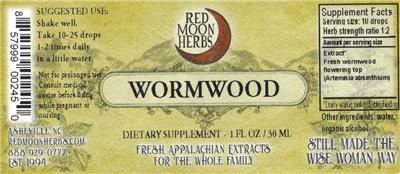
Suggested use: Shake well. Take 10-25 drops 1-2 times daily in a little water.
Precautions
Not for prolonged use.
Consult medical advice before using while pregnant or nursing.
General Statements
Red Moon Herbs Est. 1994
Still made the wise woman way
FDA Statement of Identity
Dietary Supplement
Formula
Fresh Appalachian Extracts for the whole family
Is this label outdated? Report a formula or label change and our pharmacy team will review it.
Wormwood by Red Moon Herbs label
The label scan from the NIH Dietary Supplement Label Database. Tap to enlarge.
Label images are published by the NIH Dietary Supplement Label Database for the version of this product on file. Always read your actual product label.
View the full label (PDF)The Ingredients in Wormwood by Red Moon Herbs
This is the 1 active ingredient this product is made of. Select it to open its full monograph.
Serving size10 Drop(s) Dosage formLiquid Amounts shown are per serving.
EXTRACT
Other (inactive) ingredients: Water, Alcohol. These complete the product’s ingredient list but are not active constituents.
Wormwood by Red Moon Herbs Drug Interactions
HelloPharmacist Interaction Report
Wormwood by Red Moon Herbs does interact with one category of medication.
The ingredient wormwood contains thujone, a compound with convulsant (seizure-triggering) properties. Taking this product may theoretically interfere with anticonvulsant drugs — the medications you take to prevent or control seizures.
That's a moderate-level concern.
Read the full breakdown — every affected drug type, severity by severity
Additionally, we hold interaction data only for anticonvulsants at this time. Altogether, these interactions span 50 individual medications.
If you take any seizure medication or any other prescription drugs, run them through the interaction checker on this page before you start.
Check your own medications below · Editorial policy · How we use AI
Want to check YOUR meds against Wormwood?
Ask about interactions with your drugs in plain English — “Can I take it with lisinopril?” — and we find you the answer in seconds, ingredient by ingredient.
Go to the checkerIngredients driving the most interactions
Individual Drug Interactions
The ingredients in Wormwood interact with 50 drugs. Click any drug to see the details.
1 of the 1 ingredient in Wormwood interact with drugs. Each result below shows which ingredient is responsible. Wormwood Flowering Top Extract, Fresh
MephobarbitalMebaral
How Mephobarbital interacts with Wormwood — through 1 ingredient. Tap an ingredient for the detail:
Wormwood Flowering Top Extract, FreshAnticonvulsants Moderate
Interaction Summary
Theoretically, taking wormwood might interfere with the effects of anticonvulsant drugs.
Read the full Wormwood Flowering Top Extract, Fresh + Mephobarbital interactionMethsuximideCelontin
How Methsuximide interacts with Wormwood — through 1 ingredient. Tap an ingredient for the detail:
Wormwood Flowering Top Extract, FreshAnticonvulsants Moderate
Interaction Summary
Theoretically, taking wormwood might interfere with the effects of anticonvulsant drugs.
Read the full Wormwood Flowering Top Extract, Fresh + Methsuximide interactionOxazepamSerax
How Oxazepam interacts with Wormwood — through 1 ingredient. Tap an ingredient for the detail:
Wormwood Flowering Top Extract, FreshAnticonvulsants Moderate
Interaction Summary
Theoretically, taking wormwood might interfere with the effects of anticonvulsant drugs.
Read the full Wormwood Flowering Top Extract, Fresh + Oxazepam interactionOxcarbazepineOxtellar XR, Trileptal
How Oxcarbazepine interacts with Wormwood — through 1 ingredient. Tap an ingredient for the detail:
Wormwood Flowering Top Extract, FreshAnticonvulsants Moderate
Interaction Summary
Theoretically, taking wormwood might interfere with the effects of anticonvulsant drugs.
Read the full Wormwood Flowering Top Extract, Fresh + Oxcarbazepine interactionPentobarbitalNembutal
How Pentobarbital interacts with Wormwood — through 1 ingredient. Tap an ingredient for the detail:
Wormwood Flowering Top Extract, FreshAnticonvulsants Moderate
Interaction Summary
Theoretically, taking wormwood might interfere with the effects of anticonvulsant drugs.
Read the full Wormwood Flowering Top Extract, Fresh + Pentobarbital interactionPentobarbitonePentobarbitone
How Pentobarbitone interacts with Wormwood — through 1 ingredient. Tap an ingredient for the detail:
Wormwood Flowering Top Extract, FreshAnticonvulsants Moderate
Interaction Summary
Theoretically, taking wormwood might interfere with the effects of anticonvulsant drugs.
Read the full Wormwood Flowering Top Extract, Fresh + Pentobarbitone interactionPhenacemidePhenurone
How Phenacemide interacts with Wormwood — through 1 ingredient. Tap an ingredient for the detail:
Wormwood Flowering Top Extract, FreshAnticonvulsants Moderate
Interaction Summary
Theoretically, taking wormwood might interfere with the effects of anticonvulsant drugs.
Read the full Wormwood Flowering Top Extract, Fresh + Phenacemide interactionPhenobarbitalLuminal, Phenobarbital, Solfoton
How Phenobarbital interacts with Wormwood — through 1 ingredient. Tap an ingredient for the detail:
Wormwood Flowering Top Extract, FreshAnticonvulsants Moderate
Interaction Summary
Theoretically, taking wormwood might interfere with the effects of anticonvulsant drugs.
Read the full Wormwood Flowering Top Extract, Fresh + Phenobarbital interactionPhenobarbital, PhenytoinDilantin with PB
How Phenobarbital, Phenytoin interacts with Wormwood — through 1 ingredient. Tap an ingredient for the detail:
Wormwood Flowering Top Extract, FreshAnticonvulsants Moderate
Interaction Summary
Theoretically, taking wormwood might interfere with the effects of anticonvulsant drugs.
Read the full Wormwood Flowering Top Extract, Fresh + Phenobarbital, Phenytoin interactionPhensuximideMilontin
How Phensuximide interacts with Wormwood — through 1 ingredient. Tap an ingredient for the detail:
Wormwood Flowering Top Extract, FreshAnticonvulsants Moderate
Interaction Summary
Theoretically, taking wormwood might interfere with the effects of anticonvulsant drugs.
Read the full Wormwood Flowering Top Extract, Fresh + Phensuximide interactionPhentermine, TopiramateQsymia
How Phentermine, Topiramate interacts with Wormwood — through 1 ingredient. Tap an ingredient for the detail:
Wormwood Flowering Top Extract, FreshAnticonvulsants Moderate
Interaction Summary
Theoretically, taking wormwood might interfere with the effects of anticonvulsant drugs.
Read the full Wormwood Flowering Top Extract, Fresh + Phentermine, Topiramate interactionPhenytoinDi-Phen, Dilantin, Dilantin Infatabs, Dilantin injection, Dilantin Kapseals, Phenytek
How Phenytoin interacts with Wormwood — through 1 ingredient. Tap an ingredient for the detail:
Wormwood Flowering Top Extract, FreshAnticonvulsants Moderate
Interaction Summary
Theoretically, taking wormwood might interfere with the effects of anticonvulsant drugs.
Read the full Wormwood Flowering Top Extract, Fresh + Phenytoin interactionPrimidoneMysoline
How Primidone interacts with Wormwood — through 1 ingredient. Tap an ingredient for the detail:
Wormwood Flowering Top Extract, FreshAnticonvulsants Moderate
Interaction Summary
Theoretically, taking wormwood might interfere with the effects of anticonvulsant drugs.
Read the full Wormwood Flowering Top Extract, Fresh + Primidone interactionSodium ValproateEpilim
How Sodium Valproate interacts with Wormwood — through 1 ingredient. Tap an ingredient for the detail:
Wormwood Flowering Top Extract, FreshAnticonvulsants Moderate
Interaction Summary
Theoretically, taking wormwood might interfere with the effects of anticonvulsant drugs.
Read the full Wormwood Flowering Top Extract, Fresh + Sodium Valproate interactionTiagabineGabitril
How Tiagabine interacts with Wormwood — through 1 ingredient. Tap an ingredient for the detail:
Wormwood Flowering Top Extract, FreshAnticonvulsants Moderate
Interaction Summary
Theoretically, taking wormwood might interfere with the effects of anticonvulsant drugs.
Read the full Wormwood Flowering Top Extract, Fresh + Tiagabine interactionTopiramateEprontia, Qudexy XR, Topamax, Trokendi XR
How Topiramate interacts with Wormwood — through 1 ingredient. Tap an ingredient for the detail:
Wormwood Flowering Top Extract, FreshAnticonvulsants Moderate
Interaction Summary
Theoretically, taking wormwood might interfere with the effects of anticonvulsant drugs.
Read the full Wormwood Flowering Top Extract, Fresh + Topiramate interactionTrimethadioneTridione
How Trimethadione interacts with Wormwood — through 1 ingredient. Tap an ingredient for the detail:
Wormwood Flowering Top Extract, FreshAnticonvulsants Moderate
Interaction Summary
Theoretically, taking wormwood might interfere with the effects of anticonvulsant drugs.
Read the full Wormwood Flowering Top Extract, Fresh + Trimethadione interactionValproic AcidDepacon, Depakene, Valproate
How Valproic Acid interacts with Wormwood — through 1 ingredient. Tap an ingredient for the detail:
Wormwood Flowering Top Extract, FreshAnticonvulsants Moderate
Interaction Summary
Theoretically, taking wormwood might interfere with the effects of anticonvulsant drugs.
Read the full Wormwood Flowering Top Extract, Fresh + Valproic Acid interactionVigabatrinSabril
How Vigabatrin interacts with Wormwood — through 1 ingredient. Tap an ingredient for the detail:
Wormwood Flowering Top Extract, FreshAnticonvulsants Moderate
Interaction Summary
Theoretically, taking wormwood might interfere with the effects of anticonvulsant drugs.
Read the full Wormwood Flowering Top Extract, Fresh + Vigabatrin interactionZonisamideZonegran, Zonisade
How Zonisamide interacts with Wormwood — through 1 ingredient. Tap an ingredient for the detail:
Wormwood Flowering Top Extract, FreshAnticonvulsants Moderate
Interaction Summary
Theoretically, taking wormwood might interfere with the effects of anticonvulsant drugs.
Read the full Wormwood Flowering Top Extract, Fresh + Zonisamide interactionEach ingredient & the kinds of drugs it affects
For each ingredient in Wormwood with known interactions, here are the types of medications it can affect. Open any type for the detail — or search your exact drug in the checker above.
Wormwood Flowering Top Extract, Fresh
Anticonvulsants
Theoretically, taking wormwood might interfere with the effects of anticonvulsant drugs.
Thujone, a constituent of wormwood, has convulsant effects.
Brand information
Manufacturer and brand details for Wormwood, from the product label.
Red Moon Herbs
See all Red Moon Herbs products- Name
- Red Moon Herbs
- City
- Asheville
- State
- NC
- Phone Number
- 888-929-0777
- Web Address
- redmoonherbs.com
Wormwood by Red Moon Herbs: Common Questions
Does Wormwood by Red Moon Herbs interact with any medications?
How can one product interact with so many drugs?
Where does this information come from?
Is wormwood safe to use while I'm pregnant?
What are the main side effects I should watch for?
Does wormwood actually work for digestive problems or arthritis?
Why does this product contain alcohol?
Is it safe to use long-term?
Written and reviewed by the HelloPharmacist editorial staff. Our editorial policy
Not sure if Wormwood is safe with your meds?
Our pharmacists answer your medication & supplement questions — free.
Label information is sourced from the NIH Dietary Supplement Label Database and reflects the product version on file; always read your actual product label. This page is for education only and is not a substitute for professional medical advice. Confirm with your pharmacist or doctor before combining supplements and medications.
The Full Monographs Behind Wormwood’s Ingredients
Every ingredient we hold a full HelloPharmacist monograph for — uses, evidence, safety, and the complete interaction list.
Sources & How We Checked
Wormwood's label data comes from the NIH Dietary Supplement Label Database; the ingredient interaction data is from the Natural Medicines database, reviewed by our pharmacists.
- NIH Dietary Supplement Label Database (DSLD) — The official product label on file for this supplement.
- Natural Medicines (Therapeutic Research Center) — Evidence-graded clinical reference behind the ingredient interaction data.
Content is written and reviewed by licensed HelloPharmacist pharmacists. See our data sources and editorial standards for how this information is built and checked.
The 10 references behind this product’s interaction data
Every citation that drives the interaction findings for this product’s ingredients, from the evidence-graded Natural Medicines (TRC Healthcare) database. Open an ingredient to browse its citations — links open the study on PubMed or the publisher’s site.
Wormwood 10 references
- Weisbord SD, Soule JB, Kimmel PL. Poison on line-acute renal failure caused by oil of wormwood purchased through the internet. N Engl J Med 1997;337:825-7. PubMed
- Gambelunghe C, Melai P. Absinthe: enjoying a new popularity among young people? Forensic Sci Int 2002;130:183-6.
- Hold KM, Sirisoma NS, Casida JE. Detoxification of alpha- and beta-Thujones (the active ingredients of absinthe): site specificity and species differences in cytochrome P450 oxidation in vitro and in vivo. Chem Res Toxicol 2001;14:589-95.
- Lachenmeier DW, Walch SG, Padosch SA, Kroner LU. Absinthe--a review. Crit Rev Food Sci Nutr 2006;46:365-77.
- Padosch SA, Lachenmeier DW, Kroner LU. Absinthism: a fictitious 19th century syndrome with present impact. Subst Abuse Treat Prev Policy 2006;1:14. PubMed
- Lachenmeier DW, Emmert J, Kuballa T, Sartor G. Thujone--cause of absinthism? Forensic Sci Int 2006;158:1-8. PubMed
- Dettling, A., Grass, H., Schuff, A., Skopp, G., Strohbeck-Kuehner, P., and Haffner, H. T. Absinthe: attention performance and mood under the influence of thujone. J Stud.Alcohol 2004;65(5):573-581. PubMed
- Benezet-Mazuecos, J. and de la Fuente, A. Electrocardiographic findings after acute absinthe intoxication. Int J Cardiol. 11-10-2006;113(2):e48-e50. PubMed
- El Makrini NI, Hassam B. Artemisia absinthium: burning plant! Pan Afr Med J. 2016 Jan 22;23:10. PubMed
- Kocaoglu C, Ozel A. Persistent metabolic acidosis and severe diarrhoea due to Artemisia absinthium poisoning. J Pak Med Assoc. 2014 Sep;64(9):1081-3.
Parts of this content are provided by the Therapeutic Research Center, LLC.
DISCLAIMER: Currently this does not check for drug-drug interactions. This is not an all-inclusive comprehensive list of potential interactions and is for informational purposes only. Not all interactions are known or well-reported in the scientific literature, and new interactions are continually being reported. Input is needed from a qualified healthcare provider including a pharmacist before starting any therapy. Application of clinical judgment is necessary.
© 2021 Therapeutic Research Center, LLC