
Youthful Legs Ingredients & Drug Interactions
What is this page for?
First and foremost: checking Youthful Legs against your medications. The heart of this page is the interaction checker and the full interaction report — how this product’s ingredients may interact with prescription and over-the-counter medicines you may be taking.
Around that, we add a pharmacist’s high-level view of the product as a whole — what’s inside, the evidence for its stated use, how transparent the label is, and what safety data exists — so you can see the full picture in one place. It’s educational information from our licensed clinical databases and the clinical staff at HelloPharmacist — not medical advice — and we don’t sell or endorse products. Our editorial policy
Youthful Legs is a dietary supplement by Life Extension with 1 active ingredient. Its ingredients are commonly taken for vitamin c source, digestive upset, stress and relaxation (aromatherapy).Based on those ingredients, 912 medications have a known interaction with it, the most serious rated major. The ingredients most likely to interact are Sweet Orange Peel Extract. Use the checker below to test your specific medication, or read the full HelloPharmacist Interaction Report.
Check Your Meds Against Youthful Legs by Life Extension
Ask about any prescription or over-the-counter medication and we check it for interactions with Youthful Legs by Life Extension — and tell you which ingredient is responsible.
AI summaries are generated from our interaction database for education only — always confirm with your pharmacist. How we use AI
Ask the Pharmacist
A licensed pharmacist will answer your question by email — free, usually within 24 hours.
Got it — thank you!
A licensed pharmacist will answer within 24 hours. Keep an eye on your email (worth checking spam, just in case).
HelloPharmacist Scorecard of Youthful Legs by Life Extension
Our pharmacy team’s full take, with four database checks built into the cards below — a summary of what is known, not a grade of the product itself.
What’s inside
Full disclosure
Youthful Legs contains 2 active ingredients. The main one is diosmin, a plant compound used to support circulation and vein health in the legs.
The product also contains flavonoids — a group of plant-based compounds with antioxidant properties — delivered as a micronized purified flavonoid fraction and sweet orange peel extract. The remaining ingredients are inactive: sunflower oil, gelatin, glycerin, purified water, sunflower lecithin, beeswax, and annatto (a natural colorant).
Does it work?
Moderate evidence
Diosmin is rated possibly effective for chronic venous insufficiency — a condition where veins in the legs have trouble returning blood to the heart — and for venous leg ulcers. It's also possibly effective for hemorrhoids.
For back pain and diabetic nerve pain, the evidence we hold is insufficient to rate how well it works.
How safe is it?
Well-documented data
Diosmin is generally well tolerated short-term, though long-term safety isn't as well studied. The most common side effects from oral diosmin are abdominal pain, diarrhea, dizziness, gastritis, nausea, and skin inflammation or redness.
Rarely, serious effects like irregular heartbeat (cardiac arrhythmias) or a type of anemia (hemolytic anemia) have been reported. The safety data rates diosmin as likely safe or possibly safe in pregnancy and lactation, but since safety isn't fully established, use only under medical supervision.
Meds to double-check
Moderate interaction found
Before taking Youthful Legs, check with your pharmacist if you take blood thinners or antiplatelet drugs (such as warfarin, aspirin, or clopidogrel) — diosmin may increase bleeding risk. Also double-check if you use diclofenac, chlorzoxazone, carbamazepine, or any drugs metabolized by CYP2C9, CYP3A4, CYP2E1, or P-glycoprotein enzymes, since diosmin can raise their blood levels.
The interaction tool on this page will help you search your exact medications.
The bottom line
Scorecard at a glanceFully disclosed formula with some supporting evidence for its stated purpose. Moderate medication interactions have been identified, and safety information is well characterized.
If you have chronic venous insufficiency or leg-related circulation issues and take no medications that interact with diosmin, this may be worth considering. But if you're on blood thinners, pain relievers like diclofenac, muscle relaxants like chlorzoxazone, carbamazepine, or many other drugs, you need to check with your pharmacist or doctor first — the interactions can be serious.
Long-term safety data is limited, so this works best under professional guidance.
Educational only — not medical advice; always confirm with your pharmacist. Our editorial policy · How we use AI
Assessment coverage: 1 of 2 active ingredients matched to our full ingredient reviews (monographs). Based on the product label dated May 21, 2025.
This Scorecard evaluates available label information, ingredient evidence, and known medication-safety considerations. It does not independently verify product identity, purity, potency, contamination, or manufacturing quality. How these ratings are computed
General information
Key facts about Youthful Legs, straight from the product label.
| Brand | Life Extension |
|---|---|
| Barcode (UPC) | 737870225263 |
| Net contents | 60 Softgel(s) |
| Market status | On market |
| Date entered into DSLD | May 21, 2025 |
| DSLD ID | 328799 |
| Product type | Other Combinations |
| Supplement form | Softgel Capsule |
| Dietary claims / uses | All Other, Structure/Function |
| Intended target group(s) | Adult (18 - 50 Years), Gluten Free |
Everything in this section is reproduced from the manufacturer’s own product label — it’s the label speaking, not HelloPharmacist. We show it so you can see exactly what the maker states; we don’t verify or endorse those statements.
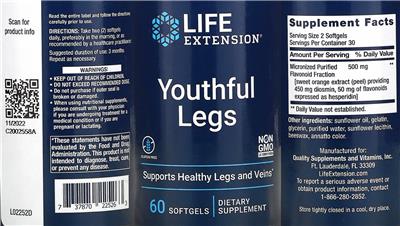
Supplement Facts
The label details for Youthful Legs by Life Extension, sourced from the NIH Dietary Supplement Label Database.
Supplement Facts
| Ingredient | Amount | % DV |
|---|---|---|
| Diosmin | 450 mg | -- |
| Flavonoids | 50 mg | -- |
| Micronized Purified Flavonoid Fraction | 500 mg | -- |
| Sweet Orange Peel Extract | 0 NP | -- |
Other ingredients: Sunflower Oil, Gelatin, Glycerin, Water, Purified, Sunflower Lecithin, Beeswax, Annatto
Tap any ingredient to jump to its full detail below.
These statements are the manufacturer’s wording, reproduced from the product label — the label is saying it, not HelloPharmacist. We don’t verify or endorse them.
General Statements
Scan for product info
Precautions
Read the entire label and follow the directions carefully prior to use.
Warnings: Keep out of reach of children.
Do not exceed recommended dose. Do not purchase if outer seal is broken or damaged.
When using nutritional supplements, please consult with your physician if you are undergoing treatment for a medical condition or if you are pregnant or lactating.
To report a serious adverse event or obtain product information, contact 1-866-280-2852.
Suggested/Recommended/Usage/Directions
Directions: Take two (2) softgels daily, preferably in the morning, or as recommended by a healthcare practitioner. Suggested duration of use: 3 months. Repeat as necessary.
FDA Disclaimer Statement
These statements have not been evaluated by the Food and Drug Administration. This product is not intended to diagnose, treat, cure, or prevent any disease.
Formulation
Gluten free Non GMO LE Certified
Supports healthy legs and veins
Seals/Symbols
Non GMO LE Certified
FDA Statement of Identity
Dietary Supplement
Storage
Store tightly closed in a cool, dry place.
Is this label outdated? Report a formula or label change and our pharmacy team will review it.
Youthful Legs by Life Extension label
The label scan from the NIH Dietary Supplement Label Database. Tap to enlarge.
Label images are published by the NIH Dietary Supplement Label Database for the version of this product on file. Always read your actual product label.
View the full label (PDF)The Ingredients in Youthful Legs by Life Extension
This is the 1 active ingredient this product is made of. Select it to open its full monograph.
Serving size2 Softgel(s) Dosage formSoftgel Capsule Servings per container30 Amounts shown are per serving.
Micronized Purified Flavonoid Fraction
Other (inactive) ingredients: Sunflower Oil, Gelatin, Glycerin, Water, Purified, Sunflower Lecithin, Beeswax, Annatto. These complete the product’s ingredient list but are not active constituents.
Youthful Legs by Life Extension Drug Interactions
HelloPharmacist Interaction Report
Youthful Legs by Life Extension contains diosmin, an ingredient with documented interactions affecting a significant number of medications.
The most serious concern is with blood thinners (anticoagulants) and blood-clotting medications (antiplatelet drugs) — diosmin may increase bleeding risk, and a case of internal bleeding has been reported in a patient taking warfarin and aspirin alongside diosmin.
Read the full breakdown — every affected drug type, severity by severity
Diosmin also slows how your body clears certain pain relievers and muscle relaxants. It inhibits enzymes (CYP2C9, CYP2E1) that break down diclofenac and chlorzoxazone, raising their blood levels by 34–53% and potentially boosting their effects.
It may similarly affect other CYP3A4 and P-glycoprotein substrates — a broad category that includes many common drugs — though the evidence for CYP3A4 is mixed. There's also a case of carbamazepine (an epilepsy medication) increasing by about 58% when taken with diosmin, which could raise the risk of side effects or toxicity.
We could not check the interactions for flavonoids or sweet orange peel extract; no data is on file for those ingredients. Altogether, these interactions span 871 individual medications.
Use the search tool on this page to check your exact prescriptions before starting.
Check your own medications below · Editorial policy · How we use AI
Want to check YOUR meds against Youthful Legs?
Ask about interactions with your drugs in plain English — “Can I take it with lisinopril?” — and we find you the answer in seconds, ingredient by ingredient.
Go to the checkerIngredients driving the most interactions
Individual Drug Interactions
The ingredients in Youthful Legs interact with 912 drugs. Click any drug to see the details.
1 of the 1 ingredient in Youthful Legs interact with drugs. Each result below shows which ingredient is responsible. Sweet Orange Peel Extract
AtorvastatinAtorvaliq
How Atorvastatin interacts with Youthful Legs — through 2 ingredients. Tap an ingredient for the detail:
Sweet Orange Peel ExtractOrganic Anion-transporting Polypeptide Substrates (oatp) Major
Interaction Summary
Consuming sweet orange juice can decrease oral absorption of OATP substrates.
Read the full Sweet Orange Peel Extract + Atorvastatin interactionDiosminCytochrome P450 3a4 (cyp3a4) Substrates Moderate
Interaction Summary
Theoretically, diosmin might inhibit the metabolism of CYP3A4 substrates.
Read the full Diosmin + Atorvastatin interactionAtorvastatin CalciumLipitor
How Atorvastatin Calcium interacts with Youthful Legs — through 2 ingredients. Tap an ingredient for the detail:
Sweet Orange Peel ExtractOrganic Anion-transporting Polypeptide Substrates (oatp) Major
Interaction Summary
Consuming sweet orange juice can decrease oral absorption of OATP substrates.
Read the full Sweet Orange Peel Extract + Atorvastatin Calcium interactionDiosminCytochrome P450 3a4 (cyp3a4) Substrates Moderate
Interaction Summary
Theoretically, diosmin might inhibit the metabolism of CYP3A4 substrates.
Read the full Diosmin + Atorvastatin Calcium interactionBosentanTracleer
How Bosentan interacts with Youthful Legs — through 2 ingredients. Tap an ingredient for the detail:
Sweet Orange Peel ExtractOrganic Anion-transporting Polypeptide Substrates (oatp) Major
Interaction Summary
Consuming sweet orange juice can decrease oral absorption of OATP substrates.
Read the full Sweet Orange Peel Extract + Bosentan interactionDiosminCytochrome P450 3a4 (cyp3a4) Substrates, Cytochrome P450 2c9 (cyp2c9) Substrates Moderate
Interaction Summary
Theoretically, diosmin might inhibit the metabolism of CYP3A4 substrates.
Read the full Diosmin + Bosentan interactionBrincidofovirTembexa
How Brincidofovir interacts with Youthful Legs — through 1 ingredient. Tap an ingredient for the detail:
Sweet Orange Peel ExtractOrganic Anion-transporting Polypeptide Substrates (oatp) Major
Interaction Summary
Consuming sweet orange juice can decrease oral absorption of OATP substrates.
Read the full Sweet Orange Peel Extract + Brincidofovir interactionCeliprololCelicard
How Celiprolol interacts with Youthful Legs — through 2 ingredients. Tap an ingredient for the detail:
Sweet Orange Peel ExtractOrganic Anion-transporting Polypeptide Substrates (oatp), Celiprolol (celicard) +1 Major
Interaction Summary
Consuming sweet orange juice can decrease oral absorption of OATP substrates.
Read the full Sweet Orange Peel Extract + Celiprolol interactionDiosminP-glycoprotein Substrates Moderate
Interaction Summary
Theoretically, diosmin might increase levels of drugs that are substrates of P-glycoprotein (P-gp).
Read the full Diosmin + Celiprolol interactionCerivastatin SodiumBaycol
How Cerivastatin Sodium interacts with Youthful Legs — through 1 ingredient. Tap an ingredient for the detail:
Sweet Orange Peel ExtractOrganic Anion-transporting Polypeptide Substrates (oatp) Major
Interaction Summary
Consuming sweet orange juice can decrease oral absorption of OATP substrates.
Read the full Sweet Orange Peel Extract + Cerivastatin Sodium interactionCinoxacinCinobac
How Cinoxacin interacts with Youthful Legs — through 1 ingredient. Tap an ingredient for the detail:
Sweet Orange Peel ExtractOrganic Anion-transporting Polypeptide Substrates (oatp), Quinolone Antibiotics Major
Interaction Summary
Consuming sweet orange juice can decrease oral absorption of OATP substrates.
Read the full Sweet Orange Peel Extract + Cinoxacin interactionCiprofloxacinCiloxan, Cipro, Cipro IV, Cipro XR, Ciprobay, Otiprio
How Ciprofloxacin interacts with Youthful Legs — through 1 ingredient. Tap an ingredient for the detail:
Sweet Orange Peel ExtractQuinolone Antibiotics, Organic Anion-transporting Polypeptide Substrates (oatp) Major
Interaction Summary
Calcium-fortified sweet orange juice might reduce quinolone absorption.
Read the full Sweet Orange Peel Extract + Ciprofloxacin interactionCiprofloxacin, HydrocortisoneCipro HC Otic
How Ciprofloxacin, Hydrocortisone interacts with Youthful Legs — through 1 ingredient. Tap an ingredient for the detail:
Sweet Orange Peel ExtractOrganic Anion-transporting Polypeptide Substrates (oatp) Major
Interaction Summary
Consuming sweet orange juice can decrease oral absorption of OATP substrates.
Read the full Sweet Orange Peel Extract + Ciprofloxacin, Hydrocortisone interactionClinafloxacinClinafloxacin
How Clinafloxacin interacts with Youthful Legs — through 1 ingredient. Tap an ingredient for the detail:
Sweet Orange Peel ExtractOrganic Anion-transporting Polypeptide Substrates (oatp), Quinolone Antibiotics Major
Interaction Summary
Consuming sweet orange juice can decrease oral absorption of OATP substrates.
Read the full Sweet Orange Peel Extract + Clinafloxacin interactionEnoxacinPenetrex
How Enoxacin interacts with Youthful Legs — through 1 ingredient. Tap an ingredient for the detail:
Sweet Orange Peel ExtractOrganic Anion-transporting Polypeptide Substrates (oatp), Quinolone Antibiotics Major
Interaction Summary
Consuming sweet orange juice can decrease oral absorption of OATP substrates.
Read the full Sweet Orange Peel Extract + Enoxacin interactionEtoposideEtopophos, VePesid, VP16
How Etoposide interacts with Youthful Legs — through 2 ingredients. Tap an ingredient for the detail:
Sweet Orange Peel ExtractP-glycoprotein Substrates, Organic Anion-transporting Polypeptide Substrates (oatp) Major
Interaction Summary
Sweet orange juice seems to modulate P-glycoprotein (P-gp), which might affect the blood levels of P-gp substrates.
Read the full Sweet Orange Peel Extract + Etoposide interactionDiosminP-glycoprotein Substrates, Cytochrome P450 3a4 (cyp3a4) Substrates Moderate
Interaction Summary
Theoretically, diosmin might increase levels of drugs that are substrates of P-glycoprotein (P-gp).
Read the full Diosmin + Etoposide interactionEzetimibe, AtorvastatinLiptruzet
How Ezetimibe, Atorvastatin interacts with Youthful Legs — through 2 ingredients. Tap an ingredient for the detail:
Sweet Orange Peel ExtractOrganic Anion-transporting Polypeptide Substrates (oatp) Major
Interaction Summary
Consuming sweet orange juice can decrease oral absorption of OATP substrates.
Read the full Sweet Orange Peel Extract + Ezetimibe, Atorvastatin interactionDiosminCytochrome P450 3a4 (cyp3a4) Substrates Moderate
Interaction Summary
Theoretically, diosmin might inhibit the metabolism of CYP3A4 substrates.
Read the full Diosmin + Ezetimibe, Atorvastatin interactionFexofenadineAllegra
How Fexofenadine interacts with Youthful Legs — through 2 ingredients. Tap an ingredient for the detail:
Sweet Orange Peel ExtractFexofenadine (allegra), P-glycoprotein Substrates +1 Major
Interaction Summary
Consuming sweet orange juice with fexofenadine can decrease oral absorption of fexofenadine.
Read the full Sweet Orange Peel Extract + Fexofenadine interactionDiosminP-glycoprotein Substrates, Fexofenadine (allegra) +1 Moderate
Interaction Summary
Theoretically, diosmin might increase levels of drugs that are substrates of P-glycoprotein (P-gp).
Read the full Diosmin + Fexofenadine interactionFexofenadine, PseudoephedrineAllegra D
How Fexofenadine, Pseudoephedrine interacts with Youthful Legs — through 2 ingredients. Tap an ingredient for the detail:
Sweet Orange Peel ExtractP-glycoprotein Substrates, Organic Anion-transporting Polypeptide Substrates (oatp) +1 Major
Interaction Summary
Sweet orange juice seems to modulate P-glycoprotein (P-gp), which might affect the blood levels of P-gp substrates.
Read the full Sweet Orange Peel Extract + Fexofenadine, Pseudoephedrine interactionDiosminFexofenadine (allegra), P-glycoprotein Substrates +1 Moderate
Interaction Summary
Theoretically, diosmin might increase the levels and clinical effects of fexofenadine.
Read the full Diosmin + Fexofenadine, Pseudoephedrine interactionFluvastatinLescol, Lescol XL
How Fluvastatin interacts with Youthful Legs — through 2 ingredients. Tap an ingredient for the detail:
Sweet Orange Peel ExtractOrganic Anion-transporting Polypeptide Substrates (oatp) Major
Interaction Summary
Consuming sweet orange juice can decrease oral absorption of OATP substrates.
Read the full Sweet Orange Peel Extract + Fluvastatin interactionDiosminCytochrome P450 2c9 (cyp2c9) Substrates Moderate
Interaction Summary
Theoretically, diosmin might inhibit the metabolism of CYP2C9 substrates.
Read the full Diosmin + Fluvastatin interactionGatifloxacinTequin, Tequin Injection
How Gatifloxacin interacts with Youthful Legs — through 1 ingredient. Tap an ingredient for the detail:
Sweet Orange Peel ExtractQuinolone Antibiotics, Organic Anion-transporting Polypeptide Substrates (oatp) Major
Interaction Summary
Calcium-fortified sweet orange juice might reduce quinolone absorption.
Read the full Sweet Orange Peel Extract + Gatifloxacin interactionGemifloxacinFactive
How Gemifloxacin interacts with Youthful Legs — through 1 ingredient. Tap an ingredient for the detail:
Sweet Orange Peel ExtractOrganic Anion-transporting Polypeptide Substrates (oatp), Quinolone Antibiotics Major
Interaction Summary
Consuming sweet orange juice can decrease oral absorption of OATP substrates.
Read the full Sweet Orange Peel Extract + Gemifloxacin interactionGlyburideAlbert Glyburide, Diabeta, Glycron, Glynase, Glynase PresTab, Micronase +1 more
How Glyburide interacts with Youthful Legs — through 2 ingredients. Tap an ingredient for the detail:
Sweet Orange Peel ExtractOrganic Anion-transporting Polypeptide Substrates (oatp) Major
Interaction Summary
Consuming sweet orange juice can decrease oral absorption of OATP substrates.
Read the full Sweet Orange Peel Extract + Glyburide interactionDiosminCytochrome P450 2c9 (cyp2c9) Substrates Moderate
Interaction Summary
Theoretically, diosmin might inhibit the metabolism of CYP2C9 substrates.
Read the full Diosmin + Glyburide interactionGlyburide, MetforminGlucovance
How Glyburide, Metformin interacts with Youthful Legs — through 2 ingredients. Tap an ingredient for the detail:
Sweet Orange Peel ExtractOrganic Anion-transporting Polypeptide Substrates (oatp) Major
Interaction Summary
Consuming sweet orange juice can decrease oral absorption of OATP substrates.
Read the full Sweet Orange Peel Extract + Glyburide, Metformin interactionDiosminCytochrome P450 2c9 (cyp2c9) Substrates Moderate
Interaction Summary
Theoretically, diosmin might inhibit the metabolism of CYP2C9 substrates.
Read the full Diosmin + Glyburide, Metformin interactionGrepafloxacinRaxar
How Grepafloxacin interacts with Youthful Legs — through 1 ingredient. Tap an ingredient for the detail:
Sweet Orange Peel ExtractQuinolone Antibiotics, Organic Anion-transporting Polypeptide Substrates (oatp) Major
Interaction Summary
Calcium-fortified sweet orange juice might reduce quinolone absorption.
Read the full Sweet Orange Peel Extract + Grepafloxacin interactionIrinotecanCamptosar, Onivyde
How Irinotecan interacts with Youthful Legs — through 2 ingredients. Tap an ingredient for the detail:
Sweet Orange Peel ExtractOrganic Anion-transporting Polypeptide Substrates (oatp) Major
Interaction Summary
Consuming sweet orange juice can decrease oral absorption of OATP substrates.
Read the full Sweet Orange Peel Extract + Irinotecan interactionDiosminCytochrome P450 3a4 (cyp3a4) Substrates Moderate
Interaction Summary
Theoretically, diosmin might inhibit the metabolism of CYP3A4 substrates.
Read the full Diosmin + Irinotecan interactionIrinotecan Hydrochloride
How Irinotecan Hydrochloride interacts with Youthful Legs — through 2 ingredients. Tap an ingredient for the detail:
Sweet Orange Peel ExtractOrganic Anion-transporting Polypeptide Substrates (oatp) Major
Interaction Summary
Consuming sweet orange juice can decrease oral absorption of OATP substrates.
Read the full Sweet Orange Peel Extract + Irinotecan Hydrochloride interactionDiosminCytochrome P450 3a4 (cyp3a4) Substrates Moderate
Interaction Summary
Theoretically, diosmin might inhibit the metabolism of CYP3A4 substrates.
Read the full Diosmin + Irinotecan Hydrochloride interactionIsoniazid, Pyrazinamide, RifampinRifater
How Isoniazid, Pyrazinamide, Rifampin interacts with Youthful Legs — through 1 ingredient. Tap an ingredient for the detail:
Sweet Orange Peel ExtractOrganic Anion-transporting Polypeptide Substrates (oatp) Major
Interaction Summary
Consuming sweet orange juice can decrease oral absorption of OATP substrates.
Read the full Sweet Orange Peel Extract + Isoniazid, Pyrazinamide, Rifampin interactionIsoniazid, RifampinRifamate
How Isoniazid, Rifampin interacts with Youthful Legs — through 1 ingredient. Tap an ingredient for the detail:
Sweet Orange Peel ExtractOrganic Anion-transporting Polypeptide Substrates (oatp) Major
Interaction Summary
Consuming sweet orange juice can decrease oral absorption of OATP substrates.
Read the full Sweet Orange Peel Extract + Isoniazid, Rifampin interactionIvermectinMectizan, Sklice, Soolantra, Stromectol
How Ivermectin interacts with Youthful Legs — through 2 ingredients. Tap an ingredient for the detail:
Sweet Orange Peel ExtractIvermectin (stromectol, Others), P-glycoprotein Substrates Major
Interaction Summary
Consuming sweet orange juice with ivermectin can decrease the oral absorption of ivermectin.
Read the full Sweet Orange Peel Extract + Ivermectin interactionDiosminP-glycoprotein Substrates Moderate
Interaction Summary
Theoretically, diosmin might increase levels of drugs that are substrates of P-glycoprotein (P-gp).
Read the full Diosmin + Ivermectin interactionLevofloxacinLeva-pak, Levaquin, Levaquin Injection
How Levofloxacin interacts with Youthful Legs — through 1 ingredient. Tap an ingredient for the detail:
Sweet Orange Peel ExtractQuinolone Antibiotics, Organic Anion-transporting Polypeptide Substrates (oatp) Major
Interaction Summary
Calcium-fortified sweet orange juice might reduce quinolone absorption.
Read the full Sweet Orange Peel Extract + Levofloxacin interactionLevofloxacin (ophthalmic)Levofloxacin
How Levofloxacin (ophthalmic) interacts with Youthful Legs — through 1 ingredient. Tap an ingredient for the detail:
Sweet Orange Peel ExtractOrganic Anion-transporting Polypeptide Substrates (oatp), Quinolone Antibiotics Major
Interaction Summary
Consuming sweet orange juice can decrease oral absorption of OATP substrates.
Read the full Sweet Orange Peel Extract + Levofloxacin (ophthalmic) interactionLomefloxacinMaxaquin
How Lomefloxacin interacts with Youthful Legs — through 1 ingredient. Tap an ingredient for the detail:
Sweet Orange Peel ExtractQuinolone Antibiotics, Organic Anion-transporting Polypeptide Substrates (oatp) Major
Interaction Summary
Calcium-fortified sweet orange juice might reduce quinolone absorption.
Read the full Sweet Orange Peel Extract + Lomefloxacin interactionLovastatinAltocor, Mevacor
How Lovastatin interacts with Youthful Legs — through 2 ingredients. Tap an ingredient for the detail:
Sweet Orange Peel ExtractOrganic Anion-transporting Polypeptide Substrates (oatp) Major
Interaction Summary
Consuming sweet orange juice can decrease oral absorption of OATP substrates.
Read the full Sweet Orange Peel Extract + Lovastatin interactionDiosminCytochrome P450 3a4 (cyp3a4) Substrates Moderate
Interaction Summary
Theoretically, diosmin might inhibit the metabolism of CYP3A4 substrates.
Read the full Diosmin + Lovastatin interactionEach ingredient & the kinds of drugs it affects
For each ingredient in Youthful Legs with known interactions, here are the types of medications it can affect. Open any type for the detail — or search your exact drug in the checker above.
Sweet Orange Peel Extract
Celiprolol (Celicard)
Consuming sweet orange with celiprolol can decrease oral absorption of celiprolol.
A pharmacokinetic study in healthy volunteers shows that celiprolol levels, after a single dose of 100 mg, are decreased by up to 90% in people who drink sweet orange juice 200 mL three times daily. It's not known if lower consumption of sweet orange juice will have the same effect. Theoretically, this occurs due to short-term inhibition of organic anion transporting polypeptide (OATP). Recommend separating drug administration and consumption of sweet orange by at least 4 hours.
Ivermectin (Stromectol, Others)
Consuming sweet orange juice with ivermectin can decrease the oral absorption of ivermectin.
A pharmacokinetic study in healthy volunteers shows that taking ivermectin orally with sweet orange juice 750 mL over 4 hours reduces the bioavailability of ivermectin. This effect does not seem to be related to effects on P-glycoprotein. The effect on ivermectin is more pronounced in males compared to females.
Organic Anion-Transporting Polypeptide Substrates (Oatp)
Consuming sweet orange juice can decrease oral absorption of OATP substrates. Separate administration by at least 4 hours.
Clinical research shows that consuming sweet orange juice inhibits OATP, which reduces bioavailability of oral drugs that are substrates of OATP. For example, sweet orange juice decreases bioavailability of fexofenadine, a substrate of OATP, by about 72% and of celiprolol, another OATP substrate, by up to 90%. Since sweet orange juice seems to affect OATP for a short time, recommend separating drug administration and consumption of sweet orange juice by at least 4 hours.
Pravastatin (Pravachol)
Consuming sweet orange juice with pravastatin can increase the absorption of pravastatin.
A small pharmacokinetic study in healthy volunteers shows that consuming sweet orange juice 800 mL over 3 hours, including before, during, and after taking pravastatin 10 mg, increases pravastatin levels by about 149%, without affecting pravastatin elimination. Theoretically this effect might be due to modulation of organic anion transporting polypeptides (OATPs) by sweet orange juice. Sweet orange juice does not seem to affect simvastatin levels, but it is not known if sweet orange affects any of the other statins.
Fexofenadine (Allegra)
Consuming sweet orange juice with fexofenadine can decrease oral absorption of fexofenadine.
Clinical research shows that coadministration of sweet orange juice 1200 mL decreases bioavailability of fexofenadine by about 72%. In an animal model, sweet orange juice decreased bioavailability of fexofenadine by 31%. Fexofenadine manufacturer data indicates that concomitant administration of sweet orange juice and fexofenadine results in larger wheal and flare sizes in research models. This suggests that sweet orange reduces the clinical response to fexofenadine. Theoretically, this occurs due to short-term inhibition of organic anion transporting polypeptide (OATP). Recommend separating drug administration and consumption of sweet orange by at least 4 hours.
P-Glycoprotein Substrates
Sweet orange juice seems to modulate P-glycoprotein (P-gp), which might affect the blood levels of P-gp substrates.
Animal and in vitro research suggest that orange juice extract inhibits drug efflux by P-gp, increasing absorption and levels of P-gp substrates. In contrast, pharmacokinetic research in humans shows that drinking large amounts of sweet orange juice decreases absorption and levels of the P-gp substrate celiprolol. This suggests that orange juice actually induces drug efflux by P-gp or affects drug levels by another mechanism such as inhibiting the gut drug transporter called organic anion transporting polypeptide (OATP). Until more is known, sweet orange juice should be used cautiously in people taking P-gp substrates.
Quinolone Antibiotics
Calcium-fortified sweet orange juice might reduce quinolone absorption.
Calcium binds to quinolones in the gut. Theoretically, the calcium in certain fortified orange juices can also bind to quinolone antibiotics and reduce their absorption and levels.
Brand information
Manufacturer and brand details for Youthful Legs, from the product label.
Life Extension
See all Life Extension products- Name
- Quality Supplements and Vitamins, Inc.
- City
- Ft. Lauderdale
- State
- FL
- ZipCode
- 33309
- Phone Number
- 1-866-280-2852
- Web Address
- LifeExtension.com
Youthful Legs by Life Extension: Common Questions
Does Youthful Legs by Life Extension interact with any medications?
How can one product interact with so many drugs?
Where does this information come from?
What is diosmin, and what's it supposed to do?
Can I take Youthful Legs if I'm pregnant or breastfeeding?
What side effects might I see from diosmin?
Does diosmin work for back pain or diabetic nerve pain?
Is there anything in this product besides diosmin?
How long is it safe to take Youthful Legs?
Written and reviewed by the HelloPharmacist editorial staff. Our editorial policy
Not sure if Youthful Legs is safe with your meds?
Our pharmacists answer your medication & supplement questions — free.
Label information is sourced from the NIH Dietary Supplement Label Database and reflects the product version on file; always read your actual product label. This page is for education only and is not a substitute for professional medical advice. Confirm with your pharmacist or doctor before combining supplements and medications.
The Full Monographs Behind Youthful Legs’s Ingredients
Every ingredient we hold a full HelloPharmacist monograph for — uses, evidence, safety, and the complete interaction list.
Sources & How We Checked
Youthful Legs's label data comes from the NIH Dietary Supplement Label Database; the ingredient interaction data is from the Natural Medicines database, reviewed by our pharmacists.
- NIH Dietary Supplement Label Database (DSLD) — The official product label on file for this supplement.
- Natural Medicines (Therapeutic Research Center) — Evidence-graded clinical reference behind the ingredient interaction data.
Content is written and reviewed by licensed HelloPharmacist pharmacists. See our data sources and editorial standards for how this information is built and checked.
The 37 references behind this product’s interaction data
Every citation that drives the interaction findings for this product’s ingredients, from the evidence-graded Natural Medicines (TRC Healthcare) database. Open an ingredient to browse its citations — links open the study on PubMed or the publisher’s site.
Diosmin 20 references
- Misra MC, Parshad R. Randomized clinical trial of micronized flavonoids in the early control of bleeding from acute internal haemorrhoids. Br J Surgery 2000;87:868-72. PubMed
- Thanapongsathorn W, Vajrabukka T. Clinical trial of oral diosmin (Daflon) in the treatment of hemorrhoids. Dis Colon Rectum 1992;35:1085-8. PubMed
- Cospite M. Double-blind, placebo-controlled evaluation of clinical activity and safety of Daflon 500 mg in the treatment of acute hemorrhoids. Angiology 1994;45:566-73.
- Guilhou JJ, Dereure O, Marzin L, et al. Efficacy of Daflon 500 mg in venous leg ulcer healing: a double-blind, randomized, controlled versus placebo trial in 107 patients. Angiology 1997;48:77-85.. PubMed
- Cospite, M. and Dominici, A. Double blind study of the pharmacodynamic and clinical activities of 5682 SE in venous insufficiency. Advantages of the new micronized form. Int Angiol. 1989;8(4 Suppl):61-65.
- Buckshee, K., Takkar, D., and Aggarwal, N. Micronized flavonoid therapy in internal hemorrhoids of pregnancy. Int J Gynaecol Obstet 1997;57(2):145-151. PubMed
- Kumar RM, Van Gompel JJ, Bower R, Rabinstein AA. Spontaneous intraventricular hemorrhage associated with prolonged diosmin therapy. Neurocrit Care. 2011 Jun;14(3):438-40. PubMed
- Milano G, Leone S, Fucile C, Zuccoli ML, Stimamiglio A, Martelli A, Mattioli F. Uncommon serum creatine phosphokinase and lactic dehydrogenase increase during diosmin therapy: two case reports. J Med Case Rep. 2014 Jun 16;8:194. PubMed
- Rajnarayana K, Venkatesham A, Krishna DR. Bioavailability of diclofenac sodium after pretreatment with diosmin in healthy volunteers. Drug Metabol Drug Interact. 2007;22(2-3):165-74. PubMed
- Rajnarayana K, Venkatesham A, Nagulu M, Srinivas M, Krishna DR. Influence of diosmin pretreatment on the pharmacokinetics of chlorzoxazone in healthy male volunteers. Drug Metabol Drug Interact. 2008;23(3-4):311-21. PubMed
- Yoo HH, Lee M, Chung HJ, Lee SK, Kim DH. Effects of diosmin, a flavonoid glycoside in citrus fruits, on P-glycoprotein-mediated drug efflux in human intestinal Caco-2 cells. J Agric Food Chem. 2007 Sep 5;55(18):7620-5. PubMed
- Bedada SK, Neerati P. Modulation of CYP3A enzyme activity by diosmin and its consequence on carbamazepine pharmacokinetics in rats. Naunyn Schmiedebergs Arch Pharmacol. 2018;391(2):115-21. PubMed
- Burkina V, Zlabek V, Halsne R, Ropstad E, Zamaratskaia G. In vitro effects of the citrus flavonoids diosmin, naringenin and naringin on the hepatic drug-metabolizing CYP3A enzyme in human, pig, mouse and fish. Biochem Pharmacol. 2016;110-111:109-16 PubMed
- Bedada SK, Boga PK. Influence of diosmin on the metabolism and disposition of carbamazepine in healthy subjects. Xenobiotica. 2017;47(10):879-84. PubMed
- Bedada SK, Boga PK, Kotakonda HK. The effect of diosmin on the pharmacokinetics of fexofenadine in healthy human volunteers. Xenobiotica. 2017;47(3):230-35. PubMed
- Poór M, Boda G, Mohos V, et al. Pharmacokinetic interaction of diosmetin and silibinin with other drugs: Inhibition of CYP2C9-mediated biotransformation and displacement from serum albumin. Biomed Pharmacother. 2018;102:912-921. PubMed
- Gavrilov SG, Karalkin AV, Moskalenko YP, Grishenkova AS. Efficacy of two micronized purified flavonoid fraction dosing regimens in the pelvic venous pain relief. Int Angiol. 2021;40(3):180-186. PubMed
- Steinbruch M, Nunes C, Gama R, et al. Is nonmicronized diosmin 600?mg as effective as micronized diosmin 900?mg plus hesperidin 100?mg on chronic venous disease symptoms? Results of a noninferiority study. Int J Vasc Med. 2020;2020:4237204. PubMed
- Schastlivtsev I, Lobastov K, Barinov V, Kanzafarova I. Diosmin 600 in adjunction to rivaroxaban reduces the risk of post-thrombotic syndrome after femoropopliteal deep vein thrombosis: results of the RIDILOTT DVT study. Int Angiol. 2020;39(5):361-371. PubMed
- Mansilha A, Caldevilla H, Puskás A, Lucien A, Roby L, Kirienko A. MPFF 1000 mg chewable once daily vs. MPFF 500 mg twice daily in chronic venous disease: the double-blind, randomized, non-inferiority CHEWY trial. Int Angiol 2022;41(6):464-475. PubMed
Sweet Orange 17 references
- Leung AY, Foster S. Encyclopedia of Common Natural Ingredients Used in Food, Drugs and Cosmetics. 2nd ed. New York, NY: John Wiley & Sons, 1996.
- FDA, CFSAN. FDA-approved potassium health claim notification for potassium containing foods. 2000. Available at: www.cfsan.fda.gov/~dms/hclm-k.html.
- Kurowska EM, Spence JD, Jordan J, et al. HDL-cholesterol-raising effect of orange juice in subjects with hypercholesterolemia. Am J Clin Nutr 2000;72:1095-100. PubMed
- Murry JJ, Healy MD. Drug-mineral interactions: a new responsibility for the hospital dietician. J Am Diet Assoc 1991;91:66-73.
- Bailey DG, Dresser GK, Munoz C, et al. Reduction of fexofenadine bioavailability by fruit juices. Clin Pharmacol Ther 2001;69:P21.
- Pletz MW, Petzold P, Allen A, et al. Effect of calcium carbonate on bioavailability of orally administered gemifloxacin. Antimicrob Agents Chemother 2003;47:2158-60.. PubMed
- Lilja JJ, Juntti-Patinen L, Neuvonen PJ. Orange juice substantially reduces the bioavailability of the beta-adrenergic-blocking agent celiprolol. Clin Pharmacol Ther 2004;75:184-90.
- Tian R, Koyabu N, Takanaga H, et al. Effects of grapefruit juice and orange juice on the intestinal efflux of P-glycoprotein substrates. Pharm Res 2002;19:802-9. PubMed
- Vanapalli SR, Chen Y, Ellingrod VL, et al. Orange juice decreases the oral bioavailability of ivermectin in health volunteers. Clin Pharmacol Ther 2003;73 (Abstract PDII-A-10):P94.
- Huang SM, Lesko LJ. Drug-drug, drug-dietary supplement, and drug-citrus fruit and other food interactions: what have we learned? J Clin Pharmacol 2004;44:559-69. PubMed
- Koitabashi Y, Kumai T, Matsumoto N, et al. Orange juice increased the bioavailability of pravastatin, 3-hydroxy-3-methylglutaryl CoA reductase inhibitor, in rats and healthy human subjects. Life Sci 2006;78:2852-9. PubMed
- Takanaga H, Ohnishi A, Yamada S, et al. Polymethoxylated flavones in orange juice are inhibitors of P-glycoprotein but not cytochrome P450 3A4. J Pharmacol Exp Ther 2000;293:230-6. DOI
- Greenblatt DJ. Analysis of drug interactions involving fruit beverages and organic anion-transporting polypeptides. J Clin Pharmacol 2009;49:1403-7. PubMed
- Bailey DG. Fruit juice inhibition of uptake transport: a new type of food-drug interaction. Br J Clin Pharmacol 2010;70:645-55. PubMed
- Kamath AV, Yao M, Zhang Y, Chong S. Effect of fruit juices on the oral bioavailability of fexofenadine in rats. J Pharm Sci 2005;94:233-9. PubMed
- Kays MB, Overholser BR, Mueller BA, et al. Effects of sevelamer hydrochloride and calcium acetate on the oral bioavailability of ciprofloxacin. Am J Kidney Dis. 2003;42(6):1253-9. PubMed
- Neuhofel, A. L., Wilton, J. H., Victory, J. M., Hejmanowsk, L. G., and Amsden, G. W. Lack of bioequivalence of ciprofloxacin when administered with calcium-fortified orange juice: a new twist on an old interaction. J Clin Pharmacol. 2002;42(4):461-466. DOI
Parts of this content are provided by the Therapeutic Research Center, LLC.
DISCLAIMER: Currently this does not check for drug-drug interactions. This is not an all-inclusive comprehensive list of potential interactions and is for informational purposes only. Not all interactions are known or well-reported in the scientific literature, and new interactions are continually being reported. Input is needed from a qualified healthcare provider including a pharmacist before starting any therapy. Application of clinical judgment is necessary.
© 2021 Therapeutic Research Center, LLC