
BCAA Max Pump Peach Mango Ingredients & Drug Interactions
by FINAFLEX
What is this page for?
First and foremost: checking BCAA Max Pump Peach Mango against your medications. The heart of this page is the interaction checker and the full interaction report — how this product’s ingredients may interact with prescription and over-the-counter medicines you may be taking.
Around that, we add a pharmacist’s high-level view of the product as a whole — what’s inside, the evidence for its stated use, how transparent the label is, and what safety data exists — so you can see the full picture in one place. It’s educational information from our licensed clinical databases and the clinical staff at HelloPharmacist — not medical advice — and we don’t sell or endorse products. Our editorial policy
BCAA Max Pump Peach Mango is a dietary supplement by FINAFLEX with 6 active ingredients. Its ingredients are commonly taken for replacing fluids and electrolytes, preventing dehydration during exercise or illness, treating low blood sodium (under medical care).Based on those ingredients, 291 medications have a known interaction with it, the most serious rated moderate. The ingredients most likely to interact are Agmatine Sulfate, Sodium. Use the checker below to test your specific medication, or read the full HelloPharmacist Interaction Report.
Check Your Meds Against BCAA Max Pump Peach Mango by FINAFLEX
Ask about any prescription or over-the-counter medication and we check it for interactions with BCAA Max Pump Peach Mango by FINAFLEX — and tell you which ingredient is responsible.
AI summaries are generated from our interaction database for education only — always confirm with your pharmacist. How we use AI
Ask the Pharmacist
A licensed pharmacist will answer your question by email — free, usually within 24 hours.
Got it — thank you!
A licensed pharmacist will answer within 24 hours. Keep an eye on your email (worth checking spam, just in case).
HelloPharmacist Scorecard of BCAA Max Pump Peach Mango by FINAFLEX
Our pharmacy team’s full take, with four database checks built into the cards below — a summary of what is known, not a grade of the product itself.
What’s inside
Partial disclosure
BCAA Max Pump has six active ingredients. The product contains three branched-chain amino acids (BCAAs) — L-leucine, L-isoleucine, and L-valine — which are amino acids your muscles use for recovery and performance.
It also includes agmatine sulfate (a compound made from the amino acid arginine), betaine anhydrous (a nutrient involved in cell function and methylation), and sodium. The inactive ingredients are malic acid, natural and artificial flavors, citric acid, sodium citrate, silica, sucralose, and acesulfame potassium.
Does it work?
Moderate evidence
For the BCAAs themselves, the evidence we hold doesn't establish an effectiveness rating for athletic performance or muscle recovery. Agmatine has been studied for athletic performance, alcohol use disorder, anxiety, and several other conditions, but the data shows insufficient reliable evidence to rate it for any of those uses.
Betaine anhydrous is possibly effective for high homocysteine levels (hyperhomocysteinemia) and has been rated effective specifically for homocystinuria, a rare genetic condition. The other conditions listed — NASH, depression, GERD, colorectal adenoma — lack sufficient evidence to rate betaine.
How safe is it?
Well-documented data
Sodium is well tolerated in normal dietary amounts, but high intake is linked to high blood pressure and heart strain; the facts advise against sodium supplements or very high intake without medical guidance. Agmatine appears well tolerated in the short term, though long-term safety in humans is not well studied.
Some people taking agmatine have reported diarrhea, indigestion, and nausea within a few days of starting; these side effects resolved when the supplement was stopped. Betaine anhydrous is generally well tolerated at studied doses, though it can cause body odor, diarrhea, nausea, vomiting, and GI distress.
Rare serious effects from sodium include worsening heart disease, high blood pressure, and kidney disease. The safety data for agmatine in pregnancy advises against use; data for breastfeeding is insufficient to say either way, so talk with your doctor or pharmacist.
For betaine, there is not enough reliable safety data in pregnancy to advise either way, and safety while breastfeeding is not well established — personalized guidance from your doctor is needed.
Meds to double-check
Moderate interaction found
Before you take this, double-check your medications if you're on: blood pressure drugs (antihypertensives) or diabetes medications (antidiabetes drugs) — agmatine may increase the risk of low blood pressure or low blood sugar at Moderate severity. Sodium interactions at Moderate severity also affect corticosteroids, lithium, didanosine, sodium phosphates, tolvaptan, and any other sodium-containing drugs.
Use the search tool below to check your exact medications.
The bottom line
Scorecard at a glancePartially disclosed formula with some supporting evidence for its stated purpose. Moderate medication interactions have been identified, and safety information is well characterized.
This is a BCAA and performance blend that's most useful for athletes focused on muscle recovery. If you take any blood pressure medication, diabetes drug, corticosteroid, or lithium, or if you have heart or kidney issues, check with your pharmacist first — the sodium and agmatine in here could affect how your medications work.
Talk to your pharmacist before starting, especially if you're pregnant or breastfeeding.
Educational only — not medical advice; always confirm with your pharmacist. Our editorial policy · How we use AI
Assessment coverage: 3 of 6 active ingredients matched to our full ingredient reviews (monographs). Based on the product label dated Sep 25, 2025.
This Scorecard evaluates available label information, ingredient evidence, and known medication-safety considerations. It does not independently verify product identity, purity, potency, contamination, or manufacturing quality. How these ratings are computed
General information
Key facts about BCAA Max Pump Peach Mango, straight from the product label.
| Brand | FINAFLEX |
|---|---|
| Barcode (UPC) | 854397007124 |
| Net contents | 10.4 Ounce(s); 295 Gram(s) |
| Market status | On market |
| Date entered into DSLD | Sep 25, 2025 |
| DSLD ID | 333634 |
| Product type | Other Combinations |
| Supplement form | Powder |
| Dietary claims / uses | Nutrient, All Other, Structure/Function |
| Intended target group(s) | Adult (18 - 50 Years), Women (not pregnant or lactating) |
Everything in this section is reproduced from the manufacturer’s own product label — it’s the label speaking, not HelloPharmacist. We show it so you can see exactly what the maker states; we don’t verify or endorse those statements.
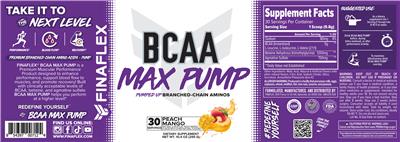
Supplement Facts
The label details for BCAA Max Pump Peach Mango by FINAFLEX, sourced from the NIH Dietary Supplement Label Database.
Supplement Facts
| Ingredient | Amount | % DV |
|---|---|---|
| Sodium | 80 mg | 4% |
| L-Leucine, Instantized | 0 NP | -- |
| Agmatine Sulfate | 750 mg | -- |
| L-Isoleucine, Instantized | 0 NP | -- |
| L-Valine, Instantized | 0 NP | -- |
| Betaine Anhydrous | 1250 mg | -- |
| Branched-Chain Amino Acids, Instantized | 5 Gram(s) | -- |
Other ingredients: Malic Acid, Natural & Artificial Flavors, Citric Acid, Sodium Citrate, Silica, Sucralose, Acesulfame Potassium
Tap any ingredient to jump to its full detail below.
These statements are the manufacturer’s wording, reproduced from the product label — the label is saying it, not HelloPharmacist. We don’t verify or endorse them.
Formulation
Take it to the next level Performance Blood flow Recovery Finaflex BCAA Max Pump is a premium muscular performance product designed to enhance performance, support blood flow to muscles, and promote recovery! Redefine yourself with BCAA Max Pump
Formula
Premium branched-chain amino acids + pump Built with clinically acceptable levels of BCAA, betaine, and agmatine sulfate BCAA Max Pump helps you preform at a higher level!
Pumped Up branched-chain aminos Peach Mango Natural & artificial peach mango flavor with other natural flavors
General Statements
Find us online: Instagram Facebook TikTok YouTube www.finaflex.com
Join the Finaflex family
FDA Statement of Identity
Dietary Supplement
Precautions
Allergen warning: Produced in a facility that processes milk, eggs, soybeans, wheat, shellfish, fish, tree nuts, sesame, and peanuts.
Warning: Keep out of reach of children. Intended for healthy adults over 18.
Do not use if pregnant or nursing. Consult a doctor or medical authority before use if you have a medical condition, a family history of health problems, or if you take other medicines or supplements.
Do not exceed serving size. Stop use if you have a bad reaction. Stop use after 8 weeks. Stop use 2 weeks before surgery. Consumer accepts all liability if used inconsistent with label.
California Prop 65 Warning: Lead - Cancer and Reproductive Harm www.P65Warnings.ca.gov
Brand IP Statement(s)
Finaflex #Redefine yourself
Seals/Symbols
GMP Certified Certified Good Manufacturing Practice U.S.A. Made Domestic & Imported Material Registered FDA Facility
Suggested/Recommended/Usage/Directions
Suggested use: As a dietary supplement mix 1 serving (1 scoop) into 8-16 fl oz water. Drink BCAA Max Pump before, during (intra-workout), or after performance activity. To maximize effectiveness drink BCAA Max Pump everyday.
Storage
Sold by weight, not volume. Store under cool, dry conditions, ideally 50 degrees-80 degrees F. Do not discard desiccant.
FDA Disclaimer Statement
These statements have not been evaluated by the Food and Drug Administration. This product is not intended to diagnose, treat, cure or prevent any disease.
Is this label outdated? Report a formula or label change and our pharmacy team will review it.
BCAA Max Pump Peach Mango by FINAFLEX label
The label scan from the NIH Dietary Supplement Label Database. Tap to enlarge.
Label images are published by the NIH Dietary Supplement Label Database for the version of this product on file. Always read your actual product label.
View the full label (PDF)The Ingredients in BCAA Max Pump Peach Mango by FINAFLEX
These are the 6 active ingredients this product is made of. Select any to open its full monograph.
Serving size9.8 Gram(s) Dosage formPowder Servings per container30 Amounts shown are per serving.
Most supplement products combine several ingredients, and a medication can interact with the product through any one of them. Each ingredient below shows whether it has known drug interactions.
Sodium
Interacts with205 drugs
Sodium is an essential mineral and electrolyte your body needs to balance fluids, support nerves, and help muscles work. Most people in modern diets g...
Sodium monograph & interactionsAgmatine Sulfate
Interacts with258 drugs
Agmatine is a compound your body makes from the amino acid arginine, and it is sold mainly as a workout and 'pump' supplement. Human evidence for most...
Agmatine Sulfate monograph & interactionsBetaine Anhydrous
No knowninteractions
Betaine anhydrous (also called trimethylglycine) is a compound found in foods like beets, spinach, and whole grains, and is sold as a supplement and a...
Betaine Anhydrous monograph & interactionsBranched-Chain Amino Acids, Instantized
- › L-Leucine, Instantized
- › L-Isoleucine, Instantized
- › L-Valine, Instantized
Other (inactive) ingredients: Malic Acid, Natural & Artificial Flavors, Citric Acid, Sodium Citrate, Silica, Sucralose, Acesulfame Potassium. These complete the product’s ingredient list but are not active constituents.
BCAA Max Pump Peach Mango by FINAFLEX Drug Interactions
HelloPharmacist Interaction Report
BCAA Max Pump Peach Mango contains sodium and agmatine, both of which have documented interactions with medications.
Sodium is the ingredient of greatest concern: high intake can reduce how well blood pressure medications (antihypertensives) work, and it can interact with corticosteroids, lithium, didanosine, sodium phosphates, tolvaptan, and other sodium-containing drugs — all at Moderate severity. The main risks are worsened blood pressure control, high sodium levels in the blood (hypernatremia), and in the case of lithium, dangerously elevated drug levels and toxicity.
Read the full breakdown — every affected drug type, severity by severity
Agmatine may lower blood pressure or blood sugar when combined with antihypertensive drugs or diabetes medications — both Moderate-severity concerns. We couldn't check three other ingredients (L-leucine, L-isoleucine, and L-valine) because interaction data isn't on file for them.
Altogether, these interactions span 288 individual medications.
Betaine anhydrous, another active ingredient, shows no documented interactions in our data. If you take any medication for blood pressure, diabetes, heart disease, or mood (including lithium), or if you use corticosteroids or sodium-containing drugs, run your exact medications through the checker below before starting this product.
Check your own medications below · Editorial policy · How we use AI
Want to check YOUR meds against BCAA Max Pump Peach Mango?
Ask about interactions with your drugs in plain English — “Can I take it with lisinopril?” — and we find you the answer in seconds, ingredient by ingredient.
Go to the checkerIngredients driving the most interactions
Individual Drug Interactions
The ingredients in BCAA Max Pump Peach Mango interact with 291 drugs. Click any drug to see the details.
2 of the 6 ingredients in BCAA Max Pump Peach Mango interact with drugs. Each result below shows which ingredient is responsible. Agmatine Sulfate Sodium
Enalapril MaleateEpaned, Vasotec
How Enalapril Maleate interacts with BCAA Max Pump Peach Mango — through 2 ingredients. Tap an ingredient for the detail:
Agmatine SulfateAntihypertensive Drugs Moderate
Interaction Summary
Theoretically, agmatine might increase the risk of hypotension when taken with antihypertensive drugs.
Read the full Agmatine Sulfate + Enalapril Maleate interactionSodiumAntihypertensive Drugs Moderate
Interaction Summary
Theoretically, a high intake of dietary sodium might reduce the effectiveness of antihypertensive drugs.
Read the full Sodium + Enalapril Maleate interactionEnalapril Maleate, FelodipineLexxel
How Enalapril Maleate, Felodipine interacts with BCAA Max Pump Peach Mango — through 2 ingredients. Tap an ingredient for the detail:
SodiumAntihypertensive Drugs Moderate
Interaction Summary
Theoretically, a high intake of dietary sodium might reduce the effectiveness of antihypertensive drugs.
Read the full Sodium + Enalapril Maleate, Felodipine interactionAgmatine SulfateAntihypertensive Drugs Moderate
Interaction Summary
Theoretically, agmatine might increase the risk of hypotension when taken with antihypertensive drugs.
Read the full Agmatine Sulfate + Enalapril Maleate, Felodipine interactionEnalapril Maleate, HydrochlorothiazideVaseretic
How Enalapril Maleate, Hydrochlorothiazide interacts with BCAA Max Pump Peach Mango — through 2 ingredients. Tap an ingredient for the detail:
SodiumAntihypertensive Drugs Moderate
Interaction Summary
Theoretically, a high intake of dietary sodium might reduce the effectiveness of antihypertensive drugs.
Read the full Sodium + Enalapril Maleate, Hydrochlorothiazide interactionAgmatine SulfateAntihypertensive Drugs Moderate
Interaction Summary
Theoretically, agmatine might increase the risk of hypotension when taken with antihypertensive drugs.
Read the full Agmatine Sulfate + Enalapril Maleate, Hydrochlorothiazide interactionEplerenoneInspra
How Eplerenone interacts with BCAA Max Pump Peach Mango — through 2 ingredients. Tap an ingredient for the detail:
SodiumAntihypertensive Drugs Moderate
Interaction Summary
Theoretically, a high intake of dietary sodium might reduce the effectiveness of antihypertensive drugs.
Read the full Sodium + Eplerenone interactionAgmatine SulfateAntihypertensive Drugs Moderate
Interaction Summary
Theoretically, agmatine might increase the risk of hypotension when taken with antihypertensive drugs.
Read the full Agmatine Sulfate + Eplerenone interactionEpoprostenolFlolan
How Epoprostenol interacts with BCAA Max Pump Peach Mango — through 2 ingredients. Tap an ingredient for the detail:
Agmatine SulfateAntihypertensive Drugs Moderate
Interaction Summary
Theoretically, agmatine might increase the risk of hypotension when taken with antihypertensive drugs.
Read the full Agmatine Sulfate + Epoprostenol interactionSodiumAntihypertensive Drugs Moderate
Interaction Summary
Theoretically, a high intake of dietary sodium might reduce the effectiveness of antihypertensive drugs.
Read the full Sodium + Epoprostenol interactionEprosartanTeveten
How Eprosartan interacts with BCAA Max Pump Peach Mango — through 2 ingredients. Tap an ingredient for the detail:
SodiumAntihypertensive Drugs Moderate
Interaction Summary
Theoretically, a high intake of dietary sodium might reduce the effectiveness of antihypertensive drugs.
Read the full Sodium + Eprosartan interactionAgmatine SulfateAntihypertensive Drugs Moderate
Interaction Summary
Theoretically, agmatine might increase the risk of hypotension when taken with antihypertensive drugs.
Read the full Agmatine Sulfate + Eprosartan interactionErtugliflozinSteglatro
How Ertugliflozin interacts with BCAA Max Pump Peach Mango — through 1 ingredient. Tap an ingredient for the detail:
Agmatine SulfateAntidiabetes Drugs Moderate
Interaction Summary
Theoretically, agmatine might increase the risk of hypoglycemia when taken with antidiabetes drugs.
Read the full Agmatine Sulfate + Ertugliflozin interactionErtugliflozin, Metformin HydrochlorideSegluromet
How Ertugliflozin, Metformin Hydrochloride interacts with BCAA Max Pump Peach Mango — through 1 ingredient. Tap an ingredient for the detail:
Agmatine SulfateAntidiabetes Drugs Moderate
Interaction Summary
Theoretically, agmatine might increase the risk of hypoglycemia when taken with antidiabetes drugs.
Read the full Agmatine Sulfate + Ertugliflozin, Metformin Hydrochloride interactionEsmololBrevibloc
How Esmolol interacts with BCAA Max Pump Peach Mango — through 2 ingredients. Tap an ingredient for the detail:
Agmatine SulfateAntihypertensive Drugs Moderate
Interaction Summary
Theoretically, agmatine might increase the risk of hypotension when taken with antihypertensive drugs.
Read the full Agmatine Sulfate + Esmolol interactionSodiumAntihypertensive Drugs Moderate
Interaction Summary
Theoretically, a high intake of dietary sodium might reduce the effectiveness of antihypertensive drugs.
Read the full Sodium + Esmolol interactionEthacrynic AcidEdecrin
How Ethacrynic Acid interacts with BCAA Max Pump Peach Mango — through 2 ingredients. Tap an ingredient for the detail:
SodiumAntihypertensive Drugs Moderate
Interaction Summary
Theoretically, a high intake of dietary sodium might reduce the effectiveness of antihypertensive drugs.
Read the full Sodium + Ethacrynic Acid interactionAgmatine SulfateAntihypertensive Drugs Moderate
Interaction Summary
Theoretically, agmatine might increase the risk of hypotension when taken with antihypertensive drugs.
Read the full Agmatine Sulfate + Ethacrynic Acid interactionExenatideBydureon, Byetta
How Exenatide interacts with BCAA Max Pump Peach Mango — through 1 ingredient. Tap an ingredient for the detail:
Agmatine SulfateAntidiabetes Drugs Moderate
Interaction Summary
Theoretically, agmatine might increase the risk of hypoglycemia when taken with antidiabetes drugs.
Read the full Agmatine Sulfate + Exenatide interactionExenatide SyntheticBydureon BCISE
How Exenatide Synthetic interacts with BCAA Max Pump Peach Mango — through 1 ingredient. Tap an ingredient for the detail:
Agmatine SulfateAntidiabetes Drugs Moderate
Interaction Summary
Theoretically, agmatine might increase the risk of hypoglycemia when taken with antidiabetes drugs.
Read the full Agmatine Sulfate + Exenatide Synthetic interactionFelodipinePlendil, Renedil
How Felodipine interacts with BCAA Max Pump Peach Mango — through 2 ingredients. Tap an ingredient for the detail:
Agmatine SulfateAntihypertensive Drugs Moderate
Interaction Summary
Theoretically, agmatine might increase the risk of hypotension when taken with antihypertensive drugs.
Read the full Agmatine Sulfate + Felodipine interactionSodiumAntihypertensive Drugs Moderate
Interaction Summary
Theoretically, a high intake of dietary sodium might reduce the effectiveness of antihypertensive drugs.
Read the full Sodium + Felodipine interactionFenoldopamCorlopam
How Fenoldopam interacts with BCAA Max Pump Peach Mango — through 2 ingredients. Tap an ingredient for the detail:
SodiumAntihypertensive Drugs Moderate
Interaction Summary
Theoretically, a high intake of dietary sodium might reduce the effectiveness of antihypertensive drugs.
Read the full Sodium + Fenoldopam interactionAgmatine SulfateAntihypertensive Drugs Moderate
Interaction Summary
Theoretically, agmatine might increase the risk of hypotension when taken with antihypertensive drugs.
Read the full Agmatine Sulfate + Fenoldopam interactionFludrocortisoneFlorinef Acetate
How Fludrocortisone interacts with BCAA Max Pump Peach Mango — through 1 ingredient. Tap an ingredient for the detail:
SodiumCorticosteroids Moderate
Interaction Summary
Concomitant use of mineralocorticoids and some glucocorticoids with sodium supplements might increase the risk of hypernatremia.
Read the full Sodium + Fludrocortisone interactionFluticasoneFlixotide, Flonase, Flovent, Seretide, Veramyst
How Fluticasone interacts with BCAA Max Pump Peach Mango — through 1 ingredient. Tap an ingredient for the detail:
SodiumCorticosteroids Moderate
Interaction Summary
Concomitant use of mineralocorticoids and some glucocorticoids with sodium supplements might increase the risk of hypernatremia.
Read the full Sodium + Fluticasone interactionFluticasone Furoate, Umeclidinium, VilanterolTrelegy Ellipta
How Fluticasone Furoate, Umeclidinium, Vilanterol interacts with BCAA Max Pump Peach Mango — through 1 ingredient. Tap an ingredient for the detail:
SodiumCorticosteroids Moderate
Interaction Summary
Concomitant use of mineralocorticoids and some glucocorticoids with sodium supplements might increase the risk of hypernatremia.
Read the full Sodium + Fluticasone Furoate, Umeclidinium, Vilanterol interactionFluticasone Furoate, Vilanterol TrifenatateBreo Ellipta
How Fluticasone Furoate, Vilanterol Trifenatate interacts with BCAA Max Pump Peach Mango — through 1 ingredient. Tap an ingredient for the detail:
SodiumCorticosteroids Moderate
Interaction Summary
Concomitant use of mineralocorticoids and some glucocorticoids with sodium supplements might increase the risk of hypernatremia.
Read the full Sodium + Fluticasone Furoate, Vilanterol Trifenatate interactionFosinoprilMonopril
How Fosinopril interacts with BCAA Max Pump Peach Mango — through 2 ingredients. Tap an ingredient for the detail:
SodiumAntihypertensive Drugs Moderate
Interaction Summary
Theoretically, a high intake of dietary sodium might reduce the effectiveness of antihypertensive drugs.
Read the full Sodium + Fosinopril interactionAgmatine SulfateAntihypertensive Drugs Moderate
Interaction Summary
Theoretically, agmatine might increase the risk of hypotension when taken with antihypertensive drugs.
Read the full Agmatine Sulfate + Fosinopril interactionFosinopril, HydrochlorothiazideMonopril HCT
How Fosinopril, Hydrochlorothiazide interacts with BCAA Max Pump Peach Mango — through 2 ingredients. Tap an ingredient for the detail:
Agmatine SulfateAntihypertensive Drugs Moderate
Interaction Summary
Theoretically, agmatine might increase the risk of hypotension when taken with antihypertensive drugs.
Read the full Agmatine Sulfate + Fosinopril, Hydrochlorothiazide interactionSodiumAntihypertensive Drugs Moderate
Interaction Summary
Theoretically, a high intake of dietary sodium might reduce the effectiveness of antihypertensive drugs.
Read the full Sodium + Fosinopril, Hydrochlorothiazide interactionFurosemideLasix
How Furosemide interacts with BCAA Max Pump Peach Mango — through 2 ingredients. Tap an ingredient for the detail:
SodiumAntihypertensive Drugs Moderate
Interaction Summary
Theoretically, a high intake of dietary sodium might reduce the effectiveness of antihypertensive drugs.
Read the full Sodium + Furosemide interactionAgmatine SulfateAntihypertensive Drugs Moderate
Interaction Summary
Theoretically, agmatine might increase the risk of hypotension when taken with antihypertensive drugs.
Read the full Agmatine Sulfate + Furosemide interactionGliclazideDiamicron
How Gliclazide interacts with BCAA Max Pump Peach Mango — through 1 ingredient. Tap an ingredient for the detail:
Agmatine SulfateAntidiabetes Drugs Moderate
Interaction Summary
Theoretically, agmatine might increase the risk of hypoglycemia when taken with antidiabetes drugs.
Read the full Agmatine Sulfate + Gliclazide interactionGlimepirideAmaryl
How Glimepiride interacts with BCAA Max Pump Peach Mango — through 1 ingredient. Tap an ingredient for the detail:
Agmatine SulfateAntidiabetes Drugs Moderate
Interaction Summary
Theoretically, agmatine might increase the risk of hypoglycemia when taken with antidiabetes drugs.
Read the full Agmatine Sulfate + Glimepiride interactionGlipizideGlucotrol, Glucotrol XL
How Glipizide interacts with BCAA Max Pump Peach Mango — through 1 ingredient. Tap an ingredient for the detail:
Agmatine SulfateAntidiabetes Drugs Moderate
Interaction Summary
Theoretically, agmatine might increase the risk of hypoglycemia when taken with antidiabetes drugs.
Read the full Agmatine Sulfate + Glipizide interactionGlipizide, MetforminMetaglip
How Glipizide, Metformin interacts with BCAA Max Pump Peach Mango — through 1 ingredient. Tap an ingredient for the detail:
Agmatine SulfateAntidiabetes Drugs Moderate
Interaction Summary
Theoretically, agmatine might increase the risk of hypoglycemia when taken with antidiabetes drugs.
Read the full Agmatine Sulfate + Glipizide, Metformin interactionGlucagonBaqsimi, Glucagon
How Glucagon interacts with BCAA Max Pump Peach Mango — through 1 ingredient. Tap an ingredient for the detail:
Agmatine SulfateAntidiabetes Drugs Moderate
Interaction Summary
Theoretically, agmatine might increase the risk of hypoglycemia when taken with antidiabetes drugs.
Read the full Agmatine Sulfate + Glucagon interactionGlucoseIV Glucose
How Glucose interacts with BCAA Max Pump Peach Mango — through 1 ingredient. Tap an ingredient for the detail:
Agmatine SulfateAntidiabetes Drugs Moderate
Interaction Summary
Theoretically, agmatine might increase the risk of hypoglycemia when taken with antidiabetes drugs.
Read the full Agmatine Sulfate + Glucose interactionGlyburideAlbert Glyburide, Diabeta, Glycron, Glynase, Glynase PresTab, Micronase +1 more
How Glyburide interacts with BCAA Max Pump Peach Mango — through 1 ingredient. Tap an ingredient for the detail:
Agmatine SulfateAntidiabetes Drugs Moderate
Interaction Summary
Theoretically, agmatine might increase the risk of hypoglycemia when taken with antidiabetes drugs.
Read the full Agmatine Sulfate + Glyburide interactionGlyburide, MetforminGlucovance
How Glyburide, Metformin interacts with BCAA Max Pump Peach Mango — through 1 ingredient. Tap an ingredient for the detail:
Agmatine SulfateAntidiabetes Drugs Moderate
Interaction Summary
Theoretically, agmatine might increase the risk of hypoglycemia when taken with antidiabetes drugs.
Read the full Agmatine Sulfate + Glyburide, Metformin interactionGuanabenz AcetateWytensin
How Guanabenz Acetate interacts with BCAA Max Pump Peach Mango — through 2 ingredients. Tap an ingredient for the detail:
Agmatine SulfateAntihypertensive Drugs Moderate
Interaction Summary
Theoretically, agmatine might increase the risk of hypotension when taken with antihypertensive drugs.
Read the full Agmatine Sulfate + Guanabenz Acetate interactionSodiumAntihypertensive Drugs Moderate
Interaction Summary
Theoretically, a high intake of dietary sodium might reduce the effectiveness of antihypertensive drugs.
Read the full Sodium + Guanabenz Acetate interactionEach ingredient & the kinds of drugs it affects
For each ingredient in BCAA Max Pump Peach Mango with known interactions, here are the types of medications they can affect. Open any type for the detail — or search your exact drug in the checker above.
Agmatine Sulfate
Antidiabetes Drugs
Theoretically, agmatine might increase the risk of hypoglycemia when taken with antidiabetes drugs.
Animal and in vitro research suggest that agmatine has mild hypoglycemic effects.
Antihypertensive Drugs
Theoretically, agmatine might increase the risk of hypotension when taken with antihypertensive drugs.
Animal research suggests that agmatine can modestly decrease heart rate and blood pressure.
Sodium
Antihypertensive Drugs
Theoretically, a high intake of dietary sodium might reduce the effectiveness of antihypertensive drugs.
High intake of dietary sodium can increase systolic and diastolic blood pressure. Also, high intake of sodium may necessitate increased use of antihypertensive medications to achieve blood pressure control in some patients, such as those with chronic kidney disease.
Corticosteroids
Concomitant use of mineralocorticoids and some glucocorticoids with sodium supplements might increase the risk of hypernatremia.
Mineralocorticoids and some glucocorticoids (corticosteroids) cause sodium retention. This effect is dose-related and depends on mineralocorticoid potency. It is most common with hydrocortisone, cortisone, and fludrocortisone, followed by prednisone and prednisolone.
Didanosine (Videx)
Concomitant use of didanosine with additional sodium from dietary or supplemental sources may increase the risk of hypernatremia.
Didanosine formulations contain a significant amount of sodium.
Lithium
Altering dietary intake of sodium might alter the levels and clinical effects of lithium.
High sodium intake can reduce plasma concentrations of lithium by increasing lithium excretion. Reducing sodium intake can significantly increase plasma concentrations of lithium and cause lithium toxicity in patients being treated with lithium carbonate. Stabilizing sodium intake is shown to reduce the percentage of patients with lithium level fluctuations above 0.8 mEq/L. Patients taking lithium should avoid significant alterations in their dietary intake of sodium.
Sodium Phosphates
Theoretically, concomitant use of sodium phosphate with sodium supplements might increase the risk of hypernatremia.
Use of high doses (> 45 mL in 24 hours) of sodium phosphate, such as those used for bowel cleansing before surgery, can lead to serious electrolyte disturbances, including hypernatremia. The risk of hypernatremia is highest in the elderly and people with other risk factors for electrolyte disturbances.
Sodium-Containing Drugs
Concomitant use of sodium-containing drugs with additional sodium from dietary or supplemental sources may increase the risk of hypernatremia and long-term sodium-related complications.
The Chronic Disease Risk Reduction (CDRR) intake level of 2.3 grams of sodium daily indicates the intake at which it is believed that chronic disease risk increases for the apparently healthy population. Some medications contain high quantities of sodium. When used in conjunction with sodium supplements or high-sodium diets, the CDRR may be exceeded. Additionally, concomitant use may increase the risk for hypernatremia; this risk is highest in the elderly and people with other risk factors for electrolyte disturbances.
Tolvaptan (Samsca)
Theoretically, concomitant use of tolvaptan with sodium might increase the risk of hypernatremia.
Tolvaptan is a vasopressin receptor 2 antagonist that is used to increase sodium levels in patients with hyponatremia. Patients taking tolvaptan should use caution with the use of sodium salts such as sodium chloride.
Brand information
Manufacturer and brand details for BCAA Max Pump Peach Mango, from the product label.
FINAFLEX
See all FINAFLEX products- Name
- FINAFLEX
- Street Address
- 3615 Francis Cir Ste 100
- City
- Alpharetta
- State
- GA
- ZipCode
- 30004
- Phone Number
- 888.678.7629
- Web Address
- FINAFLEX.com
BCAA Max Pump Peach Mango by FINAFLEX: Common Questions
Does BCAA Max Pump Peach Mango by FINAFLEX interact with any medications?
How can one product interact with so many drugs?
Where does this information come from?
What are BCAAs and why are they in this product?
What does agmatine do?
Can I take this if I'm pregnant or breastfeeding?
I'm on blood pressure medication — is this safe for me?
What side effects might I get from this?
Written and reviewed by the HelloPharmacist editorial staff. Our editorial policy
Not sure if BCAA Max Pump Peach Mango is safe with your meds?
Our pharmacists answer your medication & supplement questions — free.
Label information is sourced from the NIH Dietary Supplement Label Database and reflects the product version on file; always read your actual product label. This page is for education only and is not a substitute for professional medical advice. Confirm with your pharmacist or doctor before combining supplements and medications.
The Full Monographs Behind BCAA Max Pump Peach Mango’s Ingredients
Every ingredient we hold a full HelloPharmacist monograph for — uses, evidence, safety, and the complete interaction list.
Sodium
Interacts with 205 drugsSodium is an essential mineral and electrolyte your body needs to balance fluids, support nerves, and help muscles work. Most people in modern diets get more than enough—often too much—from...
Read the full Sodium monograph → Herb & supplement monographAgmatine
Interacts with 258 drugsAgmatine is a compound your body makes from the amino acid arginine, and it is sold mainly as a workout and 'pump' supplement. Human evidence for most of its claimed benefits is limited and...
Read the full Agmatine monograph → Herb & supplement monographBetaine Anhydrous
Betaine anhydrous (also called trimethylglycine) is a compound found in foods like beets, spinach, and whole grains, and is sold as a supplement and as a prescription medicine for a rare gen...
Read the full Betaine Anhydrous monograph →Sources & How We Checked
BCAA Max Pump Peach Mango's label data comes from the NIH Dietary Supplement Label Database; the ingredient interaction data is from the Natural Medicines database, reviewed by our pharmacists.
- NIH Dietary Supplement Label Database (DSLD) — The official product label on file for this supplement.
- Natural Medicines (Therapeutic Research Center) — Evidence-graded clinical reference behind the ingredient interaction data.
Content is written and reviewed by licensed HelloPharmacist pharmacists. See our data sources and editorial standards for how this information is built and checked.
The 52 references behind this product’s interaction data
Every citation that drives the interaction findings for this product’s ingredients, from the evidence-graded Natural Medicines (TRC Healthcare) database. Open an ingredient to browse its citations — links open the study on PubMed or the publisher’s site.
Sodium 38 references
- Garabedian-Ruffalo SM, Ruffalo RL. Drug and nutrient interactions. Am Fam Physician 1986;33:165-74.
- Food and Drug Administration Science Background: Safety of Sodium Phosphates Oral Solution. September 17, 2001. Available at: http://www.fda.gov/cder/drug/safety/sodiumphospate.htm
- Coton T, Mallaret C, Coilliot C, Carre D, Guisset M. Severe acute ulcerated gastritis induced by salt. Presse Med 2009;38(3):499-500. PubMed
- Frings-Meuthen P, Buehlmeier J, Baecker N, et al. High sodium chloride intake exacerbates immobilization-induced bone resorption and protein losses. J Appl Physiol 2011;111(2):537-542. PubMed
- Frings-Meuthen P, Baecker N, Heer M. Low-grade metabolic acidosis may be the cause of sodium chloride-induced exaggerated bone resorption. J Bone Miner Res 2008;23(4):517-524. PubMed
- Alam S, Johnson AG. A meta-analysis of randomised controlled trials (RCT) among healthy normotensive and essential hypertensive elderly patients to determine the effect of high salt (NaCl) diet of blood pressure. J Hum Hypertens 1999;13(6):367-74.
- Boudville N, Ward S, Benaroia M, House AA. Increased sodium intake correlates with greater use of antihypertensive agents by subjects with chronic kidney disease. Am J Hypertens 2005;18(10):1300-5. PubMed
- Bennett WM. Drug interactions and consequences of sodium restriction. Am J Clin Nutr 1997;65(2 Suppl):678S-681S. PubMed
- Okusa MD, Crystal LJ. Clinical manifestations and management of acute lithium intoxication. Am J Med 1994;97(4):383-9. PubMed
- Food and Nutrition Board, Institute of Medicine. Dietary reference intakes for water, potassium, sodium, chloride, and sulfate. Washington, DC: National Academy Press, 2005. Available at: http://www.nap.edu/openbook.php?record_id=10925. DOI
- D'Elia L, Rossi G, Ippolito R, Cappuccio FP, Strazzullo P. Habitual salt intake and risk of gastric cancer: a meta-analysis of prospective studies. Clin Nutr 2012;31(4):489-98. PubMed
- Goldsmith SR. Hyponatremia in heart failure: time for a trial. J Card Fail 2013;19(6):398-400. PubMed
- Willocks L, Brettle R, Keen J, Valentine C, Pinching AJ. Formulations of didanosine (ddI) and salt overload. Lancet 1992;339(8786):190.
- Chen L, Zhang Z, Chen W, Whelton PK, Appel LJ. Lower Sodium Intake and Risk of Headaches: Results From the Trial of Nonpharmacologic Interventions in the Elderly. Am J Public Health. 2016;106(7):1270-5. PubMed
- Cook NR, Appel LJ, Whelton PK. Lower levels of sodium intake and reduced cardiovascular risk. Circulation. 2014;129(9):981-9. PubMed
- Cook NR, Appel LJ, Whelton PK. Sodium Intake and All-Cause Mortality Over 20 Years in the Trials of Hypertension Prevention. J Am Coll Cardiol. 2016;68(15):1609-1617. PubMed
- Mente A, O'Donnell M, Rangarajan S, et al. Associations of urinary sodium excretion with cardiovascular events in individuals with and without hypertension: a pooled analysis of data from four studies. Lancet. 2016;388(10043):465-75. PubMed
- Moosavian SP, Haghighatdoost F, Surkan PJ, Azadbakht L. Salt and obesity: a systematic review and meta-analysis of observational studies. Int J Food Sci Nutr. 2017;68(3):265-277. PubMed
- O'Donnell M, Mente A, Rangarajan S, et al. Urinary sodium and potassium excretion, mortality, and cardiovascular events. N Engl J Med. 2014;371(7):612-23. DOI
- Poggio R, Gutierrez L, Matta MG, Elorriaga N, Irazola V, Rubinstein A. Daily sodium consumption and CVD mortality in the general population: systematic review and meta-analysis of prospective studies. Public Health Nutr. 2015;18(4):695-704. PubMed
- Stallings VA, Harrison M, Oria M; Committee to Review the Dietary Reference Intakes for Sodium and Potassium, Food and Nutrition Board, Health and Medicine Division, National Academies of Sciences, Engineering, and Medicine. Washington (DC): National Acad
- Mahtani KR, Heneghan C, Onakpoya I, et al. Reduced Salt Intake for Heart Failure: A Systematic Review. JAMA Intern Med. 2018 Dec 1;178(12):1693-1700. PubMed
- Yancy CW. Sodium Restriction in Heart Failure: Too Much Uncertainty-Do the Trials. JAMA Intern Med. 2018 Dec 1;178(12):1700-1701. PubMed
- He FJ, Campbell NRC, Ma Y, MacGregor GA, Cogswell ME, Cook NR. Errors in estimating usual sodium intake by the Kawasaki formula alter its relationship with mortality: implications for public health. Int J Epidemiol. 2018;47(6):1784-1795. PubMed
- Murthy K, Ondrey GJ, Malkani N, et al. THE EFFECTS OF HYPONATREMIA ON BONE DENSITY AND FRACTURES: A SYSTEMATIC REVIEW AND META-ANALYSIS. Endocr Pract. 2019;25(4):366-378. PubMed
- Messerli FH, Hofstetter L, Syrogiannouli L, et al. Sodium intake, life expectancy, and all-cause mortality. Eur Heart J 2021;42(21):2103-2112. PubMed
- Graudal NA, Hubeck-Graudal T, Jurgens G. Effects of low sodium diet versus high sodium diet on blood pressure, renin, aldosterone, catecholamines, cholesterol, and triglyceride. Cochrane Database Syst Rev 2020;12(12):CD004022. PubMed
- Giatti S, Santos RB, Aielo AN, et al. Association of sodium with obstructive sleep apnea. The ELSA-Brasil study. Ann Am Thorac Soc 2021;18(3):502-510. PubMed
- Nan X, Lu H, Wu J, et al. The interactive association between sodium intake, alcohol consumption and hypertension among elderly in northern China: a cross-sectional study. BMC Geriatr 2021;21(1):135. PubMed
- Kyozuka H, Fukusda T, Murata T, et al. Impact of preconception sodium intake on hypertensive disorders of pregnancy: The Japan Environment and Children's study. Pregnancy Hypertens 2021;23:66-72. PubMed
- Zhao L, Ogden CL, Yang Q, et al. Association of usual sodium intake with obesity among US children and adolescents, NHANES 2009-2016. Obesity (Silver Spring) 2021;29(3):587-594. PubMed
- Ma Y, He FJ, Sun Q, et al. 24-Hour urinary sodium and potassium excretion and cardiovascular risk. N Engl J Med 2022;386(3):252-263. PubMed
- Liu J, Yang X, Zhang P, et al. Association of urinary sodium excretion and left ventricular hypertrophy in people with type 2 diabetes mellitus: A cross-sectional study. Front Endocrinol (Lausanne) 2021;12:728493. PubMed
- Filippini T, Malavolti M, Whelton PK, Vinceti M. Sodium intake and risk of hypertension: A systematic review and dose-response meta-analysis of observational cohort studies. Curr Hypertens Rep 2022;24(5):133-144. PubMed
- Wang DD, Li Y, Nguyen XT, et al. Dietary sodium and potassium intake and risk of non-fatal cardiovascular diseases: The million veteran program. Nutrients 2022;14(5):1121. PubMed
- Kwak JH, Park CH, Eun CS, et al. The associations of dietary intake of high sodium and low zinc with gastric cancer mortality: A prospective cohort study in Korea. Nutr Cancer 2022;74(10):3501-3508. PubMed
- George S, Maiti R, Mishra BR, Jena M, Mohapatra D. Effect of regulated add-on sodium chloride intake on stabilization of serum lithium concentration in bipolar disorder: A randomized controlled trial. Bipolar Disord 2023;25(1):66-75. PubMed
- Zhou TL, Schütten MTJ, Kroon AA, et al. Urinary Sodium Excretion and Salt Intake Are Not Associated With Blood Pressure Variability in a White General Population. J Am Heart Assoc 2023;12(1):e026578. PubMed
Agmatine 3 references
- Piletz JE, Aricioglu F, Cheng JT, et al. Agmatine: clinical applications after 100 years in translation. Drug Discov Today 2013;18(17-18):880-93. PubMed
- Keynan O, Mirovsky Y, Dekel S, Gilad VH, Gilad GM. Safety and efficacy of dietary agmatine sulfate in lumbar disc-associated radiculopathy. An open-label, dose-escalating study followed by a randomized, double-blind, placebo-controlled trial. Pain Med 201 PubMed
- Shopsin B. The clinical antidepressant effect of exogenous agmatine is not reversed by parachlorophenylalanine: a pilot study. Acta Neuropsychiatr 2013;25(2):113-8. PubMed
Betaine Anhydrous 11 references
- Cystadane (betaine anhydrous for oral solution) Package insert. Orphan Medical, Inc. Minnetonka, MN. November 2005.
- Abdelmalek MF, Angulo P, Jorgensen RA, et al. Betaine, a promising new agent for patients with nonalcoholic steatohepatitis: results of a pilot study. Am J Gastroenterol 2001;96:2711-7.. PubMed
- Schwab U, Torronen A, Toppinen L, et al. Betaine supplementation decreases plasma homocysteine concentrations but does not affect body weight, body composition, or resting energy expenditure in human subjects. Am J Clin Nutr 2002;76:961-7. PubMed
- McGregor DO, Dellow WJ, Robson RA, et al. Betaine supplementation decreases post-methionine hyperhomocysteinemia in chronic renal failure. Kidney Int 2002;61:1040-6. PubMed
- Olthof MR, van Vliet T, Verhoef P, et al. Effect of homocysteine-lowering nutrients on blood lipids: results from four randomised, placebo-controlled studies in healthy humans. PloS Med 2005;2:e135. PubMed
- Knopman, D. and Patterson, M. An open-label, 24-week pilot study of the methyl donor betaine in Alzheimer disease patients. Alzheimer Dis.Assoc.Disord. 2001;15(3):162-165. PubMed
- Moat, S. J., Madhavan, A., Taylor, S. Y., Payne, N., Allen, R. H., Stabler, S. P., Goodfellow, J., McDowell, I. F., Lewis, M. J., and Lang, D. High- but not low-dose folic acid improves endothelial function in coronary artery disease. Eur J Clin Invest 2 PubMed
- Abdelmalek, M. F., Sanderson, S. O., Angulo, P., Soldevila-Pico, C., Liu, C., Peter, J., Keach, J., Cave, M., Chen, T., McClain, C. J., and Lindor, K. D. Betaine for nonalcoholic fatty liver disease: results of a randomized placebo-controlled trial. Hepa PubMed
- Ashtary-Larky D, Bagheri R, Ghanavati M, et al. Effects of betaine supplementation on cardiovascular markers: a systematic review and meta-analysis. Crit Rev Food Sci Nutr. 2021 Mar 25:1-18. PubMed
- Zawieja EE, Zawieja B, Chmurzynska A. Betaine supplementation moderately increases total cholesterol levels: a systematic review and meta-analysis. J Diet Suppl. 2021;18(1):105-117. PubMed
- Imbard A, Toumazi A, Magréault S, et al. Efficacy and pharmacokinetics of betaine in CBS and cblC deficiencies: a cross-over randomized controlled trial. Orphanet J Rare Dis 2022;17(1):417. PubMed
Parts of this content are provided by the Therapeutic Research Center, LLC.
DISCLAIMER: Currently this does not check for drug-drug interactions. This is not an all-inclusive comprehensive list of potential interactions and is for informational purposes only. Not all interactions are known or well-reported in the scientific literature, and new interactions are continually being reported. Input is needed from a qualified healthcare provider including a pharmacist before starting any therapy. Application of clinical judgment is necessary.
© 2021 Therapeutic Research Center, LLC