
Borage Leaf Mint Flavor Ingredients & Drug Interactions
by TerraVita
What is this page for?
First and foremost: checking Borage Leaf Mint Flavor against your medications. The heart of this page is the interaction checker and the full interaction report — how this product’s ingredients may interact with prescription and over-the-counter medicines you may be taking.
Around that, we add a pharmacist’s high-level view of the product as a whole — what’s inside, the evidence for its stated use, how transparent the label is, and what safety data exists — so you can see the full picture in one place. It’s educational information from our licensed clinical databases and the clinical staff at HelloPharmacist — not medical advice — and we don’t sell or endorse products. Our editorial policy
Borage Leaf Mint Flavor is a dietary supplement by TerraVita with 1 active ingredient. Its ingredients are commonly taken for eczema and dry skin, rheumatoid arthritis, inflammation.Based on those ingredients, 226 medications have a known interaction with it, the most serious rated moderate. The ingredients most likely to interact are Borage Leaf Glycerite Liquid Extract. Use the checker below to test your specific medication, or read the full HelloPharmacist Interaction Report.
Check Your Meds Against Borage Leaf Mint Flavor by TerraVita
Ask about any prescription or over-the-counter medication and we check it for interactions with Borage Leaf Mint Flavor by TerraVita — and tell you which ingredient is responsible.
AI summaries are generated from our interaction database for education only — always confirm with your pharmacist. How we use AI
Ask the Pharmacist
A licensed pharmacist will answer your question by email — free, usually within 24 hours.
Got it — thank you!
A licensed pharmacist will answer within 24 hours. Keep an eye on your email (worth checking spam, just in case).
HelloPharmacist Scorecard of Borage Leaf Mint Flavor by TerraVita
Our pharmacy team’s full take, with four database checks built into the cards below — a summary of what is known, not a grade of the product itself.
What’s inside
Full disclosure
This product contains one active ingredient: borage leaf glycerite liquid extract. In this form, borage is extracted and suspended in glycerin to create a liquid.
Borage is a plant whose seed oil and leaf have been studied for various health conditions, though borage leaf itself carries a particular concern we'll address below.
Does it work?
Couldn't assess
The evidence for borage and the conditions it's used for is quite limited in our data. For atopic dermatitis (eczema), the data rates borage as possibly ineffective.
For attention deficit-hyperactivity disorder (ADHD), acute respiratory distress syndrome (ARDS), and alcoholism, we don't have enough reliable evidence to rate whether it works.
How safe is it?
Well-documented data
Borage seed oil is generally well tolerated when taken by mouth, and the most common mild side effects are belching, bloating, diarrhea, and soft stools. However, this product uses borage leaf extract, not just the seed oil.
Borage leaf can contain liver-toxic alkaloid compounds that may cause serious liver damage with chronic exposure; the safety data advises avoiding it during pregnancy and breastfeeding because of these alkaloids and theoretical risks to the uterus. If you're taking this product regularly, talk with your doctor or pharmacist about liver safety monitoring.
Meds to double-check
Moderate interaction found
Before taking this product, double-check with your doctor or pharmacist if you're on blood thinners or antiplatelet drugs (like warfarin or aspirin), antipsychotic medications containing phenothiazines, or drugs that induce the CYP3A4 liver enzyme. These are the medication types with documented Moderate-severity interactions.
The bottom line
Scorecard at a glanceFully disclosed formula with no assessable stated purpose. Moderate medication interactions have been identified, and safety information is well characterized.
This product is for people looking to explore borage for conditions like eczema, though the evidence is limited. If you take blood thinners, antipsychotics, or certain other medications, you need to check with your doctor or pharmacist before starting.
The leaf form carries a liver safety concern, especially long-term, so it's worth discussing with your healthcare provider.
Educational only — not medical advice; always confirm with your pharmacist. Our editorial policy · How we use AI
Assessment coverage: 1 of 1 active ingredient matched to our full ingredient reviews (monographs). Based on the product label dated Dec 13, 2022.
This Scorecard evaluates available label information, ingredient evidence, and known medication-safety considerations. It does not independently verify product identity, purity, potency, contamination, or manufacturing quality. How these ratings are computed
General information
Key facts about Borage Leaf Mint Flavor, straight from the product label.
Everything in this section is reproduced from the manufacturer’s own product label — it’s the label speaking, not HelloPharmacist. We show it so you can see exactly what the maker states; we don’t verify or endorse those statements.
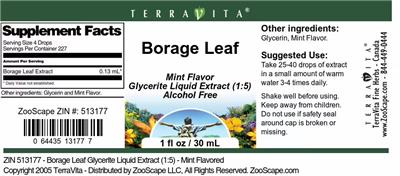
Supplement Facts
The label details for Borage Leaf Mint Flavor by TerraVita, sourced from the NIH Dietary Supplement Label Database.
Supplement Facts
| Ingredient | Amount | % DV |
|---|---|---|
| Borage Leaf Glycerite Liquid Extract | 0.13 mL | -- |
Other ingredients: Glycerin, Mint Flavor
Tap any ingredient to jump to its full detail below.
These statements are the manufacturer’s wording, reproduced from the product label — the label is saying it, not HelloPharmacist. We don’t verify or endorse them.
Brand IP Statement(s)
Copyright 2005 TerraVita - Distributed by ZooScape LLC, All Rights Reserved.
Formula
Glycerite liquid extract (1:5) Mint flavored
Formulation
Alcohol free
Suggested/Recommended/Usage/Directions
Suggested Use: Take 25-40 drops of extract in a small amount of warm water 3-4 times daily. Shake well before using.
Precautions
Keep away from children.
Do not use if safety seal around cap is broken or missing.
Is this label outdated? Report a formula or label change and our pharmacy team will review it.
Borage Leaf Mint Flavor by TerraVita label
The label scan from the NIH Dietary Supplement Label Database. Tap to enlarge.
Label images are published by the NIH Dietary Supplement Label Database for the version of this product on file. Always read your actual product label.
View the full label (PDF)The Ingredients in Borage Leaf Mint Flavor by TerraVita
This is the 1 active ingredient this product is made of. Select it to open its full monograph.
Serving size25 Drop(s) Dosage formLiquid Servings per container227 Amounts shown are per serving.
Borage Leaf Glycerite Liquid Extract
Interacts with226 drugs
Borage is a Mediterranean herb whose seed oil is rich in gamma-linolenic acid (GLA), an omega-6 fatty acid studied mostly for skin conditions and arth...
Borage Leaf Glycerite Liquid Extract monograph & interactionsOther (inactive) ingredients: Glycerin, Mint Flavor. These complete the product’s ingredient list but are not active constituents.
Borage Leaf Mint Flavor by TerraVita Drug Interactions
HelloPharmacist Interaction Report
Borage Leaf Mint Flavor by TerraVita contains borage leaf glycerite liquid extract, which has documented interactions with several medication types.
The most serious concern is with blood thinners and antiplatelet drugs (anticoagulants/antiplatelets), rated Moderate: borage contains gamma-linolenic acid, a compound that can reduce platelet clumping by up to 45% and theoretically increase bleeding risk if you're already taking medications to thin your blood or prevent clots.
Read the full breakdown — every affected drug type, severity by severity
Two other Moderate-severity interactions exist. Borage may increase seizure risk if taken with antipsychotic medications called phenothiazines, because the gamma-linolenic acid it contains could lower your seizure threshold.
Additionally, borage leaf can hold liver-toxic alkaloid compounds (pyrrolizidine alkaloids, or PAs) that your body breaks down via a liver enzyme called CYP3A4; drugs that speed up this enzyme may increase toxic alkaloid levels in your system.
We hold no data on interactions with other drug types. Altogether, these interactions span 227 individual medications.
If you take any blood thinners, antipsychotics, or medications that induce CYP3A4, check your exact prescriptions with the search tool below before starting this product.
Check your own medications below · Editorial policy · How we use AI
Want to check YOUR meds against Borage Leaf Mint Flavor?
Ask about interactions with your drugs in plain English — “Can I take it with lisinopril?” — and we find you the answer in seconds, ingredient by ingredient.
Go to the checkerIngredients driving the most interactions
Individual Drug Interactions
The ingredients in Borage Leaf Mint Flavor interact with 226 drugs. Click any drug to see the details.
1 of the 1 ingredient in Borage Leaf Mint Flavor interact with drugs. Each result below shows which ingredient is responsible. Borage Leaf Glycerite Liquid Extract
AbciximabReoPro
How Abciximab interacts with Borage Leaf Mint Flavor — through 1 ingredient. Tap an ingredient for the detail:
Borage Leaf Glycerite Liquid ExtractAnticoagulant/antiplatelet Drugs Moderate
Interaction Summary
Theoretically, borage seed oil may increase the risk of bleeding if used with anticoagulant or antiplatelet drugs.
Read the full Borage Leaf Glycerite Liquid Extract + Abciximab interactionAbrocitinibCibinqo
How Abrocitinib interacts with Borage Leaf Mint Flavor — through 1 ingredient. Tap an ingredient for the detail:
Borage Leaf Glycerite Liquid ExtractAnticoagulant/antiplatelet Drugs Moderate
Interaction Summary
Theoretically, borage seed oil may increase the risk of bleeding if used with anticoagulant or antiplatelet drugs.
Read the full Borage Leaf Glycerite Liquid Extract + Abrocitinib interactionAcenocoumarolSintrom
How Acenocoumarol interacts with Borage Leaf Mint Flavor — through 1 ingredient. Tap an ingredient for the detail:
Borage Leaf Glycerite Liquid ExtractAnticoagulant/antiplatelet Drugs Moderate
Interaction Summary
Theoretically, borage seed oil may increase the risk of bleeding if used with anticoagulant or antiplatelet drugs.
Read the full Borage Leaf Glycerite Liquid Extract + Acenocoumarol interactionAcepromazineAtravet
How Acepromazine interacts with Borage Leaf Mint Flavor — through 1 ingredient. Tap an ingredient for the detail:
Borage Leaf Glycerite Liquid ExtractPhenothiazines Moderate
Interaction Summary
Theoretically, taking borage sed oil with phenothiazines might increase the risk of seizures.
Read the full Borage Leaf Glycerite Liquid Extract + Acepromazine interactionAcetaminophen, AspirinGemnisyn
How Acetaminophen, Aspirin interacts with Borage Leaf Mint Flavor — through 1 ingredient. Tap an ingredient for the detail:
Borage Leaf Glycerite Liquid ExtractAnticoagulant/antiplatelet Drugs Moderate
Interaction Summary
Theoretically, borage seed oil may increase the risk of bleeding if used with anticoagulant or antiplatelet drugs.
Read the full Borage Leaf Glycerite Liquid Extract + Acetaminophen, Aspirin interactionAcetaminophen, Aspirin, CaffeineExcedrin, Excedrin Extra Strength, Excedrin Migraine
How Acetaminophen, Aspirin, Caffeine interacts with Borage Leaf Mint Flavor — through 1 ingredient. Tap an ingredient for the detail:
Borage Leaf Glycerite Liquid ExtractAnticoagulant/antiplatelet Drugs Moderate
Interaction Summary
Theoretically, borage seed oil may increase the risk of bleeding if used with anticoagulant or antiplatelet drugs.
Read the full Borage Leaf Glycerite Liquid Extract + Acetaminophen, Aspirin, Caffeine interactionAcetaminophen, IbuprofenCombogesic
How Acetaminophen, Ibuprofen interacts with Borage Leaf Mint Flavor — through 1 ingredient. Tap an ingredient for the detail:
Borage Leaf Glycerite Liquid ExtractAnticoagulant/antiplatelet Drugs Moderate
Interaction Summary
Theoretically, borage seed oil may increase the risk of bleeding if used with anticoagulant or antiplatelet drugs.
Read the full Borage Leaf Glycerite Liquid Extract + Acetaminophen, Ibuprofen interactionAcetylsalicylic AcidEntrophen
How Acetylsalicylic Acid interacts with Borage Leaf Mint Flavor — through 1 ingredient. Tap an ingredient for the detail:
Borage Leaf Glycerite Liquid ExtractAnticoagulant/antiplatelet Drugs Moderate
Interaction Summary
Theoretically, borage seed oil may increase the risk of bleeding if used with anticoagulant or antiplatelet drugs.
Read the full Borage Leaf Glycerite Liquid Extract + Acetylsalicylic Acid interactionAlteplase, TpaActilyse, Activase
How Alteplase, Tpa interacts with Borage Leaf Mint Flavor — through 1 ingredient. Tap an ingredient for the detail:
Borage Leaf Glycerite Liquid ExtractAnticoagulant/antiplatelet Drugs Moderate
Interaction Summary
Theoretically, borage seed oil may increase the risk of bleeding if used with anticoagulant or antiplatelet drugs.
Read the full Borage Leaf Glycerite Liquid Extract + Alteplase, Tpa interactionAluminum Hydroxide, Aspirin, Codeine Phosphate, Magnesium HydroxideAscriptin Codeine #2
How Aluminum Hydroxide, Aspirin, Codeine Phosphate, Magnesium Hydroxide interacts with Borage Leaf Mint Flavor — through 1 ingredient. Tap an ingredient for the detail:
Borage Leaf Glycerite Liquid ExtractAnticoagulant/antiplatelet Drugs Moderate
Interaction Summary
Theoretically, borage seed oil may increase the risk of bleeding if used with anticoagulant or antiplatelet drugs.
Read the full Borage Leaf Glycerite Liquid Extract + Aluminum Hydroxide, Aspirin, Codeine Phosphate, Magnesium Hydroxide interactionAluminum Hydroxide, Aspirin, Magnesium HydroxideAscriptin
How Aluminum Hydroxide, Aspirin, Magnesium Hydroxide interacts with Borage Leaf Mint Flavor — through 1 ingredient. Tap an ingredient for the detail:
Borage Leaf Glycerite Liquid ExtractAnticoagulant/antiplatelet Drugs Moderate
Interaction Summary
Theoretically, borage seed oil may increase the risk of bleeding if used with anticoagulant or antiplatelet drugs.
Read the full Borage Leaf Glycerite Liquid Extract + Aluminum Hydroxide, Aspirin, Magnesium Hydroxide interactionAminoglutethimideCytadren
How Aminoglutethimide interacts with Borage Leaf Mint Flavor — through 1 ingredient. Tap an ingredient for the detail:
Borage Leaf Glycerite Liquid ExtractCytochrome P450 3a4 (cyp3a4) Inducers Moderate
Interaction Summary
Theoretically, taking borage with drugs that induce CYP3A4 might increase levels of pyrrolizidine alkaloid (PA) toxic metabolites.
Read the full Borage Leaf Glycerite Liquid Extract + Aminoglutethimide interactionAmitriptyline, PerphenazineEtrafon, Etrafon-A, Etrafon-Forte, Triavil
How Amitriptyline, Perphenazine interacts with Borage Leaf Mint Flavor — through 1 ingredient. Tap an ingredient for the detail:
Borage Leaf Glycerite Liquid ExtractPhenothiazines Moderate
Interaction Summary
Theoretically, taking borage sed oil with phenothiazines might increase the risk of seizures.
Read the full Borage Leaf Glycerite Liquid Extract + Amitriptyline, Perphenazine interactionAmoxicillin, Omeprazole Magnesium, RifabutinTalicia
How Amoxicillin, Omeprazole Magnesium, Rifabutin interacts with Borage Leaf Mint Flavor — through 1 ingredient. Tap an ingredient for the detail:
Borage Leaf Glycerite Liquid ExtractCytochrome P450 3a4 (cyp3a4) Inducers Moderate
Interaction Summary
Theoretically, taking borage with drugs that induce CYP3A4 might increase levels of pyrrolizidine alkaloid (PA) toxic metabolites.
Read the full Borage Leaf Glycerite Liquid Extract + Amoxicillin, Omeprazole Magnesium, Rifabutin interactionAnacaulase-bcdbNexoBrid
How Anacaulase-bcdb interacts with Borage Leaf Mint Flavor — through 1 ingredient. Tap an ingredient for the detail:
Borage Leaf Glycerite Liquid ExtractAnticoagulant/antiplatelet Drugs Moderate
Interaction Summary
Theoretically, borage seed oil may increase the risk of bleeding if used with anticoagulant or antiplatelet drugs.
Read the full Borage Leaf Glycerite Liquid Extract + Anacaulase-bcdb interactionAnagrelideAgrylin
How Anagrelide interacts with Borage Leaf Mint Flavor — through 1 ingredient. Tap an ingredient for the detail:
Borage Leaf Glycerite Liquid ExtractAnticoagulant/antiplatelet Drugs Moderate
Interaction Summary
Theoretically, borage seed oil may increase the risk of bleeding if used with anticoagulant or antiplatelet drugs.
Read the full Borage Leaf Glycerite Liquid Extract + Anagrelide interactionAnisindioneMiradon
How Anisindione interacts with Borage Leaf Mint Flavor — through 1 ingredient. Tap an ingredient for the detail:
Borage Leaf Glycerite Liquid ExtractAnticoagulant/antiplatelet Drugs Moderate
Interaction Summary
Theoretically, borage seed oil may increase the risk of bleeding if used with anticoagulant or antiplatelet drugs.
Read the full Borage Leaf Glycerite Liquid Extract + Anisindione interactionAntithrombin IiiThrombate III
How Antithrombin Iii interacts with Borage Leaf Mint Flavor — through 1 ingredient. Tap an ingredient for the detail:
Borage Leaf Glycerite Liquid ExtractAnticoagulant/antiplatelet Drugs Moderate
Interaction Summary
Theoretically, borage seed oil may increase the risk of bleeding if used with anticoagulant or antiplatelet drugs.
Read the full Borage Leaf Glycerite Liquid Extract + Antithrombin Iii interactionApalutamideErleada
How Apalutamide interacts with Borage Leaf Mint Flavor — through 1 ingredient. Tap an ingredient for the detail:
Borage Leaf Glycerite Liquid ExtractCytochrome P450 3a4 (cyp3a4) Inducers Moderate
Interaction Summary
Theoretically, taking borage with drugs that induce CYP3A4 might increase levels of pyrrolizidine alkaloid (PA) toxic metabolites.
Read the full Borage Leaf Glycerite Liquid Extract + Apalutamide interactionApixabanEliquis
How Apixaban interacts with Borage Leaf Mint Flavor — through 1 ingredient. Tap an ingredient for the detail:
Borage Leaf Glycerite Liquid ExtractAnticoagulant/antiplatelet Drugs Moderate
Interaction Summary
Theoretically, borage seed oil may increase the risk of bleeding if used with anticoagulant or antiplatelet drugs.
Read the full Borage Leaf Glycerite Liquid Extract + Apixaban interactionAprepitantCinvanti, Emend
How Aprepitant interacts with Borage Leaf Mint Flavor — through 1 ingredient. Tap an ingredient for the detail:
Borage Leaf Glycerite Liquid ExtractCytochrome P450 3a4 (cyp3a4) Inducers Moderate
Interaction Summary
Theoretically, taking borage with drugs that induce CYP3A4 might increase levels of pyrrolizidine alkaloid (PA) toxic metabolites.
Read the full Borage Leaf Glycerite Liquid Extract + Aprepitant interactionAprobarbital, Butabarbital, PhenobarbitalTriple Barbital
How Aprobarbital, Butabarbital, Phenobarbital interacts with Borage Leaf Mint Flavor — through 1 ingredient. Tap an ingredient for the detail:
Borage Leaf Glycerite Liquid ExtractCytochrome P450 3a4 (cyp3a4) Inducers Moderate
Interaction Summary
Theoretically, taking borage with drugs that induce CYP3A4 might increase levels of pyrrolizidine alkaloid (PA) toxic metabolites.
Read the full Borage Leaf Glycerite Liquid Extract + Aprobarbital, Butabarbital, Phenobarbital interactionAprocitentanTryvio
How Aprocitentan interacts with Borage Leaf Mint Flavor — through 1 ingredient. Tap an ingredient for the detail:
Borage Leaf Glycerite Liquid ExtractCytochrome P450 3a4 (cyp3a4) Inducers Moderate
Interaction Summary
Theoretically, taking borage with drugs that induce CYP3A4 might increase levels of pyrrolizidine alkaloid (PA) toxic metabolites.
Read the full Borage Leaf Glycerite Liquid Extract + Aprocitentan interactionArgatrobanArgatroban
How Argatroban interacts with Borage Leaf Mint Flavor — through 1 ingredient. Tap an ingredient for the detail:
Borage Leaf Glycerite Liquid ExtractAnticoagulant/antiplatelet Drugs Moderate
Interaction Summary
Theoretically, borage seed oil may increase the risk of bleeding if used with anticoagulant or antiplatelet drugs.
Read the full Borage Leaf Glycerite Liquid Extract + Argatroban interactionArmodafinilNuvigil
How Armodafinil interacts with Borage Leaf Mint Flavor — through 1 ingredient. Tap an ingredient for the detail:
Borage Leaf Glycerite Liquid ExtractCytochrome P450 3a4 (cyp3a4) Inducers Moderate
Interaction Summary
Theoretically, taking borage with drugs that induce CYP3A4 might increase levels of pyrrolizidine alkaloid (PA) toxic metabolites.
Read the full Borage Leaf Glycerite Liquid Extract + Armodafinil interactionAspirinAngettes 75, ASA, Asaphen, Aspirin, Caprin, Cartia +8 more
How Aspirin interacts with Borage Leaf Mint Flavor — through 1 ingredient. Tap an ingredient for the detail:
Borage Leaf Glycerite Liquid ExtractAnticoagulant/antiplatelet Drugs Moderate
Interaction Summary
Theoretically, borage seed oil may increase the risk of bleeding if used with anticoagulant or antiplatelet drugs.
Read the full Borage Leaf Glycerite Liquid Extract + Aspirin interactionAspirin, Aluminum Hydroxide, Codeine Phosphate, Magnesium HydroxideAscriptin Codeine #3
How Aspirin, Aluminum Hydroxide, Codeine Phosphate, Magnesium Hydroxide interacts with Borage Leaf Mint Flavor — through 1 ingredient. Tap an ingredient for the detail:
Borage Leaf Glycerite Liquid ExtractAnticoagulant/antiplatelet Drugs Moderate
Interaction Summary
Theoretically, borage seed oil may increase the risk of bleeding if used with anticoagulant or antiplatelet drugs.
Read the full Borage Leaf Glycerite Liquid Extract + Aspirin, Aluminum Hydroxide, Codeine Phosphate, Magnesium Hydroxide interactionAspirin, ButalbitalAxotal
How Aspirin, Butalbital interacts with Borage Leaf Mint Flavor — through 1 ingredient. Tap an ingredient for the detail:
Borage Leaf Glycerite Liquid ExtractAnticoagulant/antiplatelet Drugs Moderate
Interaction Summary
Theoretically, borage seed oil may increase the risk of bleeding if used with anticoagulant or antiplatelet drugs.
Read the full Borage Leaf Glycerite Liquid Extract + Aspirin, Butalbital interactionAspirin, Butalbital, CaffeineFiorinal
How Aspirin, Butalbital, Caffeine interacts with Borage Leaf Mint Flavor — through 1 ingredient. Tap an ingredient for the detail:
Borage Leaf Glycerite Liquid ExtractAnticoagulant/antiplatelet Drugs Moderate
Interaction Summary
Theoretically, borage seed oil may increase the risk of bleeding if used with anticoagulant or antiplatelet drugs.
Read the full Borage Leaf Glycerite Liquid Extract + Aspirin, Butalbital, Caffeine interactionAspirin, Butalbital, Caffeine, Codeine PhosphateFiorinal w/ Codeine
How Aspirin, Butalbital, Caffeine, Codeine Phosphate interacts with Borage Leaf Mint Flavor — through 1 ingredient. Tap an ingredient for the detail:
Borage Leaf Glycerite Liquid ExtractAnticoagulant/antiplatelet Drugs Moderate
Interaction Summary
Theoretically, borage seed oil may increase the risk of bleeding if used with anticoagulant or antiplatelet drugs.
Read the full Borage Leaf Glycerite Liquid Extract + Aspirin, Butalbital, Caffeine, Codeine Phosphate interactionEach ingredient & the kinds of drugs it affects
For each ingredient in Borage Leaf Mint Flavor with known interactions, here are the types of medications it can affect. Open any type for the detail — or search your exact drug in the checker above.
Borage Leaf Glycerite Liquid Extract
Anticoagulant/Antiplatelet Drugs
Theoretically, borage seed oil may increase the risk of bleeding if used with anticoagulant or antiplatelet drugs.
In healthy individuals, borage seed oil supplementation does not seem to affect platelet aggregation. However, gamma-linolenic acid, a constituent of borage seed oil, seems to decrease platelet aggregation by 45% and increase the risk of bleeding by 40% in animal and clinical research.
Cytochrome P450 3A4 (Cyp3A4) Inducers
Theoretically, taking borage with drugs that induce CYP3A4 might increase levels of pyrrolizidine alkaloid (PA) toxic metabolites.
Although borage seed oil contains little to no PAs, some borage plant parts, such as the leaf, flower, and seed, can contain hepatotoxic PAs. Hepatotoxic PAs are substrates of CYP3A4, which converts these chemicals into toxic metabolites. Tell patients to avoid borage preparations that are not certified and labeled as hepatotoxic PA-free.
Phenothiazines
Theoretically, taking borage sed oil with phenothiazines might increase the risk of seizures.
Borage seed oil contains gamma-linolenic acid (GLA). There is concern that taking supplements containing GLA might cause seizures, or lower the seizure threshold, when taken with phenothiazines. This is based on limited data from two reports published in the 1980s. In one report, three patients with schizophrenia who had received phenothiazines developed EEG changes suggestive of temporal lobe epilepsy after starting treatment with evening primrose, another source of GLA. However, none experienced an actual seizure. In the other report, two patients with schizophrenia who were stabilized on phenothiazines developed seizures when evening primrose 4 grams daily was added. One of these patients had a prior history of seizures. It is unclear whether evening primrose had any additive epileptogenic effects with the phenothiazines, but there is no evidence that taking GLA-containing supplements alone can cause seizures.
Brand information
Manufacturer and brand details for Borage Leaf Mint Flavor, from the product label.
TerraVita
See all TerraVita products- Name
- ZooScape LLC
- Phone Number
- 844-449-0444
- Web Address
- www.ZooScape.com
Borage Leaf Mint Flavor by TerraVita: Common Questions
Does Borage Leaf Mint Flavor by TerraVita interact with any medications?
How can one product interact with so many drugs?
Where does this information come from?
Can I take this if I'm pregnant or breastfeeding?
What are the side effects?
Does borage help with eczema?
Why is borage leaf a concern when borage seed oil isn't?
What's in this product besides the active ingredient?
Written and reviewed by the HelloPharmacist editorial staff. Our editorial policy
Not sure if Borage Leaf Mint Flavor is safe with your meds?
Our pharmacists answer your medication & supplement questions — free.
Label information is sourced from the NIH Dietary Supplement Label Database and reflects the product version on file; always read your actual product label. This page is for education only and is not a substitute for professional medical advice. Confirm with your pharmacist or doctor before combining supplements and medications.
The Full Monographs Behind Borage Leaf Mint Flavor’s Ingredients
Every ingredient we hold a full HelloPharmacist monograph for — uses, evidence, safety, and the complete interaction list.
Sources & How We Checked
Borage Leaf Mint Flavor's label data comes from the NIH Dietary Supplement Label Database; the ingredient interaction data is from the Natural Medicines database, reviewed by our pharmacists.
- NIH Dietary Supplement Label Database (DSLD) — The official product label on file for this supplement.
- Natural Medicines (Therapeutic Research Center) — Evidence-graded clinical reference behind the ingredient interaction data.
Content is written and reviewed by licensed HelloPharmacist pharmacists. See our data sources and editorial standards for how this information is built and checked.
The 11 references behind this product’s interaction data
Every citation that drives the interaction findings for this product’s ingredients, from the evidence-graded Natural Medicines (TRC Healthcare) database. Open an ingredient to browse its citations — links open the study on PubMed or the publisher’s site.
Borage 11 references
- Guivernau M, Meza N, Barja P, Roman O. Clinical and experimental study on the long-term effect of dietary gamma-linolenic acid on plasma lipids, platelet aggregation, thromboxane formation, and prostacyclin production. Prostaglandins Leukot Essent Fatty A PubMed
- WHO working group. Pyrrolizidine alkaloids. Environmental Health Criteria, 80. WHO: Geneva, 1988.
- Fan YY, Chapkin RS. Importance of dietary gamma-linolenic acid in human health and nutrition. J Nutr 1998;128:1411-4.
- Takwale A, Tan E, Agarwal S, et al. Efficacy and tolerability of borage oil in adults and children with atopic eczema: randomised, double blind, placebo controlled, parallel group trial. BMJ 2003;327:1385. PubMed
- Chojkier M. Hepatic sinusoidal-obstruction syndrome: toxicity of pyrrolizidine alkaloids. J Hepatol 2003;39:437-46. PubMed
- Roeder E. Medicinal plants in Europe containing pyrrolizidine alkaloids. Pharmazie 1995;50:83-98.
- Wang YP, Yan J, Fu PP, Chou MW. Human liver microsomal reduction of pyrrolizidine alkaloid N-oxides to form the corresponding carcinogenic parent alkaloid. Toxicol Lett 2005;155:411-20. PubMed
- Holman CP and Bell AF. A trial of evening primrose oil in the treatment of chronic schizophrenia. J Orhtomolecular Psych 1983;12:302-304.
- Vaddadi KS. The use of gamma-linolenic acid and linoleic acid to differentiate between temporal lobe epilepsy and schizophrenia. Prostaglandins Med 1981;6(4):375-379. PubMed
- Bard, J. M., Luc, G., Jude, B., Bordet, J. C., Lacroix, B., Bonte, J. P., Parra, H. J., and Duriez, P. A therapeutic dosage (3 g/day) of borage oil supplementation has no effect on platelet aggregation in healthy volunteers. Fundam.Clin.Pharmacol. 1997;1
- Puri BK. The safety of evening primrose oil in epilepsy. Prostaglandins Leukotrienes Essential Fatty Acids 2007;77:101-3. PubMed
Parts of this content are provided by the Therapeutic Research Center, LLC.
DISCLAIMER: Currently this does not check for drug-drug interactions. This is not an all-inclusive comprehensive list of potential interactions and is for informational purposes only. Not all interactions are known or well-reported in the scientific literature, and new interactions are continually being reported. Input is needed from a qualified healthcare provider including a pharmacist before starting any therapy. Application of clinical judgment is necessary.
© 2021 Therapeutic Research Center, LLC