
Bowel Detox Formula Vanilla Flavor Ingredients & Drug Interactions
by TerraVita
What is this page for?
First and foremost: checking Bowel Detox Formula Vanilla Flavor against your medications. The heart of this page is the interaction checker and the full interaction report — how this product’s ingredients may interact with prescription and over-the-counter medicines you may be taking.
Around that, we add a pharmacist’s high-level view of the product as a whole — what’s inside, the evidence for its stated use, how transparent the label is, and what safety data exists — so you can see the full picture in one place. It’s educational information from our licensed clinical databases and the clinical staff at HelloPharmacist — not medical advice — and we don’t sell or endorse products. Our editorial policy
Bowel Detox Formula Vanilla Flavor is a dietary supplement by TerraVita with 3 active ingredients. Its ingredients are commonly taken for body and breath odor reduction, wound healing (topical), detoxification.Based on those ingredients, 2,127 medications have a known interaction with it, the most serious rated moderate. The ingredients most likely to interact are Psyllium Glycerite Liquid Extract, Kelp Glycerite Liquid Extract, Chlorophyll Glycerite Liquid Extract. Use the checker below to test your specific medication, or read the full HelloPharmacist Interaction Report.
Check Your Meds Against Bowel Detox Formula Vanilla Flavor by TerraVita
Ask about any prescription or over-the-counter medication and we check it for interactions with Bowel Detox Formula Vanilla Flavor by TerraVita — and tell you which ingredient is responsible.
AI summaries are generated from our interaction database for education only — always confirm with your pharmacist. How we use AI
Ask the Pharmacist
A licensed pharmacist will answer your question by email — free, usually within 24 hours.
Got it — thank you!
A licensed pharmacist will answer within 24 hours. Keep an eye on your email (worth checking spam, just in case).
HelloPharmacist Scorecard of Bowel Detox Formula Vanilla Flavor by TerraVita
Our pharmacy team’s full take, with four database checks built into the cards below — a summary of what is known, not a grade of the product itself.
What’s inside
Low disclosure
This liquid formula has 3 active ingredients. Chlorophyll glycerite is a liquid extract of the green pigment from plants.
Psyllium glycerite is a soluble fiber extract often used to support digestive health. Kelp glycerite is a seaweed extract.
The product also contains glycerin and vanilla flavor as inactive ingredients.
Does it work?
Strong evidence
Psyllium has solid evidence behind it: it's effective for constipation and likely effective for high cholesterol and heart health. Chlorophyll's track record is much thinner—we don't have reliable evidence that it works for herpes, wound healing, shingles, skin cancer, or pancreatitis.
The data on kelp's effectiveness isn't in our files.
How safe is it?
Well-documented data
Psyllium is generally well tolerated when you drink plenty of water with it. The most common side effects are mild digestive ones—belly pain, gas, diarrhea, or nausea.
Rare but serious risks include bowel or esophageal obstruction. Some people can have an allergic reaction to psyllium, ranging from sneezing to anaphylaxis, especially with repeated exposure.
Chlorophyll is generally well tolerated short-term, but we don't have a lot of high-quality safety data. Its main concern is photosensitization—it can make your skin more sensitive to the sun.
In rare cases, it's been linked to pseudoporphyria (blistering on the hands). During pregnancy, the safety data advises against it.
During breastfeeding, there isn't enough information, so talk with your doctor or pharmacist before using it.
Meds to double-check
Moderate interaction found
Check before starting if you take metformin, lithium, carbamazepine, olanzapine, birth control pills, digoxin, or methotrexate. Also let us know if you use any photosensitizing drugs (ones that make your skin more sun-sensitive).
We could not check kelp glycerite for interactions, so mention it to your pharmacist if you're on other medications.
The bottom line
Scorecard at a glanceFormula with limited ingredient disclosure with clinical evidence supporting its stated purpose. Moderate medication interactions have been identified, and safety information is well characterized.
This formula may help with constipation and cholesterol thanks to the psyllium, but the chlorophyll and kelp components don't have strong evidence behind them. If you take metformin, lithium, carbamazepine, olanzapine, birth control, digoxin, or methotrexate, or if you're on photosensitizing drugs, check with us first.
Pregnant women should avoid the chlorophyll component. Space the product 30–60 minutes away from most oral medications to be safe.
Educational only — not medical advice; always confirm with your pharmacist. Our editorial policy · How we use AI
Assessment coverage: 3 of 3 active ingredients matched to our full ingredient reviews (monographs). Based on the product label dated Feb 21, 2023.
This Scorecard evaluates available label information, ingredient evidence, and known medication-safety considerations. It does not independently verify product identity, purity, potency, contamination, or manufacturing quality. How these ratings are computed
General information
Key facts about Bowel Detox Formula Vanilla Flavor, straight from the product label.
Everything in this section is reproduced from the manufacturer’s own product label — it’s the label speaking, not HelloPharmacist. We show it so you can see exactly what the maker states; we don’t verify or endorse those statements.
Supplement Facts
The label details for Bowel Detox Formula Vanilla Flavor by TerraVita, sourced from the NIH Dietary Supplement Label Database.
Supplement Facts
| Ingredient | Amount | % DV |
|---|---|---|
| Proprietary Blend | 0.13 mL | -- |
| Chlorophyll Glycerite Liquid Extract | 0 NP | -- |
| Kelp Glycerite Liquid Extract | 0 NP | -- |
| Psyllium Glycerite Liquid Extract | 0 NP | -- |
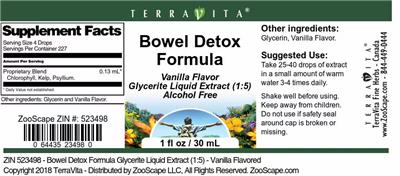
Other ingredients: Glycerin, Vanilla flavor
Tap any ingredient to jump to its full detail below.
These statements are the manufacturer’s wording, reproduced from the product label — the label is saying it, not HelloPharmacist. We don’t verify or endorse them.
Brand IP Statement(s)
Copyright 2018 TerraVita - Distributed by ZooScape LLC, All Rights Reserved.
Formula
Glycerite liquid extract (1:5)
Formulation
Alcohol free
Suggested/Recommended/Usage/Directions
Suggested Use: Take 25-40 drops of extract in a small amount of warm water 3-4 times daily. Shake well before using.
Precautions
Keep away from children.
Do not use if safety seal around cap is broken or missing.
Is this label outdated? Report a formula or label change and our pharmacy team will review it.
Bowel Detox Formula Vanilla Flavor by TerraVita label
The label scan from the NIH Dietary Supplement Label Database. Tap to enlarge.
Label images are published by the NIH Dietary Supplement Label Database for the version of this product on file. Always read your actual product label.
View the full label (PDF)The Ingredients in Bowel Detox Formula Vanilla Flavor by TerraVita
These are the 3 active ingredients this product is made of. Select any to open its full monograph.
Serving size25 Drop(s) Dosage formLiquid Servings per container227 Amounts shown are per serving.
Most supplement products combine several ingredients, and a medication can interact with the product through any one of them. Each ingredient below shows whether it has known drug interactions.
Proprietary Blend
Other (inactive) ingredients: Glycerin, Vanilla flavor. These complete the product’s ingredient list but are not active constituents.
Bowel Detox Formula Vanilla Flavor by TerraVita Drug Interactions
HelloPharmacist Interaction Report
Bowel Detox Formula Vanilla Flavor by TerraVita contains three active ingredients, two of which we've checked for drug interactions.
The most serious concerns come from the chlorophyll and psyllium components.
Read the full breakdown — every affected drug type, severity by severity
Chlorophyll may cause photosensitization (increased skin sensitivity to sunlight) on its own, and taking it alongside photosensitizing drugs—like certain antibiotics or NSAIDs used for sun-sensitive conditions—could add to that effect. There's also a case report of delayed clearance of methotrexate (a cancer and autoimmune medication) when used with chlorophyll; stopping chlorophyll a couple of days before methotrexate helped.
Altogether, these interactions span 2,030 individual medications.
Psyllium can slow or alter how your body absorbs several drugs. The main concerns are metformin (diabetes), lithium (mood disorder), carbamazepine (seizure), and olanzapine (antipsychotic)—all Moderate severity.
It may also affect birth control (ethinyl estradiol) and heart medications like digoxin, though these are Minor concerns. The fix for most is simple: space them 30–60 minutes apart.
We couldn't check kelp glycerite, so we hold no data on how it might interact.
If you take any of these medications or anything else regularly, run them through the interaction checker below before starting.
Check your own medications below · Editorial policy · How we use AI
Want to check YOUR meds against Bowel Detox Formula Vanilla Flavor?
Ask about interactions with your drugs in plain English — “Can I take it with lisinopril?” — and we find you the answer in seconds, ingredient by ingredient.
Go to the checkerIngredients driving the most interactions
Individual Drug Interactions
The ingredients in Bowel Detox Formula Vanilla Flavor interact with 2,127 drugs. Click any drug to see the details.
3 of the 3 ingredients in Bowel Detox Formula Vanilla Flavor interact with drugs. Each result below shows which ingredient is responsible. Psyllium Glycerite Liquid Extract Kelp Glycerite Liquid Extract Chlorophyll Glycerite Liquid Extract
AcepromazineAtravet
How Acepromazine interacts with Bowel Detox Formula Vanilla Flavor — through 2 ingredients. Tap an ingredient for the detail:
Chlorophyll Glycerite Liquid ExtractPhotosensitizing Drugs Moderate
Interaction Summary
Theoretically, concomitant use of chlorophyll with photosensitizing drugs may have additive effects.
Read the full Chlorophyll Glycerite Liquid Extract + Acepromazine interactionPsyllium Glycerite Liquid ExtractOral Drugs Minor
Interaction Summary
Theoretically, psyllium might increase, decrease, or have no effect on the absorption of oral drugs.
Read the full Psyllium Glycerite Liquid Extract + Acepromazine interactionAcetaminophen, Brompheniramine, PhenylpropanolamineDimetapp Cold and Flu
How Acetaminophen, Brompheniramine, Phenylpropanolamine interacts with Bowel Detox Formula Vanilla Flavor — through 2 ingredients. Tap an ingredient for the detail:
Chlorophyll Glycerite Liquid ExtractPhotosensitizing Drugs Moderate
Interaction Summary
Theoretically, concomitant use of chlorophyll with photosensitizing drugs may have additive effects.
Read the full Chlorophyll Glycerite Liquid Extract + Acetaminophen, Brompheniramine, Phenylpropanolamine interactionPsyllium Glycerite Liquid ExtractOral Drugs Minor
Interaction Summary
Theoretically, psyllium might increase, decrease, or have no effect on the absorption of oral drugs.
Read the full Psyllium Glycerite Liquid Extract + Acetaminophen, Brompheniramine, Phenylpropanolamine interactionAcetaminophen, Caffeine, Chlorpheniramine, Hydrocodone, PhenylephrineHycomine Compound
How Acetaminophen, Caffeine, Chlorpheniramine, Hydrocodone, Phenylephrine interacts with Bowel Detox Formula Vanilla Flavor — through 3 ingredients. Tap an ingredient for the detail:
Chlorophyll Glycerite Liquid ExtractPhotosensitizing Drugs Moderate
Interaction Summary
Theoretically, concomitant use of chlorophyll with photosensitizing drugs may have additive effects.
Read the full Chlorophyll Glycerite Liquid Extract + Acetaminophen, Caffeine, Chlorpheniramine, Hydrocodone, Phenylephrine interactionKelp Glycerite Liquid ExtractCytochrome P450 2d6 (cyp2d6) Substrates, Cytochrome P450 3a4 (cyp3a4) Substrates Minor
Interaction Summary
Theoretically, concomitant use of Fucus vesiculosus with CYP2D6 substrates might alter the effects of these substrates.
Read the full Kelp Glycerite Liquid Extract + Acetaminophen, Caffeine, Chlorpheniramine, Hydrocodone, Phenylephrine interactionPsyllium Glycerite Liquid ExtractOral Drugs Minor
Interaction Summary
Theoretically, psyllium might increase, decrease, or have no effect on the absorption of oral drugs.
Read the full Psyllium Glycerite Liquid Extract + Acetaminophen, Caffeine, Chlorpheniramine, Hydrocodone, Phenylephrine interactionAcetaminophen, Chlorpheniramine Maleate, Dextromethorphan HbrVicks Formula 44M Cough, Cold & Flu Relief
How Acetaminophen, Chlorpheniramine Maleate, Dextromethorphan Hbr interacts with Bowel Detox Formula Vanilla Flavor — through 3 ingredients. Tap an ingredient for the detail:
Chlorophyll Glycerite Liquid ExtractPhotosensitizing Drugs Moderate
Interaction Summary
Theoretically, concomitant use of chlorophyll with photosensitizing drugs may have additive effects.
Read the full Chlorophyll Glycerite Liquid Extract + Acetaminophen, Chlorpheniramine Maleate, Dextromethorphan Hbr interactionKelp Glycerite Liquid ExtractCytochrome P450 3a4 (cyp3a4) Substrates, Cytochrome P450 2d6 (cyp2d6) Substrates Minor
Interaction Summary
Theoretically, concomitant use of Fucus vesiculosus with CYP3A4 substrates might increase the risk for adverse effects.
Read the full Kelp Glycerite Liquid Extract + Acetaminophen, Chlorpheniramine Maleate, Dextromethorphan Hbr interactionPsyllium Glycerite Liquid ExtractOral Drugs Minor
Interaction Summary
Theoretically, psyllium might increase, decrease, or have no effect on the absorption of oral drugs.
Read the full Psyllium Glycerite Liquid Extract + Acetaminophen, Chlorpheniramine Maleate, Dextromethorphan Hbr interactionAcetaminophen, Chlorpheniramine, Codeine, PhenylephrineColrex
How Acetaminophen, Chlorpheniramine, Codeine, Phenylephrine interacts with Bowel Detox Formula Vanilla Flavor — through 3 ingredients. Tap an ingredient for the detail:
Chlorophyll Glycerite Liquid ExtractPhotosensitizing Drugs Moderate
Interaction Summary
Theoretically, concomitant use of chlorophyll with photosensitizing drugs may have additive effects.
Read the full Chlorophyll Glycerite Liquid Extract + Acetaminophen, Chlorpheniramine, Codeine, Phenylephrine interactionPsyllium Glycerite Liquid ExtractOral Drugs Minor
Interaction Summary
Theoretically, psyllium might increase, decrease, or have no effect on the absorption of oral drugs.
Read the full Psyllium Glycerite Liquid Extract + Acetaminophen, Chlorpheniramine, Codeine, Phenylephrine interactionKelp Glycerite Liquid ExtractCytochrome P450 3a4 (cyp3a4) Substrates, Cytochrome P450 2d6 (cyp2d6) Substrates Minor
Interaction Summary
Theoretically, concomitant use of Fucus vesiculosus with CYP3A4 substrates might increase the risk for adverse effects.
Read the full Kelp Glycerite Liquid Extract + Acetaminophen, Chlorpheniramine, Codeine, Phenylephrine interactionAcetaminophen, Chlorpheniramine, DextromethorphanCoricidin II Extra Strength Cold and Flu
How Acetaminophen, Chlorpheniramine, Dextromethorphan interacts with Bowel Detox Formula Vanilla Flavor — through 3 ingredients. Tap an ingredient for the detail:
Chlorophyll Glycerite Liquid ExtractPhotosensitizing Drugs Moderate
Interaction Summary
Theoretically, concomitant use of chlorophyll with photosensitizing drugs may have additive effects.
Read the full Chlorophyll Glycerite Liquid Extract + Acetaminophen, Chlorpheniramine, Dextromethorphan interactionKelp Glycerite Liquid ExtractCytochrome P450 2d6 (cyp2d6) Substrates, Cytochrome P450 3a4 (cyp3a4) Substrates Minor
Interaction Summary
Theoretically, concomitant use of Fucus vesiculosus with CYP2D6 substrates might alter the effects of these substrates.
Read the full Kelp Glycerite Liquid Extract + Acetaminophen, Chlorpheniramine, Dextromethorphan interactionPsyllium Glycerite Liquid ExtractOral Drugs Minor
Interaction Summary
Theoretically, psyllium might increase, decrease, or have no effect on the absorption of oral drugs.
Read the full Psyllium Glycerite Liquid Extract + Acetaminophen, Chlorpheniramine, Dextromethorphan interactionAcetaminophen, Chlorpheniramine, Dextromethorphan HydrobromideCoricidin HBP Maximum Strength Flu
How Acetaminophen, Chlorpheniramine, Dextromethorphan Hydrobromide interacts with Bowel Detox Formula Vanilla Flavor — through 3 ingredients. Tap an ingredient for the detail:
Chlorophyll Glycerite Liquid ExtractPhotosensitizing Drugs Moderate
Interaction Summary
Theoretically, concomitant use of chlorophyll with photosensitizing drugs may have additive effects.
Read the full Chlorophyll Glycerite Liquid Extract + Acetaminophen, Chlorpheniramine, Dextromethorphan Hydrobromide interactionPsyllium Glycerite Liquid ExtractOral Drugs Minor
Interaction Summary
Theoretically, psyllium might increase, decrease, or have no effect on the absorption of oral drugs.
Read the full Psyllium Glycerite Liquid Extract + Acetaminophen, Chlorpheniramine, Dextromethorphan Hydrobromide interactionKelp Glycerite Liquid ExtractCytochrome P450 3a4 (cyp3a4) Substrates, Cytochrome P450 2d6 (cyp2d6) Substrates Minor
Interaction Summary
Theoretically, concomitant use of Fucus vesiculosus with CYP3A4 substrates might increase the risk for adverse effects.
Read the full Kelp Glycerite Liquid Extract + Acetaminophen, Chlorpheniramine, Dextromethorphan Hydrobromide interactionAcetaminophen, Chlorpheniramine, Dextromethorphan, PhenylpropanolamineMulti Symptom Cold Relief
How Acetaminophen, Chlorpheniramine, Dextromethorphan, Phenylpropanolamine interacts with Bowel Detox Formula Vanilla Flavor — through 3 ingredients. Tap an ingredient for the detail:
Chlorophyll Glycerite Liquid ExtractPhotosensitizing Drugs Moderate
Interaction Summary
Theoretically, concomitant use of chlorophyll with photosensitizing drugs may have additive effects.
Read the full Chlorophyll Glycerite Liquid Extract + Acetaminophen, Chlorpheniramine, Dextromethorphan, Phenylpropanolamine interactionKelp Glycerite Liquid ExtractCytochrome P450 3a4 (cyp3a4) Substrates, Cytochrome P450 2d6 (cyp2d6) Substrates Minor
Interaction Summary
Theoretically, concomitant use of Fucus vesiculosus with CYP3A4 substrates might increase the risk for adverse effects.
Read the full Kelp Glycerite Liquid Extract + Acetaminophen, Chlorpheniramine, Dextromethorphan, Phenylpropanolamine interactionPsyllium Glycerite Liquid ExtractOral Drugs Minor
Interaction Summary
Theoretically, psyllium might increase, decrease, or have no effect on the absorption of oral drugs.
Read the full Psyllium Glycerite Liquid Extract + Acetaminophen, Chlorpheniramine, Dextromethorphan, Phenylpropanolamine interactionAcetaminophen, Chlorpheniramine, Dextromethorphan, PseudoephedrineChildren's Tylenol Cold Plus Cough, Tylenol Cold Ex Strength
How Acetaminophen, Chlorpheniramine, Dextromethorphan, Pseudoephedrine interacts with Bowel Detox Formula Vanilla Flavor — through 3 ingredients. Tap an ingredient for the detail:
Chlorophyll Glycerite Liquid ExtractPhotosensitizing Drugs Moderate
Interaction Summary
Theoretically, concomitant use of chlorophyll with photosensitizing drugs may have additive effects.
Read the full Chlorophyll Glycerite Liquid Extract + Acetaminophen, Chlorpheniramine, Dextromethorphan, Pseudoephedrine interactionPsyllium Glycerite Liquid ExtractOral Drugs Minor
Interaction Summary
Theoretically, psyllium might increase, decrease, or have no effect on the absorption of oral drugs.
Read the full Psyllium Glycerite Liquid Extract + Acetaminophen, Chlorpheniramine, Dextromethorphan, Pseudoephedrine interactionKelp Glycerite Liquid ExtractCytochrome P450 2d6 (cyp2d6) Substrates, Cytochrome P450 3a4 (cyp3a4) Substrates Minor
Interaction Summary
Theoretically, concomitant use of Fucus vesiculosus with CYP2D6 substrates might alter the effects of these substrates.
Read the full Kelp Glycerite Liquid Extract + Acetaminophen, Chlorpheniramine, Dextromethorphan, Pseudoephedrine interactionAcetaminophen, Chlorpheniramine, Guaifenesin, Phenylephrine, SalicylamideRhinogesic GG
How Acetaminophen, Chlorpheniramine, Guaifenesin, Phenylephrine, Salicylamide interacts with Bowel Detox Formula Vanilla Flavor — through 3 ingredients. Tap an ingredient for the detail:
Chlorophyll Glycerite Liquid ExtractPhotosensitizing Drugs Moderate
Interaction Summary
Theoretically, concomitant use of chlorophyll with photosensitizing drugs may have additive effects.
Read the full Chlorophyll Glycerite Liquid Extract + Acetaminophen, Chlorpheniramine, Guaifenesin, Phenylephrine, Salicylamide interactionKelp Glycerite Liquid ExtractCytochrome P450 3a4 (cyp3a4) Substrates Minor
Interaction Summary
Theoretically, concomitant use of Fucus vesiculosus with CYP3A4 substrates might increase the risk for adverse effects.
Read the full Kelp Glycerite Liquid Extract + Acetaminophen, Chlorpheniramine, Guaifenesin, Phenylephrine, Salicylamide interactionPsyllium Glycerite Liquid ExtractOral Drugs Minor
Interaction Summary
Theoretically, psyllium might increase, decrease, or have no effect on the absorption of oral drugs.
Read the full Psyllium Glycerite Liquid Extract + Acetaminophen, Chlorpheniramine, Guaifenesin, Phenylephrine, Salicylamide interactionAcetaminophen, Chlorpheniramine, PhenylephrineAlka-Seltzer PLUS, Histex SR, Protid
How Acetaminophen, Chlorpheniramine, Phenylephrine interacts with Bowel Detox Formula Vanilla Flavor — through 3 ingredients. Tap an ingredient for the detail:
Chlorophyll Glycerite Liquid ExtractPhotosensitizing Drugs Moderate
Interaction Summary
Theoretically, concomitant use of chlorophyll with photosensitizing drugs may have additive effects.
Read the full Chlorophyll Glycerite Liquid Extract + Acetaminophen, Chlorpheniramine, Phenylephrine interactionPsyllium Glycerite Liquid ExtractOral Drugs Minor
Interaction Summary
Theoretically, psyllium might increase, decrease, or have no effect on the absorption of oral drugs.
Read the full Psyllium Glycerite Liquid Extract + Acetaminophen, Chlorpheniramine, Phenylephrine interactionKelp Glycerite Liquid ExtractCytochrome P450 3a4 (cyp3a4) Substrates Minor
Interaction Summary
Theoretically, concomitant use of Fucus vesiculosus with CYP3A4 substrates might increase the risk for adverse effects.
Read the full Kelp Glycerite Liquid Extract + Acetaminophen, Chlorpheniramine, Phenylephrine interactionAcetaminophen, Chlorpheniramine, Phenylephrine, SalicylamideRhinogesic, Rhinogesic JR
How Acetaminophen, Chlorpheniramine, Phenylephrine, Salicylamide interacts with Bowel Detox Formula Vanilla Flavor — through 3 ingredients. Tap an ingredient for the detail:
Chlorophyll Glycerite Liquid ExtractPhotosensitizing Drugs Moderate
Interaction Summary
Theoretically, concomitant use of chlorophyll with photosensitizing drugs may have additive effects.
Read the full Chlorophyll Glycerite Liquid Extract + Acetaminophen, Chlorpheniramine, Phenylephrine, Salicylamide interactionKelp Glycerite Liquid ExtractCytochrome P450 3a4 (cyp3a4) Substrates Minor
Interaction Summary
Theoretically, concomitant use of Fucus vesiculosus with CYP3A4 substrates might increase the risk for adverse effects.
Read the full Kelp Glycerite Liquid Extract + Acetaminophen, Chlorpheniramine, Phenylephrine, Salicylamide interactionPsyllium Glycerite Liquid ExtractOral Drugs Minor
Interaction Summary
Theoretically, psyllium might increase, decrease, or have no effect on the absorption of oral drugs.
Read the full Psyllium Glycerite Liquid Extract + Acetaminophen, Chlorpheniramine, Phenylephrine, Salicylamide interactionAcetaminophen, Chlorpheniramine, PhenylpropanolamineAlumadrine, Conex, Sinadrin Max Strength, Sinulin
How Acetaminophen, Chlorpheniramine, Phenylpropanolamine interacts with Bowel Detox Formula Vanilla Flavor — through 3 ingredients. Tap an ingredient for the detail:
Chlorophyll Glycerite Liquid ExtractPhotosensitizing Drugs Moderate
Interaction Summary
Theoretically, concomitant use of chlorophyll with photosensitizing drugs may have additive effects.
Read the full Chlorophyll Glycerite Liquid Extract + Acetaminophen, Chlorpheniramine, Phenylpropanolamine interactionPsyllium Glycerite Liquid ExtractOral Drugs Minor
Interaction Summary
Theoretically, psyllium might increase, decrease, or have no effect on the absorption of oral drugs.
Read the full Psyllium Glycerite Liquid Extract + Acetaminophen, Chlorpheniramine, Phenylpropanolamine interactionKelp Glycerite Liquid ExtractCytochrome P450 3a4 (cyp3a4) Substrates Minor
Interaction Summary
Theoretically, concomitant use of Fucus vesiculosus with CYP3A4 substrates might increase the risk for adverse effects.
Read the full Kelp Glycerite Liquid Extract + Acetaminophen, Chlorpheniramine, Phenylpropanolamine interactionAcetaminophen, Chlorpheniramine, Phenylpropanolamine, OpiumHista-Derfule
How Acetaminophen, Chlorpheniramine, Phenylpropanolamine, Opium interacts with Bowel Detox Formula Vanilla Flavor — through 3 ingredients. Tap an ingredient for the detail:
Chlorophyll Glycerite Liquid ExtractPhotosensitizing Drugs Moderate
Interaction Summary
Theoretically, concomitant use of chlorophyll with photosensitizing drugs may have additive effects.
Read the full Chlorophyll Glycerite Liquid Extract + Acetaminophen, Chlorpheniramine, Phenylpropanolamine, Opium interactionKelp Glycerite Liquid ExtractCytochrome P450 3a4 (cyp3a4) Substrates Minor
Interaction Summary
Theoretically, concomitant use of Fucus vesiculosus with CYP3A4 substrates might increase the risk for adverse effects.
Read the full Kelp Glycerite Liquid Extract + Acetaminophen, Chlorpheniramine, Phenylpropanolamine, Opium interactionPsyllium Glycerite Liquid ExtractOral Drugs Minor
Interaction Summary
Theoretically, psyllium might increase, decrease, or have no effect on the absorption of oral drugs.
Read the full Psyllium Glycerite Liquid Extract + Acetaminophen, Chlorpheniramine, Phenylpropanolamine, Opium interactionAcetaminophen, Chlorpheniramine, Phenylpropanolamine, PhenyltoloxamineNorel Plus
How Acetaminophen, Chlorpheniramine, Phenylpropanolamine, Phenyltoloxamine interacts with Bowel Detox Formula Vanilla Flavor — through 3 ingredients. Tap an ingredient for the detail:
Chlorophyll Glycerite Liquid ExtractPhotosensitizing Drugs Moderate
Interaction Summary
Theoretically, concomitant use of chlorophyll with photosensitizing drugs may have additive effects.
Read the full Chlorophyll Glycerite Liquid Extract + Acetaminophen, Chlorpheniramine, Phenylpropanolamine, Phenyltoloxamine interactionPsyllium Glycerite Liquid ExtractOral Drugs Minor
Interaction Summary
Theoretically, psyllium might increase, decrease, or have no effect on the absorption of oral drugs.
Read the full Psyllium Glycerite Liquid Extract + Acetaminophen, Chlorpheniramine, Phenylpropanolamine, Phenyltoloxamine interactionKelp Glycerite Liquid ExtractCytochrome P450 3a4 (cyp3a4) Substrates Minor
Interaction Summary
Theoretically, concomitant use of Fucus vesiculosus with CYP3A4 substrates might increase the risk for adverse effects.
Read the full Kelp Glycerite Liquid Extract + Acetaminophen, Chlorpheniramine, Phenylpropanolamine, Phenyltoloxamine interactionAcetaminophen, Chlorpheniramine, PseudoephedrineAlka-Seltzer PLUS Liquid Gels, Children's Tylenol Cold, Codimal, Comtrex, Extra Strength Tylenol Allergy Sinus, Lorsin +3 more
How Acetaminophen, Chlorpheniramine, Pseudoephedrine interacts with Bowel Detox Formula Vanilla Flavor — through 3 ingredients. Tap an ingredient for the detail:
Chlorophyll Glycerite Liquid ExtractPhotosensitizing Drugs Moderate
Interaction Summary
Theoretically, concomitant use of chlorophyll with photosensitizing drugs may have additive effects.
Read the full Chlorophyll Glycerite Liquid Extract + Acetaminophen, Chlorpheniramine, Pseudoephedrine interactionKelp Glycerite Liquid ExtractCytochrome P450 3a4 (cyp3a4) Substrates Minor
Interaction Summary
Theoretically, concomitant use of Fucus vesiculosus with CYP3A4 substrates might increase the risk for adverse effects.
Read the full Kelp Glycerite Liquid Extract + Acetaminophen, Chlorpheniramine, Pseudoephedrine interactionPsyllium Glycerite Liquid ExtractOral Drugs Minor
Interaction Summary
Theoretically, psyllium might increase, decrease, or have no effect on the absorption of oral drugs.
Read the full Psyllium Glycerite Liquid Extract + Acetaminophen, Chlorpheniramine, Pseudoephedrine interactionAcetaminophen, Dexbrompheniramine, PseudoephedrineSinadrin Plus
How Acetaminophen, Dexbrompheniramine, Pseudoephedrine interacts with Bowel Detox Formula Vanilla Flavor — through 2 ingredients. Tap an ingredient for the detail:
Chlorophyll Glycerite Liquid ExtractPhotosensitizing Drugs Moderate
Interaction Summary
Theoretically, concomitant use of chlorophyll with photosensitizing drugs may have additive effects.
Read the full Chlorophyll Glycerite Liquid Extract + Acetaminophen, Dexbrompheniramine, Pseudoephedrine interactionPsyllium Glycerite Liquid ExtractOral Drugs Minor
Interaction Summary
Theoretically, psyllium might increase, decrease, or have no effect on the absorption of oral drugs.
Read the full Psyllium Glycerite Liquid Extract + Acetaminophen, Dexbrompheniramine, Pseudoephedrine interactionAcetaminophen, DiphenhydramineTylenol PM, Tylenol PM Ex Strength
How Acetaminophen, Diphenhydramine interacts with Bowel Detox Formula Vanilla Flavor — through 2 ingredients. Tap an ingredient for the detail:
Chlorophyll Glycerite Liquid ExtractPhotosensitizing Drugs Moderate
Interaction Summary
Theoretically, concomitant use of chlorophyll with photosensitizing drugs may have additive effects.
Read the full Chlorophyll Glycerite Liquid Extract + Acetaminophen, Diphenhydramine interactionPsyllium Glycerite Liquid ExtractOral Drugs Minor
Interaction Summary
Theoretically, psyllium might increase, decrease, or have no effect on the absorption of oral drugs.
Read the full Psyllium Glycerite Liquid Extract + Acetaminophen, Diphenhydramine interactionAcetaminophen, Diphenhydramine, PseudoephedrineChildren's Tylenol Allergy, Cold Control, Contac Night Allergy Relief
How Acetaminophen, Diphenhydramine, Pseudoephedrine interacts with Bowel Detox Formula Vanilla Flavor — through 2 ingredients. Tap an ingredient for the detail:
Chlorophyll Glycerite Liquid ExtractPhotosensitizing Drugs Moderate
Interaction Summary
Theoretically, concomitant use of chlorophyll with photosensitizing drugs may have additive effects.
Read the full Chlorophyll Glycerite Liquid Extract + Acetaminophen, Diphenhydramine, Pseudoephedrine interactionPsyllium Glycerite Liquid ExtractOral Drugs Minor
Interaction Summary
Theoretically, psyllium might increase, decrease, or have no effect on the absorption of oral drugs.
Read the full Psyllium Glycerite Liquid Extract + Acetaminophen, Diphenhydramine, Pseudoephedrine interactionAcetaminophen, IbuprofenCombogesic
How Acetaminophen, Ibuprofen interacts with Bowel Detox Formula Vanilla Flavor — through 3 ingredients. Tap an ingredient for the detail:
Chlorophyll Glycerite Liquid ExtractPhotosensitizing Drugs Moderate
Interaction Summary
Theoretically, concomitant use of chlorophyll with photosensitizing drugs may have additive effects.
Read the full Chlorophyll Glycerite Liquid Extract + Acetaminophen, Ibuprofen interactionKelp Glycerite Liquid ExtractAnticoagulant/antiplatelet Drugs, Cytochrome P450 2c9 (cyp2c9) Substrates Minor
Interaction Summary
Theoretically, taking Fucus vesiculosus with antiplatelet or anticoagulant drugs might increase the risk of bruising and bleeding.
Read the full Kelp Glycerite Liquid Extract + Acetaminophen, Ibuprofen interactionPsyllium Glycerite Liquid ExtractOral Drugs Minor
Interaction Summary
Theoretically, psyllium might increase, decrease, or have no effect on the absorption of oral drugs.
Read the full Psyllium Glycerite Liquid Extract + Acetaminophen, Ibuprofen interactionAcetaminophen, Phenylephrine, ChlorpheniramineSuper Cold Tabs
How Acetaminophen, Phenylephrine, Chlorpheniramine interacts with Bowel Detox Formula Vanilla Flavor — through 3 ingredients. Tap an ingredient for the detail:
Chlorophyll Glycerite Liquid ExtractPhotosensitizing Drugs Moderate
Interaction Summary
Theoretically, concomitant use of chlorophyll with photosensitizing drugs may have additive effects.
Read the full Chlorophyll Glycerite Liquid Extract + Acetaminophen, Phenylephrine, Chlorpheniramine interactionPsyllium Glycerite Liquid ExtractOral Drugs Minor
Interaction Summary
Theoretically, psyllium might increase, decrease, or have no effect on the absorption of oral drugs.
Read the full Psyllium Glycerite Liquid Extract + Acetaminophen, Phenylephrine, Chlorpheniramine interactionKelp Glycerite Liquid ExtractCytochrome P450 3a4 (cyp3a4) Substrates Minor
Interaction Summary
Theoretically, concomitant use of Fucus vesiculosus with CYP3A4 substrates might increase the risk for adverse effects.
Read the full Kelp Glycerite Liquid Extract + Acetaminophen, Phenylephrine, Chlorpheniramine interactionAcetazolamideAk-Zol, Diamox
How Acetazolamide interacts with Bowel Detox Formula Vanilla Flavor — through 2 ingredients. Tap an ingredient for the detail:
Chlorophyll Glycerite Liquid ExtractPhotosensitizing Drugs Moderate
Interaction Summary
Theoretically, concomitant use of chlorophyll with photosensitizing drugs may have additive effects.
Read the full Chlorophyll Glycerite Liquid Extract + Acetazolamide interactionPsyllium Glycerite Liquid ExtractOral Drugs Minor
Interaction Summary
Theoretically, psyllium might increase, decrease, or have no effect on the absorption of oral drugs.
Read the full Psyllium Glycerite Liquid Extract + Acetazolamide interactionAcetohexamideDymelor
How Acetohexamide interacts with Bowel Detox Formula Vanilla Flavor — through 2 ingredients. Tap an ingredient for the detail:
Chlorophyll Glycerite Liquid ExtractPhotosensitizing Drugs Moderate
Interaction Summary
Theoretically, concomitant use of chlorophyll with photosensitizing drugs may have additive effects.
Read the full Chlorophyll Glycerite Liquid Extract + Acetohexamide interactionPsyllium Glycerite Liquid ExtractOral Drugs Minor
Interaction Summary
Theoretically, psyllium might increase, decrease, or have no effect on the absorption of oral drugs.
Read the full Psyllium Glycerite Liquid Extract + Acetohexamide interactionAcitretinSoriatane
How Acitretin interacts with Bowel Detox Formula Vanilla Flavor — through 2 ingredients. Tap an ingredient for the detail:
Chlorophyll Glycerite Liquid ExtractPhotosensitizing Drugs Moderate
Interaction Summary
Theoretically, concomitant use of chlorophyll with photosensitizing drugs may have additive effects.
Read the full Chlorophyll Glycerite Liquid Extract + Acitretin interactionPsyllium Glycerite Liquid ExtractOral Drugs Minor
Interaction Summary
Theoretically, psyllium might increase, decrease, or have no effect on the absorption of oral drugs.
Read the full Psyllium Glycerite Liquid Extract + Acitretin interactionAlectinib HydrochlorideAlecensa
How Alectinib Hydrochloride interacts with Bowel Detox Formula Vanilla Flavor — through 2 ingredients. Tap an ingredient for the detail:
Chlorophyll Glycerite Liquid ExtractPhotosensitizing Drugs Moderate
Interaction Summary
Theoretically, concomitant use of chlorophyll with photosensitizing drugs may have additive effects.
Read the full Chlorophyll Glycerite Liquid Extract + Alectinib Hydrochloride interactionPsyllium Glycerite Liquid ExtractOral Drugs Minor
Interaction Summary
Theoretically, psyllium might increase, decrease, or have no effect on the absorption of oral drugs.
Read the full Psyllium Glycerite Liquid Extract + Alectinib Hydrochloride interactionAlitretinoinPanretin
How Alitretinoin interacts with Bowel Detox Formula Vanilla Flavor — through 2 ingredients. Tap an ingredient for the detail:
Chlorophyll Glycerite Liquid ExtractPhotosensitizing Drugs Moderate
Interaction Summary
Theoretically, concomitant use of chlorophyll with photosensitizing drugs may have additive effects.
Read the full Chlorophyll Glycerite Liquid Extract + Alitretinoin interactionPsyllium Glycerite Liquid ExtractOral Drugs Minor
Interaction Summary
Theoretically, psyllium might increase, decrease, or have no effect on the absorption of oral drugs.
Read the full Psyllium Glycerite Liquid Extract + Alitretinoin interactionAlogliptin, MetforminKazano
How Alogliptin, Metformin interacts with Bowel Detox Formula Vanilla Flavor — through 1 ingredient. Tap an ingredient for the detail:
Psyllium Glycerite Liquid ExtractOral Drugs, Metformin (glucophage) Moderate
Interaction Summary
Theoretically, psyllium might increase, decrease, or have no effect on the absorption of oral drugs.
Read the full Psyllium Glycerite Liquid Extract + Alogliptin, Metformin interactionAmiloride, HydrochlorothiazideAmil-Co, Amilzide, Moduret 25, Moduretic
How Amiloride, Hydrochlorothiazide interacts with Bowel Detox Formula Vanilla Flavor — through 2 ingredients. Tap an ingredient for the detail:
Chlorophyll Glycerite Liquid ExtractPhotosensitizing Drugs Moderate
Interaction Summary
Theoretically, concomitant use of chlorophyll with photosensitizing drugs may have additive effects.
Read the full Chlorophyll Glycerite Liquid Extract + Amiloride, Hydrochlorothiazide interactionPsyllium Glycerite Liquid ExtractOral Drugs Minor
Interaction Summary
Theoretically, psyllium might increase, decrease, or have no effect on the absorption of oral drugs.
Read the full Psyllium Glycerite Liquid Extract + Amiloride, Hydrochlorothiazide interactionAminolevulinic Acid HydrochlorideAmeluz, Gleolan
How Aminolevulinic Acid Hydrochloride interacts with Bowel Detox Formula Vanilla Flavor — through 2 ingredients. Tap an ingredient for the detail:
Chlorophyll Glycerite Liquid ExtractPhotosensitizing Drugs Moderate
Interaction Summary
Theoretically, concomitant use of chlorophyll with photosensitizing drugs may have additive effects.
Read the full Chlorophyll Glycerite Liquid Extract + Aminolevulinic Acid Hydrochloride interactionPsyllium Glycerite Liquid ExtractOral Drugs Minor
Interaction Summary
Theoretically, psyllium might increase, decrease, or have no effect on the absorption of oral drugs.
Read the full Psyllium Glycerite Liquid Extract + Aminolevulinic Acid Hydrochloride interactionAmiodaroneCordarone, Pacerone
How Amiodarone interacts with Bowel Detox Formula Vanilla Flavor — through 3 ingredients. Tap an ingredient for the detail:
Kelp Glycerite Liquid ExtractCytochrome P450 2c8 (cyp2c8) Substrates, Amiodarone (cordarone) +1 Moderate
Interaction Summary
Theoretically, concomitant use of Fucus vesiculosus with CYP2C8 substrates might increase the risk for adverse effects.
Read the full Kelp Glycerite Liquid Extract + Amiodarone interactionChlorophyll Glycerite Liquid ExtractPhotosensitizing Drugs Moderate
Interaction Summary
Theoretically, concomitant use of chlorophyll with photosensitizing drugs may have additive effects.
Read the full Chlorophyll Glycerite Liquid Extract + Amiodarone interactionPsyllium Glycerite Liquid ExtractOral Drugs Minor
Interaction Summary
Theoretically, psyllium might increase, decrease, or have no effect on the absorption of oral drugs.
Read the full Psyllium Glycerite Liquid Extract + Amiodarone interactionEach ingredient & the kinds of drugs it affects
For each ingredient in Bowel Detox Formula Vanilla Flavor with known interactions, here are the types of medications they can affect. Open any type for the detail — or search your exact drug in the checker above.
Psyllium Glycerite Liquid Extract
Carbamazepine (Tegretol)
Theoretically, blond psyllium might reduce the effects of carbamazepine and increase the risk for convulsions.
Blond psyllium might reduce carbamazepine absorption and serum levels. A preliminary study using blond psyllium reported decreased carbamazepine bioavailability due to binding of the drug to psyllium, as well as reduction of available fluid in the gut for dissolution of the drug.
Lithium
Theoretically, taking blond psyllium at the same time as lithium might reduce lithium absorption.
The fiber in blond psyllium might decrease the absorption of lithium. Some case reports describe a reduction in plasma lithium levels with concomitant administration of blond psyllium. This was reversed when psyllium was stopped.
Metformin (Glucophage)
Theoretically, blond psyllium might increase the therapeutic and adverse effects of metformin.
Concurrent use of blond psyllium with metformin slows and increases metformin absorption. To avoid changes in absorption, take psyllium 30-60 minutes after metformin.
Olanzapine (Zyprexa)
Theoretically, taking blond psyllium at the same time as olanzapine might reduce olanzapine absorption.
The fiber in blond psyllium might decrease the absorption of olanzapine. A single case report describes a reduction in the effectiveness of olanzapine when it was taken concomitantly with an unspecified type of psyllium 3 grams orally twice daily. This effect was reversed when psyllium was stopped.
Digoxin (Lanoxin)
Theoretically, taking blond psyllium at the same time as digoxin might reduce digoxin absorption.
Psyllium might bind digoxin in the gut. However, some clinical evidence suggests that psyllium does not impact digoxin absorption.
Ethinyl Estradiol
Theoretically, taking blond psyllium at the same time as ethinyl estradiol might alter levels of estradiol.
Concurrent use of blond psyllium with ethinyl estradiol results in a slight increase in the extent of ethinyl estradiol absorption and a slower rate of absorption. However, this is unlikely to be clinically significant.
Oral Drugs
Theoretically, psyllium might increase, decrease, or have no effect on the absorption of oral drugs.
Psyllium seems to have variable effects on drug absorption. To avoid changes in absorption, take psyllium 30-60 minutes after oral medications. Animal research shows that blond psyllium delays and increases the absorption of metformin and ethinyl estradiol. Conversely, case reports and animal research suggest that blond psyllium might reduce absorption of lithium, digoxin, olanzapine, and carbamazepine. Finally, some pharmacokinetic studies show that psyllium does not affect the absorption of levothyroxine or warfarin.
Kelp Glycerite Liquid Extract
Amiodarone (Cordarone)
Theoretically, combining Fucus vesiculosus with amiodarone might cause excessively high iodine levels.
Fucus vesiculosus contains high concentrations of iodine. Amiodarone contains 37.3% iodine and can increase iodine levels. Concomitant use might increase the risk of having excessive iodine levels and adversely affecting thyroid function. Monitor thyroid function.
Antithyroid Drugs
Due to its iodine content, Fucus vesiculosus might alter the effects of antithyroid drugs.
Fucus vesiculosus contains high concentrations of iodine. Iodine in high doses has been reported to cause both hyperthyroidism and hypothyroidism, depending on the individual's past medical history. Taking Fucus vesiculosus while using antithyroid drugs could alter the effects of the antithyroid drugs.
Lithium
Concomitant use of Fucus vesiculosus and lithium has resulted in hyperthyroidism.
There is a case of hyperthyroidism occurring in a patient taking Fucus vesiculosus and lithium. Monitor thyroid hormones closely in patients taking lithium and Fucus vesiculosus concomitantly.
Thyroid Hormone
Due to its iodine content, Fucus vesiculosus might alter the effects of thyroid hormone.
Fucus vesiculosus contains high concentrations of iodine. Iodine in high doses has been reported to cause both hyperthyroidism and hypothyroidism, depending on the individual's past medical history. Taking Fucus vesiculosus while using thyroid hormone could alter the effects of thyroid hormone.
Anticoagulant/Antiplatelet Drugs
Theoretically, taking Fucus vesiculosus with antiplatelet or anticoagulant drugs might increase the risk of bruising and bleeding.
In vitro evidence suggests that a constituent of Fucus vesiculosus, known as fucoidan, has anticoagulant effects. However, in clinical research, fucoidan does not seem to have significant anticoagulant activity when taken orally, possibly due to poor absorption.
Cytochrome P450 2C8 (Cyp2C8) Substrates
Theoretically, concomitant use of Fucus vesiculosus with CYP2C8 substrates might increase the risk for adverse effects.
In vitro research shows that fucoidan, a constituent of Fucus vesiculosus, inhibits CYP2C8. This interaction has not been reported in humans.
Cytochrome P450 2C9 (Cyp2C9) Substrates
Theoretically, concomitant use of Fucus vesiculosus with CYP2C9 substrates might increase the risk for adverse effects.
In vitro research shows that fucoidan, a constituent of Fucus vesiculosus, inhibits CYP2C9. This interaction has not been reported in humans.
Cytochrome P450 2D6 (Cyp2D6) Substrates
Theoretically, concomitant use of Fucus vesiculosus with CYP2D6 substrates might alter the effects of these substrates.
In vitro research shows that fucoidan, a constituent of Fucus vesiculosus, both inhibits and induces CYP2D6. This interaction has not been reported in humans.
Cytochrome P450 3A4 (Cyp3A4) Substrates
Theoretically, concomitant use of Fucus vesiculosus with CYP3A4 substrates might increase the risk for adverse effects.
In vitro research shows that fucoidan, a constituent of Fucus vesiculosus, inhibits CYP3A4. This interaction has not been reported in humans.
Chlorophyll Glycerite Liquid Extract
Methotrexate (Trexall, Others)
Theoretically, chlorophyll may reduce the clearance of methotrexate.
In one case report, a 54-year-old male developed delayed clearance of intravenous high-dose methotrexate with concomitant use of chlorophyll. When chlorophyll was stopped 2 days prior to methotrexate treatment, methotrexate clearance was unaffected.
Photosensitizing Drugs
Theoretically, concomitant use of chlorophyll with photosensitizing drugs may have additive effects.
Chlorophyll has been reported to cause photosensitization. In two case reports, pseudoporphyria developed after oral intake of chlorophyll. Theoretically, concomitant use with other photosensitizing drugs may exacerbate this effect.
Brand information
Manufacturer and brand details for Bowel Detox Formula Vanilla Flavor, from the product label.
TerraVita
See all TerraVita products- Name
- ZooScape LLC
- Phone Number
- 844-449-0444
- Web Address
- www.ZooScape.com
Bowel Detox Formula Vanilla Flavor by TerraVita: Common Questions
Does Bowel Detox Formula Vanilla Flavor by TerraVita interact with any medications?
How can one product interact with so many drugs?
Where does this information come from?
What is chlorophyll and why is it in here?
Will this help my constipation?
Can I take this while breastfeeding?
What are the most common side effects?
How far apart should I space this from my other medications?
Written and reviewed by the HelloPharmacist editorial staff. Our editorial policy
Not sure if Bowel Detox Formula Vanilla Flavor is safe with your meds?
Our pharmacists answer your medication & supplement questions — free.
Label information is sourced from the NIH Dietary Supplement Label Database and reflects the product version on file; always read your actual product label. This page is for education only and is not a substitute for professional medical advice. Confirm with your pharmacist or doctor before combining supplements and medications.
The Full Monographs Behind Bowel Detox Formula Vanilla Flavor’s Ingredients
Every ingredient we hold a full HelloPharmacist monograph for — uses, evidence, safety, and the complete interaction list.
Chlorophyll
Interacts with 337 drugsChlorophyll is the green pigment found in plants and algae, and supplements often use a stable form called chlorophyllin. It is most studied for reducing body and fecal odor and as a topical...
Read the full Chlorophyll monograph → Herb & supplement monographFucus Vesiculosus
Interacts with 891 drugsFucus vesiculosus (bladderwrack) is a brown seaweed rich in iodine that has been used traditionally for thyroid concerns, weight, and skin. There is little solid human evidence to support mo...
Read the full Fucus Vesiculosus monograph → Herb & supplement monographBlond Psyllium
Interacts with 2,025 drugsBlond psyllium is a soluble fiber from the seed husks of Plantago ovata, and it is one of the better-studied fiber supplements. It can help with both constipation and diarrhea and may modest...
Read the full Blond Psyllium monograph →Sources & How We Checked
Bowel Detox Formula Vanilla Flavor's label data comes from the NIH Dietary Supplement Label Database; the ingredient interaction data is from the Natural Medicines database, reviewed by our pharmacists.
- NIH Dietary Supplement Label Database (DSLD) — The official product label on file for this supplement.
- Natural Medicines (Therapeutic Research Center) — Evidence-graded clinical reference behind the ingredient interaction data.
Content is written and reviewed by licensed HelloPharmacist pharmacists. See our data sources and editorial standards for how this information is built and checked.
The 48 references behind this product’s interaction data
Every citation that drives the interaction findings for this product’s ingredients, from the evidence-graded Natural Medicines (TRC Healthcare) database. Open an ingredient to browse its citations — links open the study on PubMed or the publisher’s site.
Chlorophyll 5 references
- Mathews-Roth MM. Carotenoids in erythropoietic protoporphyria and other photosensitivity diseases. Ann N Y Acad Sci, 1993; 691:127-38. PubMed
- Belen'kii, G. B. and Krikun, B. L. [Treatment of herpes simplex and herpes zoster by chlorophyll preparations]. Sov.Med. 1971;34(1):151-152.
- Brooks SL, Sanders J, Seymour JF, Mellor JD. A case of delayed methotrexate clearance following administration of a complementary medication containing chlorophyll. J Oncol Pharm Pract. 2014 Jun;20(3):225-8. PubMed
- Rossi E, Borchard K, Cole JM. Pseudoporphyria following self-medication with chlorophyll. Australas J Dermatol. 2015 Feb;56(1):47-8. PubMed
- Zhao CY, Frew JW, Muhaidat J, et al. Chlorophyll-induced pseudoporphyria with ongoing photosensitivity after cessation - a case series of four patients. J Eur Acad Dermatol Venereol 2016;30(7):1239-42. PubMed
Fucus Vesiculosus 15 references
- Goodman GA, Rall TW, Nies AS, Taylor P. The Pharmacological Basis of Therapeutics, 9th ed.
- Food and Nutrition Board, Institute of Medicine. Dietary Reference Intakes for Vitamin A, Vitamin K, Arsenic, Boron, Chromium, Copper, Iodine, Iron, Manganese, Molybdenum, Nickel, Silicon, Vanadium, and Zinc. Washington, DC: National Academy Press, 2002.
- Phaneuf D, Cote I, Dumas P, et al. Evaluation of the contamination of marine algae (Seaweed) from the St. Lawrence River and likely to be consumed by humans. Environ Res 1999;80:S175-S182. PubMed
- Durig J, Bruhn T, Zurborn KH, et al. Anticoagulant fucoidan fractions from Fucus vesiculosus induce platelet activation in vitro. Thromb Res 1997;85:479-91. PubMed
- Conz PA, La Greca G, Benedetti P, et al. Fucus vesiculosus: a nephrotoxic alga? Nephrol Dial Transplant 1998;13:526-7.
- Ohye H, Fukata S, Kanoh M, et al. Thyrotoxicosis caused by weight-reducing herbal medicines. Arch Intern Med 2005;165:831-4. PubMed
- Okamura K, Inoue K, Omae T. A case of Hashimoto's thyroiditis with thyroid immunological abnormality manifested after habitual ingestion of seaweed. Acta Endocrinol (Copenh) 1978;88:703-12. PubMed
- Agarwal SC, Crook JR, Pepper CB. Herbal remedies -- how safe are they? A case report of polymorphic ventricular tachycardia/ventricular fibrillation induced by herbal medication used for obesity. Int J Cardiol 2006;106:260-1. PubMed
- Sterling JB, Heymann WR. Potassium iodide in dermatology: a 19th century drug for the 21st century-uses, pharmacology, adverse effects, and contraindications. J Am Acad Dermatol 2000;43:691-7. PubMed
- Catania, M. A., Oteri, A., Caiello, P., Russo, A., Salvo, F., Giustini, E. S., Caputi, A. P., and Polimeni, G. Hemorrhagic cystitis induced by an herbal mixture. South.Med.J. 2010;103(1):90-92. PubMed
- Cumashi, A., Ushakova, N. A., Preobrazhenskaya, M. E., D'Incecco, A., Piccoli, A., Totani, L., Tinari, N., Morozevich, G. E., Berman, A. E., Bilan, M. I., Usov, A. I., Ustyuzhanina, N. E., Grachev, A. A., Sanderson, C. J., Kelly, M., Rabinovich, G. A., I
- Irhimeh, M. R., Fitton, J. H., and Lowenthal, R. M. Pilot clinical study to evaluate the anticoagulant activity of fucoidan. Blood Coagul.Fibrinolysis 2009;20(7):607-610. PubMed
- Arbaizar, B. and Llorca, J. [Fucus vesiculosus induced hyperthyroidism in a patient undergoing concomitant treatment with lithium]. Actas Esp.Psiquiatr. 2011;39(6):401-403.
- Church FC, Meade JB, Treanor RE, and et al. Antithrombin activity of fucoidan. The interaction of fucoidan with heparin cofactor II, antithrombin III, and thrombin. J Biol Chem 2-25-1989;264(6):3618-3623. DOI
- Mathew L, Burney M, Gaikwad A, et al. Preclinical evaluation of safety of fucoidan extracts from Undaria pinnatifida and Fucus vesiculosus for use in cancer treatment. Integr Cancer Ther 2017;16(4):572-84.
Blond Psyllium 28 references
- McGuffin M, Hobbs C, Upton R, Goldberg A, eds. American Herbal Products Association's Botanical Safety Handbook. Boca Raton, FL: CRC Press, LLC 1997.
- Gruenwald J, Brendler T, Jaenicke C. PDR for Herbal Medicines. 1st ed. Montvale, NJ: Medical Economics Company, Inc., 1998.
- Covington TR, et al. Handbook of Nonprescription Drugs. 11th ed. Washington, DC: American Pharmaceutical Association, 1996.
- Etman M. Effect of a bulk forming laxative on the bioavailablility of carbamazepine in man. Drug Dev Ind Pharm 1995;21:1901-6.
- Perlman BB. Interaction between lithium salts and ispaghula husk. Lancet 1990;335:416.
- Agha FP, Nostrant TT, Fiddian-Green RG. Giant colonic bezoar: a medication bezoar due to psyllium seed husks. Am J Gastroenterol 1984;79:319-21.
- Anderson JW, Allgood LD, Lawrence A, et al. Cholesterol-lowering effects of psyllium intake adjunctive to diet therapy in men and women with hypercholesterolemia: meta-analysis of 8 controlled trials. Am J Clin Nutr 2000;71:472-9. PubMed
- Suhonen R, Kantola I, Bjorksten F. Anaphylactic shock due to ingestion of psyllium laxative. Allergy 1983;38:363-5. PubMed
- Vaswani SK, Hamilton RG, Valentine MD, Adkinson NF. Psyllium laxative-induced anaphylaxis, asthma, and rhinitis. Allergy 1996;51:266-8. PubMed
- Freeman GL. Psyllium hypersensitivity. Ann Allergy 1994;73:490-2.
- Morgan MS, Arlian LG, Vyszenski-Moher DL, et al. English plantain and psyllium: lack of cross-allergenicity by crossed immunoelectrophoresis. Ann Allergy Asthma Immunol 1995;75:351-9.
- Lantner RR, Espiritu BR, Zumerchik P, Tobin MC. Anaphylaxis following ingestion of a psyllium-containing cereal. JAMA 1990;264:2534-6. DOI
- Schneider RP. Perdiem causes esophageal impaction and bezoars. South Med J 1989;82:1449-50. PubMed
- Shulman LM, Minagar A, Weiner WJ. Perdiem causing esophageal obstruction in Parkinson's disease. Neurology 1999;52:670-1. PubMed
- James JM, Cooke SK, Barnett A, Sampson HA. Anaphylactic reactions to a psyllium-containing cereal. J Allergy Clin Immunol 1991;88:402-8.. PubMed
- Kaplan MJ. Anaphylactic reaction to "Heartwise." N Engl J Med 1990;323:1072-3. DOI
- Schaller DR. Anaphylactic reaction to "Heartwise." N Engl J Med 1990;323:1073. DOI
- Nordstrom M, Melander A, Robertsson E, Steen B. Influence of wheat bran and of a bulk-forming ispaghula cathartic on the bioavailability of digoxin in geriatric in-patients. Drug Nutr Interact 1987;5:67-9..
- Robinson DS, Benjamin DM, McCormack JJ. Interaction of warfarin and nonsystemic gastrointestinal drugs. Clin Pharmacol Ther 1971;12:491-5. PubMed
- Garcia JJ, Fernandez N, Diez MJ, et al. Influence of two dietary fibers in the oral bioavailability and other pharmacokinetic parameters of ethinyloestradiol. Contraception 2000;62:253-7. PubMed
- Bernedo N, García M, Gastaminza G, et al. Allergy to laxative compound (Plantago ovata seed) among health care professionals. J Investig Allergol Clin Immunol 2008;18(3):181-9.
- Fernandez N, Lopez C, Díez R, et al. Drug interactions with the dietary fiber Plantago ovata husk. Expert Opin Drug Metab Toxicol 2012;8(11):1377-86.
- Semen plantaginis in: WHO Monographs on Selected Medicinal Plants, volume 1. World Health Organization, Geneva, 1999. Available at http://apps.who.int/medicinedocs/en/d/Js2200e/. Accessed November 26, 1026.
- Diez R, Garcia JJ, Diez MJ, Sierra M, Sahagun AM, Fernandez N. Influence of Plantago ovata husk (dietary fiber) on the bioavailability and other pharmacokinetic parameters of metformin in diabetic rabbits. BMC Complement Altern Med. 2017 Jun 7;17(1):298. PubMed
- Chiu AC, Sherman SI. Effects of pharmacological fiber supplements on levothyroxine absorption. Thyroid. 1998;8(8):667-71. PubMed
- Merrick C, Madden CA, Capurso NA. A Case of Blunted Orally Disintegrating Olanzapine Effect Due to Coadministered Psyllium. J Clin Psychiatry 2021;82(2):20cr13633. PubMed
- Shin S, Kim JH, Mun YH, Chung HS. Acute esophageal obstruction after ingestion of psyllium seed husk powder: A case report. World J Clin Cases 2022;10(7):2336-2340. PubMed
- Tominaga Y, Hirayama I, Nonaka M, Yano T, Ishii M. Intestinal obstruction caused by consuming diet food containing psyllium. Acute Med Surg 2023;10(1):e846. PubMed
Parts of this content are provided by the Therapeutic Research Center, LLC.
DISCLAIMER: Currently this does not check for drug-drug interactions. This is not an all-inclusive comprehensive list of potential interactions and is for informational purposes only. Not all interactions are known or well-reported in the scientific literature, and new interactions are continually being reported. Input is needed from a qualified healthcare provider including a pharmacist before starting any therapy. Application of clinical judgment is necessary.
© 2021 Therapeutic Research Center, LLC