
CHOL-Support Ingredients & Drug Interactions
What is this page for?
First and foremost: checking CHOL-Support against your medications. The heart of this page is the interaction checker and the full interaction report — how this product’s ingredients may interact with prescription and over-the-counter medicines you may be taking.
Around that, we add a pharmacist’s high-level view of the product as a whole — what’s inside, the evidence for its stated use, how transparent the label is, and what safety data exists — so you can see the full picture in one place. It’s educational information from our licensed clinical databases and the clinical staff at HelloPharmacist — not medical advice — and we don’t sell or endorse products. Our editorial policy
CHOL-Support is a dietary supplement by Life Extension with 2 active ingredients. Its ingredients are commonly taken for high cholesterol, indigestion and heartburn, constipation and bloating.Based on those ingredients, 469 medications have a known interaction with it, the most serious rated moderate. The ingredients most likely to interact are Pycrinil Artichoke extract, Pantesin. Use the checker below to test your specific medication, or read the full HelloPharmacist Interaction Report.
Check Your Meds Against CHOL-Support by Life Extension
Ask about any prescription or over-the-counter medication and we check it for interactions with CHOL-Support by Life Extension — and tell you which ingredient is responsible.
AI summaries are generated from our interaction database for education only — always confirm with your pharmacist. How we use AI
Ask the Pharmacist
A licensed pharmacist will answer your question by email — free, usually within 24 hours.
Got it — thank you!
A licensed pharmacist will answer within 24 hours. Keep an eye on your email (worth checking spam, just in case).
HelloPharmacist Scorecard of CHOL-Support by Life Extension
Our pharmacy team’s full take, with four database checks built into the cards below — a summary of what is known, not a grade of the product itself.
What’s inside
Full disclosure
CHOL-Support contains 2 active ingredients: Pycrinil Artichoke extract and Pantesin (a form of pantethine). Artichoke extract is a plant compound used traditionally to support digestive and cholesterol health.
Pantethine is derived from pantothenic acid and works as a nutrient that your body uses in energy production and fat metabolism. The product also contains inactive ingredients — glycerin, cellulose, and purified water — that serve as the capsule base and fillers.
Does it work?
Moderate evidence
The artichoke extract in this product is rated possibly effective for high cholesterol (hyperlipidemia) and for indigestion (dyspepsia). For nonalcoholic fatty liver disease, the evidence isn't established enough to rate it.
Pantethine is rated possibly effective for a specific form of high cholesterol (hyperlipoproteinemia), but evidence is insufficient to rate it for general high cholesterol or athletic performance.
How safe is it?
Well-documented data
Both ingredients are generally well tolerated. With artichoke, the most common side effects are mild — abdominal pain, diarrhea, gas, and nausea.
Rarely, people sensitive to artichoke (especially those allergic to ragweed, daisies, and related plants) can have anaphylaxis. Pantethine's most common side effects are also mild and digestive: bloating, diarrhea, nausea, vomiting, and discomfort in the upper belly; mild itching has been reported but is uncommon.
Neither ingredient has adequate safety data in pregnancy — the safety data advises against use during pregnancy. For breastfeeding, artichoke safety hasn't been established and is best avoided; pantethine safety hasn't been well studied, so caution is advised.
Meds to double-check
Moderate interaction found
Double-check this product if you take blood thinners (anticoagulants or antiplatelet drugs) — pantethine may raise bleeding risk. Also check before use if you're on blood pressure medication, diabetes medication, or any drug metabolized by CYP2C19 or CYP2B6 liver enzymes, as artichoke may increase their blood levels.
The bottom line
Scorecard at a glanceFully disclosed formula with some supporting evidence for its stated purpose. Moderate medication interactions have been identified, and safety information is well characterized.
CHOL-Support may be worth considering if you're looking for herbal support for cholesterol and digestion — both ingredients have some evidence for those uses. Talk to your pharmacist before starting, especially if you take blood thinners, blood pressure drugs, diabetes medications, or any other regular prescriptions.
Educational only — not medical advice; always confirm with your pharmacist. Our editorial policy · How we use AI
Assessment coverage: 2 of 2 active ingredients matched to our full ingredient reviews (monographs). Based on the product label dated Apr 24, 2025.
This Scorecard evaluates available label information, ingredient evidence, and known medication-safety considerations. It does not independently verify product identity, purity, potency, contamination, or manufacturing quality. How these ratings are computed
General information
Key facts about CHOL-Support, straight from the product label.
| Brand | Life Extension |
|---|---|
| Barcode (UPC) | 737870191063 |
| Net contents | 60 Liquid Vegetarian Capsule(s) |
| Market status | On market |
| Date entered into DSLD | Apr 24, 2025 |
| DSLD ID | 328291 |
| Product type | Botanical With Nutrients |
| Supplement form | Capsule |
| Dietary claims / uses | All Other, Structure/Function |
| Intended target group(s) | Adult (18 - 50 Years), Gluten Free |
Everything in this section is reproduced from the manufacturer’s own product label — it’s the label speaking, not HelloPharmacist. We show it so you can see exactly what the maker states; we don’t verify or endorse those statements.
Supplement Facts
The label details for CHOL-Support by Life Extension, sourced from the NIH Dietary Supplement Label Database.
Supplement Facts
| Ingredient | Amount | % DV |
|---|---|---|
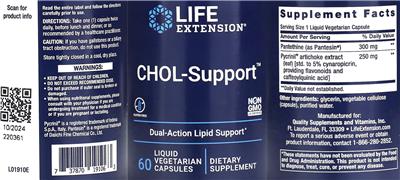
| Pycrinil Artichoke extract | 250 mg | -- |
| Pantesin | 300 mg | -- |
Other ingredients: Glycerin, Cellulose, Water, Purified
Tap any ingredient to jump to its full detail below.
These statements are the manufacturer’s wording, reproduced from the product label — the label is saying it, not HelloPharmacist. We don’t verify or endorse them.
General Statements
Scan for product info
Suggested/Recommended/Usage/Directions
Read the entire label and follow the directions carefully prior to use. Directions: Take one (1) capsule twice daily, before lunch and dinner, or as recommended by a healthcare practitioner.
Precautions
Caution: If you have gallstones or a biliary tract obstruction, do not use this product.
Warnings: Keep out of reach of children.
Do not exceed recommended dose. Do not purchase if outer seal is broken or damaged.
When using nutrition supplements, please consult with your physician if you are undergoing treatment for a medical condition or if you are pregnant or lactating.
To report a serious adverse event or obtain product information, contact 1-866-280-2852.
Storage
Store tightly closed in a cool, dry place.
Brand IP Statement(s)
Pycrinil is a registered trademark of Idena S.p.A., Italy. Pantesin is a registered trademark of Daiichi Fine Chemical Co., Ltd.
Formulation
Gluten free Non GMO LE Certified
Dual-action lipid support
Seals/Symbols
Non GMO LE Certified
FDA Statement of Identity
Dietary Supplement
FDA Disclaimer Statement
These statements have not been evaluated by the Food and Drug Administration. This product is not intended to diagnose, treat, cure, or prevent any disease.
Is this label outdated? Report a formula or label change and our pharmacy team will review it.
CHOL-Support by Life Extension label
The label scan from the NIH Dietary Supplement Label Database. Tap to enlarge.
Label images are published by the NIH Dietary Supplement Label Database for the version of this product on file. Always read your actual product label.
View the full label (PDF)The Ingredients in CHOL-Support by Life Extension
These are the 2 active ingredients this product is made of. Select any to open its full monograph.
Serving size1 Liquid Vegetarian Capsule(s) Dosage formCapsule Servings per container60 Amounts shown are per serving.
Most supplement products combine several ingredients, and a medication can interact with the product through any one of them. Each ingredient below shows whether it has known drug interactions.
Pycrinil Artichoke extract
Interacts with363 drugs
Artichoke leaf extract is a generally well-tolerated supplement that may have a mild cholesterol-lowering effect and is often used for indigestion, th...
Pycrinil Artichoke extract monograph & interactionsPantesin
Interacts with122 drugs
Pantethine is a derivative of vitamin B5 (pantothenic acid) that some studies suggest may modestly lower cholesterol and triglycerides. The evidence i...
Pantesin monograph & interactionsOther (inactive) ingredients: Glycerin, Cellulose, Water, Purified. These complete the product’s ingredient list but are not active constituents.
CHOL-Support by Life Extension Drug Interactions
HelloPharmacist Interaction Report
CHOL-Support by Life Extension contains two active ingredients, and together they interact with a substantial number of medications.
The most serious concern is with blood thinners (anticoagulant and antiplatelet drugs) — pantethine may increase bleeding risk because some evidence suggests it reduces how readily blood cells clump together.
Read the full breakdown — every affected drug type, severity by severity
Artichoke extract carries several Moderate-severity interactions. It may increase the effect of blood pressure–lowering drugs (antihypertensive drugs), raising the theoretical risk of low blood pressure (hypotension).
It may also increase low blood sugar risk (hypoglycemia) when combined with diabetes medications, since small studies show artichoke modestly reduces fasting blood glucose. Additionally, artichoke inhibits two liver enzymes — CYP2C19 and CYP2B6 — that break down many prescription drugs; this could raise levels of those medications in your bloodstream.
Neither enzyme interaction has been reported in humans, but the in-lab evidence exists.
Before you start, check your exact medications using the tool on this page. If you take any blood thinner, blood pressure drug, diabetes medication, or any prescription that your pharmacist says is metabolized by CYP2C19 or CYP2B6, run it through first.
Altogether, these interactions span 466 individual medications.
Check your own medications below · Editorial policy · How we use AI
Want to check YOUR meds against CHOL-Support?
Ask about interactions with your drugs in plain English — “Can I take it with lisinopril?” — and we find you the answer in seconds, ingredient by ingredient.
Go to the checkerIngredients driving the most interactions
Individual Drug Interactions
The ingredients in CHOL-Support interact with 469 drugs. Click any drug to see the details.
2 of the 2 ingredients in CHOL-Support interact with drugs. Each result below shows which ingredient is responsible. Pycrinil Artichoke extract Pantesin
AbciximabReoPro
How Abciximab interacts with CHOL-Support — through 1 ingredient. Tap an ingredient for the detail:
PantesinAnticoagulant/antiplatelet Drugs Moderate
Interaction Summary
Theoretically, pantethine might increase the risk of bleeding with anticoagulant or antiplatelet drugs.
Read the full Pantesin + Abciximab interactionAbrocitinibCibinqo
How Abrocitinib interacts with CHOL-Support — through 2 ingredients. Tap an ingredient for the detail:
Pycrinil Artichoke ExtractCytochrome P450 2c19 (cyp2c19) Substrates Moderate
Interaction Summary
Theoretically, artichoke might increase serum levels of drugs metabolized by CYP2C19.
Read the full Pycrinil Artichoke Extract + Abrocitinib interactionPantesinAnticoagulant/antiplatelet Drugs Moderate
Interaction Summary
Theoretically, pantethine might increase the risk of bleeding with anticoagulant or antiplatelet drugs.
Read the full Pantesin + Abrocitinib interactionAcarboseGlucobay, Prandase, Precose
How Acarbose interacts with CHOL-Support — through 1 ingredient. Tap an ingredient for the detail:
Pycrinil Artichoke ExtractAntidiabetes Drugs Moderate
Interaction Summary
Theoretically, artichoke leaf extract may increase the risk of hypoglycemia when taken with antidiabetes drugs.
Read the full Pycrinil Artichoke Extract + Acarbose interactionAcebutololRhotral, Sectral
How Acebutolol interacts with CHOL-Support — through 1 ingredient. Tap an ingredient for the detail:
Pycrinil Artichoke ExtractAntihypertensive Drugs Moderate
Interaction Summary
Theoretically, artichoke leaf extract may increase the risk of hypotension when taken with antihypertensive drugs.
Read the full Pycrinil Artichoke Extract + Acebutolol interactionAcenocoumarolSintrom
How Acenocoumarol interacts with CHOL-Support — through 1 ingredient. Tap an ingredient for the detail:
PantesinAnticoagulant/antiplatelet Drugs Moderate
Interaction Summary
Theoretically, pantethine might increase the risk of bleeding with anticoagulant or antiplatelet drugs.
Read the full Pantesin + Acenocoumarol interactionAcetaminophen, AspirinGemnisyn
How Acetaminophen, Aspirin interacts with CHOL-Support — through 1 ingredient. Tap an ingredient for the detail:
PantesinAnticoagulant/antiplatelet Drugs Moderate
Interaction Summary
Theoretically, pantethine might increase the risk of bleeding with anticoagulant or antiplatelet drugs.
Read the full Pantesin + Acetaminophen, Aspirin interactionAcetaminophen, Aspirin, CaffeineExcedrin, Excedrin Extra Strength, Excedrin Migraine
How Acetaminophen, Aspirin, Caffeine interacts with CHOL-Support — through 1 ingredient. Tap an ingredient for the detail:
PantesinAnticoagulant/antiplatelet Drugs Moderate
Interaction Summary
Theoretically, pantethine might increase the risk of bleeding with anticoagulant or antiplatelet drugs.
Read the full Pantesin + Acetaminophen, Aspirin, Caffeine interactionAcetaminophen, IbuprofenCombogesic
How Acetaminophen, Ibuprofen interacts with CHOL-Support — through 1 ingredient. Tap an ingredient for the detail:
PantesinAnticoagulant/antiplatelet Drugs Moderate
Interaction Summary
Theoretically, pantethine might increase the risk of bleeding with anticoagulant or antiplatelet drugs.
Read the full Pantesin + Acetaminophen, Ibuprofen interactionAcetaminophen, OrphenadrineOrfenagesic
How Acetaminophen, Orphenadrine interacts with CHOL-Support — through 1 ingredient. Tap an ingredient for the detail:
Pycrinil Artichoke ExtractCytochrome P450 2b6 (cyp2b6) Substrates Moderate
Interaction Summary
Theoretically, artichoke might increase serum levels of drugs metabolized by CYP2B6.
Read the full Pycrinil Artichoke Extract + Acetaminophen, Orphenadrine interactionAcetazolamideAk-Zol, Diamox
How Acetazolamide interacts with CHOL-Support — through 1 ingredient. Tap an ingredient for the detail:
Pycrinil Artichoke ExtractAntihypertensive Drugs Moderate
Interaction Summary
Theoretically, artichoke leaf extract may increase the risk of hypotension when taken with antihypertensive drugs.
Read the full Pycrinil Artichoke Extract + Acetazolamide interactionAcetohexamideDymelor
How Acetohexamide interacts with CHOL-Support — through 1 ingredient. Tap an ingredient for the detail:
Pycrinil Artichoke ExtractAntidiabetes Drugs Moderate
Interaction Summary
Theoretically, artichoke leaf extract may increase the risk of hypoglycemia when taken with antidiabetes drugs.
Read the full Pycrinil Artichoke Extract + Acetohexamide interactionAcetylsalicylic AcidEntrophen
How Acetylsalicylic Acid interacts with CHOL-Support — through 1 ingredient. Tap an ingredient for the detail:
PantesinAnticoagulant/antiplatelet Drugs Moderate
Interaction Summary
Theoretically, pantethine might increase the risk of bleeding with anticoagulant or antiplatelet drugs.
Read the full Pantesin + Acetylsalicylic Acid interactionAerosphere Budesonide, Formoterol Fumarate, GlycopyrrolateBreztri
How Aerosphere Budesonide, Formoterol Fumarate, Glycopyrrolate interacts with CHOL-Support — through 1 ingredient. Tap an ingredient for the detail:
Pycrinil Artichoke ExtractCytochrome P450 2c19 (cyp2c19) Substrates Moderate
Interaction Summary
Theoretically, artichoke might increase serum levels of drugs metabolized by CYP2C19.
Read the full Pycrinil Artichoke Extract + Aerosphere Budesonide, Formoterol Fumarate, Glycopyrrolate interactionAgomelatineValdoxan
How Agomelatine interacts with CHOL-Support — through 1 ingredient. Tap an ingredient for the detail:
Pycrinil Artichoke ExtractCytochrome P450 2c19 (cyp2c19) Substrates Moderate
Interaction Summary
Theoretically, artichoke might increase serum levels of drugs metabolized by CYP2C19.
Read the full Pycrinil Artichoke Extract + Agomelatine interactionAlbiglutideTanzeum
How Albiglutide interacts with CHOL-Support — through 1 ingredient. Tap an ingredient for the detail:
Pycrinil Artichoke ExtractAntidiabetes Drugs Moderate
Interaction Summary
Theoretically, artichoke leaf extract may increase the risk of hypoglycemia when taken with antidiabetes drugs.
Read the full Pycrinil Artichoke Extract + Albiglutide interactionAliskirenTekturna
How Aliskiren interacts with CHOL-Support — through 1 ingredient. Tap an ingredient for the detail:
Pycrinil Artichoke ExtractAntihypertensive Drugs Moderate
Interaction Summary
Theoretically, artichoke leaf extract may increase the risk of hypotension when taken with antihypertensive drugs.
Read the full Pycrinil Artichoke Extract + Aliskiren interactionAlogliptinNesina
How Alogliptin interacts with CHOL-Support — through 1 ingredient. Tap an ingredient for the detail:
Pycrinil Artichoke ExtractAntidiabetes Drugs Moderate
Interaction Summary
Theoretically, artichoke leaf extract may increase the risk of hypoglycemia when taken with antidiabetes drugs.
Read the full Pycrinil Artichoke Extract + Alogliptin interactionAlogliptin, MetforminKazano
How Alogliptin, Metformin interacts with CHOL-Support — through 1 ingredient. Tap an ingredient for the detail:
Pycrinil Artichoke ExtractAntidiabetes Drugs Moderate
Interaction Summary
Theoretically, artichoke leaf extract may increase the risk of hypoglycemia when taken with antidiabetes drugs.
Read the full Pycrinil Artichoke Extract + Alogliptin, Metformin interactionAlogliptin, PioglitazoneOseni
How Alogliptin, Pioglitazone interacts with CHOL-Support — through 1 ingredient. Tap an ingredient for the detail:
Pycrinil Artichoke ExtractAntidiabetes Drugs Moderate
Interaction Summary
Theoretically, artichoke leaf extract may increase the risk of hypoglycemia when taken with antidiabetes drugs.
Read the full Pycrinil Artichoke Extract + Alogliptin, Pioglitazone interactionAlteplase, TpaActilyse, Activase
How Alteplase, Tpa interacts with CHOL-Support — through 1 ingredient. Tap an ingredient for the detail:
PantesinAnticoagulant/antiplatelet Drugs Moderate
Interaction Summary
Theoretically, pantethine might increase the risk of bleeding with anticoagulant or antiplatelet drugs.
Read the full Pantesin + Alteplase, Tpa interactionAluminum Hydroxide, Aspirin, Codeine Phosphate, Magnesium HydroxideAscriptin Codeine #2
How Aluminum Hydroxide, Aspirin, Codeine Phosphate, Magnesium Hydroxide interacts with CHOL-Support — through 1 ingredient. Tap an ingredient for the detail:
PantesinAnticoagulant/antiplatelet Drugs Moderate
Interaction Summary
Theoretically, pantethine might increase the risk of bleeding with anticoagulant or antiplatelet drugs.
Read the full Pantesin + Aluminum Hydroxide, Aspirin, Codeine Phosphate, Magnesium Hydroxide interactionAluminum Hydroxide, Aspirin, Magnesium HydroxideAscriptin
How Aluminum Hydroxide, Aspirin, Magnesium Hydroxide interacts with CHOL-Support — through 1 ingredient. Tap an ingredient for the detail:
PantesinAnticoagulant/antiplatelet Drugs Moderate
Interaction Summary
Theoretically, pantethine might increase the risk of bleeding with anticoagulant or antiplatelet drugs.
Read the full Pantesin + Aluminum Hydroxide, Aspirin, Magnesium Hydroxide interactionAmbrisentanLetairis, Volibris
How Ambrisentan interacts with CHOL-Support — through 1 ingredient. Tap an ingredient for the detail:
Pycrinil Artichoke ExtractAntihypertensive Drugs Moderate
Interaction Summary
Theoretically, artichoke leaf extract may increase the risk of hypotension when taken with antihypertensive drugs.
Read the full Pycrinil Artichoke Extract + Ambrisentan interactionAmilorideAmilamont, Midamor
How Amiloride interacts with CHOL-Support — through 1 ingredient. Tap an ingredient for the detail:
Pycrinil Artichoke ExtractAntihypertensive Drugs Moderate
Interaction Summary
Theoretically, artichoke leaf extract may increase the risk of hypotension when taken with antihypertensive drugs.
Read the full Pycrinil Artichoke Extract + Amiloride interactionAmiloride, HydrochlorothiazideAmil-Co, Amilzide, Moduret 25, Moduretic
How Amiloride, Hydrochlorothiazide interacts with CHOL-Support — through 1 ingredient. Tap an ingredient for the detail:
Pycrinil Artichoke ExtractAntihypertensive Drugs Moderate
Interaction Summary
Theoretically, artichoke leaf extract may increase the risk of hypotension when taken with antihypertensive drugs.
Read the full Pycrinil Artichoke Extract + Amiloride, Hydrochlorothiazide interactionAmitriptylineElavil
How Amitriptyline interacts with CHOL-Support — through 1 ingredient. Tap an ingredient for the detail:
Pycrinil Artichoke ExtractCytochrome P450 2c19 (cyp2c19) Substrates Moderate
Interaction Summary
Theoretically, artichoke might increase serum levels of drugs metabolized by CYP2C19.
Read the full Pycrinil Artichoke Extract + Amitriptyline interactionAmitriptyline, ChlordiazepoxideLimbitrol DS
How Amitriptyline, Chlordiazepoxide interacts with CHOL-Support — through 1 ingredient. Tap an ingredient for the detail:
Pycrinil Artichoke ExtractCytochrome P450 2c19 (cyp2c19) Substrates Moderate
Interaction Summary
Theoretically, artichoke might increase serum levels of drugs metabolized by CYP2C19.
Read the full Pycrinil Artichoke Extract + Amitriptyline, Chlordiazepoxide interactionAmitriptyline, PerphenazineEtrafon, Etrafon-A, Etrafon-Forte, Triavil
How Amitriptyline, Perphenazine interacts with CHOL-Support — through 1 ingredient. Tap an ingredient for the detail:
Pycrinil Artichoke ExtractCytochrome P450 2c19 (cyp2c19) Substrates Moderate
Interaction Summary
Theoretically, artichoke might increase serum levels of drugs metabolized by CYP2C19.
Read the full Pycrinil Artichoke Extract + Amitriptyline, Perphenazine interactionAmlodipineNorliqva
How Amlodipine interacts with CHOL-Support — through 1 ingredient. Tap an ingredient for the detail:
Pycrinil Artichoke ExtractAntihypertensive Drugs Moderate
Interaction Summary
Theoretically, artichoke leaf extract may increase the risk of hypotension when taken with antihypertensive drugs.
Read the full Pycrinil Artichoke Extract + Amlodipine interactionAmlodipine BenzoateKaterzia
How Amlodipine Benzoate interacts with CHOL-Support — through 1 ingredient. Tap an ingredient for the detail:
Pycrinil Artichoke ExtractAntihypertensive Drugs Moderate
Interaction Summary
Theoretically, artichoke leaf extract may increase the risk of hypotension when taken with antihypertensive drugs.
Read the full Pycrinil Artichoke Extract + Amlodipine Benzoate interactionEach ingredient & the kinds of drugs it affects
For each ingredient in CHOL-Support with known interactions, here are the types of medications they can affect. Open any type for the detail — or search your exact drug in the checker above.
Pycrinil Artichoke extract
Antidiabetes Drugs
Theoretically, artichoke leaf extract may increase the risk of hypoglycemia when taken with antidiabetes drugs.
A meta-analysis of small clinical studies shows that taking artichoke leaf extract for 8-12 weeks can modestly reduce fasting plasma glucose when compared with placebo.
Antihypertensive Drugs
Theoretically, artichoke leaf extract may increase the risk of hypotension when taken with antihypertensive drugs.
A meta-analysis of small clinical studies in patients with hypertension shows that taking artichoke can reduce systolic blood pressure by around 3 mmHg and diastolic blood pressure by around 2 mmHg when compared with placebo.
Cytochrome P450 2B6 (Cyp2B6) Substrates
Theoretically, artichoke might increase serum levels of drugs metabolized by CYP2B6.
In vitro research shows that artichoke leaf extract inhibits CYP2B6 activity. However, this interaction has not been reported in humans.
Cytochrome P450 2C19 (Cyp2C19) Substrates
Theoretically, artichoke might increase serum levels of drugs metabolized by CYP2C19.
In vitro research shows that artichoke leaf extract inhibits CYP2C19 activity. However, this interaction has not been reported in humans.
Pantesin
Anticoagulant/Antiplatelet Drugs
Theoretically, pantethine might increase the risk of bleeding with anticoagulant or antiplatelet drugs.
Some evidence suggests that pantethine reduces platelet aggregation.
Brand information
Manufacturer and brand details for CHOL-Support, from the product label.
Life Extension
See all Life Extension products- Name
- Quality Supplements and Vitamins, Inc.
- City
- Ft. Lauderdale
- State
- FL
- ZipCode
- 33309
- Phone Number
- 1-866-280-2852
- Web Address
- LifeExtension.com
CHOL-Support by Life Extension: Common Questions
Does CHOL-Support by Life Extension interact with any medications?
How can one product interact with so many drugs?
Where does this information come from?
Does artichoke really lower cholesterol?
Can I take this if I'm pregnant or breastfeeding?
What are the side effects?
What is pantethine and what does it do?
Is this product suitable for someone taking aspirin?
Written and reviewed by the HelloPharmacist editorial staff. Our editorial policy
Not sure if CHOL-Support is safe with your meds?
Our pharmacists answer your medication & supplement questions — free.
Label information is sourced from the NIH Dietary Supplement Label Database and reflects the product version on file; always read your actual product label. This page is for education only and is not a substitute for professional medical advice. Confirm with your pharmacist or doctor before combining supplements and medications.
The Full Monographs Behind CHOL-Support’s Ingredients
Every ingredient we hold a full HelloPharmacist monograph for — uses, evidence, safety, and the complete interaction list.
Artichoke
Interacts with 363 drugsArtichoke leaf extract is a generally well-tolerated supplement that may have a mild cholesterol-lowering effect and is often used for indigestion, though the evidence is modest. It is not a...
Read the full Artichoke monograph → Herb & supplement monographPantethine
Interacts with 122 drugsPantethine is a derivative of vitamin B5 (pantothenic acid) that some studies suggest may modestly lower cholesterol and triglycerides. The evidence is limited and not strong enough to repla...
Read the full Pantethine monograph →Sources & How We Checked
CHOL-Support's label data comes from the NIH Dietary Supplement Label Database; the ingredient interaction data is from the Natural Medicines database, reviewed by our pharmacists.
- NIH Dietary Supplement Label Database (DSLD) — The official product label on file for this supplement.
- Natural Medicines (Therapeutic Research Center) — Evidence-graded clinical reference behind the ingredient interaction data.
Content is written and reviewed by licensed HelloPharmacist pharmacists. See our data sources and editorial standards for how this information is built and checked.
The 25 references behind this product’s interaction data
Every citation that drives the interaction findings for this product’s ingredients, from the evidence-graded Natural Medicines (TRC Healthcare) database. Open an ingredient to browse its citations — links open the study on PubMed or the publisher’s site.
Artichoke 16 references
- Leung AY, Foster S. Encyclopedia of Common Natural Ingredients Used in Food, Drugs and Cosmetics. 2nd ed. New York, NY: John Wiley & Sons, 1996.
- Walker AF, Middleton RW, Petrowicz O. Artichoke leaf extract reduces symptoms of irritable bowel syndrome in a post-marketing surveillance study. Phytother Res 2001;15:58-61. PubMed
- Pittler MH, White AR, Stevinson C, Ernst E. Effectiveness of artichoke extract in preventing alcohol-induced hangovers: a randomized controlled trial. CMAJ 2003;169:1269-73.
- Romano, C., Ferrara, A., and Falagiani, P. A case of allergy to globe artichoke and other clinical cases of rare food allergy. J Investig.Allergol.Clin Immunol. 2000;10(2):102-104.
- Miralles, J. C., Garcia-Sells, J., Bartolome, B., and Negro, J. M. Occupational rhinitis and bronchial asthma due to artichoke (Cynara scolymus). Ann Allergy Asthma Immunol. 2003;91(1):92-95. PubMed
- Franck, P., Moneret-Vautrin, D. A., Morisset, M., Kanny, G., Megret-Gabeaux, M. L., and Olivier, J. L. Anaphylactic reaction to inulin: first identification of specific IgEs to an inulin protein compound. Int Arch Allergy Immunol 2005;136(2):155-158. PubMed
- Meding, B. Allergic contact dermatitis from artichoke, Cynara scolymus. Contact Dermatitis 1983;9(4):314.
- Quirce, S., Tabar, A. I., Olaguibel, J. M., and Cuevas, M. Occupational contact urticaria syndrome caused by globe artichoke (Cynara scolymus). J Allergy Clin Immunol. 1996;97(2):710-711. PubMed
- Held C. Von der 1. Deutsche-Ungarischen Phytopharmakon-Konferenz, Budapest, 20. November 1991. Z Klin Med 1992;47:92-93.
- Barrat E, Zaïr Y, Ogier N, et al. A combined natural supplement lowers LDL cholesterol in subjects with moderate untreated hypercholesterolemia: a randomized placebo-controlled trial. Int J Food Sci Nutr. 2013;64(7):882-9. PubMed
- Huber R, Müller M, Naumann J, Schenk T, Lüdtke R. Artichoke leave extract for chronic hepatitis C - a pilot study. Phytomedicine. 2009 Sep;16(9):801-4. PubMed
- Caputo F, Barranco R, Bonsignore A, Fraternali Orcioni G, Ventura F. A rare case of fatal bowel obstruction secondary to a colonic bezoar. Am J Forensic Med Pathol. 2018;39(1):38-40. PubMed
- Elsebai MF, Abass K, Hakkola J, Atawia AR, Farag MA. The wild Egyptian artichoke as a promising functional food for the treatment of hepatitis C virus as revealed via UPLC-MS and clinical trials. Food Funct. 2016;7(7):3006-16. PubMed
- Moradi M, Sohrabi G, Golbidi M, et al. Effects of artichoke on blood pressure: a systematic review and meta-analysis. Complement Ther Med 2021;57:102668. PubMed
- Jalili C, Moradi S, Babaei A, et al. Effects of Cynara scolymus L. on glycemic indices: a systematic review and meta-analysis of randomized clinical trials. Complement Ther Med 2020;52:102496. PubMed
- Gallo R, Oddenino G, Trave I, Gasparini G, Guadagno A, Parodi A. Contact sensitivity to sesquiterpene lactone mix and artichoke in a patient with severe recurrent dermatitis: A puzzling case. Contact Dermatitis 2023;88(2):156-158. PubMed
Pantethine 9 references
- Da Col PG, Cattin L, Fonda M, et al. Pantethine in the treatment of hypercholesterolemia: a randomized double-blind trial versus tiadenol. Curr Ther Res 1984;36:314-22.
- Rubba P, Postaiglione B, De Simone F, et al. Comparative evaluation of the lipid-lowering effects of fenofibrate and pantethine in type II hyperlipoproteinemia. Curr Ther Res 1985;38:719-27.
- Coronel F, Tornero F, Torrente J, et al. Treatment of hyperlipemia in diabetic patients on dialysis with a physiological substance. Am J Nephrol 1991;11:32-6.. PubMed
- Agrati AM, Ambrosi G, Ferraro G, Palmieri. Gemfibrozil efficacy vs pantethine in dyslipoproteinemic patients: a controlled study. Curr Ther Res 1989;45:650-63.
- Rumberger, J. A., Napolitano, J., Azumano, I., Kamiya, T., and Evans, M. Pantethine, a derivative of vitamin B(5) used as a nutritional supplement, favorably alters low-density lipoprotein cholesterol metabolism in low- to moderate-cardiovascular risk No
- Hiramatsu, K., Nozaki, H., and Arimori, S. Influence of pantethine on platelet volume, microviscosity, lipid composition and functions in diabetes mellitus with hyperlipidemia. Tokai J.Exp.Clin.Med. 1981;6(1):49-57.
- McRae MP. Treatment of hyperlipoproteinemia with pantethine: A review and analysis of efficacy and tolerability. Nutrition Res 2005;25:319-333. DOI
- Cattin, L., Da Col, P. G., Fonda, M., Mameli, M. G., and Fergulio, G. A. Treatment of hypercholesterolemia with pantethine and fenofibrate; open randomized study on 43 subjects. Current Therapeutic Research 1985;38(Sep):386-395.
- Evans M, Rumberger JA, Azumano I, Napolitano JJ, Citrolo D, Kamiya T. Pantethine, a derivative of vitamin B5, favorably alters total, LDL and non-HDL cholesterol in low to moderate cardiovascular risk subjects eligible for statin therapy: a triple-blinded
Parts of this content are provided by the Therapeutic Research Center, LLC.
DISCLAIMER: Currently this does not check for drug-drug interactions. This is not an all-inclusive comprehensive list of potential interactions and is for informational purposes only. Not all interactions are known or well-reported in the scientific literature, and new interactions are continually being reported. Input is needed from a qualified healthcare provider including a pharmacist before starting any therapy. Application of clinical judgment is necessary.
© 2021 Therapeutic Research Center, LLC