
Cocoa Bean Extract by BulkSupplements.com Ingredients, Side Effects and Drug Interactions
Dietary Supplement Powder Botanical

Medically reviewed by Dr. Brian Staiger, PharmD, BCPS
Also reviewed by the HelloPharmacist Editorial Team
Updated Details about this page
- Label on file from the NIH Dietary Supplement Label Database, dated Apr 24, 2025.
- The interaction, evidence and safety records come from the Natural Medicines database, which we license, read against this label by our own system; the pharmacy team’s sections are written from those records.
- Dr. Brian Staiger, PharmD, BCPS, is a clinical pharmacist and pharmacotherapy specialist.
- Editorial policy Our sources
AI is used only to summarize verified clinical information, never the open internet. Our AI policy
Summary: The HelloPharmacist Team’s Take
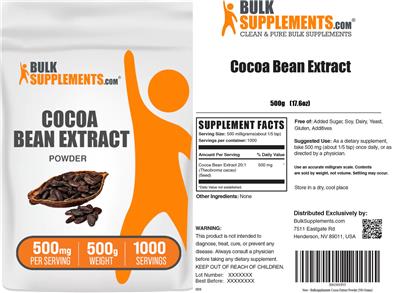
- Form
- Powder
- Serving Size
- 500 mg
- Servings
- 1,000 per container
- Container Holds
- 500 g; 17.6 Ounces
What’s in it, whether it interacts with your drugs, its side effects, whether it works, and what our pharmacists would want you to know before you start it.
- What is Cocoa Bean Extract?A single-ingredient supplement from BulkSupplements.com, in powder form.
- Active Ingredients Cocoa Bean Seed Extract 500 mg One active ingredient. We check it for drug interactions and side effects. The full Supplement Facts
- Drug Interactions 661 drugs have a documented interaction with this supplement; the most serious is rated moderate. Of those, 357 are single drugs and 304 are combination products (two or more drugs in one), each listed under its own name. Ask your pharmacist first if you take a drug in any of these categories, the most serious of the 37 on record:
- Moderate · 172 drugs
- Moderate · 172 drugs
- Moderate · 122 drugs
- Moderate · 90 drugs
- Possible Side EffectsJitterinessFast heartbeatAnxietyTrouble sleeping +1 moreReported for its one active ingredient, Cocoa. Not studied in this exact product.
- Well documented Why
Does Cocoa Bean Extract work?
Limited This product doesn't appear to be marketed for a specific use, so we graded Cocoa's overall clinical evidence instead.It is not marketed for one specific use, so this is what Cocoa has been studied for, strongest research first:
- Cardiovascular disease (CVD)
These grades are for the ingredient, not this exact product, and never a promise it will work for you.
What the research says- Full Why
- AllergensNone of its ingredient names point to a major food allergen
Who Might Consider It
- People who want it for cardiovascular disease (CVD): the use with research behind it. See the grade
- Cocoa Bean Extract may appeal to people looking at cocoa for cardiovascular support, where the evidence is rated Possibly Effective.
Who Should Be Careful
- People on stimulant-sensitive medications, heart or blood pressure medicines, or sedatives should be careful.
- Talk it over with your own doctor or pharmacist before starting, especially if you are pregnant or breastfeeding.
More Before You Take It Show all three answersHide Its Cocoa Bean Seed Extract Amount vs. Other Supplements Pregnancy and Breastfeeding The Label’s Directions
-
How does its Cocoa Bean Seed Extract amount compare with other supplements?
- Cocoa Bean Seed Extract500 mgMore than most of the 216 recent Cocoa products in our database that state an amount; 100 mg is the most common.
A label’s amount is what the product holds, not a recommended dose.
See the Cocoa Bean Seed Extract comparison -
Pregnant or breastfeeding?
- Pregnancy
- ! When used orally in large amounts.
- When used orally in moderate amounts.
- Breastfeeding
- ! When used orally in large amounts.
- When used in moderate amounts or in amounts commonly found in foods.
-
How does the label say to take it?
“Suggested Use: As a dietary supplement, take 500 mg (about 1/5 tsp) once daily, or as directed by a physician.”
The maker’s words. Your pharmacist or doctor may advise differently.
Everything the label says
From the label dated Apr 24, 2025: its one active ingredient was checked against our records. A summary of what is known, not a grade or a test of the product. How these ratings are computed
Ask Anything About This Supplement
Name a drug you take, or ask about side effects, ingredients or pregnancy.
AI answers come from this label and our own records, never the open internet. AI can make mistakes, so always check with your doctor or pharmacist. How we use AI
Ask the Pharmacist
A licensed pharmacist will answer your question by email — free, usually within 24 hours.
Got it — thank you!
A licensed pharmacist will answer within 24 hours. Keep an eye on your email (worth checking spam, just in case).
What’s Inside Cocoa Bean Extract by BulkSupplements.com
One Active Ingredient: Cocoa Bean Seed Extract
Everything this page says about drug interactions and side effects comes from what is known about Cocoa Bean Seed Extract.
Why this rating?
The label gives the exact amount of its one active ingredient, so you know how much you get in each serving. This rates what the label tells you, not the quality of the product.
Supplement Facts
| Amount Per Serving | % Daily Value | |
|---|---|---|
| Cocoa Bean Seed Extract | 500 mg | † |
† Daily Value not established.
Daily Values for adults and children 4 or more years of age.
As the label prints it, from the NIH Dietary Supplement Label Database.
Each Ingredient and Its Drug Interactions
Tap one for more about it and its full guide.
-
Cocoa Bean Seed Extract 500 mg This product contains one active ingredient, cocoa bean seed extract, which is a concentrated form of cocoa. Interacts with 661 drugs
Form on the label: Theobroma cacao seed extract
Cocoa is rich in plant compounds called flavanols that may modestly support blood vessel function and blood pressure, but most chocolate products are high in sugar, fat, and calories, which can offset any benefit.
- Enjoy cocoa as part of a balanced diet, and talk to your pharmacist before using concentrated cocoa supplements, especially if you have heart or blood pressure conditions.
The full Cocoa guide: uses, dosage and safety Every Cocoa drug interaction
How Much Cocoa Is in It, Compared With Other Supplements
Each bar is an amount that other recent supplements list for the same ingredient. The taller the bar, the more of them state it.
-
500 mg in a serving of this product
More than most products
- Most common amount
- 100 mg (about 21 in 100 products)
- Most products state
- 15 mg to 750 mg
- Compared with
- 216 recent products
Allergens in Cocoa Bean Extract
None of its ingredient names point to a major food allergen.
Not named in the ingredients
- Milk
- Egg
- Fish
- Shellfish
- Tree nuts
- Peanuts
- Wheat or other gluten grains
- Soy
- Sesame
- Made without, the label says“Free of: Added Sugar, Soy, Dairy, Yeast, Gluten, Additives”
From the label text and ingredient names on file; we do not test products. With a serious allergy, check your bottle and ask the maker or your pharmacist.
What the Label Says
The maker’s own words, from the label. We do not verify or endorse them.
- Brand IP Statement(s)
-
“BulkSupplements.com Clean & Pure Bulk Supplements”
- General statements
-
“Use an accurate milligram scale. New”
- Storage
-
“Store in a dry, cool place Contents are sold by weight, not volume. Settling may occur.”
- Formulation
-
“Cocoa Bean Extract 500 mg per serving”
The Cocoa Bean Extract Label on File
The label scan on file at the NIH Dietary Supplement Label Database, dated April 2025. Always read the label on the bottle you have.
Product Facts
- Brand
- BulkSupplements.com
- Barcode (UPC)
- X001N0UP3T
- Net contents
- 500 g; 17.6 Ounces
- Market status
- On market
- Date entered into DSLD
- Apr 24, 2025
- DSLD ID
- 330614
- Product type
- Botanical
- Supplement form
- Powder
- Dietary claims / uses
- All Other, Structure/Function
- Intended target group(s)
- Adult (18 - 50 Years), Gluten Free, Dairy Free
Is this label outdated? Report a formula or label change and our pharmacy team will review it.
Cocoa Bean Extract by BulkSupplements.com Side Effects
Why this rating?
We look for three kinds of safety information on each ingredient: side effects reported in studies, a pregnancy and breastfeeding rating, and a safety write-up from our pharmacy team. All three are on file for Cocoa.
So this rates how much is known, not whether Cocoa Bean Extract is right for you.
Reported with Cocoa, its active ingredient
- Most often
- Jitteriness, fast heartbeat, anxiety and trouble sleeping
- !Rare but serious
- Fast heart rate See details
HelloPharmacist Team Summary of Side Effects
Based on our pharmacy team's read, you can expect this product to be generally well tolerated, but its caffeine is the main thing to watch.
- The side effects you are most likely to notice are jitteriness, trouble sleeping, and headaches, all tied to the cocoa bean seed extract's caffeine.
- Fast heartbeat is reported as rare but serious, so call your doctor if it happens.
- Talk with your own doctor or pharmacist before starting if you are sensitive to stimulants, have heart rhythm problems, or are pregnant or breastfeeding.
Side Effects Reported With Cocoa
Cocoa Bean Extract Warnings: Who Should Be Careful
These warnings are for Cocoa, its one active ingredient. If any of these apply to you, talk to your doctor or pharmacist before you start it.
-
Diabetes or Low Blood Sugar
- Chocolate products are often high in sugar, fat, and calories, which can be a concern for people managing weight, diabetes, or heart disease.
-
Heart Conditions
- Because cocoa contains caffeine and theobromine, people who are sensitive to stimulants, who have heart rhythm problems, anxiety, or trouble sleeping should be cautious, especially with large amounts.
-
Other Cautions
- Avoid concentrated cocoa supplements unless your doctor approves.
-
What the Label Warns
- “Always consult a physician before taking any dietary supplement.”
- “Keep out of reach of children.”
The maker’s wording, from the product label.
-
Pregnant or Breastfeeding
The rating for pregnancy and for breastfeeding, and what it covers.
Pregnancy
-
When used orally in moderate amounts.
However, due to the caffeine content of cocoa preparations, intake should be closely monitored during pregnancy to ensure moderate consumption.
8 more points on this rating
- Fetal blood concentrations of caffeine approximate maternal concentrations.
- Some research has found that intrauterine exposure to even modest amounts of caffeine, based on maternal blood levels during the first trimester, is associated with a shorter stature in children ages 4-8 years.
- While many cocoa products contain only small amounts of caffeine (about 2-35 mg per serving), unsweetened, dry cocoa powder can contain up to 198 mg of caffeine per cup.
- According to a review by Health Canada, and a subsequent large meta-analysis conducted in the US, doses of up to 300 mg daily can be consumed during pregnancy without an increased risk of spontaneous abortion, still birth, preterm birth, fetal growth retardation, or congenital malformations.
- To be on the safe side, cocoa should be used in amounts that provide less than 300 mg of caffeine daily.
- Keep in mind that only the amount of ADDED caffeine must be stated on product labels.
- The amount of caffeine found in ingredients such as cocoa, which naturally contains caffeine, does not need to be provided.
- This can make it difficult to determine the total amount of caffeine in a given product.
-
When used orally in large amounts.
Caffeine found in cocoa crosses the placenta producing fetal blood concentrations similar to maternal levels.
10 more points on this rating
- Consumption of caffeine in amounts over 300 mg daily is associated with a significantly increased risk of miscarriage in some studies.
- Additionally, high intake of caffeine during pregnancy have been associated with premature delivery, low birth weight, and loss of the fetus.
- While many cocoa products contain only small amounts of caffeine (about 2-35 mg per serving), unsweetened, dry cocoa powder can contain up to 198 mg of caffeine per cup.
- To be on the safe side, cocoa should be used in amounts that provide less than 300 mg of caffeine daily.
- Keep in mind that only the amount of ADDED caffeine must be stated on product labels.
- The amount of caffeine found in ingredients such as cocoa, which naturally contains caffeine, does not need to be provided.
- This can make it difficult to determine the total amount of caffeine in a given product.
- Cocoa and dark chocolate products worldwide also contain heavy metals such as lead and cadmium.
- In the US, one ounce (approximately 28 grams) of most commercially available dark chocolate products tested contained levels of lead and/or cadmium above the maximum allowable dose level for California, with cadmium levels generally increasing with the percentage of cocoa.
- Large doses or excessive intake of cocoa should be avoided during pregnancy.
Breastfeeding
-
When used in moderate amounts or in amounts commonly found in foods.
Due to the caffeine content of cocoa preparations, intake should be closely monitored while breastfeeding.
5 more points on this rating
- During lactation, breast milk concentrations of caffeine are thought to be approximately 50% of serum concentrations.
- Moderate consumption of cocoa would likely result in very small amounts of caffeine exposure to a nursing infant.
- Keep in mind that only the amount of ADDED caffeine must be stated on product labels.
- The amount of caffeine found in ingredients such as cocoa, which naturally contains caffeine, does not need to be provided.
- This can make it difficult to determine the total amount of caffeine in a given product.
-
When used orally in large amounts.
Consumption of excess chocolate (16 oz per day) may cause irritability and increased bowel activity in the infant.
3 more points on this rating
- Cocoa and dark chocolate products worldwide also contain heavy metals such as lead and cadmium.
- In the US, one ounce (approximately 28 grams) of most commercially available dark chocolate products tested contained levels of lead and/or cadmium above the maximum allowable dose level for California, with cadmium levels generally increasing with the percentage of cocoa.
- Large doses or excessive intake of cocoa should be avoided during lactation.
Our pharmacy team’s notes
- For breastfeeding, cocoa is rated Possibly Safe, but its caffeine passes into breast milk, so keep intake modest and watch your baby for fussiness.
Ratings and the words beside them are from the Natural Medicines database, which we license.
The full record, with its sources, in the Cocoa guide -
Rare but Serious Side Effects
-
!
Cocoa
Allergic reactions to cocoa are uncommon but possible.
Orally: Tachycardia.
When to get help: a serious allergic reaction, with trouble breathing or swelling of the face, lips or throat, needs emergency care: call 911. For any other side effect that worries you, call your doctor or pharmacist.
These reports describe each ingredient, not studies of this exact product. Not medical advice: a side effect you notice after starting a supplement is worth a word with your pharmacist or doctor.
Cocoa Bean Extract by BulkSupplements.com Drug Interactions
This supplement has one active ingredient, Cocoa Bean Seed Extract, and we checked it against every drug in our records.
A moderate interaction on record
2 of 3, on a scale from Minor or none to Major.Why this rating?
We rate this by the most serious interaction on record, not by how many there are. For Cocoa, the most serious is rated moderate, which means it calls for caution, and sometimes monitoring or a change in timing or dose. Some involve kinds of drugs where a small change can matter, such as blood thinners and lithium.
661 drugs are on the full list. What matters is whether one you take is on it, so check yours with the interaction checker on this page.
Its one active ingredient has drug interactions on record: Cocoa.
Cocoa
- Interacts with
- 661 drugs
- Most serious
- Moderate
- Cocoa Bean Extract from BulkSupplements.com can interact with several medications.
- Its one ingredient, cocoa bean seed extract, is responsible, mainly through the caffeine it contains.
- The most serious concern is ephedrine (a stimulant), rated Moderate, where the caffeine may increase the risk of serious effects such as high blood pressure, heart attack, stroke, seizures, and death.
- Other drug types with documented interactions include dipyridamole (Persantine), a heart stress-test drug, where caffeine may blunt its effect on blood vessels, so methylxanthine products are usually stopped 24 hours before testing (Moderate).
Show seven more points
- Pentobarbital (Nembutal), a sedative, may have its effects reduced by caffeine (Moderate).
- Quinolone antibiotics may raise caffeine levels and side effects because they slow caffeine clearance (Moderate).
- Beta-adrenergic agonists may have stronger heart effects when large amounts of cocoa or caffeine are combined with them (Moderate).
- Flutamide (Eulexin) may have higher levels and more side effects because caffeine may slow its breakdown (Moderate).
- Disulfiram (Antabuse) may increase caffeine side effects (Moderate).
- Antihypertensive drugs may combine with cocoa's modest blood pressure lowering to increase the risk of low blood pressure (Moderate).
- Check your exact medications with the search tool on this page, and review the results with your own doctor or pharmacist.
The kinds of drugs it affects most
- 172 drugs
- 172 drugs
- 122 drugs
- 90 drugs
Every Cocoa drug interaction, 37 records The Cocoa records cite 119 references, listed in the Cocoa guide.
Summarized by the HelloPharmacist pharmacy team from the interaction records below. How it is written How we use AI
The Breakdown by Severity
Each drug counted once, at its most serious rating. Tap a tile to list those drugs.
Find Your Drug
Type a drug or brand name to see whether it is on the list.
- Only drugs with a documented interaction are listed, the most serious first.
- A drug with no known interaction is not listed, but searching its name tells you so.
- Open a drug to see which ingredient is responsible. Of those, 357 are single drugs and 304 are combination products (two or more drugs in one), each listed under its own name.
-
ApixabanEliquis Moderate
The ingredient responsible:
-
Cocoa Bean Seed Extract Moderate Apixaban is in the Anticoagulant/Antiplatelet Drugs category.
Theoretically, cocoa may increase the risk of bleeding if used with anticoagulant or antiplatelet drugs.
The full Cocoa Bean Seed Extract + Apixaban interaction
-
-
WarfarinWarfarin Moderate
The ingredient responsible:
-
Cocoa Bean Seed Extract Moderate Warfarin is in the Anticoagulant/Antiplatelet Drugs category.
Theoretically, cocoa may increase the risk of bleeding if used with anticoagulant or antiplatelet drugs.
The full Cocoa Bean Seed Extract + Warfarin interaction
-
-
AmlodipineNorliqva Moderate
The ingredient responsible:
-
Cocoa Bean Seed Extract Moderate Amlodipine is in the Antihypertensive Drugs category.
Theoretically, taking cocoa with antihypertensive drugs might increase the risk of hypotension.
The full Cocoa Bean Seed Extract + Amlodipine interaction
-
-
ClopidogrelPlavix Moderate
The ingredient responsible:
-
Cocoa Bean Seed Extract Moderate Clopidogrel is in the Anticoagulant/Antiplatelet Drugs category.
Theoretically, cocoa may increase the risk of bleeding if used with anticoagulant or antiplatelet drugs.
The full Cocoa Bean Seed Extract + Clopidogrel interaction
-
-
EscitalopramLexapro Moderate
The ingredient responsible:
-
Cocoa Bean Seed Extract Moderate Escitalopram is in the Cytochrome P450 1A2 (CYP1A2) Inhibitors category.
Theoretically, concomitant use might increase the levels and adverse effects of caffeine.
The full Cocoa Bean Seed Extract + Escitalopram interaction
-
-
AspirinAngettes 75, ASA, Asaphen, Aspirin, Caprin and 9 more Moderate
The ingredient responsible:
-
Cocoa Bean Seed Extract Moderate Aspirin is in the Anticoagulant/Antiplatelet Drugs category.
Theoretically, cocoa may increase the risk of bleeding if used with anticoagulant or antiplatelet drugs.
The full Cocoa Bean Seed Extract + Aspirin interaction
-
-
Losartan PotassiumCozaar Moderate
The ingredient responsible:
-
Cocoa Bean Seed Extract Moderate Losartan Potassium is in the Antihypertensive Drugs category.
Theoretically, taking cocoa with antihypertensive drugs might increase the risk of hypotension.
The full Cocoa Bean Seed Extract + Losartan Potassium interaction
-
-
RivaroxabanXarelto Moderate
The ingredient responsible:
-
Cocoa Bean Seed Extract Moderate Rivaroxaban is in the Anticoagulant/Antiplatelet Drugs category.
Theoretically, cocoa may increase the risk of bleeding if used with anticoagulant or antiplatelet drugs.
The full Cocoa Bean Seed Extract + Rivaroxaban interaction
-
-
Warfarin SodiumCoumadin, Panwarfin, Sofarin Moderate
The ingredient responsible:
-
Cocoa Bean Seed Extract Moderate Warfarin Sodium is in the Anticoagulant/Antiplatelet Drugs category.
Theoretically, cocoa may increase the risk of bleeding if used with anticoagulant or antiplatelet drugs.
The full Cocoa Bean Seed Extract + Warfarin Sodium interaction
-
-
MetoprololLopressor, Toprol XL Moderate
The ingredient responsible:
-
Cocoa Bean Seed Extract Moderate Metoprolol is in the Antihypertensive Drugs category.
Theoretically, taking cocoa with antihypertensive drugs might increase the risk of hypotension.
The full Cocoa Bean Seed Extract + Metoprolol interaction
-
-
MethylphenidateAptensio XR, Concerta, Cotempla XR-ODT, Jornay PM, Metadate and 8 more Moderate
The ingredient responsible:
-
Cocoa Bean Seed Extract Moderate Methylphenidate is in the Stimulant Drugs category.
Theoretically, concomitant use might increase stimulant adverse effects.
The full Cocoa Bean Seed Extract + Methylphenidate interaction
-
-
IbuprofenAdvil, Arthrofen, Brufen, Brufen Retard, Calodor and 15 more Moderate
The ingredient responsible:
-
Cocoa Bean Seed Extract Moderate Ibuprofen is in the Anticoagulant/Antiplatelet Drugs category.
Theoretically, cocoa may increase the risk of bleeding if used with anticoagulant or antiplatelet drugs.
The full Cocoa Bean Seed Extract + Ibuprofen interaction
-
-
AmphetamineAdensys XR-ODT, Adzenys ER, Dyanavel XR, Mydayis Moderate
The ingredient responsible:
-
Cocoa Bean Seed Extract Moderate Amphetamine is in these Stimulant Drugs, Monoamine Oxidase Inhibitors (MAOIs) categories.
Theoretically, concomitant use might increase stimulant adverse effects.
The full Cocoa Bean Seed Extract + Amphetamine interaction
-
-
LisdexamfetamineVyvanse Moderate
The ingredient responsible:
-
Cocoa Bean Seed Extract Moderate Lisdexamfetamine is in the Stimulant Drugs category.
Theoretically, concomitant use might increase stimulant adverse effects.
The full Cocoa Bean Seed Extract + Lisdexamfetamine interaction
-
-
PropranololAngilol, Bedranol SR, Beta Prograne, Half Beta Prograne, Half-Inderal LA and 7 more Moderate
The ingredient responsible:
-
Cocoa Bean Seed Extract Moderate Propranolol is in the Antihypertensive Drugs category.
Theoretically, taking cocoa with antihypertensive drugs might increase the risk of hypotension.
The full Cocoa Bean Seed Extract + Propranolol interaction
-
-
LisinoprilPrinivil, Qbrelis, Zestril Moderate
The ingredient responsible:
-
Cocoa Bean Seed Extract Moderate Lisinopril is in these Antihypertensive Drugs, ACE Inhibitors (ACEIs) categories.
Theoretically, taking cocoa with antihypertensive drugs might increase the risk of hypotension.
The full Cocoa Bean Seed Extract + Lisinopril interaction
-
-
NaproxenAleve, Anaprox, Anaprox DS, Arthroxen, EC-Naprosyn and 8 more Moderate
The ingredient responsible:
-
Cocoa Bean Seed Extract Moderate Naproxen is in the Anticoagulant/Antiplatelet Drugs category.
Theoretically, cocoa may increase the risk of bleeding if used with anticoagulant or antiplatelet drugs.
The full Cocoa Bean Seed Extract + Naproxen interaction
-
-
CitalopramCelexa Moderate
The ingredient responsible:
-
Cocoa Bean Seed Extract Moderate Citalopram is in the Cytochrome P450 1A2 (CYP1A2) Inhibitors category.
Theoretically, concomitant use might increase the levels and adverse effects of caffeine.
The full Cocoa Bean Seed Extract + Citalopram interaction
-
-
OmeprazoleLosec, Prilosec, Zegerid Moderate
The ingredient responsible:
-
Cocoa Bean Seed Extract Moderate Omeprazole is in the Cytochrome P450 1A2 (CYP1A2) Inhibitors category.
Theoretically, concomitant use might increase the levels and adverse effects of caffeine.
The full Cocoa Bean Seed Extract + Omeprazole interaction
-
-
MethamphetamineDesoxyn Moderate
The ingredient responsible:
-
Cocoa Bean Seed Extract Moderate Methamphetamine is in the Stimulant Drugs category.
Theoretically, concomitant use might increase stimulant adverse effects.
The full Cocoa Bean Seed Extract + Methamphetamine interaction
-
-
Amlodipine BesylateNorvasc Moderate
The ingredient responsible:
-
Cocoa Bean Seed Extract Moderate Amlodipine Besylate is in the Antihypertensive Drugs category.
Theoretically, taking cocoa with antihypertensive drugs might increase the risk of hypotension.
The full Cocoa Bean Seed Extract + Amlodipine Besylate interaction
-
-
CiprofloxacinCiloxan, Cipro, Cipro IV, Cipro XR, Ciprobay and 1 more Moderate
The ingredient responsible:
-
Cocoa Bean Seed Extract Moderate Ciprofloxacin is in these Quinolone Antibiotics, Cytochrome P450 1A2 (CYP1A2) Inhibitors categories.
Theoretically, quinolone antibiotics might increase the levels and adverse effects of caffeine.
The full Cocoa Bean Seed Extract + Ciprofloxacin interaction
-
-
EstrogenEstrogen Moderate
The ingredient responsible:
-
Cocoa Bean Seed Extract Moderate Estrogen is in these Cytochrome P450 1A2 (CYP1A2) Inhibitors, Estrogens categories.
Theoretically, concomitant use might increase the levels and adverse effects of caffeine.
The full Cocoa Bean Seed Extract + Estrogen interaction
-
-
DextroamphetamineDexedrine Moderate
The ingredient responsible:
-
Cocoa Bean Seed Extract Moderate Dextroamphetamine is in the Stimulant Drugs category.
Theoretically, concomitant use might increase stimulant adverse effects.
The full Cocoa Bean Seed Extract + Dextroamphetamine interaction
-
-
BisoprololZebeta Moderate
The ingredient responsible:
-
Cocoa Bean Seed Extract Moderate Bisoprolol is in the Antihypertensive Drugs category.
Theoretically, taking cocoa with antihypertensive drugs might increase the risk of hypotension.
The full Cocoa Bean Seed Extract + Bisoprolol interaction
-
-
MinoxidilLoniten, Minoxidil, Rogaine Moderate
The ingredient responsible:
-
Cocoa Bean Seed Extract Moderate Minoxidil is in the Antihypertensive Drugs category.
Theoretically, taking cocoa with antihypertensive drugs might increase the risk of hypotension.
The full Cocoa Bean Seed Extract + Minoxidil interaction
-
-
Omega-3 Fatty Acids (prescription Drug)Lovaza Moderate
The ingredient responsible:
-
Cocoa Bean Seed Extract Moderate Omega-3 Fatty Acids (prescription Drug) is in the Anticoagulant/Antiplatelet Drugs category.
Theoretically, cocoa may increase the risk of bleeding if used with anticoagulant or antiplatelet drugs.
The full Cocoa Bean Seed Extract + Omega-3 Fatty Acids (prescription Drug) interaction
-
-
SpironolactoneAldactone, Carospir, Spiroton Moderate
The ingredient responsible:
-
Cocoa Bean Seed Extract Moderate Spironolactone is in these Diuretic Drugs, Antihypertensive Drugs categories.
Theoretically, using cocoa with diuretic drugs might increase the risk of hypokalemia.
The full Cocoa Bean Seed Extract + Spironolactone interaction
-
-
ValsartanDiovan, Prexxartan Moderate
The ingredient responsible:
-
Cocoa Bean Seed Extract Moderate Valsartan is in the Antihypertensive Drugs category.
Theoretically, taking cocoa with antihypertensive drugs might increase the risk of hypotension.
The full Cocoa Bean Seed Extract + Valsartan interaction
-
-
TelmisartanMicardis Moderate
The ingredient responsible:
-
Cocoa Bean Seed Extract Moderate Telmisartan is in the Antihypertensive Drugs category.
Theoretically, taking cocoa with antihypertensive drugs might increase the risk of hypotension.
The full Cocoa Bean Seed Extract + Telmisartan interaction
-
Does It Work? Cocoa Bean Extract by BulkSupplements.com
What the research says so far. A grade is the research so far, never an endorsement.
This product doesn't appear to be marketed for a specific use, so we graded Cocoa's overall clinical evidence instead.
Why this rating?
It is not marketed for one specific use, so we looked at what Cocoa has been studied for instead.
The strongest: Cocoa is graded “Possibly Effective” for cardiovascular disease (CVD). That means some studies support it, but the evidence isn’t conclusive.
Our pharmacy team’s notes on this supplement
- The evidence is limited.
- For cardiovascular disease, cocoa is rated Possibly Effective.
- For age-related cognitive decline and stretch marks, it is rated Possibly Ineffective.
- For aging skin and HIV/AIDS-related dyslipidemia, the reliable evidence is insufficient to rate it.
What the Research Says About Cocoa
Its uses graded effective, likely effective or possibly effective:
Research suggests a benefit for
- Cardiovascular disease (CVD)
The grades are the Natural Medicines database’s, which we license; tap a grade for what it means. They are about each ingredient, not this exact product.
About BulkSupplements.com
Manufacturer and brand details for Cocoa Bean Extract, from the product label.
BulkSupplements.com has 2,871 products in our supplement database, 2,749 of them on the market, with labels on file since 2020. Our database is built from the NIH’s Dietary Supplement Label Database and our pharmacy team’s own additions, so it covers the labels filed there, not every product the brand sells.
- Name
- BulkSupplements.com
- Street Address
- 7511 Eastgate Rd
- City
- Henderson
- State
- NV
- ZipCode
- 89011
- Web Address
- bulksupplements.com
Cocoa Bean Extract by BulkSupplements.com: Common Questions
Does Cocoa Bean Extract by BulkSupplements.com interact with any drugs?
What are the side effects of Cocoa Bean Extract by BulkSupplements.com?
Who should be careful taking Cocoa Bean Extract by BulkSupplements.com?
Does Cocoa Bean Extract by BulkSupplements.com contain any common allergens?
Is Cocoa Bean Extract by BulkSupplements.com gluten free?
How can Cocoa Bean Extract by BulkSupplements.com interact with so many drugs?
Where does the information about Cocoa Bean Extract by BulkSupplements.com come from?
Is Cocoa Bean Extract by BulkSupplements.com safe to use during pregnancy?
Does Cocoa Bean Extract by BulkSupplements.com work for cardiovascular disease?
What is cocoa bean seed extract for?
Written and reviewed by the HelloPharmacist Editorial Team. Our editorial policy
Still Have a Question About Cocoa Bean Extract?
Our pharmacists answer drug and supplement questions, free, by email.
Label information is sourced from the NIH Dietary Supplement Label Database and reflects the product version on file; always read your actual product label. This page is for education only and is not a substitute for professional medical advice. Confirm with your pharmacist or doctor before combining supplements and drugs.
Who Reviews This Page
The pharmacist behind it, and how it is checked.
Dr. Brian Staiger, PharmD, BCPS
Clinical pharmacist and founder of HelloPharmacist
A licensed pharmacist for more than 13 years, he built the system behind this page: it reads the label on file, matches each active ingredient to its record in the Natural Medicines database, checks those records against every drug we cover, and our pharmacy team writes the take and the interaction summary from those records.
- 13+ Years in PharmacyRetail and clinical pharmacy, medication safety and healthcare administration.
- Board Certified (BCPS)A pharmacotherapy specialist, certified by the Board of Pharmacy Specialties.
- Herbalist TrainingCertificates in medical ethnobotany, for the herbs and supplements people take.
Where This Page Comes From
Cocoa Bean Extract’s label data comes from the NIH Dietary Supplement Label Database; the ingredient interaction data is from the Natural Medicines database, reviewed by our pharmacists.
- NIH Dietary Supplement Label Database (DSLD)
- The official product label on file for this supplement.
- Natural Medicines (Therapeutic Research Center)
- The evidence-graded clinical reference behind the ingredient interaction, evidence and safety records, which we license.
- HelloPharmacist Editorial Team
- Content is reviewed by the HelloPharmacist Editorial Team, the pharmacists on our staff and those we contract. See our data sources and editorial standards for how this information is built and checked.
- The Pharmacy Team’s Take and Summaries
- Generated from HelloPharmacist’s pharmacist-curated databases and editorial rules. Clinical methodology reviewed by Dr. Brian Staiger, PharmD, BCPS. Last generated Oct 31, 2026. How we use AI
- The ratings in the Quick Summary
- They summarize available label information, ingredient evidence and known drug-safety records: a summary of what is known, not a grade of the product itself. They do not verify product identity, purity, potency, contamination or manufacturing quality. How these ratings are computed
The References Behind the Interaction Records
Every citation the ingredients’ records rest on is listed in that ingredient’s guide, in context: Cocoa, 119 references .
Parts of this content are provided by the Therapeutic Research Center, LLC.
DISCLAIMER: Currently this does not check for drug-drug interactions. This is not an all-inclusive comprehensive list of potential interactions and is for informational purposes only. Not all interactions are known or well-reported in the scientific literature, and new interactions are continually being reported. Input is needed from a qualified healthcare provider including a pharmacist before starting any therapy. Application of clinical judgment is necessary.
© 2021 Therapeutic Research Center, LLC
Keep Exploring
- Supplement interaction checkerCheck any supplement or product against your drugs
- Drug–drug interactionsCheck two or more of your drugs against each other
- Browse drugs A to ZEvery drug we have checked against herbs and supplements
- NDC and pricing lookupFind a drug’s NDCs, packaging and costs
- Ask a pharmacistA free, personal answer from our licensed team