
Cramp ReLeaf (Menstrual) Ingredients & Drug Interactions
by Herbs Etc.
What is this page for?
First and foremost: checking Cramp ReLeaf (Menstrual) against your medications. The heart of this page is the interaction checker and the full interaction report — how this product’s ingredients may interact with prescription and over-the-counter medicines you may be taking.
Around that, we add a pharmacist’s high-level view of the product as a whole — what’s inside, the evidence for its stated use, how transparent the label is, and what safety data exists — so you can see the full picture in one place. It’s educational information from our licensed clinical databases and the clinical staff at HelloPharmacist — not medical advice — and we don’t sell or endorse products. Our editorial policy
Cramp ReLeaf (Menstrual) is a dietary supplement by Herbs Etc. with 8 active ingredients. Its ingredients are commonly taken for blood sugar support, digestive upset, antioxidant support.Based on those ingredients, 1,187 medications have a known interaction with it, the most serious rated major. The ingredients most likely to interact are Clove Flower Bud Extract, Cinnamon bark extract, Orange peel extract. Use the checker below to test your specific medication, or read the full HelloPharmacist Interaction Report.
Check Your Meds Against Cramp ReLeaf (Menstrual) by Herbs Etc.
Ask about any prescription or over-the-counter medication and we check it for interactions with Cramp ReLeaf (Menstrual) by Herbs Etc. — and tell you which ingredient is responsible.
AI summaries are generated from our interaction database for education only — always confirm with your pharmacist. How we use AI
Ask the Pharmacist
A licensed pharmacist will answer your question by email — free, usually within 24 hours.
Got it — thank you!
A licensed pharmacist will answer within 24 hours. Keep an eye on your email (worth checking spam, just in case).
HelloPharmacist Scorecard of Cramp ReLeaf (Menstrual) by Herbs Etc.
Our pharmacy team’s full take, with four database checks built into the cards below — a summary of what is known, not a grade of the product itself.
What’s inside
Low disclosure
Cramp ReLeaf contains 8 ingredients, 7 of which are herbal extracts. The active components include cinnamon bark extract, orange peel extract, bethroot root extract, clove flower bud extract, black haw stem bark extract, wild yam root extract, cardamom pod extract, and cramp bark bark extract.
A proprietary extract blend groups some of these together. These are suspended in a liquid base of alcohol, purified water, and glycerin.
Does it work?
Insufficient evidence
The evidence supporting these ingredients for menstrual cramps and related conditions is limited. Cinnamon bark has insufficient evidence for conditions like amenorrhea, blood sugar control, and diarrhea.
Orange peel, clove, and cardamom similarly lack solid evidence for the conditions listed in our data — clove shows possible effectiveness only for ventilator-associated pneumonia, which isn't what this product targets. Black haw, wild yam, and cramp bark have insufficient or no established evidence for their traditional uses, including dysmenorrhea (painful periods).
Wild yam is actually rated possibly ineffective for menopausal symptoms. We don't have effectiveness data in our database for how this combination works together for menstrual relief specifically.
How safe is it?
Well-documented data
Individual ingredients are generally well tolerated in food amounts, but this is a concentrated supplement. Cinnamon bark poses a concern with coumarin — a compound that can harm the liver with very high doses or extended use; avoid large doses during pregnancy, and concentrate the dose only under medical guidance.
Orange peel is safe as the fruit but less data exist for concentrated extracts. Clove is safe as a food spice but can be irritating or toxic in large concentrated amounts — clove oil specifically is dangerous in children.
Wild yam lacks long-term safety data and should be avoided in pregnancy and while breastfeeding due to insufficient information. Black haw and cramp bark have limited human safety data; cramp bark's effects on the uterus are uncertain, so it's best avoided in pregnancy and while nursing.
Cardamom in food amounts is generally fine; one participant reported mild skin inflammation in a trial. We hold no pregnancy or breastfeeding data for cardamom.
Meds to double-check
Major interaction found
Before taking this product, double-check if you're on celiprolol, pravastatin, ivermectin, or fexofenadine — these have Major interactions with orange peel that can significantly change their absorption. If you take any drug that depends on an OATP transporter, you'll need to separate doses by at least 4 hours.
Check whether you're on diabetes medications (cinnamon and clove may lower blood sugar further), blood thinners or antiplatelet drugs (clove theoretically increases bleeding risk), or any medication your liver breaks down — particularly those handled by CYP2D6, CYP1A2, CYP3A4, or CYP2C9 enzymes (clove may increase their levels). If you take estrogen-based hormone therapy, wild yam's estrogenic effects are theoretically a concern.
Use the medication checker on this page to verify your exact prescriptions.
The bottom line
Scorecard at a glanceFormula with limited ingredient disclosure with insufficient evidence for its stated purpose. Major medication interactions have been identified, and safety information is well characterized.
This product combines several traditional menstrual herbs, but solid evidence for its effectiveness is lacking. If you take any diabetes medications, heart drugs, blood thinners, allergy or antiparasitic medications, or drugs metabolized by your liver, check your specific prescriptions with the tool below before starting — orange peel and clove interactions are real and could affect how well your medications work.
Pregnant or nursing? Talk to your pharmacist or doctor first, especially about wild yam and cramp bark.
Educational only — not medical advice; always confirm with your pharmacist. Our editorial policy · How we use AI
Assessment coverage: 7 of 8 active ingredients matched to our full ingredient reviews (monographs). Based on the product label dated Nov 22, 2024.
This Scorecard evaluates available label information, ingredient evidence, and known medication-safety considerations. It does not independently verify product identity, purity, potency, contamination, or manufacturing quality. How these ratings are computed
General information
Key facts about Cramp ReLeaf (Menstrual), straight from the product label.
| Brand | Herbs Etc. |
|---|---|
| Barcode (UPC) | 765704107010 |
| Net contents | 1 Fluid Ounce(s); 30 Milliliter(s) |
| Market status | On market |
| Date entered into DSLD | Nov 22, 2024 |
| DSLD ID | 320855 |
| Product type | Botanical |
| Supplement form | Liquid |
| Dietary claims / uses | All Other, Structure/Function |
| Intended target group(s) | Vegan, Vegetarian, Girls: (All), Adult Female (18 - 50 Years), Seniors/Mature (>50 Years) - Women ONLY, Gluten Free |
Everything in this section is reproduced from the manufacturer’s own product label — it’s the label speaking, not HelloPharmacist. We show it so you can see exactly what the maker states; we don’t verify or endorse those statements.
Supplement Facts
The label details for Cramp ReLeaf (Menstrual) by Herbs Etc., sourced from the NIH Dietary Supplement Label Database.
Supplement Facts
| Ingredient | Amount | % DV |
|---|---|---|
| Cinnamon bark extract | 0 NP | -- |
| Proprietary Extract Blend | 1 mL | -- |
| Orange peel extract | 0 NP | -- |
| Bethroot (root) extract | 0 NP | -- |
| Clove Flower Bud Extract | 0 NP | -- |
| Black Haw Stem Bark Extract | 0 NP | -- |
| Wild Yam Root Extract, Fresh | 0 NP | -- |
| Cardamom Pod Extract | 0 NP | -- |
| Cramp Bark Bark Extract | 0 NP | -- |
Other ingredients: Alcohol, Water, Purified, Glycerin
Tap any ingredient to jump to its full detail below.
These statements are the manufacturer’s wording, reproduced from the product label — the label is saying it, not HelloPharmacist. We don’t verify or endorse them.
Formulation
Stops sharp menstrual cramps
Gluten free
Vegan
Manufactured in Santa Fe, NM.
No artificial preservatives
FDA Disclaimer Statement
Herbal Supplement
This statement has not been evaluated by the Food and Drug Administration. This product is not intended to diagnose, treat, cure or prevent any disease.
Formula
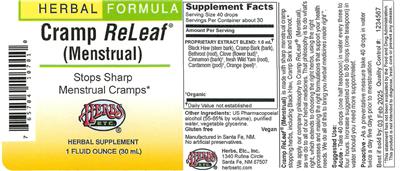
Cramp Releaf (Menstrual) is made with sharp menstrual cramp stopping herbs, including Black Haw, Cramp bark, and Bethroot.
General Statements
We apply our company philosophy to Cramp ReLeaf (Menstrual), as we do to all of our herbal medicines. That philosophy is to do what's right, which extends to choosing the right herbs, using the right processes and making the right formulations that support your health needs. We do all of this to bring you herbal medicines made right.
Suggested/Recommended/Usage/Directions
Suggested use: Acute - Take 40 drops (one half teaspoon) in water every three to four hours. Increase suggested use to 80 drops (one teaspoon) in water should you need more support/relief. Proactive - As preventative measure take 40 drops in water twice a day prior to menstruation.
Is this label outdated? Report a formula or label change and our pharmacy team will review it.
Cramp ReLeaf (Menstrual) by Herbs Etc. label
The label scan from the NIH Dietary Supplement Label Database. Tap to enlarge.
Label images are published by the NIH Dietary Supplement Label Database for the version of this product on file. Always read your actual product label.
View the full label (PDF)The Ingredients in Cramp ReLeaf (Menstrual) by Herbs Etc.
These are the 8 active ingredients this product is made of. Select any to open its full monograph.
Serving size40 Drop(s) Dosage formLiquid Servings per container30 Amounts shown are per serving.
Most supplement products combine several ingredients, and a medication can interact with the product through any one of them. Each ingredient below shows whether it has known drug interactions.
Proprietary Extract Blend
- › Cinnamon bark extract
- › Orange peel extract
- › Bethroot (root) extract
- › Clove Flower Bud Extract
- › Black Haw Stem Bark Extract
- › Wild Yam Root Extract, Fresh
- › Cardamom Pod Extract
- › Cramp Bark Bark Extract
Other (inactive) ingredients: Alcohol, Water, Purified, Glycerin. These complete the product’s ingredient list but are not active constituents.
Cramp ReLeaf (Menstrual) by Herbs Etc. Drug Interactions
HelloPharmacist Interaction Report
Cramp ReLeaf by Herbs Etc. has documented interactions with a substantial number of medications, primarily due to its orange peel and clove flower bud extracts.
The most serious concern is orange peel extract's effect on certain drug transporters and specific medications. Orange peel can significantly reduce the absorption of celiprolol (a heart medication), decreasing its levels by up to 90% — these should be separated by at least 4 hours.
It also increases absorption of pravastatin (a cholesterol drug) by about 149% and decreases absorption of ivermectin (an antiparasitic) and fexofenadine (an allergy medication).
Read the full breakdown — every affected drug type, severity by severity
Orange peel extract also affects a broader group of drugs that depend on a cellular transporter called OATP — again, spacing doses by at least 4 hours is recommended. Cinnamon bark and clove flower bud extracts can each theoretically increase blood sugar-lowering effects with diabetes medications, potentially requiring dose adjustments.
Clove may also increase levels of drugs metabolized by several liver enzymes (CYP2D6, CYP1A2, CYP3A4, and CYP2C9), though this hasn't been confirmed in humans. Clove also theoretically raises bleeding risk with blood thinners or antiplatelet drugs.
Additionally, cinnamon bark might compound effects with medications that are hard on the liver.
Black haw and cramp bark were checked with no interactions documented in our data. We could not check bethroot extract — we hold no data for it.
Altogether, these interactions span 1,165 individual medications. Use the search tool on this page to verify your exact prescriptions before starting.
Check your own medications below · Editorial policy · How we use AI
Want to check YOUR meds against Cramp ReLeaf (Menstrual)?
Ask about interactions with your drugs in plain English — “Can I take it with lisinopril?” — and we find you the answer in seconds, ingredient by ingredient.
Go to the checkerIngredients driving the most interactions
Individual Drug Interactions
The ingredients in Cramp ReLeaf (Menstrual) interact with 1,187 drugs. Click any drug to see the details.
4 of the 8 ingredients in Cramp ReLeaf (Menstrual) interact with drugs. Each result below shows which ingredient is responsible. Clove Flower Bud Extract Cinnamon bark extract Orange peel extract Wild Yam Root Extract, Fresh
AtorvastatinAtorvaliq
How Atorvastatin interacts with Cramp ReLeaf (Menstrual) — through 3 ingredients. Tap an ingredient for the detail:
Orange Peel ExtractOrganic Anion-transporting Polypeptide Substrates (oatp) Major
Interaction Summary
Consuming sweet orange juice can decrease oral absorption of OATP substrates.
Read the full Orange Peel Extract + Atorvastatin interactionCinnamon Bark ExtractHepatotoxic Drugs Moderate
Interaction Summary
Theoretically, large doses of cassia cinnamon might cause additive effects when used with hepatotoxic drugs.
Read the full Cinnamon Bark Extract + Atorvastatin interactionClove Flower Bud ExtractCytochrome P450 3a4 (cyp3a4) Substrates Moderate
Interaction Summary
Theoretically, concomitant use of clove may increase levels of drugs metabolized by CYP3A4.
Read the full Clove Flower Bud Extract + Atorvastatin interactionAtorvastatin CalciumLipitor
How Atorvastatin Calcium interacts with Cramp ReLeaf (Menstrual) — through 3 ingredients. Tap an ingredient for the detail:
Orange Peel ExtractOrganic Anion-transporting Polypeptide Substrates (oatp) Major
Interaction Summary
Consuming sweet orange juice can decrease oral absorption of OATP substrates.
Read the full Orange Peel Extract + Atorvastatin Calcium interactionClove Flower Bud ExtractCytochrome P450 3a4 (cyp3a4) Substrates Moderate
Interaction Summary
Theoretically, concomitant use of clove may increase levels of drugs metabolized by CYP3A4.
Read the full Clove Flower Bud Extract + Atorvastatin Calcium interactionCinnamon Bark ExtractHepatotoxic Drugs Moderate
Interaction Summary
Theoretically, large doses of cassia cinnamon might cause additive effects when used with hepatotoxic drugs.
Read the full Cinnamon Bark Extract + Atorvastatin Calcium interactionBosentanTracleer
How Bosentan interacts with Cramp ReLeaf (Menstrual) — through 3 ingredients. Tap an ingredient for the detail:
Orange Peel ExtractOrganic Anion-transporting Polypeptide Substrates (oatp) Major
Interaction Summary
Consuming sweet orange juice can decrease oral absorption of OATP substrates.
Read the full Orange Peel Extract + Bosentan interactionCinnamon Bark ExtractHepatotoxic Drugs Moderate
Interaction Summary
Theoretically, large doses of cassia cinnamon might cause additive effects when used with hepatotoxic drugs.
Read the full Cinnamon Bark Extract + Bosentan interactionClove Flower Bud ExtractCytochrome P450 3a4 (cyp3a4) Substrates, Cytochrome P450 2c9 (cyp2c9) Substrates Moderate
Interaction Summary
Theoretically, concomitant use of clove may increase levels of drugs metabolized by CYP3A4.
Read the full Clove Flower Bud Extract + Bosentan interactionBrincidofovirTembexa
How Brincidofovir interacts with Cramp ReLeaf (Menstrual) — through 1 ingredient. Tap an ingredient for the detail:
Orange Peel ExtractOrganic Anion-transporting Polypeptide Substrates (oatp) Major
Interaction Summary
Consuming sweet orange juice can decrease oral absorption of OATP substrates.
Read the full Orange Peel Extract + Brincidofovir interactionCeliprololCelicard
How Celiprolol interacts with Cramp ReLeaf (Menstrual) — through 1 ingredient. Tap an ingredient for the detail:
Orange Peel ExtractP-glycoprotein Substrates, Organic Anion-transporting Polypeptide Substrates (oatp) +1 Major
Interaction Summary
Sweet orange juice seems to modulate P-glycoprotein (P-gp), which might affect the blood levels of P-gp substrates.
Read the full Orange Peel Extract + Celiprolol interactionCerivastatin SodiumBaycol
How Cerivastatin Sodium interacts with Cramp ReLeaf (Menstrual) — through 2 ingredients. Tap an ingredient for the detail:
Orange Peel ExtractOrganic Anion-transporting Polypeptide Substrates (oatp) Major
Interaction Summary
Consuming sweet orange juice can decrease oral absorption of OATP substrates.
Read the full Orange Peel Extract + Cerivastatin Sodium interactionCinnamon Bark ExtractHepatotoxic Drugs Moderate
Interaction Summary
Theoretically, large doses of cassia cinnamon might cause additive effects when used with hepatotoxic drugs.
Read the full Cinnamon Bark Extract + Cerivastatin Sodium interactionCinoxacinCinobac
How Cinoxacin interacts with Cramp ReLeaf (Menstrual) — through 2 ingredients. Tap an ingredient for the detail:
Orange Peel ExtractOrganic Anion-transporting Polypeptide Substrates (oatp), Quinolone Antibiotics Major
Interaction Summary
Consuming sweet orange juice can decrease oral absorption of OATP substrates.
Read the full Orange Peel Extract + Cinoxacin interactionCinnamon Bark ExtractHepatotoxic Drugs Moderate
Interaction Summary
Theoretically, large doses of cassia cinnamon might cause additive effects when used with hepatotoxic drugs.
Read the full Cinnamon Bark Extract + Cinoxacin interactionCiprofloxacinCiloxan, Cipro, Cipro IV, Cipro XR, Ciprobay, Otiprio
How Ciprofloxacin interacts with Cramp ReLeaf (Menstrual) — through 2 ingredients. Tap an ingredient for the detail:
Orange Peel ExtractQuinolone Antibiotics, Organic Anion-transporting Polypeptide Substrates (oatp) Major
Interaction Summary
Calcium-fortified sweet orange juice might reduce quinolone absorption.
Read the full Orange Peel Extract + Ciprofloxacin interactionCinnamon Bark ExtractHepatotoxic Drugs Moderate
Interaction Summary
Theoretically, large doses of cassia cinnamon might cause additive effects when used with hepatotoxic drugs.
Read the full Cinnamon Bark Extract + Ciprofloxacin interactionCiprofloxacin, HydrocortisoneCipro HC Otic
How Ciprofloxacin, Hydrocortisone interacts with Cramp ReLeaf (Menstrual) — through 1 ingredient. Tap an ingredient for the detail:
Orange Peel ExtractOrganic Anion-transporting Polypeptide Substrates (oatp) Major
Interaction Summary
Consuming sweet orange juice can decrease oral absorption of OATP substrates.
Read the full Orange Peel Extract + Ciprofloxacin, Hydrocortisone interactionClinafloxacinClinafloxacin
How Clinafloxacin interacts with Cramp ReLeaf (Menstrual) — through 1 ingredient. Tap an ingredient for the detail:
Orange Peel ExtractOrganic Anion-transporting Polypeptide Substrates (oatp), Quinolone Antibiotics Major
Interaction Summary
Consuming sweet orange juice can decrease oral absorption of OATP substrates.
Read the full Orange Peel Extract + Clinafloxacin interactionEnoxacinPenetrex
How Enoxacin interacts with Cramp ReLeaf (Menstrual) — through 1 ingredient. Tap an ingredient for the detail:
Orange Peel ExtractQuinolone Antibiotics, Organic Anion-transporting Polypeptide Substrates (oatp) Major
Interaction Summary
Calcium-fortified sweet orange juice might reduce quinolone absorption.
Read the full Orange Peel Extract + Enoxacin interactionEtoposideEtopophos, VePesid, VP16
How Etoposide interacts with Cramp ReLeaf (Menstrual) — through 2 ingredients. Tap an ingredient for the detail:
Orange Peel ExtractP-glycoprotein Substrates, Organic Anion-transporting Polypeptide Substrates (oatp) Major
Interaction Summary
Sweet orange juice seems to modulate P-glycoprotein (P-gp), which might affect the blood levels of P-gp substrates.
Read the full Orange Peel Extract + Etoposide interactionClove Flower Bud ExtractCytochrome P450 3a4 (cyp3a4) Substrates Moderate
Interaction Summary
Theoretically, concomitant use of clove may increase levels of drugs metabolized by CYP3A4.
Read the full Clove Flower Bud Extract + Etoposide interactionEzetimibe, AtorvastatinLiptruzet
How Ezetimibe, Atorvastatin interacts with Cramp ReLeaf (Menstrual) — through 3 ingredients. Tap an ingredient for the detail:
Orange Peel ExtractOrganic Anion-transporting Polypeptide Substrates (oatp) Major
Interaction Summary
Consuming sweet orange juice can decrease oral absorption of OATP substrates.
Read the full Orange Peel Extract + Ezetimibe, Atorvastatin interactionCinnamon Bark ExtractHepatotoxic Drugs Moderate
Interaction Summary
Theoretically, large doses of cassia cinnamon might cause additive effects when used with hepatotoxic drugs.
Read the full Cinnamon Bark Extract + Ezetimibe, Atorvastatin interactionClove Flower Bud ExtractCytochrome P450 3a4 (cyp3a4) Substrates Moderate
Interaction Summary
Theoretically, concomitant use of clove may increase levels of drugs metabolized by CYP3A4.
Read the full Clove Flower Bud Extract + Ezetimibe, Atorvastatin interactionFexofenadineAllegra
How Fexofenadine interacts with Cramp ReLeaf (Menstrual) — through 2 ingredients. Tap an ingredient for the detail:
Orange Peel ExtractFexofenadine (allegra), P-glycoprotein Substrates +1 Major
Interaction Summary
Consuming sweet orange juice with fexofenadine can decrease oral absorption of fexofenadine.
Read the full Orange Peel Extract + Fexofenadine interactionClove Flower Bud ExtractCytochrome P450 3a4 (cyp3a4) Substrates Moderate
Interaction Summary
Theoretically, concomitant use of clove may increase levels of drugs metabolized by CYP3A4.
Read the full Clove Flower Bud Extract + Fexofenadine interactionFexofenadine, PseudoephedrineAllegra D
How Fexofenadine, Pseudoephedrine interacts with Cramp ReLeaf (Menstrual) — through 2 ingredients. Tap an ingredient for the detail:
Orange Peel ExtractFexofenadine (allegra), P-glycoprotein Substrates +1 Major
Interaction Summary
Consuming sweet orange juice with fexofenadine can decrease oral absorption of fexofenadine.
Read the full Orange Peel Extract + Fexofenadine, Pseudoephedrine interactionClove Flower Bud ExtractCytochrome P450 3a4 (cyp3a4) Substrates Moderate
Interaction Summary
Theoretically, concomitant use of clove may increase levels of drugs metabolized by CYP3A4.
Read the full Clove Flower Bud Extract + Fexofenadine, Pseudoephedrine interactionFluvastatinLescol, Lescol XL
How Fluvastatin interacts with Cramp ReLeaf (Menstrual) — through 3 ingredients. Tap an ingredient for the detail:
Orange Peel ExtractOrganic Anion-transporting Polypeptide Substrates (oatp) Major
Interaction Summary
Consuming sweet orange juice can decrease oral absorption of OATP substrates.
Read the full Orange Peel Extract + Fluvastatin interactionClove Flower Bud ExtractCytochrome P450 2c9 (cyp2c9) Substrates Moderate
Interaction Summary
Theoretically, concomitant use of clove may increase levels of drugs metabolized by CYP2C9.
Read the full Clove Flower Bud Extract + Fluvastatin interactionCinnamon Bark ExtractHepatotoxic Drugs Moderate
Interaction Summary
Theoretically, large doses of cassia cinnamon might cause additive effects when used with hepatotoxic drugs.
Read the full Cinnamon Bark Extract + Fluvastatin interactionGatifloxacinTequin, Tequin Injection
How Gatifloxacin interacts with Cramp ReLeaf (Menstrual) — through 2 ingredients. Tap an ingredient for the detail:
Orange Peel ExtractOrganic Anion-transporting Polypeptide Substrates (oatp), Quinolone Antibiotics Major
Interaction Summary
Consuming sweet orange juice can decrease oral absorption of OATP substrates.
Read the full Orange Peel Extract + Gatifloxacin interactionCinnamon Bark ExtractHepatotoxic Drugs Moderate
Interaction Summary
Theoretically, large doses of cassia cinnamon might cause additive effects when used with hepatotoxic drugs.
Read the full Cinnamon Bark Extract + Gatifloxacin interactionGemifloxacinFactive
How Gemifloxacin interacts with Cramp ReLeaf (Menstrual) — through 1 ingredient. Tap an ingredient for the detail:
Orange Peel ExtractOrganic Anion-transporting Polypeptide Substrates (oatp), Quinolone Antibiotics Major
Interaction Summary
Consuming sweet orange juice can decrease oral absorption of OATP substrates.
Read the full Orange Peel Extract + Gemifloxacin interactionGlyburideAlbert Glyburide, Diabeta, Glycron, Glynase, Glynase PresTab, Micronase +1 more
How Glyburide interacts with Cramp ReLeaf (Menstrual) — through 3 ingredients. Tap an ingredient for the detail:
Orange Peel ExtractOrganic Anion-transporting Polypeptide Substrates (oatp) Major
Interaction Summary
Consuming sweet orange juice can decrease oral absorption of OATP substrates.
Read the full Orange Peel Extract + Glyburide interactionClove Flower Bud ExtractAntidiabetes Drugs, Cytochrome P450 2c9 (cyp2c9) Substrates Moderate
Interaction Summary
Theoretically, concomitant use of clove extracts with antidiabetes drugs might increase the risk of hypoglycemia.
Read the full Clove Flower Bud Extract + Glyburide interactionCinnamon Bark ExtractHepatotoxic Drugs, Antidiabetes Drugs Moderate
Interaction Summary
Theoretically, large doses of cassia cinnamon might cause additive effects when used with hepatotoxic drugs.
Read the full Cinnamon Bark Extract + Glyburide interactionGlyburide, MetforminGlucovance
How Glyburide, Metformin interacts with Cramp ReLeaf (Menstrual) — through 3 ingredients. Tap an ingredient for the detail:
Orange Peel ExtractOrganic Anion-transporting Polypeptide Substrates (oatp) Major
Interaction Summary
Consuming sweet orange juice can decrease oral absorption of OATP substrates.
Read the full Orange Peel Extract + Glyburide, Metformin interactionCinnamon Bark ExtractAntidiabetes Drugs, Hepatotoxic Drugs Moderate
Interaction Summary
Theoretically, cassia cinnamon may have additive effects with antidiabetes drugs.
Read the full Cinnamon Bark Extract + Glyburide, Metformin interactionClove Flower Bud ExtractAntidiabetes Drugs, Cytochrome P450 2c9 (cyp2c9) Substrates Moderate
Interaction Summary
Theoretically, concomitant use of clove extracts with antidiabetes drugs might increase the risk of hypoglycemia.
Read the full Clove Flower Bud Extract + Glyburide, Metformin interactionGrepafloxacinRaxar
How Grepafloxacin interacts with Cramp ReLeaf (Menstrual) — through 2 ingredients. Tap an ingredient for the detail:
Orange Peel ExtractOrganic Anion-transporting Polypeptide Substrates (oatp), Quinolone Antibiotics Major
Interaction Summary
Consuming sweet orange juice can decrease oral absorption of OATP substrates.
Read the full Orange Peel Extract + Grepafloxacin interactionClove Flower Bud ExtractCytochrome P450 1a2 (cyp1a2) Substrates Moderate
Interaction Summary
Theoretically, concomitant use of clove may increase levels of drugs metabolized by CYP1A2.
Read the full Clove Flower Bud Extract + Grepafloxacin interactionIrinotecanCamptosar, Onivyde
How Irinotecan interacts with Cramp ReLeaf (Menstrual) — through 2 ingredients. Tap an ingredient for the detail:
Orange Peel ExtractOrganic Anion-transporting Polypeptide Substrates (oatp) Major
Interaction Summary
Consuming sweet orange juice can decrease oral absorption of OATP substrates.
Read the full Orange Peel Extract + Irinotecan interactionClove Flower Bud ExtractCytochrome P450 3a4 (cyp3a4) Substrates Moderate
Interaction Summary
Theoretically, concomitant use of clove may increase levels of drugs metabolized by CYP3A4.
Read the full Clove Flower Bud Extract + Irinotecan interactionIrinotecan Hydrochloride
How Irinotecan Hydrochloride interacts with Cramp ReLeaf (Menstrual) — through 2 ingredients. Tap an ingredient for the detail:
Orange Peel ExtractOrganic Anion-transporting Polypeptide Substrates (oatp) Major
Interaction Summary
Consuming sweet orange juice can decrease oral absorption of OATP substrates.
Read the full Orange Peel Extract + Irinotecan Hydrochloride interactionClove Flower Bud ExtractCytochrome P450 3a4 (cyp3a4) Substrates Moderate
Interaction Summary
Theoretically, concomitant use of clove may increase levels of drugs metabolized by CYP3A4.
Read the full Clove Flower Bud Extract + Irinotecan Hydrochloride interactionIsoniazid, Pyrazinamide, RifampinRifater
How Isoniazid, Pyrazinamide, Rifampin interacts with Cramp ReLeaf (Menstrual) — through 2 ingredients. Tap an ingredient for the detail:
Orange Peel ExtractOrganic Anion-transporting Polypeptide Substrates (oatp) Major
Interaction Summary
Consuming sweet orange juice can decrease oral absorption of OATP substrates.
Read the full Orange Peel Extract + Isoniazid, Pyrazinamide, Rifampin interactionCinnamon Bark ExtractHepatotoxic Drugs Moderate
Interaction Summary
Theoretically, large doses of cassia cinnamon might cause additive effects when used with hepatotoxic drugs.
Read the full Cinnamon Bark Extract + Isoniazid, Pyrazinamide, Rifampin interactionIsoniazid, RifampinRifamate
How Isoniazid, Rifampin interacts with Cramp ReLeaf (Menstrual) — through 2 ingredients. Tap an ingredient for the detail:
Orange Peel ExtractOrganic Anion-transporting Polypeptide Substrates (oatp) Major
Interaction Summary
Consuming sweet orange juice can decrease oral absorption of OATP substrates.
Read the full Orange Peel Extract + Isoniazid, Rifampin interactionCinnamon Bark ExtractHepatotoxic Drugs Moderate
Interaction Summary
Theoretically, large doses of cassia cinnamon might cause additive effects when used with hepatotoxic drugs.
Read the full Cinnamon Bark Extract + Isoniazid, Rifampin interactionIvermectinMectizan, Sklice, Soolantra, Stromectol
How Ivermectin interacts with Cramp ReLeaf (Menstrual) — through 1 ingredient. Tap an ingredient for the detail:
Orange Peel ExtractIvermectin (stromectol, Others), P-glycoprotein Substrates Major
Interaction Summary
Consuming sweet orange juice with ivermectin can decrease the oral absorption of ivermectin.
Read the full Orange Peel Extract + Ivermectin interactionLevofloxacinLeva-pak, Levaquin, Levaquin Injection
How Levofloxacin interacts with Cramp ReLeaf (Menstrual) — through 2 ingredients. Tap an ingredient for the detail:
Orange Peel ExtractOrganic Anion-transporting Polypeptide Substrates (oatp), Quinolone Antibiotics Major
Interaction Summary
Consuming sweet orange juice can decrease oral absorption of OATP substrates.
Read the full Orange Peel Extract + Levofloxacin interactionCinnamon Bark ExtractHepatotoxic Drugs Moderate
Interaction Summary
Theoretically, large doses of cassia cinnamon might cause additive effects when used with hepatotoxic drugs.
Read the full Cinnamon Bark Extract + Levofloxacin interactionLevofloxacin (ophthalmic)Levofloxacin
How Levofloxacin (ophthalmic) interacts with Cramp ReLeaf (Menstrual) — through 1 ingredient. Tap an ingredient for the detail:
Orange Peel ExtractOrganic Anion-transporting Polypeptide Substrates (oatp), Quinolone Antibiotics Major
Interaction Summary
Consuming sweet orange juice can decrease oral absorption of OATP substrates.
Read the full Orange Peel Extract + Levofloxacin (ophthalmic) interactionLomefloxacinMaxaquin
How Lomefloxacin interacts with Cramp ReLeaf (Menstrual) — through 2 ingredients. Tap an ingredient for the detail:
Orange Peel ExtractOrganic Anion-transporting Polypeptide Substrates (oatp), Quinolone Antibiotics Major
Interaction Summary
Consuming sweet orange juice can decrease oral absorption of OATP substrates.
Read the full Orange Peel Extract + Lomefloxacin interactionCinnamon Bark ExtractHepatotoxic Drugs Moderate
Interaction Summary
Theoretically, large doses of cassia cinnamon might cause additive effects when used with hepatotoxic drugs.
Read the full Cinnamon Bark Extract + Lomefloxacin interactionLovastatinAltocor, Mevacor
How Lovastatin interacts with Cramp ReLeaf (Menstrual) — through 3 ingredients. Tap an ingredient for the detail:
Orange Peel ExtractOrganic Anion-transporting Polypeptide Substrates (oatp) Major
Interaction Summary
Consuming sweet orange juice can decrease oral absorption of OATP substrates.
Read the full Orange Peel Extract + Lovastatin interactionCinnamon Bark ExtractHepatotoxic Drugs Moderate
Interaction Summary
Theoretically, large doses of cassia cinnamon might cause additive effects when used with hepatotoxic drugs.
Read the full Cinnamon Bark Extract + Lovastatin interactionClove Flower Bud ExtractCytochrome P450 3a4 (cyp3a4) Substrates Moderate
Interaction Summary
Theoretically, concomitant use of clove may increase levels of drugs metabolized by CYP3A4.
Read the full Clove Flower Bud Extract + Lovastatin interactionEach ingredient & the kinds of drugs it affects
For each ingredient in Cramp ReLeaf (Menstrual) with known interactions, here are the types of medications they can affect. Open any type for the detail — or search your exact drug in the checker above.
Clove Flower Bud Extract
Antidiabetes Drugs
Theoretically, concomitant use of clove extracts with antidiabetes drugs might increase the risk of hypoglycemia.
Clinical and laboratory research suggest that polyphenol extracts from clove flower buds might lower blood glucose levels. Dosing adjustments for insulin or oral hypoglycemic agents may be necessary when taken with clove. Monitor blood glucose levels closely.
Cytochrome P450 1A2 (Cyp1A2) Substrates
Theoretically, concomitant use of clove may increase levels of drugs metabolized by CYP1A2.
In vitro research shows that eugenol, the principal constituent of clove, can inhibit CYP1A2 in a dose-dependent manner,. This effect has not been reported in humans.
Cytochrome P450 2C9 (Cyp2C9) Substrates
Theoretically, concomitant use of clove may increase levels of drugs metabolized by CYP2C9.
In vitro research shows that eugenol, the principal constituent of clove, inhibits CYP2C9 in a dose-dependent manner. This effect has not been reported in humans.
Cytochrome P450 2D6 (Cyp2D6) Substrates
Theoretically, concomitant use of clove may increase levels of drugs metabolized by CYP2D6.
In vitro research shows that eugenol, the principal constituent of clove, can inhibit CYP2D6 in a dose-dependent manner. This effect has not been reported in humans.
Cytochrome P450 3A4 (Cyp3A4) Substrates
Theoretically, concomitant use of clove may increase levels of drugs metabolized by CYP3A4.
In vitro research shows that eugenol, the principal constituent of clove, can inhibit CYP3A4 in a dose-dependent manner. This effect has not been reported in humans.
Anticoagulant/Antiplatelet Drugs
Theoretically, clove oil may increase the risk of bleeding if used with anticoagulant or antiplatelet drugs.
Laboratory research suggests that eugenol, a constituent of clove, has antiplatelet activity. This interaction has not been reported in humans.
Ibuprofen (Advil, Others)
Theoretically, topical application of clove oil with ibuprofen might increase the absorption and side effects of topical ibuprofen.
Laboratory research shows that topical application of clove oil increases the absorption of topical ibuprofen. This interaction has not been reported in humans.
Cinnamon bark extract
Antidiabetes Drugs
Theoretically, cassia cinnamon may have additive effects with antidiabetes drugs.
Cassia cinnamon may lower blood glucose levels, and have additive effects in patients treated with antidiabetic agents. Dose adjustments to diabetes medications might be necessary.
Hepatotoxic Drugs
Theoretically, large doses of cassia cinnamon might cause additive effects when used with hepatotoxic drugs.
There is some concern that ingesting large amounts of cassia cinnamon for an extended duration might cause hepatotoxicity in some people. Cassia cinnamon contains coumarin, which can cause hepatotoxicity in animal models. In humans, very high doses of coumarin from 50-7000 mg/day can result in hepatotoxicity that resolves when coumarin use is discontinued. Lower amounts might also cause liver problems in sensitive people, such as those with liver disease or those taking potentially hepatotoxic agents.
Orange peel extract
Celiprolol (Celicard)
Consuming sweet orange with celiprolol can decrease oral absorption of celiprolol.
A pharmacokinetic study in healthy volunteers shows that celiprolol levels, after a single dose of 100 mg, are decreased by up to 90% in people who drink sweet orange juice 200 mL three times daily. It's not known if lower consumption of sweet orange juice will have the same effect. Theoretically, this occurs due to short-term inhibition of organic anion transporting polypeptide (OATP). Recommend separating drug administration and consumption of sweet orange by at least 4 hours.
Ivermectin (Stromectol, Others)
Consuming sweet orange juice with ivermectin can decrease the oral absorption of ivermectin.
A pharmacokinetic study in healthy volunteers shows that taking ivermectin orally with sweet orange juice 750 mL over 4 hours reduces the bioavailability of ivermectin. This effect does not seem to be related to effects on P-glycoprotein. The effect on ivermectin is more pronounced in males compared to females.
Organic Anion-Transporting Polypeptide Substrates (Oatp)
Consuming sweet orange juice can decrease oral absorption of OATP substrates. Separate administration by at least 4 hours.
Clinical research shows that consuming sweet orange juice inhibits OATP, which reduces bioavailability of oral drugs that are substrates of OATP. For example, sweet orange juice decreases bioavailability of fexofenadine, a substrate of OATP, by about 72% and of celiprolol, another OATP substrate, by up to 90%. Since sweet orange juice seems to affect OATP for a short time, recommend separating drug administration and consumption of sweet orange juice by at least 4 hours.
Pravastatin (Pravachol)
Consuming sweet orange juice with pravastatin can increase the absorption of pravastatin.
A small pharmacokinetic study in healthy volunteers shows that consuming sweet orange juice 800 mL over 3 hours, including before, during, and after taking pravastatin 10 mg, increases pravastatin levels by about 149%, without affecting pravastatin elimination. Theoretically this effect might be due to modulation of organic anion transporting polypeptides (OATPs) by sweet orange juice. Sweet orange juice does not seem to affect simvastatin levels, but it is not known if sweet orange affects any of the other statins.
Fexofenadine (Allegra)
Consuming sweet orange juice with fexofenadine can decrease oral absorption of fexofenadine.
Clinical research shows that coadministration of sweet orange juice 1200 mL decreases bioavailability of fexofenadine by about 72%. In an animal model, sweet orange juice decreased bioavailability of fexofenadine by 31%. Fexofenadine manufacturer data indicates that concomitant administration of sweet orange juice and fexofenadine results in larger wheal and flare sizes in research models. This suggests that sweet orange reduces the clinical response to fexofenadine. Theoretically, this occurs due to short-term inhibition of organic anion transporting polypeptide (OATP). Recommend separating drug administration and consumption of sweet orange by at least 4 hours.
P-Glycoprotein Substrates
Sweet orange juice seems to modulate P-glycoprotein (P-gp), which might affect the blood levels of P-gp substrates.
Animal and in vitro research suggest that orange juice extract inhibits drug efflux by P-gp, increasing absorption and levels of P-gp substrates. In contrast, pharmacokinetic research in humans shows that drinking large amounts of sweet orange juice decreases absorption and levels of the P-gp substrate celiprolol. This suggests that orange juice actually induces drug efflux by P-gp or affects drug levels by another mechanism such as inhibiting the gut drug transporter called organic anion transporting polypeptide (OATP). Until more is known, sweet orange juice should be used cautiously in people taking P-gp substrates.
Quinolone Antibiotics
Calcium-fortified sweet orange juice might reduce quinolone absorption.
Calcium binds to quinolones in the gut. Theoretically, the calcium in certain fortified orange juices can also bind to quinolone antibiotics and reduce their absorption and levels.
Wild Yam Root Extract, Fresh
Estrogens
Theoretically, wild yam might increase or decrease the effects of estrogen.
Wild yam root shows estrogenic and anti-estrogenic effects in vitro. Theoretically, wild yam might interfere with hormone therapy.
Brand information
Manufacturer and brand details for Cramp ReLeaf (Menstrual), from the product label.
Herbs Etc.
- Name
- Herbs, Etc., Inc.
- Street Address
- 1340 Rufina Circle
- City
- Santa Fe
- State
- NM
- ZipCode
- 87507
- Web Address
- www.herbsetc.com
Cramp ReLeaf (Menstrual) by Herbs Etc.: Common Questions
Does Cramp ReLeaf (Menstrual) by Herbs Etc. interact with any medications?
How can one product interact with so many drugs?
Where does this information come from?
Can I take this if I'm pregnant?
Will this actually help with period cramps?
Can I take this if I'm breastfeeding?
What does orange peel extract do in this formula?
Are there any serious side effects I should watch for?
Can I take this with allergy medications like Allegra?
Written and reviewed by the HelloPharmacist editorial staff. Our editorial policy
Not sure if Cramp ReLeaf (Menstrual) is safe with your meds?
Our pharmacists answer your medication & supplement questions — free.
Label information is sourced from the NIH Dietary Supplement Label Database and reflects the product version on file; always read your actual product label. This page is for education only and is not a substitute for professional medical advice. Confirm with your pharmacist or doctor before combining supplements and medications.
The Full Monographs Behind Cramp ReLeaf (Menstrual)’s Ingredients
Every ingredient we hold a full HelloPharmacist monograph for — uses, evidence, safety, and the complete interaction list.
Cassia Cinnamon
Interacts with 444 drugsCassia cinnamon is the common, inexpensive cinnamon used in cooking, and it is also taken as a supplement, most often for blood sugar support. The evidence for its health benefits is mixed a...
Read the full Cassia Cinnamon monograph → Herb & supplement monographSweet Orange
Interacts with 247 drugsSweet orange is a common citrus fruit that is a good source of vitamin C, fiber, and antioxidants, and is enjoyed as a food worldwide. Its peel and essential oil are used in aromatherapy and...
Read the full Sweet Orange monograph → Herb & supplement monographClove
Interacts with 979 drugsClove is a common cooking spice that is also used in traditional medicine, especially as a topical numbing agent for tooth pain thanks to its main compound, eugenol. Food amounts are general...
Read the full Clove monograph → Herb & supplement monographBlack Haw
Black Haw is a traditional herbal bark long used to ease menstrual cramps and uterine spasms, but modern human studies are very limited. It contains compounds that may relax smooth muscle, b...
Read the full Black Haw monograph → Herb & supplement monographWild Yam
Interacts with 41 drugsWild yam is a root traditionally used for menopausal symptoms, cramps, and as a so-called 'natural' hormone supplement, but solid human evidence for these uses is lacking. Despite popular cl...
Read the full Wild Yam monograph → Herb & supplement monographCardamom
Cardamom is a popular cooking spice that has long been used in traditional medicine for digestion and fresh breath. As a food, it is generally safe for most people, but high-dose supplements...
Read the full Cardamom monograph → Herb & supplement monographCramp Bark
Cramp Bark is the dried bark of Viburnum opulus, traditionally used to ease muscle and menstrual cramps. Modern, high-quality human studies are very limited, so its effectiveness is not well...
Read the full Cramp Bark monograph →Sources & How We Checked
Cramp ReLeaf (Menstrual)'s label data comes from the NIH Dietary Supplement Label Database; the ingredient interaction data is from the Natural Medicines database, reviewed by our pharmacists.
- NIH Dietary Supplement Label Database (DSLD) — The official product label on file for this supplement.
- Natural Medicines (Therapeutic Research Center) — Evidence-graded clinical reference behind the ingredient interaction data.
Content is written and reviewed by licensed HelloPharmacist pharmacists. See our data sources and editorial standards for how this information is built and checked.
The 73 references behind this product’s interaction data
Every citation that drives the interaction findings for this product’s ingredients, from the evidence-graded Natural Medicines (TRC Healthcare) database. Open an ingredient to browse its citations — links open the study on PubMed or the publisher’s site.
Cassia Cinnamon 20 references
- Electronic Code of Federal Regulations. Title 21. Part 182 -- Substances Generally Recognized As Safe. Available at: https://www.accessdata.fda.gov/scripts/cdrh/cfdocs/cfcfr/CFRSearch.cfm?CFRPart=182
- Khan A, Safdar M, Ali Khan M, et al. Cinnamon improves glucose and lipids of people with type 2 diabetes. Diabetes Care 2003;26:3215-8. PubMed
- De Benito V, Alzaga R. Occupational allergic contact dermatitis from cassia (Chinese cinnamon) as a flavouring agent in coffee. Contact Dermatitis 1999;40:165. PubMed
- Drake TE, Maibach HI. Allergic contact dermatitis and stomatitis caused by a cinnamic aldehyde-flavored toothpaste. Arch Dermatol 1976;112:202-3.
- Press release. Cinnamon capsules to reduce blood sugar are medicinal products! Efficacy has not been scientifically proven - some products contain high levels of coumarin. Federal Institute of Risk Assessment (BfM), Germany, November 11, 2006. Available a
- Felter SP, Vassallo JD, Carlton BD, Daston GP. A safety assessment of coumarin taking into account species-specificity of toxicokinetics. Food Chem Toxicol 2006;44:462-75. PubMed
- Crawford P. Effectiveness of cinnamon for lowering hemoglobin A1C in patients with type 2 diabetes: a randomized, controlled trial. J Am Board Fam Med 2009;22:507-12. PubMed
- Akilen, R., Tsiami, A., Devendra, D., and Robinson, N. Glycated haemoglobin and blood pressure-lowering effect of cinnamon in multi-ethnic Type 2 diabetic patients in the UK: a randomized, placebo-controlled, double-blind clinical trial. Diabet.Med. 2010; PubMed
- Lu T, Sheng H Wu J Cheng Y Zhu J Chen Y. Cinnamon extract improves fasting blood glucose and glycosylated hemoglobin level in Chinese patients with type 2 diabetes. Nutr Res. 2012;32(6):408-412. PubMed
- Choi, J., Lee, K. T., Ka, H., Jung, W. T., Jung, H. J., and Park, H. J. Constituents of the essential oil of the Cinnamomum cassia stem bark and the biological properties. Arch Pharm Res 2001;24(5):418-423.
- Altschuler JA, Casella SJ, MacKenzie TA, Curtis KM. The effect of cinnamon on A1C among adolescents with type 1 diabetes. Diabetes Care 2007;30(4):813-6. PubMed
- Stoecker BR, Zhan Z, Luo R, et al. Cinnamon extract lowers blood glucose in hyperglycemic subjects. FASEB J. 2010;22:722.1 (Abstract only). DOI
- Admani S, Hill H, Jacob SE. Cinnamon Sugar Scrub Dermatitis: "Natural" Is Not Always Best. Pediatr Dermatol. 2017;34(1):e42-e43. PubMed
- Isaac-Renton M, Li MK, Parsons LM. Cinnamon spice and everything not nice: many features of intraoral allergy to cinnamic aldehyde. Dermatitis. 2015;26(3):116-21. PubMed
- Vandersall A, Katta R. Eyelid dermatitis as a manifestation of systemic contact dermatitis to cinnamon. Dermatitis. 2015 Jul-Aug;26(4):189. PubMed
- Wickenberg J, Lindstedt S, Nilsson J, Hlebowicz J. Cassia cinnamon does not change the insulin sensitivity or the liver enzymes in subjects with impaired glucose tolerance. Nutr J 2014 Sep 24;13:96. PubMed
- Brancheau D, Patel B, Zughaib M. Do cinnamon supplements cause acute hepatitis? Am J Case Rep 2015;16:250-4. PubMed
- Shekarchizadeh-Esfahani P, Heydarpour F, Izadi F, Jalili C. The effect of cinnamon supplementation on liver enzymes in adults: A systematic review and meta-analysis of randomized controlled trials. Complement Ther Med 2021;58:102699. PubMed
- Bernaola J, Valverde-Monge M, Otal-Buesa M, Cullen D, Heras-Mendaza F. Cinnamon allergic contact cheilitis. Contact Dermatitis 2023;88(5):418-419. PubMed
- Patel K, Howard M, Tate B. Cheilitis caused by allergic contact dermatitis to cinnamon in chai tea: A case report. Contact Dermatitis 2023;88(3):239-240. PubMed
Sweet Orange 17 references
- Leung AY, Foster S. Encyclopedia of Common Natural Ingredients Used in Food, Drugs and Cosmetics. 2nd ed. New York, NY: John Wiley & Sons, 1996.
- FDA, CFSAN. FDA-approved potassium health claim notification for potassium containing foods. 2000. Available at: www.cfsan.fda.gov/~dms/hclm-k.html.
- Kurowska EM, Spence JD, Jordan J, et al. HDL-cholesterol-raising effect of orange juice in subjects with hypercholesterolemia. Am J Clin Nutr 2000;72:1095-100. PubMed
- Murry JJ, Healy MD. Drug-mineral interactions: a new responsibility for the hospital dietician. J Am Diet Assoc 1991;91:66-73.
- Bailey DG, Dresser GK, Munoz C, et al. Reduction of fexofenadine bioavailability by fruit juices. Clin Pharmacol Ther 2001;69:P21.
- Pletz MW, Petzold P, Allen A, et al. Effect of calcium carbonate on bioavailability of orally administered gemifloxacin. Antimicrob Agents Chemother 2003;47:2158-60.. PubMed
- Lilja JJ, Juntti-Patinen L, Neuvonen PJ. Orange juice substantially reduces the bioavailability of the beta-adrenergic-blocking agent celiprolol. Clin Pharmacol Ther 2004;75:184-90.
- Tian R, Koyabu N, Takanaga H, et al. Effects of grapefruit juice and orange juice on the intestinal efflux of P-glycoprotein substrates. Pharm Res 2002;19:802-9. PubMed
- Vanapalli SR, Chen Y, Ellingrod VL, et al. Orange juice decreases the oral bioavailability of ivermectin in health volunteers. Clin Pharmacol Ther 2003;73 (Abstract PDII-A-10):P94.
- Huang SM, Lesko LJ. Drug-drug, drug-dietary supplement, and drug-citrus fruit and other food interactions: what have we learned? J Clin Pharmacol 2004;44:559-69. PubMed
- Koitabashi Y, Kumai T, Matsumoto N, et al. Orange juice increased the bioavailability of pravastatin, 3-hydroxy-3-methylglutaryl CoA reductase inhibitor, in rats and healthy human subjects. Life Sci 2006;78:2852-9. PubMed
- Takanaga H, Ohnishi A, Yamada S, et al. Polymethoxylated flavones in orange juice are inhibitors of P-glycoprotein but not cytochrome P450 3A4. J Pharmacol Exp Ther 2000;293:230-6. DOI
- Greenblatt DJ. Analysis of drug interactions involving fruit beverages and organic anion-transporting polypeptides. J Clin Pharmacol 2009;49:1403-7. PubMed
- Bailey DG. Fruit juice inhibition of uptake transport: a new type of food-drug interaction. Br J Clin Pharmacol 2010;70:645-55. PubMed
- Kamath AV, Yao M, Zhang Y, Chong S. Effect of fruit juices on the oral bioavailability of fexofenadine in rats. J Pharm Sci 2005;94:233-9. PubMed
- Kays MB, Overholser BR, Mueller BA, et al. Effects of sevelamer hydrochloride and calcium acetate on the oral bioavailability of ciprofloxacin. Am J Kidney Dis. 2003;42(6):1253-9. PubMed
- Neuhofel, A. L., Wilton, J. H., Victory, J. M., Hejmanowsk, L. G., and Amsden, G. W. Lack of bioequivalence of ciprofloxacin when administered with calcium-fortified orange juice: a new twist on an old interaction. J Clin Pharmacol. 2002;42(4):461-466. DOI
Clove 26 references
- The Review of Natural Products by Facts and Comparisons. St. Louis, MO: Wolters Kluwer Co., 1999.
- Electronic Code of Federal Regulations. Title 21. Part 182 -- Substances Generally Recognized As Safe. Available at: https://www.accessdata.fda.gov/scripts/cdrh/cfdocs/cfcfr/CFRSearch.cfm?CFRPart=182
- Kanerva L, Estlander T, Jolanki R. Occupational allergic contact dermatitis from spices. Contact Dermatitis 1996;35:157-62. PubMed
- Chen SJ, Wang MH, Chen IJ. Antiplatelet and calcium inhibitory properties of eugenol and sodium eugenol acetate. Gen Pharmacol 1996;27:629-33. PubMed
- Malson JL, Lee EM, Murty R, et al. Clove cigarette smoking: biochemical, physiological, and subjective effects. Pharmacol Biochem Behav 2003;74:739-45. PubMed
- Kirsch CM, Yenokida GG, Jensen WA, et al. Non-cardiogenic pulmonary oedema due to the intravenous administration of clove oil. Thorax 1990;45:235-6. PubMed
- Pallares, D. E. Link between clove cigarettes and urticaria? Postgrad.Med 10-1-1999;106(4):153. PubMed
- Barnard, D. R. Repellency of essential oils to mosquitoes (Diptera: Culicidae). J Med Entomol. 1999;36(5):625-629. PubMed
- Sanchez-Perez, J. and Garcia-Diez, A. Occupational allergic contact dermatitis from eugenol, oil of cinnamon and oil of cloves in a physiotherapist. Contact Dermatitis 1999;41(6):346-347. PubMed
- Andersen, K. E., Johansen, J. D., Bruze, M., Frosch, P. J., Goossens, A., Lepoittevin, J. P., Rastogi, S., White, I., and Menne, T. The time-dose-response relationship for elicitation of contact dermatitis in isoeugenol allergic individuals. Toxicol.Appl PubMed
- Alqareer, A., Alyahya, A., and Andersson, L. The effect of clove and benzocaine versus placebo as topical anesthetics. J Dent 2006;34(10):747-750. PubMed
- Lane, B. W., Ellenhorn, M. J., Hulbert, T. V., and McCarron, M. Clove oil ingestion in an infant. Hum.Exp Toxicol. 1991;10(4):291-294. PubMed
- Quirce, S., Fernandez-Nieto, M., del, Pozo, V, Sastre, B., and Sastre, J. Occupational asthma and rhinitis caused by eugenol in a hairdresser. Allergy 2008;63(1):137-138. PubMed
- Srivastava, K. C. and Malhotra, N. Acetyl eugenol, a component of oil of cloves (Syzygium aromaticum L.) inhibits aggregation and alters arachidonic acid metabolism in human blood platelets. Prostaglandins Leukot.Essent.Fatty Acids 1991;42(1):73-81. PubMed
- Dyrbye, B. A., Dubois, L., Vink, R., and Horn, J. A patient with clove oil intoxication. Anaesth.Intensive Care 2012;40(2):365-366.
- Guidotti, T. L., Laing, L., and Prakash, U. B. Clove cigarettes. The basis for concern regarding health effects. West J Med 1989;151(2):220-228.
- Anonymous. Evaluation of the health hazard of clove cigarettes. Council on Scientific Affairs. JAMA 12-23-1988;260(24):3641-3644. DOI
- Romaguera, C., Alomar, A., Camarasa, J. M., Garcia, Bravo B., Garcia, Perez A., Grimalt, F., Guerra, P., Lopez, Gorretcher B., Pascual, A. M., Miranda, A., and . Contact dermatitis in children. Contact Dermatitis 1985;12(5):283-284. PubMed
- Hackett, P. H., Rodriguez, G., and Roach, R. C. Clove cigarettes and high-altitude pulmonary edema. JAMA 6-28-1985;253(24):3551-3552. DOI
- Isaacs, G. Permanent local anaesthesia and anhidrosis after clove oil spillage. Lancet 4-16-1983;1(8329):882. PubMed
- Saeed, S. A. and Gilani, A. H. Antithrombotic activity of clove oil. J Pak Med Assoc 1994;44(5):112-115.
- Hartnoll, G., Moore, D., and Douek, D. Near fatal ingestion of oil of cloves. Arch.Dis Child 1993;69(3):392-393. PubMed
- Srivastava, K. C. Antiplatelet principles from a food spice clove (Syzygium aromaticum L) [corrected]. Prostaglandins Leukot.Essent.Fatty Acids 1993;48(5):363-372.
- Jiang Q, Wu Y, Zhang H, et al. Development of essential oils as skin permeation enhancers: penetration enhancement effect and mechanism of action. Pharmaceutical Biol. 2017;55(1):1592-1600. PubMed
- Mohan R, Jose S, Mulakkal J, Karpinsky-Semper D, Swick AG, Krishnakumar IM. Water-soluble polyphenol-rich clove extract lowers pre- and post-prandial blood glucose levels in healthy and prediabetic volunteers: an open label pilot study. BMC Complement Alt PubMed
- Alharbi NFM, Ahad A, Bin Jardan YA, Al-Jenoobi FI. Effect of eugenol on cytochrome P450 1A2, 2C9, 2D6, and 3A4 activity in human liver microsomes. Saudi Pharm J 2024;32(7):102118. PubMed
Black Haw 1 reference
- Leung AY, Foster S. Encyclopedia of Common Natural Ingredients Used in Food, Drugs and Cosmetics. 2nd ed. New York, NY: John Wiley & Sons, 1996.
Wild Yam 7 references
- McGuffin M, Hobbs C, Upton R, Goldberg A, eds. American Herbal Products Association's Botanical Safety Handbook. Boca Raton, FL: CRC Press, LLC 1997.
- Eagon PK, Elm MS, Hunter DS, et al. Medicinal herbs: modulation of estrogen action. Era of Hope Mtg, Dept Defense; Breast Cancer Res Prog, Atlanta, GA 2000;Jun 8-11.
- Cheong JL, Bucknall R. Retinal vein thrombosis associated with a herbal phytoestrogen preparation in a susceptible patient. Postgrad Med J 2005;81:266-7.. PubMed
- Rosenberg Zand, R. S., Jenkins, D. J., and Diamandis, E. P. Effects of natural products and nutraceuticals on steroid hormone-regulated gene expression. Clin Chim.Acta 2001;312(1-2):213-219. PubMed
- Araghiniknam M, Chung S, Nelson-White T, and et al. Antioxidant activity of Dioscorea and dehydroepiandrosterone (DHEA) in older humans. Life Sciences 1996;59:L147-L157.
- Zeng M, Zhang L, Li M, et al. Estrogenic effects of the extracts from the Chinese Yam (Dioscorea opposite Thunb.) and its effective compounds in vitro and in vivo. Molecules. 2018 Jan 23;23(2). Pii: E11. PubMed
- Lu J, Wong RN, Zhang L, et al. Comparative analysis of proteins with stimulating activity on ovarian estradiol biosynthesis from four different Dioscorea species in vitro using both phenotypic and target-based approaches: implication for treating menopaus
Cardamom 2 references
- Mobacken, H. and Fregert, S. Allergic contact dermatitis from cardamom. Contact Dermatitis 1975;1(3):175-176. PubMed
- Aghasi M, Koohdani F, Qorbani M, et al. Beneficial effects of green cardamom on serum SIRT1, glycemic indices and triglyceride levels in patients with type 2 diabetes mellitus: a randomized double-blind placebo controlled clinical trial. J Sci Food Agri PubMed
Parts of this content are provided by the Therapeutic Research Center, LLC.
DISCLAIMER: Currently this does not check for drug-drug interactions. This is not an all-inclusive comprehensive list of potential interactions and is for informational purposes only. Not all interactions are known or well-reported in the scientific literature, and new interactions are continually being reported. Input is needed from a qualified healthcare provider including a pharmacist before starting any therapy. Application of clinical judgment is necessary.
© 2021 Therapeutic Research Center, LLC