
Crimson Clover Ingredients & Drug Interactions
by Herbal Terra
What is this page for?
First and foremost: checking Crimson Clover against your medications. The heart of this page is the interaction checker and the full interaction report — how this product’s ingredients may interact with prescription and over-the-counter medicines you may be taking.
Around that, we add a pharmacist’s high-level view of the product as a whole — what’s inside, the evidence for its stated use, how transparent the label is, and what safety data exists — so you can see the full picture in one place. It’s educational information from our licensed clinical databases and the clinical staff at HelloPharmacist — not medical advice — and we don’t sell or endorse products. Our editorial policy
Crimson Clover is a dietary supplement by Herbal Terra with 1 active ingredient. Its ingredients are commonly taken for menopause symptoms (hot flashes), high cholesterol, bone health/osteoporosis.Based on those ingredients, 867 medications have a known interaction with it, the most serious rated moderate. The ingredients most likely to interact are Crimson Clover (Trifolium incarnatum) dried seed extract. Use the checker below to test your specific medication, or read the full HelloPharmacist Interaction Report.
Check Your Meds Against Crimson Clover by Herbal Terra
Ask about any prescription or over-the-counter medication and we check it for interactions with Crimson Clover by Herbal Terra — and tell you which ingredient is responsible.
AI summaries are generated from our interaction database for education only — always confirm with your pharmacist. How we use AI
Ask the Pharmacist
A licensed pharmacist will answer your question by email — free, usually within 24 hours.
Got it — thank you!
A licensed pharmacist will answer within 24 hours. Keep an eye on your email (worth checking spam, just in case).
HelloPharmacist Scorecard of Crimson Clover by Herbal Terra
Our pharmacy team’s full take, with four database checks built into the cards below — a summary of what is known, not a grade of the product itself.
What’s inside
Full disclosure
This product contains one active ingredient: crimson clover (Trifolium incarnatum) dried seed extract. The extract carries phytoestrogens — naturally occurring compounds that behave like estrogen in the body.
The liquid form also contains menstruum, an inactive ingredient used to extract and preserve the herb.
Does it work?
Couldn't assess
We don't hold reliable evidence in our data to rate how well crimson clover works for any condition. The facts list several uses — androgenic alopecia (pattern hair loss), menopausal symptoms, osteoarthritis, and osteoporosis — but none have sufficient evidence to rate.
If you're considering it for one of these, talk with your doctor or pharmacist about what the research actually supports.
How safe is it?
Well-documented data
Crimson clover is generally well tolerated in the short term by healthy adults, but its estrogen-like activity warrants caution in certain people. The most common side effects reported with oral use are muscle pain, nausea, and vaginal spotting.
Because of concerns about its estrogenic effects, the safety data advises against use during pregnancy and breastfeeding — there isn't enough information to know it's safe in either situation.
Meds to double-check
Moderate interaction found
Before you start, check with your doctor or pharmacist if you take estrogens (birth control, hormone therapy), methotrexate, or tamoxifen — all carry moderate-severity interactions. Additionally, if you take any medication that your liver breaks down using CYP1A2, CYP2C19, CYP2C9, or CYP3A4 enzymes, look it up in the tool below, since crimson clover may theoretically raise its blood levels, though clinical evidence is limited.
The bottom line
Scorecard at a glanceFully disclosed formula with no assessable stated purpose. Moderate medication interactions have been identified, and safety information is well characterized.
Crimson clover may be worth considering if you're exploring natural options for menopausal symptoms or bone health, but the evidence for it is thin. More importantly, if you take estrogen therapy, methotrexate, tamoxifen, or any medication processed by your liver, you'll want to clear this with your own doctor or pharmacist first — the interactions are real, even if some are still theoretical in practice.
Educational only — not medical advice; always confirm with your pharmacist. Our editorial policy · How we use AI
Assessment coverage: 1 of 1 active ingredient matched to our full ingredient reviews (monographs). Based on the product label dated Sep 25, 2020.
This Scorecard evaluates available label information, ingredient evidence, and known medication-safety considerations. It does not independently verify product identity, purity, potency, contamination, or manufacturing quality. How these ratings are computed
General information
Key facts about Crimson Clover, straight from the product label.
| Brand | Herbal Terra |
|---|---|
| Barcode (UPC) | 7439500807896 |
| Net contents | 4 Fluid Ounce(s); 120 mL |
| Market status | On market |
| Date entered into DSLD | Sep 25, 2020 |
| DSLD ID | 234440 |
| Product type | Botanical |
| Supplement form | Liquid |
| Dietary claims / uses | All Other, Structure/Function |
| Intended target group(s) | Adult (18 - 50 Years), Gluten Free, Sugar Free |
Everything in this section is reproduced from the manufacturer’s own product label — it’s the label speaking, not HelloPharmacist. We show it so you can see exactly what the maker states; we don’t verify or endorse those statements.
Supplement Facts
The label details for Crimson Clover by Herbal Terra, sourced from the NIH Dietary Supplement Label Database.
Supplement Facts
| Ingredient | Amount | % DV |
|---|---|---|
| Crimson Clover (Trifolium incarnatum) dried seed extract | 970 mg | -- |
Other ingredients: Menstruum
Tap any ingredient to jump to its full detail below.
These statements are the manufacturer’s wording, reproduced from the product label — the label is saying it, not HelloPharmacist. We don’t verify or endorse them.
Formulation
Origin of plant material: USA.
Manufactured in the USA in an FDA registered facility
Sugar free
Dried herb/menstruum ratio: 1:3 Expertly extracted Laboratory tested 330 mg/1 mL Premium product Super concentrated liquid herbal extract
Non GMO
No artificial ingredients, GMO, gluten, color additives, fillers, preservatives or binders. Natural Gluten Free
Suggested/Recommended/Usage/Directions
Direction Shake well before use. Adults take up to 30 drops (1 mL, one full squeeze of the dropper bulb) in 3-4 fl. oz of juice or water up to 4 times a day. We recommend to seek expert medical advice before taking this or any other herbal supplements.
FDA Disclaimer Statement
Notice This product has not been evaluated by the FDA and is not intended to diagnose, treat, cure, or prevent any disease.
Precautions
Caution May have contraindications.
Do not use if you are allergic to any ingredients.
Consult a physician before using during pregnancy, if nursing, or if you are on any medications.
Keep out of the reach of children.
Storage
Store in a cool, dry, dark place.
Formula
Trifolium incarnatum
FDA Statement of Identity
Herbal Supplement
Seals/Symbols
Made in USA Made in an FDA registered facility Natural Gluten Free
Is this label outdated? Report a formula or label change and our pharmacy team will review it.
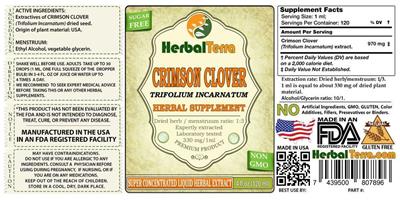
Crimson Clover by Herbal Terra label
The label scan from the NIH Dietary Supplement Label Database. Tap to enlarge.
Label images are published by the NIH Dietary Supplement Label Database for the version of this product on file. Always read your actual product label.
View the full label (PDF)The Ingredients in Crimson Clover by Herbal Terra
This is the 1 active ingredient this product is made of. Select it to open its full monograph.
Serving size1 mL Dosage formLiquid Servings per container120 Amounts shown are per serving.
Crimson Clover (Trifolium incarnatum) dried seed extract
Interacts with867 drugs
Red clover is a plant rich in isoflavones (plant compounds with weak estrogen-like activity) that is most often used for menopause symptoms like hot f...
Crimson Clover (Trifolium incarnatum) dried seed extract monograph & interactionsOther (inactive) ingredients: Menstruum. These complete the product’s ingredient list but are not active constituents.
Crimson Clover by Herbal Terra Drug Interactions
HelloPharmacist Interaction Report
Crimson Clover by Herbal Terra carries documented interactions with several medication types.
The most serious concerns are moderate-severity interactions with estrogens (including hormone therapies), methotrexate, and tamoxifen — all rooted in the herb's phytoestrogen content, which can mimic or compete with estrogen in your body.
Read the full breakdown — every affected drug type, severity by severity
Beyond those three, crimson clover may also affect how your liver processes a range of other drugs. It theoretically inhibits multiple liver enzymes (CYP1A2, CYP2C19, CYP2C9, and CYP3A4), which means it could raise blood levels of medications broken down by these pathways — though small clinical studies of the herb itself have not confirmed this effect in real people.
Additionally, older concerns about blood thinning (anticoagulant and antiplatelet effects) have not been borne out in clinical research.
Because the herb's effects on liver enzymes remain theoretical in humans, the true scope of what you might be taking it alongside is hard to pin down without checking your specific medications. Use the search tool below to verify each of your prescriptions and over-the-counter drugs before you start.
Check your own medications below · Editorial policy · How we use AI
Want to check YOUR meds against Crimson Clover?
Ask about interactions with your drugs in plain English — “Can I take it with lisinopril?” — and we find you the answer in seconds, ingredient by ingredient.
Go to the checkerIngredients driving the most interactions
Individual Drug Interactions
The ingredients in Crimson Clover interact with 867 drugs. Click any drug to see the details.
1 of the 1 ingredient in Crimson Clover interact with drugs. Each result below shows which ingredient is responsible. Crimson Clover (Trifolium incarnatum) dried seed extract
Bazedoxifene Acetate, Conjugated EstrogensDuavee
How Bazedoxifene Acetate, Conjugated Estrogens interacts with Crimson Clover — through 1 ingredient. Tap an ingredient for the detail:
Crimson Clover (trifolium Incarnatum) Dried Seed ExtractEstrogens, Cytochrome P450 3a4 (cyp3a4) Substrates Moderate
Interaction Summary
Theoretically, concomitant use of large amounts of red clover might interfere with estrogen therapy.
Read the full Crimson Clover (trifolium Incarnatum) Dried Seed Extract + Bazedoxifene Acetate, Conjugated Estrogens interactionConjugated EstrogensCenestin, Enjuvia, Premarin, Premarin Vaginal Cream
How Conjugated Estrogens interacts with Crimson Clover — through 1 ingredient. Tap an ingredient for the detail:
Crimson Clover (trifolium Incarnatum) Dried Seed ExtractCytochrome P450 3a4 (cyp3a4) Substrates, Estrogens Moderate
Interaction Summary
Theoretically, red clover might increase levels of drugs metabolized by CYP3A4; however, a small clinical study found no effect.
Read the full Crimson Clover (trifolium Incarnatum) Dried Seed Extract + Conjugated Estrogens interactionConjugated Estrogens, Medroxyprogesterone AcetatePremplus, Prempro
How Conjugated Estrogens, Medroxyprogesterone Acetate interacts with Crimson Clover — through 1 ingredient. Tap an ingredient for the detail:
Crimson Clover (trifolium Incarnatum) Dried Seed ExtractEstrogens, Cytochrome P450 3a4 (cyp3a4) Substrates Moderate
Interaction Summary
Theoretically, concomitant use of large amounts of red clover might interfere with estrogen therapy.
Read the full Crimson Clover (trifolium Incarnatum) Dried Seed Extract + Conjugated Estrogens, Medroxyprogesterone Acetate interactionConjugated Estrogens, MeprobamatePMB 200, PMB 400
How Conjugated Estrogens, Meprobamate interacts with Crimson Clover — through 1 ingredient. Tap an ingredient for the detail:
Crimson Clover (trifolium Incarnatum) Dried Seed ExtractCytochrome P450 3a4 (cyp3a4) Substrates, Estrogens Moderate
Interaction Summary
Theoretically, red clover might increase levels of drugs metabolized by CYP3A4; however, a small clinical study found no effect.
Read the full Crimson Clover (trifolium Incarnatum) Dried Seed Extract + Conjugated Estrogens, Meprobamate interactionConjugated Estrogens, MethyltestosteronePremarin with Methyltestosterone
How Conjugated Estrogens, Methyltestosterone interacts with Crimson Clover — through 1 ingredient. Tap an ingredient for the detail:
Crimson Clover (trifolium Incarnatum) Dried Seed ExtractEstrogens, Cytochrome P450 3a4 (cyp3a4) Substrates Moderate
Interaction Summary
Theoretically, concomitant use of large amounts of red clover might interfere with estrogen therapy.
Read the full Crimson Clover (trifolium Incarnatum) Dried Seed Extract + Conjugated Estrogens, Methyltestosterone interactionCyproterone Acetate, Ethinyl EstradiolDiane-35, Dianette
How Cyproterone Acetate, Ethinyl Estradiol interacts with Crimson Clover — through 1 ingredient. Tap an ingredient for the detail:
Crimson Clover (trifolium Incarnatum) Dried Seed ExtractCytochrome P450 3a4 (cyp3a4) Substrates, Estrogens +1 Moderate
Interaction Summary
Theoretically, red clover might increase levels of drugs metabolized by CYP3A4; however, a small clinical study found no effect.
Read the full Crimson Clover (trifolium Incarnatum) Dried Seed Extract + Cyproterone Acetate, Ethinyl Estradiol interactionDesogestrel, Ethinyl EstradiolDesogen, Marvelon, Marvelon 21, Marvelon 28, Mircette, Ortho-Cept +2 more
How Desogestrel, Ethinyl Estradiol interacts with Crimson Clover — through 1 ingredient. Tap an ingredient for the detail:
Crimson Clover (trifolium Incarnatum) Dried Seed ExtractCytochrome P450 1a2 (cyp1a2) Substrates, Cytochrome P450 3a4 (cyp3a4) Substrates +2 Moderate
Interaction Summary
Theoretically, red clover might increase levels of drugs metabolized by CYP1A2; however, a small clinical study found no effect.
Read the full Crimson Clover (trifolium Incarnatum) Dried Seed Extract + Desogestrel, Ethinyl Estradiol interactionDrospirenone, EstetrolNextstellis
How Drospirenone, Estetrol interacts with Crimson Clover — through 1 ingredient. Tap an ingredient for the detail:
Crimson Clover (trifolium Incarnatum) Dried Seed ExtractCytochrome P450 3a4 (cyp3a4) Substrates, Estrogens +1 Moderate
Interaction Summary
Theoretically, red clover might increase levels of drugs metabolized by CYP3A4; however, a small clinical study found no effect.
Read the full Crimson Clover (trifolium Incarnatum) Dried Seed Extract + Drospirenone, Estetrol interactionDrospirenone, Ethinyl EstradiolAngeliq, Gianvi, Yasmin
How Drospirenone, Ethinyl Estradiol interacts with Crimson Clover — through 1 ingredient. Tap an ingredient for the detail:
Crimson Clover (trifolium Incarnatum) Dried Seed ExtractCytochrome P450 1a2 (cyp1a2) Substrates, Estrogens +1 Moderate
Interaction Summary
Theoretically, red clover might increase levels of drugs metabolized by CYP1A2; however, a small clinical study found no effect.
Read the full Crimson Clover (trifolium Incarnatum) Dried Seed Extract + Drospirenone, Ethinyl Estradiol interactionEsterified EstrogensEstratab, Menest
How Esterified Estrogens interacts with Crimson Clover — through 1 ingredient. Tap an ingredient for the detail:
Crimson Clover (trifolium Incarnatum) Dried Seed ExtractEstrogens, Cytochrome P450 3a4 (cyp3a4) Substrates Moderate
Interaction Summary
Theoretically, concomitant use of large amounts of red clover might interfere with estrogen therapy.
Read the full Crimson Clover (trifolium Incarnatum) Dried Seed Extract + Esterified Estrogens interactionEsterified Estrogens, MethyltestosteroneEstratest
How Esterified Estrogens, Methyltestosterone interacts with Crimson Clover — through 1 ingredient. Tap an ingredient for the detail:
Crimson Clover (trifolium Incarnatum) Dried Seed ExtractCytochrome P450 3a4 (cyp3a4) Substrates, Estrogens Moderate
Interaction Summary
Theoretically, red clover might increase levels of drugs metabolized by CYP3A4; however, a small clinical study found no effect.
Read the full Crimson Clover (trifolium Incarnatum) Dried Seed Extract + Esterified Estrogens, Methyltestosterone interactionEstradiolDivigel, Elestrin, Estrace, Estraderm, Estring, Evamist +6 more
How Estradiol interacts with Crimson Clover — through 1 ingredient. Tap an ingredient for the detail:
Crimson Clover (trifolium Incarnatum) Dried Seed ExtractEstrogens, Cytochrome P450 1a2 (cyp1a2) Substrates +1 Moderate
Interaction Summary
Theoretically, concomitant use of large amounts of red clover might interfere with estrogen therapy.
Read the full Crimson Clover (trifolium Incarnatum) Dried Seed Extract + Estradiol interactionEstradiol, MedroxyprogesteroneDivitren
How Estradiol, Medroxyprogesterone interacts with Crimson Clover — through 1 ingredient. Tap an ingredient for the detail:
Crimson Clover (trifolium Incarnatum) Dried Seed ExtractCytochrome P450 1a2 (cyp1a2) Substrates, Estrogens +1 Moderate
Interaction Summary
Theoretically, red clover might increase levels of drugs metabolized by CYP1A2; however, a small clinical study found no effect.
Read the full Crimson Clover (trifolium Incarnatum) Dried Seed Extract + Estradiol, Medroxyprogesterone interactionEstradiol, Norethindrone AcetateActivella
How Estradiol, Norethindrone Acetate interacts with Crimson Clover — through 1 ingredient. Tap an ingredient for the detail:
Crimson Clover (trifolium Incarnatum) Dried Seed ExtractCytochrome P450 3a4 (cyp3a4) Substrates, Cytochrome P450 1a2 (cyp1a2) Substrates +1 Moderate
Interaction Summary
Theoretically, red clover might increase levels of drugs metabolized by CYP3A4; however, a small clinical study found no effect.
Read the full Crimson Clover (trifolium Incarnatum) Dried Seed Extract + Estradiol, Norethindrone Acetate interactionEstradiol, NorgestimateOrtho-Prefest
How Estradiol, Norgestimate interacts with Crimson Clover — through 1 ingredient. Tap an ingredient for the detail:
Crimson Clover (trifolium Incarnatum) Dried Seed ExtractEstrogens, Cytochrome P450 1a2 (cyp1a2) Substrates Moderate
Interaction Summary
Theoretically, concomitant use of large amounts of red clover might interfere with estrogen therapy.
Read the full Crimson Clover (trifolium Incarnatum) Dried Seed Extract + Estradiol, Norgestimate interactionEstradiol, ProgesteroneBijuvanda
How Estradiol, Progesterone interacts with Crimson Clover — through 1 ingredient. Tap an ingredient for the detail:
Crimson Clover (trifolium Incarnatum) Dried Seed ExtractCytochrome P450 1a2 (cyp1a2) Substrates, Cytochrome P450 3a4 (cyp3a4) Substrates +1 Moderate
Interaction Summary
Theoretically, red clover might increase levels of drugs metabolized by CYP1A2; however, a small clinical study found no effect.
Read the full Crimson Clover (trifolium Incarnatum) Dried Seed Extract + Estradiol, Progesterone interactionEstrogenEstrogen
How Estrogen interacts with Crimson Clover — through 1 ingredient. Tap an ingredient for the detail:
Crimson Clover (trifolium Incarnatum) Dried Seed ExtractEstrogens, Cytochrome P450 1a2 (cyp1a2) Substrates +1 Moderate
Interaction Summary
Theoretically, concomitant use of large amounts of red clover might interfere with estrogen therapy.
Read the full Crimson Clover (trifolium Incarnatum) Dried Seed Extract + Estrogen interactionEstroneOrtho-Est
How Estrone interacts with Crimson Clover — through 1 ingredient. Tap an ingredient for the detail:
Crimson Clover (trifolium Incarnatum) Dried Seed ExtractEstrogens Moderate
Interaction Summary
Theoretically, concomitant use of large amounts of red clover might interfere with estrogen therapy.
Read the full Crimson Clover (trifolium Incarnatum) Dried Seed Extract + Estrone interactionEstropipateOgen, Ortho EST
How Estropipate interacts with Crimson Clover — through 1 ingredient. Tap an ingredient for the detail:
Crimson Clover (trifolium Incarnatum) Dried Seed ExtractEstrogens Moderate
Interaction Summary
Theoretically, concomitant use of large amounts of red clover might interfere with estrogen therapy.
Read the full Crimson Clover (trifolium Incarnatum) Dried Seed Extract + Estropipate interactionEthiny Estradiol, LevonorgestrelLogynon, Microgynon 30 ED
How Ethiny Estradiol, Levonorgestrel interacts with Crimson Clover — through 1 ingredient. Tap an ingredient for the detail:
Crimson Clover (trifolium Incarnatum) Dried Seed ExtractCytochrome P450 3a4 (cyp3a4) Substrates, Estrogens +1 Moderate
Interaction Summary
Theoretically, red clover might increase levels of drugs metabolized by CYP3A4; however, a small clinical study found no effect.
Read the full Crimson Clover (trifolium Incarnatum) Dried Seed Extract + Ethiny Estradiol, Levonorgestrel interactionEthinyl EstradiolEstinyl
How Ethinyl Estradiol interacts with Crimson Clover — through 1 ingredient. Tap an ingredient for the detail:
Crimson Clover (trifolium Incarnatum) Dried Seed ExtractCytochrome P450 1a2 (cyp1a2) Substrates, Cytochrome P450 3a4 (cyp3a4) Substrates +1 Moderate
Interaction Summary
Theoretically, red clover might increase levels of drugs metabolized by CYP1A2; however, a small clinical study found no effect.
Read the full Crimson Clover (trifolium Incarnatum) Dried Seed Extract + Ethinyl Estradiol interactionEthinyl Estradiol, DesogestrelApri, Cesia, Cyclessa, Gedarel, Kariva, Linessa +4 more
How Ethinyl Estradiol, Desogestrel interacts with Crimson Clover — through 1 ingredient. Tap an ingredient for the detail:
Crimson Clover (trifolium Incarnatum) Dried Seed ExtractCytochrome P450 2c9 (cyp2c9) Substrates, Estrogens +2 Moderate
Interaction Summary
Theoretically, red clover might increase levels of drugs metabolized by CYP2C9; however, a small clinical study found no effect.
Read the full Crimson Clover (trifolium Incarnatum) Dried Seed Extract + Ethinyl Estradiol, Desogestrel interactionEthinyl Estradiol, DrospirenoneYaz
How Ethinyl Estradiol, Drospirenone interacts with Crimson Clover — through 1 ingredient. Tap an ingredient for the detail:
Crimson Clover (trifolium Incarnatum) Dried Seed ExtractCytochrome P450 3a4 (cyp3a4) Substrates, Cytochrome P450 1a2 (cyp1a2) Substrates +1 Moderate
Interaction Summary
Theoretically, red clover might increase levels of drugs metabolized by CYP3A4; however, a small clinical study found no effect.
Read the full Crimson Clover (trifolium Incarnatum) Dried Seed Extract + Ethinyl Estradiol, Drospirenone interactionEthinyl Estradiol, Ethynodiol DiacetateDemulen 1/35, Demulen 1/50, Demulen Compack, Kelnor 1/35, Zovia, Zovia 1/35 +1 more
How Ethinyl Estradiol, Ethynodiol Diacetate interacts with Crimson Clover — through 1 ingredient. Tap an ingredient for the detail:
Crimson Clover (trifolium Incarnatum) Dried Seed ExtractEstrogens, Cytochrome P450 1a2 (cyp1a2) Substrates +1 Moderate
Interaction Summary
Theoretically, concomitant use of large amounts of red clover might interfere with estrogen therapy.
Read the full Crimson Clover (trifolium Incarnatum) Dried Seed Extract + Ethinyl Estradiol, Ethynodiol Diacetate interactionEthinyl Estradiol, LevonorgestrelAlesse, Alesse 21, Alesse 28, Aviane, Enpresse, Jolessa +18 more
How Ethinyl Estradiol, Levonorgestrel interacts with Crimson Clover — through 1 ingredient. Tap an ingredient for the detail:
Crimson Clover (trifolium Incarnatum) Dried Seed ExtractCytochrome P450 1a2 (cyp1a2) Substrates, Estrogens +1 Moderate
Interaction Summary
Theoretically, red clover might increase levels of drugs metabolized by CYP1A2; however, a small clinical study found no effect.
Read the full Crimson Clover (trifolium Incarnatum) Dried Seed Extract + Ethinyl Estradiol, Levonorgestrel interactionEthinyl Estradiol, NorethindroneAranelle, Brevicon, Brevicon .5/35 21 day, Brevicon .5/35 28 day, Brevicon 1/35 21 day, Brevicon 1/35 28 day +50 more
How Ethinyl Estradiol, Norethindrone interacts with Crimson Clover — through 1 ingredient. Tap an ingredient for the detail:
Crimson Clover (trifolium Incarnatum) Dried Seed ExtractEstrogens, Cytochrome P450 3a4 (cyp3a4) Substrates +1 Moderate
Interaction Summary
Theoretically, concomitant use of large amounts of red clover might interfere with estrogen therapy.
Read the full Crimson Clover (trifolium Incarnatum) Dried Seed Extract + Ethinyl Estradiol, Norethindrone interactionEthinyl Estradiol, Norethindrone, Ferrous FumarateEstrostep Fe, Femcon FE, Junel Fe 1.5/30, Loestrin Fe, Loestrin Fe 1.5/30, Loestrin Fe 1/20 +3 more
How Ethinyl Estradiol, Norethindrone, Ferrous Fumarate interacts with Crimson Clover — through 1 ingredient. Tap an ingredient for the detail:
Crimson Clover (trifolium Incarnatum) Dried Seed ExtractCytochrome P450 1a2 (cyp1a2) Substrates, Estrogens +1 Moderate
Interaction Summary
Theoretically, red clover might increase levels of drugs metabolized by CYP1A2; however, a small clinical study found no effect.
Read the full Crimson Clover (trifolium Incarnatum) Dried Seed Extract + Ethinyl Estradiol, Norethindrone, Ferrous Fumarate interactionEthinyl Estradiol, NorgestimateCilest, Mononessa, Ortho Tri-Cyclen 28, Ortho Tri-Cyclen Lo, Ortho Tri-Cylcen, Ortho-Cyclen +5 more
How Ethinyl Estradiol, Norgestimate interacts with Crimson Clover — through 1 ingredient. Tap an ingredient for the detail:
Crimson Clover (trifolium Incarnatum) Dried Seed ExtractEstrogens, Cytochrome P450 1a2 (cyp1a2) Substrates +1 Moderate
Interaction Summary
Theoretically, concomitant use of large amounts of red clover might interfere with estrogen therapy.
Read the full Crimson Clover (trifolium Incarnatum) Dried Seed Extract + Ethinyl Estradiol, Norgestimate interactionEthinyl Estradiol, NorgestrelCryselle, Lo/Ovral, Low-Ogestrel, Ogestrel 0.5/50, Ovral
How Ethinyl Estradiol, Norgestrel interacts with Crimson Clover — through 1 ingredient. Tap an ingredient for the detail:
Crimson Clover (trifolium Incarnatum) Dried Seed ExtractCytochrome P450 3a4 (cyp3a4) Substrates, Cytochrome P450 1a2 (cyp1a2) Substrates +1 Moderate
Interaction Summary
Theoretically, red clover might increase levels of drugs metabolized by CYP3A4; however, a small clinical study found no effect.
Read the full Crimson Clover (trifolium Incarnatum) Dried Seed Extract + Ethinyl Estradiol, Norgestrel interactionEthinyl Estradiol, LevonogestrelLybrel
How Ethinyl Estradiol, Levonogestrel interacts with Crimson Clover — through 1 ingredient. Tap an ingredient for the detail:
Crimson Clover (trifolium Incarnatum) Dried Seed ExtractEstrogens, Cytochrome P450 3a4 (cyp3a4) Substrates +1 Moderate
Interaction Summary
Theoretically, concomitant use of large amounts of red clover might interfere with estrogen therapy.
Read the full Crimson Clover (trifolium Incarnatum) Dried Seed Extract + Ethinyl Estradiol, Levonogestrel interactionEach ingredient & the kinds of drugs it affects
For each ingredient in Crimson Clover with known interactions, here are the types of medications it can affect. Open any type for the detail — or search your exact drug in the checker above.
Crimson Clover (Trifolium incarnatum) dried seed extract
Estrogens
Theoretically, concomitant use of large amounts of red clover might interfere with estrogen therapy.
Red clover contains phytoestrogens which might have estrogenic activity in some people. Theoretically, red clover might compete for estrogen receptors and interfere with estrogen-containing drug therapy.
Methotrexate (Trexall, Others)
Theoretically, red clover might increase the risk of methotrexate toxicity.
In a case report, a 52-year-old female receiving weekly methotrexate injections for psoriasis developed symptoms of methotrexate toxicity, including severe vomiting and epigastric pain, after three days of taking red clover 430 mg daily. Toxicity resolved after red clover was discontinued. However, no liver function tests or methotrexate levels were reported.
Tamoxifen (Nolvadex)
Theoretically, the phytoestrogens in red clover might interfere with tamoxifen.
In vitro and animal research suggests that genistein, a constituent of red clover, might antagonize the antitumor effects of tamoxifen. However, there is some evidence from an animal study that red clover does not reduce the efficacy of tamoxifen. Until more is known, tell patients taking tamoxifen to avoid red clover.
Anticoagulant/Antiplatelet Drugs
Although some laboratory research suggests that red clover may have anticoagulant and antiplatelet activity, clinical research has not shown this effect.
In vitro research suggests that genistein in red clover has antiplatelet effects, and historically, red clover was thought to have anticoagulant effects due to its coumarin content. However, some experts state that this is unlikely as most natural coumarins have not been shown to have anticoagulant effects, and their content in red clover is low. Additionally, some clinical research in postmenopausal patients found no effect on coagulation or prothrombin time with the use of red clover flowering tops 378 mg daily for 12 months or red clover isoflavone (Rimostil) 50 mg daily for 2 years.
Caffeine
Theoretically, soy might reduce the clearance of caffeine; however, a small clinical study found no effect.
Red clover contains genistein. Taking genistein 1 gram daily for 14 days seems to inhibit caffeine clearance and metabolism in healthy females. However, this effect does not seem to occur with the lower amounts of genistein found in red clover. A clinical study in healthy postmenopausal individuals shows that taking red clover capsules standardized to contain 60 mg isoflavones twice daily for 14 days does not affect the pharmacokinetics of caffeine.
Cytochrome P450 1A2 (Cyp1A2) Substrates
Theoretically, red clover might increase levels of drugs metabolized by CYP1A2; however, a small clinical study found no effect.
In vitro evidence shows that red clover inhibits CYP1A2. However, a clinical study in healthy postmenopausal individuals shows that taking red clover capsules standardized to contain 60 mg isoflavones twice daily for 14 days does not affect the pharmacokinetics of caffeine, a CYP1A2 probe substrate.
Cytochrome P450 2C19 (Cyp2C19) Substrates
Theoretically, red clover might increase the levels and clinical effects of drugs metabolized by CYP2C19.
In vitro evidence suggests that red clover weakly inhibits CYP2C19. This interaction has not been reported in humans.
Cytochrome P450 2C9 (Cyp2C9) Substrates
Theoretically, red clover might increase levels of drugs metabolized by CYP2C9; however, a small clinical study found no effect.
In vitro evidence suggests that red clover might inhibit CYP2C9. However, a clinical study in healthy postmenopausal individuals shows that taking red clover capsules standardized to contain 60 mg isoflavones twice daily for 14 days does not affect the pharmacokinetics of tolbutamide, a CYP2C9 probe substrate.
Cytochrome P450 3A4 (Cyp3A4) Substrates
Theoretically, red clover might increase levels of drugs metabolized by CYP3A4; however, a small clinical study found no effect.
In vitro evidence shows that red clover might inhibit CYP3A4 isoenzymes. However, a clinical study in healthy postmenopausal individuals shows that taking red clover capsules standardized to contain 60 mg isoflavones twice daily for 14 days does not affect the pharmacokinetics of alprazolam, a CYP3A4 probe substrate.
Brand information
Manufacturer and brand details for Crimson Clover, from the product label.
Crimson Clover by Herbal Terra: Common Questions
Does Crimson Clover by Herbal Terra interact with any medications?
How can one product interact with so many drugs?
Where does this information come from?
Is crimson clover safe to take if I'm pregnant or nursing?
What are the most common side effects?
Does crimson clover really work for hot flashes or other menopausal symptoms?
Can this interact with my blood thinners?
What's in the liquid besides the herb?
Written and reviewed by the HelloPharmacist editorial staff. Our editorial policy
Not sure if Crimson Clover is safe with your meds?
Our pharmacists answer your medication & supplement questions — free.
Label information is sourced from the NIH Dietary Supplement Label Database and reflects the product version on file; always read your actual product label. This page is for education only and is not a substitute for professional medical advice. Confirm with your pharmacist or doctor before combining supplements and medications.
The Full Monographs Behind Crimson Clover’s Ingredients
Every ingredient we hold a full HelloPharmacist monograph for — uses, evidence, safety, and the complete interaction list.
Sources & How We Checked
Crimson Clover's label data comes from the NIH Dietary Supplement Label Database; the ingredient interaction data is from the Natural Medicines database, reviewed by our pharmacists.
- NIH Dietary Supplement Label Database (DSLD) — The official product label on file for this supplement.
- Natural Medicines (Therapeutic Research Center) — Evidence-graded clinical reference behind the ingredient interaction data.
Content is written and reviewed by licensed HelloPharmacist pharmacists. See our data sources and editorial standards for how this information is built and checked.
The 24 references behind this product’s interaction data
Every citation that drives the interaction findings for this product’s ingredients, from the evidence-graded Natural Medicines (TRC Healthcare) database. Open an ingredient to browse its citations — links open the study on PubMed or the publisher’s site.
Red Clover 24 references
- Kurzer MS, Xu X. Dietary phytoestrogens. Annu Rev Nutr 1997;17:353-81. PubMed
- Electronic Code of Federal Regulations. Title 21. Part 182 -- Substances Generally Recognized As Safe. Available at: https://www.accessdata.fda.gov/scripts/cdrh/cfdocs/cfcfr/CFRSearch.cfm?CFRPart=182
- Budzinski JW, Foster BC, Vandenhoek S, Arnason JT. An in vitro evaluation of human cytochrome P450 3A4 inhibition by selected commercial herbal extracts and tinctures. Phytomedicine 2000;7:273-82. PubMed
- This P, De La Rochefordiere A, Clough K, et al. Phytoestrogens after breast cancer. Endocr Relat Cancer 2001;8:129-34. PubMed
- Tice J, Cummings SR, Ettinger B, et al. Few adverse effects of two red clover extracts rich in phytoestrogens: a multicenter, placebo-controlled trial. Alt Ther 2001;7:S33.
- Ingram DM, Hickling C, West L, et al. A double-blind randomized controlled trial of isoflavones in the treatment of cyclical mastalgia. The Breast 2002;11:170-4. PubMed
- Unger M, Frank A. Simultaneous determination of the inhibitory potency of herbal extracts on the activity of six major cytochrome P450 enzymes using liquid chromatography/mass spectrometry and automated online extraction. Rapid Commun Mass Spectrom 2004;1 PubMed
- Cheong JL, Bucknall R. Retinal vein thrombosis associated with a herbal phytoestrogen preparation in a susceptible patient. Postgrad Med J 2005;81:266-7.. PubMed
- Geller SE, Shulman LP, van Breemen RB, et al. Safety and efficacy of black cohosh and red clover for the management of vasomotor symptoms: a randomized controlled trial. Menopause 2009;16:1156-66. PubMed
- Hidalgo LA, Chedraui PA, Morocho N, et al. The effect of red clover isoflavones on menopausal symptoms, lipids and vaginal cytology in menopausal women: a randomized, double-blind, placebo-controlled study. Gynecol Endocrinol 2005;21(5):257-264. PubMed
- Campbell MJ, Woodside JV, Honour JW, et al. Effect of red clover-derived isoflavone supplementation on insulin-like growth factor, lipid and antioxidant status in healthy female volunteers: a pilot study. Eur J Clin Nutr 2004;58(1):173-179. PubMed
- Guerrero JA, Lozano ML, Castillo J, et al. Flavonoids inhibit platelet function through binding to the thromboxane A2 receptor. J Thromb Haemost 2005;3(2):369-376. PubMed
- Kondo K, Suzuki Y, Ikeda Y, Umemura K. Genistein, an isoflavone included in soy, inhibits thrombotic vessel occlusion in the mouse femoral artery and in vitro platelet aggregation. Eur J Pharmacol 2002;455(1):53-57. PubMed
- Polini N, Rauschemberger MB, Mendiberri J, et al. Effect of genistein and raloxifene on vascular dependent platelet aggregation. Mol Cell Endocrinol 2007;267(1-2):55-62. PubMed
- Wuttke W, Jarry H, Seidlova-Wuttke D. Plant-derived alternative treatments for the aging male: facts and myths. Aging Male 2010;13(2):75-81. PubMed
- Villaseca P. Non-estrogen conventional and phytochemical treatments for vasomotor symptoms: what needs to be known for practice. Climacteric 2012;15(2):115-124. PubMed
- Chen, Y., Xiao, C. Q., He, Y. J., Chen, B. L., Wang, G., Zhou, G., Zhang, W., Tan, Z. R., Cao, S., Wang, L. P., and Zhou, H. H. Genistein alters caffeine exposure in healthy female volunteers. Eur.J Clin.Pharmacol. 2011;67(4):347-353. PubMed
- Friedman, J. A., Taylor, S. A., McDermott, W., and Alikhani, P. Multifocal and recurrent subarachnoid hemorrhage due to an herbal supplement containing natural coumarins. Neurocrit.Care 2007;7(1):76-80. PubMed
- Hooper, L., Madhavan, G., Tice, J. A., Leinster, S. J., and Cassidy, A. Effects of isoflavones on breast density in pre- and post-menopausal women: a systematic review and meta-analysis of randomized controlled trials. Hum.Reprod.Update. 2010;16(6):745-7 PubMed
- Orr A and Parker R. Red clover causing symptoms suggestive of methotrexate toxicity in a patient on high-dose methotrexate. Menopause Int. 2013;19(3):133-134. PubMed
- Clifton-Bligh PB, et al. Red cover isoflavones enriched with formononetin lower serum LDL cholesterol- a randomized, double-blind, placebo-controlled trial. Eur J Clin Nutr. 2015;69(1):134-142.
- Risk assessment for peri- and post-menopausal women taking food supplements containing isolated isoflavones. EFSA Panel on Food Additives and Nutrient Sources added to Food (ANS). 2015. DOI
- Ferraris C, Ballestra B, Listorti C, et al. Red clover and lifestyle changes to contrast menopausal symptoms in premenopausal patients with hormone-sensitive breast cancer receiving tamoxifen. Breast Cancer Res Treat 2020;180(1):157-65. doi: 10.1007/s1054 PubMed
- Chen L, Choi J, Leonard SW, et al. No Clinically Relevant Pharmacokinetic Interactions of a Red Clover Dietary Supplement with Cytochrome P450 Enzymes in Women. J Agric Food Chem. 2020;68(47):13929-13939. PubMed
Parts of this content are provided by the Therapeutic Research Center, LLC.
DISCLAIMER: Currently this does not check for drug-drug interactions. This is not an all-inclusive comprehensive list of potential interactions and is for informational purposes only. Not all interactions are known or well-reported in the scientific literature, and new interactions are continually being reported. Input is needed from a qualified healthcare provider including a pharmacist before starting any therapy. Application of clinical judgment is necessary.
© 2021 Therapeutic Research Center, LLC