
Fennel Seed Ingredients & Drug Interactions
What is this page for?
First and foremost: checking Fennel Seed against your medications. The heart of this page is the interaction checker and the full interaction report — how this product’s ingredients may interact with prescription and over-the-counter medicines you may be taking.
Around that, we add a pharmacist’s high-level view of the product as a whole — what’s inside, the evidence for its stated use, how transparent the label is, and what safety data exists — so you can see the full picture in one place. It’s educational information from our licensed clinical databases and the clinical staff at HelloPharmacist — not medical advice — and we don’t sell or endorse products. Our editorial policy
Fennel Seed is a dietary supplement by Banyan Botanicals with 1 active ingredient. Its ingredients are commonly taken for digestive upset and bloating, infant colic, menstrual cramps.Based on those ingredients, 740 medications have a known interaction with it, the most serious rated moderate. The ingredients most likely to interact are Fennel. Use the checker below to test your specific medication, or read the full HelloPharmacist Interaction Report.
Check Your Meds Against Fennel Seed by Banyan Botanicals
Ask about any prescription or over-the-counter medication and we check it for interactions with Fennel Seed by Banyan Botanicals — and tell you which ingredient is responsible.
AI summaries are generated from our interaction database for education only — always confirm with your pharmacist. How we use AI
Ask the Pharmacist
A licensed pharmacist will answer your question by email — free, usually within 24 hours.
Got it — thank you!
A licensed pharmacist will answer within 24 hours. Keep an eye on your email (worth checking spam, just in case).
HelloPharmacist Scorecard of Fennel Seed by Banyan Botanicals
Our pharmacy team’s full take, with four database checks built into the cards below — a summary of what is known, not a grade of the product itself.
What’s inside
Full disclosure
This product contains one active ingredient: fennel seed. Fennel has been used traditionally to support digestive comfort and other functions.
There are no inactive fillers or other ingredients listed.
Does it work?
Insufficient evidence
Fennel is rated Possibly Effective for dysmenorrhea (period pain). For bronchitis, anxiety, nocturnal enuresis (bedwetting), and cholera, we hold insufficient evidence to rate how well it works.
How safe is it?
Well-documented data
Fennel from food is generally well tolerated. When used as a concentrated supplement or essential oil, more caution applies.
Common side effects are gastrointestinal discomfort, photosensitivity (sun sensitivity), and allergic reactions in sensitive people. A rare serious effect is seizures.
Allergic reactions can range from mild (itching, sneezing) to severe (wheezing, difficulty breathing), and some people report fennel can trigger bronchial asthma. During pregnancy, fennel is rated Possibly Unsafe due to limited safety data and its hormone-like effects.
During breastfeeding, food amounts are likely fine, but medicinal doses and the essential oil aren't well studied. Talk with your doctor or pharmacist before taking medicinal amounts if you're pregnant or nursing.
Meds to double-check
Moderate interaction found
Before taking this fennel product, check with your doctor or pharmacist if you take blood thinners like warfarin or aspirin (Moderate risk of increased bleeding), birth control pills or hormone replacement therapy (Moderate risk of reduced effectiveness), tamoxifen for breast cancer (Moderate risk of reduced effectiveness), the antibiotic ciprofloxacin/Cipro (Moderate risk of reduced antibiotic levels), or medications broken down by your liver's CYP3A4 enzyme, such as certain statins or immunosuppressants (Moderate risk of raised drug levels).
The bottom line
Scorecard at a glanceFully disclosed formula with insufficient evidence for its stated purpose. Moderate medication interactions have been identified, and safety information is well characterized.
Fennel seed may be worth considering if you have period pain and are looking for a traditional herbal option. If you take birth control, hormone replacement therapy, blood thinners, tamoxifen, certain antibiotics (like Cipro), or drugs your liver breaks down, check with your doctor or pharmacist first — fennel could interfere with how they work.
Pregnant or nursing? Talk it over with your healthcare provider before using medicinal amounts.
Educational only — not medical advice; always confirm with your pharmacist. Our editorial policy · How we use AI
Assessment coverage: 1 of 1 active ingredient matched to our full ingredient reviews (monographs). Based on the product label dated May 23, 2024.
This Scorecard evaluates available label information, ingredient evidence, and known medication-safety considerations. It does not independently verify product identity, purity, potency, contamination, or manufacturing quality. How these ratings are computed
General information
Key facts about Fennel Seed, straight from the product label.
| Brand | Banyan Botanicals |
|---|---|
| Barcode (UPC) | 618192063217 |
| Net contents | 1 Pound(s); 454 Gram(s) |
| Market status | On market |
| Date entered into DSLD | May 23, 2024 |
| DSLD ID | 308375 |
| Product type | Botanical |
| Supplement form | Other (e.g. Tea Bag) |
| Dietary claims / uses | All Other, Structure/Function |
| Intended target group(s) | Adult (18 - 50 Years), Organic |
Everything in this section is reproduced from the manufacturer’s own product label — it’s the label speaking, not HelloPharmacist. We show it so you can see exactly what the maker states; we don’t verify or endorse those statements.
Supplement Facts
The label details for Fennel Seed by Banyan Botanicals, sourced from the NIH Dietary Supplement Label Database.
Supplement Facts
| Ingredient | Amount | % DV |
|---|---|---|
| Fennel | 1 Teaspoon(s) | -- |
Tap any ingredient to jump to its full detail below.
These statements are the manufacturer’s wording, reproduced from the product label — the label is saying it, not HelloPharmacist. We don’t verify or endorse them.
Formula
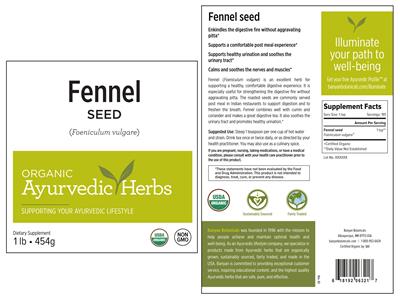
Foeniculum vulgare Organic ayurvedic herbs
Fennel (Foeniculum vulgare) is an excellent herb for supporting a healthy, comfortable digestive experience. It is especially useful for strengthening the digestive fire without aggravating pitta. The roasted seeds are commonly served post meal in Indian restaurants to support digestion and to freshen the breath. Fennel combines well with cumin and coriander and makes a great digestive tea. It also soothes the urinary tract and promotes healthy urination.
Formulation
Organic ayurvedic herbs USDA Organic
Supporting your ayurvedic lifestyle
Non GMO
Enkindles the digestive fire without aggravating pitta Supports a comfortable post meal experience Supports healthy urination and soothes the urinary tract Calms and soothes the nerves and muscles
Certified organic by: QAI
FDA Statement of Identity
Dietary Supplement
Suggested/Recommended/Usage/Directions
Suggested use: steep 1 teaspoon per one cup of hot water and strain. Drink tea once or twice daily, or as directed by your health practitioner. You may also use as a culinary spice.
Precautions
If you are pregnant, nursing, taking medications, or have a medical condition, please consult with your health care practitioner prior to the use of this product.
FDA Disclaimer Statement
These statements have not been evaluated by the Food and Drug Administration. This product is not intended to diagnose, treat, cure, or prevent any disease.
General Statements
Banyan Botanicals was founded in 1996 with the mission to help people achieve and maintain optimal health and well-being. As an ayurvedic lifestyle company, we specialize in products made from ayurvedic herbs that are organically grown, sustainably sourced, fairly traded, and made in the USA. Banyan is committed to providing exceptional customer service, inspiring educational content, and the highest quality Ayurvedic herbs that are safe, pure, and effective. Illuminate your path to well-being Get your free ayurvedic profile at banyanbotanicals.com/illuminate
Seals/Symbols
USDA Organic Sustainably Sourced Fairly Traded
Is this label outdated? Report a formula or label change and our pharmacy team will review it.
Fennel Seed by Banyan Botanicals label
The label scan from the NIH Dietary Supplement Label Database. Tap to enlarge.
Label images are published by the NIH Dietary Supplement Label Database for the version of this product on file. Always read your actual product label.
View the full label (PDF)The Ingredients in Fennel Seed by Banyan Botanicals
This is the 1 active ingredient this product is made of. Select it to open its full monograph.
Serving size1 Teaspoon(s) Dosage formOther (e.g. Tea Bag) Servings per container191 Amounts shown are per serving.
Fennel
Interacts with740 drugs
Fennel is a Mediterranean herb widely used as a food and spice, and traditionally taken for digestive complaints, colic, and menstrual cramps. Some sm...
Fennel monograph & interactionsFennel Seed by Banyan Botanicals Drug Interactions
HelloPharmacist Interaction Report
Banyan Botanicals Fennel Seed interacts with several important medication types through its fennel content.
The most serious concern is a Moderate-severity interaction with blood thinners (anticoagulant and antiplatelet drugs): animal research shows fennel oil has blood-thinning effects, which could raise your bleeding risk if you're on warfarin, aspirin, or similar medications.
Read the full breakdown — every affected drug type, severity by severity
Fennel also has Moderate interactions with birth control pills and hormone replacement therapy. Some compounds in fennel mimic estrogen in your body, which may reduce how well contraceptives and estrogen replacements work.
If you rely on these for contraception or symptom relief, this matters. Additionally, fennel theoretically interferes with tamoxifen (a breast cancer drug) through the same hormone-like mechanism, and may raise levels of certain medications your liver breaks down (CYP3A4 substrates), including some statins, immunosuppressants, and others.
Finally, fennel can reduce how much of the antibiotic ciprofloxacin (Cipro) your body absorbs — potentially cutting its levels nearly in half.
Altogether, these interactions span 741 individual medications. Before starting this product, run your exact medications through the checker on this page, and talk with your doctor or pharmacist about whether fennel is right for you.
Check your own medications below · Editorial policy · How we use AI
Want to check YOUR meds against Fennel Seed?
Ask about interactions with your drugs in plain English — “Can I take it with lisinopril?” — and we find you the answer in seconds, ingredient by ingredient.
Go to the checkerIngredients driving the most interactions
Individual Drug Interactions
The ingredients in Fennel Seed interact with 740 drugs. Click any drug to see the details.
1 of the 1 ingredient in Fennel Seed interact with drugs. Each result below shows which ingredient is responsible. Fennel
Amlodipine BenzoateKaterzia
How Amlodipine Benzoate interacts with Fennel Seed — through 1 ingredient. Tap an ingredient for the detail:
FennelCytochrome P450 3a4 (cyp3a4) Substrates Moderate
Interaction Summary
Theoretically, fennel might increase levels of drugs metabolized by CYP3A4.
Read the full Fennel + Amlodipine Benzoate interactionAmlodipine BesilateIstin
How Amlodipine Besilate interacts with Fennel Seed — through 1 ingredient. Tap an ingredient for the detail:
FennelCytochrome P450 3a4 (cyp3a4) Substrates Moderate
Interaction Summary
Theoretically, fennel might increase levels of drugs metabolized by CYP3A4.
Read the full Fennel + Amlodipine Besilate interactionAmlodipine BesylateNorvasc
How Amlodipine Besylate interacts with Fennel Seed — through 1 ingredient. Tap an ingredient for the detail:
FennelCytochrome P450 3a4 (cyp3a4) Substrates Moderate
Interaction Summary
Theoretically, fennel might increase levels of drugs metabolized by CYP3A4.
Read the full Fennel + Amlodipine Besylate interactionAmlodipine Besylate, BenazeprilLotrel
How Amlodipine Besylate, Benazepril interacts with Fennel Seed — through 1 ingredient. Tap an ingredient for the detail:
FennelCytochrome P450 3a4 (cyp3a4) Substrates Moderate
Interaction Summary
Theoretically, fennel might increase levels of drugs metabolized by CYP3A4.
Read the full Fennel + Amlodipine Besylate, Benazepril interactionAmlodipine, CelecoxibConsensi
How Amlodipine, Celecoxib interacts with Fennel Seed — through 1 ingredient. Tap an ingredient for the detail:
FennelCytochrome P450 3a4 (cyp3a4) Substrates Moderate
Interaction Summary
Theoretically, fennel might increase levels of drugs metabolized by CYP3A4.
Read the full Fennel + Amlodipine, Celecoxib interactionAmoxicillin, Omeprazole Magnesium, RifabutinTalicia
How Amoxicillin, Omeprazole Magnesium, Rifabutin interacts with Fennel Seed — through 1 ingredient. Tap an ingredient for the detail:
FennelCytochrome P450 3a4 (cyp3a4) Substrates Moderate
Interaction Summary
Theoretically, fennel might increase levels of drugs metabolized by CYP3A4.
Read the full Fennel + Amoxicillin, Omeprazole Magnesium, Rifabutin interactionAmprenavirAgenerase
How Amprenavir interacts with Fennel Seed — through 1 ingredient. Tap an ingredient for the detail:
FennelCytochrome P450 3a4 (cyp3a4) Substrates Moderate
Interaction Summary
Theoretically, fennel might increase levels of drugs metabolized by CYP3A4.
Read the full Fennel + Amprenavir interactionAnacaulase-bcdbNexoBrid
How Anacaulase-bcdb interacts with Fennel Seed — through 1 ingredient. Tap an ingredient for the detail:
FennelAnticoagulant/antiplatelet Drugs Moderate
Interaction Summary
Theoretically, fennel might increase the risk of bleeding when used with antiplatelet or anticoagulant drugs.
Read the full Fennel + Anacaulase-bcdb interactionAnagrelideAgrylin
How Anagrelide interacts with Fennel Seed — through 1 ingredient. Tap an ingredient for the detail:
FennelAnticoagulant/antiplatelet Drugs Moderate
Interaction Summary
Theoretically, fennel might increase the risk of bleeding when used with antiplatelet or anticoagulant drugs.
Read the full Fennel + Anagrelide interactionAnisindioneMiradon
How Anisindione interacts with Fennel Seed — through 1 ingredient. Tap an ingredient for the detail:
FennelAnticoagulant/antiplatelet Drugs Moderate
Interaction Summary
Theoretically, fennel might increase the risk of bleeding when used with antiplatelet or anticoagulant drugs.
Read the full Fennel + Anisindione interactionAntithrombin IiiThrombate III
How Antithrombin Iii interacts with Fennel Seed — through 1 ingredient. Tap an ingredient for the detail:
FennelAnticoagulant/antiplatelet Drugs Moderate
Interaction Summary
Theoretically, fennel might increase the risk of bleeding when used with antiplatelet or anticoagulant drugs.
Read the full Fennel + Antithrombin Iii interactionApalutamideErleada
How Apalutamide interacts with Fennel Seed — through 1 ingredient. Tap an ingredient for the detail:
FennelCytochrome P450 3a4 (cyp3a4) Substrates Moderate
Interaction Summary
Theoretically, fennel might increase levels of drugs metabolized by CYP3A4.
Read the full Fennel + Apalutamide interactionApixabanEliquis
How Apixaban interacts with Fennel Seed — through 1 ingredient. Tap an ingredient for the detail:
FennelCytochrome P450 3a4 (cyp3a4) Substrates, Anticoagulant/antiplatelet Drugs Moderate
Interaction Summary
Theoretically, fennel might increase levels of drugs metabolized by CYP3A4.
Read the full Fennel + Apixaban interactionApremilastOtezla
How Apremilast interacts with Fennel Seed — through 1 ingredient. Tap an ingredient for the detail:
FennelCytochrome P450 3a4 (cyp3a4) Substrates Moderate
Interaction Summary
Theoretically, fennel might increase levels of drugs metabolized by CYP3A4.
Read the full Fennel + Apremilast interactionAprepitantCinvanti, Emend
How Aprepitant interacts with Fennel Seed — through 1 ingredient. Tap an ingredient for the detail:
FennelCytochrome P450 3a4 (cyp3a4) Substrates Moderate
Interaction Summary
Theoretically, fennel might increase levels of drugs metabolized by CYP3A4.
Read the full Fennel + Aprepitant interactionArgatrobanArgatroban
How Argatroban interacts with Fennel Seed — through 1 ingredient. Tap an ingredient for the detail:
FennelAnticoagulant/antiplatelet Drugs Moderate
Interaction Summary
Theoretically, fennel might increase the risk of bleeding when used with antiplatelet or anticoagulant drugs.
Read the full Fennel + Argatroban interactionAripiprazoleAbilify, Abilify Maintena, Abilify Mycite
How Aripiprazole interacts with Fennel Seed — through 1 ingredient. Tap an ingredient for the detail:
FennelCytochrome P450 3a4 (cyp3a4) Substrates Moderate
Interaction Summary
Theoretically, fennel might increase levels of drugs metabolized by CYP3A4.
Read the full Fennel + Aripiprazole interactionAripiprazole LauroxilAristada, Aristada Initio Kit
How Aripiprazole Lauroxil interacts with Fennel Seed — through 1 ingredient. Tap an ingredient for the detail:
FennelCytochrome P450 3a4 (cyp3a4) Substrates Moderate
Interaction Summary
Theoretically, fennel might increase levels of drugs metabolized by CYP3A4.
Read the full Fennel + Aripiprazole Lauroxil interactionArmodafinilNuvigil
How Armodafinil interacts with Fennel Seed — through 1 ingredient. Tap an ingredient for the detail:
FennelCytochrome P450 3a4 (cyp3a4) Substrates Moderate
Interaction Summary
Theoretically, fennel might increase levels of drugs metabolized by CYP3A4.
Read the full Fennel + Armodafinil interactionAspirinAngettes 75, ASA, Asaphen, Aspirin, Caprin, Cartia +8 more
How Aspirin interacts with Fennel Seed — through 1 ingredient. Tap an ingredient for the detail:
FennelAnticoagulant/antiplatelet Drugs Moderate
Interaction Summary
Theoretically, fennel might increase the risk of bleeding when used with antiplatelet or anticoagulant drugs.
Read the full Fennel + Aspirin interactionAspirin, Aluminum Hydroxide, Codeine Phosphate, Magnesium HydroxideAscriptin Codeine #3
How Aspirin, Aluminum Hydroxide, Codeine Phosphate, Magnesium Hydroxide interacts with Fennel Seed — through 1 ingredient. Tap an ingredient for the detail:
FennelAnticoagulant/antiplatelet Drugs Moderate
Interaction Summary
Theoretically, fennel might increase the risk of bleeding when used with antiplatelet or anticoagulant drugs.
Read the full Fennel + Aspirin, Aluminum Hydroxide, Codeine Phosphate, Magnesium Hydroxide interactionAspirin, ButalbitalAxotal
How Aspirin, Butalbital interacts with Fennel Seed — through 1 ingredient. Tap an ingredient for the detail:
FennelAnticoagulant/antiplatelet Drugs Moderate
Interaction Summary
Theoretically, fennel might increase the risk of bleeding when used with antiplatelet or anticoagulant drugs.
Read the full Fennel + Aspirin, Butalbital interactionAspirin, Butalbital, CaffeineFiorinal
How Aspirin, Butalbital, Caffeine interacts with Fennel Seed — through 1 ingredient. Tap an ingredient for the detail:
FennelAnticoagulant/antiplatelet Drugs, Cytochrome P450 3a4 (cyp3a4) Substrates Moderate
Interaction Summary
Theoretically, fennel might increase the risk of bleeding when used with antiplatelet or anticoagulant drugs.
Read the full Fennel + Aspirin, Butalbital, Caffeine interactionAspirin, Butalbital, Caffeine, Codeine PhosphateFiorinal w/ Codeine
How Aspirin, Butalbital, Caffeine, Codeine Phosphate interacts with Fennel Seed — through 1 ingredient. Tap an ingredient for the detail:
FennelCytochrome P450 3a4 (cyp3a4) Substrates, Anticoagulant/antiplatelet Drugs Moderate
Interaction Summary
Theoretically, fennel might increase levels of drugs metabolized by CYP3A4.
Read the full Fennel + Aspirin, Butalbital, Caffeine, Codeine Phosphate interactionAspirin, Butalbital, Caffeine, PhenacetinMarnal
How Aspirin, Butalbital, Caffeine, Phenacetin interacts with Fennel Seed — through 1 ingredient. Tap an ingredient for the detail:
FennelAnticoagulant/antiplatelet Drugs, Cytochrome P450 3a4 (cyp3a4) Substrates Moderate
Interaction Summary
Theoretically, fennel might increase the risk of bleeding when used with antiplatelet or anticoagulant drugs.
Read the full Fennel + Aspirin, Butalbital, Caffeine, Phenacetin interactionAspirin, CaffeineAnacin
How Aspirin, Caffeine interacts with Fennel Seed — through 1 ingredient. Tap an ingredient for the detail:
FennelCytochrome P450 3a4 (cyp3a4) Substrates, Anticoagulant/antiplatelet Drugs Moderate
Interaction Summary
Theoretically, fennel might increase levels of drugs metabolized by CYP3A4.
Read the full Fennel + Aspirin, Caffeine interactionAspirin, Caffeine, Codeine PhosphateAnacin w/ Codeine
How Aspirin, Caffeine, Codeine Phosphate interacts with Fennel Seed — through 1 ingredient. Tap an ingredient for the detail:
FennelAnticoagulant/antiplatelet Drugs, Cytochrome P450 3a4 (cyp3a4) Substrates Moderate
Interaction Summary
Theoretically, fennel might increase the risk of bleeding when used with antiplatelet or anticoagulant drugs.
Read the full Fennel + Aspirin, Caffeine, Codeine Phosphate interactionAspirin, Caffeine, Dihydrocodeine BitartrateSynalgos DC
How Aspirin, Caffeine, Dihydrocodeine Bitartrate interacts with Fennel Seed — through 1 ingredient. Tap an ingredient for the detail:
FennelCytochrome P450 3a4 (cyp3a4) Substrates, Anticoagulant/antiplatelet Drugs Moderate
Interaction Summary
Theoretically, fennel might increase levels of drugs metabolized by CYP3A4.
Read the full Fennel + Aspirin, Caffeine, Dihydrocodeine Bitartrate interactionAspirin, Caffeine, Dover's PwdAcedoval, Dovacet
How Aspirin, Caffeine, Dover's Pwd interacts with Fennel Seed — through 1 ingredient. Tap an ingredient for the detail:
FennelAnticoagulant/antiplatelet Drugs, Cytochrome P450 3a4 (cyp3a4) Substrates Moderate
Interaction Summary
Theoretically, fennel might increase the risk of bleeding when used with antiplatelet or anticoagulant drugs.
Read the full Fennel + Aspirin, Caffeine, Dover's Pwd interactionAspirin, Caffeine, HydrocodoneDamason-P
How Aspirin, Caffeine, Hydrocodone interacts with Fennel Seed — through 1 ingredient. Tap an ingredient for the detail:
FennelCytochrome P450 3a4 (cyp3a4) Substrates, Anticoagulant/antiplatelet Drugs Moderate
Interaction Summary
Theoretically, fennel might increase levels of drugs metabolized by CYP3A4.
Read the full Fennel + Aspirin, Caffeine, Hydrocodone interactionEach ingredient & the kinds of drugs it affects
For each ingredient in Fennel Seed with known interactions, here are the types of medications it can affect. Open any type for the detail — or search your exact drug in the checker above.
Fennel
Anticoagulant/Antiplatelet Drugs
Theoretically, fennel might increase the risk of bleeding when used with antiplatelet or anticoagulant drugs.
Animal research suggests that fennel oil has antithrombotic and antiplatelet effects.
Ciprofloxacin (Cipro)
Theoretically, fennel might decrease the levels and clinical effects of ciprofloxacin.
Animal research shows that fennel reduces ciprofloxacin bioavailability by nearly 50%, possibly due to the metal cations such as calcium, iron, and magnesium contained in fennel. This study also found that fennel increased tissue distribution and slowed elimination of ciprofloxacin.
Contraceptive Drugs
Theoretically, taking large amounts of fennel might decrease the effects of contraceptive drugs due to competition for estrogen receptors.
Some constituents of fennel have estrogenic activity.
Cytochrome P450 3A4 (Cyp3A4) Substrates
Theoretically, fennel might increase levels of drugs metabolized by CYP3A4.
In vitro research suggests that fennel inhibits CYP3A4 enzyme activity. This effect has not been reported in humans.
Estrogens
Theoretically, taking large amounts of fennel might interfere with hormone replacement therapy due to competition for estrogen receptors.
Some constituents of fennel have estrogenic activity.
Tamoxifen (Nolvadex)
Theoretically, taking large amounts of fennel might decrease the antiestrogenic effect of tamoxifen.
Some constituents of fennel have estrogenic activity, which may interfere with the antiestrogenic activity of tamoxifen.
Brand information
Manufacturer and brand details for Fennel Seed, from the product label.
Banyan Botanicals
See all Banyan Botanicals products- Name
- Banyan Botanicals
- City
- Albuquerque
- State
- NM
- ZipCode
- 87113
- Phone Number
- 1-800-953-6424
- Web Address
- www.banyanbotanicals.com
Fennel Seed by Banyan Botanicals: Common Questions
Does Fennel Seed by Banyan Botanicals interact with any medications?
How can one product interact with so many drugs?
Where does this information come from?
Does fennel actually work for period cramps?
Is fennel safe if I'm pregnant or breastfeeding?
What are the most common side effects?
Can I use fennel if I take birth control?
Will fennel interfere with my blood thinner medication?
What if I'm allergic to fennel?
Written and reviewed by the HelloPharmacist editorial staff. Our editorial policy
Not sure if Fennel Seed is safe with your meds?
Our pharmacists answer your medication & supplement questions — free.
Label information is sourced from the NIH Dietary Supplement Label Database and reflects the product version on file; always read your actual product label. This page is for education only and is not a substitute for professional medical advice. Confirm with your pharmacist or doctor before combining supplements and medications.
The Full Monographs Behind Fennel Seed’s Ingredients
Every ingredient we hold a full HelloPharmacist monograph for — uses, evidence, safety, and the complete interaction list.
Sources & How We Checked
Fennel Seed's label data comes from the NIH Dietary Supplement Label Database; the ingredient interaction data is from the Natural Medicines database, reviewed by our pharmacists.
- NIH Dietary Supplement Label Database (DSLD) — The official product label on file for this supplement.
- Natural Medicines (Therapeutic Research Center) — Evidence-graded clinical reference behind the ingredient interaction data.
Content is written and reviewed by licensed HelloPharmacist pharmacists. See our data sources and editorial standards for how this information is built and checked.
The 17 references behind this product’s interaction data
Every citation that drives the interaction findings for this product’s ingredients, from the evidence-graded Natural Medicines (TRC Healthcare) database. Open an ingredient to browse its citations — links open the study on PubMed or the publisher’s site.
Fennel 17 references
- Leung AY, Foster S. Encyclopedia of Common Natural Ingredients Used in Food, Drugs and Cosmetics. 2nd ed. New York, NY: John Wiley & Sons, 1996.
- Brinker F. Herb Contraindications and Drug Interactions. 2nd ed. Sandy, OR: Eclectic Medical Publications, 1998.
- Zhu M, Wong PY, Li RC. Effect of oral administration of fennel (Foeniculum vulgare) on ciprofloxacin absorption and disposition in the rat. J Pharm Pharmacol 1999;51:1391-6.
- Gral N, Beani JC, Bonnot D, et al. [Plasma levels of psoralens after celery ingestion]. Ann Dermatol Venereol 1993;120:599-603.
- Burkhard PR, Burkhardt K, Haenggeli CA, Landis T. Plant-induced seizures: reappearance of an old problem. J Neurol 1999;246:667-70. PubMed
- Rosti L, Nardini A, Bettinelli ME, Rosti D. Toxic effects of a herbal tea mixture in two newborns. Acta Paediatrica 1994;83:683. PubMed
- Cuzzolin L, Zaffani S, and Benoni G. Safety implications regarding use of phytomedicines. Eur.J Clin Pharmacol. 2006;62:37-42. PubMed
- Tognolini, M., Ballabeni, V., Bertoni, S., Bruni, R., Impicciatore, M., and Barocelli, E. Protective effect of Foeniculum vulgare essential oil and anethole in an experimental model of thrombosis. Pharmacol.Res 2007;56(3):254-260. PubMed
- Subehan, Usia, T., Iwata, H., Kadota, S., and Tezuka, Y. Mechanism-based inhibition of CYP3A4 and CYP2D6 by Indonesian medicinal plants. J Ethnopharmacol. 5-24-2006;105(3):449-455. PubMed
- Tognolini, M., Barocelli, E., Ballabeni, V., Bruni, R., Bianchi, A., Chiavarini, M., and Impicciatore, M. Comparative screening of plant essential oils: phenylpropanoid moiety as basic core for antiplatelet activity. Life Sci. 2-23-2006;78(13):1419-1432. PubMed
- Subehan, Zaidi, S. F., Kadota, S., and Tezuka, Y. Inhibition on human liver cytochrome P450 3A4 by constituents of fennel (Foeniculum vulgare): identification and characterization of a mechanism-based inactivator. J Agric.Food Chem. 12-12-2007;55(25):101 PubMed
- LEVY, S. B. Bronchial asthma due to ingestion of fennel and fennel seed. Ann.Allergy 1948;6(4):415.
- Ottolenghi, A., De Chiara, A., Arrigoni, S., Terracciano, L., and De Amici, M. [Diagnosis of food allergy caused by fruit and vegetables in children with atopic dermatitis]. Pediatr Med Chir 1995;17(6):525-530.
- Trabace L, Tucci P, Ciuffreda L, et al. "Natural" relief of pregnancy-related symptoms and neonatal outcomes: above all do no harm. J Ethnopharmacol. 2015;174:396-402. PubMed
- Denaxa D, Arkwright PD. Fennel as a cause of immediate hypersensitivity to toothpaste. Ann Allergy Asthma Immunol. 2020;125(1):99-100. PubMed
- Lee HW, Ang L, Lee MS, Alimoradi Z, Kim E. Fennel for reducing pain in primary dysmenorrhea: a systematic review and meta-analysis of randomized controlled trials. Nutrients 2020;12(11):3438. PubMed
- Mathew T, John SK, Javali M, Vasireddy M, Nadig R, Sarma GRK. Substance use related cluster headache: A case series. Headache 2022;62(7):908-910. PubMed
Parts of this content are provided by the Therapeutic Research Center, LLC.
DISCLAIMER: Currently this does not check for drug-drug interactions. This is not an all-inclusive comprehensive list of potential interactions and is for informational purposes only. Not all interactions are known or well-reported in the scientific literature, and new interactions are continually being reported. Input is needed from a qualified healthcare provider including a pharmacist before starting any therapy. Application of clinical judgment is necessary.
© 2021 Therapeutic Research Center, LLC