
Friendly Bacteria Probiotic Liquid Ingredients & Drug Interactions
by Dr. Berg
What is this page for?
First and foremost: checking Friendly Bacteria Probiotic Liquid against your medications. The heart of this page is the interaction checker and the full interaction report — how this product’s ingredients may interact with prescription and over-the-counter medicines you may be taking.
Around that, we add a pharmacist’s high-level view of the product as a whole — what’s inside, the evidence for its stated use, how transparent the label is, and what safety data exists — so you can see the full picture in one place. It’s educational information from our licensed clinical databases and the clinical staff at HelloPharmacist — not medical advice — and we don’t sell or endorse products. Our editorial policy
Friendly Bacteria Probiotic Liquid is a dietary supplement by Dr. Berg with 13 active ingredients. Its ingredients are commonly taken for replacing fluids and electrolytes, preventing dehydration during exercise or illness, treating low blood sodium (under medical care).Based on those ingredients, 522 medications have a known interaction with it, the most serious rated major. The ingredients most likely to interact are Sodium, Lactobacillus acidophilus, Bifidobacterium longum. Use the checker below to test your specific medication, or read the full HelloPharmacist Interaction Report.
Check Your Meds Against Friendly Bacteria Probiotic Liquid by Dr. Berg
Ask about any prescription or over-the-counter medication and we check it for interactions with Friendly Bacteria Probiotic Liquid by Dr. Berg — and tell you which ingredient is responsible.
AI summaries are generated from our interaction database for education only — always confirm with your pharmacist. How we use AI
Ask the Pharmacist
A licensed pharmacist will answer your question by email — free, usually within 24 hours.
Got it — thank you!
A licensed pharmacist will answer within 24 hours. Keep an eye on your email (worth checking spam, just in case).
HelloPharmacist Scorecard of Friendly Bacteria Probiotic Liquid by Dr. Berg
Our pharmacy team’s full take, with four database checks built into the cards below — a summary of what is known, not a grade of the product itself.
What’s inside
Low disclosure
This product contains 13 live bacterial strains — probiotics meant to support gut health. The main active ingredients are Lactobacillus acidophilus, Lactobacillus plantarum, Bifidobacterium longum, Bifidobacterium bifidum, Lactobacillus bulgaricus, Lactobacillus casei, Bifidobacterium animalis lactis, Streptococcus thermophilus, Bacillus subtilis, Saccharomyces cerevisiae (brewer's yeast), Lactobacillus fermentum, and Lactococcus lactis.
It also contains sodium. The inactive ingredients are water, organic sugarcane molasses, blueberry juice concentrate, cherry juice concentrate, and pomegranate juice concentrate.
Does it work?
Moderate evidence
The evidence for these probiotics is mixed. Lactobacillus acidophilus is possibly effective for irritable bowel syndrome, Helicobacter pylori infection, antibiotic-associated diarrhea, and bacterial vaginosis.
Bifidobacterium bifidum is possibly effective for irritable bowel syndrome and respiratory tract infections. Bacillus subtilis is possibly effective for antibiotic-associated diarrhea.
Saccharomyces cerevisiae (brewer's yeast) is possibly effective for irritable bowel syndrome. For most other conditions listed in the research — including anxiety, asthma, diabetes, constipation, and cognitive decline — the evidence is either insufficient or not yet established in the data we hold.
Talk with your doctor about whether this product fits your specific health goals.
How safe is it?
Well-documented data
The probiotic bacteria are generally well tolerated in healthy adults and children. Mild gastrointestinal side effects — gas, bloating, abdominal discomfort, and diarrhea — have been reported but are uncommon.
Rare cases of serious infection (bacteremia or sepsis) from these organisms have occurred, almost exclusively in critically ill patients, premature infants, or people with severely weakened immune systems. If you're seriously ill, have a central line or breathing tube, or are immunocompromised, check with your doctor before use.
Brewer's yeast can cause gas, headache, and migraine in some people, and rarely anaphylaxis in those who are sensitive. The sodium content may be a concern if you have high blood pressure, heart disease, or kidney disease — normal dietary sodium is fine, but supplemental sodium requires medical oversight.
Safety data during pregnancy and lactation are limited for several of these strains; talk with your doctor or pharmacist before use if you're pregnant or breastfeeding.
Meds to double-check
Major interaction found
Check with your doctor or pharmacist before using this product if you take an MAOI (an older class of antidepressant) — brewer's yeast carries a Major risk of dangerous high blood pressure. Also double-check if you're on blood pressure medication, lithium, any antibiotic, antidiabetic drugs, antifungal drugs, corticosteroids, or any sodium-containing medicine.
The live bacteria can lose effectiveness if taken with antibiotics, so timing matters — ask your pharmacist how to separate them.
The bottom line
Scorecard at a glanceFormula with limited ingredient disclosure with some supporting evidence for its stated purpose. Major medication interactions have been identified, and safety information is well characterized.
This probiotic liquid may help with irritable bowel syndrome, antibiotic-associated diarrhea, or certain infections — but the evidence isn't strong for most conditions. The main caution is sodium content and potential interactions with blood pressure drugs, mood stabilizers, antibiotics, and blood-thinning or antidiabetic medications.
If you take any of these, or if you have high blood pressure, heart disease, or a weakened immune system, talk with your doctor or pharmacist before starting.
Educational only — not medical advice; always confirm with your pharmacist. Our editorial policy · How we use AI
Assessment coverage: 7 of 13 active ingredients matched to our full ingredient reviews (monographs). Based on the product label dated Sep 25, 2024.
This Scorecard evaluates available label information, ingredient evidence, and known medication-safety considerations. It does not independently verify product identity, purity, potency, contamination, or manufacturing quality. How these ratings are computed
General information
Key facts about Friendly Bacteria Probiotic Liquid, straight from the product label.
| Brand | Dr. Berg |
|---|---|
| Barcode (UPC) | 013964699708 |
| Net contents | 16.3 Fluid Ounce(s); 500 Milliliter(s) |
| Market status | On market |
| Date entered into DSLD | Sep 25, 2024 |
| DSLD ID | 316063 |
| Product type | Other Combinations |
| Supplement form | Liquid |
| Dietary claims / uses | All Other, Structure/Function |
| Intended target group(s) | Children 4 or More Years of Age, Adult (18 - 50 Years), Children more than 1 but less than 4 |
Everything in this section is reproduced from the manufacturer’s own product label — it’s the label speaking, not HelloPharmacist. We show it so you can see exactly what the maker states; we don’t verify or endorse those statements.
Supplement Facts
The label details for Friendly Bacteria Probiotic Liquid by Dr. Berg, sourced from the NIH Dietary Supplement Label Database.
Supplement Facts
| Ingredient | Amount | % DV |
|---|---|---|
| Calories | 0 Calorie(s) | -- |
| Total Carbohydrates | 0.5 Gram(s) | 1% |
| Sodium | 35 mg | 1% |
| Lactobacillus acidophilus | 0 NP | -- |
| Lactobacillus plantarum | 0 NP | -- |
| Bifidobacterium longum | 0 NP | -- |
| Bifidobacterium bifidum | 0 NP | -- |
| Lactobacillus bulgaricus | 0 NP | -- |
| Lactobacillus casei | 0 NP | -- |
| Bifidobacterium animalis lactis | 0 NP | -- |
| Streptococcus thermophilus | 0 NP | -- |
| Bacillus subtilis | 0 NP | -- |
| Saccharomyces cerevisiae | 0 NP | -- |
| Lactobacillus fermentum | 0 NP | -- |
| Lactococcus lactis | 0 NP | -- |
| Friendly Bacteria Probiotic Blend | 15 Gram(s) | -- |
Other ingredients: Water, organic Sugarcane molasses, Blueberry juice concentrate, Cherry Juice Concentrate, Pomegranate juice concentrate
Tap any ingredient to jump to its full detail below.
These statements are the manufacturer’s wording, reproduced from the product label — the label is saying it, not HelloPharmacist. We don’t verify or endorse them.
Suggested/Recommended/Usage/Directions
Suggested use: Adults and children 12 and up: mix 1 Tbsp with water, yogurt or kefir daily (before bed.) Children 2 to 12: mix 1 tsp with water or a favorite beverage daily (before bed).
How to take friendly bacteria probiotic? Many people take probiotics on a rotational basis - for example, ongoing for two months with a one-month break from the product. Once your friendly bacteria are replenished, there will be some continual loss of microbial life through your elimination. However, periodic consumption of this product can assist with replenishment. Shake gently before use.
Precautions
Caution: Do not exceed recommended dose.
Pregnant or nursing mothers, children under the age of 18, and individuals with known medical conditions should consult a physician before using this or any dietary supplement.
Pregnant or nursing mothers, children under the age of 18, and individuals with known medical conditions should consult a physician before using this or any dietary supplement.
Do not use if safety seal is damaged or missing.
Formulation
Why take friendly bacteria probiotic? There are many microbial depleting factors such as antibiotics, junk foods and stress. Adding probiotics to our diet supports better digestion and nutrient absorption from the food we are already eating. What is different about this product? Through our proprietary manufacturing process, the microorganisms become a small ecosystem, much more resilient and capable of working together synergistically. The selected strains are grown in a process of co-growth that combines multiple strains during production. Therefore, each strain is interacting with other strains in its liquid form. 100% natural
General Statements
Ingredient settling or floating may occur and does not impact production quality.
To reorder: shop.drberg.com
FDA Disclaimer Statement
This statement has not been evaluated by the Food and Drug Administration. This product is not intended to diagnose, treat, cure, or prevent any disease.
Storage
Store in a cool, dry place, with a lid.
Brand IP Statement(s)
Dr. Berg The Knowledge Doc
FDA Statement of Identity
Dietary Supplement
Formula
12 live probiotic strains and supports healthy digestion Contains 1x10 to the 9th (one billion) live bacteria when manufactured and provides an effective level of bacteria (4.5 x 10 to the 6th) until at least the "best by" date.
Notes on molasses and berry juices Both molasses and berry juices are used to grow the microbes during fermentation. For people who are concerned about glycemic indexes or diabetes, or who are trying to avoid sugar, the sugars are fully digested by the microbes and will not cause blood sugar spikes; nor will the product increase any other sugar-related issues.
Is this label outdated? Report a formula or label change and our pharmacy team will review it.
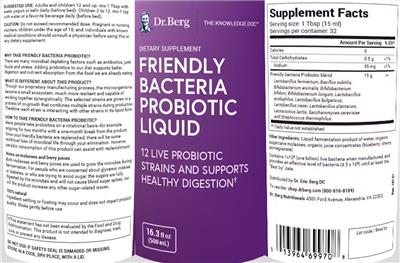
Friendly Bacteria Probiotic Liquid by Dr. Berg label
The label scan from the NIH Dietary Supplement Label Database. Tap to enlarge.
Label images are published by the NIH Dietary Supplement Label Database for the version of this product on file. Always read your actual product label.
View the full label (PDF)The Ingredients in Friendly Bacteria Probiotic Liquid by Dr. Berg
These are the 13 active ingredients this product is made of. Select any to open its full monograph.
Serving size15 mL Dosage formLiquid Servings per container32 Amounts shown are per serving.
Most supplement products combine several ingredients, and a medication can interact with the product through any one of them. Each ingredient below shows whether it has known drug interactions.
Sodium
Interacts with205 drugs
Sodium is an essential mineral and electrolyte your body needs to balance fluids, support nerves, and help muscles work. Most people in modern diets g...
Sodium monograph & interactionsFriendly Bacteria Probiotic Blend
- › Lactobacillus acidophilus
- › Lactobacillus plantarum
- › Bifidobacterium longum
- › Bifidobacterium bifidum
- › Lactobacillus bulgaricus
- › Lactobacillus casei
- › Bifidobacterium animalis lactis
- › Streptococcus thermophilus
- › Bacillus subtilis
- › Saccharomyces cerevisiae
- › Lactobacillus fermentum
- › Lactococcus lactis
Other (inactive) ingredients: Water, Organic Sugarcane molasses, Blueberry juice concentrate, Cherry Juice Concentrate, Pomegranate juice concentrate. These complete the product’s ingredient list but are not active constituents.
Friendly Bacteria Probiotic Liquid by Dr. Berg Drug Interactions
HelloPharmacist Interaction Report
Dr.
Berg's Friendly Bacteria Probiotic Liquid contains several ingredients with documented interactions. The most serious concern is Saccharomyces cerevisiae (brewer's yeast), which carries a Major interaction with MAOIs — a class of antidepressants — due to tyramine content that can trigger a dangerous spike in blood pressure.
Additionally, sodium in this product interacts with a broad range of medications through several different mechanisms.
Read the full breakdown — every affected drug type, severity by severity
Sodium's Moderate interactions span antihypertensive drugs (blood pressure medications), corticosteroids, lithium, didanosine (an HIV medication), sodium phosphate (a bowel-prep agent), tolvaptan (used for low sodium levels), and other sodium-containing drugs — the common risk is that added sodium can raise blood sodium levels too high or reduce how well these medications work. Brewer's yeast also has Moderate interactions with antidiabetes drugs (risk of low blood sugar) and lithium, and a Minor interaction with antifungal drugs.
The probiotic bacteria — Lactobacillus acidophilus, Bifidobacterium longum, Bifidobacterium bifidum, and Bacillus subtilis — all carry Moderate interactions with antibiotics: taking them at the same time may reduce the probiotic's effectiveness because antibiotics kill the live organisms.
We could not check interactions for Lactobacillus plantarum, Lactobacillus bulgaricus, Lactobacillus casei, Bifidobacterium animalis lactis, Lactobacillus fermentum, and Lactococcus lactis. Streptococcus thermophilus has been checked and no interactions are documented in our data.
Altogether, these interactions span 522 individual medications.
To find out if your specific prescriptions interact, use the medication checker below — and talk with your doctor or pharmacist before starting this product if you take any blood pressure medication, mood stabilizer, antibiotic, or any other regular medication.
Check your own medications below · Editorial policy · How we use AI
Want to check YOUR meds against Friendly Bacteria Probiotic Liquid?
Ask about interactions with your drugs in plain English — “Can I take it with lisinopril?” — and we find you the answer in seconds, ingredient by ingredient.
Go to the checkerIngredients driving the most interactions
Individual Drug Interactions
The ingredients in Friendly Bacteria Probiotic Liquid interact with 522 drugs. Click any drug to see the details.
6 of the 13 ingredients in Friendly Bacteria Probiotic Liquid interact with drugs. Each result below shows which ingredient is responsible. Sodium Lactobacillus acidophilus Bifidobacterium longum Bifidobacterium bifidum Bacillus subtilis Saccharomyces cerevisiae
AmphetamineAdensys XR-ODT, Adzenys ER, Dyanavel XR, Mydayis
How Amphetamine interacts with Friendly Bacteria Probiotic Liquid — through 1 ingredient. Tap an ingredient for the detail:
Saccharomyces CerevisiaeMonoamine Oxidase Inhibitors (maois) Major
Interaction Summary
Theoretically, taking brewer's yeast with MAOIs might increase the risk of hypertension.
Read the full Saccharomyces Cerevisiae + Amphetamine interactionIsocarboxazidMarplan
How Isocarboxazid interacts with Friendly Bacteria Probiotic Liquid — through 1 ingredient. Tap an ingredient for the detail:
Saccharomyces CerevisiaeMonoamine Oxidase Inhibitors (maois) Major
Interaction Summary
Theoretically, taking brewer's yeast with MAOIs might increase the risk of hypertension.
Read the full Saccharomyces Cerevisiae + Isocarboxazid interactionMoclobemideManerix, Moclobemide
How Moclobemide interacts with Friendly Bacteria Probiotic Liquid — through 1 ingredient. Tap an ingredient for the detail:
Saccharomyces CerevisiaeMonoamine Oxidase Inhibitors (maois) Major
Interaction Summary
Theoretically, taking brewer's yeast with MAOIs might increase the risk of hypertension.
Read the full Saccharomyces Cerevisiae + Moclobemide interactionOzanimod HydrochlorideZeposia
How Ozanimod Hydrochloride interacts with Friendly Bacteria Probiotic Liquid — through 1 ingredient. Tap an ingredient for the detail:
Saccharomyces CerevisiaeMonoamine Oxidase Inhibitors (maois) Major
Interaction Summary
Theoretically, taking brewer's yeast with MAOIs might increase the risk of hypertension.
Read the full Saccharomyces Cerevisiae + Ozanimod Hydrochloride interactionPhenelzine SulfateNardil
How Phenelzine Sulfate interacts with Friendly Bacteria Probiotic Liquid — through 1 ingredient. Tap an ingredient for the detail:
Saccharomyces CerevisiaeMonoamine Oxidase Inhibitors (maois) Major
Interaction Summary
Theoretically, taking brewer's yeast with MAOIs might increase the risk of hypertension.
Read the full Saccharomyces Cerevisiae + Phenelzine Sulfate interactionRasagilineAzilect
How Rasagiline interacts with Friendly Bacteria Probiotic Liquid — through 1 ingredient. Tap an ingredient for the detail:
Saccharomyces CerevisiaeMonoamine Oxidase Inhibitors (maois) Major
Interaction Summary
Theoretically, taking brewer's yeast with MAOIs might increase the risk of hypertension.
Read the full Saccharomyces Cerevisiae + Rasagiline interactionSafinamide MesylateXadago
How Safinamide Mesylate interacts with Friendly Bacteria Probiotic Liquid — through 1 ingredient. Tap an ingredient for the detail:
Saccharomyces CerevisiaeMonoamine Oxidase Inhibitors (maois) Major
Interaction Summary
Theoretically, taking brewer's yeast with MAOIs might increase the risk of hypertension.
Read the full Saccharomyces Cerevisiae + Safinamide Mesylate interactionSelegilineCarbex, Eldepryl, Emsam, Zelapar
How Selegiline interacts with Friendly Bacteria Probiotic Liquid — through 1 ingredient. Tap an ingredient for the detail:
Saccharomyces CerevisiaeMonoamine Oxidase Inhibitors (maois) Major
Interaction Summary
Theoretically, taking brewer's yeast with MAOIs might increase the risk of hypertension.
Read the full Saccharomyces Cerevisiae + Selegiline interactionTranylcypromineParnate
How Tranylcypromine interacts with Friendly Bacteria Probiotic Liquid — through 1 ingredient. Tap an ingredient for the detail:
Saccharomyces CerevisiaeMonoamine Oxidase Inhibitors (maois) Major
Interaction Summary
Theoretically, taking brewer's yeast with MAOIs might increase the risk of hypertension.
Read the full Saccharomyces Cerevisiae + Tranylcypromine interactionAcarboseGlucobay, Prandase, Precose
How Acarbose interacts with Friendly Bacteria Probiotic Liquid — through 1 ingredient. Tap an ingredient for the detail:
Saccharomyces CerevisiaeAntidiabetes Drugs Moderate
Interaction Summary
Taking brewer's yeast with antidiabetes drugs might increase the risk of hypoglycemia.
Read the full Saccharomyces Cerevisiae + Acarbose interactionAcebutololRhotral, Sectral
How Acebutolol interacts with Friendly Bacteria Probiotic Liquid — through 1 ingredient. Tap an ingredient for the detail:
SodiumAntihypertensive Drugs Moderate
Interaction Summary
Theoretically, a high intake of dietary sodium might reduce the effectiveness of antihypertensive drugs.
Read the full Sodium + Acebutolol interactionAcetazolamideAk-Zol, Diamox
How Acetazolamide interacts with Friendly Bacteria Probiotic Liquid — through 1 ingredient. Tap an ingredient for the detail:
SodiumAntihypertensive Drugs Moderate
Interaction Summary
Theoretically, a high intake of dietary sodium might reduce the effectiveness of antihypertensive drugs.
Read the full Sodium + Acetazolamide interactionAcetohexamideDymelor
How Acetohexamide interacts with Friendly Bacteria Probiotic Liquid — through 1 ingredient. Tap an ingredient for the detail:
Saccharomyces CerevisiaeAntidiabetes Drugs Moderate
Interaction Summary
Taking brewer's yeast with antidiabetes drugs might increase the risk of hypoglycemia.
Read the full Saccharomyces Cerevisiae + Acetohexamide interactionAlbiglutideTanzeum
How Albiglutide interacts with Friendly Bacteria Probiotic Liquid — through 1 ingredient. Tap an ingredient for the detail:
Saccharomyces CerevisiaeAntidiabetes Drugs Moderate
Interaction Summary
Taking brewer's yeast with antidiabetes drugs might increase the risk of hypoglycemia.
Read the full Saccharomyces Cerevisiae + Albiglutide interactionAliskirenTekturna
How Aliskiren interacts with Friendly Bacteria Probiotic Liquid — through 1 ingredient. Tap an ingredient for the detail:
SodiumAntihypertensive Drugs Moderate
Interaction Summary
Theoretically, a high intake of dietary sodium might reduce the effectiveness of antihypertensive drugs.
Read the full Sodium + Aliskiren interactionAlogliptinNesina
How Alogliptin interacts with Friendly Bacteria Probiotic Liquid — through 1 ingredient. Tap an ingredient for the detail:
Saccharomyces CerevisiaeAntidiabetes Drugs Moderate
Interaction Summary
Taking brewer's yeast with antidiabetes drugs might increase the risk of hypoglycemia.
Read the full Saccharomyces Cerevisiae + Alogliptin interactionAlogliptin, MetforminKazano
How Alogliptin, Metformin interacts with Friendly Bacteria Probiotic Liquid — through 1 ingredient. Tap an ingredient for the detail:
Saccharomyces CerevisiaeAntidiabetes Drugs Moderate
Interaction Summary
Taking brewer's yeast with antidiabetes drugs might increase the risk of hypoglycemia.
Read the full Saccharomyces Cerevisiae + Alogliptin, Metformin interactionAlogliptin, PioglitazoneOseni
How Alogliptin, Pioglitazone interacts with Friendly Bacteria Probiotic Liquid — through 1 ingredient. Tap an ingredient for the detail:
Saccharomyces CerevisiaeAntidiabetes Drugs Moderate
Interaction Summary
Taking brewer's yeast with antidiabetes drugs might increase the risk of hypoglycemia.
Read the full Saccharomyces Cerevisiae + Alogliptin, Pioglitazone interactionAmbrisentanLetairis, Volibris
How Ambrisentan interacts with Friendly Bacteria Probiotic Liquid — through 1 ingredient. Tap an ingredient for the detail:
SodiumAntihypertensive Drugs Moderate
Interaction Summary
Theoretically, a high intake of dietary sodium might reduce the effectiveness of antihypertensive drugs.
Read the full Sodium + Ambrisentan interactionAmikacinAmikin, Arikayce
How Amikacin interacts with Friendly Bacteria Probiotic Liquid — through 4 ingredients. Tap an ingredient for the detail:
Bifidobacterium BifidumAntibiotic Drugs Moderate
Interaction Summary
Theoretically, taking Bifidobacterium.
Read the full Bifidobacterium Bifidum + Amikacin interactionLactobacillus AcidophilusAntibiotic Drugs Moderate
Interaction Summary
Theoretically, taking Lactobacillus acidophilus with antibiotic drugs might decrease the effectiveness of L.
Read the full Lactobacillus Acidophilus + Amikacin interactionBifidobacterium LongumAntibiotic Drugs Moderate
Interaction Summary
Theoretically, taking Bifidobacterium longum with antibiotic drugs might decrease the effectiveness of B.
Read the full Bifidobacterium Longum + Amikacin interactionBacillus SubtilisAntibiotic Drugs Moderate
Interaction Summary
Theoretically, taking Bacillus subtilis with antibiotic drugs might decrease the effectiveness of B.
Read the full Bacillus Subtilis + Amikacin interactionAmilorideAmilamont, Midamor
How Amiloride interacts with Friendly Bacteria Probiotic Liquid — through 1 ingredient. Tap an ingredient for the detail:
SodiumAntihypertensive Drugs Moderate
Interaction Summary
Theoretically, a high intake of dietary sodium might reduce the effectiveness of antihypertensive drugs.
Read the full Sodium + Amiloride interactionAmiloride, HydrochlorothiazideAmil-Co, Amilzide, Moduret 25, Moduretic
How Amiloride, Hydrochlorothiazide interacts with Friendly Bacteria Probiotic Liquid — through 1 ingredient. Tap an ingredient for the detail:
SodiumAntihypertensive Drugs Moderate
Interaction Summary
Theoretically, a high intake of dietary sodium might reduce the effectiveness of antihypertensive drugs.
Read the full Sodium + Amiloride, Hydrochlorothiazide interactionAmlodipineNorliqva
How Amlodipine interacts with Friendly Bacteria Probiotic Liquid — through 1 ingredient. Tap an ingredient for the detail:
SodiumAntihypertensive Drugs Moderate
Interaction Summary
Theoretically, a high intake of dietary sodium might reduce the effectiveness of antihypertensive drugs.
Read the full Sodium + Amlodipine interactionAmlodipine BenzoateKaterzia
How Amlodipine Benzoate interacts with Friendly Bacteria Probiotic Liquid — through 1 ingredient. Tap an ingredient for the detail:
SodiumAntihypertensive Drugs Moderate
Interaction Summary
Theoretically, a high intake of dietary sodium might reduce the effectiveness of antihypertensive drugs.
Read the full Sodium + Amlodipine Benzoate interactionAmlodipine BesilateIstin
How Amlodipine Besilate interacts with Friendly Bacteria Probiotic Liquid — through 1 ingredient. Tap an ingredient for the detail:
SodiumAntihypertensive Drugs Moderate
Interaction Summary
Theoretically, a high intake of dietary sodium might reduce the effectiveness of antihypertensive drugs.
Read the full Sodium + Amlodipine Besilate interactionAmlodipine BesylateNorvasc
How Amlodipine Besylate interacts with Friendly Bacteria Probiotic Liquid — through 1 ingredient. Tap an ingredient for the detail:
SodiumAntihypertensive Drugs Moderate
Interaction Summary
Theoretically, a high intake of dietary sodium might reduce the effectiveness of antihypertensive drugs.
Read the full Sodium + Amlodipine Besylate interactionAmlodipine Besylate, BenazeprilLotrel
How Amlodipine Besylate, Benazepril interacts with Friendly Bacteria Probiotic Liquid — through 1 ingredient. Tap an ingredient for the detail:
SodiumAntihypertensive Drugs Moderate
Interaction Summary
Theoretically, a high intake of dietary sodium might reduce the effectiveness of antihypertensive drugs.
Read the full Sodium + Amlodipine Besylate, Benazepril interactionAmlodipine, CelecoxibConsensi
How Amlodipine, Celecoxib interacts with Friendly Bacteria Probiotic Liquid — through 1 ingredient. Tap an ingredient for the detail:
SodiumAntihypertensive Drugs Moderate
Interaction Summary
Theoretically, a high intake of dietary sodium might reduce the effectiveness of antihypertensive drugs.
Read the full Sodium + Amlodipine, Celecoxib interactionAmmonium ChlorideAmmonium Chloride
How Ammonium Chloride interacts with Friendly Bacteria Probiotic Liquid — through 1 ingredient. Tap an ingredient for the detail:
SodiumAntihypertensive Drugs Moderate
Interaction Summary
Theoretically, a high intake of dietary sodium might reduce the effectiveness of antihypertensive drugs.
Read the full Sodium + Ammonium Chloride interactionAmoxicillinAmix, Amoram, Amoxident, Amoxil Capsules, Amoxil Injection, Galenamox +3 more
How Amoxicillin interacts with Friendly Bacteria Probiotic Liquid — through 4 ingredients. Tap an ingredient for the detail:
Bifidobacterium BifidumAntibiotic Drugs Moderate
Interaction Summary
Theoretically, taking Bifidobacterium.
Read the full Bifidobacterium Bifidum + Amoxicillin interactionBifidobacterium LongumAntibiotic Drugs Moderate
Interaction Summary
Theoretically, taking Bifidobacterium longum with antibiotic drugs might decrease the effectiveness of B.
Read the full Bifidobacterium Longum + Amoxicillin interactionBacillus SubtilisAntibiotic Drugs Moderate
Interaction Summary
Theoretically, taking Bacillus subtilis with antibiotic drugs might decrease the effectiveness of B.
Read the full Bacillus Subtilis + Amoxicillin interactionLactobacillus AcidophilusAntibiotic Drugs Moderate
Interaction Summary
Theoretically, taking Lactobacillus acidophilus with antibiotic drugs might decrease the effectiveness of L.
Read the full Lactobacillus Acidophilus + Amoxicillin interactionEach ingredient & the kinds of drugs it affects
For each ingredient in Friendly Bacteria Probiotic Liquid with known interactions, here are the types of medications they can affect. Open any type for the detail — or search your exact drug in the checker above.
Sodium
Antihypertensive Drugs
Theoretically, a high intake of dietary sodium might reduce the effectiveness of antihypertensive drugs.
High intake of dietary sodium can increase systolic and diastolic blood pressure. Also, high intake of sodium may necessitate increased use of antihypertensive medications to achieve blood pressure control in some patients, such as those with chronic kidney disease.
Corticosteroids
Concomitant use of mineralocorticoids and some glucocorticoids with sodium supplements might increase the risk of hypernatremia.
Mineralocorticoids and some glucocorticoids (corticosteroids) cause sodium retention. This effect is dose-related and depends on mineralocorticoid potency. It is most common with hydrocortisone, cortisone, and fludrocortisone, followed by prednisone and prednisolone.
Didanosine (Videx)
Concomitant use of didanosine with additional sodium from dietary or supplemental sources may increase the risk of hypernatremia.
Didanosine formulations contain a significant amount of sodium.
Lithium
Altering dietary intake of sodium might alter the levels and clinical effects of lithium.
High sodium intake can reduce plasma concentrations of lithium by increasing lithium excretion. Reducing sodium intake can significantly increase plasma concentrations of lithium and cause lithium toxicity in patients being treated with lithium carbonate. Stabilizing sodium intake is shown to reduce the percentage of patients with lithium level fluctuations above 0.8 mEq/L. Patients taking lithium should avoid significant alterations in their dietary intake of sodium.
Sodium Phosphates
Theoretically, concomitant use of sodium phosphate with sodium supplements might increase the risk of hypernatremia.
Use of high doses (> 45 mL in 24 hours) of sodium phosphate, such as those used for bowel cleansing before surgery, can lead to serious electrolyte disturbances, including hypernatremia. The risk of hypernatremia is highest in the elderly and people with other risk factors for electrolyte disturbances.
Sodium-Containing Drugs
Concomitant use of sodium-containing drugs with additional sodium from dietary or supplemental sources may increase the risk of hypernatremia and long-term sodium-related complications.
The Chronic Disease Risk Reduction (CDRR) intake level of 2.3 grams of sodium daily indicates the intake at which it is believed that chronic disease risk increases for the apparently healthy population. Some medications contain high quantities of sodium. When used in conjunction with sodium supplements or high-sodium diets, the CDRR may be exceeded. Additionally, concomitant use may increase the risk for hypernatremia; this risk is highest in the elderly and people with other risk factors for electrolyte disturbances.
Tolvaptan (Samsca)
Theoretically, concomitant use of tolvaptan with sodium might increase the risk of hypernatremia.
Tolvaptan is a vasopressin receptor 2 antagonist that is used to increase sodium levels in patients with hyponatremia. Patients taking tolvaptan should use caution with the use of sodium salts such as sodium chloride.
Lactobacillus acidophilus
Antibiotic Drugs
Theoretically, taking Lactobacillus acidophilus with antibiotic drugs might decrease the effectiveness of L. acidophilus.
L. acidophilus preparations usually contain live and active organisms. Therefore, simultaneously taking antibiotics might kill a significant number of the organisms. Tell patients to separate administration of antibiotics and L. acidophilus preparations by at least two hours.
Bifidobacterium longum
Antibiotic Drugs
Theoretically, taking Bifidobacterium longum with antibiotic drugs might decrease the effectiveness of B. longum.
Since B. longum preparations usually contain live and active organisms, simultaneously taking antibiotics might kill a significant number of the organisms. Tell patients to separate administration of antibiotics and B. longum preparations by at least 2 hours.
Bifidobacterium bifidum
Antibiotic Drugs
Theoretically, taking Bifidobacterium. bifidum with antibiotic drugs might decrease the effectiveness of B. bifidum.
Since B. bifidum preparations usually contain live and active organisms, simultaneously taking antibiotics might kill a significant number of the organisms. Tell patients to separate administration of antibiotics and B. bifidum preparations by at least 2 hours.
Bacillus subtilis
Antibiotic Drugs
Theoretically, taking Bacillus subtilis with antibiotic drugs might decrease the effectiveness of B. subtilis.
Since B. subtilis preparations usually contain live and active organisms, simultaneously taking antibiotics might kill a significant number of the organisms. Tell patients to separate administration of antibiotics and B. subtilis preparations by at least 2 hours.
Saccharomyces cerevisiae
Monoamine Oxidase Inhibitors (Maois)
Theoretically, taking brewer's yeast with MAOIs might increase the risk of hypertension.
Brewer's yeast contains tyramine. Taking brewer's yeast with MAOIs might increase the risk for hypertensive crisis.
Antidiabetes Drugs
Taking brewer's yeast with antidiabetes drugs might increase the risk of hypoglycemia.
Clinical research shows that taking chromium-containing brewer's yeast can decrease levels of blood glucose in diabetic patients being treated with antidiabetes drugs.
Lithium
Theoretically, taking brewer's yeast with lithium might cause additive effects and side effects.
Some brewer's yeast products contains lithium.
Antifungals
Theoretically, taking antifungals with some brewer's yeast products might decrease the effectiveness of brewer's yeast.
Some brewer's yeast products contain live yeast. Therefore, simultaneously taking antifungals might kill a significant number of the organisms.
Brand information
Manufacturer and brand details for Friendly Bacteria Probiotic Liquid, from the product label.
Dr. Berg
- Name
- Dr. Berg Nutritionals
- Street Address
- 4501 Ford Avenue
- City
- Alexandria
- State
- VA
- ZipCode
- 22302
- Phone Number
- 800-816-8184
- Web Address
- shop.drberg.com
Friendly Bacteria Probiotic Liquid by Dr. Berg: Common Questions
Does Friendly Bacteria Probiotic Liquid by Dr. Berg interact with any medications?
How can one product interact with so many drugs?
Where does this information come from?
Can I take this if I'm on an antibiotic?
Is this safe during pregnancy?
Does this product have any fillers?
Will it help my irritable bowel syndrome?
What side effects should I watch for?
Is sodium a concern in this product?
Written and reviewed by the HelloPharmacist editorial staff. Our editorial policy
Not sure if Friendly Bacteria Probiotic Liquid is safe with your meds?
Our pharmacists answer your medication & supplement questions — free.
Label information is sourced from the NIH Dietary Supplement Label Database and reflects the product version on file; always read your actual product label. This page is for education only and is not a substitute for professional medical advice. Confirm with your pharmacist or doctor before combining supplements and medications.
The Full Monographs Behind Friendly Bacteria Probiotic Liquid’s Ingredients
Every ingredient we hold a full HelloPharmacist monograph for — uses, evidence, safety, and the complete interaction list.
Sodium
Interacts with 205 drugsSodium is an essential mineral and electrolyte your body needs to balance fluids, support nerves, and help muscles work. Most people in modern diets get more than enough—often too much—from...
Read the full Sodium monograph → Herb & supplement monographLactobacillus Acidophilus
Interacts with 182 drugsLactobacillus acidophilus is a 'friendly' bacterium used as a probiotic to support gut and vaginal health. It is generally well tolerated in healthy people, and there is reasonable evidence...
Read the full Lactobacillus Acidophilus monograph → Herb & supplement monographBifidobacterium Longum
Interacts with 182 drugsBifidobacterium longum is a 'friendly' bacterium found naturally in the human gut and used as a probiotic. It is generally well tolerated and is most studied for digestive issues, though evi...
Read the full Bifidobacterium Longum monograph → Herb & supplement monographBifidobacterium Bifidum
Interacts with 182 drugsBifidobacterium bifidum is a 'friendly' bacteria (probiotic) that naturally lives in the human gut and is taken to support digestion and gut balance. Some evidence suggests probiotics may he...
Read the full Bifidobacterium Bifidum monograph → Herb & supplement monographStreptococcus Thermophilus
Streptococcus thermophilus is a friendly bacterium used as a probiotic, often combined with other strains in yogurt and supplements. It is generally well tolerated in healthy people and may...
Read the full Streptococcus Thermophilus monograph → Herb & supplement monographBacillus Subtilis
Interacts with 182 drugsBacillus subtilis is a spore-forming probiotic bacterium found in soil and some fermented foods, and it is used mainly to support gut health and digestion. Early research is promising for ce...
Read the full Bacillus Subtilis monograph → Herb & supplement monographBrewer's Yeast
Interacts with 136 drugsBrewer's yeast is a nutrient-rich fungus that provides B vitamins, protein, and minerals, and a related yeast product (S. boulardii) is used for some types of diarrhea. Most other health cla...
Read the full Brewer's Yeast monograph →Sources & How We Checked
Friendly Bacteria Probiotic Liquid's label data comes from the NIH Dietary Supplement Label Database; the ingredient interaction data is from the Natural Medicines database, reviewed by our pharmacists.
- NIH Dietary Supplement Label Database (DSLD) — The official product label on file for this supplement.
- Natural Medicines (Therapeutic Research Center) — Evidence-graded clinical reference behind the ingredient interaction data.
Content is written and reviewed by licensed HelloPharmacist pharmacists. See our data sources and editorial standards for how this information is built and checked.
The 118 references behind this product’s interaction data
Every citation that drives the interaction findings for this product’s ingredients, from the evidence-graded Natural Medicines (TRC Healthcare) database. Open an ingredient to browse its citations — links open the study on PubMed or the publisher’s site.
Sodium 38 references
- Garabedian-Ruffalo SM, Ruffalo RL. Drug and nutrient interactions. Am Fam Physician 1986;33:165-74.
- Food and Drug Administration Science Background: Safety of Sodium Phosphates Oral Solution. September 17, 2001. Available at: http://www.fda.gov/cder/drug/safety/sodiumphospate.htm
- Coton T, Mallaret C, Coilliot C, Carre D, Guisset M. Severe acute ulcerated gastritis induced by salt. Presse Med 2009;38(3):499-500. PubMed
- Frings-Meuthen P, Buehlmeier J, Baecker N, et al. High sodium chloride intake exacerbates immobilization-induced bone resorption and protein losses. J Appl Physiol 2011;111(2):537-542. PubMed
- Frings-Meuthen P, Baecker N, Heer M. Low-grade metabolic acidosis may be the cause of sodium chloride-induced exaggerated bone resorption. J Bone Miner Res 2008;23(4):517-524. PubMed
- Alam S, Johnson AG. A meta-analysis of randomised controlled trials (RCT) among healthy normotensive and essential hypertensive elderly patients to determine the effect of high salt (NaCl) diet of blood pressure. J Hum Hypertens 1999;13(6):367-74.
- Boudville N, Ward S, Benaroia M, House AA. Increased sodium intake correlates with greater use of antihypertensive agents by subjects with chronic kidney disease. Am J Hypertens 2005;18(10):1300-5. PubMed
- Bennett WM. Drug interactions and consequences of sodium restriction. Am J Clin Nutr 1997;65(2 Suppl):678S-681S. PubMed
- Okusa MD, Crystal LJ. Clinical manifestations and management of acute lithium intoxication. Am J Med 1994;97(4):383-9. PubMed
- Food and Nutrition Board, Institute of Medicine. Dietary reference intakes for water, potassium, sodium, chloride, and sulfate. Washington, DC: National Academy Press, 2005. Available at: http://www.nap.edu/openbook.php?record_id=10925. DOI
- D'Elia L, Rossi G, Ippolito R, Cappuccio FP, Strazzullo P. Habitual salt intake and risk of gastric cancer: a meta-analysis of prospective studies. Clin Nutr 2012;31(4):489-98. PubMed
- Goldsmith SR. Hyponatremia in heart failure: time for a trial. J Card Fail 2013;19(6):398-400. PubMed
- Willocks L, Brettle R, Keen J, Valentine C, Pinching AJ. Formulations of didanosine (ddI) and salt overload. Lancet 1992;339(8786):190.
- Chen L, Zhang Z, Chen W, Whelton PK, Appel LJ. Lower Sodium Intake and Risk of Headaches: Results From the Trial of Nonpharmacologic Interventions in the Elderly. Am J Public Health. 2016;106(7):1270-5. PubMed
- Cook NR, Appel LJ, Whelton PK. Lower levels of sodium intake and reduced cardiovascular risk. Circulation. 2014;129(9):981-9. PubMed
- Cook NR, Appel LJ, Whelton PK. Sodium Intake and All-Cause Mortality Over 20 Years in the Trials of Hypertension Prevention. J Am Coll Cardiol. 2016;68(15):1609-1617. PubMed
- Mente A, O'Donnell M, Rangarajan S, et al. Associations of urinary sodium excretion with cardiovascular events in individuals with and without hypertension: a pooled analysis of data from four studies. Lancet. 2016;388(10043):465-75. PubMed
- Moosavian SP, Haghighatdoost F, Surkan PJ, Azadbakht L. Salt and obesity: a systematic review and meta-analysis of observational studies. Int J Food Sci Nutr. 2017;68(3):265-277. PubMed
- O'Donnell M, Mente A, Rangarajan S, et al. Urinary sodium and potassium excretion, mortality, and cardiovascular events. N Engl J Med. 2014;371(7):612-23. DOI
- Poggio R, Gutierrez L, Matta MG, Elorriaga N, Irazola V, Rubinstein A. Daily sodium consumption and CVD mortality in the general population: systematic review and meta-analysis of prospective studies. Public Health Nutr. 2015;18(4):695-704. PubMed
- Stallings VA, Harrison M, Oria M; Committee to Review the Dietary Reference Intakes for Sodium and Potassium, Food and Nutrition Board, Health and Medicine Division, National Academies of Sciences, Engineering, and Medicine. Washington (DC): National Acad
- Mahtani KR, Heneghan C, Onakpoya I, et al. Reduced Salt Intake for Heart Failure: A Systematic Review. JAMA Intern Med. 2018 Dec 1;178(12):1693-1700. PubMed
- Yancy CW. Sodium Restriction in Heart Failure: Too Much Uncertainty-Do the Trials. JAMA Intern Med. 2018 Dec 1;178(12):1700-1701. PubMed
- He FJ, Campbell NRC, Ma Y, MacGregor GA, Cogswell ME, Cook NR. Errors in estimating usual sodium intake by the Kawasaki formula alter its relationship with mortality: implications for public health. Int J Epidemiol. 2018;47(6):1784-1795. PubMed
- Murthy K, Ondrey GJ, Malkani N, et al. THE EFFECTS OF HYPONATREMIA ON BONE DENSITY AND FRACTURES: A SYSTEMATIC REVIEW AND META-ANALYSIS. Endocr Pract. 2019;25(4):366-378. PubMed
- Messerli FH, Hofstetter L, Syrogiannouli L, et al. Sodium intake, life expectancy, and all-cause mortality. Eur Heart J 2021;42(21):2103-2112. PubMed
- Graudal NA, Hubeck-Graudal T, Jurgens G. Effects of low sodium diet versus high sodium diet on blood pressure, renin, aldosterone, catecholamines, cholesterol, and triglyceride. Cochrane Database Syst Rev 2020;12(12):CD004022. PubMed
- Giatti S, Santos RB, Aielo AN, et al. Association of sodium with obstructive sleep apnea. The ELSA-Brasil study. Ann Am Thorac Soc 2021;18(3):502-510. PubMed
- Nan X, Lu H, Wu J, et al. The interactive association between sodium intake, alcohol consumption and hypertension among elderly in northern China: a cross-sectional study. BMC Geriatr 2021;21(1):135. PubMed
- Kyozuka H, Fukusda T, Murata T, et al. Impact of preconception sodium intake on hypertensive disorders of pregnancy: The Japan Environment and Children's study. Pregnancy Hypertens 2021;23:66-72. PubMed
- Zhao L, Ogden CL, Yang Q, et al. Association of usual sodium intake with obesity among US children and adolescents, NHANES 2009-2016. Obesity (Silver Spring) 2021;29(3):587-594. PubMed
- Ma Y, He FJ, Sun Q, et al. 24-Hour urinary sodium and potassium excretion and cardiovascular risk. N Engl J Med 2022;386(3):252-263. PubMed
- Liu J, Yang X, Zhang P, et al. Association of urinary sodium excretion and left ventricular hypertrophy in people with type 2 diabetes mellitus: A cross-sectional study. Front Endocrinol (Lausanne) 2021;12:728493. PubMed
- Filippini T, Malavolti M, Whelton PK, Vinceti M. Sodium intake and risk of hypertension: A systematic review and dose-response meta-analysis of observational cohort studies. Curr Hypertens Rep 2022;24(5):133-144. PubMed
- Wang DD, Li Y, Nguyen XT, et al. Dietary sodium and potassium intake and risk of non-fatal cardiovascular diseases: The million veteran program. Nutrients 2022;14(5):1121. PubMed
- Kwak JH, Park CH, Eun CS, et al. The associations of dietary intake of high sodium and low zinc with gastric cancer mortality: A prospective cohort study in Korea. Nutr Cancer 2022;74(10):3501-3508. PubMed
- George S, Maiti R, Mishra BR, Jena M, Mohapatra D. Effect of regulated add-on sodium chloride intake on stabilization of serum lithium concentration in bipolar disorder: A randomized controlled trial. Bipolar Disord 2023;25(1):66-75. PubMed
- Zhou TL, Schütten MTJ, Kroon AA, et al. Urinary Sodium Excretion and Salt Intake Are Not Associated With Blood Pressure Variability in a White General Population. J Am Heart Assoc 2023;12(1):e026578. PubMed
Lactobacillus Acidophilus 15 references
- Pierce A. The American Pharmaceutical Association Practical Guide to Natural Medicines. New York: The Stonesong Press, 1999:19.
- Begtrup LM, de Muckadell OB, Kjeldsen J, Christensen RD, Jarbøl DE. Long-term treatment with probiotics in primary care patients with irritable bowel syndrome--a randomised, double-blind, placebo controlled trial. Scand J Gastroenterol 2013;48(10):1127-35 PubMed
- Chatterjee S, Kar P, Das T, Ray S, Gangulyt S, Rajendiran C, Mitra M. Randomised placebo-controlled double blind multicentric trial on efficacy and safety of Lactobacillus acidophilus LA-5 and Bifidobacterium BB-12 for prevention of antibiotic-associated
- Shavakhi A, Tabesh E, Yaghoutkar A, Hashemi H, Tabesh F, Khodadoostan M,Minakari M, Shavakhi S, Gholamrezaei A. The effects of multistrain probiotic compound on bismuth-containing quadruple therapy for Helicobacter pylori infection: a randomized placebo-c
- Karamali M, Dadkhah F, Sadrkhanlou M, et al. Effects of probiotic supplementation on glycaemic control and lipid profiles in gestational diabetes: a randomized, double-blind, placebo-controlled trial. Diabetes Metab 2016;42(4):234-41. PubMed
- Badehnoosh B, Karamali M, Zarrati M, et al. The effects of probiotic supplementation on biomarkers of inflammation, oxidative stress and pregnancy outcomes in gestational diabetes. J Matern Fetal Neonatal Med. 2018 May;31(9):1128-1136.
- Kumar S, Kumar R, Rohilla L, Jacob N, Yadav J, Sachdeva N. A high potency multi-strain probiotic improves glycemic control in children with new-onset type 1 diabetes mellitus: A randomized, double-blind, and placebo-controlled pilot study. Pediatr Diabete
- Shahriari A, Karimi E, Shahriari M, Aslani N, Khooshideh M, Arab A. The effect of probiotic supplementation on the risk of gestational diabetes mellitus among high-risk pregnant women: A parallel double-blind, randomized, placebo-controlled clinical trial PubMed
- Xiao SD, Zhang DZ, Lu H, et al. Multicenter, randomized, controlled trial of heat-killed Lactobacillus acidophilus LB in patients with chronic diarrhea. Adv Ther. 2003;20(5):253-60.
- Rossi F, Amadoro C, Gasperi M, Colavita G. Lactobacilli infection case reports in the last three years and safety implications. Nutrients. 2022;14(6):1178. PubMed
- Ozer M, Goksu SY, Shahverdiani A, Mustafa M. Lactobacillus acidophilus-induced endocarditis and associated splenic abscess. Case Rep Infect Dis 2020;2020:1382709.
- Sadrin S, Sennoune S, Gout B, et al. A 2-strain mixture of Lactobacillus acidophilus in the treatment of irritable bowel syndrome: A placebo-controlled randomized clinical trial. Dig Liver Dis 2020;52(5):534-540. PubMed
- Stoffer JN, Slingsby TJ, Giuliari GP. Lactobacillus acidophilus endophthalmitis after intravitreal bevacizumab injection requiring intraocular lens explantation. Can J Ophthalmol 2022;57(1):e21-e22. PubMed
- Cukovic-Cavka S, Likic R, Francetic I, Rustemovic N, Opacic M, Vucelic B. Lactobacillus acidophilus as a cause of liver abscess in a NOD2/CARD15-positive patient with Crohn's disease. Digestion 2006;73(2-3):107-10.
- Hui J, Ren Y, Wang Y, Han Q. Lactobacillus acidophilus endophthalmitis postcataract operation: A case report with a literature review. Ocul Immunol Inflamm 2023.
See these in context on the Lactobacillus Acidophilus monograph →
Bifidobacterium Longum 21 references
- Ha GY, Yang CH, Kim H, Chong Y. Case of sepsis caused by Bifidobacterium longum. J Clin Microbiol 1999;37:1227-8.
- Pierce A. The American Pharmaceutical Association Practical Guide to Natural Medicines. New York: The Stonesong Press, 1999:19.
- Xiao JZ, Takahashi S, Odamaki T, et al. Antibiotic susceptibility of bifidobacterial strains distributed in the Japanese market. Biosci Biotechnol Biochem. 2010;74(2):336-42. PubMed
- Rautava S, Kainonen E, Salminen S, Isolauri E. Maternal probiotic supplementation during pregnancy and breast-feeding reduces the risk of eczema in the infant. J Allergy Clin Immunol. 2012;130(6):1355-60. PubMed
- Pruccoli G, Silvestro E, Pace Napoleone C, Aidala E, Garazzino S, Scolfaro C. Are probiotics safe? Bifidobacterium bacteremia in a child with severe heart failure. Infez Med. 2019;27(2):175-178.
- Pellonperä O, Vahlberg T, Mokkala K, et al. Weight gain and body composition during pregnancy: a randomised pilot trial with probiotics and/or fish oil. Br J Nutr. 2020 Nov 4:1-11. PubMed
- Pellonperä O, Mokkala K, Houttu N, et al. Efficacy of fish oil and/or probiotic intervention on the incidence of gestational diabetes mellitus in an at-risk group of overweight and obese women: A randomized, placebo-controlled, double-blind clinical trial PubMed
- Shahriari A, Karimi E, Shahriari M, Aslani N, Khooshideh M, Arab A. The effect of probiotic supplementation on the risk of gestational diabetes mellitus among high-risk pregnant women: A parallel double-blind, randomized, placebo-controlled clinical trial PubMed
- Esaiassen E, Hjerde E, Cavanagh JP, Simonsen GS, Klingenberg C; Norwegian Study Group on Invasive Bifidobacterial Infections. Bifidobacterium bacteremia: Clinical characteristics and a genomic approach to assess pathogenicity. J Clin Microbiol. 2017;55(7) PubMed
- Enomoto T, Sowa M, Nishimori K, et al. Effects of bifidobacterial supplementation to pregnant women and infants in the prevention of allergy development in infants and on fecal microbiota. Allergol Int 2014;63(4):575-85. PubMed
- US Food and Drug Administration (FDA). Dear Healthcare Provider Letter: Warning Regarding Use of Probiotics in Preterm Infants. September 2023. Available at: https://www.fda.gov/media/172606/download?attachment. Accessed November 1, 2023.
- Pillai A, Tan J, Paquette V, Panczuk J. Does probiotic bacteremia in premature infants impact clinically relevant outcomes? A case report and updated review of literature. Clin Nutr ESPEN. 2020;39:255-259. PubMed
- Sabaté JM, Iglicki F. Effect of Bifidobacterium longum 35624 on disease severity and quality of life in patients with irritable bowel syndrome. World J Gastroenterol 2022;28(7):732-744.
- Malaguarnera M, Greco F, Barone G, Gargante MP, Malaguarnera M, Toscano MA. Bifidobacterium longum with fructo-oligosaccharide (FOS) treatment in minimal hepatic encephalopathy: a randomized, double-blind, placebo-controlled study. Dig Dis Sci 2007;52(11) PubMed
- Zbinden A, Zbinden R, Berger C, Arlettaz R. Case series of Bifidobacterium longum bacteremia in three preterm infants on probiotic therapy. Neonatology 2015;107(1):56-9.
- Tamaki H, Nakase H, Inoue S, et al. Efficacy of probiotic treatment with Bifidobacterium longum 536 for induction of remission in active ulcerative colitis: A randomized, double-blinded, placebo-controlled multicenter trial. Dig Endosc 2016;28(1):67-74.
- Bertelli C, Pillonel T, Torregrossa A, et al. Bifidobacterium longum bacteremia in preterm infants receiving probiotics. Clin Infect Dis 2015;60(6):924-7. PubMed
- Esaiassen E, Cavanagh P, Hjerde E, Simonsen GS, Støen R, Klingenberg C. Bifidobacterium longum subspecies infantis bacteremia in 3 extremely preterm infants receiving probiotics. Emerg Infect Dis 2016;22(9):1664-6.
- Tena D, Losa C, Medina MJ, Sáez-Nieto JA. Peritonitis caused by Bifidobacterium longum: case report and literature review. Anaerobe 2014;27:27-30. PubMed
- Sangkanjanavanich S, Pradubpongsa P, Mitthamsiri W, Sangasapaviliya A, Boonpiyathad T. Bifidobacterium infantis 35624 efficacy in patients with uncontrolled asthma: A randomized placebo-controlled trial. Ann Allergy Asthma Immunol 2022;129(6):790-792. PubMed
- Wilson HL, Ong CW. Bifidobacterium longum vertebrodiscitis in a patient with cirrhosis and prostate cancer. Anaerobe 2017;47:47-50. PubMed
See these in context on the Bifidobacterium Longum monograph →
Bifidobacterium Bifidum 7 references
- Pierce A. The American Pharmaceutical Association Practical Guide to Natural Medicines. New York: The Stonesong Press, 1999:19.
- Xiao JZ, Takahashi S, Odamaki T, et al. Antibiotic susceptibility of bifidobacterial strains distributed in the Japanese market. Biosci Biotechnol Biochem. 2010;74(2):336-42. PubMed
- Rerksuppaphol S, Rerksuppaphol L. Randomized controlled trial of probiotics to reduce common cold in schoolchildren. Pediatr Int. 2012;54(5):682-7. PubMed
- Karamali M, Dadkhah F, Sadrkhanlou M, et al. Effects of probiotic supplementation on glycaemic control and lipid profiles in gestational diabetes: a randomized, double-blind, placebo-controlled trial. Diabetes Metab 2016;42(4):234-41. PubMed
- Badehnoosh B, Karamali M, Zarrati M, et al. The effects of probiotic supplementation on biomarkers of inflammation, oxidative stress and pregnancy outcomes in gestational diabetes. J Matern Fetal Neonatal Med. 2018 May;31(9):1128-1136.
- Pruccoli G, Silvestro E, Pace Napoleone C, Aidala E, Garazzino S, Scolfaro C. Are probiotics safe? Bifidobacterium bacteremia in a child with severe heart failure. Infez Med. 2019;27(2):175-178.
- Esaiassen E, Hjerde E, Cavanagh JP, Simonsen GS, Klingenberg C; Norwegian Study Group on Invasive Bifidobacterial Infections. Bifidobacterium bacteremia: Clinical characteristics and a genomic approach to assess pathogenicity. J Clin Microbiol. 2017;55(7) PubMed
See these in context on the Bifidobacterium Bifidum monograph →
Streptococcus Thermophilus 21 references
- Saxelin M, Chuang NH, Chassy B, et al. Lactobacilli and bacteremia in southern Finland 1989-1992. Clin Infect Dis 1996;22:564-6. PubMed
- Tynkkynen S, Singh KV, Varmanen P. Vancomycin resistance factor of Lactobacillus rhamnosus GG in relation to enterococcal vancomycin resistance (van) genes. Int J Food Microbiol 1998;41:195-204. PubMed
- Klein G, Zill E, Schindler R, et al. Peritonitis associated with vancomycin-resistant Lactobacillus rhamnosus in a continuous ambulatory peritoneal dialysis patient; organism identification, antibiotic therapy, and case report. J Clin Microbiol 1998;36:
- Kalima P, Masterton RG, Roddie PH, et al. Lactobacillus rhamnosus infection in a child following bone marrow transplant. J Infect 1996;32:165-7. PubMed
- Goldin BR. Health Benefits of probiotics. Br J Nutr 1998;80:S203-7. DOI
- Rautio M, Jousimies-Somer H, Kauma H, et al. Liver abscess due to Lactobacillus rhamnosus strain indistinguishable from L. rhamnosus strain GG. Clin Infect Dis 1999;28:1159-60.
- MacGregor G, Smith AJ, Thakker B, Kinsella J. Yoghurt biotherapy: contraindicated in immunosuppressed patients? Postgrad Med J 2002;78:366-7. PubMed
- Land MH, Rouster-Stevens K, Woods CR, et al. Lactobacillus sepsis associated with probiotic therapy. Pediatrics 2005;115:178-81.
- De Groote MA, Frank DN, Dowell E, et al. Lactobacillus rhamnosus GG bacteremia associated with probiotic use in a child with short gut syndrome. Pediatr Infect Dis J 2005;24:278-80. PubMed
- Vahabnezhad E, Mochon AB, Wozniak LJ, Ziring DA. Lactobacillus bacteremia associated with probiotic use in a pediatric patient with ulcerative colitis. J Clin Gastroenterol. 2013;47(5):437-9. PubMed
- Dolatkhah N, Hajifaraji M, Abbasalizadeh F, Aghamohammadzadeh N, Mehrabi Y, Abbasi MM. Is there a value for probiotic supplements in gestational diabetes mellitus? A randomized clinical trial. J Health Popul Nutr. 2015;33:25. PubMed
- Pruccoli G, Silvestro E, Pace Napoleone C, Aidala E, Garazzino S, Scolfaro C. Are probiotics safe? Bifidobacterium bacteremia in a child with severe heart failure. Infez Med. 2019;27(2):175-178.
- Sendil S, Shrimanker I, Mansoora Q, Goldman J, Nookala VK. Lactobacillus rhamnosus bacteremia in an immunocompromised renal transplant patient. Cureus. 2020;12(2):e6887. PubMed
- Albarillo FS, Shah U, Joyce C, Slade D. Lactobacillus rhamnosus Infection: A single-center 4-year descriptive analysis. J Glob Infect Dis. 2020;12(3):119-123. PubMed
- Pasala S, Singer L, Arshad T, Roach K. Lactobacillus endocarditis in a healthy patient with probiotic use. IDCases. 2020;22:e00915. PubMed
- Agrawal S, Tuchman ES, Bruce MJ, Theodorou ME. Fatal Lactobacillus endocarditis in a patient with transcatheter aortic valve replacement. BMJ Case Rep. 2020;13(11):e236835.
- Antoun M, Hattab Y, Akhrass FA, Hamilton LD. Uncommon pathogen, Lactobacillus, causing infective endocarditis: Case report and review. Case Rep Infect Dis. 2020;2020:8833948. PubMed
- Rossi F, Amadoro C, Gasperi M, Colavita G. Lactobacilli infection case reports in the last three years and safety implications. Nutrients. 2022;14(6):1178. PubMed
- Franko B, Vaillant M, Recule C, Vautrin E, et al. Lactobacillus paracasei endocarditis in a consumer of probiotics. Med Mal Infect. 2013;43(4):171-3. PubMed
- Campbell RE, Miller A, Afroze A. Native valve endocarditis secondary to Lactobacillus paracasei bacteremia. Consultant. 2020;60(9):27-8. DOI
- Kato K, Funabashi N, Takaoka H, et al. Lactobacillus paracasei endocarditis in a consumer of probiotics with advanced and severe bicuspid aortic valve stenosis complicated with diffuse left ventricular mid-layer fibrosis. Int J Cardiol. 2016;224:157-161. PubMed
See these in context on the Streptococcus Thermophilus monograph →
Bacillus Subtilis 10 references
- Pierce A. The American Pharmaceutical Association Practical Guide to Natural Medicines. New York: The Stonesong Press, 1999:19.
- Lampropoulos PK, Gkentzi D, Tzifas S, Dimitriou G. Neonatal sepsis due to Bacillus subtilis. Cureus 2021;13(9):e17692. PubMed
- La Jeon Y, Yang JJ, Kim MJ, et al. Combined Bacillus licheniformis and Bacillus subtilis infection in a patient with oesophageal perforation. J Med Microbiol 2012;61(Pt 12):1766-1769. PubMed
- Wallet F, Crunelle V, Roussel-Delvallez M, Fruchart A, Saunier P, Courcol RJ. Bacillus subtilis as a cause of cholangitis in polycystic kidney and liver disease. Am J Gastroenterol 1996;91(7):1477-8.
- Velasco E, Martins CA, Tabak D, Bouzas LF. "Bacillus subtilis" infection in a patient submitted to a bone marrow transplantation. Rev Paul Med 1992;110(3):116-7.
- Kato A, Yoshifuji A, Komori K, et al. A case of Bacillus subtilis var. natto bacteremia caused by ingestion of natto during COVID-19 treatment in a maintenance hemodialysis patient with multiple myeloma. J Infect Chemother 2022;28(8):1212-1215. PubMed
- Freedman KE, Hill JL, Wei Y, et al. Examining the gastrointestinal and immunomodulatory effects of the novel probiotic Bacillus subtilis DE111. Int J Mol Sci 2021;22(5):2453. PubMed
- Lefevre M, Racedo SM, Denayrolles M, et al. Safety assessment of Bacillus subtilis CU1 for use as a probiotic in humans. Regul Toxicol Pharmacol 2017;83:54-65. PubMed
- Hanifi A, Culpepper T, Mai V, et al. Evaluation of Bacillus subtilis R0179 on gastrointestinal viability and general wellness: a randomised, double-blind, placebo-controlled trial in healthy adults. Benef Microbes 2015;6(1):19-27. PubMed
- Tokano M, Tarumoto N, Imai K, et al. A case of bacterial meningitis caused by Bacillus subtilis var. natto. Intern Med. 2022. Epub ahead of print.
Brewer's Yeast 6 references
- Blumenthal M, ed. The Complete German Commission E Monographs: Therapeutic Guide to Herbal Medicines. Trans. S. Klein. Boston, MA: American Botanical Council, 1998.
- Lewis SJ, Freedman AR. Review article: the use of biotherapeutic agents in the prevention and treatment of gastrointestinal disease. Aliment Pharmacol Ther 1998;12:807-22. PubMed
- Bahijiri, S. M., Mira, S. A., Mufti, A. M., and Ajabnoor, M. A. The effects of inorganic chromium and brewer's yeast supplementation on glucose tolerance, serum lipids and drug dosage in individuals with type 2 diabetes. Saudi.Med.J. 2000;21(9):831-837. DOI
- Schrauzer, G. N. and de, Vroey E. Effects of nutritional lithium supplementation on mood. A placebo-controlled study with former drug users. Biol.Trace Elem.Res. 1994;40(1):89-101. PubMed
- Gayathri R, Aruna T, Malar S, Shilpa B, Dhanasekar KR. Efficacy of Saccharomyces cerevisiae CNCM I-3856 as an add-on therapy for irritable bowel syndrome. Int J Colorectal Dis. 2020;35(1):139-145. PubMed
- Mourey F, Decherf A, Jeanne JF, et al. Saccharomyces cerevisiae I-3856 in irritable bowel syndrome with predominant constipation. World J Gastroenterol 2022;28(22):2509-2522.
Parts of this content are provided by the Therapeutic Research Center, LLC.
DISCLAIMER: Currently this does not check for drug-drug interactions. This is not an all-inclusive comprehensive list of potential interactions and is for informational purposes only. Not all interactions are known or well-reported in the scientific literature, and new interactions are continually being reported. Input is needed from a qualified healthcare provider including a pharmacist before starting any therapy. Application of clinical judgment is necessary.
© 2021 Therapeutic Research Center, LLC