
HLC MindLinx Powder Ingredients & Drug Interactions
by Pharmax
What is this page for?
First and foremost: checking HLC MindLinx Powder against your medications. The heart of this page is the interaction checker and the full interaction report — how this product’s ingredients may interact with prescription and over-the-counter medicines you may be taking.
Around that, we add a pharmacist’s high-level view of the product as a whole — what’s inside, the evidence for its stated use, how transparent the label is, and what safety data exists — so you can see the full picture in one place. It’s educational information from our licensed clinical databases and the clinical staff at HelloPharmacist — not medical advice — and we don’t sell or endorse products. Our editorial policy
HLC MindLinx Powder is a dietary supplement by Pharmax with 7 active ingredients. Its ingredients are commonly taken for muscle recovery and sports performance, gut health and 'leaky gut', recovery from severe illness or injury.Based on those ingredients, 232 medications have a known interaction with it, the most serious rated moderate. The ingredients most likely to interact are Bifidobacterium bifidum (CUL 20), Lactobacillus acidophilus (CUL 60), Bifidobacterium animalis subsp. lactis (CUL 34). Use the checker below to test your specific medication, or read the full HelloPharmacist Interaction Report.
Check Your Meds Against HLC MindLinx Powder by Pharmax
Ask about any prescription or over-the-counter medication and we check it for interactions with HLC MindLinx Powder by Pharmax — and tell you which ingredient is responsible.
AI summaries are generated from our interaction database for education only — always confirm with your pharmacist. How we use AI
Ask the Pharmacist
A licensed pharmacist will answer your question by email — free, usually within 24 hours.
Got it — thank you!
A licensed pharmacist will answer within 24 hours. Keep an eye on your email (worth checking spam, just in case).
HelloPharmacist Scorecard of HLC MindLinx Powder by Pharmax
Four independent checks of what is known — a summary of the available information, not a grade of the product itself.
By FDA rules, dietary supplements can’t claim to treat, cure, or prevent disease — so labels speak in careful marketing language. We discern each product’s intended use from its name, label claims, and label statements, then grade the clinical evidence for that use. How these ratings are computed
The stated purpose hasn't been mapped to our evidence data yet.
Why this rating?
- We haven't mapped this product's purpose to our evidence data yet — it'll be graded on the next content refresh.
Most active ingredients don't disclose an individual amount — you can't tell how much of each you're getting.
Why this rating?
- The label discloses an exact amount for 2 of its 7 active ingredients.
- “HLC Consortium” is listed as a grouped ingredient — the label doesn't break down how much of each component you get.
The most serious documented interaction for these ingredients is Moderate. Check your medications for a personalized result.
Why this rating?
- 4 of the 5 matched ingredients can interact with medications — Lactobacillus Acidophilus, Glutamine, Bifidobacterium Animalis Subsp. Lactis, Bifidobacterium Bifidum.
- The most serious interaction on file is rated Moderate.
- Some involve high-stakes drug classes: seizure medications.
- For scale: 232 individual medications appear in the full list. A big number alone doesn't make a product dangerous — what matters is whether YOUR medication is on it, so run yours through the interaction checker on this page.
Adverse-effect, pregnancy, and general safety data are on file for most of these ingredients.
Why this rating?
- We hold adverse-effect (side-effect) data for 5 of the 5 matched ingredients.
- Pregnancy & breastfeeding safety ratings cover 5 of 5.
- General safety write-ups exist for 5 of 5.
- Remember: this measures how much safety information exists. Thin data is not the same as being safe.
HelloPharmacist summaryFormula with limited ingredient disclosure with no assessable stated purpose. Moderate medication interactions have been identified, and safety information is well characterized.
Assessment coverage: 6 of 7 active ingredients matched to our full ingredient reviews (monographs). Based on the product label dated Jan 25, 2016.
This Scorecard evaluates available label information, ingredient evidence, and known medication-safety considerations. It does not independently verify product identity, purity, potency, contamination, or manufacturing quality. How these ratings are computed
General information
Key facts about HLC MindLinx Powder, straight from the product label.
| Brand | Pharmax |
|---|---|
| Barcode (UPC) | 88319620161 |
| Net contents | 2.1 oz.; 60 Gram(s) |
| Market status | Off market |
| Date entered into DSLD | Jan 25, 2016 |
| DSLD ID | 55600 |
| Product type | Other Combinations |
| Supplement form | Powder |
| Dietary claims / uses | All Other |
| Intended target group(s) | Adult (18 - 50 Years), Gluten Free, Dairy Free |
Everything in this section is reproduced from the manufacturer’s own product label — it’s the label speaking, not HelloPharmacist. We show it so you can see exactly what the maker states; we don’t verify or endorse those statements.
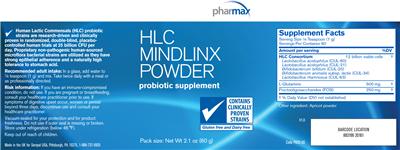
Supplement Facts
The label details for HLC MindLinx Powder by Pharmax, sourced from the NIH Dietary Supplement Label Database.
Supplement Facts
| Ingredient | Amount | % DV |
|---|---|---|
| L-Glutamine | 500 mg | -- |
| Fructooligosaccharides | 250 mg | -- |
| Bifidobacterium bifidum (CUL 20) | 0 NP | -- |
| Lactobacillus acidophilus (CUL 60) | 0 NP | -- |
| Bifidobacterium animalis subsp. lactis (CUL 34) | 0 NP | -- |
| Lactobacillus acidophilus (CUL-21) | 0 NP | -- |
| HLC Consortium | 0 NP | -- |
| Lactobacillus rhamnosus (CUL 63) | 0 NP | -- |
Other ingredients: Apricot powder
Tap any ingredient to jump to its full detail below.
These statements are the manufacturer’s wording, reproduced from the product label — the label is saying it, not HelloPharmacist. We don’t verify or endorse them.
Precautions
If you are pregnant or breastfeeding, consult your healthcare practitioner prior to use.
If symptoms of digestive upset occur, worsen or persist beyond three days, discontinue use and consult healthcare practitioner.
Vacuum-sealed for your protection and for product freshness. Do not use if outer seal is missing or broken.
Keep out of reach of children.
Risk information: If you have an immune-compromised condition, do not use.
Storage
Store under refrigeration (below 46(0)F).
FDA Statement of Identity
probiotic supplement
Seals/Symbols
Contains Clinically Proven Strains
Formulation
Gluten free and Dairy free
General Statements
Pack Size: Net Wt 2.1 oz (60g)
General
V1.0 Code PB20-60
Formula
Human Lactic Commensals (HLC) probiotic strains are research-driven and clinically proven in randomized, double-blind, placebo-controlled human trials at 25 billion CFU per day. Proprietary non-pathogenic human-sourced microflora bacterial strains are utilized as they have strong epithelial adherence and a naturally high tolerance to stomach acid.
Suggested/Recommended/Usage/Directions
Recommended adult intake: In a glass, add water to 1/4 teaspoon (1g) and mix. Take twice daily with a meal or as professionally directed.
Is this label outdated? Report a formula or label change and our pharmacy team will review it.
HLC MindLinx Powder by Pharmax label
The label scan from the NIH Dietary Supplement Label Database. Tap to enlarge.
Label images are published by the NIH Dietary Supplement Label Database for the version of this product on file. Always read your actual product label.
View the full label (PDF)The Ingredients in HLC MindLinx Powder by Pharmax
These are the 7 active ingredients this product is made of. Select any to open its full monograph.
Serving size0.25 tsp Dosage formPowder Servings per container60 Amounts shown are per serving.
Most supplement products combine several ingredients, and a medication can interact with the product through any one of them. Each ingredient below shows whether it has known drug interactions.
L-Glutamine
Interacts with50 drugs
Glutamine is the most abundant amino acid in the body and is usually made in your muscles. A prescription form is FDA-approved to help reduce sickle c...
L-Glutamine monograph & interactionsFructooligosaccharides
No knowninteractions
Fructo-oligosaccharides (FOS) are a type of soluble fiber that acts as a prebiotic, meaning they feed the helpful bacteria in your gut. They are gener...
Fructooligosaccharides monograph & interactionsHLC Consortium
- › Bifidobacterium bifidum (CUL 20)
- › Lactobacillus acidophilus (CUL 60)
- › Bifidobacterium animalis subsp. lactis (CUL 34)
- › Lactobacillus acidophilus (CUL-21)
- › Lactobacillus rhamnosus (CUL 63)
Other (inactive) ingredients: Apricot powder. These complete the product’s ingredient list but are not active constituents.
HLC MindLinx Powder by Pharmax Drug Interactions
HLC MindLinx Powder contains 7 ingredients, and 4 of them have known drug interactions. Altogether they interact with 232 medications. Here’s the picture, then you can look up your own drug.
Want to check YOUR meds against HLC MindLinx Powder?
Ask about interactions with your drugs in plain English — “Can I take it with lisinopril?” — and we find you the answer in seconds, ingredient by ingredient.
Go to the checkerIngredients driving the most interactions
Individual Drug Interactions
The ingredients in HLC MindLinx Powder interact with 232 drugs. Click any drug to see the details.
4 of the 7 ingredients in HLC MindLinx Powder interact with drugs. Each result below shows which ingredient is responsible. Bifidobacterium bifidum (CUL 20) Lactobacillus acidophilus (CUL 60) Bifidobacterium animalis subsp. lactis (CUL 34) L-Glutamine
ClinafloxacinClinafloxacin
How Clinafloxacin interacts with HLC MindLinx Powder — through 3 ingredients. Tap an ingredient for the detail:
Bifidobacterium Animalis Subsp. Lactis (cul 34)Antibiotic Drugs Moderate
Interaction Summary
Theoretically, taking Bifidobacterium lactis with antibiotic drugs might decrease the effectiveness of B.
Read the full Bifidobacterium Animalis Subsp. Lactis (cul 34) + Clinafloxacin interactionBifidobacterium Bifidum (cul 20)Antibiotic Drugs Moderate
Interaction Summary
Theoretically, taking Bifidobacterium.
Read the full Bifidobacterium Bifidum (cul 20) + Clinafloxacin interactionLactobacillus Acidophilus (cul-21)Antibiotic Drugs Moderate
Interaction Summary
Theoretically, taking Lactobacillus acidophilus with antibiotic drugs might decrease the effectiveness of L.
Read the full Lactobacillus Acidophilus (cul-21) + Clinafloxacin interactionClindamycinCleocin, Cleocin T Gel, ClindaMax, Clindesse, Dalacin C
How Clindamycin interacts with HLC MindLinx Powder — through 3 ingredients. Tap an ingredient for the detail:
Lactobacillus Acidophilus (cul-21)Antibiotic Drugs Moderate
Interaction Summary
Theoretically, taking Lactobacillus acidophilus with antibiotic drugs might decrease the effectiveness of L.
Read the full Lactobacillus Acidophilus (cul-21) + Clindamycin interactionBifidobacterium Animalis Subsp. Lactis (cul 34)Antibiotic Drugs Moderate
Interaction Summary
Theoretically, taking Bifidobacterium lactis with antibiotic drugs might decrease the effectiveness of B.
Read the full Bifidobacterium Animalis Subsp. Lactis (cul 34) + Clindamycin interactionBifidobacterium Bifidum (cul 20)Antibiotic Drugs Moderate
Interaction Summary
Theoretically, taking Bifidobacterium.
Read the full Bifidobacterium Bifidum (cul 20) + Clindamycin interactionClobazamFrisium, Onfi, Sympazan
How Clobazam interacts with HLC MindLinx Powder — through 1 ingredient. Tap an ingredient for the detail:
L-glutamineAnticonvulsants Moderate
Interaction Summary
Theoretically, glutamine might antagonize the effects of anticonvulsant medications.
Read the full L-glutamine + Clobazam interactionClofazimineLamprene
How Clofazimine interacts with HLC MindLinx Powder — through 3 ingredients. Tap an ingredient for the detail:
Lactobacillus Acidophilus (cul-21)Antibiotic Drugs Moderate
Interaction Summary
Theoretically, taking Lactobacillus acidophilus with antibiotic drugs might decrease the effectiveness of L.
Read the full Lactobacillus Acidophilus (cul-21) + Clofazimine interactionBifidobacterium Animalis Subsp. Lactis (cul 34)Antibiotic Drugs Moderate
Interaction Summary
Theoretically, taking Bifidobacterium lactis with antibiotic drugs might decrease the effectiveness of B.
Read the full Bifidobacterium Animalis Subsp. Lactis (cul 34) + Clofazimine interactionBifidobacterium Bifidum (cul 20)Antibiotic Drugs Moderate
Interaction Summary
Theoretically, taking Bifidobacterium.
Read the full Bifidobacterium Bifidum (cul 20) + Clofazimine interactionClonazepamCeberclon, Klonopin, Rivotril
How Clonazepam interacts with HLC MindLinx Powder — through 1 ingredient. Tap an ingredient for the detail:
L-glutamineAnticonvulsants Moderate
Interaction Summary
Theoretically, glutamine might antagonize the effects of anticonvulsant medications.
Read the full L-glutamine + Clonazepam interactionClorazepateTranxene, Tranxene SD, Tranxene T-Tab
How Clorazepate interacts with HLC MindLinx Powder — through 1 ingredient. Tap an ingredient for the detail:
L-glutamineAnticonvulsants Moderate
Interaction Summary
Theoretically, glutamine might antagonize the effects of anticonvulsant medications.
Read the full L-glutamine + Clorazepate interactionCloxacillin SodiumCloxapen, Cloxi, Tegopen
How Cloxacillin Sodium interacts with HLC MindLinx Powder — through 3 ingredients. Tap an ingredient for the detail:
Lactobacillus Acidophilus (cul-21)Antibiotic Drugs Moderate
Interaction Summary
Theoretically, taking Lactobacillus acidophilus with antibiotic drugs might decrease the effectiveness of L.
Read the full Lactobacillus Acidophilus (cul-21) + Cloxacillin Sodium interactionBifidobacterium Animalis Subsp. Lactis (cul 34)Antibiotic Drugs Moderate
Interaction Summary
Theoretically, taking Bifidobacterium lactis with antibiotic drugs might decrease the effectiveness of B.
Read the full Bifidobacterium Animalis Subsp. Lactis (cul 34) + Cloxacillin Sodium interactionBifidobacterium Bifidum (cul 20)Antibiotic Drugs Moderate
Interaction Summary
Theoretically, taking Bifidobacterium.
Read the full Bifidobacterium Bifidum (cul 20) + Cloxacillin Sodium interactionColistimethateColy-Mycin M
How Colistimethate interacts with HLC MindLinx Powder — through 3 ingredients. Tap an ingredient for the detail:
Bifidobacterium Animalis Subsp. Lactis (cul 34)Antibiotic Drugs Moderate
Interaction Summary
Theoretically, taking Bifidobacterium lactis with antibiotic drugs might decrease the effectiveness of B.
Read the full Bifidobacterium Animalis Subsp. Lactis (cul 34) + Colistimethate interactionLactobacillus Acidophilus (cul-21)Antibiotic Drugs Moderate
Interaction Summary
Theoretically, taking Lactobacillus acidophilus with antibiotic drugs might decrease the effectiveness of L.
Read the full Lactobacillus Acidophilus (cul-21) + Colistimethate interactionBifidobacterium Bifidum (cul 20)Antibiotic Drugs Moderate
Interaction Summary
Theoretically, taking Bifidobacterium.
Read the full Bifidobacterium Bifidum (cul 20) + Colistimethate interactionCyclacillinCyclapen-W, Cylcapen
How Cyclacillin interacts with HLC MindLinx Powder — through 3 ingredients. Tap an ingredient for the detail:
Bifidobacterium Animalis Subsp. Lactis (cul 34)Antibiotic Drugs Moderate
Interaction Summary
Theoretically, taking Bifidobacterium lactis with antibiotic drugs might decrease the effectiveness of B.
Read the full Bifidobacterium Animalis Subsp. Lactis (cul 34) + Cyclacillin interactionBifidobacterium Bifidum (cul 20)Antibiotic Drugs Moderate
Interaction Summary
Theoretically, taking Bifidobacterium.
Read the full Bifidobacterium Bifidum (cul 20) + Cyclacillin interactionLactobacillus Acidophilus (cul-21)Antibiotic Drugs Moderate
Interaction Summary
Theoretically, taking Lactobacillus acidophilus with antibiotic drugs might decrease the effectiveness of L.
Read the full Lactobacillus Acidophilus (cul-21) + Cyclacillin interactionCycloserineSeromycin
How Cycloserine interacts with HLC MindLinx Powder — through 3 ingredients. Tap an ingredient for the detail:
Lactobacillus Acidophilus (cul-21)Antibiotic Drugs Moderate
Interaction Summary
Theoretically, taking Lactobacillus acidophilus with antibiotic drugs might decrease the effectiveness of L.
Read the full Lactobacillus Acidophilus (cul-21) + Cycloserine interactionBifidobacterium Animalis Subsp. Lactis (cul 34)Antibiotic Drugs Moderate
Interaction Summary
Theoretically, taking Bifidobacterium lactis with antibiotic drugs might decrease the effectiveness of B.
Read the full Bifidobacterium Animalis Subsp. Lactis (cul 34) + Cycloserine interactionBifidobacterium Bifidum (cul 20)Antibiotic Drugs Moderate
Interaction Summary
Theoretically, taking Bifidobacterium.
Read the full Bifidobacterium Bifidum (cul 20) + Cycloserine interactionDalbavancin HydrochlorideDalvance
How Dalbavancin Hydrochloride interacts with HLC MindLinx Powder — through 3 ingredients. Tap an ingredient for the detail:
Bifidobacterium Animalis Subsp. Lactis (cul 34)Antibiotic Drugs Moderate
Interaction Summary
Theoretically, taking Bifidobacterium lactis with antibiotic drugs might decrease the effectiveness of B.
Read the full Bifidobacterium Animalis Subsp. Lactis (cul 34) + Dalbavancin Hydrochloride interactionBifidobacterium Bifidum (cul 20)Antibiotic Drugs Moderate
Interaction Summary
Theoretically, taking Bifidobacterium.
Read the full Bifidobacterium Bifidum (cul 20) + Dalbavancin Hydrochloride interactionLactobacillus Acidophilus (cul-21)Antibiotic Drugs Moderate
Interaction Summary
Theoretically, taking Lactobacillus acidophilus with antibiotic drugs might decrease the effectiveness of L.
Read the full Lactobacillus Acidophilus (cul-21) + Dalbavancin Hydrochloride interactionDapsoneAczone, Avlosulfon, Dapsone
How Dapsone interacts with HLC MindLinx Powder — through 3 ingredients. Tap an ingredient for the detail:
Lactobacillus Acidophilus (cul-21)Antibiotic Drugs Moderate
Interaction Summary
Theoretically, taking Lactobacillus acidophilus with antibiotic drugs might decrease the effectiveness of L.
Read the full Lactobacillus Acidophilus (cul-21) + Dapsone interactionBifidobacterium Animalis Subsp. Lactis (cul 34)Antibiotic Drugs Moderate
Interaction Summary
Theoretically, taking Bifidobacterium lactis with antibiotic drugs might decrease the effectiveness of B.
Read the full Bifidobacterium Animalis Subsp. Lactis (cul 34) + Dapsone interactionBifidobacterium Bifidum (cul 20)Antibiotic Drugs Moderate
Interaction Summary
Theoretically, taking Bifidobacterium.
Read the full Bifidobacterium Bifidum (cul 20) + Dapsone interactionDaptomycinCubicin, Dapzura RT
How Daptomycin interacts with HLC MindLinx Powder — through 3 ingredients. Tap an ingredient for the detail:
Bifidobacterium Animalis Subsp. Lactis (cul 34)Antibiotic Drugs Moderate
Interaction Summary
Theoretically, taking Bifidobacterium lactis with antibiotic drugs might decrease the effectiveness of B.
Read the full Bifidobacterium Animalis Subsp. Lactis (cul 34) + Daptomycin interactionLactobacillus Acidophilus (cul-21)Antibiotic Drugs Moderate
Interaction Summary
Theoretically, taking Lactobacillus acidophilus with antibiotic drugs might decrease the effectiveness of L.
Read the full Lactobacillus Acidophilus (cul-21) + Daptomycin interactionBifidobacterium Bifidum (cul 20)Antibiotic Drugs Moderate
Interaction Summary
Theoretically, taking Bifidobacterium.
Read the full Bifidobacterium Bifidum (cul 20) + Daptomycin interactionDemeclocyclineDeclomycin
How Demeclocycline interacts with HLC MindLinx Powder — through 3 ingredients. Tap an ingredient for the detail:
Bifidobacterium Animalis Subsp. Lactis (cul 34)Antibiotic Drugs Moderate
Interaction Summary
Theoretically, taking Bifidobacterium lactis with antibiotic drugs might decrease the effectiveness of B.
Read the full Bifidobacterium Animalis Subsp. Lactis (cul 34) + Demeclocycline interactionBifidobacterium Bifidum (cul 20)Antibiotic Drugs Moderate
Interaction Summary
Theoretically, taking Bifidobacterium.
Read the full Bifidobacterium Bifidum (cul 20) + Demeclocycline interactionLactobacillus Acidophilus (cul-21)Antibiotic Drugs Moderate
Interaction Summary
Theoretically, taking Lactobacillus acidophilus with antibiotic drugs might decrease the effectiveness of L.
Read the full Lactobacillus Acidophilus (cul-21) + Demeclocycline interactionDiazepamDiastat AcuDial, Valium, Valium injection, Valtoco
How Diazepam interacts with HLC MindLinx Powder — through 1 ingredient. Tap an ingredient for the detail:
L-glutamineAnticonvulsants Moderate
Interaction Summary
Theoretically, glutamine might antagonize the effects of anticonvulsant medications.
Read the full L-glutamine + Diazepam interactionDicloxacillin InjectionDynapen Injection
How Dicloxacillin Injection interacts with HLC MindLinx Powder — through 3 ingredients. Tap an ingredient for the detail:
Lactobacillus Acidophilus (cul-21)Antibiotic Drugs Moderate
Interaction Summary
Theoretically, taking Lactobacillus acidophilus with antibiotic drugs might decrease the effectiveness of L.
Read the full Lactobacillus Acidophilus (cul-21) + Dicloxacillin Injection interactionBifidobacterium Bifidum (cul 20)Antibiotic Drugs Moderate
Interaction Summary
Theoretically, taking Bifidobacterium.
Read the full Bifidobacterium Bifidum (cul 20) + Dicloxacillin Injection interactionBifidobacterium Animalis Subsp. Lactis (cul 34)Antibiotic Drugs Moderate
Interaction Summary
Theoretically, taking Bifidobacterium lactis with antibiotic drugs might decrease the effectiveness of B.
Read the full Bifidobacterium Animalis Subsp. Lactis (cul 34) + Dicloxacillin Injection interactionDicloxacillin SodiumDycill, Dynapen, Pathocil, Pathocil Injection
How Dicloxacillin Sodium interacts with HLC MindLinx Powder — through 3 ingredients. Tap an ingredient for the detail:
Bifidobacterium Animalis Subsp. Lactis (cul 34)Antibiotic Drugs Moderate
Interaction Summary
Theoretically, taking Bifidobacterium lactis with antibiotic drugs might decrease the effectiveness of B.
Read the full Bifidobacterium Animalis Subsp. Lactis (cul 34) + Dicloxacillin Sodium interactionBifidobacterium Bifidum (cul 20)Antibiotic Drugs Moderate
Interaction Summary
Theoretically, taking Bifidobacterium.
Read the full Bifidobacterium Bifidum (cul 20) + Dicloxacillin Sodium interactionLactobacillus Acidophilus (cul-21)Antibiotic Drugs Moderate
Interaction Summary
Theoretically, taking Lactobacillus acidophilus with antibiotic drugs might decrease the effectiveness of L.
Read the full Lactobacillus Acidophilus (cul-21) + Dicloxacillin Sodium interactionDirithromycinDynabac
How Dirithromycin interacts with HLC MindLinx Powder — through 3 ingredients. Tap an ingredient for the detail:
Lactobacillus Acidophilus (cul-21)Antibiotic Drugs Moderate
Interaction Summary
Theoretically, taking Lactobacillus acidophilus with antibiotic drugs might decrease the effectiveness of L.
Read the full Lactobacillus Acidophilus (cul-21) + Dirithromycin interactionBifidobacterium Animalis Subsp. Lactis (cul 34)Antibiotic Drugs Moderate
Interaction Summary
Theoretically, taking Bifidobacterium lactis with antibiotic drugs might decrease the effectiveness of B.
Read the full Bifidobacterium Animalis Subsp. Lactis (cul 34) + Dirithromycin interactionBifidobacterium Bifidum (cul 20)Antibiotic Drugs Moderate
Interaction Summary
Theoretically, taking Bifidobacterium.
Read the full Bifidobacterium Bifidum (cul 20) + Dirithromycin interactionDivalproex SodiumDepakote
How Divalproex Sodium interacts with HLC MindLinx Powder — through 1 ingredient. Tap an ingredient for the detail:
L-glutamineAnticonvulsants Moderate
Interaction Summary
Theoretically, glutamine might antagonize the effects of anticonvulsant medications.
Read the full L-glutamine + Divalproex Sodium interactionDoripenemDoribax
How Doripenem interacts with HLC MindLinx Powder — through 3 ingredients. Tap an ingredient for the detail:
Lactobacillus Acidophilus (cul-21)Antibiotic Drugs Moderate
Interaction Summary
Theoretically, taking Lactobacillus acidophilus with antibiotic drugs might decrease the effectiveness of L.
Read the full Lactobacillus Acidophilus (cul-21) + Doripenem interactionBifidobacterium Bifidum (cul 20)Antibiotic Drugs Moderate
Interaction Summary
Theoretically, taking Bifidobacterium.
Read the full Bifidobacterium Bifidum (cul 20) + Doripenem interactionBifidobacterium Animalis Subsp. Lactis (cul 34)Antibiotic Drugs Moderate
Interaction Summary
Theoretically, taking Bifidobacterium lactis with antibiotic drugs might decrease the effectiveness of B.
Read the full Bifidobacterium Animalis Subsp. Lactis (cul 34) + Doripenem interactionDoxycyclineDoryx, Doxy, Doxy-D, Doxycin, Doxycycline Injection, Doxylin +6 more
How Doxycycline interacts with HLC MindLinx Powder — through 3 ingredients. Tap an ingredient for the detail:
Bifidobacterium Animalis Subsp. Lactis (cul 34)Antibiotic Drugs Moderate
Interaction Summary
Theoretically, taking Bifidobacterium lactis with antibiotic drugs might decrease the effectiveness of B.
Read the full Bifidobacterium Animalis Subsp. Lactis (cul 34) + Doxycycline interactionBifidobacterium Bifidum (cul 20)Antibiotic Drugs Moderate
Interaction Summary
Theoretically, taking Bifidobacterium.
Read the full Bifidobacterium Bifidum (cul 20) + Doxycycline interactionLactobacillus Acidophilus (cul-21)Antibiotic Drugs Moderate
Interaction Summary
Theoretically, taking Lactobacillus acidophilus with antibiotic drugs might decrease the effectiveness of L.
Read the full Lactobacillus Acidophilus (cul-21) + Doxycycline interactionDoxycycline HyclateActiclate, Acticlate Cap, Lymepak
How Doxycycline Hyclate interacts with HLC MindLinx Powder — through 3 ingredients. Tap an ingredient for the detail:
Lactobacillus Acidophilus (cul-21)Antibiotic Drugs Moderate
Interaction Summary
Theoretically, taking Lactobacillus acidophilus with antibiotic drugs might decrease the effectiveness of L.
Read the full Lactobacillus Acidophilus (cul-21) + Doxycycline Hyclate interactionBifidobacterium Animalis Subsp. Lactis (cul 34)Antibiotic Drugs Moderate
Interaction Summary
Theoretically, taking Bifidobacterium lactis with antibiotic drugs might decrease the effectiveness of B.
Read the full Bifidobacterium Animalis Subsp. Lactis (cul 34) + Doxycycline Hyclate interactionBifidobacterium Bifidum (cul 20)Antibiotic Drugs Moderate
Interaction Summary
Theoretically, taking Bifidobacterium.
Read the full Bifidobacterium Bifidum (cul 20) + Doxycycline Hyclate interactionDoxycycline MonohydrateErfacea
How Doxycycline Monohydrate interacts with HLC MindLinx Powder — through 3 ingredients. Tap an ingredient for the detail:
Bifidobacterium Bifidum (cul 20)Antibiotic Drugs Moderate
Interaction Summary
Theoretically, taking Bifidobacterium.
Read the full Bifidobacterium Bifidum (cul 20) + Doxycycline Monohydrate interactionLactobacillus Acidophilus (cul-21)Antibiotic Drugs Moderate
Interaction Summary
Theoretically, taking Lactobacillus acidophilus with antibiotic drugs might decrease the effectiveness of L.
Read the full Lactobacillus Acidophilus (cul-21) + Doxycycline Monohydrate interactionBifidobacterium Animalis Subsp. Lactis (cul 34)Antibiotic Drugs Moderate
Interaction Summary
Theoretically, taking Bifidobacterium lactis with antibiotic drugs might decrease the effectiveness of B.
Read the full Bifidobacterium Animalis Subsp. Lactis (cul 34) + Doxycycline Monohydrate interactionDoxycylineDoxychel
How Doxycyline interacts with HLC MindLinx Powder — through 3 ingredients. Tap an ingredient for the detail:
Bifidobacterium Animalis Subsp. Lactis (cul 34)Antibiotic Drugs Moderate
Interaction Summary
Theoretically, taking Bifidobacterium lactis with antibiotic drugs might decrease the effectiveness of B.
Read the full Bifidobacterium Animalis Subsp. Lactis (cul 34) + Doxycyline interactionBifidobacterium Bifidum (cul 20)Antibiotic Drugs Moderate
Interaction Summary
Theoretically, taking Bifidobacterium.
Read the full Bifidobacterium Bifidum (cul 20) + Doxycyline interactionLactobacillus Acidophilus (cul-21)Antibiotic Drugs Moderate
Interaction Summary
Theoretically, taking Lactobacillus acidophilus with antibiotic drugs might decrease the effectiveness of L.
Read the full Lactobacillus Acidophilus (cul-21) + Doxycyline interactionEnoxacinPenetrex
How Enoxacin interacts with HLC MindLinx Powder — through 3 ingredients. Tap an ingredient for the detail:
Lactobacillus Acidophilus (cul-21)Antibiotic Drugs Moderate
Interaction Summary
Theoretically, taking Lactobacillus acidophilus with antibiotic drugs might decrease the effectiveness of L.
Read the full Lactobacillus Acidophilus (cul-21) + Enoxacin interactionBifidobacterium Animalis Subsp. Lactis (cul 34)Antibiotic Drugs Moderate
Interaction Summary
Theoretically, taking Bifidobacterium lactis with antibiotic drugs might decrease the effectiveness of B.
Read the full Bifidobacterium Animalis Subsp. Lactis (cul 34) + Enoxacin interactionBifidobacterium Bifidum (cul 20)Antibiotic Drugs Moderate
Interaction Summary
Theoretically, taking Bifidobacterium.
Read the full Bifidobacterium Bifidum (cul 20) + Enoxacin interactionEphedrine, Phenobarbital, TheophyllineTedral
How Ephedrine, Phenobarbital, Theophylline interacts with HLC MindLinx Powder — through 1 ingredient. Tap an ingredient for the detail:
L-glutamineAnticonvulsants Moderate
Interaction Summary
Theoretically, glutamine might antagonize the effects of anticonvulsant medications.
Read the full L-glutamine + Ephedrine, Phenobarbital, Theophylline interactionErtapenemInvanz
How Ertapenem interacts with HLC MindLinx Powder — through 3 ingredients. Tap an ingredient for the detail:
Lactobacillus Acidophilus (cul-21)Antibiotic Drugs Moderate
Interaction Summary
Theoretically, taking Lactobacillus acidophilus with antibiotic drugs might decrease the effectiveness of L.
Read the full Lactobacillus Acidophilus (cul-21) + Ertapenem interactionBifidobacterium Bifidum (cul 20)Antibiotic Drugs Moderate
Interaction Summary
Theoretically, taking Bifidobacterium.
Read the full Bifidobacterium Bifidum (cul 20) + Ertapenem interactionBifidobacterium Animalis Subsp. Lactis (cul 34)Antibiotic Drugs Moderate
Interaction Summary
Theoretically, taking Bifidobacterium lactis with antibiotic drugs might decrease the effectiveness of B.
Read the full Bifidobacterium Animalis Subsp. Lactis (cul 34) + Ertapenem interactionErythromycinE-Mycin, Ery-Tab, Eryc, EryPed Chewable, Erythro Base, Erythro E-C +6 more
How Erythromycin interacts with HLC MindLinx Powder — through 3 ingredients. Tap an ingredient for the detail:
Bifidobacterium Animalis Subsp. Lactis (cul 34)Antibiotic Drugs Moderate
Interaction Summary
Theoretically, taking Bifidobacterium lactis with antibiotic drugs might decrease the effectiveness of B.
Read the full Bifidobacterium Animalis Subsp. Lactis (cul 34) + Erythromycin interactionLactobacillus Acidophilus (cul-21)Antibiotic Drugs Moderate
Interaction Summary
Theoretically, taking Lactobacillus acidophilus with antibiotic drugs might decrease the effectiveness of L.
Read the full Lactobacillus Acidophilus (cul-21) + Erythromycin interactionBifidobacterium Bifidum (cul 20)Antibiotic Drugs Moderate
Interaction Summary
Theoretically, taking Bifidobacterium.
Read the full Bifidobacterium Bifidum (cul 20) + Erythromycin interactionErythromycin EthylsuccinateE.E.S. 400, E.E.S. Chewable, Wyamycin S
How Erythromycin Ethylsuccinate interacts with HLC MindLinx Powder — through 3 ingredients. Tap an ingredient for the detail:
Bifidobacterium Bifidum (cul 20)Antibiotic Drugs Moderate
Interaction Summary
Theoretically, taking Bifidobacterium.
Read the full Bifidobacterium Bifidum (cul 20) + Erythromycin Ethylsuccinate interactionBifidobacterium Animalis Subsp. Lactis (cul 34)Antibiotic Drugs Moderate
Interaction Summary
Theoretically, taking Bifidobacterium lactis with antibiotic drugs might decrease the effectiveness of B.
Read the full Bifidobacterium Animalis Subsp. Lactis (cul 34) + Erythromycin Ethylsuccinate interactionLactobacillus Acidophilus (cul-21)Antibiotic Drugs Moderate
Interaction Summary
Theoretically, taking Lactobacillus acidophilus with antibiotic drugs might decrease the effectiveness of L.
Read the full Lactobacillus Acidophilus (cul-21) + Erythromycin Ethylsuccinate interactionErythromycin Ethylsuccinate, SulfisoxazolePediazole
How Erythromycin Ethylsuccinate, Sulfisoxazole interacts with HLC MindLinx Powder — through 3 ingredients. Tap an ingredient for the detail:
Lactobacillus Acidophilus (cul-21)Antibiotic Drugs Moderate
Interaction Summary
Theoretically, taking Lactobacillus acidophilus with antibiotic drugs might decrease the effectiveness of L.
Read the full Lactobacillus Acidophilus (cul-21) + Erythromycin Ethylsuccinate, Sulfisoxazole interactionBifidobacterium Bifidum (cul 20)Antibiotic Drugs Moderate
Interaction Summary
Theoretically, taking Bifidobacterium.
Read the full Bifidobacterium Bifidum (cul 20) + Erythromycin Ethylsuccinate, Sulfisoxazole interactionBifidobacterium Animalis Subsp. Lactis (cul 34)Antibiotic Drugs Moderate
Interaction Summary
Theoretically, taking Bifidobacterium lactis with antibiotic drugs might decrease the effectiveness of B.
Read the full Bifidobacterium Animalis Subsp. Lactis (cul 34) + Erythromycin Ethylsuccinate, Sulfisoxazole interactionEach ingredient & the kinds of drugs it affects
For each ingredient in HLC MindLinx Powder with known interactions, here are the types of medications they can affect. Open any type for the detail — or search your exact drug in the checker above.
Bifidobacterium bifidum (CUL 20)
Antibiotic Drugs
Theoretically, taking Bifidobacterium. bifidum with antibiotic drugs might decrease the effectiveness of B. bifidum.
Since B. bifidum preparations usually contain live and active organisms, simultaneously taking antibiotics might kill a significant number of the organisms. Tell patients to separate administration of antibiotics and B. bifidum preparations by at least 2 hours.
Lactobacillus acidophilus (CUL 60)
Antibiotic Drugs
Theoretically, taking Lactobacillus acidophilus with antibiotic drugs might decrease the effectiveness of L. acidophilus.
L. acidophilus preparations usually contain live and active organisms. Therefore, simultaneously taking antibiotics might kill a significant number of the organisms. Tell patients to separate administration of antibiotics and L. acidophilus preparations by at least two hours.
Bifidobacterium animalis subsp. lactis (CUL 34)
Antibiotic Drugs
Theoretically, taking Bifidobacterium lactis with antibiotic drugs might decrease the effectiveness of B. lactis.
Since B. lactis preparations usually contain live and active organisms, simultaneously taking antibiotics might kill a significant number of the organisms. Tell patients to separate administration of antibiotics and B. lactis preparations by at least 2 hours.
L-Glutamine
Anticonvulsants
Theoretically, glutamine might antagonize the effects of anticonvulsant medications.
Glutamine is metabolized to the excitatory neurotransmitter glutamate. Glutamate might have antagonistic effects with anticonvulsant drugs. However, this interaction has not yet been reported in humans.
Brand information
Manufacturer and brand details for HLC MindLinx Powder, from the product label.
Pharmax
See all Pharmax products- Name
- Seroyal USA
- City
- Pittsburgh
- State
- PA
- ZipCode
- 15275
- Phone Number
- 1-888-737-6925
- Web Address
- seroyal.com
HLC MindLinx Powder by Pharmax: Common Questions
Does HLC MindLinx Powder by Pharmax interact with any medications?
How can one product interact with so many drugs?
Where does this information come from?
Written and reviewed by the HelloPharmacist editorial staff. Our editorial policy
Not sure if HLC MindLinx Powder is safe with your meds?
Our pharmacists answer your medication & supplement questions — free.
Label information is sourced from the NIH Dietary Supplement Label Database and reflects the product version on file; always read your actual product label. This page is for education only and is not a substitute for professional medical advice. Confirm with your pharmacist or doctor before combining supplements and medications.
The Full Monographs Behind HLC MindLinx Powder’s Ingredients
Every ingredient we hold a full HelloPharmacist monograph for — uses, evidence, safety, and the complete interaction list.
Glutamine
Interacts with 50 drugsGlutamine is the most abundant amino acid in the body and is usually made in your muscles. A prescription form is FDA-approved to help reduce sickle cell disease complications, but for most...
Read the full Glutamine monograph → Herb & supplement monographFructo-oligosaccharides (fos)
Fructo-oligosaccharides (FOS) are a type of soluble fiber that acts as a prebiotic, meaning they feed the helpful bacteria in your gut. They are generally considered safe for most people in...
Read the full Fructo-oligosaccharides (fos) monograph → Herb & supplement monographBifidobacterium Bifidum
Interacts with 182 drugsBifidobacterium bifidum is a 'friendly' bacteria (probiotic) that naturally lives in the human gut and is taken to support digestion and gut balance. Some evidence suggests probiotics may he...
Read the full Bifidobacterium Bifidum monograph → Herb & supplement monographLactobacillus Acidophilus
Interacts with 182 drugsLactobacillus acidophilus is a 'friendly' bacterium used as a probiotic to support gut and vaginal health. It is generally well tolerated in healthy people, and there is reasonable evidence...
Read the full Lactobacillus Acidophilus monograph → Herb & supplement monographBifidobacterium Animalis Subsp. Lactis
Interacts with 182 drugsBifidobacterium animalis subsp. lactis is a well-studied probiotic bacterium commonly added to supplements and yogurts to support digestion and gut health. It appears generally safe for most...
Read the full Bifidobacterium Animalis Subsp. Lactis monograph →Sources & How We Checked
HLC MindLinx Powder's label data comes from the NIH Dietary Supplement Label Database; the ingredient interaction data is from the Natural Medicines database, reviewed by our pharmacists.
- NIH Dietary Supplement Label Database (DSLD) — The official product label on file for this supplement.
- Natural Medicines (Therapeutic Research Center) — Evidence-graded clinical reference behind the ingredient interaction data.
Content is written and reviewed by licensed HelloPharmacist pharmacists. See our data sources and editorial standards for how this information is built and checked.
The 47 references behind this product’s interaction data
Every citation that drives the interaction findings for this product’s ingredients, from the evidence-graded Natural Medicines (TRC Healthcare) database. Open an ingredient to browse its citations — links open the study on PubMed or the publisher’s site.
Glutamine 11 references
- Miller AL. Therapeutic considerations of L-glutamine: a review of the literature. Altern Med Rev 1999;4:239-48..
- Bozzetti F, Biganzoli L, Gavazzi C, et al. Glutamine supplementation in cancer patients receiving chemotherapy: a double-blind randomized study. Nutrition 1997;13:748-51.. PubMed
- Mebane AH. L-Glutamine and mania. Am J Psychiatry 984;141:1302-3.
- Meldrum BS. Glutamate as a neurotransmitter in the brain: review of physiology and pathology. J Nutr 2000;130:1007S-15S.. PubMed
- Garlick PJ. Assessment of the safety of glutamine and other amino acids. J Nutr 2001;131:2556S-61S.. PubMed
- Chapman AG. Glutamate and epilepsy. J Nutr 2000;130:1043S-5S.. PubMed
- Ziegler TR. Glutamine supplementation in cancer patients receiving bone marrow transplantation and high dose chemotherapy. J Nutr 2001;131:2578S-84S.. PubMed
- Laviano A, Molfino A, Lacaria MT, Canelli A, De Leo S, Preziosa I, Rossi Fanelli F. Glutamine supplementation favors weight loss in nondieting obese female patients. A pilot study. Eur J Clin Nutr. 2014 Nov;68(11):1264-6. PubMed
- Endari (l-glutamine) [package insert]. Torrance, CA: Emmaus Medical,Inc; 2017.
- Niihara Y, Miller ST, Kanter J, et al. A Phase 3 Trial of l-Glutamine in Sickle Cell Disease. N Engl J Med 2018;379(3):226-35. doi: 10.1056/NEJMoa1715971.
- Ogden HB, Child RB, Fallowfield JL, et al. Gastrointestinal Tolerance of Low, Medium and High Dose Acute Oral l-Glutamine Supplementation in Healthy Adults: A Pilot Study. Nutrients. 2020;12(10):2953. PubMed
Fructo-oligosaccharides (fos) 6 references
- Briet F, et al. Symptomatic response to varying levels of fructo-oligosaccharides consumed occasionally or regularly. Eur J Clin Nutr 1995;49:501-7.
- Bouhnik Y, Vahedi K, Achour L, et al. Short-chain fructo-oligosaccharide administration dose-dependently increases fecal bifidobacteria in healthy humans. J Nutr 1999;129:113-6. PubMed
- Cummings JH, Macfarlane GT, Englyst HN. Prebiotic digestion and fermentation. Am J Clin Nutr 2001;73:415S-420S. PubMed
- Souza DDS, Tahan S, Weber TK, Araujo-Filho HB, de Morais MB. Randomized, double-blind, placebo-controlled parallel clinical trial assessing the effect of fructooligosaccharides in infants with constipation. Nutrients. 2018;10(11). pii: E1602. PubMed
- Andermann TM, Fouladi F, Tamburini FB, et al. A Fructo-Oligosaccharide Prebiotic Is Well Tolerated in Adults Undergoing Allogeneic Hematopoietic Stem Cell Transplantation: A Phase I Dose-Escalation Trial. Transplant Cell Ther 2021;27(11):932. PubMed
- Dou Y, Yu X, Luo Y, Chen B, Ma D, Zhu J. Effect of Fructooligosaccharides Supplementation on the Gut Microbiota in Human: A Systematic Review and Meta-Analysis. Nutrients 2022;14(16):3298. PubMed
See these in context on the Fructo-oligosaccharides (fos) monograph →
Bifidobacterium Bifidum 7 references
- Pierce A. The American Pharmaceutical Association Practical Guide to Natural Medicines. New York: The Stonesong Press, 1999:19.
- Xiao JZ, Takahashi S, Odamaki T, et al. Antibiotic susceptibility of bifidobacterial strains distributed in the Japanese market. Biosci Biotechnol Biochem. 2010;74(2):336-42. PubMed
- Rerksuppaphol S, Rerksuppaphol L. Randomized controlled trial of probiotics to reduce common cold in schoolchildren. Pediatr Int. 2012;54(5):682-7. PubMed
- Karamali M, Dadkhah F, Sadrkhanlou M, et al. Effects of probiotic supplementation on glycaemic control and lipid profiles in gestational diabetes: a randomized, double-blind, placebo-controlled trial. Diabetes Metab 2016;42(4):234-41. PubMed
- Badehnoosh B, Karamali M, Zarrati M, et al. The effects of probiotic supplementation on biomarkers of inflammation, oxidative stress and pregnancy outcomes in gestational diabetes. J Matern Fetal Neonatal Med. 2018 May;31(9):1128-1136.
- Pruccoli G, Silvestro E, Pace Napoleone C, Aidala E, Garazzino S, Scolfaro C. Are probiotics safe? Bifidobacterium bacteremia in a child with severe heart failure. Infez Med. 2019;27(2):175-178.
- Esaiassen E, Hjerde E, Cavanagh JP, Simonsen GS, Klingenberg C; Norwegian Study Group on Invasive Bifidobacterial Infections. Bifidobacterium bacteremia: Clinical characteristics and a genomic approach to assess pathogenicity. J Clin Microbiol. 2017;55(7) PubMed
See these in context on the Bifidobacterium Bifidum monograph →
Lactobacillus Acidophilus 15 references
- Pierce A. The American Pharmaceutical Association Practical Guide to Natural Medicines. New York: The Stonesong Press, 1999:19.
- Begtrup LM, de Muckadell OB, Kjeldsen J, Christensen RD, Jarbøl DE. Long-term treatment with probiotics in primary care patients with irritable bowel syndrome--a randomised, double-blind, placebo controlled trial. Scand J Gastroenterol 2013;48(10):1127-35 PubMed
- Chatterjee S, Kar P, Das T, Ray S, Gangulyt S, Rajendiran C, Mitra M. Randomised placebo-controlled double blind multicentric trial on efficacy and safety of Lactobacillus acidophilus LA-5 and Bifidobacterium BB-12 for prevention of antibiotic-associated
- Shavakhi A, Tabesh E, Yaghoutkar A, Hashemi H, Tabesh F, Khodadoostan M,Minakari M, Shavakhi S, Gholamrezaei A. The effects of multistrain probiotic compound on bismuth-containing quadruple therapy for Helicobacter pylori infection: a randomized placebo-c
- Karamali M, Dadkhah F, Sadrkhanlou M, et al. Effects of probiotic supplementation on glycaemic control and lipid profiles in gestational diabetes: a randomized, double-blind, placebo-controlled trial. Diabetes Metab 2016;42(4):234-41. PubMed
- Badehnoosh B, Karamali M, Zarrati M, et al. The effects of probiotic supplementation on biomarkers of inflammation, oxidative stress and pregnancy outcomes in gestational diabetes. J Matern Fetal Neonatal Med. 2018 May;31(9):1128-1136.
- Kumar S, Kumar R, Rohilla L, Jacob N, Yadav J, Sachdeva N. A high potency multi-strain probiotic improves glycemic control in children with new-onset type 1 diabetes mellitus: A randomized, double-blind, and placebo-controlled pilot study. Pediatr Diabete
- Shahriari A, Karimi E, Shahriari M, Aslani N, Khooshideh M, Arab A. The effect of probiotic supplementation on the risk of gestational diabetes mellitus among high-risk pregnant women: A parallel double-blind, randomized, placebo-controlled clinical trial PubMed
- Xiao SD, Zhang DZ, Lu H, et al. Multicenter, randomized, controlled trial of heat-killed Lactobacillus acidophilus LB in patients with chronic diarrhea. Adv Ther. 2003;20(5):253-60.
- Rossi F, Amadoro C, Gasperi M, Colavita G. Lactobacilli infection case reports in the last three years and safety implications. Nutrients. 2022;14(6):1178. PubMed
- Ozer M, Goksu SY, Shahverdiani A, Mustafa M. Lactobacillus acidophilus-induced endocarditis and associated splenic abscess. Case Rep Infect Dis 2020;2020:1382709.
- Sadrin S, Sennoune S, Gout B, et al. A 2-strain mixture of Lactobacillus acidophilus in the treatment of irritable bowel syndrome: A placebo-controlled randomized clinical trial. Dig Liver Dis 2020;52(5):534-540. PubMed
- Stoffer JN, Slingsby TJ, Giuliari GP. Lactobacillus acidophilus endophthalmitis after intravitreal bevacizumab injection requiring intraocular lens explantation. Can J Ophthalmol 2022;57(1):e21-e22. PubMed
- Cukovic-Cavka S, Likic R, Francetic I, Rustemovic N, Opacic M, Vucelic B. Lactobacillus acidophilus as a cause of liver abscess in a NOD2/CARD15-positive patient with Crohn's disease. Digestion 2006;73(2-3):107-10.
- Hui J, Ren Y, Wang Y, Han Q. Lactobacillus acidophilus endophthalmitis postcataract operation: A case report with a literature review. Ocul Immunol Inflamm 2023.
See these in context on the Lactobacillus Acidophilus monograph →
Bifidobacterium Animalis Subsp. Lactis 8 references
- Pierce A. The American Pharmaceutical Association Practical Guide to Natural Medicines. New York: The Stonesong Press, 1999:19.
- Phuapradit P, Varavithya W, Vathanophas K, et al. Reduction of rotavirus infection in children receiving bifidobacteria-supplemented formula. J Med Assoc Thai 1999;82:S43-8.
- Xiao JZ, Takahashi S, Odamaki T, et al. Antibiotic susceptibility of bifidobacterial strains distributed in the Japanese market. Biosci Biotechnol Biochem. 2010;74(2):336-42. PubMed
- Begtrup LM, de Muckadell OB, Kjeldsen J, Christensen RD, Jarbøl DE. Long-term treatment with probiotics in primary care patients with irritable bowel syndrome--a randomised, double-blind, placebo controlled trial. Scand J Gastroenterol 2013;48(10):1127-35 PubMed
- Taipale TJ, Pienihäkkinen K, Isolauri E, Jokela JT, Söderling EM. Bifidobacterium animalis subsp. lactis BB-12 in reducing the risk of infections in early childhood. Pediatr Res. 2016;79(1-1):65-9. PubMed
- Amat-Bou M, Garcia-Ribera S, Climent E, et al. Effects of Bifidobacterium animalis Subsp. lactis (BPL1) supplementation in children and adolescents with prader-willi syndrome: A randomized crossover trial. Nutrients. 2020;12(10):3123. PubMed
- Mäkelä SM, Forssten SD, Kailajärvi M, et al. Effects of Bifidobacterium animalis ssp. lactis 420 on gastrointestinal inflammation induced by a nonsteroidal anti-inflammatory drug: A randomized, placebo-controlled, double-blind clinical trial. Br J Clin Ph
- Wildt S, Munck LK, Vinter-Jensen L, et al. Probiotic treatment of collagenous colitis: a randomized, double-blind, placebo-controlled trial with Lactobacillus acidophilus and Bifidobacterium animalis subsp. Lactis. Inflamm Bowel Dis 2006;12(5):395-401. PubMed
See these in context on the Bifidobacterium Animalis Subsp. Lactis monograph →
Parts of this content are provided by the Therapeutic Research Center, LLC.
DISCLAIMER: Currently this does not check for drug-drug interactions. This is not an all-inclusive comprehensive list of potential interactions and is for informational purposes only. Not all interactions are known or well-reported in the scientific literature, and new interactions are continually being reported. Input is needed from a qualified healthcare provider including a pharmacist before starting any therapy. Application of clinical judgment is necessary.
© 2021 Therapeutic Research Center, LLC