
Kidney Tonic Ingredients & Drug Interactions
by Herbs Etc.
What is this page for?
First and foremost: checking Kidney Tonic against your medications. The heart of this page is the interaction checker and the full interaction report — how this product’s ingredients may interact with prescription and over-the-counter medicines you may be taking.
Around that, we add a pharmacist’s high-level view of the product as a whole — what’s inside, the evidence for its stated use, how transparent the label is, and what safety data exists — so you can see the full picture in one place. It’s educational information from our licensed clinical databases and the clinical staff at HelloPharmacist — not medical advice — and we don’t sell or endorse products. Our editorial policy
Kidney Tonic is a dietary supplement by Herbs Etc. with 10 active ingredients. Its ingredients are commonly taken for water retention (diuretic), digestive upset and bloating, urinary tract support.Based on those ingredients, 1,233 medications have a known interaction with it, the most serious rated moderate. The ingredients most likely to interact are Uva-Ursi leaf extract, Cubeb Berry Extract, Boldo leaf extract. Use the checker below to test your specific medication, or read the full HelloPharmacist Interaction Report.
Check Your Meds Against Kidney Tonic by Herbs Etc.
Ask about any prescription or over-the-counter medication and we check it for interactions with Kidney Tonic by Herbs Etc. — and tell you which ingredient is responsible.
AI summaries are generated from our interaction database for education only — always confirm with your pharmacist. How we use AI
Ask the Pharmacist
A licensed pharmacist will answer your question by email — free, usually within 24 hours.
Got it — thank you!
A licensed pharmacist will answer within 24 hours. Keep an eye on your email (worth checking spam, just in case).
HelloPharmacist Scorecard of Kidney Tonic by Herbs Etc.
Our pharmacy team’s full take, with four database checks built into the cards below — a summary of what is known, not a grade of the product itself.
What’s inside
Low disclosure
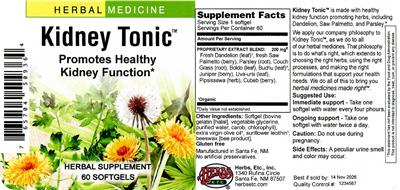
Kidney Tonic contains 10 active herbal ingredients: juniper berry extract, buchu leaf extract, boldo leaf extract, uva ursi leaf extract, pipsissewa herb extract, couch grass root extract, dandelion leaf extract (fresh), cubeb berry extract, saw palmetto berry extract (fresh), and parsley root extract. A proprietary extract blend is also listed; we hold limited data on its individual components.
The product includes several inactive ingredients (fillers and binders): bovine gelatin, glycerin, purified water, carob, chlorophyll, extra virgin olive oil, sunflower lecithin, and beeswax.
Does it work?
Not established
The evidence supporting these ingredients for their traditional uses is limited. Juniper berry, buchu, boldo, pipsissewa, and couch grass root have no established effectiveness ratings in our data.
Uva ursi is rated possibly ineffective for urinary tract infections, its primary traditional use. Dandelion and parsley lack reliable evidence for their claimed benefits.
Saw palmetto is rated possibly ineffective for benign prostate enlargement and possibly effective only for a specific surgical procedure (transurethral resection of the prostate). Overall, the research foundation for this product's claimed kidney-support role is not established in the data we hold.
How safe is it?
Well-documented data
Most of these ingredients are generally well tolerated in short-term, low-dose use, but several carry cautions. Juniper and uva ursi should not be used long-term due to the risk of kidney irritation or toxicity.
Buchu and boldo pose a liver concern—boldo contains ascaridole, a known liver toxin, with reported cases of elevated liver enzymes and jaundice. Uva ursi and pipsissewa may cause hydroquinone toxicity with chronic use, marked by tinnitus, vomiting, delirium, and convulsions.
Common short-term side effects across ingredients include stomach upset, nausea, diarrhea, and headache; parsley and dandelion may rarely trigger allergic reactions including anaphylaxis in sensitive people. During pregnancy, juniper, buchu, boldo, uva ursi, pipsissewa, couch grass, dandelion, cubeb, and saw palmetto are all advised against due to potential uterine stimulation or lack of safety data.
While breastfeeding, all these ingredients lack sufficient safety information and should be avoided. Parsley in normal food amounts is likely acceptable, but medicinal doses are not advised during pregnancy, and concentrated supplements are not recommended while breastfeeding.
Meds to double-check
Moderate interaction found
Before taking Kidney Tonic, check with your pharmacist if you take blood thinners like warfarin, clopidogrel, or heparin (Major/Moderate risk of bleeding); antidiabetes drugs (Moderate risk of low blood sugar); lithium (Moderate risk of toxicity); liver-toxic medications; heart drugs or immunosuppressants like tacrolimus; diuretics or blood pressure drugs; or acid-reducing medications like omeprazole or famotidine. Dandelion and parsley also interact with quinolone antibiotics and certain CYP1A2 medications.
No interactions are documented for pipsissewa or couch grass, but we hold limited data on both.
The bottom line
Scorecard at a glanceFormula with limited ingredient disclosure with no established evidence rating for its marketed use. Moderate medication interactions have been identified, and safety information is well characterized.
This is a traditional herbal blend with no established evidence of effectiveness for kidney health. If you take blood thinners, diabetes medications, lithium, heart drugs, immunosuppressants, or acid-reducing medications, you must check this product against your specific prescriptions before starting.
Women who are pregnant or breastfeeding should not use it. Talk to your pharmacist or doctor before adding Kidney Tonic to your routine, especially if you have liver or kidney problems or take any regular medications.
Educational only — not medical advice; always confirm with your pharmacist. Our editorial policy · How we use AI
Assessment coverage: 10 of 10 active ingredients matched to our full ingredient reviews (monographs). Based on the product label dated Jul 24, 2025.
This Scorecard evaluates available label information, ingredient evidence, and known medication-safety considerations. It does not independently verify product identity, purity, potency, contamination, or manufacturing quality. How these ratings are computed
General information
Key facts about Kidney Tonic, straight from the product label.
| Brand | Herbs Etc. |
|---|---|
| Barcode (UPC) | 765704509364 |
| Net contents | 60 Softgel(s) |
| Market status | On market |
| Date entered into DSLD | Jul 24, 2025 |
| DSLD ID | 333396 |
| Product type | Botanical |
| Supplement form | Softgel Capsule |
| Dietary claims / uses | All Other, Structure/Function |
| Intended target group(s) | Adult (18 - 50 Years), Women (not pregnant or lactating), Gluten Free |
Everything in this section is reproduced from the manufacturer’s own product label — it’s the label speaking, not HelloPharmacist. We show it so you can see exactly what the maker states; we don’t verify or endorse those statements.
Supplement Facts
The label details for Kidney Tonic by Herbs Etc., sourced from the NIH Dietary Supplement Label Database.
Supplement Facts
| Ingredient | Amount | % DV |
|---|---|---|
| Juniper berry extract | 0 NP | -- |
| Proprietary Extract Blend | 200 mg | -- |
| Buchu leaf extract | 0 NP | -- |
| Boldo leaf extract | 0 NP | -- |
| Uva-Ursi leaf extract | 0 NP | -- |
| Pipsissewa herb extract | 0 NP | -- |
| Couch Grass Root Extract | 0 NP | -- |
| Dandelion Leaf Extract, Fresh | 0 NP | -- |
| Cubeb Berry Extract | 0 NP | -- |
| Saw Palmetto Berry Extract, Fresh | 0 NP | -- |
| Parsley Root Extract | 0 NP | -- |
Other ingredients: Bovine Gelatin, Glycerin, Water, Purified, Carob, Chlorophyll, Extra Virgin Olive Oil, Sunflower Lecithin, Beeswax
Tap any ingredient to jump to its full detail below.
These statements are the manufacturer’s wording, reproduced from the product label — the label is saying it, not HelloPharmacist. We don’t verify or endorse them.
Formulation
Promotes healthy kidney function
Gluten free No artificial preservatives.
Manufactured in Santa Fe, NM.
FDA Statement of Identity
Herbal Supplement
Formula
Kidney Tonic is made with healthy kidney function promoting herbs, including Dandelion, Saw Palmetto, and Parsley.
General Statements
We apply our company philosophy to Kidney Tonic, as we do to all of our herbal medicines. That philosophy is to do what's right, which extends to choosing the right herbs, using the right processes, and making the right formulations that support your health needs. We do all of this to bring you herbal medicines made right.
Herbal Medicine
Suggested/Recommended/Usage/Directions
Suggested use: Immediate support - Take one softgel with water every four hours. Ongoing support - Take one softgel with water twice a day.
Precautions
Caution: Do not use during pregnancy.
Side effects: A peculiar urine smell and color may occur.
FDA Disclaimer Statement
This statement has not been evaluated by the Food and Drug Administration. This product is not intended to diagnose, treat, cure, or prevent any disease.
Is this label outdated? Report a formula or label change and our pharmacy team will review it.
Kidney Tonic by Herbs Etc. label
The label scan from the NIH Dietary Supplement Label Database. Tap to enlarge.
Label images are published by the NIH Dietary Supplement Label Database for the version of this product on file. Always read your actual product label.
View the full label (PDF)The Ingredients in Kidney Tonic by Herbs Etc.
These are the 10 active ingredients this product is made of. Select any to open its full monograph.
Serving size1 Softgel(s) Dosage formSoftgel Capsule Servings per container60 Amounts shown are per serving.
Most supplement products combine several ingredients, and a medication can interact with the product through any one of them. Each ingredient below shows whether it has known drug interactions.
Other (inactive) ingredients: Bovine Gelatin, Glycerin, Water, Purified, Carob, Chlorophyll, Extra Virgin Olive Oil, Sunflower Lecithin, Beeswax. These complete the product’s ingredient list but are not active constituents.
Kidney Tonic by Herbs Etc. Drug Interactions
HelloPharmacist Interaction Report
Kidney Tonic by Herbs Etc. contains multiple ingredients with documented interactions affecting medications.
The most serious concern is with blood thinners (anticoagulants and antiplatelet drugs), where several ingredients—buchu, boldo, dandelion, saw palmetto, and parsley—may enhance bleeding risk at Major or Moderate severity.
Read the full breakdown — every affected drug type, severity by severity
Additionally, this product affects blood sugar management (antidiabetes drugs) through juniper and dandelion; liver function through buchu and boldo, which carry the risk of liver damage; kidney function through diuretic interactions in juniper, buchu, boldo, dandelion, and parsley; and lithium levels through juniper, buchu, boldo, dandelion, and parsley. Boldo poses a specific Moderate risk with the immunosuppressant tacrolimus and with warfarin.
Uva ursi and cubebs may inhibit how your liver breaks down certain medications (CYP450 pathways and glucuronidated drugs). Dandelion and parsley may interact with quinolone antibiotics and CYP1A2 substrates, respectively.
Cubebs may reduce effectiveness of acid-reducing medications.
We could not check pipsissewa, couch grass root, or the proprietary extract blend itself for drug interactions because our data on those are limited. Run your exact medications through the interaction checker below before taking this product.
Altogether, these interactions span 1,212 individual medications.
Check your own medications below · Editorial policy · How we use AI
Want to check YOUR meds against Kidney Tonic?
Ask about interactions with your drugs in plain English — “Can I take it with lisinopril?” — and we find you the answer in seconds, ingredient by ingredient.
Go to the checkerIngredients driving the most interactions
Individual Drug Interactions
The ingredients in Kidney Tonic interact with 1,233 drugs. Click any drug to see the details.
8 of the 10 ingredients in Kidney Tonic interact with drugs. Each result below shows which ingredient is responsible. Uva-Ursi leaf extract Cubeb Berry Extract Boldo leaf extract Buchu leaf extract Dandelion Leaf Extract, Fresh Parsley Root Extract Saw Palmetto Berry Extract, Fresh Juniper berry extract
6-mercaptopurinePurinethol
How 6-mercaptopurine interacts with Kidney Tonic — through 2 ingredients. Tap an ingredient for the detail:
Boldo Leaf ExtractHepatotoxic Drugs Moderate
Interaction Summary
Theoretically, taking boldo with hepatotoxic drugs might increase the risk of hepatic injury and disease.
Read the full Boldo Leaf Extract + 6-mercaptopurine interactionBuchu Leaf ExtractHepatotoxic Drugs Moderate
Interaction Summary
Buchu contains pulegone, a known hepatotoxin.
Read the full Buchu Leaf Extract + 6-mercaptopurine interactionAdo-trastuzumab EmtansineKadcyla
How Ado-trastuzumab Emtansine interacts with Kidney Tonic — through 2 ingredients. Tap an ingredient for the detail:
Cubeb Berry ExtractCytochrome P450 3a4 (cyp3a4) Substrates Moderate
Interaction Summary
Several compounds isolated from cubebs can inhibit cytochrome P450 3A4 (CYP3A4) in vitro.
Read the full Cubeb Berry Extract + Ado-trastuzumab Emtansine interactionUva-ursi Leaf ExtractCytochrome P450 3a4 (cyp3a4) Substrates Moderate
Interaction Summary
Theoretically, uva ursi may decrease the metabolism of CYP3A4 substrates.
Read the full Uva-ursi Leaf Extract + Ado-trastuzumab Emtansine interactionAbacavir Sulfate, Dolutegravir, LamivudineTriumeq
How Abacavir Sulfate, Dolutegravir, Lamivudine interacts with Kidney Tonic — through 2 ingredients. Tap an ingredient for the detail:
Buchu Leaf ExtractHepatotoxic Drugs Moderate
Interaction Summary
Buchu contains pulegone, a known hepatotoxin.
Read the full Buchu Leaf Extract + Abacavir Sulfate, Dolutegravir, Lamivudine interactionBoldo Leaf ExtractHepatotoxic Drugs Moderate
Interaction Summary
Theoretically, taking boldo with hepatotoxic drugs might increase the risk of hepatic injury and disease.
Read the full Boldo Leaf Extract + Abacavir Sulfate, Dolutegravir, Lamivudine interactionAbacavir, LamivudineEpzicom
How Abacavir, Lamivudine interacts with Kidney Tonic — through 2 ingredients. Tap an ingredient for the detail:
Boldo Leaf ExtractHepatotoxic Drugs Moderate
Interaction Summary
Theoretically, taking boldo with hepatotoxic drugs might increase the risk of hepatic injury and disease.
Read the full Boldo Leaf Extract + Abacavir, Lamivudine interactionBuchu Leaf ExtractHepatotoxic Drugs Moderate
Interaction Summary
Buchu contains pulegone, a known hepatotoxin.
Read the full Buchu Leaf Extract + Abacavir, Lamivudine interactionAbciximabReoPro
How Abciximab interacts with Kidney Tonic — through 5 ingredients. Tap an ingredient for the detail:
Buchu Leaf ExtractAnticoagulant/antiplatelet Drugs Moderate
Interaction Summary
Buchu may have antiplatelet effects.
Read the full Buchu Leaf Extract + Abciximab interactionBoldo Leaf ExtractAnticoagulant/antiplatelet Drugs Moderate
Interaction Summary
Theoretically, taking boldo with anticoagulant/antiplatelet drugs might increase the risk of bleeding.
Read the full Boldo Leaf Extract + Abciximab interactionDandelion Leaf Extract, FreshAnticoagulant/antiplatelet Drugs Moderate
Interaction Summary
Theoretically, taking dandelion root along with anticoagulant or antiplatelet drugs might increase the risk of bruising and bleeding.
Read the full Dandelion Leaf Extract, Fresh + Abciximab interactionSaw Palmetto Berry Extract, FreshAnticoagulant/antiplatelet Drugs Moderate
Interaction Summary
Saw palmetto might increase the risk of bleeding with anticoagulant or antiplatelet drugs.
Read the full Saw Palmetto Berry Extract, Fresh + Abciximab interactionParsley Root ExtractAnticoagulant/antiplatelet Drugs Moderate
Interaction Summary
Theoretically, parsley might increase the risk of bleeding when taken with anticoagulant or antiplatelet drugs.
Read the full Parsley Root Extract + Abciximab interactionAbemaciclibVerzenio
How Abemaciclib interacts with Kidney Tonic — through 2 ingredients. Tap an ingredient for the detail:
Uva-ursi Leaf ExtractCytochrome P450 3a4 (cyp3a4) Substrates Moderate
Interaction Summary
Theoretically, uva ursi may decrease the metabolism of CYP3A4 substrates.
Read the full Uva-ursi Leaf Extract + Abemaciclib interactionCubeb Berry ExtractCytochrome P450 3a4 (cyp3a4) Substrates Moderate
Interaction Summary
Several compounds isolated from cubebs can inhibit cytochrome P450 3A4 (CYP3A4) in vitro.
Read the full Cubeb Berry Extract + Abemaciclib interactionAbiraterone
How Abiraterone interacts with Kidney Tonic — through 4 ingredients. Tap an ingredient for the detail:
Boldo Leaf ExtractHepatotoxic Drugs Moderate
Interaction Summary
Theoretically, taking boldo with hepatotoxic drugs might increase the risk of hepatic injury and disease.
Read the full Boldo Leaf Extract + Abiraterone interactionCubeb Berry ExtractCytochrome P450 3a4 (cyp3a4) Substrates Moderate
Interaction Summary
Several compounds isolated from cubebs can inhibit cytochrome P450 3A4 (CYP3A4) in vitro.
Read the full Cubeb Berry Extract + Abiraterone interactionBuchu Leaf ExtractHepatotoxic Drugs Moderate
Interaction Summary
Buchu contains pulegone, a known hepatotoxin.
Read the full Buchu Leaf Extract + Abiraterone interactionUva-ursi Leaf ExtractCytochrome P450 3a4 (cyp3a4) Substrates Moderate
Interaction Summary
Theoretically, uva ursi may decrease the metabolism of CYP3A4 substrates.
Read the full Uva-ursi Leaf Extract + Abiraterone interactionAbiraterone AcetateYonsa, Zytiga
How Abiraterone Acetate interacts with Kidney Tonic — through 4 ingredients. Tap an ingredient for the detail:
Uva-ursi Leaf ExtractCytochrome P450 3a4 (cyp3a4) Substrates Moderate
Interaction Summary
Theoretically, uva ursi may decrease the metabolism of CYP3A4 substrates.
Read the full Uva-ursi Leaf Extract + Abiraterone Acetate interactionBuchu Leaf ExtractHepatotoxic Drugs Moderate
Interaction Summary
Buchu contains pulegone, a known hepatotoxin.
Read the full Buchu Leaf Extract + Abiraterone Acetate interactionBoldo Leaf ExtractHepatotoxic Drugs Moderate
Interaction Summary
Theoretically, taking boldo with hepatotoxic drugs might increase the risk of hepatic injury and disease.
Read the full Boldo Leaf Extract + Abiraterone Acetate interactionCubeb Berry ExtractCytochrome P450 3a4 (cyp3a4) Substrates Moderate
Interaction Summary
Several compounds isolated from cubebs can inhibit cytochrome P450 3A4 (CYP3A4) in vitro.
Read the full Cubeb Berry Extract + Abiraterone Acetate interactionAbrocitinibCibinqo
How Abrocitinib interacts with Kidney Tonic — through 6 ingredients. Tap an ingredient for the detail:
Dandelion Leaf Extract, FreshAnticoagulant/antiplatelet Drugs Moderate
Interaction Summary
Theoretically, taking dandelion root along with anticoagulant or antiplatelet drugs might increase the risk of bruising and bleeding.
Read the full Dandelion Leaf Extract, Fresh + Abrocitinib interactionBoldo Leaf ExtractAnticoagulant/antiplatelet Drugs Moderate
Interaction Summary
Theoretically, taking boldo with anticoagulant/antiplatelet drugs might increase the risk of bleeding.
Read the full Boldo Leaf Extract + Abrocitinib interactionParsley Root ExtractAnticoagulant/antiplatelet Drugs Moderate
Interaction Summary
Theoretically, parsley might increase the risk of bleeding when taken with anticoagulant or antiplatelet drugs.
Read the full Parsley Root Extract + Abrocitinib interactionSaw Palmetto Berry Extract, FreshAnticoagulant/antiplatelet Drugs Moderate
Interaction Summary
Saw palmetto might increase the risk of bleeding with anticoagulant or antiplatelet drugs.
Read the full Saw Palmetto Berry Extract, Fresh + Abrocitinib interactionBuchu Leaf ExtractAnticoagulant/antiplatelet Drugs Moderate
Interaction Summary
Buchu may have antiplatelet effects.
Read the full Buchu Leaf Extract + Abrocitinib interactionUva-ursi Leaf ExtractCytochrome P450 2c19 (cyp2c19) Substrates Moderate
Interaction Summary
Theoretically, uva ursi may decrease the metabolism of CYP2C19 substrates.
Read the full Uva-ursi Leaf Extract + Abrocitinib interactionAcalabrutinibCalquence
How Acalabrutinib interacts with Kidney Tonic — through 2 ingredients. Tap an ingredient for the detail:
Uva-ursi Leaf ExtractCytochrome P450 3a4 (cyp3a4) Substrates, P-glycoprotein Substrates Moderate
Interaction Summary
Theoretically, uva ursi may decrease the metabolism of CYP3A4 substrates.
Read the full Uva-ursi Leaf Extract + Acalabrutinib interactionCubeb Berry ExtractCytochrome P450 3a4 (cyp3a4) Substrates Moderate
Interaction Summary
Several compounds isolated from cubebs can inhibit cytochrome P450 3A4 (CYP3A4) in vitro.
Read the full Cubeb Berry Extract + Acalabrutinib interactionAcarboseGlucobay, Prandase, Precose
How Acarbose interacts with Kidney Tonic — through 5 ingredients. Tap an ingredient for the detail:
Dandelion Leaf Extract, FreshAntidiabetes Drugs Moderate
Interaction Summary
Theoretically, dandelion might increase the risk for hypoglycemia when used with antidiabetes drugs.
Read the full Dandelion Leaf Extract, Fresh + Acarbose interactionBoldo Leaf ExtractHepatotoxic Drugs Moderate
Interaction Summary
Theoretically, taking boldo with hepatotoxic drugs might increase the risk of hepatic injury and disease.
Read the full Boldo Leaf Extract + Acarbose interactionBuchu Leaf ExtractHepatotoxic Drugs Moderate
Interaction Summary
Buchu contains pulegone, a known hepatotoxin.
Read the full Buchu Leaf Extract + Acarbose interactionParsley Root ExtractAntidiabetes Drugs Moderate
Interaction Summary
Theoretically, parsley might increase the risk of hypoglycemia when taken with antidiabetes drugs.
Read the full Parsley Root Extract + Acarbose interactionJuniper Berry ExtractAntidiabetes Drugs Moderate
Interaction Summary
Theoretically, taking juniper berry with antidiabetes medications might cause additive hypoglycemia.
Read the full Juniper Berry Extract + Acarbose interactionAcebutololRhotral, Sectral
How Acebutolol interacts with Kidney Tonic — through 2 ingredients. Tap an ingredient for the detail:
Boldo Leaf ExtractHepatotoxic Drugs Moderate
Interaction Summary
Theoretically, taking boldo with hepatotoxic drugs might increase the risk of hepatic injury and disease.
Read the full Boldo Leaf Extract + Acebutolol interactionBuchu Leaf ExtractHepatotoxic Drugs Moderate
Interaction Summary
Buchu contains pulegone, a known hepatotoxin.
Read the full Buchu Leaf Extract + Acebutolol interactionAcenocoumarolSintrom
How Acenocoumarol interacts with Kidney Tonic — through 5 ingredients. Tap an ingredient for the detail:
Buchu Leaf ExtractAnticoagulant/antiplatelet Drugs Moderate
Interaction Summary
Buchu may have antiplatelet effects.
Read the full Buchu Leaf Extract + Acenocoumarol interactionSaw Palmetto Berry Extract, FreshAnticoagulant/antiplatelet Drugs Moderate
Interaction Summary
Saw palmetto might increase the risk of bleeding with anticoagulant or antiplatelet drugs.
Read the full Saw Palmetto Berry Extract, Fresh + Acenocoumarol interactionParsley Root ExtractAnticoagulant/antiplatelet Drugs Moderate
Interaction Summary
Theoretically, parsley might increase the risk of bleeding when taken with anticoagulant or antiplatelet drugs.
Read the full Parsley Root Extract + Acenocoumarol interactionBoldo Leaf ExtractAnticoagulant/antiplatelet Drugs Moderate
Interaction Summary
Theoretically, taking boldo with anticoagulant/antiplatelet drugs might increase the risk of bleeding.
Read the full Boldo Leaf Extract + Acenocoumarol interactionDandelion Leaf Extract, FreshAnticoagulant/antiplatelet Drugs Moderate
Interaction Summary
Theoretically, taking dandelion root along with anticoagulant or antiplatelet drugs might increase the risk of bruising and bleeding.
Read the full Dandelion Leaf Extract, Fresh + Acenocoumarol interactionAcetaminophenChildren's Tylenol, Children's Tylenol Meltaways, Tylenol, Tylenol Ex Strength
How Acetaminophen interacts with Kidney Tonic — through 5 ingredients. Tap an ingredient for the detail:
Dandelion Leaf Extract, FreshGlucuronidated Drugs, Cytochrome P450 1a2 (cyp1a2) Substrates Moderate
Interaction Summary
Theoretically, dandelion might increase the clearance of drugs that are UDP-glucuronosyltransferase substrates.
Read the full Dandelion Leaf Extract, Fresh + Acetaminophen interactionBoldo Leaf ExtractHepatotoxic Drugs Moderate
Interaction Summary
Theoretically, taking boldo with hepatotoxic drugs might increase the risk of hepatic injury and disease.
Read the full Boldo Leaf Extract + Acetaminophen interactionUva-ursi Leaf ExtractGlucuronidated Drugs Moderate
Interaction Summary
Theoretically, uva ursi may increase levels of drugs metabolized by glucuronidation.
Read the full Uva-ursi Leaf Extract + Acetaminophen interactionBuchu Leaf ExtractHepatotoxic Drugs Moderate
Interaction Summary
Buchu contains pulegone, a known hepatotoxin.
Read the full Buchu Leaf Extract + Acetaminophen interactionParsley Root ExtractCytochrome P450 1a2 (cyp1a2) Substrates Moderate
Interaction Summary
Theoretically, parsley might increase serum levels of CYP1A2 substrates.
Read the full Parsley Root Extract + Acetaminophen interactionAcetaminophen, AspirinGemnisyn
How Acetaminophen, Aspirin interacts with Kidney Tonic — through 6 ingredients. Tap an ingredient for the detail:
Parsley Root ExtractCytochrome P450 1a2 (cyp1a2) Substrates, Anticoagulant/antiplatelet Drugs +1 Moderate
Interaction Summary
Theoretically, parsley might increase serum levels of CYP1A2 substrates.
Read the full Parsley Root Extract + Acetaminophen, Aspirin interactionSaw Palmetto Berry Extract, FreshAnticoagulant/antiplatelet Drugs Moderate
Interaction Summary
Saw palmetto might increase the risk of bleeding with anticoagulant or antiplatelet drugs.
Read the full Saw Palmetto Berry Extract, Fresh + Acetaminophen, Aspirin interactionDandelion Leaf Extract, FreshGlucuronidated Drugs, Cytochrome P450 1a2 (cyp1a2) Substrates +1 Moderate
Interaction Summary
Theoretically, dandelion might increase the clearance of drugs that are UDP-glucuronosyltransferase substrates.
Read the full Dandelion Leaf Extract, Fresh + Acetaminophen, Aspirin interactionBoldo Leaf ExtractHepatotoxic Drugs, Anticoagulant/antiplatelet Drugs Moderate
Interaction Summary
Theoretically, taking boldo with hepatotoxic drugs might increase the risk of hepatic injury and disease.
Read the full Boldo Leaf Extract + Acetaminophen, Aspirin interactionBuchu Leaf ExtractHepatotoxic Drugs, Anticoagulant/antiplatelet Drugs Moderate
Interaction Summary
Buchu contains pulegone, a known hepatotoxin.
Read the full Buchu Leaf Extract + Acetaminophen, Aspirin interactionUva-ursi Leaf ExtractGlucuronidated Drugs Moderate
Interaction Summary
Theoretically, uva ursi may increase levels of drugs metabolized by glucuronidation.
Read the full Uva-ursi Leaf Extract + Acetaminophen, Aspirin interactionAcetaminophen, Aspirin, CaffeineExcedrin, Excedrin Extra Strength, Excedrin Migraine
How Acetaminophen, Aspirin, Caffeine interacts with Kidney Tonic — through 7 ingredients. Tap an ingredient for the detail:
Uva-ursi Leaf ExtractGlucuronidated Drugs, Cytochrome P450 3a4 (cyp3a4) Substrates Moderate
Interaction Summary
Theoretically, uva ursi may increase levels of drugs metabolized by glucuronidation.
Read the full Uva-ursi Leaf Extract + Acetaminophen, Aspirin, Caffeine interactionCubeb Berry ExtractCytochrome P450 3a4 (cyp3a4) Substrates Moderate
Interaction Summary
Several compounds isolated from cubebs can inhibit cytochrome P450 3A4 (CYP3A4) in vitro.
Read the full Cubeb Berry Extract + Acetaminophen, Aspirin, Caffeine interactionBuchu Leaf ExtractHepatotoxic Drugs, Anticoagulant/antiplatelet Drugs Moderate
Interaction Summary
Buchu contains pulegone, a known hepatotoxin.
Read the full Buchu Leaf Extract + Acetaminophen, Aspirin, Caffeine interactionParsley Root ExtractAspirin, Cytochrome P450 1a2 (cyp1a2) Substrates +1 Moderate
Interaction Summary
Theoretically, aspirin might increase the severity of allergic reactions to parsley.
Read the full Parsley Root Extract + Acetaminophen, Aspirin, Caffeine interactionSaw Palmetto Berry Extract, FreshAnticoagulant/antiplatelet Drugs Moderate
Interaction Summary
Saw palmetto might increase the risk of bleeding with anticoagulant or antiplatelet drugs.
Read the full Saw Palmetto Berry Extract, Fresh + Acetaminophen, Aspirin, Caffeine interactionBoldo Leaf ExtractAnticoagulant/antiplatelet Drugs, Hepatotoxic Drugs Moderate
Interaction Summary
Theoretically, taking boldo with anticoagulant/antiplatelet drugs might increase the risk of bleeding.
Read the full Boldo Leaf Extract + Acetaminophen, Aspirin, Caffeine interactionDandelion Leaf Extract, FreshGlucuronidated Drugs, Cytochrome P450 1a2 (cyp1a2) Substrates +1 Moderate
Interaction Summary
Theoretically, dandelion might increase the clearance of drugs that are UDP-glucuronosyltransferase substrates.
Read the full Dandelion Leaf Extract, Fresh + Acetaminophen, Aspirin, Caffeine interactionAcetaminophen, Brompheniramine, PhenylpropanolamineDimetapp Cold and Flu
How Acetaminophen, Brompheniramine, Phenylpropanolamine interacts with Kidney Tonic — through 5 ingredients. Tap an ingredient for the detail:
Dandelion Leaf Extract, FreshCytochrome P450 1a2 (cyp1a2) Substrates, Glucuronidated Drugs Moderate
Interaction Summary
Theoretically, dandelion might increase levels of drugs metabolized by CYP1A2.
Read the full Dandelion Leaf Extract, Fresh + Acetaminophen, Brompheniramine, Phenylpropanolamine interactionBoldo Leaf ExtractHepatotoxic Drugs Moderate
Interaction Summary
Theoretically, taking boldo with hepatotoxic drugs might increase the risk of hepatic injury and disease.
Read the full Boldo Leaf Extract + Acetaminophen, Brompheniramine, Phenylpropanolamine interactionUva-ursi Leaf ExtractGlucuronidated Drugs Moderate
Interaction Summary
Theoretically, uva ursi may increase levels of drugs metabolized by glucuronidation.
Read the full Uva-ursi Leaf Extract + Acetaminophen, Brompheniramine, Phenylpropanolamine interactionBuchu Leaf ExtractHepatotoxic Drugs Moderate
Interaction Summary
Buchu contains pulegone, a known hepatotoxin.
Read the full Buchu Leaf Extract + Acetaminophen, Brompheniramine, Phenylpropanolamine interactionParsley Root ExtractCytochrome P450 1a2 (cyp1a2) Substrates Moderate
Interaction Summary
Theoretically, parsley might increase serum levels of CYP1A2 substrates.
Read the full Parsley Root Extract + Acetaminophen, Brompheniramine, Phenylpropanolamine interactionAcetaminophen, ButalbitalAxocet, Bancap, Bucet, Butex Forte, Esgic CF, Orbivan CF +5 more
How Acetaminophen, Butalbital interacts with Kidney Tonic — through 5 ingredients. Tap an ingredient for the detail:
Parsley Root ExtractCytochrome P450 1a2 (cyp1a2) Substrates Moderate
Interaction Summary
Theoretically, parsley might increase serum levels of CYP1A2 substrates.
Read the full Parsley Root Extract + Acetaminophen, Butalbital interactionDandelion Leaf Extract, FreshGlucuronidated Drugs, Cytochrome P450 1a2 (cyp1a2) Substrates Moderate
Interaction Summary
Theoretically, dandelion might increase the clearance of drugs that are UDP-glucuronosyltransferase substrates.
Read the full Dandelion Leaf Extract, Fresh + Acetaminophen, Butalbital interactionBoldo Leaf ExtractHepatotoxic Drugs Moderate
Interaction Summary
Theoretically, taking boldo with hepatotoxic drugs might increase the risk of hepatic injury and disease.
Read the full Boldo Leaf Extract + Acetaminophen, Butalbital interactionBuchu Leaf ExtractHepatotoxic Drugs Moderate
Interaction Summary
Buchu contains pulegone, a known hepatotoxin.
Read the full Buchu Leaf Extract + Acetaminophen, Butalbital interactionUva-ursi Leaf ExtractGlucuronidated Drugs Moderate
Interaction Summary
Theoretically, uva ursi may increase levels of drugs metabolized by glucuronidation.
Read the full Uva-ursi Leaf Extract + Acetaminophen, Butalbital interactionAcetaminophen, Butalbital, CaffeineEsgic, Esgic Plus, Fiogesic, Fioricet, Repan, Tecnal +1 more
How Acetaminophen, Butalbital, Caffeine interacts with Kidney Tonic — through 6 ingredients. Tap an ingredient for the detail:
Uva-ursi Leaf ExtractGlucuronidated Drugs, Cytochrome P450 3a4 (cyp3a4) Substrates Moderate
Interaction Summary
Theoretically, uva ursi may increase levels of drugs metabolized by glucuronidation.
Read the full Uva-ursi Leaf Extract + Acetaminophen, Butalbital, Caffeine interactionBuchu Leaf ExtractHepatotoxic Drugs Moderate
Interaction Summary
Buchu contains pulegone, a known hepatotoxin.
Read the full Buchu Leaf Extract + Acetaminophen, Butalbital, Caffeine interactionParsley Root ExtractCytochrome P450 1a2 (cyp1a2) Substrates Moderate
Interaction Summary
Theoretically, parsley might increase serum levels of CYP1A2 substrates.
Read the full Parsley Root Extract + Acetaminophen, Butalbital, Caffeine interactionDandelion Leaf Extract, FreshGlucuronidated Drugs, Cytochrome P450 1a2 (cyp1a2) Substrates Moderate
Interaction Summary
Theoretically, dandelion might increase the clearance of drugs that are UDP-glucuronosyltransferase substrates.
Read the full Dandelion Leaf Extract, Fresh + Acetaminophen, Butalbital, Caffeine interactionBoldo Leaf ExtractHepatotoxic Drugs Moderate
Interaction Summary
Theoretically, taking boldo with hepatotoxic drugs might increase the risk of hepatic injury and disease.
Read the full Boldo Leaf Extract + Acetaminophen, Butalbital, Caffeine interactionCubeb Berry ExtractCytochrome P450 3a4 (cyp3a4) Substrates Moderate
Interaction Summary
Several compounds isolated from cubebs can inhibit cytochrome P450 3A4 (CYP3A4) in vitro.
Read the full Cubeb Berry Extract + Acetaminophen, Butalbital, Caffeine interactionAcetaminophen, Butalbital, Caffeine, CodeineEsgic with Codeine, Fioricet w/ Codeine
How Acetaminophen, Butalbital, Caffeine, Codeine interacts with Kidney Tonic — through 6 ingredients. Tap an ingredient for the detail:
Dandelion Leaf Extract, FreshCytochrome P450 1a2 (cyp1a2) Substrates, Glucuronidated Drugs Moderate
Interaction Summary
Theoretically, dandelion might increase levels of drugs metabolized by CYP1A2.
Read the full Dandelion Leaf Extract, Fresh + Acetaminophen, Butalbital, Caffeine, Codeine interactionBoldo Leaf ExtractHepatotoxic Drugs Moderate
Interaction Summary
Theoretically, taking boldo with hepatotoxic drugs might increase the risk of hepatic injury and disease.
Read the full Boldo Leaf Extract + Acetaminophen, Butalbital, Caffeine, Codeine interactionCubeb Berry ExtractCytochrome P450 3a4 (cyp3a4) Substrates Moderate
Interaction Summary
Several compounds isolated from cubebs can inhibit cytochrome P450 3A4 (CYP3A4) in vitro.
Read the full Cubeb Berry Extract + Acetaminophen, Butalbital, Caffeine, Codeine interactionBuchu Leaf ExtractHepatotoxic Drugs Moderate
Interaction Summary
Buchu contains pulegone, a known hepatotoxin.
Read the full Buchu Leaf Extract + Acetaminophen, Butalbital, Caffeine, Codeine interactionUva-ursi Leaf ExtractGlucuronidated Drugs, Cytochrome P450 3a4 (cyp3a4) Substrates Moderate
Interaction Summary
Theoretically, uva ursi may increase levels of drugs metabolized by glucuronidation.
Read the full Uva-ursi Leaf Extract + Acetaminophen, Butalbital, Caffeine, Codeine interactionParsley Root ExtractCytochrome P450 1a2 (cyp1a2) Substrates Moderate
Interaction Summary
Theoretically, parsley might increase serum levels of CYP1A2 substrates.
Read the full Parsley Root Extract + Acetaminophen, Butalbital, Caffeine, Codeine interactionAcetaminophen, Butalbital, CodeineBancap w/ Codeine
How Acetaminophen, Butalbital, Codeine interacts with Kidney Tonic — through 5 ingredients. Tap an ingredient for the detail:
Parsley Root ExtractCytochrome P450 1a2 (cyp1a2) Substrates Moderate
Interaction Summary
Theoretically, parsley might increase serum levels of CYP1A2 substrates.
Read the full Parsley Root Extract + Acetaminophen, Butalbital, Codeine interactionDandelion Leaf Extract, FreshCytochrome P450 1a2 (cyp1a2) Substrates, Glucuronidated Drugs Moderate
Interaction Summary
Theoretically, dandelion might increase levels of drugs metabolized by CYP1A2.
Read the full Dandelion Leaf Extract, Fresh + Acetaminophen, Butalbital, Codeine interactionBoldo Leaf ExtractHepatotoxic Drugs Moderate
Interaction Summary
Theoretically, taking boldo with hepatotoxic drugs might increase the risk of hepatic injury and disease.
Read the full Boldo Leaf Extract + Acetaminophen, Butalbital, Codeine interactionBuchu Leaf ExtractHepatotoxic Drugs Moderate
Interaction Summary
Buchu contains pulegone, a known hepatotoxin.
Read the full Buchu Leaf Extract + Acetaminophen, Butalbital, Codeine interactionUva-ursi Leaf ExtractGlucuronidated Drugs Moderate
Interaction Summary
Theoretically, uva ursi may increase levels of drugs metabolized by glucuronidation.
Read the full Uva-ursi Leaf Extract + Acetaminophen, Butalbital, Codeine interactionAcetaminophen, Butalbital, Codeine PhosphatePhrenilin #3
How Acetaminophen, Butalbital, Codeine Phosphate interacts with Kidney Tonic — through 5 ingredients. Tap an ingredient for the detail:
Uva-ursi Leaf ExtractGlucuronidated Drugs Moderate
Interaction Summary
Theoretically, uva ursi may increase levels of drugs metabolized by glucuronidation.
Read the full Uva-ursi Leaf Extract + Acetaminophen, Butalbital, Codeine Phosphate interactionBuchu Leaf ExtractHepatotoxic Drugs Moderate
Interaction Summary
Buchu contains pulegone, a known hepatotoxin.
Read the full Buchu Leaf Extract + Acetaminophen, Butalbital, Codeine Phosphate interactionParsley Root ExtractCytochrome P450 1a2 (cyp1a2) Substrates Moderate
Interaction Summary
Theoretically, parsley might increase serum levels of CYP1A2 substrates.
Read the full Parsley Root Extract + Acetaminophen, Butalbital, Codeine Phosphate interactionDandelion Leaf Extract, FreshGlucuronidated Drugs, Cytochrome P450 1a2 (cyp1a2) Substrates Moderate
Interaction Summary
Theoretically, dandelion might increase the clearance of drugs that are UDP-glucuronosyltransferase substrates.
Read the full Dandelion Leaf Extract, Fresh + Acetaminophen, Butalbital, Codeine Phosphate interactionBoldo Leaf ExtractHepatotoxic Drugs Moderate
Interaction Summary
Theoretically, taking boldo with hepatotoxic drugs might increase the risk of hepatic injury and disease.
Read the full Boldo Leaf Extract + Acetaminophen, Butalbital, Codeine Phosphate interactionAcetaminophen, Caffeine, Chlorpheniramine, Hydrocodone, PhenylephrineHycomine Compound
How Acetaminophen, Caffeine, Chlorpheniramine, Hydrocodone, Phenylephrine interacts with Kidney Tonic — through 6 ingredients. Tap an ingredient for the detail:
Dandelion Leaf Extract, FreshGlucuronidated Drugs, Cytochrome P450 1a2 (cyp1a2) Substrates Moderate
Interaction Summary
Theoretically, dandelion might increase the clearance of drugs that are UDP-glucuronosyltransferase substrates.
Read the full Dandelion Leaf Extract, Fresh + Acetaminophen, Caffeine, Chlorpheniramine, Hydrocodone, Phenylephrine interactionBoldo Leaf ExtractHepatotoxic Drugs Moderate
Interaction Summary
Theoretically, taking boldo with hepatotoxic drugs might increase the risk of hepatic injury and disease.
Read the full Boldo Leaf Extract + Acetaminophen, Caffeine, Chlorpheniramine, Hydrocodone, Phenylephrine interactionBuchu Leaf ExtractHepatotoxic Drugs Moderate
Interaction Summary
Buchu contains pulegone, a known hepatotoxin.
Read the full Buchu Leaf Extract + Acetaminophen, Caffeine, Chlorpheniramine, Hydrocodone, Phenylephrine interactionUva-ursi Leaf ExtractCytochrome P450 3a4 (cyp3a4) Substrates, Glucuronidated Drugs Moderate
Interaction Summary
Theoretically, uva ursi may decrease the metabolism of CYP3A4 substrates.
Read the full Uva-ursi Leaf Extract + Acetaminophen, Caffeine, Chlorpheniramine, Hydrocodone, Phenylephrine interactionCubeb Berry ExtractCytochrome P450 3a4 (cyp3a4) Substrates Moderate
Interaction Summary
Several compounds isolated from cubebs can inhibit cytochrome P450 3A4 (CYP3A4) in vitro.
Read the full Cubeb Berry Extract + Acetaminophen, Caffeine, Chlorpheniramine, Hydrocodone, Phenylephrine interactionParsley Root ExtractCytochrome P450 1a2 (cyp1a2) Substrates Moderate
Interaction Summary
Theoretically, parsley might increase serum levels of CYP1A2 substrates.
Read the full Parsley Root Extract + Acetaminophen, Caffeine, Chlorpheniramine, Hydrocodone, Phenylephrine interactionAcetaminophen, Caffeine, CodeineGesic C15, Gesic C30, Gesic C8, Lenoltec 1, Lenoltec 2, Lenoltec 3 +1 more
How Acetaminophen, Caffeine, Codeine interacts with Kidney Tonic — through 6 ingredients. Tap an ingredient for the detail:
Parsley Root ExtractCytochrome P450 1a2 (cyp1a2) Substrates Moderate
Interaction Summary
Theoretically, parsley might increase serum levels of CYP1A2 substrates.
Read the full Parsley Root Extract + Acetaminophen, Caffeine, Codeine interactionBoldo Leaf ExtractHepatotoxic Drugs Moderate
Interaction Summary
Theoretically, taking boldo with hepatotoxic drugs might increase the risk of hepatic injury and disease.
Read the full Boldo Leaf Extract + Acetaminophen, Caffeine, Codeine interactionDandelion Leaf Extract, FreshCytochrome P450 1a2 (cyp1a2) Substrates, Glucuronidated Drugs Moderate
Interaction Summary
Theoretically, dandelion might increase levels of drugs metabolized by CYP1A2.
Read the full Dandelion Leaf Extract, Fresh + Acetaminophen, Caffeine, Codeine interactionUva-ursi Leaf ExtractGlucuronidated Drugs, Cytochrome P450 3a4 (cyp3a4) Substrates Moderate
Interaction Summary
Theoretically, uva ursi may increase levels of drugs metabolized by glucuronidation.
Read the full Uva-ursi Leaf Extract + Acetaminophen, Caffeine, Codeine interactionCubeb Berry ExtractCytochrome P450 3a4 (cyp3a4) Substrates Moderate
Interaction Summary
Several compounds isolated from cubebs can inhibit cytochrome P450 3A4 (CYP3A4) in vitro.
Read the full Cubeb Berry Extract + Acetaminophen, Caffeine, Codeine interactionBuchu Leaf ExtractHepatotoxic Drugs Moderate
Interaction Summary
Buchu contains pulegone, a known hepatotoxin.
Read the full Buchu Leaf Extract + Acetaminophen, Caffeine, Codeine interactionAcetaminophen, Caffeine, Codeine, SalicylamideCodalan No.1, Codalan No.2, Codalan No.3
How Acetaminophen, Caffeine, Codeine, Salicylamide interacts with Kidney Tonic — through 6 ingredients. Tap an ingredient for the detail:
Uva-ursi Leaf ExtractCytochrome P450 3a4 (cyp3a4) Substrates, Glucuronidated Drugs Moderate
Interaction Summary
Theoretically, uva ursi may decrease the metabolism of CYP3A4 substrates.
Read the full Uva-ursi Leaf Extract + Acetaminophen, Caffeine, Codeine, Salicylamide interactionBuchu Leaf ExtractHepatotoxic Drugs Moderate
Interaction Summary
Buchu contains pulegone, a known hepatotoxin.
Read the full Buchu Leaf Extract + Acetaminophen, Caffeine, Codeine, Salicylamide interactionParsley Root ExtractCytochrome P450 1a2 (cyp1a2) Substrates Moderate
Interaction Summary
Theoretically, parsley might increase serum levels of CYP1A2 substrates.
Read the full Parsley Root Extract + Acetaminophen, Caffeine, Codeine, Salicylamide interactionDandelion Leaf Extract, FreshGlucuronidated Drugs, Cytochrome P450 1a2 (cyp1a2) Substrates Moderate
Interaction Summary
Theoretically, dandelion might increase the clearance of drugs that are UDP-glucuronosyltransferase substrates.
Read the full Dandelion Leaf Extract, Fresh + Acetaminophen, Caffeine, Codeine, Salicylamide interactionBoldo Leaf ExtractHepatotoxic Drugs Moderate
Interaction Summary
Theoretically, taking boldo with hepatotoxic drugs might increase the risk of hepatic injury and disease.
Read the full Boldo Leaf Extract + Acetaminophen, Caffeine, Codeine, Salicylamide interactionCubeb Berry ExtractCytochrome P450 3a4 (cyp3a4) Substrates Moderate
Interaction Summary
Several compounds isolated from cubebs can inhibit cytochrome P450 3A4 (CYP3A4) in vitro.
Read the full Cubeb Berry Extract + Acetaminophen, Caffeine, Codeine, Salicylamide interactionAcetaminophen, Caffeine, DihydrocodeineDHC Plus, Panlor DC, Panlor SS
How Acetaminophen, Caffeine, Dihydrocodeine interacts with Kidney Tonic — through 6 ingredients. Tap an ingredient for the detail:
Dandelion Leaf Extract, FreshCytochrome P450 1a2 (cyp1a2) Substrates, Glucuronidated Drugs Moderate
Interaction Summary
Theoretically, dandelion might increase levels of drugs metabolized by CYP1A2.
Read the full Dandelion Leaf Extract, Fresh + Acetaminophen, Caffeine, Dihydrocodeine interactionBoldo Leaf ExtractHepatotoxic Drugs Moderate
Interaction Summary
Theoretically, taking boldo with hepatotoxic drugs might increase the risk of hepatic injury and disease.
Read the full Boldo Leaf Extract + Acetaminophen, Caffeine, Dihydrocodeine interactionCubeb Berry ExtractCytochrome P450 3a4 (cyp3a4) Substrates Moderate
Interaction Summary
Several compounds isolated from cubebs can inhibit cytochrome P450 3A4 (CYP3A4) in vitro.
Read the full Cubeb Berry Extract + Acetaminophen, Caffeine, Dihydrocodeine interactionBuchu Leaf ExtractHepatotoxic Drugs Moderate
Interaction Summary
Buchu contains pulegone, a known hepatotoxin.
Read the full Buchu Leaf Extract + Acetaminophen, Caffeine, Dihydrocodeine interactionUva-ursi Leaf ExtractCytochrome P450 3a4 (cyp3a4) Substrates, Glucuronidated Drugs Moderate
Interaction Summary
Theoretically, uva ursi may decrease the metabolism of CYP3A4 substrates.
Read the full Uva-ursi Leaf Extract + Acetaminophen, Caffeine, Dihydrocodeine interactionParsley Root ExtractCytochrome P450 1a2 (cyp1a2) Substrates Moderate
Interaction Summary
Theoretically, parsley might increase serum levels of CYP1A2 substrates.
Read the full Parsley Root Extract + Acetaminophen, Caffeine, Dihydrocodeine interactionAcetaminophen, Caffeine, IsomethepteneMigralam
How Acetaminophen, Caffeine, Isometheptene interacts with Kidney Tonic — through 6 ingredients. Tap an ingredient for the detail:
Parsley Root ExtractCytochrome P450 1a2 (cyp1a2) Substrates Moderate
Interaction Summary
Theoretically, parsley might increase serum levels of CYP1A2 substrates.
Read the full Parsley Root Extract + Acetaminophen, Caffeine, Isometheptene interactionDandelion Leaf Extract, FreshCytochrome P450 1a2 (cyp1a2) Substrates, Glucuronidated Drugs Moderate
Interaction Summary
Theoretically, dandelion might increase levels of drugs metabolized by CYP1A2.
Read the full Dandelion Leaf Extract, Fresh + Acetaminophen, Caffeine, Isometheptene interactionBoldo Leaf ExtractHepatotoxic Drugs Moderate
Interaction Summary
Theoretically, taking boldo with hepatotoxic drugs might increase the risk of hepatic injury and disease.
Read the full Boldo Leaf Extract + Acetaminophen, Caffeine, Isometheptene interactionUva-ursi Leaf ExtractGlucuronidated Drugs, Cytochrome P450 3a4 (cyp3a4) Substrates Moderate
Interaction Summary
Theoretically, uva ursi may increase levels of drugs metabolized by glucuronidation.
Read the full Uva-ursi Leaf Extract + Acetaminophen, Caffeine, Isometheptene interactionCubeb Berry ExtractCytochrome P450 3a4 (cyp3a4) Substrates Moderate
Interaction Summary
Several compounds isolated from cubebs can inhibit cytochrome P450 3A4 (CYP3A4) in vitro.
Read the full Cubeb Berry Extract + Acetaminophen, Caffeine, Isometheptene interactionBuchu Leaf ExtractHepatotoxic Drugs Moderate
Interaction Summary
Buchu contains pulegone, a known hepatotoxin.
Read the full Buchu Leaf Extract + Acetaminophen, Caffeine, Isometheptene interactionAcetaminophen, Caffeine, PyrilamineMidol Max Strength Menstrual
How Acetaminophen, Caffeine, Pyrilamine interacts with Kidney Tonic — through 7 ingredients. Tap an ingredient for the detail:
Uva-ursi Leaf ExtractCytochrome P450 3a4 (cyp3a4) Substrates, Glucuronidated Drugs Moderate
Interaction Summary
Theoretically, uva ursi may decrease the metabolism of CYP3A4 substrates.
Read the full Uva-ursi Leaf Extract + Acetaminophen, Caffeine, Pyrilamine interactionBuchu Leaf ExtractHepatotoxic Drugs Moderate
Interaction Summary
Buchu contains pulegone, a known hepatotoxin.
Read the full Buchu Leaf Extract + Acetaminophen, Caffeine, Pyrilamine interactionParsley Root ExtractCytochrome P450 1a2 (cyp1a2) Substrates, Diuretic Drugs Moderate
Interaction Summary
Theoretically, parsley might increase serum levels of CYP1A2 substrates.
Read the full Parsley Root Extract + Acetaminophen, Caffeine, Pyrilamine interactionDandelion Leaf Extract, FreshGlucuronidated Drugs, Cytochrome P450 1a2 (cyp1a2) Substrates Moderate
Interaction Summary
Theoretically, dandelion might increase the clearance of drugs that are UDP-glucuronosyltransferase substrates.
Read the full Dandelion Leaf Extract, Fresh + Acetaminophen, Caffeine, Pyrilamine interactionBoldo Leaf ExtractHepatotoxic Drugs Moderate
Interaction Summary
Theoretically, taking boldo with hepatotoxic drugs might increase the risk of hepatic injury and disease.
Read the full Boldo Leaf Extract + Acetaminophen, Caffeine, Pyrilamine interactionCubeb Berry ExtractCytochrome P450 3a4 (cyp3a4) Substrates Moderate
Interaction Summary
Several compounds isolated from cubebs can inhibit cytochrome P450 3A4 (CYP3A4) in vitro.
Read the full Cubeb Berry Extract + Acetaminophen, Caffeine, Pyrilamine interactionJuniper Berry ExtractDiuretic Drugs Minor
Interaction Summary
Theoretically, juniper berry might increase the risk of adverse effects from diuretic drugs.
Read the full Juniper Berry Extract + Acetaminophen, Caffeine, Pyrilamine interactionAcetaminophen, Chlorpheniramine Maleate, Dextromethorphan HbrVicks Formula 44M Cough, Cold & Flu Relief
How Acetaminophen, Chlorpheniramine Maleate, Dextromethorphan Hbr interacts with Kidney Tonic — through 6 ingredients. Tap an ingredient for the detail:
Dandelion Leaf Extract, FreshCytochrome P450 1a2 (cyp1a2) Substrates, Glucuronidated Drugs Moderate
Interaction Summary
Theoretically, dandelion might increase levels of drugs metabolized by CYP1A2.
Read the full Dandelion Leaf Extract, Fresh + Acetaminophen, Chlorpheniramine Maleate, Dextromethorphan Hbr interactionBoldo Leaf ExtractHepatotoxic Drugs Moderate
Interaction Summary
Theoretically, taking boldo with hepatotoxic drugs might increase the risk of hepatic injury and disease.
Read the full Boldo Leaf Extract + Acetaminophen, Chlorpheniramine Maleate, Dextromethorphan Hbr interactionCubeb Berry ExtractCytochrome P450 3a4 (cyp3a4) Substrates Moderate
Interaction Summary
Several compounds isolated from cubebs can inhibit cytochrome P450 3A4 (CYP3A4) in vitro.
Read the full Cubeb Berry Extract + Acetaminophen, Chlorpheniramine Maleate, Dextromethorphan Hbr interactionBuchu Leaf ExtractHepatotoxic Drugs Moderate
Interaction Summary
Buchu contains pulegone, a known hepatotoxin.
Read the full Buchu Leaf Extract + Acetaminophen, Chlorpheniramine Maleate, Dextromethorphan Hbr interactionUva-ursi Leaf ExtractCytochrome P450 3a4 (cyp3a4) Substrates, Glucuronidated Drugs Moderate
Interaction Summary
Theoretically, uva ursi may decrease the metabolism of CYP3A4 substrates.
Read the full Uva-ursi Leaf Extract + Acetaminophen, Chlorpheniramine Maleate, Dextromethorphan Hbr interactionParsley Root ExtractCytochrome P450 1a2 (cyp1a2) Substrates Moderate
Interaction Summary
Theoretically, parsley might increase serum levels of CYP1A2 substrates.
Read the full Parsley Root Extract + Acetaminophen, Chlorpheniramine Maleate, Dextromethorphan Hbr interactionAcetaminophen, Chlorpheniramine, Codeine, PhenylephrineColrex
How Acetaminophen, Chlorpheniramine, Codeine, Phenylephrine interacts with Kidney Tonic — through 6 ingredients. Tap an ingredient for the detail:
Parsley Root ExtractCytochrome P450 1a2 (cyp1a2) Substrates Moderate
Interaction Summary
Theoretically, parsley might increase serum levels of CYP1A2 substrates.
Read the full Parsley Root Extract + Acetaminophen, Chlorpheniramine, Codeine, Phenylephrine interactionDandelion Leaf Extract, FreshCytochrome P450 1a2 (cyp1a2) Substrates, Glucuronidated Drugs Moderate
Interaction Summary
Theoretically, dandelion might increase levels of drugs metabolized by CYP1A2.
Read the full Dandelion Leaf Extract, Fresh + Acetaminophen, Chlorpheniramine, Codeine, Phenylephrine interactionBoldo Leaf ExtractHepatotoxic Drugs Moderate
Interaction Summary
Theoretically, taking boldo with hepatotoxic drugs might increase the risk of hepatic injury and disease.
Read the full Boldo Leaf Extract + Acetaminophen, Chlorpheniramine, Codeine, Phenylephrine interactionUva-ursi Leaf ExtractGlucuronidated Drugs, Cytochrome P450 3a4 (cyp3a4) Substrates Moderate
Interaction Summary
Theoretically, uva ursi may increase levels of drugs metabolized by glucuronidation.
Read the full Uva-ursi Leaf Extract + Acetaminophen, Chlorpheniramine, Codeine, Phenylephrine interactionCubeb Berry ExtractCytochrome P450 3a4 (cyp3a4) Substrates Moderate
Interaction Summary
Several compounds isolated from cubebs can inhibit cytochrome P450 3A4 (CYP3A4) in vitro.
Read the full Cubeb Berry Extract + Acetaminophen, Chlorpheniramine, Codeine, Phenylephrine interactionBuchu Leaf ExtractHepatotoxic Drugs Moderate
Interaction Summary
Buchu contains pulegone, a known hepatotoxin.
Read the full Buchu Leaf Extract + Acetaminophen, Chlorpheniramine, Codeine, Phenylephrine interactionEach ingredient & the kinds of drugs it affects
For each ingredient in Kidney Tonic with known interactions, here are the types of medications they can affect. Open any type for the detail — or search your exact drug in the checker above.
Uva-Ursi leaf extract
Cytochrome P450 2C19 (Cyp2C19) Substrates
Theoretically, uva ursi may decrease the metabolism of CYP2C19 substrates.
In vitro, uva ursi appears to inhibit cytochrome CYP2C19. This effect has not been reported in humans.
Cytochrome P450 3A4 (Cyp3A4) Substrates
Theoretically, uva ursi may decrease the metabolism of CYP3A4 substrates.
In vitro, uva ursi appears to inhibit CYP3A4. This effect has not been reported in humans.
Glucuronidated Drugs
Theoretically, uva ursi may increase levels of drugs metabolized by glucuronidation.
In vitro, uva ursi extract appears to strongly inhibit UDP-glucuronosyltransferase (UGT) 1A1 (UGT1A1). However, uva ursi extract does not appear to inhibit UGT1A1 in animal models. This effect has not been reported in humans.
Lithium
Theoretically, uva ursi may increase lithium levels, necessitating a decrease in dose.
Uva ursi may have diuretic properties. Diuretics may increase lithium reabsorption with sodium in the proximal tubule of the kidney. Theoretically, uva ursi might reduce excretion and increase levels of lithium.
Urinary Acidifying Agents
Effects of uva ursi in the urinary tract may be reduced by urinary acidifying agents.
Uva ursi seems to work best in alkaline urine. Theoretically, taking uva ursi with medications known to acidify the urine may decrease any effects of uva ursi on the urinary tract.
P-Glycoprotein Substrates
Theoretically, uva ursi may alter the levels of drugs transported by P-glycoprotein.
In vitro, uva ursi appears to inhibit the multi-drug transporter protein, P-glycoprotein. This effect has not been reported in humans.
Cubeb Berry Extract
Cytochrome P450 3A4 (Cyp3A4) Substrates
Several compounds isolated from cubebs can inhibit cytochrome P450 3A4 (CYP3A4) in vitro. So far, this effect has not been reported in humans. Theoretically, cubebs might increase the effects and side effects of drugs metabolized by CYP3A4. These include lovastatin (Mevacor), clarithromycin (Biaxin), cyclosporine (Neoral, Sandimmune), diltiazem (Cardizem), estrogens, indinavir (Crixivan), triazolam (Halcion), and numerous others.
Antacids
Theoretically, due to reports that cubebs increases stomach acid, cubebs might decrease the effectiveness of antacids.
H2-Blockers
Theoretically, due to reports that cubebs increases stomach acid, cubebs might decrease the effectiveness of H2-blockers. The H2 blockers include cimetidine (Tagamet), ranitidine (Zantac), nizatidine (Axid), and famotidine (Pepcid).
Proton Pump Inhibitors (Ppis)
Theoretically, due to reports that cubebs increases stomach acid, cubebs might decrease the effectiveness of PPIs. PPIs include omeprazole (Prilosec), lansoprazole (Prevacid), rabeprazole (Aciphex), pantoprazole (Protonix), and esomeprazole (Nexium).
Boldo leaf extract
Anticoagulant/Antiplatelet Drugs
Theoretically, taking boldo with anticoagulant/antiplatelet drugs might increase the risk of bleeding.
Animal and in vitro research shows that boldine, a constituent of boldo, has antiplatelet activity. In one case report, an adult taking a combination of boldo and fenugreek with warfarin experienced an increase in international normalized ratio (INR); however, it is unclear if this effect was due to boldo, fenugreek, the combination, or another factor.
Hepatotoxic Drugs
Theoretically, taking boldo with hepatotoxic drugs might increase the risk of hepatic injury and disease.
Boldo leaf contains ascaridole, a known liver toxin. Many cases of hepatotoxicity, including elevated liver transaminase levels and jaundice, have been reported in patients taking boldo.
Lithium
Theoretically, taking boldo with lithium might increase the levels and clinical effects of lithium.
Boldo is believed to have diuretic effects. Theoretically, these diuretic effects might reduce the excretion of lithium. The dose of lithium might need to be decreased.
Tacrolimus (Prograf)
Taking boldo with tacrolimus may decrease the levels and clinical effects of tacrolimus, potentially increasing the risk of transplant rejection.
In one case report, a patient with a long-term history of stable tacrolimus levels developed subtherapeutic levels after taking boldo 300 mg twice daily orally for several weeks. Tacrolimus levels returned to normal after discontinuing boldo. However, the mechanism of this interaction is unclear.
Warfarin (Coumadin)
A combination of boldo and fenugreek was thought to be associated with an increased international normalized ratio (INR) in a female on warfarin. It is not clear if boldo, fenugreek, or the combination played a role in this interaction. Therefore, boldo may have additive effects with warfarin.
Buchu leaf extract
Anticoagulant/Antiplatelet Drugs
Buchu may have antiplatelet effects. Theoretically, buchu may enhance the effects of anticoagulant or antiplatelet drugs and increase the risk of bleeding in some patients. Some anticoagulant or antiplatelet drugs include aspirin, clopidogrel (Plavix), dalteparin (Fragmin), enoxaparin (Lovenox), heparin, ticlopidine (Ticlid), warfarin (Coumadin), and others.
Hepatotoxic Drugs
Buchu contains pulegone, a known hepatotoxin. There is some concern that buchu may adversely affect the liver, especially when the leaf is used in large doses or the oil is ingested. Theoretically, concomitant use with hepatotoxic drugs might increase the risk of liver damage. Some of these drugs include acarbose (Precose, Prandase), amiodarone (Cordarone), atorvastatin (Lipitor), azathioprine (Imuran), carbamazepine (Tegretol), cerivastatin (Baycol), diclofenac (Voltaren), felbamate (Felbatol), fenofibrate (Tricor), fluvastatin (Lescol), gemfibrozil (Lopid), isoniazid, itraconazole, (Sporanox), ketoconazole (Nizoral), leflunomide (Arava), lovastatin (Mevacor), methotrexate (Rheumatrex), nevirapine (Viramune), niacin, nitrofurantoin (Macrodantin), pioglitazone (Actos), pravastatin (Pravachol), pyrazinamide, rifampin (Rifadin), ritonavir (Norvir), rosiglitazone (Avandia), simvastatin (Zocor), tacrine (Cognex), tamoxifen, terbinafine (Lamisil), valproic acid, and zileuton (Zyflo)
Lithium
Buchu is thought to have diuretic properties. Theoretically, buchu might reduce excretion and increase levels of lithium. The dose of lithium might need to be decreased.
Dandelion Leaf Extract, Fresh
Anticoagulant/Antiplatelet Drugs
Theoretically, taking dandelion root along with anticoagulant or antiplatelet drugs might increase the risk of bruising and bleeding.
In vitro research suggests that dandelion root inhibits platelet aggregation.
Antidiabetes Drugs
Theoretically, dandelion might increase the risk for hypoglycemia when used with antidiabetes drugs.
Laboratory research suggests that dandelion extract may have moderate alpha-glucosidase inhibitor activity and might also increase insulin secretion. Also, in a case report, a 58-year-old woman with type 2 diabetes who was being treated with insulin developed hypoglycemia 2 weeks after beginning to eat salads containing dandelion.
Cytochrome P450 1A2 (Cyp1A2) Substrates
Theoretically, dandelion might increase levels of drugs metabolized by CYP1A2.
Laboratory research suggests that dandelion might inhibit CYP1A2. So far, this interaction has not been reported in humans. However, until more is known, watch for an increase in the levels of drugs metabolized by CYP1A2 in patients taking dandelion.
Glucuronidated Drugs
Theoretically, dandelion might increase the clearance of drugs that are UDP-glucuronosyltransferase substrates.
There is some preliminary evidence that dandelion might induce UDP-glucuronosyltransferase, a phase II enzyme.
Lithium
Theoretically, through diuretic effects, dandelion might reduce excretion and increase levels of lithium.
Animal research suggests that dandelion has diuretic properties. As diuretics can increase serum lithium levels, the dose of lithium might need to be decreased when taken with dandelion.
Potassium-Sparing Diuretics
Theoretically, dandelion might increase the risk of hyperkalemia when taken with potassium-sparing diuretics.
Dandelion contains significant amounts of potassium.
Quinolone Antibiotics
Theoretically, dandelion might lower fluoroquinolone levels.
Animal research shows that dandelion reduces absorption of ciprofloxacin and can lower levels by 73%. However, this effect has not been reported in humans.
Parsley Root Extract
Anticoagulant/Antiplatelet Drugs
Theoretically, parsley might increase the risk of bleeding when taken with anticoagulant or antiplatelet drugs.
Animal research suggests that parsley has antiplatelet effects.
Antidiabetes Drugs
Theoretically, parsley might increase the risk of hypoglycemia when taken with antidiabetes drugs.
Animal research suggests that parsley might decrease blood glucose. Monitor blood glucose levels closely. Dose adjustments might be necessary.
Cytochrome P450 1A2 (Cyp1A2) Substrates
Theoretically, parsley might increase serum levels of CYP1A2 substrates.
Laboratory research suggests that parsley can inhibit CYP1A2.
Diuretic Drugs
Theoretically, parsley might enhance or interfere with the effects of diuretic drugs.
Animal research suggests that parsley seed extract increases urine elimination. Parsley leaf and root might also interfere with diuretic therapy due their purported aquaretic effects.
Pentobarbital (Nembutal)
Theoretically, parsley might increase the duration of pentobarbital effects.
Animal research suggests that parsley juice prolongs the action of pentobarbital, perhaps by decreasing cytochrome P450 levels. It is not known if this occurs in humans or if this applies to other barbiturates or sedatives.
Sirolimus (Rapamune)
Theoretically, large quantities of parsley might increase sirolimus levels.
In one case report, an adult female with a history of kidney transplant presented with elevated blood sirolimus levels, approximately 4-7 times greater than previous measures, after daily consumption of a juice containing approximately 30 grams of parsley for 7 days. Sirolimus levels returned to normal a week after the parsley juice was discontinued.
Warfarin (Coumadin)
Theoretically, large amounts of parsley leaf and root might decrease the effects of warfarin.
Parlsey contains vitamin K.
Aspirin
Theoretically, aspirin might increase the severity of allergic reactions to parsley.
In one case, severe urticaria and swelling were reported after taking aspirin with parsley in an individual with a known mild parsley allergy.
Saw Palmetto Berry Extract, Fresh
Anticoagulant/Antiplatelet Drugs
Saw palmetto might increase the risk of bleeding with anticoagulant or antiplatelet drugs.
Saw palmetto is reported to prolong bleeding time. Theoretically, it might increase the risk of bleeding when used concomitantly with anticoagulant or antiplatelet drugs.
Contraceptive Drugs
Saw palmetto might reduce the effectiveness of contraceptive drugs.
Saw palmetto might have antiestrogenic effects. Theoretically, it might interfere with contraceptive drugs taken concomitantly.
Estrogens
Saw palmetto might reduce the effectiveness of estrogens.
Saw palmetto might have antiestrogenic effects. Theoretically, it might interfere with estrogens taken concomitantly.
Juniper berry extract
Antidiabetes Drugs
Theoretically, taking juniper berry with antidiabetes medications might cause additive hypoglycemia.
Animal research shows that juniper berry can lower blood glucose.
Diuretic Drugs
Theoretically, juniper berry might increase the risk of adverse effects from diuretic drugs.
Juniper berry is thought to have mild diuretic effects.
Lithium
Theoretically, juniper berry might reduce lithium excretion and increase serum levels of lithium.
Juniper berry is thought to have mild diuretic effects.
Brand information
Manufacturer and brand details for Kidney Tonic, from the product label.
Herbs Etc.
- Name
- Herbs, Etc., Inc.
- Street Address
- 1340 Rufina Circle
- City
- Santa Fe
- State
- NM
- ZipCode
- 87507
- Web Address
- www.herbsetc.com
Kidney Tonic by Herbs Etc.: Common Questions
Does Kidney Tonic by Herbs Etc. interact with any medications?
How can one product interact with so many drugs?
Where does this information come from?
Is Kidney Tonic safe to take while pregnant or breastfeeding?
Will this product actually help my kidneys?
What are the most common side effects?
Can I take this with blood thinners like warfarin?
What if I'm on diabetes medication or lithium?
Why does this product have so many ingredients?
Written and reviewed by the HelloPharmacist editorial staff. Our editorial policy
Not sure if Kidney Tonic is safe with your meds?
Our pharmacists answer your medication & supplement questions — free.
Label information is sourced from the NIH Dietary Supplement Label Database and reflects the product version on file; always read your actual product label. This page is for education only and is not a substitute for professional medical advice. Confirm with your pharmacist or doctor before combining supplements and medications.
The Full Monographs Behind Kidney Tonic’s Ingredients
Every ingredient we hold a full HelloPharmacist monograph for — uses, evidence, safety, and the complete interaction list.
Juniper
Interacts with 162 drugsJuniper berry is a traditional herb best known for flavoring gin and for its folk use as a diuretic and digestive aid. Solid human evidence for its health benefits is limited, and it can irr...
Read the full Juniper monograph → Herb & supplement monographBuchu
Interacts with 481 drugsBuchu is a fragrant South African shrub whose leaves are traditionally used for urinary and bladder complaints and as a diuretic. Solid human studies are lacking, so its benefits are largely...
Read the full Buchu monograph → Herb & supplement monographBoldo
Interacts with 482 drugsBoldo is a South American shrub whose leaves are traditionally used for digestive and gallbladder complaints, but good human evidence is very limited. The leaves and oil contain ascaridole,...
Read the full Boldo monograph → Herb & supplement monographUva Ursi
Interacts with 803 drugsUva ursi is a traditional herb used mainly for urinary tract infections, and its leaves contain a compound called arbutin that may have antimicrobial effects in the urine. Evidence in people...
Read the full Uva Ursi monograph → Herb & supplement monographPipsissewa
Pipsissewa is a North American forest herb with a long history of traditional use as a diuretic and urinary remedy, but modern human research is very limited. There is not enough good eviden...
Read the full Pipsissewa monograph → Herb & supplement monographCouch Grass
Couch grass is a common lawn weed whose rhizome has long been used in traditional European herbal medicine, mainly for urinary and bladder complaints. High-quality human studies are lacking,...
Read the full Couch Grass monograph → Herb & supplement monographDandelion
Interacts with 457 drugsDandelion is a common plant used in food and traditional medicine, often promoted as a natural 'water pill' and digestive aid. Human evidence for these uses is very limited, so its benefits...
Read the full Dandelion monograph → Herb & supplement monographCubebs
Interacts with 665 drugsCubebs are spicy, peppery berries from a vine in the pepper family that have long been used in traditional medicine for coughs, digestion, and urinary problems. Modern human studies are very...
Read the full Cubebs monograph → Herb & supplement monographSaw Palmetto
Interacts with 174 drugsSaw palmetto is a plant extract most often used for urinary symptoms linked to an enlarged prostate (BPH). The best research suggests it works no better than a placebo for most men, though i...
Read the full Saw Palmetto monograph → Herb & supplement monographParsley
Interacts with 443 drugsParsley is a popular culinary herb that is safe to eat in normal food amounts and is a good source of vitamins K and C. It is traditionally used as a diuretic and for digestion, but solid hu...
Read the full Parsley monograph →Sources & How We Checked
Kidney Tonic's label data comes from the NIH Dietary Supplement Label Database; the ingredient interaction data is from the Natural Medicines database, reviewed by our pharmacists.
- NIH Dietary Supplement Label Database (DSLD) — The official product label on file for this supplement.
- Natural Medicines (Therapeutic Research Center) — Evidence-graded clinical reference behind the ingredient interaction data.
Content is written and reviewed by licensed HelloPharmacist pharmacists. See our data sources and editorial standards for how this information is built and checked.
The 101 references behind this product’s interaction data
Every citation that drives the interaction findings for this product’s ingredients, from the evidence-graded Natural Medicines (TRC Healthcare) database. Open an ingredient to browse its citations — links open the study on PubMed or the publisher’s site.
Juniper 7 references
- Newall CA, Anderson LA, Philpson JD. Herbal Medicine: A Guide for Healthcare Professionals. London, UK: The Pharmaceutical Press, 1996.
- The Review of Natural Products by Facts and Comparisons. St. Louis, MO: Wolters Kluwer Co., 1999.
- Brinker F. Herb Contraindications and Drug Interactions. 2nd ed. Sandy, OR: Eclectic Medical Publications, 1998.
- Robbers JE, Tyler VE. Tyler's Herbs of Choice: The Therapeutic Use of Phytomedicinals. New York, NY: The Haworth Herbal Press, 1999.
- Sanchez de Medina F, Gamez MJ, Jimenez I, et al. Hypoglycemic activity of juniper "berries." Planta Med 1994;60:197-200. PubMed
- Swanston-Flatt SK, Day C, Bailey CJ, Flatt PR. Traditional plant treatments for diabetes. Studies in normal and streptozotocin diabetic mice. Diabetologia 1990;33:462-4. PubMed
- Tammaro A, Adebanjo GAR, Chello C, et al. Bullous dermatitis caused by common juniper. Contact Dermatitis. 2020. PubMed
Buchu 3 references
- Newall CA, Anderson LA, Philpson JD. Herbal Medicine: A Guide for Healthcare Professionals. London, UK: The Pharmaceutical Press, 1996.
- Fetrow CW, Avila JR. Professional's Handbook of Complementary & Alternative Medicines. 1st ed. Springhouse, PA: Springhouse Corp., 1999.
- Moolla A, Viljoen AM. 'Buchu' - Agathosma betulina and Agathosma crenulata (Retaceae): a review. J Ethnopharmacol 2008;119(3):413-9.
Boldo 10 references
- Newall CA, Anderson LA, Philpson JD. Herbal Medicine: A Guide for Healthcare Professionals. London, UK: The Pharmaceutical Press, 1996.
- Lambert J, Cormier J. Potential interaction between warfarin and boldo-fenugreek. Pharmacotherapy 2001;21:509-12. PubMed
- Piscaglia F, Leoni S, Venturi A, et al. Caution in the use of boldo in herbal laxatives: a case of hepatotoxicity. Scand J Gastroenterol 2005;40:236-9. PubMed
- Agarwal SC, Crook JR, Pepper CB. Herbal remedies -- how safe are they? A case report of polymorphic ventricular tachycardia/ventricular fibrillation induced by herbal medication used for obesity. Int J Cardiol 2006;106:260-1. PubMed
- Teng, C. M., Hsueh, C. M., Chang, Y. L., Ko, F. N., Lee, S. S., and Liu, K. C. Antiplatelet effects of some aporphine and phenanthrene alkaloids in rabbits and man. J Pharm Pharmacol 1997;49(7):706-711. PubMed
- Carbajal R, Yisfalem A, Pradhan N, et al. Case report: Boldo (Peumus boldus) and tacrolimus interaction in a renal transplant patient. Transplant Proc 2014;46(7):2400-2. PubMed
- Almeida ER, Melo AM, Xavier H. Toxicological evaluation of the hydro-alcohol extract of the dry leaves of Peumus boldus and boldine in rats. Phytother Res 2000;14(2):99-102. DOI
- Ribeiro RJ, Silvestre C, Duarte C. Hidden risks of alternative medicines: a case of boldo-induced hepatotoxicity. J Diet Suppl 2017;14(2):186-90. PubMed
- Oliveira Sá A, Pimentel T, Oliveira N. Boldo-Induced Hepatotoxicity: A Case of Unexplained Jaundice. Eur J Case Rep Intern Med 2020;7(12):002116. PubMed
- Valdes R, Feuereisen A, Bellinghausen M. Allergic Contact Dermatitis to Boldo. Dermatitis 2021;32(2):e31-e32. PubMed
Uva Ursi 8 references
- Newall CA, Anderson LA, Philpson JD. Herbal Medicine: A Guide for Healthcare Professionals. London, UK: The Pharmaceutical Press, 1996.
- Schulz V, Hansel R, Tyler VE. Rational Phytotherapy: A Physician's Guide to Herbal Medicine. Terry C. Telger, transl. 3rd ed. Berlin, GER: Springer, 1998.
- Brinker F. Herb Contraindications and Drug Interactions. 2nd ed. Sandy, OR: Eclectic Medical Publications, 1998.
- Wang L, Del Priore LV. Bull's-eye maculopathy secondary to herbal toxicity from uva ursi. Am J Ophthalmol 2004;137:1135-7. PubMed
- Beaux, D., Fleurentin, J., and Mortier, F. Effect of extracts of Orthosiphon stamineus Benth, Hieracium pilosella L., Sambucus nigra L. and Arctostaphylos uva-ursi (L.) Spreng. in rats. Phytother.Res 1999;13(3):222-225.
- de Arriba SG, Naser B, Nolte KU. Risk assessment of free hydroquinone derived from Arctostaphylos Uva-ursi folium herbal preparations. Int J Toxicol. 2013;32(6):442-453.
- Park JB, Kim D, Min JS, et al. Identification and characterization of in vitro inhibitors against UDP-glucuronosyltransferase 1A1 in uva-ursi extracts and evaluation of in vivo uva-ursi-drug interactions. Food Chem Toxicol. 2018;120:651-661. PubMed
- Chauhan B, Yu C, Krantis A, et al. In vitro activity of uva-ursi against cytochrome P450 isoenzymes and P-glycoprotein. Can J Physiol Pharmacol. 2007;85(11):1099-107.
Pipsissewa 1 reference
- Leung AY, Foster S. Encyclopedia of Common Natural Ingredients Used in Food, Drugs and Cosmetics. 2nd ed. New York, NY: John Wiley & Sons, 1996.
Dandelion 27 references
- Maliakal PP, Wanwimolruk S. Effect of herbal teas on hepatic drug metabolizing enzymes in rats. J Pharm Pharmacol 2001;53:1323-9. PubMed
- Williams CA, Goldstone F, Greenham J. Flavonoids, cinnamic acids and coumarins from the different tissues and medicinal preparations of Taraxacum officinale. Phytochemistry 1996;42:121-7. PubMed
- Hussain Z, Waheed A, Qureshi RA, et al. The effect of medicinal plants of Islamabad and Murree region of Pakistan on insulin secretion from INS-1 cells. Phytother Res 2004;18:73-7. PubMed
- Racz-Kotilla E, Racz G, Solomon A. The action of Taraxacum officinale extracts on the body weight and diuresis of laboratory animals. Planta Med 1974;26:212-7. PubMed
- Zhu M, Wong PY, Li RC. Effects of taraxacum mongolicum on the bioavailability and disposition of ciprofloxacin in rats. J Pharm Sci 1999;88:632-4. PubMed
- Jovanovic M, Mimica-Dukic N, Poljacki M, Boza P. Erythema multiforme due to contact with weeds: a recurrence after patch testing. Contact Dermatitis 2003;48:17-25. PubMed
- Chivato T, Juan F, Montoro A, Laguna R. Anaphylaxis induced by ingestion of a pollen compound. J Investig Allergol Clin Immunol 1996;6:208-9.
- Cohen SH, Yunginger JW, Rosenberg N, Fink JN. Acute allergic reaction after composite pollen ingestion. J Allergy Clin Immunol 1979;64:270-4. PubMed
- Lovell CR, Rowan M. Dandelion dermatitis. Contact Dermatitis 1991;25:185-8. PubMed
- Agarwal SC, Crook JR, Pepper CB. Herbal remedies -- how safe are they? A case report of polymorphic ventricular tachycardia/ventricular fibrillation induced by herbal medication used for obesity. Int J Cardiol 2006;106:260-1. PubMed
- Martín-Muñoz MF, Bartolome B, Caminoa M, et al. Bee pollen: a dangerous food for allergic children. Identification of responsible allergens. Allergol Immunopathol (Madr) 2010;38:263-5. PubMed
- Neef H, Cilli F, Declerck PJ, et al. Platelet anti-aggregating activity of Taraxacum officinale Weber. Phytotherapy Research 1996;10:s138-s140.
- Cuzzolin L, Zaffani S, and Benoni G. Safety implications regarding use of phytomedicines. Eur.J Clin Pharmacol. 2006;62:37-42. PubMed
- Posadzki, P., Watson, L. K., and Ernst, E. Adverse effects of herbal medicines: an overview of systematic reviews. Clin Med 2013;13(1):7-12. PubMed
- Wakelin, S. H., Marren, P., Young, E., and Shaw, S. Compositae sensitivity and chronic hand dermatitis in a seven-year-old boy. Br J Dermatol 1997;137(2):289-291. PubMed
- Ingber, A. Seasonal allergic contact dermatitis from Taraxacum officinale (dandelion) in an Israeli florist. Contact Dermatitis 2000;43(1):49.
- Rodriguez, B., Rodriguez, A., de Barrio, M., Tornero, P., and Baeza, M. L. Asthma induced by canary food mix. Allergy Asthma Proc. 2003;24(4):265-268.
- Syhaieva, I. A. [Efficiency of specific immunotherapy in treatment of patients with seasonal allergic rhinitis]. Lik.Sprava. 2006;(1-2):51-53.
- Catania, M. A., Oteri, A., Caiello, P., Russo, A., Salvo, F., Giustini, E. S., Caputi, A. P., and Polimeni, G. Hemorrhagic cystitis induced by an herbal mixture. South.Med.J. 2010;103(1):90-92. PubMed
- Goksu, E., Eken, C., Karadeniz, O., and Kucukyilmaz, O. First report of hypoglycemia secondary to dandelion (Taraxacum officinale) ingestion. Am J Emerg.Med 2010;28(1):111-112. PubMed
- Fernandez-Gonzalez, D., Gonzalez-Parrado, Z., Vega-Maray, A. M., Valencia-Barrera, R. M., Camazon-Izquierdo, B., De, Nuntiis P., and Mandrioli, P. Platanus pollen allergen, Pla a 1: quantification in the atmosphere and influence on a sensitizing populati
- Liang, K. L., Su, M. C., Shiao, J. Y., Wu, S. H., Li, Y. H., and Jiang, R. S. Role of pollen allergy in Taiwanese patients with allergic rhinitis. J Formos.Med Assoc. 2010;109(12):879-885. PubMed
- Yang, Y., Zhao, Y., Wang, C. S., Wang, X. D., and Zhang, L. [Prevalence of sensitization to aeroallergens in 10 030 patients with allergic rhinitis]. Zhonghua Er.Bi Yan.Hou Tou.Jing.Wai Ke Za Zhi 2011;46(11):914-920.
- Davies, M. G. and Kersey, P. J. Contact allergy to yarrow and dandelion. Contact Dermatitis 1986;14(4):256-257. PubMed
- Collins JM and Miller DR. Dandelion green bezoar following antrectomy and vagotomy - case report. J Kansas Med Soc 1966;67(6):303-304.
- Moriarty B, Pinney JH, Owen-Casey MP, Rustin MH, Deroide F, Laing C, Davenport A. Digital necrosis from dandelion tea. Br J Dermatol. 2013 Jul;169(1):227-30. PubMed
- Onal S, Timur S, Okutucu B, Zihnioglu F. Inhibition of alphaglucosidase by aqueous extracts of some potent antidiabetic medicinal herbs. Prep Biochem Biotechnol 2005;35:29-36.
Cubebs 2 references
- Brinker F. Herb Contraindications and Drug Interactions. 2nd ed. Sandy, OR: Eclectic Medical Publications, 1998.
- Usia T, Watabe T, Kadota S, Tezuka Y. Potent CYP3A4 inhibitory constituents of Piper cubeba. J Nat Prod 2005;68(1):64-8.
Saw Palmetto 22 references
- Wilt TJ, Ishani A, Stark G, et al. Saw palmetto extracts for treatment of benign prostatic hyperplasia: a systematic review. JAMA 1998;280:1604-9. PubMed
- Carraro JC, Raynaud JP, Koch G, et al. Comparison of phytotherapy (Permixon) with finasteride in the treatment of benign prostate hyperplasia: a randomized international study of 1,098 patients. Prostate 1996;29:231-40. DOI
- Di Silverio F, D'Eramo G, Lubrano C, et al. Evidence that Serenoa repens extract displays an antiestrogenic activity in prostatic tissue of benign prostatic hypertrophy patients. Eur Urol 1992;21:309-14. PubMed
- Stepanov VN, Siniakova LA, Sarrazin B, Raynaud JP. Efficacy and tolerability of the lipidosterolic extract of Serenoa repens (Permixon) in benign prostatic hyperplasia: a double-blind comparison of two dosage regimens. Adv Ther 1999;16:231-41.
- Cheema P, El-Mefty O, Jazieh AR. Intraoperative haemorrhage associated with the use of extract of Saw Palmetto herb: a case report and review of literature. J Intern Med 2001;250:167-9. PubMed
- Jibrin I, Erinle A, Saidi A, Aliyu ZY. Saw palmetto-induced pancreatitis. South Med J 2006;99:611-2. PubMed
- Prager N, Bickett K, French N, Marcovici G. A randomized, double-blind, placebo-controlled trial to determine the effectiveness of botanically derived inhibitors of 5-alpha-reductase in the treatment of androgenetic alopecia. J Altern Complement Med 2002
- Avins AL, Bent S, Staccone S, et al. A detailed safety assessment of a saw palmetto extract. Complement Ther Med 2008;16:147-54. PubMed
- Morgia, G., Mucciardi, G., Gali, A., Madonia, M., Marchese, F., Di, Benedetto A., Romano, G., Bonvissuto, G., Castelli, T., Macchione, L., and Magno, C. Treatment of chronic prostatitis/chronic pelvic pain syndrome category IIIA with Serenoa repens plus
- Aliaev, IuG, Vinarov, A. Z., Lokshin, K. L., and Spivak, L. G. [Efficiency and safety of prostamol-Uno in patients with chronic abacterial prostatitis]. Urologiia. 2006;(1):47-50.
- Agbabiaka, T. B., Pittler, M. H., Wider, B., and Ernst, E. Serenoa repens (saw palmetto): a systematic review of adverse events. Drug Saf 2009;32(8):637-647. PubMed
- Wargo, K. A., Allman, E., and Ibrahim, F. A possible case of saw palmetto-induced pancreatitis. South.Med.J. 2010;103(7):683-685. PubMed
- Lapi, F., Gallo, E., Giocaliere, E., Vietri, M., Baronti, R., Pieraccini, G., Tafi, A., Menniti-Ippolito, F., Mugelli, A., Firenzuoli, F., and Vannacci, A. Acute liver damage due to Serenoa repens: a case report. Br.J.Clin.Pharmacol. 2010;69(5):558-560.
- Mantovani, F. Serenoa repens in benign prostatic hypertrophy: analysis of 2 Italian studies. Minerva Urol.Nefrol. 2010;62(4):335-340.
- Hanaka, M., Yoshii, C., Yatera, K., Ito, C., Chojin, Y., Nagata, S., Yamasaki, K., Nishida, C., Kawanami, T., Kawanami, Y., Ishimoto, H., and Mukae, H. [A case of rhabdomyolysis caused by saw palmetto of healthy foods]. J.UOEH. 6-1-2012;34(2):193-199. PubMed
- Miroddi, M., Carni, A., Mannucci, C., Moleti, M., Navarra, M., and Calapai, G. Hot flashes in a young girl: a wake-up call concerning Serenoa repens use in children. Pediatrics 2012;130(5):e1374-e1376.
- Braeckman J. The extract of Serenoa repens in the treatment of benign prostatic hyperplasia: a multicenter open study. Current Therapeutic Research 1994;55(7):776-785. DOI
- Jipescu D, Patel A, Bohra H, Pientka A. Rare case of saw palmetto induced heart block. JACC 2017;69(11) supplement:2310.
- Morabito P, Miroddi M, Giovinazzo S, Spina E, Calapai G. Serenoa repens as an endocrine disruptor in a 10-year-Old young girl: a new case report. Pharmacology. 2015;96(1-2):41-3. doi: 10.1159/000431327.
- Gammoudi R, Ameur K, Ouni B, et al. Fixed drug eruption to Serenoa repens: first case report and consideration of the use of herbal medicine. Dermatol Ther 2020 Aug 29:e14247.
- Paulis G, Paulis A, Perletti G. Serenoa repens and its effects on male sexual function. A systematic review and meta-analysis of clinical trials. Arch Ital Urol Androl 2021;93(4):475-480. PubMed
- Venkateswaran S, Declet-Bauzo R, Shodeinde M, Gilford P. Postoperative Retroperitoneal Hematoma: A Case of Saw Palmetto and the Importance of Primary Care Intervention. HCA Healthc J Med 2020;1(5):279-282. PubMed
Parsley 21 references
- Newall CA, Anderson LA, Philpson JD. Herbal Medicine: A Guide for Healthcare Professionals. London, UK: The Pharmaceutical Press, 1996.
- Leung AY, Foster S. Encyclopedia of Common Natural Ingredients Used in Food, Drugs and Cosmetics. 2nd ed. New York, NY: John Wiley & Sons, 1996.
- McGuffin M, Hobbs C, Upton R, Goldberg A, eds. American Herbal Products Association's Botanical Safety Handbook. Boca Raton, FL: CRC Press, LLC 1997.
- Brinker F. Herb Contraindications and Drug Interactions. 2nd ed. Sandy, OR: Eclectic Medical Publications, 1998.
- Robbers JE, Tyler VE. Tyler's Herbs of Choice: The Therapeutic Use of Phytomedicinals. New York, NY: The Haworth Herbal Press, 1999.
- Foster S, Tyler VE. Tyler's Honest Herbal, 4th ed., Binghamton, NY: Haworth Herbal Press, 1999. DOI
- Eberhard P, Gall HM, Muller I, Moller R. Dramatic augmentation of a food allergy by acetylsalicylic acid. J Allergy Clin Immunol 2000;105:844 PubMed
- Tunali T, Yarat A, Yanardag R, et al. Effect of parsley (Petroselinum crispum) on the skin of STZ induced diabetic rats. Phytother Res 1999;13:138-41.. DOI
- Chuang CH, Doyle P, Wang JD, et al. Herbal medicines used during the first trimester and major congenital malformations: an analysis of data from a pregnancy cohort study. Drug Saf 2006;29:537-48. PubMed
- Ciganda C, and Laborde A. Herbal infusions used for induced abortion. J Toxicol.Clin Toxicol. 2003;41:235-239. PubMed
- Jakovljevic, V., Raskovic, A., Popovic, M., and Sabo, J. The effect of celery and parsley juices on pharmacodynamic activity of drugs involving cytochrome P450 in their metabolism. Eur.J Drug Metab Pharmacokinet. 2002;27(3):153-156. PubMed
- Kreydiyyeh, S. I. and Usta, J. Diuretic effect and mechanism of action of parsley. J Ethnopharmacol 2002;79(3):353-357. PubMed
- Yanardag, R., Bolkent, S., Tabakoglu-Oguz, A., and Ozsoy-Sacan, O. Effects of Petroselinum crispum extract on pancreatic B cells and blood glucose of streptozotocin-induced diabetic rats. Biol Pharm Bull. 2003;26(8):1206-1210. PubMed
- Bolkent, S., Yanardag, R., Ozsoy-Sacan, O., and Karabulut-Bulan, O. Effects of parsley (Petroselinum crispum) on the liver of diabetic rats: a morphological and biochemical study. Phytother.Res 2004;18(12):996-999.
- Ozsoy-Sacan, O., Yanardag, R., Orak, H., Ozgey, Y., Yarat, A., and Tunali, T. Effects of parsley (Petroselinum crispum) extract versus glibornuride on the liver of streptozotocin-induced diabetic rats. J Ethnopharmacol 3-8-2006;104(1-2):175-181. PubMed
- Peterson, S., Lampe, J. W., Bammler, T. K., Gross-Steinmeyer, K., and Eaton, D. L. Apiaceous vegetable constituents inhibit human cytochrome P-450 1A2 (hCYP1A2) activity and hCYP1A2-mediated mutagenicity of aflatoxin B1. Food Chem.Toxicol. 2006;44(9):147 PubMed
- Gadi, D., Bnouham, M., Aziz, M., Ziyyat, A., Legssyer, A., Legrand, C., Lafeve, F. F., and Mekhfi, H. Parsley extract inhibits in vitro and ex vivo platelet aggregation and prolongs bleeding time in rats. J Ethnopharmacol 8-17-2009;125(1):170-174. PubMed
- Arslan S, Ucar R, Caliskaner AZ. A Cases of Near-fatal Anaphylaxis: Parsley "Over-use" as an Herbal Remedy. Med Arch. 2014;68(6):426-7.
- Foti C, Cassano N, Mistrello G, Amato S, Romita P, Vena GA. Contact urticaria to raw arugula and parsley. Ann Allergy Asthma Immunol. 2011 May;106(5):447-8. PubMed
- Farzaei MH, Abbasabadi Z, Ardekani MR, Rahimi R, Farzaei F. Parsley: a review of ethnopharmacology, phytochemistry and biological activities. J Tradit Chin Med. 2013;33(6):815-26. PubMed
- Kurtaran M, Koc NS, Aksun MS, Yildirim T, Yilmaz SR, Erdem Y. Petroselinum crispum, a commonly consumed food, affects sirolimus level in a renal transplant recipient: a case report. Ther Adv Drug Saf 2021;12:20420986211009358.
Parts of this content are provided by the Therapeutic Research Center, LLC.
DISCLAIMER: Currently this does not check for drug-drug interactions. This is not an all-inclusive comprehensive list of potential interactions and is for informational purposes only. Not all interactions are known or well-reported in the scientific literature, and new interactions are continually being reported. Input is needed from a qualified healthcare provider including a pharmacist before starting any therapy. Application of clinical judgment is necessary.
© 2021 Therapeutic Research Center, LLC