
Kyo-Green Greens Blend Powdered Drink Mix Ingredients & Drug Interactions
by Kyo-Green
What is this page for?
First and foremost: checking Kyo-Green Greens Blend Powdered Drink Mix against your medications. The heart of this page is the interaction checker and the full interaction report — how this product’s ingredients may interact with prescription and over-the-counter medicines you may be taking.
Around that, we add a pharmacist’s high-level view of the product as a whole — what’s inside, the evidence for its stated use, how transparent the label is, and what safety data exists — so you can see the full picture in one place. It’s educational information from our licensed clinical databases and the clinical staff at HelloPharmacist — not medical advice — and we don’t sell or endorse products. Our editorial policy
Kyo-Green Greens Blend Powdered Drink Mix is a dietary supplement by Kyo-Green with 6 active ingredients. Its ingredients are commonly taken for high cholesterol, heart health support, blood sugar support.Based on those ingredients, 338 medications have a known interaction with it, the most serious rated moderate. The ingredients most likely to interact are Chlorella, Powder, Barley, Powder. Use the checker below to test your specific medication, or read the full HelloPharmacist Interaction Report.
Check Your Meds Against Kyo-Green Greens Blend Powdered Drink Mix by Kyo-Green
Ask about any prescription or over-the-counter medication and we check it for interactions with Kyo-Green Greens Blend Powdered Drink Mix by Kyo-Green — and tell you which ingredient is responsible.
AI summaries are generated from our interaction database for education only — always confirm with your pharmacist. How we use AI
Ask the Pharmacist
A licensed pharmacist will answer your question by email — free, usually within 24 hours.
Got it — thank you!
A licensed pharmacist will answer within 24 hours. Keep an eye on your email (worth checking spam, just in case).
HelloPharmacist Scorecard of Kyo-Green Greens Blend Powdered Drink Mix by Kyo-Green
Our pharmacy team’s full take, with four database checks built into the cards below — a summary of what is known, not a grade of the product itself.
What’s inside
Low disclosure
Kyo-Green contains six active ingredients: barley powder and brown rice powder as grain bases, chlorella and wheatgrass powders as nutrient-dense greens, kelp powder for minerals, and fructooligosaccharides (a prebiotic fiber). The product also contains inactive ingredients including potato starch, vitamin C, beta-carotene, licorice extract, and guar gum as binders and fillers.
Does it work?
Strong evidence
The only ingredient here with solid effectiveness evidence is barley powder, which is likely effective for lowering cholesterol and supporting coronary heart disease. The other ingredients' effectiveness isn't well established in the data we hold — chlorella shows possibly effective evidence for pregnancy-related low iron, but the rest (wheatgrass, kelp, and the others) either have insufficient evidence or we couldn't assess them.
This is a green-food blend, not a targeted treatment for any one condition.
How safe is it?
Well-documented data
Barley is generally well tolerated as a food, but it contains gluten — so if you're gluten-sensitive or have celiac disease, this product isn't for you. Barley can cause bloating, gas, and an unpleasant taste in some people; allergic reactions are possible in sensitive individuals.
Chlorella is generally well tolerated short-term, but product quality varies widely. It may cause digestive upset (cramping, diarrhea, gas, nausea), especially in the first two weeks, and can cause photosensitivity (sun sensitivity) in some users.
Allergic reactions including asthma and anaphylaxis have been reported, though they're rare. Safety data for pregnancy and breastfeeding hasn't been established for concentrated chlorella supplements — talk with your doctor before using if you're pregnant or nursing.
Meds to double-check
Moderate interaction found
Check your medications against this product if you take warfarin (Coumadin) or other blood thinners — chlorella may make them less effective. Also double-check if you're on photosensitizing drugs (ask your pharmacist if you're unsure) or if you take triclabendazole (Egaten) for a parasite infection.
Use the search tool on this page to run your exact medications through our checker.
The bottom line
Scorecard at a glanceFormula with limited ingredient disclosure with strong clinical evidence behind its ingredients' uses. Moderate medication interactions have been identified, and safety information is well characterized.
This is a green-food powder with some solid evidence behind barley's effect on cholesterol and heart health. If you take warfarin or a photosensitizing medication, or take triclabendazole for a parasite infection, you'll need to check with your pharmacist before starting.
If you have gluten sensitivity or celiac disease, skip it. Otherwise, most people tolerate it well, though digestive upset is common in the first couple of weeks.
Educational only — not medical advice; always confirm with your pharmacist. Our editorial policy · How we use AI
Assessment coverage: 2 of 6 active ingredients matched to our full ingredient reviews (monographs). Based on the product label dated Jan 23, 2025.
This Scorecard evaluates available label information, ingredient evidence, and known medication-safety considerations. It does not independently verify product identity, purity, potency, contamination, or manufacturing quality. How these ratings are computed
General information
Key facts about Kyo-Green Greens Blend Powdered Drink Mix, straight from the product label.
| Brand | Kyo-Green |
|---|---|
| Barcode (UPC) | 023542700504 |
| Net contents | 5.3 Ounce(s); 150 Gram(s) |
| Market status | On market |
| Date entered into DSLD | Jan 23, 2025 |
| DSLD ID | 326191 |
| Product type | Botanical With Nutrients |
| Supplement form | Powder |
| Dietary claims / uses | All Other, Structure/Function |
| Intended target group(s) | Vegan, Vegetarian, Adult (18 - 50 Years), Gluten Free, Dairy Free |
Everything in this section is reproduced from the manufacturer’s own product label — it’s the label speaking, not HelloPharmacist. We show it so you can see exactly what the maker states; we don’t verify or endorse those statements.
Supplement Facts
The label details for Kyo-Green Greens Blend Powdered Drink Mix by Kyo-Green, sourced from the NIH Dietary Supplement Label Database.
Supplement Facts
| Ingredient | Amount | % DV |
|---|---|---|
| Brown Rice, Powder | 0 NP | -- |
| Barley, Powder | 0 NP | -- |
| Kelp, Powder | 0 NP | -- |
| Chlorella, Powder | 0 NP | -- |
| Wheatgrass, Powder | 0 NP | -- |
| Kyo-Green Powder Proprietary Blend | 2.5 Gram(s) | -- |
| Fructooligosaccharides | 0 NP | -- |
Other ingredients: Potato Starch, Vitamin C, Beta-Carotene, Licorice Extract, Guar Gum
Tap any ingredient to jump to its full detail below.
These statements are the manufacturer’s wording, reproduced from the product label — the label is saying it, not HelloPharmacist. We don’t verify or endorse them.
Formulation
Energy
GMO free Gluten free
Vegan
Free of: GMOs, soy, gluten, dairy, tree nuts, sodium, yeast, artificial colors and flavors.
Suitable for vegans.
Seals/Symbols
Vegan
Formula
Barley grass, wheat grass & chlorella
Kyo-Green Powdered Drink Mix contains a unique blend of superfoods that provide balanced nutritional benefits for the whole body. Barely grass and wheat grass grown in Japan's pristine highlands encourage a strong immune response and sustained energy. Brown rice and FOS (from chicory root) promote healthy digestion. Chlorella and kelp's unique nutrient composition supports heart health.
FDA Statement of Identity
Nutritional Supplement
Suggested/Recommended/Usage/Directions
Suggested use: Mix one teaspoon of powder with six to eight ounces (one cup) of juice or water daily.
Mix one serving of fast dissolving Kyo-Green powder with water or fruit juice, or add to your favorite smoothie. Stir, enjoy and get going!
Storage
Store in a cool, dry place with cap tight. Keep away from direct light.
Precautions
Keep out of reach of children.
Glass bottle inside. Handle with care.
Safety sealed: Do not use if inner seal is broken or missing.
FDA Disclaimer Statement
These statements have not been evaluated by the Food and Drug Administration. This product is not intended to diagnose, treat, cure or prevent any disease.
Is this label outdated? Report a formula or label change and our pharmacy team will review it.
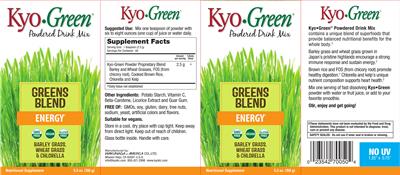
Kyo-Green Greens Blend Powdered Drink Mix by Kyo-Green label
The label scan from the NIH Dietary Supplement Label Database. Tap to enlarge.
Label images are published by the NIH Dietary Supplement Label Database for the version of this product on file. Always read your actual product label.
View the full label (PDF)The Ingredients in Kyo-Green Greens Blend Powdered Drink Mix by Kyo-Green
These are the 6 active ingredients this product is made of. Select any to open its full monograph.
Serving size2.5 Gram(s) Dosage formPowder Servings per container60 Amounts shown are per serving.
Most supplement products combine several ingredients, and a medication can interact with the product through any one of them. Each ingredient below shows whether it has known drug interactions.
Kyo-Green Powder Proprietary Blend
- › Brown Rice, Powder
- › Barley, Powder
- › Kelp, Powder
- › Chlorella, Powder
- › Wheatgrass, Powder
- › Fructooligosaccharides
Other (inactive) ingredients: Potato Starch, Vitamin C, Beta-Carotene, Licorice Extract, Guar Gum. These complete the product’s ingredient list but are not active constituents.
Kyo-Green Greens Blend Powdered Drink Mix by Kyo-Green Drug Interactions
HelloPharmacist Interaction Report
Kyo-Green Greens Blend Powdered Drink Mix contains two ingredients with documented interactions across a wide range of medications.
The most serious interaction involves chlorella, which contains significant amounts of vitamin K and may reduce the effectiveness of warfarin (Coumadin), a blood thinner — at least one case report shows warfarin therapy became sub-therapeutic after someone started chlorella supplements.
Read the full breakdown — every affected drug type, severity by severity
Chlorella also has a Moderate interaction with photosensitizing drugs (medications that make your skin more sensitive to sun damage), where it may have additive effects and increase your risk of sun sensitivity reactions.
Barley powder has a documented Moderate interaction with triclabendazole (Egaten), an antiparasitic medication — animal research suggests barley might reduce how well your body absorbs it, though this hasn't been shown in humans.
We could not check brown rice powder, kelp powder, wheatgrass powder, or fructooligosaccharides — we hold no data for those ingredients. Altogether, these interactions span 337 individual medications.
Use the medication checker on this page to see if any of your specific drugs are affected before you start.
Check your own medications below · Editorial policy · How we use AI
Want to check YOUR meds against Kyo-Green Greens Blend Powdered Drink Mix?
Ask about interactions with your drugs in plain English — “Can I take it with lisinopril?” — and we find you the answer in seconds, ingredient by ingredient.
Go to the checkerIngredients driving the most interactions
Individual Drug Interactions
The ingredients in Kyo-Green Greens Blend Powdered Drink Mix interact with 338 drugs. Click any drug to see the details.
2 of the 6 ingredients in Kyo-Green Greens Blend Powdered Drink Mix interact with drugs. Each result below shows which ingredient is responsible. Chlorella, Powder Barley, Powder
AcepromazineAtravet
How Acepromazine interacts with Kyo-Green Greens Blend Powdered Drink Mix — through 1 ingredient. Tap an ingredient for the detail:
Chlorella, PowderPhotosensitizing Drugs Moderate
Interaction Summary
Theoretically, chlorella might have additive effects with photosensitizing drugs.
Read the full Chlorella, Powder + Acepromazine interactionAcetaminophen, Brompheniramine, PhenylpropanolamineDimetapp Cold and Flu
How Acetaminophen, Brompheniramine, Phenylpropanolamine interacts with Kyo-Green Greens Blend Powdered Drink Mix — through 1 ingredient. Tap an ingredient for the detail:
Chlorella, PowderPhotosensitizing Drugs Moderate
Interaction Summary
Theoretically, chlorella might have additive effects with photosensitizing drugs.
Read the full Chlorella, Powder + Acetaminophen, Brompheniramine, Phenylpropanolamine interactionAcetaminophen, Caffeine, Chlorpheniramine, Hydrocodone, PhenylephrineHycomine Compound
How Acetaminophen, Caffeine, Chlorpheniramine, Hydrocodone, Phenylephrine interacts with Kyo-Green Greens Blend Powdered Drink Mix — through 1 ingredient. Tap an ingredient for the detail:
Chlorella, PowderPhotosensitizing Drugs Moderate
Interaction Summary
Theoretically, chlorella might have additive effects with photosensitizing drugs.
Read the full Chlorella, Powder + Acetaminophen, Caffeine, Chlorpheniramine, Hydrocodone, Phenylephrine interactionAcetaminophen, Chlorpheniramine Maleate, Dextromethorphan HbrVicks Formula 44M Cough, Cold & Flu Relief
How Acetaminophen, Chlorpheniramine Maleate, Dextromethorphan Hbr interacts with Kyo-Green Greens Blend Powdered Drink Mix — through 1 ingredient. Tap an ingredient for the detail:
Chlorella, PowderPhotosensitizing Drugs Moderate
Interaction Summary
Theoretically, chlorella might have additive effects with photosensitizing drugs.
Read the full Chlorella, Powder + Acetaminophen, Chlorpheniramine Maleate, Dextromethorphan Hbr interactionAcetaminophen, Chlorpheniramine, Codeine, PhenylephrineColrex
How Acetaminophen, Chlorpheniramine, Codeine, Phenylephrine interacts with Kyo-Green Greens Blend Powdered Drink Mix — through 1 ingredient. Tap an ingredient for the detail:
Chlorella, PowderPhotosensitizing Drugs Moderate
Interaction Summary
Theoretically, chlorella might have additive effects with photosensitizing drugs.
Read the full Chlorella, Powder + Acetaminophen, Chlorpheniramine, Codeine, Phenylephrine interactionAcetaminophen, Chlorpheniramine, DextromethorphanCoricidin II Extra Strength Cold and Flu
How Acetaminophen, Chlorpheniramine, Dextromethorphan interacts with Kyo-Green Greens Blend Powdered Drink Mix — through 1 ingredient. Tap an ingredient for the detail:
Chlorella, PowderPhotosensitizing Drugs Moderate
Interaction Summary
Theoretically, chlorella might have additive effects with photosensitizing drugs.
Read the full Chlorella, Powder + Acetaminophen, Chlorpheniramine, Dextromethorphan interactionAcetaminophen, Chlorpheniramine, Dextromethorphan HydrobromideCoricidin HBP Maximum Strength Flu
How Acetaminophen, Chlorpheniramine, Dextromethorphan Hydrobromide interacts with Kyo-Green Greens Blend Powdered Drink Mix — through 1 ingredient. Tap an ingredient for the detail:
Chlorella, PowderPhotosensitizing Drugs Moderate
Interaction Summary
Theoretically, chlorella might have additive effects with photosensitizing drugs.
Read the full Chlorella, Powder + Acetaminophen, Chlorpheniramine, Dextromethorphan Hydrobromide interactionAcetaminophen, Chlorpheniramine, Dextromethorphan, PhenylpropanolamineMulti Symptom Cold Relief
How Acetaminophen, Chlorpheniramine, Dextromethorphan, Phenylpropanolamine interacts with Kyo-Green Greens Blend Powdered Drink Mix — through 1 ingredient. Tap an ingredient for the detail:
Chlorella, PowderPhotosensitizing Drugs Moderate
Interaction Summary
Theoretically, chlorella might have additive effects with photosensitizing drugs.
Read the full Chlorella, Powder + Acetaminophen, Chlorpheniramine, Dextromethorphan, Phenylpropanolamine interactionAcetaminophen, Chlorpheniramine, Dextromethorphan, PseudoephedrineChildren's Tylenol Cold Plus Cough, Tylenol Cold Ex Strength
How Acetaminophen, Chlorpheniramine, Dextromethorphan, Pseudoephedrine interacts with Kyo-Green Greens Blend Powdered Drink Mix — through 1 ingredient. Tap an ingredient for the detail:
Chlorella, PowderPhotosensitizing Drugs Moderate
Interaction Summary
Theoretically, chlorella might have additive effects with photosensitizing drugs.
Read the full Chlorella, Powder + Acetaminophen, Chlorpheniramine, Dextromethorphan, Pseudoephedrine interactionAcetaminophen, Chlorpheniramine, Guaifenesin, Phenylephrine, SalicylamideRhinogesic GG
How Acetaminophen, Chlorpheniramine, Guaifenesin, Phenylephrine, Salicylamide interacts with Kyo-Green Greens Blend Powdered Drink Mix — through 1 ingredient. Tap an ingredient for the detail:
Chlorella, PowderPhotosensitizing Drugs Moderate
Interaction Summary
Theoretically, chlorella might have additive effects with photosensitizing drugs.
Read the full Chlorella, Powder + Acetaminophen, Chlorpheniramine, Guaifenesin, Phenylephrine, Salicylamide interactionAcetaminophen, Chlorpheniramine, PhenylephrineAlka-Seltzer PLUS, Histex SR, Protid
How Acetaminophen, Chlorpheniramine, Phenylephrine interacts with Kyo-Green Greens Blend Powdered Drink Mix — through 1 ingredient. Tap an ingredient for the detail:
Chlorella, PowderPhotosensitizing Drugs Moderate
Interaction Summary
Theoretically, chlorella might have additive effects with photosensitizing drugs.
Read the full Chlorella, Powder + Acetaminophen, Chlorpheniramine, Phenylephrine interactionAcetaminophen, Chlorpheniramine, Phenylephrine, SalicylamideRhinogesic, Rhinogesic JR
How Acetaminophen, Chlorpheniramine, Phenylephrine, Salicylamide interacts with Kyo-Green Greens Blend Powdered Drink Mix — through 1 ingredient. Tap an ingredient for the detail:
Chlorella, PowderPhotosensitizing Drugs Moderate
Interaction Summary
Theoretically, chlorella might have additive effects with photosensitizing drugs.
Read the full Chlorella, Powder + Acetaminophen, Chlorpheniramine, Phenylephrine, Salicylamide interactionAcetaminophen, Chlorpheniramine, PhenylpropanolamineAlumadrine, Conex, Sinadrin Max Strength, Sinulin
How Acetaminophen, Chlorpheniramine, Phenylpropanolamine interacts with Kyo-Green Greens Blend Powdered Drink Mix — through 1 ingredient. Tap an ingredient for the detail:
Chlorella, PowderPhotosensitizing Drugs Moderate
Interaction Summary
Theoretically, chlorella might have additive effects with photosensitizing drugs.
Read the full Chlorella, Powder + Acetaminophen, Chlorpheniramine, Phenylpropanolamine interactionAcetaminophen, Chlorpheniramine, Phenylpropanolamine, OpiumHista-Derfule
How Acetaminophen, Chlorpheniramine, Phenylpropanolamine, Opium interacts with Kyo-Green Greens Blend Powdered Drink Mix — through 1 ingredient. Tap an ingredient for the detail:
Chlorella, PowderPhotosensitizing Drugs Moderate
Interaction Summary
Theoretically, chlorella might have additive effects with photosensitizing drugs.
Read the full Chlorella, Powder + Acetaminophen, Chlorpheniramine, Phenylpropanolamine, Opium interactionAcetaminophen, Chlorpheniramine, Phenylpropanolamine, PhenyltoloxamineNorel Plus
How Acetaminophen, Chlorpheniramine, Phenylpropanolamine, Phenyltoloxamine interacts with Kyo-Green Greens Blend Powdered Drink Mix — through 1 ingredient. Tap an ingredient for the detail:
Chlorella, PowderPhotosensitizing Drugs Moderate
Interaction Summary
Theoretically, chlorella might have additive effects with photosensitizing drugs.
Read the full Chlorella, Powder + Acetaminophen, Chlorpheniramine, Phenylpropanolamine, Phenyltoloxamine interactionAcetaminophen, Chlorpheniramine, PseudoephedrineAlka-Seltzer PLUS Liquid Gels, Children's Tylenol Cold, Codimal, Comtrex, Extra Strength Tylenol Allergy Sinus, Lorsin +3 more
How Acetaminophen, Chlorpheniramine, Pseudoephedrine interacts with Kyo-Green Greens Blend Powdered Drink Mix — through 1 ingredient. Tap an ingredient for the detail:
Chlorella, PowderPhotosensitizing Drugs Moderate
Interaction Summary
Theoretically, chlorella might have additive effects with photosensitizing drugs.
Read the full Chlorella, Powder + Acetaminophen, Chlorpheniramine, Pseudoephedrine interactionAcetaminophen, Dexbrompheniramine, PseudoephedrineSinadrin Plus
How Acetaminophen, Dexbrompheniramine, Pseudoephedrine interacts with Kyo-Green Greens Blend Powdered Drink Mix — through 1 ingredient. Tap an ingredient for the detail:
Chlorella, PowderPhotosensitizing Drugs Moderate
Interaction Summary
Theoretically, chlorella might have additive effects with photosensitizing drugs.
Read the full Chlorella, Powder + Acetaminophen, Dexbrompheniramine, Pseudoephedrine interactionAcetaminophen, DiphenhydramineTylenol PM, Tylenol PM Ex Strength
How Acetaminophen, Diphenhydramine interacts with Kyo-Green Greens Blend Powdered Drink Mix — through 1 ingredient. Tap an ingredient for the detail:
Chlorella, PowderPhotosensitizing Drugs Moderate
Interaction Summary
Theoretically, chlorella might have additive effects with photosensitizing drugs.
Read the full Chlorella, Powder + Acetaminophen, Diphenhydramine interactionAcetaminophen, Diphenhydramine, PseudoephedrineChildren's Tylenol Allergy, Cold Control, Contac Night Allergy Relief
How Acetaminophen, Diphenhydramine, Pseudoephedrine interacts with Kyo-Green Greens Blend Powdered Drink Mix — through 1 ingredient. Tap an ingredient for the detail:
Chlorella, PowderPhotosensitizing Drugs Moderate
Interaction Summary
Theoretically, chlorella might have additive effects with photosensitizing drugs.
Read the full Chlorella, Powder + Acetaminophen, Diphenhydramine, Pseudoephedrine interactionAcetaminophen, IbuprofenCombogesic
How Acetaminophen, Ibuprofen interacts with Kyo-Green Greens Blend Powdered Drink Mix — through 1 ingredient. Tap an ingredient for the detail:
Chlorella, PowderPhotosensitizing Drugs Moderate
Interaction Summary
Theoretically, chlorella might have additive effects with photosensitizing drugs.
Read the full Chlorella, Powder + Acetaminophen, Ibuprofen interactionAcetaminophen, Phenylephrine, ChlorpheniramineSuper Cold Tabs
How Acetaminophen, Phenylephrine, Chlorpheniramine interacts with Kyo-Green Greens Blend Powdered Drink Mix — through 1 ingredient. Tap an ingredient for the detail:
Chlorella, PowderPhotosensitizing Drugs Moderate
Interaction Summary
Theoretically, chlorella might have additive effects with photosensitizing drugs.
Read the full Chlorella, Powder + Acetaminophen, Phenylephrine, Chlorpheniramine interactionAcetazolamideAk-Zol, Diamox
How Acetazolamide interacts with Kyo-Green Greens Blend Powdered Drink Mix — through 1 ingredient. Tap an ingredient for the detail:
Chlorella, PowderPhotosensitizing Drugs Moderate
Interaction Summary
Theoretically, chlorella might have additive effects with photosensitizing drugs.
Read the full Chlorella, Powder + Acetazolamide interactionAcetohexamideDymelor
How Acetohexamide interacts with Kyo-Green Greens Blend Powdered Drink Mix — through 1 ingredient. Tap an ingredient for the detail:
Chlorella, PowderPhotosensitizing Drugs Moderate
Interaction Summary
Theoretically, chlorella might have additive effects with photosensitizing drugs.
Read the full Chlorella, Powder + Acetohexamide interactionAcitretinSoriatane
How Acitretin interacts with Kyo-Green Greens Blend Powdered Drink Mix — through 1 ingredient. Tap an ingredient for the detail:
Chlorella, PowderPhotosensitizing Drugs Moderate
Interaction Summary
Theoretically, chlorella might have additive effects with photosensitizing drugs.
Read the full Chlorella, Powder + Acitretin interactionAlectinib HydrochlorideAlecensa
How Alectinib Hydrochloride interacts with Kyo-Green Greens Blend Powdered Drink Mix — through 1 ingredient. Tap an ingredient for the detail:
Chlorella, PowderPhotosensitizing Drugs Moderate
Interaction Summary
Theoretically, chlorella might have additive effects with photosensitizing drugs.
Read the full Chlorella, Powder + Alectinib Hydrochloride interactionAlitretinoinPanretin
How Alitretinoin interacts with Kyo-Green Greens Blend Powdered Drink Mix — through 1 ingredient. Tap an ingredient for the detail:
Chlorella, PowderPhotosensitizing Drugs Moderate
Interaction Summary
Theoretically, chlorella might have additive effects with photosensitizing drugs.
Read the full Chlorella, Powder + Alitretinoin interactionAmiloride, HydrochlorothiazideAmil-Co, Amilzide, Moduret 25, Moduretic
How Amiloride, Hydrochlorothiazide interacts with Kyo-Green Greens Blend Powdered Drink Mix — through 1 ingredient. Tap an ingredient for the detail:
Chlorella, PowderPhotosensitizing Drugs Moderate
Interaction Summary
Theoretically, chlorella might have additive effects with photosensitizing drugs.
Read the full Chlorella, Powder + Amiloride, Hydrochlorothiazide interactionAminolevulinic Acid HydrochlorideAmeluz, Gleolan
How Aminolevulinic Acid Hydrochloride interacts with Kyo-Green Greens Blend Powdered Drink Mix — through 1 ingredient. Tap an ingredient for the detail:
Chlorella, PowderPhotosensitizing Drugs Moderate
Interaction Summary
Theoretically, chlorella might have additive effects with photosensitizing drugs.
Read the full Chlorella, Powder + Aminolevulinic Acid Hydrochloride interactionAmiodaroneCordarone, Pacerone
How Amiodarone interacts with Kyo-Green Greens Blend Powdered Drink Mix — through 1 ingredient. Tap an ingredient for the detail:
Chlorella, PowderPhotosensitizing Drugs Moderate
Interaction Summary
Theoretically, chlorella might have additive effects with photosensitizing drugs.
Read the full Chlorella, Powder + Amiodarone interactionAmitriptylineElavil
How Amitriptyline interacts with Kyo-Green Greens Blend Powdered Drink Mix — through 1 ingredient. Tap an ingredient for the detail:
Chlorella, PowderPhotosensitizing Drugs Moderate
Interaction Summary
Theoretically, chlorella might have additive effects with photosensitizing drugs.
Read the full Chlorella, Powder + Amitriptyline interactionEach ingredient & the kinds of drugs it affects
For each ingredient in Kyo-Green Greens Blend Powdered Drink Mix with known interactions, here are the types of medications they can affect. Open any type for the detail — or search your exact drug in the checker above.
Chlorella, Powder
Photosensitizing Drugs
Theoretically, chlorella might have additive effects with photosensitizing drugs.
Chlorella has been reported to cause photosensitization. In five case reports, patients who had ingested chlorella exhibited swelling followed by erythematopurpuric lesions on sun-exposed areas of the body. Theoretically, concomitant use with photosensitizing drugs may exacerbate effects.
Warfarin (Coumadin)
Theoretically, chlorella might reduce the clinical effects of warfarin.
Chlorella contains significant amounts of vitamin K. There is at least one case report of warfarin therapy becoming sub-therapeutic after initiation of chlorella supplements.
Barley, Powder
Triclabendazole (Egaten)
Theoretically, barley might decrease the clinical effects of triclabendazole.
Animal research suggests that a diet supplemented with barley can reduce the bioavailability of triclabendazole when taken concomitantly. This effect has not been shown in humans.
Brand information
Manufacturer and brand details for Kyo-Green Greens Blend Powdered Drink Mix, from the product label.
Kyo-Green
See all Kyo-Green products- Name
- Wakunaga of America Co., Ltd.
- City
- Mission Viejo
- State
- CA
- ZipCode
- 92691
- Phone Number
- (800) 421.2998
- Web Address
- www.kyolic.com
Kyo-Green Greens Blend Powdered Drink Mix by Kyo-Green: Common Questions
Does Kyo-Green Greens Blend Powdered Drink Mix by Kyo-Green interact with any medications?
How can one product interact with so many drugs?
Where does this information come from?
Does this have gluten in it?
Can I take this while pregnant or breastfeeding?
Will this lower my cholesterol?
What kind of side effects might I get?
How much vitamin K is in this?
Is this product tested for quality and purity?
Written and reviewed by the HelloPharmacist editorial staff. Our editorial policy
Not sure if Kyo-Green Greens Blend Powdered Drink Mix is safe with your meds?
Our pharmacists answer your medication & supplement questions — free.
Label information is sourced from the NIH Dietary Supplement Label Database and reflects the product version on file; always read your actual product label. This page is for education only and is not a substitute for professional medical advice. Confirm with your pharmacist or doctor before combining supplements and medications.
The Full Monographs Behind Kyo-Green Greens Blend Powdered Drink Mix’s Ingredients
Every ingredient we hold a full HelloPharmacist monograph for — uses, evidence, safety, and the complete interaction list.
Barley
Interacts with 1 drugBarley is a nutritious whole grain that is a good source of soluble fiber called beta-glucan, which has solid evidence for modestly lowering LDL ('bad') cholesterol when eaten regularly. It...
Read the full Barley monograph → Herb & supplement monographChlorella
Interacts with 337 drugsChlorella is a nutrient-rich freshwater green algae taken as a supplement for general wellness, immune support, and 'detox.' Some small studies suggest possible benefits for cholesterol, blo...
Read the full Chlorella monograph →Sources & How We Checked
Kyo-Green Greens Blend Powdered Drink Mix's label data comes from the NIH Dietary Supplement Label Database; the ingredient interaction data is from the Natural Medicines database, reviewed by our pharmacists.
- NIH Dietary Supplement Label Database (DSLD) — The official product label on file for this supplement.
- Natural Medicines (Therapeutic Research Center) — Evidence-graded clinical reference behind the ingredient interaction data.
Content is written and reviewed by licensed HelloPharmacist pharmacists. See our data sources and editorial standards for how this information is built and checked.
The 28 references behind this product’s interaction data
Every citation that drives the interaction findings for this product’s ingredients, from the evidence-graded Natural Medicines (TRC Healthcare) database. Open an ingredient to browse its citations — links open the study on PubMed or the publisher’s site.
Barley 15 references
- Brinker F. Herb Contraindications and Drug Interactions. 2nd ed. Sandy, OR: Eclectic Medical Publications, 1998.
- Fernandez-Anaya S, Crespo JF, Rodriguez JR, et al. Beer anaphylaxis. J Allergy Clin Immunol 1999;103:959-60.
- Lembo A, Camilleri M. Chronic constipation. N Engl J Med 2003;349:1360-8. . PubMed
- Ferre, I., Giraldez, F. J., Alvarez-Bujidos, M. L., and Mantecon, A. R. Influence of barley supplement on plasma concentration of triclabendazole metabolites in sheep. Vet.Rec. 11-22-1997;141(21):549-551. PubMed
- Curioni, A., Santucci, B., Cristaudo, A., Canistraci, C., Pietravalle, M., Simonato, B., and Giannattasio, M. Urticaria from beer: an immediate hypersensitivity reaction due to a 10- kDa protein derived from barley. Clin Exp Allergy 1999;29(3):407-413. PubMed
- Fernandez-Anaya, S., Crespo, J. F., Rodriguez, J. R., Daroca, P., Carmona, E., Herraez, L., and Lopez-Rubio, A. Beer anaphylaxis. J Allergy Clin Immunol. 1999;103(5 Pt 1):959-960.
- Cronin, E. Contact dermatitis from barley dust. Contact Dermatitis 1979;5(3):196. PubMed
- Block, G., Tse, K. S., Kijek, K., Chan, H., and Chan-Yeung, M. Baker's asthma. Studies of the cross-antigenicity between different cereal grains. Clin Allergy 1984;14(2):177-185.
- van Ketel, W. G. Immediate type allergy to malt in beer. Contact Dermatitis 1980;6(4):297-298. PubMed
- Ellis, H. J., Doyle, A. P., Day, P., Wieser, H., and Ciclitira, P. J. Demonstration of the presence of coeliac-activating gliadin-like epitopes in malted barley. Int Arch Allergy Immunol. 1994;104(3):308-310. PubMed
- Vidal, C. and Gonzalez-Quintela, A. Food-induced and occupational asthma due to barley flour. Ann Allergy Asthma Immunol. 1995;75(2):121-124.
- Gutgesell, C. and Fuchs, T. Contact urticaria from beer. Contact Dermatitis 1995;33(6):436-437. PubMed
- Baker, P. G. and Read, A. E. Oats and barley toxicity in coeliac patients. Postgrad.Med J 1976;52(607):264-268. PubMed
- Nakase, M., Usui, Y., Alvarez-Nakase, A. M., Adachi, T., Urisu, A., Nakamura, R., Aoki, N., Kitajima, K., and Matsuda, T. Cereal allergens: rice-seed allergens with structural similarity to wheat and barley allergens. Allergy 1998;53(46 Suppl):55-57. PubMed
- Pereira, F., Rafael, M., and Lacerda, M. H. Contact dermatitis from barley. Contact Dermatitis 1998;39(5):261-262. PubMed
Chlorella 13 references
- Peirce A. The American Pharmaceutical Association Practical Guide to Natural Medicines. New York, NY: William Morrow and Co., 1999.
- Ng TP, Tan WC, Lee YK. Occupational asthma in a pharmacist induced by chlorella, a unicellular algae preparation. Resp Med 1994;88:555-7. PubMed
- Jitsukawa K, Suizu R, Hidano A. Chlorella photosensitization. New phytophotodermatosis. Int J Dermatol 1984;23:263-8. PubMed
- Merchant RE, Carmack CA, Wise CM. Nutritional supplementation with Chlorella pyrenoidosa for patients with fibromyalgia syndrome: a pilot study. Phytother Res 2000;14:167-73.
- Merchant RE, Rice CD, Young HF. Dietary Chlorella pyrenoidosa for patients with malignant glioma: effects on immunocompetence, quality of life, and survival. Phytother Res 1990;4:220-31.
- Halperin SA, Smith B, Nolan C, et al. Safety and immunoenhancing effect of a Chlorella-derived dietary supplement in healthy adults undergoing influenza vaccination: randomized, double-blind, placebo-controlled trial. CMAJ 2003;169:111-7..
- Ohtake, T., Negishi, K., Okamoto, K., Oka, M., Maesato, K., Moriya, H., and Kobayashi, S. Manganese-induced Parkinsonism in a patient undergoing maintenance hemodialysis. Am J Kidney Dis 2005;46(4):749-753. PubMed
- Ng, T. P., Tan, W. C., and Lee, Y. K. Occupational asthma in a pharmacist induced by Chlorella, a unicellular algae preparation. Respir.Med. 1994;88(7):555-557. PubMed
- Ohkawa, S., Yoneda, Y., Ohsumi, Y., and Tabuchi, M. [Warfarin therapy and chlorella]. Rinsho Shinkeigaku 1995;35(7):806-807.
- Azocar J, Diaz A. Efficacy and safety of chlorella supplementation in adults with chronic hepatitis C virus infection. World J Gastroenterol 2013;19(7):1085-90. PubMed
- Panahi Y, Badeli R, Karami GR, Badeli Z, Sahebkar A. A randomized controlled trial of 6-week Chlorella vulgaris supplementation in patients with major depressive disorder. Complement Ther Med 2015;23(4):598-602. PubMed
- Nakano S, Takekoshi H, Nakano M. Chlorella pyrenoidosa supplementation reduces the risk of anemia, proteinuria and edema in pregnant women. Plant Foods Hum Nutr 2010;65(1):25-30. PubMed
- Yavasoglu I, Turgutkaya A, Bolaman Z. Chlorella-induced thrombocytopenia. Sao Paulo Med J 2018;136(6):602-3. PubMed
Parts of this content are provided by the Therapeutic Research Center, LLC.
DISCLAIMER: Currently this does not check for drug-drug interactions. This is not an all-inclusive comprehensive list of potential interactions and is for informational purposes only. Not all interactions are known or well-reported in the scientific literature, and new interactions are continually being reported. Input is needed from a qualified healthcare provider including a pharmacist before starting any therapy. Application of clinical judgment is necessary.
© 2021 Therapeutic Research Center, LLC