
Luo Bu Ma Tablets Ingredients & Drug Interactions
by Plum Flower
What is this page for?
First and foremost: checking Luo Bu Ma Tablets against your medications. The heart of this page is the interaction checker and the full interaction report — how this product’s ingredients may interact with prescription and over-the-counter medicines you may be taking.
Around that, we add a pharmacist’s high-level view of the product as a whole — what’s inside, the evidence for its stated use, how transparent the label is, and what safety data exists — so you can see the full picture in one place. It’s educational information from our licensed clinical databases and the clinical staff at HelloPharmacist — not medical advice — and we don’t sell or endorse products. Our editorial policy
Luo Bu Ma Tablets is a dietary supplement by Plum Flower with 8 active ingredients. Its ingredients are commonly taken for eye irritation and tired eyes, cooling and 'heat-clearing' in traditional chinese medicine, cold and flu symptoms.Based on those ingredients, 973 medications have a known interaction with it, the most serious rated major. The ingredients most likely to interact are Uncaria rhynchophylla Thorn, Twig Extract, Crataegus pinnatifida fruit extract. Use the checker below to test your specific medication, or read the full HelloPharmacist Interaction Report.
Check Your Meds Against Luo Bu Ma Tablets by Plum Flower
Ask about any prescription or over-the-counter medication and we check it for interactions with Luo Bu Ma Tablets by Plum Flower — and tell you which ingredient is responsible.
AI summaries are generated from our interaction database for education only — always confirm with your pharmacist. How we use AI
Ask the Pharmacist
A licensed pharmacist will answer your question by email — free, usually within 24 hours.
Got it — thank you!
A licensed pharmacist will answer within 24 hours. Keep an eye on your email (worth checking spam, just in case).
HelloPharmacist Scorecard of Luo Bu Ma Tablets by Plum Flower
Our pharmacy team’s full take, with four database checks built into the cards below — a summary of what is known, not a grade of the product itself.
What’s inside
Low disclosure
This tablet contains 8 ingredients: a proprietary extract blend (which pulls together multiple plant sources), along with individual extracts of chrysanthemum flower, hawthorn fruit, cat's claw vine and thorn, and several other traditional plant materials including Apocynum venetum leaf, Alisma orientale rhizome, Achyranthes bidentata root, and Prunella vulgaris spike. The inactive ingredients — dextrin, sodium starch glycolate, hypromellose, polyethylene glycol, and magnesium stearate — are binders and fillers that hold the tablet together.
Does it work?
Couldn't assess
We don't have enough reliable evidence in our data to rate how well this product works for any condition. The individual ingredients are used traditionally in herbal medicine, but the effectiveness ratings in our monographs show insufficient evidence for claims like reducing angina, easing headaches, managing diabetes, or supporting cardiovascular health.
If you're considering this for a specific health goal, talk with your pharmacist or doctor about whether the evidence supports it.
How safe is it?
Well-documented data
Hawthorn and cat's claw are generally well tolerated in short-term use by healthy adults, though hawthorn requires medical supervision if you have a heart condition. Chrysanthemum can trigger allergic reactions — including skin reactions, hives, and rarely asthma — and an estimated 60% of Europeans are allergic to it.
Cat's claw safety over the long term hasn't been well studied, and case reports link it to kidney injury in some patients. Pregnancy and breastfeeding safety data are not established for the key ingredients, so these should be avoided unless your doctor says otherwise.
Meds to double-check
Major interaction found
Before taking this product, double-check with your pharmacist if you take: nitrates or phosphodiesterase-5 inhibitors (Major risk of dangerous blood pressure drops), blood pressure medications, heart rhythm drugs including beta-blockers and calcium channel blockers, blood thinners (anticoagulants or antiplatelet drugs), digoxin, drugs metabolized by the liver enzyme CYP3A4 (a very common group), immune-suppressing medications, or the COVID antiviral nirmatrelvir/ritonavir (Paxlovid).
The bottom line
Scorecard at a glanceFormula with limited ingredient disclosure with no assessable stated purpose. Major medication interactions have been identified, and safety information is well characterized.
If you take any prescription medication — especially for blood pressure, heart rhythm, blood clotting, or immune function — check this product with your pharmacist first; interactions are documented and some are serious. Those with heart conditions should get medical clearance.
People with chrysanthemum allergies should avoid it. Talk with your pharmacist or doctor before starting, especially if you're pregnant, breastfeeding, or taking multiple medications.
Educational only — not medical advice; always confirm with your pharmacist. Our editorial policy · How we use AI
Assessment coverage: 3 of 8 active ingredients matched to our full ingredient reviews (monographs). Based on the product label dated Oct 24, 2024.
This Scorecard evaluates available label information, ingredient evidence, and known medication-safety considerations. It does not independently verify product identity, purity, potency, contamination, or manufacturing quality. How these ratings are computed
General information
Key facts about Luo Bu Ma Tablets, straight from the product label.
| Brand | Plum Flower |
|---|---|
| Barcode (UPC) | 739934939604 |
| Net contents | 100 Tablet(s); 1.06 Ounce(s); 30 Gram(s) |
| Market status | On market |
| Date entered into DSLD | Oct 24, 2024 |
| DSLD ID | 323738 |
| Product type | Botanical |
| Supplement form | Tablet Or Pill |
| Dietary claims / uses | All Other, Structure/Function |
| Intended target group(s) | Adult (18 - 50 Years), Women (not pregnant or lactating) |
Everything in this section is reproduced from the manufacturer’s own product label — it’s the label speaking, not HelloPharmacist. We show it so you can see exactly what the maker states; we don’t verify or endorse those statements.
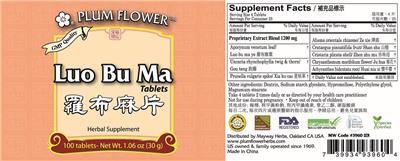
Supplement Facts
The label details for Luo Bu Ma Tablets by Plum Flower, sourced from the NIH Dietary Supplement Label Database.
Supplement Facts
| Ingredient | Amount | % DV |
|---|---|---|
| Proprietary Extract Blend | 1200 mg | -- |
| Chrysanthemum morifolium Flower Extract | 0 NP | -- |
| Apocynum venetum leaf extract | 0 NP | -- |
| Crataegus pinnatifida fruit extract | 0 NP | -- |
| Alisma orientale Rhizome Extract | 0 NP | -- |
| Achyranthes bidentata Root Extract | 0 NP | -- |
| Uncaria rhynchophylla Thorn, Twig Extract | 0 NP | -- |
| Prunella vulgaris Spike Extract | 0 NP | -- |
| Cristaria plicata Shell Extract | 0 NP | -- |
Other ingredients: Dextrin, Sodium Starch Glycolate, Hypromellose, Polyethylene Glycol, Magnesium Stearate
Tap any ingredient to jump to its full detail below.
These statements are the manufacturer’s wording, reproduced from the product label — the label is saying it, not HelloPharmacist. We don’t verify or endorse them.
Formulation
GMP quality
Plum Flower Guarantee Sourced sustainably Species verified
US owned & family operated since 1969. Made in China
FDA Statement of Identity
Herbal Supplement
Suggested/Recommended/Usage/Directions
Take 4 tablets 2 times daily or as directed by your health care practitioner.
Precautions
Not for use during pregnancy.
Keep out of reach of children
Seals/Symbols
FDA Registered cGMP Compliant Made at a cGMP Certified Facility Lab tested quality verified
Is this label outdated? Report a formula or label change and our pharmacy team will review it.
Luo Bu Ma Tablets by Plum Flower label
The label scan from the NIH Dietary Supplement Label Database. Tap to enlarge.
Label images are published by the NIH Dietary Supplement Label Database for the version of this product on file. Always read your actual product label.
View the full label (PDF)The Ingredients in Luo Bu Ma Tablets by Plum Flower
These are the 8 active ingredients this product is made of. Select any to open its full monograph.
Serving size4 Tablet(s) Dosage formTablet Or Pill Servings per container25 Amounts shown are per serving.
Most supplement products combine several ingredients, and a medication can interact with the product through any one of them. Each ingredient below shows whether it has known drug interactions.
Proprietary Extract Blend
- › Chrysanthemum morifolium Flower Extract
- › Apocynum venetum leaf extract
- › Crataegus pinnatifida fruit extract
- › Alisma orientale Rhizome Extract
- › Achyranthes bidentata Root Extract
- › Uncaria rhynchophylla Thorn, Twig Extract
- › Prunella vulgaris Spike Extract
- › Cristaria plicata Shell Extract
Other (inactive) ingredients: Dextrin, Sodium Starch Glycolate, Hypromellose, Polyethylene Glycol, Magnesium Stearate. These complete the product’s ingredient list but are not active constituents.
Luo Bu Ma Tablets by Plum Flower Drug Interactions
HelloPharmacist Interaction Report
Luo Bu Ma Tablets by Plum Flower contains several ingredients with documented interactions affecting blood pressure, heart function, and how your body metabolizes certain medications.
The most serious concerns involve hawthorn (Crataegus pinnatifida), which can cause dangerous drops in blood pressure or excessive bleeding when combined with nitrates (used for chest pain) or phosphodiesterase-5 inhibitors (like sildenafil for erectile dysfunction) — both rated Major severity.
Read the full breakdown — every affected drug type, severity by severity
Hawthorn also interacts moderately with beta-blockers, calcium channel blockers, blood thinners (anticoagulants and antiplatelet drugs), and digoxin (a heart medication), potentially adding to their effects on blood pressure, heart rate, or bleeding risk. Cat's claw (Uncaria rhynchophylla) carries moderate interactions with blood pressure medications, drugs metabolized by the liver enzyme CYP3A4 — which includes many common medications — blood thinners, immune-suppressing drugs, calcium channel blockers, and the COVID antiviral nirmatrelvir/ritonavir (Paxlovid).
We could not check three other ingredients in this product: Apocynum venetum leaf extract, Alisma orientale rhizome extract, Achyranthes bidentata root extract, and Prunella vulgaris spike extract and Cristaria plicata shell extract — we hold no interaction data for them. Altogether, these interactions span 959 individual medications.
Run your exact prescriptions through the medication checker on this page before starting.
Check your own medications below · Editorial policy · How we use AI
Want to check YOUR meds against Luo Bu Ma Tablets?
Ask about interactions with your drugs in plain English — “Can I take it with lisinopril?” — and we find you the answer in seconds, ingredient by ingredient.
Go to the checkerIngredients driving the most interactions
Individual Drug Interactions
The ingredients in Luo Bu Ma Tablets interact with 973 drugs. Click any drug to see the details.
2 of the 8 ingredients in Luo Bu Ma Tablets interact with drugs. Each result below shows which ingredient is responsible. Uncaria rhynchophylla Thorn, Twig Extract Crataegus pinnatifida fruit extract
AvanafilStendra
How Avanafil interacts with Luo Bu Ma Tablets — through 2 ingredients. Tap an ingredient for the detail:
Crataegus Pinnatifida Fruit ExtractPhosphodiesterase-5 Inhibitors Major
Interaction Summary
Theoretically, concomitant use might result in additive vasodilation and hypotension.
Read the full Crataegus Pinnatifida Fruit Extract + Avanafil interactionUncaria Rhynchophylla Thorn, Twig ExtractCytochrome P450 3a4 (cyp3a4) Substrates Moderate
Interaction Summary
Theoretically, cat's claw might increase or decrease the levels and effects of drugs metabolized by CYP3A4.
Read the full Uncaria Rhynchophylla Thorn, Twig Extract + Avanafil interactionFinasteride, TadalafilEntadfi
How Finasteride, Tadalafil interacts with Luo Bu Ma Tablets — through 2 ingredients. Tap an ingredient for the detail:
Crataegus Pinnatifida Fruit ExtractPhosphodiesterase-5 Inhibitors Major
Interaction Summary
Theoretically, concomitant use might result in additive vasodilation and hypotension.
Read the full Crataegus Pinnatifida Fruit Extract + Finasteride, Tadalafil interactionUncaria Rhynchophylla Thorn, Twig ExtractCytochrome P450 3a4 (cyp3a4) Substrates Moderate
Interaction Summary
Theoretically, cat's claw might increase or decrease the levels and effects of drugs metabolized by CYP3A4.
Read the full Uncaria Rhynchophylla Thorn, Twig Extract + Finasteride, Tadalafil interactionGlyceryl TrinitrateNitronal
How Glyceryl Trinitrate interacts with Luo Bu Ma Tablets — through 1 ingredient. Tap an ingredient for the detail:
Crataegus Pinnatifida Fruit ExtractNitrates Major
Interaction Summary
Theoretically, concomitant use might cause additive coronary vasodilatory effects.
Read the full Crataegus Pinnatifida Fruit Extract + Glyceryl Trinitrate interactionIsosorbide DinitrateAngitak, Cedocard Retard, Isoket, Isoket Retard, Isordil
How Isosorbide Dinitrate interacts with Luo Bu Ma Tablets — through 1 ingredient. Tap an ingredient for the detail:
Crataegus Pinnatifida Fruit ExtractNitrates Major
Interaction Summary
Theoretically, concomitant use might cause additive coronary vasodilatory effects.
Read the full Crataegus Pinnatifida Fruit Extract + Isosorbide Dinitrate interactionIsosorbide Dinitrate, HydralazineBiDil
How Isosorbide Dinitrate, Hydralazine interacts with Luo Bu Ma Tablets — through 2 ingredients. Tap an ingredient for the detail:
Crataegus Pinnatifida Fruit ExtractNitrates Major
Interaction Summary
Theoretically, concomitant use might cause additive coronary vasodilatory effects.
Read the full Crataegus Pinnatifida Fruit Extract + Isosorbide Dinitrate, Hydralazine interactionUncaria Rhynchophylla Thorn, Twig ExtractAntihypertensive Drugs Moderate
Interaction Summary
Theoretically, taking cat's claw with antihypertensive drugs might increase the risk of hypotension.
Read the full Uncaria Rhynchophylla Thorn, Twig Extract + Isosorbide Dinitrate, Hydralazine interactionIsosorbide MononitrateAngeze, Angeze SR, Chemydur 60XL, Dynamin, Elantan, Elantan LA +13 more
How Isosorbide Mononitrate interacts with Luo Bu Ma Tablets — through 1 ingredient. Tap an ingredient for the detail:
Crataegus Pinnatifida Fruit ExtractNitrates Major
Interaction Summary
Theoretically, concomitant use might cause additive coronary vasodilatory effects.
Read the full Crataegus Pinnatifida Fruit Extract + Isosorbide Mononitrate interactionMacitentan, TadalafilOpsynvi
How Macitentan, Tadalafil interacts with Luo Bu Ma Tablets — through 2 ingredients. Tap an ingredient for the detail:
Crataegus Pinnatifida Fruit ExtractPhosphodiesterase-5 Inhibitors Major
Interaction Summary
Theoretically, concomitant use might result in additive vasodilation and hypotension.
Read the full Crataegus Pinnatifida Fruit Extract + Macitentan, Tadalafil interactionUncaria Rhynchophylla Thorn, Twig ExtractAntihypertensive Drugs, Cytochrome P450 3a4 (cyp3a4) Substrates Moderate
Interaction Summary
Theoretically, taking cat's claw with antihypertensive drugs might increase the risk of hypotension.
Read the full Uncaria Rhynchophylla Thorn, Twig Extract + Macitentan, Tadalafil interactionNicorandilAprior, Dancor, Ikorel, Sigmart, Zynicor
How Nicorandil interacts with Luo Bu Ma Tablets — through 1 ingredient. Tap an ingredient for the detail:
Crataegus Pinnatifida Fruit ExtractNitrates Major
Interaction Summary
Theoretically, concomitant use might cause additive coronary vasodilatory effects.
Read the full Crataegus Pinnatifida Fruit Extract + Nicorandil interactionNitroglycerinGonitro, Nitro Time, Nitro-Bid, Nitrocine Timecaps, Nitrogard, Nitrogard SR +7 more
How Nitroglycerin interacts with Luo Bu Ma Tablets — through 1 ingredient. Tap an ingredient for the detail:
Crataegus Pinnatifida Fruit ExtractNitrates Major
Interaction Summary
Theoretically, concomitant use might cause additive coronary vasodilatory effects.
Read the full Crataegus Pinnatifida Fruit Extract + Nitroglycerin interactionPentaerythritol TetranitratePeritrate, Peritrate SA
How Pentaerythritol Tetranitrate interacts with Luo Bu Ma Tablets — through 1 ingredient. Tap an ingredient for the detail:
Crataegus Pinnatifida Fruit ExtractNitrates Major
Interaction Summary
Theoretically, concomitant use might cause additive coronary vasodilatory effects.
Read the full Crataegus Pinnatifida Fruit Extract + Pentaerythritol Tetranitrate interactionSildenafilRevatio
How Sildenafil interacts with Luo Bu Ma Tablets — through 2 ingredients. Tap an ingredient for the detail:
Crataegus Pinnatifida Fruit ExtractPhosphodiesterase-5 Inhibitors Major
Interaction Summary
Theoretically, concomitant use might result in additive vasodilation and hypotension.
Read the full Crataegus Pinnatifida Fruit Extract + Sildenafil interactionUncaria Rhynchophylla Thorn, Twig ExtractCytochrome P450 3a4 (cyp3a4) Substrates Moderate
Interaction Summary
Theoretically, cat's claw might increase or decrease the levels and effects of drugs metabolized by CYP3A4.
Read the full Uncaria Rhynchophylla Thorn, Twig Extract + Sildenafil interactionSildenafil CitrateViagra
How Sildenafil Citrate interacts with Luo Bu Ma Tablets — through 2 ingredients. Tap an ingredient for the detail:
Crataegus Pinnatifida Fruit ExtractPhosphodiesterase-5 Inhibitors Major
Interaction Summary
Theoretically, concomitant use might result in additive vasodilation and hypotension.
Read the full Crataegus Pinnatifida Fruit Extract + Sildenafil Citrate interactionUncaria Rhynchophylla Thorn, Twig ExtractCytochrome P450 3a4 (cyp3a4) Substrates Moderate
Interaction Summary
Theoretically, cat's claw might increase or decrease the levels and effects of drugs metabolized by CYP3A4.
Read the full Uncaria Rhynchophylla Thorn, Twig Extract + Sildenafil Citrate interactionTadalafilCialis, Tadliq
How Tadalafil interacts with Luo Bu Ma Tablets — through 2 ingredients. Tap an ingredient for the detail:
Crataegus Pinnatifida Fruit ExtractPhosphodiesterase-5 Inhibitors Major
Interaction Summary
Theoretically, concomitant use might result in additive vasodilation and hypotension.
Read the full Crataegus Pinnatifida Fruit Extract + Tadalafil interactionUncaria Rhynchophylla Thorn, Twig ExtractCytochrome P450 3a4 (cyp3a4) Substrates Moderate
Interaction Summary
Theoretically, cat's claw might increase or decrease the levels and effects of drugs metabolized by CYP3A4.
Read the full Uncaria Rhynchophylla Thorn, Twig Extract + Tadalafil interactionVardenafilLevitra, Staxyn
How Vardenafil interacts with Luo Bu Ma Tablets — through 2 ingredients. Tap an ingredient for the detail:
Crataegus Pinnatifida Fruit ExtractPhosphodiesterase-5 Inhibitors Major
Interaction Summary
Theoretically, concomitant use might result in additive vasodilation and hypotension.
Read the full Crataegus Pinnatifida Fruit Extract + Vardenafil interactionUncaria Rhynchophylla Thorn, Twig ExtractCytochrome P450 3a4 (cyp3a4) Substrates Moderate
Interaction Summary
Theoretically, cat's claw might increase or decrease the levels and effects of drugs metabolized by CYP3A4.
Read the full Uncaria Rhynchophylla Thorn, Twig Extract + Vardenafil interaction6-mercaptopurinePurinethol
How 6-mercaptopurine interacts with Luo Bu Ma Tablets — through 1 ingredient. Tap an ingredient for the detail:
Uncaria Rhynchophylla Thorn, Twig ExtractImmunosuppressants Moderate
Interaction Summary
Theoretically, cat's claw might interfere with immunosuppressive therapy.
Read the full Uncaria Rhynchophylla Thorn, Twig Extract + 6-mercaptopurine interactionAdo-trastuzumab EmtansineKadcyla
How Ado-trastuzumab Emtansine interacts with Luo Bu Ma Tablets — through 1 ingredient. Tap an ingredient for the detail:
Uncaria Rhynchophylla Thorn, Twig ExtractCytochrome P450 3a4 (cyp3a4) Substrates Moderate
Interaction Summary
Theoretically, cat's claw might increase or decrease the levels and effects of drugs metabolized by CYP3A4.
Read the full Uncaria Rhynchophylla Thorn, Twig Extract + Ado-trastuzumab Emtansine interactionAbciximabReoPro
How Abciximab interacts with Luo Bu Ma Tablets — through 2 ingredients. Tap an ingredient for the detail:
Uncaria Rhynchophylla Thorn, Twig ExtractAnticoagulant/antiplatelet Drugs Moderate
Interaction Summary
Theoretically, cat's claw may increase the risk of bleeding if used with anticoagulant or antiplatelet drugs.
Read the full Uncaria Rhynchophylla Thorn, Twig Extract + Abciximab interactionCrataegus Pinnatifida Fruit ExtractAnticoagulant/antiplatelet Drugs Moderate
Interaction Summary
Theoretically, hawthorn may increase the risk of bleeding if used with anticoagulant or antiplatelet drugs.
Read the full Crataegus Pinnatifida Fruit Extract + Abciximab interactionAbemaciclibVerzenio
How Abemaciclib interacts with Luo Bu Ma Tablets — through 1 ingredient. Tap an ingredient for the detail:
Uncaria Rhynchophylla Thorn, Twig ExtractCytochrome P450 3a4 (cyp3a4) Substrates Moderate
Interaction Summary
Theoretically, cat's claw might increase or decrease the levels and effects of drugs metabolized by CYP3A4.
Read the full Uncaria Rhynchophylla Thorn, Twig Extract + Abemaciclib interactionAbiraterone
How Abiraterone interacts with Luo Bu Ma Tablets — through 1 ingredient. Tap an ingredient for the detail:
Uncaria Rhynchophylla Thorn, Twig ExtractCytochrome P450 3a4 (cyp3a4) Substrates Moderate
Interaction Summary
Theoretically, cat's claw might increase or decrease the levels and effects of drugs metabolized by CYP3A4.
Read the full Uncaria Rhynchophylla Thorn, Twig Extract + Abiraterone interactionAbiraterone AcetateYonsa, Zytiga
How Abiraterone Acetate interacts with Luo Bu Ma Tablets — through 1 ingredient. Tap an ingredient for the detail:
Uncaria Rhynchophylla Thorn, Twig ExtractCytochrome P450 3a4 (cyp3a4) Substrates Moderate
Interaction Summary
Theoretically, cat's claw might increase or decrease the levels and effects of drugs metabolized by CYP3A4.
Read the full Uncaria Rhynchophylla Thorn, Twig Extract + Abiraterone Acetate interactionAbrocitinibCibinqo
How Abrocitinib interacts with Luo Bu Ma Tablets — through 2 ingredients. Tap an ingredient for the detail:
Crataegus Pinnatifida Fruit ExtractAnticoagulant/antiplatelet Drugs Moderate
Interaction Summary
Theoretically, hawthorn may increase the risk of bleeding if used with anticoagulant or antiplatelet drugs.
Read the full Crataegus Pinnatifida Fruit Extract + Abrocitinib interactionUncaria Rhynchophylla Thorn, Twig ExtractAnticoagulant/antiplatelet Drugs, Immunosuppressants Moderate
Interaction Summary
Theoretically, cat's claw may increase the risk of bleeding if used with anticoagulant or antiplatelet drugs.
Read the full Uncaria Rhynchophylla Thorn, Twig Extract + Abrocitinib interactionAcalabrutinibCalquence
How Acalabrutinib interacts with Luo Bu Ma Tablets — through 1 ingredient. Tap an ingredient for the detail:
Uncaria Rhynchophylla Thorn, Twig ExtractCytochrome P450 3a4 (cyp3a4) Substrates Moderate
Interaction Summary
Theoretically, cat's claw might increase or decrease the levels and effects of drugs metabolized by CYP3A4.
Read the full Uncaria Rhynchophylla Thorn, Twig Extract + Acalabrutinib interactionAcebutololRhotral, Sectral
How Acebutolol interacts with Luo Bu Ma Tablets — through 2 ingredients. Tap an ingredient for the detail:
Crataegus Pinnatifida Fruit ExtractBeta-blockers Moderate
Interaction Summary
Theoretically, concomitant use might cause additive effects on blood pressure and heart rate.
Read the full Crataegus Pinnatifida Fruit Extract + Acebutolol interactionUncaria Rhynchophylla Thorn, Twig ExtractAntihypertensive Drugs Moderate
Interaction Summary
Theoretically, taking cat's claw with antihypertensive drugs might increase the risk of hypotension.
Read the full Uncaria Rhynchophylla Thorn, Twig Extract + Acebutolol interactionAcenocoumarolSintrom
How Acenocoumarol interacts with Luo Bu Ma Tablets — through 2 ingredients. Tap an ingredient for the detail:
Crataegus Pinnatifida Fruit ExtractAnticoagulant/antiplatelet Drugs Moderate
Interaction Summary
Theoretically, hawthorn may increase the risk of bleeding if used with anticoagulant or antiplatelet drugs.
Read the full Crataegus Pinnatifida Fruit Extract + Acenocoumarol interactionUncaria Rhynchophylla Thorn, Twig ExtractAnticoagulant/antiplatelet Drugs Moderate
Interaction Summary
Theoretically, cat's claw may increase the risk of bleeding if used with anticoagulant or antiplatelet drugs.
Read the full Uncaria Rhynchophylla Thorn, Twig Extract + Acenocoumarol interactionAcetaminophen, AspirinGemnisyn
How Acetaminophen, Aspirin interacts with Luo Bu Ma Tablets — through 2 ingredients. Tap an ingredient for the detail:
Uncaria Rhynchophylla Thorn, Twig ExtractAnticoagulant/antiplatelet Drugs Moderate
Interaction Summary
Theoretically, cat's claw may increase the risk of bleeding if used with anticoagulant or antiplatelet drugs.
Read the full Uncaria Rhynchophylla Thorn, Twig Extract + Acetaminophen, Aspirin interactionCrataegus Pinnatifida Fruit ExtractAnticoagulant/antiplatelet Drugs Moderate
Interaction Summary
Theoretically, hawthorn may increase the risk of bleeding if used with anticoagulant or antiplatelet drugs.
Read the full Crataegus Pinnatifida Fruit Extract + Acetaminophen, Aspirin interactionAcetaminophen, Aspirin, CaffeineExcedrin, Excedrin Extra Strength, Excedrin Migraine
How Acetaminophen, Aspirin, Caffeine interacts with Luo Bu Ma Tablets — through 2 ingredients. Tap an ingredient for the detail:
Crataegus Pinnatifida Fruit ExtractAnticoagulant/antiplatelet Drugs Moderate
Interaction Summary
Theoretically, hawthorn may increase the risk of bleeding if used with anticoagulant or antiplatelet drugs.
Read the full Crataegus Pinnatifida Fruit Extract + Acetaminophen, Aspirin, Caffeine interactionUncaria Rhynchophylla Thorn, Twig ExtractCytochrome P450 3a4 (cyp3a4) Substrates, Anticoagulant/antiplatelet Drugs Moderate
Interaction Summary
Theoretically, cat's claw might increase or decrease the levels and effects of drugs metabolized by CYP3A4.
Read the full Uncaria Rhynchophylla Thorn, Twig Extract + Acetaminophen, Aspirin, Caffeine interactionAcetaminophen, Butalbital, CaffeineEsgic, Esgic Plus, Fiogesic, Fioricet, Repan, Tecnal +1 more
How Acetaminophen, Butalbital, Caffeine interacts with Luo Bu Ma Tablets — through 1 ingredient. Tap an ingredient for the detail:
Uncaria Rhynchophylla Thorn, Twig ExtractCytochrome P450 3a4 (cyp3a4) Substrates Moderate
Interaction Summary
Theoretically, cat's claw might increase or decrease the levels and effects of drugs metabolized by CYP3A4.
Read the full Uncaria Rhynchophylla Thorn, Twig Extract + Acetaminophen, Butalbital, Caffeine interactionAcetaminophen, Butalbital, Caffeine, CodeineEsgic with Codeine, Fioricet w/ Codeine
How Acetaminophen, Butalbital, Caffeine, Codeine interacts with Luo Bu Ma Tablets — through 1 ingredient. Tap an ingredient for the detail:
Uncaria Rhynchophylla Thorn, Twig ExtractCytochrome P450 3a4 (cyp3a4) Substrates Moderate
Interaction Summary
Theoretically, cat's claw might increase or decrease the levels and effects of drugs metabolized by CYP3A4.
Read the full Uncaria Rhynchophylla Thorn, Twig Extract + Acetaminophen, Butalbital, Caffeine, Codeine interactionAcetaminophen, Caffeine, Chlorpheniramine, Hydrocodone, PhenylephrineHycomine Compound
How Acetaminophen, Caffeine, Chlorpheniramine, Hydrocodone, Phenylephrine interacts with Luo Bu Ma Tablets — through 1 ingredient. Tap an ingredient for the detail:
Uncaria Rhynchophylla Thorn, Twig ExtractCytochrome P450 3a4 (cyp3a4) Substrates Moderate
Interaction Summary
Theoretically, cat's claw might increase or decrease the levels and effects of drugs metabolized by CYP3A4.
Read the full Uncaria Rhynchophylla Thorn, Twig Extract + Acetaminophen, Caffeine, Chlorpheniramine, Hydrocodone, Phenylephrine interactionAcetaminophen, Caffeine, CodeineGesic C15, Gesic C30, Gesic C8, Lenoltec 1, Lenoltec 2, Lenoltec 3 +1 more
How Acetaminophen, Caffeine, Codeine interacts with Luo Bu Ma Tablets — through 1 ingredient. Tap an ingredient for the detail:
Uncaria Rhynchophylla Thorn, Twig ExtractCytochrome P450 3a4 (cyp3a4) Substrates Moderate
Interaction Summary
Theoretically, cat's claw might increase or decrease the levels and effects of drugs metabolized by CYP3A4.
Read the full Uncaria Rhynchophylla Thorn, Twig Extract + Acetaminophen, Caffeine, Codeine interactionEach ingredient & the kinds of drugs it affects
For each ingredient in Luo Bu Ma Tablets with known interactions, here are the types of medications they can affect. Open any type for the detail — or search your exact drug in the checker above.
Uncaria rhynchophylla Thorn, Twig Extract
Anticoagulant/Antiplatelet Drugs
Theoretically, cat's claw may increase the risk of bleeding if used with anticoagulant or antiplatelet drugs.
Cat's claw contains rhynchophylline and isorhynchophylline. Animal research suggests that these alkaloids can inhibit platelet aggregation. This interaction has not been reported in humans.
Antihypertensive Drugs
Theoretically, taking cat's claw with antihypertensive drugs might increase the risk of hypotension.
Cat's claw contains rhynchophylline. In vitro and animal research suggests that rhynchophylline can lower blood pressure. This interaction has not been reported in humans.
Calcium Channel Blockers
Theoretically, taking cat's claw with calcium channel blockers might increase the risk of hypotension.
Cat's claw contains various alkaloids, including rhynchophylline, isorhynchophylline, corynoxeine, and isocorynoxiene. Animal research suggests that these alkaloids can lower blood pressure by acting as calcium channel blockers. This interaction has not been reported in humans.
Cytochrome P450 3A4 (Cyp3A4) Substrates
Theoretically, cat's claw might increase or decrease the levels and effects of drugs metabolized by CYP3A4.
Cat's claw may affect the clearance of drugs metabolized by CYP3A4. In vitro research shows that cat's claw can inhibit CYP3A4 enzymes. In one case report, a patient taking cat's claw (at an unspecified dose) experienced increased serum levels of atazanavir, ritonavir, and saquinavir, all of which are CYP3A4 substrates. Levels returned to normal 15 days after discontinuation of the cat's claw supplement, suggesting inhibition of CYP3A4 by cat's claw. In contrast, animal research suggests that rhynchophylline, an alkaloid contained in cat's claw, induces CYP3A expression and accelerates the metabolism of nirmatrelvir, the active component in the nirmatrelvir/ritonavir combination product.
Immunosuppressants
Theoretically, cat's claw might interfere with immunosuppressive therapy.
In human and laboratory research, cat's claw has been shown to have immunostimulating activity. It stimulates phagocytosis and increases respiratory cellular activity and the mobility of leukocytes. Theoretically, this could interfere with the activity of immunosuppressant medications.
Nirmatrelvir/Ritonavir (Paxlovid)
Theoretically, cat's claw may decrease the levels of nirmatrelvir.
Cat's claw contains rhynchophylline. Animal research suggests that this alkaloid induces CYP3A expression, thereby accelerating the metabolism of nirmatrelvir, the active component in the nirmatrelvir/ritonavir combination product. This interaction has not been reported in humans.
Crataegus pinnatifida fruit extract
Nitrates
Theoretically, concomitant use might cause additive coronary vasodilatory effects.
Some evidence shows that hawthorn might lower blood pressure due to vasodilatory effects.
Phosphodiesterase-5 Inhibitors
Theoretically, concomitant use might result in additive vasodilation and hypotension.
Hawthorn might inhibit PDE-5 and cause vasodilation.
Anticoagulant/Antiplatelet Drugs
Theoretically, hawthorn may increase the risk of bleeding if used with anticoagulant or antiplatelet drugs.
In vitro and animal research shows that hawthorn can inhibit platelet aggregation. However, its effect in humans is unclear. One observational study shows that patients taking hawthorn shortly before undergoing coronary artery bypass graft (CABG) surgery or valve replacement surgery have a 10% incidence of postoperative bleeding, compared with 1% in those who never consumed hawthorn extract. However, clinical research shows that taking a specific preparation of dried hawthorn leaves and flowers (Crataesor, Soria Natural Lab) 800 mg three times daily for 15 days does not affect platelet aggregation or levels of thromboxane B2, the metabolite of thromboxane A2, in healthy humans.
Beta-Blockers
Theoretically, concomitant use might cause additive effects on blood pressure and heart rate.
Some evidence shows that hawthorn might lower blood pressure and heart rate.
Calcium Channel Blockers
Theoretically, concomitant use might cause additive coronary vasodilation and hypotensive effects.
Some evidence shows that hawthorn might lower blood pressure due to vasodilatory effects.
Digoxin (Lanoxin)
Theoretically, hawthorn might potentiate the effects and adverse effects of digoxin.
Hawthorn appears to improve cardiac output; however, hawthorn does not appear to affect digoxin pharmacokinetics. Case reports suggest that at least one species of hawthorn root extract (Crataegus mexicana) may produce adverse effects similar to digoxin and can cross-react with digoxin assays, leading to falsely elevated plasma digoxin levels.
Brand information
Manufacturer and brand details for Luo Bu Ma Tablets, from the product label.
Plum Flower
- Name
- Mayway Herbs
- City
- Oakland
- State
- CA
- Web Address
- plumflowerherbs.com
Luo Bu Ma Tablets by Plum Flower: Common Questions
Does Luo Bu Ma Tablets by Plum Flower interact with any medications?
How can one product interact with so many drugs?
Where does this information come from?
Can I take this if I'm pregnant or breastfeeding?
What is chrysanthemum in here for?
Can this cause allergic reactions?
What is cat's claw in here for?
Does this product have any fillers?
How well does this product work?
Written and reviewed by the HelloPharmacist editorial staff. Our editorial policy
Not sure if Luo Bu Ma Tablets is safe with your meds?
Our pharmacists answer your medication & supplement questions — free.
Label information is sourced from the NIH Dietary Supplement Label Database and reflects the product version on file; always read your actual product label. This page is for education only and is not a substitute for professional medical advice. Confirm with your pharmacist or doctor before combining supplements and medications.
The Full Monographs Behind Luo Bu Ma Tablets’s Ingredients
Every ingredient we hold a full HelloPharmacist monograph for — uses, evidence, safety, and the complete interaction list.
Chrysanthemum
Chrysanthemum flowers are most often used as a soothing tea in traditional Chinese medicine and as a folk remedy for eye irritation, colds, and minor inflammation. Solid human evidence for t...
Read the full Chrysanthemum monograph → Herb & supplement monographHawthorn
Interacts with 191 drugsHawthorn is a plant traditionally used for heart-related complaints, and some studies suggest it may modestly help symptoms of mild heart failure when added to standard care. However, the ev...
Read the full Hawthorn monograph → Herb & supplement monographCat's Claw
Interacts with 962 drugsCat's claw is a South American vine traditionally used for inflammation, joint pain, and immune support. Some small studies hint it may help with arthritis symptoms, but the overall evidence...
Read the full Cat's Claw monograph →Sources & How We Checked
Luo Bu Ma Tablets's label data comes from the NIH Dietary Supplement Label Database; the ingredient interaction data is from the Natural Medicines database, reviewed by our pharmacists.
- NIH Dietary Supplement Label Database (DSLD) — The official product label on file for this supplement.
- Natural Medicines (Therapeutic Research Center) — Evidence-graded clinical reference behind the ingredient interaction data.
Content is written and reviewed by licensed HelloPharmacist pharmacists. See our data sources and editorial standards for how this information is built and checked.
The 66 references behind this product’s interaction data
Every citation that drives the interaction findings for this product’s ingredients, from the evidence-graded Natural Medicines (TRC Healthcare) database. Open an ingredient to browse its citations — links open the study on PubMed or the publisher’s site.
Chrysanthemum 25 references
- Kuno Y, Kawabe Y, Sakakibara S. Allergic contact dermatitis associated with photosensitivity, from alantolactone in a chrysanthemum farmer. Contact Dermatitis 1999;40:224-5. PubMed
- deJong NW, Vermeulen AM, van Wijik RG, deGroot H. Occupational allergy caused by flowers. Allergy 1998;53:204-9. PubMed
- Camplimi P, Sertoli A, Fabbri P, Panconesi E. Alantolactone sensitivity in chrysanthemum contact dermatitis. Contact Dermatitis 1978;4:93-102. PubMed
- Bleumink E, Mitchell JC, Geismann TA, Towers GH. Contact hypersensitivity to sesquiterpene lactones in Chrysanthemum dermatitis. Contact Dermatitis 1976;2:81-8.
- Lamminpaa A, Estlander T, Jolanki R, Kanerva L. Occupational allergic contact dermatitis caused by decorative plants. Contact Dermatitis 1996;34:330-5. PubMed
- Hausen BM. The sensitizing capacity of Compositae plants. III. Test results and cross-reactions in Compositae-sensitive patients. Dermatologica 1979;159:1-11. DOI
- Kuno, Y., Kawabe, Y., and Sakakibara, S. Allergic contact dermatitis associated with photosensitivity, from alantolactone in a chrysanthemum farmer. Contact Dermatitis 1999;40(4):224-225. PubMed
- Schulz, K. H., Hausen, B. M., Wallhofer, L., and Schmidt-Loffler, P. Chrysanthemum allergy. Pt. II: Experimental studies on the causative agents. Arch.Dermatol.Forsch. 1975;251(3):235-244.
- Singhal, V. and Reddy, B. S. Common contact sensitizers in Delhi. J Dermatol 2000;27(7):440-445. PubMed
- Kuroume, T., Todokoro, M., Tomidokoro, H., Kanbe, Y., and Matsumura, T. Chrysanthemum pollinosis in Japan. Int.Arch.Allergy Appl.Immunol. 1975;48(6):800-811.
- Groenewoud, G. C., de Jong, N. W., Burdorf, A., de Groot, H., and van Wyk, R. G. Prevalence of occupational allergy to Chrysanthemum pollen in greenhouses in the Netherlands. Allergy 2002;57(9):835-840.
- Jovanovic, M. and Poljacki, M. [Compositae dermatitis]. Med Pregl. 2003;56(1-2):43-49. PubMed
- Hashimoto, Y., Kawada, A., Aragane, Y., and Tezuka, T. Occupational contact dermatitis from chrysanthemum in a mortician. Contact Dermatitis 2003;49(2):106-107. PubMed
- Groenewoud, G. C., de Groot, H., and van Wijk, R. G. Impact of occupational and inhalant allergy on rhinitis-specific quality of life in employees of bell pepper greenhouses in the Netherlands. Ann Allergy Asthma Immunol 2006;96(1):92-97. PubMed
- Sharma, S. C. and Kaur, S. Airborne contact dermatitis from Compositae plants in northern India. Contact Dermatitis 1989;21(1):1-5. PubMed
- Sharma, S. C., Tanwar, R. C., and Kaur, S. Contact dermatitis from chrysanthemums in India. Contact Dermatitis 1989;21(2):69-71. PubMed
- Tanaka, T., Moriwaki, S. I., and Horio, T. Occupational dermatitis with simultaneous immediate and delayed allergy to chrysanthemum. Contact Dermatitis 1987;16(3):152-154. PubMed
- Frain-Bell, W., Hetherington, A., and Johnson, B. E. Contact allergic sensitivity to chrysanthemum and the photosensitivity dermatitis and actinic reticuloid syndrome. Br.J.Dermatol. 1979;101(5):491-501. PubMed
- Diener, C., Schlenvoigt, G., Jager, L., Prater, E., and Schubert, H. Allergens of chrysanthemum pollen. Allergol.Immunopathol.(Madr.) 1986;14(1):49-53.
- Zeller, W., de Gols, M., and Hausen, B. M. The sensitizing capacity of Compositae plants. VI. Guinea pig sensitization experiments with ornamental plants and weeds using different methods. Arch Dermatol.Res 1985;277(1):28-35. PubMed
- Schmidt, R. J. When is a chrysanthemum dermatitis not a chrysanthemum dermatitis? The case for describing florists' chrysanthemums as Dendranthema cultivars. Contact Dermatitis 1985;13(2):115-119.
- Schmidt, R. J. and Kingston, T. Chrysanthemum dermatitis in South Wales; diagnosis by patch testing with feverfew (Tanacetum parthenium) extract. Contact Dermatitis 1985;13(2):120-121.
- Mitchell, J. C., Geissman, T. A., Dupuis, G., and Towers, G. H. Allergic contact dermatitis caused by Artemisia and Chrysanthemum species. The role of sesquiterpene lactones. J.Invest Dermatol. 1971;56(2):98-101. PubMed
- Sugai, T., Takahashi, Y., and Okuno, F. Chrysanthemum dermatitis in Japan. Contact Dermatitis 1980;6(2):155. PubMed
- Wakelin, S. H., Marren, P., Young, E., and Shaw, S. Compositae sensitivity and chronic hand dermatitis in a seven-year-old boy. Br J Dermatol 1997;137(2):289-291. PubMed
Hawthorn 25 references
- Tauchert M. Efficacy and safety of crataegus extract WS 1442 in comparison with placebo in patients with chronic stable New York Heart Association class-III heart failure. Am Heart J 2002;143:910-5. PubMed
- Pittler MH, Schmidt K, Ernst E. Hawthorn extract for treating chronic heart failure: meta-analysis of randomized trials. Am J Med 2003;114:665-74.. PubMed
- Chang Q, Zuo Z, Harrison F, Chow MS. Hawthorn. J Clin Pharmacol 2002;42:605-12.
- Holubarsch CJ, Colucci WS, Meinertz T, et al. The efficacy and safety of Crataegus extract WS 1442 in patients with heart failure: the SPICE trial. Eur J Heart Fail 2008;10:1255-63. PubMed
- Pittler MH, Guo R, and Ernst E. Hawthorn extract for treating chronic heart failure. Cochrane.Database.Syst Rev 2008:CD005312. PubMed
- Zick SM, Vautaw BM, Gillespie B, Aaronson KD. Hawthorn Extract Randomized Blinded Chronic Heart Failure (HERB CHF) trial. Eur J Heart Fail. 2009;11:990-99. PubMed
- Werner NS, Duschek S, and Schandry R. D-camphor-crataegus berry extract combination increases blood pressure and cognitive functioning in the elderly - a randomized, placebo controlled double blind study. Phytomedicine. 2009;16:1077-82. PubMed
- Dalli E, Colomer E, Tormos MC, et al. Crataegus laevigata decreases neutrophil elastase and has hypolipidemic effect: a randomized, double-blind, placebo-controlled trial. Phytomedicine. 6-15-2011;18:769-75. PubMed
- Maek-a-nantawat W, Phonrat B, Dhitavat J, et al. Safety and efficacy of CKBM-A01, a Chinese herbal medicine, among asymptomatic HIV patients. Southeast Asian J Trop.Med Public Health 2009;40:494-501.
- Asher GN, Viera AJ, Weaver MA, et al. Effect of hawthorn standardized extract on flow mediated dilation in prehypertensive and mildly hypertensive adults: a randomized, controlled cross-over trial. BMC.Complement Altern.Med 2012;12:26. PubMed
- Walker AF, Marakis G, Simpson E, et al. Hypotensive effects of hawthorn for patients with diabetes taking prescription drugs: a randomised controlled trial. Br J Gen.Pract 2006;56:437-43.
- Daniele C, Mazzanti G, Pittler MH, et al. Adverse-event profile of Crataegus spp.: a systematic review. Drug Saf 2006;29:523-35. PubMed
- Tankanow R, Tamer HR, Streetman DS, et al. Interaction study between digoxin and a preparation of hawthorn (Crataegus oxyacantha). J.Clin.Pharmacol. 2003;43:637-42. DOI
- Tauchert, M., Gildor, A., and Lipinski, J. [High-dose Crataegus extract WS 1442 in the treatment of NYHA stage II heart failure]. Herz 1999;24(6):465-474.
- Horoz, M., Gok, E., Genctoy, G., Ozcan, T., Olmaz, R., Akca, M., Kiykim, A., and Gurses, I. Crataegus orientalis associated multiorgan hypersensitivity reaction and acute renal failure. Intern.Med 2008;47(23):2039-2042. PubMed
- Dalli, E., Valles, J., Cosin-Sales, J., Santos, M. T., Moscardo, A., Milara, J., and Sotillo, J. F. Effects of hawthorn (Crataegus laevigata) on platelet aggregation in healthy volunteers. Thromb.Res 2011;128(4):398-400. PubMed
- Rogov VD. [Toxiderma due to the fruits of the hawthorn]. Vestn Dermatol Venerol 1984;7(7):46-47.
- Loew D, Albrecht M, and Podzuweit H. Efficacy and tolerability of a Hawthorn preparation in patients with heart failure Stage I and II according to NYHA - a surveillance study. Phytomedicine 1996;3(Suppl 1):92.
- Rababa'h AM, Altarabsheh SE, Haddad O, Deo SV, Obeidat Y, Al-Azzam S. Hawthorn Herb Increases the Risk of Bleeding after Cardiac Surgery: An Evidence-Based Approach. Heart Surg Forum 2016;19(4):E175-9. PubMed
- Shatoor AS, Soliman H, Al-Hashem F, Gamal BE, Othman A, El-Menshaw N. Effect of hawthorn (Crataegus aronia syn. Azarolus (L)) on platelet function in albino wistar rats. Thromb Res 2012;130(1):75-80. PubMed
- Vibes J, Lasserre B, Gleye J, Declume C. Inhibition of thromboxane A2 biosynthesis in vitro by the main components of Crataegus oxyacantha (hawthorn) flower heads. Prostaglandins Leukot Essent Fatty Acids 1994;50(4):173-5. PubMed
- Rogers KL, Grice ID, Griffiths LR. Inhibition of platelet aggregation and 5-HT release by extracts of Australian plants used traditionally as headache treatments. Eur J Pharm Sci 2000;9(4):355-63. PubMed
- Zhou CC, Huang XX, Gao PY, et al. Two new compounds from Crataegus pinnatifida and their antithrombotic activities. J Asian Nat Prod Res 2014;16(2):169-74.
- Palmer KG, Lebin JA, Cronin MT, Mazor SS, Burns RA. Crataegus mexicana (Tejocote) Exposure Associated with Cardiotoxicity and a Falsely Elevated Digoxin Level. J Med Toxicol. 2019;15(4):295-298. PubMed
- Espinosa J, Bassett R, Lucerna A, Finn D. Hawthorne root (Crataegus mexicana) toxicity. Am J Emerg Med. 2024;78:242.e5-242.e6. PubMed
Cat's Claw 16 references
- McGuffin M, Hobbs C, Upton R, Goldberg A, eds. American Herbal Products Association's Botanical Safety Handbook. Boca Raton, FL: CRC Press, LLC 1997.
- Budzinski JW, Foster BC, Vandenhoek S, Arnason JT. An in vitro evaluation of human cytochrome P450 3A4 inhibition by selected commercial herbal extracts and tinctures. Phytomedicine 2000;7:273-82. PubMed
- Sandoval M, Charbonnet RM, Okuhama NN, et al. Cat's claw inhibits TNFalpha production and scavenges free radicals: role in cytoprotection. Free Radic Biol Med 2000;29:71-78.
- Müller AC, Kanfer I. Potential pharmacokinetic interactions between antiretrovirals and medicinal plants used as complementary and African traditional medicines. Biopharm Drug Dispos. 2011;32(8):458-70. PubMed
- Sheng, Y., Bryngelsson, C., and Pero, R. W. Enhanced DNA repair, immune function and reduced toxicity of C-MED-100, a novel aqueous extract from Uncaria tomentosa. J Ethnopharmacol. 2000;69(2):115-126. PubMed
- Lamm, S., Sheng, Y., and Pero, R. W. Persistent response to pneumococcal vaccine in individuals supplemented with a novel water soluble extract of Uncaria tomentosa, C-Med-100. Phytomedicine 2001;8(4):267-274.
- Sheng, Y., Li, L., Holmgren, K., and Pero, R. W. DNA repair enhancement of aqueous extracts of Uncaria tomentosa in a human volunteer study. Phytomedicine 2001;8(4):275-282.
- Chen, C. X., Jin, R. M., Li, Y. K., Zhong, J., Yue, L., Chen, S. C., and Zhou, J. Y. Inhibitory effect of rhynchophylline on platelet aggregation and thrombosis. Zhongguo Yao Li Xue.Bao. 1992;13(2):126-130.
- Flythe, J. E., Rueda, J. F., Riscoe, M. K., and Watnick, S. Silicate nephrolithiasis after ingestion of supplements containing silica dioxide. Am.J.Kidney Dis. 2009;54(1):127-130. PubMed
- Zhou, J. and Zhou, S. Antihypertensive and neuroprotective activities of rhynchophylline: the role of rhynchophylline in neurotransmission and ion channel activity. J.Ethnopharmacol. 10-28-2010;132(1):15-27. PubMed
- Zhou, J. Y. and Zhou, S. W. Isorhynchophylline: A plant alkaloid with therapeutic potential for cardiovascular and central nervous system diseases. Fitoterapia 2012;83(4):617-626. PubMed
- Hemingway, S. R. and Phillipson, J. D. Proceedings: Alkaloids from S. American species of Uncaria (Rubiaceae). J.Pharm.Pharmacol. 1974;26 Suppl:113P.
- Hilepo, J. N., Bellucci, A. G., and Mossey, R. T. Acute renal failure caused by 'cat's claw' herbal remedy in a patient with systemic lupus erythematosus. Nephron 1997;77(3):361. PubMed
- De Paula LCL, Fonseca F, Perazzo F, et al. Uncaria tomentosa (cat's claw) improves quality of life in patients with advanced solid tumors. J Altern Complement Med. 2015;21(1):22-30.
- Portalatin G, Shettigar S, Carrion-Rodriguez A, et al. Ketogenic-Diet Shake Containing Uncaria tomentosa-Associated Acute Interstitial Nephritis. Case Rep Nephrol Dial 2022;12(3):219-225.
- Lei S, Guo A, Lu J, et al. Activation of PXR causes drug interactions with Paxlovid in transgenic mice. Acta Pharm Sin B 2023;13(11):4502-4510. PubMed
Parts of this content are provided by the Therapeutic Research Center, LLC.
DISCLAIMER: Currently this does not check for drug-drug interactions. This is not an all-inclusive comprehensive list of potential interactions and is for informational purposes only. Not all interactions are known or well-reported in the scientific literature, and new interactions are continually being reported. Input is needed from a qualified healthcare provider including a pharmacist before starting any therapy. Application of clinical judgment is necessary.
© 2021 Therapeutic Research Center, LLC