
MentaBiotics Ingredients & Drug Interactions
by Amare
What is this page for?
First and foremost: checking MentaBiotics against your medications. The heart of this page is the interaction checker and the full interaction report — how this product’s ingredients may interact with prescription and over-the-counter medicines you may be taking.
Around that, we add a pharmacist’s high-level view of the product as a whole — what’s inside, the evidence for its stated use, how transparent the label is, and what safety data exists — so you can see the full picture in one place. It’s educational information from our licensed clinical databases and the clinical staff at HelloPharmacist — not medical advice — and we don’t sell or endorse products. Our editorial policy
MentaBiotics is a dietary supplement by Amare with 11 active ingredients. Its ingredients are commonly taken for digestive health and regularity, irritable bowel syndrome (ibs), diarrhea (including antibiotic-related).Based on those ingredients, 1,398 medications have a known interaction with it, the most serious rated major. The ingredients most likely to interact are Suntheanine, Bifidobacterium longum R0175, Lactobacillus helveticus R0052. Use the checker below to test your specific medication, or read the full HelloPharmacist Interaction Report.
Check Your Meds Against MentaBiotics by Amare
Ask about any prescription or over-the-counter medication and we check it for interactions with MentaBiotics by Amare — and tell you which ingredient is responsible.
AI summaries are generated from our interaction database for education only — always confirm with your pharmacist. How we use AI
Ask the Pharmacist
A licensed pharmacist will answer your question by email — free, usually within 24 hours.
Got it — thank you!
A licensed pharmacist will answer within 24 hours. Keep an eye on your email (worth checking spam, just in case).
HelloPharmacist Scorecard of MentaBiotics by Amare
Our pharmacy team’s full take, with four database checks built into the cards below — a summary of what is known, not a grade of the product itself.
What’s inside
Low disclosure
MentaBiotics contains 13 active ingredients designed to support gut and cognitive function. The formula includes L-glutamine (an amino acid for digestive health), two probiotic strains (Bifidobacterium longum and Lactobacillus helveticus), and theanine (Suntheanine) for focus and calm.
It also contains fruit and plant extracts — Applephenon from apple, Enovita from grape, and several prebiotic fibers — plus proprietary blends for digestive support and phytonutrients. The powder also contains inactive ingredients: natural flavors, citric acid, malic acid, and stevia leaf extract.
Does it work?
Moderate evidence
The evidence for most uses in MentaBiotics is not well established in the data we hold. L-glutamine is effective for sickle cell disease and possibly effective for HIV/AIDS-related wasting and recovery after surgery or critical illness, though most of that research focuses on medical use rather than supplementation.
Theanine is possibly effective for cognitive function. The two Lactobacillus strains and Bifidobacterium have insufficient evidence in our data for the conditions listed (from cognitive decline and anxiety to athletic performance and antibiotic-associated diarrhea).
Grape extract is possibly effective for chronic venous insufficiency (poor circulation in the legs) but possibly ineffective for allergies, nausea from chemotherapy, and weight loss. We don't have effectiveness data for many of the other ingredients.
How safe is it?
Well-documented data
L-glutamine is generally well tolerated in healthy adults but should be used only under medical supervision by people with kidney or liver disease. Common side effects include belching, bloating, constipation, diarrhea, flatulence, nausea, and vomiting — especially at high doses.
Rare cases of dizziness and mania have been reported, particularly in people with bipolar disorder. The probiotic strains are generally well tolerated in healthy people but require caution in severely ill or immune-compromised patients; very rare cases of serious infection have been reported.
Theanine is generally well tolerated short-term but long-term safety is not well studied; it may cause headaches, drowsiness, or increased dream activity. Avoid theanine during pregnancy and breastfeeding — there isn't enough safety data.
Data for L-glutamine in pregnancy and breastfeeding are limited, so talk with your doctor. Apple extract as a food is safe in normal amounts; concentrated extracts are not well studied in pregnancy or breastfeeding.
Grape as food is considered safe in pregnancy, though concentrated supplements are not; it's safe while breastfeeding as food but not well studied as a supplement. Rare allergic reactions including anaphylaxis have been reported for apple and grape products.
Meds to double-check
Major interaction found
Before taking MentaBiotics, double-check with your pharmacist if you take blood pressure medications (especially atenolol), fexofenadine (an antihistamine), aliskiren (a blood pressure drug), or lithium — the apple extract significantly reduces their absorption. If you take anticonvulsants, tell your pharmacist about the L-glutamine.
Blood thinners or antiplatelet drugs need a check because of grape extract's theoretical anticoagulant effects. Antibiotics may be less effective if taken at the same time as the probiotics — separate them by a few hours.
Anyone taking medications that depend on liver enzymes (cytochrome P450) should verify with their pharmacist before starting, as the grape extract may affect drug levels.
The bottom line
Scorecard at a glanceFormula with limited ingredient disclosure with some supporting evidence for its stated purpose. Major medication interactions have been identified, and safety information is well characterized.
MentaBiotics may be worth considering if you're interested in gut health and cognitive support, but it carries real interactions with blood pressure drugs, certain antibiotics, and several other common medications. If you take any prescription medication — especially for blood pressure, anticonvulsants, or blood thinning — check this product against your exact meds before starting.
Talk with your pharmacist to be sure it's safe for your specific situation.
Educational only — not medical advice; always confirm with your pharmacist. Our editorial policy · How we use AI
Assessment coverage: 6 of 13 active ingredients matched to our full ingredient reviews (monographs). Based on the product label dated Jun 20, 2024.
This Scorecard evaluates available label information, ingredient evidence, and known medication-safety considerations. It does not independently verify product identity, purity, potency, contamination, or manufacturing quality. How these ratings are computed
General information
Key facts about MentaBiotics, straight from the product label.
Everything in this section is reproduced from the manufacturer’s own product label — it’s the label speaking, not HelloPharmacist. We show it so you can see exactly what the maker states; we don’t verify or endorse those statements.
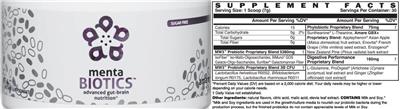
Supplement Facts
The label details for MentaBiotics by Amare, sourced from the NIH Dietary Supplement Label Database.
Supplement Facts
| Ingredient | Amount | % DV |
|---|---|---|
| Calories | 15 Calorie(s) | -- |
| Total Carbohydrates | 5 Gram(s) | 2% |
| L-Glutamine | 0 NP | -- |
| Total Sugars | 0 Gram(s) | -- |
| Bifidobacterium longum R0175 | 0 NP | -- |
| Suntheanine | 0 NP | -- |
| Lactobacillus rhamnosus R0011 | 0 NP | -- |
| Lactobacillus helveticus R0052 | 0 NP | -- |
| Total Fibers | 5 Gram(s) | -- |
| Bimuno | 0 NP | -- |
| IsoFiber | 0 NP | -- |
| Amare GBX+ Proprietary Blend | 0 NP | -- |
| Applephenon Asian Apple Fruit Extract | 0 NP | -- |
| Enovita | 0 NP | -- |
| Enzogenol | 0 NP | -- |
| MW3 Prebiotic Proprietary Blend | 5380 mg | -- |
| Sunfiber | 0 NP | -- |
| MW3 Probiotic Proprietary Blend | 0 NP | -- |
| Phytobiotic Proprietary Blend | 75 mg | -- |
| Digestive Performance Proprietary Blend | 160 mg | -- |
| ProDigest | 0 NP | -- |
Other ingredients: Natural Flavors, Citric Acid, Malic Acid, Stevia Leaf Extract
Tap any ingredient to jump to its full detail below.
These statements are the manufacturer’s wording, reproduced from the product label — the label is saying it, not HelloPharmacist. We don’t verify or endorse them.
FDA Statement of Identity
Dietary Supplement
Formulation
Advanced gut-brain nutrition
Sugar free
Precautions
Contains milk and soy. Milk and soy ingredients are used in the growth/culture media to nourish our probiotic bacteria during the production process, but the finished probiotics do not contain appreciable levels of milk or soy.
Is this label outdated? Report a formula or label change and our pharmacy team will review it.
MentaBiotics by Amare label
The label scan from the NIH Dietary Supplement Label Database. Tap to enlarge.
Label images are published by the NIH Dietary Supplement Label Database for the version of this product on file. Always read your actual product label.
View the full label (PDF)The Ingredients in MentaBiotics by Amare
These are the 11 active ingredients this product is made of. Select any to open its full monograph.
Serving size7 Gram(s) Dosage formPowder Servings per container30 Amounts shown are per serving.
Most supplement products combine several ingredients, and a medication can interact with the product through any one of them. Each ingredient below shows whether it has known drug interactions.
Total Fibers
MW3 Prebiotic Proprietary Blend
- › Bimuno
- › IsoFiber
- › Sunfiber
MW3 Probiotic Proprietary Blend
- › Bifidobacterium longum R0175
- › Lactobacillus rhamnosus R0011
- › Lactobacillus helveticus R0052
Phytobiotic Proprietary Blend
- › Suntheanine
- › Amare GBX+ Proprietary Blend
Digestive Performance Proprietary Blend
- › L-Glutamine
- › ProDigest
Other (inactive) ingredients: Natural Flavors, Citric Acid, Malic Acid, Stevia Leaf Extract. These complete the product’s ingredient list but are not active constituents.
MentaBiotics by Amare Drug Interactions
HelloPharmacist Interaction Report
MentaBiotics by Amare contains ingredients with several documented interactions that warrant a medication check before you start.
The most serious concern is Applephenon (apple fruit extract), which significantly reduces absorption of organic anion-transporting polypeptide substrates (OATP) — a Major severity interaction affecting drugs like fexofenadine, atenolol, and aliskiren. This means these medications may become less effective at controlling their intended condition.
Read the full breakdown — every affected drug type, severity by severity
Enovita (grape extract) interacts with several cytochrome P450 enzyme systems (CYP1A2, CYP2D6, CYP3A4, and CYP2E1 substrates), theoretically altering levels of many common medications — though human data are limited. It may also increase bleeding risk with blood thinners (anticoagulants) or antiplatelet drugs, and can reduce cyclosporine absorption.
L-Glutamine carries a Moderate interaction with anticonvulsants, theoretically antagonizing their effects. Bifidobacterium longum and Lactobacillus helveticus both may be killed if taken alongside antibiotics, reducing their probiotic benefit.
Theanine (Suntheanine) may lower blood pressure and could potentiate antihypertensive medications (Moderate), and theoretically add to sedation from CNS depressants like sleeping pills or anxiety medications (Minor). There is also a minor serotonin concern with serotonergic drugs, though no human reports of harm exist.
We could not check several ingredients including Total Fibers, Bimuno, IsoFiber, Enzogenol, Sunfiber, and ProDigest.
Altogether, these interactions span 1,386 individual medications. Please use the interaction checker below with your exact medication list before adding this product.
Check your own medications below · Editorial policy · How we use AI
Want to check YOUR meds against MentaBiotics?
Ask about interactions with your drugs in plain English — “Can I take it with lisinopril?” — and we find you the answer in seconds, ingredient by ingredient.
Go to the checkerIngredients driving the most interactions
Individual Drug Interactions
The ingredients in MentaBiotics interact with 1,398 drugs. Click any drug to see the details.
4 of the 11 ingredients in MentaBiotics interact with drugs. Each result below shows which ingredient is responsible. Suntheanine Bifidobacterium longum R0175 Lactobacillus helveticus R0052 L-Glutamine
AtorvastatinAtorvaliq
How Atorvastatin interacts with MentaBiotics — through 2 ingredients. Tap an ingredient for the detail:
Applephenon Asian Apple Fruit ExtractOrganic Anion-transporting Polypeptide Substrates (oatp) Major
Interaction Summary
Concomitant consumption of apple juice can significantly decrease oral absorption and blood levels of OATP substrates.
Read the full Applephenon Asian Apple Fruit Extract + Atorvastatin interactionEnovitaCytochrome P450 3a4 (cyp3a4) Substrates Moderate
Interaction Summary
It is unclear if grape seed extract inhibits or induces CYP3A4; research is conflicting.
Read the full Enovita + Atorvastatin interactionAtorvastatin CalciumLipitor
How Atorvastatin Calcium interacts with MentaBiotics — through 2 ingredients. Tap an ingredient for the detail:
Applephenon Asian Apple Fruit ExtractOrganic Anion-transporting Polypeptide Substrates (oatp) Major
Interaction Summary
Concomitant consumption of apple juice can significantly decrease oral absorption and blood levels of OATP substrates.
Read the full Applephenon Asian Apple Fruit Extract + Atorvastatin Calcium interactionEnovitaCytochrome P450 3a4 (cyp3a4) Substrates Moderate
Interaction Summary
It is unclear if grape seed extract inhibits or induces CYP3A4; research is conflicting.
Read the full Enovita + Atorvastatin Calcium interactionBosentanTracleer
How Bosentan interacts with MentaBiotics — through 3 ingredients. Tap an ingredient for the detail:
Applephenon Asian Apple Fruit ExtractOrganic Anion-transporting Polypeptide Substrates (oatp), Antihypertensive Drugs Major
Interaction Summary
Concomitant consumption of apple juice can significantly decrease oral absorption and blood levels of OATP substrates.
Read the full Applephenon Asian Apple Fruit Extract + Bosentan interactionEnovitaCytochrome P450 3a4 (cyp3a4) Substrates, Cytochrome P450 2c9 (cyp2c9) Substrates Moderate
Interaction Summary
It is unclear if grape seed extract inhibits or induces CYP3A4; research is conflicting.
Read the full Enovita + Bosentan interactionSuntheanineAntihypertensive Drugs Moderate
Interaction Summary
Theanine might lower blood pressure, potentiating the effects of antihypertensive drugs.
Read the full Suntheanine + Bosentan interactionBrincidofovirTembexa
How Brincidofovir interacts with MentaBiotics — through 1 ingredient. Tap an ingredient for the detail:
Applephenon Asian Apple Fruit ExtractOrganic Anion-transporting Polypeptide Substrates (oatp) Major
Interaction Summary
Concomitant consumption of apple juice can significantly decrease oral absorption and blood levels of OATP substrates.
Read the full Applephenon Asian Apple Fruit Extract + Brincidofovir interactionCeliprololCelicard
How Celiprolol interacts with MentaBiotics — through 2 ingredients. Tap an ingredient for the detail:
Applephenon Asian Apple Fruit ExtractOrganic Anion-transporting Polypeptide Substrates (oatp), Antihypertensive Drugs Major
Interaction Summary
Concomitant consumption of apple juice can significantly decrease oral absorption and blood levels of OATP substrates.
Read the full Applephenon Asian Apple Fruit Extract + Celiprolol interactionSuntheanineAntihypertensive Drugs Moderate
Interaction Summary
Theanine might lower blood pressure, potentiating the effects of antihypertensive drugs.
Read the full Suntheanine + Celiprolol interactionCerivastatin SodiumBaycol
How Cerivastatin Sodium interacts with MentaBiotics — through 1 ingredient. Tap an ingredient for the detail:
Applephenon Asian Apple Fruit ExtractOrganic Anion-transporting Polypeptide Substrates (oatp) Major
Interaction Summary
Concomitant consumption of apple juice can significantly decrease oral absorption and blood levels of OATP substrates.
Read the full Applephenon Asian Apple Fruit Extract + Cerivastatin Sodium interactionCinoxacinCinobac
How Cinoxacin interacts with MentaBiotics — through 3 ingredients. Tap an ingredient for the detail:
Applephenon Asian Apple Fruit ExtractOrganic Anion-transporting Polypeptide Substrates (oatp) Major
Interaction Summary
Concomitant consumption of apple juice can significantly decrease oral absorption and blood levels of OATP substrates.
Read the full Applephenon Asian Apple Fruit Extract + Cinoxacin interactionLactobacillus Helveticus R0052Antibiotic Drugs Moderate
Interaction Summary
Theoretically, taking Lactobacillus helveticus with antibiotic drugs might decrease the effectiveness of L.
Read the full Lactobacillus Helveticus R0052 + Cinoxacin interactionBifidobacterium Longum R0175Antibiotic Drugs Moderate
Interaction Summary
Theoretically, taking Bifidobacterium longum with antibiotic drugs might decrease the effectiveness of B.
Read the full Bifidobacterium Longum R0175 + Cinoxacin interactionCiprofloxacinCiloxan, Cipro, Cipro IV, Cipro XR, Ciprobay, Otiprio
How Ciprofloxacin interacts with MentaBiotics — through 3 ingredients. Tap an ingredient for the detail:
Applephenon Asian Apple Fruit ExtractOrganic Anion-transporting Polypeptide Substrates (oatp) Major
Interaction Summary
Concomitant consumption of apple juice can significantly decrease oral absorption and blood levels of OATP substrates.
Read the full Applephenon Asian Apple Fruit Extract + Ciprofloxacin interactionBifidobacterium Longum R0175Antibiotic Drugs Moderate
Interaction Summary
Theoretically, taking Bifidobacterium longum with antibiotic drugs might decrease the effectiveness of B.
Read the full Bifidobacterium Longum R0175 + Ciprofloxacin interactionLactobacillus Helveticus R0052Antibiotic Drugs Moderate
Interaction Summary
Theoretically, taking Lactobacillus helveticus with antibiotic drugs might decrease the effectiveness of L.
Read the full Lactobacillus Helveticus R0052 + Ciprofloxacin interactionCiprofloxacin, HydrocortisoneCipro HC Otic
How Ciprofloxacin, Hydrocortisone interacts with MentaBiotics — through 1 ingredient. Tap an ingredient for the detail:
Applephenon Asian Apple Fruit ExtractOrganic Anion-transporting Polypeptide Substrates (oatp) Major
Interaction Summary
Concomitant consumption of apple juice can significantly decrease oral absorption and blood levels of OATP substrates.
Read the full Applephenon Asian Apple Fruit Extract + Ciprofloxacin, Hydrocortisone interactionClinafloxacinClinafloxacin
How Clinafloxacin interacts with MentaBiotics — through 3 ingredients. Tap an ingredient for the detail:
Applephenon Asian Apple Fruit ExtractOrganic Anion-transporting Polypeptide Substrates (oatp) Major
Interaction Summary
Concomitant consumption of apple juice can significantly decrease oral absorption and blood levels of OATP substrates.
Read the full Applephenon Asian Apple Fruit Extract + Clinafloxacin interactionBifidobacterium Longum R0175Antibiotic Drugs Moderate
Interaction Summary
Theoretically, taking Bifidobacterium longum with antibiotic drugs might decrease the effectiveness of B.
Read the full Bifidobacterium Longum R0175 + Clinafloxacin interactionLactobacillus Helveticus R0052Antibiotic Drugs Moderate
Interaction Summary
Theoretically, taking Lactobacillus helveticus with antibiotic drugs might decrease the effectiveness of L.
Read the full Lactobacillus Helveticus R0052 + Clinafloxacin interactionEnoxacinPenetrex
How Enoxacin interacts with MentaBiotics — through 3 ingredients. Tap an ingredient for the detail:
Applephenon Asian Apple Fruit ExtractOrganic Anion-transporting Polypeptide Substrates (oatp) Major
Interaction Summary
Concomitant consumption of apple juice can significantly decrease oral absorption and blood levels of OATP substrates.
Read the full Applephenon Asian Apple Fruit Extract + Enoxacin interactionLactobacillus Helveticus R0052Antibiotic Drugs Moderate
Interaction Summary
Theoretically, taking Lactobacillus helveticus with antibiotic drugs might decrease the effectiveness of L.
Read the full Lactobacillus Helveticus R0052 + Enoxacin interactionBifidobacterium Longum R0175Antibiotic Drugs Moderate
Interaction Summary
Theoretically, taking Bifidobacterium longum with antibiotic drugs might decrease the effectiveness of B.
Read the full Bifidobacterium Longum R0175 + Enoxacin interactionEtoposideEtopophos, VePesid, VP16
How Etoposide interacts with MentaBiotics — through 2 ingredients. Tap an ingredient for the detail:
Applephenon Asian Apple Fruit ExtractOrganic Anion-transporting Polypeptide Substrates (oatp) Major
Interaction Summary
Concomitant consumption of apple juice can significantly decrease oral absorption and blood levels of OATP substrates.
Read the full Applephenon Asian Apple Fruit Extract + Etoposide interactionEnovitaCytochrome P450 3a4 (cyp3a4) Substrates Moderate
Interaction Summary
It is unclear if grape seed extract inhibits or induces CYP3A4; research is conflicting.
Read the full Enovita + Etoposide interactionEzetimibe, AtorvastatinLiptruzet
How Ezetimibe, Atorvastatin interacts with MentaBiotics — through 2 ingredients. Tap an ingredient for the detail:
Applephenon Asian Apple Fruit ExtractOrganic Anion-transporting Polypeptide Substrates (oatp) Major
Interaction Summary
Concomitant consumption of apple juice can significantly decrease oral absorption and blood levels of OATP substrates.
Read the full Applephenon Asian Apple Fruit Extract + Ezetimibe, Atorvastatin interactionEnovitaCytochrome P450 3a4 (cyp3a4) Substrates Moderate
Interaction Summary
It is unclear if grape seed extract inhibits or induces CYP3A4; research is conflicting.
Read the full Enovita + Ezetimibe, Atorvastatin interactionFexofenadineAllegra
How Fexofenadine interacts with MentaBiotics — through 2 ingredients. Tap an ingredient for the detail:
Applephenon Asian Apple Fruit ExtractOrganic Anion-transporting Polypeptide Substrates (oatp), Fexofenadine (allegra) Major
Interaction Summary
Concomitant consumption of apple juice can significantly decrease oral absorption and blood levels of OATP substrates.
Read the full Applephenon Asian Apple Fruit Extract + Fexofenadine interactionEnovitaCytochrome P450 3a4 (cyp3a4) Substrates Moderate
Interaction Summary
It is unclear if grape seed extract inhibits or induces CYP3A4; research is conflicting.
Read the full Enovita + Fexofenadine interactionFexofenadine, PseudoephedrineAllegra D
How Fexofenadine, Pseudoephedrine interacts with MentaBiotics — through 2 ingredients. Tap an ingredient for the detail:
Applephenon Asian Apple Fruit ExtractOrganic Anion-transporting Polypeptide Substrates (oatp), Fexofenadine (allegra) Major
Interaction Summary
Concomitant consumption of apple juice can significantly decrease oral absorption and blood levels of OATP substrates.
Read the full Applephenon Asian Apple Fruit Extract + Fexofenadine, Pseudoephedrine interactionEnovitaCytochrome P450 3a4 (cyp3a4) Substrates Moderate
Interaction Summary
It is unclear if grape seed extract inhibits or induces CYP3A4; research is conflicting.
Read the full Enovita + Fexofenadine, Pseudoephedrine interactionFluvastatinLescol, Lescol XL
How Fluvastatin interacts with MentaBiotics — through 2 ingredients. Tap an ingredient for the detail:
Applephenon Asian Apple Fruit ExtractOrganic Anion-transporting Polypeptide Substrates (oatp) Major
Interaction Summary
Concomitant consumption of apple juice can significantly decrease oral absorption and blood levels of OATP substrates.
Read the full Applephenon Asian Apple Fruit Extract + Fluvastatin interactionEnovitaCytochrome P450 2c9 (cyp2c9) Substrates Minor
Interaction Summary
It is unclear if grape juice or grape seed extract inhibits CYP2C9; research is conflicting.
Read the full Enovita + Fluvastatin interactionGatifloxacinTequin, Tequin Injection
How Gatifloxacin interacts with MentaBiotics — through 3 ingredients. Tap an ingredient for the detail:
Applephenon Asian Apple Fruit ExtractOrganic Anion-transporting Polypeptide Substrates (oatp) Major
Interaction Summary
Concomitant consumption of apple juice can significantly decrease oral absorption and blood levels of OATP substrates.
Read the full Applephenon Asian Apple Fruit Extract + Gatifloxacin interactionLactobacillus Helveticus R0052Antibiotic Drugs Moderate
Interaction Summary
Theoretically, taking Lactobacillus helveticus with antibiotic drugs might decrease the effectiveness of L.
Read the full Lactobacillus Helveticus R0052 + Gatifloxacin interactionBifidobacterium Longum R0175Antibiotic Drugs Moderate
Interaction Summary
Theoretically, taking Bifidobacterium longum with antibiotic drugs might decrease the effectiveness of B.
Read the full Bifidobacterium Longum R0175 + Gatifloxacin interactionGemifloxacinFactive
How Gemifloxacin interacts with MentaBiotics — through 3 ingredients. Tap an ingredient for the detail:
Applephenon Asian Apple Fruit ExtractOrganic Anion-transporting Polypeptide Substrates (oatp) Major
Interaction Summary
Concomitant consumption of apple juice can significantly decrease oral absorption and blood levels of OATP substrates.
Read the full Applephenon Asian Apple Fruit Extract + Gemifloxacin interactionBifidobacterium Longum R0175Antibiotic Drugs Moderate
Interaction Summary
Theoretically, taking Bifidobacterium longum with antibiotic drugs might decrease the effectiveness of B.
Read the full Bifidobacterium Longum R0175 + Gemifloxacin interactionLactobacillus Helveticus R0052Antibiotic Drugs Moderate
Interaction Summary
Theoretically, taking Lactobacillus helveticus with antibiotic drugs might decrease the effectiveness of L.
Read the full Lactobacillus Helveticus R0052 + Gemifloxacin interactionGlyburideAlbert Glyburide, Diabeta, Glycron, Glynase, Glynase PresTab, Micronase +1 more
How Glyburide interacts with MentaBiotics — through 2 ingredients. Tap an ingredient for the detail:
Applephenon Asian Apple Fruit ExtractAntidiabetes Drugs, Organic Anion-transporting Polypeptide Substrates (oatp) Major
Interaction Summary
Theoretically, consuming apple juice with antidiabetes drugs might interfere with blood glucose control.
Read the full Applephenon Asian Apple Fruit Extract + Glyburide interactionEnovitaCytochrome P450 2c9 (cyp2c9) Substrates Minor
Interaction Summary
It is unclear if grape juice or grape seed extract inhibits CYP2C9; research is conflicting.
Read the full Enovita + Glyburide interactionGlyburide, MetforminGlucovance
How Glyburide, Metformin interacts with MentaBiotics — through 2 ingredients. Tap an ingredient for the detail:
Applephenon Asian Apple Fruit ExtractOrganic Anion-transporting Polypeptide Substrates (oatp), Antidiabetes Drugs Major
Interaction Summary
Concomitant consumption of apple juice can significantly decrease oral absorption and blood levels of OATP substrates.
Read the full Applephenon Asian Apple Fruit Extract + Glyburide, Metformin interactionEnovitaCytochrome P450 2c9 (cyp2c9) Substrates Minor
Interaction Summary
It is unclear if grape juice or grape seed extract inhibits CYP2C9; research is conflicting.
Read the full Enovita + Glyburide, Metformin interactionGrepafloxacinRaxar
How Grepafloxacin interacts with MentaBiotics — through 4 ingredients. Tap an ingredient for the detail:
Applephenon Asian Apple Fruit ExtractOrganic Anion-transporting Polypeptide Substrates (oatp) Major
Interaction Summary
Concomitant consumption of apple juice can significantly decrease oral absorption and blood levels of OATP substrates.
Read the full Applephenon Asian Apple Fruit Extract + Grepafloxacin interactionBifidobacterium Longum R0175Antibiotic Drugs Moderate
Interaction Summary
Theoretically, taking Bifidobacterium longum with antibiotic drugs might decrease the effectiveness of B.
Read the full Bifidobacterium Longum R0175 + Grepafloxacin interactionEnovitaCytochrome P450 1a2 (cyp1a2) Substrates Moderate
Interaction Summary
Theoretically, grape juice might reduce the levels of CYP1A2 substrates.
Read the full Enovita + Grepafloxacin interactionLactobacillus Helveticus R0052Antibiotic Drugs Moderate
Interaction Summary
Theoretically, taking Lactobacillus helveticus with antibiotic drugs might decrease the effectiveness of L.
Read the full Lactobacillus Helveticus R0052 + Grepafloxacin interactionIrinotecanCamptosar, Onivyde
How Irinotecan interacts with MentaBiotics — through 2 ingredients. Tap an ingredient for the detail:
Applephenon Asian Apple Fruit ExtractOrganic Anion-transporting Polypeptide Substrates (oatp) Major
Interaction Summary
Concomitant consumption of apple juice can significantly decrease oral absorption and blood levels of OATP substrates.
Read the full Applephenon Asian Apple Fruit Extract + Irinotecan interactionEnovitaCytochrome P450 3a4 (cyp3a4) Substrates Moderate
Interaction Summary
It is unclear if grape seed extract inhibits or induces CYP3A4; research is conflicting.
Read the full Enovita + Irinotecan interactionIrinotecan Hydrochloride
How Irinotecan Hydrochloride interacts with MentaBiotics — through 2 ingredients. Tap an ingredient for the detail:
Applephenon Asian Apple Fruit ExtractOrganic Anion-transporting Polypeptide Substrates (oatp) Major
Interaction Summary
Concomitant consumption of apple juice can significantly decrease oral absorption and blood levels of OATP substrates.
Read the full Applephenon Asian Apple Fruit Extract + Irinotecan Hydrochloride interactionEnovitaCytochrome P450 3a4 (cyp3a4) Substrates Moderate
Interaction Summary
It is unclear if grape seed extract inhibits or induces CYP3A4; research is conflicting.
Read the full Enovita + Irinotecan Hydrochloride interactionIsoniazid, Pyrazinamide, RifampinRifater
How Isoniazid, Pyrazinamide, Rifampin interacts with MentaBiotics — through 1 ingredient. Tap an ingredient for the detail:
Applephenon Asian Apple Fruit ExtractOrganic Anion-transporting Polypeptide Substrates (oatp) Major
Interaction Summary
Concomitant consumption of apple juice can significantly decrease oral absorption and blood levels of OATP substrates.
Read the full Applephenon Asian Apple Fruit Extract + Isoniazid, Pyrazinamide, Rifampin interactionIsoniazid, RifampinRifamate
How Isoniazid, Rifampin interacts with MentaBiotics — through 3 ingredients. Tap an ingredient for the detail:
Applephenon Asian Apple Fruit ExtractOrganic Anion-transporting Polypeptide Substrates (oatp) Major
Interaction Summary
Concomitant consumption of apple juice can significantly decrease oral absorption and blood levels of OATP substrates.
Read the full Applephenon Asian Apple Fruit Extract + Isoniazid, Rifampin interactionLactobacillus Helveticus R0052Antibiotic Drugs Moderate
Interaction Summary
Theoretically, taking Lactobacillus helveticus with antibiotic drugs might decrease the effectiveness of L.
Read the full Lactobacillus Helveticus R0052 + Isoniazid, Rifampin interactionBifidobacterium Longum R0175Antibiotic Drugs Moderate
Interaction Summary
Theoretically, taking Bifidobacterium longum with antibiotic drugs might decrease the effectiveness of B.
Read the full Bifidobacterium Longum R0175 + Isoniazid, Rifampin interactionLevofloxacinLeva-pak, Levaquin, Levaquin Injection
How Levofloxacin interacts with MentaBiotics — through 3 ingredients. Tap an ingredient for the detail:
Applephenon Asian Apple Fruit ExtractOrganic Anion-transporting Polypeptide Substrates (oatp) Major
Interaction Summary
Concomitant consumption of apple juice can significantly decrease oral absorption and blood levels of OATP substrates.
Read the full Applephenon Asian Apple Fruit Extract + Levofloxacin interactionBifidobacterium Longum R0175Antibiotic Drugs Moderate
Interaction Summary
Theoretically, taking Bifidobacterium longum with antibiotic drugs might decrease the effectiveness of B.
Read the full Bifidobacterium Longum R0175 + Levofloxacin interactionLactobacillus Helveticus R0052Antibiotic Drugs Moderate
Interaction Summary
Theoretically, taking Lactobacillus helveticus with antibiotic drugs might decrease the effectiveness of L.
Read the full Lactobacillus Helveticus R0052 + Levofloxacin interactionLevofloxacin (ophthalmic)Levofloxacin
How Levofloxacin (ophthalmic) interacts with MentaBiotics — through 3 ingredients. Tap an ingredient for the detail:
Applephenon Asian Apple Fruit ExtractOrganic Anion-transporting Polypeptide Substrates (oatp) Major
Interaction Summary
Concomitant consumption of apple juice can significantly decrease oral absorption and blood levels of OATP substrates.
Read the full Applephenon Asian Apple Fruit Extract + Levofloxacin (ophthalmic) interactionBifidobacterium Longum R0175Antibiotic Drugs Moderate
Interaction Summary
Theoretically, taking Bifidobacterium longum with antibiotic drugs might decrease the effectiveness of B.
Read the full Bifidobacterium Longum R0175 + Levofloxacin (ophthalmic) interactionLactobacillus Helveticus R0052Antibiotic Drugs Moderate
Interaction Summary
Theoretically, taking Lactobacillus helveticus with antibiotic drugs might decrease the effectiveness of L.
Read the full Lactobacillus Helveticus R0052 + Levofloxacin (ophthalmic) interactionLomefloxacinMaxaquin
How Lomefloxacin interacts with MentaBiotics — through 3 ingredients. Tap an ingredient for the detail:
Applephenon Asian Apple Fruit ExtractOrganic Anion-transporting Polypeptide Substrates (oatp) Major
Interaction Summary
Concomitant consumption of apple juice can significantly decrease oral absorption and blood levels of OATP substrates.
Read the full Applephenon Asian Apple Fruit Extract + Lomefloxacin interactionLactobacillus Helveticus R0052Antibiotic Drugs Moderate
Interaction Summary
Theoretically, taking Lactobacillus helveticus with antibiotic drugs might decrease the effectiveness of L.
Read the full Lactobacillus Helveticus R0052 + Lomefloxacin interactionBifidobacterium Longum R0175Antibiotic Drugs Moderate
Interaction Summary
Theoretically, taking Bifidobacterium longum with antibiotic drugs might decrease the effectiveness of B.
Read the full Bifidobacterium Longum R0175 + Lomefloxacin interactionLovastatinAltocor, Mevacor
How Lovastatin interacts with MentaBiotics — through 2 ingredients. Tap an ingredient for the detail:
Applephenon Asian Apple Fruit ExtractOrganic Anion-transporting Polypeptide Substrates (oatp) Major
Interaction Summary
Concomitant consumption of apple juice can significantly decrease oral absorption and blood levels of OATP substrates.
Read the full Applephenon Asian Apple Fruit Extract + Lovastatin interactionEnovitaCytochrome P450 3a4 (cyp3a4) Substrates Moderate
Interaction Summary
It is unclear if grape seed extract inhibits or induces CYP3A4; research is conflicting.
Read the full Enovita + Lovastatin interactionMethotrexateOtrexup, Rasuvo, Reditrex, Rheumatrex
How Methotrexate interacts with MentaBiotics — through 1 ingredient. Tap an ingredient for the detail:
Applephenon Asian Apple Fruit ExtractOrganic Anion-transporting Polypeptide Substrates (oatp) Major
Interaction Summary
Concomitant consumption of apple juice can significantly decrease oral absorption and blood levels of OATP substrates.
Read the full Applephenon Asian Apple Fruit Extract + Methotrexate interactionEach ingredient & the kinds of drugs it affects
For each ingredient in MentaBiotics with known interactions, here are the types of medications they can affect. Open any type for the detail — or search your exact drug in the checker above.
Suntheanine
Antihypertensive Drugs
Theanine might lower blood pressure, potentiating the effects of antihypertensive drugs.
Animal research shows that theanine can lower blood pressure in spontaneously hypertensive animals. Theoretically, concomitant use of theanine and antihypertensive drugs might potentiate the antihypertensive activity.
Cns Depressants
Theoretically, theanine might have additive sedative effects when used in conjunction with CNS depressants. However, it is unclear if this concern is clinically relevant.
Theoretically, theanine may compete with glutamate and/or increase plasma gamma-aminobutyric acid (GABA) levels, which could cause CNS depression. In one clinical study, some subjects taking oral theanine reported drowsiness.
Serotonergic Drugs
Clinical studies regarding the effects of L-theanine on serotonin levels are conflicting. Some studies suggest it can increase serotonin levels in the brain while others report that it may decrease them. Nevertheless, there have been no reports of l-theanine being a causative agent in serotonergic-related side effects or serotonin syndrome.
Bifidobacterium longum R0175
Antibiotic Drugs
Theoretically, taking Bifidobacterium longum with antibiotic drugs might decrease the effectiveness of B. longum.
Since B. longum preparations usually contain live and active organisms, simultaneously taking antibiotics might kill a significant number of the organisms. Tell patients to separate administration of antibiotics and B. longum preparations by at least 2 hours.
Lactobacillus helveticus R0052
Antibiotic Drugs
Theoretically, taking Lactobacillus helveticus with antibiotic drugs might decrease the effectiveness of L. helveticus.
Lactobacillus helveticus preparations usually contain live and active organisms. Therefore, simultaneously taking antibiotics might kill a significant number of the organisms. Tell patients to separate administration of antibiotics and L. helveticus preparations by at least two hours.
L-Glutamine
Anticonvulsants
Theoretically, glutamine might antagonize the effects of anticonvulsant medications.
Glutamine is metabolized to the excitatory neurotransmitter glutamate. Glutamate might have antagonistic effects with anticonvulsant drugs. However, this interaction has not yet been reported in humans.
Brand information
Manufacturer and brand details for MentaBiotics, from the product label.
MentaBiotics by Amare: Common Questions
Does MentaBiotics by Amare interact with any medications?
How can one product interact with so many drugs?
Where does this information come from?
Can I take MentaBiotics if I'm pregnant?
Will this help with anxiety?
What should I expect as side effects?
Can I take MentaBiotics with my antibiotics?
Will this work better if I take it every day?
Is there anything in this product I should know about if I have food allergies?
Written and reviewed by the HelloPharmacist editorial staff. Our editorial policy
Not sure if MentaBiotics is safe with your meds?
Our pharmacists answer your medication & supplement questions — free.
Label information is sourced from the NIH Dietary Supplement Label Database and reflects the product version on file; always read your actual product label. This page is for education only and is not a substitute for professional medical advice. Confirm with your pharmacist or doctor before combining supplements and medications.
The Full Monographs Behind MentaBiotics’s Ingredients
Every ingredient we hold a full HelloPharmacist monograph for — uses, evidence, safety, and the complete interaction list.
Bifidobacterium Longum
Interacts with 182 drugsBifidobacterium longum is a 'friendly' bacterium found naturally in the human gut and used as a probiotic. It is generally well tolerated and is most studied for digestive issues, though evi...
Read the full Bifidobacterium Longum monograph → Herb & supplement monographLactobacillus Helveticus
Interacts with 182 drugsLactobacillus helveticus is a lactic acid bacterium used as a probiotic, often combined with other strains in mood, gut, and general wellness products. Early research is interesting—especial...
Read the full Lactobacillus Helveticus monograph → Herb & supplement monographTheanine
Interacts with 565 drugsTheanine (usually L-theanine) is an amino acid found naturally in tea leaves that many people take to feel calmer and less stressed without strong drowsiness. Early research suggests it may...
Read the full Theanine monograph → Herb & supplement monographGlutamine
Interacts with 50 drugsGlutamine is the most abundant amino acid in the body and is usually made in your muscles. A prescription form is FDA-approved to help reduce sickle cell disease complications, but for most...
Read the full Glutamine monograph →Sources & How We Checked
MentaBiotics's label data comes from the NIH Dietary Supplement Label Database; the ingredient interaction data is from the Natural Medicines database, reviewed by our pharmacists.
- NIH Dietary Supplement Label Database (DSLD) — The official product label on file for this supplement.
- Natural Medicines (Therapeutic Research Center) — Evidence-graded clinical reference behind the ingredient interaction data.
Content is written and reviewed by licensed HelloPharmacist pharmacists. See our data sources and editorial standards for how this information is built and checked.
The 90 references behind this product’s interaction data
Every citation that drives the interaction findings for this product’s ingredients, from the evidence-graded Natural Medicines (TRC Healthcare) database. Open an ingredient to browse its citations — links open the study on PubMed or the publisher’s site.
Glutamine 11 references
- Miller AL. Therapeutic considerations of L-glutamine: a review of the literature. Altern Med Rev 1999;4:239-48..
- Bozzetti F, Biganzoli L, Gavazzi C, et al. Glutamine supplementation in cancer patients receiving chemotherapy: a double-blind randomized study. Nutrition 1997;13:748-51.. PubMed
- Mebane AH. L-Glutamine and mania. Am J Psychiatry 984;141:1302-3.
- Meldrum BS. Glutamate as a neurotransmitter in the brain: review of physiology and pathology. J Nutr 2000;130:1007S-15S.. PubMed
- Garlick PJ. Assessment of the safety of glutamine and other amino acids. J Nutr 2001;131:2556S-61S.. PubMed
- Chapman AG. Glutamate and epilepsy. J Nutr 2000;130:1043S-5S.. PubMed
- Ziegler TR. Glutamine supplementation in cancer patients receiving bone marrow transplantation and high dose chemotherapy. J Nutr 2001;131:2578S-84S.. PubMed
- Laviano A, Molfino A, Lacaria MT, Canelli A, De Leo S, Preziosa I, Rossi Fanelli F. Glutamine supplementation favors weight loss in nondieting obese female patients. A pilot study. Eur J Clin Nutr. 2014 Nov;68(11):1264-6. PubMed
- Endari (l-glutamine) [package insert]. Torrance, CA: Emmaus Medical,Inc; 2017.
- Niihara Y, Miller ST, Kanter J, et al. A Phase 3 Trial of l-Glutamine in Sickle Cell Disease. N Engl J Med 2018;379(3):226-35. doi: 10.1056/NEJMoa1715971.
- Ogden HB, Child RB, Fallowfield JL, et al. Gastrointestinal Tolerance of Low, Medium and High Dose Acute Oral l-Glutamine Supplementation in Healthy Adults: A Pilot Study. Nutrients. 2020;12(10):2953. PubMed
Bifidobacterium Longum 21 references
- Ha GY, Yang CH, Kim H, Chong Y. Case of sepsis caused by Bifidobacterium longum. J Clin Microbiol 1999;37:1227-8.
- Pierce A. The American Pharmaceutical Association Practical Guide to Natural Medicines. New York: The Stonesong Press, 1999:19.
- Xiao JZ, Takahashi S, Odamaki T, et al. Antibiotic susceptibility of bifidobacterial strains distributed in the Japanese market. Biosci Biotechnol Biochem. 2010;74(2):336-42. PubMed
- Rautava S, Kainonen E, Salminen S, Isolauri E. Maternal probiotic supplementation during pregnancy and breast-feeding reduces the risk of eczema in the infant. J Allergy Clin Immunol. 2012;130(6):1355-60. PubMed
- Pruccoli G, Silvestro E, Pace Napoleone C, Aidala E, Garazzino S, Scolfaro C. Are probiotics safe? Bifidobacterium bacteremia in a child with severe heart failure. Infez Med. 2019;27(2):175-178.
- Pellonperä O, Vahlberg T, Mokkala K, et al. Weight gain and body composition during pregnancy: a randomised pilot trial with probiotics and/or fish oil. Br J Nutr. 2020 Nov 4:1-11. PubMed
- Pellonperä O, Mokkala K, Houttu N, et al. Efficacy of fish oil and/or probiotic intervention on the incidence of gestational diabetes mellitus in an at-risk group of overweight and obese women: A randomized, placebo-controlled, double-blind clinical trial PubMed
- Shahriari A, Karimi E, Shahriari M, Aslani N, Khooshideh M, Arab A. The effect of probiotic supplementation on the risk of gestational diabetes mellitus among high-risk pregnant women: A parallel double-blind, randomized, placebo-controlled clinical trial PubMed
- Esaiassen E, Hjerde E, Cavanagh JP, Simonsen GS, Klingenberg C; Norwegian Study Group on Invasive Bifidobacterial Infections. Bifidobacterium bacteremia: Clinical characteristics and a genomic approach to assess pathogenicity. J Clin Microbiol. 2017;55(7) PubMed
- Enomoto T, Sowa M, Nishimori K, et al. Effects of bifidobacterial supplementation to pregnant women and infants in the prevention of allergy development in infants and on fecal microbiota. Allergol Int 2014;63(4):575-85. PubMed
- US Food and Drug Administration (FDA). Dear Healthcare Provider Letter: Warning Regarding Use of Probiotics in Preterm Infants. September 2023. Available at: https://www.fda.gov/media/172606/download?attachment. Accessed November 1, 2023.
- Pillai A, Tan J, Paquette V, Panczuk J. Does probiotic bacteremia in premature infants impact clinically relevant outcomes? A case report and updated review of literature. Clin Nutr ESPEN. 2020;39:255-259. PubMed
- Sabaté JM, Iglicki F. Effect of Bifidobacterium longum 35624 on disease severity and quality of life in patients with irritable bowel syndrome. World J Gastroenterol 2022;28(7):732-744.
- Malaguarnera M, Greco F, Barone G, Gargante MP, Malaguarnera M, Toscano MA. Bifidobacterium longum with fructo-oligosaccharide (FOS) treatment in minimal hepatic encephalopathy: a randomized, double-blind, placebo-controlled study. Dig Dis Sci 2007;52(11) PubMed
- Zbinden A, Zbinden R, Berger C, Arlettaz R. Case series of Bifidobacterium longum bacteremia in three preterm infants on probiotic therapy. Neonatology 2015;107(1):56-9.
- Tamaki H, Nakase H, Inoue S, et al. Efficacy of probiotic treatment with Bifidobacterium longum 536 for induction of remission in active ulcerative colitis: A randomized, double-blinded, placebo-controlled multicenter trial. Dig Endosc 2016;28(1):67-74.
- Bertelli C, Pillonel T, Torregrossa A, et al. Bifidobacterium longum bacteremia in preterm infants receiving probiotics. Clin Infect Dis 2015;60(6):924-7. PubMed
- Esaiassen E, Cavanagh P, Hjerde E, Simonsen GS, Støen R, Klingenberg C. Bifidobacterium longum subspecies infantis bacteremia in 3 extremely preterm infants receiving probiotics. Emerg Infect Dis 2016;22(9):1664-6.
- Tena D, Losa C, Medina MJ, Sáez-Nieto JA. Peritonitis caused by Bifidobacterium longum: case report and literature review. Anaerobe 2014;27:27-30. PubMed
- Sangkanjanavanich S, Pradubpongsa P, Mitthamsiri W, Sangasapaviliya A, Boonpiyathad T. Bifidobacterium infantis 35624 efficacy in patients with uncontrolled asthma: A randomized placebo-controlled trial. Ann Allergy Asthma Immunol 2022;129(6):790-792. PubMed
- Wilson HL, Ong CW. Bifidobacterium longum vertebrodiscitis in a patient with cirrhosis and prostate cancer. Anaerobe 2017;47:47-50. PubMed
See these in context on the Bifidobacterium Longum monograph →
Theanine 6 references
- Yokogoshi H, Kobayashi M. Hypotensive effect of gamma-glutamylethylamide in spontaneously hypertensive rats. Life Sci 1998;62:1065-8.
- Haskell, C. F., Kennedy, D. O., Milne, A. L., Wesnes, K. A., and Scholey, A. B. The effects of L-theanine, caffeine and their combination on cognition and mood. Biol.Psychol. 2008;77(2):113-122. PubMed
- Yokogoshi, H., Kato, Y., Sagesaka, Y. M., Takihara-Matsuura, T., Kakuda, T., and Takeuchi, N. Reduction effect of theanine on blood pressure and brain 5-hydroxyindoles in spontaneously hypertensive rats. Biosci.Biotechnol.Biochem. 1995;59(4):615-618. PubMed
- Lyon MR, Kapoor MP, Juneja LR. The effects of L-theanine (Suntheanine®) on objective sleep quality in boys with attention deficit hyperactivity disorder (ADHD): a randomized, double-blind, placebo-controlled clinical trial. Altern Med Rev. 2011;16(4):348-
- Hidese S, Ota M, Wakabayashi C, et al. Effects of chronic l-theanine administration in patients with major depressive disorder: an open-label study. Acta Neuropsychiatr 2017;29(2):72-9.
- Tsuchiya T, Honda H, Oikawa M, et al. Oral administration of the amino acids cystine and theanine attenuates the adverse events of S-1 adjuvant chemotherapy in gastrointestinal cancer patients. Int J Clin Oncol 2016;21(6):1085-90. PubMed
Lactobacillus Helveticus 2 references
- Pierce A. The American Pharmaceutical Association Practical Guide to Natural Medicines. New York: The Stonesong Press, 1999:19.
- Rossi F, Amadoro C, Gasperi M, Colavita G. Lactobacilli infection case reports in the last three years and safety implications. Nutrients. 2022;14(6):1178. PubMed
See these in context on the Lactobacillus Helveticus monograph →
Apple 16 references
- The Review of Natural Products by Facts and Comparisons. St. Louis, MO: Wolters Kluwer Co., 1999.
- Bailey DG, Dresser GK, Munoz C, et al. Reduction of fexofenadine bioavailability by fruit juices. Clin Pharmacol Ther 2001;69:P21.
- Rodriguez J, Crespo JF, Lopez-Rubio A, et al. Clinical cross-reactivity among foods of the Rosaceae family. J Allergy Clin Immunol 2000;106:183-189. PubMed
- Greenblatt DJ. Analysis of drug interactions involving fruit beverages and organic anion-transporting polypeptides. J Clin Pharmacol 2009;49:1403-7. PubMed
- Bailey DG. Fruit juice inhibition of uptake transport: a new type of food-drug interaction. Br J Clin Pharmacol 2010;70:645-55. PubMed
- Kamath AV, Yao M, Zhang Y, Chong S. Effect of fruit juices on the oral bioavailability of fexofenadine in rats. J Pharm Sci 2005;94:233-9. PubMed
- Tapaninen T, Neuvonen PJ, Niemi M. Orange and apple juice greatly reduce the plasma concentrations of the OATP2B1 substrate aliskiren. Br J Clin Pharmacol 2011;71:718-26. PubMed
- Jeon H, Jang IJ, Lee S, et al. Apple juice greatly reduces systemic exposure to atenolol. Br J Clin Pharmacol 2012 May 11. doi: 10.1111/j.1365-2125.2012.04324.x. [Epub ahead of print]. PubMed
- Visvanathan, R., Chen, R., Horowitz, M., and Chapman, I. Blood pressure responses in healthy older people to 50 g carbohydrate drinks with differing glycaemic effects. Br J Nutr 2004;92(2):335-340. PubMed
- Asp, N. G., Agardh, C. D., Ahren, B., Dencker, I., Johansson, C. G., Lundquist, I., Nyman, M., Sartor, G., and Schersten, B. Dietary fibre in type II diabetes. Acta Med Scand Suppl 1981;656:47-50. PubMed
- Akamine Y, Miura M, Komori H, et al. Effects of one-time apple juice ingestion on the pharmacokinetics of fexofenadine enantiomers. Eur J Clin Pharmacol. 2014 Sep;70(9):1087-95. PubMed
- Luo J, Imai H, Ohyama T, et al. The Pharmacokinetic Exposure to Fexofenadine is Volume-Dependently Reduced in Healthy Subjects Following Oral Administration With Apple Juice. Clin Transl Sci. 2016 Aug;9(4):201-6. PubMed
- Tsiougkos N, Vovolis V. Repeated anaphylactic episodes to orange and apple. Eur Ann Allergy Clin Immunol. 2013 May;45(3):113-5.
- Rubido S, García-Caballero L, Abeleira MT, Limeres J, García M, Diz P. Effect of chewing an apple on dental plaque removal and on salivary bacterial viability. PLoS One. 2018;13(7):e0199812. PubMed
- Krishnasamy S, Lomer MCE, Marciani L, et al. Processing apples to puree or juice speeds gastric emptying and reduces postprandial intestinal volumes and satiety in healthy adults. J Nutr 2020;150(11):2890-9. PubMed
- Awan S, Abelleira A, Khehra L, Hieber R. Undetectable serum lithium concentrations after coadministration of liquid lithium citrate and apple juice: A case report. Ment Health Clin. 2021;11(1):27-30. PubMed
Grape 34 references
- Kiesewetter H, Koscielny J, Kalus U, et al. Efficacy of orally administered extract of red vine leaf AS 195 (folia vitis viniferae) in chronic venous insufficiency (stages I-II). A randomized, double-blind, placebo-controlled trial. Arzneimittelforschung
- Xiao Dong S, Zhi Ping Z, Zhong Xiao W, et al. Possible enhancement of the first-pass metabolism of phenacetin by ingestion of grape juice in Chinese subjects. Br J Clin Pharmacol 1999;48:638-40. PubMed
- Vaswani SK, Hamilton RG, Carey RN, et al. Anaphylaxis recurrent urticaria and angioedema from grape hypersensitivity. J Allergy Clin Immunol 1998;101:S31.
- Chevallier A. The Encyclopedia of Medicinal Plants. London, UK: Dorling Kindersley, Ltd., 1996.
- Bernstein DI, Bernstein CK, Deng C, et al. Evaluation of the clinical efficacy and safety of grapeseed extract in the treatment of fall seasonal allergic rhinitis: a pilot study. Ann Allergy Asthma Immunol 2002;88:272-8.. PubMed
- Greenblatt DJ, von Moltke LL, Perloff ES, et al. Interaction of flurbiprofen with cranberry juice, grape juice, tea, and fluconazole: in vitro and clinical studies. Clin Pharmacol Ther 2006;79:125-33. PubMed
- Ward NC, Hodgson JM, Croft KD, et al. The combination of vitamin C and grape-seed polyphenols increases blood pressure: a randomized, double-blind, placebo-controlled trial. J Hypertens 2005;23:427-34.. PubMed
- Ray, S. D., Parikh, H., Hickey, E., Bagchi, M., and Bagchi, D. Differential effects of IH636 grape seed proanthocyanidin extract and a DNA repair modulator 4-aminobenzamide on liver microsomal cytochrome 4502E1-dependent aniline hydroxylation. Mol Cell B PubMed
- O'Byrne, D. J., Devaraj, S., Grundy, S. M., and Jialal, I. Comparison of the antioxidant effects of Concord grape juice flavonoids alpha-tocopherol on markers of oxidative stress in healthy adults. Am J Clin.Nutr. 2002;76(6):1367-1374.
- Schaefer, E., Peil, H., Ambrosetti, L., and Petrini, O. Oedema protective properties of the red vine leaf extract AS 195 (Folia vitis viniferae) in the treatment of chronic venous insufficiency. A 6-week observational clinical trial. Arzneimittelforschun PubMed
- Nishikawa, M., Ariyoshi, N., Kotani, A., Ishii, I., Nakamura, H., Nakasa, H., Ida, M., Nakamura, H., Kimura, N., Kimura, M., Hasegawa, A., Kusu, F., Ohmori, S., Nakazawa, K., and Kitada, M. Effects of continuous ingestion of green tea or grape seed extra
- de Lange, D. W., Scholman, W. L., Kraaijenhagen, R. J., Akkerman, J. W., and van de Wiel, A. Alcohol and polyphenolic grape extract inhibit platelet adhesion in flowing blood. Eur.J Clin.Invest 2004;34(12):818-824. PubMed
- Samet, J. M. and Coultas, D. B. Reduced forced vital capacity in California grape workers. What does it mean? Am Rev.Respir.Dis 1992;145(2 Pt 1):255-256. PubMed
- Gamsky, T. E., McCurdy, S. A., Samuels, S. J., and Schenker, M. B. Reduced FVC among California grape workers. Am Rev.Respir.Dis 1992;145(2 Pt 1):257-262. PubMed
- de Lange, D. W., Verhoef, S., Gorter, G., Kraaijenhagen, R. J., van de Wiel, A., and Akkerman, J. W. Polyphenolic grape extract inhibits platelet activation through PECAM-1: an explanation for the French paradox. Alcohol Clin.Exp.Res 2007;31(8):1308-1314 PubMed
- Etheridge, A. S., Black, S. R., Patel, P. R., So, J., and Mathews, J. M. An in vitro evaluation of cytochrome P450 inhibition and P-glycoprotein interaction with goldenseal, Ginkgo biloba, grape seed, milk thistle, and ginseng extracts and their constitu
- Krikorian, R., Nash, T. A., Shidler, M. D., Shukitt-Hale, B., and Joseph, J. A. Concord grape juice supplementation improves memory function in older adults with mild cognitive impairment. Br J Nutr. 2010;103(5):730-734. PubMed
- Ingersoll, G. L., Wasilewski, A., Haller, M., Pandya, K., Bennett, J., He, H., Hoffmire, C., and Berry, C. Effect of concord grape juice on chemotherapy-induced nausea and vomiting: results of a pilot study. Oncol.Nurs.Forum 2010;37(2):213-221. PubMed
- Oliveira-Freitas, V. L., Dalla, Costa T., Manfro, R. C., Cruz, L. B., and Schwartsmann, G. Influence of purple grape juice in cyclosporine bioavailability. J Ren Nutr. 2010;20(5):309-313. PubMed
- Hollis, J. H., Houchins, J. A., Blumberg, J. B., and Mattes, R. D. Effects of concord grape juice on appetite, diet, body weight, lipid profile, and antioxidant status of adults. J Am Coll.Nutr. 2009;28(5):574-582. PubMed
- Dohadwala, M. M., Hamburg, N. M., Holbrook, M., Kim, B. H., Duess, M. A., Levit, A., Titas, M., Chung, W. B., Vincent, F. B., Caiano, T. L., Frame, A. A., Keaney, J. F., Jr., and Vita, J. A. Effects of Concord grape juice on ambulatory blood pressure in
- Rabe, E., Stucker, M., Esperester, A., Schafer, E., and Ottillinger, B. Efficacy and tolerability of a red-vine-leaf extract in patients suffering from chronic venous insufficiency--results of a double-blind placebo-controlled study. Eur.J Vasc.Endovasc. PubMed
- Trotta, M., Cesaretti, M., Conzi, R., Derchi, L. E., and Borgonovo, G. Elderly male with mesogastric pain. Small bowel obstruction caused by an intact fresh grape. Ann.Emerg.Med 2011;58(4):e1-e2. PubMed
- McCurdy, S. A., Wiggins, P., Schenker, M. B., Munn, S., Shaieb, A. M., Weinbaum, Z., Goldsmith, D., McGillis, S. T., Berman, B., and Samuels, S. Assessing dermatitis in epidemiologic studies: occupational skin disease among California grape and tomato ha
- Winter, C. K. and Kurtz, P. H. Factors influencing grape worker susceptibility to skin rashes. Bull.Environ.Contam Toxicol. 1985;35(3):418-426. PubMed
- Yamasaki, R., Dekio, S., and Jidoi, J. Contact dermatitis from grape bud. Contact Dermatitis 1985;12(4):226-227. PubMed
- Cox, J. and Grigg, M. Small bowel obstruction by an intact grape. J Am Geriatr.Soc 1986;34(7):550. PubMed
- Faircloth, D. E. and Robison, W. J. Obstruction of the sigmoid colon by grape seeds. JAMA 11-27-1981;246(21):2430. PubMed
- Marguerie, C. and Drouet, M. [Occupational eosinophilic lung in a grape grower: role of sulfites]. Allerg.Immunol.(Paris) 1995;27(5):163-167.
- Brito, FF., Martinez, A., Palacios, R., Mur, P., Gomez, E., Galindo, P. A., Borja, J., and Martinez, J. Rhinoconjunctivitis and asthma caused by vine pollen: a case report. J Allergy Clin Immunol 1999;103(2 Pt 1):262-266. PubMed
- Ras RT, Zock PL, Zebregs YE, et al. Effect of polyphenol-rich grape seed extract on ambulatory blood pressure in subjects with pre- and stage I hypertension. Br J Nutr 2013;110(12):2234-41. PubMed
- Berry AC, Nakshabendi R, Abidali H, et al. Adverse effects of grape seed extract supplement: A clinical case and long-term follow-up. J Diet Suppl. 2016;13(2):232-5. PubMed
- Martínez-Maqueda D, Zapatera B, Gallego-Narbón A, Vaquero MP, Saura-Calixto F, Pérez-Jiménez J. A 6-week supplementation with grape pomace to subjects at cardiometabolic risk ameliorates insulin sensitivity, without affecting other metabolic syndrome mark
- Moon SW, Shin YU, Cho H, Bae SH, Kim HK; and for the Mogen Study Group. Effect of grape seed proanthocyanidin extract on hard exudates in patients with non-proliferative diabetic retinopathy. Medicine (Baltimore) 2019;98(21):e15515. PubMed
Parts of this content are provided by the Therapeutic Research Center, LLC.
DISCLAIMER: Currently this does not check for drug-drug interactions. This is not an all-inclusive comprehensive list of potential interactions and is for informational purposes only. Not all interactions are known or well-reported in the scientific literature, and new interactions are continually being reported. Input is needed from a qualified healthcare provider including a pharmacist before starting any therapy. Application of clinical judgment is necessary.
© 2021 Therapeutic Research Center, LLC