
Neem Powder Ingredients & Drug Interactions
What is this page for?
First and foremost: checking Neem Powder against your medications. The heart of this page is the interaction checker and the full interaction report — how this product’s ingredients may interact with prescription and over-the-counter medicines you may be taking.
Around that, we add a pharmacist’s high-level view of the product as a whole — what’s inside, the evidence for its stated use, how transparent the label is, and what safety data exists — so you can see the full picture in one place. It’s educational information from our licensed clinical databases and the clinical staff at HelloPharmacist — not medical advice — and we don’t sell or endorse products. Our editorial policy
Neem Powder is a dietary supplement by Banyan Botanicals with 1 active ingredient. Its ingredients are commonly taken for skin conditions, dental and gum health, antimicrobial and antiparasitic.Based on those ingredients, 1,013 medications have a known interaction with it, the most serious rated moderate. The ingredients most likely to interact are Neem. Use the checker below to test your specific medication, or read the full HelloPharmacist Interaction Report.
Check Your Meds Against Neem Powder by Banyan Botanicals
Ask about any prescription or over-the-counter medication and we check it for interactions with Neem Powder by Banyan Botanicals — and tell you which ingredient is responsible.
AI summaries are generated from our interaction database for education only — always confirm with your pharmacist. How we use AI
Ask the Pharmacist
A licensed pharmacist will answer your question by email — free, usually within 24 hours.
Got it — thank you!
A licensed pharmacist will answer within 24 hours. Keep an eye on your email (worth checking spam, just in case).
HelloPharmacist Scorecard of Neem Powder by Banyan Botanicals
Our pharmacy team’s full take, with four database checks built into the cards below — a summary of what is known, not a grade of the product itself.
What’s inside
Full disclosure
Neem Powder contains one active ingredient: neem leaf. Neem is a traditional botanical used in Ayurvedic practice.
This product has no other inactive ingredients listed.
Does it work?
Moderate evidence
Neem leaf is possibly effective for gingivitis (gum inflammation) and lice. It's also possibly effective for reducing dental plaque.
For acne and tungiasis (a parasitic skin infection), the evidence isn't strong enough to rate. Keep in mind that most of the research is still limited — more high-quality studies would help us understand how well it really works.
How safe is it?
Well-documented data
Neem leaf powder is generally well tolerated when taken by mouth in adults, though rigorous safety testing hasn't been done. Topically, it's well tolerated in both children and adults; the main side effect is contact dermatitis (skin irritation) in people with sensitive skin.
However, neem oil and seed extracts are different from leaf powder and can be toxic if swallowed — especially in children. Rare serious effects reported with neem leaf include heart rhythm problems (ventricular fibrillation) and heart failure in adults, and breakdown of red blood cells (hemolysis) in people with a glucose-6-phosphate dehydrogenase deficiency.
Neem may affect fertility and pregnancy, so the safety data advises against it during pregnancy. There isn't enough data to know whether it's safe while breastfeeding, so talk with your doctor or pharmacist for personalized advice.
Meds to double-check
Moderate interaction found
Check your medications before adding this product. The biggest concern is antidiabetes drugs — neem can lower blood sugar and raise the risk of levels dropping too low.
Also double-check any immunosuppressants you take, and any medications processed by your liver (CYP1A2, CYP3A4, CYP2C9, or CYP2C8 substrates) or pumped out by your kidneys (P-glycoprotein substrates). Use the drug checker on this page to look up your exact prescriptions, then talk with your doctor or pharmacist.
The bottom line
Scorecard at a glanceFully disclosed formula with some supporting evidence for its stated purpose. Moderate medication interactions have been identified, and safety information is well characterized.
Neem leaf is used traditionally for gum health, plaque, and lice, and some research backs those uses. But it interacts with many common medications — especially diabetes drugs and those processed through your liver — so it's not a take-it-and-forget-it choice.
If you're on prescription medication, check your drugs on this page first, then discuss neem with your doctor or pharmacist before you start.
Educational only — not medical advice; always confirm with your pharmacist. Our editorial policy · How we use AI
Assessment coverage: 1 of 1 active ingredient matched to our full ingredient reviews (monographs). Based on the product label dated May 23, 2024.
This Scorecard evaluates available label information, ingredient evidence, and known medication-safety considerations. It does not independently verify product identity, purity, potency, contamination, or manufacturing quality. How these ratings are computed
General information
Key facts about Neem Powder, straight from the product label.
| Brand | Banyan Botanicals |
|---|---|
| Barcode (UPC) | 618192073612 |
| Net contents | 1 lb; 454 Gram(s) |
| Market status | On market |
| Date entered into DSLD | May 23, 2024 |
| DSLD ID | 308384 |
| Product type | Botanical |
| Supplement form | Powder |
| Dietary claims / uses | All Other, Structure/Function |
| Intended target group(s) | Adult (18 - 50 Years), Organic |
Everything in this section is reproduced from the manufacturer’s own product label — it’s the label speaking, not HelloPharmacist. We show it so you can see exactly what the maker states; we don’t verify or endorse those statements.
Supplement Facts
The label details for Neem Powder by Banyan Botanicals, sourced from the NIH Dietary Supplement Label Database.
Supplement Facts
| Ingredient | Amount | % DV |
|---|---|---|
| Neem | 0.5 Teaspoon(s) | -- |
Tap any ingredient to jump to its full detail below.
These statements are the manufacturer’s wording, reproduced from the product label — the label is saying it, not HelloPharmacist. We don’t verify or endorse them.
Formula
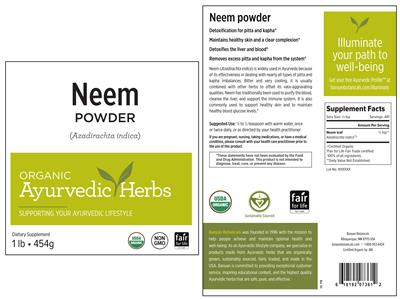
Azadirachta indica Organic ayurvedic herbs
Neem (Azdairachta indica) is widely used in Ayurveda because of its effectiveness in dealing with nearly all types of pitta and kapha imbalances. Bitter and very cooling, it is usually combined with other herbs to offset its vata-aggravating qualities. Neem has traditionally been used to purify the blood, cleanse the liver, and support the immune system. It is also commonly used to support healthy skin and to maintain healthy blood glucose levels.
Formulation
Supporting your ayurvedic lifestyle
USDA Organic
Non GMO
Detoxification for pitta and kapha Maintains healthy skin and a clear complexion Detoxifies the liver and blood Removes excess pitta and kapha from the system
Certified organic by: QAI
FDA Statement of Identity
Dietary Supplement
Seals/Symbols
USDA Organic Fair for life Fair trade
Sustainably sourced
Suggested/Recommended/Usage/Directions
Suggested use: 1/4 to 1/2 teaspoon with warm water, once or twice daily, or as directed by your health practitioner.
Precautions
If you are pregnant, nursing, taking medications, or have a medical condition, please consult with your health care practitioner prior to the use of this product.
FDA Disclaimer Statement
These statements have not been evaluated by the Food and Drug Administration. This product is not intended to diagnose, treat, cure, or prevent any disease.
General Statements
Banyan Botanicals was founded in 1996 with the mission to help people achieve and maintain optimal health and well-being. As an ayurvedic lifestyle company, we specialize in products made from ayurvedic herbs that are organically grown, sustainably sourced, fairly traded, and made in the USA. Banyan is committed to providing exceptional customer service, inspiring educational content, and the highest quality ayurvedic herbs that are safe, pure, and effective. Illuminate your path to well-being Get your free ayurvedic profile at banyanbotanicals.com/illuminate
Is this label outdated? Report a formula or label change and our pharmacy team will review it.
Neem Powder by Banyan Botanicals label
The label scan from the NIH Dietary Supplement Label Database. Tap to enlarge.
Label images are published by the NIH Dietary Supplement Label Database for the version of this product on file. Always read your actual product label.
View the full label (PDF)The Ingredients in Neem Powder by Banyan Botanicals
This is the 1 active ingredient this product is made of. Select it to open its full monograph.
Serving size0.25 Teaspoon(s) Dosage formPowder Servings per container441 Amounts shown are per serving.
Neem
Interacts with1,013 drugs
Neem is a tree from India used for centuries in traditional medicine, especially for skin, dental, and antimicrobial purposes. Some small studies are...
Neem monograph & interactionsNeem Powder by Banyan Botanicals Drug Interactions
HelloPharmacist Interaction Report
Neem Powder by Banyan Botanicals interacts with medications through its neem leaf content — specifically through several enzyme systems your liver and kidneys use to break down drugs.
The most serious concern is with antidiabetes drugs: neem can lower blood sugar, and when combined with diabetes medications, it may push your levels too low (hypoglycemia, or low blood sugar).
Read the full breakdown — every affected drug type, severity by severity
Neem also theoretically increases the levels and effects of several other drug types by slowing how your body clears them. These include CYP1A2, CYP3A4, CYP2C9, and CYP2C8 substrates — a range of common medications metabolized by these liver pathways.
Additionally, neem may raise levels of P-glycoprotein substrates, which are drugs your kidneys normally pump out. None of these liver-enzyme interactions have been reported in humans yet; they're based on lab research so far.
Neem may also reduce how well immunosuppressants work if you're taking them for an organ transplant or autoimmune condition. Altogether, these interactions span 1,014 individual medications.
Before you start neem, use the drug checker on this page to look up your exact prescriptions. If you take diabetes medication or an immunosuppressant, or if your medications are metabolized by those liver enzymes, talk with your doctor or pharmacist about whether neem is right for you.
Check your own medications below · Editorial policy · How we use AI
Want to check YOUR meds against Neem Powder?
Ask about interactions with your drugs in plain English — “Can I take it with lisinopril?” — and we find you the answer in seconds, ingredient by ingredient.
Go to the checkerIngredients driving the most interactions
Individual Drug Interactions
The ingredients in Neem Powder interact with 1,013 drugs. Click any drug to see the details.
1 of the 1 ingredient in Neem Powder interact with drugs. Each result below shows which ingredient is responsible. Neem
Pitolisant HydrochlorideWakix
How Pitolisant Hydrochloride interacts with Neem Powder — through 1 ingredient. Tap an ingredient for the detail:
NeemCytochrome P450 3a4 (cyp3a4) Substrates Moderate
Interaction Summary
Theoretically, neem leaf extract might increase the levels and clinical effects of CYP3A4 substrates.
Read the full Neem + Pitolisant Hydrochloride interactionPolatuzumab Vedotin-piiqPolivy
How Polatuzumab Vedotin-piiq interacts with Neem Powder — through 1 ingredient. Tap an ingredient for the detail:
NeemCytochrome P450 3a4 (cyp3a4) Substrates Moderate
Interaction Summary
Theoretically, neem leaf extract might increase the levels and clinical effects of CYP3A4 substrates.
Read the full Neem + Polatuzumab Vedotin-piiq interactionPomalidomidePomalyst
How Pomalidomide interacts with Neem Powder — through 1 ingredient. Tap an ingredient for the detail:
NeemCytochrome P450 3a4 (cyp3a4) Substrates, Cytochrome P450 1a2 (cyp1a2) Substrates +2 Moderate
Interaction Summary
Theoretically, neem leaf extract might increase the levels and clinical effects of CYP3A4 substrates.
Read the full Neem + Pomalidomide interactionPonatinibIclusig
How Ponatinib interacts with Neem Powder — through 1 ingredient. Tap an ingredient for the detail:
NeemCytochrome P450 3a4 (cyp3a4) Substrates Moderate
Interaction Summary
Theoretically, neem leaf extract might increase the levels and clinical effects of CYP3A4 substrates.
Read the full Neem + Ponatinib interactionPonesimodPonvory
How Ponesimod interacts with Neem Powder — through 1 ingredient. Tap an ingredient for the detail:
NeemCytochrome P450 3a4 (cyp3a4) Substrates Moderate
Interaction Summary
Theoretically, neem leaf extract might increase the levels and clinical effects of CYP3A4 substrates.
Read the full Neem + Ponesimod interactionPralsetinibGavreto
How Pralsetinib interacts with Neem Powder — through 1 ingredient. Tap an ingredient for the detail:
NeemCytochrome P450 3a4 (cyp3a4) Substrates, P-glycoprotein Substrates Moderate
Interaction Summary
Theoretically, neem leaf extract might increase the levels and clinical effects of CYP3A4 substrates.
Read the full Neem + Pralsetinib interactionPramlintideSymlin
How Pramlintide interacts with Neem Powder — through 1 ingredient. Tap an ingredient for the detail:
NeemAntidiabetes Drugs Moderate
Interaction Summary
Neem might increase the risk of hypoglycemia when taken with antidiabetes drugs.
Read the full Neem + Pramlintide interactionPrednisoloneCortalone, Delta Cortef, Pred Forte, Prednisolone, Solupred, Sterane
How Prednisolone interacts with Neem Powder — through 1 ingredient. Tap an ingredient for the detail:
NeemImmunosuppressants, Cytochrome P450 3a4 (cyp3a4) Substrates +1 Moderate
Interaction Summary
Theoretically, neem might decrease the effectiveness of immunosuppressants.
Read the full Neem + Prednisolone interactionPrednisoneCortan, Deltasone, Meticorten, Orasone, Prednicen-M, Prednisone +2 more
How Prednisone interacts with Neem Powder — through 1 ingredient. Tap an ingredient for the detail:
NeemCytochrome P450 3a4 (cyp3a4) Substrates, Immunosuppressants +1 Moderate
Interaction Summary
Theoretically, neem leaf extract might increase the levels and clinical effects of CYP3A4 substrates.
Read the full Neem + Prednisone interactionPretomanidPretomanid
How Pretomanid interacts with Neem Powder — through 1 ingredient. Tap an ingredient for the detail:
NeemImmunosuppressants Moderate
Interaction Summary
Theoretically, neem might decrease the effectiveness of immunosuppressants.
Read the full Neem + Pretomanid interactionProgesteroneMilprosa
How Progesterone interacts with Neem Powder — through 1 ingredient. Tap an ingredient for the detail:
NeemCytochrome P450 3a4 (cyp3a4) Substrates Moderate
Interaction Summary
Theoretically, neem leaf extract might increase the levels and clinical effects of CYP3A4 substrates.
Read the full Neem + Progesterone interactionProgesterone (prescription Drug)Endometrin, Prometrium, Utrogestan
How Progesterone (prescription Drug) interacts with Neem Powder — through 1 ingredient. Tap an ingredient for the detail:
NeemCytochrome P450 3a4 (cyp3a4) Substrates Moderate
Interaction Summary
Theoretically, neem leaf extract might increase the levels and clinical effects of CYP3A4 substrates.
Read the full Neem + Progesterone (prescription Drug) interactionProgestin, Oral ContraceptiveSlynd
How Progestin, Oral Contraceptive interacts with Neem Powder — through 1 ingredient. Tap an ingredient for the detail:
NeemCytochrome P450 3a4 (cyp3a4) Substrates Moderate
Interaction Summary
Theoretically, neem leaf extract might increase the levels and clinical effects of CYP3A4 substrates.
Read the full Neem + Progestin, Oral Contraceptive interactionPropafenoneArythmol, Rythmol
How Propafenone interacts with Neem Powder — through 1 ingredient. Tap an ingredient for the detail:
NeemCytochrome P450 1a2 (cyp1a2) Substrates Moderate
Interaction Summary
Theoretically, neem leaf extract might increase the levels and clinical effects of CYP1A2 substrates.
Read the full Neem + Propafenone interactionPropranololAngilol, Bedranol SR, Beta Prograne, Half Beta Prograne, Half-Inderal LA, Inderal +6 more
How Propranolol interacts with Neem Powder — through 1 ingredient. Tap an ingredient for the detail:
NeemCytochrome P450 1a2 (cyp1a2) Substrates Moderate
Interaction Summary
Theoretically, neem leaf extract might increase the levels and clinical effects of CYP1A2 substrates.
Read the full Neem + Propranolol interactionPropranolol HydrochlorideHemangeol
How Propranolol Hydrochloride interacts with Neem Powder — through 1 ingredient. Tap an ingredient for the detail:
NeemCytochrome P450 1a2 (cyp1a2) Substrates Moderate
Interaction Summary
Theoretically, neem leaf extract might increase the levels and clinical effects of CYP1A2 substrates.
Read the full Neem + Propranolol Hydrochloride interactionPrucaloprideMotegrity, Resolor, Resotran
How Prucalopride interacts with Neem Powder — through 1 ingredient. Tap an ingredient for the detail:
NeemP-glycoprotein Substrates Moderate
Interaction Summary
Theoretically, neem leaf extract might increase the levels and clinical effects of P-glycoprotein substrates.
Read the full Neem + Prucalopride interactionPseudoephedrine, TerfenadineTeldafen
How Pseudoephedrine, Terfenadine interacts with Neem Powder — through 1 ingredient. Tap an ingredient for the detail:
NeemP-glycoprotein Substrates Moderate
Interaction Summary
Theoretically, neem leaf extract might increase the levels and clinical effects of P-glycoprotein substrates.
Read the full Neem + Pseudoephedrine, Terfenadine interactionQuetiapineDopaquel, Seroquel
How Quetiapine interacts with Neem Powder — through 1 ingredient. Tap an ingredient for the detail:
NeemCytochrome P450 3a4 (cyp3a4) Substrates Moderate
Interaction Summary
Theoretically, neem leaf extract might increase the levels and clinical effects of CYP3A4 substrates.
Read the full Neem + Quetiapine interactionQuinidineCardioquin, Cin-Quin, Duraquin, Lin-Qin, Quinova, Quinaglute, Quinaglute Duratabs +2 more
How Quinidine interacts with Neem Powder — through 1 ingredient. Tap an ingredient for the detail:
NeemP-glycoprotein Substrates, Cytochrome P450 3a4 (cyp3a4) Substrates Moderate
Interaction Summary
Theoretically, neem leaf extract might increase the levels and clinical effects of P-glycoprotein substrates.
Read the full Neem + Quinidine interactionQuinineQualaquin
How Quinine interacts with Neem Powder — through 1 ingredient. Tap an ingredient for the detail:
NeemCytochrome P450 3a4 (cyp3a4) Substrates Moderate
Interaction Summary
Theoretically, neem leaf extract might increase the levels and clinical effects of CYP3A4 substrates.
Read the full Neem + Quinine interactionQuinine SulfateQuinamm, Quinine Sulfate
How Quinine Sulfate interacts with Neem Powder — through 1 ingredient. Tap an ingredient for the detail:
NeemCytochrome P450 3a4 (cyp3a4) Substrates Moderate
Interaction Summary
Theoretically, neem leaf extract might increase the levels and clinical effects of CYP3A4 substrates.
Read the full Neem + Quinine Sulfate interactionQuizartinibVanflyta
How Quizartinib interacts with Neem Powder — through 1 ingredient. Tap an ingredient for the detail:
NeemCytochrome P450 3a4 (cyp3a4) Substrates Moderate
Interaction Summary
Theoretically, neem leaf extract might increase the levels and clinical effects of CYP3A4 substrates.
Read the full Neem + Quizartinib interactionRabeprazolePariet
How Rabeprazole interacts with Neem Powder — through 1 ingredient. Tap an ingredient for the detail:
NeemCytochrome P450 3a4 (cyp3a4) Substrates, Cytochrome P450 2c9 (cyp2c9) Substrates Moderate
Interaction Summary
Theoretically, neem leaf extract might increase the levels and clinical effects of CYP3A4 substrates.
Read the full Neem + Rabeprazole interactionRabeprazole SodiumAciphex, Aciphex Sprinkle
How Rabeprazole Sodium interacts with Neem Powder — through 1 ingredient. Tap an ingredient for the detail:
NeemCytochrome P450 3a4 (cyp3a4) Substrates Moderate
Interaction Summary
Theoretically, neem leaf extract might increase the levels and clinical effects of CYP3A4 substrates.
Read the full Neem + Rabeprazole Sodium interactionRamelteonRozerem
How Ramelteon interacts with Neem Powder — through 1 ingredient. Tap an ingredient for the detail:
NeemCytochrome P450 3a4 (cyp3a4) Substrates, Cytochrome P450 1a2 (cyp1a2) Substrates +1 Moderate
Interaction Summary
Theoretically, neem leaf extract might increase the levels and clinical effects of CYP3A4 substrates.
Read the full Neem + Ramelteon interactionRanitidineRanit, Ranitidine injection, Zantac, Zantac 150, Zantac 150 EFFER, Zantac 150 GEL +4 more
How Ranitidine interacts with Neem Powder — through 1 ingredient. Tap an ingredient for the detail:
NeemP-glycoprotein Substrates Moderate
Interaction Summary
Theoretically, neem leaf extract might increase the levels and clinical effects of P-glycoprotein substrates.
Read the full Neem + Ranitidine interactionRanitidine Bismuth CitrateTritec
How Ranitidine Bismuth Citrate interacts with Neem Powder — through 1 ingredient. Tap an ingredient for the detail:
NeemP-glycoprotein Substrates Moderate
Interaction Summary
Theoretically, neem leaf extract might increase the levels and clinical effects of P-glycoprotein substrates.
Read the full Neem + Ranitidine Bismuth Citrate interactionRanolazineAspruzyo, Ranexa
How Ranolazine interacts with Neem Powder — through 1 ingredient. Tap an ingredient for the detail:
NeemP-glycoprotein Substrates, Cytochrome P450 3a4 (cyp3a4) Substrates Moderate
Interaction Summary
Theoretically, neem leaf extract might increase the levels and clinical effects of P-glycoprotein substrates.
Read the full Neem + Ranolazine interactionRasagilineAzilect
How Rasagiline interacts with Neem Powder — through 1 ingredient. Tap an ingredient for the detail:
NeemCytochrome P450 1a2 (cyp1a2) Substrates Moderate
Interaction Summary
Theoretically, neem leaf extract might increase the levels and clinical effects of CYP1A2 substrates.
Read the full Neem + Rasagiline interactionEach ingredient & the kinds of drugs it affects
For each ingredient in Neem Powder with known interactions, here are the types of medications it can affect. Open any type for the detail — or search your exact drug in the checker above.
Neem
Antidiabetes Drugs
Neem might increase the risk of hypoglycemia when taken with antidiabetes drugs.
Some clinical research shows that neem can lower blood glucose levels in adults with type 2 diabetes, including those already taking metformin.
Cytochrome P450 1A2 (Cyp1A2) Substrates
Theoretically, neem leaf extract might increase the levels and clinical effects of CYP1A2 substrates.
In vitro research shows that neem leaf extract inhibits CYP1A2 enzymes. So far, this reaction has not been reported in humans.
Cytochrome P450 2C8 (Cyp2C8) Substrates
Theoretically, neem leaf extract might increase the levels and clinical effects of CYP2C8 substrates.
In vitro research shows that neem leaf methanol extract inhibits CYP2C8 enzymes. So far, this reaction has not been reported in humans.
Cytochrome P450 2C9 (Cyp2C9) Substrates
Theoretically, neem leaf extract might increase the levels and clinical effects of CYP2C9 substrates.
In vitro research shows that neem leaf methanol extract inhibits CYP2C9 enzymes. So far, this reaction has not been reported in humans.
Cytochrome P450 3A4 (Cyp3A4) Substrates
Theoretically, neem leaf extract might increase the levels and clinical effects of CYP3A4 substrates.
In vitro research shows that neem leaf methanol extract inhibits CYP3A4 enzymes. So far, this reaction has not been reported in humans.
Immunosuppressants
Theoretically, neem might decrease the effectiveness of immunosuppressants.
Animal research suggests that neem might have immunostimulant effects.
P-Glycoprotein Substrates
Theoretically, neem leaf extract might increase the levels and clinical effects of P-glycoprotein substrates.
In vitro research shows that neem leaf methanol extract inhibits renal P-glycoprotein transport activity. So far, this reaction has not been reported in humans.
Brand information
Manufacturer and brand details for Neem Powder, from the product label.
Banyan Botanicals
See all Banyan Botanicals products- Name
- Banyan Botanicals
- City
- Albuquerque
- State
- NM
- ZipCode
- 87113
- Phone Number
- 1-800-953-6424
- Web Address
- banyanbotanicals.com
Neem Powder by Banyan Botanicals: Common Questions
Does Neem Powder by Banyan Botanicals interact with any medications?
How can one product interact with so many drugs?
Where does this information come from?
Is neem safe during pregnancy or while breastfeeding?
Can I use neem on my skin?
What does neem actually work for?
I have diabetes and take metformin. Can I take neem?
What are the side effects of neem powder?
Written and reviewed by the HelloPharmacist editorial staff. Our editorial policy
Not sure if Neem Powder is safe with your meds?
Our pharmacists answer your medication & supplement questions — free.
Label information is sourced from the NIH Dietary Supplement Label Database and reflects the product version on file; always read your actual product label. This page is for education only and is not a substitute for professional medical advice. Confirm with your pharmacist or doctor before combining supplements and medications.
The Full Monographs Behind Neem Powder’s Ingredients
Every ingredient we hold a full HelloPharmacist monograph for — uses, evidence, safety, and the complete interaction list.
Sources & How We Checked
Neem Powder's label data comes from the NIH Dietary Supplement Label Database; the ingredient interaction data is from the Natural Medicines database, reviewed by our pharmacists.
- NIH Dietary Supplement Label Database (DSLD) — The official product label on file for this supplement.
- Natural Medicines (Therapeutic Research Center) — Evidence-graded clinical reference behind the ingredient interaction data.
Content is written and reviewed by licensed HelloPharmacist pharmacists. See our data sources and editorial standards for how this information is built and checked.
The 28 references behind this product’s interaction data
Every citation that drives the interaction findings for this product’s ingredients, from the evidence-graded Natural Medicines (TRC Healthcare) database. Open an ingredient to browse its citations — links open the study on PubMed or the publisher’s site.
Neem 28 references
- Sinniah D, Baskaran G. Margosa oil poisoning as a cause of Reye's syndrome. Lancet 1981;1:487-9. PubMed
- Sinniah D, Baskaran G, Looi LM, Leong KL. Reye-like syndrome due to margosa oil poisoning: report of a case with postmortem findings. Am J Gastroenterol 1982;77:158-61.
- Sinniah R, Sinniah D, Chia LS, Baskaran G. Animal model of margosa oil ingestion with Reye-like syndrome. Pathogenesis of microvesicular fatty liver. J Pathol 1989;159:255-64. PubMed
- Lai SM, Lim KW, Cheng HK. Margosa oil poisoning as a cause of toxic encephalopathy. Singapore Med J 1990;31:463-5.
- Biswas K, Chattopadhyay I, Banerjee RK, Bandyopadhyay U. Biological activities and medicinal properties of neem (Azadirachta indica). Curr Sci 2002;82:1336-45.
- Upadhyay SN, Dhawan S, Garg S, Talwar GP. Immunomodulatory effects of neem (Azadirachta indica) oil. Int J Immunopharmacol 1992;14:1187-93. PubMed
- Ibrahim IA, Khalid SA, Omer SA, Adam SE. On the toxicology of Azadirachta indica leaves. J Ethnopharmacol 1992;35:267-73. PubMed
- Ali BH. Toxicology of Azadirachta indica. J Ethnopharmacol 1994;42:71-2. PubMed
- Boeke SJ, Boersma MG, Alink GM, et al. Safety evaluation of neem (Azadirachta indica) derived pesticides. J Ethnopharmacol 2004;94:25-41. PubMed
- Abdel-Ghaffar, F. and Semmler, M. Efficacy of neem seed extract shampoo on head lice of naturally infected humans in Egypt. Parasitol.Res 2007;100(2):329-332. PubMed
- Reutemann, P. and Ehrlich, A. Neem oil: an herbal therapy for alopecia causes dermatitis. Dermatitis 2008;19(3):E12-E15.
- Senanayake, M. P., Rupasinghe, S., and Dissanayake, P. V. Margosa (Kohomba) oil induced toxic encephalopathy following home remedy for intestinal worms. Ceylon Med.J 2009;54(4):140. PubMed
- Bhaskar, M. V., Pramod, S. J., Jeevika, M. U., Chandan, P. K., and Shetteppa, G. MR imaging findings of neem oil poisoning. AJNR Am J Neuroradiol. 2010;31(7):E60-E61.
- Iyyadurai, R., Surekha, V., Sathyendra, S., Paul, Wilson B., and Gopinath, K. G. Azadirachtin poisoning: a case report. Clin Toxicol.(Phila) 2010;48(8):857-858. PubMed
- Sinniah, D., Sinniah, R., Baskaran, G., Pathmanathan, R., Yamashita, F., and Yoshino, M. Evaluation of the possible role of glucose, carnitine, coenzyme Q10 and steroids in the treatment of Reye's syndrome using the margosa oil animal model. Acta Paediat PubMed
- Balakrishnan, V., Pillai, N. R., and Santhakumari, G. Ventricular fibrillation and cardiac arrest due to neem leaf poisoning. J.Assoc.Physicians India 1986;34(7):536.
- Sivashanmugham, R., Bhaskar, N., and Banumathi, N. Ventricular fibrillation and cardiac arrest due to neem leaf poisoning. J.Assoc.Physicians India 1984;32(7):610-611.
- Mukherjee, S. and Talwar, G. P. Termination of pregnancy in rodents by oral administration of praneem, a purified neem seed extract. Am J Reprod.Immunol. 1996;35(1):51-56. PubMed
- Talwar, G. P., Pal, R., Singh, O., Garg, S., Taluja, V., Upadhyay, S. N., Gopalan, S., Jain, V., Kaur, J., and Sehgal, S. Safety of intrauterine administration of purified neem seed oil (Praneem Vilci) in women & effect of its co-administration with the
- Talwar, G. P., Shah, S., Mukherjee, S., and Chabra, R. Induced termination of pregnancy by purified extracts of Azadirachta Indica (Neem): mechanisms involved. Am J Reprod.Immunol. 1997;37(6):485-491. PubMed
- Greenblatt DT, Banerjee P, White JM. Allergic contact dermatitis caused by neem oil. Contact Dermatitis. 2012;67(4):242-3. PubMed
- Page C, Hawes EM. Haemolytic anaemia after ingestion of Neem (Azadirachta indica) tea. BMJ Case Rep. 2013. pii: bcr2013200890.
- Braidy N, Berg J, Clement J, et al. Role of nicotinamide dinucleotide and related precursors as therapeutic targets for age-related degenerative diseases: rationale, biochemistry, pharmacokinetics, and outcomes. Antiox Redox Signal 2018.
- Jadhav PB. Leucoderma on the lips induced by neem (Azadirachta indica): case series. Clin Exp Dermatol. 2018;43(8):943-6.
- Giuggioli D, Lumetti F, Spinella A, et al. Use of Neem oil and Hypericum perforatum for treatment of calcinosis-related skin ulcers in systemic sclerosis. J Int Med Res 2019:300060519882176. Online ahead of print.
- Pingali U, Ali MA, Gundagani S, Nutalapati C. Evaluation of the effect of an aqueous extract of Azadirachta indica (neem) leaves and twigs on glycemic control, endothelial dysfunction and systemic inflammation in subjects with type 2 diabetes mellitus - a
- Amaeze O, Marques ES, Wei W, et al. Evaluation of Nigerian Medicinal Plants Extract on Human P-glycoprotein and Cytochrome P450 Enzyme Induction: Implications for Herb-drug Interaction. Curr Drug Metab. 2021;22(14):1103-1113. PubMed
- Amaeze O, Eng H, Horlbogen L, Varma MVS, Slitt A. Cytochrome P450 Enzyme Inhibition and Herb-Drug Interaction Potential of Medicinal Plant Extracts Used for Management of Diabetes in Nigeria. Eur J Drug Metab Pharmacokinet. 2021;46(3):437-450. PubMed
Parts of this content are provided by the Therapeutic Research Center, LLC.
DISCLAIMER: Currently this does not check for drug-drug interactions. This is not an all-inclusive comprehensive list of potential interactions and is for informational purposes only. Not all interactions are known or well-reported in the scientific literature, and new interactions are continually being reported. Input is needed from a qualified healthcare provider including a pharmacist before starting any therapy. Application of clinical judgment is necessary.
© 2021 Therapeutic Research Center, LLC