
Nin Jiom Pei Pa KOA Ingredients & Drug Interactions
by Nin Jiom
What is this page for?
First and foremost: checking Nin Jiom Pei Pa KOA against your medications. The heart of this page is the interaction checker and the full interaction report — how this product’s ingredients may interact with prescription and over-the-counter medicines you may be taking.
Around that, we add a pharmacist’s high-level view of the product as a whole — what’s inside, the evidence for its stated use, how transparent the label is, and what safety data exists — so you can see the full picture in one place. It’s educational information from our licensed clinical databases and the clinical staff at HelloPharmacist — not medical advice — and we don’t sell or endorse products. Our editorial policy
Nin Jiom Pei Pa KOA is a dietary supplement by Nin Jiom with 19 active ingredients. Its ingredients are commonly taken for replacing fluids and electrolytes, preventing dehydration during exercise or illness, treating low blood sodium (under medical care).Based on those ingredients, 1,444 medications have a known interaction with it, the most serious rated major. The ingredients most likely to interact are Chinese Licorice, Ginger, Fresh, Pomelo. Use the checker below to test your specific medication, or read the full HelloPharmacist Interaction Report.
Check Your Meds Against Nin Jiom Pei Pa KOA by Nin Jiom
Ask about any prescription or over-the-counter medication and we check it for interactions with Nin Jiom Pei Pa KOA by Nin Jiom — and tell you which ingredient is responsible.
AI summaries are generated from our interaction database for education only — always confirm with your pharmacist. How we use AI
Ask the Pharmacist
A licensed pharmacist will answer your question by email — free, usually within 24 hours.
Got it — thank you!
A licensed pharmacist will answer within 24 hours. Keep an eye on your email (worth checking spam, just in case).
HelloPharmacist Scorecard of Nin Jiom Pei Pa KOA by Nin Jiom
Our pharmacy team’s full take, with four database checks built into the cards below — a summary of what is known, not a grade of the product itself.
What’s inside
Full disclosure
Nin Jiom Pei Pa KOA contains 18 active herbal and food-based ingredients. The most prominent are sodium, honey, and Chinese licorice, along with traditional Chinese botanicals including apricot, ginger, schisandra, pomelo, coltsfoot, poria mushroom, and several others.
The product also contains inactive ingredients: purified water, caramel color, and natural flavors.
Does it work?
Moderate evidence
Evidence for this product's ingredients is limited or insufficient in our data. Honey is possibly effective for cough, cold sores, oral mucositis, burns, and dry eye—uses that align with a throat lozenge.
Ginger is possibly effective for pregnancy-related nausea, period pain, and osteoarthritis. For the other active ingredients—Chinese licorice, schisandra, coltsfoot, ginger, and most of the traditional botanicals—effectiveness claims in our data are rated insufficient or not established.
This is a traditional formula, but we don't hold robust clinical evidence for how well it works as a cough or throat remedy.
How safe is it?
Well-documented data
Sodium is essential in small amounts, but excess intake is linked to high blood pressure and heart strain; normal dietary amounts are fine, but avoid sodium supplements or very high intake without medical advice. Honey is generally safe for adults and children over 1 year and is well tolerated orally and topically, though a small number of trial participants experienced nausea, stomach pain, or stinging when applied to skin.
Chinese licorice is generally well tolerated in food amounts, but the active compound glycyrrhizin can cause headache, nausea, vomiting, or contact dermatitis with high doses or long-term use. Coltsfoot may contain liver-toxic pyrrolizidine alkaloids and carries serious concerns about liver and lung damage with chronic use.
Poria is generally well tolerated in traditional use, though allergic reactions including allergic rhinitis and asthma have been reported rarely. Ginger is well tolerated at typical doses but can cause abdominal discomfort, heartburn, diarrhea, or a burning sensation in the mouth at higher intakes.
Meds to double-check
Major interaction found
Before taking this product, double-check with your pharmacist if you take heart medications like cyclosporine, scopolamine, amiodarone, digoxin, or celiprolol; psychiatric drugs like buspirone or midazolam; blood thinners like warfarin, aspirin, or clopidogrel; blood pressure medications; lithium; medications cleared by your liver's CYP3A4 enzyme system; or any drugs that affect blood sugar. The sodium and multiple herbal ingredients create a wide interaction risk.
The bottom line
Scorecard at a glanceFully disclosed formula with some supporting evidence for its stated purpose. Major medication interactions have been identified, and safety information is well characterized.
This is a traditional liquid herbal product blending honey, ginger, licorice, and other botanicals—ingredients with some evidence for soothing throat symptoms. However, it contains sodium (raising concerns for anyone on blood pressure or heart medications or lithium) and pomelo, a citrus that dramatically alters levels of numerous medications.
If you take any prescription drugs—especially heart, psychiatric, blood-pressure, or blood-thinning medications—check with your pharmacist before using this product. Pregnant or breastfeeding individuals should also talk to their provider, as several ingredients carry cautions.
Educational only — not medical advice; always confirm with your pharmacist. Our editorial policy · How we use AI
Assessment coverage: 11 of 18 active ingredients matched to our full ingredient reviews (monographs). Based on the product label dated Aug 22, 2025.
This Scorecard evaluates available label information, ingredient evidence, and known medication-safety considerations. It does not independently verify product identity, purity, potency, contamination, or manufacturing quality. How these ratings are computed
General information
Key facts about Nin Jiom Pei Pa KOA, straight from the product label.
| Brand | Nin Jiom |
|---|---|
| Barcode (UPC) | 081364363659 |
| Net contents | 10 Fluid Ounce(s); 300 Milliliter(s) |
| Market status | On market |
| Date entered into DSLD | Aug 22, 2025 |
| DSLD ID | 337345 |
| Product type | Other Combinations |
| Supplement form | Liquid |
| Dietary claims / uses | All Other, Structure/Function |
| Intended target group(s) | Adult (18 - 50 Years) |
Everything in this section is reproduced from the manufacturer’s own product label — it’s the label speaking, not HelloPharmacist. We show it so you can see exactly what the maker states; we don’t verify or endorse those statements.
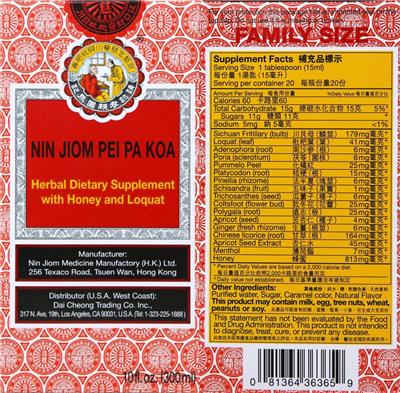
Supplement Facts
The label details for Nin Jiom Pei Pa KOA by Nin Jiom, sourced from the NIH Dietary Supplement Label Database.
Supplement Facts
| Ingredient | Amount | % DV |
|---|---|---|
| Calories | 60 Calorie(s) | -- |
| Total Carbohydrates | 15 Gram(s) | 5% |
| Sugar | 11 Gram(s) | -- |
| Sodium | 5 mg | 1% |
| Honey | 813 mg | -- |
| Chinese Licorice | 164 mg | -- |
| Sichuan Fritillary | 179 mg | -- |
| Polygala | 25 mg | -- |
| Apricot seed extract | 45 mg | -- |
| Pinellia | 6 mg | -- |
| Platycodon | 15 mg | -- |
| Loquat | 41 mg | -- |
| Poria | 6 mg | -- |
| Apricot | 4 mg | -- |
| Adenophora | 6 mg | -- |
| Menthol | 7 mg | -- |
| Trichosanthes | 6 mg | -- |
| Pomelo | 25 mg | -- |
| Schisandra | 1 mg | -- |
| Coltsfoot | 25 mg | -- |
| Ginger, Fresh | 6 mg | -- |
Other ingredients: Water, Purified, Caramel color, Natural Flavors
Tap any ingredient to jump to its full detail below.
These statements are the manufacturer’s wording, reproduced from the product label — the label is saying it, not HelloPharmacist. We don’t verify or endorse them.
FDA Statement of Identity
Herbal Dietary Supplement with Honey and Loquat
Formula
Herbal Dietary Supplement with Honey and Loquat
Precautions
For your protection this package has an imprinted seal on the top flap. Do not use if it is missing or broken.
This product may contain milk, egg, tree nuts, wheat, peanuts or soy.
FDA Disclaimer Statement
This statement has not been evaluated by the Food and Drug Administration. This product is not intended to diagnose, treat, cure, or prevent any disease.
Is this label outdated? Report a formula or label change and our pharmacy team will review it.
Nin Jiom Pei Pa KOA by Nin Jiom label
The label scan from the NIH Dietary Supplement Label Database. Tap to enlarge.
Label images are published by the NIH Dietary Supplement Label Database for the version of this product on file. Always read your actual product label.
View the full label (PDF)The Ingredients in Nin Jiom Pei Pa KOA by Nin Jiom
These are the 19 active ingredients this product is made of. Select any to open its full monograph.
Serving size15 mL Dosage formLiquid Servings per container20 Amounts shown are per serving.
Most supplement products combine several ingredients, and a medication can interact with the product through any one of them. Each ingredient below shows whether it has known drug interactions.
Sugar
Sodium
Interacts with205 drugs
Sodium is an essential mineral and electrolyte your body needs to balance fluids, support nerves, and help muscles work. Most people in modern diets g...
Sodium monograph & interactionsHoney
Interacts with736 drugs
Honey is a natural food with some real, modest evidence for easing coughs and helping certain wounds, especially when special medical-grade or Manuka...
Honey monograph & interactionsChinese Licorice
Interacts with1,040 drugs
Licorice root is a traditional remedy used for sore throats, coughs, and digestive complaints, but solid human evidence is limited for most uses. Regu...
Chinese Licorice monograph & interactionsSichuan Fritillary
Polygala
Apricot seed extract
No knowninteractions
Apricot is a nutritious fruit that provides fiber, potassium, and vitamins A and C, and it is safe and healthy to eat as part of a normal diet. There...
Apricot seed extract monograph & interactionsPinellia
Platycodon
Loquat
Poria
Interacts with417 drugs
Poria mushroom (Fu Ling) is a fungus long used in Traditional Chinese Medicine, mainly as a mild diuretic and digestive and calming aid. Modern scient...
Poria monograph & interactionsApricot
No knowninteractions
Apricot is a nutritious fruit that provides fiber, potassium, and vitamins A and C, and it is safe and healthy to eat as part of a normal diet. There...
Apricot monograph & interactionsAdenophora
Menthol
Trichosanthes
Interacts with86 drugs
Chinese cucumber (Trichosanthes kirilowii) is a plant used in traditional Chinese medicine, and a protein from its root called trichosanthin (Compound...
Trichosanthes monograph & interactionsPomelo
Interacts with990 drugs
Grapefruit is a nutritious citrus fruit rich in vitamin C and other nutrients, and it is generally safe to eat. However, grapefruit is famous for seri...
Pomelo monograph & interactionsSchisandra
Interacts with803 drugs
Schisandra is a traditional Chinese medicine berry used as an adaptogen for stress, fatigue, and liver support. Human evidence is limited and most cla...
Schisandra monograph & interactionsColtsfoot
Interacts with374 drugs
Coltsfoot is a traditional herb long used to soothe coughs and clear mucus, but solid human evidence for these uses is lacking. More importantly, the...
Coltsfoot monograph & interactionsGinger, Fresh
Interacts with1,007 drugs
Ginger is a widely used culinary spice with a long history in traditional medicine, and it has the strongest evidence for helping with nausea and vomi...
Ginger, Fresh monograph & interactionsOther (inactive) ingredients: Water, Purified, Caramel color, Natural Flavors. These complete the product’s ingredient list but are not active constituents.
Nin Jiom Pei Pa KOA by Nin Jiom Drug Interactions
HelloPharmacist Interaction Report
Nin Jiom Pei Pa KOA by Nin Jiom is a liquid herbal product that interacts with a substantial number of medications.
The most serious interaction involves pomelo (listed as grapefruit in our data), which contains compounds that dramatically increase blood levels of several cardiac and psychiatric drugs—cyclosporine, scopolamine, amiodarone, terfenadine, buspirone, and dextromethorphan all carry Major severity warnings. Pomelo can also decrease levels of celiprolol and etoposide, potentially reducing their effectiveness.
Read the full breakdown — every affected drug type, severity by severity
Sodium, a key ingredient here, poses Moderate-severity interactions with blood pressure medications, corticosteroids, lithium, and several other drug classes. High sodium intake can reduce how well blood pressure drugs work and can dangerously raise lithium levels.
Chinese licorice interacts with digoxin (a heart medication), several enzyme systems that affect how your body clears drugs like warfarin and midazolam, and loop diuretics. Schisandra similarly affects drug-clearing enzymes and can raise levels of tacrolimus and midazolam.
Ginger and coltsfoot both carry Moderate warnings around bleeding risk with anticoagulants and antiplatelet drugs like warfarin and aspirin. Honey poses a Minor risk with blood thinners.
Several ingredients we could not check for interactions include Sichuan fritillary, polygala, pinellia, platycodon, loquat, adenophora, menthol, and trichosanthes. Apricot seed extract, poria, and apricot fruit had no interactions documented in our data.
Altogether, these interactions span 1,426 individual medications.
Before you start this product, use the medication checker below with your exact prescriptions—especially if you take heart medications, blood thinners, psychiatric drugs, or medications to control blood pressure or blood sugar.
Check your own medications below · Editorial policy · How we use AI
Want to check YOUR meds against Nin Jiom Pei Pa KOA?
Ask about interactions with your drugs in plain English — “Can I take it with lisinopril?” — and we find you the answer in seconds, ingredient by ingredient.
Go to the checkerIngredients driving the most interactions
Individual Drug Interactions
The ingredients in Nin Jiom Pei Pa KOA interact with 1,444 drugs. Click any drug to see the details.
9 of the 19 ingredients in Nin Jiom Pei Pa KOA interact with drugs. Each result below shows which ingredient is responsible. Chinese Licorice Ginger, Fresh Pomelo Schisandra Honey Poria Coltsfoot Sodium Trichosanthes
Ado-trastuzumab EmtansineKadcyla
How Ado-trastuzumab Emtansine interacts with Nin Jiom Pei Pa KOA — through 5 ingredients. Tap an ingredient for the detail:
PomeloCytochrome P450 3a4 (cyp3a4) Substrates Major
Interaction Summary
Grapefruit juice can increase levels of drugs metabolized by CYP3A4.
Read the full Pomelo + Ado-trastuzumab Emtansine interactionSchisandraCytochrome P450 3a4 (cyp3a4) Substrates Moderate
Interaction Summary
Schisandra can increase the levels and clinical effects of drugs metabolized by CYP3A4.
Read the full Schisandra + Ado-trastuzumab Emtansine interactionGinger, FreshCytochrome P450 3a4 (cyp3a4) Substrates Moderate
Interaction Summary
Ginger might increase or decrease the levels of CYP3A4 substrates.
Read the full Ginger, Fresh + Ado-trastuzumab Emtansine interactionChinese LicoriceCytochrome P450 3a4 (cyp3a4) Substrates Moderate
Interaction Summary
Theoretically, licorice might increase or decrease levels of drugs metabolized by CYP3A4.
Read the full Chinese Licorice + Ado-trastuzumab Emtansine interactionHoneyCytochrome P450 3a4 (cyp3a4) Substrates Minor
Interaction Summary
Theoretically, honey might decrease levels of drugs metabolized by CYP3A4, but research is conflicting.
Read the full Honey + Ado-trastuzumab Emtansine interactionAbemaciclibVerzenio
How Abemaciclib interacts with Nin Jiom Pei Pa KOA — through 5 ingredients. Tap an ingredient for the detail:
PomeloCytochrome P450 3a4 (cyp3a4) Substrates Major
Interaction Summary
Grapefruit juice can increase levels of drugs metabolized by CYP3A4.
Read the full Pomelo + Abemaciclib interactionSchisandraCytochrome P450 3a4 (cyp3a4) Substrates Moderate
Interaction Summary
Schisandra can increase the levels and clinical effects of drugs metabolized by CYP3A4.
Read the full Schisandra + Abemaciclib interactionGinger, FreshCytochrome P450 3a4 (cyp3a4) Substrates Moderate
Interaction Summary
Ginger might increase or decrease the levels of CYP3A4 substrates.
Read the full Ginger, Fresh + Abemaciclib interactionChinese LicoriceCytochrome P450 3a4 (cyp3a4) Substrates Moderate
Interaction Summary
Theoretically, licorice might increase or decrease levels of drugs metabolized by CYP3A4.
Read the full Chinese Licorice + Abemaciclib interactionHoneyCytochrome P450 3a4 (cyp3a4) Substrates Minor
Interaction Summary
Theoretically, honey might decrease levels of drugs metabolized by CYP3A4, but research is conflicting.
Read the full Honey + Abemaciclib interactionAbiraterone
How Abiraterone interacts with Nin Jiom Pei Pa KOA — through 5 ingredients. Tap an ingredient for the detail:
PomeloCytochrome P450 3a4 (cyp3a4) Substrates Major
Interaction Summary
Grapefruit juice can increase levels of drugs metabolized by CYP3A4.
Read the full Pomelo + Abiraterone interactionChinese LicoriceCytochrome P450 3a4 (cyp3a4) Substrates Moderate
Interaction Summary
Theoretically, licorice might increase or decrease levels of drugs metabolized by CYP3A4.
Read the full Chinese Licorice + Abiraterone interactionSchisandraCytochrome P450 3a4 (cyp3a4) Substrates Moderate
Interaction Summary
Schisandra can increase the levels and clinical effects of drugs metabolized by CYP3A4.
Read the full Schisandra + Abiraterone interactionGinger, FreshCytochrome P450 3a4 (cyp3a4) Substrates Moderate
Interaction Summary
Ginger might increase or decrease the levels of CYP3A4 substrates.
Read the full Ginger, Fresh + Abiraterone interactionHoneyCytochrome P450 3a4 (cyp3a4) Substrates Minor
Interaction Summary
Theoretically, honey might decrease levels of drugs metabolized by CYP3A4, but research is conflicting.
Read the full Honey + Abiraterone interactionAbiraterone AcetateYonsa, Zytiga
How Abiraterone Acetate interacts with Nin Jiom Pei Pa KOA — through 5 ingredients. Tap an ingredient for the detail:
PomeloCytochrome P450 3a4 (cyp3a4) Substrates Major
Interaction Summary
Grapefruit juice can increase levels of drugs metabolized by CYP3A4.
Read the full Pomelo + Abiraterone Acetate interactionGinger, FreshCytochrome P450 3a4 (cyp3a4) Substrates Moderate
Interaction Summary
Ginger might increase or decrease the levels of CYP3A4 substrates.
Read the full Ginger, Fresh + Abiraterone Acetate interactionChinese LicoriceCytochrome P450 3a4 (cyp3a4) Substrates Moderate
Interaction Summary
Theoretically, licorice might increase or decrease levels of drugs metabolized by CYP3A4.
Read the full Chinese Licorice + Abiraterone Acetate interactionSchisandraCytochrome P450 3a4 (cyp3a4) Substrates Moderate
Interaction Summary
Schisandra can increase the levels and clinical effects of drugs metabolized by CYP3A4.
Read the full Schisandra + Abiraterone Acetate interactionHoneyCytochrome P450 3a4 (cyp3a4) Substrates Minor
Interaction Summary
Theoretically, honey might decrease levels of drugs metabolized by CYP3A4, but research is conflicting.
Read the full Honey + Abiraterone Acetate interactionAcalabrutinibCalquence
How Acalabrutinib interacts with Nin Jiom Pei Pa KOA — through 5 ingredients. Tap an ingredient for the detail:
PomeloCytochrome P450 3a4 (cyp3a4) Substrates, P-glycoprotein Substrates Major
Interaction Summary
Grapefruit juice can increase levels of drugs metabolized by CYP3A4.
Read the full Pomelo + Acalabrutinib interactionSchisandraCytochrome P450 3a4 (cyp3a4) Substrates, P-glycoprotein Substrates Moderate
Interaction Summary
Schisandra can increase the levels and clinical effects of drugs metabolized by CYP3A4.
Read the full Schisandra + Acalabrutinib interactionGinger, FreshCytochrome P450 3a4 (cyp3a4) Substrates, P-glycoprotein Substrates Moderate
Interaction Summary
Ginger might increase or decrease the levels of CYP3A4 substrates.
Read the full Ginger, Fresh + Acalabrutinib interactionChinese LicoriceP-glycoprotein Substrates, Cytochrome P450 3a4 (cyp3a4) Substrates Moderate
Interaction Summary
Theoretically, licorice might decrease the absorption of P-glycoprotein substrates.
Read the full Chinese Licorice + Acalabrutinib interactionHoneyCytochrome P450 3a4 (cyp3a4) Substrates Minor
Interaction Summary
Theoretically, honey might decrease levels of drugs metabolized by CYP3A4, but research is conflicting.
Read the full Honey + Acalabrutinib interactionAcetaminophen, Aspirin, CaffeineExcedrin, Excedrin Extra Strength, Excedrin Migraine
How Acetaminophen, Aspirin, Caffeine interacts with Nin Jiom Pei Pa KOA — through 6 ingredients. Tap an ingredient for the detail:
PomeloCaffeine, Cytochrome P450 3a4 (cyp3a4) Substrates +1 Major
Interaction Summary
Grapefruit juice can decrease the clearance of caffeine, potentially increasing the effects and adverse effects of caffeine.
Read the full Pomelo + Acetaminophen, Aspirin, Caffeine interactionGinger, FreshCytochrome P450 1a2 (cyp1a2) Substrates, Cytochrome P450 3a4 (cyp3a4) Substrates +1 Moderate
Interaction Summary
Theoretically, ginger might increase the levels of CYP1A2 substrates.
Read the full Ginger, Fresh + Acetaminophen, Aspirin, Caffeine interactionSchisandraCytochrome P450 3a4 (cyp3a4) Substrates Moderate
Interaction Summary
Schisandra can increase the levels and clinical effects of drugs metabolized by CYP3A4.
Read the full Schisandra + Acetaminophen, Aspirin, Caffeine interactionChinese LicoriceCytochrome P450 1a2 (cyp1a2) Substrates, Cytochrome P450 3a4 (cyp3a4) Substrates Moderate
Interaction Summary
Theoretically, licorice might decrease the levels and clinical effects of CYP1A2 substrates.
Read the full Chinese Licorice + Acetaminophen, Aspirin, Caffeine interactionColtsfootAnticoagulant/antiplatelet Drugs Moderate
Interaction Summary
Concomitant use might increase the risk of bleeding due to decreased platelet aggregation.
Read the full Coltsfoot + Acetaminophen, Aspirin, Caffeine interactionHoneyAnticoagulant/antiplatelet Drugs, Cytochrome P450 3a4 (cyp3a4) Substrates Minor
Interaction Summary
Theoretically, honey may increase the risk of bleeding when used with anticoagulant or antiplatelet drugs.
Read the full Honey + Acetaminophen, Aspirin, Caffeine interactionAcetaminophen, Butalbital, CaffeineEsgic, Esgic Plus, Fiogesic, Fioricet, Repan, Tecnal +1 more
How Acetaminophen, Butalbital, Caffeine interacts with Nin Jiom Pei Pa KOA — through 5 ingredients. Tap an ingredient for the detail:
PomeloCaffeine, Cytochrome P450 3a4 (cyp3a4) Substrates +1 Major
Interaction Summary
Grapefruit juice can decrease the clearance of caffeine, potentially increasing the effects and adverse effects of caffeine.
Read the full Pomelo + Acetaminophen, Butalbital, Caffeine interactionChinese LicoriceCytochrome P450 1a2 (cyp1a2) Substrates, Cytochrome P450 3a4 (cyp3a4) Substrates Moderate
Interaction Summary
Theoretically, licorice might decrease the levels and clinical effects of CYP1A2 substrates.
Read the full Chinese Licorice + Acetaminophen, Butalbital, Caffeine interactionSchisandraCytochrome P450 3a4 (cyp3a4) Substrates Moderate
Interaction Summary
Schisandra can increase the levels and clinical effects of drugs metabolized by CYP3A4.
Read the full Schisandra + Acetaminophen, Butalbital, Caffeine interactionGinger, FreshCytochrome P450 1a2 (cyp1a2) Substrates, Cytochrome P450 3a4 (cyp3a4) Substrates Moderate
Interaction Summary
Theoretically, ginger might increase the levels of CYP1A2 substrates.
Read the full Ginger, Fresh + Acetaminophen, Butalbital, Caffeine interactionHoneyCytochrome P450 3a4 (cyp3a4) Substrates Minor
Interaction Summary
Theoretically, honey might decrease levels of drugs metabolized by CYP3A4, but research is conflicting.
Read the full Honey + Acetaminophen, Butalbital, Caffeine interactionAcetaminophen, Butalbital, Caffeine, CodeineEsgic with Codeine, Fioricet w/ Codeine
How Acetaminophen, Butalbital, Caffeine, Codeine interacts with Nin Jiom Pei Pa KOA — through 6 ingredients. Tap an ingredient for the detail:
PomeloCytochrome P450 3a4 (cyp3a4) Substrates, Caffeine +1 Major
Interaction Summary
Grapefruit juice can increase levels of drugs metabolized by CYP3A4.
Read the full Pomelo + Acetaminophen, Butalbital, Caffeine, Codeine interactionGinger, FreshCytochrome P450 3a4 (cyp3a4) Substrates, Cytochrome P450 1a2 (cyp1a2) Substrates Moderate
Interaction Summary
Ginger might increase or decrease the levels of CYP3A4 substrates.
Read the full Ginger, Fresh + Acetaminophen, Butalbital, Caffeine, Codeine interactionSchisandraCytochrome P450 3a4 (cyp3a4) Substrates Moderate
Interaction Summary
Schisandra can increase the levels and clinical effects of drugs metabolized by CYP3A4.
Read the full Schisandra + Acetaminophen, Butalbital, Caffeine, Codeine interactionPoriaCns Depressants Moderate
Interaction Summary
Theoretically, taking poria mushroom extract may enhance the therapeutic and adverse effects of sedatives.
Read the full Poria + Acetaminophen, Butalbital, Caffeine, Codeine interactionChinese LicoriceCytochrome P450 1a2 (cyp1a2) Substrates, Cytochrome P450 3a4 (cyp3a4) Substrates Moderate
Interaction Summary
Theoretically, licorice might decrease the levels and clinical effects of CYP1A2 substrates.
Read the full Chinese Licorice + Acetaminophen, Butalbital, Caffeine, Codeine interactionHoneyCytochrome P450 3a4 (cyp3a4) Substrates Minor
Interaction Summary
Theoretically, honey might decrease levels of drugs metabolized by CYP3A4, but research is conflicting.
Read the full Honey + Acetaminophen, Butalbital, Caffeine, Codeine interactionAcetaminophen, Caffeine, Chlorpheniramine, Hydrocodone, PhenylephrineHycomine Compound
How Acetaminophen, Caffeine, Chlorpheniramine, Hydrocodone, Phenylephrine interacts with Nin Jiom Pei Pa KOA — through 6 ingredients. Tap an ingredient for the detail:
PomeloCytochrome P450 1a2 (cyp1a2) Substrates, Caffeine +1 Major
Interaction Summary
Theoretically, grapefruit juice might increase levels of drugs metabolized by CYP1A2.
Read the full Pomelo + Acetaminophen, Caffeine, Chlorpheniramine, Hydrocodone, Phenylephrine interactionPoriaCns Depressants, Anticholinergic Drugs Moderate
Interaction Summary
Theoretically, taking poria mushroom extract may enhance the therapeutic and adverse effects of sedatives.
Read the full Poria + Acetaminophen, Caffeine, Chlorpheniramine, Hydrocodone, Phenylephrine interactionSchisandraCytochrome P450 3a4 (cyp3a4) Substrates Moderate
Interaction Summary
Schisandra can increase the levels and clinical effects of drugs metabolized by CYP3A4.
Read the full Schisandra + Acetaminophen, Caffeine, Chlorpheniramine, Hydrocodone, Phenylephrine interactionChinese LicoriceCytochrome P450 1a2 (cyp1a2) Substrates, Cytochrome P450 3a4 (cyp3a4) Substrates Moderate
Interaction Summary
Theoretically, licorice might decrease the levels and clinical effects of CYP1A2 substrates.
Read the full Chinese Licorice + Acetaminophen, Caffeine, Chlorpheniramine, Hydrocodone, Phenylephrine interactionGinger, FreshCytochrome P450 1a2 (cyp1a2) Substrates, Cytochrome P450 3a4 (cyp3a4) Substrates Moderate
Interaction Summary
Theoretically, ginger might increase the levels of CYP1A2 substrates.
Read the full Ginger, Fresh + Acetaminophen, Caffeine, Chlorpheniramine, Hydrocodone, Phenylephrine interactionHoneyCytochrome P450 3a4 (cyp3a4) Substrates Minor
Interaction Summary
Theoretically, honey might decrease levels of drugs metabolized by CYP3A4, but research is conflicting.
Read the full Honey + Acetaminophen, Caffeine, Chlorpheniramine, Hydrocodone, Phenylephrine interactionAcetaminophen, Caffeine, CodeineGesic C15, Gesic C30, Gesic C8, Lenoltec 1, Lenoltec 2, Lenoltec 3 +1 more
How Acetaminophen, Caffeine, Codeine interacts with Nin Jiom Pei Pa KOA — through 6 ingredients. Tap an ingredient for the detail:
PomeloCytochrome P450 3a4 (cyp3a4) Substrates, Caffeine +1 Major
Interaction Summary
Grapefruit juice can increase levels of drugs metabolized by CYP3A4.
Read the full Pomelo + Acetaminophen, Caffeine, Codeine interactionGinger, FreshCytochrome P450 3a4 (cyp3a4) Substrates, Cytochrome P450 1a2 (cyp1a2) Substrates Moderate
Interaction Summary
Ginger might increase or decrease the levels of CYP3A4 substrates.
Read the full Ginger, Fresh + Acetaminophen, Caffeine, Codeine interactionSchisandraCytochrome P450 3a4 (cyp3a4) Substrates Moderate
Interaction Summary
Schisandra can increase the levels and clinical effects of drugs metabolized by CYP3A4.
Read the full Schisandra + Acetaminophen, Caffeine, Codeine interactionPoriaCns Depressants Moderate
Interaction Summary
Theoretically, taking poria mushroom extract may enhance the therapeutic and adverse effects of sedatives.
Read the full Poria + Acetaminophen, Caffeine, Codeine interactionChinese LicoriceCytochrome P450 1a2 (cyp1a2) Substrates, Cytochrome P450 3a4 (cyp3a4) Substrates Moderate
Interaction Summary
Theoretically, licorice might decrease the levels and clinical effects of CYP1A2 substrates.
Read the full Chinese Licorice + Acetaminophen, Caffeine, Codeine interactionHoneyCytochrome P450 3a4 (cyp3a4) Substrates Minor
Interaction Summary
Theoretically, honey might decrease levels of drugs metabolized by CYP3A4, but research is conflicting.
Read the full Honey + Acetaminophen, Caffeine, Codeine interactionAcetaminophen, Caffeine, Codeine, SalicylamideCodalan No.1, Codalan No.2, Codalan No.3
How Acetaminophen, Caffeine, Codeine, Salicylamide interacts with Nin Jiom Pei Pa KOA — through 6 ingredients. Tap an ingredient for the detail:
PomeloCaffeine, Cytochrome P450 3a4 (cyp3a4) Substrates +1 Major
Interaction Summary
Grapefruit juice can decrease the clearance of caffeine, potentially increasing the effects and adverse effects of caffeine.
Read the full Pomelo + Acetaminophen, Caffeine, Codeine, Salicylamide interactionPoriaCns Depressants Moderate
Interaction Summary
Theoretically, taking poria mushroom extract may enhance the therapeutic and adverse effects of sedatives.
Read the full Poria + Acetaminophen, Caffeine, Codeine, Salicylamide interactionSchisandraCytochrome P450 3a4 (cyp3a4) Substrates Moderate
Interaction Summary
Schisandra can increase the levels and clinical effects of drugs metabolized by CYP3A4.
Read the full Schisandra + Acetaminophen, Caffeine, Codeine, Salicylamide interactionGinger, FreshCytochrome P450 1a2 (cyp1a2) Substrates, Cytochrome P450 3a4 (cyp3a4) Substrates Moderate
Interaction Summary
Theoretically, ginger might increase the levels of CYP1A2 substrates.
Read the full Ginger, Fresh + Acetaminophen, Caffeine, Codeine, Salicylamide interactionChinese LicoriceCytochrome P450 1a2 (cyp1a2) Substrates, Cytochrome P450 3a4 (cyp3a4) Substrates Moderate
Interaction Summary
Theoretically, licorice might decrease the levels and clinical effects of CYP1A2 substrates.
Read the full Chinese Licorice + Acetaminophen, Caffeine, Codeine, Salicylamide interactionHoneyCytochrome P450 3a4 (cyp3a4) Substrates Minor
Interaction Summary
Theoretically, honey might decrease levels of drugs metabolized by CYP3A4, but research is conflicting.
Read the full Honey + Acetaminophen, Caffeine, Codeine, Salicylamide interactionAcetaminophen, Caffeine, DihydrocodeineDHC Plus, Panlor DC, Panlor SS
How Acetaminophen, Caffeine, Dihydrocodeine interacts with Nin Jiom Pei Pa KOA — through 6 ingredients. Tap an ingredient for the detail:
PomeloCytochrome P450 1a2 (cyp1a2) Substrates, Cytochrome P450 3a4 (cyp3a4) Substrates +1 Major
Interaction Summary
Theoretically, grapefruit juice might increase levels of drugs metabolized by CYP1A2.
Read the full Pomelo + Acetaminophen, Caffeine, Dihydrocodeine interactionChinese LicoriceCytochrome P450 1a2 (cyp1a2) Substrates, Cytochrome P450 3a4 (cyp3a4) Substrates Moderate
Interaction Summary
Theoretically, licorice might decrease the levels and clinical effects of CYP1A2 substrates.
Read the full Chinese Licorice + Acetaminophen, Caffeine, Dihydrocodeine interactionGinger, FreshCytochrome P450 3a4 (cyp3a4) Substrates, Cytochrome P450 1a2 (cyp1a2) Substrates Moderate
Interaction Summary
Ginger might increase or decrease the levels of CYP3A4 substrates.
Read the full Ginger, Fresh + Acetaminophen, Caffeine, Dihydrocodeine interactionSchisandraCytochrome P450 3a4 (cyp3a4) Substrates Moderate
Interaction Summary
Schisandra can increase the levels and clinical effects of drugs metabolized by CYP3A4.
Read the full Schisandra + Acetaminophen, Caffeine, Dihydrocodeine interactionPoriaCns Depressants Moderate
Interaction Summary
Theoretically, taking poria mushroom extract may enhance the therapeutic and adverse effects of sedatives.
Read the full Poria + Acetaminophen, Caffeine, Dihydrocodeine interactionHoneyCytochrome P450 3a4 (cyp3a4) Substrates Minor
Interaction Summary
Theoretically, honey might decrease levels of drugs metabolized by CYP3A4, but research is conflicting.
Read the full Honey + Acetaminophen, Caffeine, Dihydrocodeine interactionAcetaminophen, Caffeine, IsomethepteneMigralam
How Acetaminophen, Caffeine, Isometheptene interacts with Nin Jiom Pei Pa KOA — through 5 ingredients. Tap an ingredient for the detail:
PomeloCaffeine, Cytochrome P450 3a4 (cyp3a4) Substrates +1 Major
Interaction Summary
Grapefruit juice can decrease the clearance of caffeine, potentially increasing the effects and adverse effects of caffeine.
Read the full Pomelo + Acetaminophen, Caffeine, Isometheptene interactionChinese LicoriceCytochrome P450 3a4 (cyp3a4) Substrates, Cytochrome P450 1a2 (cyp1a2) Substrates Moderate
Interaction Summary
Theoretically, licorice might increase or decrease levels of drugs metabolized by CYP3A4.
Read the full Chinese Licorice + Acetaminophen, Caffeine, Isometheptene interactionGinger, FreshCytochrome P450 1a2 (cyp1a2) Substrates, Cytochrome P450 3a4 (cyp3a4) Substrates Moderate
Interaction Summary
Theoretically, ginger might increase the levels of CYP1A2 substrates.
Read the full Ginger, Fresh + Acetaminophen, Caffeine, Isometheptene interactionSchisandraCytochrome P450 3a4 (cyp3a4) Substrates Moderate
Interaction Summary
Schisandra can increase the levels and clinical effects of drugs metabolized by CYP3A4.
Read the full Schisandra + Acetaminophen, Caffeine, Isometheptene interactionHoneyCytochrome P450 3a4 (cyp3a4) Substrates Minor
Interaction Summary
Theoretically, honey might decrease levels of drugs metabolized by CYP3A4, but research is conflicting.
Read the full Honey + Acetaminophen, Caffeine, Isometheptene interactionAcetaminophen, Caffeine, PyrilamineMidol Max Strength Menstrual
How Acetaminophen, Caffeine, Pyrilamine interacts with Nin Jiom Pei Pa KOA — through 6 ingredients. Tap an ingredient for the detail:
PomeloCytochrome P450 1a2 (cyp1a2) Substrates, Cytochrome P450 3a4 (cyp3a4) Substrates +1 Major
Interaction Summary
Theoretically, grapefruit juice might increase levels of drugs metabolized by CYP1A2.
Read the full Pomelo + Acetaminophen, Caffeine, Pyrilamine interactionSchisandraCytochrome P450 3a4 (cyp3a4) Substrates Moderate
Interaction Summary
Schisandra can increase the levels and clinical effects of drugs metabolized by CYP3A4.
Read the full Schisandra + Acetaminophen, Caffeine, Pyrilamine interactionPoriaAnticholinergic Drugs Moderate
Interaction Summary
Theoretically, poria mushroom might decrease the clinical effects of anticholinergic drugs.
Read the full Poria + Acetaminophen, Caffeine, Pyrilamine interactionChinese LicoriceDiuretic Drugs, Cytochrome P450 1a2 (cyp1a2) Substrates +1 Moderate
Interaction Summary
Theoretically, concomitant use of licorice with diuretic drugs might increase the risk of hypokalemia.
Read the full Chinese Licorice + Acetaminophen, Caffeine, Pyrilamine interactionGinger, FreshCytochrome P450 3a4 (cyp3a4) Substrates, Cytochrome P450 1a2 (cyp1a2) Substrates Moderate
Interaction Summary
Ginger might increase or decrease the levels of CYP3A4 substrates.
Read the full Ginger, Fresh + Acetaminophen, Caffeine, Pyrilamine interactionHoneyCytochrome P450 3a4 (cyp3a4) Substrates Minor
Interaction Summary
Theoretically, honey might decrease levels of drugs metabolized by CYP3A4, but research is conflicting.
Read the full Honey + Acetaminophen, Caffeine, Pyrilamine interactionAcetaminophen, Chlorpheniramine Maleate, Dextromethorphan HbrVicks Formula 44M Cough, Cold & Flu Relief
How Acetaminophen, Chlorpheniramine Maleate, Dextromethorphan Hbr interacts with Nin Jiom Pei Pa KOA — through 6 ingredients. Tap an ingredient for the detail:
PomeloDextromethorphan (robitussin Dm, Others), Cytochrome P450 3a4 (cyp3a4) Substrates +1 Major
Interaction Summary
Grapefruit juice can increase blood levels of dextromethorphan, potentially increasing the effects and adverse effects of dextromethorphan.
Read the full Pomelo + Acetaminophen, Chlorpheniramine Maleate, Dextromethorphan Hbr interactionGinger, FreshCytochrome P450 1a2 (cyp1a2) Substrates, Cytochrome P450 3a4 (cyp3a4) Substrates Moderate
Interaction Summary
Theoretically, ginger might increase the levels of CYP1A2 substrates.
Read the full Ginger, Fresh + Acetaminophen, Chlorpheniramine Maleate, Dextromethorphan Hbr interactionSchisandraCytochrome P450 3a4 (cyp3a4) Substrates Moderate
Interaction Summary
Schisandra can increase the levels and clinical effects of drugs metabolized by CYP3A4.
Read the full Schisandra + Acetaminophen, Chlorpheniramine Maleate, Dextromethorphan Hbr interactionPoriaAnticholinergic Drugs Moderate
Interaction Summary
Theoretically, poria mushroom might decrease the clinical effects of anticholinergic drugs.
Read the full Poria + Acetaminophen, Chlorpheniramine Maleate, Dextromethorphan Hbr interactionChinese LicoriceCytochrome P450 3a4 (cyp3a4) Substrates, Cytochrome P450 1a2 (cyp1a2) Substrates Moderate
Interaction Summary
Theoretically, licorice might increase or decrease levels of drugs metabolized by CYP3A4.
Read the full Chinese Licorice + Acetaminophen, Chlorpheniramine Maleate, Dextromethorphan Hbr interactionHoneyCytochrome P450 3a4 (cyp3a4) Substrates Minor
Interaction Summary
Theoretically, honey might decrease levels of drugs metabolized by CYP3A4, but research is conflicting.
Read the full Honey + Acetaminophen, Chlorpheniramine Maleate, Dextromethorphan Hbr interactionAcetaminophen, Chlorpheniramine, Codeine, PhenylephrineColrex
How Acetaminophen, Chlorpheniramine, Codeine, Phenylephrine interacts with Nin Jiom Pei Pa KOA — through 6 ingredients. Tap an ingredient for the detail:
PomeloCytochrome P450 3a4 (cyp3a4) Substrates, Cytochrome P450 1a2 (cyp1a2) Substrates Major
Interaction Summary
Grapefruit juice can increase levels of drugs metabolized by CYP3A4.
Read the full Pomelo + Acetaminophen, Chlorpheniramine, Codeine, Phenylephrine interactionChinese LicoriceCytochrome P450 3a4 (cyp3a4) Substrates, Cytochrome P450 1a2 (cyp1a2) Substrates Moderate
Interaction Summary
Theoretically, licorice might increase or decrease levels of drugs metabolized by CYP3A4.
Read the full Chinese Licorice + Acetaminophen, Chlorpheniramine, Codeine, Phenylephrine interactionPoriaAnticholinergic Drugs, Cns Depressants Moderate
Interaction Summary
Theoretically, poria mushroom might decrease the clinical effects of anticholinergic drugs.
Read the full Poria + Acetaminophen, Chlorpheniramine, Codeine, Phenylephrine interactionSchisandraCytochrome P450 3a4 (cyp3a4) Substrates Moderate
Interaction Summary
Schisandra can increase the levels and clinical effects of drugs metabolized by CYP3A4.
Read the full Schisandra + Acetaminophen, Chlorpheniramine, Codeine, Phenylephrine interactionGinger, FreshCytochrome P450 3a4 (cyp3a4) Substrates, Cytochrome P450 1a2 (cyp1a2) Substrates Moderate
Interaction Summary
Ginger might increase or decrease the levels of CYP3A4 substrates.
Read the full Ginger, Fresh + Acetaminophen, Chlorpheniramine, Codeine, Phenylephrine interactionHoneyCytochrome P450 3a4 (cyp3a4) Substrates Minor
Interaction Summary
Theoretically, honey might decrease levels of drugs metabolized by CYP3A4, but research is conflicting.
Read the full Honey + Acetaminophen, Chlorpheniramine, Codeine, Phenylephrine interactionAcetaminophen, Chlorpheniramine, DextromethorphanCoricidin II Extra Strength Cold and Flu
How Acetaminophen, Chlorpheniramine, Dextromethorphan interacts with Nin Jiom Pei Pa KOA — through 6 ingredients. Tap an ingredient for the detail:
PomeloCytochrome P450 1a2 (cyp1a2) Substrates, Cytochrome P450 3a4 (cyp3a4) Substrates +1 Major
Interaction Summary
Theoretically, grapefruit juice might increase levels of drugs metabolized by CYP1A2.
Read the full Pomelo + Acetaminophen, Chlorpheniramine, Dextromethorphan interactionChinese LicoriceCytochrome P450 1a2 (cyp1a2) Substrates, Cytochrome P450 3a4 (cyp3a4) Substrates Moderate
Interaction Summary
Theoretically, licorice might decrease the levels and clinical effects of CYP1A2 substrates.
Read the full Chinese Licorice + Acetaminophen, Chlorpheniramine, Dextromethorphan interactionGinger, FreshCytochrome P450 1a2 (cyp1a2) Substrates, Cytochrome P450 3a4 (cyp3a4) Substrates Moderate
Interaction Summary
Theoretically, ginger might increase the levels of CYP1A2 substrates.
Read the full Ginger, Fresh + Acetaminophen, Chlorpheniramine, Dextromethorphan interactionPoriaAnticholinergic Drugs Moderate
Interaction Summary
Theoretically, poria mushroom might decrease the clinical effects of anticholinergic drugs.
Read the full Poria + Acetaminophen, Chlorpheniramine, Dextromethorphan interactionSchisandraCytochrome P450 3a4 (cyp3a4) Substrates Moderate
Interaction Summary
Schisandra can increase the levels and clinical effects of drugs metabolized by CYP3A4.
Read the full Schisandra + Acetaminophen, Chlorpheniramine, Dextromethorphan interactionHoneyCytochrome P450 3a4 (cyp3a4) Substrates Minor
Interaction Summary
Theoretically, honey might decrease levels of drugs metabolized by CYP3A4, but research is conflicting.
Read the full Honey + Acetaminophen, Chlorpheniramine, Dextromethorphan interactionAcetaminophen, Chlorpheniramine, Dextromethorphan HydrobromideCoricidin HBP Maximum Strength Flu
How Acetaminophen, Chlorpheniramine, Dextromethorphan Hydrobromide interacts with Nin Jiom Pei Pa KOA — through 6 ingredients. Tap an ingredient for the detail:
PomeloDextromethorphan (robitussin Dm, Others), Cytochrome P450 3a4 (cyp3a4) Substrates +1 Major
Interaction Summary
Grapefruit juice can increase blood levels of dextromethorphan, potentially increasing the effects and adverse effects of dextromethorphan.
Read the full Pomelo + Acetaminophen, Chlorpheniramine, Dextromethorphan Hydrobromide interactionChinese LicoriceCytochrome P450 3a4 (cyp3a4) Substrates, Cytochrome P450 1a2 (cyp1a2) Substrates Moderate
Interaction Summary
Theoretically, licorice might increase or decrease levels of drugs metabolized by CYP3A4.
Read the full Chinese Licorice + Acetaminophen, Chlorpheniramine, Dextromethorphan Hydrobromide interactionGinger, FreshCytochrome P450 3a4 (cyp3a4) Substrates, Cytochrome P450 1a2 (cyp1a2) Substrates Moderate
Interaction Summary
Ginger might increase or decrease the levels of CYP3A4 substrates.
Read the full Ginger, Fresh + Acetaminophen, Chlorpheniramine, Dextromethorphan Hydrobromide interactionSchisandraCytochrome P450 3a4 (cyp3a4) Substrates Moderate
Interaction Summary
Schisandra can increase the levels and clinical effects of drugs metabolized by CYP3A4.
Read the full Schisandra + Acetaminophen, Chlorpheniramine, Dextromethorphan Hydrobromide interactionPoriaAnticholinergic Drugs Moderate
Interaction Summary
Theoretically, poria mushroom might decrease the clinical effects of anticholinergic drugs.
Read the full Poria + Acetaminophen, Chlorpheniramine, Dextromethorphan Hydrobromide interactionHoneyCytochrome P450 3a4 (cyp3a4) Substrates Minor
Interaction Summary
Theoretically, honey might decrease levels of drugs metabolized by CYP3A4, but research is conflicting.
Read the full Honey + Acetaminophen, Chlorpheniramine, Dextromethorphan Hydrobromide interactionAcetaminophen, Chlorpheniramine, Dextromethorphan, PhenylpropanolamineMulti Symptom Cold Relief
How Acetaminophen, Chlorpheniramine, Dextromethorphan, Phenylpropanolamine interacts with Nin Jiom Pei Pa KOA — through 6 ingredients. Tap an ingredient for the detail:
PomeloCytochrome P450 1a2 (cyp1a2) Substrates, Dextromethorphan (robitussin Dm, Others) +1 Major
Interaction Summary
Theoretically, grapefruit juice might increase levels of drugs metabolized by CYP1A2.
Read the full Pomelo + Acetaminophen, Chlorpheniramine, Dextromethorphan, Phenylpropanolamine interactionSchisandraCytochrome P450 3a4 (cyp3a4) Substrates Moderate
Interaction Summary
Schisandra can increase the levels and clinical effects of drugs metabolized by CYP3A4.
Read the full Schisandra + Acetaminophen, Chlorpheniramine, Dextromethorphan, Phenylpropanolamine interactionPoriaAnticholinergic Drugs Moderate
Interaction Summary
Theoretically, poria mushroom might decrease the clinical effects of anticholinergic drugs.
Read the full Poria + Acetaminophen, Chlorpheniramine, Dextromethorphan, Phenylpropanolamine interactionChinese LicoriceCytochrome P450 1a2 (cyp1a2) Substrates, Cytochrome P450 3a4 (cyp3a4) Substrates Moderate
Interaction Summary
Theoretically, licorice might decrease the levels and clinical effects of CYP1A2 substrates.
Read the full Chinese Licorice + Acetaminophen, Chlorpheniramine, Dextromethorphan, Phenylpropanolamine interactionGinger, FreshCytochrome P450 1a2 (cyp1a2) Substrates, Cytochrome P450 3a4 (cyp3a4) Substrates Moderate
Interaction Summary
Theoretically, ginger might increase the levels of CYP1A2 substrates.
Read the full Ginger, Fresh + Acetaminophen, Chlorpheniramine, Dextromethorphan, Phenylpropanolamine interactionHoneyCytochrome P450 3a4 (cyp3a4) Substrates Minor
Interaction Summary
Theoretically, honey might decrease levels of drugs metabolized by CYP3A4, but research is conflicting.
Read the full Honey + Acetaminophen, Chlorpheniramine, Dextromethorphan, Phenylpropanolamine interactionAcetaminophen, Chlorpheniramine, Dextromethorphan, PseudoephedrineChildren's Tylenol Cold Plus Cough, Tylenol Cold Ex Strength
How Acetaminophen, Chlorpheniramine, Dextromethorphan, Pseudoephedrine interacts with Nin Jiom Pei Pa KOA — through 6 ingredients. Tap an ingredient for the detail:
PomeloCytochrome P450 3a4 (cyp3a4) Substrates, Dextromethorphan (robitussin Dm, Others) +1 Major
Interaction Summary
Grapefruit juice can increase levels of drugs metabolized by CYP3A4.
Read the full Pomelo + Acetaminophen, Chlorpheniramine, Dextromethorphan, Pseudoephedrine interactionGinger, FreshCytochrome P450 3a4 (cyp3a4) Substrates, Cytochrome P450 1a2 (cyp1a2) Substrates Moderate
Interaction Summary
Ginger might increase or decrease the levels of CYP3A4 substrates.
Read the full Ginger, Fresh + Acetaminophen, Chlorpheniramine, Dextromethorphan, Pseudoephedrine interactionPoriaAnticholinergic Drugs Moderate
Interaction Summary
Theoretically, poria mushroom might decrease the clinical effects of anticholinergic drugs.
Read the full Poria + Acetaminophen, Chlorpheniramine, Dextromethorphan, Pseudoephedrine interactionSchisandraCytochrome P450 3a4 (cyp3a4) Substrates Moderate
Interaction Summary
Schisandra can increase the levels and clinical effects of drugs metabolized by CYP3A4.
Read the full Schisandra + Acetaminophen, Chlorpheniramine, Dextromethorphan, Pseudoephedrine interactionChinese LicoriceCytochrome P450 1a2 (cyp1a2) Substrates, Cytochrome P450 3a4 (cyp3a4) Substrates Moderate
Interaction Summary
Theoretically, licorice might decrease the levels and clinical effects of CYP1A2 substrates.
Read the full Chinese Licorice + Acetaminophen, Chlorpheniramine, Dextromethorphan, Pseudoephedrine interactionHoneyCytochrome P450 3a4 (cyp3a4) Substrates Minor
Interaction Summary
Theoretically, honey might decrease levels of drugs metabolized by CYP3A4, but research is conflicting.
Read the full Honey + Acetaminophen, Chlorpheniramine, Dextromethorphan, Pseudoephedrine interactionAcetaminophen, Chlorpheniramine, Guaifenesin, Phenylephrine, SalicylamideRhinogesic GG
How Acetaminophen, Chlorpheniramine, Guaifenesin, Phenylephrine, Salicylamide interacts with Nin Jiom Pei Pa KOA — through 6 ingredients. Tap an ingredient for the detail:
PomeloCytochrome P450 3a4 (cyp3a4) Substrates, Cytochrome P450 1a2 (cyp1a2) Substrates Major
Interaction Summary
Grapefruit juice can increase levels of drugs metabolized by CYP3A4.
Read the full Pomelo + Acetaminophen, Chlorpheniramine, Guaifenesin, Phenylephrine, Salicylamide interactionPoriaAnticholinergic Drugs Moderate
Interaction Summary
Theoretically, poria mushroom might decrease the clinical effects of anticholinergic drugs.
Read the full Poria + Acetaminophen, Chlorpheniramine, Guaifenesin, Phenylephrine, Salicylamide interactionSchisandraCytochrome P450 3a4 (cyp3a4) Substrates Moderate
Interaction Summary
Schisandra can increase the levels and clinical effects of drugs metabolized by CYP3A4.
Read the full Schisandra + Acetaminophen, Chlorpheniramine, Guaifenesin, Phenylephrine, Salicylamide interactionGinger, FreshCytochrome P450 1a2 (cyp1a2) Substrates, Cytochrome P450 3a4 (cyp3a4) Substrates Moderate
Interaction Summary
Theoretically, ginger might increase the levels of CYP1A2 substrates.
Read the full Ginger, Fresh + Acetaminophen, Chlorpheniramine, Guaifenesin, Phenylephrine, Salicylamide interactionChinese LicoriceCytochrome P450 3a4 (cyp3a4) Substrates, Cytochrome P450 1a2 (cyp1a2) Substrates Moderate
Interaction Summary
Theoretically, licorice might increase or decrease levels of drugs metabolized by CYP3A4.
Read the full Chinese Licorice + Acetaminophen, Chlorpheniramine, Guaifenesin, Phenylephrine, Salicylamide interactionHoneyCytochrome P450 3a4 (cyp3a4) Substrates Minor
Interaction Summary
Theoretically, honey might decrease levels of drugs metabolized by CYP3A4, but research is conflicting.
Read the full Honey + Acetaminophen, Chlorpheniramine, Guaifenesin, Phenylephrine, Salicylamide interactionAcetaminophen, Chlorpheniramine, PhenylephrineAlka-Seltzer PLUS, Histex SR, Protid
How Acetaminophen, Chlorpheniramine, Phenylephrine interacts with Nin Jiom Pei Pa KOA — through 6 ingredients. Tap an ingredient for the detail:
PomeloCytochrome P450 1a2 (cyp1a2) Substrates, Cytochrome P450 3a4 (cyp3a4) Substrates Major
Interaction Summary
Theoretically, grapefruit juice might increase levels of drugs metabolized by CYP1A2.
Read the full Pomelo + Acetaminophen, Chlorpheniramine, Phenylephrine interactionChinese LicoriceCytochrome P450 1a2 (cyp1a2) Substrates, Cytochrome P450 3a4 (cyp3a4) Substrates Moderate
Interaction Summary
Theoretically, licorice might decrease the levels and clinical effects of CYP1A2 substrates.
Read the full Chinese Licorice + Acetaminophen, Chlorpheniramine, Phenylephrine interactionGinger, FreshCytochrome P450 1a2 (cyp1a2) Substrates, Cytochrome P450 3a4 (cyp3a4) Substrates Moderate
Interaction Summary
Theoretically, ginger might increase the levels of CYP1A2 substrates.
Read the full Ginger, Fresh + Acetaminophen, Chlorpheniramine, Phenylephrine interactionSchisandraCytochrome P450 3a4 (cyp3a4) Substrates Moderate
Interaction Summary
Schisandra can increase the levels and clinical effects of drugs metabolized by CYP3A4.
Read the full Schisandra + Acetaminophen, Chlorpheniramine, Phenylephrine interactionPoriaAnticholinergic Drugs Moderate
Interaction Summary
Theoretically, poria mushroom might decrease the clinical effects of anticholinergic drugs.
Read the full Poria + Acetaminophen, Chlorpheniramine, Phenylephrine interactionHoneyCytochrome P450 3a4 (cyp3a4) Substrates Minor
Interaction Summary
Theoretically, honey might decrease levels of drugs metabolized by CYP3A4, but research is conflicting.
Read the full Honey + Acetaminophen, Chlorpheniramine, Phenylephrine interactionAcetaminophen, Chlorpheniramine, Phenylephrine, SalicylamideRhinogesic, Rhinogesic JR
How Acetaminophen, Chlorpheniramine, Phenylephrine, Salicylamide interacts with Nin Jiom Pei Pa KOA — through 6 ingredients. Tap an ingredient for the detail:
PomeloCytochrome P450 3a4 (cyp3a4) Substrates, Cytochrome P450 1a2 (cyp1a2) Substrates Major
Interaction Summary
Grapefruit juice can increase levels of drugs metabolized by CYP3A4.
Read the full Pomelo + Acetaminophen, Chlorpheniramine, Phenylephrine, Salicylamide interactionChinese LicoriceCytochrome P450 1a2 (cyp1a2) Substrates, Cytochrome P450 3a4 (cyp3a4) Substrates Moderate
Interaction Summary
Theoretically, licorice might decrease the levels and clinical effects of CYP1A2 substrates.
Read the full Chinese Licorice + Acetaminophen, Chlorpheniramine, Phenylephrine, Salicylamide interactionGinger, FreshCytochrome P450 3a4 (cyp3a4) Substrates, Cytochrome P450 1a2 (cyp1a2) Substrates Moderate
Interaction Summary
Ginger might increase or decrease the levels of CYP3A4 substrates.
Read the full Ginger, Fresh + Acetaminophen, Chlorpheniramine, Phenylephrine, Salicylamide interactionSchisandraCytochrome P450 3a4 (cyp3a4) Substrates Moderate
Interaction Summary
Schisandra can increase the levels and clinical effects of drugs metabolized by CYP3A4.
Read the full Schisandra + Acetaminophen, Chlorpheniramine, Phenylephrine, Salicylamide interactionPoriaAnticholinergic Drugs Moderate
Interaction Summary
Theoretically, poria mushroom might decrease the clinical effects of anticholinergic drugs.
Read the full Poria + Acetaminophen, Chlorpheniramine, Phenylephrine, Salicylamide interactionHoneyCytochrome P450 3a4 (cyp3a4) Substrates Minor
Interaction Summary
Theoretically, honey might decrease levels of drugs metabolized by CYP3A4, but research is conflicting.
Read the full Honey + Acetaminophen, Chlorpheniramine, Phenylephrine, Salicylamide interactionAcetaminophen, Chlorpheniramine, PhenylpropanolamineAlumadrine, Conex, Sinadrin Max Strength, Sinulin
How Acetaminophen, Chlorpheniramine, Phenylpropanolamine interacts with Nin Jiom Pei Pa KOA — through 6 ingredients. Tap an ingredient for the detail:
PomeloCytochrome P450 1a2 (cyp1a2) Substrates, Cytochrome P450 3a4 (cyp3a4) Substrates Major
Interaction Summary
Theoretically, grapefruit juice might increase levels of drugs metabolized by CYP1A2.
Read the full Pomelo + Acetaminophen, Chlorpheniramine, Phenylpropanolamine interactionPoriaAnticholinergic Drugs Moderate
Interaction Summary
Theoretically, poria mushroom might decrease the clinical effects of anticholinergic drugs.
Read the full Poria + Acetaminophen, Chlorpheniramine, Phenylpropanolamine interactionSchisandraCytochrome P450 3a4 (cyp3a4) Substrates Moderate
Interaction Summary
Schisandra can increase the levels and clinical effects of drugs metabolized by CYP3A4.
Read the full Schisandra + Acetaminophen, Chlorpheniramine, Phenylpropanolamine interactionChinese LicoriceCytochrome P450 1a2 (cyp1a2) Substrates, Cytochrome P450 3a4 (cyp3a4) Substrates Moderate
Interaction Summary
Theoretically, licorice might decrease the levels and clinical effects of CYP1A2 substrates.
Read the full Chinese Licorice + Acetaminophen, Chlorpheniramine, Phenylpropanolamine interactionGinger, FreshCytochrome P450 1a2 (cyp1a2) Substrates, Cytochrome P450 3a4 (cyp3a4) Substrates Moderate
Interaction Summary
Theoretically, ginger might increase the levels of CYP1A2 substrates.
Read the full Ginger, Fresh + Acetaminophen, Chlorpheniramine, Phenylpropanolamine interactionHoneyCytochrome P450 3a4 (cyp3a4) Substrates Minor
Interaction Summary
Theoretically, honey might decrease levels of drugs metabolized by CYP3A4, but research is conflicting.
Read the full Honey + Acetaminophen, Chlorpheniramine, Phenylpropanolamine interactionAcetaminophen, Chlorpheniramine, Phenylpropanolamine, OpiumHista-Derfule
How Acetaminophen, Chlorpheniramine, Phenylpropanolamine, Opium interacts with Nin Jiom Pei Pa KOA — through 6 ingredients. Tap an ingredient for the detail:
PomeloCytochrome P450 3a4 (cyp3a4) Substrates, Cytochrome P450 1a2 (cyp1a2) Substrates Major
Interaction Summary
Grapefruit juice can increase levels of drugs metabolized by CYP3A4.
Read the full Pomelo + Acetaminophen, Chlorpheniramine, Phenylpropanolamine, Opium interactionGinger, FreshCytochrome P450 3a4 (cyp3a4) Substrates, Cytochrome P450 1a2 (cyp1a2) Substrates Moderate
Interaction Summary
Ginger might increase or decrease the levels of CYP3A4 substrates.
Read the full Ginger, Fresh + Acetaminophen, Chlorpheniramine, Phenylpropanolamine, Opium interactionSchisandraCytochrome P450 3a4 (cyp3a4) Substrates Moderate
Interaction Summary
Schisandra can increase the levels and clinical effects of drugs metabolized by CYP3A4.
Read the full Schisandra + Acetaminophen, Chlorpheniramine, Phenylpropanolamine, Opium interactionPoriaAnticholinergic Drugs, Cns Depressants Moderate
Interaction Summary
Theoretically, poria mushroom might decrease the clinical effects of anticholinergic drugs.
Read the full Poria + Acetaminophen, Chlorpheniramine, Phenylpropanolamine, Opium interactionChinese LicoriceCytochrome P450 3a4 (cyp3a4) Substrates, Cytochrome P450 1a2 (cyp1a2) Substrates Moderate
Interaction Summary
Theoretically, licorice might increase or decrease levels of drugs metabolized by CYP3A4.
Read the full Chinese Licorice + Acetaminophen, Chlorpheniramine, Phenylpropanolamine, Opium interactionHoneyCytochrome P450 3a4 (cyp3a4) Substrates Minor
Interaction Summary
Theoretically, honey might decrease levels of drugs metabolized by CYP3A4, but research is conflicting.
Read the full Honey + Acetaminophen, Chlorpheniramine, Phenylpropanolamine, Opium interactionAcetaminophen, Chlorpheniramine, Phenylpropanolamine, PhenyltoloxamineNorel Plus
How Acetaminophen, Chlorpheniramine, Phenylpropanolamine, Phenyltoloxamine interacts with Nin Jiom Pei Pa KOA — through 6 ingredients. Tap an ingredient for the detail:
PomeloCytochrome P450 3a4 (cyp3a4) Substrates, Cytochrome P450 1a2 (cyp1a2) Substrates Major
Interaction Summary
Grapefruit juice can increase levels of drugs metabolized by CYP3A4.
Read the full Pomelo + Acetaminophen, Chlorpheniramine, Phenylpropanolamine, Phenyltoloxamine interactionChinese LicoriceCytochrome P450 3a4 (cyp3a4) Substrates, Cytochrome P450 1a2 (cyp1a2) Substrates Moderate
Interaction Summary
Theoretically, licorice might increase or decrease levels of drugs metabolized by CYP3A4.
Read the full Chinese Licorice + Acetaminophen, Chlorpheniramine, Phenylpropanolamine, Phenyltoloxamine interactionPoriaAnticholinergic Drugs Moderate
Interaction Summary
Theoretically, poria mushroom might decrease the clinical effects of anticholinergic drugs.
Read the full Poria + Acetaminophen, Chlorpheniramine, Phenylpropanolamine, Phenyltoloxamine interactionSchisandraCytochrome P450 3a4 (cyp3a4) Substrates Moderate
Interaction Summary
Schisandra can increase the levels and clinical effects of drugs metabolized by CYP3A4.
Read the full Schisandra + Acetaminophen, Chlorpheniramine, Phenylpropanolamine, Phenyltoloxamine interactionGinger, FreshCytochrome P450 1a2 (cyp1a2) Substrates, Cytochrome P450 3a4 (cyp3a4) Substrates Moderate
Interaction Summary
Theoretically, ginger might increase the levels of CYP1A2 substrates.
Read the full Ginger, Fresh + Acetaminophen, Chlorpheniramine, Phenylpropanolamine, Phenyltoloxamine interactionHoneyCytochrome P450 3a4 (cyp3a4) Substrates Minor
Interaction Summary
Theoretically, honey might decrease levels of drugs metabolized by CYP3A4, but research is conflicting.
Read the full Honey + Acetaminophen, Chlorpheniramine, Phenylpropanolamine, Phenyltoloxamine interactionAcetaminophen, Chlorpheniramine, PseudoephedrineAlka-Seltzer PLUS Liquid Gels, Children's Tylenol Cold, Codimal, Comtrex, Extra Strength Tylenol Allergy Sinus, Lorsin +3 more
How Acetaminophen, Chlorpheniramine, Pseudoephedrine interacts with Nin Jiom Pei Pa KOA — through 6 ingredients. Tap an ingredient for the detail:
PomeloCytochrome P450 1a2 (cyp1a2) Substrates, Cytochrome P450 3a4 (cyp3a4) Substrates Major
Interaction Summary
Theoretically, grapefruit juice might increase levels of drugs metabolized by CYP1A2.
Read the full Pomelo + Acetaminophen, Chlorpheniramine, Pseudoephedrine interactionChinese LicoriceCytochrome P450 1a2 (cyp1a2) Substrates, Cytochrome P450 3a4 (cyp3a4) Substrates Moderate
Interaction Summary
Theoretically, licorice might decrease the levels and clinical effects of CYP1A2 substrates.
Read the full Chinese Licorice + Acetaminophen, Chlorpheniramine, Pseudoephedrine interactionGinger, FreshCytochrome P450 3a4 (cyp3a4) Substrates, Cytochrome P450 1a2 (cyp1a2) Substrates Moderate
Interaction Summary
Ginger might increase or decrease the levels of CYP3A4 substrates.
Read the full Ginger, Fresh + Acetaminophen, Chlorpheniramine, Pseudoephedrine interactionSchisandraCytochrome P450 3a4 (cyp3a4) Substrates Moderate
Interaction Summary
Schisandra can increase the levels and clinical effects of drugs metabolized by CYP3A4.
Read the full Schisandra + Acetaminophen, Chlorpheniramine, Pseudoephedrine interactionPoriaAnticholinergic Drugs Moderate
Interaction Summary
Theoretically, poria mushroom might decrease the clinical effects of anticholinergic drugs.
Read the full Poria + Acetaminophen, Chlorpheniramine, Pseudoephedrine interactionHoneyCytochrome P450 3a4 (cyp3a4) Substrates Minor
Interaction Summary
Theoretically, honey might decrease levels of drugs metabolized by CYP3A4, but research is conflicting.
Read the full Honey + Acetaminophen, Chlorpheniramine, Pseudoephedrine interactionAcetaminophen, DextromethorphanTylenol Cough Ex Strength
How Acetaminophen, Dextromethorphan interacts with Nin Jiom Pei Pa KOA — through 5 ingredients. Tap an ingredient for the detail:
PomeloCytochrome P450 1a2 (cyp1a2) Substrates, Cytochrome P450 3a4 (cyp3a4) Substrates +1 Major
Interaction Summary
Theoretically, grapefruit juice might increase levels of drugs metabolized by CYP1A2.
Read the full Pomelo + Acetaminophen, Dextromethorphan interactionChinese LicoriceCytochrome P450 1a2 (cyp1a2) Substrates, Cytochrome P450 3a4 (cyp3a4) Substrates Moderate
Interaction Summary
Theoretically, licorice might decrease the levels and clinical effects of CYP1A2 substrates.
Read the full Chinese Licorice + Acetaminophen, Dextromethorphan interactionSchisandraCytochrome P450 3a4 (cyp3a4) Substrates Moderate
Interaction Summary
Schisandra can increase the levels and clinical effects of drugs metabolized by CYP3A4.
Read the full Schisandra + Acetaminophen, Dextromethorphan interactionGinger, FreshCytochrome P450 1a2 (cyp1a2) Substrates, Cytochrome P450 3a4 (cyp3a4) Substrates Moderate
Interaction Summary
Theoretically, ginger might increase the levels of CYP1A2 substrates.
Read the full Ginger, Fresh + Acetaminophen, Dextromethorphan interactionHoneyCytochrome P450 3a4 (cyp3a4) Substrates Minor
Interaction Summary
Theoretically, honey might decrease levels of drugs metabolized by CYP3A4, but research is conflicting.
Read the full Honey + Acetaminophen, Dextromethorphan interactionAcetaminophen, Dextromethorphan, Doxylamine, PseudoephedrineVicks NyQuil
How Acetaminophen, Dextromethorphan, Doxylamine, Pseudoephedrine interacts with Nin Jiom Pei Pa KOA — through 6 ingredients. Tap an ingredient for the detail:
PomeloDextromethorphan (robitussin Dm, Others), Cytochrome P450 3a4 (cyp3a4) Substrates +1 Major
Interaction Summary
Grapefruit juice can increase blood levels of dextromethorphan, potentially increasing the effects and adverse effects of dextromethorphan.
Read the full Pomelo + Acetaminophen, Dextromethorphan, Doxylamine, Pseudoephedrine interactionGinger, FreshCytochrome P450 1a2 (cyp1a2) Substrates, Cytochrome P450 3a4 (cyp3a4) Substrates Moderate
Interaction Summary
Theoretically, ginger might increase the levels of CYP1A2 substrates.
Read the full Ginger, Fresh + Acetaminophen, Dextromethorphan, Doxylamine, Pseudoephedrine interactionChinese LicoriceCytochrome P450 1a2 (cyp1a2) Substrates, Cytochrome P450 3a4 (cyp3a4) Substrates Moderate
Interaction Summary
Theoretically, licorice might decrease the levels and clinical effects of CYP1A2 substrates.
Read the full Chinese Licorice + Acetaminophen, Dextromethorphan, Doxylamine, Pseudoephedrine interactionPoriaAnticholinergic Drugs Moderate
Interaction Summary
Theoretically, poria mushroom might decrease the clinical effects of anticholinergic drugs.
Read the full Poria + Acetaminophen, Dextromethorphan, Doxylamine, Pseudoephedrine interactionSchisandraCytochrome P450 3a4 (cyp3a4) Substrates Moderate
Interaction Summary
Schisandra can increase the levels and clinical effects of drugs metabolized by CYP3A4.
Read the full Schisandra + Acetaminophen, Dextromethorphan, Doxylamine, Pseudoephedrine interactionHoneyCytochrome P450 3a4 (cyp3a4) Substrates Minor
Interaction Summary
Theoretically, honey might decrease levels of drugs metabolized by CYP3A4, but research is conflicting.
Read the full Honey + Acetaminophen, Dextromethorphan, Doxylamine, Pseudoephedrine interactionAcetaminophen, Dextromethorphan, Guaifenesin, PhenylephrineConar-A
How Acetaminophen, Dextromethorphan, Guaifenesin, Phenylephrine interacts with Nin Jiom Pei Pa KOA — through 5 ingredients. Tap an ingredient for the detail:
PomeloCytochrome P450 1a2 (cyp1a2) Substrates, Cytochrome P450 3a4 (cyp3a4) Substrates +1 Major
Interaction Summary
Theoretically, grapefruit juice might increase levels of drugs metabolized by CYP1A2.
Read the full Pomelo + Acetaminophen, Dextromethorphan, Guaifenesin, Phenylephrine interactionSchisandraCytochrome P450 3a4 (cyp3a4) Substrates Moderate
Interaction Summary
Schisandra can increase the levels and clinical effects of drugs metabolized by CYP3A4.
Read the full Schisandra + Acetaminophen, Dextromethorphan, Guaifenesin, Phenylephrine interactionChinese LicoriceCytochrome P450 3a4 (cyp3a4) Substrates, Cytochrome P450 1a2 (cyp1a2) Substrates Moderate
Interaction Summary
Theoretically, licorice might increase or decrease levels of drugs metabolized by CYP3A4.
Read the full Chinese Licorice + Acetaminophen, Dextromethorphan, Guaifenesin, Phenylephrine interactionGinger, FreshCytochrome P450 3a4 (cyp3a4) Substrates, Cytochrome P450 1a2 (cyp1a2) Substrates Moderate
Interaction Summary
Ginger might increase or decrease the levels of CYP3A4 substrates.
Read the full Ginger, Fresh + Acetaminophen, Dextromethorphan, Guaifenesin, Phenylephrine interactionHoneyCytochrome P450 3a4 (cyp3a4) Substrates Minor
Interaction Summary
Theoretically, honey might decrease levels of drugs metabolized by CYP3A4, but research is conflicting.
Read the full Honey + Acetaminophen, Dextromethorphan, Guaifenesin, Phenylephrine interactionEach ingredient & the kinds of drugs it affects
For each ingredient in Nin Jiom Pei Pa KOA with known interactions, here are the types of medications they can affect. Open any type for the detail — or search your exact drug in the checker above.
Chinese Licorice
Antihypertensive Drugs
Theoretically, licorice might reduce the effects of antihypertensive drugs.
In human research, licorice increases blood pressure in a dose-dependent manner.
Cisplatin (Platinol-Aq)
Theoretically, licorice might reduce the effects of cisplatin.
In animal research, licorice diminished the therapeutic efficacy of cisplatin.
Corticosteroids
Theoretically, concomitant use of licorice and corticosteroids might increase the side effects of corticosteroids.
Case reports suggest that concomitant use of licorice and oral corticosteroids, such as hydrocortisone, can potentiate the duration of activity and increase blood levels of corticosteroids. Additionally, in one case report, a patient with neurogenic orthostatic hypertension stabilized on fludrocortisone 0.1 mg twice daily developed pseudohyperaldosteronism after recent consumption of large amounts of black licorice.
Cytochrome P450 2B6 (Cyp2B6) Substrates
Theoretically, licorice might increase levels of drugs metabolized by CYP2B6.
In vitro research shows that licorice extract and glabridin, a licorice constituent, inhibit CYP2B6 isoenzymes. Licorice extract from the species G. uralensis seems to inhibit CYP2B6 isoenzymes to a greater degree than G. glabra extract in vitro. Theoretically, these species of licorice might increase levels of drugs metabolized by CYP2B6; however, these interactions have not yet been reported in humans.
Cytochrome P450 2C19 (Cyp2C19) Substrates
Theoretically, licorice might increase levels of drugs metabolized by CYP2C19.
In vitro, licorice extracts from the species G. glabra and G. uralensis inhibit CYP2C19 isoenzymes in vitro. Theoretically, these species of licorice might increase levels of drugs metabolized by CYP2C19; however, this interaction has not yet been reported in humans.
Cytochrome P450 2C8 (Cyp2C8) Substrates
Theoretically, licorice might increase levels of drugs metabolized by CYP2C8.
In vitro, licorice extract from the species G. glabra and G. uralensis inhibits CYP2C8 isoenzymes. Theoretically, these species of licorice might increase levels of drugs metabolized by CYP2C8; however, this interaction has not yet been reported in humans.
Cytochrome P450 2C9 (Cyp2C9) Substrates
Theoretically, licorice might increase or decrease levels of drugs metabolized by CYP2C9.
There is conflicting evidence about the effect of licorice on CYP2C9 enzyme activity. In vitro research shows that extracts from the licorice species G. glabra and G. uralensis moderately inhibit CYP2C9 isoenzymes. However, evidence from an animal model shows that licorice extract from the species G. uralensis can induce hepatic CYP2C9 activity. Until more is known, licorice should be used cautiously in people taking CYP2C9 substrates.
Cytochrome P450 3A4 (Cyp3A4) Substrates
Theoretically, licorice might increase or decrease levels of drugs metabolized by CYP3A4.
Pharmacokinetic research shows that the licorice constituent glycyrrhizin, taken in a dosage of 150 mg orally twice daily for 14 days, modestly decreases the area under the concentration-time curve of midazolam by about 20%. Midazolam is a substrate of CYP3A4, suggesting that glycyrrhizin modestly induces CYP3A4 activity. Animal research also shows that licorice extract from the species G. uralensis induces CYP3A4 activity. However, licorice extract from G. glabra species appear to inhibit CYP3A4-induced metabolism of testosterone in vitro. It is thought that the G. glabra inhibits CYP3A4 due to its constituent glabridin, which is a moderate CYP3A4 inhibitor in vitro and not present in other licorice species. Until more is known, licorice should be used cautiously in people taking CYP3A4 substrates.
Digoxin (Lanoxin)
Theoretically, concomitant use of licorice with digoxin might increase the risk of cardiac toxicity.
Overuse or misuse of licorice with cardiac glycoside therapy might increase the risk of cardiac toxicity due to potassium loss.
Diuretic Drugs
Theoretically, concomitant use of licorice with diuretic drugs might increase the risk of hypokalemia.
Overuse of licorice might compound diuretic-induced potassium loss. In one case report, a 72-year-old male with a past medical history of hypertension, type 2 diabetes, hyperlipidemia, arrhythmia, stroke, and hepatic dysfunction was hospitalized with severe hypokalemia and uncontrolled hypertension due to pseudohyperaldosteronism. This was thought to be provoked by concomitant daily consumption of a product containing 225 mg of glycyrrhizin, a constituent of licorice, and hydrochlorothiazide 12.5 mg for 1 month.
Estrogens
Theoretically, licorice might increase or decrease the effects of estrogen therapy.
Theoretically, licorice might interfere with estrogen therapy due to estrogenic and anti-estrogenic effects.
Loop Diuretics
Theoretically, loop diuretics might increase the mineralocorticoid effects of licorice.
Theoretically, loop diuretics might enhance the mineralocorticoid effects of licorice by inhibiting the enzyme that converts cortisol to cortisone; however, bumetanide (Bumex) does not appear to have this effect.
Midazolam (Versed)
Theoretically, licorice might decrease levels of midazolam.
In humans, the licorice constituent glycyrrhizin appears to moderately induce the metabolism of midazolam. This is likely due to induction of cytochrome P450 3A4 by licorice. Until more is known, licorice should be used cautiously in people taking midazolam.
P-Glycoprotein Substrates
Theoretically, licorice might decrease the absorption of P-glycoprotein substrates.
In vitro research shows that licorice can increase P-glycoprotein activity.
Paclitaxel (Abraxane, Onxol)
Theoretically, licorice might decrease plasma levels and clinical effects of paclitaxel.
Multiple doses of licorice taken concomitantly with paclitaxel might reduce the effectiveness of paclitaxel. Animal research shows that licorice 3 grams/kg given orally for 14 days before intravenous administration of paclitaxel decreases the exposure to paclitaxel and increases its clearance. Theoretically, this occurs because licorice induces cytochrome P450 3A4 enzymes, which metabolize paclitaxel. Notably, a single dose of licorice did not affect exposure or clearance of paclitaxel.
Warfarin (Coumadin)
Theoretically, licorice might decrease plasma levels and clinical effects of warfarin.
Licorice seems to increase metabolism and decrease levels of warfarin in animal models. This is likely due to induction of cytochrome P450 2C9 (CYP2C9) metabolism by licorice. Advise patients taking warfarin to avoid taking licorice.
Cytochrome P450 1A2 (Cyp1A2) Substrates
Theoretically, licorice might decrease the levels and clinical effects of CYP1A2 substrates.
In vitro research shows that licorice induces CYP1A2 enzymes.
Methotrexate (Trexall, Others)
Theoretically, licorice might increase levels of methotrexate.
Animal research suggests that intravenous administration of glycyrrhizin, a licorice constituent, and high-dose methotrexate may delay methotrexate excretion and increase systemic exposure, leading to transient elevations in liver enzymes and total bilirubin. This interaction has not yet been reported in humans.
Ginger, Fresh
Anticoagulant/Antiplatelet Drugs
Ginger may have antiplatelet effects and may increase the risk of bleeding if used with anticoagulant or antiplatelet drugs. However, research is conflicting.
Laboratory research suggests that ginger inhibits thromboxane synthetase and decreases platelet aggregation. However, this has not been demonstrated unequivocally in humans, with mixed results from clinical trials. Theoretically, excessive amounts of ginger might increase the risk of bleeding when used with anticoagulant/antiplatelet drugs.
Antidiabetes Drugs
Theoretically, taking ginger with antidiabetes drugs might increase the risk of hypoglycemia.
Animal and human research suggests that ginger might increase insulin levels and/or decrease blood glucose levels.
Cytochrome P450 3A4 (Cyp3A4) Substrates
Ginger might increase or decrease the levels of CYP3A4 substrates.
In vitro research and some case reports suggest that ginger inhibits CYP3A4 activity. Three case reports from the World Health Organization (WHO) adverse drug reaction database describe increased toxicity in patients taking ginger and cancer medications that are CYP3A4 substrates (imatinib, dabrafenib, and crizotinib). However, the causality of this interaction is unclear due to the presence of multiple interacting drugs and routes of administration.
Conversely, other in vitro research suggests that ginger induces CYP3A4 activity, leading to reduced levels of CYP3A4 substrates. However, this interaction has not been reported in humans.
Losartan (Cozaar)
Theoretically, ginger might increase levels of losartan and the risk of hypotension.
In animal research, ginger increased the levels and hypotensive effects of a single dose of losartan. It is not clear if ginger alters the concentration or effects of losartan when taken continuously. Additionally, this interaction has not been shown in humans.
Nifedipine (Procardia)
Ginger may have antiplatelet effects and increase the risk of bleeding if used with nifedipine.
Clinical research shows that combined treatment with ginger 1 gram plus nifedipine 10 mg significantly inhibits platelet aggregation when compared to nifedipine or ginger alone.
P-Glycoprotein Substrates
Ginger might increase the absorption and blood levels of P-glycoprotein (P-gp) substrates.
In vitro research and case reports suggest that ginger inhibits drug efflux by P-gp, potentially increasing absorption and serum levels of P-gp substrates. Two case reports from the World Health Organization (WHO) adverse drug reaction database describe increased toxicity in patients taking ginger and cancer medications that are P-gp substrates (trametinib, crizotinib). However, the causality of this interaction is unclear due to the presence of multiple interacting drugs and routes of administration.
Phenprocoumon (Marcoumar, Others)
Ginger might increase the risk of bleeding with phenprocoumon.
Phenprocoumon, a warfarin-related anticoagulant, might increase the international normalized ratio (INR) when taken with ginger. There is one case report of a 76-year-old woman with a stable INR on phenprocoumon that increased to greater than 10 when she began consuming dried ginger and ginger tea.
Warfarin (Coumadin)
Ginger might increase the risk of bleeding with warfarin.
Laboratory research suggests that ginger might inhibit thromboxane synthetase and decrease platelet aggregation. In one case report, ginger increased the INR when taken with phenprocoumon, which has similar pharmacological effects as warfarin. In another case report, ginger increased the INR when taken with a combination of warfarin, hydrochlorothiazide, and acetaminophen. A longitudinal analysis suggests that taking ginger increases the risk of bleeding in patients taking warfarin for at least 4 months. However, research in healthy people suggests that ginger has no effect on INR, or the pharmacokinetics or pharmacodynamics of warfarin. Until more is known, monitor INRs closely in patients taking large amounts of ginger.
Calcium Channel Blockers
Theoretically, taking ginger with calcium channel blockers might increase the risk of hypotension.
Some animal and in vitro research suggests that ginger has hypotensive and calcium channel-blocking effects. Another animal study shows that concomitant administration of ginger and the calcium channel blocker amlodipine leads to greater reductions in blood pressure when compared with amlodipine alone.
Cyclosporine (Neoral, Sandimmune)
Theoretically, when taken prior to cyclosporine, ginger might decrease cyclosporine levels.
In an animal model, ginger juice taken 2 hours prior to cyclosporine administration reduced the maximum concentration and area under the curve of cyclosporine by 51% and 40%, respectively. This effect was not observed when ginger juice and cyclosporine were administered at the same time.
Cytochrome P450 1A2 (Cyp1A2) Substrates
Theoretically, ginger might increase the levels of CYP1A2 substrates.
In vitro research shows that ginger inhibits CYP1A2 activity. However, this interaction has not been reported in humans.
Cytochrome P450 2B6 (Cyp2B6) Substrates
Theoretically, ginger might increase the levels of CYP2B6 substrates.
In vitro research shows that ginger inhibits CYP2B6 activity. However, this interaction has not been reported in humans.
Cytochrome P450 2C9 (Cyp2C9) Substrates
Theoretically, ginger might increase the levels of CYP2C9 substrates.
In vitro research shows that ginger inhibits CYP2C9 activity. However, this interaction has not been reported in humans.
Metronidazole (Flagyl)
Theoretically, ginger might increase levels of metronidazole.
In an animal model, ginger increased the absorption and plasma half-life of metronidazole. In addition, the elimination rate and clearance of metronidazole was significantly reduced.
Pomelo
Amiodarone (Cordarone)
Grapefruit juice can increase blood levels of amiodarone, potentially increasing the effects and adverse effects of amiodarone.
Clinical research shows that grapefruit juice inhibits metabolism and increases absorption of amiodarone. Grapefruit juice increases amiodarone plasma levels by 50% and peak concentration by 84%.
Artemether (Artenam, Paluther)
Grapefruit juice can increase blood levels of oral artemether, potentially increasing the effects and adverse effects of artemether.
Clinical research shows that grapefruit juice increases the levels of oral artemether by 90% to 250% in healthy males.
Benzodiazepines
Grapefruit juice might increase blood levels of some oral benzodiazepines, potentially increasing the effects and adverse effects of these drugs.
Clinical research shows that grapefruit juice can increase plasma triazolam concentrations. Repeated consumption of grapefruit juice greatly increases triazolam concentrations and prolongs the half-life, probably due to inhibition of cytochrome P450 3A4 (CYP3A4). Some studies show that grapefruit juice, particularly when taken in large quantities, reduces the clearance and increases the maximum blood levels, area under the plasma concentration curve (AUC), and duration of effect of midazolam. However, there is no effect on intravenous midazolam. Grapefruit juice has also been shown to increase the maximum blood levels and duration of effect of diazepam, but the clinical significance of this is not known. This interaction does not appear to occur with alprazolam.
Buspirone (Buspar)
Grapefruit juice can increase blood levels of buspirone, potentially increasing the effects and adverse effects of buspirone.
Clinical research shows that grapefruit juice increases absorption and plasma concentrations of buspirone.
Calcium Channel Blockers
Grapefruit juice can increase blood levels of oral calcium channel blockers, potentially increasing the effects and adverse effects of these drugs.
Clinical research shows that grapefruit juice increases absorption and plasma concentrations of amlodipine, nifedipine, nisoldipine, verapamil, felodipine, nimodipine, nicardipine, diltiazem, pranidipine, nitrendipine, and manidipine,
This interaction is likely the result of the inhibition of intestinal metabolism of these drugs by CYP3A4, although some research suggests grapefruit may alter plasma drug levels by reducing the rate of gastric emptying. Consuming grapefruit juice 1 liter daily increases steady state concentrations of verapamil by as much as 50%. However, some references dispute the clinical relevance of the interactions with amlodipine, diltiazem, and verapamil. Other research in healthy individuals suggests plasma levels of felodipine and nifedipine are not affected when given intravenously. There is considerable interindividual variability in the effect of grapefruit juice on drug metabolism, which might account for inconsistent study results. In healthy older adults, the hemodynamic response to felodipine plus grapefruit juice might be influenced by altered autonomic regulation. In older healthy adults, a single dose of grapefruit juice and felodipine enhanced the blood pressure-lowering effects of felodipine. However, after a week of grapefruit juice and felodipine (steady state), the hypotensive activity was reduced, possibly due to compensatory tachycardia. Research indicates it is necessary to withhold grapefruit juice for as long as 3 days to avoid interactions with felodipine and nisoldipine.
Carbamazepine (Tegretol)
Grapefruit juice can increase blood levels of carbamazepine, potentially increasing the effects and adverse effects of carbamazepine.
Clinical research shows that grapefruit juice increases absorption and plasma concentrations of carbamazepine.
Carvedilol (Coreg)
Grapefruit juice can increase blood levels of carvedilol, potentially increasing the effects and adverse effects of carvedilol.
Clinical research shows that grapefruit juice increases the bioavailability of a single dose of carvedilol by 16%.
Celiprolol (Celicard)
Grapefruit juice can decrease blood levels of celiprolol, potentially decreasing the clinical effects of celiprolol.
In human research, taking grapefruit juice within two hours of celiprolol appears to decrease absorption and blood levels of celiprolol by approximately 85%. This interaction is due to grapefruit-induced inhibition of organic anion transporting polypeptide (OATP). Grapefruit juice is thought to affect OATP for only a short time. Therefore, separating drug administration and consumption of grapefruit by at least 4 hours is likely to prevent this interaction.
Cisapride (Propulsid)
Grapefruit juice can increase blood levels of cisapride, potentially increasing the effects and adverse effects of cisapride.
Clinical research shows that grapefruit juice increases the absorption and plasma concentrations of cisapride. According to the cisapride prescribing information, grapefruit juice is contraindicated in patients taking cisapride.
Clomipramine (Anafranil)
Theoretically, grapefruit juice might increase blood levels of clomipramine, potentially increasing the effects and adverse effects of clomipramine.
Case reports have shown that clomipramine trough levels increase significantly after the addition of grapefruit juice to the therapeutic regimen.
Clopidogrel (Plavix)
Grapefruit juice can decrease blood levels of the active metabolite of clopidogrel, thereby decreasing the antiplatelet effect of clopidogrel.
Clopidogrel is an antiplatelet prodrug that is metabolized primarily by cytochrome P450 2C19 (CYP2C19) to form the active metabolite. A small clinical study shows that taking grapefruit juice with clopidogrel decreases plasma levels of the active metabolite by more than 80% and impairs the antiplatelet effect of clopidogrel. This effect is possibly due to grapefruit-induced inhibition of CYP2C19.
Cyclosporine (Neoral, Sandimmune)
Grapefruit juice can increase blood levels of oral cyclosporine, potentially increasing the effects and adverse effects of cyclosporine.
Clinical research shows that grapefruit juice increases the absorption and plasma concentrations of cyclosporine. The mechanism of action is unclear. However, there is no effect on intravenous cyclosporine.
Cytochrome P450 3A4 (Cyp3A4) Substrates
Grapefruit juice can increase levels of drugs metabolized by CYP3A4.
Clinical research shows that grapefruit juice can inhibit CYP3A4 metabolism of drugs, causing increased drug levels and potentially increasing the risk of adverse effects. When taken orally, effects of grapefruit juice on CYP3A4 levels appear to last at least 48 hours. Grapefruit's ability to inhibit CYP3A4 has even been harnessed to intentionally increase levels of venetoclax, which is metabolized by CYP3A4, in an elderly patient with acute myeloid leukemia who could not afford full dose venetoclax. The lower dose of venetoclax in combination with grapefruit juice resulted in serum levels of venetoclax in the therapeutic reference range of full dose venetoclax and positive treatment outcomes for the patient.
Professional consensus recommends the consideration of patient age, existing medical conditions, additional medications, and the potential for additive adverse effects when evaluating the risks of concomitant use of grapefruit juice with any medication metabolized by CYP3A4. While all patients are at risk for interactions with grapefruit juice consumption, patients older than 70 years of age and those taking multiple medications are at the greatest risk for a serious or fatal interaction with grapefruit juice.
Dextromethorphan (Robitussin Dm, Others)
Grapefruit juice can increase blood levels of dextromethorphan, potentially increasing the effects and adverse effects of dextromethorphan.
Clinical research shows that grapefruit juice can inhibit cytochrome P450 3A4 (CYP3A4) metabolism, causing increased dextromethorphan levels.
Estrogens
Grapefruit juice can increase blood levels of estrogens, potentially increasing the effects and adverse effects of estrogens.
Clinical research shows that grapefruit increases the levels of endogenous and exogenous estrogens by inhibiting cytochrome P450 3A4 (CYP3A4) enzymes. Grapefruit juice increases exogenously administered 17-beta-estradiol by about 20% in females without ovaries and ethinyl-estradiol in healthy females.
Etoposide (Vepesid)
Grapefruit juice can decrease blood levels of etoposide, potentially decreasing the clinical effects of etoposide.
Clinical research shows that grapefruit juice decreases the absorption and plasma concentrations of etoposide. There is some evidence that grapefruit juice co-administered with oral etoposide can reduce levels of etoposide by about 26%. Grapefruit juice seems to inhibit organic anion transporting polypeptide (OATP), which is a drug transporter in the gut, liver, and kidney. Grapefruit juice is thought to affect OATP for only a short time. Therefore, separating drug administration and consumption of grapefruit by at least 4 hours is likely to prevent this interaction.
Halofantrine
Grapefruit juice can increase blood levels of halofantrine, potentially increasing the effects and adverse effects of halofantrine.
Clinical research shows that grapefruit juice inhibits cytochrome P450 3A4 (CYP3A4) metabolism, which increases halofantrine levels and peak concentration, as well as a marker of ventricular tachyarrhythmia potential.
Hmg-Coa Reductase Inhibitors ("Statins")
Grapefruit juice can increase blood levels of statins that are metabolized by cytochrome P450 3A4 (CYP3A4), potentially increasing the effects and adverse effects of these statins. Additionally, grapefruit juice might interfere with the bioavailability of statins that are substrates of organic anion transporting polypeptides (OATP).
Clinical research shows that grapefruit juice inhibits metabolism and increases absorption and plasma concentrations of statins that are metabolized by CYP3A4. These include lovastatin, simvastatin, and atorvastatin. Keep in mind that there is considerable variability in the effect of grapefruit juice on drug metabolism, so individual patient response is difficult to predict.
Some statins, including pravastatin, fluvastatin, pitavastatin, and rosuvastatin, are not metabolized by CYP3A4. However, grapefruit juice might still affect the bioavailability of these statins. These statins are substrates of OATP. Grapefruit juice can inhibit OATP. Therefore, grapefruit juice may reduce the bioavailability or increase drug levels of these statins depending on the type of OATP. However, grapefruit juice affects OATP for only a short time. Therefore, separating drug administration by at least 4 hours is likely to avoid this interaction.
Methadone (Dolophine)
Grapefruit juice can increase blood levels of methadone, potentially increasing the effects and adverse effects of methadone.
Clinical research shows that grapefruit juice inhibits the metabolism of methadone, increasing methadone levels and peak concentrations. In one case, a 51-year-old male taking methadone 90 mg daily and no other medications was found unresponsive. The patient reported drinking grapefruit juice 500 mL daily for 3 days prior to the event. Methadone is a substrate of cytochrome P450 3A4 (CYP3A4), and grapefruit juice-induced inhibition of CYP3A4 is the likely cause of this interaction.
Methylprednisolone
Grapefruit juice can increase blood levels of methylprednisolone, potentially increasing the effects and adverse effects of methylprednisolone.
Clinical research shows that grapefruit juice can increase the plasma concentration of orally administered methylprednisolone. Grapefruit juice 200 mL three times daily given with methylprednisolone 16 mg increased methylprednisolone half-life by 35%, peak plasma concentration by 27%, and total area under the curve by 75%.
Organic Anion-Transporting Polypeptide Substrates (Oatp)
Grapefruit juice can decrease levels of drugs that are substrates of OATP.
In vitro and clinical research show that consuming grapefruit juice inhibits OATP, which reduces the bioavailability of oral drugs that are substrates of OATP. Various clinical studies have shown reduced absorption of OATP substrates when taken with grapefruit, including fexofenadine, acebutolol, aliskiren, celiprolol, levothyroxine, nadolol, and pitavastatin. Grapefruit juice is thought to affect OATP for only a short time. Therefore, separating drug administration and consumption of grapefruit by at least 4 hours is likely to prevent this interaction.
Praziquantel (Biltricide)
Grapefruit juice can increase blood levels of praziquantel, potentially increasing the effects and adverse effects of praziquantel.
Clinical research shows that grapefruit juice can inhibit cytochrome P450 3A4 (CYP3A4) metabolism of praziquantel. Plasma concentrations of praziquantel can increase by as much as 160% when administered with 250 mL of commercially available grapefruit juice.
Qt Interval-Prolonging Drugs
Grapefruit or grapefruit juice, especially if consumed in large amounts, can cause additive QT interval prolongation when taken with QT interval-prolonging drugs, potentially increasing the risk of ventricular arrhythmias.
Clinical research in healthy volunteers shows that drinking 6 liters of grapefruit juice over 6 hours prolonged the QTc by a peak amount of 14 milliseconds (ms). This prolongation was similar to the QT prolongation caused by the drug moxifloxacin. In individuals with long QT syndrome, a smaller dose of grapefruit juice, 1.5 liters, resulted in a greater peak QTc prolongation of about 30 ms. The effect of smaller quantities of grapefruit juice on the QT interval is unclear.
Quetiapine (Seroquel)
Grapefruit juice may increase blood levels of quetiapine, increasing the effects and adverse effects of quetiapine.
Quetiapine is metabolized by cytochrome P450 3A4 (CYP3A4). Grapefruit can inhibit CYP3A4. In one case report, a healthy 28-year-old female with bipolar disorder stabilized on quetiapine 800 mg daily presented with quetiapine toxicity considered to be related to consuming a gallon of grapefruit juice over the past 24 hours.
Quinidine
Grapefruit juice can alter blood levels of quinidine, potentially increasing or decreasing the clinical effects of quinidine.
Clinical research shows that grapefruit juice decreases quinidine absorption, clearance, and metabolism, and prolongs the half-life by about 20%.
Schisandra
Cyclophosphamide
Theoretically, schisandra might increase the levels and clinical effects of cyclophosphamide.
In vitro research shows that schisandra increases the concentration of cyclophosphamide, likely through inhibition of cytochrome P450 3A4. After multiple doses of the schisandra constituents schisandrin A and schisantherin A, the maximum concentration of cyclophosphamide was increased by 7% and 75%, respectively, while the overall exposure to cyclophosphamide was increased by 29% and 301%, respectively.
Cyclosporine (Neoral, Sandimmune)
Schisandra can increase the levels and clinical effects of cyclosporine.
A small observational study in children with aplastic anemia found that taking schisandra with cyclosporine increased cyclosporine trough levels by 93% without increasing the risk of adverse events. However, the dose of cyclosporine was reduced in 9% of children to maintain appropriate cyclosporine blood concentrations.
Cytochrome P450 2C19 (Cyp2C19) Substrates
Theoretically, schisandra might increase the levels and clinical effects of CYP2C19 substrates.
In vitro research shows that schisandra inhibits CYP2C19, and animal research shows that schisandra increases the concentration of voriconazole, a CYP2C19 substrate. Theoretically, schisandra may also inhibit the metabolism of other CYP2C19 substrates. This effect has not been reported in humans.
Cytochrome P450 2C9 (Cyp2C9) Substrates
Theoretically, schisandra might decrease the levels and clinical effects of CYP2C9 substrates.
In vitro and animal research suggests that schisandra induces CYP2C9 enzymes. This effect has not been reported in humans.
Cytochrome P450 3A4 (Cyp3A4) Substrates
Schisandra can increase the levels and clinical effects of drugs metabolized by CYP3A4.
Most clinical and laboratory research shows that schisandra, administered either as a single dose or up to twice daily for 14 days, inhibits CYP3A4 and increases the concentration of CYP3A4 substrates such as cyclophosphamide, midazolam, tacrolimus, and talinolol. Although one in vitro and animal study shows that schisandra may induce CYP3A4 metabolism, this effect appears to be overpowered by schisandra's CYP3A4 inhibitory activity and has not been reported in humans.
Midazolam (Versed)
Schisandra can increase the levels and clinical effects of midazolam.
A small pharmacokinetic study in healthy adults shows that taking schisandra extract (Hezheng Pharmaceutical Co.) containing deoxyschizandrin 33.75 mg twice daily for 8 days and a single dose of midazolam 15 mg on day 8 increases the overall exposure to midazolam by about 119%, increases the peak plasma level of midazolam by 86%, and decreases midazolam clearance by about 52%. This effect has been attributed to inhibition of CYP3A4 by schisandra.
P-Glycoprotein Substrates
Schisandra might increase the levels and clinical effects of P-glycoprotein substrates.
In vitro research shows that schisandra extracts and constituents such as schisandrin B inhibit P-glycoprotein mediated efflux in intestinal cells and in P-glycoprotein over-expressing cell lines. Additionally, a small clinical study shows that schisandra increases the peak concentration and overall exposure to talinolol, a P-glycoprotein probe substrate. Theoretically, schisandra might inhibit the efflux of other P-glycoprotein substrates.
Sirolimus (Rapamune)
Schisandra can increase the levels and clinical effects of sirolimus.
A small pharmacokinetic study in healthy volunteers shows that taking 3 capsules of schisandra (Hezheng Pharmaceutical Company) containing a total of 33.75 mg deoxyschizandrin twice daily for 13 days and then taking a single dose of sirolimus 2 mg increases the overall exposure and peak level of sirolimus by two-fold. This effect is thought to be due to inhibition of cytochrome P450 3A4 by schisandra, as well as possible inhibition of the P-glycoprotein drug transporter.
Tacrolimus (Prograf)
Schisandra can increase the levels and clinical effects of tacrolimus.
Clinical research in healthy children and adults, transplant patients, and patients with nephrotic syndrome and various rheumatic immunologic disorders shows that taking schisandra with tacrolimus increases tacrolimus peak levels by 183% to 268%, prolongs or delays time to peak tacrolimus concentrations, increases overall exposure to tacrolimus by 126% to 343%, and decreases tacrolimus clearance by 19% to 73%. This effect is thought to be due to inhibition of P-glycoprotein drug transporter and CYP3A4 and CYP3A5 by schisandra. Some clinical and observational studies suggest that schisandra increases tacrolimus levels similarly in both expressors and non-expressors of CYP3A5, while other studies suggest it does so to a greater degree in CYP3A5 expressors than non-expressors. Animal research suggests that the greatest increase in tacrolimus levels occurs when schisandra is taken either concomitantly or up to 2 hours before tacrolimus, and clinical and observational research in humans suggests that schisandra may increase whole blood levels of tacrolimus and decrease clearance of tacrolimus in a dose-dependent manner.
Talinolol
Schisandra can increase the levels and clinical effects of talinolol.
A small pharmacokinetic study in healthy volunteers shows that taking schisandra extract 300 mg twice daily for 14 days with a single dose of talinolol 100 mg on day 14 increases the peak talinolol level by 51% and the overall exposure to talinolol by 47%. This effect is thought to be due to the possible inhibition of cytochrome P450 3A4 and P-glycoprotein by schisandra.
tly.
Voriconazole (Vfend)
Theoretically, schisandra might increase the levels and clinical effects of voriconazole.
Animal research shows that oral schisandra given daily for 1 or 14 days increases levels of intravenously administered voriconazole, a cytochrome P450 (CYP) 2C19 substrate. This effect is thought to be due to inhibition of CYP2C19 by schisandra. However, this interaction has not been reported in humans.
Warfarin (Coumadin)
Theoretically, schisandra might decrease the levels and clinical effects of warfarin.
Animal research suggests that oral schisandra extract, given daily for 6 days, reduces levels of intravenously administered warfarin. This effect might be due to the induction of cytochrome P450 (CYP) 2C9 metabolism by schisandra. However, this interaction has not been reported in humans.
Honey
Phenytoin (Dilantin)
Theoretically, honey might increase levels of phenytoin.
In an animal model, the rate and extent of absorption of phenytoin was increased by honey. This effect has not been reported in humans.
Anticoagulant/Antiplatelet Drugs
Theoretically, honey may increase the risk of bleeding when used with anticoagulant or antiplatelet drugs.
In vitro, honey inhibits platelet aggregation and increases the time to clotting. Furthermore, animal research suggests that feeding mice large doses of honey for 12 days increases bleeding time when compared with no intervention. However, these effects have not been reported in humans.
Cytochrome P450 3A4 (Cyp3A4) Substrates
Theoretically, honey might decrease levels of drugs metabolized by CYP3A4, but research is conflicting.
Some clinical research shows that honey induces CYP3A4. However, other clinical studies found no effect on CYP3A4 activity. Different honey preparations may have different effects on CYP3A4.
Poria
Anticholinergic Drugs
Theoretically, poria mushroom might decrease the clinical effects of anticholinergic drugs.
In animal research, poria mushroom essential oil reduces acetylcholinesterase activity. This interaction has not been shown in humans.
Cholinergic Drugs
Theoretically, poria mushroom might have additive effects when used with cholinergic drugs.
In animal research, poria mushroom essential oil reduces acetylcholinesterase activity. This interaction has not been shown in humans.
Cns Depressants
Theoretically, taking poria mushroom extract may enhance the therapeutic and adverse effects of sedatives.
Animal research shows that poria mushroom extract has sedative properties. This interaction has not been shown in humans.
Coltsfoot
Anticoagulant/Antiplatelet Drugs
Concomitant use might increase the risk of bleeding due to decreased platelet aggregation. Coltsfoot has been reported to inhibit platelet aggregation; avoid concomitant use. Some of these drugs include aspirin, clopidogrel (Plavix), dalteparin (Fragmin), enoxaparin (Lovenox), heparin, ticlopidine (Ticlid), warfarin (Coumadin), and others.
Antihypertensive Drugs
Theoretically, excessive doses of coltsfoot may interfere with antihypertensive or cardiovascular therapy.
Cytochrome P450 3A4 (Cyp3A4) Inducers
Hepatotoxic pyrrolizidine alkaloids (PA) are substrates of cytochrome P450 3A4 (CYP3A4). Theoretically, drugs that induce CYP3A4 might increase the conversion of PAs to toxic metabolites. Some drugs that induce CYP3A4 include carbamazepine (Tegretol), phenobarbital, phenytoin (Dilantin), rifampin, rifabutin (Mycobutin), and others.
Sodium
Antihypertensive Drugs
Theoretically, a high intake of dietary sodium might reduce the effectiveness of antihypertensive drugs.
High intake of dietary sodium can increase systolic and diastolic blood pressure. Also, high intake of sodium may necessitate increased use of antihypertensive medications to achieve blood pressure control in some patients, such as those with chronic kidney disease.
Corticosteroids
Concomitant use of mineralocorticoids and some glucocorticoids with sodium supplements might increase the risk of hypernatremia.
Mineralocorticoids and some glucocorticoids (corticosteroids) cause sodium retention. This effect is dose-related and depends on mineralocorticoid potency. It is most common with hydrocortisone, cortisone, and fludrocortisone, followed by prednisone and prednisolone.
Didanosine (Videx)
Concomitant use of didanosine with additional sodium from dietary or supplemental sources may increase the risk of hypernatremia.
Didanosine formulations contain a significant amount of sodium.
Lithium
Altering dietary intake of sodium might alter the levels and clinical effects of lithium.
High sodium intake can reduce plasma concentrations of lithium by increasing lithium excretion. Reducing sodium intake can significantly increase plasma concentrations of lithium and cause lithium toxicity in patients being treated with lithium carbonate. Stabilizing sodium intake is shown to reduce the percentage of patients with lithium level fluctuations above 0.8 mEq/L. Patients taking lithium should avoid significant alterations in their dietary intake of sodium.
Sodium Phosphates
Theoretically, concomitant use of sodium phosphate with sodium supplements might increase the risk of hypernatremia.
Use of high doses (> 45 mL in 24 hours) of sodium phosphate, such as those used for bowel cleansing before surgery, can lead to serious electrolyte disturbances, including hypernatremia. The risk of hypernatremia is highest in the elderly and people with other risk factors for electrolyte disturbances.
Sodium-Containing Drugs
Concomitant use of sodium-containing drugs with additional sodium from dietary or supplemental sources may increase the risk of hypernatremia and long-term sodium-related complications.
The Chronic Disease Risk Reduction (CDRR) intake level of 2.3 grams of sodium daily indicates the intake at which it is believed that chronic disease risk increases for the apparently healthy population. Some medications contain high quantities of sodium. When used in conjunction with sodium supplements or high-sodium diets, the CDRR may be exceeded. Additionally, concomitant use may increase the risk for hypernatremia; this risk is highest in the elderly and people with other risk factors for electrolyte disturbances.
Tolvaptan (Samsca)
Theoretically, concomitant use of tolvaptan with sodium might increase the risk of hypernatremia.
Tolvaptan is a vasopressin receptor 2 antagonist that is used to increase sodium levels in patients with hyponatremia. Patients taking tolvaptan should use caution with the use of sodium salts such as sodium chloride.
Trichosanthes
Antidiabetes Drugs
Theoretically, concomitant use of Chinese cucumber with antidiabetic drugs may have additive effects and adverse effects. Monitor blood glucose levels closely, dose adjustment may be needed.
Brand information
Manufacturer and brand details for Nin Jiom Pei Pa KOA, from the product label.
Nin Jiom
See all Nin Jiom products- Name
- Nin Jiom Medicine Manufactory (H.K.) Ltd.
- Street Address
- 256 Texaco Road
- City
- Tsuen Wan
- State
- Hong Kong
Nin Jiom Pei Pa KOA by Nin Jiom: Common Questions
Does Nin Jiom Pei Pa KOA by Nin Jiom interact with any medications?
How can one product interact with so many drugs?
Where does this information come from?
Is this safe to use if I take blood thinners like warfarin?
Does this product contain sugar?
Can I take this while pregnant?
What is this product supposed to help with?
Is this okay to use if I take heart or blood pressure medication?
Can I use this while breastfeeding?
Written and reviewed by the HelloPharmacist editorial staff. Our editorial policy
Not sure if Nin Jiom Pei Pa KOA is safe with your meds?
Our pharmacists answer your medication & supplement questions — free.
Label information is sourced from the NIH Dietary Supplement Label Database and reflects the product version on file; always read your actual product label. This page is for education only and is not a substitute for professional medical advice. Confirm with your pharmacist or doctor before combining supplements and medications.
The Full Monographs Behind Nin Jiom Pei Pa KOA’s Ingredients
Every ingredient we hold a full HelloPharmacist monograph for — uses, evidence, safety, and the complete interaction list.
Sodium
Interacts with 205 drugsSodium is an essential mineral and electrolyte your body needs to balance fluids, support nerves, and help muscles work. Most people in modern diets get more than enough—often too much—from...
Read the full Sodium monograph → Herb & supplement monographHoney
Interacts with 736 drugsHoney is a natural food with some real, modest evidence for easing coughs and helping certain wounds, especially when special medical-grade or Manuka honey is used. It is generally safe for...
Read the full Honey monograph → Herb & supplement monographLicorice
Interacts with 1,040 drugsLicorice root is a traditional remedy used for sore throats, coughs, and digestive complaints, but solid human evidence is limited for most uses. Regular licorice contains glycyrrhizin, whic...
Read the full Licorice monograph → Herb & supplement monographApricot
Apricot is a nutritious fruit that provides fiber, potassium, and vitamins A and C, and it is safe and healthy to eat as part of a normal diet. There is little strong evidence that apricot f...
Read the full Apricot monograph → Herb & supplement monographPoria Mushroom
Interacts with 417 drugsPoria mushroom (Fu Ling) is a fungus long used in Traditional Chinese Medicine, mainly as a mild diuretic and digestive and calming aid. Modern scientific evidence in humans is very limited,...
Read the full Poria Mushroom monograph → Herb & supplement monographChinese Cucumber
Interacts with 86 drugsChinese cucumber (Trichosanthes kirilowii) is a plant used in traditional Chinese medicine, and a protein from its root called trichosanthin (Compound Q) has been studied as an injectable dr...
Read the full Chinese Cucumber monograph → Herb & supplement monographGrapefruit
Interacts with 990 drugsGrapefruit is a nutritious citrus fruit rich in vitamin C and other nutrients, and it is generally safe to eat. However, grapefruit is famous for serious interactions with many prescription...
Read the full Grapefruit monograph → Herb & supplement monographSchisandra
Interacts with 803 drugsSchisandra is a traditional Chinese medicine berry used as an adaptogen for stress, fatigue, and liver support. Human evidence is limited and most claims are not well proven, but it appears...
Read the full Schisandra monograph → Herb & supplement monographColtsfoot
Interacts with 374 drugsColtsfoot is a traditional herb long used to soothe coughs and clear mucus, but solid human evidence for these uses is lacking. More importantly, the raw plant can contain liver-toxic pyrrol...
Read the full Coltsfoot monograph → Herb & supplement monographGinger
Interacts with 1,007 drugsGinger is a widely used culinary spice with a long history in traditional medicine, and it has the strongest evidence for helping with nausea and vomiting, including from motion sickness, pr...
Read the full Ginger monograph →Sources & How We Checked
Nin Jiom Pei Pa KOA's label data comes from the NIH Dietary Supplement Label Database; the ingredient interaction data is from the Natural Medicines database, reviewed by our pharmacists.
- NIH Dietary Supplement Label Database (DSLD) — The official product label on file for this supplement.
- Natural Medicines (Therapeutic Research Center) — Evidence-graded clinical reference behind the ingredient interaction data.
Content is written and reviewed by licensed HelloPharmacist pharmacists. See our data sources and editorial standards for how this information is built and checked.
The 433 references behind this product’s interaction data
Every citation that drives the interaction findings for this product’s ingredients, from the evidence-graded Natural Medicines (TRC Healthcare) database. Open an ingredient to browse its citations — links open the study on PubMed or the publisher’s site.
Sodium 38 references
- Garabedian-Ruffalo SM, Ruffalo RL. Drug and nutrient interactions. Am Fam Physician 1986;33:165-74.
- Food and Drug Administration Science Background: Safety of Sodium Phosphates Oral Solution. September 17, 2001. Available at: http://www.fda.gov/cder/drug/safety/sodiumphospate.htm
- Coton T, Mallaret C, Coilliot C, Carre D, Guisset M. Severe acute ulcerated gastritis induced by salt. Presse Med 2009;38(3):499-500. PubMed
- Frings-Meuthen P, Buehlmeier J, Baecker N, et al. High sodium chloride intake exacerbates immobilization-induced bone resorption and protein losses. J Appl Physiol 2011;111(2):537-542. PubMed
- Frings-Meuthen P, Baecker N, Heer M. Low-grade metabolic acidosis may be the cause of sodium chloride-induced exaggerated bone resorption. J Bone Miner Res 2008;23(4):517-524. PubMed
- Alam S, Johnson AG. A meta-analysis of randomised controlled trials (RCT) among healthy normotensive and essential hypertensive elderly patients to determine the effect of high salt (NaCl) diet of blood pressure. J Hum Hypertens 1999;13(6):367-74.
- Boudville N, Ward S, Benaroia M, House AA. Increased sodium intake correlates with greater use of antihypertensive agents by subjects with chronic kidney disease. Am J Hypertens 2005;18(10):1300-5. PubMed
- Bennett WM. Drug interactions and consequences of sodium restriction. Am J Clin Nutr 1997;65(2 Suppl):678S-681S. PubMed
- Okusa MD, Crystal LJ. Clinical manifestations and management of acute lithium intoxication. Am J Med 1994;97(4):383-9. PubMed
- Food and Nutrition Board, Institute of Medicine. Dietary reference intakes for water, potassium, sodium, chloride, and sulfate. Washington, DC: National Academy Press, 2005. Available at: http://www.nap.edu/openbook.php?record_id=10925. DOI
- D'Elia L, Rossi G, Ippolito R, Cappuccio FP, Strazzullo P. Habitual salt intake and risk of gastric cancer: a meta-analysis of prospective studies. Clin Nutr 2012;31(4):489-98. PubMed
- Goldsmith SR. Hyponatremia in heart failure: time for a trial. J Card Fail 2013;19(6):398-400. PubMed
- Willocks L, Brettle R, Keen J, Valentine C, Pinching AJ. Formulations of didanosine (ddI) and salt overload. Lancet 1992;339(8786):190.
- Chen L, Zhang Z, Chen W, Whelton PK, Appel LJ. Lower Sodium Intake and Risk of Headaches: Results From the Trial of Nonpharmacologic Interventions in the Elderly. Am J Public Health. 2016;106(7):1270-5. PubMed
- Cook NR, Appel LJ, Whelton PK. Lower levels of sodium intake and reduced cardiovascular risk. Circulation. 2014;129(9):981-9. PubMed
- Cook NR, Appel LJ, Whelton PK. Sodium Intake and All-Cause Mortality Over 20 Years in the Trials of Hypertension Prevention. J Am Coll Cardiol. 2016;68(15):1609-1617. PubMed
- Mente A, O'Donnell M, Rangarajan S, et al. Associations of urinary sodium excretion with cardiovascular events in individuals with and without hypertension: a pooled analysis of data from four studies. Lancet. 2016;388(10043):465-75. PubMed
- Moosavian SP, Haghighatdoost F, Surkan PJ, Azadbakht L. Salt and obesity: a systematic review and meta-analysis of observational studies. Int J Food Sci Nutr. 2017;68(3):265-277. PubMed
- O'Donnell M, Mente A, Rangarajan S, et al. Urinary sodium and potassium excretion, mortality, and cardiovascular events. N Engl J Med. 2014;371(7):612-23. DOI
- Poggio R, Gutierrez L, Matta MG, Elorriaga N, Irazola V, Rubinstein A. Daily sodium consumption and CVD mortality in the general population: systematic review and meta-analysis of prospective studies. Public Health Nutr. 2015;18(4):695-704. PubMed
- Stallings VA, Harrison M, Oria M; Committee to Review the Dietary Reference Intakes for Sodium and Potassium, Food and Nutrition Board, Health and Medicine Division, National Academies of Sciences, Engineering, and Medicine. Washington (DC): National Acad
- Mahtani KR, Heneghan C, Onakpoya I, et al. Reduced Salt Intake for Heart Failure: A Systematic Review. JAMA Intern Med. 2018 Dec 1;178(12):1693-1700. PubMed
- Yancy CW. Sodium Restriction in Heart Failure: Too Much Uncertainty-Do the Trials. JAMA Intern Med. 2018 Dec 1;178(12):1700-1701. PubMed
- He FJ, Campbell NRC, Ma Y, MacGregor GA, Cogswell ME, Cook NR. Errors in estimating usual sodium intake by the Kawasaki formula alter its relationship with mortality: implications for public health. Int J Epidemiol. 2018;47(6):1784-1795. PubMed
- Murthy K, Ondrey GJ, Malkani N, et al. THE EFFECTS OF HYPONATREMIA ON BONE DENSITY AND FRACTURES: A SYSTEMATIC REVIEW AND META-ANALYSIS. Endocr Pract. 2019;25(4):366-378. PubMed
- Messerli FH, Hofstetter L, Syrogiannouli L, et al. Sodium intake, life expectancy, and all-cause mortality. Eur Heart J 2021;42(21):2103-2112. PubMed
- Graudal NA, Hubeck-Graudal T, Jurgens G. Effects of low sodium diet versus high sodium diet on blood pressure, renin, aldosterone, catecholamines, cholesterol, and triglyceride. Cochrane Database Syst Rev 2020;12(12):CD004022. PubMed
- Giatti S, Santos RB, Aielo AN, et al. Association of sodium with obstructive sleep apnea. The ELSA-Brasil study. Ann Am Thorac Soc 2021;18(3):502-510. PubMed
- Nan X, Lu H, Wu J, et al. The interactive association between sodium intake, alcohol consumption and hypertension among elderly in northern China: a cross-sectional study. BMC Geriatr 2021;21(1):135. PubMed
- Kyozuka H, Fukusda T, Murata T, et al. Impact of preconception sodium intake on hypertensive disorders of pregnancy: The Japan Environment and Children's study. Pregnancy Hypertens 2021;23:66-72. PubMed
- Zhao L, Ogden CL, Yang Q, et al. Association of usual sodium intake with obesity among US children and adolescents, NHANES 2009-2016. Obesity (Silver Spring) 2021;29(3):587-594. PubMed
- Ma Y, He FJ, Sun Q, et al. 24-Hour urinary sodium and potassium excretion and cardiovascular risk. N Engl J Med 2022;386(3):252-263. PubMed
- Liu J, Yang X, Zhang P, et al. Association of urinary sodium excretion and left ventricular hypertrophy in people with type 2 diabetes mellitus: A cross-sectional study. Front Endocrinol (Lausanne) 2021;12:728493. PubMed
- Filippini T, Malavolti M, Whelton PK, Vinceti M. Sodium intake and risk of hypertension: A systematic review and dose-response meta-analysis of observational cohort studies. Curr Hypertens Rep 2022;24(5):133-144. PubMed
- Wang DD, Li Y, Nguyen XT, et al. Dietary sodium and potassium intake and risk of non-fatal cardiovascular diseases: The million veteran program. Nutrients 2022;14(5):1121. PubMed
- Kwak JH, Park CH, Eun CS, et al. The associations of dietary intake of high sodium and low zinc with gastric cancer mortality: A prospective cohort study in Korea. Nutr Cancer 2022;74(10):3501-3508. PubMed
- George S, Maiti R, Mishra BR, Jena M, Mohapatra D. Effect of regulated add-on sodium chloride intake on stabilization of serum lithium concentration in bipolar disorder: A randomized controlled trial. Bipolar Disord 2023;25(1):66-75. PubMed
- Zhou TL, Schütten MTJ, Kroon AA, et al. Urinary Sodium Excretion and Salt Intake Are Not Associated With Blood Pressure Variability in a White General Population. J Am Heart Assoc 2023;12(1):e026578. PubMed
Honey 40 references
- The Review of Natural Products by Facts and Comparisons. St. Louis, MO: Wolters Kluwer Co., 1999.
- Leung AY, Foster S. Encyclopedia of Common Natural Ingredients Used in Food, Drugs and Cosmetics. 2nd ed. New York, NY: John Wiley & Sons, 1996.
- Bose B. Honey or sugar in treatment of infected wounds? Lancet 1982;1:963. PubMed
- Ozhan H, Akdemir R, Yazici M, et al. Cardiac emergencies caused by honey ingestion: a single centre experience. Emerg Med J 2004;21:742-4. PubMed
- Centers for Disease Control. Botulism in the Unites Sates, 1899-1996. Handbook for epidemiologists, clinicians, and laboratory workers, 1998. Available online: http://www.cdc.gov/ncidod/dbmd/diseaseinfo/botulism.PDF.
- Simon A, Traynor K, Santos K, et al. Medical honey for wound care - still the 'latest resort'? Evid Based Complement Alternat Med 2009;6:165-73. PubMed
- Gethin G, Cowman S. Case series of use of Manuka honey in leg ulceration. Int Wound J 2005;2:10-15. PubMed
- Ingle R, Levin J, Polinder K. Wound healing with honey - a randomised controlled trial. S Afr Med J 2006;96:831-5.
- Johnson DW, van Eps C, Mudge DW, et al. Randomized, controlled trial of topical exit-site application of honey (Medihoney) versus mupirocin for the prevention of catheter-associated infections in hemodialysis patients. J Am Soc Nephrol 2005;16:1456-62. PubMed
- Sukriti and Garg, S. K. Influence of honey on the pharmacokinetics of phenytoin in rabbits. Ind J Pharmacol 2002;34(147).
- Jung, A. and Ottosson, J. [Infantile botulism caused by honey]. Ugeskr Laeger 2001;163(2):169.
- Gunduz, A., Turedi, S., Uzun, H., and Topbas, M. Mad honey poisoning. Am J Emerg.Med 2006;24(5):595-598.
- van der Vorst, M. M., Jamal, W., Rotimi, V. O., and Moosa, A. Infant botulism due to consumption of contaminated commercially prepared honey. First report from the Arabian Gulf States. Med Princ.Pract. 2006;15(6):456-458. PubMed
- Tushar, T., Vinod, T., Rajan, S., Shashindran, C., and Adithan, C. Effect of honey on CYP3A4, CYP2D6 and CYP2C19 enzyme activity in healthy human volunteers. Basic Clin Pharmacol Toxicol 2007;100(4):269-272. PubMed
- Nilforoushzadeh, M. A., Jaffary, F., Moradi, S., Derakhshan, R., and Haftbaradaran, E. Effect of topical honey application along with intralesional injection of glucantime in the treatment of cutaneous leishmaniasis. BMC Complement Altern Med 2007;7:13. PubMed
- Koca, I. and Koca, A. F. Poisoning by mad honey: a brief review. Food Chem Toxicol 2007;45(8):1315-1318. PubMed
- Akinci, S., Arslan, U., Karakurt, K., and Cengel, A. An unusual presentation of mad honey poisoning: acute myocardial infarction. Int J Cardiol 2008;129(2):e56-e58. PubMed
- Yildirim, N., Aydin, M., Cam, F., and Celik, O. Clinical presentation of non-ST-segment elevation myocardial infarction in the course of intoxication with mad honey. Am J Emerg Med 2008;26(1):108.e-2. PubMed
- Shrestha, P., Vaidya, R., and Sherpa, K. Mad honey poisoning: a rare case report of seven cases. Nepal Med Coll J 2009;11(3):212-213.
- Fetzner, L., Burhenne, J., Weiss, J., Völker, M., Unger, M., Mikus, G., and Haefeli, W. E. Daily honey consumption does not change CYP3A activity in humans. J Clin Pharmacol 2011;51(8):1223-1232. PubMed
- Thamboo, A., Thamboo, A., Philpott, C., Javer, A., and Clark, A. Single-blind study of manuka honey in allergic fungal rhinosinusitis. J Otolaryngol Head Neck Surg 2011;40(3):238-243.
- Ahmed, A., Khan, R. A., Azim, M. K., Saeed, S. A., Mesaik, M. A., Ahmed, S., and Imran, I. Effect of natural honey on human platelets and blood coagulation proteins. Pak.J Pharm Sci 2011;24(3):389-397.
- Yarlioglues, M., Akpek, M., Ardic, I., Elcik, D., Sahin, O., and Kaya, M. G. Mad-honey sexual activity and acute inferior myocardial infarctions in a married couple. Tex.Heart Inst.J 2011;38(5):577-580.
- Biberoglu, S., Biberoglu, K., and Komsuoglu, B. Mad honey. JAMA 4-1-1988;259(13):1943.
- Biberoglu, K., Biberoglu, S., and Komsuoglu, B. Transient Wolff-Parkinson-White syndrome during honey intoxication. Isr.J.Med.Sci. 1988;24(4-5):253-254.
- Gössinger, H., Hruby, K., Pohl, A., Davogg, S., Sutterlütti, G., and Mathis, G. [Poisoning with andromedotoxin-containing honey]. Dtsch Med Wochenschr 1983;108(41):1555-1558.
- Fenicia, L., Ferrini, A. M., Aureli, P., and Pocecco, M. A case of infant botulism associated with honey feeding in Italy. Eur J Epidemiol 1993;9(6):671-673. PubMed
- Sutlupinar, N., Mat, A., and Satganoglu, Y. Poisoning by toxic honey in Turkey. Arch.Toxicol. 1993;67(2):148-150. PubMed
- von Malottki, K. and Wiechmann, H. W. [Acute life-threatening bradycardia: food poisoning by Turkish wild honey]. Dtsch.Med.Wochenschr. 7-26-1996;121(30):936-938.
- Abdulla CO, Ayubi A, Zulfiquer F, Santhanam G, Ahmed MA, Deeb J. Infant botulism following honey ingestion. BMJ Case Rep. 2012 Sep 7;2012.
- Johnson DW, Badve SV, Pascoe EM, Beller E, Cass A, Clark C, de Zoysa J, Isbel NM, McTaggart S, Morrish AT, Playford EG, Scaria A, Snelling P, Vergara LA, Hawley CM; HONEYPOT Study Collaborative Group. Antibacterial honey for the prevention of peritoneal-d
- Matos D, Serrano P, Menezes Brandão F. A case of allergic contact dermatitis caused by propolis-enriched honey. Contact Dermatitis. 2015 Jan;72(1):59-60. PubMed
- Oduwole O, Meremikwu MM, Oyo-Ita A, Udoh EE. Honey for acute cough in children. Cochrane Database Syst Rev. 2014 Dec 23;12:CD007094. PubMed
- Vezir E, Kaya A, Toyran M, Azkur D, Dibek Misirlioglu E, Kocabas CN. Anaphylaxis/angioedema caused by honey ingestion. Allergy Asthma Proc. 2014 Jan-Feb;35(1):71-4. PubMed
- Wang YT, Qi Y, Tang FY, et al. The effect of cupping therapy for low back pain: A meta-analysis based on existing randomized controlled trials. J Back Musculoskelet Rehabil. 2017;30(6):1187-1195. PubMed
- Oduwole O, Udoh EE, Oyo-Ita A, Meremikwu MM. Honey for acute cough in children. Cochrane Database Syst Rev. 2018;4:CD007094. PubMed
- Wong D, Albietz JM, Tran H, et al. Treatment of contact lens related dry eye with antibacterial honey. Cont Lens Anterior Eye. 2017;40(6):389-393. PubMed
- Martina SJ, Ramar LAP, Silaban MRI, Luthfi M, Govindan PAP. Antiplatelet Effectivity between Aspirin with Honey on Cardiovascular Disease Based on Bleeding Time Taken on Mice. Open Access Maced J Med Sci. 2019 Oct 14;7(20):3416-3420. PubMed
- Jhawar N, Gonzalez-Estrada A. Honey-induced anaphylaxis in an adult. QJM 2022;115(5):325-326. PubMed
- Di Costanzo M, De Paulis N, Peveri S, Montagni M, Berni Canani R, Biasucci G. Anaphylaxis caused by artisanal honey in a child: a case report. J Med Case Rep 2021;15(1):235. PubMed
Licorice 92 references
- Farese RV Jr, Biglieri EG, Shackleton CH, et al. Licorice-induced hypermineralocorticoidism. N Engl J Med 1991;325:1223-7. PubMed
- Sigurjonsdottir HA, Ragnarsson J, Franzson L, Sigurdsson G. Is blood pressure commonly raised by moderate consumption of liquorice? J Hum Hypertens 1995;9:345-8.
- Armanini D, Lewicka S, Pratesi C, et al. Further studies on the mechanism of the mineralocorticoid action of licorice in humans. J Endocrinol Invest 1996;19:624-9. PubMed
- Zhang YD, Lorenzo B, Reidenberg MM. Inhibition of 11 beta hydroxysteroid dehydrogenase obtained from guinea pig kidney by furosemide, naringenin and some other compounds. J Steroid Biochem Mol Biol 1994;49:81-5.
- Strandberg TE, Jarvenpaa AL, Vanhanen H, McKeigue PM. Birth outcome in relation to licorice consumption during pregnancy. Am J Epidemiol 2001;153:1085-8. PubMed
- Sigurjonsdottir HA, Franzson L, Manhem K, et al. Liquorice-induced rise in blood pressure: a linear dose-response relationship. J Hum Hypertens 2001;15:549-52. PubMed
- Amato P, Christophe S, Mellon PL. Estrogenic activity of herbs commonly used as remedies for menopausal symptoms. Menopause 2002;9:145-50. PubMed
- Kent UM, Aviram M, Rosenblat M, Hollenberg PF. The licorice root derived isoflavan glabridin inhibits the activities of human cytochrome P450S 3A4, 2B6, and 2C9. Drug Metab Dispos 2002;30:709-15.. PubMed
- Yoshida S, Takayama Y. Licorice-induced hypokalemia as a treatable cause of dropped head syndrome. Clin Neurol Neurosurg 2003;105:286-7.. PubMed
- Strandberg TE, Andersson S, Jarvenpaa AL, et al. Preterm birth and licorice consumption during pregnancy. Am J Epidemiol 2002;156:803-5.. PubMed
- Hussain RM. The sweet cake that reaches parts other cakes can't! Postgrad Med J 2003;79:115-6.. PubMed
- Morris DJ, Davis E, Latif SA. Licorice, tobacco chewing, and hypertension. N Engl J Med 1990;322:849-50. PubMed
- Quinkler M, Stewart PM. Hypertension and the cortisol-cortisone shuttle. J Clin Endocrinol Metab 2003;88:2384-92. PubMed
- Westman EC, Guthrie GP. Licorice, tobacco chewing, and hypertension. N Engl J Med 1990;322:850. PubMed
- Mu Y, Zhang J, Zhang S, et al. Traditional Chinese medicines Wu Wei Zi (Schisandra chinensis Baill) and Gan Cao (Glycyrrhiza uralensis Fisch) activate pregnane X receptor and increase warfarin clearance in rats. J Pharmacol Exp Ther 2006;316:1369-77. PubMed
- Yasue H, Itoh T, Mizuno Y, Harada E. Severe hypokalemia, rhabdomyolysis, muscle paralysis, and respiratory impairment in a hypertensive patient taking herbal medicines containing licorice. Intern Med 2007;46:575-8. PubMed
- Brayley J, Jones J. Life-threatening hypokalemia associated with excessive licorice ingestion (letter). Am J Psychiatry 1994;151:617-8. PubMed
- de Klerk GJ, Nieuwenhuis G, Beutler JJ. Hypokalaemia and hypertension associated with use of liquorice flavoured chewing gum. BMJ 1997;314:731-2.
- Dellow EL, Unwin RJ, Honour JW. Pontefract cakes can be bad for you: refractory hypertension and liquorice excess. Nephol Dial Transplant 1999;14:218-20. PubMed
- Elinav E, Chajek-Shaul T. Licorice consumption causing severe hypokalemic paralysis. Mayo Clin Proc 2003;78:767-8. PubMed
- Eriksson JW, Carlberg B, Hillom V. Life-threatening ventricular tachycardia due to liquorice-induced hypokalemia. J Intern Med 1999;245:307-10.
- Janse A, van Iersel M, Hoefnagels WH, Olde Rikker MG. The old lady who liked liquorice: hypertension due to chronic intoxication in a memory-impaired patient. Neth J Med 2005;63:149-50.
- Lin SH, Yang SS, Chau T, Halperin ML. An unusual cause of hypokalemic paralysis: chronic licorice ingestion. Am J Med Sci 2003;325:153-6. PubMed
- van den Bosch AE, van der Klooster JM, Zuidgeest DM, et al. Severe hypokalemic paralysis and rhabdomyolysis due to ingestion of liquorice. Neth J Med 2005;63:146-8.
- van Uum SH. Liquorice and hypertension. Neth J Med 2005;63:119-20.
- Russo S, Mastropasqua M, Mosetti MA, et al. Low doses of liquorice can induce hypertension encephalopathy. Am J Nephrol 2000;20:145-8. PubMed
- Stormer FC, Reistad R, Alexander J. Glycyrrhizic acid in liquorice - evaluation of health hazard. Food Chem Toxicol 1993;31:303-12. PubMed
- Sontia B, Mooney J, Gaudet L, Touyz RM. Pseudohyperaldosteronism, liquorice, and hypertension. J Clin Hypertens (Greenwich) 2008;10:153-7. PubMed
- Francini-Pesenti F, Puato M, Piccoli A, Brocadello F. Liquorice-induced hypokalaemia and water retention in the absence of hypertension. Phytother Res 2008;22:563-5. PubMed
- Lapi F, Gallo E, Bernasconi S, et al. Myopathies associated with red yeast rice and liquorice: spontaneous reports from the Italian Surveillance System of Natural Health Products. Br J Clin Pharmacol 2008;66:572-4. PubMed
- Chen MF, Shimada F, Kato H, Yano S, Kanaoka M. Effect of glycyrrhizin on the pharmacokinetics of prednisolone following low dosage of prednisolone hemisuccinate. Endocrinol Jpn 1990;37:331-41. PubMed
- Teelucksingh S, Mackie AD, Burt D, McIntyre MA, Brett L, Edwards CR. Potentiation of hydrocortisone activity in skin by glycyrrhetinic acid. Lancet 1990;335(8697):1060-3. PubMed
- Heidemann HT, Kreuzfelder E. Hypokalemic rhabdomyolysis with myoglobinuria due to licorice ingestion and diuretic treatment. Klin Wochenschr 1983;61:303-5. PubMed
- Hukkanen J, Ukkola O, Savolainen MJ. Effects of low-dose liquorice alone or in combination with hydrochlorothiazide on the plasma potassium in healthy volunteers. Blood Press 2009;18:192-5. PubMed
- Bisogni V, Rossi GP, Calò LA. Apparent mineralcorticoid excess syndrome, an often forgotten or unrecognized cause of hypokalemia and hypertension: case report and appraisal of the pathophysiology. Blood Press. 2014 Jun;23(3):189-92. PubMed
- Dehours E, Vallé B, Rougé-Bugat ME, Florent B, Bounes V, Franchitto N. Suspected hypokalaemia following liquorice ingestion on board ship. J Telemed Telecare. 2013 Jun;19(4):227-8. PubMed
- Kormann R, Languille E, Amiot HM, Hertig A. Dying for a cup of tea. BMJ Case Rep. 2012 Oct 19;2012. PubMed
- Panduranga P, Al-Rawahi N. Licorice-induced severe hypokalemia with recurrent torsade de pointes. Ann Noninvasive Electrocardiol. 2013 Nov;18(6):593-6. PubMed
- Räikkönen K, Seckl JR, Heinonen K, Pyhälä R, Feldt K, Jones A, Pesonen AK, Phillips DI, Lahti J, Järvenpää AL, Eriksson JG, Matthews KA, Strandberg TE, Kajantie E. Maternal prenatal licorice consumption alters hypothalamic-pituitary-adrenocortical axis fu
- Robles BJ, Sandoval AR, Dardon JD, Blas CA. Lethal liquorice lollies (liquorice abuse causing pseudohyperaldosteronism). BMJ Case Rep. 2013 Sep 19;2013. PubMed
- Chamberlain, J. J. and Abolnik, I. Z. Pulmonary edema following a licorice binge. West J Med 1997;167(3):184-185.
- Barrella, M., Lauria, G., Quatrale, R., and Paolino, E. Hypokaliemic rhabdomyolysis associated with liquorice ingestion: report of an atypical case. Ital.J Neurol.Sci 1997;18(4):217-220. PubMed
- Fugh-Berman, A. Herb-drug interactions. Lancet 2000;355(9198):134-138. PubMed
- Hasegawa, J., Suyama, Y., Kinugawa, T., Morisawa, T., and Kishimoto, Y. Echocardiographic findings of the heart resembling dilated cardiomyopathy during hypokalemic myopathy due to licorice-induced pseudoaldosteronism. Cardiovasc.Drugs Ther 1998;12(6):59 PubMed
- van Rossum, T. G., Vulto, A. G., Hop, W. C., Brouwer, J. T., Niesters, H. G., and Schalm, S. W. Intravenous glycyrrhizin for the treatment of chronic hepatitis C: a double-blind, randomized, placebo-controlled phase I/II trial. J Gastroenterol Hepatol 199 PubMed
- Lozano, P., Flores, D., Martinez, S., Artigues, I., Rimbau, E. M., and Gomez, F. Upper limb ischemia induced by chronic licorice ingestion. J Cardiovasc.Surg (Torino) 2000;41(4):631-632.
- Brouwers, A. J. and van der, Meulen J. ['Licorice hypertension' also caused by licorice tea]. Ned.Tijdschr Geneeskd. 4-14-2001;145(15):744-747.
- van Rossum, T. G., Vulto, A. G., Hop, W. C., and Schalm, S. W. Glycyrrhizin-induced reduction of ALT in European patients with chronic hepatitis C. Am J Gastroenterol 2001;96(8):2432-2437. PubMed
- Sigurjonsdottir, H. A., Manhem, K., Axelson, M., and Wallerstedt, S. Subjects with essential hypertension are more sensitive to the inhibition of 11 beta-HSD by liquorice. J Hum Hypertens 2003;17(2):125-131.
- Shintani, S., Murase, H., Tsukagoshi, H., and Shiigai, T. Glycyrrhizin (licorice)-induced hypokalemic myopathy. Report of 2 cases and review of the literature. Eur Neurol 1992;32(1):44-51. PubMed
- Chen, M. F., Shimada, F., Kato, H., Yano, S., and Kanaoka, M. Effect of oral administration of glycyrrhizin on the pharmacokinetics of prednisolone. Endocrinol Jpn 1991;38(2):167-174. PubMed
- Lee, C. K., Park, K. K., Lim, S. S., Park, J. H., and Chung, W. Y. Effects of the licorice extract against tumor growth and cisplatin-induced toxicity in a mouse xenograft model of colon cancer. Biol Pharm Bull 2007;30(11):2191-2195. PubMed
- Isaia, G. C., Pellissetto, C., Ravazzoli, M., and Tamone, C. Acute adrenal crisis and hypercalcemia in a patient assuming high liquorice doses. Minerva Med 2008;99(1):91-94.
- Bocker, D. and Breithardt, G. [Induction of arrhythmia by licorice abuse]. Z Kardiol 1991;80(6):389-391.
- Tacconi, P., Paribello, A., Cannas, A., and Marrosu, M. G. Carpal tunnel syndrome triggered by excessive licorice consumption. J Peripher.Nerv.Syst. 2009;14(1):64-65. PubMed
- Tu, J. H., He, Y. J., Chen, Y., Fan, L., Zhang, W., Tan, Z. R., Huang, Y. F., Guo, D., Hu, D. L., Wang, D., and Hong-Hao Zhou. Effect of glycyrrhizin on the activity of CYP3A enzyme in humans. Eur J Clin Pharmacol 2010;66(8):805-810. PubMed
- Goultschin, J., Palmon, S., Shapira, L., Brayer, L., and Gedalia, I. Effect of glycyrrhizin-containing toothpaste on dental plaque reduction and gingival health in humans. A pilot study. J Clin Periodontol 1991;18(3):210-212. PubMed
- Scali, M., Pratesi, C., Zennaro, M. C., Zampollo, V., and Armanini, D. Pseudohyperaldosteronism from liquorice-containing laxatives. J Endocrinol Invest 1990;13(10):847-848. PubMed
- Chatterjee, N., Domoto-Reilly, K., Fecci, P. E., Schwamm, L. H., and Singhal, A. B. Licorice-associated reversible cerebral vasoconstriction with PRES. Neurology 2010;75(21):1939-1941. PubMed
- Imtiaz, K. E. Sweet root, bitter pill: liquorice-induced hyperaldosteronism. QJM 2011;104(12):1093-1095. PubMed
- van Beers, E. J., Stam, J., and van den Bergh, W. M. Licorice consumption as a cause of posterior reversible encephalopathy syndrome: a case report. Crit Care 2011;15(1):R64. PubMed
- MacKenzie, M. A., Hoefnagels, W. H., Jansen, R. W., Benraad, T. J., and Kloppenborg, P. W. The influence of glycyrrhetinic acid on plasma cortisol and cortisone in healthy young volunteers. J Clin Endocrinol Metab 1990;70(6):1637-1643. PubMed
- Bardhan, K. D., Cumberland, D. C., Dixon, R. A., and Holdsworth, C. D. Clinical trial of deglycyrrhizinised liquorice in gastric ulcer. Gut 1978;19(9):779-782. PubMed
- Koster, M. and David, G. K. Reversible severe hypertension due to licorice ingestion. N Engl J Med 1968;278(25):1381-1383. PubMed
- Corse, F. M., Galgani, S., Gasparini, C., Giacanelli, M., and Piazza, G. Acute hypokalemic myopathy due to chronic licorice ingestion: report of a case. Ital J Neurol Sci 1983;4(4):493-497. PubMed
- Berlango Jimenez A., Jimenez Murillo L., Montero Perez F. J., Munoz Avila J. A., Torres Murillo J., and Calderon de la Barca Gazquez J. M. [Acute rhabdomyolysis and tetraparesis secondary to hypokalemia due to ingested licorice]. An Med Interna 1995;12(1)
- Bernardi, M., D'Intino, P. E., Trevisani, F., Cantelli-Forti, G., Raggi, M. A., Turchetto, E., and Gasbarrini, G. Effects of prolonged ingestion of graded doses of licorice by healthy volunteers. Life Sci 1994;55(11):863-872. PubMed
- van der Zwan A. Hypertension encephalopathy after liquorice ingestion. Clin Neurol Neurosurg 1993;95(1):35-37. PubMed
- Werner, S., Brismar, K., and Olsson, S. Hyperprolactinaemia and liquorice. Lancet 2-10-1979;1(8111):319.
- Nishioka, K. and Seguchi, T. Contact allergy due to oil-soluble licorice extracts in cosmetic products. Contact Dermatitis 1999;40(1):56. PubMed
- Yoshino T, Yanagawa T, Watanabe K. Risk factors for pseudoaldosteronism with rhabdomyolysis caused by consumption of drugs containing licorice and differences between incidence of these conditions in Japan and other countries: case report and literature r
- Li G, Simmler C, Chen L, et al. Cytochrome P450 inhibition by three licorice species and fourteen licorice constituents. Eur J Pharm Sci. 2017;109:182-190. PubMed
- Li J, Fan X, Wang Q. Hypertensive crisis with 2 target organ impairment induced by glycyrrhizin: a case report. Medicine (Baltimore) 2018;97(11):e0073. PubMed
- Foster CA, Church KS, Poddar M, Van Uum SH, Spaic T. Licorice-induced hypertension: a case of pseudohyperaldosteronism due to jelly bean ingestion. Postgrad Med 2017;129(3):329-31. PubMed
- Gallacher SD, Tsokolas G, Dimitropoulos I. Liquorice-induced apparent mineralocorticoid excess presenting in the emergency department. Clin Med (Lond) 2017;17(1):43-5. PubMed
- Dai DW, Singh I, Hershman JM. Lozenge-induced hypermineralcorticoid state--a unique case of licorice lozenges resulting in hypertension and hypokalemia. J Clin Hypertens (Greenwich) 2016;18(2):159-60.
- O'Connell K, Kinsella J, McMahon C, Holian J, O'Riordan S. Posterior reversible encephalopathy syndrome (PRES) associated with liquorice consumption. Ir J Med Sci 2016;185(4):945-7. PubMed
- Hataya Y, Oba A, Yamashita T, Komatsu Y. Hyponatremia in an elderly patient due to isolated hypoaldosteronism occurring after licorice withdrawal. Intern Med 2017;56(2):175-9. PubMed
- Ha Y, Wang T, Li J, et al. Herb-Drug Interaction Potential of Licorice Extract and Paclitaxel: A Pharmacokinetic Study in Rats. Eur J Drug Metab Pharmacokinet. 2020;45(2):257-264. PubMed
- Edelman ER, Butala NM, Avery LL, Lundquist AL, Dighe AS. Case 30-2020: A 54-Year-Old Man with Sudden Cardiac Arrest. N Engl J Med. 2020;383(13):1263-1275. PubMed
- Wang H, Dong L, Qu F, et al. Effects of glycyrrhizin on the pharmacokinetics of nobiletin in rats and its potential mechanism. Pharm Biol. 2020 Dec;58(1):352-356. PubMed
- Attou R, Redant S, Honore PM, Preseau T, Hantson P, De Bels D. Liquorice intoxication can lead to cardiac arrest! Case Rep Emerg Med. 2020;2020:3727682. PubMed
- Benge E, Shah P, Yamaguchi L, Josef V. Trick or Treat? Licorice-Induced Hypokalemia: A Case Report. Cureus 2020;12(11):e11656. PubMed
- Abe K, Higurashi T, Takahashi M, et al. Concomitant Use of High-dose Methotrexate and Glycyrrhizin Affects Pharmacokinetics of Methotrexate, Resulting in Hepatic Toxicity. In Vivo 2021;35(4):2163-2169. PubMed
- Awad N, Makar G, Burroughs V, Ravi P, Burroughs SR. Licorice-induced apparent mineralocorticoid excess causing persistent hypertension and hypokalemia. Acta Endocrinol (Buchar) 2020;16(4):508-510. PubMed
- Patel P, Aknouk M, Dawson A, et al. How Much Is Too Much? Exploring Pseudohyperaldosteronism in Glycyrrhizic Acid Toxicity From Chronic Licorice Root Consumption. Cureus 2021;13(7):e16454. PubMed
- Fan ZJ, Liu JM, Li XX, et al. Glycyrrhizin-Induced Pseudohyperaldosteronism: A Case Report. Chin J Integr Med 2022. PubMed
- Gatica-Ortega ME, Pastor-Nieto MA. Allergic contact dermatitis to Glycyrrhiza inflata root extract in an anti-acne cosmetic product. Contact Dermatitis 2021;85(4):454-455.
- Wang JB, Huang A, Wang Y, et al. Corticosteroid plus glycyrrhizin therapy for chronic drug- or herb-induced liver injury achieves biochemical and histological improvements: a randomised open-label trial. Aliment Pharmacol Ther 2022;55(10):1297-1310. PubMed
- Puaratanaarunkon T, Washrawirul C, Chuenboonngarm N, Noppakun N, Asawanonda P, Kumtornrut C. Efficacy and safety of a facial serum containing snail secretion filtrate, Calendula officinalis, and Glycyrrhiza glaba root extract in the treatment of maskne: A
- Haron MH, Dale O, Martin K, et al. Evaluation of the Herb-Drug Interaction Potential of Commonly Used Botanicals on the US Market with Regard to PXR- and AhR-Mediated Influences on CYP3A4 and CYP1A2. J Diet Suppl 2022. PubMed
- Han EJ, Park JS. Lethal Arrhythmia Induced by Licorice. J Korean Med Sci 2023;38(12):e107. PubMed
Apricot 1 reference
- Dietary Supplements - What You Need to Know — NIH Office of Dietary Supplements Source
Poria Mushroom 3 references
- McGuffin M, Hobbs C, Upton R, Goldberg A, eds. American Herbal Products Association's Botanical Safety Handbook. Boca Raton, FL: CRC Press, LLC 1997.
- Kim H, Park I, Park K, Park S, Kim YI, Park BG. The positive effects of Poria cocos extract on quality of sleep in insomnia rat models. Int J Environ Res Public Health 2022;19(11):6629. PubMed
- Lv Q, Di X, Bian B, Li K, Guo J. Neuroprotective effects of Poria cocos (Agaricomycetes) essential oil on Aß1-40-induced learning and memory deficit in rats. Int J Med Mushrooms 2022;24(10):73-82.
Chinese Cucumber 4 references
- The Review of Natural Products by Facts and Comparisons. St. Louis, MO: Wolters Kluwer Co., 1999.
- McGuffin M, Hobbs C, Upton R, Goldberg A, eds. American Herbal Products Association's Botanical Safety Handbook. Boca Raton, FL: CRC Press, LLC 1997.
- Hikino H, Yoshizawa M, Suzuki Y, et al. Isolation and hypoglycemic activity of trichosans A, B, C, D, and E: glycans of Trichosanthes kirilowii roots. Planta Med 1989;55:349-50.
- Jung YB, Roh KJ, Jung JA, et al. Effect of SKI 306X, a new herbal anti-arthritic agent, in patients with osteoarthritis of the knee: a double-blind placebo controlled study. Am J Chin Med. 2001;29(3-4):485-91. PubMed
Grapefruit 157 references
- Penzak SR, Gubbins PO, Gurley BJ, et al. Grapefruit juice decreases the systemic availability of itraconazole capsules in healthy volunteers. Ther Drug Monit 1999;21:304-9. PubMed
- Ioannides-Demos LL, Christophidis N, et al. Dosing implications of a clinical interaction between grapefruit juice and cyclosporine and metabolite concentrations in patients with autoimmune diseases. J Rheumatol 1997;24:49-54.
- Josefsson M, Zackrisson AL, Ahlner J. Effect of grapefruit juice on the pharmacokinetics of amlodipine in healthy volunteers. Eur J Clin Pharmacol 1996;51:189-93. PubMed
- Garg SK, Kumar N, Bhargava VK, Prabhakar SK. Effect of grapefruit juice on carbamazepine bioavailability in patients with epilepsy. Clin Pharmacol Ther 1998;64:286-8. PubMed
- Weber A, Jager R, Borner A, et al. Can grapefruit juice influence ethinylestradiol bioavailability? Contraception 1996;53:41-7.
- Schubert W, Cullberg G, Edgar B, Hedner T. Inhibition of 17 beta-estradiol metabolism by grapefruit juice in ovariectomized women. Maturitas 1994;20:155-63.
- Kantola T, Kivisto KT, Neuvonen PJ, et al. Grapefruit juice greatly increases serum concentrations of lovastatin and lovastatin acid. Clin Pharmacol Ther 1998 63:397-402. PubMed
- Bailey DG, Spence JD, Munoz C, Arnold JM. Interaction of citrus juices with felodipine and nifedipine. Lancet 1991;337:268-9. PubMed
- Bailey DG, Arnold JM, Strong HA, et al. Effect of grapefruit juice and naringin on nisoldipine pharmacokinetics. Clin Pharmacol Ther 1993;54:589-94. PubMed
- Rau SE, Bend JR, Arnold MO, et al. Grapefruit juice-terfenadine single-dose interaction: magnitude, mechanism, and relevance. Clin Pharmacol Ther 1997 61:401-9. PubMed
- Offman EM, Freeman DJ, Dresser GK, et al. Cisapride interaction with grapefruit juice and red wine. Clin Pharmacol Ther 2000;67:110 (abstract PI-83).
- Bailey DG, Dresser GK, Kreeft JH, et al. Grapefruit juice-felodipine interaction: Effect of segments and an extract from unprocessed fruit. Clin Pharmacol Ther 2000;67:107 (abstract PI-71).
- Soldner A, Christians U, Susanto M, et al. Grapefruit juice activates P-glycoprotein-mediated drug transport. Pharm Res 1999;16:478-85. PubMed
- Zaidenstein R, Avni B, Dishi V, et al. Effect of grapefruit juice on the pharmacokinetics of losartan in healthy volunteers. Clin Pharmacol Ther 1998;65:(abstract PI-60). DOI
- Dresser GK, Bailey DG, Carruthers SG. Grapefruit juice-felodipine interaction in healthy seniors. Clin Pharmacol Ther 1998;65:(abstract PIII-63).
- Varis T, Kivisto KT, Neuvonen PJ. Grapefruit juice can increase the plasma concentration of methylprednisolone. Eur J Clin Pharmacol 2000;56:489-93.
- Gross AS, Goh YD, Addison RS, et al. Influence of grapefruit juice on cisapride pharmacokinetics. Clin Pharmacol Ther 1999;65:395-401. PubMed
- Lilja JJ, Kivisto KT, Neuvonen PJ. Grapefruit juice increases serum concentrations of atorvastatin and has no effect on pravastatin. Clin Pharmacol Ther 1999;66:118-27. DOI
- Ozdemir M, Aktan Y, Boydag BS. Interaction between grapefruit juice and diazepam in humans. Eur J Drug Metab Pharmacokinet 1998;23:55-9. PubMed
- Zaidenstein R, Dishi V, Gips M, et al. The effect of grapefruit juice on the pharmacokinetics of orally administered verapamil. Eur J Clin Pharmacol 1998;54:337-40. PubMed
- Lilja JJ, Kivisto KT, Backman JT, et al. Grapefruit juice substantially increases plasma concentrations of buspirone. Clin Pharmacol Ther 1998;64:655-60. PubMed
- Kupferschmidt HH, Fattinger KE, Ha HR, et al. Grapefruit juice enhances the bioavailability of the HIV protease inhibitor saquinavir in man. Br J Clin Pharmacol 1998;45:355-9. DOI
- Lilja JJ, Kivisto KT, Neuvonen PJ. Grapefruit juice-simvastatin interaction: effect on serum concentrations of simvastatin, simvastatin acid, and HMG-CoA reductase inhibitors. Clin Pharmacol Ther 1998;64:477-83. PubMed
- Curhan GC, Willett WC, Speizer FE, Stamfer MJ. Beverage use and risk of kidney stones in women. Ann Intern Med 1998;128:534-40.
- Fuhr U. Drug Interactions with Grapefruit Juice. Drug Saf 1998;18:251-72. DOI
- Oesterheld J, Kallepalli BR. Grapefruit juice and clomipramine: shifting metabolitic ratios. J Clin Psychopharmacol 1997;17:62-3. PubMed
- van Agtmael MA, Gupta V, van der Wosten TH, et al. Grapefruit juice increases the bioavailability of artemether. Eur J Clin Pharmacol 1999;55:405-10. PubMed
- van Agtmael MA, Gupta V, van der Graaf CA, van Boxtel CJ. The effect of grapefruit juice on the time-dependent decline of artemether plasma levels in healthy subjects. Clin Pharmacol Ther 1999;66:408-14.
- Damkier P, Hansen LL, Brosen K. Effect of diclofenac, disulfiram, itraconazole, grapefruit juice and erythromycin on the pharmacokinetics of quinidine. Br J Clin Pharmacol 1999;48:829-38. PubMed
- Takanaga H, Ohnishi A, Murakami H, et al. Relationship between time after intake of grapefruit juice and the effect on pharmacokinetics and pharmacodynamics of nisoldipine in healthy subjects. Clin Pharmacol Ther 2000:67:201-14. PubMed
- Takanaga H, Ohnishi A, Matsuo H, et al. Pharmacokinetic analysis of felodipine-grapefruit juice interaction based on an irreversible enzyme inhibition model. Br J Clin Pharmacol 2000;49:49-58. PubMed
- Coreg monograph. In: Gillis MC, Ed. Compendium of Pharmaceuticals and Specialities (CPS). 34th ed. Ottawa, Ontario, CAN:Canadian Pharmacists Assn, 1999:395.
- Dresser GK, Bailey DG, Carruthers SG. Grapefruit juice-felodipine interaction in the elderly. Clin Pharmacol Ther 2000;68:28-34. PubMed
- Bailey DG, Dresser GK, Munoz C, et al. Reduction of fexofenadine bioavailability by fruit juices. Clin Pharmacol Ther 2001;69:P21.
- Lilja JJ, Kivisto KT, Backman JT, Neuvonen PJ. Effect of grapefruit juice dose on grapefruit juice-triazolam interaction: repeated consumption prolongs triazolam half-life. Eur J Clin Pharmacol 2000;56:411-5. PubMed
- Erlund I, Meririnne E, Alfthan G, Aro A. Plasma kinetics and urinary excretion of the flavanones naringenin and hesperetin in humans after ingestion of orange juice and grapefruit juice. J Nutr 2001;131:235-41. PubMed
- Ho PC, Ghose K, Saville D, Wanwimolruk S. Effect of grapefruit juice on pharmacokinetics and pharmacodynamics of verapamil enantiomers in healthy volunteers. Eur J Clin Pharmacol 2000;56:693-8. PubMed
- Uno T, Ohkubo T, Sugawara K, et al. Effects of grapefruit juice on the stereoselective disposition of nicardipine in humans: evidence for dominant presystemic elimination at the gut site. Eur J Clin Pharmacol 2000;56:643-9. PubMed
- Bailey DG, Dresser GK. Grapefruit juice-lovastatin interaction. Clin Pharmacol Ther 2000;67:690.
- Lilja JJ, Kivisto KT, Neuvonen PJ. Duration of effect of grapefruit juice on the pharmacokinetics of the CYP3A4 substrate simvastatin. Clin Pharmacol Ther 2000;68:384-90. PubMed
- Castro N, Jung H, Medina R, et al. Interaction between grapefruit juice and praziquantel in humans. Antimicrob Agents Chemother 2002;46:1614-6. PubMed
- Jetter A, Kinzig-Schippers M, Walchner-Bonjean M, et al. Effects of grapefruit juice on the pharmacokinetics of sildenafil. Clin Pharmacol Ther 2002;71:21-9. PubMed
- Ebert U, Oertel R, Kirch W. Influence of grapefruit juice on scopolamine pharmacokinetics and pharmacodynamics in healthy male and female subjects. Int J Clin Pharmacol Ther 2000;38:523-31. PubMed
- Fuhr U, Muller-Peltzer H, Kern R, et al. Effects of grapefruit juice and smoking on verapamil concentrations in steady state. Eur J Clin Pharmacol 2002;58:45-53. PubMed
- Kanazawa S, Ohkubo T, Sugawara K. The effects of grapefruit juice on the pharmacokinetics of erythromycin. Eur J Clin Pharmacol 2001;56:799-803. PubMed
- Reif S, Nicolson M, Bisset D, et al. Effect of grapefruit juice intake on etoposide bioavailability. Eur J Clin Pharmacol 2002;58:491-4.. PubMed
- Greenblatt DJ, von Moltke LL, Harmatz JS. Time course of recovery of cytochrome P450 3A function after single doses of grapefruit juice. Clin Pharmacol Ther 2003;74:121-29 . PubMed
- Gupta MC, Garg SK, Badyal D, et al. Effect of grapefruit juice on the pharmacokinetics of theophylline in healthy male volunteers. Methods Find Exp Clin Pharmacol 1999;21:679-82. PubMed
- Edwards DJ, Fitzsimmons ME, Schuetz EG, et al. 6',7'-Dihydroxybergamottin in grapefruit juice and Seville orange juice: effects on cyclosporine disposition, enterocyte CYP3A4, and P-glycoprotein. Clin Pharmacol Ther 1999;65:237-44. PubMed
- Rogers JD, Zhao J, Liu L, et al. Grapefruit juice has minimal effects on plasma concentrations of lovastatin-derived 3-hydroxy-3-methylglutaryl coenzyme A reductase inhibitors. Clin Pharmacol Ther 1999;66:358-66. PubMed
- Veronese ML, Gillen LP, Burke JP, et al. Exposure-dependent inhibition of intestinal and hepatic CYP3A4 in vivo by grapefruit juice. J Clin Pharmacol 2003;43:831-9. . PubMed
- Bailey DG, Dresser GK, Bend JR. Bergamottin, lime juice, and red wine as inhibitors of cytochrome P450 3A4 activity: comparison with grapefruit juice. Clin Pharmacol Ther 2003;73:529-37 . PubMed
- Becquemont L, Verstuyft C, Kerb R, et al. Effect of grapefruit juice on digoxin pharmacokinetics in humans. Clin Pharmacol Ther 2001;70:311-6. DOI
- Dresser GK, Bailey DG, Leake BF, et al. Fruit juices inhibit organic anion transporting polypeptide-mediated drug uptake to decrease the oral availability of fexofenadine. Clin Pharmacol Ther 2002;71:11-20. PubMed
- Parker RB, Yates CR, Soberman JE, Laizure SC. Effects of grapefruit juice on intestinal P-glycoprotein: evaluation using digoxin in humans. Pharmacotherapy 2003;23:979-87. PubMed
- Di Marco MP, Edwards DJ, Wainer IW, Ducharme MP. The effect of grapefruit juice and seville orange juice on the pharmacokinetics of dextromethorphan: the role of gut CYP3A and P-glycoprotein. Life Sci 2002;71:1149-60. PubMed
- Gaudineau C, Beckerman R, Welbourn S, Auclair K. Inhibition of human P450 enzymes by multiple constituents of the Ginkgo biloba extract. Biochem Biophys Res Comm 2004;318:1072–8. PubMed
- Sullivan DM, Ford MA, Boyden TW. Grapefruit juice and the response to warfarin. Am J Health-Syst Pharm 1998;55:1581-3. PubMed
- Fukazawa I, Uchida N, Uchida E, Yasuhara H. Effects of grapefruit juice on the pharmacokinetics of atorvastatin and pravastatin in Japanese. Br J Clin Pharmacol 2003;57:448-55.
- Unger M, Frank A. Simultaneous determination of the inhibitory potency of herbal extracts on the activity of six major cytochrome P450 enzymes using liquid chromatography/mass spectrometry and automated online extraction. Rapid Commun Mass Spectrom 2004;1 PubMed
- Zitron E, Scholz E, Owen RW, et al. QTc prolongation by grapefruit juice and its potential pharmacological basis: HERG channel blockade by flavonoids. Circulation 2005;835:835-8. PubMed
- Monroe KR, Murphy SP, Kolonel LN, Pike MC. Prospective study of grapefruit intake and risk of breast cancer in postmenopausal women: the Mutliethnic Cohort Study. Br J Cancer 2007;97:440-5.
- Farkas D, Oleson LE, Zhao Y, et al. Pomegranate juice does not impair clearance of oral or intravenous midazolam, a probe for cytochrome P450-3A activity: comparison with grapefruit juice. J Clin Pharmacol 2007;47:286-94. PubMed
- Potential drug interactions with grapefruit. Pharmacist's Letter / Prescriber's Letter 2007;23(2):230204.
- Dresser GK, Kim RB, Bailey DG. Effect of grapefruit juice volume on the reduction of fexofenadine bioavailability: possible role of organic anion transporting polypeptides. Clin Pharmacol Ther 2005;77:170-7. PubMed
- Greenblatt DJ. Analysis of drug interactions involving fruit beverages and organic anion-transporting polypeptides. J Clin Pharmacol 2009;49:1403-7. PubMed
- Bailey DG. Fruit juice inhibition of uptake transport: a new type of food-drug interaction. Br J Clin Pharmacol 2010;70:645-55. PubMed
- Product information for Cordarone. Wyeth Pharmaceuticals, Inc. Philadelphia, PA 19101. September 2006.
- Demarles D, Gillotin C, Bonaventure-Paci S, et al. Single-dose pharmacokinetics of amprenavir coadministered with grapefruit juice. Antimicrob Agents Chemother 2002;46:1589-90. PubMed
- Yasui N, Kondo T, Furukori H, et al. Effects of repeated ingestion of grapefruit juice on the single and multiple oral-dose pharmacokinetics and pharmacodynamics of alprazolam. Psychopharmacology (Berl) 2000;150:185-90. PubMed
- Hori H, Yoshimura R, Ueda N, et al. Grapefruit juice-fluvoxamine interaction -- is it risky or not? J Clin Psychopharmacol 2003;23:422-4. PubMed
- Benmebarek M, Devaud C, Gex-Fabry M, et al. Effects of grapefruit juice on the pharmacokinetics of the enantiomers of methadone. Clin Pharmacol Ther 2004;76:55-63.
- Yin OQ, Gallagher N, Li A, et al. Effect of grapefruit juice on the pharmacokinetics of nilotinib in healthy participants. J Clin Pharmacol 2010;50:188-94. PubMed
- Lilja JJ, Raaska K, Neuvonen PJ. Effects of grapefruit juice on the pharmacokinetics of acebutolol. Br J Clin Pharmacol 2005;60:659-63. PubMed
- Hollander, A. A., van Rooij, J., Lentjes, G. W., Arbouw, F., van Bree, J. B., Schoemaker, R. C., van Es, L. A., van der Woude, F. J., and Cohen, A. F. The effect of grapefruit juice on cyclosporine and prednisone metabolism in transplant patients. Clin Ph PubMed
- Sigusch, H., Hippius, M., Henschel, L., Kaufmann, K., and Hoffmann, A. Influence of grapefruit juice on the pharmacokinetics of a slow release nifedipine formulation. Pharmazie 1994;49(7):522-524.
- Andersen, V., Pedersen, N., Larsen, N. E., Sonne, J., and Larsen, S. Intestinal first pass metabolism of midazolam in liver cirrhosis --effect of grapefruit juice. Br J Clin Pharmacol 2002;54(2):120-124. PubMed
- Hukkinen, S. K., Varhe, A., Olkkola, K. T., and Neuvonen, P. J. Plasma concentrations of triazolam are increased by concomitant ingestion of grapefruit juice. Clin Pharmacol Ther 1995;58(2):127-131. PubMed
- Kupferschmidt, H. H., Ha, H. R., Ziegler, W. H., Meier, P. J., and Krahenbuhl, S. Interaction between grapefruit juice and midazolam in humans. Clin Pharmacol Ther 1995;58(1):20-28. PubMed
- Libersa, C. C., Brique, S. A., Motte, K. B., Caron, J. F., Guedon-Moreau, L. M., Humbert, L., Vincent, A., Devos, P., and Lhermitte, M. A. Dramatic inhibition of amiodarone metabolism induced by grapefruit juice. Br J Clin Pharmacol 2000;49(4):373-378. PubMed
- Min, D. I., Ku, Y. M., Geraets, D. R., and Lee, H. Effect of grapefruit juice on the pharmacokinetics and pharmacodynamics of quinidine in healthy volunteers. J Clin Pharmacol 1996;36(5):469-476. PubMed
- Lee, A. J., Chan, W. K., Harralson, A. F., Buffum, J., and Bui, B. C. The effects of grapefruit juice on sertraline metabolism: an in vitro and in vivo study. Clin Ther 1999;21(11):1890-1899. PubMed
- Kawakami, M., Suzuki, K., Ishizuka, T., Hidaka, T., Matsuki, Y., and Nakamura, H. Effect of grapefruit juice on pharmacokinetics of itraconazole in healthy subjects. Int J Clin Pharmacol Ther 1998;36(6):306-308.
- Benton, R. E., Honig, P. K., Zamani, K., Cantilena, L. R., and Woosley, R. L. Grapefruit juice alters terfenadine pharmacokinetics, resulting in prolongation of repolarization on the electrocardiogram. Clin Pharmacol Ther 1996;59(4):383-388. PubMed
- Clifford, C. P., Adams, D. A., Murray, S., Taylor, G. W., Wilkins, M. R., Boobis, A. R., and Davies, D. S. The cardiac effects of terfenadine after inhibition of its metabolism by grapefruit juice. Eur J Clin Pharmacol 1997;52(4):311-315. PubMed
- Ando, H., Tsuruoka, S., Yanagihara, H., Sugimoto, K., Miyata, M., Yamazoe, Y., Takamura, T., Kaneko, S., and Fujimura, A. Effects of grapefruit juice on the pharmacokinetics of pitavastatin and atorvastatin. Br J Clin Pharmacol 2005;60(5):494-497. DOI
- Lilja, J. J., Neuvonen, M., and Neuvonen, P. J. Effects of regular consumption of grapefruit juice on the pharmacokinetics of simvastatin. Br J Clin Pharmacol 2004;58(1):56-60. PubMed
- Charbit, B., Becquemont, L., Lepere, B., Peytavin, G., and Funck-Brentano, C. Pharmacokinetic and pharmacodynamic interaction between grapefruit juice and halofantrine. Clin Pharmacol Ther 2002;72(5):514-523. PubMed
- Cuong, B. T., Binh, V. Q., Dai, B., Duy, D. N., Lovell, C. M., Rieckmann, K. H., and Edstein, M. D. Does gender, food or grapefruit juice alter the pharmacokinetics of primaquine in healthy subjects? Br J Clin Pharmacol 2006;61(6):682-689. PubMed
- Culm-Merdek, K. E., von Moltke, L. L., Gan, L., Horan, K. A., Reynolds, R., Harmatz, J. S., Court MH, and Greenblatt, D. J. Effect of extended exposure to grapefruit juice on cytochrome P450 3A activity in humans: comparison with ritonavir. Clin Pharmacol
- Hugen, P. W., Burger, D. M., Koopmans, P. P., Stuart, J. W., Kroon, F. P., van Leusen, R., and Hekster, Y. A. Saquinavir soft-gel capsules (Fortovase) give lower exposure than expected, even after a high-fat breakfast. Pharm World Sci 2002;24(3):83-86.
- Sugimoto, K., Araki, N., Ohmori, M., Harada, K., Cui, Y., Tsuruoka, S., Kawaguchi, A., and Fujimura, A. Interaction between grapefruit juice and hypnotic drugs: comparison of triazolam and quazepam. Eur J Clin Pharmacol 2006;62(3):209-215. PubMed
- Lilja, J. J., Backman, J. T., Laitila, J., Luurila, H., and Neuvonen, P. J. Itraconazole increases but grapefruit juice greatly decreases plasma concentrations of celiprolol. Clin Pharmacol Ther 2003;73(3):192-198. PubMed
- Schwarz, U. I., Seemann, D., Oertel, R., Miehlke, S., Kuhlisch, E., Fromm, M. F., Kim, R. B., Bailey, D. G., and Kirch, W. Grapefruit juice ingestion significantly reduces talinolol bioavailability. Clin Pharmacol Ther 2005;77(4):291-301. PubMed
- Bailey, D. G., Arnold, J. M., Munoz, C., and Spence, J. D. Grapefruit juice--felodipine interaction: mechanism, predictability, and effect of naringin. Clin Pharmacol Ther 1993;53(6):637-642. PubMed
- Bailey, D. G., Arnold, J. M., Bend, J. R., Tran, L. T., and Spence, J. D. Grapefruit juice-felodipine interaction: reproducibility and characterization with the extended release drug formulation. Br J Clin Pharmacol 1995;40(2):135-140.
- Christensen, H., Asberg, A., Holmboe, A. B., and Berg, K. J. Coadministration of grapefruit juice increases systemic exposure of diltiazem in healthy volunteers. Eur J Clin Pharmacol 2002;58(8):515-520. PubMed
- Edgar, B., Bailey, D., Bergstrand, R., Johnsson, G., and Regardh, C. G. Acute effects of drinking grapefruit juice on the pharmacokinetics and dynamics of felodipine--and its potential clinical relevance. Eur J Clin Pharmacol 1992;42(3):313-317.
- Goosen, T. C., Cillie, D., Bailey, D. G., Yu, C., He, K., Hollenberg, P. F., Woster, P. M., Cohen, L., Williams, J. A., Rheeders, M., and Dijkstra, H. P. Bergamottin contribution to the grapefruit juice-felodipine interaction and disposition in humans. Cl PubMed
- Fuhr, U., Maier-Bruggemann, A., Blume, H., Muck, W., Unger, S., Kuhlmann, J., Huschka, C., Zaigler, M., Rietbrock, S., and Staib, A. H. Grapefruit juice increases oral nimodipine bioavailability. Int J Clin Pharmacol Ther 1998;36(3):126-132.
- Hashimoto, K., Shirafuji, T., Sekino, H., Matsuoka, O., Sekino, H., Onnagawa, O., Okamoto, T., Kudo, S., and Azuma, J. Interaction of citrus juices with pranidipine, a new 1,4-dihydropyridine calcium antagonist, in healthy subjects. Eur J Clin Pharmacol 1 PubMed
- Lundahl, J., Regardh, C. G., Edgar, B., and Johnsson, G. Effects of grapefruit juice ingestion--pharmacokinetics and haemodynamics of intravenously and orally administered felodipine in healthy men. Eur J Clin Pharmacol 1997;52(2):139-145. PubMed
- Lundahl, J., Regardh, C. G., Edgar, B., and Johnsson, G. Relationship between time of intake of grapefruit juice and its effect on pharmacokinetics and pharmacodynamics of felodipine in healthy subjects. Eur J Clin Pharmacol 1995;49(1-2):61-67. PubMed
- Rashid, T. J., Martin, U., Clarke, H., Waller, D. G., Renwick, A. G., and George, C. F. Factors affecting the absolute bioavailability of nifedipine. Br J Clin Pharmacol 1995;40(1):51-58. PubMed
- Soons, P. A., Vogels, B. A., Roosemalen, M. C., Schoemaker, H. C., Uchida, E., Edgar, B., Lundahl, J., Cohen, A. F., and Breimer, D. D. Grapefruit juice and cimetidine inhibit stereoselective metabolism of nitrendipine in humans. Clin Pharmacol Ther 1991; PubMed
- Rashid, J., McKinstry, C., Renwick, A. G., Dirnhuber, M., Waller, D. G., and George, C. F. Quercetin, an in vitro inhibitor of CYP3A, does not contribute to the interaction between nifedipine and grapefruit juice. Br J Clin Pharmacol 1993;36(5):460-463.
- Uno, T., Ohkubo, T., Motomura, S., and Sugawara, K. Effect of grapefruit juice on the disposition of manidipine enantiomers in healthy subjects. Br J Clin Pharmacol 2006;61(5):533-537. DOI
- Bistrup, C., Nielsen, F. T., Jeppesen, U. E., and Dieperink, H. Effect of grapefruit juice on Sandimmun Neoral absorption among stable renal allograft recipients. Nephrol Dial.Transplant. 2001;16(2):373-377. PubMed
- Ducharme, M. P., Warbasse, L. H., and Edwards, D. J. Disposition of intravenous and oral cyclosporine after administration with grapefruit juice. Clin Pharmacol Ther 1995;57(5):485-491. PubMed
- Ku, Y. M., Min, D. I., and Flanigan, M. Effect of grapefruit juice on the pharmacokinetics of microemulsion cyclosporine and its metabolite in healthy volunteers: does the formulation difference matter? J Clin Pharmacol 1998;38(10):959-965. PubMed
- Lee, M., Min, D. I., Ku, Y. M., and Flanigan, M. Effect of grapefruit juice on pharmacokinetics of microemulsion cyclosporine in African American subjects compared with Caucasian subjects: does ethnic difference matter? J Clin Pharmacol 2001;41(3):317-323 PubMed
- Schwarz, U. I., Johnston, P. E., Bailey, D. G., Kim, R. B., Mayo, G., and Milstone, A. Impact of citrus soft drinks relative to grapefruit juice on ciclosporin disposition. Br J Clin Pharmacol 2006;62(4):485-491. PubMed
- Yee, G. C., Stanley, D. L., Pessa, L. J., Dalla, Costa T., Beltz, S. E., Ruiz, J., and Lowenthal, D. T. Effect of grapefruit juice on blood cyclosporin concentration. Lancet 4-15-1995;345(8955):955-956. PubMed
- Paine, M. F., Widmer, W. W., Hart, H. L., Pusek, S. N., Beavers, K. L., Criss, A. B., Brown, S. S., Thomas, B. F., and Watkins, P. B. A furanocoumarin-free grapefruit juice establishes furanocoumarins as the mediators of the grapefruit juice-felodipine in
- Sigusch, H., Henschel, L., Kraul, H., Merkel, U., and Hoffmann, A. Lack of effect of grapefruit juice on diltiazem bioavailability in normal subjects. Pharmazie 1994;49(9):675-679.
- Fingerova, H., Oborna, I., Petrova, P., Budikova, M., and Jezdinsky, J. [Does grapefruit juice increase the bioavailability of orally administered sex steroids?]. Ceska.Gynekol. 2003;68(2):117-121.
- Glaeser, H., Bailey, D. G., Dresser, G. K., Gregor, J. C., Schwarz, U. I., McGrath, J. S., Jolicoeur, E., Lee, W., Leake, B. F., Tirona, R. G., and Kim, R. B. Intestinal drug transporter expression and the impact of grapefruit juice in humans. Clin Pharma PubMed
- Lilja, J. J., Laitinen, K., and Neuvonen, P. J. Effects of grapefruit juice on the absorption of levothyroxine. Br J Clin Pharmacol 2005;60(3):337-341. PubMed
- Kivisto, K. T., Lilja, J. J., Backman, J. T., and Neuvonen, P. J. Repeated consumption of grapefruit juice considerably increases plasma concentrations of cisapride. Clin Pharmacol Ther 1999;66(5):448-453. PubMed
- Desta, Z., Kivisto, K. T., Lilja, J. J., Backman, J. T., Soukhova, N., Neuvonen, P. J., and Flockhart, D. A. Stereoselective pharmacokinetics of cisapride in healthy volunteers and the effect of repeated administration of grapefruit juice. Br J Clin Pharm PubMed
- Odou, P., Ferrari, N., Barthelemy, C., Brique, S., Lhermitte, M., Vincent, A., Libersa, C., and Robert, H. Grapefruit juice-nifedipine interaction: possible involvement of several mechanisms. J Clin Pharm Ther 2005;30(2):153-158. PubMed
- Wason, S., DiGiacinto, J. L., and Davis, M. W. Effects of grapefruit and Seville orange juices on the pharmacokinetic properties of colchicine in healthy subjects. Clin Ther 2012;34(10):2161-2173. PubMed
- Bailey, D. G., Dresser, G. K., Kreeft, J. H., Munoz, C., Freeman, D. J., and Bend, J. R. Grapefruit-felodipine interaction: effect of unprocessed fruit and probable active ingredients. Clin Pharmacol Ther 2000;68(5):468-477. PubMed
- Kumar, A., Teuber, S. S., Naguwa, S., Prindiville, T., and Gershwin, M. E. Eosinophilic gastroenteritis and citrus-induced urticaria. Clin Rev Allergy Immunol 2006;30(1):61-70. PubMed
- Ferdman, R. M., Ong, P. Y., and Church, J. A. Pectin anaphylaxis and possible association with cashew allergy. Ann.Allergy Asthma Immunol. 2006;97(6):759-760. PubMed
- Guo, L. Q., Chen, Q. Y., Wang, X., Liu, Y. X., Chu, X. M., Cao, X. M., Li, J. H., and Yamazoe, Y. Different roles of pummelo furanocoumarin and cytochrome P450 3A5*3 polymorphism in the fate and action of felodipine. Curr Drug Metab 2007;8(6):623-630. PubMed
- Curhan, G. C., Willett, W. C., Rimm, E. B., Spiegelman, D., and Stampfer, M. J. Prospective study of beverage use and the risk of kidney stones. Am J Epidemiol. 2-1-1996;143(3):240-247. PubMed
- Holmberg MT, Tornio A, Joutsi-Korhonen L, Neuvonen M, Neuvonen PJ, Lassila R, Niemi M, Backman JT. Grapefruit juice markedly increases the plasma concentrations and antiplatelet effects of ticagrelor in healthy subjects. Br J Clin Pharmacol. 2013 Jun;75(6 PubMed
- Holmberg MT, Tornio A, Neuvonen M, Neuvonen PJ, Backman JT, Niemi M. Grapefruit juice inhibits the metabolic activation of clopidogrel. Clin Pharmacol Ther. 2014 Mar;95(3):307-13. PubMed
- Hu M, Mak VW, Yin OQ, Chu TT, Tomlinson B. Effects of grapefruit juice and SLCO1B1 388A>G polymorphism on the pharmacokinetics of pitavastatin. Drug Metab Pharmacokinet. 2013;28(2):104-8.
- Ieiri I, Doi Y, Maeda K, Sasaki T, Kimura M, Hirota T, Chiyoda T, Miyagawa M, Irie S, Iwasaki K, Sugiyama Y. Microdosing clinical study: pharmacokinetic, pharmacogenomic (SLCO2B1), and interaction (grapefruit juice) profiles of celiprolol following the or
- Misaka S, Miyazaki N, Yatabe MS, Ono T, Shikama Y, Fukushima T, Kimura J. Pharmacokinetic and pharmacodynamic interaction of nadolol with itraconazole, rifampicin and grapefruit juice in healthy volunteers. J Clin Pharmacol. 2013 Jul;53(7):738-45. PubMed
- Nieminen TH, Hagelberg NM, Saari TI, Neuvonen M, Neuvonen PJ, Laine K, Olkkola KT. Grapefruit juice enhances the exposure to oral oxycodone. Basic Clin Pharmacol Toxicol. 2010 Oct;107(4):782-8. PubMed
- Piccirillo G, Magrì D, Matera S, Magnanti M, Pasquazzi E, Schifano E, Velitti S, Mitra M, Marigliano V, Paroli M, Ghiselli A. Effects of pink grapefruit juice on QT variability in patients with dilated or hypertensive cardiomyopathy and in healthy subject
- Seidegård J, Randvall G, Nyberg L, Borgå O. Grapefruit juice interaction with oral budesonide: equal effect on immediate-release and delayed-release formulations. Pharmazie. 2009 Jul;64(7):461-5. DOI
- Shoaf SE, Mallikaarjun S, Bricmont P. Effect of grapefruit juice on the pharmacokinetics of tolvaptan, a non-peptide arginine vasopressin antagonist, in healthy subjects. Eur J Clin Pharmacol. 2012 Feb;68(2):207-11. PubMed
- Tanaka S, Uchida S, Miyakawa S, Inui N, Takeuchi K, Watanabe H, Namiki N. Comparison of inhibitory duration of grapefruit juice on organic anion-transporting polypeptide and cytochrome P450 3A4. Biol Pharm Bull. 2013;36(12):1936-41. PubMed
- Tapaninen T, Neuvonen PJ, Niemi M. Grapefruit juice greatly reduces the plasma concentrations of the OATP2B1 and CYP3A4 substrate aliskiren. Clin Pharmacol Ther. 2010 Sep;88(3):339-42. PubMed
- van Erp NP, Baker SD, Zandvliet AS, Ploeger BA, den Hollander M, Chen Z, den Hartigh J, König-Quartel JM, Guchelaar HJ, Gelderblom H. Marginal increase of sunitinib exposure by grapefruit juice. Cancer Chemother Pharmacol. 2011 Mar;67(3):695-703. PubMed
- Goldbart A, Press J, Sofer S, Kapelushnik J. Near fatal acute colchicine intoxication in a child. A case report. Eur J Pediatr. 2000;159(12):895-7. PubMed
- Dahan A, Amidon GL. Grapefruit juice and its constituents augment colchicine intestinal absorption: potential hazardous interaction and the role of p-glycoprotein. Pharm Res. 2009 Apr;26(4):883-92. PubMed
- Bailey DG. Predicting clinical relevance of grapefruit-drug interactions: a complicated process. J Clin Pharm Ther. 2017 Apr;42(2):125-27. PubMed
- Mouly S, Lloret-Linares C, Sellire PO, Sene D, Bergmann JF. Is the clinical relevance of drug-food and drug-herb interactions limited to grapefruit juice and Saint-John's Wort? Pharmacol Res. 2017 Apr;118:82-92. PubMed
- Tsuji H, Ohmura K, Nakashima R, et al. Efficacy and safety of grapefruit juice intake accompanying tacrolimus treatment in connective tissues disease patients. Intern Med. 2016;55(12):1547-52.
- Jia Y, Liu J, Xu J. Influence of grapefruit juice on pharmacokinetics of triptolide in rats grapefruit juice on the effects of triptolide. Xenobiotica. 2017 Apr 16:1-5. PubMed
- Kawaguchi-Suzuki M, Nasiri-Kenari N, Shuster J, et al. Effect of low-furanocoumarin hybrid grapefruit juice consumption on midazolam pharmacokinetics. J Clin Pharmacol. 2017 Mar;57(3):305-11. PubMed
- Chorin E, Hochstadt A, Granot Y, et al. Grapefruit juice prolongs the QT interval of healthy volunteers and patients with long QT syndrome. Heart Rhythm. 2019. pii: S1547-5271(19)30368-6. PubMed
- Ershad M, Cruz MD, Mostafa A, Mckeever R, Vearrier D, Greenberg MI. Opioid toxidrome following grapefruit juice consumption in the setting of methadone maintenance. J Addict Med 2019;[Epub ahead of print]. PubMed
- Shen X, Chen F, Wang F, Huang P, Luo W. The effect of grapefruit juice on the pharmacokinetics of tadalafil in rats. Biomed Res Int 2020;2020:1631735. PubMed
- Loretz C, Ho MD, Alam N, Mitchell W, Li AP. Application of cryopreserved human intestinal mucosa and cryopreserved human enterocytes in the evaluation of herb-drug interactions: evaluation of CYP3A inhibitory potential of grapefruit juice and commercial f
- Holmberg MT, Tornio A, Hyvärinen H, et al. Effect of grapefruit juice on the bioactivation of prasugrel. Br J Clin Pharmacol. 2015;80(1):139-45. PubMed
- Guideline on the investigation of drug interactions. CPMP/EWP/560/95/Rev. 1 Corr. 2. European Medicines Agency, 2015. Available at: https://www.ema.europa.eu/en/documents/scientific-guideline/guideline-investigation-drug-interactions-revision-1_en.pdf (As
- Cinderella MA, Morell B, Munjal S. Grapefruit Juice Cleanse Mimicking Quetiapine Overdose: Case Report and Review of Literature. J Clin Psychopharmacol 2021;41(6):690-692. PubMed
- Long Z, Ruan M, Wu W, Zeng Q, Li Q, Huang Z. The successful combination of grapefruit juice and venetoclax in an unfit acute myeloid leukemia patient with adverse risk: A case report. Front Oncol 2022;12:912696. PubMed
- Piscitelli J, Nikanjam M, Capparelli EV, et al. Fexofenadine Plasma Concentrations to Estimate Systemic Exposure in Healthy Adults Using a Limited Sampling Strategy with a Population Pharmacokinetic Approach. Ther Drug Monit 2023;45(4):539-545. PubMed
- Abu Dayyih W, Zakaraya Z, Hailat M, et al. The Validation and Determination of Empagliflozin Concentration in the Presence of Grapefruit Juice Using HPLC for Pharmacokinetic Applications. Molecules 2024;29(6):1236. PubMed
- Moffid MA, Mostafa EA, Mahmoud ST, Sayed RM. An eco-friendly ultra-performance liquid chromatography-mass spectrometry method for quantification of rivaroxaban and ticagrelor in rat plasma: grapefruit interactions. Bioanalysis 2023;15(22):1327-1341. PubMed
Schisandra 26 references
- Leung AY, Foster S. Encyclopedia of Common Natural Ingredients Used in Food, Drugs and Cosmetics. 2nd ed. New York, NY: John Wiley & Sons, 1996.
- Iwata H, Tezuka Y, Kadota S, et al. Identification and characterization of potent CYP3A4 inhibitors in Schisandra fruit extract. Drug Metab Dispos 2004;32:1351-8. PubMed
- Mu Y, Zhang J, Zhang S, et al. Traditional Chinese medicines Wu Wei Zi (Schisandra chinensis Baill) and Gan Cao (Glycyrrhiza uralensis Fisch) activate pregnane X receptor and increase warfarin clearance in rats. J Pharmacol Exp Ther 2006;316:1369-77. PubMed
- Xin HW, Wu XC, Li Q, et al. Effects of Schisandra sphenanthera extract on the pharmacokinetics of tacrolimus in healthy volunteers. Br J Clin Pharmacol 2007;64:469-75.
- Qin XL, Bi HC, Wang XD, et al. Mechanistic understanding of the different effects of Wuhzi Tablet (Schisandra sphenanthera extract) on the absorption and first-pass intestinal and hepatic metabolism of tacrolimus (FK506). Int J Pharm 2010;389:114-21.
- Makino, T., Mizuno, F., and Mizukami, H. Does a kampo medicine containing schisandra fruit affect pharmacokinetics of nifedipine like grapefruit juice? Biol.Pharm.Bull. 2006;29(10):2065-2069. PubMed
- Fan L, Mao XQ, Tao GY, Wang G, Jiang F, Chen Y, Li Q, Zhang W, Lei HP, Hu DL, Huang YF, Wang D, Zhou HH. Effect of Schisandra chinensis extract and Ginkgo biloba extract on the pharmacokinetics of talinolol in healthy volunteers. Xenobiotica. 2009 Mar;39(
- Jiang W, Wang X, Xu X, Kong L. Effect of Schisandra sphenanthera extract on the concentration of tacrolimus in the blood of liver transplant patients. Int J Clin Pharmacol Ther. 2010 Mar;48(3):224-9. PubMed
- Xin HW, Wu XC, Li Q, Yu AR, Xiong L. Effects of Schisandra sphenanthera extract on the pharmacokinetics of midazolam in healthy volunteers. Br J Clin Pharmacol. 2009 May;67(5):541-6.
- Li J, Chen S, Qin X, et at. Wuzhi Tablet (<i>Schisandra sphenanthera</i> Extract) is a Promising Tacrolimus-Sparing Agent for Renal Transplant Recipients Who are CYP3A5 Expressers: a Two-Phase Prospective Study. Drug Metab Dispos. 2017;45(11):1114-1119.
- Qin XL, Li JL, Wang SH, Chen X, Huang M, Bi HC. Co-administration of Wuzhi tablet (Schisandra sphenanthera extract) alters tacrolimus pharmacokinetics in a dose- and time-dependent manner in rats. J Ethnopharmacol. 2020;263:113233. PubMed
- Yuan F, Liang X, Chen X, Qin X, Tan C, Wang L. CYP2C19 is involved in the effect of Wuzhi tablet (Schisandra sphenanthera extract) and its constituents on the pharmacokinetics of intravenous voriconazole. Pharmazie. 2020;75(11):559-564. DOI
- Zhang Z, Lu X, Dong L, Ma J, Fan X. Clinical observation on the effect of Wuzhi soft capsule on FK506 concentration in membranous nephropathy patients. Medicine (Baltimore). 2019;98(48):e18150. PubMed
- Yoo HH, Lee M, Lee MW, Lim SY, Shin J, Kim DH. Effects of Schisandra lignans on P-glycoprotein-mediated drug efflux in human intestinal Caco-2. Planta Med. 2007;73(5):444-50.
- Qiangrong P, Wang T, Lu Q, Hu X. Schisandrin B--a novel inhibitor of P-glycoprotein. Biochem Biophys Res Commun. 2005;335(2):406-11. PubMed
- Chen L, Ji N, Zhang M, Chen W. The influence of Wuzhi capsule on the pharmacokinetics of cyclophosphamide. Recent Pat Anticancer Drug Discov 2021. PubMed
- Cheng X, Ma J, Xu X, Zhang L, Wang X, Wu R. Effect of Wuzhi capsules on cyclosporine A concentration in children with aplastic anemia immunotherapy: a single-center observational study. Expert Rev Clin Pharmacol 2022:1-5. PubMed
- Cheng F, Li Q, Wang J, Zeng F, Zhang Y. Effects and safety evaluation of Wuzhi capsules combined with tacrolimus for the treatment of kidney transplantation recipients. J Clin Pharm Ther 2021;46(6):1636-49. PubMed
- Teng F, Wang W, Zhang W, et al. Effect of hepar-protecting Wuzhi capsule on pharmacokinetics and dose-effect character of tacrolimus in healthy volunteers. Biopharm Drug Dispos 2022.
- Kou K, Sun X, Li M, et al. Beneficial effects of Wuzhi capsule on tacrolimus blood concentrations in liver transplant patients with different donor-recipient CYP3A5 genotypes. J Clin Pharm Ther 2022;47(2):200-10. PubMed
- Peng Y, Jiang F, Zhou R, et al. Clinical evaluation of the efficacy and safety of co-administration of Wuzhi capsule and tacrolimus in adult Chinese patients with myasthenia gravis. Neuropsychiatr Dis Treat 2021;17:2281-9. PubMed
- Chen P, Dai R, She Y, et al. Prediction of tacrolimus and Wuzhi tablet pharmacokinetic interaction magnitude in renal transplant recipients. Clin Transplant 2022;36(12):e14807. PubMed
- Qu J, Bian R, Liu B, et al. The pharmacokinetic study of tacrolimus and Wuzhi capsule in Chinese liver transplant patients. Front Pharmacol 2022;13:956166. PubMed
- Zhou Y, Huang X, Liu L, et al. Effect of Wuzhi preparations on tacrolimus in CYP3A5 expressers during the early period after transplantation: A real-life experience from heart transplant recipients. Transpl Immunol 2023;76:101748. PubMed
- Huang Q, Lin X, Wang Y, et al. Tacrolimus pharmacokinetics in pediatric nephrotic syndrome: A combination of population pharmacokinetic modelling and machine learning approaches to improve individual prediction. Front Pharmacol 2022;13:942129. PubMed
- Wang CB, Zhang YJ, Zhao MM, Zhao LM. Population pharmacokinetic analyses of tacrolimus in non-transplant patients: a systematic review. Eur J Clin Pharmacol 2023;79(7):897-913. PubMed
Coltsfoot 8 references
- Roulet M, Laurini R, Rivier L, Calame A. Hepatic veno-occlusive disease in newborn infant of a woman drinking herbal tea. J Pediatr 1988;112:433-6. PubMed
- WHO working group. Pyrrolizidine alkaloids. Environmental Health Criteria, 80. WHO: Geneva, 1988.
- Chojkier M. Hepatic sinusoidal-obstruction syndrome: toxicity of pyrrolizidine alkaloids. J Hepatol 2003;39:437-46. PubMed
- Roeder E. Medicinal plants in Europe containing pyrrolizidine alkaloids. Pharmazie 1995;50:83-98.
- Wilson BE, Hobbs WN. Case report: pseudoephedrine-associated thyroid storm: thyroid hormone-catecholamine interactions. Am J Med Sci 1993;306:317-9. PubMed
- Wang YP, Yan J, Fu PP, Chou MW. Human liver microsomal reduction of pyrrolizidine alkaloid N-oxides to form the corresponding carcinogenic parent alkaloid. Toxicol Lett 2005;155:411-20. PubMed
- Hwang SB, Chang MN, Garcia ML, et al. L-652,469--a dual receptor antagonist of platelet activating factor and dihydropyridines from Tussilago farfara L. Eur J Pharmacol 1987;141:269-81. PubMed
- Freshour JE, Odle B, Rikhye S, Stewart DW. Coltsfoot as a potential cause of deep vein thrombosis and pulmonary embolism in a patient also consuming kava and blue vervain. J Diet Suppl 2012;9:149-54. PubMed
Ginger 64 references
- Fischer-Rasmussen W, Kjaer SK, Dahl C, Asping U. Ginger treatment of hyperemesis gravidarum. Eur J Obstet Gynecol Reprod Biol 1991;38:19-24. PubMed
- Jewell D, Young G. Interventions for nausea and vomiting in early pregnancy. Cochrane Database Syst Rev 2000;(2):CD000145. PubMed
- Vutyavanich T, Kraisarin T, Ruangsri R. Ginger for nausea and vomiting in pregnancy: randomized, double-masked, placebo-controlled trial. Obstet Gynecol 2001;97:577-82. DOI
- Backon J. Ginger in preventing nausea and vomiting of pregnancy; a caveat due to its thromboxane synthetase activity and effect on testosterone binding. Eur J Obstet Gynecol Reprod Biol 1991;42:163-4. PubMed
- Srivastava KC. Effect of onion and ginger consumption on platelet thromboxane production in humans. Prostaglandins Leukot Essent Fatty Acids 1989;35:183-5. PubMed
- Stewart JJ, Wood MJ, Wood CD, Mims ME. Effects of ginger on motion sickness susceptibility and gastric function. Pharmacology 1991;42:111-20. PubMed
- Smith C, Crowther C, Willson K, et al. A randomized controlled trial of ginger to treat nausea and vomiting in pregnancy. Obstet Gynecol 2004;103:639-45. PubMed
- Portnoi G, Chng LA, Karimi-Tabesh L, et al. Prospective comparative study of the safety and effectiveness of ginger for the treatment of nausea and vomiting in pregnancy. Am J Obstet Gynecol 2003;189:1374-7.. PubMed
- Wigler I, Grotto I, Caspi D, Yaron M. The effects of Zintona EC (a ginger extract) on symptomatic gonarthritis. Osteoarthritis Cartilage 2003;11:783-9. PubMed
- Ghayur MN, Gilani AH. Ginger lowers blood pressure through blockade of voltage-dependent calcium channels. J Cardiovasc Pharmacol 2005;45:74-80. PubMed
- Thomson M, Al-Qattan KK, Al-Sawan SM, et al. The use of ginger (Zingiber officinale Rosc.) as a potential anti-inflammatory and antithrombotic agent. Prostaglandins Leukot Essent Fatty Acids 2002;67:475-8. PubMed
- Kanerva L, Estlander T, Jolanki R. Occupational allergic contact dermatitis from spices. Contact Dermatitis 1996;35:157-62. PubMed
- Akhani SP, Vishwakarma SL, Goyal RK. Anti-diabetic activity of Zingiber officinale in streptozotocin-induced type I diabetic rats. J Pharm Pharmacol 2004;56:101-5.
- Kruth P, Brosi E, Fux R, et al. Ginger-associated overanticoagulation by phenprocoumon. Ann Pharmacother 2004;38:257-60. PubMed
- Jiang X, Williams KM, Liauw WS, et al. Effect of ginkgo and ginger on the pharmacokinetics and pharmacodynamics of warfarin in healthy subjects. Br J Clin Pharmacol 2005;59:425-32. PubMed
- Borrelli F, Capasso R, Aviello G, et al. Effectiveness and safety of ginger in the treatment of pregnancy-induced nausea and vomiting. Obstet Gynecol 2005;105:849-56. PubMed
- Smith C, Crowther C, Wilson K et al. A randomized controlled trial of ginger to treat nausea and vomiting in pregnancy. Obstet Gynecol 2004;103:639-45. PubMed
- Jiang X, Blair EY, McLachlan AJ. Investigation of the effects of herbal medicines on warfarin response in healthy subjects: a population pharmacokinetic-pharmacodynamic modeling approach. J Clin Pharmacol 2006;46:1370-8. PubMed
- Chittumma P, Kaewkiattikun K, Wiriyasiriwach B. Comparison of the effectiveness of ginger and vitamin B6 for treatment of nausea and vomiting in early pregnancy: a randomized double-blind controlled trial. J Med Assoc Thai 2007;90:15-20.
- Ozgoli G, Goli M, Moattar F. Comparison of effects of ginger, mefenamic acid, and ibuprofen on pain in women with primary dysmenorrhea. J Altern Complement Med 2009;15:129-32. PubMed
- Black CD, Herring MP, Hurley DJ, O'Connor PJ. Ginger (Zingiber officinale) reduces muscle pain caused by eccentric exercise. J Pain 2010;11:894-903. PubMed
- Heitmann K, Nordeng H, Holst L. Safety of ginger use in pregnancy: results from a large population-based cohort study. Eur J Clin Pharmacol 2012 Jun 17. PubMed
- Ryan JL, Heckler CE, Roscoe JA, et al. Ginger (Zingiber officinale) reduces acute chemotherapy-induced nausea: a URCC CCOP study of 576 patients. Support Care Cancer. 2012;20:1479-89. PubMed
- Backon J. Ginger as an antiemetic: possible side effects due to its thromboxane synthetase activity. Anaesthesia. 1991;46(8):705-6.. PubMed
- Abebe W. Herbal medication: potential for adverse interactions with analgesic drugs. J Clin Pharm Ther. 2002;27:391-401. PubMed
- Argento A, Tiraferri E, Marzaloni M. [Oral anticoagulants and medicinal plants. An emerging interaction]. Ann Ital Med Int. 2000;15:139-43.
- Young HY, Liao JC, Chang YS, et al. Synergistic effect of ginger and nifedipine on human platelet aggregation: a study in hypertensive patients and normal volunteers. Am J Chin Med. 2006;34:545-51. PubMed
- Greenway FL, Liu Z, Martin CK, et al. Safety and efficacy of NT, an herbal supplement, in treating human obesity. Int J Obes (Lond). 2006;30:1737-41. PubMed
- Shalansky S, Lynd L, Richardson K, et al. Risk of warfarin-related bleeding events and supratherapeutic international normalized ratios associated with complementary and alternative medicine: a longitudinal analysis. Pharmacotherapy. 2007;27:1237-47. PubMed
- Lesho EP, Saullo L, Udvari-Nagy S. A 76-year-old woman with erratic anticoagulation. Cleve Clin J Med. 2004;71:651-6. PubMed
- Okonta JM, Uboh M, Obonga WO. Herb-Drug Interaction: A Case Study of Effect of Ginger on the Pharmacokinetic of Metronidazole in Rabbit. Indian Journal of Pharmaceutical Sciences (India) 2008;70(230):232. PubMed
- Chiang HM, Chao PD, Hsiu SL, et al. Ginger significantly decreased the oral bioavailability of cyclosporine in rats. Am J Chin Med. 2006;34:845-55. PubMed
- Bhandari U, Kanojia R, Pillai KK. Effect of ethanolic extract of Zingiber officinale on dyslipidaemia in diabetic rats. J Ethnopharmacol. 2005;97:227-30. PubMed
- Ojewole JA. Analgesic, antiinflammatory and hypoglycaemic effects of ethanol extract of Zingiber officinale (Roscoe) rhizomes (Zingiberaceae) in mice and rats. Phytother Res. 2006;20:764-72.
- Al-Amin ZM, Thomson M, Al-Qattan KK, et al. Anti-diabetic and hypolipidaemic properties of ginger (Zingiber officinale) in streptozotocin-induced diabetic rats. Br J Nutr. 2006;96:660-6.
- Islam MS, Choi H. Comparative effects of dietary ginger (Zingiber officinale) and garlic (Allium sativum) investigated in a type 2 diabetes model of rats. J Med Food. 2008;11:152-9.
- Cady RK, Goldstein J, Nett R, et al. A double-blind placebo-controlled pilot study of sublingual feverfew and ginger (LipiGesic M) in the treatment of migraine. Headache 2011;51:1078-86.
- Futrell, J. M. and Rietschel, R. L. Spice allergy evaluated by results of patch tests. Cutis 1993;52(5):288-290.
- Sripramote, M. and Lekhyananda, N. A randomized comparison of ginger and vitamin B6 in the treatment of nausea and vomiting of pregnancy. J Med Assoc.Thai. 2003;86(9):846-853.
- Lohsiriwat, S., Rukkiat, M., Chaikomin, R., and Leelakusolvong, S. Effect of ginger on lower esophageal sphincter pressure. J.Med.Assoc.Thai. 2010;93(3):366-372.
- Liu, P. H. and Ho, H. L. Ginger and drug bezoar induced small bowel obstruction. J R.Coll.Surg.Edinb. 1983;28(6):397-398.
- Maghbooli M, Golipour F, Moghimi Esfandabadi A, Yousefi M. Comparison between the efficacy of ginger and sumatriptan in the ablative treatment of the common migraine. Phytother Res 2014;28(3):412-5. PubMed
- Mahluji S, Attari VE, Mobasseri M, Payahoo L, Ostadrahimi A, Golzari SE. Effects of ginger (Zingiber officinale) on plasma glucose level, HbA1c and insulin sensitivity in type 2 diabetic patients. Int J Food Sci Nutr 2013;64(6):682-6.
- Mozaffari-Khosravi H, Talaei B, Jalali BA, Najarzadeh A, Mozayan MR. The effect of ginger powder supplementation on insulin resistance and glycemic indices in patients with type 2 diabetes: a randomized, double-blind, placebo-controlled trial. Complement PubMed
- Paramdeep G. Efficacy and tolerability of ginger (Zingiber officinale) in patients of osteoarthritis of knee. Indian J Physiol Pharmacol 2013;57(2):177-83.
- Rahnama P, Montazeri A, Huseini HF, Kianbakht S, Naseri M. Effect of Zingiber officinale R. rhizomes (ginger) on pain relief in primary dysmenorrhea: a placebo randomized trial. BMC Complement Altern Med 2012;12:92. PubMed
- Viljoen E, Visser J, Koen N, Musekiwa A. A systematic review and meta-analysis of the effect and safety of ginger in the treatment of pregnancy-associated nausea and vomiting. Nutr J 2014;13:20. PubMed
- Bartels EM, Folmer VN, Bliddal H, et al. Efficacy and safety of ginger in osteoarthritis patients: a meta-analysis of randomized placebo-controlled trials. Osteoarthritis Cartilage. 2015;23(1):13-21. PubMed
- Choi JS, Han JY, Ahn HK, et al. Assessment of fetal and neonatal outcomes in the offspring of women who had been treated with dried ginger (Zingiberis rhizoma siccus) for a variety of illnesses during pregnancy. J Obstet Gynaecol. 2015;35(2):125-30.
- Marx W, McKavanagh D, McCarthy AL, Bird R, Ried K, Chan A, Isenring L. The effect of ginger (Zingiber officinale) on platelet aggregation: A systematic literature review. PLoS One. 2015;10(10):e0141119. PubMed
- Crichton M, Marshall S, Marx W, McCarthy AL, Isenring E. Efficacy of ginger (Zingiber officinale) in ameliorating chemotherapy-induced nausea and vomiting and chemotherapy-related outcomes: A systematic review update and meta-analysis. J Acad Nutr Diet. 2 PubMed
- Martins LB, Rodrigues AMDS, Monteze NM, et al. Double-blind placebo-controlled randomized clinical trial of ginger (Zingiber officinale Rosc.) in the prophylactic treatment of migraine. Cephalalgia. 2020;40(1):88-95.
- Martins LB, Rodrigues AMDS, Rodrigues DF, Dos Santos LC, Teixeira AL, Ferreira AVM. Double-blind placebo-controlled randomized clinical trial of ginger (Zingiber officinale Rosc.) addition in migraine acute treatment. Cephalalgia. 2019;39(1):68-76.
- Ahad A, Raish M, Bin Jardan YA, Alam MA, Al-Mohizea AM, Al-Jenoobi FI. Effect of Hibiscus sabdariffa and Zingiber officinale on the antihypertensive activity and pharmacokinetic of losartan in hypertensive rats. Xenobiotica. 2020:1-11.
- Okuhira H, Nakatani Y, Furukawa F, Kanazawa N. Anaphylaxis to ginger induced by herbal medicine. Allergol Int. 2020;69(1):159-160. PubMed
- Yamprasert R, Chanvimalueng W, Mukkasombut N, Itharat A. Ginger extract versus Loratadine in the treatment of allergic rhinitis: a randomized controlled trial. BMC Complement Med Ther. 2020;20(1):116. PubMed
- Ebrahimzadeh A, Ebrahimzadeh A, Mirghazanfari SM, Hazrati E, Hadi S, Milajerdi A. The effect of ginger supplementation on metabolic profiles in patients with type 2 diabetes mellitus: a systematic review and meta-analysis of randomized controlled trials. PubMed
- Alam MA, Bin Jardan YA, Alzenaidy B, et al. Effect of Hibiscus sabdariffa and Zingiber officinale on pharmacokinetics and pharmacodynamics of amlodipine. J Pharm Pharmacol 2021;73(9):1151-60.
- Akbarzadeh E, Heydari M, Atarzadeh F, Jaladat AM. Chronic dysuria following ginger (Zingiber officinale) use: a case report. Galen Med J 2018;7:e1086. DOI
- Haron MH, Dale O, Martin K, et al. Evaluation of the Herb-Drug Interaction Potential of Commonly Used Botanicals on the US Market with Regard to PXR- and AhR-Mediated Influences on CYP3A4 and CYP1A2. J Diet Suppl 2022. PubMed
- Rostamkhani H, Veisi P, Niknafs B, Jafarabadi MA, Ghoreishi Z. The effect of zingiber officinale on prooxidant-antioxidant balance and glycemic control in diabetic patients with ESRD undergoing hemodialysis: a double-blind randomized control trial. BMC Co PubMed
- Husain I, Dale OR, Idrisi M, et al. Evaluation of the Herb-Drug Interaction (HDI) Potential of Zingiber officinale and Its Major Phytoconstituents. J Agric Food Chem. 2023;71(19):7521-7534.
- Committee on Practice Bulletins-Obstetrics. ACOG Practice Bulletin No. 189: Nausea And Vomiting Of Pregnancy. Obstet Gynecol. 2018;131(1):e15-e30. PubMed
- Pochet S, Lechon AS, Lescrainier C, et al. Herb-anticancer drug interactions in real life based on VigiBase, the WHO global database. Sci Rep 2022;12(1):14178. PubMed
Parts of this content are provided by the Therapeutic Research Center, LLC.
DISCLAIMER: Currently this does not check for drug-drug interactions. This is not an all-inclusive comprehensive list of potential interactions and is for informational purposes only. Not all interactions are known or well-reported in the scientific literature, and new interactions are continually being reported. Input is needed from a qualified healthcare provider including a pharmacist before starting any therapy. Application of clinical judgment is necessary.
© 2021 Therapeutic Research Center, LLC