
PalmettoGuard Ingredients & Drug Interactions
What is this page for?
First and foremost: checking PalmettoGuard against your medications. The heart of this page is the interaction checker and the full interaction report — how this product’s ingredients may interact with prescription and over-the-counter medicines you may be taking.
Around that, we add a pharmacist’s high-level view of the product as a whole — what’s inside, the evidence for its stated use, how transparent the label is, and what safety data exists — so you can see the full picture in one place. It’s educational information from our licensed clinical databases and the clinical staff at HelloPharmacist — not medical advice — and we don’t sell or endorse products. Our editorial policy
PalmettoGuard is a dietary supplement by Life Extension with 6 active ingredients. Its ingredients are commonly taken for memory and concentration, digestive upset, hair growth.Based on those ingredients, 466 medications have a known interaction with it, the most serious rated moderate. The ingredients most likely to interact are Rosemary Leaf Extract, Saw Palmetto fruit extract, Stinging Nettle Root Extract. Use the checker below to test your specific medication, or read the full HelloPharmacist Interaction Report.
Check Your Meds Against PalmettoGuard by Life Extension
Ask about any prescription or over-the-counter medication and we check it for interactions with PalmettoGuard by Life Extension — and tell you which ingredient is responsible.
AI summaries are generated from our interaction database for education only — always confirm with your pharmacist. How we use AI
Ask the Pharmacist
A licensed pharmacist will answer your question by email — free, usually within 24 hours.
Got it — thank you!
A licensed pharmacist will answer within 24 hours. Keep an eye on your email (worth checking spam, just in case).
HelloPharmacist Scorecard of PalmettoGuard by Life Extension
Our pharmacy team’s full take, with four database checks built into the cards below — a summary of what is known, not a grade of the product itself.
What’s inside
Partial disclosure
PalmettoGuard contains 6 active ingredients aimed at supporting prostate and urinary tract health. The main components are rosemary leaf extract, saw palmetto fruit extract, stinging nettle root extract, dwarf nettle extract, boron, and beta-sitosterol.
Together they're combined with pumpkin seed oil and several inactive ingredients — gelatin capsule, glycerin, sunflower lecithin, purified water, beeswax, maltodextrin, and carob — that help deliver and stabilize the formula.
Does it work?
Strong evidence
The evidence for this product's ingredients is mixed. Rosemary has possibly effective evidence for memory support, but the data on its other claimed uses (age-related cognitive decline, hair loss, liver health) is insufficient to rate.
The nettle extracts appear possibly effective for diabetes management based on clinical research, though evidence for other uses like allergies or asthma remains insufficient. Boron is likely effective for boron deficiency and possibly effective for vaginal yeast infections and radiation skin damage.
Beta-sitosterol is likely effective for benign prostate enlargement (BPH) and possibly effective for cholesterol and heart health. Evidence for saw palmetto isn't established in our data.
How safe is it?
Well-documented data
Rosemary is safe in normal food amounts, but concentrated extracts require caution — it's possibly unsafe in pregnancy, and medicinal doses should be avoided while breastfeeding. The ingredient can cause allergic reactions, skin inflammation, and rarely occupational asthma or seizures from its camphor content.
Boron is generally well tolerated below 20 mg daily but is possibly unsafe in pregnancy (high amounts may harm the fetus) and should be avoided while breastfeeding. Stinging nettle extracts are generally well tolerated but are likely unsafe in pregnancy and safety during breastfeeding hasn't been established — avoid them until you speak with your doctor.
Both nettle extracts can cause constipation or diarrhea. Beta-sitosterol is generally well tolerated short-term but lacks safety data for pregnancy and breastfeeding, so avoid supplemental use during those times.
It may occasionally trigger acne or stomach upset.
Meds to double-check
Moderate interaction found
Before you take PalmettoGuard, check your medications against these categories: blood thinners and antiplatelet drugs (anticoagulants and aspirin), diabetes medications, diuretic water pills, lithium, warfarin (Coumadin), salicylate-containing pain relievers like choline magnesium trisalicylate and salsalate, and any medications broken down by the liver enzyme CYP1A2. Use the medication checker on this page to look up your exact drugs.
The bottom line
Scorecard at a glancePartially disclosed formula with clinical evidence supporting its stated purpose. Moderate medication interactions have been identified, and safety information is well characterized.
This product brings together several herbs with some evidence behind them, especially for prostate and blood sugar support. If you take blood thinners, diabetes medications, diuretics, lithium, or salicylate-containing pain relievers, you need to check with your pharmacist before starting.
Pregnant or breastfeeding? Talk to your doctor first — several of these ingredients aren't recommended during those times.
Educational only — not medical advice; always confirm with your pharmacist. Our editorial policy · How we use AI
Assessment coverage: 5 of 6 active ingredients matched to our full ingredient reviews (monographs). Based on the product label dated May 21, 2025.
This Scorecard evaluates available label information, ingredient evidence, and known medication-safety considerations. It does not independently verify product identity, purity, potency, contamination, or manufacturing quality. How these ratings are computed
General information
Key facts about PalmettoGuard, straight from the product label.
| Brand | Life Extension |
|---|---|
| Barcode (UPC) | 737870179061 |
| Net contents | 60 Softgel(s) |
| Market status | On market |
| Date entered into DSLD | May 21, 2025 |
| DSLD ID | 328636 |
| Product type | Botanical With Nutrients |
| Supplement form | Softgel Capsule |
| Dietary claims / uses | Nutrient, All Other, Structure/Function |
| Intended target group(s) | Adult Male (18-50 Years), Seniors/Mature (>50 Years) - Men ONLY, Gluten Free |
Everything in this section is reproduced from the manufacturer’s own product label — it’s the label speaking, not HelloPharmacist. We show it so you can see exactly what the maker states; we don’t verify or endorse those statements.
Supplement Facts
The label details for PalmettoGuard by Life Extension, sourced from the NIH Dietary Supplement Label Database.
Supplement Facts
| Ingredient | Amount | % DV |
|---|---|---|
| Total Fatty Acids | 136 mg | -- |
| Rosemary Leaf Extract | 400 mcg | -- |
| Saw Palmetto fruit extract | 160 mg | -- |
| Boron | 1.5 mg | -- |
| Stinging Nettle Root Extract | 0 NP | -- |
| Stinging And Dwarf Nettle Extracts Blend | 120 mg | -- |
| Dwarf Nettle extract | 0 NP | -- |
| Beta-Sitosterol | 45 mg | -- |
Other ingredients: Pumpkin Seed Oil, Gelatin, Glycerin, Sunflower Lecithin, Water, Purified, Beeswax, Maltodextrin, Carob
Tap any ingredient to jump to its full detail below.
These statements are the manufacturer’s wording, reproduced from the product label — the label is saying it, not HelloPharmacist. We don’t verify or endorse them.
General Statements
Scan for product info
Precautions
Read the entire label and follow the directions carefully prior to use.
Warnings: Keep out of reach of children.
Do not exceed recommended dose. Do not purchase if outer seal is broken or damaged.
When using nutritional supplements, please consult with your physician if you are undergoing treatment for a medical condition or if you are pregnant or lactating.
To report a serious adverse event or obtain product information, contact 1-866-280-2852.
Suggested/Recommended/Usage/Directions
Directions: Take one (1) softgel in the morning and one (1) softgel in the evening, or as recommended by a healthcare practitioner.
Storage
Store tightly closed in a cool, dry place.
FDA Disclaimer Statement
These statements have not been evaluated by the Food and Drug Administration. This product is not intended to diagnose, treat, cure, or prevent any disease.
Brand IP Statement(s)
Albion is a registered trademark of Albion Laboratories, Inc.
Formula
Saw palmetto, nettle root and beta-sitosterol
Formulation
Gluten free Non GMO LE Certified
Promotes a healthy prostate
Seals/Symbols
Non GMO LE Certified
FDA Statement of Identity
Dietary Supplement
Is this label outdated? Report a formula or label change and our pharmacy team will review it.
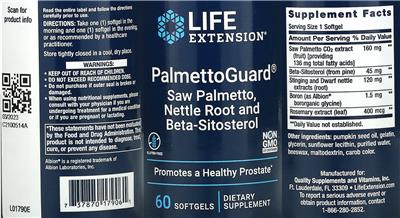
PalmettoGuard by Life Extension label
The label scan from the NIH Dietary Supplement Label Database. Tap to enlarge.
Label images are published by the NIH Dietary Supplement Label Database for the version of this product on file. Always read your actual product label.
View the full label (PDF)The Ingredients in PalmettoGuard by Life Extension
These are the 6 active ingredients this product is made of. Select any to open its full monograph.
Serving size1 Softgel(s) Dosage formSoftgel Capsule Servings per container60 Amounts shown are per serving.
Most supplement products combine several ingredients, and a medication can interact with the product through any one of them. Each ingredient below shows whether it has known drug interactions.
Rosemary Leaf Extract
Interacts with372 drugs
Rosemary is a fragrant Mediterranean herb that is safe and flavorful in normal food amounts. Some early research suggests possible benefits for memory...
Rosemary Leaf Extract monograph & interactionsSaw Palmetto fruit extract
Interacts with174 drugs
Saw palmetto is a plant extract most often used for urinary symptoms linked to an enlarged prostate (BPH). The best research suggests it works no bett...
Saw Palmetto fruit extract monograph & interactions- › Total Fatty Acids
Boron
No knowninteractions
Boron is a trace mineral found in many plant foods and sold as a supplement, mainly promoted for bone, joint, and hormone health. The human evidence f...
Boron monograph & interactionsStinging And Dwarf Nettle Extracts Blend
Beta-Sitosterol
No knowninteractions
Beta-sitosterol is a plant sterol that may modestly lower LDL ('bad') cholesterol and may help ease urinary symptoms from an enlarged prostate. Eviden...
Beta-Sitosterol monograph & interactionsOther (inactive) ingredients: Pumpkin Seed Oil, Gelatin, Glycerin, Sunflower Lecithin, Water, Purified, Beeswax, Maltodextrin, Carob. These complete the product’s ingredient list but are not active constituents.
PalmettoGuard by Life Extension Drug Interactions
HelloPharmacist Interaction Report
PalmettoGuard by Life Extension contains several ingredients with documented interactions with medications.
Rosemary Leaf Extract poses the most serious concern — it may increase bleeding risk if you're taking blood thinners or antiplatelet drugs (anticoagulants or aspirin-like medications), a Moderate-severity interaction.
Read the full breakdown — every affected drug type, severity by severity
The nettle extracts (Stinging Nettle Root and Dwarf Nettle) interact with diabetes medications, diuretics, lithium, and warfarin. Both may lower blood sugar levels when taken with diabetes drugs, may add to the water-losing effect of diuretic medications, could raise lithium levels in your body, and may interfere with warfarin's blood-thinning action because they contain vitamin K.
Rosemary also contains salicylates and may have additive effects with salicylate-containing drugs like aspirin, choline magnesium trisalicylate (Trilisate), and salsalate (Disalcid). Additionally, rosemary may theoretically decrease levels of certain medications broken down by the liver enzyme CYP1A2 — a Minor interaction.
Boron and beta-sitosterol show no documented interactions in our data. We could not check Total Fatty Acids or the saw palmetto component.
Altogether, these interactions span 443 individual medications.
Please run your exact medications through the interaction checker on this page before you start.
Check your own medications below · Editorial policy · How we use AI
Want to check YOUR meds against PalmettoGuard?
Ask about interactions with your drugs in plain English — “Can I take it with lisinopril?” — and we find you the answer in seconds, ingredient by ingredient.
Go to the checkerIngredients driving the most interactions
Individual Drug Interactions
The ingredients in PalmettoGuard interact with 466 drugs. Click any drug to see the details.
3 of the 6 ingredients in PalmettoGuard interact with drugs. Each result below shows which ingredient is responsible. Rosemary Leaf Extract Saw Palmetto fruit extract Stinging Nettle Root Extract
AbciximabReoPro
How Abciximab interacts with PalmettoGuard — through 2 ingredients. Tap an ingredient for the detail:
Saw Palmetto Fruit ExtractAnticoagulant/antiplatelet Drugs Moderate
Interaction Summary
Saw palmetto might increase the risk of bleeding with anticoagulant or antiplatelet drugs.
Read the full Saw Palmetto Fruit Extract + Abciximab interactionRosemary Leaf ExtractAnticoagulant/antiplatelet Drugs Moderate
Interaction Summary
Theoretically, rosemary may increase the risk of bleeding if used with anticoagulant or antiplatelet drugs.
Read the full Rosemary Leaf Extract + Abciximab interactionAbrocitinibCibinqo
How Abrocitinib interacts with PalmettoGuard — through 2 ingredients. Tap an ingredient for the detail:
Rosemary Leaf ExtractAnticoagulant/antiplatelet Drugs Moderate
Interaction Summary
Theoretically, rosemary may increase the risk of bleeding if used with anticoagulant or antiplatelet drugs.
Read the full Rosemary Leaf Extract + Abrocitinib interactionSaw Palmetto Fruit ExtractAnticoagulant/antiplatelet Drugs Moderate
Interaction Summary
Saw palmetto might increase the risk of bleeding with anticoagulant or antiplatelet drugs.
Read the full Saw Palmetto Fruit Extract + Abrocitinib interactionAcarboseGlucobay, Prandase, Precose
How Acarbose interacts with PalmettoGuard — through 2 ingredients. Tap an ingredient for the detail:
Rosemary Leaf ExtractAntidiabetes Drugs Moderate
Interaction Summary
Theoretically, taking rosemary with antidiabetes drugs might increase the risk of hypoglycemia.
Read the full Rosemary Leaf Extract + Acarbose interactionDwarf Nettle ExtractAntidiabetes Drugs Moderate
Interaction Summary
Theoretically, stinging nettle might have additive effects with antidiabetes drugs.
Read the full Dwarf Nettle Extract + Acarbose interactionAcenocoumarolSintrom
How Acenocoumarol interacts with PalmettoGuard — through 2 ingredients. Tap an ingredient for the detail:
Rosemary Leaf ExtractAnticoagulant/antiplatelet Drugs Moderate
Interaction Summary
Theoretically, rosemary may increase the risk of bleeding if used with anticoagulant or antiplatelet drugs.
Read the full Rosemary Leaf Extract + Acenocoumarol interactionSaw Palmetto Fruit ExtractAnticoagulant/antiplatelet Drugs Moderate
Interaction Summary
Saw palmetto might increase the risk of bleeding with anticoagulant or antiplatelet drugs.
Read the full Saw Palmetto Fruit Extract + Acenocoumarol interactionAcetaminophen, AspirinGemnisyn
How Acetaminophen, Aspirin interacts with PalmettoGuard — through 2 ingredients. Tap an ingredient for the detail:
Rosemary Leaf ExtractCytochrome P450 1a2 (cyp1a2) Substrates, Anticoagulant/antiplatelet Drugs +1 Moderate
Interaction Summary
Theoretically, rosemary might decrease the levels and clinical effects of CYP1A2 substrates.
Read the full Rosemary Leaf Extract + Acetaminophen, Aspirin interactionSaw Palmetto Fruit ExtractAnticoagulant/antiplatelet Drugs Moderate
Interaction Summary
Saw palmetto might increase the risk of bleeding with anticoagulant or antiplatelet drugs.
Read the full Saw Palmetto Fruit Extract + Acetaminophen, Aspirin interactionAcetaminophen, Aspirin, CaffeineExcedrin, Excedrin Extra Strength, Excedrin Migraine
How Acetaminophen, Aspirin, Caffeine interacts with PalmettoGuard — through 2 ingredients. Tap an ingredient for the detail:
Rosemary Leaf ExtractAspirin, Cytochrome P450 1a2 (cyp1a2) Substrates +1 Moderate
Interaction Summary
Theoretically, rosemary might have additive effects with salicylate-containing drugs such as aspirin.
Read the full Rosemary Leaf Extract + Acetaminophen, Aspirin, Caffeine interactionSaw Palmetto Fruit ExtractAnticoagulant/antiplatelet Drugs Moderate
Interaction Summary
Saw palmetto might increase the risk of bleeding with anticoagulant or antiplatelet drugs.
Read the full Saw Palmetto Fruit Extract + Acetaminophen, Aspirin, Caffeine interactionAcetaminophen, Caffeine, PyrilamineMidol Max Strength Menstrual
How Acetaminophen, Caffeine, Pyrilamine interacts with PalmettoGuard — through 2 ingredients. Tap an ingredient for the detail:
Dwarf Nettle ExtractDiuretic Drugs Moderate
Interaction Summary
Theoretically, combining stinging nettle with diuretic drugs may have additive effects.
Read the full Dwarf Nettle Extract + Acetaminophen, Caffeine, Pyrilamine interactionRosemary Leaf ExtractCytochrome P450 1a2 (cyp1a2) Substrates Minor
Interaction Summary
Theoretically, rosemary might decrease the levels and clinical effects of CYP1A2 substrates.
Read the full Rosemary Leaf Extract + Acetaminophen, Caffeine, Pyrilamine interactionAcetaminophen, IbuprofenCombogesic
How Acetaminophen, Ibuprofen interacts with PalmettoGuard — through 2 ingredients. Tap an ingredient for the detail:
Rosemary Leaf ExtractCytochrome P450 1a2 (cyp1a2) Substrates, Anticoagulant/antiplatelet Drugs Moderate
Interaction Summary
Theoretically, rosemary might decrease the levels and clinical effects of CYP1A2 substrates.
Read the full Rosemary Leaf Extract + Acetaminophen, Ibuprofen interactionSaw Palmetto Fruit ExtractAnticoagulant/antiplatelet Drugs Moderate
Interaction Summary
Saw palmetto might increase the risk of bleeding with anticoagulant or antiplatelet drugs.
Read the full Saw Palmetto Fruit Extract + Acetaminophen, Ibuprofen interactionAcetaminophen, Pamabrom, PyrilamineMidol Max Strength PMS, Pamprin, Pamprin ES
How Acetaminophen, Pamabrom, Pyrilamine interacts with PalmettoGuard — through 2 ingredients. Tap an ingredient for the detail:
Dwarf Nettle ExtractDiuretic Drugs Moderate
Interaction Summary
Theoretically, combining stinging nettle with diuretic drugs may have additive effects.
Read the full Dwarf Nettle Extract + Acetaminophen, Pamabrom, Pyrilamine interactionRosemary Leaf ExtractCytochrome P450 1a2 (cyp1a2) Substrates Minor
Interaction Summary
Theoretically, rosemary might decrease the levels and clinical effects of CYP1A2 substrates.
Read the full Rosemary Leaf Extract + Acetaminophen, Pamabrom, Pyrilamine interactionAcetazolamideAk-Zol, Diamox
How Acetazolamide interacts with PalmettoGuard — through 1 ingredient. Tap an ingredient for the detail:
Dwarf Nettle ExtractDiuretic Drugs Moderate
Interaction Summary
Theoretically, combining stinging nettle with diuretic drugs may have additive effects.
Read the full Dwarf Nettle Extract + Acetazolamide interactionAcetohexamideDymelor
How Acetohexamide interacts with PalmettoGuard — through 2 ingredients. Tap an ingredient for the detail:
Rosemary Leaf ExtractAntidiabetes Drugs Moderate
Interaction Summary
Theoretically, taking rosemary with antidiabetes drugs might increase the risk of hypoglycemia.
Read the full Rosemary Leaf Extract + Acetohexamide interactionDwarf Nettle ExtractAntidiabetes Drugs Moderate
Interaction Summary
Theoretically, stinging nettle might have additive effects with antidiabetes drugs.
Read the full Dwarf Nettle Extract + Acetohexamide interactionAcetylsalicylic AcidEntrophen
How Acetylsalicylic Acid interacts with PalmettoGuard — through 2 ingredients. Tap an ingredient for the detail:
Rosemary Leaf ExtractAspirin, Anticoagulant/antiplatelet Drugs Moderate
Interaction Summary
Theoretically, rosemary might have additive effects with salicylate-containing drugs such as aspirin.
Read the full Rosemary Leaf Extract + Acetylsalicylic Acid interactionSaw Palmetto Fruit ExtractAnticoagulant/antiplatelet Drugs Moderate
Interaction Summary
Saw palmetto might increase the risk of bleeding with anticoagulant or antiplatelet drugs.
Read the full Saw Palmetto Fruit Extract + Acetylsalicylic Acid interactionAlbiglutideTanzeum
How Albiglutide interacts with PalmettoGuard — through 2 ingredients. Tap an ingredient for the detail:
Rosemary Leaf ExtractAntidiabetes Drugs Moderate
Interaction Summary
Theoretically, taking rosemary with antidiabetes drugs might increase the risk of hypoglycemia.
Read the full Rosemary Leaf Extract + Albiglutide interactionDwarf Nettle ExtractAntidiabetes Drugs Moderate
Interaction Summary
Theoretically, stinging nettle might have additive effects with antidiabetes drugs.
Read the full Dwarf Nettle Extract + Albiglutide interactionAlogliptinNesina
How Alogliptin interacts with PalmettoGuard — through 2 ingredients. Tap an ingredient for the detail:
Dwarf Nettle ExtractAntidiabetes Drugs Moderate
Interaction Summary
Theoretically, stinging nettle might have additive effects with antidiabetes drugs.
Read the full Dwarf Nettle Extract + Alogliptin interactionRosemary Leaf ExtractAntidiabetes Drugs Moderate
Interaction Summary
Theoretically, taking rosemary with antidiabetes drugs might increase the risk of hypoglycemia.
Read the full Rosemary Leaf Extract + Alogliptin interactionAlogliptin, MetforminKazano
How Alogliptin, Metformin interacts with PalmettoGuard — through 2 ingredients. Tap an ingredient for the detail:
Rosemary Leaf ExtractAntidiabetes Drugs Moderate
Interaction Summary
Theoretically, taking rosemary with antidiabetes drugs might increase the risk of hypoglycemia.
Read the full Rosemary Leaf Extract + Alogliptin, Metformin interactionDwarf Nettle ExtractAntidiabetes Drugs Moderate
Interaction Summary
Theoretically, stinging nettle might have additive effects with antidiabetes drugs.
Read the full Dwarf Nettle Extract + Alogliptin, Metformin interactionAlogliptin, PioglitazoneOseni
How Alogliptin, Pioglitazone interacts with PalmettoGuard — through 2 ingredients. Tap an ingredient for the detail:
Dwarf Nettle ExtractAntidiabetes Drugs Moderate
Interaction Summary
Theoretically, stinging nettle might have additive effects with antidiabetes drugs.
Read the full Dwarf Nettle Extract + Alogliptin, Pioglitazone interactionRosemary Leaf ExtractAntidiabetes Drugs Moderate
Interaction Summary
Theoretically, taking rosemary with antidiabetes drugs might increase the risk of hypoglycemia.
Read the full Rosemary Leaf Extract + Alogliptin, Pioglitazone interactionAlteplase, TpaActilyse, Activase
How Alteplase, Tpa interacts with PalmettoGuard — through 2 ingredients. Tap an ingredient for the detail:
Rosemary Leaf ExtractAnticoagulant/antiplatelet Drugs Moderate
Interaction Summary
Theoretically, rosemary may increase the risk of bleeding if used with anticoagulant or antiplatelet drugs.
Read the full Rosemary Leaf Extract + Alteplase, Tpa interactionSaw Palmetto Fruit ExtractAnticoagulant/antiplatelet Drugs Moderate
Interaction Summary
Saw palmetto might increase the risk of bleeding with anticoagulant or antiplatelet drugs.
Read the full Saw Palmetto Fruit Extract + Alteplase, Tpa interactionAluminum Hydroxide, Aspirin, Codeine Phosphate, Magnesium HydroxideAscriptin Codeine #2
How Aluminum Hydroxide, Aspirin, Codeine Phosphate, Magnesium Hydroxide interacts with PalmettoGuard — through 2 ingredients. Tap an ingredient for the detail:
Saw Palmetto Fruit ExtractAnticoagulant/antiplatelet Drugs Moderate
Interaction Summary
Saw palmetto might increase the risk of bleeding with anticoagulant or antiplatelet drugs.
Read the full Saw Palmetto Fruit Extract + Aluminum Hydroxide, Aspirin, Codeine Phosphate, Magnesium Hydroxide interactionRosemary Leaf ExtractAnticoagulant/antiplatelet Drugs, Aspirin Moderate
Interaction Summary
Theoretically, rosemary may increase the risk of bleeding if used with anticoagulant or antiplatelet drugs.
Read the full Rosemary Leaf Extract + Aluminum Hydroxide, Aspirin, Codeine Phosphate, Magnesium Hydroxide interactionAluminum Hydroxide, Aspirin, Magnesium HydroxideAscriptin
How Aluminum Hydroxide, Aspirin, Magnesium Hydroxide interacts with PalmettoGuard — through 2 ingredients. Tap an ingredient for the detail:
Rosemary Leaf ExtractAspirin, Anticoagulant/antiplatelet Drugs Moderate
Interaction Summary
Theoretically, rosemary might have additive effects with salicylate-containing drugs such as aspirin.
Read the full Rosemary Leaf Extract + Aluminum Hydroxide, Aspirin, Magnesium Hydroxide interactionSaw Palmetto Fruit ExtractAnticoagulant/antiplatelet Drugs Moderate
Interaction Summary
Saw palmetto might increase the risk of bleeding with anticoagulant or antiplatelet drugs.
Read the full Saw Palmetto Fruit Extract + Aluminum Hydroxide, Aspirin, Magnesium Hydroxide interactionAmiloride, HydrochlorothiazideAmil-Co, Amilzide, Moduret 25, Moduretic
How Amiloride, Hydrochlorothiazide interacts with PalmettoGuard — through 1 ingredient. Tap an ingredient for the detail:
Dwarf Nettle ExtractDiuretic Drugs Moderate
Interaction Summary
Theoretically, combining stinging nettle with diuretic drugs may have additive effects.
Read the full Dwarf Nettle Extract + Amiloride, Hydrochlorothiazide interactionAmmonium ChlorideAmmonium Chloride
How Ammonium Chloride interacts with PalmettoGuard — through 1 ingredient. Tap an ingredient for the detail:
Dwarf Nettle ExtractDiuretic Drugs Moderate
Interaction Summary
Theoretically, combining stinging nettle with diuretic drugs may have additive effects.
Read the full Dwarf Nettle Extract + Ammonium Chloride interactionAnacaulase-bcdbNexoBrid
How Anacaulase-bcdb interacts with PalmettoGuard — through 2 ingredients. Tap an ingredient for the detail:
Rosemary Leaf ExtractAnticoagulant/antiplatelet Drugs Moderate
Interaction Summary
Theoretically, rosemary may increase the risk of bleeding if used with anticoagulant or antiplatelet drugs.
Read the full Rosemary Leaf Extract + Anacaulase-bcdb interactionSaw Palmetto Fruit ExtractAnticoagulant/antiplatelet Drugs Moderate
Interaction Summary
Saw palmetto might increase the risk of bleeding with anticoagulant or antiplatelet drugs.
Read the full Saw Palmetto Fruit Extract + Anacaulase-bcdb interactionAnagrelideAgrylin
How Anagrelide interacts with PalmettoGuard — through 2 ingredients. Tap an ingredient for the detail:
Saw Palmetto Fruit ExtractAnticoagulant/antiplatelet Drugs Moderate
Interaction Summary
Saw palmetto might increase the risk of bleeding with anticoagulant or antiplatelet drugs.
Read the full Saw Palmetto Fruit Extract + Anagrelide interactionRosemary Leaf ExtractCytochrome P450 1a2 (cyp1a2) Substrates, Anticoagulant/antiplatelet Drugs Moderate
Interaction Summary
Theoretically, rosemary might decrease the levels and clinical effects of CYP1A2 substrates.
Read the full Rosemary Leaf Extract + Anagrelide interactionAnisindioneMiradon
How Anisindione interacts with PalmettoGuard — through 2 ingredients. Tap an ingredient for the detail:
Rosemary Leaf ExtractAnticoagulant/antiplatelet Drugs Moderate
Interaction Summary
Theoretically, rosemary may increase the risk of bleeding if used with anticoagulant or antiplatelet drugs.
Read the full Rosemary Leaf Extract + Anisindione interactionSaw Palmetto Fruit ExtractAnticoagulant/antiplatelet Drugs Moderate
Interaction Summary
Saw palmetto might increase the risk of bleeding with anticoagulant or antiplatelet drugs.
Read the full Saw Palmetto Fruit Extract + Anisindione interactionAntidiabetes, Dipeptidyl Peptidase-4 (dpp-iv) InhibitorGlyxambi
How Antidiabetes, Dipeptidyl Peptidase-4 (dpp-iv) Inhibitor interacts with PalmettoGuard — through 2 ingredients. Tap an ingredient for the detail:
Rosemary Leaf ExtractAntidiabetes Drugs Moderate
Interaction Summary
Theoretically, taking rosemary with antidiabetes drugs might increase the risk of hypoglycemia.
Read the full Rosemary Leaf Extract + Antidiabetes, Dipeptidyl Peptidase-4 (dpp-iv) Inhibitor interactionDwarf Nettle ExtractAntidiabetes Drugs Moderate
Interaction Summary
Theoretically, stinging nettle might have additive effects with antidiabetes drugs.
Read the full Dwarf Nettle Extract + Antidiabetes, Dipeptidyl Peptidase-4 (dpp-iv) Inhibitor interactionAntithrombin IiiThrombate III
How Antithrombin Iii interacts with PalmettoGuard — through 2 ingredients. Tap an ingredient for the detail:
Rosemary Leaf ExtractAnticoagulant/antiplatelet Drugs Moderate
Interaction Summary
Theoretically, rosemary may increase the risk of bleeding if used with anticoagulant or antiplatelet drugs.
Read the full Rosemary Leaf Extract + Antithrombin Iii interactionSaw Palmetto Fruit ExtractAnticoagulant/antiplatelet Drugs Moderate
Interaction Summary
Saw palmetto might increase the risk of bleeding with anticoagulant or antiplatelet drugs.
Read the full Saw Palmetto Fruit Extract + Antithrombin Iii interactionApixabanEliquis
How Apixaban interacts with PalmettoGuard — through 2 ingredients. Tap an ingredient for the detail:
Saw Palmetto Fruit ExtractAnticoagulant/antiplatelet Drugs Moderate
Interaction Summary
Saw palmetto might increase the risk of bleeding with anticoagulant or antiplatelet drugs.
Read the full Saw Palmetto Fruit Extract + Apixaban interactionRosemary Leaf ExtractAnticoagulant/antiplatelet Drugs Moderate
Interaction Summary
Theoretically, rosemary may increase the risk of bleeding if used with anticoagulant or antiplatelet drugs.
Read the full Rosemary Leaf Extract + Apixaban interactionArgatrobanArgatroban
How Argatroban interacts with PalmettoGuard — through 2 ingredients. Tap an ingredient for the detail:
Rosemary Leaf ExtractAnticoagulant/antiplatelet Drugs Moderate
Interaction Summary
Theoretically, rosemary may increase the risk of bleeding if used with anticoagulant or antiplatelet drugs.
Read the full Rosemary Leaf Extract + Argatroban interactionSaw Palmetto Fruit ExtractAnticoagulant/antiplatelet Drugs Moderate
Interaction Summary
Saw palmetto might increase the risk of bleeding with anticoagulant or antiplatelet drugs.
Read the full Saw Palmetto Fruit Extract + Argatroban interactionAspirinAngettes 75, ASA, Asaphen, Aspirin, Caprin, Cartia +8 more
How Aspirin interacts with PalmettoGuard — through 2 ingredients. Tap an ingredient for the detail:
Rosemary Leaf ExtractAnticoagulant/antiplatelet Drugs, Aspirin Moderate
Interaction Summary
Theoretically, rosemary may increase the risk of bleeding if used with anticoagulant or antiplatelet drugs.
Read the full Rosemary Leaf Extract + Aspirin interactionSaw Palmetto Fruit ExtractAnticoagulant/antiplatelet Drugs Moderate
Interaction Summary
Saw palmetto might increase the risk of bleeding with anticoagulant or antiplatelet drugs.
Read the full Saw Palmetto Fruit Extract + Aspirin interactionAspirin, Aluminum Hydroxide, Codeine Phosphate, Magnesium HydroxideAscriptin Codeine #3
How Aspirin, Aluminum Hydroxide, Codeine Phosphate, Magnesium Hydroxide interacts with PalmettoGuard — through 2 ingredients. Tap an ingredient for the detail:
Rosemary Leaf ExtractAspirin, Anticoagulant/antiplatelet Drugs Moderate
Interaction Summary
Theoretically, rosemary might have additive effects with salicylate-containing drugs such as aspirin.
Read the full Rosemary Leaf Extract + Aspirin, Aluminum Hydroxide, Codeine Phosphate, Magnesium Hydroxide interactionSaw Palmetto Fruit ExtractAnticoagulant/antiplatelet Drugs Moderate
Interaction Summary
Saw palmetto might increase the risk of bleeding with anticoagulant or antiplatelet drugs.
Read the full Saw Palmetto Fruit Extract + Aspirin, Aluminum Hydroxide, Codeine Phosphate, Magnesium Hydroxide interactionEach ingredient & the kinds of drugs it affects
For each ingredient in PalmettoGuard with known interactions, here are the types of medications they can affect. Open any type for the detail — or search your exact drug in the checker above.
Rosemary Leaf Extract
Anticoagulant/Antiplatelet Drugs
Theoretically, rosemary may increase the risk of bleeding if used with anticoagulant or antiplatelet drugs.
In vitro and animal research suggests that rosemary inhibits platelet aggregation.
Antidiabetes Drugs
Theoretically, taking rosemary with antidiabetes drugs might increase the risk of hypoglycemia.
Animal research shows that rosemary extract can decrease blood glucose levels in diabetic models. However, research in humans is conflicting. Although rosemary powder decreased blood glucose levels in healthy adults, no change in blood glucose levels was seen in adults with type 2 diabetes, most of whom were taking antidiabetes drugs.
Aspirin
Theoretically, rosemary might have additive effects with salicylate-containing drugs such as aspirin.
Rosemary is reported to contain salicylates.
Choline Magnesium Trisalicylate (Trilisate)
Theoretically, rosemary might have additive effects with salicylate-containing drugs such as choline magnesium trisalicylate.
Rosemary is reported to contain salicylate.
Salsalate (Disalcid)
Theoretically, rosemary might have additive effects with salicylate-containing drugs such as salsalate.
Rosemary is reported to contain salicylate.
Cytochrome P450 1A2 (Cyp1A2) Substrates
Theoretically, rosemary might decrease the levels and clinical effects of CYP1A2 substrates.
In vitro research shows that rosemary induces CYP1A2 enzymes. This effect has not been reported in humans.
Saw Palmetto fruit extract
Anticoagulant/Antiplatelet Drugs
Saw palmetto might increase the risk of bleeding with anticoagulant or antiplatelet drugs.
Saw palmetto is reported to prolong bleeding time. Theoretically, it might increase the risk of bleeding when used concomitantly with anticoagulant or antiplatelet drugs.
Contraceptive Drugs
Saw palmetto might reduce the effectiveness of contraceptive drugs.
Saw palmetto might have antiestrogenic effects. Theoretically, it might interfere with contraceptive drugs taken concomitantly.
Estrogens
Saw palmetto might reduce the effectiveness of estrogens.
Saw palmetto might have antiestrogenic effects. Theoretically, it might interfere with estrogens taken concomitantly.
Stinging Nettle Root Extract
Antidiabetes Drugs
Theoretically, stinging nettle might have additive effects with antidiabetes drugs.
Clinical research shows that stinging nettle might decrease blood glucose levels in patients with diabetes.
Diuretic Drugs
Theoretically, combining stinging nettle with diuretic drugs may have additive effects.
Animal research suggests that the above ground parts and roots of stinging nettle may have a diuretic effect.
Lithium
Theoretically, stinging nettle might reduce excretion and increase levels of lithium.
Animal research suggests that stinging nettle has diuretic and natriuretic properties, which could alter the excretion of lithium. The dose of lithium might need to be decreased.
Warfarin (Coumadin)
There is some concern that stinging nettle might decrease the effects of anticoagulant drugs such as warfarin.
Stinging nettle contains a significant amount of vitamin K. When taken in large quantities, this might interfere with the activity of warfarin.
Brand information
Manufacturer and brand details for PalmettoGuard, from the product label.
Life Extension
See all Life Extension products- Name
- Quality Supplements and Vitamins, Inc.
- City
- Ft. Lauderdale
- State
- FL
- ZipCode
- 33309
- Phone Number
- 1-866-280-2852
- Web Address
- LifeExtension.com
PalmettoGuard by Life Extension: Common Questions
Does PalmettoGuard by Life Extension interact with any medications?
How can one product interact with so many drugs?
Where does this information come from?
Is rosemary in this product the same as cooking rosemary?
Can I take this if I'm pregnant or breastfeeding?
What does beta-sitosterol do in this formula?
Could this product affect my blood sugar?
What side effects might I notice?
Does this work for an enlarged prostate?
Written and reviewed by the HelloPharmacist editorial staff. Our editorial policy
Not sure if PalmettoGuard is safe with your meds?
Our pharmacists answer your medication & supplement questions — free.
Label information is sourced from the NIH Dietary Supplement Label Database and reflects the product version on file; always read your actual product label. This page is for education only and is not a substitute for professional medical advice. Confirm with your pharmacist or doctor before combining supplements and medications.
The Full Monographs Behind PalmettoGuard’s Ingredients
Every ingredient we hold a full HelloPharmacist monograph for — uses, evidence, safety, and the complete interaction list.
Rosemary
Interacts with 372 drugsRosemary is a fragrant Mediterranean herb that is safe and flavorful in normal food amounts. Some early research suggests possible benefits for memory, mood, and hair growth, but the evidenc...
Read the full Rosemary monograph → Herb & supplement monographSaw Palmetto
Interacts with 174 drugsSaw palmetto is a plant extract most often used for urinary symptoms linked to an enlarged prostate (BPH). The best research suggests it works no better than a placebo for most men, though i...
Read the full Saw Palmetto monograph → Herb & supplement monographBoron
Boron is a trace mineral found in many plant foods and sold as a supplement, mainly promoted for bone, joint, and hormone health. The human evidence for most of these uses is limited or prel...
Read the full Boron monograph → Herb & supplement monographStinging Nettle
Interacts with 164 drugsStinging nettle is a common plant used as food and in traditional medicine, most often for prostate symptoms, allergies, and joint pain. The evidence is mixed and mostly preliminary, so it i...
Read the full Stinging Nettle monograph → Herb & supplement monographBeta-sitosterol
Beta-sitosterol is a plant sterol that may modestly lower LDL ('bad') cholesterol and may help ease urinary symptoms from an enlarged prostate. Evidence is moderate for these uses and weaker...
Read the full Beta-sitosterol monograph →Sources & How We Checked
PalmettoGuard's label data comes from the NIH Dietary Supplement Label Database; the ingredient interaction data is from the Natural Medicines database, reviewed by our pharmacists.
- NIH Dietary Supplement Label Database (DSLD) — The official product label on file for this supplement.
- Natural Medicines (Therapeutic Research Center) — Evidence-graded clinical reference behind the ingredient interaction data.
Content is written and reviewed by licensed HelloPharmacist pharmacists. See our data sources and editorial standards for how this information is built and checked.
The 78 references behind this product’s interaction data
Every citation that drives the interaction findings for this product’s ingredients, from the evidence-graded Natural Medicines (TRC Healthcare) database. Open an ingredient to browse its citations — links open the study on PubMed or the publisher’s site.
Rosemary 20 references
- Newall CA, Anderson LA, Philpson JD. Herbal Medicine: A Guide for Healthcare Professionals. London, UK: The Pharmaceutical Press, 1996.
- Foster S, Tyler VE. Tyler's Honest Herbal: A Sensible Guide to the Use of Herbs and Related Remedies. 3rd ed., Binghamton, NY: Haworth Herbal Press, 1993.
- The Review of Natural Products by Facts and Comparisons. St. Louis, MO: Wolters Kluwer Co., 1999.
- McGuffin M, Hobbs C, Upton R, Goldberg A, eds. American Herbal Products Association's Botanical Safety Handbook. Boca Raton, FL: CRC Press, LLC 1997.
- Gruenwald J, Brendler T, Jaenicke C. PDR for Herbal Medicines. 1st ed. Montvale, NJ: Medical Economics Company, Inc., 1998.
- Cartier LC, Lehrer A, Malo JL. Occupational asthma caused by aromatic herbs. Allergy 1996;51:647-9. DOI
- Burkhard PR, Burkhardt K, Haenggeli CA, Landis T. Plant-induced seizures: reappearance of an old problem. J Neurol 1999;246:667-70. PubMed
- Swain AR, Dutton SP, Truswell AS. Salicylates in foods. J Am Diet.Assoc 1985;85(8):950-60. DOI
- Zhu BT, Loder DP, Cai MX, et al. Dietary administration of an extract from rosemary leaves enhances the liver microsomal metabolism of endogenous estrogens and decreases their uterotropic action in CD-1 mice. Carcinogenesis 1998;19(10):1821-7. PubMed
- Debersac P, Heydel JM, Amiot MJ, et al. Induction of cytochrome P450 and/or detoxication enzymes by various extracts of rosemary: description of specific patterns. Food Chem Toxicol 2001;39(9):907-18. PubMed
- Debersac P, Vernevaut MF, Amiot MJ, et al. Effects of a water-soluble extract of rosemary and its purified component rosmarinic acid on xenobiotic-metabolizing enzymes in rat liver. Food Chem Toxicol 2001;39(2):109-17. PubMed
- Lee JJ, Jin YR, Lee JH, et al. Antiplatelet activity of carnosic acid, a phenolic diterpene from Rosmarinus officinalis. Planta Med 2007;73(2):121-7.
- Yamamoto J, Yamada K, Naemura A, et al. Testing various herbs for antithrombotic effect. Nutrition 2005;21(5):580-7. PubMed
- Naemura A, Ura M, Yamashita T, et al. Long-term intake of rosemary and common thyme herbs inhibits experimental thrombosis without prolongation of bleeding time. Thromb Res 2008;122(4):517-22. PubMed
- Lee JJ, Jin YR, Lim Y, et al. Antiplatelet activity of carnosol is mediated by the inhibition of TXA2 receptor and cytosolic calcium mobilization. Vascul Pharmacol 2006;45:148-53. PubMed
- Bakirel, T., Bakirel, U., Keles, O. U., Ulgen, S. G., and Yardibi, H. In vivo assessment of antidiabetic and antioxidant activities of rosemary (Rosmarinus officinalis) in alloxan-diabetic rabbits. J Ethnopharmacol 2-28-2008;116(1):64-73. PubMed
- Erenmemisoglu, A., Saraymen, R., and Ustun, S. Effect of a Rosmarinus officinalis leave extract on plasma glucose levels in normoglycaemic and diabetic mice. Pharmazie 1997;52(8):645-646.
- Valones MAA, Silva ICG, Gueiros LAM, Leão JC, Caldas AF Jr, Carvalho AAT. Clinical assessment of rosemary-based toothpaste (Rosmarinus officinalis Linn.): A randomized controlled double-blind study. Braz Dent J. 2019;30(2):146-151. PubMed
- Quirarte-Báez SM, Zamora-Perez AL, Reyes-Estrada CA, et al. A shortened treatment with rosemary tea (rosmarinus officinalis) instead of glucose in patients with diabetes mellitus type 2 (TSD). J Popul Ther Clin Pharmacol. 2019;26(4):e18-e28.
- Al Jamal A. Effect of rosemary (Rosmarinus officinalis) on lipid profiles and blood glucose in human diabetic patients (type-2). African J. Biochem. Res. 2014;8(8):147-50. DOI
Saw Palmetto 22 references
- Wilt TJ, Ishani A, Stark G, et al. Saw palmetto extracts for treatment of benign prostatic hyperplasia: a systematic review. JAMA 1998;280:1604-9. PubMed
- Carraro JC, Raynaud JP, Koch G, et al. Comparison of phytotherapy (Permixon) with finasteride in the treatment of benign prostate hyperplasia: a randomized international study of 1,098 patients. Prostate 1996;29:231-40. DOI
- Di Silverio F, D'Eramo G, Lubrano C, et al. Evidence that Serenoa repens extract displays an antiestrogenic activity in prostatic tissue of benign prostatic hypertrophy patients. Eur Urol 1992;21:309-14. PubMed
- Stepanov VN, Siniakova LA, Sarrazin B, Raynaud JP. Efficacy and tolerability of the lipidosterolic extract of Serenoa repens (Permixon) in benign prostatic hyperplasia: a double-blind comparison of two dosage regimens. Adv Ther 1999;16:231-41.
- Cheema P, El-Mefty O, Jazieh AR. Intraoperative haemorrhage associated with the use of extract of Saw Palmetto herb: a case report and review of literature. J Intern Med 2001;250:167-9. PubMed
- Jibrin I, Erinle A, Saidi A, Aliyu ZY. Saw palmetto-induced pancreatitis. South Med J 2006;99:611-2. PubMed
- Prager N, Bickett K, French N, Marcovici G. A randomized, double-blind, placebo-controlled trial to determine the effectiveness of botanically derived inhibitors of 5-alpha-reductase in the treatment of androgenetic alopecia. J Altern Complement Med 2002
- Avins AL, Bent S, Staccone S, et al. A detailed safety assessment of a saw palmetto extract. Complement Ther Med 2008;16:147-54. PubMed
- Morgia, G., Mucciardi, G., Gali, A., Madonia, M., Marchese, F., Di, Benedetto A., Romano, G., Bonvissuto, G., Castelli, T., Macchione, L., and Magno, C. Treatment of chronic prostatitis/chronic pelvic pain syndrome category IIIA with Serenoa repens plus
- Aliaev, IuG, Vinarov, A. Z., Lokshin, K. L., and Spivak, L. G. [Efficiency and safety of prostamol-Uno in patients with chronic abacterial prostatitis]. Urologiia. 2006;(1):47-50.
- Agbabiaka, T. B., Pittler, M. H., Wider, B., and Ernst, E. Serenoa repens (saw palmetto): a systematic review of adverse events. Drug Saf 2009;32(8):637-647. PubMed
- Wargo, K. A., Allman, E., and Ibrahim, F. A possible case of saw palmetto-induced pancreatitis. South.Med.J. 2010;103(7):683-685. PubMed
- Lapi, F., Gallo, E., Giocaliere, E., Vietri, M., Baronti, R., Pieraccini, G., Tafi, A., Menniti-Ippolito, F., Mugelli, A., Firenzuoli, F., and Vannacci, A. Acute liver damage due to Serenoa repens: a case report. Br.J.Clin.Pharmacol. 2010;69(5):558-560.
- Mantovani, F. Serenoa repens in benign prostatic hypertrophy: analysis of 2 Italian studies. Minerva Urol.Nefrol. 2010;62(4):335-340.
- Hanaka, M., Yoshii, C., Yatera, K., Ito, C., Chojin, Y., Nagata, S., Yamasaki, K., Nishida, C., Kawanami, T., Kawanami, Y., Ishimoto, H., and Mukae, H. [A case of rhabdomyolysis caused by saw palmetto of healthy foods]. J.UOEH. 6-1-2012;34(2):193-199. PubMed
- Miroddi, M., Carni, A., Mannucci, C., Moleti, M., Navarra, M., and Calapai, G. Hot flashes in a young girl: a wake-up call concerning Serenoa repens use in children. Pediatrics 2012;130(5):e1374-e1376.
- Braeckman J. The extract of Serenoa repens in the treatment of benign prostatic hyperplasia: a multicenter open study. Current Therapeutic Research 1994;55(7):776-785. DOI
- Jipescu D, Patel A, Bohra H, Pientka A. Rare case of saw palmetto induced heart block. JACC 2017;69(11) supplement:2310.
- Morabito P, Miroddi M, Giovinazzo S, Spina E, Calapai G. Serenoa repens as an endocrine disruptor in a 10-year-Old young girl: a new case report. Pharmacology. 2015;96(1-2):41-3. doi: 10.1159/000431327.
- Gammoudi R, Ameur K, Ouni B, et al. Fixed drug eruption to Serenoa repens: first case report and consideration of the use of herbal medicine. Dermatol Ther 2020 Aug 29:e14247.
- Paulis G, Paulis A, Perletti G. Serenoa repens and its effects on male sexual function. A systematic review and meta-analysis of clinical trials. Arch Ital Urol Androl 2021;93(4):475-480. PubMed
- Venkateswaran S, Declet-Bauzo R, Shodeinde M, Gilford P. Postoperative Retroperitoneal Hematoma: A Case of Saw Palmetto and the Importance of Primary Care Intervention. HCA Healthc J Med 2020;1(5):279-282. PubMed
Boron 6 references
- Ellenhorn MJ, et al. Ellenhorn's Medical Toxicology: Diagnoses and Treatment of Human Poisoning. 2nd ed. Baltimore, MD: Williams & Wilkins, 1997.
- Food and Nutrition Board, Institute of Medicine. Dietary Reference Intakes for Vitamin A, Vitamin K, Arsenic, Boron, Chromium, Copper, Iodine, Iron, Manganese, Molybdenum, Nickel, Silicon, Vanadium, and Zinc. Washington, DC: National Academy Press, 2002.
- Thai L, Hart LL. Boric acid vaginal suppositories. Ann Pharmacother 1993;27:1355-7.
- Acs N, Banhidy F, Puho E, Czeizel AE. Teratogenic effects of vaginal boric acid treatment during pregnancy. Int J Gynaecol Obstet 2006;93:55-6. PubMed
- Garabrant, D. H., Bernstein, L., Peters, J. M., and Smith, T. J. Respiratory and eye irritation from boron oxide and boric acid dusts. J Occup Med 1984;26(8):584-586. PubMed
- Hjelm C, Harari F, Vahter M. Pre- and postnatal environmental boron exposure and infant growth: results from a mother-child cohort in northern Argentina. Environ Res 2019;171:60-8. PubMed
Stinging Nettle 23 references
- Monographs on the medicinal uses of plant drugs. Exeter, UK: European Scientific Co-op Phytother, 1997.
- Newall CA, Anderson LA, Philpson JD. Herbal Medicine: A Guide for Healthcare Professionals. London, UK: The Pharmaceutical Press, 1996.
- The Review of Natural Products by Facts and Comparisons. St. Louis, MO: Wolters Kluwer Co., 1999.
- Schulz V, Hansel R, Tyler VE. Rational Phytotherapy: A Physician's Guide to Herbal Medicine. Terry C. Telger, transl. 3rd ed. Berlin, GER: Springer, 1998.
- Leung AY, Foster S. Encyclopedia of Common Natural Ingredients Used in Food, Drugs and Cosmetics. 2nd ed. New York, NY: John Wiley & Sons, 1996.
- Brinker F. Herb Contraindications and Drug Interactions. 2nd ed. Sandy, OR: Eclectic Medical Publications, 1998.
- Mittman P. Randomized, double-blind study of freeze-dried Urtica dioica in the treatment of allergic rhinitis. Planta Med 1990;56:44-7.
- Vontobel HP, Herzog R, Rutishauser G, Kres H. [Results of a double-blind study on the effectiveness of ERU (extractum radicis Urticae) capsules in conservative treatment of benign prostatic hyperplasia]. (Abstract). Urologe A 1985;24:49-51.
- Randall C, Randall H, Dobbs F, et al. Randomized controlled trial of nettle sting for treatment of base-of-thumb pain. J R Soc Med 2000;93:305-9. PubMed
- Caliskaner Z, Karaayvaz M, Ozturk S. Misuse of a herb: stinging nettle (Urtica urens) induced severe tongue oedema. Complement Ther Med 2004;12:57-8. PubMed
- Krzeski, T., Kazon, M., Borkowski, A., Witeska, A., and Kuczera, J. Combined extracts of Urtica dioica and Pygeum africanum in the treatment of benign prostatic hyperplasia: double-blind comparison of two doses. Clin Ther 1993;15(6):1011-1020.
- Randall, C., Meethan, K., Randall, H., and Dobbs, F. Nettle sting of Urtica dioica for joint pain--an exploratory study of this complementary therapy. Complement Ther Med 1999;7(3):126-131. PubMed
- Tahri, A., Yamani, S., Legssyer, A., Aziz, M., Mekhfi, H., Bnouham, M., and Ziyyat, A. Acute diuretic, natriuretic and hypotensive effects of a continuous perfusion of aqueous extract of Urtica dioica in the rat. J Ethnopharmacol 2000;73(1-2):95-100. PubMed
- Sahin, M., Yilmaz, H., Gursoy, A., Demirel, A. N., Tutuncu, N. B., and Guvener, N. D. Gynaecomastia in a man and hyperoestrogenism in a woman due to ingestion of nettle (Urtica dioica). N.Z.Med.J. 2007;120(1265):U2803.
- Randall, C., Dickens, A., White, A., Sanders, H., Fox, M., and Campbell, J. Nettle sting for chronic knee pain: a randomised controlled pilot study. Complement Ther.Med. 2008;16(2):66-72. PubMed
- Rayburn, K., Fleischbein, E., Song, J., Allen, B., Kundert, M., Leiter, C., and Bush, T. Stinging nettle cream for osteoarthritis. Altern.Ther.Health Med. 2009;15(4):60-61.
- Oliver, F., Amon, E. U., Breathnach, A., Francis, D. M., Sarathchandra, P., Black, A. K., and Greaves, M. W. Contact urticaria due to the common stinging nettle (Urtica dioica)-- histological, ultrastructural and pharmacological studies. Clin Exp Dermato PubMed
- Kulze, A. and Greaves, M. Contact urticaria caused by stinging nettles. Br.J Dermatol. 1988;119(2):269-270. PubMed
- Patten G. Medicinal plant review: Urtica. Aust J Med Herbalism 1993;5(1):5-13.
- Maor D, Little M. Skin contact with a stinging tree requiring intensive care unit admission. Contact Dermatitis. 2017 Nov;77(5):335-37. PubMed
- Easton L, Vaid S, Nagel AK, Venci JV, Fortuna RJ. Stinging Nettle (Urtica dioica): An Unusual Case of Galactorrhea. Am J Case Rep 2021;22:e933999. PubMed
- Niazi B, Ahmed K, Ahmed M, Ali S, Song K, Elias S. Drug-Induced Liver Injury from Herbal Liver Detoxification Tea. Case Rep Gastroenterol 2022;16(3):612-617. PubMed
- Nnamani I, Tolu-Akinnawo O, Dufera RR, Akintunde A, Maliakkal B. Tinospora cordifolia (Guduchi/Giloy)-Induced Liver Injury: A Case Review. Cureus 2023;15(5):e39793. PubMed
Beta-sitosterol 7 references
- Berges RR, Windeler J, Trampisch HJ, et al. Randomised, placebo-controlled, double-blind clinical trial of beta-sitosterol in patients with benign prostatic hyperplasia. Beta-sitosterol Study Group. Lancet 1995;345:1529-32.
- Klippel KF, Hiltl DM, Schipp B. A multicentric, placebo-controlled, double-blind clinical trial of beta-sitosterol (phytosterol) for the treatment of benign prostatic hyperplasia. Br J Urol 1997;80:427-32.
- Wilt TJ, MacDonald R, Ishani A. beta-sitosterol for the treatment of benign prostatic hyperplasia: a systematic review. BJU Int 1999;83:976-83. PubMed
- Oster P, Schlierf G, Heuck CC, et al. [Sitosterol in familial hyperlipoproteinemia type II. A randomized, double-blind, cross-over study]. Dtsch Med Wochenschr 1976;101:1308-11.
- Becker M, Staab D, Von Bergman K. Long-term treatment of severe familial hypercholesterolemia in children: effect of sitosterol and bezafibrate. Pediatrics 1992;89:138-42. DOI
- Prager N, Bickett K, French N, Marcovici G. A randomized, double-blind, placebo-controlled trial to determine the effectiveness of botanically derived inhibitors of 5-alpha-reductase in the treatment of androgenetic alopecia. J Altern Complement Med 2002
- Lorenze A, Hsueh W, Nasr J. Beta-sitosterol-induced acute pancreatitis: A case report and review of the literature. Cureus. 2020;12(3):e7407. PubMed
Parts of this content are provided by the Therapeutic Research Center, LLC.
DISCLAIMER: Currently this does not check for drug-drug interactions. This is not an all-inclusive comprehensive list of potential interactions and is for informational purposes only. Not all interactions are known or well-reported in the scientific literature, and new interactions are continually being reported. Input is needed from a qualified healthcare provider including a pharmacist before starting any therapy. Application of clinical judgment is necessary.
© 2021 Therapeutic Research Center, LLC