
PureCalm Ingredients & Drug Interactions
What is this page for?
First and foremost: checking PureCalm against your medications. The heart of this page is the interaction checker and the full interaction report — how this product’s ingredients may interact with prescription and over-the-counter medicines you may be taking.
Around that, we add a pharmacist’s high-level view of the product as a whole — what’s inside, the evidence for its stated use, how transparent the label is, and what safety data exists — so you can see the full picture in one place. It’s educational information from our licensed clinical databases and the clinical staff at HelloPharmacist — not medical advice — and we don’t sell or endorse products. Our editorial policy
PureCalm is a dietary supplement by Native Remedies with 3 active ingredients. Its ingredients are commonly taken for anxiety and stress, sleep problems, relaxation and calming.Based on those ingredients, 851 medications have a known interaction with it, the most serious rated moderate. The ingredients most likely to interact are Passion Flower, Lemon Balm, Lavender. Use the checker below to test your specific medication, or read the full HelloPharmacist Interaction Report.
Check Your Meds Against PureCalm by Native Remedies
Ask about any prescription or over-the-counter medication and we check it for interactions with PureCalm by Native Remedies — and tell you which ingredient is responsible.
AI summaries are generated from our interaction database for education only — always confirm with your pharmacist. How we use AI
Ask the Pharmacist
A licensed pharmacist will answer your question by email — free, usually within 24 hours.
Got it — thank you!
A licensed pharmacist will answer within 24 hours. Keep an eye on your email (worth checking spam, just in case).
HelloPharmacist Scorecard of PureCalm by Native Remedies
Our pharmacy team’s full take, with four database checks built into the cards below — a summary of what is known, not a grade of the product itself.
What’s inside
Low disclosure
PureCalm contains three active herbal ingredients: lavender, passion flower, and lemon balm. Lavender has traditionally been used for relaxation and appears possibly effective for period pain.
Passion flower is used for sleep and anxiety relief and shows possible effectiveness for both insomnia and pre-procedure jitters. Lemon balm is included for stress and mood support, with evidence suggesting it may help with cold sores and stress relief.
The product is a liquid formulation with glycerin and deionized water as inactive ingredients.
Does it work?
Moderate evidence
The ingredients in PureCalm show mixed evidence for their marketed uses. Passion flower is possibly effective for both insomnia and pre-procedural anxiety.
Lavender is possibly effective for period pain but shows insufficient evidence for anxiety and fatigue relief. Lemon balm is possibly effective for stress, depression, and cold sores.
For other claimed uses like cancer-related pain and alopecia, the evidence is either insufficient or suggests the ingredient may not work. Talk with your pharmacist about whether this product is a good fit for your specific goal.
How safe is it?
Well-documented data
Lavender, passion flower, and lemon balm are all generally well tolerated for short-term use. The most commonly reported side effects are mild: dizziness, drowsiness, headache, nausea, constipation, and digestive upset.
Rare serious side effects including cardiac rhythm changes and severe allergic reactions have been reported in case reports, though it's often unclear whether the herbal ingredient or other factors caused them. Passion flower should be avoided during pregnancy due to potential effects on the uterus and lack of safety data, and should be avoided while breastfeeding.
Lemon balm should be avoided during pregnancy unless your doctor advises otherwise, and use caution while breastfeeding. Lavender has insufficient safety data to know if medicinal amounts are safe in pregnancy or nursing—talk with your doctor or pharmacist for personalized advice if you're pregnant or breastfeeding.
Meds to double-check
Moderate interaction found
Before taking PureCalm, check with your pharmacist if you take any CNS depressants—sedatives, sleeping pills, anti-anxiety medications, pain relievers, or alcohol—because all three ingredients may intensify drowsiness. Additionally, if you take thyroid hormone replacement therapy, lemon balm may interfere with it.
And if you take medications cleared by your CYP3A4 enzyme or OATP transporters, passion flower may theoretically affect how well they work. Use the medication checker below to verify your prescriptions.
The bottom line
Scorecard at a glanceFormula with limited ingredient disclosure with some supporting evidence for its stated purpose. Moderate medication interactions have been identified, and safety information is well characterized.
PureCalm may help with sleep, anxiety, stress, or period pain if those are your goals, though the evidence is stronger for some uses than others. Don't take it if you're on sedating medications, thyroid hormone therapy, or certain other drugs without checking with your pharmacist first—the ingredient interactions are real and can affect how your medications work.
If you're pregnant or nursing, discuss it with your doctor before starting. Run your full medication list through our checker on this page.
Educational only — not medical advice; always confirm with your pharmacist. Our editorial policy · How we use AI
Assessment coverage: 3 of 3 active ingredients matched to our full ingredient reviews (monographs). Based on the product label dated Jun 25, 2025.
This Scorecard evaluates available label information, ingredient evidence, and known medication-safety considerations. It does not independently verify product identity, purity, potency, contamination, or manufacturing quality. How these ratings are computed
General information
Key facts about PureCalm, straight from the product label.
| Brand | Native Remedies |
|---|---|
| Barcode (UPC) | 810845011372 |
| Net contents | 2 Fluid Ounce(s); 59 mL |
| Market status | On market |
| Date entered into DSLD | Jun 25, 2025 |
| DSLD ID | 331835 |
| Product type | Botanical |
| Supplement form | Liquid |
| Dietary claims / uses | All Other, Structure/Function |
| Intended target group(s) | Children 4 or More Years of Age, Adult (18 - 50 Years), Kosher |
Everything in this section is reproduced from the manufacturer’s own product label — it’s the label speaking, not HelloPharmacist. We show it so you can see exactly what the maker states; we don’t verify or endorse those statements.
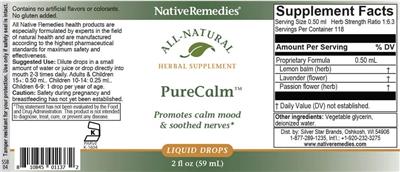
Supplement Facts
The label details for PureCalm by Native Remedies, sourced from the NIH Dietary Supplement Label Database.
Supplement Facts
| Ingredient | Amount | % DV |
|---|---|---|
| Lavender | 0 NP | -- |
| Passion Flower | 0 NP | -- |
| Proprietary Formula | 0.5 mL | -- |
| Lemon Balm | 0 NP | -- |
Other ingredients: Glycerin, Water, Deionized
Tap any ingredient to jump to its full detail below.
These statements are the manufacturer’s wording, reproduced from the product label — the label is saying it, not HelloPharmacist. We don’t verify or endorse them.
Precautions
Tamper resistant for your protection. Use only if safety seal is intact.
Caution: Safety during pregnancy and breastfeeding has not yet been established.
Formulation
Contains no artificial flavors or colorants. No gluten added.
All Native Remedies health products are especially formulated by experts in the field of natural health and are manufactured according to the highest pharmaceutical standards for maximum safety and effectiveness.
All-Natural Promotes calm mood & soothed nerves Liquid Drops
Suggested/Recommended/Usage/Directions
Suggested Use: Dilute drops in a small amount of water or juice or drop directly into mouth 2-3 times daily. Adults & Children 15+: 0.50 mL. Children 10-14: 0.25 mL. Children 6-9: 1 drop per year of age.
FDA Disclaimer Statement
This statement has not been evaluated by the Food and Drug Administration. This product is not intended to diagnose, treat, cure, or prevent any disease.
Seals/Symbols
K Parve (Kosher) K-1604
Formula
K Parve (Kosher) K-1604
FDA Statement of Identity
Herbal Supplement
General Statements
Int'l.: +1-920-232-3275
Is this label outdated? Report a formula or label change and our pharmacy team will review it.
PureCalm by Native Remedies label
The label scan from the NIH Dietary Supplement Label Database. Tap to enlarge.
Label images are published by the NIH Dietary Supplement Label Database for the version of this product on file. Always read your actual product label.
View the full label (PDF)The Ingredients in PureCalm by Native Remedies
These are the 3 active ingredients this product is made of. Select any to open its full monograph.
Serving size0.5 mL Dosage formLiquid Servings per container118 Amounts shown are per serving.
Most supplement products combine several ingredients, and a medication can interact with the product through any one of them. Each ingredient below shows whether it has known drug interactions.
Proprietary Formula
- › Lavender
- › Passion Flower
- › Lemon Balm
Other (inactive) ingredients: Glycerin, Water, Deionized. These complete the product’s ingredient list but are not active constituents.
PureCalm by Native Remedies Drug Interactions
HelloPharmacist Interaction Report
PureCalm by Native Remedies contains three active ingredients—lavender, passion flower, and lemon balm—all of which interact with CNS depressants (drugs that slow your central nervous system, like sedatives, sleeping pills, and some pain relievers).
The most serious interaction is Moderate severity: all three ingredients may add to the drowsiness and sedative effects of these medications, potentially making you overly drowsy or impairing your thinking and coordination.
Read the full breakdown — every affected drug type, severity by severity
Passion flower also has two Minor interactions documented. It may theoretically reduce how well your body absorbs certain medications that use OATP transporters, and it may theoretically decrease the effects of drugs that depend on the CYP3A4 enzyme pathway.
Lemon balm additionally interacts with thyroid hormone replacement therapy—theoretically, it might interfere with how well your thyroid medication works by binding to receptors your body uses to respond to the hormone.
Altogether, these interactions span 839 individual medications. Use the medication checker on this page to look up your exact prescriptions and over-the-counter drugs before you start PureCalm.
Check your own medications below · Editorial policy · How we use AI
Want to check YOUR meds against PureCalm?
Ask about interactions with your drugs in plain English — “Can I take it with lisinopril?” — and we find you the answer in seconds, ingredient by ingredient.
Go to the checkerIngredients driving the most interactions
Individual Drug Interactions
The ingredients in PureCalm interact with 851 drugs. Click any drug to see the details.
3 of the 3 ingredients in PureCalm interact with drugs. Each result below shows which ingredient is responsible. Passion Flower Lemon Balm Lavender
AcepromazineAtravet
How Acepromazine interacts with PureCalm — through 3 ingredients. Tap an ingredient for the detail:
Lemon BalmCns Depressants Moderate
Interaction Summary
Theoretically, concomitant use of lemon balm might have additive effects with CNS depressant drugs.
Read the full Lemon Balm + Acepromazine interactionLavenderCns Depressants Moderate
Interaction Summary
Theoretically, lavender might potentiate the therapeutic effects and adverse effects of CNS depressants.
Read the full Lavender + Acepromazine interactionPassion FlowerCns Depressants Moderate
Interaction Summary
Concomitant use of passion flower with sedative drugs might cause additive effects and side effects.
Read the full Passion Flower + Acepromazine interactionAcetaminophen, Butalbital, Caffeine, CodeineEsgic with Codeine, Fioricet w/ Codeine
How Acetaminophen, Butalbital, Caffeine, Codeine interacts with PureCalm — through 3 ingredients. Tap an ingredient for the detail:
Passion FlowerCytochrome P450 3a4 (cyp3a4) Substrates, Cns Depressants Moderate
Interaction Summary
Theoretically, passion flower might decrease the effects of CYP3A4 substrates.
Read the full Passion Flower + Acetaminophen, Butalbital, Caffeine, Codeine interactionLavenderCns Depressants Moderate
Interaction Summary
Theoretically, lavender might potentiate the therapeutic effects and adverse effects of CNS depressants.
Read the full Lavender + Acetaminophen, Butalbital, Caffeine, Codeine interactionLemon BalmCns Depressants Moderate
Interaction Summary
Theoretically, concomitant use of lemon balm might have additive effects with CNS depressant drugs.
Read the full Lemon Balm + Acetaminophen, Butalbital, Caffeine, Codeine interactionAcetaminophen, Butalbital, CodeineBancap w/ Codeine
How Acetaminophen, Butalbital, Codeine interacts with PureCalm — through 3 ingredients. Tap an ingredient for the detail:
Lemon BalmCns Depressants Moderate
Interaction Summary
Theoretically, concomitant use of lemon balm might have additive effects with CNS depressant drugs.
Read the full Lemon Balm + Acetaminophen, Butalbital, Codeine interactionLavenderCns Depressants Moderate
Interaction Summary
Theoretically, lavender might potentiate the therapeutic effects and adverse effects of CNS depressants.
Read the full Lavender + Acetaminophen, Butalbital, Codeine interactionPassion FlowerCns Depressants Moderate
Interaction Summary
Concomitant use of passion flower with sedative drugs might cause additive effects and side effects.
Read the full Passion Flower + Acetaminophen, Butalbital, Codeine interactionAcetaminophen, Butalbital, Codeine PhosphatePhrenilin #3
How Acetaminophen, Butalbital, Codeine Phosphate interacts with PureCalm — through 3 ingredients. Tap an ingredient for the detail:
Passion FlowerCns Depressants Moderate
Interaction Summary
Concomitant use of passion flower with sedative drugs might cause additive effects and side effects.
Read the full Passion Flower + Acetaminophen, Butalbital, Codeine Phosphate interactionLavenderCns Depressants Moderate
Interaction Summary
Theoretically, lavender might potentiate the therapeutic effects and adverse effects of CNS depressants.
Read the full Lavender + Acetaminophen, Butalbital, Codeine Phosphate interactionLemon BalmCns Depressants Moderate
Interaction Summary
Theoretically, concomitant use of lemon balm might have additive effects with CNS depressant drugs.
Read the full Lemon Balm + Acetaminophen, Butalbital, Codeine Phosphate interactionAcetaminophen, Caffeine, Chlorpheniramine, Hydrocodone, PhenylephrineHycomine Compound
How Acetaminophen, Caffeine, Chlorpheniramine, Hydrocodone, Phenylephrine interacts with PureCalm — through 3 ingredients. Tap an ingredient for the detail:
Lemon BalmCns Depressants Moderate
Interaction Summary
Theoretically, concomitant use of lemon balm might have additive effects with CNS depressant drugs.
Read the full Lemon Balm + Acetaminophen, Caffeine, Chlorpheniramine, Hydrocodone, Phenylephrine interactionPassion FlowerCytochrome P450 3a4 (cyp3a4) Substrates, Cns Depressants Moderate
Interaction Summary
Theoretically, passion flower might decrease the effects of CYP3A4 substrates.
Read the full Passion Flower + Acetaminophen, Caffeine, Chlorpheniramine, Hydrocodone, Phenylephrine interactionLavenderCns Depressants Moderate
Interaction Summary
Theoretically, lavender might potentiate the therapeutic effects and adverse effects of CNS depressants.
Read the full Lavender + Acetaminophen, Caffeine, Chlorpheniramine, Hydrocodone, Phenylephrine interactionAcetaminophen, Caffeine, CodeineGesic C15, Gesic C30, Gesic C8, Lenoltec 1, Lenoltec 2, Lenoltec 3 +1 more
How Acetaminophen, Caffeine, Codeine interacts with PureCalm — through 3 ingredients. Tap an ingredient for the detail:
Passion FlowerCns Depressants, Cytochrome P450 3a4 (cyp3a4) Substrates Moderate
Interaction Summary
Concomitant use of passion flower with sedative drugs might cause additive effects and side effects.
Read the full Passion Flower + Acetaminophen, Caffeine, Codeine interactionLemon BalmCns Depressants Moderate
Interaction Summary
Theoretically, concomitant use of lemon balm might have additive effects with CNS depressant drugs.
Read the full Lemon Balm + Acetaminophen, Caffeine, Codeine interactionLavenderCns Depressants Moderate
Interaction Summary
Theoretically, lavender might potentiate the therapeutic effects and adverse effects of CNS depressants.
Read the full Lavender + Acetaminophen, Caffeine, Codeine interactionAcetaminophen, Caffeine, Codeine, SalicylamideCodalan No.1, Codalan No.2, Codalan No.3
How Acetaminophen, Caffeine, Codeine, Salicylamide interacts with PureCalm — through 3 ingredients. Tap an ingredient for the detail:
Passion FlowerCns Depressants, Cytochrome P450 3a4 (cyp3a4) Substrates Moderate
Interaction Summary
Concomitant use of passion flower with sedative drugs might cause additive effects and side effects.
Read the full Passion Flower + Acetaminophen, Caffeine, Codeine, Salicylamide interactionLavenderCns Depressants Moderate
Interaction Summary
Theoretically, lavender might potentiate the therapeutic effects and adverse effects of CNS depressants.
Read the full Lavender + Acetaminophen, Caffeine, Codeine, Salicylamide interactionLemon BalmCns Depressants Moderate
Interaction Summary
Theoretically, concomitant use of lemon balm might have additive effects with CNS depressant drugs.
Read the full Lemon Balm + Acetaminophen, Caffeine, Codeine, Salicylamide interactionAcetaminophen, Caffeine, DihydrocodeineDHC Plus, Panlor DC, Panlor SS
How Acetaminophen, Caffeine, Dihydrocodeine interacts with PureCalm — through 3 ingredients. Tap an ingredient for the detail:
Lemon BalmCns Depressants Moderate
Interaction Summary
Theoretically, concomitant use of lemon balm might have additive effects with CNS depressant drugs.
Read the full Lemon Balm + Acetaminophen, Caffeine, Dihydrocodeine interactionPassion FlowerCns Depressants, Cytochrome P450 3a4 (cyp3a4) Substrates Moderate
Interaction Summary
Concomitant use of passion flower with sedative drugs might cause additive effects and side effects.
Read the full Passion Flower + Acetaminophen, Caffeine, Dihydrocodeine interactionLavenderCns Depressants Moderate
Interaction Summary
Theoretically, lavender might potentiate the therapeutic effects and adverse effects of CNS depressants.
Read the full Lavender + Acetaminophen, Caffeine, Dihydrocodeine interactionAcetaminophen, Chlorpheniramine, Codeine, PhenylephrineColrex
How Acetaminophen, Chlorpheniramine, Codeine, Phenylephrine interacts with PureCalm — through 3 ingredients. Tap an ingredient for the detail:
Passion FlowerCns Depressants, Cytochrome P450 3a4 (cyp3a4) Substrates Moderate
Interaction Summary
Concomitant use of passion flower with sedative drugs might cause additive effects and side effects.
Read the full Passion Flower + Acetaminophen, Chlorpheniramine, Codeine, Phenylephrine interactionLemon BalmCns Depressants Moderate
Interaction Summary
Theoretically, concomitant use of lemon balm might have additive effects with CNS depressant drugs.
Read the full Lemon Balm + Acetaminophen, Chlorpheniramine, Codeine, Phenylephrine interactionLavenderCns Depressants Moderate
Interaction Summary
Theoretically, lavender might potentiate the therapeutic effects and adverse effects of CNS depressants.
Read the full Lavender + Acetaminophen, Chlorpheniramine, Codeine, Phenylephrine interactionAcetaminophen, Chlorpheniramine, Phenylpropanolamine, OpiumHista-Derfule
How Acetaminophen, Chlorpheniramine, Phenylpropanolamine, Opium interacts with PureCalm — through 3 ingredients. Tap an ingredient for the detail:
Passion FlowerCytochrome P450 3a4 (cyp3a4) Substrates, Cns Depressants Moderate
Interaction Summary
Theoretically, passion flower might decrease the effects of CYP3A4 substrates.
Read the full Passion Flower + Acetaminophen, Chlorpheniramine, Phenylpropanolamine, Opium interactionLavenderCns Depressants Moderate
Interaction Summary
Theoretically, lavender might potentiate the therapeutic effects and adverse effects of CNS depressants.
Read the full Lavender + Acetaminophen, Chlorpheniramine, Phenylpropanolamine, Opium interactionLemon BalmCns Depressants Moderate
Interaction Summary
Theoretically, concomitant use of lemon balm might have additive effects with CNS depressant drugs.
Read the full Lemon Balm + Acetaminophen, Chlorpheniramine, Phenylpropanolamine, Opium interactionAcetaminophen, Chlorzoxazone, CodeineAcetazone Forte C8, Parafon Forte C8
How Acetaminophen, Chlorzoxazone, Codeine interacts with PureCalm — through 3 ingredients. Tap an ingredient for the detail:
Lemon BalmCns Depressants Moderate
Interaction Summary
Theoretically, concomitant use of lemon balm might have additive effects with CNS depressant drugs.
Read the full Lemon Balm + Acetaminophen, Chlorzoxazone, Codeine interactionLavenderCns Depressants Moderate
Interaction Summary
Theoretically, lavender might potentiate the therapeutic effects and adverse effects of CNS depressants.
Read the full Lavender + Acetaminophen, Chlorzoxazone, Codeine interactionPassion FlowerCns Depressants Moderate
Interaction Summary
Concomitant use of passion flower with sedative drugs might cause additive effects and side effects.
Read the full Passion Flower + Acetaminophen, Chlorzoxazone, Codeine interactionAcetaminophen, CodeineTylenol No.3, Tylenol w/ Codeine
How Acetaminophen, Codeine interacts with PureCalm — through 3 ingredients. Tap an ingredient for the detail:
Passion FlowerCns Depressants Moderate
Interaction Summary
Concomitant use of passion flower with sedative drugs might cause additive effects and side effects.
Read the full Passion Flower + Acetaminophen, Codeine interactionLemon BalmCns Depressants Moderate
Interaction Summary
Theoretically, concomitant use of lemon balm might have additive effects with CNS depressant drugs.
Read the full Lemon Balm + Acetaminophen, Codeine interactionLavenderCns Depressants Moderate
Interaction Summary
Theoretically, lavender might potentiate the therapeutic effects and adverse effects of CNS depressants.
Read the full Lavender + Acetaminophen, Codeine interactionAcetaminophen, Codeine, DoxylamineMersyndol
How Acetaminophen, Codeine, Doxylamine interacts with PureCalm — through 3 ingredients. Tap an ingredient for the detail:
LavenderCns Depressants Moderate
Interaction Summary
Theoretically, lavender might potentiate the therapeutic effects and adverse effects of CNS depressants.
Read the full Lavender + Acetaminophen, Codeine, Doxylamine interactionPassion FlowerCns Depressants Moderate
Interaction Summary
Concomitant use of passion flower with sedative drugs might cause additive effects and side effects.
Read the full Passion Flower + Acetaminophen, Codeine, Doxylamine interactionLemon BalmCns Depressants Moderate
Interaction Summary
Theoretically, concomitant use of lemon balm might have additive effects with CNS depressant drugs.
Read the full Lemon Balm + Acetaminophen, Codeine, Doxylamine interactionAcetaminophen, Codeine, MethocarbamolAcetaminophen, Codeine, Methocarbamol, Robaxacet 8
How Acetaminophen, Codeine, Methocarbamol interacts with PureCalm — through 3 ingredients. Tap an ingredient for the detail:
Lemon BalmCns Depressants Moderate
Interaction Summary
Theoretically, concomitant use of lemon balm might have additive effects with CNS depressant drugs.
Read the full Lemon Balm + Acetaminophen, Codeine, Methocarbamol interactionLavenderCns Depressants Moderate
Interaction Summary
Theoretically, lavender might potentiate the therapeutic effects and adverse effects of CNS depressants.
Read the full Lavender + Acetaminophen, Codeine, Methocarbamol interactionPassion FlowerCns Depressants Moderate
Interaction Summary
Concomitant use of passion flower with sedative drugs might cause additive effects and side effects.
Read the full Passion Flower + Acetaminophen, Codeine, Methocarbamol interactionAcetaminophen, Dichloralantipyrine, IsomethepteneAmidrine, Midchlor, Migquin, Migratine
How Acetaminophen, Dichloralantipyrine, Isometheptene interacts with PureCalm — through 3 ingredients. Tap an ingredient for the detail:
Lemon BalmCns Depressants Moderate
Interaction Summary
Theoretically, concomitant use of lemon balm might have additive effects with CNS depressant drugs.
Read the full Lemon Balm + Acetaminophen, Dichloralantipyrine, Isometheptene interactionLavenderCns Depressants Moderate
Interaction Summary
Theoretically, lavender might potentiate the therapeutic effects and adverse effects of CNS depressants.
Read the full Lavender + Acetaminophen, Dichloralantipyrine, Isometheptene interactionPassion FlowerCns Depressants Moderate
Interaction Summary
Concomitant use of passion flower with sedative drugs might cause additive effects and side effects.
Read the full Passion Flower + Acetaminophen, Dichloralantipyrine, Isometheptene interactionAcetaminophen, Dichloralphenazone, IsomethepteneMidrin
How Acetaminophen, Dichloralphenazone, Isometheptene interacts with PureCalm — through 3 ingredients. Tap an ingredient for the detail:
Passion FlowerCns Depressants Moderate
Interaction Summary
Concomitant use of passion flower with sedative drugs might cause additive effects and side effects.
Read the full Passion Flower + Acetaminophen, Dichloralphenazone, Isometheptene interactionLavenderCns Depressants Moderate
Interaction Summary
Theoretically, lavender might potentiate the therapeutic effects and adverse effects of CNS depressants.
Read the full Lavender + Acetaminophen, Dichloralphenazone, Isometheptene interactionLemon BalmCns Depressants Moderate
Interaction Summary
Theoretically, concomitant use of lemon balm might have additive effects with CNS depressant drugs.
Read the full Lemon Balm + Acetaminophen, Dichloralphenazone, Isometheptene interactionAcetaminophen, Dichlorophenazone, IsometheptaneIsocom
How Acetaminophen, Dichlorophenazone, Isometheptane interacts with PureCalm — through 3 ingredients. Tap an ingredient for the detail:
Lemon BalmCns Depressants Moderate
Interaction Summary
Theoretically, concomitant use of lemon balm might have additive effects with CNS depressant drugs.
Read the full Lemon Balm + Acetaminophen, Dichlorophenazone, Isometheptane interactionLavenderCns Depressants Moderate
Interaction Summary
Theoretically, lavender might potentiate the therapeutic effects and adverse effects of CNS depressants.
Read the full Lavender + Acetaminophen, Dichlorophenazone, Isometheptane interactionPassion FlowerCns Depressants Moderate
Interaction Summary
Concomitant use of passion flower with sedative drugs might cause additive effects and side effects.
Read the full Passion Flower + Acetaminophen, Dichlorophenazone, Isometheptane interactionAcetaminophen, DiphenhydramineTylenol PM, Tylenol PM Ex Strength
How Acetaminophen, Diphenhydramine interacts with PureCalm — through 3 ingredients. Tap an ingredient for the detail:
Passion FlowerCns Depressants Moderate
Interaction Summary
Concomitant use of passion flower with sedative drugs might cause additive effects and side effects.
Read the full Passion Flower + Acetaminophen, Diphenhydramine interactionLavenderCns Depressants Moderate
Interaction Summary
Theoretically, lavender might potentiate the therapeutic effects and adverse effects of CNS depressants.
Read the full Lavender + Acetaminophen, Diphenhydramine interactionLemon BalmCns Depressants Moderate
Interaction Summary
Theoretically, concomitant use of lemon balm might have additive effects with CNS depressant drugs.
Read the full Lemon Balm + Acetaminophen, Diphenhydramine interactionAcetaminophen, Diphenhydramine, PseudoephedrineChildren's Tylenol Allergy, Cold Control, Contac Night Allergy Relief
How Acetaminophen, Diphenhydramine, Pseudoephedrine interacts with PureCalm — through 3 ingredients. Tap an ingredient for the detail:
Lemon BalmCns Depressants Moderate
Interaction Summary
Theoretically, concomitant use of lemon balm might have additive effects with CNS depressant drugs.
Read the full Lemon Balm + Acetaminophen, Diphenhydramine, Pseudoephedrine interactionLavenderCns Depressants Moderate
Interaction Summary
Theoretically, lavender might potentiate the therapeutic effects and adverse effects of CNS depressants.
Read the full Lavender + Acetaminophen, Diphenhydramine, Pseudoephedrine interactionPassion FlowerCns Depressants Moderate
Interaction Summary
Concomitant use of passion flower with sedative drugs might cause additive effects and side effects.
Read the full Passion Flower + Acetaminophen, Diphenhydramine, Pseudoephedrine interactionAcetaminophen, HydrocodoneAnexsia, Anodynos DHC, Azdone, Co-Gesic, Doucet, Lorcet +9 more
How Acetaminophen, Hydrocodone interacts with PureCalm — through 3 ingredients. Tap an ingredient for the detail:
Passion FlowerCns Depressants, Cytochrome P450 3a4 (cyp3a4) Substrates Moderate
Interaction Summary
Concomitant use of passion flower with sedative drugs might cause additive effects and side effects.
Read the full Passion Flower + Acetaminophen, Hydrocodone interactionLavenderCns Depressants Moderate
Interaction Summary
Theoretically, lavender might potentiate the therapeutic effects and adverse effects of CNS depressants.
Read the full Lavender + Acetaminophen, Hydrocodone interactionLemon BalmCns Depressants Moderate
Interaction Summary
Theoretically, concomitant use of lemon balm might have additive effects with CNS depressant drugs.
Read the full Lemon Balm + Acetaminophen, Hydrocodone interactionAcetaminophen, MeperidineDemerol APAP
How Acetaminophen, Meperidine interacts with PureCalm — through 3 ingredients. Tap an ingredient for the detail:
Lemon BalmCns Depressants Moderate
Interaction Summary
Theoretically, concomitant use of lemon balm might have additive effects with CNS depressant drugs.
Read the full Lemon Balm + Acetaminophen, Meperidine interactionPassion FlowerCns Depressants Moderate
Interaction Summary
Concomitant use of passion flower with sedative drugs might cause additive effects and side effects.
Read the full Passion Flower + Acetaminophen, Meperidine interactionLavenderCns Depressants Moderate
Interaction Summary
Theoretically, lavender might potentiate the therapeutic effects and adverse effects of CNS depressants.
Read the full Lavender + Acetaminophen, Meperidine interactionAcetaminophen, OxycodonePercocet, Roxicet, Tylox, Xartemis XR
How Acetaminophen, Oxycodone interacts with PureCalm — through 3 ingredients. Tap an ingredient for the detail:
LavenderCns Depressants Moderate
Interaction Summary
Theoretically, lavender might potentiate the therapeutic effects and adverse effects of CNS depressants.
Read the full Lavender + Acetaminophen, Oxycodone interactionLemon BalmCns Depressants Moderate
Interaction Summary
Theoretically, concomitant use of lemon balm might have additive effects with CNS depressant drugs.
Read the full Lemon Balm + Acetaminophen, Oxycodone interactionPassion FlowerCns Depressants Moderate
Interaction Summary
Concomitant use of passion flower with sedative drugs might cause additive effects and side effects.
Read the full Passion Flower + Acetaminophen, Oxycodone interactionAcetaminophen, PentazocineTalacen
How Acetaminophen, Pentazocine interacts with PureCalm — through 3 ingredients. Tap an ingredient for the detail:
Passion FlowerCns Depressants Moderate
Interaction Summary
Concomitant use of passion flower with sedative drugs might cause additive effects and side effects.
Read the full Passion Flower + Acetaminophen, Pentazocine interactionLavenderCns Depressants Moderate
Interaction Summary
Theoretically, lavender might potentiate the therapeutic effects and adverse effects of CNS depressants.
Read the full Lavender + Acetaminophen, Pentazocine interactionLemon BalmCns Depressants Moderate
Interaction Summary
Theoretically, concomitant use of lemon balm might have additive effects with CNS depressant drugs.
Read the full Lemon Balm + Acetaminophen, Pentazocine interactionAcetaminophen, PropoxypheneDarvocet-N 100, Darvocet-N 50, E-Lor, Wygesic
How Acetaminophen, Propoxyphene interacts with PureCalm — through 3 ingredients. Tap an ingredient for the detail:
Passion FlowerCns Depressants Moderate
Interaction Summary
Concomitant use of passion flower with sedative drugs might cause additive effects and side effects.
Read the full Passion Flower + Acetaminophen, Propoxyphene interactionLemon BalmCns Depressants Moderate
Interaction Summary
Theoretically, concomitant use of lemon balm might have additive effects with CNS depressant drugs.
Read the full Lemon Balm + Acetaminophen, Propoxyphene interactionLavenderCns Depressants Moderate
Interaction Summary
Theoretically, lavender might potentiate the therapeutic effects and adverse effects of CNS depressants.
Read the full Lavender + Acetaminophen, Propoxyphene interactionAcetazolamideAk-Zol, Diamox
How Acetazolamide interacts with PureCalm — through 3 ingredients. Tap an ingredient for the detail:
LavenderCns Depressants Moderate
Interaction Summary
Theoretically, lavender might potentiate the therapeutic effects and adverse effects of CNS depressants.
Read the full Lavender + Acetazolamide interactionLemon BalmCns Depressants Moderate
Interaction Summary
Theoretically, concomitant use of lemon balm might have additive effects with CNS depressant drugs.
Read the full Lemon Balm + Acetazolamide interactionPassion FlowerCns Depressants Moderate
Interaction Summary
Concomitant use of passion flower with sedative drugs might cause additive effects and side effects.
Read the full Passion Flower + Acetazolamide interactionAlfentanilAlfenta
How Alfentanil interacts with PureCalm — through 3 ingredients. Tap an ingredient for the detail:
Passion FlowerCytochrome P450 3a4 (cyp3a4) Substrates, Cns Depressants Moderate
Interaction Summary
Theoretically, passion flower might decrease the effects of CYP3A4 substrates.
Read the full Passion Flower + Alfentanil interactionLemon BalmCns Depressants Moderate
Interaction Summary
Theoretically, concomitant use of lemon balm might have additive effects with CNS depressant drugs.
Read the full Lemon Balm + Alfentanil interactionLavenderCns Depressants Moderate
Interaction Summary
Theoretically, lavender might potentiate the therapeutic effects and adverse effects of CNS depressants.
Read the full Lavender + Alfentanil interactionAlprazolamNiravam, Xanax
How Alprazolam interacts with PureCalm — through 3 ingredients. Tap an ingredient for the detail:
Passion FlowerCytochrome P450 3a4 (cyp3a4) Substrates, Cns Depressants Moderate
Interaction Summary
Theoretically, passion flower might decrease the effects of CYP3A4 substrates.
Read the full Passion Flower + Alprazolam interactionLavenderCns Depressants Moderate
Interaction Summary
Theoretically, lavender might potentiate the therapeutic effects and adverse effects of CNS depressants.
Read the full Lavender + Alprazolam interactionLemon BalmCns Depressants Moderate
Interaction Summary
Theoretically, concomitant use of lemon balm might have additive effects with CNS depressant drugs.
Read the full Lemon Balm + Alprazolam interactionAluminum Hydroxide, Aspirin, Codeine Phosphate, Magnesium HydroxideAscriptin Codeine #2
How Aluminum Hydroxide, Aspirin, Codeine Phosphate, Magnesium Hydroxide interacts with PureCalm — through 3 ingredients. Tap an ingredient for the detail:
Passion FlowerCns Depressants Moderate
Interaction Summary
Concomitant use of passion flower with sedative drugs might cause additive effects and side effects.
Read the full Passion Flower + Aluminum Hydroxide, Aspirin, Codeine Phosphate, Magnesium Hydroxide interactionLemon BalmCns Depressants Moderate
Interaction Summary
Theoretically, concomitant use of lemon balm might have additive effects with CNS depressant drugs.
Read the full Lemon Balm + Aluminum Hydroxide, Aspirin, Codeine Phosphate, Magnesium Hydroxide interactionLavenderCns Depressants Moderate
Interaction Summary
Theoretically, lavender might potentiate the therapeutic effects and adverse effects of CNS depressants.
Read the full Lavender + Aluminum Hydroxide, Aspirin, Codeine Phosphate, Magnesium Hydroxide interactionAminoglutethimideCytadren
How Aminoglutethimide interacts with PureCalm — through 3 ingredients. Tap an ingredient for the detail:
LavenderCns Depressants Moderate
Interaction Summary
Theoretically, lavender might potentiate the therapeutic effects and adverse effects of CNS depressants.
Read the full Lavender + Aminoglutethimide interactionLemon BalmCns Depressants Moderate
Interaction Summary
Theoretically, concomitant use of lemon balm might have additive effects with CNS depressant drugs.
Read the full Lemon Balm + Aminoglutethimide interactionPassion FlowerCns Depressants Moderate
Interaction Summary
Concomitant use of passion flower with sedative drugs might cause additive effects and side effects.
Read the full Passion Flower + Aminoglutethimide interactionAminophylline, Amobarbital, EphedrineAmesec
How Aminophylline, Amobarbital, Ephedrine interacts with PureCalm — through 3 ingredients. Tap an ingredient for the detail:
Passion FlowerCns Depressants Moderate
Interaction Summary
Concomitant use of passion flower with sedative drugs might cause additive effects and side effects.
Read the full Passion Flower + Aminophylline, Amobarbital, Ephedrine interactionLemon BalmCns Depressants Moderate
Interaction Summary
Theoretically, concomitant use of lemon balm might have additive effects with CNS depressant drugs.
Read the full Lemon Balm + Aminophylline, Amobarbital, Ephedrine interactionLavenderCns Depressants Moderate
Interaction Summary
Theoretically, lavender might potentiate the therapeutic effects and adverse effects of CNS depressants.
Read the full Lavender + Aminophylline, Amobarbital, Ephedrine interactionEach ingredient & the kinds of drugs it affects
For each ingredient in PureCalm with known interactions, here are the types of medications they can affect. Open any type for the detail — or search your exact drug in the checker above.
Passion Flower
Cns Depressants
Concomitant use of passion flower with sedative drugs might cause additive effects and side effects.
Research in animals and humans shows that passion flower has sedative effects which can be additive when used with sedative medications like lorazepam.
Cytochrome P450 3A4 (Cyp3A4) Substrates
Theoretically, passion flower might decrease the effects of CYP3A4 substrates.
In vitro research suggests that passion flower can induce CYP3A4 enzymes, albeit to a much lower degree than rifampin, a known CYP3A4 inducer.
Organic Anion-Transporting Polypeptide Substrates (Oatp)
Theoretically, passion flower might reduce the bioavailability of OATP2B1 and OATP1A2 substrates.
In vitro research shows that the passion flower constituents apigenin and vitexin inhibit OATP2B1 and OATP1A2. This inhibition may be dose-dependent. One specific high-flavonoid passion flower extract (Valverde) seems to inhibit OATP2B1 and OATP1A2, while another extract with a lower flavonoid concentration (Arkocaps) shows less potent inhibition. OATPs are responsible for the uptake of drugs and other compounds into the body; however, the specific activities of OATP2B1 and OATP1A2 are not well characterized.
Lemon Balm
Cns Depressants
Theoretically, concomitant use of lemon balm might have additive effects with CNS depressant drugs.
Lemon balm seems to have CNS depressant activity in animals and in humans.
Thyroid Hormone
Theoretically, lemon balm might interfere with thyroid hormone replacement therapy.
In vitro, constituents of lemon balm extract bind to thyroid stimulating hormone (TSH), preventing TSH receptor-binding and leading to the inhibition of TSH-stimulated adenylate cyclase activity. In animals, lemon balm extract has been shown to decrease levels of circulating TSH and inhibit thyroid secretion.
Lavender
Cns Depressants
Theoretically, lavender might potentiate the therapeutic effects and adverse effects of CNS depressants.
Laboratory research suggests that lavender has sedative effects. However, clinical studies in patients taking oral lavender oil (Silexan) 160 mg for 10 weeks or taking lavender flower powder 1 gram daily for 2 months have not reported side effects of drowsiness, sedation, or sleepiness. There is still some concern that higher doses or different preparations of lavender might have additive effects with CNS depressant medications.
Brand information
Manufacturer and brand details for PureCalm, from the product label.
Native Remedies
See all Native Remedies products- Name
- Silver Star Brands
- City
- Oshkosh
- State
- WI
- ZipCode
- 54906
- Phone Number
- 1-877-289-1235
- Web Address
- www.nativeremedies.com
PureCalm by Native Remedies: Common Questions
Does PureCalm by Native Remedies interact with any medications?
How can one product interact with so many drugs?
Where does this information come from?
Will PureCalm make me drowsy?
Is this safe to take while pregnant or breastfeeding?
What is this product supposed to help with?
Can I take this with my sleeping medication?
What are the most common side effects?
Does this product have fillers?
Written and reviewed by the HelloPharmacist editorial staff. Our editorial policy
Not sure if PureCalm is safe with your meds?
Our pharmacists answer your medication & supplement questions — free.
Label information is sourced from the NIH Dietary Supplement Label Database and reflects the product version on file; always read your actual product label. This page is for education only and is not a substitute for professional medical advice. Confirm with your pharmacist or doctor before combining supplements and medications.
The Full Monographs Behind PureCalm’s Ingredients
Every ingredient we hold a full HelloPharmacist monograph for — uses, evidence, safety, and the complete interaction list.
Lavender
Interacts with 248 drugsLavender is a fragrant herb most popular for promoting relaxation, easing anxiety, and supporting sleep, with some encouraging evidence for a standardized oral lavender oil product for anxie...
Read the full Lavender monograph → Herb & supplement monographPassion Flower
Interacts with 838 drugsPassion flower is a traditional calming herb that many people use for anxiety and sleep. Early studies hint it may help with mild anxiety and restlessness, but the evidence is limited and mo...
Read the full Passion Flower monograph → Herb & supplement monographLemon Balm
Interacts with 264 drugsLemon balm is a gentle, lemon-scented mint-family herb traditionally used to ease stress, support sleep, and calm digestion, and topically for cold sores. Early studies are promising but gen...
Read the full Lemon Balm monograph →Sources & How We Checked
PureCalm's label data comes from the NIH Dietary Supplement Label Database; the ingredient interaction data is from the Natural Medicines database, reviewed by our pharmacists.
- NIH Dietary Supplement Label Database (DSLD) — The official product label on file for this supplement.
- Natural Medicines (Therapeutic Research Center) — Evidence-graded clinical reference behind the ingredient interaction data.
Content is written and reviewed by licensed HelloPharmacist pharmacists. See our data sources and editorial standards for how this information is built and checked.
The 51 references behind this product’s interaction data
Every citation that drives the interaction findings for this product’s ingredients, from the evidence-graded Natural Medicines (TRC Healthcare) database. Open an ingredient to browse its citations — links open the study on PubMed or the publisher’s site.
Lavender 20 references
- The Review of Natural Products by Facts and Comparisons. St. Louis, MO: Wolters Kluwer Co., 1999.
- Schulz V, Hansel R, Tyler VE. Rational Phytotherapy: A Physician's Guide to Herbal Medicine. Terry C. Telger, transl. 3rd ed. Berlin, GER: Springer, 1998.
- Akhondzadeh S, Kashani L, Fotouhi A, et al. Comparison of Lavandula angustifolia Mill. tincture and imipramine in the treatment of mild to moderate depression: a double-blind, randomized trial. Prog Neuropsychopharmacol Biol Psychiatry 2003;27:123-7. PubMed
- Varma S, Blackford S, Statham BN, Blackwell A. Combined contact allergy to tea tree oil and lavender oil complicating chronic vulvovaginitis. Contact Dermatitis 2000;42:309-10.
- Coulson IH and Khan AS. Facial 'pillow' dermatitis due to lavender oil allergy. Contact Dermatitis 1999;41(2):111. PubMed
- Woelk, H. and Schlafke, S. A multi-center, double-blind, randomised study of the Lavender oil preparation Silexan in comparison to Lorazepam for generalized anxiety disorder. Phytomedicine. 2010;17(2):94-99. PubMed
- Kasper, S., Gastpar, M., Muller, W. E., Volz, H. P., Moller, H. J., Dienel, A., and Schlafke, S. Silexan, an orally administered Lavandula oil preparation, is effective in the treatment of 'subsyndromal' anxiety disorder: a randomized, double-blind, plac
- Uehleke, B., Schaper, S., Dienel, A., Schlaefke, S., and Stange, R. Phase II trial on the effects of Silexan in patients with neurasthenia, post-traumatic stress disorder or somatization disorder. Phytomedicine. 6-15-2012;19(8-9):665-671. PubMed
- Brandao FM. Occupational allergy to lavender oil. Contact Dermatitis 1986;15(4):249-250. PubMed
- Rademaker M. Allergic contact dermatitis from lavender fragrance in Difflam gel. Contact Dermatitis 1994;31(1):58-59. PubMed
- Kasper S, Gastpar M, Müller WE, et al. Lavender oil preparation Silexan is effective in generalized anxiety disorder--a randomized, double-blind comparison to placebo and paroxetine. Int J Neuropsychopharmacol. 2014 Jun;17(6):859-69. PubMed
- Farshbaf-Khalili A, Kamalifard M, Namadian M. Comparison of the effect of lavender and bitter orange on anxiety in postmenopausal women: A triple-blind, randomized, controlled clinical trial. Complement Ther Clin Pract 2018;31:132-8. PubMed
- Bingham LJ, Tam MM, Palmer AM, Cahill JL, Nixon RL. Contact allergy and allergic contact dermatitis caused by lavender: A retrospective study from an Australian clinic. Contact Dermatitis. 2019;81(1):37-42. PubMed
- Donelli D, Antonelli M, Bellinazzi C, Gensini GF, Firenzuoli F. Effects of lavender on anxiety: A systematic review and meta-analysis. Phytomedicine. 2019;65:153099. PubMed
- Firoozeei TS, Feizi A, Rezaeizadeh H, Zargaran A, Roohafza HR, Karimi M. The antidepressant effects of lavender (Lavandula angustifolia Mill.): A systematic review and meta-analysis of randomized controlled clinical trials. Complement Ther Med 2021;59:102 PubMed
- Kodama T, Watanabe T, Mataki N, Kanoh S, Kichikawa Y. Acute eosinophilic pneumonia following aromatherapy with essential oil. Respir Med Case Rep 2022;37:101657. PubMed
- Barbaud A, Kurihara F, Raison-Peyron N, et al. Allergic contact dermatitis from essential oil in consumer products: Mode of uses and value of patch-tests with an essential oil series. Results of a French study of the DAG (dermato-allergy group of the Fren
- Ozer H, Sayan ZA, Baloglu I, Ozturk Y, Yonet F, Turkmen K. Unknown criminals for kidney: Acute interstitial nephritis due to lavender tea. Explore (NY) 2023. PubMed
- Kasper S, Volz HP, Möller HJ, et al. Lavender oil preparation Silexan is effective in mild-to-moderate major depression: a randomized, placebo- and reference-controlled trial. Eur Arch Psychiatry Clin Neurosci 2024. PubMed
- Simaei SR, Askari VR, Rostami M, et al. Lavender and metformin effectively propagate progesterone levels in patients with polycystic ovary syndrome: A randomized, double-blind clinical trial. Fitoterapia 2023;172:105720. PubMed
Passion Flower 19 references
- Newall CA, Anderson LA, Philpson JD. Herbal Medicine: A Guide for Healthcare Professionals. London, UK: The Pharmaceutical Press, 1996.
- The Review of Natural Products by Facts and Comparisons. St. Louis, MO: Wolters Kluwer Co., 1999.
- Fisher AA, Purcell P, Le Couteur DG. Toxicity of Passiflora incarnata L. J Toxicol Clin Toxicol 2000;38:63-6.
- Akhondzadeh S, Naghavi HR, Shayeganpour A, et al. Passionflower in the treatment of generalized anxiety: a pilot double-blind randomized controlled trial with oxazepam. J Clin Pharm Ther 2001;26:363-7. PubMed
- Farnsworth N, Bingel A, Cordell G, et al. Potential value of plants as sources of new antifertility agents I. J Pharm Sci 1975;64:535-98. DOI
- Mori A, Hasegawa K, Murasaki M, et al. Clinical evaluation of Passiflamin (passiflora extract) on neurosis - multicenter double blind study in comparison with mexazolam. Rinsho Hyoka (Clinical Evaluation) 1993;21:383-440.
- Miyasaka LS, Atallah AN, Soares BG. Passiflora for anxiety disorder. Cochrane Database Syst Rev 2007;(1):CD004518. DOI
- Speroni E., Minghetti A. Neuropharmacological activity of extracts from Passiflora incarnata. Planta Med. 1988;54:488-91.
- Capasso A., Sorrentino L. Pharmacological studies on the sedative and hypnotic effect of Kava kava and Passiflora extracts combination. Phytomedicine. 2005;12:39-45. PubMed
- Carrasco MC, Vallejo JR, Pardo-de-Santayana M, et al. Interactions of Valeriana officinalis L. and Passiflora incarnata L. in a patient treated with lorazepam. Phytother Res. 2009 Dec;23:1795-6.
- Smith, G. W., Chalmers, T. M., and Nuki, G. Vasculitis associated with herbal preparation containing Passiflora extract. Br J Rheumatol. 1993;32(1):87-88.
- Soulimani, R., Younos, C., Jarmouni, S., Bousta, D., Misslin, R., and Mortier, F. Behavioural effects of Passiflora incarnata L. and its indole alkaloid and flavonoid derivatives and maltol in the mouse. J Ethnopharmacol. 1997;57(1):11-20. PubMed
- Nojoumi M, Ghaeli P, Salimi S, Sharifi A, Raisi F. Effects of Passion Flower Extract, as an Add-On Treatment to Sertraline, on Reaction Time in Patients ?with Generalized Anxiety Disorder: A Double-Blind Placebo-Controlled Study. Iran J Psychiatry. 2016;1
- Rokhtabnak F, Ghodraty MR, Kholdebarin A, et al. Comparing the Effect of Preoperative Administration of Melatonin and Passiflora incarnata on Postoperative Cognitive Disorders in Adult Patients Undergoing Elective Surgery. Anesth Pain Med. 2016;7(1):e4123 PubMed
- Dantas LP, de Oliveira-Ribeiro A, de Almeida-Souza LM, Groppo FC. Effects of passiflora incarnata and midazolam for control of anxiety in patients undergoing dental extraction. Med Oral Patol Oral Cir Bucal. 2017;22(1):e95-e101. PubMed
- Ozturk Z, Kalayci CC. Pregnancy outcomes in psychiatric patients treated with passiflora incarnata. Complement Ther Med. 2018 Feb;36:30-32. PubMed
- da Cunha RS, Amorim KS, Gercina AC, et al. Herbal medicines as anxiolytics prior to third molar surgical extraction. A randomized controlled clinical trial. Clin Oral Investig. 2020. PubMed
- Schäfer AM, Gilgen PM, Spirgi C, et al. Constituents of Passiflora incarnata, but Not of Valeriana officinalis, Interact with the Organic Anion Transporting Polypeptides (OATP)2B1 and OATP1A2. Planta Med. 2021. PubMed
- Mazzari ALDA, Lacerda MG, Milton FA, et al. In vitro effects of European and Latin-American medicinal plants in CYP3A4 gene expression, glutathione levels, and P-glycoprotein activity. Front Pharmacol 2022;13:826395. PubMed
Lemon Balm 12 references
- Wolbling RH, Leonhardt K. Local therapy of herpes simplex with dried extract from Melissa officinalis. Phytomedicine 1994;1:25-31.
- Akhondzadeh S, Noroozian M, Mohammadi M, et al. Melissa officinalis extract in the treatment of patients with mild to moderate Alzheimer's disease: a double blind, randomised, placebo controlled trial. J Neurol Neurosurg Psychiatry 2003;74:863-6. PubMed
- Kennedy DO, Scholey AB, Tildesley NT, et al. Modulation of mood and cognitive performance following acute administration of Melissa officinalis (lemon balm). Pharmacol Biochem Behav 2002;72:953-64. PubMed
- Albrecht M, Berger W, Laux P, Schmidt U, et al. Psychopharmaka und Verkehrssicherheit. Der Einfluß von Euvegal® - Dragees forte auf die Fahrtüchtigkeit und Kombinationswirkungen mit Alkohol Z Allg Med 1995;71:1215-25.
- Herberg, KW. Nebenwirkungen pflanzlicher Beruhigungsmittel/ Leistung und Befinden nach Einnahme einer Baldrian-Hopfen-Kombination. Z.Allg Med 1996;72:234-240.
- Soulimani R, Fleurentin J, Mortier F, et al. Neurotropic action of the hydroalcoholic extract of Melissa officinalis in the mouse. Planta Med. 1991 Apr;57:105-9.
- Sourgens H, Winterhoff H, Gumbinger HG, et al. Antihormonal effects of plant extracts. TSH- and prolactin-suppressing properties of Lithospermum officinale and other plants. Planta Med. 1982 Jun;45:78-86. DOI
- Auf'mkolk M, Ingbar JC, Amir SM, et al. Inhibition by certain plant extracts of the binding and adenylate cyclase stimulatory effect of bovine thyrotropin in human thyroid membranes. Endocrinology. 1984 Aug;115:527-34. PubMed
- Santini F, Vitti P, Ceccarini G, et al. In vitro assay of thyroid disruptors affecting TSH-stimulated adenylate cyclase activity. J Endocrinol Invest. 2003 Oct;26:950-5. PubMed
- Alijaniha F, et al. Heart palpitation relief with Melissa officinalis leaf extract: double blind, randomized, placebo controlled trial of efficacy and safety. J Ethnopharmacol. 2015;164:378-384. doi: 10.1016/j.jep.2015.02.007. Epub 2015 Feb 11. PubMed
- Araj-Khodaei M, Noorbala AA, Yarani R, et al. A double-blind, randomized pilot study for comparison of Melissa officinalis L. and Lavandula angustifolia Mill. with Fluoxetine for the treatment of depression. BMC Complement Med Ther. 2020;20(1):207. PubMed
- Kucuk U, Pham M, Raza Raja MH, Saad Shaukat MH, Clark R. Transient complete atrioventricular block associated with herbal supplement use. S D Med 2023;76(7):311-313.
Parts of this content are provided by the Therapeutic Research Center, LLC.
DISCLAIMER: Currently this does not check for drug-drug interactions. This is not an all-inclusive comprehensive list of potential interactions and is for informational purposes only. Not all interactions are known or well-reported in the scientific literature, and new interactions are continually being reported. Input is needed from a qualified healthcare provider including a pharmacist before starting any therapy. Application of clinical judgment is necessary.
© 2021 Therapeutic Research Center, LLC