
R-Lipoic Acid Ingredients & Drug Interactions
by SuperSmart
What is this page for?
First and foremost: checking R-Lipoic Acid against your medications. The heart of this page is the interaction checker and the full interaction report — how this product’s ingredients may interact with prescription and over-the-counter medicines you may be taking.
Around that, we add a pharmacist’s high-level view of the product as a whole — what’s inside, the evidence for its stated use, how transparent the label is, and what safety data exists — so you can see the full picture in one place. It’s educational information from our licensed clinical databases and the clinical staff at HelloPharmacist — not medical advice — and we don’t sell or endorse products. Our editorial policy
R-Lipoic Acid is a dietary supplement by SuperSmart with 1 active ingredient. Its ingredients are commonly taken for diabetic nerve pain (neuropathy), blood sugar support in diabetes, antioxidant support.Based on those ingredients, 263 medications have a known interaction with it, the most serious rated moderate. The ingredients most likely to interact are Alpha R-Lipoic Acid. Use the checker below to test your specific medication, or read the full HelloPharmacist Interaction Report.
Check Your Meds Against R-Lipoic Acid by SuperSmart
Ask about any prescription or over-the-counter medication and we check it for interactions with R-Lipoic Acid by SuperSmart — and tell you which ingredient is responsible.
AI summaries are generated from our interaction database for education only — always confirm with your pharmacist. How we use AI
Ask the Pharmacist
A licensed pharmacist will answer your question by email — free, usually within 24 hours.
Got it — thank you!
A licensed pharmacist will answer within 24 hours. Keep an eye on your email (worth checking spam, just in case).
HelloPharmacist Scorecard of R-Lipoic Acid by SuperSmart
Our pharmacy team’s full take, with four database checks built into the cards below — a summary of what is known, not a grade of the product itself.
What’s inside
Full disclosure
This product contains one active ingredient: alpha R-lipoic acid, also called R-lipoic acid. It's an antioxidant compound that your body naturally produces and that's found in foods like organ meats and spinach.
The tablet also includes several inactive ingredients (microcrystalline cellulose, tricalcium phosphate, stearic acid, bamboo extract, hydroxypropyl methylcellulose, and glycerol) that help form and preserve the pill.
Does it work?
Moderate evidence
The evidence for R-lipoic acid is modest. It's rated possibly effective for diabetic neuropathy—nerve damage from diabetes—and possibly effective for high cholesterol (hyperlipidemia) and obesity.
These ratings mean there's some promising research, but we don't have strong proof yet. If you're considering it for any of these uses, talk with your doctor about whether it fits your situation and whether the evidence is convincing enough for you.
How safe is it?
Well-documented data
Alpha R-lipoic acid is generally well tolerated by most adults. The most common side effects from the oral form are headache, heartburn, nausea, and vomiting.
Some people have also reported dizziness, rash, or itching. Rare cases have raised concerns about insulin autoimmune syndrome, though this is uncommon.
Because the supplement can lower blood sugar, it's best used under medical guidance, especially if you have diabetes or take diabetes medications. There isn't enough reliable safety data to use this supplement during pregnancy or while breastfeeding.
The safety notes advise against it in both situations. If you're pregnant, planning to become pregnant, or breastfeeding, talk with your pharmacist or doctor before taking it.
Meds to double-check
Moderate interaction found
Before taking this product, double-check if you're on any blood thinners or antiplatelet drugs (like warfarin or aspirin)—there's a Moderate risk of increased bleeding. Also check any chemotherapy medications, thyroid hormone pills, or diabetes drugs you take, as alpha-lipoic acid may affect how they work.
The bottom line
Scorecard at a glanceFully disclosed formula with some supporting evidence behind its ingredients' uses. Moderate medication interactions have been identified, and safety information is well characterized.
R-Lipoic Acid may help with diabetic nerve pain, high cholesterol, or weight management—though the evidence is still developing. It's safest if you don't take blood thinners, chemotherapy, thyroid drugs, or diabetes medications without checking first.
Pregnant or breastfeeding? Skip it and talk with your doctor.
Run your medications through the interaction checker before you start.
Educational only — not medical advice; always confirm with your pharmacist. Our editorial policy · How we use AI
Assessment coverage: 1 of 1 active ingredient matched to our full ingredient reviews (monographs). Based on the product label dated Jul 24, 2025.
This Scorecard evaluates available label information, ingredient evidence, and known medication-safety considerations. It does not independently verify product identity, purity, potency, contamination, or manufacturing quality. How these ratings are computed
General information
Key facts about R-Lipoic Acid, straight from the product label.
| Brand | SuperSmart |
|---|---|
| Barcode (UPC) | 5453003823018 |
| Net contents | 90 Tablet(s) |
| Market status | On market |
| Date entered into DSLD | Jul 24, 2025 |
| DSLD ID | 332728 |
| Product type | Non-nutrient/non-botanical |
| Supplement form | Tablet Or Pill |
| Dietary claims / uses | All Other |
| Intended target group(s) | Adult (18 - 50 Years) |
Everything in this section is reproduced from the manufacturer’s own product label — it’s the label speaking, not HelloPharmacist. We show it so you can see exactly what the maker states; we don’t verify or endorse those statements.
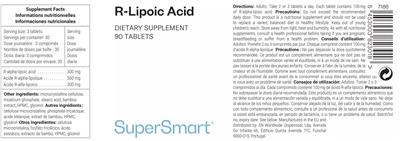
Supplement Facts
The label details for R-Lipoic Acid by SuperSmart, sourced from the NIH Dietary Supplement Label Database.
Supplement Facts
| Ingredient | Amount | % DV |
|---|---|---|
| Alpha R-Lipoic Acid | 300 mg | -- |
Other ingredients: Microcrystalline Cellulose, Tricalcium Phosphate, Stearic Acid, Bamboo Extract, Hydroxypropyl Methylcellulose, Glycerol
Tap any ingredient to jump to its full detail below.
These statements are the manufacturer’s wording, reproduced from the product label — the label is saying it, not HelloPharmacist. We don’t verify or endorse them.
FDA Statement of Identity
Dietary Supplement
Suggested/Recommended/Usage/Directions
Directions: Adults. Take 2 or 3 tablets a day.
Formula
Each tablet contains 100 mg of R-alpha-lipoic acid.
Precautions
Precautions: Do not exceed the recommended daily dose. This product is a nutritional supplement and should not be used to replace a varied, balanced diet or healthy lifestyle.
Keep out of young children's reach.
As with all nutritional supplements, consult a health professional before taking if you are pregnant, breastfeeding or suffer from a health problem.
Storage
Store away from direct light, heat and humidity.
Is this label outdated? Report a formula or label change and our pharmacy team will review it.
R-Lipoic Acid by SuperSmart label
The label scan from the NIH Dietary Supplement Label Database. Tap to enlarge.
Label images are published by the NIH Dietary Supplement Label Database for the version of this product on file. Always read your actual product label.
View the full label (PDF)The Ingredients in R-Lipoic Acid by SuperSmart
This is the 1 active ingredient this product is made of. Select it to open its full monograph.
Serving size2 Tablet(s) Dosage formTablet Or Pill Servings per container30 Amounts shown are per serving.
Alpha R-Lipoic Acid
Interacts with263 drugs
Alpha-lipoic acid (ALA) is an antioxidant made naturally by the body and found in small amounts in foods. It is most studied for diabetic nerve pain,...
Alpha R-Lipoic Acid monograph & interactionsOther (inactive) ingredients: Microcrystalline Cellulose, Tricalcium Phosphate, Stearic Acid, Bamboo Extract, Hydroxypropyl Methylcellulose, Glycerol. These complete the product’s ingredient list but are not active constituents.
R-Lipoic Acid by SuperSmart Drug Interactions
HelloPharmacist Interaction Report
R-Lipoic Acid by SuperSmart contains a single active ingredient, alpha R-lipoic acid, that has documented interactions with several medication types.
The most serious concern is with blood thinners and antiplatelet drugs (like warfarin or aspirin): alpha-lipoic acid may increase bleeding risk by thinning the blood further, a Moderate-severity interaction.
Read the full breakdown — every affected drug type, severity by severity
You should also be cautious if you take chemotherapy drugs. Alpha-lipoic acid's antioxidant properties might interfere with alkylating agents and antitumor antibiotics, which work by creating free radicals to kill cancer cells—a Moderate concern.
If you're on thyroid hormone medication, alpha-lipoic acid may reduce how well it works, also Moderate severity. Additionally, if you take diabetes medications, there's a Minor risk that this supplement could lower your blood sugar too much, though clinical studies haven't shown a major effect.
Altogether, these interactions span 262 individual medications. Before you start R-Lipoic Acid, run your exact medications through the checker on this page—especially if you take blood thinners, cancer treatments, thyroid drugs, or diabetes medications.
Check your own medications below · Editorial policy · How we use AI
Want to check YOUR meds against R-Lipoic Acid?
Ask about interactions with your drugs in plain English — “Can I take it with lisinopril?” — and we find you the answer in seconds, ingredient by ingredient.
Go to the checkerIngredients driving the most interactions
Individual Drug Interactions
The ingredients in R-Lipoic Acid interact with 263 drugs. Click any drug to see the details.
1 of the 1 ingredient in R-Lipoic Acid interact with drugs. Each result below shows which ingredient is responsible. Alpha R-Lipoic Acid
AbciximabReoPro
How Abciximab interacts with R-Lipoic Acid — through 1 ingredient. Tap an ingredient for the detail:
Alpha R-lipoic AcidAnticoagulant/antiplatelet Drugs Moderate
Interaction Summary
Theoretically, alpha-lipoic acid may have antiplatelet effects and may increase the risk of bleeding if used with anticoagulant or antiplatelet drugs.
Read the full Alpha R-lipoic Acid + Abciximab interactionAbrocitinibCibinqo
How Abrocitinib interacts with R-Lipoic Acid — through 1 ingredient. Tap an ingredient for the detail:
Alpha R-lipoic AcidAnticoagulant/antiplatelet Drugs Moderate
Interaction Summary
Theoretically, alpha-lipoic acid may have antiplatelet effects and may increase the risk of bleeding if used with anticoagulant or antiplatelet drugs.
Read the full Alpha R-lipoic Acid + Abrocitinib interactionAcenocoumarolSintrom
How Acenocoumarol interacts with R-Lipoic Acid — through 1 ingredient. Tap an ingredient for the detail:
Alpha R-lipoic AcidAnticoagulant/antiplatelet Drugs Moderate
Interaction Summary
Theoretically, alpha-lipoic acid may have antiplatelet effects and may increase the risk of bleeding if used with anticoagulant or antiplatelet drugs.
Read the full Alpha R-lipoic Acid + Acenocoumarol interactionAcetaminophen, AspirinGemnisyn
How Acetaminophen, Aspirin interacts with R-Lipoic Acid — through 1 ingredient. Tap an ingredient for the detail:
Alpha R-lipoic AcidAnticoagulant/antiplatelet Drugs Moderate
Interaction Summary
Theoretically, alpha-lipoic acid may have antiplatelet effects and may increase the risk of bleeding if used with anticoagulant or antiplatelet drugs.
Read the full Alpha R-lipoic Acid + Acetaminophen, Aspirin interactionAcetaminophen, Aspirin, CaffeineExcedrin, Excedrin Extra Strength, Excedrin Migraine
How Acetaminophen, Aspirin, Caffeine interacts with R-Lipoic Acid — through 1 ingredient. Tap an ingredient for the detail:
Alpha R-lipoic AcidAnticoagulant/antiplatelet Drugs Moderate
Interaction Summary
Theoretically, alpha-lipoic acid may have antiplatelet effects and may increase the risk of bleeding if used with anticoagulant or antiplatelet drugs.
Read the full Alpha R-lipoic Acid + Acetaminophen, Aspirin, Caffeine interactionAcetaminophen, IbuprofenCombogesic
How Acetaminophen, Ibuprofen interacts with R-Lipoic Acid — through 1 ingredient. Tap an ingredient for the detail:
Alpha R-lipoic AcidAnticoagulant/antiplatelet Drugs Moderate
Interaction Summary
Theoretically, alpha-lipoic acid may have antiplatelet effects and may increase the risk of bleeding if used with anticoagulant or antiplatelet drugs.
Read the full Alpha R-lipoic Acid + Acetaminophen, Ibuprofen interactionAcetylsalicylic AcidEntrophen
How Acetylsalicylic Acid interacts with R-Lipoic Acid — through 1 ingredient. Tap an ingredient for the detail:
Alpha R-lipoic AcidAnticoagulant/antiplatelet Drugs Moderate
Interaction Summary
Theoretically, alpha-lipoic acid may have antiplatelet effects and may increase the risk of bleeding if used with anticoagulant or antiplatelet drugs.
Read the full Alpha R-lipoic Acid + Acetylsalicylic Acid interactionAlteplase, TpaActilyse, Activase
How Alteplase, Tpa interacts with R-Lipoic Acid — through 1 ingredient. Tap an ingredient for the detail:
Alpha R-lipoic AcidAnticoagulant/antiplatelet Drugs Moderate
Interaction Summary
Theoretically, alpha-lipoic acid may have antiplatelet effects and may increase the risk of bleeding if used with anticoagulant or antiplatelet drugs.
Read the full Alpha R-lipoic Acid + Alteplase, Tpa interactionAltretamineHexalen
How Altretamine interacts with R-Lipoic Acid — through 1 ingredient. Tap an ingredient for the detail:
Alpha R-lipoic AcidAlkylating Agents Moderate
Interaction Summary
Theoretically, the antioxidant effects of alpha-lipoic acid might alter the effectiveness of alkylating agents.
Read the full Alpha R-lipoic Acid + Altretamine interactionAluminum Hydroxide, Aspirin, Codeine Phosphate, Magnesium HydroxideAscriptin Codeine #2
How Aluminum Hydroxide, Aspirin, Codeine Phosphate, Magnesium Hydroxide interacts with R-Lipoic Acid — through 1 ingredient. Tap an ingredient for the detail:
Alpha R-lipoic AcidAnticoagulant/antiplatelet Drugs Moderate
Interaction Summary
Theoretically, alpha-lipoic acid may have antiplatelet effects and may increase the risk of bleeding if used with anticoagulant or antiplatelet drugs.
Read the full Alpha R-lipoic Acid + Aluminum Hydroxide, Aspirin, Codeine Phosphate, Magnesium Hydroxide interactionAluminum Hydroxide, Aspirin, Magnesium HydroxideAscriptin
How Aluminum Hydroxide, Aspirin, Magnesium Hydroxide interacts with R-Lipoic Acid — through 1 ingredient. Tap an ingredient for the detail:
Alpha R-lipoic AcidAnticoagulant/antiplatelet Drugs Moderate
Interaction Summary
Theoretically, alpha-lipoic acid may have antiplatelet effects and may increase the risk of bleeding if used with anticoagulant or antiplatelet drugs.
Read the full Alpha R-lipoic Acid + Aluminum Hydroxide, Aspirin, Magnesium Hydroxide interactionAnacaulase-bcdbNexoBrid
How Anacaulase-bcdb interacts with R-Lipoic Acid — through 1 ingredient. Tap an ingredient for the detail:
Alpha R-lipoic AcidAnticoagulant/antiplatelet Drugs Moderate
Interaction Summary
Theoretically, alpha-lipoic acid may have antiplatelet effects and may increase the risk of bleeding if used with anticoagulant or antiplatelet drugs.
Read the full Alpha R-lipoic Acid + Anacaulase-bcdb interactionAnagrelideAgrylin
How Anagrelide interacts with R-Lipoic Acid — through 1 ingredient. Tap an ingredient for the detail:
Alpha R-lipoic AcidAnticoagulant/antiplatelet Drugs Moderate
Interaction Summary
Theoretically, alpha-lipoic acid may have antiplatelet effects and may increase the risk of bleeding if used with anticoagulant or antiplatelet drugs.
Read the full Alpha R-lipoic Acid + Anagrelide interactionAnisindioneMiradon
How Anisindione interacts with R-Lipoic Acid — through 1 ingredient. Tap an ingredient for the detail:
Alpha R-lipoic AcidAnticoagulant/antiplatelet Drugs Moderate
Interaction Summary
Theoretically, alpha-lipoic acid may have antiplatelet effects and may increase the risk of bleeding if used with anticoagulant or antiplatelet drugs.
Read the full Alpha R-lipoic Acid + Anisindione interactionAntithrombin IiiThrombate III
How Antithrombin Iii interacts with R-Lipoic Acid — through 1 ingredient. Tap an ingredient for the detail:
Alpha R-lipoic AcidAnticoagulant/antiplatelet Drugs Moderate
Interaction Summary
Theoretically, alpha-lipoic acid may have antiplatelet effects and may increase the risk of bleeding if used with anticoagulant or antiplatelet drugs.
Read the full Alpha R-lipoic Acid + Antithrombin Iii interactionApixabanEliquis
How Apixaban interacts with R-Lipoic Acid — through 1 ingredient. Tap an ingredient for the detail:
Alpha R-lipoic AcidAnticoagulant/antiplatelet Drugs Moderate
Interaction Summary
Theoretically, alpha-lipoic acid may have antiplatelet effects and may increase the risk of bleeding if used with anticoagulant or antiplatelet drugs.
Read the full Alpha R-lipoic Acid + Apixaban interactionArgatrobanArgatroban
How Argatroban interacts with R-Lipoic Acid — through 1 ingredient. Tap an ingredient for the detail:
Alpha R-lipoic AcidAnticoagulant/antiplatelet Drugs Moderate
Interaction Summary
Theoretically, alpha-lipoic acid may have antiplatelet effects and may increase the risk of bleeding if used with anticoagulant or antiplatelet drugs.
Read the full Alpha R-lipoic Acid + Argatroban interactionAspirinAngettes 75, ASA, Asaphen, Aspirin, Caprin, Cartia +8 more
How Aspirin interacts with R-Lipoic Acid — through 1 ingredient. Tap an ingredient for the detail:
Alpha R-lipoic AcidAnticoagulant/antiplatelet Drugs Moderate
Interaction Summary
Theoretically, alpha-lipoic acid may have antiplatelet effects and may increase the risk of bleeding if used with anticoagulant or antiplatelet drugs.
Read the full Alpha R-lipoic Acid + Aspirin interactionAspirin, Aluminum Hydroxide, Codeine Phosphate, Magnesium HydroxideAscriptin Codeine #3
How Aspirin, Aluminum Hydroxide, Codeine Phosphate, Magnesium Hydroxide interacts with R-Lipoic Acid — through 1 ingredient. Tap an ingredient for the detail:
Alpha R-lipoic AcidAnticoagulant/antiplatelet Drugs Moderate
Interaction Summary
Theoretically, alpha-lipoic acid may have antiplatelet effects and may increase the risk of bleeding if used with anticoagulant or antiplatelet drugs.
Read the full Alpha R-lipoic Acid + Aspirin, Aluminum Hydroxide, Codeine Phosphate, Magnesium Hydroxide interactionAspirin, ButalbitalAxotal
How Aspirin, Butalbital interacts with R-Lipoic Acid — through 1 ingredient. Tap an ingredient for the detail:
Alpha R-lipoic AcidAnticoagulant/antiplatelet Drugs Moderate
Interaction Summary
Theoretically, alpha-lipoic acid may have antiplatelet effects and may increase the risk of bleeding if used with anticoagulant or antiplatelet drugs.
Read the full Alpha R-lipoic Acid + Aspirin, Butalbital interactionAspirin, Butalbital, CaffeineFiorinal
How Aspirin, Butalbital, Caffeine interacts with R-Lipoic Acid — through 1 ingredient. Tap an ingredient for the detail:
Alpha R-lipoic AcidAnticoagulant/antiplatelet Drugs Moderate
Interaction Summary
Theoretically, alpha-lipoic acid may have antiplatelet effects and may increase the risk of bleeding if used with anticoagulant or antiplatelet drugs.
Read the full Alpha R-lipoic Acid + Aspirin, Butalbital, Caffeine interactionAspirin, Butalbital, Caffeine, Codeine PhosphateFiorinal w/ Codeine
How Aspirin, Butalbital, Caffeine, Codeine Phosphate interacts with R-Lipoic Acid — through 1 ingredient. Tap an ingredient for the detail:
Alpha R-lipoic AcidAnticoagulant/antiplatelet Drugs Moderate
Interaction Summary
Theoretically, alpha-lipoic acid may have antiplatelet effects and may increase the risk of bleeding if used with anticoagulant or antiplatelet drugs.
Read the full Alpha R-lipoic Acid + Aspirin, Butalbital, Caffeine, Codeine Phosphate interactionAspirin, Butalbital, Caffeine, PhenacetinMarnal
How Aspirin, Butalbital, Caffeine, Phenacetin interacts with R-Lipoic Acid — through 1 ingredient. Tap an ingredient for the detail:
Alpha R-lipoic AcidAnticoagulant/antiplatelet Drugs Moderate
Interaction Summary
Theoretically, alpha-lipoic acid may have antiplatelet effects and may increase the risk of bleeding if used with anticoagulant or antiplatelet drugs.
Read the full Alpha R-lipoic Acid + Aspirin, Butalbital, Caffeine, Phenacetin interactionAspirin, CaffeineAnacin
How Aspirin, Caffeine interacts with R-Lipoic Acid — through 1 ingredient. Tap an ingredient for the detail:
Alpha R-lipoic AcidAnticoagulant/antiplatelet Drugs Moderate
Interaction Summary
Theoretically, alpha-lipoic acid may have antiplatelet effects and may increase the risk of bleeding if used with anticoagulant or antiplatelet drugs.
Read the full Alpha R-lipoic Acid + Aspirin, Caffeine interactionAspirin, Caffeine, Codeine PhosphateAnacin w/ Codeine
How Aspirin, Caffeine, Codeine Phosphate interacts with R-Lipoic Acid — through 1 ingredient. Tap an ingredient for the detail:
Alpha R-lipoic AcidAnticoagulant/antiplatelet Drugs Moderate
Interaction Summary
Theoretically, alpha-lipoic acid may have antiplatelet effects and may increase the risk of bleeding if used with anticoagulant or antiplatelet drugs.
Read the full Alpha R-lipoic Acid + Aspirin, Caffeine, Codeine Phosphate interactionAspirin, Caffeine, Dihydrocodeine BitartrateSynalgos DC
How Aspirin, Caffeine, Dihydrocodeine Bitartrate interacts with R-Lipoic Acid — through 1 ingredient. Tap an ingredient for the detail:
Alpha R-lipoic AcidAnticoagulant/antiplatelet Drugs Moderate
Interaction Summary
Theoretically, alpha-lipoic acid may have antiplatelet effects and may increase the risk of bleeding if used with anticoagulant or antiplatelet drugs.
Read the full Alpha R-lipoic Acid + Aspirin, Caffeine, Dihydrocodeine Bitartrate interactionAspirin, Caffeine, Dover's PwdAcedoval, Dovacet
How Aspirin, Caffeine, Dover's Pwd interacts with R-Lipoic Acid — through 1 ingredient. Tap an ingredient for the detail:
Alpha R-lipoic AcidAnticoagulant/antiplatelet Drugs Moderate
Interaction Summary
Theoretically, alpha-lipoic acid may have antiplatelet effects and may increase the risk of bleeding if used with anticoagulant or antiplatelet drugs.
Read the full Alpha R-lipoic Acid + Aspirin, Caffeine, Dover's Pwd interactionAspirin, Caffeine, HydrocodoneDamason-P
How Aspirin, Caffeine, Hydrocodone interacts with R-Lipoic Acid — through 1 ingredient. Tap an ingredient for the detail:
Alpha R-lipoic AcidAnticoagulant/antiplatelet Drugs Moderate
Interaction Summary
Theoretically, alpha-lipoic acid may have antiplatelet effects and may increase the risk of bleeding if used with anticoagulant or antiplatelet drugs.
Read the full Alpha R-lipoic Acid + Aspirin, Caffeine, Hydrocodone interactionAspirin, Caffeine, Isobutylallylbarbituric Acid, PhenacetinLanorinal
How Aspirin, Caffeine, Isobutylallylbarbituric Acid, Phenacetin interacts with R-Lipoic Acid — through 1 ingredient. Tap an ingredient for the detail:
Alpha R-lipoic AcidAnticoagulant/antiplatelet Drugs Moderate
Interaction Summary
Theoretically, alpha-lipoic acid may have antiplatelet effects and may increase the risk of bleeding if used with anticoagulant or antiplatelet drugs.
Read the full Alpha R-lipoic Acid + Aspirin, Caffeine, Isobutylallylbarbituric Acid, Phenacetin interactionAspirin, Caffeine, OrphenadrineInvagesic, Invagesic Forte, Norgesic, Norgesic Forte, Orphengesic, Orphengesic Forte
How Aspirin, Caffeine, Orphenadrine interacts with R-Lipoic Acid — through 1 ingredient. Tap an ingredient for the detail:
Alpha R-lipoic AcidAnticoagulant/antiplatelet Drugs Moderate
Interaction Summary
Theoretically, alpha-lipoic acid may have antiplatelet effects and may increase the risk of bleeding if used with anticoagulant or antiplatelet drugs.
Read the full Alpha R-lipoic Acid + Aspirin, Caffeine, Orphenadrine interactionEach ingredient & the kinds of drugs it affects
For each ingredient in R-Lipoic Acid with known interactions, here are the types of medications it can affect. Open any type for the detail — or search your exact drug in the checker above.
Alpha R-Lipoic Acid
Alkylating Agents
Theoretically, the antioxidant effects of alpha-lipoic acid might alter the effectiveness of alkylating agents.
The use of antioxidants like alpha-lipoic acid during chemotherapy is controversial. There are concerns that antioxidants could reduce the activity of chemotherapy drugs that generate free radicals. However, some researchers theorize that antioxidants might make chemotherapy more effective by reducing oxidative stress that might interfere with apoptosis (cell death) of cancer cells. More evidence is needed to determine what effect, if any, antioxidants such as alpha-lipoic acid have on chemotherapy. Advise patients to consult their oncologist before using alpha-lipoic acid.
Anticoagulant/Antiplatelet Drugs
Theoretically, alpha-lipoic acid may have antiplatelet effects and may increase the risk of bleeding if used with anticoagulant or antiplatelet drugs.
In vitro, alpha-lipoic acid inhibits platelet aggregation.
Antitumor Antibiotics
Theoretically, the antioxidant effects of alpha-lipoic acid might alter the effectiveness of antitumor antibiotics.
The use of antioxidants like alpha-lipoic acid during chemotherapy is controversial. There are concerns that antioxidants could reduce the activity of antitumor antibiotic drugs, which work by generating free radicals. However, some researchers theorize that antioxidants might make chemotherapy more effective by reducing oxidative stress that might interfere with apoptosis (cell death) of cancer cells. More evidence is needed to determine what effect, if any, antioxidants such as alpha-lipoic acid have on chemotherapy involving antitumor antibiotics. Advise patients to consult their oncologist before using alpha-lipoic acid.
Thyroid Hormone
Theoretically, alpha-lipoic acid might decrease the effects of thyroid hormone drugs.
Animal research suggests that co-administration of thyroxine with alpha-lipoic acid reduces conversion into the active T3 form.
Antidiabetes Drugs
Theoretically, taking alpha-lipoic acid with antidiabetes drugs might increase the risk of hypoglycemia.
Although some small clinical studies have suggested that alpha-lipoic acid can lower blood glucose levels, larger clinical studies in patients with diabetes have shown no clinically meaningful effect. Additionally, co-administration of single doses of alpha-lipoic acid and glyburide or acarbose did not cause detectable drug interactions in healthy volunteers.
Brand information
Manufacturer and brand details for R-Lipoic Acid, from the product label.
SuperSmart
See all SuperSmart products- Name
- SN Worldwide Unipessoal, LDA
- Street Address
- Avenida Do Infante 66 Edificio Quinta Avenida 1 C
- City
- Funchal
- ZipCode
- 9000-015
R-Lipoic Acid by SuperSmart: Common Questions
Does R-Lipoic Acid by SuperSmart interact with any medications?
How can one product interact with so many drugs?
Where does this information come from?
Will this supplement lower my blood sugar?
What's the most common side effect?
Can I take this during pregnancy?
Can I take this while breastfeeding?
Does this really work for nerve pain from diabetes?
Written and reviewed by the HelloPharmacist editorial staff. Our editorial policy
Not sure if R-Lipoic Acid is safe with your meds?
Our pharmacists answer your medication & supplement questions — free.
Label information is sourced from the NIH Dietary Supplement Label Database and reflects the product version on file; always read your actual product label. This page is for education only and is not a substitute for professional medical advice. Confirm with your pharmacist or doctor before combining supplements and medications.
The Full Monographs Behind R-Lipoic Acid’s Ingredients
Every ingredient we hold a full HelloPharmacist monograph for — uses, evidence, safety, and the complete interaction list.
Sources & How We Checked
R-Lipoic Acid's label data comes from the NIH Dietary Supplement Label Database; the ingredient interaction data is from the Natural Medicines database, reviewed by our pharmacists.
- NIH Dietary Supplement Label Database (DSLD) — The official product label on file for this supplement.
- Natural Medicines (Therapeutic Research Center) — Evidence-graded clinical reference behind the ingredient interaction data.
Content is written and reviewed by licensed HelloPharmacist pharmacists. See our data sources and editorial standards for how this information is built and checked.
The 48 references behind this product’s interaction data
Every citation that drives the interaction findings for this product’s ingredients, from the evidence-graded Natural Medicines (TRC Healthcare) database. Open an ingredient to browse its citations — links open the study on PubMed or the publisher’s site.
Alpha-lipoic Acid 48 references
- Labriola D, Livingston R. Possible interactions between dietary antioxidants and chemotherapy. Oncology 1999;13:1003-8.
- Anon. Alpha-lipoic acid. Altern Med Rev 1998;3:308-10.
- Konrad T, Vicini P, Kusterer K, et al. Alpha-lipoic acid treatment decreases serum lactate and pyruvate concentrations and improves glucose effectiveness in lean and obese patients with Type 2 diabetes. Diabetes Care 1999;22:280-7. PubMed
- Ziegler D, Hanefeld M, Ruhnau KJ, et al. Treatment of symptomatic diabetic peripheral neuropathy with the antioxidant alpha-lipoic acid: A 3-week, multicentre randomized controlled trial (ALADIN Study). Diabetologia 1995;38:1425-33.
- Gleiter CH, Schreeb KH, Freudenthaler S, et al. Lack of interaction between thioctic acid, glibenclamide and acarbose. Br J Clin Pharmacol 1999;48:819-25. PubMed
- Jacob S, Henriksen EJ, Tritschler HJ, et al. Improvement of insulin-stimulated glucose-disposal in type 2 diabetes after repeated parenteral administration of thioctic acid. Exp Clin Endocrinol Diabet 1996;104:284-8. PubMed
- Jacob S, Henriksen EJ, Schiemann AL, et al. Enhancement of glucose disposal in patients with type 2 diabetes by alpha-lipoic acid. Arzneimittelforschung 1995;45:872-4.
- Jacob S, Ruus P, Hermann R, et al. Oral administration of RAC-alpha-lipoic acid modulates insulin sensitivity in patients with type-2 diabetes mellitus: a placebo-controlled, pilot trial. Free Rad Biol Med 1999;27:309-14.
- Segermann J, Hotze A, Ulrich H, Rao GS. Effect of alpha-lipoic acid on the peripheral conversion of thyroxine to triiodothyronine and on serum lipid-, protein- and glucose levels. Arzneimittelforschung 1991;41:1294-8.
- Beitner H. Randomized, placebo controlled, double-blind study on the clinical efficacy of a cream containing 5% alpha-lipoic acid related to photoaging of facial skin. Br J Dermatol 2003;149:841-9.
- Ziegler D, Nowak H, Kempler P, et al. Treatment of symptomatic diabetic polyneuropathy with the antioxidant alpha-lipoic acid: A meta-analysis. Diabet Med 2004;21:114-21.
- Prasad KN. Rationale for using high-dose multiple dietary antioxidants as an adjunct to radiation therapy and chemotherapy. J Nutr 2004;134:3182S-3S. PubMed
- Conklin KA. Cancer chemotherapy and antioxidants. J Nutr 2004;134:3201S-3204S. PubMed
- Vincent HK, Bourguignon CM, Vincent KR, Taylor AG. Effects of alpha-lipoic acid supplementation in peripheral arterial disease: a pilot study. J Alt Complement Med 2007;13:577-84. PubMed
- Furukawa N, Miyamura N, Nishida K, et al. Possible relevance of alpha lipoic acid contained in a health supplement in a case of insulin autoimmune syndrome. Diabetes Res Clin Pract 2007;75:366-7. PubMed
- Ziegler D., Ametov A., Barinov A., Dyck P. J., Gurieva I., Low P. A., Munzel U., Yakhno N., Raz I., Novosadova M., Maus J., Samigullin, R. Oral treatment with alpha-lipoic acid improves symptomatic diabetic polyneuropathy: the SYDNEY 2 trial. Diabetes Car
- Gu X. M., Zhang S. S., Wu J. C., Tang Z. Y., Lu Z. Q., Li H., Liu C., Chen L., Ning, G. [Efficacy and safety of high-dose a-lipoic acid in the treatment of diabetic polyneuropathy]. Zhonghua Yi Xue Za Zhi 2010;90(35):2473-2476.
- Porasuphatana S., Suddee S., Nartnampong A., Konsil J., Harnwong B., Santaweesuk A. Glycemic and oxidative status of patients with type 2 diabetes mellitus following oral administration of alpha-lipoic acid: a randomized double-blinded placebo-controlled
- Ansar H., Mazloom Z., Kazemi F., Hejazi N. Effect of alpha-lipoic acid on blood glucose, insulin resistance and glutathione peroxidase of type 2 diabetic patients. Saudi Med J 2011;32(6):584-588. DOI
- de Oliveira A. M., Rondó P. H., Luzia L. A., D'Abronzo F. H., Illison V. K. The effects of lipoic acid and a-tocopherol supplementation on the lipid profile and insulin sensitivity of patients with type 2 diabetes mellitus: a randomized, double-blind, pla
- Mazloom Z., Ansar H. The Effect of Alpha-Lipoic Acid on Blood Pressure in Type 2 Diabetics. Iranian Journal of Endocrinology and Metabolism 2009;11(3):245-250.
- Volchegorskii I. A., Rassokhina L. M., Koliadich M. I., Alekseev M. I. [Comparative study of alpha-lipoic acid and mexidol effects on affective status, cognitive functions and quality of life in diabetes mellitus patients]. Eksp Klin Farmakol 2011;74(11):
- Cavalcanti D. R., da Silveira F. R. Alpha lipoic acid in burning mouth syndrome--a randomized double-blind placebo-controlled trial. J Oral Pathol Med 2009;38(3):254-261. PubMed
- Koh E. H., Lee W. J., Lee S. A., Kim E. H., Cho E. H., Jeong E., Kim D. W., Kim M. S., Park J. Y., Park K. G., Lee H. J., Lee I. K., Lim S., Jang H. C., Lee K. H., Lee K. U. Effects of alpha-lipoic Acid on body weight in obese subjects. Am J Med 2011;124( PubMed
- Bergqvist-Karlsson, A., Thelin, I., and Bergendorff, O. Contact dermatitis to alpha-lipoic acid in an anti-wrinkle cream. Contact Dermatitis 2006;55(1):56-57.
- Tang, J., Wingerchuk, D. M., Crum, B. A., Rubin, D. I., and Demaerschalk, B. M. Alpha-lipoic acid may improve symptomatic diabetic polyneuropathy. Neurologist. 2007;13(3):164-167. PubMed
- Hegazy SK, Tolba OA, Mostafa TM, Eid MA, El-Afify DR. Alpha-lipoic acid improves subclinical left ventricular dysfunction in asymptomatic patients with type 1 diabetes. Rev Diabet Stud 2013;10(1):58-67. PubMed
- Huang Z, Wan X, Liu J, et al. Short-term continuous subcutaneous insulin infusion combined with insulin sensitizers rosiglitazone, metformin, or antioxidant a-lipoic acid in patients with newly diagnosed type 2 diabetes mellitus. Diabetes Technol Ther 201
- Sarezky D, Raquib AR, Dunaief JL, Kim BJ. Tolerability in the elderly population of high-dose alpha lipoic acid: a potential antioxidant therapy for the eye. Clin Ophthalmol. 2016 Sep 29;10:1899-1903. PubMed
- Boriani F, Granchi D, Roatti G, Merlini L, Sabattini T, Baldini N. Alpha-lipoic acid after median nerve decompression at the carpal tunnel: a randomized controlled trial. J Hand Surg Am. 2017 Apr;42(4):236-42. PubMed
- Karkabounas S, Papadopoulos N, Anastasiadou C, et al. Effects of a-lipoic Acid, carnosine, and thiamine supplementation in obese patients with type 2 diabetes mellitus: A randomized, double-blind study. J Med Food. 2018;21(12):1197-1203.
- Murray GL, Colombo J. (r)Alpha lipoic acid is a safe, effective pharmacologic therapy of chronic orthostatic hypotension associated with low sympathetic tone. Int J Angiol. 2019;28(3):188-193. PubMed
- Bobe G, Michels AJ, Zhang WJ, et al. A randomized controlled trial of long-term (R)-α-lipoic acid supplementation promotes weight loss in overweight or obese adults without altering baseline elevated plasma triglyceride concentrations. J Nutr. 2020:
- Passiatore M, Perna A, De-Vitis R, Taccardo G. The use of alfa-lipoic acid-R (ALA-R) in patients with mild-moderate carpal tunnel syndrome: A randomised controlled open label prospective study. Malays Orthop J. 2020;14(1):1-6. PubMed
- El-Nahas MR, Elkannishy G, Abdelhafez H, Elkhamisy ET, El-Sehrawy AA. Oral alpha lipoic acid treatment for symptomatic diabetic peripheral neuropathy: A randomized double-blinded placebo-controlled study. Endocr Metab Immune Disord Drug Targets. 2020. PubMed
- Kim BJ, Hunter A, Brucker AJ, et al. Orally administered alpha lipoic acid as a treatment for geographic atrophy: A randomized clinical trial. Ophthalmol Retina. 2020;4(9):889-898. PubMed
- Derosa G, D'Angelo A, Preti P, Maffioli P. Safety and efficacy of alpha lipoic acid during 4 years of observation: A retrospective, clinical trial in healthy subjects in primary prevention. Drug Des Devel Ther. 2020;14:5367-5374.
- Sun Y, Guan X, Wang H, et al. Randomized clinical trial of combined therapy with oral a-lipoic acid and NB-UVB for nonsegmental stable vitiligo. Dermatol Ther. 2021;34(1):e14610.
- Gilron I, Robb S, Tu D, et al. Double-blind, randomized, placebo-controlled crossover trial of alpha-lipoic acid for the treatment of fibromyalgia pain: the IMPALA trial. Pain. 2021;162(2):561-568. PubMed
- Gullo D, Evans JL, Sortino G, Goldfine ID, Vigneri R. Insulin autoimmune syndrome (Hirata Disease) in European Caucasians taking a-lipoic acid. Clin Endocrinol (Oxf). 2014;81(2):204-9.
- Yukina M, Nuralieva N, Solovyev M, Troshina E, Vasilyev E. Insulin autoimmune syndrome. Endocrinol Diabetes Metab Case Rep. 2020;2020:19-0159. PubMed
- Moffa S, Improta I, Rocchetti S, Mezza T, Giaccari A. Potential cause-effect relationship between insulin autoimmune syndrome and alpha lipoic acid: Two case reports. Nutrition. 2019;57:1-4. PubMed
- Izzo V, Greco C, Corradini D, et al. Insulin autoimmune syndrome in an Argentine woman taking a-lipoic acid: A case report and review of the literature. SAGE Open Med Case Rep. 2018;6:2050313X18819601.
- EFSA Panel on Nutrition, Novel Foods and Food Allergens (NDA), Turck D, et al. Scientific opinion on the relationship between intake of alpha-lipoic acid (thioctic acid) and the risk of insulin autoimmune syndrome. EFSA J 2021;19(6):e06577. PubMed
- Jibril AT, Jayedi A, Shab-Bidar S. Efficacy and safety of oral alpha-lipoic acid supplementation for type 2 diabetes management: a systematic review and dose-response meta-analysis of randomized trials. Endocr Connect 2022;11(10):e220322. PubMed
- Corazza M, Arlotti E, Schettini N, Pacetti L, Bianchi A, Borghi A. Allergic contact dermatitis due to a-lipoic acid in a topical over-the-counter product: A case report. Contact Dermatitis 2023.
- Velasco-Amador JP, Prados-Carmona Á, Navarro-Triviño FJ. Contact urticaria syndrome caused by alpha-lipoic acid in a master formula for vulvar lichen sclerosus. Contact Dermatitis 2023;89(2):136-137. PubMed
- Sehgal T, Ohri U, Mittal N, Attri P, Dishant F. A Case of Insulin Autoimmune Syndrome in an Indian Male Taking Alpha-Lipoic Acid. Cureus 2023;15(8):e43743. PubMed
Parts of this content are provided by the Therapeutic Research Center, LLC.
DISCLAIMER: Currently this does not check for drug-drug interactions. This is not an all-inclusive comprehensive list of potential interactions and is for informational purposes only. Not all interactions are known or well-reported in the scientific literature, and new interactions are continually being reported. Input is needed from a qualified healthcare provider including a pharmacist before starting any therapy. Application of clinical judgment is necessary.
© 2021 Therapeutic Research Center, LLC