
Restore by Herbally Grounded Ingredients, Side Effects and Drug Interactions
Dietary Supplement Capsule Botanical
UPC 7 18122 29022 2 Match it to the barcode on your bottle

Medically reviewed by Dr. Brian Staiger, PharmD, BCPS
Also reviewed by the HelloPharmacist Editorial Team
Updated Details about this page
- Label on file from the NIH Dietary Supplement Label Database, dated Sep 25, 2024.
- The interaction, evidence and safety records come from the Natural Medicines database, which we license, read against this label by our own system; the pharmacy team’s sections are written from those records.
- Dr. Brian Staiger, PharmD, BCPS, is a clinical pharmacist and pharmacotherapy specialist.
- Editorial policy Our sources
AI is used only to summarize verified clinical information, never the open internet. Our AI policy
Summary: The HelloPharmacist Team’s Take
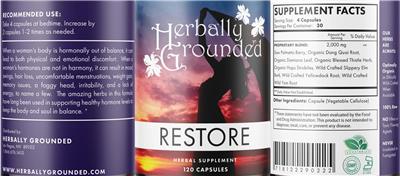
- Form
- Capsule
- Serving Size
- 4 Capsules
- Servings
- 30 per container
- Container Holds
- 120 Capsules
What’s in it, whether it interacts with your drugs, its side effects, whether it works, and what our pharmacists would want you to know before you start it.
- What is Restore?A supplement from Herbally Grounded with eight active ingredients, in capsule form.
- Active Ingredients Saw PalmettoDong quaiDamianaBlessed ThistleHopsSlippery ElmYellow DockWild Yam Eight active ingredients. Each one can interact with drugs or cause side effects on its own, so we check every one. The full Supplement Facts
- Drug Interactions 2,138 drugs have a documented interaction with this supplement; the most serious is rated major. Of those, 1,599 are single drugs and 539 are combination products (two or more drugs in one), each listed under its own name. Ask your pharmacist first if you take a drug in any of these categories, the most serious of the 14 on record:
- Major · 75 drugs
- Major · 2 drugs
- Major · 1 drug
- Moderate · 2,022 drugs
- Possible Side EffectsNausea 4 ingredientsHeadache 3 ingredientsStomach upset 3 ingredientsBurpingDrowsinessCramping +9 moreCombined from seven of its eight active ingredients. Not studied in this exact product.
- Well documented Why
Does Restore work?
Not establishedWhat It Is Marketed For
Women's hormone balance
From the claims on the product’s label.
This is what Saw Palmetto has been studied for, strongest research first:
- Transurethral resection of the prostate (TURP)
These grades are for the ingredient, not this exact product, and never a promise it will work for you.
What the research says- Low Why
- AllergensNone of its ingredient names point to a major food allergen
- Barcode (UPC)7 18122 29022 2Match it to the barcode on your bottle to be sure this is your product. Not your product? Search for it here
Who Might Consider It
- People looking for Women's hormone balance, which is what it is marketed for. There is no graded research for that use.
- People who want it for transurethral resection of the prostate (TURP): the use with research behind it. See the grade
- Restore may be of interest to adults looking into herbal support for the uses above, but the evidence behind most of its ingredients is limited.
Who Should Be Careful
- If you take warfarin, a diuretic, digoxin, or any blood thinner, or you are pregnant, breastfeeding, or managing a hormone-sensitive condition, talk it over with your own doctor or pharmacist before starting.
- Anyone with kidney or liver problems should also get personal advice first.
More Before You Take It Show both answersHide Pregnancy and Breastfeeding The Label’s Directions
-
Pregnant or breastfeeding?
- Pregnancy and Breastfeeding Saw Palmetto
- ! When used orally.
- Pregnancy Blessed Thistle
- ! When used orally; avoid using.
- Breastfeeding Blessed Thistle
- Insufficient reliable information available; avoid using.
- Pregnancy Hops
- ! Not enough safety information; best avoided during pregnancy.
- Breastfeeding Hops
- Insufficient reliable information available; avoid using.
-
How does the label say to take it?
“Recommended Use: Take 4 capsules at bedtime. Increase by 2 capsules 1-2 times as needed.”
The maker’s words. Your pharmacist or doctor may advise differently.
Everything the label says
From the label dated Sep 25, 2024: all eight of its active ingredients were checked against our records. A summary of what is known, not a grade or a test of the product. How these ratings are computed
Ask Anything About This Supplement
Name a drug you take, or ask about side effects, ingredients or pregnancy.
AI answers come from this label and our own records, never the open internet. AI can make mistakes, so always check with your doctor or pharmacist. How we use AI
Ask the Pharmacist
A licensed pharmacist will answer your question by email — free, usually within 24 hours.
Got it — thank you!
A licensed pharmacist will answer within 24 hours. Keep an eye on your email (worth checking spam, just in case).
What’s Inside Restore by Herbally Grounded
Eight Active Ingredients, Each Checked on Its Own
A supplement is often several ingredients in one bottle, and each one can interact with drugs or cause side effects on its own. We check every one of them against our records.
- Saw PalmettoDrug interactions on record, most serious: Moderate
- Dong quaiDrug interactions on record, most serious: Major
- DamianaDrug interactions on record, most serious: Moderate
- Blessed ThistleNo drug interactions on record
- HopsDrug interactions on record, most serious: Moderate
- Slippery ElmDrug interactions on record, most serious: Moderate
- Yellow DockDrug interactions on record, most serious: Major
- Wild YamDrug interactions on record, most serious: Moderate
The label gives an exact amount for 0 of its 8 active ingredients. Eight are inside one proprietary blend, “Proprietary Blend”, and the label gives one total for it, not how much of each ingredient is in it.
- 0 state an exact amount
- 8 have no amount of their own
- Proprietary Blend 2,000 mg in total · 8 ingredients, no amount for each
This rates what the label tells you, not the quality of the product.
Supplement Facts
| Amount Per Serving | % Daily Value | |
|---|---|---|
| Proprietary Blend | 2000 mg | † |
| Saw Palmetto | † | |
| Dong quai | † | |
| Damiana | † | |
| Blessed Thistle | † | |
| Hops | † | |
| Slippery Elm | † | |
| Yellow Dock | † | |
| Wild Yam | † | |
Other ingredients: Cellulose
† Daily Value not established.
Daily Values for adults and children 4 or more years of age.
As the label prints it, from the NIH Dietary Supplement Label Database.
Each Ingredient and Its Drug Interactions
Tap one for more about it and its full guide. A drug can interact with this supplement through any one of them.
Restore's active ingredients are herbs with traditional uses: slippery elm (a soothing fiber), damiana, wild yam, saw palmetto, hops, blessed thistle, dong quai, and yellow dock.
- We have no information on the amounts of any ingredient.
-
Proprietary Blend 2000 mg Several of them are listed inside a proprietary blend, whose exact amounts are not broken out on the label. Eight ingredients inside it, each checked on its own
- Saw Palmetto 174 drugs
- Dong quai 163 drugs
- Damiana 86 drugs
- Blessed Thistle 36 drugs
- Hops 865 drugs
- Slippery Elm 2,022 drugs
- Yellow Dock 78 drugs
- Wild Yam 41 drugs
Other Ingredients (Inactive)
The capsule or tablet itself, fillers, coatings and flavors. Not part of the drug interaction check; the allergen check below reads them.
- Cellulose
Allergens in Restore
None of its ingredient names point to a major food allergen.
Not named in the ingredients
- Milk
- Egg
- Fish
- Shellfish
- Tree nuts
- Peanuts
- Wheat or other gluten grains
- Soy
- Sesame
- Made without, the label says“Vegetarian”
From the label text and ingredient names on file; we do not test products. With a serious allergy, check your bottle and ask the maker or your pharmacist.
What the Label Says
The maker’s own words, from the label. We do not verify or endorse them.
- Formulation
-
“When a woman's body is hormonally out of balance, it can lead to both physical and emotional discomfort. When a woman's hormones are not in harmony, it can result in mood swings, hair loss, uncomfortable menstruations, weight gain, memory issues, a foggy head, irritability, and a lack of energy, to name a few. The amazing herbs in this formula have long been used in supporting healthy hormone levels to keep the body and soul in balance.”
“Our herbs are always: Optimally organic or ethically wild-crafted when available”
3 more from the label
“100% Raw”
“No fillers or toxic flowing agents Never irradiated or fumigated”
“K Parve (Kosher) K-1604”
- FDA Statement of Identity
-
“Herbal Supplement”
The Restore Label on File
The label scan on file at the NIH Dietary Supplement Label Database, dated September 2024. Always read the label on the bottle you have.
Product Facts
- Brand
- Herbally Grounded
- Barcode (UPC)
- 718122290222
- Net contents
- 120 Capsules
- Market status
- On market
- Date entered into DSLD
- Sep 25, 2024
- DSLD ID
- 318570
- Product type
- Botanical
- Supplement form
- Capsule
- Dietary claims / uses
- All Other, Structure/Function
- Intended target group(s)
- Vegetarian, Adult (18 - 50 Years), Kosher
Is this label outdated? Report a formula or label change and our pharmacy team will review it.
Restore by Herbally Grounded Side Effects
Why this rating?
We look for three kinds of safety information on each ingredient: side effects reported in studies, a pregnancy and breastfeeding rating, and a safety write-up from our pharmacy team. All three are on file for each of the eight ingredients we could check.
So this rates how much is known, not whether Restore is right for you.
Reported with eight of its ingredients
- Most often
- Nausea, headache, stomach upset, burping, drowsiness and cramping
- !Rare but serious
- Severe allergic reaction See details
HelloPharmacist Team Summary: Restore by Herbally Grounded Side Effects
You can expect Restore to be generally well tolerated, though most of its ingredients have limited human safety data.
- The side effects you are most likely to notice are nausea, upset stomach, and headache, with the nausea and upset stomach reported across several of its herbs.
- Drowsiness and sleepiness have been reported with hops, so see how the product affects you before you drive.
- Rarely, very large doses of damiana have been linked to seizures, so call your doctor right away if you have any unusual symptoms.
- If you are pregnant, breastfeeding, or take blood thinners, diuretics, or digoxin, talk with your own doctor or pharmacist before starting.
Side Effects, Ingredient by Ingredient
A supplement’s side effects come from its ingredients. Here is what is reported with each one.
Saw Palmetto
Most reported
- Stomach upset
- Nausea
- Dizziness
- Headache
Dong Quai
Most reported
- Burping
- Flatulence
From the Natural Medicines database, which we license.
Every reported effect, in the Dong Quai guideDamiana
Most reported
- Upset stomach
- Nausea
- Headache
Hops
Most reported
- Drowsiness
- Sleepiness
Slippery Elm
Most reported
- Nausea
- Other digestive upset
Yellow Dock
Most reported
- Cramping
- Loose stools
- Diarrhea
- Nausea
Wild Yam
Most reported
- Fever
- Headache
- Upset stomach
- Vomiting
From the Natural Medicines database, which we license.
Every reported effect, in the Wild Yam guideBlessed Thistle has side-effect reports, but no list of the most common ones. Read them in the Blessed Thistle guide
Restore Warnings: Who Should Be Careful
Restore has eight active ingredients, and each can carry warnings of its own. We checked all eight, and each warning below names the ingredient it comes from. If any of these apply to you, talk to your doctor or pharmacist before you start it.
- Saw Palmetto1 warning below
- Dong Quai3 warnings below
- DamianaNo warnings in its guide
- Blessed Thistle3 warnings below
- Hops3 warnings below
- Slippery Elm3 warnings below
- Yellow Dock3 warnings below
- Wild Yam3 warnings below
-
Bleeding Problems or Surgery
- Dong QuaiDong Quai may increase the risk of bleeding, so people with bleeding disorders, those scheduled for surgery, or anyone taking blood thinners should be especially careful and talk to a doctor first.
- Dong QuaiIt may stimulate the uterus and affect bleeding, which could be harmful.
-
Liver Disease
- Wild YamPeople with kidney or liver problems should also check with a healthcare provider first.
-
Kidney Disease or Kidney Stones
- Yellow DockPeople with a history of kidney stones, kidney disease, or gout should be especially cautious or avoid it, since oxalates can contribute to certain stones.
-
Stomach or Bowel Problems
- Blessed ThistleThose with stomach or intestinal problems, such as ulcers, gastritis, or inflammatory bowel disease, should be careful because bitter herbs can increase stomach acid.
- Yellow DockPeople with bowel conditions such as inflammatory bowel disease, blockage, or unexplained abdominal pain should not use laxative herbs without medical advice.
-
Hormone-Sensitive Conditions
- Dong QuaiAnyone with a hormone-sensitive condition should also check with their doctor before use.
- HopsPeople with hormone-sensitive conditions (such as certain breast, uterine, or ovarian cancers, or endometriosis) should be cautious because of the plant's estrogen-like compounds, and should ask their doctor first.
- Wild YamBe cautious if you have a hormone-sensitive condition (such as certain breast, uterine, or ovarian conditions), since the effects of wild yam on hormones are not well understood.
-
Mental Health Conditions
- HopsPeople with depression should also use caution given hops' sedative effects.
-
Allergies
- Blessed ThistlePeople who are allergic to ragweed, marigolds, daisies, chrysanthemums, or other plants in the Asteraceae family may also react to blessed thistle.
- Slippery ElmPeople with a known allergy to elm should avoid it.
-
Children
- Yellow DockDo not give it to children unless a healthcare provider recommends it.
-
If You Take Other Drugs
- Slippery ElmAlways talk with your pharmacist or doctor before starting any herbal supplement, especially if you have a medical condition or take other medicines.
-
Other Cautions
- Saw PalmettoStill, it should be used with care, and you should talk to your doctor or pharmacist first.
- Blessed ThistleStill, human safety data are limited, so caution is wise.
- HopsBecause hops can cause drowsiness, use caution if you need to drive or operate machinery, and be careful combining it with anything else that makes you sleepy.
- Slippery ElmBecause slippery elm is a thick fiber that swells in water, it is wise to take it with plenty of fluid to avoid choking or it sticking in the throat, especially in people with swallowing difficulties.
-
Pregnant or Breastfeeding
Each ingredient’s rating for pregnancy and for breastfeeding, and what it covers.
Pregnancy and Breastfeeding The record rates both the same
-
When used orally.
Saw palmetto has hormonal activity; avoid using.
Pregnancy
-
When used orally; avoid using.
Breastfeeding
-
Insufficient reliable information available; avoid using.
Show 6 more ingredients
Pregnancy
-
Not enough safety information; best avoided during pregnancy.
Breastfeeding
-
Insufficient reliable information available; avoid using.
Pregnancy
-
When used orally.
Dong quai has uterine stimulant and relaxant effects; theoretically, it could adversely affect pregnancy.
Observational research has found that intake of An-Tai-Yin, an herbal combination product containing dong quai and parsley, during the first trimester is associated with an increased risk of congenital malformations of the musculoskeletal system, connective tissue, and eyes.
Breastfeeding
-
Insufficient reliable information available; avoid use.
Pregnancy
-
Not enough reliable safety data; some sources caution against using it during pregnancy.
Breastfeeding
-
Insufficient reliable information available; avoid using.
Slippery elm bark has historically been inserted into the cervix to induce abortion.
2 more points on this rating
- As a result, slippery elm has been reported in some sources to have abortifacient activity.
- However, there is no reliable information available about whether slippery elm has abortifacient activity when taken orally.
Pregnancy
-
When used orally; avoid using.
Yellow dock contains anthraquinone glycosides; unstandardized laxatives are not desirable during pregnancy.
Breastfeeding
-
When used orally; avoid using.
Anthraquinones are secreted into breast milk.
Pregnancy and Breastfeeding The record rates both the same
-
Insufficient reliable information available; avoid using.
Pregnancy and Breastfeeding The record rates both the same
-
Insufficient reliable information available; avoid using.
Our pharmacy team’s notes
- Slippery ElmFor slippery elm, some sources caution against pregnancy use, but there is not enough data to know either way.
- Pregnancy data advise against use for saw palmetto (likely unsafe), blessed thistle (likely unsafe), dong quai (possibly unsafe), and yellow dock (possibly unsafe).
- For damiana, wild yam, and hops, our pharmacists advise avoiding use during pregnancy and breastfeeding.
- For breastfeeding, yellow dock is rated possibly unsafe, and for dong quai, our pharmacists advise avoiding it.
Ratings and the words beside them are from the Natural Medicines database, which we license. Where it has no rating, the rating and note are our pharmacy team’s.
-
Rare but Serious Side Effects
-
!
Saw Palmetto
Rare reports have linked saw palmetto to liver or pancreas problems, though a direct cause is not well established.
-
!
Dong Quai
Allergic reactions are possible, especially in people allergic to other plants in the carrot/celery family.
-
!
Damiana
There have been rare reports of more serious reactions, including seizures, with very large doses.
-
!
Blessed Thistle
Some people may have allergic reactions, especially if they are sensitive to related plants; these can include skin rash or itching.
-
!
Hops
Handling fresh hops plants can cause skin or eye irritation and, in rare cases, allergic reactions.
-
!
Slippery Elm
Because it is mostly a soothing fiber, serious problems are uncommon.
-
!
Yellow Dock
Allergic reactions are possible but uncommon.
Orally: Raw leaves or rhizomes can cause hypocalcemia, kidney stones, and vomiting.
-
!
Wild Yam
As with any supplement, allergic reactions are possible.
Orally: Anaphylaxis.
When to get help: a serious allergic reaction, with trouble breathing or swelling of the face, lips or throat, needs emergency care: call 911. For any other side effect that worries you, call your doctor or pharmacist.
These reports describe each ingredient, not studies of this exact product. Not medical advice: a side effect you notice after starting a supplement is worth a word with your pharmacist or doctor.
Restore by Herbally Grounded Drug Interactions
We checked all eight active ingredients in this supplement against every drug in our records. A drug can interact with it through any one of them.
A major interaction on record
3 of 3, on a scale from Minor or none to Major.Why this rating?
We rate this by the most serious interaction on record, not by how many there are. For Blessed Thistle, Yellow Dock, Damiana, Hops and Dong Quai, the most serious is rated major, which means the combination is best avoided, or used only under close supervision. Some involve kinds of drugs where a small change can matter, such as blood thinners, diabetes drugs and heart-rhythm drugs.
2,139 drugs are on the full list. What matters is whether one you take is on it, so check yours with the interaction checker on this page.
All eight of its active ingredients have drug interactions on record. The ones below matter most.
- Interacts with
- 163 drugs
- Most serious
- Major
- The most serious is rated Major: dong quai may increase the risk of bleeding when taken with warfarin (Coumadin), a blood thinner, because it can strengthen warfarin's effects.
- Interacts with
- 36 drugs
- Most serious
- Minor
- Blessed thistle has Minor interactions with H2-blockers, antacids, and proton pump inhibitors (PPIs), since it may reduce their effectiveness.
- Interacts with
- 865 drugs
- Most serious
- Moderate
- Hops has Minor ratings for drugs processed by the CYP1A2 and CYP3A4 liver enzymes.
Show three more ingredients
- Interacts with
- 78 drugs
- Most serious
- Major
- Yellow dock also carries Major ratings.
- It may raise the risk of low potassium (hypokalemia) with diuretics (water pills), and it may increase the toxic effects of digoxin (Lanoxin), a heart medication.
- Yellow dock also carries a Moderate rating for warfarin through its laxative effect.
- Interacts with
- 2,022 drugs
- Most serious
- Moderate
- Most of its records involve Oral Drugs.
- Interacts with
- 174 drugs
- Most serious
- Moderate
- Most of its records involve Anticoagulant/Antiplatelet Drugs, Estrogens and Contraceptive Drugs.
And two more ingredients with records, each in the cards below.
From the HelloPharmacist Team
Looking at the supplement as a whole rather than one ingredient at a time:
- Restore by Herbally Grounded does interact with medications, and the interactions come from seven of its herbal ingredients: slippery elm, damiana, wild yam, saw palmetto, hops, blessed thistle, dong quai, and yellow dock.
- Several Moderate interactions are also documented: estrogens (wild yam, saw palmetto, hops, and dong quai), contraceptive pills (saw palmetto), anticoagulant and antiplatelet drugs (saw palmetto and dong quai), antidiabetes drugs (damiana, which may increase the risk of low blood sugar (hypoglycemia)), sedatives (hops, which may add to drowsiness), and oral drugs (slippery elm, which may slow their absorption).
- Its listed components are covered above.
Summarized by the HelloPharmacist pharmacy team from the interaction records below. How it is written How we use AI
Why Restore Interacts, Ingredient by Ingredient
A product interacts through its ingredients. Each card: how many drugs, the most serious rating, and the kinds of drugs it affects most (tap a kind for what it means).
The ingredients driving the most interactions
-
Slippery Elm 2,022 drugs
Most serious: Moderate1 interaction record on file
The kinds of drugs it affects most
- 2,022 drugs
Every Slippery Elm drug interaction, 1 record The Slippery Elm records cite 3 references, listed in the Slippery Elm guide.
-
Hops 865 drugs
Most serious: Moderate4 interaction records on file
The kinds of drugs it affects most
- 645 drugs
- 248 drugs
- 186 drugs
- 41 drugs
Every Hops drug interaction, 4 records The Hops records cite 15 references, listed in the Hops guide.
-
Saw Palmetto 174 drugs
Most serious: Moderate3 interaction records on file
The kinds of drugs it affects most
- 122 drugs
- 41 drugs
- 30 drugs
Every Saw Palmetto drug interaction, 3 records The Saw Palmetto records cite 22 references, listed in the Saw Palmetto guide.
-
Dong quai 163 drugs
Most serious: Major3 interaction records on file
The kinds of drugs it affects most
- 122 drugs
- 41 drugs
- 2 drugs
Every Dong Quai drug interaction, 3 records The Dong Quai records cite 19 references, listed in the Dong Quai guide.
-
Damiana 86 drugs
Most serious: Moderate1 interaction record on file
The kinds of drugs it affects most
- 86 drugs
Every Damiana drug interaction, 1 record The Damiana records cite 2 references, listed in the Damiana guide.
-
Yellow Dock 78 drugs
Most serious: Major3 interaction records on file
The kinds of drugs it affects most
- 75 drugs
- 2 drugs
- 1 drug
Every Yellow Dock drug interaction, 3 records The Yellow Dock records cite 8 references, listed in the Yellow Dock guide.
-
Wild Yam 41 drugs
Most serious: Moderate1 interaction record on file
The kinds of drugs it affects most
- 41 drugs
Every Wild Yam drug interaction, 1 record The Wild Yam records cite 7 references, listed in the Wild Yam guide.
-
Blessed Thistle 36 drugs
Most serious: Minor3 interaction records on file
The kinds of drugs it affects most
- 16 drugs
- 14 drugs
- 6 drugs
Every Blessed Thistle drug interaction, 3 records The Blessed Thistle records cite 2 references, listed in the Blessed Thistle guide.
The Breakdown by Severity
Each drug counted once, at its most serious rating. Tap a tile to list those drugs.
Find Your Drug
Type a drug or brand name to see whether it is on the list.
- Only drugs with a documented interaction are listed, the most serious first.
- A drug with no known interaction is not listed, but searching its name tells you so.
- Open a drug to see which ingredient is responsible. Of those, 1,599 are single drugs and 539 are combination products (two or more drugs in one), each listed under its own name.
-
WarfarinWarfarin Major
The 5 ingredients responsible:
-
Dong Quai Major Warfarin is in the Anticoagulant/Antiplatelet Drugs category.
Theoretically, dong quai may increase the risk of bleeding when used with anticoagulant or antiplatelet drugs; however, research is conflicting.
The full Dong Quai + Warfarin interaction -
Yellow Dock Moderate
Theoretically, the laxative effects of yellow dock might increase the effects of warfarin, including the risk of bleeding.
The full Yellow Dock + Warfarin interaction -
Saw Palmetto Moderate Warfarin is in the Anticoagulant/Antiplatelet Drugs category.
Saw palmetto might increase the risk of bleeding with anticoagulant or antiplatelet drugs.
The full Saw Palmetto + Warfarin interaction -
Slippery Elm Moderate Warfarin is in the Oral Drugs category.
Theoretically, slippery elm may slow the absorption and reduce serum levels of oral drugs.
The full Slippery Elm + Warfarin interaction -
Hops Minor Warfarin is in these Cytochrome P450 3A4 (CYP3A4) Substrates, Cytochrome P450 1A2 (CYP1A2) Substrates categories.
Theoretically, hops extract might alter metabolism of CYP3A4 substrates; however, this effect may not be clinically significant.
The full Hops + Warfarin interaction
-
-
Warfarin SodiumCoumadin, Panwarfin, Sofarin Major
The 5 ingredients responsible:
-
Dong Quai Major Warfarin Sodium is in the Anticoagulant/Antiplatelet Drugs category.
Theoretically, dong quai may increase the risk of bleeding when used with anticoagulant or antiplatelet drugs; however, research is conflicting.
The full Dong Quai + Warfarin Sodium interaction -
Saw Palmetto Moderate Warfarin Sodium is in the Anticoagulant/Antiplatelet Drugs category.
Saw palmetto might increase the risk of bleeding with anticoagulant or antiplatelet drugs.
The full Saw Palmetto + Warfarin Sodium interaction -
Slippery Elm Moderate Warfarin Sodium is in the Oral Drugs category.
Theoretically, slippery elm may slow the absorption and reduce serum levels of oral drugs.
The full Slippery Elm + Warfarin Sodium interaction -
Yellow Dock Moderate
Theoretically, the laxative effects of yellow dock might increase the effects of warfarin, including the risk of bleeding.
The full Yellow Dock + Warfarin Sodium interaction -
Hops Minor Warfarin Sodium is in these Cytochrome P450 1A2 (CYP1A2) Substrates, Cytochrome P450 3A4 (CYP3A4) Substrates categories.
Hops extract does not seem to affect the metabolism of CYP1A2 substrates.
The full Hops + Warfarin Sodium interaction
-
-
SpironolactoneAldactone, Carospir, Spiroton Major
The 2 ingredients responsible:
-
Yellow Dock Major Spironolactone is in the Diuretic Drugs category.
Theoretically, yellow dock may increase the risk of hypokalemia when taken with diuretics.
The full Yellow Dock + Spironolactone interaction -
Slippery Elm Moderate Spironolactone is in the Oral Drugs category.
Theoretically, slippery elm may slow the absorption and reduce serum levels of oral drugs.
The full Slippery Elm + Spironolactone interaction
-
-
HydrochlorothiazideAquazide, Aquazide H, Esidrix, HCTZ, Hydro and 4 more Major
The 2 ingredients responsible:
-
Yellow Dock Major Hydrochlorothiazide is in the Diuretic Drugs category.
Theoretically, yellow dock may increase the risk of hypokalemia when taken with diuretics.
The full Yellow Dock + Hydrochlorothiazide interaction -
Slippery Elm Moderate Hydrochlorothiazide is in the Oral Drugs category.
Theoretically, slippery elm may slow the absorption and reduce serum levels of oral drugs.
The full Slippery Elm + Hydrochlorothiazide interaction
-
-
DigoxinDigitek, Lanoxicaps, Lanoxin Major
The 2 ingredients responsible:
-
Yellow Dock Major
Theoretically, yellow dock may increase the risk of digoxin toxicity when used long-term or in large amounts.
The full Yellow Dock + Digoxin interaction -
Slippery Elm Moderate Digoxin is in the Oral Drugs category.
Theoretically, slippery elm may slow the absorption and reduce serum levels of oral drugs.
The full Slippery Elm + Digoxin interaction
-
-
AcetazolamideAk-Zol, Diamox Major
The 3 ingredients responsible:
-
Yellow Dock Major Acetazolamide is in the Diuretic Drugs category.
Theoretically, yellow dock may increase the risk of hypokalemia when taken with diuretics.
The full Yellow Dock + Acetazolamide interaction -
Slippery Elm Moderate Acetazolamide is in the Oral Drugs category.
Theoretically, slippery elm may slow the absorption and reduce serum levels of oral drugs.
The full Slippery Elm + Acetazolamide interaction -
Hops Moderate Acetazolamide is in the CNS Depressants category.
Theoretically, concomitant use of hops with sedative drugs might cause additive sedation.
The full Hops + Acetazolamide interaction
-
-
MannitolBronchitol, Osmitrol Major
The 2 ingredients responsible:
-
Yellow Dock Major Mannitol is in the Diuretic Drugs category.
Theoretically, yellow dock may increase the risk of hypokalemia when taken with diuretics.
The full Yellow Dock + Mannitol interaction -
Slippery Elm Moderate Mannitol is in the Oral Drugs category.
Theoretically, slippery elm may slow the absorption and reduce serum levels of oral drugs.
The full Slippery Elm + Mannitol interaction
-
-
IndapamideLozide, Lozol Major
The 2 ingredients responsible:
-
Yellow Dock Major Indapamide is in the Diuretic Drugs category.
Theoretically, yellow dock may increase the risk of hypokalemia when taken with diuretics.
The full Yellow Dock + Indapamide interaction -
Slippery Elm Moderate Indapamide is in the Oral Drugs category.
Theoretically, slippery elm may slow the absorption and reduce serum levels of oral drugs.
The full Slippery Elm + Indapamide interaction
-
-
FurosemideLasix Major
The 2 ingredients responsible:
-
Yellow Dock Major Furosemide is in the Diuretic Drugs category.
Theoretically, yellow dock may increase the risk of hypokalemia when taken with diuretics.
The full Yellow Dock + Furosemide interaction -
Slippery Elm Moderate Furosemide is in the Oral Drugs category.
Theoretically, slippery elm may slow the absorption and reduce serum levels of oral drugs.
The full Slippery Elm + Furosemide interaction
-
-
UreaUreaphil Major
The 2 ingredients responsible:
-
Yellow Dock Major Urea is in the Diuretic Drugs category.
Theoretically, yellow dock may increase the risk of hypokalemia when taken with diuretics.
The full Yellow Dock + Urea interaction -
Slippery Elm Moderate Urea is in the Oral Drugs category.
Theoretically, slippery elm may slow the absorption and reduce serum levels of oral drugs.
The full Slippery Elm + Urea interaction
-
-
TorsemideDemadex, Soaanz Major
The 2 ingredients responsible:
-
Yellow Dock Major Torsemide is in the Diuretic Drugs category.
Theoretically, yellow dock may increase the risk of hypokalemia when taken with diuretics.
The full Yellow Dock + Torsemide interaction -
Slippery Elm Moderate Torsemide is in the Oral Drugs category.
Theoretically, slippery elm may slow the absorption and reduce serum levels of oral drugs.
The full Slippery Elm + Torsemide interaction
-
-
BendroflumethiazideAprinox, Naturetin, Neo-NaClex Major
The 2 ingredients responsible:
-
Yellow Dock Major Bendroflumethiazide is in the Diuretic Drugs category.
Theoretically, yellow dock may increase the risk of hypokalemia when taken with diuretics.
The full Yellow Dock + Bendroflumethiazide interaction -
Slippery Elm Moderate Bendroflumethiazide is in the Oral Drugs category.
Theoretically, slippery elm may slow the absorption and reduce serum levels of oral drugs.
The full Slippery Elm + Bendroflumethiazide interaction
-
-
BumetanideBurinex Major
The 2 ingredients responsible:
-
Yellow Dock Major Bumetanide is in the Diuretic Drugs category.
Theoretically, yellow dock may increase the risk of hypokalemia when taken with diuretics.
The full Yellow Dock + Bumetanide interaction -
Slippery Elm Moderate Bumetanide is in the Oral Drugs category.
Theoretically, slippery elm may slow the absorption and reduce serum levels of oral drugs.
The full Slippery Elm + Bumetanide interaction
-
-
PolythiazideRenese Major
The 2 ingredients responsible:
-
Yellow Dock Major Polythiazide is in the Diuretic Drugs category.
Theoretically, yellow dock may increase the risk of hypokalemia when taken with diuretics.
The full Yellow Dock + Polythiazide interaction -
Slippery Elm Moderate Polythiazide is in the Oral Drugs category.
Theoretically, slippery elm may slow the absorption and reduce serum levels of oral drugs.
The full Slippery Elm + Polythiazide interaction
-
-
QuinethazoneHydromox Major
The 2 ingredients responsible:
-
Yellow Dock Major Quinethazone is in the Diuretic Drugs category.
Theoretically, yellow dock may increase the risk of hypokalemia when taken with diuretics.
The full Yellow Dock + Quinethazone interaction -
Slippery Elm Moderate Quinethazone is in the Oral Drugs category.
Theoretically, slippery elm may slow the absorption and reduce serum levels of oral drugs.
The full Slippery Elm + Quinethazone interaction
-
-
Ethacrynic AcidEdecrin Major
The 2 ingredients responsible:
-
Yellow Dock Major Ethacrynic Acid is in the Diuretic Drugs category.
Theoretically, yellow dock may increase the risk of hypokalemia when taken with diuretics.
The full Yellow Dock + Ethacrynic Acid interaction -
Slippery Elm Moderate Ethacrynic Acid is in the Oral Drugs category.
Theoretically, slippery elm may slow the absorption and reduce serum levels of oral drugs.
The full Slippery Elm + Ethacrynic Acid interaction
-
-
TheobromineTheobromine Major
The 2 ingredients responsible:
-
Yellow Dock Major Theobromine is in the Diuretic Drugs category.
Theoretically, yellow dock may increase the risk of hypokalemia when taken with diuretics.
The full Yellow Dock + Theobromine interaction -
Slippery Elm Moderate Theobromine is in the Oral Drugs category.
Theoretically, slippery elm may slow the absorption and reduce serum levels of oral drugs.
The full Slippery Elm + Theobromine interaction
-
-
Ammonium ChlorideAmmonium Chloride Major
The 2 ingredients responsible:
-
Yellow Dock Major Ammonium Chloride is in the Diuretic Drugs category.
Theoretically, yellow dock may increase the risk of hypokalemia when taken with diuretics.
The full Yellow Dock + Ammonium Chloride interaction -
Slippery Elm Moderate Ammonium Chloride is in the Oral Drugs category.
Theoretically, slippery elm may slow the absorption and reduce serum levels of oral drugs.
The full Slippery Elm + Ammonium Chloride interaction
-
-
ChlorothiazideDiuril Major
The 2 ingredients responsible:
-
Yellow Dock Major Chlorothiazide is in the Diuretic Drugs category.
Theoretically, yellow dock may increase the risk of hypokalemia when taken with diuretics.
The full Yellow Dock + Chlorothiazide interaction -
Slippery Elm Moderate Chlorothiazide is in the Oral Drugs category.
Theoretically, slippery elm may slow the absorption and reduce serum levels of oral drugs.
The full Slippery Elm + Chlorothiazide interaction
-
-
CyclothiazideAnhydron, Fluidil Major
The 2 ingredients responsible:
-
Yellow Dock Major Cyclothiazide is in the Diuretic Drugs category.
Theoretically, yellow dock may increase the risk of hypokalemia when taken with diuretics.
The full Yellow Dock + Cyclothiazide interaction -
Slippery Elm Moderate Cyclothiazide is in the Oral Drugs category.
Theoretically, slippery elm may slow the absorption and reduce serum levels of oral drugs.
The full Slippery Elm + Cyclothiazide interaction
-
-
ChlorthalidoneHygroton, Thalitone Major
The 2 ingredients responsible:
-
Yellow Dock Major Chlorthalidone is in the Diuretic Drugs category.
Theoretically, yellow dock may increase the risk of hypokalemia when taken with diuretics.
The full Yellow Dock + Chlorthalidone interaction -
Slippery Elm Moderate Chlorthalidone is in the Oral Drugs category.
Theoretically, slippery elm may slow the absorption and reduce serum levels of oral drugs.
The full Slippery Elm + Chlorthalidone interaction
-
-
HydroflumethiazideSaluron Major
The 2 ingredients responsible:
-
Yellow Dock Major Hydroflumethiazide is in the Diuretic Drugs category.
Theoretically, yellow dock may increase the risk of hypokalemia when taken with diuretics.
The full Yellow Dock + Hydroflumethiazide interaction -
Slippery Elm Moderate Hydroflumethiazide is in the Oral Drugs category.
Theoretically, slippery elm may slow the absorption and reduce serum levels of oral drugs.
The full Slippery Elm + Hydroflumethiazide interaction
-
-
MethazolamideNeptazane Major
The 2 ingredients responsible:
-
Yellow Dock Major Methazolamide is in the Diuretic Drugs category.
Theoretically, yellow dock may increase the risk of hypokalemia when taken with diuretics.
The full Yellow Dock + Methazolamide interaction -
Slippery Elm Moderate Methazolamide is in the Oral Drugs category.
Theoretically, slippery elm may slow the absorption and reduce serum levels of oral drugs.
The full Slippery Elm + Methazolamide interaction
-
-
BenzthiazideExna Major
The 2 ingredients responsible:
-
Yellow Dock Major Benzthiazide is in the Diuretic Drugs category.
Theoretically, yellow dock may increase the risk of hypokalemia when taken with diuretics.
The full Yellow Dock + Benzthiazide interaction -
Slippery Elm Moderate Benzthiazide is in the Oral Drugs category.
Theoretically, slippery elm may slow the absorption and reduce serum levels of oral drugs.
The full Slippery Elm + Benzthiazide interaction
-
-
MetolazoneDiulo, Mykrox, Zaroxolyn Major
The 2 ingredients responsible:
-
Yellow Dock Major Metolazone is in the Diuretic Drugs category.
Theoretically, yellow dock may increase the risk of hypokalemia when taken with diuretics.
The full Yellow Dock + Metolazone interaction -
Slippery Elm Moderate Metolazone is in the Oral Drugs category.
Theoretically, slippery elm may slow the absorption and reduce serum levels of oral drugs.
The full Slippery Elm + Metolazone interaction
-
-
TrichlormethiazideAq 4B Aquazide, Marazide II, Metahydrin, Naqua Major
The 2 ingredients responsible:
-
Yellow Dock Major Trichlormethiazide is in the Diuretic Drugs category.
Theoretically, yellow dock may increase the risk of hypokalemia when taken with diuretics.
The full Yellow Dock + Trichlormethiazide interaction -
Slippery Elm Moderate Trichlormethiazide is in the Oral Drugs category.
Theoretically, slippery elm may slow the absorption and reduce serum levels of oral drugs.
The full Slippery Elm + Trichlormethiazide interaction
-
-
MethyclothiazideAquatensen, Enduron Major
The 2 ingredients responsible:
-
Yellow Dock Major Methyclothiazide is in the Diuretic Drugs category.
Theoretically, yellow dock may increase the risk of hypokalemia when taken with diuretics.
The full Yellow Dock + Methyclothiazide interaction -
Slippery Elm Moderate Methyclothiazide is in the Oral Drugs category.
Theoretically, slippery elm may slow the absorption and reduce serum levels of oral drugs.
The full Slippery Elm + Methyclothiazide interaction
-
-
Hydrochlorothiazide and LisinoprilPrinzide, Zestoretic Major
The 2 ingredients responsible:
-
Yellow Dock Major Hydrochlorothiazide and Lisinopril is in the Diuretic Drugs category.
Theoretically, yellow dock may increase the risk of hypokalemia when taken with diuretics.
The full Yellow Dock + Hydrochlorothiazide and Lisinopril interaction -
Slippery Elm Moderate Hydrochlorothiazide and Lisinopril is in the Oral Drugs category.
Theoretically, slippery elm may slow the absorption and reduce serum levels of oral drugs.
The full Slippery Elm + Hydrochlorothiazide and Lisinopril interaction
-
-
Hydrochlorothiazide and Losartan PotassiumHyzaar Major
The 3 ingredients responsible:
-
Yellow Dock Major Hydrochlorothiazide and Losartan Potassium is in the Diuretic Drugs category.
Theoretically, yellow dock may increase the risk of hypokalemia when taken with diuretics.
The full Yellow Dock + Hydrochlorothiazide and Losartan Potassium interaction -
Slippery Elm Moderate Hydrochlorothiazide and Losartan Potassium is in the Oral Drugs category.
Theoretically, slippery elm may slow the absorption and reduce serum levels of oral drugs.
The full Slippery Elm + Hydrochlorothiazide and Losartan Potassium interaction -
Hops Minor Hydrochlorothiazide and Losartan Potassium is in the Cytochrome P450 3A4 (CYP3A4) Substrates category.
Theoretically, hops extract might alter metabolism of CYP3A4 substrates; however, this effect may not be clinically significant.
The full Hops + Hydrochlorothiazide and Losartan Potassium interaction
-
-
Sacubitril and ValsartanEntresto Major
The 2 ingredients responsible:
-
Yellow Dock Major Sacubitril and Valsartan is in the Diuretic Drugs category.
Theoretically, yellow dock may increase the risk of hypokalemia when taken with diuretics.
The full Yellow Dock + Sacubitril and Valsartan interaction -
Slippery Elm Moderate Sacubitril and Valsartan is in the Oral Drugs category.
Theoretically, slippery elm may slow the absorption and reduce serum levels of oral drugs.
The full Slippery Elm + Sacubitril and Valsartan interaction
-
Does It Work? Restore by Herbally Grounded
How it rates in the research so far, then each ingredient on its own. A grade is the research so far, never an endorsement.
What It Is Marketed For
Women's hormone balance
From the claims on the product’s label.
Why this rating?
The graded research on its ingredients is about other conditions, so there is no grade for what it is marketed for.
Our pharmacy team’s notes on this supplement
- The evidence is mixed.
- For all other listed uses across the herbs, the rating is Insufficient Reliable Evidence To Rate, which means we cannot tell from the data whether they work.
The Evidence, Ingredient by Ingredient
Each card holds our notes on one ingredient, then its uses graded effective, likely effective or possibly effective.
Saw Palmetto
Our pharmacy team’s notes on Saw Palmetto
- For saw palmetto, the ratings are Possibly Effective for transurethral resection of the prostate (TURP) and Possibly Ineffective for benign prostatic hyperplasia (BPH).
Research suggests a benefit for
- Transurethral resection of the prostate (TURP)
Dong Quai
From our Dong Quai guide
- People most commonly use Dong Quai for menopause symptoms (like hot flashes), menstrual cramps, irregular periods, and PMS.
- It is also used as a general tonic for women's health and to support blood flow.
No use is graded effective, likely effective or possibly effective for it yet.
Every graded use, in the Dong Quai guideDamiana
From our Damiana guide
- Damiana is popular, but the science behind it is thin.
- Most claims come from traditional use, laboratory studies, and a small number of animal experiments rather than large, well-designed human trials.
No use is graded effective, likely effective or possibly effective for it yet.
Every graded use, in the Damiana guideBlessed Thistle
From our Blessed Thistle guide
- Blessed thistle is most commonly used to ease mild digestive problems, such as poor appetite, bloating, and indigestion.
- Like other bitter herbs, it is thought to encourage the release of saliva and digestive juices.
No use is graded effective, likely effective or possibly effective for it yet.
Every graded use, in the Blessed Thistle guideHops
From our Hops guide
- People most commonly take hops for sleep problems and mild anxiety or restlessness.
- Some studies, often using hops combined with valerian, suggest a possible modest benefit for sleep quality.
No use is graded effective, likely effective or possibly effective for it yet.
Every graded use, in the Hops guideSlippery Elm
From our Slippery Elm guide
- People most often use slippery elm for throat and digestive comfort.
- It is a common ingredient in throat lozenges, and many people feel it eases the scratchy feeling of a sore throat or cough.
No use is graded effective, likely effective or possibly effective for it yet.
Every graded use, in the Slippery Elm guideYellow Dock
From our Yellow Dock guide
- Yellow dock is best known in traditional herbalism as a mild laxative for constipation and as a bitter tonic to support digestion.
- It is also popularly used for skin problems and as a so-called "blood builder" because the root contains some iron.
No use is graded effective, likely effective or possibly effective for it yet.
Every graded use, in the Yellow Dock guideWild Yam
Our pharmacy team’s notes on Wild Yam
- Wild yam is rated Possibly Ineffective for menopausal symptoms.
No use is graded effective, likely effective or possibly effective for it yet.
Every graded use, in the Wild Yam guideThe grades are the Natural Medicines database’s, which we license; tap a grade for what it means. They are about each ingredient, not this exact product.
About Herbally Grounded
Manufacturer and brand details for Restore, from the product label.
Herbally Grounded has 70 products in our supplement database, all of them on the market, with labels on file since 2020. Our database is built from the NIH’s Dietary Supplement Label Database and our pharmacy team’s own additions, so it covers the labels filed there, not every product the brand sells.
- Name
- Herbally Grounded
- City
- Las Vegas
- State
- NV
- ZipCode
- 89102
- Phone Number
- 1.866.676.1410
- Web Address
- www.herballygrounded.com
Restore by Herbally Grounded: Common Questions
Does Restore by Herbally Grounded interact with any drugs?
What are the side effects of Restore by Herbally Grounded?
Who should be careful taking Restore by Herbally Grounded?
Can Restore by Herbally Grounded affect the liver?
Can Restore by Herbally Grounded affect the kidneys?
Does Restore by Herbally Grounded contain any common allergens?
How can Restore by Herbally Grounded interact with so many drugs?
Where does the information about Restore by Herbally Grounded come from?
Is Restore by Herbally Grounded safe to take during pregnancy?
What is slippery elm in Restore by Herbally Grounded for?
Does saw palmetto in Restore by Herbally Grounded help with prostate symptoms?
Does wild yam help with menopause?
Can Restore by Herbally Grounded make you drowsy?
Written and reviewed by the HelloPharmacist Editorial Team. Our editorial policy
Still Have a Question About Restore?
Our pharmacists answer drug and supplement questions, free, by email.
Label information is sourced from the NIH Dietary Supplement Label Database and reflects the product version on file; always read your actual product label. This page is for education only and is not a substitute for professional medical advice. Confirm with your pharmacist or doctor before combining supplements and drugs.
Who Reviews This Page
The pharmacist behind it, and how it is checked.
Dr. Brian Staiger, PharmD, BCPS
Clinical pharmacist and founder of HelloPharmacist
A licensed pharmacist for more than 13 years, he built the system behind this page: it reads the label on file, matches each active ingredient to its record in the Natural Medicines database, checks those records against every drug we cover, and our pharmacy team writes the take and the interaction summary from those records.
- 13+ Years in PharmacyRetail and clinical pharmacy, medication safety and healthcare administration.
- Board Certified (BCPS)A pharmacotherapy specialist, certified by the Board of Pharmacy Specialties.
- Herbalist TrainingCertificates in medical ethnobotany, for the herbs and supplements people take.
Where This Page Comes From
Restore’s label data comes from the NIH Dietary Supplement Label Database; the ingredient interaction data is from the Natural Medicines database, reviewed by our pharmacists.
- NIH Dietary Supplement Label Database (DSLD)
- The official product label on file for this supplement.
- Natural Medicines (Therapeutic Research Center)
- The evidence-graded clinical reference behind the ingredient interaction, evidence and safety records, which we license.
- HelloPharmacist Editorial Team
- Content is reviewed by the HelloPharmacist Editorial Team, the pharmacists on our staff and those we contract. See our data sources and editorial standards for how this information is built and checked.
- The Pharmacy Team’s Take and Summaries
- Generated from HelloPharmacist’s pharmacist-curated databases and editorial rules. Clinical methodology reviewed by Dr. Brian Staiger, PharmD, BCPS. Last generated Oct 31, 2026. How we use AI
- The ratings in the Quick Summary
- They summarize available label information, ingredient evidence and known drug-safety records: a summary of what is known, not a grade of the product itself. They do not verify product identity, purity, potency, contamination or manufacturing quality. How these ratings are computed
The References Behind the Interaction Records
Every citation the ingredients’ records rest on is listed in that ingredient’s guide, in context: Saw Palmetto, 22 references; Dong Quai, 19 references; Damiana, 2 references; Blessed Thistle, 2 references; Hops, 15 references; Slippery Elm, 3 references; Yellow Dock, 8 references; Wild Yam, 7 references .
Parts of this content are provided by the Therapeutic Research Center, LLC.
DISCLAIMER: Currently this does not check for drug-drug interactions. This is not an all-inclusive comprehensive list of potential interactions and is for informational purposes only. Not all interactions are known or well-reported in the scientific literature, and new interactions are continually being reported. Input is needed from a qualified healthcare provider including a pharmacist before starting any therapy. Application of clinical judgment is necessary.
© 2021 Therapeutic Research Center, LLC
Keep Exploring
- Supplement interaction checkerCheck any supplement or product against your drugs
- Drug–drug interactionsCheck two or more of your drugs against each other
- Browse drugs A to ZEvery drug we have checked against herbs and supplements
- NDC and pricing lookupFind a drug’s NDCs, packaging and costs
- Ask a pharmacistA free, personal answer from our licensed team