
Sinest Ingredients & Drug Interactions
What is this page for?
First and foremost: checking Sinest against your medications. The heart of this page is the interaction checker and the full interaction report — how this product’s ingredients may interact with prescription and over-the-counter medicines you may be taking.
Around that, we add a pharmacist’s high-level view of the product as a whole — what’s inside, the evidence for its stated use, how transparent the label is, and what safety data exists — so you can see the full picture in one place. It’s educational information from our licensed clinical databases and the clinical staff at HelloPharmacist — not medical advice — and we don’t sell or endorse products. Our editorial policy
Sinest is a dietary supplement by Dr. Wong's Essentials with 4 active ingredients. Its ingredients are commonly taken for enlarged prostate (bph) symptoms, seasonal allergies, joint pain and arthritis.Based on those ingredients, 514 medications have a known interaction with it, the most serious rated moderate. The ingredients most likely to interact are Chrysin Seed Extract, Nettle Root Extract. Use the checker below to test your specific medication, or read the full HelloPharmacist Interaction Report.
Check Your Meds Against Sinest by Dr. Wong's Essentials
Ask about any prescription or over-the-counter medication and we check it for interactions with Sinest by Dr. Wong's Essentials — and tell you which ingredient is responsible.
AI summaries are generated from our interaction database for education only — always confirm with your pharmacist. How we use AI
Ask the Pharmacist
A licensed pharmacist will answer your question by email — free, usually within 24 hours.
Got it — thank you!
A licensed pharmacist will answer within 24 hours. Keep an eye on your email (worth checking spam, just in case).
HelloPharmacist Scorecard of Sinest by Dr. Wong's Essentials
Our pharmacy team’s full take, with four database checks built into the cards below — a summary of what is known, not a grade of the product itself.
What’s inside
Low disclosure
Sinest by Dr. Wong's Essentials contains four active ingredients.
Nettle root extract is included for its traditional use — research shows it may help lower blood glucose in diabetes, though evidence for other uses like hay fever or asthma is still not established. Pygeum africanum bark extract is used for prostate health and is rated likely effective for benign prostatic hyperplasia.
Chrysin seed extract is a flavonoid studied for various conditions, but the evidence isn't established in our data. Serrapeptidase is an enzyme whose interaction data we could not check.
The capsule also contains inactive ingredients (gelatin, microcrystalline cellulose, silicon dioxide, and magnesium stearate) that help form and deliver the product.
Does it work?
Strong evidence
The only ingredient with established evidence is pygeum — it's rated likely effective for benign prostatic hyperplasia. Nettle root is possibly effective for diabetes, based on clinical research showing it may lower blood glucose.
For chrysin and serrapeptidase, the evidence we hold isn't established — their effectiveness for anxiety, athletic performance, or other uses hasn't been reliably proven in the research we have on file.
How safe is it?
Well-documented data
Nettle root is generally well tolerated when used as directed, though constipation and diarrhea have been reported. Rare case reports describe liver injury with herbal products containing nettle plus other ingredients, but this is uncommon.
Nettle is likely unsafe in pregnancy due to traditional concerns about effects on the uterus, and safety during breastfeeding hasn't been established — both should be avoided. Pygeum is generally well tolerated short-term, with nausea and abdominal pain reported in some trials at rates similar to placebo.
Like nettle, it has no established safe use in pregnancy and should be avoided while breastfeeding. Chrysin appears generally well tolerated in short-term use, but long-term safety isn't well studied.
It's best avoided in pregnancy and breastfeeding due to insufficient safety data.
Meds to double-check
Moderate interaction found
Before you take Sinest, double-check with us if you're on a blood thinner like warfarin or aspirin, diabetes drugs, water pills (diuretics), estrogen therapy, birth control pills, or lithium. Nettle can interfere with warfarin and diabetes control; chrysin may weaken birth control and increase bleeding risk.
We also hold no data for serrapeptidase, so mention that ingredient to your pharmacist too.
The bottom line
Scorecard at a glanceFormula with limited ingredient disclosure with clinical evidence supporting its stated purpose. Moderate medication interactions have been identified, and safety information is well characterized.
Sinest is aimed at men's prostate health, grounded in pygeum's established benefit for benign prostatic hyperplasia. If you take a blood thinner, diabetes medication, diuretic, lithium, estrogen therapy, or birth control, check with us before starting — this product has significant interactions with each.
It's not for use in pregnancy or while breastfeeding.
Educational only — not medical advice; always confirm with your pharmacist. Our editorial policy · How we use AI
Assessment coverage: 3 of 4 active ingredients matched to our full ingredient reviews (monographs). Based on the product label dated Aug 22, 2025.
This Scorecard evaluates available label information, ingredient evidence, and known medication-safety considerations. It does not independently verify product identity, purity, potency, contamination, or manufacturing quality. How these ratings are computed
General information
Key facts about Sinest, straight from the product label.
| Brand | Dr. Wong's Essentials |
|---|---|
| Net contents | 60 Capsule(s) |
| Market status | On market |
| Date entered into DSLD | Aug 22, 2025 |
| DSLD ID | 335839 |
| Product type | Other Combinations |
| Supplement form | Capsule |
| Dietary claims / uses | All Other, Structure/Function |
| Intended target group(s) | Adult (18 - 50 Years), Gluten Free, Dairy Free |
Everything in this section is reproduced from the manufacturer’s own product label — it’s the label speaking, not HelloPharmacist. We show it so you can see exactly what the maker states; we don’t verify or endorse those statements.
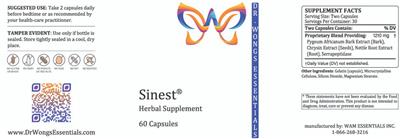
Supplement Facts
The label details for Sinest by Dr. Wong's Essentials, sourced from the NIH Dietary Supplement Label Database.
Supplement Facts
| Ingredient | Amount | % DV |
|---|---|---|
| Proprietary Blend | 1210 mg | -- |
| Nettle Root Extract | 0 NP | -- |
| Serrapeptidase | 0 NP | -- |
| Pygeum africanum Bark Extract | 0 NP | -- |
| Chrysin Seed Extract | 0 NP | -- |
Other ingredients: Gelatin, Microcrystalline Cellulose, Silicon Dioxide, Magnesium Stearate
Tap any ingredient to jump to its full detail below.
These statements are the manufacturer’s wording, reproduced from the product label — the label is saying it, not HelloPharmacist. We don’t verify or endorse them.
Suggested/Recommended/Usage/Directions
Suggested use: Take 2 capsules daily before bedtime or as recommended by your health-care practitioner.
Precautions
Tamper evident: Use only if bottle is sealed.
Storage
Store tightly sealed in a cool, dry place.
Formulation
No gluten or wheat No dairy No peanuts or tree nuts No eggs No soy No seafood
FDA Statement of Identity
Herbal Supplement
FDA Disclaimer Statement
These statements have not been evaluated by the Food and Drug Administration. This product is not intended to diagnose, treat, cure or prevent any disease.
Is this label outdated? Report a formula or label change and our pharmacy team will review it.
Sinest by Dr. Wong's Essentials label
The label scan from the NIH Dietary Supplement Label Database. Tap to enlarge.
Label images are published by the NIH Dietary Supplement Label Database for the version of this product on file. Always read your actual product label.
View the full label (PDF)The Ingredients in Sinest by Dr. Wong's Essentials
These are the 4 active ingredients this product is made of. Select any to open its full monograph.
Serving size2 Capsule(s) Dosage formCapsule Servings per container30 Amounts shown are per serving.
Most supplement products combine several ingredients, and a medication can interact with the product through any one of them. Each ingredient below shows whether it has known drug interactions.
Proprietary Blend
- › Nettle Root Extract
- › Serrapeptidase
- › Pygeum africanum Bark Extract
- › Chrysin Seed Extract
Other (inactive) ingredients: Gelatin, Microcrystalline Cellulose, Silicon Dioxide, Magnesium Stearate. These complete the product’s ingredient list but are not active constituents.
Sinest by Dr. Wong's Essentials Drug Interactions
HelloPharmacist Interaction Report
Sinest by Dr.
Wong's Essentials contains four ingredients, and we have interaction data for three of them. The most serious concern is with nettle root extract and blood thinners like warfarin — nettle is high in vitamin K, which can interfere with how warfarin works and reduce its protective effect against clots.
Read the full breakdown — every affected drug type, severity by severity
Nettle root also interacts with diabetes medications, water pills (diuretics), and lithium. Because nettle may lower blood sugar, combining it with diabetes drugs could push your levels too low.
With diuretics, the effect on fluid balance could add up. And with lithium, nettle's diuretic properties might change how your body clears it, potentially raising lithium levels to unsafe amounts.
Chrysm seed extract carries its own Moderate interactions with estrogen therapy and birth control pills — it may weaken their effects. It also theoretically increases bleeding risk with blood thinners and aspirin-like drugs, and may interfere with a few specific medications (diclofenac, aromatase inhibitors, and mephenytoin).
We could not check serrapeptidase — we hold no data for it.
Altogether, these interactions span 512 individual medications. Use the medication checker below with your exact prescriptions before you start.
Check your own medications below · Editorial policy · How we use AI
Want to check YOUR meds against Sinest?
Ask about interactions with your drugs in plain English — “Can I take it with lisinopril?” — and we find you the answer in seconds, ingredient by ingredient.
Go to the checkerIngredients driving the most interactions
Individual Drug Interactions
The ingredients in Sinest interact with 514 drugs. Click any drug to see the details.
2 of the 4 ingredients in Sinest interact with drugs. Each result below shows which ingredient is responsible. Chrysin Seed Extract Nettle Root Extract
AbciximabReoPro
How Abciximab interacts with Sinest — through 1 ingredient. Tap an ingredient for the detail:
Chrysin Seed ExtractAnticoagulant/antiplatelet Drugs Moderate
Interaction Summary
Theoretically, chrysin might increase the risk of bleeding when taken with anticoagulant or antiplatelet drugs.
Read the full Chrysin Seed Extract + Abciximab interactionAbrocitinibCibinqo
How Abrocitinib interacts with Sinest — through 1 ingredient. Tap an ingredient for the detail:
Chrysin Seed ExtractAnticoagulant/antiplatelet Drugs Moderate
Interaction Summary
Theoretically, chrysin might increase the risk of bleeding when taken with anticoagulant or antiplatelet drugs.
Read the full Chrysin Seed Extract + Abrocitinib interactionAcarboseGlucobay, Prandase, Precose
How Acarbose interacts with Sinest — through 1 ingredient. Tap an ingredient for the detail:
Nettle Root ExtractAntidiabetes Drugs Moderate
Interaction Summary
Theoretically, stinging nettle might have additive effects with antidiabetes drugs.
Read the full Nettle Root Extract + Acarbose interactionAcenocoumarolSintrom
How Acenocoumarol interacts with Sinest — through 1 ingredient. Tap an ingredient for the detail:
Chrysin Seed ExtractAnticoagulant/antiplatelet Drugs Moderate
Interaction Summary
Theoretically, chrysin might increase the risk of bleeding when taken with anticoagulant or antiplatelet drugs.
Read the full Chrysin Seed Extract + Acenocoumarol interactionAcetaminophen, AspirinGemnisyn
How Acetaminophen, Aspirin interacts with Sinest — through 1 ingredient. Tap an ingredient for the detail:
Chrysin Seed ExtractCytochrome P450 1a2 (cyp1a2) Substrates, Anticoagulant/antiplatelet Drugs +1 Moderate
Interaction Summary
Theoretically, chrysin might increase levels of drugs metabolized by CYP1A2.
Read the full Chrysin Seed Extract + Acetaminophen, Aspirin interactionAcetaminophen, Aspirin, CaffeineExcedrin, Excedrin Extra Strength, Excedrin Migraine
How Acetaminophen, Aspirin, Caffeine interacts with Sinest — through 1 ingredient. Tap an ingredient for the detail:
Chrysin Seed ExtractGlucuronidated Drugs, Cytochrome P450 1a2 (cyp1a2) Substrates +1 Moderate
Interaction Summary
Theoretically, chrysin might increase the clearance of drugs that are UGT1A1 substrates, thereby reducing their effectiveness.
Read the full Chrysin Seed Extract + Acetaminophen, Aspirin, Caffeine interactionAcetaminophen, Caffeine, PyrilamineMidol Max Strength Menstrual
How Acetaminophen, Caffeine, Pyrilamine interacts with Sinest — through 2 ingredients. Tap an ingredient for the detail:
Nettle Root ExtractDiuretic Drugs Moderate
Interaction Summary
Theoretically, combining stinging nettle with diuretic drugs may have additive effects.
Read the full Nettle Root Extract + Acetaminophen, Caffeine, Pyrilamine interactionChrysin Seed ExtractGlucuronidated Drugs, Cytochrome P450 1a2 (cyp1a2) Substrates Minor
Interaction Summary
Theoretically, chrysin might increase the clearance of drugs that are UGT1A1 substrates, thereby reducing their effectiveness.
Read the full Chrysin Seed Extract + Acetaminophen, Caffeine, Pyrilamine interactionAcetaminophen, IbuprofenCombogesic
How Acetaminophen, Ibuprofen interacts with Sinest — through 1 ingredient. Tap an ingredient for the detail:
Chrysin Seed ExtractAnticoagulant/antiplatelet Drugs, Glucuronidated Drugs +1 Moderate
Interaction Summary
Theoretically, chrysin might increase the risk of bleeding when taken with anticoagulant or antiplatelet drugs.
Read the full Chrysin Seed Extract + Acetaminophen, Ibuprofen interactionAcetaminophen, Pamabrom, PyrilamineMidol Max Strength PMS, Pamprin, Pamprin ES
How Acetaminophen, Pamabrom, Pyrilamine interacts with Sinest — through 2 ingredients. Tap an ingredient for the detail:
Nettle Root ExtractDiuretic Drugs Moderate
Interaction Summary
Theoretically, combining stinging nettle with diuretic drugs may have additive effects.
Read the full Nettle Root Extract + Acetaminophen, Pamabrom, Pyrilamine interactionChrysin Seed ExtractCytochrome P450 1a2 (cyp1a2) Substrates, Glucuronidated Drugs Minor
Interaction Summary
Theoretically, chrysin might increase levels of drugs metabolized by CYP1A2.
Read the full Chrysin Seed Extract + Acetaminophen, Pamabrom, Pyrilamine interactionAcetazolamideAk-Zol, Diamox
How Acetazolamide interacts with Sinest — through 1 ingredient. Tap an ingredient for the detail:
Nettle Root ExtractDiuretic Drugs Moderate
Interaction Summary
Theoretically, combining stinging nettle with diuretic drugs may have additive effects.
Read the full Nettle Root Extract + Acetazolamide interactionAcetohexamideDymelor
How Acetohexamide interacts with Sinest — through 1 ingredient. Tap an ingredient for the detail:
Nettle Root ExtractAntidiabetes Drugs Moderate
Interaction Summary
Theoretically, stinging nettle might have additive effects with antidiabetes drugs.
Read the full Nettle Root Extract + Acetohexamide interactionAcetylsalicylic AcidEntrophen
How Acetylsalicylic Acid interacts with Sinest — through 1 ingredient. Tap an ingredient for the detail:
Chrysin Seed ExtractAnticoagulant/antiplatelet Drugs Moderate
Interaction Summary
Theoretically, chrysin might increase the risk of bleeding when taken with anticoagulant or antiplatelet drugs.
Read the full Chrysin Seed Extract + Acetylsalicylic Acid interactionAlbiglutideTanzeum
How Albiglutide interacts with Sinest — through 1 ingredient. Tap an ingredient for the detail:
Nettle Root ExtractAntidiabetes Drugs Moderate
Interaction Summary
Theoretically, stinging nettle might have additive effects with antidiabetes drugs.
Read the full Nettle Root Extract + Albiglutide interactionAlogliptinNesina
How Alogliptin interacts with Sinest — through 1 ingredient. Tap an ingredient for the detail:
Nettle Root ExtractAntidiabetes Drugs Moderate
Interaction Summary
Theoretically, stinging nettle might have additive effects with antidiabetes drugs.
Read the full Nettle Root Extract + Alogliptin interactionAlogliptin, MetforminKazano
How Alogliptin, Metformin interacts with Sinest — through 1 ingredient. Tap an ingredient for the detail:
Nettle Root ExtractAntidiabetes Drugs Moderate
Interaction Summary
Theoretically, stinging nettle might have additive effects with antidiabetes drugs.
Read the full Nettle Root Extract + Alogliptin, Metformin interactionAlogliptin, PioglitazoneOseni
How Alogliptin, Pioglitazone interacts with Sinest — through 1 ingredient. Tap an ingredient for the detail:
Nettle Root ExtractAntidiabetes Drugs Moderate
Interaction Summary
Theoretically, stinging nettle might have additive effects with antidiabetes drugs.
Read the full Nettle Root Extract + Alogliptin, Pioglitazone interactionAlteplase, TpaActilyse, Activase
How Alteplase, Tpa interacts with Sinest — through 1 ingredient. Tap an ingredient for the detail:
Chrysin Seed ExtractAnticoagulant/antiplatelet Drugs Moderate
Interaction Summary
Theoretically, chrysin might increase the risk of bleeding when taken with anticoagulant or antiplatelet drugs.
Read the full Chrysin Seed Extract + Alteplase, Tpa interactionAluminum Hydroxide, Aspirin, Codeine Phosphate, Magnesium HydroxideAscriptin Codeine #2
How Aluminum Hydroxide, Aspirin, Codeine Phosphate, Magnesium Hydroxide interacts with Sinest — through 1 ingredient. Tap an ingredient for the detail:
Chrysin Seed ExtractAnticoagulant/antiplatelet Drugs Moderate
Interaction Summary
Theoretically, chrysin might increase the risk of bleeding when taken with anticoagulant or antiplatelet drugs.
Read the full Chrysin Seed Extract + Aluminum Hydroxide, Aspirin, Codeine Phosphate, Magnesium Hydroxide interactionAluminum Hydroxide, Aspirin, Magnesium HydroxideAscriptin
How Aluminum Hydroxide, Aspirin, Magnesium Hydroxide interacts with Sinest — through 1 ingredient. Tap an ingredient for the detail:
Chrysin Seed ExtractAnticoagulant/antiplatelet Drugs Moderate
Interaction Summary
Theoretically, chrysin might increase the risk of bleeding when taken with anticoagulant or antiplatelet drugs.
Read the full Chrysin Seed Extract + Aluminum Hydroxide, Aspirin, Magnesium Hydroxide interactionAmiloride, HydrochlorothiazideAmil-Co, Amilzide, Moduret 25, Moduretic
How Amiloride, Hydrochlorothiazide interacts with Sinest — through 1 ingredient. Tap an ingredient for the detail:
Nettle Root ExtractDiuretic Drugs Moderate
Interaction Summary
Theoretically, combining stinging nettle with diuretic drugs may have additive effects.
Read the full Nettle Root Extract + Amiloride, Hydrochlorothiazide interactionAmmonium ChlorideAmmonium Chloride
How Ammonium Chloride interacts with Sinest — through 1 ingredient. Tap an ingredient for the detail:
Nettle Root ExtractDiuretic Drugs Moderate
Interaction Summary
Theoretically, combining stinging nettle with diuretic drugs may have additive effects.
Read the full Nettle Root Extract + Ammonium Chloride interactionAnacaulase-bcdbNexoBrid
How Anacaulase-bcdb interacts with Sinest — through 1 ingredient. Tap an ingredient for the detail:
Chrysin Seed ExtractAnticoagulant/antiplatelet Drugs Moderate
Interaction Summary
Theoretically, chrysin might increase the risk of bleeding when taken with anticoagulant or antiplatelet drugs.
Read the full Chrysin Seed Extract + Anacaulase-bcdb interactionAnagrelideAgrylin
How Anagrelide interacts with Sinest — through 1 ingredient. Tap an ingredient for the detail:
Chrysin Seed ExtractCytochrome P450 1a2 (cyp1a2) Substrates, Anticoagulant/antiplatelet Drugs Moderate
Interaction Summary
Theoretically, chrysin might increase levels of drugs metabolized by CYP1A2.
Read the full Chrysin Seed Extract + Anagrelide interactionAnastrozoleArimidex
How Anastrozole interacts with Sinest — through 1 ingredient. Tap an ingredient for the detail:
Chrysin Seed ExtractAromatase Inhibitors Moderate
Interaction Summary
Theoretically, chrysin might increase the effects and adverse effects of aromatase inhibitors.
Read the full Chrysin Seed Extract + Anastrozole interactionAnisindioneMiradon
How Anisindione interacts with Sinest — through 1 ingredient. Tap an ingredient for the detail:
Chrysin Seed ExtractAnticoagulant/antiplatelet Drugs Moderate
Interaction Summary
Theoretically, chrysin might increase the risk of bleeding when taken with anticoagulant or antiplatelet drugs.
Read the full Chrysin Seed Extract + Anisindione interactionAntidiabetes, Dipeptidyl Peptidase-4 (dpp-iv) InhibitorGlyxambi
How Antidiabetes, Dipeptidyl Peptidase-4 (dpp-iv) Inhibitor interacts with Sinest — through 1 ingredient. Tap an ingredient for the detail:
Nettle Root ExtractAntidiabetes Drugs Moderate
Interaction Summary
Theoretically, stinging nettle might have additive effects with antidiabetes drugs.
Read the full Nettle Root Extract + Antidiabetes, Dipeptidyl Peptidase-4 (dpp-iv) Inhibitor interactionAntithrombin IiiThrombate III
How Antithrombin Iii interacts with Sinest — through 1 ingredient. Tap an ingredient for the detail:
Chrysin Seed ExtractAnticoagulant/antiplatelet Drugs Moderate
Interaction Summary
Theoretically, chrysin might increase the risk of bleeding when taken with anticoagulant or antiplatelet drugs.
Read the full Chrysin Seed Extract + Antithrombin Iii interactionApixabanEliquis
How Apixaban interacts with Sinest — through 1 ingredient. Tap an ingredient for the detail:
Chrysin Seed ExtractAnticoagulant/antiplatelet Drugs Moderate
Interaction Summary
Theoretically, chrysin might increase the risk of bleeding when taken with anticoagulant or antiplatelet drugs.
Read the full Chrysin Seed Extract + Apixaban interactionArgatrobanArgatroban
How Argatroban interacts with Sinest — through 1 ingredient. Tap an ingredient for the detail:
Chrysin Seed ExtractAnticoagulant/antiplatelet Drugs Moderate
Interaction Summary
Theoretically, chrysin might increase the risk of bleeding when taken with anticoagulant or antiplatelet drugs.
Read the full Chrysin Seed Extract + Argatroban interactionAspirinAngettes 75, ASA, Asaphen, Aspirin, Caprin, Cartia +8 more
How Aspirin interacts with Sinest — through 1 ingredient. Tap an ingredient for the detail:
Chrysin Seed ExtractAnticoagulant/antiplatelet Drugs Moderate
Interaction Summary
Theoretically, chrysin might increase the risk of bleeding when taken with anticoagulant or antiplatelet drugs.
Read the full Chrysin Seed Extract + Aspirin interactionEach ingredient & the kinds of drugs it affects
For each ingredient in Sinest with known interactions, here are the types of medications they can affect. Open any type for the detail — or search your exact drug in the checker above.
Chrysin Seed Extract
Anticoagulant/Antiplatelet Drugs
Theoretically, chrysin might increase the risk of bleeding when taken with anticoagulant or antiplatelet drugs.
In vitro evidence suggests that chrysin might inhibit platelet aggregation.
Aromatase Inhibitors
Theoretically, chrysin might increase the effects and adverse effects of aromatase inhibitors.
In vitro research suggests that chrysin might decrease estrogen synthesis by acting as an aromatase (estrogen synthetase) inhibitor..
Contraceptive Drugs
Theoretically, chrysin might reduce the efficacy of estrogen-containing contraceptive drugs.
In vitro research suggests that chrysin might have antiestrogenic activity.
Diclofenac (Voltaren, Others)
Theoretically, chrysin might increase the effects and adverse effects of diclofenac.
In vitro research suggests that chrysin and its sulfate conjugate inhibit diclofenac metabolism. It is speculated that chrysin and its sulfate conjugate reduce the metabolism of diclofenac by inhibiting cytochrome P450 2C9. This effect has not been reported in humans.
Estrogens
Theoretically, chrysin might decrease the effects of estrogen therapy.
In vitro research suggests that chrysin might have antiestrogenic activity.
Mephenytoin (Mesantoin)
Theoretically, chrysin might increase the effects and adverse effects of mephenytoin.
In vitro research suggests that chrysin and its sulfate and glucuronide conjugates inhibit S-mephenytoin metabolism. It is speculated that chrysin and its conjugates reduce the metabolism of S-mephenytoin by inhibiting cytochrome P450 2C19. This effect has not been reported in humans.
Cytochrome P450 1A2 (Cyp1A2) Substrates
Theoretically, chrysin might increase levels of drugs metabolized by CYP1A2.
In vitro research suggests that chrysin inhibits CYP1A2 isozymes. However, chrysin does not appear to inhibit CYP1A2-dependent caffeine metabolism in animals. Due to chrysin's low bioavailability and rapid metabolism to glucuronide and sulfate conjugates, this interaction is unlikely.
Glucuronidated Drugs
Theoretically, chrysin might increase the clearance of drugs that are UGT1A1 substrates, thereby reducing their effectiveness.
In vitro research suggests that chrysin might induce UDP-glucuronosyltransferase 1A1 (UGT1A1).
Testosterone
Theoretically, chrysin might increase the effects and adverse effects of testosterone.
In vitro research suggests that chrysin and its sulfate conjugate inhibit testosterone metabolism. It is speculated that chrysin and its sulfate conjugate reduce the metabolism of testosterone by inhibiting cytochrome P450 3A4. This effect has not been reported in humans.
Nettle Root Extract
Antidiabetes Drugs
Theoretically, stinging nettle might have additive effects with antidiabetes drugs.
Clinical research shows that stinging nettle might decrease blood glucose levels in patients with diabetes.
Diuretic Drugs
Theoretically, combining stinging nettle with diuretic drugs may have additive effects.
Animal research suggests that the above ground parts and roots of stinging nettle may have a diuretic effect.
Lithium
Theoretically, stinging nettle might reduce excretion and increase levels of lithium.
Animal research suggests that stinging nettle has diuretic and natriuretic properties, which could alter the excretion of lithium. The dose of lithium might need to be decreased.
Warfarin (Coumadin)
There is some concern that stinging nettle might decrease the effects of anticoagulant drugs such as warfarin.
Stinging nettle contains a significant amount of vitamin K. When taken in large quantities, this might interfere with the activity of warfarin.
Brand information
Manufacturer and brand details for Sinest, from the product label.
Dr. Wong's Essentials
See all Dr. Wong's Essentials products- Name
- WAM Essentials Inc.
- Phone Number
- 1-866-268-3216
- Web Address
- www.DrWongsEssentials.com
Sinest by Dr. Wong's Essentials: Common Questions
Does Sinest by Dr. Wong's Essentials interact with any medications?
How can one product interact with so many drugs?
Where does this information come from?
Can I take Sinest if I'm on warfarin or another blood thinner?
Is Sinest safe to take if I'm pregnant or breastfeeding?
What is nettle root extract used for in this product?
What are the most common side effects of Sinest?
Will Sinest work if I'm on diabetes medication?
Does Sinest affect birth control?
Written and reviewed by the HelloPharmacist editorial staff. Our editorial policy
Not sure if Sinest is safe with your meds?
Our pharmacists answer your medication & supplement questions — free.
Label information is sourced from the NIH Dietary Supplement Label Database and reflects the product version on file; always read your actual product label. This page is for education only and is not a substitute for professional medical advice. Confirm with your pharmacist or doctor before combining supplements and medications.
The Full Monographs Behind Sinest’s Ingredients
Every ingredient we hold a full HelloPharmacist monograph for — uses, evidence, safety, and the complete interaction list.
Stinging Nettle
Interacts with 164 drugsStinging nettle is a common plant used as food and in traditional medicine, most often for prostate symptoms, allergies, and joint pain. The evidence is mixed and mostly preliminary, so it i...
Read the full Stinging Nettle monograph → Herb & supplement monographPygeum
Pygeum is an extract from the bark of the African cherry tree that is most often used to ease urinary symptoms linked to an enlarged prostate. Some studies suggest modest benefit for these s...
Read the full Pygeum monograph → Herb & supplement monographChrysin
Interacts with 358 drugsChrysin is a plant flavonoid sold mainly as a bodybuilding supplement claimed to raise testosterone or block estrogen, but human studies have not shown these benefits, largely because the bo...
Read the full Chrysin monograph →Sources & How We Checked
Sinest's label data comes from the NIH Dietary Supplement Label Database; the ingredient interaction data is from the Natural Medicines database, reviewed by our pharmacists.
- NIH Dietary Supplement Label Database (DSLD) — The official product label on file for this supplement.
- Natural Medicines (Therapeutic Research Center) — Evidence-graded clinical reference behind the ingredient interaction data.
Content is written and reviewed by licensed HelloPharmacist pharmacists. See our data sources and editorial standards for how this information is built and checked.
The 49 references behind this product’s interaction data
Every citation that drives the interaction findings for this product’s ingredients, from the evidence-graded Natural Medicines (TRC Healthcare) database. Open an ingredient to browse its citations — links open the study on PubMed or the publisher’s site.
Stinging Nettle 23 references
- Monographs on the medicinal uses of plant drugs. Exeter, UK: European Scientific Co-op Phytother, 1997.
- Newall CA, Anderson LA, Philpson JD. Herbal Medicine: A Guide for Healthcare Professionals. London, UK: The Pharmaceutical Press, 1996.
- The Review of Natural Products by Facts and Comparisons. St. Louis, MO: Wolters Kluwer Co., 1999.
- Schulz V, Hansel R, Tyler VE. Rational Phytotherapy: A Physician's Guide to Herbal Medicine. Terry C. Telger, transl. 3rd ed. Berlin, GER: Springer, 1998.
- Leung AY, Foster S. Encyclopedia of Common Natural Ingredients Used in Food, Drugs and Cosmetics. 2nd ed. New York, NY: John Wiley & Sons, 1996.
- Brinker F. Herb Contraindications and Drug Interactions. 2nd ed. Sandy, OR: Eclectic Medical Publications, 1998.
- Mittman P. Randomized, double-blind study of freeze-dried Urtica dioica in the treatment of allergic rhinitis. Planta Med 1990;56:44-7.
- Vontobel HP, Herzog R, Rutishauser G, Kres H. [Results of a double-blind study on the effectiveness of ERU (extractum radicis Urticae) capsules in conservative treatment of benign prostatic hyperplasia]. (Abstract). Urologe A 1985;24:49-51.
- Randall C, Randall H, Dobbs F, et al. Randomized controlled trial of nettle sting for treatment of base-of-thumb pain. J R Soc Med 2000;93:305-9. PubMed
- Caliskaner Z, Karaayvaz M, Ozturk S. Misuse of a herb: stinging nettle (Urtica urens) induced severe tongue oedema. Complement Ther Med 2004;12:57-8. PubMed
- Krzeski, T., Kazon, M., Borkowski, A., Witeska, A., and Kuczera, J. Combined extracts of Urtica dioica and Pygeum africanum in the treatment of benign prostatic hyperplasia: double-blind comparison of two doses. Clin Ther 1993;15(6):1011-1020.
- Randall, C., Meethan, K., Randall, H., and Dobbs, F. Nettle sting of Urtica dioica for joint pain--an exploratory study of this complementary therapy. Complement Ther Med 1999;7(3):126-131. PubMed
- Tahri, A., Yamani, S., Legssyer, A., Aziz, M., Mekhfi, H., Bnouham, M., and Ziyyat, A. Acute diuretic, natriuretic and hypotensive effects of a continuous perfusion of aqueous extract of Urtica dioica in the rat. J Ethnopharmacol 2000;73(1-2):95-100. PubMed
- Sahin, M., Yilmaz, H., Gursoy, A., Demirel, A. N., Tutuncu, N. B., and Guvener, N. D. Gynaecomastia in a man and hyperoestrogenism in a woman due to ingestion of nettle (Urtica dioica). N.Z.Med.J. 2007;120(1265):U2803.
- Randall, C., Dickens, A., White, A., Sanders, H., Fox, M., and Campbell, J. Nettle sting for chronic knee pain: a randomised controlled pilot study. Complement Ther.Med. 2008;16(2):66-72. PubMed
- Rayburn, K., Fleischbein, E., Song, J., Allen, B., Kundert, M., Leiter, C., and Bush, T. Stinging nettle cream for osteoarthritis. Altern.Ther.Health Med. 2009;15(4):60-61.
- Oliver, F., Amon, E. U., Breathnach, A., Francis, D. M., Sarathchandra, P., Black, A. K., and Greaves, M. W. Contact urticaria due to the common stinging nettle (Urtica dioica)-- histological, ultrastructural and pharmacological studies. Clin Exp Dermato PubMed
- Kulze, A. and Greaves, M. Contact urticaria caused by stinging nettles. Br.J Dermatol. 1988;119(2):269-270. PubMed
- Patten G. Medicinal plant review: Urtica. Aust J Med Herbalism 1993;5(1):5-13.
- Maor D, Little M. Skin contact with a stinging tree requiring intensive care unit admission. Contact Dermatitis. 2017 Nov;77(5):335-37. PubMed
- Easton L, Vaid S, Nagel AK, Venci JV, Fortuna RJ. Stinging Nettle (Urtica dioica): An Unusual Case of Galactorrhea. Am J Case Rep 2021;22:e933999. PubMed
- Niazi B, Ahmed K, Ahmed M, Ali S, Song K, Elias S. Drug-Induced Liver Injury from Herbal Liver Detoxification Tea. Case Rep Gastroenterol 2022;16(3):612-617. PubMed
- Nnamani I, Tolu-Akinnawo O, Dufera RR, Akintunde A, Maliakkal B. Tinospora cordifolia (Guduchi/Giloy)-Induced Liver Injury: A Case Review. Cureus 2023;15(5):e39793. PubMed
Pygeum 3 references
- Ishani A, MacDonald R, Nelson D, et al. Pygeum africanum for the treatment of patients with benign prostatic hyperplasia: a systematic review and quantitative meta-analysis. Am J Med 2000;109:654-64.. PubMed
- Wilt T, Ishani A, Mac Donald R, et al. Pygeum africanum for benign prostatic hyperplasia. Cochrane Database Syst Rev 2002;CD001044.. PubMed
- Andro M and Riffaud J. Pygeum africanum extract for the treatment of patients with benign prostatic hyperplasia: a review of 25 years of published experience. Curr Ther Res 1995;56(8):796-817. DOI
Chrysin 23 references
- Galijatovic A, Otake Y, Walle UK, Walle T. Extensive metabolism of the flavonoid chrysin by human Caco-2 and Hep G2 cells. Xenobiotica 1999;29:1241-56. PubMed
- Lee H, Yeom H, Kim YG, et al. Structure-related inhibition of human hepatic caffeine N3-demethylation by naturally occurring flavonoids. Biochem Pharmacol 1998;55:1369-75. PubMed
- Galijatovic A, Walle UK, Walle T. Induction of UDP-glucuronosyltransferase by the flavonoids chrysin and quercetin in Caco-2 cells. Pharm Res 2000;17:21-6.
- Walle UK, Galijatovic A, Walle T. Transport of the flavonoid chrysin and its conjugated metabolites by the human intestinal cell line Caco-2. Biochem Pharmacol 1999;58:431-8. PubMed
- Kao YC, Zhou C, Sherman M, et al. Molecular basis of the inhibition of human aromatase (estrogen synthetase) by flavone and isoflavone phytoestrogens: A site-directed mutagenesis study. Environ Health Perspect 1998;106:85-92. PubMed
- Jeong HJ, Shin YG, Kim IH, Pezzuto JM. Inhibition of aromatase activity by flavonoids. Arch Pharm Res 1999;22:309-12. PubMed
- Walle T, Otake Y, Galijatovic A, et al. Induction of UDP-glucuronosyltransferase UGT1A1 by the flavonoid chrysin in the human hepatoma cell line hep G2. Drug Metab Dispos 2000;28:1077-82. DOI
- Walle T, Otake Y, Brubaker JA, et al. Disposition and metabolism of the flavonoid chrysin in normal volunteers. Br J Clin Pharmacol 2001;51:143-6. DOI
- Galijatovic A, Otake Y, Walle UK, Walle T. Induction of UDP-glucuronosyltransferase UGT1A1 by the flavonoid chrysin in Caco-2 cells--potential role in carcinogen bioinactivation. Pharm Res 2001;18:374-9. PubMed
- Lautraite S, Musonda AC, Doehmer J, et al. Flavonoids inhibit genetic toxicity produced by carcinogens in cells expressing CYP1A2 and CYP1A1. Mutagenesis 2002;17:45-53. PubMed
- Han, D. H., Denison, M. S., Tachibana, H., and Yamada, K. Relationship between estrogen receptor-binding and estrogenic activities of environmental estrogens and suppression by flavonoids. Biosci.Biotechnol.Biochem 2002;66(7):1479-1487. PubMed
- O'Leary, K. A., de Pascual-Tereasa, S., Needs, P. W., Bao, Y. P., O'Brien, N. M., and Williamson, G. Effect of flavonoids and vitamin E on cyclooxygenase-2 (COX-2) transcription. Mutat.Res 7-13-2004;551(1-2):245-254. PubMed
- Woodman, O. L. and Chan, E. C. Vascular and anti-oxidant actions of flavonols and flavones. Clin Exp Pharmacol Physiol 2004;31(11):786-790. PubMed
- Simons, A. L., Renouf, M., Hendrich, S., and Murphy, P. A. Human gut microbial degradation of flavonoids: structure-function relationships. J Agric.Food Chem 5-18-2005;53(10):4258-4263. PubMed
- Kim, H. J., Lee, S. B., Park, S. K., Kim, H. M., Park, Y. I., and Dong, M. S. Effects of hydroxyl group numbers on the B-ring of 5,7-dihydroxyflavones on the differential inhibition of human CYP 1A and CYP1B1 enzymes. Arch Pharm Res 2005;28(10):1114-1121 PubMed
- Moon, Y. J., Wang, X., and Morris, M. E. Dietary flavonoids: effects on xenobiotic and carcinogen metabolism. Toxicol In Vitro 2006;20(2):187-210. PubMed
- Landolfi, R., Mower, R. L., and Steiner, M. Modification of platelet function and arachidonic acid metabolism by bioflavonoids. Structure-activity relations. Biochem Pharmacol 5-1-1984;33(9):1525-1530. PubMed
- Tsyrlov, I. B., Mikhailenko, V. M., and Gelboin, H. V. Isozyme- and species-specific susceptibility of cDNA-expressed CYP1A P-450s to different flavonoids. Biochim.Biophys Acta 4-13-1994;1205(2):325-335. PubMed
- Collins, B. M., McLachlan, J. A., and Arnold, S. F. The estrogenic and antiestrogenic activities of phytochemicals with the human estrogen receptor expressed in yeast. Steroids 1997;62(4):365-372. PubMed
- Kuiper, G. G., Lemmen, J. G., Carlsson, B., Corton, J. C., Safe, S. H., van der Saag, P. T., van der Burg, B., and Gustafsson, J. A. Interaction of estrogenic chemicals and phytoestrogens with estrogen receptor beta. Endocrinology 1998;139(10):4252-4263. PubMed
- Liu G, Xie W, He AD, et al. Antiplatelet activity of chrysin via inhibiting platelet aIIbß3-mediated signaling pathway. Mol Nutr Food Res 2016;60(9):1984-93.
- Noh K, Oh do G, Nepal MR, et al. Pharmacokinetic interaction of chrysin with caffeine in rats. Biomol Ther (Seoul) 2016;24(4):446-52. PubMed
- Mohos V, Fliszár-Nyúl E, Ungvári O, et al. Effects of Chrysin and Its Major Conjugated Metabolites Chrysin-7-Sulfate and Chrysin-7-Glucuronide on Cytochrome P450 Enzymes and on OATP, P-gp, BCRP, and MRP2 Transporters. Drug Metab Dispos 2020;48(10):1064-10 PubMed
Parts of this content are provided by the Therapeutic Research Center, LLC.
DISCLAIMER: Currently this does not check for drug-drug interactions. This is not an all-inclusive comprehensive list of potential interactions and is for informational purposes only. Not all interactions are known or well-reported in the scientific literature, and new interactions are continually being reported. Input is needed from a qualified healthcare provider including a pharmacist before starting any therapy. Application of clinical judgment is necessary.
© 2021 Therapeutic Research Center, LLC