
Whey Protein (Grass-Fed) Ingredients & Drug Interactions
What is this page for?
First and foremost: checking Whey Protein (Grass-Fed) against your medications. The heart of this page is the interaction checker and the full interaction report — how this product’s ingredients may interact with prescription and over-the-counter medicines you may be taking.
Around that, we add a pharmacist’s high-level view of the product as a whole — what’s inside, the evidence for its stated use, how transparent the label is, and what safety data exists — so you can see the full picture in one place. It’s educational information from our licensed clinical databases and the clinical staff at HelloPharmacist — not medical advice — and we don’t sell or endorse products. Our editorial policy
Whey Protein (Grass-Fed) is a dietary supplement by BulkSupplements.com with 1 active ingredient. Its ingredients are commonly taken for muscle building and recovery, increasing daily protein intake, weight management.Based on those ingredients, 53 medications have a known interaction with it, the most serious rated major. The ingredients most likely to interact are Whey Protein. Use the checker below to test your specific medication, or read the full HelloPharmacist Interaction Report.
Check Your Meds Against Whey Protein (Grass-Fed) by BulkSupplements.com
Ask about any prescription or over-the-counter medication and we check it for interactions with Whey Protein (Grass-Fed) by BulkSupplements.com — and tell you which ingredient is responsible.
AI summaries are generated from our interaction database for education only — always confirm with your pharmacist. How we use AI
Ask the Pharmacist
A licensed pharmacist will answer your question by email — free, usually within 24 hours.
Got it — thank you!
A licensed pharmacist will answer within 24 hours. Keep an eye on your email (worth checking spam, just in case).
HelloPharmacist Scorecard of Whey Protein (Grass-Fed) by BulkSupplements.com
Our pharmacy team’s full take, with four database checks built into the cards below — a summary of what is known, not a grade of the product itself.
What’s inside
Full disclosure
This product contains one active ingredient: whey protein from grass-fed sources. Whey protein is a complete protein derived from milk and provides all nine essential amino acids your body can't make on its own.
There are no other inactive ingredients listed.
Does it work?
Moderate evidence
The evidence for whey protein in athletic performance is possibly effective — meaning some studies support it, though the data isn't airtight. For bone health (osteoporosis) and lung function in COPD, the evidence leans toward possibly ineffective.
There isn't enough reliable evidence in our data to rate it for age-related memory loss or HIV/AIDS-related weight loss, so we can't say whether it helps with those.
How safe is it?
Well-documented data
Whey protein is generally well tolerated by most healthy adults at typical doses. The most common side effects are dose-related and include bloating, cramps, diarrhea, nausea, headache, fatigue, reflux, acne, reduced appetite, and thirst.
There's a documented pattern of whey protein triggering or worsening acne in teenagers and young adults; acne typically clears when the supplement stops. Because concentrated whey supplements aren't as well studied as whey as a food, check with your doctor before starting — especially at high doses.
Meds to double-check
Major interaction found
Check your medications before taking this product if you use levodopa (Major interaction — may worsen Parkinson symptoms), quinolone or tetracycline antibiotics (Moderate — need 2 to 4-6 hours separation), or bisphosphonates for bone health (Moderate — take at least 30 minutes before whey protein). Use the search tool below to verify your prescriptions.
The bottom line
Scorecard at a glanceFully disclosed formula with some supporting evidence behind its ingredients' uses. Major medication interactions have been identified, and safety information is well characterized.
Whey protein may help athletic performance and is tolerated well by most healthy adults. If you take levodopa for Parkinson disease or are on quinolone or tetracycline antibiotics or bisphosphonates, you need to space this product several hours away from those medications or avoid it altogether.
Watch for dose-related side effects like bloating, cramps, or acne. Talk to your pharmacist about your exact medications before you start.
Educational only — not medical advice; always confirm with your pharmacist. Our editorial policy · How we use AI
Assessment coverage: 1 of 1 active ingredient matched to our full ingredient reviews (monographs). Based on the product label dated May 23, 2024.
This Scorecard evaluates available label information, ingredient evidence, and known medication-safety considerations. It does not independently verify product identity, purity, potency, contamination, or manufacturing quality. How these ratings are computed
General information
Key facts about Whey Protein (Grass-Fed), straight from the product label.
| Brand | BulkSupplements.com |
|---|---|
| Barcode (UPC) | X000TE8753 |
| Net contents | 500 Gram(s); 17.6 Ounce(s); 1.1 Pound(s) |
| Market status | On market |
| Date entered into DSLD | May 23, 2024 |
| DSLD ID | 312357 |
| Product type | Amino Acid/protein |
| Supplement form | Powder |
| Dietary claims / uses | All Other, Structure/Function |
| Intended target group(s) | Adult (18 - 50 Years) |
Everything in this section is reproduced from the manufacturer’s own product label — it’s the label speaking, not HelloPharmacist. We show it so you can see exactly what the maker states; we don’t verify or endorse those statements.
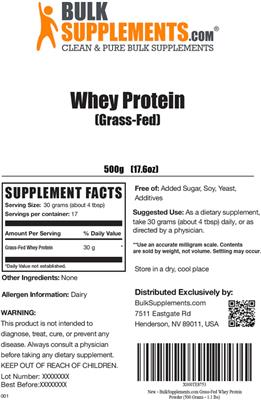
Supplement Facts
The label details for Whey Protein (Grass-Fed) by BulkSupplements.com, sourced from the NIH Dietary Supplement Label Database.
Supplement Facts
| Ingredient | Amount | % DV |
|---|---|---|
| Whey Protein | 30 Gram(s) | -- |
Tap any ingredient to jump to its full detail below.
These statements are the manufacturer’s wording, reproduced from the product label — the label is saying it, not HelloPharmacist. We don’t verify or endorse them.
Brand IP Statement(s)
Bulksupplements.com Clean & pure bulk supplements
Formulation
Free of: Added sugar, soy, yeast, additives
Suggested/Recommended/Usage/Directions
Suggested use: As a dietary supplement, take 30 grams (about 4 tbsp) daily, or as directed by a physician.
General Statements
Use an accurate milligram scale.
New
Storage
Contents are sold by weight, not volume. Settling may occur. Store in a dry, cool place
Precautions
Allergen information: Dairy
Always consult a physician before taking any dietary supplement.
Keep out of reach of children.
FDA Disclaimer Statement
Warning: This product is not intended to diagnose, treat, cure, or prevent any disease.
Is this label outdated? Report a formula or label change and our pharmacy team will review it.
Whey Protein (Grass-Fed) by BulkSupplements.com label
The label scan from the NIH Dietary Supplement Label Database. Tap to enlarge.
Label images are published by the NIH Dietary Supplement Label Database for the version of this product on file. Always read your actual product label.
View the full label (PDF)The Ingredients in Whey Protein (Grass-Fed) by BulkSupplements.com
This is the 1 active ingredient this product is made of. Select it to open its full monograph.
Serving size30 Gram(s) Dosage formPowder Servings per container17 Amounts shown are per serving.
Whey Protein
Interacts with53 drugs
Whey protein is a high-quality, complete protein made from cow's milk that can help people meet protein needs and support muscle growth when combined...
Whey Protein monograph & interactionsWhey Protein (Grass-Fed) by BulkSupplements.com Drug Interactions
HelloPharmacist Interaction Report
BulkSupplements.com Whey Protein has documented interactions with several medication types.
The most serious concern is with levodopa (used for Parkinson disease): whey protein may lower how much levodopa your body absorbs, and studies show that protein alongside levodopa can worsen tremor, rigidity, and "on-off" episodes in people with Parkinson disease.
Read the full breakdown — every affected drug type, severity by severity
You'll also want to time this product carefully around certain antibiotics. Whey protein contains minerals like calcium that bind to quinolone and tetracycline antibiotics in your gut, reducing how much antibiotic you absorb — take those at least 2 hours before or 4-6 hours after whey protein.
The same mineral-binding issue affects bisphosphonates (bone medications): take them at least 30 minutes before whey protein, ideally at a different time of day.
Altogether, these interactions span 53 individual medications. Use the interaction checker below to run your exact prescriptions through before you start.
Check your own medications below · Editorial policy · How we use AI
Want to check YOUR meds against Whey Protein (Grass-Fed)?
Ask about interactions with your drugs in plain English — “Can I take it with lisinopril?” — and we find you the answer in seconds, ingredient by ingredient.
Go to the checkerIngredients driving the most interactions
Individual Drug Interactions
The ingredients in Whey Protein (Grass-Fed) interact with 53 drugs. Click any drug to see the details.
1 of the 1 ingredient in Whey Protein (Grass-Fed) interact with drugs. Each result below shows which ingredient is responsible. Whey Protein
AlendronateBinosto, Fosamax
How Alendronate interacts with Whey Protein (Grass-Fed) — through 1 ingredient. Tap an ingredient for the detail:
Whey ProteinBisphosphonates Moderate
Interaction Summary
Theoretically, whey protein might reduce the absorption of bisphosphonates.
Read the full Whey Protein + Alendronate interactionAlendronate Sodium
How Alendronate Sodium interacts with Whey Protein (Grass-Fed) — through 1 ingredient. Tap an ingredient for the detail:
Whey ProteinBisphosphonates Moderate
Interaction Summary
Theoretically, whey protein might reduce the absorption of bisphosphonates.
Read the full Whey Protein + Alendronate Sodium interactionAlendronate Sodium, CholecalciferolFosamax Plus D
How Alendronate Sodium, Cholecalciferol interacts with Whey Protein (Grass-Fed) — through 1 ingredient. Tap an ingredient for the detail:
Whey ProteinBisphosphonates Moderate
Interaction Summary
Theoretically, whey protein might reduce the absorption of bisphosphonates.
Read the full Whey Protein + Alendronate Sodium, Cholecalciferol interactionAmphotericin, TetracyclineMysteclin-F
How Amphotericin, Tetracycline interacts with Whey Protein (Grass-Fed) — through 1 ingredient. Tap an ingredient for the detail:
Whey ProteinTetracycline Antibiotics Moderate
Interaction Summary
Theoretically, whey protein might decrease tetracycline absorption.
Read the full Whey Protein + Amphotericin, Tetracycline interactionBismuth Subsalicylate, Metronidazole, TetracyclineHelidac
How Bismuth Subsalicylate, Metronidazole, Tetracycline interacts with Whey Protein (Grass-Fed) — through 1 ingredient. Tap an ingredient for the detail:
Whey ProteinTetracycline Antibiotics Moderate
Interaction Summary
Theoretically, whey protein might decrease tetracycline absorption.
Read the full Whey Protein + Bismuth Subsalicylate, Metronidazole, Tetracycline interactionChlortetracyclineAureomycin
How Chlortetracycline interacts with Whey Protein (Grass-Fed) — through 1 ingredient. Tap an ingredient for the detail:
Whey ProteinTetracycline Antibiotics Moderate
Interaction Summary
Theoretically, whey protein might decrease tetracycline absorption.
Read the full Whey Protein + Chlortetracycline interactionCinoxacinCinobac
How Cinoxacin interacts with Whey Protein (Grass-Fed) — through 1 ingredient. Tap an ingredient for the detail:
Whey ProteinQuinolone Antibiotics Moderate
Interaction Summary
Theoretically, whey protein might decrease quinolone absorption.
Read the full Whey Protein + Cinoxacin interactionCiprofloxacinCiloxan, Cipro, Cipro IV, Cipro XR, Ciprobay, Otiprio
How Ciprofloxacin interacts with Whey Protein (Grass-Fed) — through 1 ingredient. Tap an ingredient for the detail:
Whey ProteinQuinolone Antibiotics Moderate
Interaction Summary
Theoretically, whey protein might decrease quinolone absorption.
Read the full Whey Protein + Ciprofloxacin interactionClinafloxacinClinafloxacin
How Clinafloxacin interacts with Whey Protein (Grass-Fed) — through 1 ingredient. Tap an ingredient for the detail:
Whey ProteinQuinolone Antibiotics Moderate
Interaction Summary
Theoretically, whey protein might decrease quinolone absorption.
Read the full Whey Protein + Clinafloxacin interactionDemeclocyclineDeclomycin
How Demeclocycline interacts with Whey Protein (Grass-Fed) — through 1 ingredient. Tap an ingredient for the detail:
Whey ProteinTetracycline Antibiotics Moderate
Interaction Summary
Theoretically, whey protein might decrease tetracycline absorption.
Read the full Whey Protein + Demeclocycline interactionDoripenemDoribax
How Doripenem interacts with Whey Protein (Grass-Fed) — through 1 ingredient. Tap an ingredient for the detail:
Whey ProteinQuinolone Antibiotics, Tetracycline Antibiotics Moderate
Interaction Summary
Theoretically, whey protein might decrease quinolone absorption.
Read the full Whey Protein + Doripenem interactionDoxycyclineDoryx, Doxy, Doxy-D, Doxycin, Doxycycline Injection, Doxylin +6 more
How Doxycycline interacts with Whey Protein (Grass-Fed) — through 1 ingredient. Tap an ingredient for the detail:
Whey ProteinTetracycline Antibiotics Moderate
Interaction Summary
Theoretically, whey protein might decrease tetracycline absorption.
Read the full Whey Protein + Doxycycline interactionDoxycycline HyclateActiclate, Acticlate Cap, Lymepak
How Doxycycline Hyclate interacts with Whey Protein (Grass-Fed) — through 1 ingredient. Tap an ingredient for the detail:
Whey ProteinTetracycline Antibiotics Moderate
Interaction Summary
Theoretically, whey protein might decrease tetracycline absorption.
Read the full Whey Protein + Doxycycline Hyclate interactionDoxycycline MonohydrateErfacea
How Doxycycline Monohydrate interacts with Whey Protein (Grass-Fed) — through 1 ingredient. Tap an ingredient for the detail:
Whey ProteinTetracycline Antibiotics Moderate
Interaction Summary
Theoretically, whey protein might decrease tetracycline absorption.
Read the full Whey Protein + Doxycycline Monohydrate interactionDoxycylineDoxychel
How Doxycyline interacts with Whey Protein (Grass-Fed) — through 1 ingredient. Tap an ingredient for the detail:
Whey ProteinTetracycline Antibiotics Moderate
Interaction Summary
Theoretically, whey protein might decrease tetracycline absorption.
Read the full Whey Protein + Doxycyline interactionEnoxacinPenetrex
How Enoxacin interacts with Whey Protein (Grass-Fed) — through 1 ingredient. Tap an ingredient for the detail:
Whey ProteinQuinolone Antibiotics Moderate
Interaction Summary
Theoretically, whey protein might decrease quinolone absorption.
Read the full Whey Protein + Enoxacin interactionEravacyclineXerava
How Eravacycline interacts with Whey Protein (Grass-Fed) — through 1 ingredient. Tap an ingredient for the detail:
Whey ProteinTetracycline Antibiotics Moderate
Interaction Summary
Theoretically, whey protein might decrease tetracycline absorption.
Read the full Whey Protein + Eravacycline interactionEtidronate DisodiumDidrocal, Didronel
How Etidronate Disodium interacts with Whey Protein (Grass-Fed) — through 1 ingredient. Tap an ingredient for the detail:
Whey ProteinBisphosphonates Moderate
Interaction Summary
Theoretically, whey protein might reduce the absorption of bisphosphonates.
Read the full Whey Protein + Etidronate Disodium interactionFinafloxacinXtoro
How Finafloxacin interacts with Whey Protein (Grass-Fed) — through 1 ingredient. Tap an ingredient for the detail:
Whey ProteinQuinolone Antibiotics Moderate
Interaction Summary
Theoretically, whey protein might decrease quinolone absorption.
Read the full Whey Protein + Finafloxacin interactionGatifloxacinTequin, Tequin Injection
How Gatifloxacin interacts with Whey Protein (Grass-Fed) — through 1 ingredient. Tap an ingredient for the detail:
Whey ProteinQuinolone Antibiotics Moderate
Interaction Summary
Theoretically, whey protein might decrease quinolone absorption.
Read the full Whey Protein + Gatifloxacin interactionGemifloxacinFactive
How Gemifloxacin interacts with Whey Protein (Grass-Fed) — through 1 ingredient. Tap an ingredient for the detail:
Whey ProteinQuinolone Antibiotics Moderate
Interaction Summary
Theoretically, whey protein might decrease quinolone absorption.
Read the full Whey Protein + Gemifloxacin interactionGrepafloxacinRaxar
How Grepafloxacin interacts with Whey Protein (Grass-Fed) — through 1 ingredient. Tap an ingredient for the detail:
Whey ProteinQuinolone Antibiotics Moderate
Interaction Summary
Theoretically, whey protein might decrease quinolone absorption.
Read the full Whey Protein + Grepafloxacin interactionIbandronateBoniva, Boniva IV
How Ibandronate interacts with Whey Protein (Grass-Fed) — through 1 ingredient. Tap an ingredient for the detail:
Whey ProteinBisphosphonates Moderate
Interaction Summary
Theoretically, whey protein might reduce the absorption of bisphosphonates.
Read the full Whey Protein + Ibandronate interactionLevofloxacinLeva-pak, Levaquin, Levaquin Injection
How Levofloxacin interacts with Whey Protein (Grass-Fed) — through 1 ingredient. Tap an ingredient for the detail:
Whey ProteinQuinolone Antibiotics Moderate
Interaction Summary
Theoretically, whey protein might decrease quinolone absorption.
Read the full Whey Protein + Levofloxacin interactionLevofloxacin (ophthalmic)Levofloxacin
How Levofloxacin (ophthalmic) interacts with Whey Protein (Grass-Fed) — through 1 ingredient. Tap an ingredient for the detail:
Whey ProteinQuinolone Antibiotics Moderate
Interaction Summary
Theoretically, whey protein might decrease quinolone absorption.
Read the full Whey Protein + Levofloxacin (ophthalmic) interactionLomefloxacinMaxaquin
How Lomefloxacin interacts with Whey Protein (Grass-Fed) — through 1 ingredient. Tap an ingredient for the detail:
Whey ProteinQuinolone Antibiotics Moderate
Interaction Summary
Theoretically, whey protein might decrease quinolone absorption.
Read the full Whey Protein + Lomefloxacin interactionMetronidazole, Tetracyline, Bismuth Subcitrate PotassiumPylera
How Metronidazole, Tetracyline, Bismuth Subcitrate Potassium interacts with Whey Protein (Grass-Fed) — through 1 ingredient. Tap an ingredient for the detail:
Whey ProteinTetracycline Antibiotics Moderate
Interaction Summary
Theoretically, whey protein might decrease tetracycline absorption.
Read the full Whey Protein + Metronidazole, Tetracyline, Bismuth Subcitrate Potassium interactionMinocyclineAcnamino MR, Aknemin, Amzeeq, Arestin Miscrosperes, Dynacin, Minocin +6 more
How Minocycline interacts with Whey Protein (Grass-Fed) — through 1 ingredient. Tap an ingredient for the detail:
Whey ProteinTetracycline Antibiotics Moderate
Interaction Summary
Theoretically, whey protein might decrease tetracycline absorption.
Read the full Whey Protein + Minocycline interactionMinocycline HydrochlorideMinolira, Ximino
How Minocycline Hydrochloride interacts with Whey Protein (Grass-Fed) — through 1 ingredient. Tap an ingredient for the detail:
Whey ProteinTetracycline Antibiotics Moderate
Interaction Summary
Theoretically, whey protein might decrease tetracycline absorption.
Read the full Whey Protein + Minocycline Hydrochloride interactionMoxifloxacinAvelox
How Moxifloxacin interacts with Whey Protein (Grass-Fed) — through 1 ingredient. Tap an ingredient for the detail:
Whey ProteinQuinolone Antibiotics Moderate
Interaction Summary
Theoretically, whey protein might decrease quinolone absorption.
Read the full Whey Protein + Moxifloxacin interactionEach ingredient & the kinds of drugs it affects
For each ingredient in Whey Protein (Grass-Fed) with known interactions, here are the types of medications it can affect. Open any type for the detail — or search your exact drug in the checker above.
Whey Protein
Levodopa
Theoretically, whey protein might decrease levodopa absorption.
Small clinical studies show that concomitant ingestion of protein or high doses of leucine or isoleucine (100 mg/kg) and levodopa can exacerbate tremor, rigidity, and the "on-off" syndrome in patients with Parkinson disease.
Bisphosphonates
Theoretically, whey protein might reduce the absorption of bisphosphonates.
Whey protein contains minerals such as calcium that bind bisphosphonates in the gut. Advise patients to take bisphosphonates at least 30 minutes before whey protein, but preferably at a different time of day.
Quinolone Antibiotics
Theoretically, whey protein might decrease quinolone absorption.
Whey protein contains minerals, such as calcium, that can bind to quinolones in the gut. To avoid this interaction, advise patients to take oral quinolones at least 2 hours before or 4-6 hours after whey protein.
Tetracycline Antibiotics
Theoretically, whey protein might decrease tetracycline absorption.
Whey protein contains minerals, such as calcium, that bind to tetracyclines in the gut. To avoid this interaction, advise patients to take oral tetracyclines at least 2 hours before or 4-6 hours after whey protein.
Brand information
Manufacturer and brand details for Whey Protein (Grass-Fed), from the product label.
BulkSupplements.com
See all BulkSupplements.com products- Name
- BulkSupplements.com
- Street Address
- 7511 Eastgate Rd
- City
- Henderson
- State
- NV
- ZipCode
- 89011
- Web Address
- BulkSupplements.com
Whey Protein (Grass-Fed) by BulkSupplements.com: Common Questions
Does Whey Protein (Grass-Fed) by BulkSupplements.com interact with any medications?
How can one product interact with so many drugs?
Where does this information come from?
Will whey protein help me build muscle and improve my workout?
What side effects should I watch for?
Can I take this while breastfeeding or pregnant?
Will whey protein help my bones?
Does this product have any fillers or other ingredients I should know about?
Written and reviewed by the HelloPharmacist editorial staff. Our editorial policy
Not sure if Whey Protein (Grass-Fed) is safe with your meds?
Our pharmacists answer your medication & supplement questions — free.
Label information is sourced from the NIH Dietary Supplement Label Database and reflects the product version on file; always read your actual product label. This page is for education only and is not a substitute for professional medical advice. Confirm with your pharmacist or doctor before combining supplements and medications.
The Full Monographs Behind Whey Protein (Grass-Fed)’s Ingredients
Every ingredient we hold a full HelloPharmacist monograph for — uses, evidence, safety, and the complete interaction list.
Sources & How We Checked
Whey Protein (Grass-Fed)'s label data comes from the NIH Dietary Supplement Label Database; the ingredient interaction data is from the Natural Medicines database, reviewed by our pharmacists.
- NIH Dietary Supplement Label Database (DSLD) — The official product label on file for this supplement.
- Natural Medicines (Therapeutic Research Center) — Evidence-graded clinical reference behind the ingredient interaction data.
Content is written and reviewed by licensed HelloPharmacist pharmacists. See our data sources and editorial standards for how this information is built and checked.
The 25 references behind this product’s interaction data
Every citation that drives the interaction findings for this product’s ingredients, from the evidence-graded Natural Medicines (TRC Healthcare) database. Open an ingredient to browse its citations — links open the study on PubMed or the publisher’s site.
Whey Protein 25 references
- Martindale W. Martindale the Extra Pharmacopoeia. Pharmaceutical Press, 1999.
- Maton PN, Burton ME. Antacids revisited: a review of their clinical pharmacology and recommended therapeutic use. Drugs 1999;57:855-70.
- Bell SJ. Whey protein concentrates with and without immunoglobulins: a review. J Med Food 2000;3:1-13. PubMed
- Nutt JG, Woodward WR, Hammerstad JP, et al. The "on-off" phenomenon in Parkinson's disease. Relation to levodopa absorption and transport. N Engl J Med 1984;310:483-8. PubMed
- Baruzzi A, Contin M, Riva R, et al. Influence of meal ingestion time on pharmacokinetics of orally administered levodopa in parkinsonian patients. Clin Neuropharmacol 1987;10:527-37. PubMed
- Juncos JL, Fabbrini G, Mouradian MM, et al. Dietary influences on the antiparkinsonian response to levodopa. Arch Neurol 1987;44:1003-5. PubMed
- Eriksson T, Granerus AK, Linde A, et al. "On-off" phenomenon in Parkinson's disease: relationship between dopa and other large neutral amino acids in plasma. Neurology 1988;38:1245-8. PubMed
- Semla TP, Beizer JL, Higbee MD. Geriatric Dosage Handbook. 4th ed. Hudson, OH: Lexicomp, 1998.
- Pletz MW, Petzold P, Allen A, et al. Effect of calcium carbonate on bioavailability of orally administered gemifloxacin. Antimicrob Agents Chemother 2003;47:2158-60.. PubMed
- Peters ML, Leonard M, Licata AA. Role of alendronate and risedronate in preventing and treating osteoporosis. Cleve Clin J Med 2001;68:945-51. PubMed
- Micke, P., Beeh, K. M., and Buhl, R. Effects of long-term supplementation with whey proteins on plasma glutathione levels of HIV-infected patients. Eur.J Nutr 2002;41(1):12-18. PubMed
- Chitapanarux, T., Tienboon, P., Pojchamarnwiputh, S., and Leelarungrayub, D. Open-labeled pilot study of cysteine-rich whey protein isolate supplementation for nonalcoholic steatohepatitis patients. J Gastroenterol.Hepatol. 2009;24(6):1045-1050. PubMed
- Sataloff, R. T., Bittermann, T., Marks, L., Lurie, D., and Hawkshaw, M. The effects of glutathione enhancement on sensorineural hearing loss. Ear Nose Throat J 2010;89(9):422-433.
- Zhu, K., Meng, X., Kerr, D. A., Devine, A., Solah, V., Binns, C. W., and Prince, R. L. The effects of a two-year randomized, controlled trial of whey protein supplementation on bone structure, IGF-1, and urinary calcium excretion in older postmenopausal
- Bjorkman, M. P., Pilvi, T. K., Kekkonen, R. A., Korpela, R., and Tilvis, R. S. Similar effects of leucine rich and regular dairy products on muscle mass and functions of older polymyalgia rheumatica patients: a randomized crossover trial. J Nutr Health A
- Brun, A. C., Stordal, K., Johannesdottir, G. B., Bentsen, B. S., and Medhus, A. W. The effect of protein composition in liquid meals on gastric emptying rate in children with cerebral palsy. Clin.Nutr 2012;31(1):108-112. PubMed
- Gouni-Berthold, I., Schulte, D. M., Krone, W., Lapointe, J. F., Lemieux, P., Predel, H. G., and Berthold, H. K. The whey fermentation product malleable protein matrix decreases TAG concentrations in patients with the metabolic syndrome: a randomised plac
- Errichiello, L., Pezzella, M., Santulli, L., Striano, S., Zara, F., Minetti, C., Mainardi, P., and Striano, P. A proof-of-concept trial of the whey protein alfa-lactalbumin in chronic cortical myoclonus. Mov Disord. 2011;26(14):2573-2575. PubMed
- Carcillo, J. A., Dean, J. M., Holubkov, R., Berger, J., Meert, K. L., Anand, K. J., Zimmerman, J., Newth, C. J., Harrison, R., Burr, J., Willson, D. F., and Nicholson, C. The randomized comparative pediatric critical illness stress-induced immune suppres
- Chungchunlam, S. M., Moughan, P. J., Henare, S. J., and Ganesh, S. Effect of time of consumption of preloads on measures of satiety in healthy normal weight women. Appetite 2012;59(2):281-288. PubMed
- Rencuzogullari I, Börekçi A, Karakoyun S, et al. Coronary thrombosis in three coronary arteries due to whey protein. Am J Emerg Med. 2017;35(4):664.e3-664.e4. PubMed
- Silverberg NB. Whey protein precipitating moderate to severe acne flares in 5 teenaged athletes. Case Reports Cutis. 2012;90(2):70-2.
- Simonart T. Acne and whey protein supplementation among bodybuilders. Dermatology. 2012;225(3):256-8. PubMed
- Pontes TC, Costa Fernandes Filho GM, Pereira Trindade AS, Sobral Filho JF. Incidence of acne vulgaris in young adult users of protein-calorie supplements in the city of João Pessoa-PB. An Bras Dermatol. 2013;88(6):907-12.
- Adebamowo CA, Spiegelman D, Berkey CS, et al. Milk consumption and acne in teenaged boys. J Am Acad Dermatol. 2008 May;58(5):787-93. PubMed
Parts of this content are provided by the Therapeutic Research Center, LLC.
DISCLAIMER: Currently this does not check for drug-drug interactions. This is not an all-inclusive comprehensive list of potential interactions and is for informational purposes only. Not all interactions are known or well-reported in the scientific literature, and new interactions are continually being reported. Input is needed from a qualified healthcare provider including a pharmacist before starting any therapy. Application of clinical judgment is necessary.
© 2021 Therapeutic Research Center, LLC