
Brown Seaweed 500 mg Ingredients & Drug Interactions
by NusaPure
What is this page for?
First and foremost: checking Brown Seaweed 500 mg against your medications. The heart of this page is the interaction checker and the full interaction report — how this product’s ingredients may interact with prescription and over-the-counter medicines you may be taking.
Around that, we add a pharmacist’s high-level view of the product as a whole — what’s inside, the evidence for its stated use, how transparent the label is, and what safety data exists — so you can see the full picture in one place. It’s educational information from our licensed clinical databases and the clinical staff at HelloPharmacist — not medical advice — and we don’t sell or endorse products. Our editorial policy
Brown Seaweed 500 mg is a dietary supplement by NusaPure with 1 active ingredient. Its ingredients are commonly taken for source of dietary iodine, thyroid support, cervical dilation (medical procedure).Based on those ingredients, 69 medications have a known interaction with it, the most serious rated moderate. The ingredients most likely to interact are Brown Seaweed extract. Use the checker below to test your specific medication, or read the full HelloPharmacist Interaction Report.
Check Your Meds Against Brown Seaweed 500 mg by NusaPure
Ask about any prescription or over-the-counter medication and we check it for interactions with Brown Seaweed 500 mg by NusaPure — and tell you which ingredient is responsible.
AI summaries are generated from our interaction database for education only — always confirm with your pharmacist. How we use AI
Ask the Pharmacist
A licensed pharmacist will answer your question by email — free, usually within 24 hours.
Got it — thank you!
A licensed pharmacist will answer within 24 hours. Keep an eye on your email (worth checking spam, just in case).
HelloPharmacist Scorecard of Brown Seaweed 500 mg by NusaPure
Our pharmacy team’s full take, with four database checks built into the cards below — a summary of what is known, not a grade of the product itself.
What’s inside
Full disclosure
This product contains one active ingredient: brown seaweed extract at 500 mg per capsule. Brown seaweed (also called kelp) is a marine plant that naturally concentrates potassium and iodine from seawater.
The remaining ingredients are inactive — cellulose, silica, and rice powder — which are fillers and binders that help form the capsule.
Does it work?
Couldn't assess
The evidence we hold doesn't establish that brown seaweed works for any condition. It's been studied for abortion, labor induction, cancer, high blood pressure, weight loss, and radiation sickness, but the data either doesn't show benefit or isn't strong enough to draw a conclusion.
If you're thinking about this supplement for a specific health reason, talk with your pharmacist about what the research actually shows.
How safe is it?
Well-documented data
Orally, iodine-reduced brown seaweed is generally well tolerated. However, some brown seaweed supplements deliver very high amounts of iodine, which can affect your thyroid — and the amount varies between products and batches.
There's also a rare but serious concern: brown seaweed concentrates arsenic from the ocean, and prolonged use of some supplements has caused arsenic poisoning with symptoms like headache, weakness, fatigue, rash, and diarrhea. Pregnancy and breastfeeding are red flags.
High iodine can harm the developing fetal thyroid, and this supplement is best avoided in pregnancy unless your doctor directs otherwise. During breastfeeding, excess iodine passes into milk and may affect the infant's thyroid, so concentrated supplements are not recommended.
Meds to double-check
Moderate interaction found
Before taking this product, double-check with your pharmacist if you're on thyroid hormone replacement (like levothyroxine), antithyroid drugs, amiodarone, digoxin, ACE inhibitors, or potassium-sparing diuretics. All of these have documented Moderate-severity interactions with brown seaweed's iodine and potassium content.
The bottom line
Scorecard at a glanceFully disclosed formula with no assessable stated purpose. Moderate medication interactions have been identified, and safety information is well characterized.
Brown seaweed may appeal to you if you're looking for a natural source of trace minerals, but it's not proven to work for any medical condition. If you take heart medication, blood pressure drugs, thyroid medication, or water pills, check with your pharmacist first — the potassium and iodine content can interact.
Skip this supplement if you're pregnant or nursing, and be aware that iodine levels and arsenic content vary unpredictably between batches.
Educational only — not medical advice; always confirm with your pharmacist. Our editorial policy · How we use AI
Assessment coverage: 1 of 1 active ingredient matched to our full ingredient reviews (monographs). Based on the product label dated Mar 25, 2021.
This Scorecard evaluates available label information, ingredient evidence, and known medication-safety considerations. It does not independently verify product identity, purity, potency, contamination, or manufacturing quality. How these ratings are computed
General information
Key facts about Brown Seaweed 500 mg, straight from the product label.
| Brand | NusaPure |
|---|---|
| Barcode (UPC) | X001PA6QKX |
| Net contents | 200 Veg Cap(s) |
| Market status | On market |
| Date entered into DSLD | Mar 25, 2021 |
| DSLD ID | 246234 |
| Product type | Non-nutrient/non-botanical |
| Supplement form | Capsule |
| Dietary claims / uses | All Other, Structure/Function |
| Intended target group(s) | Adult (18 - 50 Years), Gluten Free, Dairy Free, Sugar Free |
Everything in this section is reproduced from the manufacturer’s own product label — it’s the label speaking, not HelloPharmacist. We show it so you can see exactly what the maker states; we don’t verify or endorse those statements.
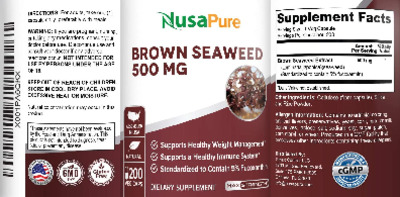
Supplement Facts
The label details for Brown Seaweed 500 mg by NusaPure, sourced from the NIH Dietary Supplement Label Database.
Supplement Facts
| Ingredient | Amount | % DV |
|---|---|---|
| Brown Seaweed extract | 500 mg | -- |
Other ingredients: Cellulose, Silica, Rice powder
Tap any ingredient to jump to its full detail below.
These statements are the manufacturer’s wording, reproduced from the product label — the label is saying it, not HelloPharmacist. We don’t verify or endorse them.
Suggested/Recommended/Usage/Directions
Directions: For adults, take one (1) capsule daily, preferably with meals.
Precautions
Warning: If you are pregnant, nursing, or taking any medications, consult your doctor before use.
Discontinue use and consult your doctor if any adverse reactions occur.
Not intended for use by persons under the age of 18. Keep out of reach of children.
Allergen Information: Contains no artificial coloring, artificial flavors, preservatives, yeast, corn, milk, or milk derivatives, lactose, salt, sodium, soy, sugar, gluten, corn starch or wheat. Produced in a GMP facility that processes other ingredients containing these allergens.
Storage
Store in cool, dry place. Avoid excessive heat or moisture.
Formulation
Natural color variation may occur in this product.
Assembled in USA Natural Supports healthy weight management Supports a healthy immune system
Max Strength
Allergen Information: Contains no artificial coloring, artificial flavors, preservatives, yeast, corn, milk, or milk derivatives, lactose, salt, sodium, soy, sugar, gluten, corn starch or wheat.
FDA Disclaimer Statement
These statements have not been evaluated by the Food and Drug Administration. This product is not intended to diagnose, treat, cure or prevent any disease.
Seals/Symbols
Premium Quality Assembled in USA Gluten Free FDA Registered Facility
Manufactured in a cGMP Inspected Facility
Formula
Standardized to contain 5% fucoxanthin
FDA Statement of Identity
Dietary Supplement
Is this label outdated? Report a formula or label change and our pharmacy team will review it.
Brown Seaweed 500 mg by NusaPure label
The label scan from the NIH Dietary Supplement Label Database. Tap to enlarge.
Label images are published by the NIH Dietary Supplement Label Database for the version of this product on file. Always read your actual product label.
View the full label (PDF)The Ingredients in Brown Seaweed 500 mg by NusaPure
This is the 1 active ingredient this product is made of. Select it to open its full monograph.
Serving size1 Veg Capsule(s) Dosage formCapsule Servings per container200 Amounts shown are per serving.
Brown Seaweed extract
Interacts with69 drugs
Laminaria is a type of brown seaweed (kelp) that is very rich in iodine and is also used in medical settings as a natural cervical dilator. Because it...
Brown Seaweed extract monograph & interactionsOther (inactive) ingredients: Cellulose, Silica, Rice powder. These complete the product’s ingredient list but are not active constituents.
Brown Seaweed 500 mg by NusaPure Drug Interactions
HelloPharmacist Interaction Report
Brown Seaweed 500 mg by NusaPure contains one active ingredient — brown seaweed extract — that has documented interactions with several medication types.
The most serious concern involves iodine content: this supplement can contain very high amounts of iodine that may interfere with thyroid medications and antithyroid drugs, potentially altering how well they work.
Read the full breakdown — every affected drug type, severity by severity
Because brown seaweed is high in potassium, it can raise your blood potassium level when combined with ACE inhibitors (blood pressure drugs), potassium-sparing diuretics (water pills), or digoxin (a heart medication). High blood potassium can be risky, especially with digoxin, where it may increase side effects.
The iodine content also poses a theoretical risk if you take amiodarone, a heart rhythm medication that itself contains high amounts of iodine — together they could raise iodine to unsafe levels.
Altogether, these interactions span 69 individual medications. If you're on any heart, blood pressure, thyroid, or water pill medication, use the checker below to look up your exact drugs before you start this supplement.
Check your own medications below · Editorial policy · How we use AI
Want to check YOUR meds against Brown Seaweed 500 mg?
Ask about interactions with your drugs in plain English — “Can I take it with lisinopril?” — and we find you the answer in seconds, ingredient by ingredient.
Go to the checkerIngredients driving the most interactions
Individual Drug Interactions
The ingredients in Brown Seaweed 500 mg interact with 69 drugs. Click any drug to see the details.
1 of the 1 ingredient in Brown Seaweed 500 mg interact with drugs. Each result below shows which ingredient is responsible. Brown Seaweed extract
AmilorideAmilamont, Midamor
How Amiloride interacts with Brown Seaweed 500 mg — through 1 ingredient. Tap an ingredient for the detail:
Brown Seaweed ExtractPotassium-sparing Diuretics Moderate
Interaction Summary
Theoretically, laminaria might increase the risk of hyperkalemia when taken with potassium-sparing diuretics.
Read the full Brown Seaweed Extract + Amiloride interactionAmiloride, HydrochlorothiazideAmil-Co, Amilzide, Moduret 25, Moduretic
How Amiloride, Hydrochlorothiazide interacts with Brown Seaweed 500 mg — through 1 ingredient. Tap an ingredient for the detail:
Brown Seaweed ExtractPotassium-sparing Diuretics Moderate
Interaction Summary
Theoretically, laminaria might increase the risk of hyperkalemia when taken with potassium-sparing diuretics.
Read the full Brown Seaweed Extract + Amiloride, Hydrochlorothiazide interactionAmiodaroneCordarone, Pacerone
How Amiodarone interacts with Brown Seaweed 500 mg — through 1 ingredient. Tap an ingredient for the detail:
Brown Seaweed ExtractAmiodarone (cordarone) Moderate
Interaction Summary
Theoretically, combining laminaria with amiodarone might cause excessively high iodine levels.
Read the full Brown Seaweed Extract + Amiodarone interactionAmlodipine Besylate, BenazeprilLotrel
How Amlodipine Besylate, Benazepril interacts with Brown Seaweed 500 mg — through 1 ingredient. Tap an ingredient for the detail:
Brown Seaweed ExtractAce Inhibitors (aceis) Moderate
Interaction Summary
Theoretically, laminaria might increase the risk of hyperkalemia when taken with ACEIs.
Read the full Brown Seaweed Extract + Amlodipine Besylate, Benazepril interactionBenazeprilLotensin
How Benazepril interacts with Brown Seaweed 500 mg — through 1 ingredient. Tap an ingredient for the detail:
Brown Seaweed ExtractAce Inhibitors (aceis) Moderate
Interaction Summary
Theoretically, laminaria might increase the risk of hyperkalemia when taken with ACEIs.
Read the full Brown Seaweed Extract + Benazepril interactionBenazepril, HydrochlorothiazideLotensin HCT
How Benazepril, Hydrochlorothiazide interacts with Brown Seaweed 500 mg — through 1 ingredient. Tap an ingredient for the detail:
Brown Seaweed ExtractAce Inhibitors (aceis) Moderate
Interaction Summary
Theoretically, laminaria might increase the risk of hyperkalemia when taken with ACEIs.
Read the full Brown Seaweed Extract + Benazepril, Hydrochlorothiazide interactionBendroflumethiazide, PotassiumCentyl K, Neo-NaClex-K
How Bendroflumethiazide, Potassium interacts with Brown Seaweed 500 mg — through 1 ingredient. Tap an ingredient for the detail:
Brown Seaweed ExtractPotassium-sparing Diuretics Moderate
Interaction Summary
Theoretically, laminaria might increase the risk of hyperkalemia when taken with potassium-sparing diuretics.
Read the full Brown Seaweed Extract + Bendroflumethiazide, Potassium interactionBumetanide, PotassiumBurinex K
How Bumetanide, Potassium interacts with Brown Seaweed 500 mg — through 1 ingredient. Tap an ingredient for the detail:
Brown Seaweed ExtractPotassium-sparing Diuretics Moderate
Interaction Summary
Theoretically, laminaria might increase the risk of hyperkalemia when taken with potassium-sparing diuretics.
Read the full Brown Seaweed Extract + Bumetanide, Potassium interactionCaptoprilAcepril, Capoten
How Captopril interacts with Brown Seaweed 500 mg — through 1 ingredient. Tap an ingredient for the detail:
Brown Seaweed ExtractAce Inhibitors (aceis) Moderate
Interaction Summary
Theoretically, laminaria might increase the risk of hyperkalemia when taken with ACEIs.
Read the full Brown Seaweed Extract + Captopril interactionCaptopril, HydrochlorothiazideAcezide, Capozide
How Captopril, Hydrochlorothiazide interacts with Brown Seaweed 500 mg — through 1 ingredient. Tap an ingredient for the detail:
Brown Seaweed ExtractAce Inhibitors (aceis) Moderate
Interaction Summary
Theoretically, laminaria might increase the risk of hyperkalemia when taken with ACEIs.
Read the full Brown Seaweed Extract + Captopril, Hydrochlorothiazide interactionCarbimazoleNeo-Mercazole
How Carbimazole interacts with Brown Seaweed 500 mg — through 1 ingredient. Tap an ingredient for the detail:
Brown Seaweed ExtractAntithyroid Drugs Moderate
Interaction Summary
Due to its iodine content, laminaria might alter the effects of antithyroid drugs.
Read the full Brown Seaweed Extract + Carbimazole interactionCilazaprilInhibace
How Cilazapril interacts with Brown Seaweed 500 mg — through 1 ingredient. Tap an ingredient for the detail:
Brown Seaweed ExtractAce Inhibitors (aceis) Moderate
Interaction Summary
Theoretically, laminaria might increase the risk of hyperkalemia when taken with ACEIs.
Read the full Brown Seaweed Extract + Cilazapril interactionConjugated EstrogensCenestin, Enjuvia, Premarin, Premarin Vaginal Cream
How Conjugated Estrogens interacts with Brown Seaweed 500 mg — through 1 ingredient. Tap an ingredient for the detail:
Brown Seaweed ExtractThyroid Hormone Moderate
Interaction Summary
Due to its iodine content, laminaria might alter the effects of thyroid hormone.
Read the full Brown Seaweed Extract + Conjugated Estrogens interactionDesiccated Thyroid ExtractWesthroid, WP Thyroid
How Desiccated Thyroid Extract interacts with Brown Seaweed 500 mg — through 1 ingredient. Tap an ingredient for the detail:
Brown Seaweed ExtractThyroid Hormone Moderate
Interaction Summary
Due to its iodine content, laminaria might alter the effects of thyroid hormone.
Read the full Brown Seaweed Extract + Desiccated Thyroid Extract interactionDesiccated Thyroid Extract (prescription Drug)Nature-Throid, Thyrar
How Desiccated Thyroid Extract (prescription Drug) interacts with Brown Seaweed 500 mg — through 1 ingredient. Tap an ingredient for the detail:
Brown Seaweed ExtractThyroid Hormone Moderate
Interaction Summary
Due to its iodine content, laminaria might alter the effects of thyroid hormone.
Read the full Brown Seaweed Extract + Desiccated Thyroid Extract (prescription Drug) interactionDextrothyroxineCholoxin
How Dextrothyroxine interacts with Brown Seaweed 500 mg — through 1 ingredient. Tap an ingredient for the detail:
Brown Seaweed ExtractThyroid Hormone Moderate
Interaction Summary
Due to its iodine content, laminaria might alter the effects of thyroid hormone.
Read the full Brown Seaweed Extract + Dextrothyroxine interactionDibasic Sodium Phosphate, Monobasic Potassium Phosphate, Monobasic Sodium Phosphate Monohydrate (prescription Drug)K-Phos Neutral
How Dibasic Sodium Phosphate, Monobasic Potassium Phosphate, Monobasic Sodium Phosphate Monohydrate (prescription Drug) interacts with Brown Seaweed 500 mg — through 1 ingredient. Tap an ingredient for the detail:
Brown Seaweed ExtractPotassium-sparing Diuretics Moderate
Interaction Summary
Theoretically, laminaria might increase the risk of hyperkalemia when taken with potassium-sparing diuretics.
Read the full Brown Seaweed Extract + Dibasic Sodium Phosphate, Monobasic Potassium Phosphate, Monobasic Sodium Phosphate Monohydrate (prescription Drug) interactionDigoxinDigitek, Lanoxicaps, Lanoxin
How Digoxin interacts with Brown Seaweed 500 mg — through 1 ingredient. Tap an ingredient for the detail:
Brown Seaweed ExtractDigoxin (lanoxin) Moderate
Interaction Summary
Theoretically, laminaria might increase the risk of hyperkalemia, which could increase the effects and adverse effects of digoxin.
Read the full Brown Seaweed Extract + Digoxin interactionDiltiazem, EnalaprilTeczem
How Diltiazem, Enalapril interacts with Brown Seaweed 500 mg — through 1 ingredient. Tap an ingredient for the detail:
Brown Seaweed ExtractAce Inhibitors (aceis) Moderate
Interaction Summary
Theoretically, laminaria might increase the risk of hyperkalemia when taken with ACEIs.
Read the full Brown Seaweed Extract + Diltiazem, Enalapril interactionDrospirenoneDrospirenone
How Drospirenone interacts with Brown Seaweed 500 mg — through 1 ingredient. Tap an ingredient for the detail:
Brown Seaweed ExtractPotassium-sparing Diuretics Moderate
Interaction Summary
Theoretically, laminaria might increase the risk of hyperkalemia when taken with potassium-sparing diuretics.
Read the full Brown Seaweed Extract + Drospirenone interactionDrospirenone, EstetrolNextstellis
How Drospirenone, Estetrol interacts with Brown Seaweed 500 mg — through 1 ingredient. Tap an ingredient for the detail:
Brown Seaweed ExtractPotassium-sparing Diuretics Moderate
Interaction Summary
Theoretically, laminaria might increase the risk of hyperkalemia when taken with potassium-sparing diuretics.
Read the full Brown Seaweed Extract + Drospirenone, Estetrol interactionDrospirenone, Ethinyl EstradiolAngeliq, Gianvi, Yasmin
How Drospirenone, Ethinyl Estradiol interacts with Brown Seaweed 500 mg — through 1 ingredient. Tap an ingredient for the detail:
Brown Seaweed ExtractPotassium-sparing Diuretics Moderate
Interaction Summary
Theoretically, laminaria might increase the risk of hyperkalemia when taken with potassium-sparing diuretics.
Read the full Brown Seaweed Extract + Drospirenone, Ethinyl Estradiol interactionEnalapril MaleateEpaned, Vasotec
How Enalapril Maleate interacts with Brown Seaweed 500 mg — through 1 ingredient. Tap an ingredient for the detail:
Brown Seaweed ExtractAce Inhibitors (aceis) Moderate
Interaction Summary
Theoretically, laminaria might increase the risk of hyperkalemia when taken with ACEIs.
Read the full Brown Seaweed Extract + Enalapril Maleate interactionEnalapril Maleate, FelodipineLexxel
How Enalapril Maleate, Felodipine interacts with Brown Seaweed 500 mg — through 1 ingredient. Tap an ingredient for the detail:
Brown Seaweed ExtractAce Inhibitors (aceis) Moderate
Interaction Summary
Theoretically, laminaria might increase the risk of hyperkalemia when taken with ACEIs.
Read the full Brown Seaweed Extract + Enalapril Maleate, Felodipine interactionEnalapril Maleate, HydrochlorothiazideVaseretic
How Enalapril Maleate, Hydrochlorothiazide interacts with Brown Seaweed 500 mg — through 1 ingredient. Tap an ingredient for the detail:
Brown Seaweed ExtractAce Inhibitors (aceis) Moderate
Interaction Summary
Theoretically, laminaria might increase the risk of hyperkalemia when taken with ACEIs.
Read the full Brown Seaweed Extract + Enalapril Maleate, Hydrochlorothiazide interactionEthinyl Estradiol, DrospirenoneYaz
How Ethinyl Estradiol, Drospirenone interacts with Brown Seaweed 500 mg — through 1 ingredient. Tap an ingredient for the detail:
Brown Seaweed ExtractPotassium-sparing Diuretics Moderate
Interaction Summary
Theoretically, laminaria might increase the risk of hyperkalemia when taken with potassium-sparing diuretics.
Read the full Brown Seaweed Extract + Ethinyl Estradiol, Drospirenone interactionFinerenoneKerendia
How Finerenone interacts with Brown Seaweed 500 mg — through 1 ingredient. Tap an ingredient for the detail:
Brown Seaweed ExtractPotassium-sparing Diuretics Moderate
Interaction Summary
Theoretically, laminaria might increase the risk of hyperkalemia when taken with potassium-sparing diuretics.
Read the full Brown Seaweed Extract + Finerenone interactionFosinoprilMonopril
How Fosinopril interacts with Brown Seaweed 500 mg — through 1 ingredient. Tap an ingredient for the detail:
Brown Seaweed ExtractAce Inhibitors (aceis) Moderate
Interaction Summary
Theoretically, laminaria might increase the risk of hyperkalemia when taken with ACEIs.
Read the full Brown Seaweed Extract + Fosinopril interactionFosinopril, HydrochlorothiazideMonopril HCT
How Fosinopril, Hydrochlorothiazide interacts with Brown Seaweed 500 mg — through 1 ingredient. Tap an ingredient for the detail:
Brown Seaweed ExtractAce Inhibitors (aceis) Moderate
Interaction Summary
Theoretically, laminaria might increase the risk of hyperkalemia when taken with ACEIs.
Read the full Brown Seaweed Extract + Fosinopril, Hydrochlorothiazide interactionFurosemide, PotassiumDiumide-K Continus, Lasikal
How Furosemide, Potassium interacts with Brown Seaweed 500 mg — through 1 ingredient. Tap an ingredient for the detail:
Brown Seaweed ExtractPotassium-sparing Diuretics Moderate
Interaction Summary
Theoretically, laminaria might increase the risk of hyperkalemia when taken with potassium-sparing diuretics.
Read the full Brown Seaweed Extract + Furosemide, Potassium interactionEach ingredient & the kinds of drugs it affects
For each ingredient in Brown Seaweed 500 mg with known interactions, here are the types of medications it can affect. Open any type for the detail — or search your exact drug in the checker above.
Brown Seaweed extract
Ace Inhibitors (Aceis)
Theoretically, laminaria might increase the risk of hyperkalemia when taken with ACEIs.
Laminaria contains potassium.
Amiodarone (Cordarone)
Theoretically, combining laminaria with amiodarone might cause excessively high iodine levels.
Amiodarone contains 37.3% iodine and can increase iodine levels. Concomitant use with laminaria supplements, some of which may contain as much as 1000 mcg iodine, might increase the risk of adverse effects from iodine, including altered thyroid function.
Antithyroid Drugs
Due to its iodine content, laminaria might alter the effects of antithyroid drugs.
Some laminaria supplements contain up to 1000 mcg of iodine. Iodine in high doses has been reported to cause both hyperthyroidism and hypothyroidism, depending on the individual's past medical history. Taking laminaria could theoretically alter the effects of antithyroid drugs.
Digoxin (Lanoxin)
Theoretically, laminaria might increase the risk of hyperkalemia, which could increase the effects and adverse effects of digoxin.
Laminaria contains potassium.
Potassium-Sparing Diuretics
Theoretically, laminaria might increase the risk of hyperkalemia when taken with potassium-sparing diuretics.
Laminaria contains potassium.
Thyroid Hormone
Due to its iodine content, laminaria might alter the effects of thyroid hormone.
Some laminaria supplements contain up to 1000 mcg of iodine. Iodine in high doses has been reported to cause both hyperthyroidism and hypothyroidism, depending on the individual's past medical history. Taking laminaria could theoretically alter the effects of thyroid hormone.
Brand information
Manufacturer and brand details for Brown Seaweed 500 mg, from the product label.
NusaPure
See all NusaPure products- Name
- Gmax Central LLC
- Street Address
- 4700 Millenia Boulevard, Suite 175 PMB 92909
- City
- Orlando
- State
- FL
- ZipCode
- 32839
Brown Seaweed 500 mg by NusaPure: Common Questions
Does Brown Seaweed 500 mg by NusaPure interact with any medications?
How can one product interact with so many drugs?
Where does this information come from?
Can I take this if I'm pregnant or nursing?
Why would brown seaweed interact with my thyroid medication?
What's the arsenic risk I've heard about?
Is this supplement proven to help with weight loss or blood pressure?
How much potassium does each capsule contain?
Written and reviewed by the HelloPharmacist editorial staff. Our editorial policy
Not sure if Brown Seaweed 500 mg is safe with your meds?
Our pharmacists answer your medication & supplement questions — free.
Label information is sourced from the NIH Dietary Supplement Label Database and reflects the product version on file; always read your actual product label. This page is for education only and is not a substitute for professional medical advice. Confirm with your pharmacist or doctor before combining supplements and medications.
The Full Monographs Behind Brown Seaweed 500 mg’s Ingredients
Every ingredient we hold a full HelloPharmacist monograph for — uses, evidence, safety, and the complete interaction list.
Sources & How We Checked
Brown Seaweed 500 mg's label data comes from the NIH Dietary Supplement Label Database; the ingredient interaction data is from the Natural Medicines database, reviewed by our pharmacists.
- NIH Dietary Supplement Label Database (DSLD) — The official product label on file for this supplement.
- Natural Medicines (Therapeutic Research Center) — Evidence-graded clinical reference behind the ingredient interaction data.
Content is written and reviewed by licensed HelloPharmacist pharmacists. See our data sources and editorial standards for how this information is built and checked.
The 9 references behind this product’s interaction data
Every citation that drives the interaction findings for this product’s ingredients, from the evidence-graded Natural Medicines (TRC Healthcare) database. Open an ingredient to browse its citations — links open the study on PubMed or the publisher’s site.
Laminaria 9 references
- The Review of Natural Products by Facts and Comparisons. St. Louis, MO: Wolters Kluwer Co., 1999.
- Brinker F. Herb Contraindications and Drug Interactions. 2nd ed. Sandy, OR: Eclectic Medical Publications, 1998.
- Pye KG, Kelsey SM, House IM, et al. Severe dyserythropoeisis and autoimmune thrombocytopenia associated with ingestion of kelp supplement. Lancet 1992;339:1540.
- Kazzi GM, Bottoms SF, Rosen MG. Efficacy and safety of Laminaria digitata for preinduction ripening of the cervix. Obstet Gynecol 1982;60:440-3..
- Harrell BL, Rudolph AH. Letter: Kelp diet: A cause of acneform eruption. Arch Dermatol 1976;112:560.
- Eliason BC. Transient hyperthyroidism in a patient taking dietary supplements containing kelp. J Am Board Fam Pract 1998;11:478-80. PubMed
- Norman JA, Pickford CJ, Sanders TW, Waller M. Human intake of arsenic and iodine from seaweed-based food supplements and health foods available in the UK. Food Addit Contam 1988;5:103-9.. PubMed
- Amster E, Tiwary A, Schenker MB. Case report: potential arsenic toxicosis secondary to herbal kelp supplement. Environ Health Perspect 2007;115:606-8. PubMed
- Miyai K, Tokushige T, Kondo M; Iodine Research Group. Suppression of thyroid function during ingestion of seaweed "Kombu" (Laminaria japonoca) in normal Japanese adults. Endocr J. 2008 Dec;55(6):1103-8. Epub 2008 Aug 9.
Parts of this content are provided by the Therapeutic Research Center, LLC.
DISCLAIMER: Currently this does not check for drug-drug interactions. This is not an all-inclusive comprehensive list of potential interactions and is for informational purposes only. Not all interactions are known or well-reported in the scientific literature, and new interactions are continually being reported. Input is needed from a qualified healthcare provider including a pharmacist before starting any therapy. Application of clinical judgment is necessary.
© 2021 Therapeutic Research Center, LLC