
Calm Wind Teapills Ingredients & Drug Interactions
by Plum Flower
What is this page for?
First and foremost: checking Calm Wind Teapills against your medications. The heart of this page is the interaction checker and the full interaction report — how this product’s ingredients may interact with prescription and over-the-counter medicines you may be taking.
Around that, we add a pharmacist’s high-level view of the product as a whole — what’s inside, the evidence for its stated use, how transparent the label is, and what safety data exists — so you can see the full picture in one place. It’s educational information from our licensed clinical databases and the clinical staff at HelloPharmacist — not medical advice — and we don’t sell or endorse products. Our editorial policy
Calm Wind Teapills is a dietary supplement by Plum Flower with 4 active ingredients. Its ingredients are commonly taken for source of vitamin c, digestive support, aromatherapy and relaxation.Based on those ingredients, 813 medications have a known interaction with it, the most serious rated moderate. The ingredients most likely to interact are Paeonia lactiflora Root Extract, Atractylodes macrocephala rhizome extract, Citrus reticulata Peel Extract. Use the checker below to test your specific medication, or read the full HelloPharmacist Interaction Report.
Check Your Meds Against Calm Wind Teapills by Plum Flower
Ask about any prescription or over-the-counter medication and we check it for interactions with Calm Wind Teapills by Plum Flower — and tell you which ingredient is responsible.
AI summaries are generated from our interaction database for education only — always confirm with your pharmacist. How we use AI
Ask the Pharmacist
A licensed pharmacist will answer your question by email — free, usually within 24 hours.
Got it — thank you!
A licensed pharmacist will answer within 24 hours. Keep an eye on your email (worth checking spam, just in case).
HelloPharmacist Scorecard of Calm Wind Teapills by Plum Flower
Our pharmacy team’s full take, with four database checks built into the cards below — a summary of what is known, not a grade of the product itself.
What’s inside
Low disclosure
Calm Wind Teapills contains 4 active ingredients in a proprietary blend, plus inactive ingredients (magnesium silicate, activated carbon, maltose, and china wax) that help hold the pill together. The blend includes citrus reticulata (tangerine) peel extract, paeonia lactiflora (peony) root extract, saposhnikovia divaricata root extract, and atractylodes macrocephala rhizome extract — traditional herbs used in Chinese medicine formulas.
Does it work?
Couldn't assess
Our data don't establish that any of the active ingredients in this product are effective for a specific condition. Tangerine peel extract has been studied for cancer but the evidence is insufficient to draw conclusions.
Peony root, atractylodes, and saposhnikovia have similarly insufficient evidence for the conditions they're traditionally used for — ranging from migraine and fatigue to anorexia and colds. If you're considering this product, talk with your pharmacist about what you're hoping it will do.
How safe is it?
Well-documented data
Peony root is generally well tolerated in the short term, though high-quality safety data are limited. The most common side effects reported are gastrointestinal — abdominal bloating, loss of appetite, diarrhea, and nausea — with diarrhea appearing in a small number of trial participants.
Tangerine peel extract is safe when you eat the fruit as food, but concentrated extracts should be used cautiously under medical guidance. Atractylodes has limited human safety data; the most common reported side effects are allergic reaction, dry mouth, and nausea.
Peony and atractylodes are not recommended during pregnancy or breastfeeding due to insufficient safety data.
Meds to double-check
Moderate interaction found
Before taking this product, double-check these medication types with the search tool: blood thinners and antiplatelet drugs (moderate concern), birth control and estrogen therapy (moderate concern), and any medications that your liver metabolizes, especially CYP3A4 and CYP1A2 substrates, including clozapine, phenytoin, and aromatase inhibitors (moderate to minor concern). Worst severity is Moderate.
The bottom line
Scorecard at a glanceFormula with limited ingredient disclosure with no assessable stated purpose. Moderate medication interactions have been identified, and safety information is well characterized.
Calm Wind Teapills is a traditional Chinese herbal blend with limited human evidence for its intended effects. If you take any prescription medications — especially blood thinners, birth control, antipsychotics, anti-seizure drugs, or hormone therapy — you need to check your specific drugs with the tool on this page before starting.
Pregnant women and those breastfeeding should avoid it. Talk with your pharmacist about whether this is right for you.
Educational only — not medical advice; always confirm with your pharmacist. Our editorial policy · How we use AI
Assessment coverage: 3 of 4 active ingredients matched to our full ingredient reviews (monographs). Based on the product label dated Aug 22, 2025.
This Scorecard evaluates available label information, ingredient evidence, and known medication-safety considerations. It does not independently verify product identity, purity, potency, contamination, or manufacturing quality. How these ratings are computed
General information
Key facts about Calm Wind Teapills, straight from the product label.
| Brand | Plum Flower |
|---|---|
| Barcode (UPC) | 739934860267 |
| Net contents | 200 Pill(s); 1.2 Ounce(s); 34 Gram(s) |
| Market status | On market |
| Date entered into DSLD | Aug 22, 2025 |
| DSLD ID | 336448 |
| Product type | Botanical |
| Supplement form | Tablet Or Pill |
| Dietary claims / uses | All Other |
| Intended target group(s) | Adult (18 - 50 Years) |
Everything in this section is reproduced from the manufacturer’s own product label — it’s the label speaking, not HelloPharmacist. We show it so you can see exactly what the maker states; we don’t verify or endorse those statements.
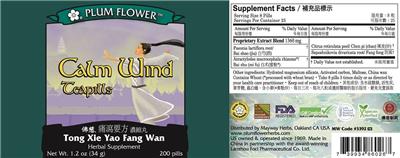
Supplement Facts
The label details for Calm Wind Teapills by Plum Flower, sourced from the NIH Dietary Supplement Label Database.
Supplement Facts
| Ingredient | Amount | % DV |
|---|---|---|
| Proprietary Extract Blend | 1360 mg | -- |
| Citrus reticulata Peel Extract | 0 NP | -- |
| Paeonia lactiflora Root Extract | 0 NP | -- |
| Saposhnikovia divaricata Root Extract | 0 NP | -- |
| Atractylodes macrocephala rhizome extract | 0 NP | -- |
Other ingredients: Magnesium Silicate, Hydrated, Carbon, Activated, Maltose, China Wax
Tap any ingredient to jump to its full detail below.
These statements are the manufacturer’s wording, reproduced from the product label — the label is saying it, not HelloPharmacist. We don’t verify or endorse them.
General Statements
Tong Xie Yao Fang Wan
Foci Pharmaceutical 1929 US owned & operated since 1969.
FDA Statement of Identity
Herbal Supplement
Precautions
Contains wheat (processed with wheat bran)
Keep out of reach of children.
Suggested/Recommended/Usage/Directions
Take 8 pills 3 times daily or as directed by your health care practitioner.
Seals/Symbols
Plum Flower Guarantee Sourced sustainably FDA Registered cGMP Compliant Made in a cGMP Certified Facility Lab Tested Quality Verified Species Verified
Formulation
Made in China in partnership with Lanzhou Foci Pharmaceutical Co. Ltd.
Is this label outdated? Report a formula or label change and our pharmacy team will review it.
Calm Wind Teapills by Plum Flower label
The label scan from the NIH Dietary Supplement Label Database. Tap to enlarge.
Label images are published by the NIH Dietary Supplement Label Database for the version of this product on file. Always read your actual product label.
View the full label (PDF)The Ingredients in Calm Wind Teapills by Plum Flower
These are the 4 active ingredients this product is made of. Select any to open its full monograph.
Serving size8 Pill(s) Dosage formTablet Or Pill Servings per container25 Amounts shown are per serving.
Most supplement products combine several ingredients, and a medication can interact with the product through any one of them. Each ingredient below shows whether it has known drug interactions.
Proprietary Extract Blend
- › Citrus reticulata Peel Extract
- › Paeonia lactiflora Root Extract
- › Saposhnikovia divaricata Root Extract
- › Atractylodes macrocephala rhizome extract
Other (inactive) ingredients: Magnesium Silicate, Hydrated, Carbon, Activated, Maltose, China Wax. These complete the product’s ingredient list but are not active constituents.
Calm Wind Teapills by Plum Flower Drug Interactions
HelloPharmacist Interaction Report
Calm Wind Teapills by Plum Flower contains four ingredients, two of which we could check for interactions.
Overall, these interactions span 803 individual medications.
Read the full breakdown — every affected drug type, severity by severity
Peony root extract carries the most serious concerns — it can theoretically affect how your liver breaks down certain medications (CYP1A2 and CYP3A4 substrates), potentially raising their levels in your blood. The biggest worry here is clozapine (an antipsychotic), where in-lab studies show peony may suppress its breakdown, though this hasn't been confirmed in people.
Peony also has theoretical estrogenic activity, which raises concern if you take estrogen-containing medications, birth control pills, or drugs that depend on estrogen competition for their effect.
Peony may also increase bleeding risk if you take blood thinners (anticoagulants) or antiplatelet drugs like warfarin or aspirin — lab work suggests it could have anticoagulant effects itself. Additionally, animal studies hint that peony might lower phenytoin (an anti-seizure drug) levels, though human data are sparse.
Tangerine peel extract and atractylodes each carry minor to moderate theoretical concerns with certain enzyme-metabolized drugs (CYP3A4 and CYP1A2 substrates) and, in atractylodes' case, anticoagulants and aromatase inhibitors — but human evidence is very limited. We could not check Saposhnikovia divaricata root extract.
Before you start, run your exact medications through the checker below.
Check your own medications below · Editorial policy · How we use AI
Want to check YOUR meds against Calm Wind Teapills?
Ask about interactions with your drugs in plain English — “Can I take it with lisinopril?” — and we find you the answer in seconds, ingredient by ingredient.
Go to the checkerIngredients driving the most interactions
Individual Drug Interactions
The ingredients in Calm Wind Teapills interact with 813 drugs. Click any drug to see the details.
3 of the 4 ingredients in Calm Wind Teapills interact with drugs. Each result below shows which ingredient is responsible. Paeonia lactiflora Root Extract Atractylodes macrocephala rhizome extract Citrus reticulata Peel Extract
Aspirin, Caffeine, Dihydrocodeine BitartrateSynalgos DC
How Aspirin, Caffeine, Dihydrocodeine Bitartrate interacts with Calm Wind Teapills — through 3 ingredients. Tap an ingredient for the detail:
Paeonia Lactiflora Root ExtractAnticoagulant/antiplatelet Drugs, Cytochrome P450 1a2 (cyp1a2) Substrates +1 Moderate
Interaction Summary
Theoretically, combining peony with anticoagulant or antiplatelet drugs might increase the risk of bleeding.
Read the full Paeonia Lactiflora Root Extract + Aspirin, Caffeine, Dihydrocodeine Bitartrate interactionAtractylodes Macrocephala Rhizome ExtractAnticoagulant/antiplatelet Drugs, Cytochrome P450 3a4 (cyp3a4) Substrates +1 Moderate
Interaction Summary
Theoretically, atractylodes might increase the risk of bleeding when used concomitantly with anticoagulant and antiplatelet drugs.
Read the full Atractylodes Macrocephala Rhizome Extract + Aspirin, Caffeine, Dihydrocodeine Bitartrate interactionCitrus Reticulata Peel ExtractCytochrome P450 3a4 (cyp3a4) Substrates Minor
Interaction Summary
In vitro, tangeretin, a constituent of tangerine, induces a 52% increase in the metabolism of midazolam by cytochrome P450 3A4 (CYP3A4).
Read the full Citrus Reticulata Peel Extract + Aspirin, Caffeine, Dihydrocodeine Bitartrate interactionAspirin, Caffeine, Dover's PwdAcedoval, Dovacet
How Aspirin, Caffeine, Dover's Pwd interacts with Calm Wind Teapills — through 3 ingredients. Tap an ingredient for the detail:
Paeonia Lactiflora Root ExtractCytochrome P450 3a4 (cyp3a4) Substrates, Anticoagulant/antiplatelet Drugs +1 Moderate
Interaction Summary
Theoretically, use of peony may increase the levels and clinical effects of drugs metabolized by CYP3A4.
Read the full Paeonia Lactiflora Root Extract + Aspirin, Caffeine, Dover's Pwd interactionAtractylodes Macrocephala Rhizome ExtractCytochrome P450 3a4 (cyp3a4) Substrates, Anticoagulant/antiplatelet Drugs +1 Moderate
Interaction Summary
Theoretically, atractylodes might increase the levels of CYP3A4 substrates.
Read the full Atractylodes Macrocephala Rhizome Extract + Aspirin, Caffeine, Dover's Pwd interactionCitrus Reticulata Peel ExtractCytochrome P450 3a4 (cyp3a4) Substrates Minor
Interaction Summary
In vitro, tangeretin, a constituent of tangerine, induces a 52% increase in the metabolism of midazolam by cytochrome P450 3A4 (CYP3A4).
Read the full Citrus Reticulata Peel Extract + Aspirin, Caffeine, Dover's Pwd interactionAspirin, Caffeine, HydrocodoneDamason-P
How Aspirin, Caffeine, Hydrocodone interacts with Calm Wind Teapills — through 3 ingredients. Tap an ingredient for the detail:
Paeonia Lactiflora Root ExtractAnticoagulant/antiplatelet Drugs, Cytochrome P450 3a4 (cyp3a4) Substrates +1 Moderate
Interaction Summary
Theoretically, combining peony with anticoagulant or antiplatelet drugs might increase the risk of bleeding.
Read the full Paeonia Lactiflora Root Extract + Aspirin, Caffeine, Hydrocodone interactionAtractylodes Macrocephala Rhizome ExtractAnticoagulant/antiplatelet Drugs, Cytochrome P450 3a4 (cyp3a4) Substrates +1 Moderate
Interaction Summary
Theoretically, atractylodes might increase the risk of bleeding when used concomitantly with anticoagulant and antiplatelet drugs.
Read the full Atractylodes Macrocephala Rhizome Extract + Aspirin, Caffeine, Hydrocodone interactionCitrus Reticulata Peel ExtractCytochrome P450 3a4 (cyp3a4) Substrates Minor
Interaction Summary
In vitro, tangeretin, a constituent of tangerine, induces a 52% increase in the metabolism of midazolam by cytochrome P450 3A4 (CYP3A4).
Read the full Citrus Reticulata Peel Extract + Aspirin, Caffeine, Hydrocodone interactionAspirin, Caffeine, Isobutylallylbarbituric Acid, PhenacetinLanorinal
How Aspirin, Caffeine, Isobutylallylbarbituric Acid, Phenacetin interacts with Calm Wind Teapills — through 3 ingredients. Tap an ingredient for the detail:
Paeonia Lactiflora Root ExtractCytochrome P450 1a2 (cyp1a2) Substrates, Cytochrome P450 3a4 (cyp3a4) Substrates +1 Moderate
Interaction Summary
Theoretically, use of peony may increase the levels and clinical effects of drugs metabolized by CYP1A2.
Read the full Paeonia Lactiflora Root Extract + Aspirin, Caffeine, Isobutylallylbarbituric Acid, Phenacetin interactionAtractylodes Macrocephala Rhizome ExtractAnticoagulant/antiplatelet Drugs, Cytochrome P450 1a2 (cyp1a2) Substrates +1 Moderate
Interaction Summary
Theoretically, atractylodes might increase the risk of bleeding when used concomitantly with anticoagulant and antiplatelet drugs.
Read the full Atractylodes Macrocephala Rhizome Extract + Aspirin, Caffeine, Isobutylallylbarbituric Acid, Phenacetin interactionCitrus Reticulata Peel ExtractCytochrome P450 3a4 (cyp3a4) Substrates Minor
Interaction Summary
In vitro, tangeretin, a constituent of tangerine, induces a 52% increase in the metabolism of midazolam by cytochrome P450 3A4 (CYP3A4).
Read the full Citrus Reticulata Peel Extract + Aspirin, Caffeine, Isobutylallylbarbituric Acid, Phenacetin interactionAspirin, Caffeine, OrphenadrineInvagesic, Invagesic Forte, Norgesic, Norgesic Forte, Orphengesic, Orphengesic Forte
How Aspirin, Caffeine, Orphenadrine interacts with Calm Wind Teapills — through 3 ingredients. Tap an ingredient for the detail:
Atractylodes Macrocephala Rhizome ExtractCytochrome P450 3a4 (cyp3a4) Substrates, Cytochrome P450 1a2 (cyp1a2) Substrates +1 Moderate
Interaction Summary
Theoretically, atractylodes might increase the levels of CYP3A4 substrates.
Read the full Atractylodes Macrocephala Rhizome Extract + Aspirin, Caffeine, Orphenadrine interactionPaeonia Lactiflora Root ExtractCytochrome P450 1a2 (cyp1a2) Substrates, Cytochrome P450 3a4 (cyp3a4) Substrates +1 Moderate
Interaction Summary
Theoretically, use of peony may increase the levels and clinical effects of drugs metabolized by CYP1A2.
Read the full Paeonia Lactiflora Root Extract + Aspirin, Caffeine, Orphenadrine interactionCitrus Reticulata Peel ExtractCytochrome P450 3a4 (cyp3a4) Substrates Minor
Interaction Summary
In vitro, tangeretin, a constituent of tangerine, induces a 52% increase in the metabolism of midazolam by cytochrome P450 3A4 (CYP3A4).
Read the full Citrus Reticulata Peel Extract + Aspirin, Caffeine, Orphenadrine interactionAspirin, Caffeine, Phenacetin, PropoxypheneMargesic Comp. 65
How Aspirin, Caffeine, Phenacetin, Propoxyphene interacts with Calm Wind Teapills — through 3 ingredients. Tap an ingredient for the detail:
Paeonia Lactiflora Root ExtractAnticoagulant/antiplatelet Drugs, Cytochrome P450 1a2 (cyp1a2) Substrates +1 Moderate
Interaction Summary
Theoretically, combining peony with anticoagulant or antiplatelet drugs might increase the risk of bleeding.
Read the full Paeonia Lactiflora Root Extract + Aspirin, Caffeine, Phenacetin, Propoxyphene interactionAtractylodes Macrocephala Rhizome ExtractAnticoagulant/antiplatelet Drugs, Cytochrome P450 3a4 (cyp3a4) Substrates +1 Moderate
Interaction Summary
Theoretically, atractylodes might increase the risk of bleeding when used concomitantly with anticoagulant and antiplatelet drugs.
Read the full Atractylodes Macrocephala Rhizome Extract + Aspirin, Caffeine, Phenacetin, Propoxyphene interactionCitrus Reticulata Peel ExtractCytochrome P450 3a4 (cyp3a4) Substrates Minor
Interaction Summary
In vitro, tangeretin, a constituent of tangerine, induces a 52% increase in the metabolism of midazolam by cytochrome P450 3A4 (CYP3A4).
Read the full Citrus Reticulata Peel Extract + Aspirin, Caffeine, Phenacetin, Propoxyphene interactionAspirin, Calcium Carbonate, Magnesium Carbonate, Magnesium OxideBufferin
How Aspirin, Calcium Carbonate, Magnesium Carbonate, Magnesium Oxide interacts with Calm Wind Teapills — through 2 ingredients. Tap an ingredient for the detail:
Paeonia Lactiflora Root ExtractAnticoagulant/antiplatelet Drugs Moderate
Interaction Summary
Theoretically, combining peony with anticoagulant or antiplatelet drugs might increase the risk of bleeding.
Read the full Paeonia Lactiflora Root Extract + Aspirin, Calcium Carbonate, Magnesium Carbonate, Magnesium Oxide interactionAtractylodes Macrocephala Rhizome ExtractAnticoagulant/antiplatelet Drugs Moderate
Interaction Summary
Theoretically, atractylodes might increase the risk of bleeding when used concomitantly with anticoagulant and antiplatelet drugs.
Read the full Atractylodes Macrocephala Rhizome Extract + Aspirin, Calcium Carbonate, Magnesium Carbonate, Magnesium Oxide interactionAspirin, CarisoprodolSoma Compound
How Aspirin, Carisoprodol interacts with Calm Wind Teapills — through 2 ingredients. Tap an ingredient for the detail:
Paeonia Lactiflora Root ExtractAnticoagulant/antiplatelet Drugs Moderate
Interaction Summary
Theoretically, combining peony with anticoagulant or antiplatelet drugs might increase the risk of bleeding.
Read the full Paeonia Lactiflora Root Extract + Aspirin, Carisoprodol interactionAtractylodes Macrocephala Rhizome ExtractAnticoagulant/antiplatelet Drugs Moderate
Interaction Summary
Theoretically, atractylodes might increase the risk of bleeding when used concomitantly with anticoagulant and antiplatelet drugs.
Read the full Atractylodes Macrocephala Rhizome Extract + Aspirin, Carisoprodol interactionAspirin, Carisoprodol, Codeine PhosphateSoma Compound w/ Codeine
How Aspirin, Carisoprodol, Codeine Phosphate interacts with Calm Wind Teapills — through 2 ingredients. Tap an ingredient for the detail:
Paeonia Lactiflora Root ExtractAnticoagulant/antiplatelet Drugs Moderate
Interaction Summary
Theoretically, combining peony with anticoagulant or antiplatelet drugs might increase the risk of bleeding.
Read the full Paeonia Lactiflora Root Extract + Aspirin, Carisoprodol, Codeine Phosphate interactionAtractylodes Macrocephala Rhizome ExtractAnticoagulant/antiplatelet Drugs Moderate
Interaction Summary
Theoretically, atractylodes might increase the risk of bleeding when used concomitantly with anticoagulant and antiplatelet drugs.
Read the full Atractylodes Macrocephala Rhizome Extract + Aspirin, Carisoprodol, Codeine Phosphate interactionAspirin, Chlorpheniramine, PhenylpropanolamineAlka-Seltzer Plus Cold
How Aspirin, Chlorpheniramine, Phenylpropanolamine interacts with Calm Wind Teapills — through 3 ingredients. Tap an ingredient for the detail:
Paeonia Lactiflora Root ExtractAnticoagulant/antiplatelet Drugs, Cytochrome P450 3a4 (cyp3a4) Substrates Moderate
Interaction Summary
Theoretically, combining peony with anticoagulant or antiplatelet drugs might increase the risk of bleeding.
Read the full Paeonia Lactiflora Root Extract + Aspirin, Chlorpheniramine, Phenylpropanolamine interactionAtractylodes Macrocephala Rhizome ExtractAnticoagulant/antiplatelet Drugs, Cytochrome P450 3a4 (cyp3a4) Substrates Moderate
Interaction Summary
Theoretically, atractylodes might increase the risk of bleeding when used concomitantly with anticoagulant and antiplatelet drugs.
Read the full Atractylodes Macrocephala Rhizome Extract + Aspirin, Chlorpheniramine, Phenylpropanolamine interactionCitrus Reticulata Peel ExtractCytochrome P450 3a4 (cyp3a4) Substrates Minor
Interaction Summary
In vitro, tangeretin, a constituent of tangerine, induces a 52% increase in the metabolism of midazolam by cytochrome P450 3A4 (CYP3A4).
Read the full Citrus Reticulata Peel Extract + Aspirin, Chlorpheniramine, Phenylpropanolamine interactionAspirin, Citric Acid, Sodium BicarbonateAlka-Seltzer Pain Reliever and Antacid
How Aspirin, Citric Acid, Sodium Bicarbonate interacts with Calm Wind Teapills — through 2 ingredients. Tap an ingredient for the detail:
Paeonia Lactiflora Root ExtractAnticoagulant/antiplatelet Drugs Moderate
Interaction Summary
Theoretically, combining peony with anticoagulant or antiplatelet drugs might increase the risk of bleeding.
Read the full Paeonia Lactiflora Root Extract + Aspirin, Citric Acid, Sodium Bicarbonate interactionAtractylodes Macrocephala Rhizome ExtractAnticoagulant/antiplatelet Drugs Moderate
Interaction Summary
Theoretically, atractylodes might increase the risk of bleeding when used concomitantly with anticoagulant and antiplatelet drugs.
Read the full Atractylodes Macrocephala Rhizome Extract + Aspirin, Citric Acid, Sodium Bicarbonate interactionAspirin, Codeine PhosphateAspirin w/ Codeine
How Aspirin, Codeine Phosphate interacts with Calm Wind Teapills — through 2 ingredients. Tap an ingredient for the detail:
Paeonia Lactiflora Root ExtractAnticoagulant/antiplatelet Drugs Moderate
Interaction Summary
Theoretically, combining peony with anticoagulant or antiplatelet drugs might increase the risk of bleeding.
Read the full Paeonia Lactiflora Root Extract + Aspirin, Codeine Phosphate interactionAtractylodes Macrocephala Rhizome ExtractAnticoagulant/antiplatelet Drugs Moderate
Interaction Summary
Theoretically, atractylodes might increase the risk of bleeding when used concomitantly with anticoagulant and antiplatelet drugs.
Read the full Atractylodes Macrocephala Rhizome Extract + Aspirin, Codeine Phosphate interactionAspirin, Codeine Phosphate, MethocarbamolRobaxisal C
How Aspirin, Codeine Phosphate, Methocarbamol interacts with Calm Wind Teapills — through 2 ingredients. Tap an ingredient for the detail:
Paeonia Lactiflora Root ExtractAnticoagulant/antiplatelet Drugs Moderate
Interaction Summary
Theoretically, combining peony with anticoagulant or antiplatelet drugs might increase the risk of bleeding.
Read the full Paeonia Lactiflora Root Extract + Aspirin, Codeine Phosphate, Methocarbamol interactionAtractylodes Macrocephala Rhizome ExtractAnticoagulant/antiplatelet Drugs Moderate
Interaction Summary
Theoretically, atractylodes might increase the risk of bleeding when used concomitantly with anticoagulant and antiplatelet drugs.
Read the full Atractylodes Macrocephala Rhizome Extract + Aspirin, Codeine Phosphate, Methocarbamol interactionAspirin, Codeine Phosphate, PhenobarbitalPhenaphen
How Aspirin, Codeine Phosphate, Phenobarbital interacts with Calm Wind Teapills — through 2 ingredients. Tap an ingredient for the detail:
Paeonia Lactiflora Root ExtractAnticoagulant/antiplatelet Drugs Moderate
Interaction Summary
Theoretically, combining peony with anticoagulant or antiplatelet drugs might increase the risk of bleeding.
Read the full Paeonia Lactiflora Root Extract + Aspirin, Codeine Phosphate, Phenobarbital interactionAtractylodes Macrocephala Rhizome ExtractAnticoagulant/antiplatelet Drugs Moderate
Interaction Summary
Theoretically, atractylodes might increase the risk of bleeding when used concomitantly with anticoagulant and antiplatelet drugs.
Read the full Atractylodes Macrocephala Rhizome Extract + Aspirin, Codeine Phosphate, Phenobarbital interactionAspirin, Diphenhydramine, PhenylpropanolamineAlka Seltzer Plus Night Time Effervescent
How Aspirin, Diphenhydramine, Phenylpropanolamine interacts with Calm Wind Teapills — through 2 ingredients. Tap an ingredient for the detail:
Paeonia Lactiflora Root ExtractAnticoagulant/antiplatelet Drugs Moderate
Interaction Summary
Theoretically, combining peony with anticoagulant or antiplatelet drugs might increase the risk of bleeding.
Read the full Paeonia Lactiflora Root Extract + Aspirin, Diphenhydramine, Phenylpropanolamine interactionAtractylodes Macrocephala Rhizome ExtractAnticoagulant/antiplatelet Drugs Moderate
Interaction Summary
Theoretically, atractylodes might increase the risk of bleeding when used concomitantly with anticoagulant and antiplatelet drugs.
Read the full Atractylodes Macrocephala Rhizome Extract + Aspirin, Diphenhydramine, Phenylpropanolamine interactionAspirin, DipyridamoleAggrenox, Asasantin Retard
How Aspirin, Dipyridamole interacts with Calm Wind Teapills — through 2 ingredients. Tap an ingredient for the detail:
Paeonia Lactiflora Root ExtractAnticoagulant/antiplatelet Drugs Moderate
Interaction Summary
Theoretically, combining peony with anticoagulant or antiplatelet drugs might increase the risk of bleeding.
Read the full Paeonia Lactiflora Root Extract + Aspirin, Dipyridamole interactionAtractylodes Macrocephala Rhizome ExtractAnticoagulant/antiplatelet Drugs Moderate
Interaction Summary
Theoretically, atractylodes might increase the risk of bleeding when used concomitantly with anticoagulant and antiplatelet drugs.
Read the full Atractylodes Macrocephala Rhizome Extract + Aspirin, Dipyridamole interactionAspirin, Ethoheptazine, MeprobamateEquagesic
How Aspirin, Ethoheptazine, Meprobamate interacts with Calm Wind Teapills — through 2 ingredients. Tap an ingredient for the detail:
Paeonia Lactiflora Root ExtractAnticoagulant/antiplatelet Drugs Moderate
Interaction Summary
Theoretically, combining peony with anticoagulant or antiplatelet drugs might increase the risk of bleeding.
Read the full Paeonia Lactiflora Root Extract + Aspirin, Ethoheptazine, Meprobamate interactionAtractylodes Macrocephala Rhizome ExtractAnticoagulant/antiplatelet Drugs Moderate
Interaction Summary
Theoretically, atractylodes might increase the risk of bleeding when used concomitantly with anticoagulant and antiplatelet drugs.
Read the full Atractylodes Macrocephala Rhizome Extract + Aspirin, Ethoheptazine, Meprobamate interactionAspirin, HydrocodoneAlor 5 500, Lortab ASA
How Aspirin, Hydrocodone interacts with Calm Wind Teapills — through 3 ingredients. Tap an ingredient for the detail:
Paeonia Lactiflora Root ExtractAnticoagulant/antiplatelet Drugs, Cytochrome P450 3a4 (cyp3a4) Substrates Moderate
Interaction Summary
Theoretically, combining peony with anticoagulant or antiplatelet drugs might increase the risk of bleeding.
Read the full Paeonia Lactiflora Root Extract + Aspirin, Hydrocodone interactionAtractylodes Macrocephala Rhizome ExtractAnticoagulant/antiplatelet Drugs, Cytochrome P450 3a4 (cyp3a4) Substrates Moderate
Interaction Summary
Theoretically, atractylodes might increase the risk of bleeding when used concomitantly with anticoagulant and antiplatelet drugs.
Read the full Atractylodes Macrocephala Rhizome Extract + Aspirin, Hydrocodone interactionCitrus Reticulata Peel ExtractCytochrome P450 3a4 (cyp3a4) Substrates Minor
Interaction Summary
In vitro, tangeretin, a constituent of tangerine, induces a 52% increase in the metabolism of midazolam by cytochrome P450 3A4 (CYP3A4).
Read the full Citrus Reticulata Peel Extract + Aspirin, Hydrocodone interactionAspirin, MeprobamateMicrainin
How Aspirin, Meprobamate interacts with Calm Wind Teapills — through 2 ingredients. Tap an ingredient for the detail:
Paeonia Lactiflora Root ExtractAnticoagulant/antiplatelet Drugs Moderate
Interaction Summary
Theoretically, combining peony with anticoagulant or antiplatelet drugs might increase the risk of bleeding.
Read the full Paeonia Lactiflora Root Extract + Aspirin, Meprobamate interactionAtractylodes Macrocephala Rhizome ExtractAnticoagulant/antiplatelet Drugs Moderate
Interaction Summary
Theoretically, atractylodes might increase the risk of bleeding when used concomitantly with anticoagulant and antiplatelet drugs.
Read the full Atractylodes Macrocephala Rhizome Extract + Aspirin, Meprobamate interactionAspirin, MethocarbamolRobaxisal
How Aspirin, Methocarbamol interacts with Calm Wind Teapills — through 2 ingredients. Tap an ingredient for the detail:
Paeonia Lactiflora Root ExtractAnticoagulant/antiplatelet Drugs Moderate
Interaction Summary
Theoretically, combining peony with anticoagulant or antiplatelet drugs might increase the risk of bleeding.
Read the full Paeonia Lactiflora Root Extract + Aspirin, Methocarbamol interactionAtractylodes Macrocephala Rhizome ExtractAnticoagulant/antiplatelet Drugs Moderate
Interaction Summary
Theoretically, atractylodes might increase the risk of bleeding when used concomitantly with anticoagulant and antiplatelet drugs.
Read the full Atractylodes Macrocephala Rhizome Extract + Aspirin, Methocarbamol interactionAspirin, OmeprazoleYosprala
How Aspirin, Omeprazole interacts with Calm Wind Teapills — through 3 ingredients. Tap an ingredient for the detail:
Paeonia Lactiflora Root ExtractAnticoagulant/antiplatelet Drugs, Cytochrome P450 3a4 (cyp3a4) Substrates Moderate
Interaction Summary
Theoretically, combining peony with anticoagulant or antiplatelet drugs might increase the risk of bleeding.
Read the full Paeonia Lactiflora Root Extract + Aspirin, Omeprazole interactionAtractylodes Macrocephala Rhizome ExtractAnticoagulant/antiplatelet Drugs, Cytochrome P450 3a4 (cyp3a4) Substrates Moderate
Interaction Summary
Theoretically, atractylodes might increase the risk of bleeding when used concomitantly with anticoagulant and antiplatelet drugs.
Read the full Atractylodes Macrocephala Rhizome Extract + Aspirin, Omeprazole interactionCitrus Reticulata Peel ExtractCytochrome P450 3a4 (cyp3a4) Substrates Minor
Interaction Summary
In vitro, tangeretin, a constituent of tangerine, induces a 52% increase in the metabolism of midazolam by cytochrome P450 3A4 (CYP3A4).
Read the full Citrus Reticulata Peel Extract + Aspirin, Omeprazole interactionAspirin, OxycodonePercodan
How Aspirin, Oxycodone interacts with Calm Wind Teapills — through 2 ingredients. Tap an ingredient for the detail:
Paeonia Lactiflora Root ExtractAnticoagulant/antiplatelet Drugs Moderate
Interaction Summary
Theoretically, combining peony with anticoagulant or antiplatelet drugs might increase the risk of bleeding.
Read the full Paeonia Lactiflora Root Extract + Aspirin, Oxycodone interactionAtractylodes Macrocephala Rhizome ExtractAnticoagulant/antiplatelet Drugs Moderate
Interaction Summary
Theoretically, atractylodes might increase the risk of bleeding when used concomitantly with anticoagulant and antiplatelet drugs.
Read the full Atractylodes Macrocephala Rhizome Extract + Aspirin, Oxycodone interactionAspirin, PentazocineTalwin Compound
How Aspirin, Pentazocine interacts with Calm Wind Teapills — through 2 ingredients. Tap an ingredient for the detail:
Paeonia Lactiflora Root ExtractAnticoagulant/antiplatelet Drugs, Cytochrome P450 1a2 (cyp1a2) Substrates Moderate
Interaction Summary
Theoretically, combining peony with anticoagulant or antiplatelet drugs might increase the risk of bleeding.
Read the full Paeonia Lactiflora Root Extract + Aspirin, Pentazocine interactionAtractylodes Macrocephala Rhizome ExtractAnticoagulant/antiplatelet Drugs, Cytochrome P450 1a2 (cyp1a2) Substrates Moderate
Interaction Summary
Theoretically, atractylodes might increase the risk of bleeding when used concomitantly with anticoagulant and antiplatelet drugs.
Read the full Atractylodes Macrocephala Rhizome Extract + Aspirin, Pentazocine interactionAtazanavirReyataz
How Atazanavir interacts with Calm Wind Teapills — through 3 ingredients. Tap an ingredient for the detail:
Paeonia Lactiflora Root ExtractCytochrome P450 3a4 (cyp3a4) Substrates Moderate
Interaction Summary
Theoretically, use of peony may increase the levels and clinical effects of drugs metabolized by CYP3A4.
Read the full Paeonia Lactiflora Root Extract + Atazanavir interactionCitrus Reticulata Peel ExtractCytochrome P450 3a4 (cyp3a4) Substrates Minor
Interaction Summary
In vitro, tangeretin, a constituent of tangerine, induces a 52% increase in the metabolism of midazolam by cytochrome P450 3A4 (CYP3A4).
Read the full Citrus Reticulata Peel Extract + Atazanavir interactionAtractylodes Macrocephala Rhizome ExtractCytochrome P450 3a4 (cyp3a4) Substrates Minor
Interaction Summary
Theoretically, atractylodes might increase the levels of CYP3A4 substrates.
Read the full Atractylodes Macrocephala Rhizome Extract + Atazanavir interactionAtazanavir, CobicistatEvotaz
How Atazanavir, Cobicistat interacts with Calm Wind Teapills — through 3 ingredients. Tap an ingredient for the detail:
Paeonia Lactiflora Root ExtractCytochrome P450 3a4 (cyp3a4) Substrates Moderate
Interaction Summary
Theoretically, use of peony may increase the levels and clinical effects of drugs metabolized by CYP3A4.
Read the full Paeonia Lactiflora Root Extract + Atazanavir, Cobicistat interactionAtractylodes Macrocephala Rhizome ExtractCytochrome P450 3a4 (cyp3a4) Substrates Minor
Interaction Summary
Theoretically, atractylodes might increase the levels of CYP3A4 substrates.
Read the full Atractylodes Macrocephala Rhizome Extract + Atazanavir, Cobicistat interactionCitrus Reticulata Peel ExtractCytochrome P450 3a4 (cyp3a4) Substrates Minor
Interaction Summary
In vitro, tangeretin, a constituent of tangerine, induces a 52% increase in the metabolism of midazolam by cytochrome P450 3A4 (CYP3A4).
Read the full Citrus Reticulata Peel Extract + Atazanavir, Cobicistat interactionAtogepantQulipta
How Atogepant interacts with Calm Wind Teapills — through 3 ingredients. Tap an ingredient for the detail:
Paeonia Lactiflora Root ExtractCytochrome P450 3a4 (cyp3a4) Substrates Moderate
Interaction Summary
Theoretically, use of peony may increase the levels and clinical effects of drugs metabolized by CYP3A4.
Read the full Paeonia Lactiflora Root Extract + Atogepant interactionCitrus Reticulata Peel ExtractCytochrome P450 3a4 (cyp3a4) Substrates Minor
Interaction Summary
In vitro, tangeretin, a constituent of tangerine, induces a 52% increase in the metabolism of midazolam by cytochrome P450 3A4 (CYP3A4).
Read the full Citrus Reticulata Peel Extract + Atogepant interactionAtractylodes Macrocephala Rhizome ExtractCytochrome P450 3a4 (cyp3a4) Substrates Minor
Interaction Summary
Theoretically, atractylodes might increase the levels of CYP3A4 substrates.
Read the full Atractylodes Macrocephala Rhizome Extract + Atogepant interactionAtorvastatinAtorvaliq
How Atorvastatin interacts with Calm Wind Teapills — through 3 ingredients. Tap an ingredient for the detail:
Paeonia Lactiflora Root ExtractCytochrome P450 3a4 (cyp3a4) Substrates Moderate
Interaction Summary
Theoretically, use of peony may increase the levels and clinical effects of drugs metabolized by CYP3A4.
Read the full Paeonia Lactiflora Root Extract + Atorvastatin interactionCitrus Reticulata Peel ExtractCytochrome P450 3a4 (cyp3a4) Substrates Minor
Interaction Summary
In vitro, tangeretin, a constituent of tangerine, induces a 52% increase in the metabolism of midazolam by cytochrome P450 3A4 (CYP3A4).
Read the full Citrus Reticulata Peel Extract + Atorvastatin interactionAtractylodes Macrocephala Rhizome ExtractCytochrome P450 3a4 (cyp3a4) Substrates Minor
Interaction Summary
Theoretically, atractylodes might increase the levels of CYP3A4 substrates.
Read the full Atractylodes Macrocephala Rhizome Extract + Atorvastatin interactionAtorvastatin CalciumLipitor
How Atorvastatin Calcium interacts with Calm Wind Teapills — through 3 ingredients. Tap an ingredient for the detail:
Paeonia Lactiflora Root ExtractCytochrome P450 3a4 (cyp3a4) Substrates Moderate
Interaction Summary
Theoretically, use of peony may increase the levels and clinical effects of drugs metabolized by CYP3A4.
Read the full Paeonia Lactiflora Root Extract + Atorvastatin Calcium interactionCitrus Reticulata Peel ExtractCytochrome P450 3a4 (cyp3a4) Substrates Minor
Interaction Summary
In vitro, tangeretin, a constituent of tangerine, induces a 52% increase in the metabolism of midazolam by cytochrome P450 3A4 (CYP3A4).
Read the full Citrus Reticulata Peel Extract + Atorvastatin Calcium interactionAtractylodes Macrocephala Rhizome ExtractCytochrome P450 3a4 (cyp3a4) Substrates Minor
Interaction Summary
Theoretically, atractylodes might increase the levels of CYP3A4 substrates.
Read the full Atractylodes Macrocephala Rhizome Extract + Atorvastatin Calcium interactionAtropine, Chlorpheniramine, Hyoscyamine, Phenylephrine, Phenylpropanolamine, ScopolamineAtrohist Plus, Pro Tuss, Ru-tuss, Stahist
How Atropine, Chlorpheniramine, Hyoscyamine, Phenylephrine, Phenylpropanolamine, Scopolamine interacts with Calm Wind Teapills — through 3 ingredients. Tap an ingredient for the detail:
Paeonia Lactiflora Root ExtractCytochrome P450 3a4 (cyp3a4) Substrates Moderate
Interaction Summary
Theoretically, use of peony may increase the levels and clinical effects of drugs metabolized by CYP3A4.
Read the full Paeonia Lactiflora Root Extract + Atropine, Chlorpheniramine, Hyoscyamine, Phenylephrine, Phenylpropanolamine, Scopolamine interactionAtractylodes Macrocephala Rhizome ExtractCytochrome P450 3a4 (cyp3a4) Substrates Minor
Interaction Summary
Theoretically, atractylodes might increase the levels of CYP3A4 substrates.
Read the full Atractylodes Macrocephala Rhizome Extract + Atropine, Chlorpheniramine, Hyoscyamine, Phenylephrine, Phenylpropanolamine, Scopolamine interactionCitrus Reticulata Peel ExtractCytochrome P450 3a4 (cyp3a4) Substrates Minor
Interaction Summary
In vitro, tangeretin, a constituent of tangerine, induces a 52% increase in the metabolism of midazolam by cytochrome P450 3A4 (CYP3A4).
Read the full Citrus Reticulata Peel Extract + Atropine, Chlorpheniramine, Hyoscyamine, Phenylephrine, Phenylpropanolamine, Scopolamine interactionAvacopanTavneos
How Avacopan interacts with Calm Wind Teapills — through 3 ingredients. Tap an ingredient for the detail:
Paeonia Lactiflora Root ExtractCytochrome P450 3a4 (cyp3a4) Substrates Moderate
Interaction Summary
Theoretically, use of peony may increase the levels and clinical effects of drugs metabolized by CYP3A4.
Read the full Paeonia Lactiflora Root Extract + Avacopan interactionAtractylodes Macrocephala Rhizome ExtractCytochrome P450 3a4 (cyp3a4) Substrates Minor
Interaction Summary
Theoretically, atractylodes might increase the levels of CYP3A4 substrates.
Read the full Atractylodes Macrocephala Rhizome Extract + Avacopan interactionCitrus Reticulata Peel ExtractCytochrome P450 3a4 (cyp3a4) Substrates Minor
Interaction Summary
In vitro, tangeretin, a constituent of tangerine, induces a 52% increase in the metabolism of midazolam by cytochrome P450 3A4 (CYP3A4).
Read the full Citrus Reticulata Peel Extract + Avacopan interactionEach ingredient & the kinds of drugs it affects
For each ingredient in Calm Wind Teapills with known interactions, here are the types of medications they can affect. Open any type for the detail — or search your exact drug in the checker above.
Paeonia lactiflora Root Extract
Anticoagulant/Antiplatelet Drugs
Theoretically, combining peony with anticoagulant or antiplatelet drugs might increase the risk of bleeding.
In vitro research suggests that peony might have antiplatelet, anticoagulant, and antithrombotic effects.
Clozapine (Clozaril)
Theoretically, peony might increase the levels and clinical effects of clozapine.
In vitro research shows that peony suppresses the metabolism of clozapine via weak-to-moderate inhibitory effects on cytochromes P450 (CYP) 1A2 and CYP3A4. This effect has not been reported in humans.
Contraceptive Drugs
Theoretically, peony might interfere with contraceptive drugs due to competition for estrogen receptors.
In vitro and animal research shows that peony extract has estrogenic activity. Concomitant use might also increase the risk for estrogen-related adverse effects.
Cytochrome P450 1A2 (Cyp1A2) Substrates
Theoretically, use of peony may increase the levels and clinical effects of drugs metabolized by CYP1A2.
In vitro research shows that peony suppresses the metabolism of clozapine via weak-to-moderate inhibitory effects on CYP1A2 and CYP3A4. This effect has not been reported in humans.
Cytochrome P450 3A4 (Cyp3A4) Substrates
Theoretically, use of peony may increase the levels and clinical effects of drugs metabolized by CYP3A4.
In vitro research shows that peony suppresses the metabolism of clozapine via weak-to-moderate inhibitory effects on CYP1A2 and CYP3A4. This effect has not been reported in humans.
Estrogens
Theoretically, concomitant use of large amounts of peony might interfere with hormone replacement therapy and/or increase the risk for estrogen-related adverse effects.
In vitro and animal research shows that peony extract has estrogenic activity. Theoretically, peony might compete for estrogen receptors and/or cause additive estrogenic effects.
Phenytoin (Dilantin)
Theoretically, peony might reduce the levels and clinical effects of phenytoin.
Animal research shows that taking peony root reduces levels of phenytoin. Some researchers suggest that peony root might affect cytochrome P450 (CYP) 2C9, which metabolizes phenytoin. However, preliminary research in humans shows that peony root does not alter levels of losartan (Cozaar), which is also metabolized by CYP2C9.
Atractylodes macrocephala rhizome extract
Anticoagulant/Antiplatelet Drugs
Theoretically, atractylodes might increase the risk of bleeding when used concomitantly with anticoagulant and antiplatelet drugs.
Laboratory research suggests that atractylenolides II and III, constituents of atractylodes, reduce platelet activation. So far, this has not been shown in humans.
Aromatase Inhibitors
Theoretically, atractylodes may have an additive effect when used with other aromatase inhibitors.
Laboratory research suggests that atractylodes and its constituents exhibit aromatase inhibitor effects.
Hexobarbital
Theoretically, taking atractylodes may prolong the therapeutic and adverse effects of hexobarbital.
In animals, atractylodes has been shown to prolong the effects of hexobarbital. These effects have not been shown in humans.
Cytochrome P450 1A2 (Cyp1A2) Substrates
Theoretically, atractylodes might decrease the levels of CYP1A2 substrates.
In animals, atractylodes administered at high doses has been shown to induce CYP1A2 activity. This effect has not been shown in humans.
Cytochrome P450 3A4 (Cyp3A4) Substrates
Theoretically, atractylodes might increase the levels of CYP3A4 substrates.
In animals, atractylodes administered at high doses has been shown to inhibit CYP3A1 activity, which is a homolog to the human CYP3A4 enzyme. This effect has not been shown in humans.
Citrus reticulata Peel Extract
Cytochrome P450 3A4 (Cyp3A4) Substrates
In vitro, tangeretin, a constituent of tangerine, induces a 52% increase in the metabolism of midazolam by cytochrome P450 3A4 (CYP3A4). This suggests that tangeretin may stimulate CYP3A4 activity. However, in humans, drinking tangerine juice 200 mL slightly delayed the absorption, but did not affect the metabolism, of midazolam, a CYP3A4 substrate. Theoretically, tangerine juice might increase CYP3A4 activity and decrease levels of drugs metabolized by this enzyme. However, this effect is unlikely.
Some drugs metabolized by CYP3A4 include amitriptyline (Elavil), amiodarone (Cordarone), citalopram (Celexa), felodipine (Plendil), lansoprazole (Prevacid), ondansetron (Zofran), prednisone (Deltasone, Orasone), sertraline (Zoloft), sibutramine (Meridia), and many others.
Midazolam (Versed)
In vitro, tangeretin, a constituent of tangerine, appears to increase the metabolism of midazolam in human liver microsomes by up to 52%. However, in humans, drinking tangerine juice 200 mL slightly delayed the absorption, but did not affect the metabolism, of midazolam. Theoretically, tangerine juice might increase the metabolism and reduce the effects of midazolam. However, this effect is unlikely.
Brand information
Manufacturer and brand details for Calm Wind Teapills, from the product label.
Plum Flower
- Name
- Mayway Herbs
- City
- Oakland
- State
- CA
- Web Address
- www.plumflowerherbs.com
Calm Wind Teapills by Plum Flower: Common Questions
Does Calm Wind Teapills by Plum Flower interact with any medications?
How can one product interact with so many drugs?
Where does this information come from?
Can I take Calm Wind Teapills if I'm pregnant or breastfeeding?
What are the main side effects I might experience?
Does this product actually work for what it's supposed to treat?
I'm on warfarin. Can I take this?
What is tangerine peel extract used for in this blend?
Is this product safe if I'm not taking any medications?
Written and reviewed by the HelloPharmacist editorial staff. Our editorial policy
Not sure if Calm Wind Teapills is safe with your meds?
Our pharmacists answer your medication & supplement questions — free.
Label information is sourced from the NIH Dietary Supplement Label Database and reflects the product version on file; always read your actual product label. This page is for education only and is not a substitute for professional medical advice. Confirm with your pharmacist or doctor before combining supplements and medications.
The Full Monographs Behind Calm Wind Teapills’s Ingredients
Every ingredient we hold a full HelloPharmacist monograph for — uses, evidence, safety, and the complete interaction list.
Tangerine
Interacts with 643 drugsTangerine is a sweet citrus fruit that is a good source of vitamin C and other nutrients, and is widely enjoyed as food. While the peel and essential oil are used in traditional medicine and...
Read the full Tangerine monograph → Herb & supplement monographPeony
Interacts with 811 drugsPeony root is a traditional Chinese medicine herb often used for menstrual problems, cramps, and inflammation, frequently as part of combination formulas. Human evidence for most uses is lim...
Read the full Peony monograph → Herb & supplement monographAtractylodes
Interacts with 801 drugsAtractylodes is a root used for centuries in traditional Chinese, Japanese, and Thai medicine, mostly for digestive complaints and fatigue, often as part of multi-herb formulas. Modern resea...
Read the full Atractylodes monograph →Sources & How We Checked
Calm Wind Teapills's label data comes from the NIH Dietary Supplement Label Database; the ingredient interaction data is from the Natural Medicines database, reviewed by our pharmacists.
- NIH Dietary Supplement Label Database (DSLD) — The official product label on file for this supplement.
- Natural Medicines (Therapeutic Research Center) — Evidence-graded clinical reference behind the ingredient interaction data.
Content is written and reviewed by licensed HelloPharmacist pharmacists. See our data sources and editorial standards for how this information is built and checked.
The 24 references behind this product’s interaction data
Every citation that drives the interaction findings for this product’s ingredients, from the evidence-graded Natural Medicines (TRC Healthcare) database. Open an ingredient to browse its citations — links open the study on PubMed or the publisher’s site.
Tangerine 3 references
- Yuan, J. M., Wang, X. L., Xiang, Y. B., Gao, Y. T., Ross, R. K., and Yu, M. C. Preserved foods in relation to risk of nasopharyngeal carcinoma in Shanghai, China. Int J Cancer 2000;85(3):358-363. DOI
- Backman, J. T., Maenpaa, J., Belle, D. J., Wrighton, S. A., Kivisto, K. T., and Neuvonen, P. J. Lack of correlation between in vitro and in vivo studies on the effects of tangeretin and tangerine juice on midazolam hydroxylation. Clin Pharmacol Ther 2000; PubMed
- Vilaplana, J. and Romaguera, C. Contact dermatitis from the essential oil of tangerine in fragrance. Contact Dermatitis 2002;46(2):108. PubMed
Peony 15 references
- Chen LC, Chou MH, Lin MF, Yang LL. Effects of Paeoniae Radix, a traditional Chinese medicine, on the pharmacokinetics of phenytoin. J Clin Pharm Ther 2001;26:271-8. PubMed
- Guo TL, Zhou XW. [Clinical observations on the treatment of the gestational hypertension syndrome with Angelica and Paeonia powder]. Zhong Xi Yi Jie He Za Zhi 1986;6:714-6, 707.
- Xie HJ, Yasar U, Sandberg M, Rane A. Paeoniae Radix, a traditional Chinese medicine, and CYP2C9 activity. J Clin Pharm Ther 2002;27:229-30. . PubMed
- Harada M, Suzuki M, Ozaki Y. Effect of Japanese Angelica root and peony root on uterine contraction in the rabbit in situ. J Pharmacobiodyn 1984;7:304-11. PubMed
- Anon. Monograph. Peony (Paeonia spp). Alt Med Rev 2001;6:495-9.
- Bruynzeel DP. Contact Dermatitis Due to Paeonia (Peony). Contact Dermatitis 1989; 20:152-3..
- Bian, X., Xu, Y., Zhu, L., Gao, P., Liu, X., Liu, S., Qian, M., Gai, M., Yang, J., and Wu, Y. Prevention of maternal-fetal blood group incompatibility with traditional Chinese herbal medicine. Chin Med J (Engl.) 1998;111(7):585-587.
- Wong, A. L. and Chan, T. Y. Interaction between warfarin and the herbal product quilinggao. Ann Pharmacother 2003;37(6):836-838.
- Cai Y, Yuan Q, Xu K, et al. Assessment of the therapeutic effect of total glycosides of peony for juvenile idiopathic arthritis: a systematic review and meta-analysis. Evid Based Complement Alternat Med 2016;2016:8292486.
- Koo YK, Kim JM, Koo JY, et al. Platelet anti-aggregatory and blood anti-coagulant effects of compounds isolated from Paeonia lactiflora and Paeonia suffruticosa. Pharmazie 2010;65(8):624-8.
- Wang W, Tian DD, Zheng B, et al. Peony-glycyrrhiza decoction, an herbal preparation, inhibits clozapine metabolism via cytochrome P450s, but not flavin-containing monooxygenase in in vitro models. Drug Metab Dispos 2015;43(7):1147-53. PubMed
- Zhou Y, Jin L, Kong F, et al. Clinical and immunological consequences of total glucosides of paeony treatment in Sjögren's syndrome: A randomized controlled pilot trial. Int Immunopharmacol. 2016 Oct;39:314-319. doi: 10.1016/j.intimp.2016.08.006. PubMed
- Zhu Q, Qi X, Wu Y, Wang K. Clinical study of total glucosides of paeony for the treatment of diabetic kidney disease in patients with diabetes mellitus. Int Urol Nephrol. 2016 Nov;48(11):1873-1880. doi: 10.1007/s11255-016-1345-5. PubMed
- Xu Y, Li X, Chen T, et al. Radix Paeoniae Alba increases serum estrogen level and up-regulates estrogen receptor expression in uterus and vagina of immature/ovariectomized mice. Phytother Res. 2019;33(1):117-29. [RETRACTED].
- Liu X, Li X, Li X, et al. The efficacy and safety of total glucosides of peony in the treatment of primary Sjögren's syndrome: a multi-center, randomized, double-blinded, placebo-controlled clinical trial. Clin Rheumatol. 2019;38(3):657-64. Erratum i
Atractylodes 6 references
- Liu Y, Jia Z, Dong L, et al. A randomized pilot study of atractylenolide I on gastric cancer cachexia patients. Evid Based Complement Alternat Med 2008;5:337-44. PubMed
- Chen Y, Yang W, Guo L, Wu X, Zhang T, Liu J, Zhang J. Atractylodes lactone compounds inhibit platelet activation. Platelets. 2017 Mar;28(2):194-202. PubMed
- Jiang H, Shi J, Li Y. Screening for compounds with aromatase inhibiting activities from Atractylodes macrocephala Koidz. Molecules. 2011 Apr 14;16(4):3146-51. PubMed
- Koonrungsesomboon N, Na-Bangchang K, Karbwang J. Therapeutic potential and pharmacological activities of Atractylodes lancea (Thunb.) DC. Asian Pac J Trop Med. 2014 Jun;7(6):421-8. PubMed
- Li L, Tang LY, Man GC, Yeung BH, Lau CB, Leung PC, Wang CC. Potential reproductive toxicity of Largehead Atractylodes Rhizome, the most commonly used Chinese medicine for threatened miscarriage. Hum Reprod. 2011 Dec;26(12):3280-8. PubMed
- Muhamad N, Plengsuriyakarn T, Na-Bangchang K. Atractylodes lancea for cholangiocarcinoma: Modulatory effects on CYP1A2 and CYP3A1 and pharmacokinetics in rats and biodistribution in mice. PLoS One 2022;17(11):e0277614. PubMed
Parts of this content are provided by the Therapeutic Research Center, LLC.
DISCLAIMER: Currently this does not check for drug-drug interactions. This is not an all-inclusive comprehensive list of potential interactions and is for informational purposes only. Not all interactions are known or well-reported in the scientific literature, and new interactions are continually being reported. Input is needed from a qualified healthcare provider including a pharmacist before starting any therapy. Application of clinical judgment is necessary.
© 2021 Therapeutic Research Center, LLC