
Cool Comfort Ingredients & Drug Interactions
What is this page for?
First and foremost: checking Cool Comfort against your medications. The heart of this page is the interaction checker and the full interaction report — how this product’s ingredients may interact with prescription and over-the-counter medicines you may be taking.
Around that, we add a pharmacist’s high-level view of the product as a whole — what’s inside, the evidence for its stated use, how transparent the label is, and what safety data exists — so you can see the full picture in one place. It’s educational information from our licensed clinical databases and the clinical staff at HelloPharmacist — not medical advice — and we don’t sell or endorse products. Our editorial policy
Cool Comfort is a dietary supplement by LifeBiome Rise with 4 active ingredients. Its ingredients are commonly taken for stress and anxiety, sleep problems, fatigue and low energy.Based on those ingredients, 1,484 medications have a known interaction with it, the most serious rated moderate. The ingredients most likely to interact are KSM-66, Black Cohosh Rhizome, Root Extract, FenuSMART. Use the checker below to test your specific medication, or read the full HelloPharmacist Interaction Report.
Check Your Meds Against Cool Comfort by LifeBiome Rise
Ask about any prescription or over-the-counter medication and we check it for interactions with Cool Comfort by LifeBiome Rise — and tell you which ingredient is responsible.
AI summaries are generated from our interaction database for education only — always confirm with your pharmacist. How we use AI
Ask the Pharmacist
A licensed pharmacist will answer your question by email — free, usually within 24 hours.
Got it — thank you!
A licensed pharmacist will answer within 24 hours. Keep an eye on your email (worth checking spam, just in case).
HelloPharmacist Scorecard of Cool Comfort by LifeBiome Rise
Our pharmacy team’s full take, with four database checks built into the cards below — a summary of what is known, not a grade of the product itself.
What’s inside
Full disclosure
Cool Comfort contains four active ingredients. Ashwagandha (KSM-66) is an adaptogenic herb traditionally used to support relaxation and stress response.
Chromium is a mineral that plays a role in blood sugar metabolism. Black cohosh rhizome and root extract is an herbal ingredient used in women's health, and FenuSMART (a fenugreek seed component) is a plant extract sometimes used for hormonal and metabolic support.
The product also contains inactive ingredients — hypromellose, rice flour, maltodextrin, silica, and microcrystalline cellulose — which serve as capsule material and fillers.
Does it work?
Strong evidence
Ashwagandha is possibly effective for insomnia, anxiety, stress, and generalized anxiety disorder, but evidence for bipolar disorder is insufficient. Chromium is likely effective for chromium deficiency and possibly effective for diabetes, though it appears possibly ineffective for prediabetes, schizophrenia, and high blood pressure.
Black cohosh is possibly effective for menopausal symptoms; evidence for acne, sexual dysfunction, anxiety, and breast cancer-related hot flashes is insufficient. Fenugreek is possibly effective for sexual dysfunction, sexual arousal, dysmenorrhea, and diabetes.
The overall evidence supporting the product's effectiveness for its stated purpose — if that purpose is "cool comfort" as a branded name — is not specified in the ingredient data.
How safe is it?
Well-documented data
Ashwagandha is generally well tolerated short-term in healthy adults, though long-term safety data are limited. Common side effects may include diarrhea, nausea, gastrointestinal upset, and drowsiness; rare serious effects include liver problems.
It is likely unsafe in pregnancy due to miscarriage risk and should be avoided while breastfeeding. Chromium is usually well tolerated at typical supplement doses, though high or long-term doses carry some risk; common effects may include headache, insomnia, irritability, and mood changes.
Chromium is likely safe in pregnancy at small amounts from food or prenatal vitamins, but extra supplement doses should be avoided without medical advice; it is likely safe while breastfeeding. Black cohosh is generally well tolerated short-term but carries rare liver concerns; common effects may include dizziness, headache, gastrointestinal upset, and tiredness.
It is possibly unsafe in pregnancy and possibly unsafe while breastfeeding. Fenugreek is generally well tolerated in food amounts, but supplement doses may cause abdominal pain, bloating, diarrhea, nausea, or rarely severe allergic reactions.
It is likely unsafe in pregnancy (medicinal doses) and possibly safe while breastfeeding, though evidence for milk supply is limited.
Meds to double-check
Moderate interaction found
Before taking Cool Comfort, check with your own doctor or pharmacist if you take any blood thinners or antiplatelet drugs (like warfarin or clopidogrel), diabetes or insulin medications, blood pressure drugs, benzodiazepines or other sedatives, thyroid medication (especially levothyroxine), antidepressants (particularly serotonergic ones like sertraline or duloxetine), hepatotoxic drugs, theophylline, phenytoin, or sildenafil. The interactions span multiple severity levels, with Moderate concerns being the most serious documented.
The bottom line
Scorecard at a glanceFully disclosed formula with strong clinical evidence behind its ingredients' uses. Moderate medication interactions have been identified, and safety information is well characterized.
Cool Comfort may appeal to someone seeking herbal support for stress, anxiety, sleep, or women's health — but the multiple medication interactions, particularly with diabetes drugs, blood thinners, thyroid medications, and liver-affecting drugs, mean you need to clear it with your own doctor or pharmacist before starting. Pregnant people and those breastfeeding should discuss it with their healthcare provider, as safety data are limited or advise against use for some ingredients.
If you take any prescription medication, check your exact drugs with the tool on this page first.
Educational only — not medical advice; always confirm with your pharmacist. Our editorial policy · How we use AI
Assessment coverage: 4 of 4 active ingredients matched to our full ingredient reviews (monographs). Based on the product label dated Jun 20, 2024.
This Scorecard evaluates available label information, ingredient evidence, and known medication-safety considerations. It does not independently verify product identity, purity, potency, contamination, or manufacturing quality. How these ratings are computed
General information
Key facts about Cool Comfort, straight from the product label.
| Brand | LifeBiome Rise |
|---|---|
| Barcode (UPC) | 810047391166 |
| Net contents | 60 Vegan Capsule(s) |
| Market status | On market |
| Date entered into DSLD | Jun 20, 2024 |
| DSLD ID | 309381 |
| Product type | Botanical With Nutrients |
| Supplement form | Capsule |
| Dietary claims / uses | All Other, Structure/Function |
| Intended target group(s) | Vegan, Vegetarian, Adult Female (18 - 50 Years), Menopause, Seniors/Mature (>50 Years) - Women ONLY, Gluten Free |
Everything in this section is reproduced from the manufacturer’s own product label — it’s the label speaking, not HelloPharmacist. We show it so you can see exactly what the maker states; we don’t verify or endorse those statements.
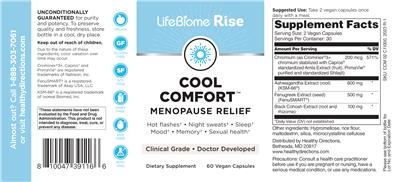
Supplement Facts
The label details for Cool Comfort by LifeBiome Rise, sourced from the NIH Dietary Supplement Label Database.
Supplement Facts
| Ingredient | Amount | % DV |
|---|---|---|
| KSM-66 | 600 mg | -- |
| Chromium | 200 mcg | 571% |
| Black Cohosh Rhizome, Root Extract | 100 mg | -- |
| FenuSMART | 500 mg | -- |
Other ingredients: Hypromellose, Rice Flour, Maltodextrin, Silica, Microcrystalline Cellulose
Tap any ingredient to jump to its full detail below.
These statements are the manufacturer’s wording, reproduced from the product label — the label is saying it, not HelloPharmacist. We don’t verify or endorse them.
General Statements
Almost out? Call 1-888-303-7061 or visit healthydirections.com
Doctor developed
Formulation
Unconditionally guaranteed for purity and potency.
Due to the nature of these ingredients, color variation over time may occur.
Vegan
GF Gluten free SF Soy free Dairy free Egg free Non-GMO
Menopause relief Hot flashes Night sweats Sleep Mood Memory Sexual health Clinical grade
Storage
To preserve quality and freshness, store bottle in a cool, dry place.
Precautions
Keep out of reach of children.
Precautions: Consult a health care practitioner before use if you are pregnant or nursing, have a serious medical condition, or use any medications.
Brand IP Statement(s)
Crominex 3+, Capros and PrimaVie are registered trademarks of Natreon, Inc. FenuSMART is a registered trademark of Akay USA, LLC. KSM-66 is a registered trademark of Ixoreal Biomed, Inc.
FDA Disclaimer Statement
These statements have not been evaluated by the Food and Drug Administration. This product is not intended to diagnose, treat, cure, or prevent any disease.
FDA Statement of Identity
Dietary Supplement
Suggested/Recommended/Usage/Directions
Suggested use: Take 2 vegan capsules once daily with a meal.
Is this label outdated? Report a formula or label change and our pharmacy team will review it.
Cool Comfort by LifeBiome Rise label
The label scan from the NIH Dietary Supplement Label Database. Tap to enlarge.
Label images are published by the NIH Dietary Supplement Label Database for the version of this product on file. Always read your actual product label.
View the full label (PDF)The Ingredients in Cool Comfort by LifeBiome Rise
These are the 4 active ingredients this product is made of. Select any to open its full monograph.
Serving size2 Vegan Capsule(s) Dosage formCapsule Servings per container30 Amounts shown are per serving.
Most supplement products combine several ingredients, and a medication can interact with the product through any one of them. Each ingredient below shows whether it has known drug interactions.
KSM-66
Interacts with1,372 drugs
Ashwagandha is an Ayurvedic herb most often taken to help with stress, anxiety, and sleep, and some small studies suggest it may help, though the evid...
KSM-66 monograph & interactionsChromium
Interacts with178 drugs
Chromium is an essential trace mineral involved in how the body handles sugar and fat. Some studies suggest it may modestly help blood sugar control i...
Chromium monograph & interactionsBlack Cohosh Rhizome, Root Extract
Interacts with652 drugs
Black cohosh is a North American plant most often used to ease menopause symptoms like hot flashes, but the research is mixed and far from settled. It...
Black Cohosh Rhizome, Root Extract monograph & interactionsFenuSMART
Interacts with389 drugs
Fenugreek is a common kitchen spice that is also taken as a supplement, mainly for blood sugar, cholesterol, and to support breast milk production. So...
FenuSMART monograph & interactionsOther (inactive) ingredients: Hypromellose, Rice Flour, Maltodextrin, Silica, Microcrystalline Cellulose. These complete the product’s ingredient list but are not active constituents.
Cool Comfort by LifeBiome Rise Drug Interactions
HelloPharmacist Interaction Report
Cool Comfort by LifeBiome Rise has documented interactions with multiple medications through its four active ingredients: ashwagandha (KSM-66), chromium, black cohosh, and fenugreek.
The most serious interaction is ashwagandha's potential to increase the risk of liver damage (hepatotoxicity) when combined with drugs that are toxic to the liver — a Moderate-severity concern.
Read the full breakdown — every affected drug type, severity by severity
Ashwagandha may increase sedation when taken with central nervous system depressants (like sleep aids and some anxiety medications), benzodiazepines, and barbiturates. It can also lower blood pressure additively with blood pressure medications, raise the risk of low blood sugar with diabetes drugs, potentially boost thyroid hormone effects, and theoretically weaken immunosuppressants.
Chromium may increase the risk of low blood sugar when used with diabetes medications or insulin, and can interfere with levothyroxine (Synthroid) absorption — chromium should be separated from thyroid medication by several hours.
Black cohosh may interact with drugs broken down by the liver enzyme CYP2D6, raise liver damage risk with hepatotoxic drugs, potentially alter estrogen therapy effects, and increase serotonin syndrome risk with serotonergic antidepressants. Fenugreek may add to the blood-thinning effects of anticoagulants and antiplatelet drugs, increase low blood sugar risk with diabetes medications, reduce theophylline and phenytoin levels, potentially raise bleeding risk with warfarin, and theoretically lower blood pressure further with metoprolol.
Almost all major drug classes are affected. Altogether, these interactions span 1,485 individual medications.
Use the medication checker below to verify your exact prescriptions before starting this product.
Check your own medications below · Editorial policy · How we use AI
Want to check YOUR meds against Cool Comfort?
Ask about interactions with your drugs in plain English — “Can I take it with lisinopril?” — and we find you the answer in seconds, ingredient by ingredient.
Go to the checkerIngredients driving the most interactions
Individual Drug Interactions
The ingredients in Cool Comfort interact with 1,484 drugs. Click any drug to see the details.
4 of the 4 ingredients in Cool Comfort interact with drugs. Each result below shows which ingredient is responsible. KSM-66 Black Cohosh Rhizome, Root Extract FenuSMART Chromium
AlemtuzumabCampath
How Alemtuzumab interacts with Cool Comfort — through 1 ingredient. Tap an ingredient for the detail:
Ksm-66Immunosuppressants Moderate
Interaction Summary
Theoretically, taking ashwagandha might decrease the effects of immunosuppressants.
Read the full Ksm-66 + Alemtuzumab interactionAlfentanilAlfenta
How Alfentanil interacts with Cool Comfort — through 1 ingredient. Tap an ingredient for the detail:
Ksm-66Cns Depressants, Cytochrome P450 3a4 (cyp3a4) Substrates Moderate
Interaction Summary
Theoretically, taking ashwagandha might increase the sedative effects of CNS depressants.
Read the full Ksm-66 + Alfentanil interactionAliskirenTekturna
How Aliskiren interacts with Cool Comfort — through 2 ingredients. Tap an ingredient for the detail:
Ksm-66Cytochrome P450 3a4 (cyp3a4) Substrates, Antihypertensive Drugs Moderate
Interaction Summary
Theoretically, ashwagandha might decrease the levels and clinical effects of CYP3A4 substrates.
Read the full Ksm-66 + Aliskiren interactionFenusmartAntihypertensive Drugs Minor
Interaction Summary
Fenugreek may also have an additive effect on blood pressure-lowering medications.
Read the full Fenusmart + Aliskiren interactionAllopurinolCaplenal, Cosuric, Rimapurinol, Zyloprim, Zyloric
How Allopurinol interacts with Cool Comfort — through 2 ingredients. Tap an ingredient for the detail:
Black Cohosh Rhizome, Root ExtractHepatotoxic Drugs Moderate
Interaction Summary
Theoretically, taking black cohosh with hepatotoxic drugs may increase the risk of liver damage.
Read the full Black Cohosh Rhizome, Root Extract + Allopurinol interactionKsm-66Hepatotoxic Drugs Moderate
Interaction Summary
Theoretically, taking ashwagandha with hepatotoxic drugs might increase the risk of liver damage.
Read the full Ksm-66 + Allopurinol interactionAlmotriptanAlmogran, Axert
How Almotriptan interacts with Cool Comfort — through 2 ingredients. Tap an ingredient for the detail:
Black Cohosh Rhizome, Root ExtractSerotonergic Drugs Moderate
Interaction Summary
Combining serotonergic drugs with black cohosh might cause additive serotonergic effects.
Read the full Black Cohosh Rhizome, Root Extract + Almotriptan interactionKsm-66Cytochrome P450 3a4 (cyp3a4) Substrates, Serotonergic Drugs Minor
Interaction Summary
Theoretically, ashwagandha might decrease the levels and clinical effects of CYP3A4 substrates.
Read the full Ksm-66 + Almotriptan interactionAlogliptinNesina
How Alogliptin interacts with Cool Comfort — through 4 ingredients. Tap an ingredient for the detail:
Black Cohosh Rhizome, Root ExtractHepatotoxic Drugs Moderate
Interaction Summary
Theoretically, taking black cohosh with hepatotoxic drugs may increase the risk of liver damage.
Read the full Black Cohosh Rhizome, Root Extract + Alogliptin interactionChromiumAntidiabetes Drugs Moderate
Interaction Summary
Theoretically, chromium may have additive effects with antidiabetic agents and increase the risk of hypoglycemia.
Read the full Chromium + Alogliptin interactionFenusmartAntidiabetes Drugs Moderate
Interaction Summary
Theoretically, fenugreek seed might have additive hypoglycemic effects when used with antidiabetes drugs.
Read the full Fenusmart + Alogliptin interactionKsm-66Cytochrome P450 3a4 (cyp3a4) Substrates, Hepatotoxic Drugs +1 Moderate
Interaction Summary
Theoretically, ashwagandha might decrease the levels and clinical effects of CYP3A4 substrates.
Read the full Ksm-66 + Alogliptin interactionAlogliptin, MetforminKazano
How Alogliptin, Metformin interacts with Cool Comfort — through 3 ingredients. Tap an ingredient for the detail:
Ksm-66Antidiabetes Drugs Moderate
Interaction Summary
Theoretically, taking ashwagandha with antidiabetes drugs might increase the risk of hypoglycemia.
Read the full Ksm-66 + Alogliptin, Metformin interactionFenusmartAntidiabetes Drugs Moderate
Interaction Summary
Theoretically, fenugreek seed might have additive hypoglycemic effects when used with antidiabetes drugs.
Read the full Fenusmart + Alogliptin, Metformin interactionChromiumAntidiabetes Drugs Moderate
Interaction Summary
Theoretically, chromium may have additive effects with antidiabetic agents and increase the risk of hypoglycemia.
Read the full Chromium + Alogliptin, Metformin interactionAlogliptin, PioglitazoneOseni
How Alogliptin, Pioglitazone interacts with Cool Comfort — through 4 ingredients. Tap an ingredient for the detail:
ChromiumAntidiabetes Drugs Moderate
Interaction Summary
Theoretically, chromium may have additive effects with antidiabetic agents and increase the risk of hypoglycemia.
Read the full Chromium + Alogliptin, Pioglitazone interactionFenusmartAntidiabetes Drugs Moderate
Interaction Summary
Theoretically, fenugreek seed might have additive hypoglycemic effects when used with antidiabetes drugs.
Read the full Fenusmart + Alogliptin, Pioglitazone interactionBlack Cohosh Rhizome, Root ExtractHepatotoxic Drugs Moderate
Interaction Summary
Theoretically, taking black cohosh with hepatotoxic drugs may increase the risk of liver damage.
Read the full Black Cohosh Rhizome, Root Extract + Alogliptin, Pioglitazone interactionKsm-66Antidiabetes Drugs, Cytochrome P450 3a4 (cyp3a4) Substrates +1 Moderate
Interaction Summary
Theoretically, taking ashwagandha with antidiabetes drugs might increase the risk of hypoglycemia.
Read the full Ksm-66 + Alogliptin, Pioglitazone interactionAlosetronLotronex
How Alosetron interacts with Cool Comfort — through 2 ingredients. Tap an ingredient for the detail:
Black Cohosh Rhizome, Root ExtractSerotonergic Drugs Moderate
Interaction Summary
Combining serotonergic drugs with black cohosh might cause additive serotonergic effects.
Read the full Black Cohosh Rhizome, Root Extract + Alosetron interactionKsm-66Serotonergic Drugs Minor
Interaction Summary
Some animal studies have reported that ashwagandha can enhance serotonergic transmission by altering certain serotonin (5-HT) receptors.
Read the full Ksm-66 + Alosetron interactionAlprazolamNiravam, Xanax
How Alprazolam interacts with Cool Comfort — through 1 ingredient. Tap an ingredient for the detail:
Ksm-66Cytochrome P450 3a4 (cyp3a4) Substrates, Benzodiazepines +1 Moderate
Interaction Summary
Theoretically, ashwagandha might decrease the levels and clinical effects of CYP3A4 substrates.
Read the full Ksm-66 + Alprazolam interactionAlteplase, TpaActilyse, Activase
How Alteplase, Tpa interacts with Cool Comfort — through 1 ingredient. Tap an ingredient for the detail:
FenusmartAnticoagulant/antiplatelet Drugs Moderate
Interaction Summary
Theoretically, fenugreek might have additive effects when used with anticoagulant or antiplatelet drugs.
Read the full Fenusmart + Alteplase, Tpa interactionAluminum Hydroxide, Aspirin, Codeine Phosphate, Magnesium HydroxideAscriptin Codeine #2
How Aluminum Hydroxide, Aspirin, Codeine Phosphate, Magnesium Hydroxide interacts with Cool Comfort — through 4 ingredients. Tap an ingredient for the detail:
FenusmartAnticoagulant/antiplatelet Drugs Moderate
Interaction Summary
Theoretically, fenugreek might have additive effects when used with anticoagulant or antiplatelet drugs.
Read the full Fenusmart + Aluminum Hydroxide, Aspirin, Codeine Phosphate, Magnesium Hydroxide interactionBlack Cohosh Rhizome, Root ExtractCytochrome P450 2d6 (cyp2d6) Substrates Moderate
Interaction Summary
Some research suggests that black cohosh might inhibit CYP2D6, but there is conflicting evidence.
Read the full Black Cohosh Rhizome, Root Extract + Aluminum Hydroxide, Aspirin, Codeine Phosphate, Magnesium Hydroxide interactionKsm-66Cns Depressants Moderate
Interaction Summary
Theoretically, taking ashwagandha might increase the sedative effects of CNS depressants.
Read the full Ksm-66 + Aluminum Hydroxide, Aspirin, Codeine Phosphate, Magnesium Hydroxide interactionChromiumAspirin, Nonsteroidal Anti-inflammatory Drugs (nsaids) Minor
Interaction Summary
Theoretically, aspirin might increase chromium absorption.
Read the full Chromium + Aluminum Hydroxide, Aspirin, Codeine Phosphate, Magnesium Hydroxide interactionAluminum Hydroxide, Aspirin, Magnesium HydroxideAscriptin
How Aluminum Hydroxide, Aspirin, Magnesium Hydroxide interacts with Cool Comfort — through 2 ingredients. Tap an ingredient for the detail:
FenusmartAnticoagulant/antiplatelet Drugs Moderate
Interaction Summary
Theoretically, fenugreek might have additive effects when used with anticoagulant or antiplatelet drugs.
Read the full Fenusmart + Aluminum Hydroxide, Aspirin, Magnesium Hydroxide interactionChromiumNonsteroidal Anti-inflammatory Drugs (nsaids), Aspirin Minor
Interaction Summary
NSAIDs might increase chromium levels in the body.
Read the full Chromium + Aluminum Hydroxide, Aspirin, Magnesium Hydroxide interactionAmbrisentanLetairis, Volibris
How Ambrisentan interacts with Cool Comfort — through 3 ingredients. Tap an ingredient for the detail:
Black Cohosh Rhizome, Root ExtractHepatotoxic Drugs Moderate
Interaction Summary
Theoretically, taking black cohosh with hepatotoxic drugs may increase the risk of liver damage.
Read the full Black Cohosh Rhizome, Root Extract + Ambrisentan interactionKsm-66Antihypertensive Drugs, Hepatotoxic Drugs +1 Moderate
Interaction Summary
Theoretically, taking ashwagandha with antihypertensive drugs might increase the risk of hypotension.
Read the full Ksm-66 + Ambrisentan interactionFenusmartAntihypertensive Drugs Minor
Interaction Summary
Fenugreek may also have an additive effect on blood pressure-lowering medications.
Read the full Fenusmart + Ambrisentan interactionAmilorideAmilamont, Midamor
How Amiloride interacts with Cool Comfort — through 2 ingredients. Tap an ingredient for the detail:
Ksm-66Antihypertensive Drugs Moderate
Interaction Summary
Theoretically, taking ashwagandha with antihypertensive drugs might increase the risk of hypotension.
Read the full Ksm-66 + Amiloride interactionFenusmartAntihypertensive Drugs Minor
Interaction Summary
Fenugreek may also have an additive effect on blood pressure-lowering medications.
Read the full Fenusmart + Amiloride interactionAmiloride, HydrochlorothiazideAmil-Co, Amilzide, Moduret 25, Moduretic
How Amiloride, Hydrochlorothiazide interacts with Cool Comfort — through 2 ingredients. Tap an ingredient for the detail:
Ksm-66Antihypertensive Drugs Moderate
Interaction Summary
Theoretically, taking ashwagandha with antihypertensive drugs might increase the risk of hypotension.
Read the full Ksm-66 + Amiloride, Hydrochlorothiazide interactionFenusmartAntihypertensive Drugs Minor
Interaction Summary
Fenugreek may also have an additive effect on blood pressure-lowering medications.
Read the full Fenusmart + Amiloride, Hydrochlorothiazide interactionAminoglutethimideCytadren
How Aminoglutethimide interacts with Cool Comfort — through 1 ingredient. Tap an ingredient for the detail:
Ksm-66Cns Depressants Moderate
Interaction Summary
Theoretically, taking ashwagandha might increase the sedative effects of CNS depressants.
Read the full Ksm-66 + Aminoglutethimide interactionAminophylline, Amobarbital, EphedrineAmesec
How Aminophylline, Amobarbital, Ephedrine interacts with Cool Comfort — through 1 ingredient. Tap an ingredient for the detail:
Ksm-66Cns Depressants Moderate
Interaction Summary
Theoretically, taking ashwagandha might increase the sedative effects of CNS depressants.
Read the full Ksm-66 + Aminophylline, Amobarbital, Ephedrine interactionAminosalicylic AcidPaser
How Aminosalicylic Acid interacts with Cool Comfort — through 2 ingredients. Tap an ingredient for the detail:
Black Cohosh Rhizome, Root ExtractHepatotoxic Drugs Moderate
Interaction Summary
Theoretically, taking black cohosh with hepatotoxic drugs may increase the risk of liver damage.
Read the full Black Cohosh Rhizome, Root Extract + Aminosalicylic Acid interactionKsm-66Hepatotoxic Drugs Moderate
Interaction Summary
Theoretically, taking ashwagandha with hepatotoxic drugs might increase the risk of liver damage.
Read the full Ksm-66 + Aminosalicylic Acid interactionAmiodaroneCordarone, Pacerone
How Amiodarone interacts with Cool Comfort — through 2 ingredients. Tap an ingredient for the detail:
Ksm-66Hepatotoxic Drugs, Cytochrome P450 3a4 (cyp3a4) Substrates Moderate
Interaction Summary
Theoretically, taking ashwagandha with hepatotoxic drugs might increase the risk of liver damage.
Read the full Ksm-66 + Amiodarone interactionBlack Cohosh Rhizome, Root ExtractHepatotoxic Drugs Moderate
Interaction Summary
Theoretically, taking black cohosh with hepatotoxic drugs may increase the risk of liver damage.
Read the full Black Cohosh Rhizome, Root Extract + Amiodarone interactionAmitriptylineElavil
How Amitriptyline interacts with Cool Comfort — through 2 ingredients. Tap an ingredient for the detail:
Ksm-66Cns Depressants, Cytochrome P450 3a4 (cyp3a4) Substrates +2 Moderate
Interaction Summary
Theoretically, taking ashwagandha might increase the sedative effects of CNS depressants.
Read the full Ksm-66 + Amitriptyline interactionBlack Cohosh Rhizome, Root ExtractCytochrome P450 2d6 (cyp2d6) Substrates, Serotonergic Drugs Moderate
Interaction Summary
Some research suggests that black cohosh might inhibit CYP2D6, but there is conflicting evidence.
Read the full Black Cohosh Rhizome, Root Extract + Amitriptyline interactionAmitriptyline, ChlordiazepoxideLimbitrol DS
How Amitriptyline, Chlordiazepoxide interacts with Cool Comfort — through 2 ingredients. Tap an ingredient for the detail:
Ksm-66Cytochrome P450 1a2 (cyp1a2) Substrates, Serotonergic Drugs +3 Moderate
Interaction Summary
Theoretically, ashwagandha might decrease the levels and clinical effects of CYP1A2 substrates.
Read the full Ksm-66 + Amitriptyline, Chlordiazepoxide interactionBlack Cohosh Rhizome, Root ExtractSerotonergic Drugs, Cytochrome P450 2d6 (cyp2d6) Substrates Moderate
Interaction Summary
Combining serotonergic drugs with black cohosh might cause additive serotonergic effects.
Read the full Black Cohosh Rhizome, Root Extract + Amitriptyline, Chlordiazepoxide interactionAmitriptyline, PerphenazineEtrafon, Etrafon-A, Etrafon-Forte, Triavil
How Amitriptyline, Perphenazine interacts with Cool Comfort — through 2 ingredients. Tap an ingredient for the detail:
Black Cohosh Rhizome, Root ExtractSerotonergic Drugs, Cytochrome P450 2d6 (cyp2d6) Substrates Moderate
Interaction Summary
Combining serotonergic drugs with black cohosh might cause additive serotonergic effects.
Read the full Black Cohosh Rhizome, Root Extract + Amitriptyline, Perphenazine interactionKsm-66Cytochrome P450 1a2 (cyp1a2) Substrates, Cns Depressants +2 Moderate
Interaction Summary
Theoretically, ashwagandha might decrease the levels and clinical effects of CYP1A2 substrates.
Read the full Ksm-66 + Amitriptyline, Perphenazine interactionAmlodipineNorliqva
How Amlodipine interacts with Cool Comfort — through 2 ingredients. Tap an ingredient for the detail:
Ksm-66Antihypertensive Drugs, Cytochrome P450 3a4 (cyp3a4) Substrates Moderate
Interaction Summary
Theoretically, taking ashwagandha with antihypertensive drugs might increase the risk of hypotension.
Read the full Ksm-66 + Amlodipine interactionFenusmartAntihypertensive Drugs Minor
Interaction Summary
Fenugreek may also have an additive effect on blood pressure-lowering medications.
Read the full Fenusmart + Amlodipine interactionAmlodipine BenzoateKaterzia
How Amlodipine Benzoate interacts with Cool Comfort — through 2 ingredients. Tap an ingredient for the detail:
Ksm-66Cytochrome P450 3a4 (cyp3a4) Substrates, Antihypertensive Drugs Moderate
Interaction Summary
Theoretically, ashwagandha might decrease the levels and clinical effects of CYP3A4 substrates.
Read the full Ksm-66 + Amlodipine Benzoate interactionFenusmartAntihypertensive Drugs Minor
Interaction Summary
Fenugreek may also have an additive effect on blood pressure-lowering medications.
Read the full Fenusmart + Amlodipine Benzoate interactionAmlodipine BesilateIstin
How Amlodipine Besilate interacts with Cool Comfort — through 2 ingredients. Tap an ingredient for the detail:
Ksm-66Antihypertensive Drugs, Cytochrome P450 3a4 (cyp3a4) Substrates Moderate
Interaction Summary
Theoretically, taking ashwagandha with antihypertensive drugs might increase the risk of hypotension.
Read the full Ksm-66 + Amlodipine Besilate interactionFenusmartAntihypertensive Drugs Minor
Interaction Summary
Fenugreek may also have an additive effect on blood pressure-lowering medications.
Read the full Fenusmart + Amlodipine Besilate interactionAmlodipine BesylateNorvasc
How Amlodipine Besylate interacts with Cool Comfort — through 2 ingredients. Tap an ingredient for the detail:
Ksm-66Cytochrome P450 3a4 (cyp3a4) Substrates, Antihypertensive Drugs Moderate
Interaction Summary
Theoretically, ashwagandha might decrease the levels and clinical effects of CYP3A4 substrates.
Read the full Ksm-66 + Amlodipine Besylate interactionFenusmartAntihypertensive Drugs Minor
Interaction Summary
Fenugreek may also have an additive effect on blood pressure-lowering medications.
Read the full Fenusmart + Amlodipine Besylate interactionAmlodipine Besylate, BenazeprilLotrel
How Amlodipine Besylate, Benazepril interacts with Cool Comfort — through 2 ingredients. Tap an ingredient for the detail:
Ksm-66Antihypertensive Drugs, Cytochrome P450 3a4 (cyp3a4) Substrates Moderate
Interaction Summary
Theoretically, taking ashwagandha with antihypertensive drugs might increase the risk of hypotension.
Read the full Ksm-66 + Amlodipine Besylate, Benazepril interactionFenusmartAntihypertensive Drugs Minor
Interaction Summary
Fenugreek may also have an additive effect on blood pressure-lowering medications.
Read the full Fenusmart + Amlodipine Besylate, Benazepril interactionAmlodipine, CelecoxibConsensi
How Amlodipine, Celecoxib interacts with Cool Comfort — through 3 ingredients. Tap an ingredient for the detail:
Ksm-66Cytochrome P450 3a4 (cyp3a4) Substrates, Antihypertensive Drugs Moderate
Interaction Summary
Theoretically, ashwagandha might decrease the levels and clinical effects of CYP3A4 substrates.
Read the full Ksm-66 + Amlodipine, Celecoxib interactionFenusmartAntihypertensive Drugs Minor
Interaction Summary
Fenugreek may also have an additive effect on blood pressure-lowering medications.
Read the full Fenusmart + Amlodipine, Celecoxib interactionChromiumNonsteroidal Anti-inflammatory Drugs (nsaids) Minor
Interaction Summary
NSAIDs might increase chromium levels in the body.
Read the full Chromium + Amlodipine, Celecoxib interactionAmmonium ChlorideAmmonium Chloride
How Ammonium Chloride interacts with Cool Comfort — through 2 ingredients. Tap an ingredient for the detail:
Ksm-66Antihypertensive Drugs Moderate
Interaction Summary
Theoretically, taking ashwagandha with antihypertensive drugs might increase the risk of hypotension.
Read the full Ksm-66 + Ammonium Chloride interactionFenusmartAntihypertensive Drugs Minor
Interaction Summary
Fenugreek may also have an additive effect on blood pressure-lowering medications.
Read the full Fenusmart + Ammonium Chloride interactionEach ingredient & the kinds of drugs it affects
For each ingredient in Cool Comfort with known interactions, here are the types of medications they can affect. Open any type for the detail — or search your exact drug in the checker above.
KSM-66
Antidiabetes Drugs
Theoretically, taking ashwagandha with antidiabetes drugs might increase the risk of hypoglycemia.
There is preliminary clinical evidence suggesting that ashwagandha might lower blood glucose levels. Theoretically, ashwagandha might have additive effects when used with antidiabetes drugs and increase the risk of hypoglycemia.
Antihypertensive Drugs
Theoretically, taking ashwagandha with antihypertensive drugs might increase the risk of hypotension.
Animal research suggests that ashwagandha might lower systolic and diastolic blood pressure. Theoretically, ashwagandha might have additive effects when used with antihypertensive drugs and increase the risk of hypotension.
Benzodiazepines
Theoretically, taking ashwagandha might increase the sedative effects of benzodiazepines.
There is preliminary evidence that ashwagandha might have an additive effect with diazepam (Valium) and clonazepam (Klonopin). This may also occur with other benzodiazepines.
Cns Depressants
Theoretically, taking ashwagandha might increase the sedative effects of CNS depressants.
Ashwagandha seems to have sedative effects. Theoretically, this may potentiate the effects of barbiturates, other sedatives, and anxiolytics.
Hepatotoxic Drugs
Theoretically, taking ashwagandha with hepatotoxic drugs might increase the risk of liver damage.
Ashwagandha has been linked to cases of acute hepatitis, liver failure, hepatic encephalopathy, autoimmune hepatitis, the need for liver transplantation, and death due to liver failure.
Immunosuppressants
Theoretically, taking ashwagandha might decrease the effects of immunosuppressants.
Ashwagandha has demonstrated immunostimulant effects in humans. Animal research has shown that ashwagandha can attenuate the immunosuppression caused by cyclophosphamide.
Thyroid Hormone
Ashwagandha might increase the effects and adverse effects of thyroid hormone.
Concomitant use of ashwagandha with thyroid hormones may cause additive therapeutic and adverse effects. Preliminary clinical research and animal studies suggest that ashwagandha boosts thyroid hormone synthesis and secretion. In one clinical study, ashwagandha increased triiodothyronine (T3) and thyroxine (T4) levels by 41.5% and 19.6%, respectively, and reduced serum TSH levels by 17.4% from baseline in adults with subclinical hypothyroidism.
Cytochrome P450 1A2 (Cyp1A2) Substrates
Theoretically, ashwagandha might decrease the levels and clinical effects of CYP1A2 substrates.
In vitro research shows that ashwagandha extract induces CYP1A2 enzymes.
Cytochrome P450 3A4 (Cyp3A4) Substrates
Theoretically, ashwagandha might decrease the levels and clinical effects of CYP3A4 substrates.
In vitro research shows that ashwagandha extract induces CYP3A4 enzymes.
Serotonergic Drugs
Some animal studies have reported that ashwagandha can enhance serotonergic transmission by altering certain serotonin (5-HT) receptors. However, there is no evidence to suggest that ashwagandha increases the risk of serotonin-related effects, and there have been no published case reports of serotonin syndrome when combined with other serotonergic drugs. Nevertheless, due to the lack of extensive studies on the matter and the fact that ashwagandha appears to affect serotonergic pathways, it would be prudent to exercise caution when combining it with drugs that affect serotonin. [References: - Effects of Withania somnifera (Ashwaga ndha) on Stress and the Stress-Related Neuropsychiatric Disorders Anxiety, Depression, and Insomnia. Curr Neuropharmacol. 2021 Sep 14; 19: 1468–1495. - A Prospective, Randomized Double-Blind, Placebo-Controlled Study of Safety and Efficacy of a High-Concentration Full-Spectrum Extract of Ashwagandha Root in Reducing Stress and Anxiety in Adults. https://www.ncbi.nlm.nih.gov/pmc/articles/PMC3573577/]
Black Cohosh Rhizome, Root Extract
Atorvastatin (Lipitor)
Taking black cohosh with atorvastatin might increase the risk for elevated liver function tests.
In one case report, a patient taking atorvastatin (Lipitor) developed significantly elevated liver function enzymes after starting black cohosh 100 mg four times daily. Liver enzymes returned to normal when black cohosh was discontinued. It is unclear whether the elevated liver enzymes were due to black cohosh itself or an interaction between atorvastatin and black cohosh.
Cisplatin (Platinol-Aq)
Theoretically, black cohosh may reduce the clinical effects of cisplatin.
Animal research suggests that black cohosh might decrease the cytotoxic effect of cisplatin on breast cancer cells.
Cytochrome P450 2D6 (Cyp2D6) Substrates
Some research suggests that black cohosh might inhibit CYP2D6, but there is conflicting evidence.
Some clinical research suggests that black cohosh might modestly inhibit CYP2D6 and increase levels of drugs metabolized by this enzyme. However, contradictory clinical research shows a specific black cohosh product (Remifemin, Enzymatic Therapy) 40 mg twice daily does not significantly inhibit metabolism of a CYP2D6 substrate in healthy study volunteers. Until more is known, use black cohosh cautiously in patients taking drugs metabolized by CYP2D6.
Estrogens
Theoretically, black cohosh may alter the effects of estrogen therapy.
Some research suggests that black cohosh has estrogenic effects. This may enhance or inhibit the effects of estrogen therapy.
Hepatotoxic Drugs
Theoretically, taking black cohosh with hepatotoxic drugs may increase the risk of liver damage.
There is concern that black cohosh might be linked to cases of liver failure and autoimmune hepatitis.
Serotonergic Drugs
Combining serotonergic drugs with black cohosh might cause additive serotonergic effects.
Black cohosh might increase the risk of serotonin syndrome when combined with other serotonergic drugs. Black cohosh acts as an agonist at several serotonin receptor subtypes and might interact with other serotonergic medications. In one case, a 55-year-old female who had been on stable treatment with sertraline 50 mg and duloxetine 60 mg daily developed serotonin syndrome after taking black cohosh extract 40 mg daily for 3 days.
Organic Anion-Transporting Polypeptide Substrates (Oatp)
Black cohosh may inhibit one form of OATP, OATP2B1, which could reduce the bioavailability and clinical effects of OATP2B1 substrates.
In vitro research shows that black cohosh modestly inhibits OATP2B1. OATPs are expressed in the small intestine and liver and are responsible for the uptake of drugs and other compounds into the body. Inhibition of OATP may reduce the bioavailability of oral drugs that are substrates of OATP.
FenuSMART
Anticoagulant/Antiplatelet Drugs
Theoretically, fenugreek might have additive effects when used with anticoagulant or antiplatelet drugs.
Some of the constituents in fenugreek have antiplatelet effects in animal and in vitro research. However, common fenugreek products might not contain sufficient concentrations of these constituents for clinical effects. A clinical study in patients with coronary artery disease or diabetes shows that taking fenugreek seed powder 2.5 grams twice daily for 3 months does not affect platelet aggregation, fibrinolytic activity, or fibrinogen levels .
Antidiabetes Drugs
Theoretically, fenugreek seed might have additive hypoglycemic effects when used with antidiabetes drugs.
Clinical research shows that fenugreek seed can reduce fasting blood glucose and 2-hour postprandial glucose levels in adults with type 2 diabetes.
Clopidogrel (Plavix)
Theoretically, fenugreek seed might alter the clinical effects of clopidogrel by inhibiting its conversion to the active form.
Animal research shows that fenugreek seed 200 mg/kg daily for 14 days increases the maximum serum concentration of clopidogrel by 21%. It is unclear how this affects the pharmacokinetics of the active metabolite of clopidogrel; however, this study found that concomitant use of fenugreek seed and clopidogrel prolonged bleeding time by an additional 11%.
Metoprolol (Toprol)
Theoretically, fenugreek seed might have additive hypotensive effects when used with metoprolol.
Animal research shows that fenugreek seed 300 mg/kg daily for 2 weeks decreases systolic and diastolic blood pressure by 9% and 11%, respectively, when administered alone, and by 15% and 22%, respectively, when given with metoprolol 10 mg/kg.
Phenytoin (Dilantin)
Theoretically, fenugreek might decrease plasma levels of phenytoin.
Animal research shows that taking fenugreek seeds for 1 week decreases maximum concentrations and the area under the curve of a single dose of phenytoin by 44% and 72%, respectively. This seems to be related to increased clearance. So far, this interaction has not been reported in humans.
Sildenafil (Viagra)
Theoretically, concurrent use of sildenafil and fenugreek might reduce levels and therapeutic effects of sildenafil.
Animal research shows that taking fenugreek seeds for 1 week reduces maximum concentrations and the area under the curve of a single dose of sildenafil by 27% and 48%, respectively. So far, this interaction has not been reported in humans.
Theophylline
Theoretically, fenugreek may reduce the levels and clinical effects of theophylline.
Animal research shows that fenugreek 50 grams daily for 7 days reduces the maximum serum concentration (Cmax) of theophylline by 28% and the area under the plasma drug concentration-time curve (AUC) by 22%.
Warfarin (Coumadin)
Theoretically, fenugreek might have additive effects with warfarin and increase the international normalized ratio (INR).
Some fenugreek constituents have antiplatelet effects, although these might not be present in concentrations that are clinically significant. In one case report, a patient taking warfarin experienced an increased INR when starting to take fenugreek in combination with boldo.
Antihypertensive Drugs
Fenugreek may also have an additive effect on blood pressure-lowering medications. Studies on animals have shown that fenugreek seed can decrease both systolic and diastolic blood pressure by up to 22% when combined with metoprolol. Therefore, it is essential to monitor your blood pressure regularly if you are taking fenugreek and metoprolol together or any other antihypertensive drugs.
Chromium
Antidiabetes Drugs
Theoretically, chromium may have additive effects with antidiabetic agents and increase the risk of hypoglycemia.
Some research shows that taking chromium might lower blood glucose levels, especially in patients with poorly controlled type 2 diabetes.
Insulin
Theoretically, concomitant use of chromium and insulin might increase the risk of hypoglycemia.
In clinical research, chromium has been shown to increase insulin sensitivity,
Levothyroxine (Synthroid, Others)
Chromium might bind levothyroxine in the intestinal tract and decrease levothyroxine absorption.
Clinical research in healthy volunteers shows that taking chromium picolinate 1000 mcg with levothyroxine 1 mg decreases serum levels of levothyroxine by 17% when compared to taking levothyroxine alone. Advise patients to take levothyroxine at least 30 minutes before or 3-4 hours after taking chromium.
Aspirin
Theoretically, aspirin might increase chromium absorption.
Animal research suggests that aspirin may increase chromium absorption and chromium levels in the blood.
Nonsteroidal Anti-Inflammatory Drugs (Nsaids)
NSAIDs might increase chromium levels in the body.
Drugs that are prostaglandin inhibitors, such as NSAIDs, seem to increase chromium absorption and retention.
Brand information
Manufacturer and brand details for Cool Comfort, from the product label.
LifeBiome Rise
See all LifeBiome Rise products- Name
- Healthy Directions
- City
- Bethesda
- State
- MD
- ZipCode
- 20817
- Phone Number
- 1-888-303-7061
Cool Comfort by LifeBiome Rise: Common Questions
Does Cool Comfort by LifeBiome Rise interact with any medications?
How can one product interact with so many drugs?
Where does this information come from?
Can I take Cool Comfort if I'm pregnant or breastfeeding?
What are the most common side effects I might experience?
Will Cool Comfort help with insomnia or anxiety?
Is there any risk of liver damage with this product?
Why do I need to separate chromium from my thyroid medication?
What is FenuSMART and what is it used for?
Written and reviewed by the HelloPharmacist editorial staff. Our editorial policy
Not sure if Cool Comfort is safe with your meds?
Our pharmacists answer your medication & supplement questions — free.
Label information is sourced from the NIH Dietary Supplement Label Database and reflects the product version on file; always read your actual product label. This page is for education only and is not a substitute for professional medical advice. Confirm with your pharmacist or doctor before combining supplements and medications.
The Full Monographs Behind Cool Comfort’s Ingredients
Every ingredient we hold a full HelloPharmacist monograph for — uses, evidence, safety, and the complete interaction list.
Ashwagandha
Interacts with 1,372 drugsAshwagandha is an Ayurvedic herb most often taken to help with stress, anxiety, and sleep, and some small studies suggest it may help, though the evidence is still limited. It is generally w...
Read the full Ashwagandha monograph → Herb & supplement monographChromium
Interacts with 178 drugsChromium is an essential trace mineral involved in how the body handles sugar and fat. Some studies suggest it may modestly help blood sugar control in certain people with type 2 diabetes, b...
Read the full Chromium monograph → Herb & supplement monographBlack Cohosh
Interacts with 652 drugsBlack cohosh is a North American plant most often used to ease menopause symptoms like hot flashes, but the research is mixed and far from settled. It is generally well tolerated for short-t...
Read the full Black Cohosh monograph → Herb & supplement monographFenugreek
Interacts with 389 drugsFenugreek is a common kitchen spice that is also taken as a supplement, mainly for blood sugar, cholesterol, and to support breast milk production. Some early research is encouraging for blo...
Read the full Fenugreek monograph →Sources & How We Checked
Cool Comfort's label data comes from the NIH Dietary Supplement Label Database; the ingredient interaction data is from the Natural Medicines database, reviewed by our pharmacists.
- NIH Dietary Supplement Label Database (DSLD) — The official product label on file for this supplement.
- Natural Medicines (Therapeutic Research Center) — Evidence-graded clinical reference behind the ingredient interaction data.
Content is written and reviewed by licensed HelloPharmacist pharmacists. See our data sources and editorial standards for how this information is built and checked.
The 183 references behind this product’s interaction data
Every citation that drives the interaction findings for this product’s ingredients, from the evidence-graded Natural Medicines (TRC Healthcare) database. Open an ingredient to browse its citations — links open the study on PubMed or the publisher’s site.
Ashwagandha 32 references
- McGuffin M, Hobbs C, Upton R, Goldberg A, eds. American Herbal Products Association's Botanical Safety Handbook. Boca Raton, FL: CRC Press, LLC 1997.
- Upton R, ed. Ashwagandha Root (Withania somnifera): Analytical, quality control, and therapuetic monograph. Santa Cruz, CA: American Herbal Pharmacopoeia 2000:1-25.
- Davis L, Kuttan G. Effect of Withania somnifera on cyclophosphamide-induced urotoxicity. Cancer Lett 2000;148:9-17. PubMed
- Davis L, Kuttan G. Suppressive effect of cyclophosphamide-induced toxicity by Withania somnifera extract in mice. J Ethnopharmacol 1998;62:209-14. PubMed
- Mishra LC, Singh BB, Dagenais S. Scientific basis for the therapeutic use of Withania somnifera (ashwagandha): a review. Altern Med Rev 2000;5:334-46. DOI
- Andallu B, Radhika B. Hypoglycemic, diuretic and hypocholesterolemic effect of winter cherry (Withania somnifera, Dunal) root. Indian J Exp Biol 2000;38:607-9.
- Kulkarni RR, Patki PS, Jog VP, et al. Treatment of osteoarthritis with a herbomineral formulation: a double-blind, placebo-controlled, cross-over study. J Ethnopharmacol 1991;33:91-5. PubMed
- Ahumada F, Aspee F, Wikman G, Hancke J. Withania somnifera exract. Its effects on arterial blood pressure in anaesthetized dogs. Phytother Res 1991;5:111-14.
- Panda S, Kar A. Withania somnifera and Bauhinia purpurea in the regulation of circulating thyroid hormone concentrations in female mice. J Ethnopharmacol 1999;67:233-39. PubMed
- Panda S, Kar A. Changes in thyroid hormone concentrations after administration of ashwagandha root extract to adult male mice. J Pharm Pharmacol 1998;50:1065-68. PubMed
- Sehgal, V. N., Verma, P., and Bhattacharya, S. N. Fixed-drug eruption caused by ashwagandha (Withania somnifera): a widely used Ayurvedic drug. Skinmed. 2012;10(1):48-49.
- Agnihotri AP, Sontakke SD, Thawani VR, Saoji A, Goswami VS. Effects of Withania somnifera in patients of schizophrenia: a randomized, double blind, placebo controlled pilot trial study. Indian J Pharmacol. 2013;45(4):417-8. PubMed
- Biswal BM, Sulaiman SA, Ismail HC, Zakaria H, Musa KI. Effect of Withania somnifera (Ashwagandha) on the development of chemotherapy-induced fatigue and quality of life in breast cancer patients. Integr Cancer Ther. 2013;12(4):312-22.
- Sharma AK, Basu I, Singh S. Efficacy and safety of Ashwagandha root extract in subclinical hypothyroid patients: a double-blind, randomized placebo-controlled trial. J Altern Complement Med. 2018 Mar;24(3):243-248. PubMed
- Durg S, Bavage S, Shivaram SB. Withania somnifera (Indian ginseng) in diabetes mellitus: A systematic review and meta-analysis of scientific evidence from experimental research to clinical application. Phytother Res. 2020;34(5):1041-1059.
- Björnsson HK, Björnsson ES, Avula B, et al. Ashwagandha-induced liver injury: A case series from Iceland and the US Drug-Induced Liver Injury Network. Liver Int. 2020;40(4):825-829. PubMed
- Tharakan A, Shukla H, Benny IR, Tharakan M, George L, Koshy S. Immunomodulatory Effect of Withania somnifera (Ashwagandha) Extract-A Randomized, Double-Blind, Placebo Controlled Trial with an Open Label Extension on Healthy Participants. J Clin Med 2021;1 PubMed
- Ireland PJ, Hardy T, Burt AD, Donnelly MC. Drug-induced hepatocellular injury due to herbal supplement ashwagandha. J R Coll Physicians Edinb. 2021;51(4):363-365. PubMed
- Kamal HI, Patel K, Brdak A, Heffernan J, Ahmad N. Ashwagandha as a unique cause of thyrotoxicosis presenting with supraventricular tachycardia. Cureus. 2022 Mar 25;14(3):e23494. PubMed
- Suryawanshi G, Abdallah M, Thomson M, Desai N, Chauhan A, Lim N. Ashwagandha-Associated Acute Liver Failure Requiring Liver Transplantation. Am J Ther 2023;30(1):e80-e83. PubMed
- Pusec CM, Wolsky R, Llerena C, Sura P. A Case of Supplement-Induced Hepatitis. Cureus 2022;14(10):e30433. PubMed
- Ajgaonkar A, Jain M, Debnath K. Efficacy and Safety of Ashwagandha (Withania somnifera) Root Extract for Improvement of Sexual Health in Healthy Women: A Prospective, Randomized, Placebo-Controlled Study. Cureus 2022;14(10):e30787. PubMed
- Haron MH, Dale O, Martin K, et al. Evaluation of the Herb-Drug Interaction Potential of Commonly Used Botanicals on the US Market with Regard to PXR- and AhR-Mediated Influences on CYP3A4 and CYP1A2. J Diet Suppl 2022. PubMed
- Lubarska M, Halasinski P, Hryhorowicz S, et al. Liver Dangers of Herbal Products: A Case Report of Ashwagandha-Induced Liver Injury. Int J Environ Res Public Health 2023;20(5):3921. PubMed
- Tóth M, Benedek AE, Longerich T, Seitz HK. Ashwagandha-induced acute liver injury: A case report. Clin Case Rep 2023;11(3):e7078.
- Bokan G, Glamocanin T, Mavija Z, et al. Herb-Induced Liver Injury by Ayurvedic Ashwagandha as Assessed for Causality by the Updated RUCAM: An Emerging Cause. Pharmaceuticals (Basel) 2023;16(8):1129. PubMed
- Patel PA, Sanborn E, Then R, Williams DM. Recurrent Reversible Cerebral Vasoconstriction Syndrome: A Report of Two Cases. Cureus 2023;15(8):e42992. PubMed
- Majeed M, Nagabhushanam K, Murali A, Vishwanathan DT, Mamidala RV, Mundkur L. A Standardized Withania somniferra (Linn.) Root Extract with Piperine Alleviates the Symptoms of Anxiety and Depression by Increasing Serotonin Levels: A Double-Blind, Randomize
- Philips CA, Valsan A, Theruvath AH, et al. Ashwagandha-induced liver injury-A case series from India and literature review. Hepatol Commun 2023;7(10):e0270. PubMed
- Hayashi M, Hamada H, Azuma SI, Hayashi K. Painless Thyroiditis by Withania somnifera (Ashwagandha). Cureus 2024;16(3):e55352. PubMed
- Vazirani S, Kothari A, Fujimoto J, Gomez M. Supplements Are Not a Synonym for Safe: Suspected Liver Injury From Ashwagandha. Fed Pract 2023;40(9):315-319. PubMed
- Patel M, Newell R, Hillier M, Ramalingam R. Herbal remedies as a potential cause of hypoadrenalism. Br J Hosp Med (Lond) 2024;85(6):1-4. PubMed
Chromium 53 references
- Cerulli J, Grabe DW, Gauthier I, et al. Chromium picolinate toxicity. Ann Pharmacother 1998;32:428-31. PubMed
- Urberg M, Zemel MB. Evidence for synergism between chromium and nicotinic acid in the control of glucose tolerance in elderly humans. Metabolism 1987;36:896-9. PubMed
- Mohamedshah FY, Moser-Veillon PB, Yamini S, et al. Distribution of a stable isotope of chromium (53Cr) in serum, urine, and breast milk in lactating women. Am J Clin Nutr 1998;67:1250-5. PubMed
- Wasser WG, Feldman NS, D'Agati VD. Chronic renal failure after ingestion of over-the-counter chromium picolinate. [letter]. Ann Intern Med 1997;126:410. PubMed
- Mertz W. Interaction of chromium with insulin: a progress report. Nutr Rev 1998;56:174-7. PubMed
- Anderson RA. Chromium, glucose intolerance and diabetes. J Am Coll Nutr 1998;17:548-55. PubMed
- McLeod MN, Gaynes BN, Golden RN. Chromium potentiation of antidepressant pharmacotherapy for dysthymic disorder in 5 patients. J Clin Psych 1999;60:237-40. PubMed
- Fowler JF Jr. Systemic contact dermatitis caused by oral chromium picolinate. Cutis 2000;65:116. DOI
- Trent LK, Thieding-Cancel D. Effects of chromium picolinate on body composition. J Sports Med Phys Fitness 1995;35:273-80.
- Food and Nutrition Board, Institute of Medicine. Dietary Reference Intakes for Vitamin A, Vitamin K, Arsenic, Boron, Chromium, Copper, Iodine, Iron, Manganese, Molybdenum, Nickel, Silicon, Vanadium, and Zinc. Washington, DC: National Academy Press, 2002.
- Rabinovitz H, Friedensohn A, Leibovitz A, et al. Effect of chromium supplementation on blood glucose and lipid levels in type 2 diabetes mellitus elderly patients. Int J Vitam Nutr Res 2004;74:178-82. PubMed
- Lanca S, Alves A, Vieira AI, et al. Chromium-induced toxic hepatitis. Eur J Intern Med 2002;13:518-20. PubMed
- Kockler DR, McCarthy MW, Lawson CL. Seizure activity and unresponsiveness after hydroxycut ingestion. Pharmacotherapy 2001;21:647-51.. PubMed
- Davidson JR, Abraham K, Connor KM, McLeod MN. Effectiveness of chromium in atypical depression: a placebo-controlled trial. Biol Psychiatry 2003;53:261-4.. PubMed
- Food Standards Agency. Medicines and Healthcare products Regulatory Agency (MHRA). Expert Group on Vitamins and Minerals. Available at: http://cot.food.gov.uk/sites/default/files/vitmin2003.pdf.
- Mouser JF, Hak EB, Helms RA, et al. Chromium and zinc concentrations in pediatric patients receiving long-term parenteral nutrition. Am J Health Syst Pharm 1999;56:1950-6. PubMed
- Stevens T, Qadri A, Zein NN. Two patients with acute liver injury associated with use of the herbal weight-loss supplement hydroxycut. Ann Intern Med 2005;142:477-8. PubMed
- Wani S, Weskamp C, Marple J, Spry L. Acute tubular necrosis associated with chromium picolinate-containing dietary supplement. Ann Pharmacother 2006;40:563-6. PubMed
- Kleefstra N, Houweling ST, Jansman FG, et al. Chromium treatment has no effect in patients with poorly controlled, insulin-treated type 2 diabetes in an obese Western population: a randomized, double-blind, placebo-controlled trial. Diabetes Care 2006;29: PubMed
- Martin J, Wang ZQ, Zhang XH, et al. Chromium picolinate supplementation attenuates body weight gain and increases insulin sensitivity in subjects with type 2 diabetes. Diabetes Care 2006;29:1826-32. PubMed
- Singer GM, Geohas J. The effect of chromium picolinate and biotin supplementation on glycemic control in poorly controlled patients with type 2 diabetes mellitus: a placebo-controlled, double-blinded, randomized trial. Diabetes Technol Ther 2006;8:636-43. PubMed
- John-Kalarickal J, Pearlman G, Carlson HE. New medications which decrease levothyroxine absorption. Thyroid 2007;17:763-5. PubMed
- Yazaki Y, Faridi Z, Ma Y, et al. A pilot study of chromium picolinate for weight loss. J Altern Complement Med 2010;16:291-9. PubMed
- Davis ML, Seaborn CD, and Stoecker BJ. Effects of over-the-counter drugs on chromium retention and urinary excretion in rats. Nutrition Research 1995;15(2):201-210.
- Young P, Turiansky G, Bonner M, and et al. Acute generalized exanthematous pustulosis induced by chromium picolinate. J.Am Acad.Dermatol. 1999;41(5 Pt 2):820-823. PubMed
- Gibb, H. J., Lees, P. S., Pinsky, P. F., and Rooney, B. C. Lung cancer among workers in chromium chemical production. Am J Ind.Med 2000;38(2):115-126. DOI
- Gibb, H. J., Lees, P. S., Pinsky, P. F., and Rooney, B. C. Clinical findings of irritation among chromium chemical production workers. Am J Ind.Med 2000;38(2):127-131. PubMed
- Pittler, M. H. and Ernst, E. Dietary supplements for body-weight reduction: a systematic review. Am.J.Clin Nutr. 2004;79(4):529-536. PubMed
- Pei, D., Hsieh, C. H., Hung, Y. J., Li, J. C., Lee, C. H., and Kuo, S. W. The influence of chromium chloride-containing milk to glycemic control of patients with type 2 diabetes mellitus: a randomized, double-blind, placebo-controlled trial. Metabolism 2 PubMed
- Hisatomi, K., Ishii, H., Hashiguchi, K., Seki, M., Ide, M., Sugiyama, K., Ishimoto, H., Nakayama, S., Mukae, H., and Kohno, S. Interstitial pneumonia caused by inhalation of fumes of nickel and chrome. Respirology. 2006;11(6):814-817. PubMed
- Kleefstra, N., Houweling, S. T., Bakker, S. J., Verhoeven, S., Gans, R. O., Meyboom-de Jong, B., and Bilo, H. J. Chromium treatment has no effect in patients with type 2 diabetes in a Western population: a randomized, double-blind, placebo-controlled tri DOI
- Parsons, A., Ingram, J., Inglis, J., Aveyard, P., Johnstone, E., Brown, K., Franklin, M., and Bermudez, I. A proof of concept randomised placebo controlled factorial trial to examine the efficacy of St John's wort for smoking cessation and chromium to pr
- Bagdon RE and Hazen RE. Skin permeation and cutaneous hypersensitivity as a basis for making risk assessments of chromium as a soil contaminant. Environ.Health Perspect. 1991;92:111-119. PubMed
- Bharmal, S. V., Moyes, V., Ahmed, S., and Grossman, A. Hypoglycaemia: possible mediation by chromium salt medication. Hormones.(Athens.) 2010;9(2):181-183. PubMed
- Krol, E., Krejpcio, Z., Byks, H., Bogdanski, P., and Pupek-Musialik, D. Effects of chromium brewer's yeast supplementation on body mass, blood carbohydrates, and lipids and minerals in type 2 diabetic patients. Biol.Trace Elem.Res. 2011;143(2):726-737.
- Unisa, S., Jagannath, P., Dhir, V., Khandelwal, C., Sarangi, L., and Roy, T. K. Population-based study to estimate prevalence and determine risk factors of gallbladder diseases in the rural Gangetic basin of North India. HPB (Oxford) 2011;13(2):117-125. PubMed
- Noda, S., Asano, Y., and Sato, S. Lichen planus in a patient with long-term exposure to chrome. Eur.J.Dermatol. 2011;21(3):417-418. PubMed
- Xiang, J., Sun, Z., and Huan, J. N. Intensive chromic acid burns and acute chromium poisoning with acute renal failure. Chin Med.J.(Engl.) 7-5-2011;124(13):2071-2073.
- Chhabra, D., Oda, K., Jagannath, P., Utsunomiya, H., Takekoshi, S., and Nimura, Y. Chronic heavy metal exposure and gallbladder cancer risk in India, a comparative study with Japan. Asian Pac.J.Cancer Prev. 2012;13(1):187-190. PubMed
- Huszonek, J. Over-the-counter chromium picolinate. Am J Psychiatry 1993;150(10):1560-1561. PubMed
- Bunner S and McGinnis R. Chromium-induced hypoglycemia. Psychosomatics 1998;39(3):298-299. PubMed
- Martin, W. R. and Fuller, R. E. Suspected chromium picolinate-induced rhabdomyolysis. Pharmacotherapy 1998;18(4):860-862. DOI
- Proctor, D. M., Fredrick, M. M., Scott, P. K., Paustenbach, D. J., and Finley, B. L. The prevalence of chromium allergy in the United States and its implications for setting soil cleanup: a cost-effectiveness case study. Regul.Toxicol Pharmacol 1998;28(1 PubMed
- De Marchi S, Cecchin E, De Marchi SU. Systemic allergic dermatitis resulting from oral administration of chromium with a food supplement. Contact Dermatitis 2014;70(2):123-5. PubMed
- Hedberg YS, Gumulka M, Lind ML, Matura M, Lidén C. Severe occupational chromium allergy despite cement legislation. Contact Dermatitis. 2014;70(5):321-3. PubMed
- Thyssen JP, Jellesen MS, Møller P, Menné T, Johansen JD. Allergic chromium dermatitis from wearing 'chromium-free' footwear. Contact Dermatitis 2014;70(3):185-7. PubMed
- Liu Y, Cotillard A, Vatier C, et al. A Dietary Supplement Containing Cinnamon, Chromium and Carnosine Decreases Fasting Plasma Glucose and Increases Lean Mass in Overweight or Obese Pre-Diabetic Subjects: A Randomized, Placebo-Controlled Trial. PLoS One.
- Jamilian M, Asemi Z. Chromium Supplementation and the Effects on Metabolic Status in Women with Polycystic Ovary Syndrome: A Randomized, Double-Blind, Placebo-Controlled Trial. Ann Nutr Metab. 2015;67(1):42-8. PubMed
- Guimarães MM, Carvalho AC, Silva MS. Effect of chromium supplementation on the glucose homeostasis and anthropometry of type 2 diabetic patients: Double blind, randomized clinical trial: Chromium, glucose homeostasis and anthropometry. J Trace Elem Med Bi PubMed
- Paiva AN, Lima JG, Medeiros AC, et al. Beneficial effects of oral chromium picolinate supplementation on glycemic control in patients with type 2 diabetes: A randomized clinical study. J Trace Elem Med Biol. 2015;32:66-72. PubMed
- Yin RV, Phung OJ. Effect of chromium supplementation on glycated hemoglobin and fasting plasma glucose in patients with diabetes mellitus. Nutr J. 2015;14:14. PubMed
- Jamilian M, Zadeh Modarres S, Amiri Siavashani M, et al. The influences of chromium supplementation on glycemic control, markers of cardio-metabolic risk, and oxidative stress in infertile polycystic ovary syndrome women candidate for in vitro fertilizati
- Alinaghi F, Thyssen JP, Zachariae C, Johansen JD. No immediate effect of regulatory reduction of chromium in leather among adult patients with chromium allergy. Contact Dermatitis 2021;85(5):514-522. PubMed
Black Cohosh 68 references
- McFarlin BL, Gibson MH, O'Rear J, Harman P. A national survey of herbal preparation use by nurse-midwives for labor stimulation. Review of the literature and recommendations for practice. J Nurse Midwifery 1999;44:205-16. PubMed
- Whiting PW, Clouston A, Kerlin P. Black cohosh and other herbal remedies associated with acute hepatitis. Med J Aust 2002;177:440-3. PubMed
- Pepping J. Black cohosh: Cimicifuga racemosa. Am J Health Syst Pharm 1999;56:1400-2. PubMed
- Liske E. Therapeutic efficacy and safety of Cimicifuga racemosa for gynecologic disorders. Adv Ther 1998;15:45-53.
- Kruse SO, Lohning A, Pauli GF, et al. Fukiic and piscidic acid esters from the rhizome of Cimicifuga racemosa and the in vitro estrogenic activity of fukinolic acid. Planta Med 1999;65:763-4.
- Jacobson JS, Troxel AB, Evans J, et al. Randomized trial of black cohosh for the treatment of hot flashes among women with a history of breast cancer. J Clin Oncol 2001;19:2739-45. PubMed
- Gunn TR, Wright IM. The use of black and blue cohosh in labour. N Z Med J 1996;109:410-1.
- Baillie N, Rasmussen P. Black and blue cohosh in labour. N Z Med J 1997;110:20-1.
- Lontos S, Jones RM, Angus PW, Gow PJ. Acute liver failure associated with the use of herbal preparations containing black cohosh. Med J Aust 2003;179:390-1.. DOI
- Wuttke W, Seidlova-Wuttke D, Gorkow C. The Cimicifuga preparation BNO 1055 vs. conjugated estrogens in a double-blind placebo-controlled study: effects on menopause symptoms and bone markers. Maturitas 2003;44:S67-77. PubMed
- Huntley A, Ernst E. A systematic review of the safety of black cohosh. Menopause 2003;10:58-64.. DOI
- Cohen SM, O'Connor AM, Hart J, et al. Autoimmune hepatitis associated with the use of black cohosh: a case study. Menopause 2004;11:575-7. PubMed
- Vitetta L, Thomsen M, Sali A. Black cohosh and other herbal remedies associated with acute hepatitis. Med J Aust 2003;178:411-2.. PubMed
- Thomsen M, Vitetta L, Schmidt M, Sali A. Acute liver failure associated with the use of herbal preparations containing black cohosh. Med J Aust 2004;180:598-600.. DOI
- Cohen B, Schardt D. Center for Science in the Public Interest. Letter to Food and Drug Administration. Commissioner Mark McClellan, MD, PhD. March 4, 2004.
- Seidlova-Wuttke D, Hesse O, Jarry H, et al. Evidence for selective estrogen receptor modulator activity in a black cohosh (Cimicifuga racemosa) extract: comparison with estradiol-17beta. Eur J Endocrinol 2003;149:351-62. PubMed
- Rockwell S, Liu Y, Higgins SA. Alteration of the effects of cancer therapy agents on breast cancer cells by the herbal medicine black cohosh. Breast Cancer Res Treat 2005;90:233-9. PubMed
- Levitsky J, Alli TA, Wisecarver J, Sorrell MF. Fulminant liver failure associated with the use of black cohosh. Dig Dis Sci 2005;50:538-9. PubMed
- Cheong JL, Bucknall R. Retinal vein thrombosis associated with a herbal phytoestrogen preparation in a susceptible patient. Postgrad Med J 2005;81:266-7.. PubMed
- Nappi RE, Malavasi B, Brundu B, Facchinetti F. Efficacy of Cimicifuga racemosa on climacteric complaints: a randomized study versus low-dose transdermal estradiol. Gynecol Endocrinol 2005;20:30-5.
- Gurley BJ, Gardner SF, Hubbard MA, et al. In vivo effects of goldenseal, kava kava, black cohosh, and valerian on human cytochrome P450 1A2, 2D6, 2E1, and 3A4/5 phenotypes. Clin Pharmacol Ther 2005;77:415-26. PubMed
- Minciullo PL, Saija A, Patafi M, et al. Muscle damage induced by black cohosh (Cimicifuga racemosa). Phytomedicine 2006;13:115-8. PubMed
- Wuttke W, Gorkow C, Seidlova-Wuttke D. Effects of black cohosh (Cimicifuga racemosa) on bone turnover, vaginal mucosa, and various blood parameters in postmenopausal women: a double-blind, placebo-controlled, and conjugated estrogens-controlled study. Men PubMed
- MHRA. Black cohosh (Cimicifuga racemosa) - risk of liver problems. Herbal Safety News July 2006. Available at: http://www.mhra.gov.uk/home/idcplg?IdcService=SS_GET_PAGE&useSecondary= true&ssDocName=CON2024131&ssTargetNodeId=663.
- Dugoua JJ, Seely D, Perri D, et al. Safety and efficacy of black cohosh (cimicifuga racemosa) during pregnancy and lactation. Can J Clin Pharmacol 2006;13:e257-61.
- Raus K, Brucker C, Gorkow C, Wuttke W. First-time proof of endometrial safety of the special black cohosh extract (Actaea or Cimicifuga racemosa extract) CR BNO 1055. Menopause 2006;13:678-91. PubMed
- Lynch CR, Folkers ME, Hutson WR. Fulminant hepatic failure associated with the use of black cohosh: a case report. Liver Transpl 2006;12:989-92. PubMed
- Bai W, Henneicke-von Zepelin HH, Wang S, et al. Efficacy and tolerability of a medicinal product containing an isopropanolic black cohosh extract in Chinese women with menopausal symptoms: A randomized, double blind, parallel-controlled study versus tibol
- Meyer S, Vogt T, Obermann EC, et al. Cutaneous pseudolymphoma induced by Cimicifuga racemosa. Dermatology 2007;214:94-6.
- Gori L, Firenzuoli F. Is black cohosh a hepatotoxic medicinal herb? Forsch Komplementarmed 2007;14:109-10. PubMed
- Assessment of case reports connected to herbal medicinal products containing cimicifugae racemosa rhizoma (black cohosh, root). Doc. Ref. EMEA/269259/2006. Available at: www.emea.eu.int/pdfs/human/hmpc/26925806en.pdf (Accessed 30 November 2007).
- Chung DJ, Kim HY, Park KH, et al. Black cohosh and St. John's wort (GYNO-Plus) for climacteric symptoms. Yonsei Med J 2007;48:289-94. PubMed
- Chow ECY, Teo M, Ring JA, Chen JW. Liver failure associated with the use of black cohosh for menopausal symptoms. Med J Aust 2008;188:420-2. PubMed
- Mahady GB, Low Dog T, Barrett ML, et al. United States Pharmacopeia review of the black cohosh case reports of hepatotoxicity. Menopause 2008;15:628-38. PubMed
- Hepatotoxicity with black cohosh. Australian Adv Drug Reactions Bull 2006;25:6. Available at: www.tga.gov.au/adr/aadrb/aadr0604.htm#a1.
- Dunbar K, Solga SF. Black cohosh, safety, and public awareness. Liver Int 2007;27:1017. PubMed
- Patel NM, Derkits RM. Possible increase in liver enzymes secondary to atorvastatin and black cohosh administration. J Pharm Pract 2007;20:341-6. DOI
- Joy D, Joy J, Duane P. Black cohosh: a cause of abnormal postmenopausal liver function tests. Climacteric 2008;11:84-8. PubMed
- Australian Adverse Drug Reactions Advisory Committee. Black cohosh and liver toxicity - an update. Aust Adv Drug Reactions Bull 2007;26:11.
- Gurley BJ, Swain A, Hubbard MA, et al. Clinical assessement of CYP2D6-mediated herb-drug interactions in humans: Effects of milk-thistle, black cohosh, goldenseal, kava kava, St. John's wort, and Echinacea. Mol Nutr Food Res 2008;52:755-63.
- Spangler L, Newton KM, Grothaus LC, et al. The effects of black cohosh therapies on lipids, fibrinogen, glucose and insulin. Maturitas 2007;57:195-204. PubMed
- Teschke R, Bahre R, Genthner A, et al. Suspected black cohosh hepatotoxicity - challenges and pitfalls of causality assessment. Maturitas 2009;63:302-14. PubMed
- Brasky TM, Lampe JW, Potter JD, et al. Specialty supplements and breast cancer risk in the VITamins And Lifestyle (VITAL) cohort. Cancer Epidemiol Biomarkers Prev 2010;19:1696-708. PubMed
- Fuchikami H, Satoh H, Tsujimoto M, Ohdo S, Ohtani H, Sawada Y. Effects of herbal extracts on the function of human organic anion-transporting polypeptide OATP-B. Drug Metab Dispos 2006;34:577-82. PubMed
- Vermes G, Bánhidy F, Acs N. The effects of remifemin on subjective symptoms of menopause. Adv Ther 2005;22:148-54. PubMed
- Nuntanakorn, P., Jiang, B., Einbond, L. S., Yang, H., Kronenberg, F., Weinstein, I. B., and Kennelly, E. J. Polyphenolic constituents of Actaea racemosa. J Nat Prod 2006;69(3):314-318.
- Oktem M, Eroglu D, Karahan HB, Taskintuna N, Kuscu E, Zeyneloglu HB. Black cohosh and fluoxetine in the treatment of postmenopausal symptoms: a prospective, randomized trial. Adv Ther 2007;24:448-61. PubMed
- Briese V, Stammwitz U, Friede M, Henneicke-von Zepelin HH. Black cohosh with or without St. John's wort for symptom-specific climacteric treatment--results of a large-scale, controlled, observational study. Maturitas 2007;57:405-14. PubMed
- Naser, B. and Liske, E. Liver failure associated with the use of black cohosh for menopausal symptoms. Med J Aust. 1-19-2009;190(2):99. PubMed
- van de Meerendonk, H. W., van Hunsel, F. P., and van der Wiel, H. E. [Autoimmune hepatitis induced by Actaea racemosa. Side affects of an herb extract]. Ned.Tijdschr.Geneeskd. 2-7-2009;153(6):246-249.
- Wong, V. C., Lim, C. E., Luo, X., and Wong, W. S. Current alternative and complementary therapies used in menopause. Gynecol.Endocrinol. 2009;25(3):166-174. PubMed
- Pierard, S., Coche, J. C., Lanthier, P., Dekoninck, X., Lanthier, N., Rahier, J., and Geubel, A. P. Severe hepatitis associated with the use of black cohosh: a report of two cases and an advice for caution. Eur J Gastroenterol Hepatol. 2009;21(8):941-945 PubMed
- Vannacci, A., Lapi, F., Gallo, E., Vietri, M., Toti, M., Menniti-Ippolito, F., Raschetti, R., Firenzuoli, F., and Mugelli, A. A case of hepatitis associated with long-term use of Cimicifuga racemosa. Altern.Ther Health Med 2009;15(3):62-63.
- Zimmermann, R., Witte, A., Voll, R. E., Strobel, J., and Frieser, M. Coagulation activation and fluid retention associated with the use of black cohosh: a case study. Climacteric. 2010;13(2):187-191. PubMed
- Amsterdam JD, Yao Y, Mao JJ, Soeller I, Rockwell K, Shults J. Randomized, double-blind, placebo-controlled trial of Cimicifuga racemosa (black cohosh) in women with anxiety disorder due to menopause. J Clin Psychopharmacol 2009;29:478-83. PubMed
- Bai WP, Wang SY, Liu JL, Geng L, Hu LN, Zhang ZL, Chen SL, Zheng SR. [Efficacy and safety of remifemin compared to tibolone for controlling of perimenopausal symptoms]. Zhonghua Fu Chan Ke Za Zhi 2009;44:597-600.
- McKenzie, S. C. and Rahman, A. Bradycardia in a patient taking black cohosh. Med J Aust. 10-18-2010;193(8):479-481. PubMed
- Stolze H. [An alternative to treat menopausal complaints]. Gynecologie 1982;1:14-16.
- Guzman G, Kallwitz ER, Wojewoda C, et al. Liver Injury with Features Mimicking Autoimmune Hepatitis following the Use of Black Cohosh. Case Rep Med. 2009;2009:918156. PubMed
- Enbom ET, Le MD, Oesterich L, Rutgers J, French SW. Mechanism of hepatotoxicity due to black cohosh (Cimicifuga racemosa): histological, immunohistochemical and electron microscopy analysis of two liver biopsies with clinical correlation. Exp Mol Pathol. PubMed
- Sen A. Orobuccolingual dyskinesia after long-term use of black cohosh and ginseng. J Neuropsychiatry Clin Neurosci 2013 Fall;25(4):E50. PubMed
- Hoban CL, Byard RW, Musgrave IF. Analysis of spontaneous adverse drug reactions to echinacea, valerian, black cohosh and ginkgo in Australia from 2000 to 2015. J Integr Med. 2019;17(5):338-343. PubMed
- Pkhaladze L, Davidova N, Khomasuridze A, Shengelia R, Panossian AG. Actaea racemosa L. is more effective in combination with Rhodiola rosea L. for relief of menopausal symptoms: a randomized, double-blind, placebo-controlled study. Pharmaceuticals (Basel) PubMed
- Yalçin M, Oguz A, Bestepe EE, Saglam NGU, Ergelen M. Black cohosh associated mania in a patient with unipolar depression. Int J Psychiatry Med 2020 Sep 21:91217420961185. doi: 10.1177/0091217420961185. PubMed
- Brar HS, Marathi R. Case of cholestatic drug-induced liver injury (DILI) associated with black cohosh. BMJ Case Rep 2021;14(5):e240408. PubMed
- Castelo-Branco C, Navarro C, Beltrán E, Losa F, Camacho M; on the behalf of the Natural Products Study Group of the Spanish Menopause Society. Black cohosh efficacy and safety for menopausal symptoms. The Spanish Menopause Society statement. Gynecol Endoc PubMed
- Trant AA, Chagpar A, Wei W, et al. The Effect of Black Cohosh on Ki67 expression and Tumor Volume: A Pilot Study of Ductal Carcinoma in Situ Patients. Integr Cancer Ther 2022;21:15347354221137290. PubMed
- Dernbach MR, Carpenter JE, Shah N, Carter GB. Black Cohosh Interactions with Prescription Medications Associated with Serotonin Toxicity and Rhabdomyolysis: A Case Report. J Emerg Med 2024;66(5):e592-e596. PubMed
Fenugreek 30 references
- Madar Z, Thorne R. Dietary fiber. Prog Food Nutr Sci 1987;11:153-74.
- Sharma RD, Raghuram TC, Rao NS. Effect of fenugreek seeds on blood glucose and serum lipids in type I diabetes. Eur J Clin Nutr 1990;44:301-6.
- Patil SP, Niphadkar PV, Bapat MM. Allergy to fenugreek (Trigonella foenum graecum). Ann Allergy Asthma Immunol 1997;78:297-300. PubMed
- Lambert J, Cormier J. Potential interaction between warfarin and boldo-fenugreek. Pharmacotherapy 2001;21:509-12. PubMed
- Bordia A, Verma SK, Srivastava KC. Effect of ginger (Zingiber officinale Rosc.) and fenugreek (Trigonella foenumgraecum L.) on blood lipids, blood sugar and platelet aggregation in patients with coronary artery disease. Prostaglandins Leukot Essent Fatty PubMed
- Yalcin SS, Tekinalp G, Ozalp I. Peculiar odor of traditional food and maple syrup urine disease. Pediatr Int 1999;41:108-9. PubMed
- Sewell AC, Mosandl A, Bohles H. False diagnosis of maple syrup urine disease owing to ingestion of herbal tea. N Engl J Med 1999;341:769.. PubMed
- Abdo MS, al-Kafawi AA. Experimental studies on the effect of Trigonella foenum-graecum (abstract). Planta Med 1969;17:14-8.
- Gupta A, Gupta R, Lal B. Effect of Trigonella foenum-graecum (fenugreek) seeds on glycaemic control and insulin resistance in type 2 diabetes mellitus: a double blind placebo controlled study. J Assoc Physicians India 2001;49:1057-61.
- Gabay MP. Galactogogues: medications that induce lactation. J Hum Lact 2002;18:274-9. PubMed
- Chevassus H, Gaillard JB, Farret A, et al. A fenugreek seed extract selectively reduces spontaneous fat intake in overweight subjects. Eur J Clin Pharmacol 2010;66(5):449-55. PubMed
- Turkyilmaz C, Onal E, Hirfanoglu IM, et al. The effect of galactagogue herbal tea on breast milk production and short-term catch-up of birth weight in the first week of life. J Altern Complement Med 2011;17(2):139-42. PubMed
- Swafford S, Berens P. Effect of fenugreek on breast milk volume. Abstract presented at: 5th International Meeting of the Academy of Breastfeeding Medicine; September 11-13,2000, Tucson, Arizona.
- Abdel-Barry, J. A., Abdel-Hassan, I. A., Jawad, A. M., and al Hakiem, M. H. Hypoglycaemic effect of aqueous extract of the leaves of Trigonella foenum-graecum in healthy volunteers. East Mediterr.Health J 2000;6(1):83-88. DOI
- Parvizpur, A., Ahmadiani, A., and Kamalinejad, M. Probable role of spinal purinoceptors in the analgesic effect of Trigonella foenum (TFG) leaves extract. J Ethnopharmacol 3-8-2006;104(1-2):108-112. PubMed
- Mora, A., Herrrera, A., Lopez, C., Dahbi, G., Mamani, R., Pita, J. M., Alonso, M. P., Llovo, J., Bernardez, M. I., Blanco, J. E., Blanco, M., and Blanco, J. Characteristics of the Shiga-toxin-producing enteroaggregative Escherichia coli O104:H4 German ou
- Blanco, J. [Stx2a-producing enteroaggregative Escherichia coli O104:H4-ST678. Microbiological diagnostic already, for this and other STEC/VTEC serotypes!]. Enferm.Infecc.Microbiol.Clin. 2012;30(2):84-89.
- Beutin, L. and Martin, A. Outbreak of Shiga toxin-producing Escherichia coli (STEC) O104:H4 infection in Germany causes a paradigm shift with regard to human pathogenicity of STEC strains. J Food Prot. 2012;75(2):408-418. PubMed
- King LA, Nogareda F, Weill FX, Mariani-Kurkdjian P, Loukiadis E, Gault G, Jourdan-DaSilva N, Bingen E, Macé M, Thevenot D, Ong N, Castor C, Noël H, Van Cauteren D, Charron M, Vaillant V, Aldabe B, Goulet V, Delmas G, Couturier E, Le Strat Y, Combe C, Delm
- Reeder C, Legrand A, O'Connor-Von SK. The Effect of Fenugreek on Milk Production and Prolactin Levels in Mothers of Preterm Infants. Clinical Lactation 2013;4(4):159-165. DOI
- Al-Jenoobi FI, Ahad A, Mahrous GM, Al-Mohizea AM, AlKharfy KM, Al-Suwayeh SA. Effects of fenugreek, garden cress, and black seed on theophylline pharmacokinetics in beagle dogs. Pharm Biol 2015;53(2):296-300. PubMed
- Rao A, Steels E, Inder WJ, Abraham S, Vitetta L. Testofen, a specialised Trigonella foenum-graecum seed extract reduces age-related symptoms of androgen decrease, increases testosterone levels and improves sexual function in healthy aging males in a doubl
- Steels E, Rao A, Vitetta L. Physiological aspects of male libido enhanced by standardized Trigonella foenum-graecum extract and mineral formulation. Phytother Res. 2011 Sep;25(9):1294-300.
- Gong J, Fang K, Dong H, Wang D, Hu M, Lu F. Effect of fenugreek on hyperglycaemia and hyperlipidemia in diabetes and prediabetes: A meta-analysis. J Ethnopharmacol. 2016 Dec 24;194:260-268. PubMed
- Ouzir M, El Bairi K, Amzazi S. Toxicological properties of fenugreek (Trigonella foenum graecum). Food Chem Toxicol. 2016 Oct;96:145-54. PubMed
- Khodamoradi K, Khosropanah MH, Ayati Z, et al. The Effects of Fenugreek on Cardiometabolic Risk Factors in Adults: A Systematic Review and Meta-analysis. Complement Ther Med. 2020;52:102416. PubMed
- Alkharfy K, Jan B, Alotaibi K, et al. Clopidogrel-herb Interactions: A Pharmacokinetic and Pharmacodynamic Assessment in a Rat Model. Curr Drug Metab 2021;22(12):969-977. PubMed
- Bin Jardan YA, Ahad A, Raish M, Alam MA, Al-Mohizea AM, Al-Jenoobi FI. Effects of garden cress, fenugreek and black seed on the pharmacodynamics of metoprolol: an herb-drug interaction study in rats with hypertension. Pharm Biol 2021;59(1):1088-1097. PubMed
- Al-Mohizea AM, Ahad A, El-Maghraby GM, et al. Effects of Nigella sativa, Lepidium sativum and Trigonella foenum-graecum on sildenafil disposition in beagle dogs. Eur J Drug Metab Pharmacokinet. 2015;40(2):219-24. PubMed
- Alkharfy KM, Al-Jenoobi FI, Al-Mohizea AM, et al. Effects of Lepidium sativum, Nigella sativa and Trigonella foenum-graceum on phenytoin pharmacokinetics in beagle dogs. Phytother Res. 2013;27(12):1800-4.
Parts of this content are provided by the Therapeutic Research Center, LLC.
DISCLAIMER: Currently this does not check for drug-drug interactions. This is not an all-inclusive comprehensive list of potential interactions and is for informational purposes only. Not all interactions are known or well-reported in the scientific literature, and new interactions are continually being reported. Input is needed from a qualified healthcare provider including a pharmacist before starting any therapy. Application of clinical judgment is necessary.
© 2021 Therapeutic Research Center, LLC