
Daily Probiotics Ingredients & Drug Interactions
What is this page for?
First and foremost: checking Daily Probiotics against your medications. The heart of this page is the interaction checker and the full interaction report — how this product’s ingredients may interact with prescription and over-the-counter medicines you may be taking.
Around that, we add a pharmacist’s high-level view of the product as a whole — what’s inside, the evidence for its stated use, how transparent the label is, and what safety data exists — so you can see the full picture in one place. It’s educational information from our licensed clinical databases and the clinical staff at HelloPharmacist — not medical advice — and we don’t sell or endorse products. Our editorial policy
Daily Probiotics is a dietary supplement by Sports Research with 15 active ingredients. Its ingredients are commonly taken for digestive health and balance, diarrhea (including antibiotic-related), vaginal yeast and bacterial infections.Based on those ingredients, 2,115 medications have a known interaction with it, the most serious rated major. The ingredients most likely to interact are Acacia senegal, Apple Fiber, Lactobacillus acidophilus. Use the checker below to test your specific medication, or read the full HelloPharmacist Interaction Report.
Check Your Meds Against Daily Probiotics by Sports Research
Ask about any prescription or over-the-counter medication and we check it for interactions with Daily Probiotics by Sports Research — and tell you which ingredient is responsible.
AI summaries are generated from our interaction database for education only — always confirm with your pharmacist. How we use AI
Ask the Pharmacist
A licensed pharmacist will answer your question by email — free, usually within 24 hours.
Got it — thank you!
A licensed pharmacist will answer within 24 hours. Keep an eye on your email (worth checking spam, just in case).
HelloPharmacist Scorecard of Daily Probiotics by Sports Research
Our pharmacy team’s full take, with four database checks built into the cards below — a summary of what is known, not a grade of the product itself.
What’s inside
Low disclosure
Daily Probiotics contains 15 active ingredients: four Lactobacillus strains (acidophilus, plantarum, paracasei, casei, rhamnosus GG, and fermentum), five Bifidobacterium strains (longum infantis, bifidum, breve, animalis lactis, and longum longum), Lactococcus lactis, Apple Fiber, inulin, and Acacia senegal. The probiotic strains are beneficial bacteria meant to support gut health, while the fiber components—apple fiber and inulin—serve as fuel for those bacteria.
The product also contains several inactive ingredients including starch, a plant-based capsule material (hypromellose), and gellan gum to hold everything together.
Does it work?
Moderate evidence
The evidence for these probiotics is mixed. Lactobacillus acidophilus is possibly effective for irritable bowel syndrome, Helicobacter pylori infection, antibiotic-associated diarrhea, and bacterial vaginosis.
Bifidobacterium bifidum is possibly effective for irritable bowel syndrome and respiratory tract infections. For the other strains and conditions tested—age-related cognitive decline, hay fever, anxiety, asthma, athletic performance—the evidence we hold is insufficient to rate them.
Inulin shows possibly effective evidence for obesity, constipation, and diabetes. Apple fiber's effectiveness for the conditions listed in our data is insufficient to rate.
Overall, this is a product where some ingredients have decent evidence for gut-related conditions, but many uses lack solid research backing.
How safe is it?
Well-documented data
These probiotics are generally well tolerated in healthy adults and children. The most common side effects are mild and gastrointestinal—bloating, flatulence, abdominal discomfort, and diarrhea—especially when starting or at higher doses.
Rare but serious cases of bacterial infection from the probiotics themselves (bacteremia, sepsis) have been reported in critically ill or severely immunocompromised patients, particularly infants, though these cases are uncommon. If you have a weakened immune system, heart valve issues, or are critically ill, check with your doctor before use.
Inulin and apple fiber can cause gas and bloating at higher doses. For pregnancy and breastfeeding, Bifidobacterium longum strains are rated possibly safe, but pregnancy and breastfeeding safety data are limited or not established for most other ingredients, so talk to your doctor before use if you're pregnant or nursing.
Meds to double-check
Major interaction found
Before taking Daily Probiotics, check with your pharmacist if you take any of these: antibiotic drugs (the live bacteria can be killed, reducing the probiotic's benefit—space them a few hours apart), organic anion-transporting polypeptide substrates like fexofenadine, atenolol, or aliskiren (apple fiber can significantly lower their blood levels), antihypertensive drugs or antidiabetes drugs (apple fiber may interfere with blood pressure or blood sugar control), lithium (apple fiber may reduce absorption), or antidiabetes drugs (inulin might increase low blood sugar risk). No interactions are documented for the ingredients we could not check.
The bottom line
Scorecard at a glanceFormula with limited ingredient disclosure with some supporting evidence behind its ingredients' uses. Major medication interactions have been identified, and safety information is well characterized.
Daily Probiotics is a reasonable choice if you're looking to support digestive health and have solid evidence for irritable bowel syndrome or antibiotic-associated diarrhea—but check your medications first, especially blood pressure drugs, heart drugs, diabetes medications, and antibiotics. If you're seriously ill, immunocompromised, or pregnant or breastfeeding, talk to your pharmacist or doctor before starting.
Don't take this with antibiotics at the same time; separate them by a few hours.
Educational only — not medical advice; always confirm with your pharmacist. Our editorial policy · How we use AI
Assessment coverage: 8 of 15 active ingredients matched to our full ingredient reviews (monographs). Based on the product label dated Mar 25, 2025.
This Scorecard evaluates available label information, ingredient evidence, and known medication-safety considerations. It does not independently verify product identity, purity, potency, contamination, or manufacturing quality. How these ratings are computed
General information
Key facts about Daily Probiotics, straight from the product label.
| Brand | Sports Research |
|---|---|
| Barcode (UPC) | 023249090090 |
| Net contents | 30 Delayed Release Capsule(s) |
| Market status | On market |
| Date entered into DSLD | Mar 25, 2025 |
| DSLD ID | 326252 |
| Product type | Other Combinations |
| Supplement form | Capsule |
| Dietary claims / uses | All Other, Structure/Function |
| Intended target group(s) | Vegan, Vegetarian, Adult (18 - 50 Years), Gluten Free, Dairy Free |
Everything in this section is reproduced from the manufacturer’s own product label — it’s the label speaking, not HelloPharmacist. We show it so you can see exactly what the maker states; we don’t verify or endorse those statements.
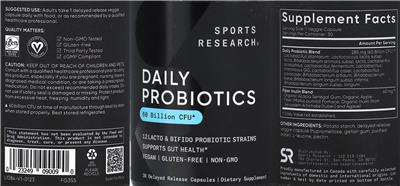
Supplement Facts
The label details for Daily Probiotics by Sports Research, sourced from the NIH Dietary Supplement Label Database.
Supplement Facts
| Ingredient | Amount | % DV |
|---|---|---|
| Lactobacillus acidophilus | 0 NP | -- |
| Bifidobacterium longum infantis | 0 NP | -- |
| Lactobacillus plantarum | 0 NP | -- |
| Bifidobacterium bifidum | 0 NP | -- |
| Lactobacillus paracasei | 0 NP | -- |
| Bifidobacterium breve | 0 NP | -- |
| Lactobacillus casei | 0 NP | -- |
| Bifidobacterium animalis lactis | 0 NP | -- |
| Lactobacillus rhamnosus GG | 0 NP | -- |
| Lactobacillus fermentum | 0 NP | -- |
| Daily Probiotic Blend | 285 mg | -- |
| Bifidobacterium longum longum | 0 NP | -- |
| Lactococcus lactis | 0 NP | -- |
| Acacia senegal | 0 NP | -- |
| Apple Fiber | 0 NP | -- |
| Fiber Inulin Blend | 60 mg | -- |
| Inulin | 0 NP | -- |
Other ingredients: Starch, Hypromellose, Gellan Gum, Water, Purified, L-Leucine, Pectin
Tap any ingredient to jump to its full detail below.
These statements are the manufacturer’s wording, reproduced from the product label — the label is saying it, not HelloPharmacist. We don’t verify or endorse them.
Suggested/Recommended/Usage/Directions
Suggested use: Adults take 1 delayed release veggie capsule daily with food or as recommended by a qualified healthcare professional.
Seals/Symbols
Quality Matters: IGEN Non-GMO Tested Certified Vegan Vegan.org
Formulation
IGEN Non-GMO Tested Non-GMO Tested Gluten-Free
Certified Vegan Vegan.org
Third Party Tested cGMP Compliant
Supports gut health
Vegan
Gluten-Free Non-GMO
Proudly manufactured in Canada with carefully selected ingredients of domestic and international origins.
Precautions
Caution: Keep out of reach of children and pets.
Consult with a qualified healthcare professional prior to using this product, especially if you are pregnant, nursing, have a diagnosed medical condition, or are taking a prescription medication.
Caution: Keep out of reach of children and pets. Do not exceed recommended daily intake. Do not use if safety seal is damaged or missing.
Storage
Protect product from excessive heat, freezing, humidity and light. 60 billion CFU at time of manufacture through best by date when stored properly. Best stored refrigerated.
FDA Disclaimer Statement
This statement has not been evaluated by the Food and Drug Administration. This product is not intended to diagnose, treat, cure, or prevent any disease.
General Statements
HDPE Non BPA Please recycle Scan for more
@sportsresearch
Formula
60 billion CFU 60 billion CFU at time of manufacture through best by date when stored properly. Best stored refrigerated. 12 lacto & bifido probiotic strains
FDA Statement of Identity
Dietary Supplement
Is this label outdated? Report a formula or label change and our pharmacy team will review it.
Daily Probiotics by Sports Research label
The label scan from the NIH Dietary Supplement Label Database. Tap to enlarge.
Label images are published by the NIH Dietary Supplement Label Database for the version of this product on file. Always read your actual product label.
View the full label (PDF)The Ingredients in Daily Probiotics by Sports Research
These are the 15 active ingredients this product is made of. Select any to open its full monograph.
Serving size1 Veggie Capsule(s) Dosage formCapsule Servings per container30 Amounts shown are per serving.
Most supplement products combine several ingredients, and a medication can interact with the product through any one of them. Each ingredient below shows whether it has known drug interactions.
Daily Probiotic Blend
- › Lactobacillus acidophilus
- › Bifidobacterium longum infantis
- › Lactobacillus plantarum
- › Bifidobacterium bifidum
- › Lactobacillus paracasei
- › Bifidobacterium breve
- › Lactobacillus casei
- › Bifidobacterium animalis lactis
- › Lactobacillus rhamnosus GG
- › Lactobacillus fermentum
- › Bifidobacterium longum longum
- › Lactococcus lactis
Fiber Inulin Blend
- › Acacia senegal
- › Apple Fiber
- › Inulin
Other (inactive) ingredients: Starch, Hypromellose, Gellan Gum, Water, Purified, L-Leucine, Pectin. These complete the product’s ingredient list but are not active constituents.
Daily Probiotics by Sports Research Drug Interactions
HelloPharmacist Interaction Report
Daily Probiotics by Sports Research contains several probiotic strains and fiber ingredients that interact with medications.
The most serious interaction involves Apple Fiber, which contains a Major-severity interaction with organic anion-transporting polypeptide substrates (OATP)—a group of drugs whose absorption can be significantly reduced when taken with apple products. This includes fexofenadine (Allegra), atenolol (Tenormin), and aliskiren (Tekturna, Rasilez), where bioavailability can drop by 58% to 82%.
Read the full breakdown — every affected drug type, severity by severity
Several probiotic strains—Lactobacillus acidophilus, Bifidobacterium longum infantis, Bifidobacterium bifidum, Bifidobacterium breve, and Bifidobacterium longum longum—carry Moderate-severity interactions with antibiotic drugs. Since these probiotics contain live organisms, taking antibiotics at the same time can kill a significant number of them and reduce their effectiveness.
The Apple Fiber component also interacts with antihypertensive drugs (blood pressure medications), antidiabetes drugs, and lithium, all at Moderate severity. Additionally, inulin in this product carries a Minor interaction with antidiabetes drugs, as it may theoretically increase the risk of low blood sugar (hypoglycemia).
We could not check several ingredients for interactions: Lactobacillus plantarum, Lactobacillus paracasei, Lactobacillus casei, Bifidobacterium animalis lactis, Lactobacillus rhamnosus GG, Lactobacillus fermentum, Lactococcus lactis, and Acacia senegal.
Altogether, these interactions span 461 individual medications. Use the medication checker on this page to search your exact drugs before starting this product.
Check your own medications below · Editorial policy · How we use AI
Want to check YOUR meds against Daily Probiotics?
Ask about interactions with your drugs in plain English — “Can I take it with lisinopril?” — and we find you the answer in seconds, ingredient by ingredient.
Go to the checkerIngredients driving the most interactions
Individual Drug Interactions
The ingredients in Daily Probiotics interact with 2,115 drugs. Click any drug to see the details.
7 of the 15 ingredients in Daily Probiotics interact with drugs. Each result below shows which ingredient is responsible. Acacia senegal Apple Fiber Lactobacillus acidophilus Bifidobacterium longum infantis Bifidobacterium bifidum Bifidobacterium breve Inulin
AtorvastatinAtorvaliq
How Atorvastatin interacts with Daily Probiotics — through 2 ingredients. Tap an ingredient for the detail:
Apple FiberOrganic Anion-transporting Polypeptide Substrates (oatp) Major
Interaction Summary
Concomitant consumption of apple juice can significantly decrease oral absorption and blood levels of OATP substrates.
Read the full Apple Fiber + Atorvastatin interactionAcacia SenegalOral Drugs Moderate
Interaction Summary
Theoretically, gum arabic can alter the absorption of oral drugs due to its fiber content.
Read the full Acacia Senegal + Atorvastatin interactionAtorvastatin CalciumLipitor
How Atorvastatin Calcium interacts with Daily Probiotics — through 2 ingredients. Tap an ingredient for the detail:
Apple FiberOrganic Anion-transporting Polypeptide Substrates (oatp) Major
Interaction Summary
Concomitant consumption of apple juice can significantly decrease oral absorption and blood levels of OATP substrates.
Read the full Apple Fiber + Atorvastatin Calcium interactionAcacia SenegalOral Drugs Moderate
Interaction Summary
Theoretically, gum arabic can alter the absorption of oral drugs due to its fiber content.
Read the full Acacia Senegal + Atorvastatin Calcium interactionBosentanTracleer
How Bosentan interacts with Daily Probiotics — through 2 ingredients. Tap an ingredient for the detail:
Apple FiberOrganic Anion-transporting Polypeptide Substrates (oatp), Antihypertensive Drugs Major
Interaction Summary
Concomitant consumption of apple juice can significantly decrease oral absorption and blood levels of OATP substrates.
Read the full Apple Fiber + Bosentan interactionAcacia SenegalOral Drugs Moderate
Interaction Summary
Theoretically, gum arabic can alter the absorption of oral drugs due to its fiber content.
Read the full Acacia Senegal + Bosentan interactionBrincidofovirTembexa
How Brincidofovir interacts with Daily Probiotics — through 2 ingredients. Tap an ingredient for the detail:
Apple FiberOrganic Anion-transporting Polypeptide Substrates (oatp) Major
Interaction Summary
Concomitant consumption of apple juice can significantly decrease oral absorption and blood levels of OATP substrates.
Read the full Apple Fiber + Brincidofovir interactionAcacia SenegalOral Drugs Moderate
Interaction Summary
Theoretically, gum arabic can alter the absorption of oral drugs due to its fiber content.
Read the full Acacia Senegal + Brincidofovir interactionCeliprololCelicard
How Celiprolol interacts with Daily Probiotics — through 2 ingredients. Tap an ingredient for the detail:
Apple FiberOrganic Anion-transporting Polypeptide Substrates (oatp), Antihypertensive Drugs Major
Interaction Summary
Concomitant consumption of apple juice can significantly decrease oral absorption and blood levels of OATP substrates.
Read the full Apple Fiber + Celiprolol interactionAcacia SenegalOral Drugs Moderate
Interaction Summary
Theoretically, gum arabic can alter the absorption of oral drugs due to its fiber content.
Read the full Acacia Senegal + Celiprolol interactionCerivastatin SodiumBaycol
How Cerivastatin Sodium interacts with Daily Probiotics — through 2 ingredients. Tap an ingredient for the detail:
Apple FiberOrganic Anion-transporting Polypeptide Substrates (oatp) Major
Interaction Summary
Concomitant consumption of apple juice can significantly decrease oral absorption and blood levels of OATP substrates.
Read the full Apple Fiber + Cerivastatin Sodium interactionAcacia SenegalOral Drugs Moderate
Interaction Summary
Theoretically, gum arabic can alter the absorption of oral drugs due to its fiber content.
Read the full Acacia Senegal + Cerivastatin Sodium interactionCinoxacinCinobac
How Cinoxacin interacts with Daily Probiotics — through 6 ingredients. Tap an ingredient for the detail:
Apple FiberOrganic Anion-transporting Polypeptide Substrates (oatp) Major
Interaction Summary
Concomitant consumption of apple juice can significantly decrease oral absorption and blood levels of OATP substrates.
Read the full Apple Fiber + Cinoxacin interactionLactobacillus AcidophilusAntibiotic Drugs Moderate
Interaction Summary
Theoretically, taking Lactobacillus acidophilus with antibiotic drugs might decrease the effectiveness of L.
Read the full Lactobacillus Acidophilus + Cinoxacin interactionAcacia SenegalOral Drugs Moderate
Interaction Summary
Theoretically, gum arabic can alter the absorption of oral drugs due to its fiber content.
Read the full Acacia Senegal + Cinoxacin interactionBifidobacterium BreveAntibiotic Drugs Moderate
Interaction Summary
Theoretically, taking Bifidobacterium breve with antibiotic drugs might decrease the effectiveness of B.
Read the full Bifidobacterium Breve + Cinoxacin interactionBifidobacterium BifidumAntibiotic Drugs Moderate
Interaction Summary
Theoretically, taking Bifidobacterium.
Read the full Bifidobacterium Bifidum + Cinoxacin interactionBifidobacterium Longum LongumAntibiotic Drugs Moderate
Interaction Summary
Theoretically, taking Bifidobacterium longum with antibiotic drugs might decrease the effectiveness of B.
Read the full Bifidobacterium Longum Longum + Cinoxacin interactionCiprofloxacinCiloxan, Cipro, Cipro IV, Cipro XR, Ciprobay, Otiprio
How Ciprofloxacin interacts with Daily Probiotics — through 6 ingredients. Tap an ingredient for the detail:
Apple FiberOrganic Anion-transporting Polypeptide Substrates (oatp) Major
Interaction Summary
Concomitant consumption of apple juice can significantly decrease oral absorption and blood levels of OATP substrates.
Read the full Apple Fiber + Ciprofloxacin interactionBifidobacterium Longum LongumAntibiotic Drugs Moderate
Interaction Summary
Theoretically, taking Bifidobacterium longum with antibiotic drugs might decrease the effectiveness of B.
Read the full Bifidobacterium Longum Longum + Ciprofloxacin interactionBifidobacterium BifidumAntibiotic Drugs Moderate
Interaction Summary
Theoretically, taking Bifidobacterium.
Read the full Bifidobacterium Bifidum + Ciprofloxacin interactionAcacia SenegalOral Drugs Moderate
Interaction Summary
Theoretically, gum arabic can alter the absorption of oral drugs due to its fiber content.
Read the full Acacia Senegal + Ciprofloxacin interactionLactobacillus AcidophilusAntibiotic Drugs Moderate
Interaction Summary
Theoretically, taking Lactobacillus acidophilus with antibiotic drugs might decrease the effectiveness of L.
Read the full Lactobacillus Acidophilus + Ciprofloxacin interactionBifidobacterium BreveAntibiotic Drugs Moderate
Interaction Summary
Theoretically, taking Bifidobacterium breve with antibiotic drugs might decrease the effectiveness of B.
Read the full Bifidobacterium Breve + Ciprofloxacin interactionCiprofloxacin, HydrocortisoneCipro HC Otic
How Ciprofloxacin, Hydrocortisone interacts with Daily Probiotics — through 1 ingredient. Tap an ingredient for the detail:
Apple FiberOrganic Anion-transporting Polypeptide Substrates (oatp) Major
Interaction Summary
Concomitant consumption of apple juice can significantly decrease oral absorption and blood levels of OATP substrates.
Read the full Apple Fiber + Ciprofloxacin, Hydrocortisone interactionClinafloxacinClinafloxacin
How Clinafloxacin interacts with Daily Probiotics — through 6 ingredients. Tap an ingredient for the detail:
Apple FiberOrganic Anion-transporting Polypeptide Substrates (oatp) Major
Interaction Summary
Concomitant consumption of apple juice can significantly decrease oral absorption and blood levels of OATP substrates.
Read the full Apple Fiber + Clinafloxacin interactionBifidobacterium BreveAntibiotic Drugs Moderate
Interaction Summary
Theoretically, taking Bifidobacterium breve with antibiotic drugs might decrease the effectiveness of B.
Read the full Bifidobacterium Breve + Clinafloxacin interactionAcacia SenegalOral Drugs Moderate
Interaction Summary
Theoretically, gum arabic can alter the absorption of oral drugs due to its fiber content.
Read the full Acacia Senegal + Clinafloxacin interactionBifidobacterium BifidumAntibiotic Drugs Moderate
Interaction Summary
Theoretically, taking Bifidobacterium.
Read the full Bifidobacterium Bifidum + Clinafloxacin interactionBifidobacterium Longum LongumAntibiotic Drugs Moderate
Interaction Summary
Theoretically, taking Bifidobacterium longum with antibiotic drugs might decrease the effectiveness of B.
Read the full Bifidobacterium Longum Longum + Clinafloxacin interactionLactobacillus AcidophilusAntibiotic Drugs Moderate
Interaction Summary
Theoretically, taking Lactobacillus acidophilus with antibiotic drugs might decrease the effectiveness of L.
Read the full Lactobacillus Acidophilus + Clinafloxacin interactionEnoxacinPenetrex
How Enoxacin interacts with Daily Probiotics — through 6 ingredients. Tap an ingredient for the detail:
Apple FiberOrganic Anion-transporting Polypeptide Substrates (oatp) Major
Interaction Summary
Concomitant consumption of apple juice can significantly decrease oral absorption and blood levels of OATP substrates.
Read the full Apple Fiber + Enoxacin interactionLactobacillus AcidophilusAntibiotic Drugs Moderate
Interaction Summary
Theoretically, taking Lactobacillus acidophilus with antibiotic drugs might decrease the effectiveness of L.
Read the full Lactobacillus Acidophilus + Enoxacin interactionBifidobacterium BifidumAntibiotic Drugs Moderate
Interaction Summary
Theoretically, taking Bifidobacterium.
Read the full Bifidobacterium Bifidum + Enoxacin interactionAcacia SenegalOral Drugs Moderate
Interaction Summary
Theoretically, gum arabic can alter the absorption of oral drugs due to its fiber content.
Read the full Acacia Senegal + Enoxacin interactionBifidobacterium Longum LongumAntibiotic Drugs Moderate
Interaction Summary
Theoretically, taking Bifidobacterium longum with antibiotic drugs might decrease the effectiveness of B.
Read the full Bifidobacterium Longum Longum + Enoxacin interactionBifidobacterium BreveAntibiotic Drugs Moderate
Interaction Summary
Theoretically, taking Bifidobacterium breve with antibiotic drugs might decrease the effectiveness of B.
Read the full Bifidobacterium Breve + Enoxacin interactionEtoposideEtopophos, VePesid, VP16
How Etoposide interacts with Daily Probiotics — through 2 ingredients. Tap an ingredient for the detail:
Apple FiberOrganic Anion-transporting Polypeptide Substrates (oatp) Major
Interaction Summary
Concomitant consumption of apple juice can significantly decrease oral absorption and blood levels of OATP substrates.
Read the full Apple Fiber + Etoposide interactionAcacia SenegalOral Drugs Moderate
Interaction Summary
Theoretically, gum arabic can alter the absorption of oral drugs due to its fiber content.
Read the full Acacia Senegal + Etoposide interactionEzetimibe, AtorvastatinLiptruzet
How Ezetimibe, Atorvastatin interacts with Daily Probiotics — through 2 ingredients. Tap an ingredient for the detail:
Apple FiberOrganic Anion-transporting Polypeptide Substrates (oatp) Major
Interaction Summary
Concomitant consumption of apple juice can significantly decrease oral absorption and blood levels of OATP substrates.
Read the full Apple Fiber + Ezetimibe, Atorvastatin interactionAcacia SenegalOral Drugs Moderate
Interaction Summary
Theoretically, gum arabic can alter the absorption of oral drugs due to its fiber content.
Read the full Acacia Senegal + Ezetimibe, Atorvastatin interactionFexofenadineAllegra
How Fexofenadine interacts with Daily Probiotics — through 2 ingredients. Tap an ingredient for the detail:
Apple FiberOrganic Anion-transporting Polypeptide Substrates (oatp), Fexofenadine (allegra) Major
Interaction Summary
Concomitant consumption of apple juice can significantly decrease oral absorption and blood levels of OATP substrates.
Read the full Apple Fiber + Fexofenadine interactionAcacia SenegalOral Drugs Moderate
Interaction Summary
Theoretically, gum arabic can alter the absorption of oral drugs due to its fiber content.
Read the full Acacia Senegal + Fexofenadine interactionFexofenadine, PseudoephedrineAllegra D
How Fexofenadine, Pseudoephedrine interacts with Daily Probiotics — through 2 ingredients. Tap an ingredient for the detail:
Apple FiberOrganic Anion-transporting Polypeptide Substrates (oatp), Fexofenadine (allegra) Major
Interaction Summary
Concomitant consumption of apple juice can significantly decrease oral absorption and blood levels of OATP substrates.
Read the full Apple Fiber + Fexofenadine, Pseudoephedrine interactionAcacia SenegalOral Drugs Moderate
Interaction Summary
Theoretically, gum arabic can alter the absorption of oral drugs due to its fiber content.
Read the full Acacia Senegal + Fexofenadine, Pseudoephedrine interactionFluvastatinLescol, Lescol XL
How Fluvastatin interacts with Daily Probiotics — through 2 ingredients. Tap an ingredient for the detail:
Apple FiberOrganic Anion-transporting Polypeptide Substrates (oatp) Major
Interaction Summary
Concomitant consumption of apple juice can significantly decrease oral absorption and blood levels of OATP substrates.
Read the full Apple Fiber + Fluvastatin interactionAcacia SenegalOral Drugs Moderate
Interaction Summary
Theoretically, gum arabic can alter the absorption of oral drugs due to its fiber content.
Read the full Acacia Senegal + Fluvastatin interactionGatifloxacinTequin, Tequin Injection
How Gatifloxacin interacts with Daily Probiotics — through 6 ingredients. Tap an ingredient for the detail:
Apple FiberOrganic Anion-transporting Polypeptide Substrates (oatp) Major
Interaction Summary
Concomitant consumption of apple juice can significantly decrease oral absorption and blood levels of OATP substrates.
Read the full Apple Fiber + Gatifloxacin interactionAcacia SenegalOral Drugs Moderate
Interaction Summary
Theoretically, gum arabic can alter the absorption of oral drugs due to its fiber content.
Read the full Acacia Senegal + Gatifloxacin interactionLactobacillus AcidophilusAntibiotic Drugs Moderate
Interaction Summary
Theoretically, taking Lactobacillus acidophilus with antibiotic drugs might decrease the effectiveness of L.
Read the full Lactobacillus Acidophilus + Gatifloxacin interactionBifidobacterium Longum LongumAntibiotic Drugs Moderate
Interaction Summary
Theoretically, taking Bifidobacterium longum with antibiotic drugs might decrease the effectiveness of B.
Read the full Bifidobacterium Longum Longum + Gatifloxacin interactionBifidobacterium BreveAntibiotic Drugs Moderate
Interaction Summary
Theoretically, taking Bifidobacterium breve with antibiotic drugs might decrease the effectiveness of B.
Read the full Bifidobacterium Breve + Gatifloxacin interactionBifidobacterium BifidumAntibiotic Drugs Moderate
Interaction Summary
Theoretically, taking Bifidobacterium.
Read the full Bifidobacterium Bifidum + Gatifloxacin interactionGemifloxacinFactive
How Gemifloxacin interacts with Daily Probiotics — through 6 ingredients. Tap an ingredient for the detail:
Apple FiberOrganic Anion-transporting Polypeptide Substrates (oatp) Major
Interaction Summary
Concomitant consumption of apple juice can significantly decrease oral absorption and blood levels of OATP substrates.
Read the full Apple Fiber + Gemifloxacin interactionBifidobacterium BreveAntibiotic Drugs Moderate
Interaction Summary
Theoretically, taking Bifidobacterium breve with antibiotic drugs might decrease the effectiveness of B.
Read the full Bifidobacterium Breve + Gemifloxacin interactionBifidobacterium BifidumAntibiotic Drugs Moderate
Interaction Summary
Theoretically, taking Bifidobacterium.
Read the full Bifidobacterium Bifidum + Gemifloxacin interactionBifidobacterium Longum LongumAntibiotic Drugs Moderate
Interaction Summary
Theoretically, taking Bifidobacterium longum with antibiotic drugs might decrease the effectiveness of B.
Read the full Bifidobacterium Longum Longum + Gemifloxacin interactionLactobacillus AcidophilusAntibiotic Drugs Moderate
Interaction Summary
Theoretically, taking Lactobacillus acidophilus with antibiotic drugs might decrease the effectiveness of L.
Read the full Lactobacillus Acidophilus + Gemifloxacin interactionAcacia SenegalOral Drugs Moderate
Interaction Summary
Theoretically, gum arabic can alter the absorption of oral drugs due to its fiber content.
Read the full Acacia Senegal + Gemifloxacin interactionGlyburideAlbert Glyburide, Diabeta, Glycron, Glynase, Glynase PresTab, Micronase +1 more
How Glyburide interacts with Daily Probiotics — through 3 ingredients. Tap an ingredient for the detail:
Apple FiberAntidiabetes Drugs, Organic Anion-transporting Polypeptide Substrates (oatp) Major
Interaction Summary
Theoretically, consuming apple juice with antidiabetes drugs might interfere with blood glucose control.
Read the full Apple Fiber + Glyburide interactionAcacia SenegalOral Drugs Moderate
Interaction Summary
Theoretically, gum arabic can alter the absorption of oral drugs due to its fiber content.
Read the full Acacia Senegal + Glyburide interactionInulinAntidiabetes Drugs Minor
Interaction Summary
Theoretically, inulin might increase the risk of hypoglycemia with antidiabetes drugs.
Read the full Inulin + Glyburide interactionGlyburide, MetforminGlucovance
How Glyburide, Metformin interacts with Daily Probiotics — through 3 ingredients. Tap an ingredient for the detail:
Apple FiberOrganic Anion-transporting Polypeptide Substrates (oatp), Antidiabetes Drugs Major
Interaction Summary
Concomitant consumption of apple juice can significantly decrease oral absorption and blood levels of OATP substrates.
Read the full Apple Fiber + Glyburide, Metformin interactionAcacia SenegalOral Drugs Moderate
Interaction Summary
Theoretically, gum arabic can alter the absorption of oral drugs due to its fiber content.
Read the full Acacia Senegal + Glyburide, Metformin interactionInulinAntidiabetes Drugs Minor
Interaction Summary
Theoretically, inulin might increase the risk of hypoglycemia with antidiabetes drugs.
Read the full Inulin + Glyburide, Metformin interactionGrepafloxacinRaxar
How Grepafloxacin interacts with Daily Probiotics — through 6 ingredients. Tap an ingredient for the detail:
Apple FiberOrganic Anion-transporting Polypeptide Substrates (oatp) Major
Interaction Summary
Concomitant consumption of apple juice can significantly decrease oral absorption and blood levels of OATP substrates.
Read the full Apple Fiber + Grepafloxacin interactionAcacia SenegalOral Drugs Moderate
Interaction Summary
Theoretically, gum arabic can alter the absorption of oral drugs due to its fiber content.
Read the full Acacia Senegal + Grepafloxacin interactionBifidobacterium BreveAntibiotic Drugs Moderate
Interaction Summary
Theoretically, taking Bifidobacterium breve with antibiotic drugs might decrease the effectiveness of B.
Read the full Bifidobacterium Breve + Grepafloxacin interactionBifidobacterium Longum LongumAntibiotic Drugs Moderate
Interaction Summary
Theoretically, taking Bifidobacterium longum with antibiotic drugs might decrease the effectiveness of B.
Read the full Bifidobacterium Longum Longum + Grepafloxacin interactionLactobacillus AcidophilusAntibiotic Drugs Moderate
Interaction Summary
Theoretically, taking Lactobacillus acidophilus with antibiotic drugs might decrease the effectiveness of L.
Read the full Lactobacillus Acidophilus + Grepafloxacin interactionBifidobacterium BifidumAntibiotic Drugs Moderate
Interaction Summary
Theoretically, taking Bifidobacterium.
Read the full Bifidobacterium Bifidum + Grepafloxacin interactionIrinotecanCamptosar, Onivyde
How Irinotecan interacts with Daily Probiotics — through 2 ingredients. Tap an ingredient for the detail:
Apple FiberOrganic Anion-transporting Polypeptide Substrates (oatp) Major
Interaction Summary
Concomitant consumption of apple juice can significantly decrease oral absorption and blood levels of OATP substrates.
Read the full Apple Fiber + Irinotecan interactionAcacia SenegalOral Drugs Moderate
Interaction Summary
Theoretically, gum arabic can alter the absorption of oral drugs due to its fiber content.
Read the full Acacia Senegal + Irinotecan interactionIrinotecan Hydrochloride
How Irinotecan Hydrochloride interacts with Daily Probiotics — through 1 ingredient. Tap an ingredient for the detail:
Apple FiberOrganic Anion-transporting Polypeptide Substrates (oatp) Major
Interaction Summary
Concomitant consumption of apple juice can significantly decrease oral absorption and blood levels of OATP substrates.
Read the full Apple Fiber + Irinotecan Hydrochloride interactionIsoniazid, Pyrazinamide, RifampinRifater
How Isoniazid, Pyrazinamide, Rifampin interacts with Daily Probiotics — through 2 ingredients. Tap an ingredient for the detail:
Apple FiberOrganic Anion-transporting Polypeptide Substrates (oatp) Major
Interaction Summary
Concomitant consumption of apple juice can significantly decrease oral absorption and blood levels of OATP substrates.
Read the full Apple Fiber + Isoniazid, Pyrazinamide, Rifampin interactionAcacia SenegalOral Drugs Moderate
Interaction Summary
Theoretically, gum arabic can alter the absorption of oral drugs due to its fiber content.
Read the full Acacia Senegal + Isoniazid, Pyrazinamide, Rifampin interactionIsoniazid, RifampinRifamate
How Isoniazid, Rifampin interacts with Daily Probiotics — through 6 ingredients. Tap an ingredient for the detail:
Apple FiberOrganic Anion-transporting Polypeptide Substrates (oatp) Major
Interaction Summary
Concomitant consumption of apple juice can significantly decrease oral absorption and blood levels of OATP substrates.
Read the full Apple Fiber + Isoniazid, Rifampin interactionLactobacillus AcidophilusAntibiotic Drugs Moderate
Interaction Summary
Theoretically, taking Lactobacillus acidophilus with antibiotic drugs might decrease the effectiveness of L.
Read the full Lactobacillus Acidophilus + Isoniazid, Rifampin interactionBifidobacterium BreveAntibiotic Drugs Moderate
Interaction Summary
Theoretically, taking Bifidobacterium breve with antibiotic drugs might decrease the effectiveness of B.
Read the full Bifidobacterium Breve + Isoniazid, Rifampin interactionAcacia SenegalOral Drugs Moderate
Interaction Summary
Theoretically, gum arabic can alter the absorption of oral drugs due to its fiber content.
Read the full Acacia Senegal + Isoniazid, Rifampin interactionBifidobacterium Longum LongumAntibiotic Drugs Moderate
Interaction Summary
Theoretically, taking Bifidobacterium longum with antibiotic drugs might decrease the effectiveness of B.
Read the full Bifidobacterium Longum Longum + Isoniazid, Rifampin interactionBifidobacterium BifidumAntibiotic Drugs Moderate
Interaction Summary
Theoretically, taking Bifidobacterium.
Read the full Bifidobacterium Bifidum + Isoniazid, Rifampin interactionLevofloxacinLeva-pak, Levaquin, Levaquin Injection
How Levofloxacin interacts with Daily Probiotics — through 6 ingredients. Tap an ingredient for the detail:
Apple FiberOrganic Anion-transporting Polypeptide Substrates (oatp) Major
Interaction Summary
Concomitant consumption of apple juice can significantly decrease oral absorption and blood levels of OATP substrates.
Read the full Apple Fiber + Levofloxacin interactionBifidobacterium BreveAntibiotic Drugs Moderate
Interaction Summary
Theoretically, taking Bifidobacterium breve with antibiotic drugs might decrease the effectiveness of B.
Read the full Bifidobacterium Breve + Levofloxacin interactionLactobacillus AcidophilusAntibiotic Drugs Moderate
Interaction Summary
Theoretically, taking Lactobacillus acidophilus with antibiotic drugs might decrease the effectiveness of L.
Read the full Lactobacillus Acidophilus + Levofloxacin interactionAcacia SenegalOral Drugs Moderate
Interaction Summary
Theoretically, gum arabic can alter the absorption of oral drugs due to its fiber content.
Read the full Acacia Senegal + Levofloxacin interactionBifidobacterium Longum LongumAntibiotic Drugs Moderate
Interaction Summary
Theoretically, taking Bifidobacterium longum with antibiotic drugs might decrease the effectiveness of B.
Read the full Bifidobacterium Longum Longum + Levofloxacin interactionBifidobacterium BifidumAntibiotic Drugs Moderate
Interaction Summary
Theoretically, taking Bifidobacterium.
Read the full Bifidobacterium Bifidum + Levofloxacin interactionLevofloxacin (ophthalmic)Levofloxacin
How Levofloxacin (ophthalmic) interacts with Daily Probiotics — through 5 ingredients. Tap an ingredient for the detail:
Apple FiberOrganic Anion-transporting Polypeptide Substrates (oatp) Major
Interaction Summary
Concomitant consumption of apple juice can significantly decrease oral absorption and blood levels of OATP substrates.
Read the full Apple Fiber + Levofloxacin (ophthalmic) interactionBifidobacterium BreveAntibiotic Drugs Moderate
Interaction Summary
Theoretically, taking Bifidobacterium breve with antibiotic drugs might decrease the effectiveness of B.
Read the full Bifidobacterium Breve + Levofloxacin (ophthalmic) interactionBifidobacterium BifidumAntibiotic Drugs Moderate
Interaction Summary
Theoretically, taking Bifidobacterium.
Read the full Bifidobacterium Bifidum + Levofloxacin (ophthalmic) interactionBifidobacterium Longum LongumAntibiotic Drugs Moderate
Interaction Summary
Theoretically, taking Bifidobacterium longum with antibiotic drugs might decrease the effectiveness of B.
Read the full Bifidobacterium Longum Longum + Levofloxacin (ophthalmic) interactionLactobacillus AcidophilusAntibiotic Drugs Moderate
Interaction Summary
Theoretically, taking Lactobacillus acidophilus with antibiotic drugs might decrease the effectiveness of L.
Read the full Lactobacillus Acidophilus + Levofloxacin (ophthalmic) interactionLomefloxacinMaxaquin
How Lomefloxacin interacts with Daily Probiotics — through 6 ingredients. Tap an ingredient for the detail:
Apple FiberOrganic Anion-transporting Polypeptide Substrates (oatp) Major
Interaction Summary
Concomitant consumption of apple juice can significantly decrease oral absorption and blood levels of OATP substrates.
Read the full Apple Fiber + Lomefloxacin interactionBifidobacterium BreveAntibiotic Drugs Moderate
Interaction Summary
Theoretically, taking Bifidobacterium breve with antibiotic drugs might decrease the effectiveness of B.
Read the full Bifidobacterium Breve + Lomefloxacin interactionLactobacillus AcidophilusAntibiotic Drugs Moderate
Interaction Summary
Theoretically, taking Lactobacillus acidophilus with antibiotic drugs might decrease the effectiveness of L.
Read the full Lactobacillus Acidophilus + Lomefloxacin interactionBifidobacterium Longum LongumAntibiotic Drugs Moderate
Interaction Summary
Theoretically, taking Bifidobacterium longum with antibiotic drugs might decrease the effectiveness of B.
Read the full Bifidobacterium Longum Longum + Lomefloxacin interactionAcacia SenegalOral Drugs Moderate
Interaction Summary
Theoretically, gum arabic can alter the absorption of oral drugs due to its fiber content.
Read the full Acacia Senegal + Lomefloxacin interactionBifidobacterium BifidumAntibiotic Drugs Moderate
Interaction Summary
Theoretically, taking Bifidobacterium.
Read the full Bifidobacterium Bifidum + Lomefloxacin interactionLovastatinAltocor, Mevacor
How Lovastatin interacts with Daily Probiotics — through 2 ingredients. Tap an ingredient for the detail:
Apple FiberOrganic Anion-transporting Polypeptide Substrates (oatp) Major
Interaction Summary
Concomitant consumption of apple juice can significantly decrease oral absorption and blood levels of OATP substrates.
Read the full Apple Fiber + Lovastatin interactionAcacia SenegalOral Drugs Moderate
Interaction Summary
Theoretically, gum arabic can alter the absorption of oral drugs due to its fiber content.
Read the full Acacia Senegal + Lovastatin interactionMethotrexateOtrexup, Rasuvo, Reditrex, Rheumatrex
How Methotrexate interacts with Daily Probiotics — through 2 ingredients. Tap an ingredient for the detail:
Apple FiberOrganic Anion-transporting Polypeptide Substrates (oatp) Major
Interaction Summary
Concomitant consumption of apple juice can significantly decrease oral absorption and blood levels of OATP substrates.
Read the full Apple Fiber + Methotrexate interactionAcacia SenegalOral Drugs Moderate
Interaction Summary
Theoretically, gum arabic can alter the absorption of oral drugs due to its fiber content.
Read the full Acacia Senegal + Methotrexate interactionEach ingredient & the kinds of drugs it affects
For each ingredient in Daily Probiotics with known interactions, here are the types of medications they can affect. Open any type for the detail — or search your exact drug in the checker above.
Acacia senegal
Amoxicillin (Amoxil, Trimox)
Gum arabic can reduce the absorption of amoxicillin.
A small study in healthy volunteers shows that taking amoxicillin and gum arabic concurrently significantly reduces the absorption of amoxicillin. Separate doses of amoxicillin from gum arabic by at least 2 hours.
Oral Drugs
Theoretically, gum arabic can alter the absorption of oral drugs due to its fiber content.
Gum arabic has been used as a suspending osmotic agent in drug formulations. It might improve bioavailability of water-insoluble drugs like naproxen, but reduce absorption of polar drugs like amoxicillin. To avoid changes in absorption, take gum arabic 30-60 minutes after oral medications.
Apple Fiber
Organic Anion-Transporting Polypeptide Substrates (Oatp)
Concomitant consumption of apple juice can significantly decrease oral absorption and blood levels of OATP substrates.
Research shows that consuming apple juice inhibits OATP, which reduces bioavailability of oral drugs that are substrates of OATP. Fexofenadine, atenolol, and aliskiren are substrates of OATP. Clinical research shows that coadministration of apple juice decreases bioavailability of fexofenadine by up to 78%, aliskiren by 63%, and atenolol by up to 82%. These effects appear to increase with larger quantities of apple juice. It is thought that apple juice might affect OATP for only a short time. Therefore, separating drug administration and consumption of apple juice by at least 4 hours might avoid this interaction.
Aliskiren (Tekturna, Rasilez)
Concomitant consumption of apple juice can significantly decrease oral absorption and blood levels of aliskiren.
Pharmacokinetic research shows that coadministration of apple juice 200 mL along with aliskiren 150 mg decreases the bioavailability of aliskiren by 63%. Apple juice seems to inhibit organic anion transporting polypeptide (OATP), which is involved in drug uptake in the gut, liver, and kidney. It is thought that apple juice might affect OATP for only a short time. Therefore, separating drug administration and consumption of apple juice by at least 4 hours might avoid this interaction.
Antidiabetes Drugs
Theoretically, consuming apple juice with antidiabetes drugs might interfere with blood glucose control.
Clinical research suggests that consuming apples or drinking apple juice can raise blood glucose levels, with the effects of drinking apple juice being more significant than consuming apples.
Antihypertensive Drugs
Consuming apple juice with antihypertensive drugs might interfere with blood pressure control.
Some clinical evidence suggests that consuming apple and cherry juice can increase blood pressure in elderly patients.
Atenolol (Tenormin)
Concomitant consumption of apple juice can significantly decrease oral absorption and blood levels of atenolol.
Pharmacokinetic research shows that coadministration of apple juice 600-1200 mL decreases levels of atenolol by 58% to 82% in a dose-dependent manner. Apple juice seems to inhibit organic anion transporting polypeptide (OATP), which is involved in drug uptake in the gut, liver, and kidney. It is thought that apple juice might affect OATP for only a short time. Therefore, separating drug administration and consumption of apple juice by at least 4 hours might avoid this interaction.
Fexofenadine (Allegra)
Concomitant consumption of apple juice can significantly decrease oral absorption and blood levels of fexofenadine.
Pharmacokinetic research shows that coadministration of apple juice 400-1200 mL along with fexofenadine 60-120 mg decreases bioavailability of fexofenadine by up to 78%. Coadministration with smaller quantities of apple juice (150 mL or less) does not appear to affect the bioavailability of fexofenadine. Apple juice seems to inhibit organic anion transporting polypeptide (OATP), which is involved in drug uptake in the gut, liver, and kidney. It is thought that apple juice might affect OATP for only a short time. Therefore, separating drug administration and consumption of apple juice by at least 4 hours might avoid this interaction.
Lithium
There is some concern that concomitant consumption of apple juice might decrease oral absorption and blood levels of lithium.
In one case report, a patient had an undetectable serum lithium level when lithium citrate was administered with apple juice. When lithium was administered with an alternative beverage, the lithium level became detectable and the patient demonstrated clinical improvement.
Lactobacillus acidophilus
Antibiotic Drugs
Theoretically, taking Lactobacillus acidophilus with antibiotic drugs might decrease the effectiveness of L. acidophilus.
L. acidophilus preparations usually contain live and active organisms. Therefore, simultaneously taking antibiotics might kill a significant number of the organisms. Tell patients to separate administration of antibiotics and L. acidophilus preparations by at least two hours.
Bifidobacterium longum infantis
Antibiotic Drugs
Theoretically, taking Bifidobacterium longum with antibiotic drugs might decrease the effectiveness of B. longum.
Since B. longum preparations usually contain live and active organisms, simultaneously taking antibiotics might kill a significant number of the organisms. Tell patients to separate administration of antibiotics and B. longum preparations by at least 2 hours.
Bifidobacterium bifidum
Antibiotic Drugs
Theoretically, taking Bifidobacterium. bifidum with antibiotic drugs might decrease the effectiveness of B. bifidum.
Since B. bifidum preparations usually contain live and active organisms, simultaneously taking antibiotics might kill a significant number of the organisms. Tell patients to separate administration of antibiotics and B. bifidum preparations by at least 2 hours.
Bifidobacterium breve
Antibiotic Drugs
Theoretically, taking Bifidobacterium breve with antibiotic drugs might decrease the effectiveness of B. breve.
Since B. breve preparations usually contain live and active organisms, simultaneously taking antibiotics might kill a significant number of the organisms. Tell patients to separate administration of antibiotics and B. breve preparations by at least 2 hours.
Inulin
Antidiabetes Drugs
Theoretically, inulin might increase the risk of hypoglycemia with antidiabetes drugs.
Some clinical research shows that inulin improves glycemic control in patients with diabetes; however, it is unclear if it has hypoglycemic effects.
Brand information
Manufacturer and brand details for Daily Probiotics, from the product label.
Sports Research
See all Sports Research products- Name
- Sports Research
- Street Address
- 784 Channel St.
- City
- San Pedro
- State
- CA
- ZipCode
- 90731
- Phone Number
- 310.519.1484
- Web Address
- sportsresearch.com
Daily Probiotics by Sports Research: Common Questions
Does Daily Probiotics by Sports Research interact with any medications?
How can one product interact with so many drugs?
Where does this information come from?
Can I take this with antibiotics?
What are the most common side effects?
Is this safe if I'm pregnant or breastfeeding?
Does this actually work for IBS or digestive problems?
Will this interfere with my blood pressure or diabetes medication?
What's the apple fiber and inulin doing in a probiotic supplement?
Written and reviewed by the HelloPharmacist editorial staff. Our editorial policy
Not sure if Daily Probiotics is safe with your meds?
Our pharmacists answer your medication & supplement questions — free.
Label information is sourced from the NIH Dietary Supplement Label Database and reflects the product version on file; always read your actual product label. This page is for education only and is not a substitute for professional medical advice. Confirm with your pharmacist or doctor before combining supplements and medications.
The Full Monographs Behind Daily Probiotics’s Ingredients
Every ingredient we hold a full HelloPharmacist monograph for — uses, evidence, safety, and the complete interaction list.
Lactobacillus Acidophilus
Interacts with 182 drugsLactobacillus acidophilus is a 'friendly' bacterium used as a probiotic to support gut and vaginal health. It is generally well tolerated in healthy people, and there is reasonable evidence...
Read the full Lactobacillus Acidophilus monograph → Herb & supplement monographBifidobacterium Longum
Interacts with 182 drugsBifidobacterium longum is a 'friendly' bacterium found naturally in the human gut and used as a probiotic. It is generally well tolerated and is most studied for digestive issues, though evi...
Read the full Bifidobacterium Longum monograph → Herb & supplement monographBifidobacterium Bifidum
Interacts with 182 drugsBifidobacterium bifidum is a 'friendly' bacteria (probiotic) that naturally lives in the human gut and is taken to support digestion and gut balance. Some evidence suggests probiotics may he...
Read the full Bifidobacterium Bifidum monograph → Herb & supplement monographBifidobacterium Breve
Interacts with 182 drugsBifidobacterium breve is a 'friendly' gut bacterium taken as a probiotic, most often to support digestion and balance the gut microbiome. Some studies suggest possible benefits for certain d...
Read the full Bifidobacterium Breve monograph → Herb & supplement monographGum Arabic
Interacts with 2,022 drugsGum arabic is a soluble dietary fiber from the acacia tree that is widely used as a safe food additive and is sometimes taken as a supplement for digestive health and as a prebiotic. Early s...
Read the full Gum Arabic monograph → Herb & supplement monographApple
Interacts with 300 drugsApples are a nutritious whole food that provides fiber, vitamins, and antioxidant plant compounds, and eating them regularly fits well into a healthy diet. While research suggests apples may...
Read the full Apple monograph → Herb & supplement monographInulin
Interacts with 86 drugsInulin is a type of plant fiber (a prebiotic) found naturally in foods like chicory root, onions, and garlic, and it is widely added to supplements and processed foods. It may help with regu...
Read the full Inulin monograph →Sources & How We Checked
Daily Probiotics's label data comes from the NIH Dietary Supplement Label Database; the ingredient interaction data is from the Natural Medicines database, reviewed by our pharmacists.
- NIH Dietary Supplement Label Database (DSLD) — The official product label on file for this supplement.
- Natural Medicines (Therapeutic Research Center) — Evidence-graded clinical reference behind the ingredient interaction data.
Content is written and reviewed by licensed HelloPharmacist pharmacists. See our data sources and editorial standards for how this information is built and checked.
The 94 references behind this product’s interaction data
Every citation that drives the interaction findings for this product’s ingredients, from the evidence-graded Natural Medicines (TRC Healthcare) database. Open an ingredient to browse its citations — links open the study on PubMed or the publisher’s site.
Lactobacillus Acidophilus 15 references
- Pierce A. The American Pharmaceutical Association Practical Guide to Natural Medicines. New York: The Stonesong Press, 1999:19.
- Begtrup LM, de Muckadell OB, Kjeldsen J, Christensen RD, Jarbøl DE. Long-term treatment with probiotics in primary care patients with irritable bowel syndrome--a randomised, double-blind, placebo controlled trial. Scand J Gastroenterol 2013;48(10):1127-35 PubMed
- Chatterjee S, Kar P, Das T, Ray S, Gangulyt S, Rajendiran C, Mitra M. Randomised placebo-controlled double blind multicentric trial on efficacy and safety of Lactobacillus acidophilus LA-5 and Bifidobacterium BB-12 for prevention of antibiotic-associated
- Shavakhi A, Tabesh E, Yaghoutkar A, Hashemi H, Tabesh F, Khodadoostan M,Minakari M, Shavakhi S, Gholamrezaei A. The effects of multistrain probiotic compound on bismuth-containing quadruple therapy for Helicobacter pylori infection: a randomized placebo-c
- Karamali M, Dadkhah F, Sadrkhanlou M, et al. Effects of probiotic supplementation on glycaemic control and lipid profiles in gestational diabetes: a randomized, double-blind, placebo-controlled trial. Diabetes Metab 2016;42(4):234-41. PubMed
- Badehnoosh B, Karamali M, Zarrati M, et al. The effects of probiotic supplementation on biomarkers of inflammation, oxidative stress and pregnancy outcomes in gestational diabetes. J Matern Fetal Neonatal Med. 2018 May;31(9):1128-1136.
- Kumar S, Kumar R, Rohilla L, Jacob N, Yadav J, Sachdeva N. A high potency multi-strain probiotic improves glycemic control in children with new-onset type 1 diabetes mellitus: A randomized, double-blind, and placebo-controlled pilot study. Pediatr Diabete
- Shahriari A, Karimi E, Shahriari M, Aslani N, Khooshideh M, Arab A. The effect of probiotic supplementation on the risk of gestational diabetes mellitus among high-risk pregnant women: A parallel double-blind, randomized, placebo-controlled clinical trial PubMed
- Xiao SD, Zhang DZ, Lu H, et al. Multicenter, randomized, controlled trial of heat-killed Lactobacillus acidophilus LB in patients with chronic diarrhea. Adv Ther. 2003;20(5):253-60.
- Rossi F, Amadoro C, Gasperi M, Colavita G. Lactobacilli infection case reports in the last three years and safety implications. Nutrients. 2022;14(6):1178. PubMed
- Ozer M, Goksu SY, Shahverdiani A, Mustafa M. Lactobacillus acidophilus-induced endocarditis and associated splenic abscess. Case Rep Infect Dis 2020;2020:1382709.
- Sadrin S, Sennoune S, Gout B, et al. A 2-strain mixture of Lactobacillus acidophilus in the treatment of irritable bowel syndrome: A placebo-controlled randomized clinical trial. Dig Liver Dis 2020;52(5):534-540. PubMed
- Stoffer JN, Slingsby TJ, Giuliari GP. Lactobacillus acidophilus endophthalmitis after intravitreal bevacizumab injection requiring intraocular lens explantation. Can J Ophthalmol 2022;57(1):e21-e22. PubMed
- Cukovic-Cavka S, Likic R, Francetic I, Rustemovic N, Opacic M, Vucelic B. Lactobacillus acidophilus as a cause of liver abscess in a NOD2/CARD15-positive patient with Crohn's disease. Digestion 2006;73(2-3):107-10.
- Hui J, Ren Y, Wang Y, Han Q. Lactobacillus acidophilus endophthalmitis postcataract operation: A case report with a literature review. Ocul Immunol Inflamm 2023.
See these in context on the Lactobacillus Acidophilus monograph →
Bifidobacterium Longum 21 references
- Ha GY, Yang CH, Kim H, Chong Y. Case of sepsis caused by Bifidobacterium longum. J Clin Microbiol 1999;37:1227-8.
- Pierce A. The American Pharmaceutical Association Practical Guide to Natural Medicines. New York: The Stonesong Press, 1999:19.
- Xiao JZ, Takahashi S, Odamaki T, et al. Antibiotic susceptibility of bifidobacterial strains distributed in the Japanese market. Biosci Biotechnol Biochem. 2010;74(2):336-42. PubMed
- Rautava S, Kainonen E, Salminen S, Isolauri E. Maternal probiotic supplementation during pregnancy and breast-feeding reduces the risk of eczema in the infant. J Allergy Clin Immunol. 2012;130(6):1355-60. PubMed
- Pruccoli G, Silvestro E, Pace Napoleone C, Aidala E, Garazzino S, Scolfaro C. Are probiotics safe? Bifidobacterium bacteremia in a child with severe heart failure. Infez Med. 2019;27(2):175-178.
- Pellonperä O, Vahlberg T, Mokkala K, et al. Weight gain and body composition during pregnancy: a randomised pilot trial with probiotics and/or fish oil. Br J Nutr. 2020 Nov 4:1-11. PubMed
- Pellonperä O, Mokkala K, Houttu N, et al. Efficacy of fish oil and/or probiotic intervention on the incidence of gestational diabetes mellitus in an at-risk group of overweight and obese women: A randomized, placebo-controlled, double-blind clinical trial PubMed
- Shahriari A, Karimi E, Shahriari M, Aslani N, Khooshideh M, Arab A. The effect of probiotic supplementation on the risk of gestational diabetes mellitus among high-risk pregnant women: A parallel double-blind, randomized, placebo-controlled clinical trial PubMed
- Esaiassen E, Hjerde E, Cavanagh JP, Simonsen GS, Klingenberg C; Norwegian Study Group on Invasive Bifidobacterial Infections. Bifidobacterium bacteremia: Clinical characteristics and a genomic approach to assess pathogenicity. J Clin Microbiol. 2017;55(7) PubMed
- Enomoto T, Sowa M, Nishimori K, et al. Effects of bifidobacterial supplementation to pregnant women and infants in the prevention of allergy development in infants and on fecal microbiota. Allergol Int 2014;63(4):575-85. PubMed
- US Food and Drug Administration (FDA). Dear Healthcare Provider Letter: Warning Regarding Use of Probiotics in Preterm Infants. September 2023. Available at: https://www.fda.gov/media/172606/download?attachment. Accessed November 1, 2023.
- Pillai A, Tan J, Paquette V, Panczuk J. Does probiotic bacteremia in premature infants impact clinically relevant outcomes? A case report and updated review of literature. Clin Nutr ESPEN. 2020;39:255-259. PubMed
- Sabaté JM, Iglicki F. Effect of Bifidobacterium longum 35624 on disease severity and quality of life in patients with irritable bowel syndrome. World J Gastroenterol 2022;28(7):732-744.
- Malaguarnera M, Greco F, Barone G, Gargante MP, Malaguarnera M, Toscano MA. Bifidobacterium longum with fructo-oligosaccharide (FOS) treatment in minimal hepatic encephalopathy: a randomized, double-blind, placebo-controlled study. Dig Dis Sci 2007;52(11) PubMed
- Zbinden A, Zbinden R, Berger C, Arlettaz R. Case series of Bifidobacterium longum bacteremia in three preterm infants on probiotic therapy. Neonatology 2015;107(1):56-9.
- Tamaki H, Nakase H, Inoue S, et al. Efficacy of probiotic treatment with Bifidobacterium longum 536 for induction of remission in active ulcerative colitis: A randomized, double-blinded, placebo-controlled multicenter trial. Dig Endosc 2016;28(1):67-74.
- Bertelli C, Pillonel T, Torregrossa A, et al. Bifidobacterium longum bacteremia in preterm infants receiving probiotics. Clin Infect Dis 2015;60(6):924-7. PubMed
- Esaiassen E, Cavanagh P, Hjerde E, Simonsen GS, Støen R, Klingenberg C. Bifidobacterium longum subspecies infantis bacteremia in 3 extremely preterm infants receiving probiotics. Emerg Infect Dis 2016;22(9):1664-6.
- Tena D, Losa C, Medina MJ, Sáez-Nieto JA. Peritonitis caused by Bifidobacterium longum: case report and literature review. Anaerobe 2014;27:27-30. PubMed
- Sangkanjanavanich S, Pradubpongsa P, Mitthamsiri W, Sangasapaviliya A, Boonpiyathad T. Bifidobacterium infantis 35624 efficacy in patients with uncontrolled asthma: A randomized placebo-controlled trial. Ann Allergy Asthma Immunol 2022;129(6):790-792. PubMed
- Wilson HL, Ong CW. Bifidobacterium longum vertebrodiscitis in a patient with cirrhosis and prostate cancer. Anaerobe 2017;47:47-50. PubMed
See these in context on the Bifidobacterium Longum monograph →
Bifidobacterium Bifidum 7 references
- Pierce A. The American Pharmaceutical Association Practical Guide to Natural Medicines. New York: The Stonesong Press, 1999:19.
- Xiao JZ, Takahashi S, Odamaki T, et al. Antibiotic susceptibility of bifidobacterial strains distributed in the Japanese market. Biosci Biotechnol Biochem. 2010;74(2):336-42. PubMed
- Rerksuppaphol S, Rerksuppaphol L. Randomized controlled trial of probiotics to reduce common cold in schoolchildren. Pediatr Int. 2012;54(5):682-7. PubMed
- Karamali M, Dadkhah F, Sadrkhanlou M, et al. Effects of probiotic supplementation on glycaemic control and lipid profiles in gestational diabetes: a randomized, double-blind, placebo-controlled trial. Diabetes Metab 2016;42(4):234-41. PubMed
- Badehnoosh B, Karamali M, Zarrati M, et al. The effects of probiotic supplementation on biomarkers of inflammation, oxidative stress and pregnancy outcomes in gestational diabetes. J Matern Fetal Neonatal Med. 2018 May;31(9):1128-1136.
- Pruccoli G, Silvestro E, Pace Napoleone C, Aidala E, Garazzino S, Scolfaro C. Are probiotics safe? Bifidobacterium bacteremia in a child with severe heart failure. Infez Med. 2019;27(2):175-178.
- Esaiassen E, Hjerde E, Cavanagh JP, Simonsen GS, Klingenberg C; Norwegian Study Group on Invasive Bifidobacterial Infections. Bifidobacterium bacteremia: Clinical characteristics and a genomic approach to assess pathogenicity. J Clin Microbiol. 2017;55(7) PubMed
See these in context on the Bifidobacterium Bifidum monograph →
Bifidobacterium Breve 9 references
- Pierce A. The American Pharmaceutical Association Practical Guide to Natural Medicines. New York: The Stonesong Press, 1999:19.
- Xiao JZ, Takahashi S, Odamaki T, et al. Antibiotic susceptibility of bifidobacterial strains distributed in the Japanese market. Biosci Biotechnol Biochem. 2010;74(2):336-42. PubMed
- Pruccoli G, Silvestro E, Pace Napoleone C, Aidala E, Garazzino S, Scolfaro C. Are probiotics safe? Bifidobacterium bacteremia in a child with severe heart failure. Infez Med. 2019;27(2):175-178.
- Ohishi A, Takahashi S, Ito Y, et al. Bifidobacterium septicemia associated with postoperative probiotic therapy in a neonate with omphalocele. J Pediatr. 2010;156(4):679-81. PubMed
- Sakurai Y, Watanabe T, Miura Y, et al. Clinical and bacteriologic characteristics of six cases of Bifidobacterium breve bacteremia due to probiotic administration in the neonatal intensive care unit. Pediatr Infect Dis J 2022;41(1):62-65. PubMed
- Esaiassen E, Hjerde E, Cavanagh JP, Simonsen GS, Klingenberg C; Norwegian Study Group on Invasive Bifidobacterial Infections. Bifidobacterium bacteremia: Clinical characteristics and a genomic approach to assess pathogenicity. J Clin Microbiol. 2017;55(7) PubMed
- Wakabayashi Y, Nakayama S, Yamamoto A, et al. First case of necrotizing fasciitis and bacteremia caused by Bifidobacteriumbreve. Anaerobe 2022;76:102613.
- Takeda Y, Ota K, Kondo A, et al. A case of necrotizing fasciitis caused by Bifidobacterium breve. IDCases 2022;31:e01667. PubMed
- Suwantarat N, Romagnoli M, Wakefield T, Carroll KC. Ventriculoperitoneal shunt infection caused by Bifidobacterium breve. Anaerobe 2014;28:1-3. PubMed
See these in context on the Bifidobacterium Breve monograph →
Gum Arabic 8 references
- Jensen CD, Spiller GA, Gates JE, et al. The effect of acacia gum and a water-soluble dietary fiber mixture on blood lipids in humans. J Am Coll Nutr 1993;12:147-54. PubMed
- Eltayeb IB, Awad AI, Elderbi MA, Shadad SA. Effect of gum arabic on the absorption of a single oral dose of amoxicillin in healthy Sudanese volunteers. J Antimicrob Chemother 2004;54:577-8. PubMed
- Babiker R, Merghani TH, Elmusharaf K, et al. Effects of gum Arabic ingestion on body mass index and body fat percentage in healthy adult females: two-arm randomized, placebo controlled, double-blind trial. Nutr J 2012;11:111. PubMed
- Babiker R, Elmusharaf K, Keogh MB, Banaga AS, Saeed AM. Metabolic effect of gum Arabic (Acacia senegal) in patients with type 2 diabetes mellitus (T2DM): randomized, placebo controlled double blind trial. Functional Foods in Health and Disease. 2017;7(3): DOI
- Beneke CE, Viljoen AM, Hamman JH. Polymeric plant-derived excipients in drug delivery. Molecules. 2009;14(7):2602-20. PubMed
- Ali NE, Kaddam LA, Alkarib SY, et al. Gum Arabic (Acacia Senegal) Augmented Total Antioxidant Capacity and Reduced C-Reactive Protein among Haemodialysis Patients in Phase II Trial. Int J Nephrol. 2020;2020:7214673.
- Mortensen A, Aguilar F, Crebelli R, et al. Re-evaluation of acacia gum (E 414) as a food additive. EFSA J. 2017;15(4):e04741. PubMed
- Larson R, Nelson C, Korczak R, et al. Acacia Gum Is Well Tolerated While Increasing Satiety and Lowering Peak Blood Glucose Response in Healthy Human Subjects. Nutrients 2021;13(2):618. PubMed
Apple 16 references
- The Review of Natural Products by Facts and Comparisons. St. Louis, MO: Wolters Kluwer Co., 1999.
- Bailey DG, Dresser GK, Munoz C, et al. Reduction of fexofenadine bioavailability by fruit juices. Clin Pharmacol Ther 2001;69:P21.
- Rodriguez J, Crespo JF, Lopez-Rubio A, et al. Clinical cross-reactivity among foods of the Rosaceae family. J Allergy Clin Immunol 2000;106:183-189. PubMed
- Greenblatt DJ. Analysis of drug interactions involving fruit beverages and organic anion-transporting polypeptides. J Clin Pharmacol 2009;49:1403-7. PubMed
- Bailey DG. Fruit juice inhibition of uptake transport: a new type of food-drug interaction. Br J Clin Pharmacol 2010;70:645-55. PubMed
- Kamath AV, Yao M, Zhang Y, Chong S. Effect of fruit juices on the oral bioavailability of fexofenadine in rats. J Pharm Sci 2005;94:233-9. PubMed
- Tapaninen T, Neuvonen PJ, Niemi M. Orange and apple juice greatly reduce the plasma concentrations of the OATP2B1 substrate aliskiren. Br J Clin Pharmacol 2011;71:718-26. PubMed
- Jeon H, Jang IJ, Lee S, et al. Apple juice greatly reduces systemic exposure to atenolol. Br J Clin Pharmacol 2012 May 11. doi: 10.1111/j.1365-2125.2012.04324.x. [Epub ahead of print]. PubMed
- Visvanathan, R., Chen, R., Horowitz, M., and Chapman, I. Blood pressure responses in healthy older people to 50 g carbohydrate drinks with differing glycaemic effects. Br J Nutr 2004;92(2):335-340. PubMed
- Asp, N. G., Agardh, C. D., Ahren, B., Dencker, I., Johansson, C. G., Lundquist, I., Nyman, M., Sartor, G., and Schersten, B. Dietary fibre in type II diabetes. Acta Med Scand Suppl 1981;656:47-50. PubMed
- Akamine Y, Miura M, Komori H, et al. Effects of one-time apple juice ingestion on the pharmacokinetics of fexofenadine enantiomers. Eur J Clin Pharmacol. 2014 Sep;70(9):1087-95. PubMed
- Luo J, Imai H, Ohyama T, et al. The Pharmacokinetic Exposure to Fexofenadine is Volume-Dependently Reduced in Healthy Subjects Following Oral Administration With Apple Juice. Clin Transl Sci. 2016 Aug;9(4):201-6. PubMed
- Tsiougkos N, Vovolis V. Repeated anaphylactic episodes to orange and apple. Eur Ann Allergy Clin Immunol. 2013 May;45(3):113-5.
- Rubido S, García-Caballero L, Abeleira MT, Limeres J, García M, Diz P. Effect of chewing an apple on dental plaque removal and on salivary bacterial viability. PLoS One. 2018;13(7):e0199812. PubMed
- Krishnasamy S, Lomer MCE, Marciani L, et al. Processing apples to puree or juice speeds gastric emptying and reduces postprandial intestinal volumes and satiety in healthy adults. J Nutr 2020;150(11):2890-9. PubMed
- Awan S, Abelleira A, Khehra L, Hieber R. Undetectable serum lithium concentrations after coadministration of liquid lithium citrate and apple juice: A case report. Ment Health Clin. 2021;11(1):27-30. PubMed
Inulin 18 references
- Williams CM. Effects of inulin on lipid parameters in humans. J Nutr 1999 Jul;129(7 Suppl):1471S-3S. PubMed
- Pedersen A, Sandstrom B, Van Amelsvoort JM. The effect of ingestion of inulin on blood lipids and gastrointestinal symptoms in healthy females. Br J Nutr 1997;78:215-22. PubMed
- Cummings JH, Macfarlane GT, Englyst HN. Prebiotic digestion and fermentation. Am J Clin Nutr 2001;73:415S-420S. PubMed
- Bonnema AL, Kolberg LW, Thomas W, Slavin JL. Gastrointestinal tolerance of chicory inulin products. J Am Diet Assoc 2010;110(6):865-8. PubMed
- Dehghan P, Gargari BP, Jafar-Abadi MA, Aliasgharzadeh A. Inulin controls inflammation and metabolic endotoxemia in women with type 2 diabetes mellitus: a randomized-controlled clinical trial. Int J Food Sci Nutr 2014;65(1):117-23. PubMed
- Guess ND, Dornhorst A, Oliver N, Frost GS. A randomised crossover trial: the effect of inulin on glucose homeostasis in subtypes of prediabetes. Ann Nutr Metab 2016;68(1):26-34. PubMed
- Marteau P, Jacobs H, Cazaubiel M, Signoret C, Prevel JM, Housez B. Effects of chicory inulin in constipated elderly people: a double-blind controlled trial. Int J Food Sci Nutr 2011;62(2):164-70. PubMed
- Mensink MA, Frijlink HW, van der Voort Maarschalk K, Hinrichs WL. Inulin, a flexible oligosaccharide I: review of its physicochemical characteristics. Carbohydr Polym 2015;130:405-19. PubMed
- Slavin J, Feirtag J. Chicory inulin does not increase stool weight or speed up intestinal transit time in healthy male subjects. Food Funct. 2011;2(1):72-7. PubMed
- Micka A, Siepelmeyer A, Holz A, Theis S, Schön C. Effect of consumption of chicory inulin on bowel function in healthy subjects with constipation: a randomized, double-blind, placebo-controlled trial. Int J Food Sci Nutr. 2017;68(1):82-89. PubMed
- Smiljanec K, Mitchell CM, Privitera OF, Neilson AP, Davy KP, Davy BM. Pre-meal inulin consumption does not affect acute energy intake in overweight and obese middle-aged and older adults: A randomized controlled crossover pilot trial. Nutr Health. 2017;23 PubMed
- Cai X, Yu H, Liu L, et al. Milk powder co-supplemented with inulin and resistant dextrin improves glycemic control and insulin resistance in elderly type 2 diabetes mellitus: a 12-week randomized, double-blind, placebo-controlled trial. Mol Nutr Food Res PubMed
- Rao M, Gao C, Xu L, et al. Effect of inulin-type carbohydrates on insulin resistance in patients with type 2 diabetes and obesity: a systematic review and meta-analysis. J Diabetes Res. 2019;2019:5101423. PubMed
- Mitchell CM, Davy BM, Ponder MA, et al. Prebiotic Inulin Supplementation and Peripheral Insulin Sensitivity in adults at Elevated Risk for Type 2 Diabetes: A Pilot Randomized Controlled Trial. Nutrients 2021;13(9):3235. PubMed
- Li L, Li P, Xu L. Assessing the effects of inulin-type fructan intake on body weight, blood glucose, and lipid profile: A systematic review and meta-analysis of randomized controlled trials. Food Sci Nutr 2021;9(8):4598-4616. PubMed
- Ziaei R, Shahshahan Z, Ghasemi-Tehrani H, Heidari Z, Ghiasvand R. Effects of inulin-type fructans with different degrees of polymerization on inflammation, oxidative stress and endothelial dysfunction in women with polycystic ovary syndrome: A randomized,
- Risso D, Kaczmarczyk M, Laurie I, et al. Moderate intakes of soluble corn fibre or inulin do not cause gastrointestinal discomfort and are well tolerated in healthy children. Int J Food Sci Nutr 2022;73(8):1104-1115. PubMed
- Isakov VA, Pilipenko VI, Vlasova AV, Kochetkova AA. Evaluation of the efficacy of kombucha-based drink enriched with inulin and vitamins for the management of constipation-predominant irritable bowel syndrome in females: A randomized pilot study. Curr Dev PubMed
Parts of this content are provided by the Therapeutic Research Center, LLC.
DISCLAIMER: Currently this does not check for drug-drug interactions. This is not an all-inclusive comprehensive list of potential interactions and is for informational purposes only. Not all interactions are known or well-reported in the scientific literature, and new interactions are continually being reported. Input is needed from a qualified healthcare provider including a pharmacist before starting any therapy. Application of clinical judgment is necessary.
© 2021 Therapeutic Research Center, LLC