
Hawthorn Tincture Ingredients & Drug Interactions
by Genestra Brands
What is this page for?
First and foremost: checking Hawthorn Tincture against your medications. The heart of this page is the interaction checker and the full interaction report — how this product’s ingredients may interact with prescription and over-the-counter medicines you may be taking.
Around that, we add a pharmacist’s high-level view of the product as a whole — what’s inside, the evidence for its stated use, how transparent the label is, and what safety data exists — so you can see the full picture in one place. It’s educational information from our licensed clinical databases and the clinical staff at HelloPharmacist — not medical advice — and we don’t sell or endorse products. Our editorial policy
Hawthorn Tincture is a dietary supplement by Genestra Brands with 1 active ingredient. Its ingredients are commonly taken for heart failure symptoms, high blood pressure, chest pain (angina).Based on those ingredients, 191 medications have a known interaction with it, the most serious rated major. The ingredients most likely to interact are Hawthorn (Crataegus laevigata) berry extract. Use the checker below to test your specific medication, or read the full HelloPharmacist Interaction Report.
Check Your Meds Against Hawthorn Tincture by Genestra Brands
Ask about any prescription or over-the-counter medication and we check it for interactions with Hawthorn Tincture by Genestra Brands — and tell you which ingredient is responsible.
AI summaries are generated from our interaction database for education only — always confirm with your pharmacist. How we use AI
Ask the Pharmacist
A licensed pharmacist will answer your question by email — free, usually within 24 hours.
Got it — thank you!
A licensed pharmacist will answer within 24 hours. Keep an eye on your email (worth checking spam, just in case).
HelloPharmacist Scorecard of Hawthorn Tincture by Genestra Brands
Our pharmacy team’s full take, with four database checks built into the cards below — a summary of what is known, not a grade of the product itself.
What’s inside
Full disclosure
This product contains one active ingredient: hawthorn berry extract from Crataegus laevigata. The liquid is made with purified water and ethanol (the extraction medium).
Does it work?
Not established
The evidence we hold does not establish that hawthorn is effective for angina, anxiety, arrhythmia, atherosclerosis, cardiovascular disease, or cognitive function — all conditions studied show insufficient reliable evidence to rate it. If you're considering hawthorn for heart-related symptoms, that's a conversation to have with your doctor, not something to self-treat.
How safe is it?
Well-documented data
Hawthorn is generally well tolerated when used appropriately, but because it affects the heart, any use needs medical supervision. The safety data advises against use during pregnancy and breastfeeding — there isn't enough information to know it's safe in either situation.
Serious adverse effects are rare; the most concerning is a multiorgan allergic reaction leading to acute kidney failure, reported in isolated cases. A small number of trial participants reported heart palpitations, rapid heartbeat, or breathing changes, though the relationship to hawthorn wasn't always clear.
Meds to double-check
Major interaction found
Before you take this hawthorn tincture, double-check with your doctor or pharmacist if you're on nitrates or phosphodiesterase-5 inhibitors (Major risk of severe blood pressure drop). Also flag beta-blockers, calcium channel blockers, blood thinners, or digoxin (Moderate risk of added or amplified effects).
The bottom line
Scorecard at a glanceFully disclosed formula with no established evidence rating for its marketed use. Major medication interactions have been identified, and safety information is well characterized.
This is a product for someone whose doctor has specifically recommended hawthorn and who's aware of the interactions — not a first-line choice for heart symptoms you haven't discussed with your healthcare provider. If you take any heart, blood pressure, blood-thinning, or erectile dysfunction medication, or digoxin, you need to talk with your doctor or pharmacist before starting this product.
Pregnant or breastfeeding? Skip it until you've checked with your provider.
Educational only — not medical advice; always confirm with your pharmacist. Our editorial policy · How we use AI
Assessment coverage: 1 of 1 active ingredient matched to our full ingredient reviews (monographs). Based on the product label dated Feb 23, 2016.
This Scorecard evaluates available label information, ingredient evidence, and known medication-safety considerations. It does not independently verify product identity, purity, potency, contamination, or manufacturing quality. How these ratings are computed
General information
Key facts about Hawthorn Tincture, straight from the product label.
| Brand | Genestra Brands |
|---|---|
| Barcode (UPC) | 88319613760 |
| Net contents | 2 fl. Oz.; 60 mL |
| Market status | On market |
| Date entered into DSLD | Feb 23, 2016 |
| DSLD ID | 56436 |
| Product type | Botanical |
| Supplement form | Liquid |
| Dietary claims / uses | All Other |
| Intended target group(s) | Vegan, Vegetarian, Adult (18 - 50 Years), Dairy Free |
Everything in this section is reproduced from the manufacturer’s own product label — it’s the label speaking, not HelloPharmacist. We show it so you can see exactly what the maker states; we don’t verify or endorse those statements.
Supplement Facts
The label details for Hawthorn Tincture by Genestra Brands, sourced from the NIH Dietary Supplement Label Database.
Supplement Facts
| Ingredient | Amount | % DV |
|---|---|---|
| Hawthorn (Crataegus laevigata) berry extract | 1.25 mL | -- |
Other ingredients: purified Water, Ethanol
Tap any ingredient to jump to its full detail below.
These statements are the manufacturer’s wording, reproduced from the product label — the label is saying it, not HelloPharmacist. We don’t verify or endorse them.
Formulation
Guaranteed to contain no added starch, soy, sodium, sugar, artificial coloring or flavoring, dairy or animal products.
Ideal for vegans.
Precautions
Quality Assurance: Safety-sealed for your protection and for product freshness. Do not use if outer seal is missing or broken.
Risk Information: If you are pregnant or breastfeeding, do not use.
Storage
Store in a cool, dry place.
General
V1.0 691
FDA Statement of Identity
HERBAL SUPPLEMENT
Seals/Symbols
Seroyal
Suggested/Recommended/Usage/Directions
Recommended Adult Dose: Take 25 drops two to three times daily, thirty minutes before meals or as recommended by your healthcare practitioner.
Is this label outdated? Report a formula or label change and our pharmacy team will review it.
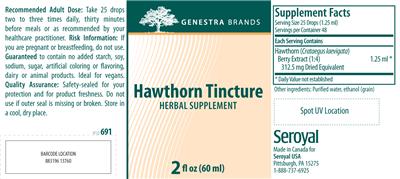
Hawthorn Tincture by Genestra Brands label
The label scan from the NIH Dietary Supplement Label Database. Tap to enlarge.
Label images are published by the NIH Dietary Supplement Label Database for the version of this product on file. Always read your actual product label.
View the full label (PDF)The Ingredients in Hawthorn Tincture by Genestra Brands
This is the 1 active ingredient this product is made of. Select it to open its full monograph.
Serving size1.25 mL Dosage formLiquid Servings per container48 Amounts shown are per serving.
Hawthorn (Crataegus laevigata) berry extract
Interacts with191 drugs
Hawthorn is a plant traditionally used for heart-related complaints, and some studies suggest it may modestly help symptoms of mild heart failure when...
Hawthorn (Crataegus laevigata) berry extract monograph & interactionsOther (inactive) ingredients: Purified Water, Ethanol. These complete the product’s ingredient list but are not active constituents.
Hawthorn Tincture by Genestra Brands Drug Interactions
HelloPharmacist Interaction Report
Genestra Brands Hawthorn Tincture, a single-ingredient product containing hawthorn berry extract, has documented interactions with several medication types that affect the heart and blood flow.
The most serious concerns are with nitrates (used for chest pain) and phosphodiesterase-5 inhibitors (like sildenafil for erectile dysfunction) — both rated Major severity — because hawthorn can cause additional widening of blood vessels and potentially dangerous drops in blood pressure when combined with either class.
Read the full breakdown — every affected drug type, severity by severity
Moderate-severity interactions are documented with beta-blockers, calcium channel blockers, blood thinners (anticoagulants and antiplatelet drugs), and digoxin (Lanoxin, a heart medication). With beta-blockers and calcium channel blockers, hawthorn may add to their blood-pressure-lowering and heart-rate effects.
Blood thinners carry a theoretical risk of increased bleeding because hawthorn may reduce clotting, though human evidence is limited. Digoxin poses a special concern: while hawthorn doesn't appear to change how your body processes the drug, case reports suggest it could amplify both the intended and unwanted effects of this narrow-margin medication.
Altogether, these interactions span 191 individual medications. Before starting this product, check your exact medications with the search tool on this page, and discuss the results with your doctor or pharmacist — especially if you take any heart or blood pressure medication.
Check your own medications below · Editorial policy · How we use AI
Want to check YOUR meds against Hawthorn Tincture?
Ask about interactions with your drugs in plain English — “Can I take it with lisinopril?” — and we find you the answer in seconds, ingredient by ingredient.
Go to the checkerIngredients driving the most interactions
Individual Drug Interactions
The ingredients in Hawthorn Tincture interact with 191 drugs. Click any drug to see the details.
1 of the 1 ingredient in Hawthorn Tincture interact with drugs. Each result below shows which ingredient is responsible. Hawthorn (Crataegus laevigata) berry extract
AvanafilStendra
How Avanafil interacts with Hawthorn Tincture — through 1 ingredient. Tap an ingredient for the detail:
Hawthorn (crataegus Laevigata) Berry ExtractPhosphodiesterase-5 Inhibitors Major
Interaction Summary
Theoretically, concomitant use might result in additive vasodilation and hypotension.
Read the full Hawthorn (crataegus Laevigata) Berry Extract + Avanafil interactionFinasteride, TadalafilEntadfi
How Finasteride, Tadalafil interacts with Hawthorn Tincture — through 1 ingredient. Tap an ingredient for the detail:
Hawthorn (crataegus Laevigata) Berry ExtractPhosphodiesterase-5 Inhibitors Major
Interaction Summary
Theoretically, concomitant use might result in additive vasodilation and hypotension.
Read the full Hawthorn (crataegus Laevigata) Berry Extract + Finasteride, Tadalafil interactionGlyceryl TrinitrateNitronal
How Glyceryl Trinitrate interacts with Hawthorn Tincture — through 1 ingredient. Tap an ingredient for the detail:
Hawthorn (crataegus Laevigata) Berry ExtractNitrates Major
Interaction Summary
Theoretically, concomitant use might cause additive coronary vasodilatory effects.
Read the full Hawthorn (crataegus Laevigata) Berry Extract + Glyceryl Trinitrate interactionIsosorbide DinitrateAngitak, Cedocard Retard, Isoket, Isoket Retard, Isordil
How Isosorbide Dinitrate interacts with Hawthorn Tincture — through 1 ingredient. Tap an ingredient for the detail:
Hawthorn (crataegus Laevigata) Berry ExtractNitrates Major
Interaction Summary
Theoretically, concomitant use might cause additive coronary vasodilatory effects.
Read the full Hawthorn (crataegus Laevigata) Berry Extract + Isosorbide Dinitrate interactionIsosorbide Dinitrate, HydralazineBiDil
How Isosorbide Dinitrate, Hydralazine interacts with Hawthorn Tincture — through 1 ingredient. Tap an ingredient for the detail:
Hawthorn (crataegus Laevigata) Berry ExtractNitrates Major
Interaction Summary
Theoretically, concomitant use might cause additive coronary vasodilatory effects.
Read the full Hawthorn (crataegus Laevigata) Berry Extract + Isosorbide Dinitrate, Hydralazine interactionIsosorbide MononitrateAngeze, Angeze SR, Chemydur 60XL, Dynamin, Elantan, Elantan LA +13 more
How Isosorbide Mononitrate interacts with Hawthorn Tincture — through 1 ingredient. Tap an ingredient for the detail:
Hawthorn (crataegus Laevigata) Berry ExtractNitrates Major
Interaction Summary
Theoretically, concomitant use might cause additive coronary vasodilatory effects.
Read the full Hawthorn (crataegus Laevigata) Berry Extract + Isosorbide Mononitrate interactionMacitentan, TadalafilOpsynvi
How Macitentan, Tadalafil interacts with Hawthorn Tincture — through 1 ingredient. Tap an ingredient for the detail:
Hawthorn (crataegus Laevigata) Berry ExtractPhosphodiesterase-5 Inhibitors Major
Interaction Summary
Theoretically, concomitant use might result in additive vasodilation and hypotension.
Read the full Hawthorn (crataegus Laevigata) Berry Extract + Macitentan, Tadalafil interactionNicorandilAprior, Dancor, Ikorel, Sigmart, Zynicor
How Nicorandil interacts with Hawthorn Tincture — through 1 ingredient. Tap an ingredient for the detail:
Hawthorn (crataegus Laevigata) Berry ExtractNitrates Major
Interaction Summary
Theoretically, concomitant use might cause additive coronary vasodilatory effects.
Read the full Hawthorn (crataegus Laevigata) Berry Extract + Nicorandil interactionNitroglycerinGonitro, Nitro Time, Nitro-Bid, Nitrocine Timecaps, Nitrogard, Nitrogard SR +7 more
How Nitroglycerin interacts with Hawthorn Tincture — through 1 ingredient. Tap an ingredient for the detail:
Hawthorn (crataegus Laevigata) Berry ExtractNitrates Major
Interaction Summary
Theoretically, concomitant use might cause additive coronary vasodilatory effects.
Read the full Hawthorn (crataegus Laevigata) Berry Extract + Nitroglycerin interactionPentaerythritol TetranitratePeritrate, Peritrate SA
How Pentaerythritol Tetranitrate interacts with Hawthorn Tincture — through 1 ingredient. Tap an ingredient for the detail:
Hawthorn (crataegus Laevigata) Berry ExtractNitrates Major
Interaction Summary
Theoretically, concomitant use might cause additive coronary vasodilatory effects.
Read the full Hawthorn (crataegus Laevigata) Berry Extract + Pentaerythritol Tetranitrate interactionSildenafilRevatio
How Sildenafil interacts with Hawthorn Tincture — through 1 ingredient. Tap an ingredient for the detail:
Hawthorn (crataegus Laevigata) Berry ExtractPhosphodiesterase-5 Inhibitors Major
Interaction Summary
Theoretically, concomitant use might result in additive vasodilation and hypotension.
Read the full Hawthorn (crataegus Laevigata) Berry Extract + Sildenafil interactionSildenafil CitrateViagra
How Sildenafil Citrate interacts with Hawthorn Tincture — through 1 ingredient. Tap an ingredient for the detail:
Hawthorn (crataegus Laevigata) Berry ExtractPhosphodiesterase-5 Inhibitors Major
Interaction Summary
Theoretically, concomitant use might result in additive vasodilation and hypotension.
Read the full Hawthorn (crataegus Laevigata) Berry Extract + Sildenafil Citrate interactionTadalafilCialis, Tadliq
How Tadalafil interacts with Hawthorn Tincture — through 1 ingredient. Tap an ingredient for the detail:
Hawthorn (crataegus Laevigata) Berry ExtractPhosphodiesterase-5 Inhibitors Major
Interaction Summary
Theoretically, concomitant use might result in additive vasodilation and hypotension.
Read the full Hawthorn (crataegus Laevigata) Berry Extract + Tadalafil interactionVardenafilLevitra, Staxyn
How Vardenafil interacts with Hawthorn Tincture — through 1 ingredient. Tap an ingredient for the detail:
Hawthorn (crataegus Laevigata) Berry ExtractPhosphodiesterase-5 Inhibitors Major
Interaction Summary
Theoretically, concomitant use might result in additive vasodilation and hypotension.
Read the full Hawthorn (crataegus Laevigata) Berry Extract + Vardenafil interactionAbciximabReoPro
How Abciximab interacts with Hawthorn Tincture — through 1 ingredient. Tap an ingredient for the detail:
Hawthorn (crataegus Laevigata) Berry ExtractAnticoagulant/antiplatelet Drugs Moderate
Interaction Summary
Theoretically, hawthorn may increase the risk of bleeding if used with anticoagulant or antiplatelet drugs.
Read the full Hawthorn (crataegus Laevigata) Berry Extract + Abciximab interactionAbrocitinibCibinqo
How Abrocitinib interacts with Hawthorn Tincture — through 1 ingredient. Tap an ingredient for the detail:
Hawthorn (crataegus Laevigata) Berry ExtractAnticoagulant/antiplatelet Drugs Moderate
Interaction Summary
Theoretically, hawthorn may increase the risk of bleeding if used with anticoagulant or antiplatelet drugs.
Read the full Hawthorn (crataegus Laevigata) Berry Extract + Abrocitinib interactionAcebutololRhotral, Sectral
How Acebutolol interacts with Hawthorn Tincture — through 1 ingredient. Tap an ingredient for the detail:
Hawthorn (crataegus Laevigata) Berry ExtractBeta-blockers Moderate
Interaction Summary
Theoretically, concomitant use might cause additive effects on blood pressure and heart rate.
Read the full Hawthorn (crataegus Laevigata) Berry Extract + Acebutolol interactionAcenocoumarolSintrom
How Acenocoumarol interacts with Hawthorn Tincture — through 1 ingredient. Tap an ingredient for the detail:
Hawthorn (crataegus Laevigata) Berry ExtractAnticoagulant/antiplatelet Drugs Moderate
Interaction Summary
Theoretically, hawthorn may increase the risk of bleeding if used with anticoagulant or antiplatelet drugs.
Read the full Hawthorn (crataegus Laevigata) Berry Extract + Acenocoumarol interactionAcetaminophen, AspirinGemnisyn
How Acetaminophen, Aspirin interacts with Hawthorn Tincture — through 1 ingredient. Tap an ingredient for the detail:
Hawthorn (crataegus Laevigata) Berry ExtractAnticoagulant/antiplatelet Drugs Moderate
Interaction Summary
Theoretically, hawthorn may increase the risk of bleeding if used with anticoagulant or antiplatelet drugs.
Read the full Hawthorn (crataegus Laevigata) Berry Extract + Acetaminophen, Aspirin interactionAcetaminophen, Aspirin, CaffeineExcedrin, Excedrin Extra Strength, Excedrin Migraine
How Acetaminophen, Aspirin, Caffeine interacts with Hawthorn Tincture — through 1 ingredient. Tap an ingredient for the detail:
Hawthorn (crataegus Laevigata) Berry ExtractAnticoagulant/antiplatelet Drugs Moderate
Interaction Summary
Theoretically, hawthorn may increase the risk of bleeding if used with anticoagulant or antiplatelet drugs.
Read the full Hawthorn (crataegus Laevigata) Berry Extract + Acetaminophen, Aspirin, Caffeine interactionAcetaminophen, IbuprofenCombogesic
How Acetaminophen, Ibuprofen interacts with Hawthorn Tincture — through 1 ingredient. Tap an ingredient for the detail:
Hawthorn (crataegus Laevigata) Berry ExtractAnticoagulant/antiplatelet Drugs Moderate
Interaction Summary
Theoretically, hawthorn may increase the risk of bleeding if used with anticoagulant or antiplatelet drugs.
Read the full Hawthorn (crataegus Laevigata) Berry Extract + Acetaminophen, Ibuprofen interactionAcetylsalicylic AcidEntrophen
How Acetylsalicylic Acid interacts with Hawthorn Tincture — through 1 ingredient. Tap an ingredient for the detail:
Hawthorn (crataegus Laevigata) Berry ExtractAnticoagulant/antiplatelet Drugs Moderate
Interaction Summary
Theoretically, hawthorn may increase the risk of bleeding if used with anticoagulant or antiplatelet drugs.
Read the full Hawthorn (crataegus Laevigata) Berry Extract + Acetylsalicylic Acid interactionAlteplase, TpaActilyse, Activase
How Alteplase, Tpa interacts with Hawthorn Tincture — through 1 ingredient. Tap an ingredient for the detail:
Hawthorn (crataegus Laevigata) Berry ExtractAnticoagulant/antiplatelet Drugs Moderate
Interaction Summary
Theoretically, hawthorn may increase the risk of bleeding if used with anticoagulant or antiplatelet drugs.
Read the full Hawthorn (crataegus Laevigata) Berry Extract + Alteplase, Tpa interactionAluminum Hydroxide, Aspirin, Codeine Phosphate, Magnesium HydroxideAscriptin Codeine #2
How Aluminum Hydroxide, Aspirin, Codeine Phosphate, Magnesium Hydroxide interacts with Hawthorn Tincture — through 1 ingredient. Tap an ingredient for the detail:
Hawthorn (crataegus Laevigata) Berry ExtractAnticoagulant/antiplatelet Drugs Moderate
Interaction Summary
Theoretically, hawthorn may increase the risk of bleeding if used with anticoagulant or antiplatelet drugs.
Read the full Hawthorn (crataegus Laevigata) Berry Extract + Aluminum Hydroxide, Aspirin, Codeine Phosphate, Magnesium Hydroxide interactionAluminum Hydroxide, Aspirin, Magnesium HydroxideAscriptin
How Aluminum Hydroxide, Aspirin, Magnesium Hydroxide interacts with Hawthorn Tincture — through 1 ingredient. Tap an ingredient for the detail:
Hawthorn (crataegus Laevigata) Berry ExtractAnticoagulant/antiplatelet Drugs Moderate
Interaction Summary
Theoretically, hawthorn may increase the risk of bleeding if used with anticoagulant or antiplatelet drugs.
Read the full Hawthorn (crataegus Laevigata) Berry Extract + Aluminum Hydroxide, Aspirin, Magnesium Hydroxide interactionAmlodipineNorliqva
How Amlodipine interacts with Hawthorn Tincture — through 1 ingredient. Tap an ingredient for the detail:
Hawthorn (crataegus Laevigata) Berry ExtractCalcium Channel Blockers Moderate
Interaction Summary
Theoretically, concomitant use might cause additive coronary vasodilation and hypotensive effects.
Read the full Hawthorn (crataegus Laevigata) Berry Extract + Amlodipine interactionAmlodipine BenzoateKaterzia
How Amlodipine Benzoate interacts with Hawthorn Tincture — through 1 ingredient. Tap an ingredient for the detail:
Hawthorn (crataegus Laevigata) Berry ExtractCalcium Channel Blockers Moderate
Interaction Summary
Theoretically, concomitant use might cause additive coronary vasodilation and hypotensive effects.
Read the full Hawthorn (crataegus Laevigata) Berry Extract + Amlodipine Benzoate interactionAmlodipine BesilateIstin
How Amlodipine Besilate interacts with Hawthorn Tincture — through 1 ingredient. Tap an ingredient for the detail:
Hawthorn (crataegus Laevigata) Berry ExtractCalcium Channel Blockers Moderate
Interaction Summary
Theoretically, concomitant use might cause additive coronary vasodilation and hypotensive effects.
Read the full Hawthorn (crataegus Laevigata) Berry Extract + Amlodipine Besilate interactionAmlodipine BesylateNorvasc
How Amlodipine Besylate interacts with Hawthorn Tincture — through 1 ingredient. Tap an ingredient for the detail:
Hawthorn (crataegus Laevigata) Berry ExtractCalcium Channel Blockers Moderate
Interaction Summary
Theoretically, concomitant use might cause additive coronary vasodilation and hypotensive effects.
Read the full Hawthorn (crataegus Laevigata) Berry Extract + Amlodipine Besylate interactionAmlodipine Besylate, BenazeprilLotrel
How Amlodipine Besylate, Benazepril interacts with Hawthorn Tincture — through 1 ingredient. Tap an ingredient for the detail:
Hawthorn (crataegus Laevigata) Berry ExtractCalcium Channel Blockers Moderate
Interaction Summary
Theoretically, concomitant use might cause additive coronary vasodilation and hypotensive effects.
Read the full Hawthorn (crataegus Laevigata) Berry Extract + Amlodipine Besylate, Benazepril interactionEach ingredient & the kinds of drugs it affects
For each ingredient in Hawthorn Tincture with known interactions, here are the types of medications it can affect. Open any type for the detail — or search your exact drug in the checker above.
Hawthorn (Crataegus laevigata) berry extract
Nitrates
Theoretically, concomitant use might cause additive coronary vasodilatory effects.
Some evidence shows that hawthorn might lower blood pressure due to vasodilatory effects.
Phosphodiesterase-5 Inhibitors
Theoretically, concomitant use might result in additive vasodilation and hypotension.
Hawthorn might inhibit PDE-5 and cause vasodilation.
Anticoagulant/Antiplatelet Drugs
Theoretically, hawthorn may increase the risk of bleeding if used with anticoagulant or antiplatelet drugs.
In vitro and animal research shows that hawthorn can inhibit platelet aggregation. However, its effect in humans is unclear. One observational study shows that patients taking hawthorn shortly before undergoing coronary artery bypass graft (CABG) surgery or valve replacement surgery have a 10% incidence of postoperative bleeding, compared with 1% in those who never consumed hawthorn extract. However, clinical research shows that taking a specific preparation of dried hawthorn leaves and flowers (Crataesor, Soria Natural Lab) 800 mg three times daily for 15 days does not affect platelet aggregation or levels of thromboxane B2, the metabolite of thromboxane A2, in healthy humans.
Beta-Blockers
Theoretically, concomitant use might cause additive effects on blood pressure and heart rate.
Some evidence shows that hawthorn might lower blood pressure and heart rate.
Calcium Channel Blockers
Theoretically, concomitant use might cause additive coronary vasodilation and hypotensive effects.
Some evidence shows that hawthorn might lower blood pressure due to vasodilatory effects.
Digoxin (Lanoxin)
Theoretically, hawthorn might potentiate the effects and adverse effects of digoxin.
Hawthorn appears to improve cardiac output; however, hawthorn does not appear to affect digoxin pharmacokinetics. Case reports suggest that at least one species of hawthorn root extract (Crataegus mexicana) may produce adverse effects similar to digoxin and can cross-react with digoxin assays, leading to falsely elevated plasma digoxin levels.
Brand information
Manufacturer and brand details for Hawthorn Tincture, from the product label.
Genestra Brands
- Name
- Seroyal USA
- City
- Pittsburgh
- State
- PA
- ZipCode
- 15275
- Phone Number
- 1-888-737-6925
- Web Address
- seroyal.com
Hawthorn Tincture by Genestra Brands: Common Questions
Does Hawthorn Tincture by Genestra Brands interact with any medications?
How can one product interact with so many drugs?
Where does this information come from?
Does hawthorn actually work for heart problems?
Can I take hawthorn if I'm pregnant or breastfeeding?
What's in this tincture besides hawthorn?
Is hawthorn safe if I don't have heart problems?
What side effects should I watch for?
Written and reviewed by the HelloPharmacist editorial staff. Our editorial policy
Not sure if Hawthorn Tincture is safe with your meds?
Our pharmacists answer your medication & supplement questions — free.
Label information is sourced from the NIH Dietary Supplement Label Database and reflects the product version on file; always read your actual product label. This page is for education only and is not a substitute for professional medical advice. Confirm with your pharmacist or doctor before combining supplements and medications.
The Full Monographs Behind Hawthorn Tincture’s Ingredients
Every ingredient we hold a full HelloPharmacist monograph for — uses, evidence, safety, and the complete interaction list.
Sources & How We Checked
Hawthorn Tincture's label data comes from the NIH Dietary Supplement Label Database; the ingredient interaction data is from the Natural Medicines database, reviewed by our pharmacists.
- NIH Dietary Supplement Label Database (DSLD) — The official product label on file for this supplement.
- Natural Medicines (Therapeutic Research Center) — Evidence-graded clinical reference behind the ingredient interaction data.
Content is written and reviewed by licensed HelloPharmacist pharmacists. See our data sources and editorial standards for how this information is built and checked.
The 25 references behind this product’s interaction data
Every citation that drives the interaction findings for this product’s ingredients, from the evidence-graded Natural Medicines (TRC Healthcare) database. Open an ingredient to browse its citations — links open the study on PubMed or the publisher’s site.
Hawthorn 25 references
- Tauchert M. Efficacy and safety of crataegus extract WS 1442 in comparison with placebo in patients with chronic stable New York Heart Association class-III heart failure. Am Heart J 2002;143:910-5. PubMed
- Pittler MH, Schmidt K, Ernst E. Hawthorn extract for treating chronic heart failure: meta-analysis of randomized trials. Am J Med 2003;114:665-74.. PubMed
- Chang Q, Zuo Z, Harrison F, Chow MS. Hawthorn. J Clin Pharmacol 2002;42:605-12.
- Holubarsch CJ, Colucci WS, Meinertz T, et al. The efficacy and safety of Crataegus extract WS 1442 in patients with heart failure: the SPICE trial. Eur J Heart Fail 2008;10:1255-63. PubMed
- Pittler MH, Guo R, and Ernst E. Hawthorn extract for treating chronic heart failure. Cochrane.Database.Syst Rev 2008:CD005312. PubMed
- Zick SM, Vautaw BM, Gillespie B, Aaronson KD. Hawthorn Extract Randomized Blinded Chronic Heart Failure (HERB CHF) trial. Eur J Heart Fail. 2009;11:990-99. PubMed
- Werner NS, Duschek S, and Schandry R. D-camphor-crataegus berry extract combination increases blood pressure and cognitive functioning in the elderly - a randomized, placebo controlled double blind study. Phytomedicine. 2009;16:1077-82. PubMed
- Dalli E, Colomer E, Tormos MC, et al. Crataegus laevigata decreases neutrophil elastase and has hypolipidemic effect: a randomized, double-blind, placebo-controlled trial. Phytomedicine. 6-15-2011;18:769-75. PubMed
- Maek-a-nantawat W, Phonrat B, Dhitavat J, et al. Safety and efficacy of CKBM-A01, a Chinese herbal medicine, among asymptomatic HIV patients. Southeast Asian J Trop.Med Public Health 2009;40:494-501.
- Asher GN, Viera AJ, Weaver MA, et al. Effect of hawthorn standardized extract on flow mediated dilation in prehypertensive and mildly hypertensive adults: a randomized, controlled cross-over trial. BMC.Complement Altern.Med 2012;12:26. PubMed
- Walker AF, Marakis G, Simpson E, et al. Hypotensive effects of hawthorn for patients with diabetes taking prescription drugs: a randomised controlled trial. Br J Gen.Pract 2006;56:437-43.
- Daniele C, Mazzanti G, Pittler MH, et al. Adverse-event profile of Crataegus spp.: a systematic review. Drug Saf 2006;29:523-35. PubMed
- Tankanow R, Tamer HR, Streetman DS, et al. Interaction study between digoxin and a preparation of hawthorn (Crataegus oxyacantha). J.Clin.Pharmacol. 2003;43:637-42. DOI
- Tauchert, M., Gildor, A., and Lipinski, J. [High-dose Crataegus extract WS 1442 in the treatment of NYHA stage II heart failure]. Herz 1999;24(6):465-474.
- Horoz, M., Gok, E., Genctoy, G., Ozcan, T., Olmaz, R., Akca, M., Kiykim, A., and Gurses, I. Crataegus orientalis associated multiorgan hypersensitivity reaction and acute renal failure. Intern.Med 2008;47(23):2039-2042. PubMed
- Dalli, E., Valles, J., Cosin-Sales, J., Santos, M. T., Moscardo, A., Milara, J., and Sotillo, J. F. Effects of hawthorn (Crataegus laevigata) on platelet aggregation in healthy volunteers. Thromb.Res 2011;128(4):398-400. PubMed
- Rogov VD. [Toxiderma due to the fruits of the hawthorn]. Vestn Dermatol Venerol 1984;7(7):46-47.
- Loew D, Albrecht M, and Podzuweit H. Efficacy and tolerability of a Hawthorn preparation in patients with heart failure Stage I and II according to NYHA - a surveillance study. Phytomedicine 1996;3(Suppl 1):92.
- Rababa'h AM, Altarabsheh SE, Haddad O, Deo SV, Obeidat Y, Al-Azzam S. Hawthorn Herb Increases the Risk of Bleeding after Cardiac Surgery: An Evidence-Based Approach. Heart Surg Forum 2016;19(4):E175-9. PubMed
- Shatoor AS, Soliman H, Al-Hashem F, Gamal BE, Othman A, El-Menshaw N. Effect of hawthorn (Crataegus aronia syn. Azarolus (L)) on platelet function in albino wistar rats. Thromb Res 2012;130(1):75-80. PubMed
- Vibes J, Lasserre B, Gleye J, Declume C. Inhibition of thromboxane A2 biosynthesis in vitro by the main components of Crataegus oxyacantha (hawthorn) flower heads. Prostaglandins Leukot Essent Fatty Acids 1994;50(4):173-5. PubMed
- Rogers KL, Grice ID, Griffiths LR. Inhibition of platelet aggregation and 5-HT release by extracts of Australian plants used traditionally as headache treatments. Eur J Pharm Sci 2000;9(4):355-63. PubMed
- Zhou CC, Huang XX, Gao PY, et al. Two new compounds from Crataegus pinnatifida and their antithrombotic activities. J Asian Nat Prod Res 2014;16(2):169-74.
- Palmer KG, Lebin JA, Cronin MT, Mazor SS, Burns RA. Crataegus mexicana (Tejocote) Exposure Associated with Cardiotoxicity and a Falsely Elevated Digoxin Level. J Med Toxicol. 2019;15(4):295-298. PubMed
- Espinosa J, Bassett R, Lucerna A, Finn D. Hawthorne root (Crataegus mexicana) toxicity. Am J Emerg Med. 2024;78:242.e5-242.e6. PubMed
Parts of this content are provided by the Therapeutic Research Center, LLC.
DISCLAIMER: Currently this does not check for drug-drug interactions. This is not an all-inclusive comprehensive list of potential interactions and is for informational purposes only. Not all interactions are known or well-reported in the scientific literature, and new interactions are continually being reported. Input is needed from a qualified healthcare provider including a pharmacist before starting any therapy. Application of clinical judgment is necessary.
© 2021 Therapeutic Research Center, LLC