
Hyde Max Pump Cherry Limeade Ingredients & Drug Interactions
by PS ProSupps
What is this page for?
First and foremost: checking Hyde Max Pump Cherry Limeade against your medications. The heart of this page is the interaction checker and the full interaction report — how this product’s ingredients may interact with prescription and over-the-counter medicines you may be taking.
Around that, we add a pharmacist’s high-level view of the product as a whole — what’s inside, the evidence for its stated use, how transparent the label is, and what safety data exists — so you can see the full picture in one place. It’s educational information from our licensed clinical databases and the clinical staff at HelloPharmacist — not medical advice — and we don’t sell or endorse products. Our editorial policy
Hyde Max Pump Cherry Limeade is a dietary supplement by PS ProSupps with 5 active ingredients. Its ingredients are commonly taken for improving high-intensity exercise performance, building muscle strength and size, sports and athletic training.Based on those ingredients, 564 medications have a known interaction with it, the most serious rated moderate. The ingredients most likely to interact are L-Arginine Nitrate, Vitamin C. Use the checker below to test your specific medication, or read the full HelloPharmacist Interaction Report.
Check Your Meds Against Hyde Max Pump Cherry Limeade by PS ProSupps
Ask about any prescription or over-the-counter medication and we check it for interactions with Hyde Max Pump Cherry Limeade by PS ProSupps — and tell you which ingredient is responsible.
AI summaries are generated from our interaction database for education only — always confirm with your pharmacist. How we use AI
Ask the Pharmacist
A licensed pharmacist will answer your question by email — free, usually within 24 hours.
Got it — thank you!
A licensed pharmacist will answer within 24 hours. Keep an eye on your email (worth checking spam, just in case).
HelloPharmacist Scorecard of Hyde Max Pump Cherry Limeade by PS ProSupps
Our pharmacy team’s full take, with four database checks built into the cards below — a summary of what is known, not a grade of the product itself.
What’s inside
Full disclosure
Hyde Max Pump Cherry Limeade is a 5-ingredient pre-workout powder. The active ingredients are creatine HCl (a compound that helps your muscles produce energy during intense exercise), vitamin C (an antioxidant), beta-alanine (which may support athletic performance), L-citruline, and L-arginine nitrate (which work to improve blood flow).
The powder also contains inactive ingredients like citric acid, natural and artificial flavors, calcium silicate, silicon dioxide, and sucralose for taste and texture.
Does it work?
Moderate evidence
Creatine is possibly effective for muscle strength and athletic performance, and possibly effective for certain muscle-wasting conditions (sarcopenia) and cerebral creatine deficiency syndromes. Beta-alanine is possibly effective for athletic performance and physical performance.
Vitamin C is effective for vitamin C deficiency and possibly effective for several other conditions including cataracts and exercise-related respiratory infections. L-arginine nitrate and L-citruline have no effectiveness ratings in our data.
How safe is it?
Well-documented data
Creatine is generally well tolerated in healthy adults, but people with kidney problems should be careful — safety in pregnancy has not been established, so it's best avoided, and there isn't enough data for nursing mothers to avoid use. Most common side effects are dehydration, diarrhea, stomach upset, muscle cramps, and water retention.
Vitamin C is generally safe at normal dietary doses; very high doses can cause stomach cramps, heartburn, diarrhea, nausea, and vomiting. Normal amounts in food and prenatal vitamins are fine, but high-dose supplements in pregnancy should be discussed with your doctor first; the same goes for breastfeeding.
Beta-alanine is generally well tolerated but commonly causes harmless skin tingling and flushing; safety during pregnancy and breastfeeding has not been established, so avoid use. L-arginine nitrate is often well tolerated short-term but can lower blood pressure and may not be safe for everyone — use only under medical supervision, and safety in pregnancy and breastfeeding is not well established.
Meds to double-check
Moderate interaction found
Before starting, double-check with your doctor or pharmacist if you take blood thinners (anticoagulants like warfarin or antiplatelet drugs), blood pressure medications (ACE inhibitors, angiotensin receptor blockers, or other antihypertensive drugs), diabetes medications, thyroid medication (levothyroxine), chemotherapy drugs, potassium-sparing diuretics, or estrogen-based medications like oral contraceptives. Altogether, these interactions span 564 individual medications.
The bottom line
Scorecard at a glanceFully disclosed formula with some supporting evidence for its stated purpose. Moderate medication interactions have been identified, and safety information is well characterized.
This is a pre-workout designed to support muscle pumps and athletic performance through creatine, beta-alanine, and arginine. If you take blood pressure medications, blood thinners, diabetes drugs, or thyroid medication, you'll need to check with your own doctor or pharmacist before using it, since the vitamin C and L-arginine can interact.
People with kidney problems should also get clearance first.
Educational only — not medical advice; always confirm with your pharmacist. Our editorial policy · How we use AI
Assessment coverage: 4 of 5 active ingredients matched to our full ingredient reviews (monographs). Based on the product label dated Jun 22, 2023.
This Scorecard evaluates available label information, ingredient evidence, and known medication-safety considerations. It does not independently verify product identity, purity, potency, contamination, or manufacturing quality. How these ratings are computed
General information
Key facts about Hyde Max Pump Cherry Limeade, straight from the product label.
| Brand | PS ProSupps |
|---|---|
| Barcode (UPC) | 810034811493 |
| Net contents | 9.87 Ounce(s); 280 Gram(s) |
| Market status | On market |
| Date entered into DSLD | Jun 22, 2023 |
| DSLD ID | 295373 |
| Product type | Other Combinations |
| Supplement form | Powder |
| Dietary claims / uses | All Other, Structure/Function |
| Intended target group(s) | Adult (18 - 50 Years), Gluten Free |
Everything in this section is reproduced from the manufacturer’s own product label — it’s the label speaking, not HelloPharmacist. We show it so you can see exactly what the maker states; we don’t verify or endorse those statements.
Supplement Facts
The label details for Hyde Max Pump Cherry Limeade by PS ProSupps, sourced from the NIH Dietary Supplement Label Database.
Supplement Facts
| Ingredient | Amount | % DV |
|---|---|---|
| Creatine HCl | 1000 mg | -- |
| Vitamin C | 60 mg | 66% |
| Beta-Alanine | 3200 mg | -- |
| L-Citruline | 4000 mg | -- |
| L-Arginine Nitrate | 1000 mg | -- |
Other ingredients: Citric Acid, Natural and Artificial flavors, Calcium Silicate, Silicon Dioxide, Sucralose
Tap any ingredient to jump to its full detail below.
These statements are the manufacturer’s wording, reproduced from the product label — the label is saying it, not HelloPharmacist. We don’t verify or endorse them.
General Statements
There's a better you waiting to get out and if you're willing to put in the work, ProSupps is uniquely qualified to unleash your full potential. Having climbed to the top of the fitness mountain ourselves, we can show you how to get here through elite supplementation, education, and inspiration. We're here for your relentless pursuit of greatness, but nobody is going to do it for you. You have to earn it.
Sold by weight, not volume.
Seals/Symbols
Made in the USA With foreign & domestic ingredients
FDA Statement of Identity
Dietary Supplement
Formulation
Stim-free pre workout
Stim-free pre workout
0% Juice. Gluten Free.
Formula
Cherry Limeade Natural & artificial flavors
Suggested/Recommended/Usage/Directions
Suggested Use: For maximum stimulant-free pumps, mix 1 scoop of HYDE Max Pump with 6-8 oz of water 30-45 minutes prior to exercise.
Precautions
Warning: This product is intended for healthy adults, 18 years of age or older. Keep out of reach of children.
Consult a physician prior to use if you have any medical condition or take any medications.
Use only as directed.
Warning for California Residents: Consuming this product can expose you to chemicals including lead, which is known to the state of California to cause cancer and birth defects or other reproductive harm. For more information go to: www.P65Warnings.ca.gov
Brand IP Statement(s)
NO3-T Nitrate Technology NO3-T.com/Patents NO3-T is a registered trademark of Thermolife International LLC, this mark covers the use of one or more patents listed on www.NO3-T.com/patents.
Storage
Store in cool, dry place. Avoid excess heat and moisture.
FDA Disclaimer Statement
These statements have not been evaluated by the Food and Drug Administration. This product is not intended to diagnose, treat, cure, or prevent any disease.
Is this label outdated? Report a formula or label change and our pharmacy team will review it.
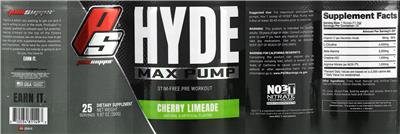
Hyde Max Pump Cherry Limeade by PS ProSupps label
The label scan from the NIH Dietary Supplement Label Database. Tap to enlarge.
Label images are published by the NIH Dietary Supplement Label Database for the version of this product on file. Always read your actual product label.
View the full label (PDF)The Ingredients in Hyde Max Pump Cherry Limeade by PS ProSupps
These are the 5 active ingredients this product is made of. Select any to open its full monograph.
Serving size11.2 Gram(s) Dosage formPowder Servings per container25 Amounts shown are per serving.
Most supplement products combine several ingredients, and a medication can interact with the product through any one of them. Each ingredient below shows whether it has known drug interactions.
Creatine HCl
No knowninteractions
Creatine is one of the most studied sports supplements, with solid evidence that it can boost strength and performance during short, high-intensity ac...
Creatine HCl monograph & interactionsVitamin C
Interacts with207 drugs
Vitamin C (ascorbic acid) is an essential nutrient your body needs but cannot make, so you must get it from food or supplements. It's important for im...
Vitamin C monograph & interactionsBeta-Alanine
No knowninteractions
Beta-alanine is an amino acid taken mostly by athletes to raise muscle carnosine, which may help buffer acid and reduce fatigue during short, high-int...
Beta-Alanine monograph & interactionsL-Citruline
L-Arginine Nitrate
Interacts with403 drugs
L-arginine is an amino acid that the body uses to make nitric oxide, a substance that helps blood vessels relax and widen. It is popularly used for bl...
L-Arginine Nitrate monograph & interactionsOther (inactive) ingredients: Citric Acid, Natural and Artificial flavors, Calcium Silicate, Silicon Dioxide, Sucralose. These complete the product’s ingredient list but are not active constituents.
Hyde Max Pump Cherry Limeade by PS ProSupps Drug Interactions
HelloPharmacist Interaction Report
Hyde Max Pump Cherry Limeade by PS ProSupps contains vitamin C and L-arginine nitrate, both of which interact with medications.
The most serious interactions are Moderate in severity. Vitamin C can interact with several drug types including blood thinners (anticoagulants) like warfarin, where high doses may reduce effectiveness, and with estrogen-based medications like oral contraceptives, where vitamin C may increase hormone levels.
L-arginine nitrate interacts with blood pressure medications (antihypertensive drugs), blood thinners (anticoagulant/antiplatelet drugs), diabetes medications, potassium-sparing diuretics, ACE inhibitors, angiotensin receptor blockers (ARBs), and certain other cardiac drugs, potentially lowering blood pressure further, increasing bleeding risk, or raising potassium levels.
Read the full breakdown — every affected drug type, severity by severity
Vitamin C also has documented Moderate interactions with chemotherapy drugs (alkylating agents and antitumor antibiotics), where its antioxidant effects might reduce drug effectiveness; with thyroid medication (levothyroxine), where vitamin C increases absorption; with the HIV medication indinavir; with the antipsychotic fluphenazine; and with aluminum-containing compounds, which increase aluminum absorption.
We could not check L-citruline — no interaction data is on file for that ingredient. Beta-alanine has no interactions documented in our data.
You'll want to run your exact medications through the interaction checker on this page before starting, especially if you take any blood pressure, blood sugar, blood thinner, or thyroid medications.
Check your own medications below · Editorial policy · How we use AI
Want to check YOUR meds against Hyde Max Pump Cherry Limeade?
Ask about interactions with your drugs in plain English — “Can I take it with lisinopril?” — and we find you the answer in seconds, ingredient by ingredient.
Go to the checkerIngredients driving the most interactions
Individual Drug Interactions
The ingredients in Hyde Max Pump Cherry Limeade interact with 564 drugs. Click any drug to see the details.
2 of the 5 ingredients in Hyde Max Pump Cherry Limeade interact with drugs. Each result below shows which ingredient is responsible. L-Arginine Nitrate Vitamin C
AbciximabReoPro
How Abciximab interacts with Hyde Max Pump Cherry Limeade — through 1 ingredient. Tap an ingredient for the detail:
L-arginine NitrateAnticoagulant/antiplatelet Drugs Moderate
Interaction Summary
Theoretically, concomitant use of L-arginine with anticoagulant and antiplatelet drugs might have additive effects and increase the risk of bleeding.
Read the full L-arginine Nitrate + Abciximab interactionAbrocitinibCibinqo
How Abrocitinib interacts with Hyde Max Pump Cherry Limeade — through 1 ingredient. Tap an ingredient for the detail:
L-arginine NitrateAnticoagulant/antiplatelet Drugs Moderate
Interaction Summary
Theoretically, concomitant use of L-arginine with anticoagulant and antiplatelet drugs might have additive effects and increase the risk of bleeding.
Read the full L-arginine Nitrate + Abrocitinib interactionAcarboseGlucobay, Prandase, Precose
How Acarbose interacts with Hyde Max Pump Cherry Limeade — through 1 ingredient. Tap an ingredient for the detail:
L-arginine NitrateAntidiabetes Drugs Moderate
Interaction Summary
Theoretically, concomitant use of L-arginine might have additive effects with antidiabetes drugs.
Read the full L-arginine Nitrate + Acarbose interactionAcebutololRhotral, Sectral
How Acebutolol interacts with Hyde Max Pump Cherry Limeade — through 1 ingredient. Tap an ingredient for the detail:
L-arginine NitrateAntihypertensive Drugs Moderate
Interaction Summary
Theoretically, concomitant use of L-arginine and antihypertensive drugs may increase the risk of hypotension.
Read the full L-arginine Nitrate + Acebutolol interactionAcenocoumarolSintrom
How Acenocoumarol interacts with Hyde Max Pump Cherry Limeade — through 1 ingredient. Tap an ingredient for the detail:
L-arginine NitrateAnticoagulant/antiplatelet Drugs Moderate
Interaction Summary
Theoretically, concomitant use of L-arginine with anticoagulant and antiplatelet drugs might have additive effects and increase the risk of bleeding.
Read the full L-arginine Nitrate + Acenocoumarol interactionAcetaminophen, AspirinGemnisyn
How Acetaminophen, Aspirin interacts with Hyde Max Pump Cherry Limeade — through 2 ingredients. Tap an ingredient for the detail:
L-arginine NitrateAnticoagulant/antiplatelet Drugs Moderate
Interaction Summary
Theoretically, concomitant use of L-arginine with anticoagulant and antiplatelet drugs might have additive effects and increase the risk of bleeding.
Read the full L-arginine Nitrate + Acetaminophen, Aspirin interactionVitamin CAcetaminophen (tylenol, Others), Aspirin Minor
Interaction Summary
High-dose vitamin C might slightly prolong the clearance of acetaminophen.
Read the full Vitamin C + Acetaminophen, Aspirin interactionAcetaminophen, Aspirin, CaffeineExcedrin, Excedrin Extra Strength, Excedrin Migraine
How Acetaminophen, Aspirin, Caffeine interacts with Hyde Max Pump Cherry Limeade — through 2 ingredients. Tap an ingredient for the detail:
L-arginine NitrateAnticoagulant/antiplatelet Drugs Moderate
Interaction Summary
Theoretically, concomitant use of L-arginine with anticoagulant and antiplatelet drugs might have additive effects and increase the risk of bleeding.
Read the full L-arginine Nitrate + Acetaminophen, Aspirin, Caffeine interactionVitamin CAcetaminophen (tylenol, Others), Aspirin Minor
Interaction Summary
High-dose vitamin C might slightly prolong the clearance of acetaminophen.
Read the full Vitamin C + Acetaminophen, Aspirin, Caffeine interactionAcetaminophen, IbuprofenCombogesic
How Acetaminophen, Ibuprofen interacts with Hyde Max Pump Cherry Limeade — through 2 ingredients. Tap an ingredient for the detail:
L-arginine NitrateAnticoagulant/antiplatelet Drugs Moderate
Interaction Summary
Theoretically, concomitant use of L-arginine with anticoagulant and antiplatelet drugs might have additive effects and increase the risk of bleeding.
Read the full L-arginine Nitrate + Acetaminophen, Ibuprofen interactionVitamin CAcetaminophen (tylenol, Others) Minor
Interaction Summary
High-dose vitamin C might slightly prolong the clearance of acetaminophen.
Read the full Vitamin C + Acetaminophen, Ibuprofen interactionAcetazolamideAk-Zol, Diamox
How Acetazolamide interacts with Hyde Max Pump Cherry Limeade — through 1 ingredient. Tap an ingredient for the detail:
L-arginine NitrateAntihypertensive Drugs Moderate
Interaction Summary
Theoretically, concomitant use of L-arginine and antihypertensive drugs may increase the risk of hypotension.
Read the full L-arginine Nitrate + Acetazolamide interactionAcetohexamideDymelor
How Acetohexamide interacts with Hyde Max Pump Cherry Limeade — through 1 ingredient. Tap an ingredient for the detail:
L-arginine NitrateAntidiabetes Drugs Moderate
Interaction Summary
Theoretically, concomitant use of L-arginine might have additive effects with antidiabetes drugs.
Read the full L-arginine Nitrate + Acetohexamide interactionAcetylsalicylic AcidEntrophen
How Acetylsalicylic Acid interacts with Hyde Max Pump Cherry Limeade — through 2 ingredients. Tap an ingredient for the detail:
L-arginine NitrateAnticoagulant/antiplatelet Drugs Moderate
Interaction Summary
Theoretically, concomitant use of L-arginine with anticoagulant and antiplatelet drugs might have additive effects and increase the risk of bleeding.
Read the full L-arginine Nitrate + Acetylsalicylic Acid interactionVitamin CAspirin Minor
Interaction Summary
Acidification of the urine by vitamin C might increase aspirin levels.
Read the full Vitamin C + Acetylsalicylic Acid interactionAlbiglutideTanzeum
How Albiglutide interacts with Hyde Max Pump Cherry Limeade — through 1 ingredient. Tap an ingredient for the detail:
L-arginine NitrateAntidiabetes Drugs Moderate
Interaction Summary
Theoretically, concomitant use of L-arginine might have additive effects with antidiabetes drugs.
Read the full L-arginine Nitrate + Albiglutide interactionAlginic Acid, Aluminum HydroxideRafton
How Alginic Acid, Aluminum Hydroxide interacts with Hyde Max Pump Cherry Limeade — through 1 ingredient. Tap an ingredient for the detail:
Vitamin CAluminum Moderate
Interaction Summary
Vitamin C can increase the amount of aluminum absorbed from aluminum compounds.
Read the full Vitamin C + Alginic Acid, Aluminum Hydroxide interactionAliskirenTekturna
How Aliskiren interacts with Hyde Max Pump Cherry Limeade — through 1 ingredient. Tap an ingredient for the detail:
L-arginine NitrateAntihypertensive Drugs Moderate
Interaction Summary
Theoretically, concomitant use of L-arginine and antihypertensive drugs may increase the risk of hypotension.
Read the full L-arginine Nitrate + Aliskiren interactionAlogliptinNesina
How Alogliptin interacts with Hyde Max Pump Cherry Limeade — through 1 ingredient. Tap an ingredient for the detail:
L-arginine NitrateAntidiabetes Drugs Moderate
Interaction Summary
Theoretically, concomitant use of L-arginine might have additive effects with antidiabetes drugs.
Read the full L-arginine Nitrate + Alogliptin interactionAlogliptin, MetforminKazano
How Alogliptin, Metformin interacts with Hyde Max Pump Cherry Limeade — through 1 ingredient. Tap an ingredient for the detail:
L-arginine NitrateAntidiabetes Drugs Moderate
Interaction Summary
Theoretically, concomitant use of L-arginine might have additive effects with antidiabetes drugs.
Read the full L-arginine Nitrate + Alogliptin, Metformin interactionAlogliptin, PioglitazoneOseni
How Alogliptin, Pioglitazone interacts with Hyde Max Pump Cherry Limeade — through 1 ingredient. Tap an ingredient for the detail:
L-arginine NitrateAntidiabetes Drugs Moderate
Interaction Summary
Theoretically, concomitant use of L-arginine might have additive effects with antidiabetes drugs.
Read the full L-arginine Nitrate + Alogliptin, Pioglitazone interactionAlteplase, TpaActilyse, Activase
How Alteplase, Tpa interacts with Hyde Max Pump Cherry Limeade — through 1 ingredient. Tap an ingredient for the detail:
L-arginine NitrateAnticoagulant/antiplatelet Drugs Moderate
Interaction Summary
Theoretically, concomitant use of L-arginine with anticoagulant and antiplatelet drugs might have additive effects and increase the risk of bleeding.
Read the full L-arginine Nitrate + Alteplase, Tpa interactionAltretamineHexalen
How Altretamine interacts with Hyde Max Pump Cherry Limeade — through 1 ingredient. Tap an ingredient for the detail:
Vitamin CAlkylating Agents Moderate
Interaction Summary
Theoretically, antioxidant effects of vitamin C might reduce the effectiveness of alkylating agents.
Read the full Vitamin C + Altretamine interactionAluminum Acetate, Benzethonium ChlorideBuro-Sol Otic Solution
How Aluminum Acetate, Benzethonium Chloride interacts with Hyde Max Pump Cherry Limeade — through 1 ingredient. Tap an ingredient for the detail:
Vitamin CAluminum Moderate
Interaction Summary
Vitamin C can increase the amount of aluminum absorbed from aluminum compounds.
Read the full Vitamin C + Aluminum Acetate, Benzethonium Chloride interactionAluminum ChlorideAluminum Chloride, Anhydrol Forte, Driclor, Drysol
How Aluminum Chloride interacts with Hyde Max Pump Cherry Limeade — through 1 ingredient. Tap an ingredient for the detail:
Vitamin CAluminum Moderate
Interaction Summary
Vitamin C can increase the amount of aluminum absorbed from aluminum compounds.
Read the full Vitamin C + Aluminum Chloride interactionAluminum HydroxideAlu-Cap, Amphojel, Gaviscon
How Aluminum Hydroxide interacts with Hyde Max Pump Cherry Limeade — through 1 ingredient. Tap an ingredient for the detail:
Vitamin CAluminum Moderate
Interaction Summary
Vitamin C can increase the amount of aluminum absorbed from aluminum compounds.
Read the full Vitamin C + Aluminum Hydroxide interactionAluminum Hydroxide, Aspirin, Codeine Phosphate, Magnesium HydroxideAscriptin Codeine #2
How Aluminum Hydroxide, Aspirin, Codeine Phosphate, Magnesium Hydroxide interacts with Hyde Max Pump Cherry Limeade — through 2 ingredients. Tap an ingredient for the detail:
Vitamin CAspirin, Aluminum Moderate
Interaction Summary
Acidification of the urine by vitamin C might increase aspirin levels.
Read the full Vitamin C + Aluminum Hydroxide, Aspirin, Codeine Phosphate, Magnesium Hydroxide interactionL-arginine NitrateAnticoagulant/antiplatelet Drugs Moderate
Interaction Summary
Theoretically, concomitant use of L-arginine with anticoagulant and antiplatelet drugs might have additive effects and increase the risk of bleeding.
Read the full L-arginine Nitrate + Aluminum Hydroxide, Aspirin, Codeine Phosphate, Magnesium Hydroxide interactionAluminum Hydroxide, Aspirin, Magnesium HydroxideAscriptin
How Aluminum Hydroxide, Aspirin, Magnesium Hydroxide interacts with Hyde Max Pump Cherry Limeade — through 2 ingredients. Tap an ingredient for the detail:
L-arginine NitrateAnticoagulant/antiplatelet Drugs Moderate
Interaction Summary
Theoretically, concomitant use of L-arginine with anticoagulant and antiplatelet drugs might have additive effects and increase the risk of bleeding.
Read the full L-arginine Nitrate + Aluminum Hydroxide, Aspirin, Magnesium Hydroxide interactionVitamin CAspirin, Aluminum Moderate
Interaction Summary
Acidification of the urine by vitamin C might increase aspirin levels.
Read the full Vitamin C + Aluminum Hydroxide, Aspirin, Magnesium Hydroxide interactionAluminum Hydroxide, Magnesium Hydroxide (otc Drug)Maalox, Mucogel
How Aluminum Hydroxide, Magnesium Hydroxide (otc Drug) interacts with Hyde Max Pump Cherry Limeade — through 1 ingredient. Tap an ingredient for the detail:
Vitamin CAluminum Moderate
Interaction Summary
Vitamin C can increase the amount of aluminum absorbed from aluminum compounds.
Read the full Vitamin C + Aluminum Hydroxide, Magnesium Hydroxide (otc Drug) interactionAluminum Hydroxide, Magnesium Hydroxide, Simethicone (otc Drug)Mylanta
How Aluminum Hydroxide, Magnesium Hydroxide, Simethicone (otc Drug) interacts with Hyde Max Pump Cherry Limeade — through 1 ingredient. Tap an ingredient for the detail:
Vitamin CAluminum Moderate
Interaction Summary
Vitamin C can increase the amount of aluminum absorbed from aluminum compounds.
Read the full Vitamin C + Aluminum Hydroxide, Magnesium Hydroxide, Simethicone (otc Drug) interactionAluminum, CalciumDomeboro
How Aluminum, Calcium interacts with Hyde Max Pump Cherry Limeade — through 1 ingredient. Tap an ingredient for the detail:
Vitamin CAluminum Moderate
Interaction Summary
Vitamin C can increase the amount of aluminum absorbed from aluminum compounds.
Read the full Vitamin C + Aluminum, Calcium interactionAluminum, Magnesium (otc Drug)Almagel
How Aluminum, Magnesium (otc Drug) interacts with Hyde Max Pump Cherry Limeade — through 1 ingredient. Tap an ingredient for the detail:
Vitamin CAluminum Moderate
Interaction Summary
Vitamin C can increase the amount of aluminum absorbed from aluminum compounds.
Read the full Vitamin C + Aluminum, Magnesium (otc Drug) interactionAluminum, Magnesium Hydroxide (otc Drug)Wingel
How Aluminum, Magnesium Hydroxide (otc Drug) interacts with Hyde Max Pump Cherry Limeade — through 1 ingredient. Tap an ingredient for the detail:
Vitamin CAluminum Moderate
Interaction Summary
Vitamin C can increase the amount of aluminum absorbed from aluminum compounds.
Read the full Vitamin C + Aluminum, Magnesium Hydroxide (otc Drug) interactionAmbrisentanLetairis, Volibris
How Ambrisentan interacts with Hyde Max Pump Cherry Limeade — through 1 ingredient. Tap an ingredient for the detail:
L-arginine NitrateAntihypertensive Drugs Moderate
Interaction Summary
Theoretically, concomitant use of L-arginine and antihypertensive drugs may increase the risk of hypotension.
Read the full L-arginine Nitrate + Ambrisentan interactionEach ingredient & the kinds of drugs it affects
For each ingredient in Hyde Max Pump Cherry Limeade with known interactions, here are the types of medications they can affect. Open any type for the detail — or search your exact drug in the checker above.
L-Arginine Nitrate
Ace Inhibitors (Aceis)
Theoretically, concomitant use of L-arginine and ACE inhibitors may increase the risk for hypotension and hyperkalemia.
Combining L-arginine with some antihypertensive drugs, especially ACE inhibitors, seems to have additive vasodilating and blood pressure-lowering effects. Furthermore, ACE inhibitors can increase potassium levels. Use of L-arginine has been associated with hyperkalemia in some patients. Theoretically, concomitant use of ACE inhibitors with L-arginine may increases the risk of hyperkalemia.
Angiotensin Receptor Blockers (Arbs)
Theoretically, concomitant use of L-arginine and ARBs may increase the risk of hypotension and hyperkalemia.
L-arginine increases nitric oxide, which causes vasodilation. Combining L-arginine with ARBs seems to increase L-arginine-induced vasodilation. Furthermore, ARBs can increase potassium levels. Use of L-arginine has been associated with hyperkalemia in some patients. Theoretically, concomitant use of ARBs with L-arginine may increases the risk of hyperkalemia.
Anticoagulant/Antiplatelet Drugs
Theoretically, concomitant use of L-arginine with anticoagulant and antiplatelet drugs might have additive effects and increase the risk of bleeding.
Preliminary research suggests that L-arginine infusions reduce platelet aggregation in humans. The clinical significance of this effect is unclear.
Antidiabetes Drugs
Theoretically, concomitant use of L-arginine might have additive effects with antidiabetes drugs.
Preliminary clinical research shows that L-arginine decreases blood glucose levels in patients with type 2 diabetes.
Antihypertensive Drugs
Theoretically, concomitant use of L-arginine and antihypertensive drugs may increase the risk of hypotension.
L-arginine increases nitric oxide, which causes vasodilation. Clinical evidence shows that L-arginine can reduce blood pressure in some individuals with hypertension. Furthermore, combining L-arginine with some antihypertensive drugs seems to have additive vasodilating and blood pressure-lowering effects.
Isoproterenol (Isuprel)
Theoretically, concurrent use of isoproterenol and L-arginine might result in additive effects and hypotension.
Preliminary clinical evidence suggests that L-arginine enhances isoproterenol-induced vasodilation in patients with essential hypertension or a family history of essential hypertension.
Potassium-Sparing Diuretics
Theoretically concomitant use of potassium-sparing diuretics with L-arginine may increases the risk of hyperkalemia.
Potassium-sparing diuretics can increase potassium levels. Use of L-arginine has been associated with hyperkalemia in some patients.
Sildenafil (Viagra)
Theoretically, concurrent use of sildenafil and L-arginine might increase the risk for hypotension.
In vivo, concurrent use of L-arginine and sildenafil has resulted in increased vasodilation. Theoretically, concurrent use might have additive vasodilatory and hypotensive effects. However, in studies evaluating the combined use of L-arginine and sildenafil for erectile dysfunction, hypotension was not reported.
Testosterone
Theoretically, concomitant use of L-arginine and testosterone might have additive effects.
In clinical research, L-arginine increases the level of testosterone in male patients with erectile dysfunction. The clinical significance of this finding is unclear.
Vitamin C
Alkylating Agents
Theoretically, antioxidant effects of vitamin C might reduce the effectiveness of alkylating agents.
The use of antioxidants like vitamin C during chemotherapy is controversial. There is concern that antioxidants could reduce the activity of chemotherapy drugs that generate free radicals, such as cyclophosphamide, chlorambucil, carmustine, busulfan, and thiotepa. In contrast, some researchers theorize that antioxidants might make chemotherapy more effective by reducing oxidative stress that could interfere with apoptosis (cell death) of cancer cells. More evidence is needed to determine what effect, if any, antioxidants such as vitamin C have on chemotherapy.
Aluminum
Vitamin C can increase the amount of aluminum absorbed from aluminum compounds.
Research in animals and humans shows that vitamin C increases aluminum absorption, theoretically by chelating aluminum and keeping it in solution where it is available for absorption. In people with normal renal function, urinary excretion of aluminum will likely increase, making aluminum retention and toxicity unlikely. Patients with renal failure who take aluminum-containing compounds such as phosphate binders should avoid vitamin C supplements in doses above the recommended dietary allowances.
Antitumor Antibiotics
Theoretically, the antioxidant effects of vitamin C might reduce the effectiveness of antitumor antibiotics.
The use of antioxidants like vitamin C during chemotherapy is controversial. There is concern that antioxidants could reduce the activity of chemotherapy drugs which generate free radicals, such as doxorubicin. In contrast, some researchers theorize that antioxidants might make chemotherapy more effective by reducing oxidative stress that could interfere with apoptosis (cell death) of cancer cells. More evidence is needed to determine what effects, if any, antioxidants such as vitamin C have on chemotherapy.
Estrogens
Vitamin C might increase blood levels of estrogens.
Increases in plasma estrogen levels of up to 55% occur under some circumstances when vitamin C is taken concurrently with oral contraceptives or hormone replacement therapy, including topical products. It is suggested that vitamin C prevents oxidation of estrogen in the tissues, regenerates oxidized estrogen, and reduces sulfate conjugation of estrogen in the gut wall. When tissue levels of vitamin C are high, these processes are already maximized and supplemental vitamin C does not have any effect on estrogen levels. Increases in plasma estrogen levels may occur when patients who are deficient in vitamin C take supplements. Monitor these patients for estrogen-related side effects.
Fluphenazine (Prolixin)
Theoretically, vitamin C might decrease levels of fluphenazine.
In one patient there was a clinically significant decrease in fluphenazine levels when vitamin C (500 mg twice daily) was started. The mechanism is not known, and there is no further data to confirm this interaction.
Indinavir (Crixivan)
Vitamin C can modestly reduce indinavir levels.
One pharmacokinetic study shows that taking vitamin C 1 gram orally once daily along with indinavir 800 mg orally three times daily reduces the area under the concentration-time curve of indinavir by 14%. The mechanism of this interaction is unknown, but it is unlikely to be clinically significant in most patients. The effect of higher doses of vitamin C on indinavir levels is unknown.
Levothyroxine (Synthroid, Others)
Vitamin C can increase levothyroxine absorption.
Two clinical studies in adults with poorly controlled hypothyroidism show that swallowing levothyroxine with a glass of water containing vitamin C 500-1000 mg in solution reduces thyroid stimulating hormone (TSH) levels and increases thyroxine (T4) levels when compared with taking levothyroxine alone. This suggests that vitamin C increases the oral absorption of levothyroxine, possibly due to a reduction in pH.
Warfarin (Coumadin)
High-dose vitamin C might reduce the levels and effectiveness of warfarin.
Vitamin C in high doses may cause diarrhea and possibly reduce warfarin absorption. There are reports of two people who took up to 16 grams daily of vitamin C and had a reduction in prothrombin time. Lower doses of 5-10 grams daily can also reduce warfarin absorption. In many cases, this does not seem to be clinically significant. However, a case of warfarin resistance has been reported for a patient who took vitamin C 500 mg twice daily. Cessation of vitamin C supplementation resulted in a rapid increase in international normalized ratio (INR). Tell patients taking warfarin to avoid taking vitamin C in excessively high doses (greater than 10 grams daily). Lower doses may be safe, but the anticoagulation activity of warfarin should be monitored. Patients who are stabilized on warfarin while taking vitamin C should avoid adjusting vitamin C dosage to prevent the possibility of warfarin resistance.
Acetaminophen (Tylenol, Others)
High-dose vitamin C might slightly prolong the clearance of acetaminophen.
A small pharmacokinetic study in healthy volunteers shows that taking high-dose vitamin C (3 grams) 1.5 hours after taking acetaminophen 1 gram slightly increases the apparent half-life of acetaminophen from around 2.3 hours to 3.1 hours. Ascorbic acid competitively inhibits sulfate conjugation of acetaminophen. However, to compensate, elimination of acetaminophen glucuronide and unconjugated acetaminophen increases. This effect is not likely to be clinically significant.
Aspirin
Acidification of the urine by vitamin C might increase aspirin levels.
It has been suggested that acidification of the urine by vitamin C could increase reabsorption of salicylates by the renal tubules, and increase plasma salicylate levels. However, short-term use of up to 6 grams daily of vitamin C does not seem to affect urinary pH or salicylate excretion, suggesting this interaction is not clinically significant.
Choline Magnesium Trisalicylate (Trilisate)
Acidification of the urine by vitamin C might increase choline magnesium trisalicylate levels.
It has been suggested that acidification of the urine by vitamin C could increase reabsorption of salicylates by the renal tubules, and increase plasma salicylate levels. However, short-term use of up to 6 grams daily of vitamin C does not seem to affect urinary pH or salicylate excretion, suggesting this interaction probably is not clinically significant.
Niacin
Vitamin C might decrease the beneficial effects of niacin on high-density lipoprotein (HDL) cholesterol levels.
A combination of niacin and simvastatin (Zocor) effectively raises HDL cholesterol levels in patients with coronary disease and low HDL levels. Clinical research shows that taking a combination of antioxidants (vitamin C, vitamin E, beta-carotene, and selenium) along with niacin and simvastatin (Zocor) attenuates this rise in HDL, specifically the HDL-2 and apolipoprotein A1 fractions, by more than 50% in patients with coronary disease. It is not known whether this adverse effect is due to a single antioxidant such as vitamin C, or to the combination. It also is not known whether it will occur in other patient populations.
Salsalate (Disalcid)
Acidification of the urine by vitamin C might increase salsalate levels.
It has been suggested that acidification of the urine by vitamin C could increase reabsorption of salicylates by the renal tubules, and increase plasma salicylate levels. However, short-term use of up to 6 grams/day vitamin C does not seem to affect urinary pH or salicylate excretion, suggesting this interaction probably is not clinically significant.
Brand information
Manufacturer and brand details for Hyde Max Pump Cherry Limeade, from the product label.
PS ProSupps
See all PS ProSupps products- Name
- ProSupps USA, LLC.
- Street Address
- 5757 Main Street, Suite 205
- City
- Frisco
- State
- Texas
- ZipCode
- 75034
- Phone Number
- 1-888-575-7301
- Web Address
- ProSupps.com
Hyde Max Pump Cherry Limeade by PS ProSupps: Common Questions
Does Hyde Max Pump Cherry Limeade by PS ProSupps interact with any medications?
How can one product interact with so many drugs?
Where does this information come from?
Will this help me build muscle?
What's that tingling feeling I might get?
Is this safe for me to take while pregnant?
Can I take this if I have kidney problems?
Will this cause water retention?
What's the difference between the amino acids in this — L-citruline, L-arginine, and beta-alanine?
Written and reviewed by the HelloPharmacist editorial staff. Our editorial policy
Not sure if Hyde Max Pump Cherry Limeade is safe with your meds?
Our pharmacists answer your medication & supplement questions — free.
Label information is sourced from the NIH Dietary Supplement Label Database and reflects the product version on file; always read your actual product label. This page is for education only and is not a substitute for professional medical advice. Confirm with your pharmacist or doctor before combining supplements and medications.
The Full Monographs Behind Hyde Max Pump Cherry Limeade’s Ingredients
Every ingredient we hold a full HelloPharmacist monograph for — uses, evidence, safety, and the complete interaction list.
Creatine
Creatine is one of the most studied sports supplements, with solid evidence that it can boost strength and performance during short, high-intensity activities like weightlifting and sprintin...
Read the full Creatine monograph → Herb & supplement monographVitamin C
Interacts with 207 drugsVitamin C (ascorbic acid) is an essential nutrient your body needs but cannot make, so you must get it from food or supplements. It's important for immune function, collagen, and acts as an...
Read the full Vitamin C monograph → Herb & supplement monographBeta-alanine
Beta-alanine is an amino acid taken mostly by athletes to raise muscle carnosine, which may help buffer acid and reduce fatigue during short, high-intensity exercise. The evidence is moderat...
Read the full Beta-alanine monograph → Herb & supplement monographL-arginine
Interacts with 403 drugsL-arginine is an amino acid that the body uses to make nitric oxide, a substance that helps blood vessels relax and widen. It is popularly used for blood pressure, erectile dysfunction, and...
Read the full L-arginine monograph →Sources & How We Checked
Hyde Max Pump Cherry Limeade's label data comes from the NIH Dietary Supplement Label Database; the ingredient interaction data is from the Natural Medicines database, reviewed by our pharmacists.
- NIH Dietary Supplement Label Database (DSLD) — The official product label on file for this supplement.
- Natural Medicines (Therapeutic Research Center) — Evidence-graded clinical reference behind the ingredient interaction data.
Content is written and reviewed by licensed HelloPharmacist pharmacists. See our data sources and editorial standards for how this information is built and checked.
The 216 references behind this product’s interaction data
Every citation that drives the interaction findings for this product’s ingredients, from the evidence-graded Natural Medicines (TRC Healthcare) database. Open an ingredient to browse its citations — links open the study on PubMed or the publisher’s site.
Creatine 86 references
- Koshy KM, Griswold E, Schneeberger EE. Interstitial nephritis in a patient taking creatine. N Engl J Med 1999;340:814-5. PubMed
- Vahedi K, Domingo V, Amarenco P, Bousser MG. Ischemic stroke in a sportsman who consumed MaHuang extract and creatine monohydrate for bodybuilding. J Neurol Neurosurg Psychiatr 2000;68:112-3.
- Greenhaff P. Renal dysfunction accompanying oral creatine supplements. Lancet 1998;352:233-4. PubMed
- Vandenberghe K, Goris M, Van Hecke P, et al. Long-term creatine intake is beneficial to muscle performance during resistance training (abstract). J Appl Physiol 1997;83:2055-63. PubMed
- Hultman E, Soderlund K, Timmons JA, et al. Muscle creatine loading in men. J Appl Physiol 1996;81:232-7. PubMed
- Pritchard NR, Kalra PA. Renal dysfunction accompanying oral creatine supplements. Lancet 1998;351:1252-3. PubMed
- Poortmans JR, Auquier H, Renaut V, et al. Effect of short-term creatine supplementation on renal responses in men (abstract). Eur J Appl Physiol Occup Physiol 1997;76:566-7. PubMed
- Poortmans JR, Francaux M. Long-term oral creatine supplementation does not impair renal function in healthy athletes. Med Sci Sports Exerc 1999;31:1108-10. PubMed
- Mihic S, MacDonald JR, McKenzie S, Tarnopolsky MA. Acute creatine loading increases fat-free mass, but does not affect blood pressure, plasma creatinine, or CK activity in men and women. Med Sci Sports Exerc 2000;32:291-6. PubMed
- Rawson ES, Wehnert ML, Clarkson PM. Effects of 30 days of creatine ingestion in older men. Eur J Appl Physiol Occup Physiol 1999;80:139-44. PubMed
- Earnest CP, Almada AL, Mitchell TL. High-performance capillary electrophoresis-pure creatine monohydrate reduces blood lipids in men and women. Clin Sci (Colch) 1996;91:113-8. PubMed
- Juhn MS. Oral creatine supplementation. Separating fact from hype. Phys Sportsmed 1999;27:47-50,53-54,56,61,89. PubMed
- Juhn MS, O'Kane JW, Vinci DM. Oral creatine supplementation in male collegiate athletes: a survey of dosing habits and side effects. J Am Diet Assoc 1999;99:593-5.
- Green AL, Hultman E, Macdonald IA, et al. Carbohydrate ingestion augments skeletal muscle creatine accumulation during creatine supplementation in humans. Am J Physiol 1996;271:E821-6. PubMed
- Balsom PD, Soderlund K, Sjodin B, Ekblom B. Skeletal muscle metabolism during short duration high-intensity exercise: influence of creatine supplementation. Acta Physiol Scand 1995;154:303-10. PubMed
- Snow RJ, McKenna MJ, Selig SE, et al. Effect of creatine supplementation on sprint exercise performance and muscle metabolism. (abstract) J Appl Physiol 1998;84:1667-73. PubMed
- McNaughton LR, Dalton B, Tarr J. The effects of creatine supplementation on high-intensity exercise performance in elite performers. (abstract) Eur J Appl Physiol Occup Physiol 1998;78:236-40. PubMed
- Groeneveld GJ, Veldink JH, van der Tweel I, et al. A randomized sequential trial of creatine in amyotrophic lateral sclerosis. Ann Neurol 2003;53:437-45. . PubMed
- Robinson SJ. Acute quadriceps compartment syndrome and rhabdomyolysis in a weight lifter using high-dose creatine supplementation. J Am Board Fam Pract 2000;13:134-7. PubMed
- Kammer RT. Lone atrial fibrillation associated with creatine monohydrate supplementation. Pharmacotherapy 2005;25:762-4. PubMed
- Gualano B, Ugrinowitsch C, Novaes RB, et al. Effects of creatine supplementation on renal function: a randomized, double-blind, placebo-controlled clinical trial. Eur J Appl Physiol 2008;103:33-40. PubMed
- Pfeffer, G., Majamaa, K., Turnbull, D. M., Thorburn, D., and Chinnery, P. F. Treatment for mitochondrial disorders. Cochrane Database.Syst.Rev. 2012;4:CD004426. PubMed
- Boos, C. J., White, S. H., Bland, S. A., and McAllister, P. D. Dietary supplements and military operations: caution is advised. J R.Army Med Corps 2010;156(1):41-43. PubMed
- Kreider, R. B. Dietary supplements and the promotion of muscle growth with resistance exercise. Sports Med 1999;27(2):97-110. PubMed
- Juhn, M. S., O'Kane, J. W., and Vinci, D. M. Oral creatine supplementation in male collegiate athletes: a survey of dosing habits and side effects. J Am.Diet.Assoc 1999;99(5):593-595.
- Volek, J. S., Duncan, N. D., Mazzetti, S. A., Putukian, M., Gomez, A. L., and Kraemer, W. J. No effect of heavy resistance training and creatine supplementation on blood lipids. Int J Sport Nutr.Exerc.Metab 2000;10(2):144-156. PubMed
- Robinson, T. M., Sewell, D. A., Casey, A., Steenge, G., and Greenhaff, P. L. Dietary creatine supplementation does not affect some haematological indices, or indices of muscle damage and hepatic and renal function. Br.J Sports Med 2000;34(4):284-288. PubMed
- Tarnopolsky, M. A. Potential benefits of creatine monohydrate supplementation in the elderly. Curr.Opin.Clin Nutr.Metab Care 2000;3(6):497-502. PubMed
- Tarnopolsky, M. A. and MacLennan, D. P. Creatine monohydrate supplementation enhances high-intensity exercise performance in males and females. Int J Sport Nutr.Exerc.Metab 2000;10(4):452-463. PubMed
- Arciero, P. J., Hannibal, N. S., III, Nindl, B. C., Gentile, C. L., Hamed, J., and Vukovich, M. D. Comparison of creatine ingestion and resistance training on energy expenditure and limb blood flow. Metabolism 2001;50(12):1429-1434. PubMed
- Chrusch, M. J., Chilibeck, P. D., Chad, K. E., Davison, K. S., and Burke, D. G. Creatine supplementation combined with resistance training in older men. Med Sci.Sports Exerc. 2001;33(12):2111-2117. PubMed
- Cox, G., Mujika, I., Tumilty, D., and Burke, L. Acute creatine supplementation and performance during a field test simulating match play in elite female soccer players. Int J Sport Nutr.Exerc.Metab 2002;12(1):33-46. PubMed
- Kilduff, L. P., Vidakovic, P., Cooney, G., Twycross-Lewis, R., Amuna, P., Parker, M., Paul, L., and Pitsiladis, Y. P. Effects of creatine on isometric bench-press performance in resistance-trained humans. Med Sci.Sports Exerc. 2002;34(7):1176-1183. PubMed
- Brose, A., Parise, G., and Tarnopolsky, M. A. Creatine supplementation enhances isometric strength and body composition improvements following strength exercise training in older adults. J Gerontol A Biol.Sci.Med Sci. 2003;58(1):11-19. PubMed
- Volek, J. S., Ratamess, N. A., Rubin, M. R., Gomez, A. L., French, D. N., McGuigan, M. M., Scheett, T. P., Sharman, M. J., Hakkinen, K., and Kraemer, W. J. The effects of creatine supplementation on muscular performance and body composition responses to
- Tyler, T. F., Nicholas, S. J., Hershman, E. B., Glace, B. W., Mullaney, M. J., and McHugh, M. P. The effect of creatine supplementation on strength recovery after anterior cruciate ligament (ACL) reconstruction: a randomized, placebo-controlled, double-b DOI
- Groeneveld, G. J., Beijer, C., Veldink, J. H., Kalmijn, S., Wokke, J. H., and van den Berg, L. H. Few adverse effects of long-term creatine supplementation in a placebo-controlled trial. Int J Sports Med 2005;26(4):307-313. PubMed
- Astorino, T. A., Marrocco, A. C., Gross, S. M., Johnson, D. L., Brazil, C. M., Icenhower, M. E., and Kneessi, R. J. Is running performance enhanced with creatine serum ingestion? J Strength.Cond.Res 2005;19(4):730-734. PubMed
- Cramer, J. T., Stout, J. R., Culbertson, J. Y., and Egan, A. D. Effects of creatine supplementation and three days of resistance training on muscle strength, power output, and neuromuscular function. J Strength.Cond.Res 2007;21(3):668-677. PubMed
- Young, P., De, Jonghe P., Stogbauer, F., and Butterfass-Bahloul, T. Treatment for Charcot-Marie-Tooth disease. Cochrane.Database.Syst.Rev. 2008;(1):CD006052. PubMed
- Ostojic, S. M. and Ahmetovic, Z. Gastrointestinal distress after creatine supplementation in athletes: are side effects dose dependent? Res.Sports Med. 2008;16(1):15-22. PubMed
- Whitt, K. N., Ward, S. C., Deniz, K., Liu, L., Odin, J. A., and Qin, L. Cholestatic liver injury associated with whey protein and creatine supplements. Semin.Liver Dis. 2008;28(2):226-231. PubMed
- Koenig CA, Benardot D Cody M Thompson WR. Comparison of creatine monohydrate and carbohydrate supplementation on repeated jump height performance. J Strength Cond Res. 2008;22(4):1081-1086. PubMed
- Gordon, P. H., Cheung, Y. K., Levin, B., Andrews, H., Doorish, C., Macarthur, R. B., Montes, J., Bednarz, K., Florence, J., Rowin, J., Boylan, K., Mozaffar, T., Tandan, R., Mitsumoto, H., Kelvin, E. A., Chapin, J., Bedlack, R., Rivner, M., McCluskey, L.
- Bender, A., Samtleben, W., Elstner, M., and Klopstock, T. Long-term creatine supplementation is safe in aged patients with Parkinson disease. Nutr.Res. 2008;28(3):172-178. PubMed
- Parness, J. You're "hot" from pumping iron? Anesth.Analg. 2009;108(3):711-713. PubMed
- Gualano, B., Ferreira, D. C., Sapienza, M. T., Seguro, A. C., and Lancha, A. H., Jr. Effect of short-term high-dose creatine supplementation on measured GFR in a young man with a single kidney. Am.J.Kidney Dis. 2010;55(3):e7-e9. PubMed
- Saidi, H. and Mani, M. Severe metabolic acidosis secondary to coadministration of creatine and metformin, a case report. Am.J.Emerg.Med. 2010;28(3):388-6. PubMed
- Gualano, B., de, Salles Painelli, V, Roschel, H., Lugaresi, R., Dorea, E., Artioli, G. G., Lima, F. R., da Silva, M. E., Cunha, M. R., Seguro, A. C., Shimizu, M. H., Otaduy, M. C., Sapienza, M. T., da Costa, Leite C., Bonfa, E., and Lancha Junior, A. H.
- Neves, M., Jr., Gualano, B., Roschel, H., Lima, F. R., Lucia, de Sa-Pinto, Seguro, A. C., Shimizu, M. H., Sapienza, M. T., Fuller, R., Lancha, A. H., Jr., and Bonfa, E. Effect of creatine supplementation on measured glomerular filtration rate in postmeno
- Gufford, B. T., Sriraghavan, K., Miller, N. J., Miller, D. W., Gu, X., Vennerstrom, J. L., and Robinson, D. H. Physicochemical characterization of creatine N-methylguanidinium salts. J.Diet.Suppl 2010;7(3):240-252.
- Lugaresi, R., Leme, M., de, Salles Painelli, V, Murai, I. H., Roschel, H., Sapienza, M. T., Lancha Junior, A. H., and Gualano, B. Does long-term creatine supplementation impair kidney function in resistance-trained individuals consuming a high-protein di
- Poortmans, J. R. and Francaux, M. Renal dysfunction accompanying oral creatine supplements. Lancet 7-18-1998;352(9123):234. PubMed
- Maganaris, C. N. and Maughan, R. J. Creatine supplementation enhances maximum voluntary isometric force and endurance capacity in resistance trained men. Acta Physiol Scand. 1998;163(3):279-287. PubMed
- Vandebuerie, F., Vanden Eynde, B., Vandenberghe, K., and Hespel, P. Effect of creatine loading on endurance capacity and sprint power in cyclists. Int J Sports Med 1998;19(7):490-495. PubMed
- Juhn, M. S. and Tarnopolsky, M. Oral creatine supplementation and athletic performance: a critical review. Clin J Sport Med 1998;8(4):286-297. PubMed
- Vandenberghe K, Van Hecke P, Van Leemputte M, and et al. Inhibition of muscle phosphocreatine resynthesis by caffeine after creatine loading. Med Sci Sports Exerc 1997;29(5 Supplement):249.
- Ziegenfuss T, Lowery LM, and Lemon PW. Acute fluid volume changes in men during three days of creatine supplementation. J Exerc Physiol Online 1998;1(3): .
- Kuehl K, Goldberg L, and Elliot D. Renal insufficiency after creatine supplementation in a college football athlete. Med Sci Sports Exerc 1998;30(5 Suppl ):S235. DOI
- Balsom PD, Ekblom B, Soderlund K, and et al. Creatine supplementation and dynamic high-intensity intermittent excercise. Scand J Med Sci Sports 1993;3:143-149.
- Kirksey KB, Warren BJ, Stone MH, and et al. The effects of six weeks of creatine monohydrate supplementation in male and female track athletes. Med Sci Sports Exerc 1997;29(5 Suppl):S145.
- Kreider R, Ransom J, Rasmussen C, and et al. Creatine supplementation during pre-season football does not affect markers of renal function. 83rd Annual Experimental Biology Meeting 1999;
- Rasmussen C, Kreider R, Ransom J, and et al. Creatine supplementation during pre-season football training does not affect fluid or electrolyte status. 46th Annual American College of Sports Medicine Annual Meeting 1999; DOI
- Tan CW, Hae Tha M, Joo Ng H. Creatine supplementation and venous thrombotic events. Am J Med 2014;127(8):e7-8. PubMed
- Young C, Oladipo O, Frasier S, et al. Hemorrhagic stroke in young healthy male following use of sports supplement Jack3d. Mil Med 2012;177(12):1450-4. PubMed
- Vilella AL, Limsuwat C, Williams DR, Seifert CF. Cholestatic jaundice as a result of combination designer supplement ingestion. Ann Pharmacother 2013;47(7-8):e33. PubMed
- Li N, Hauser R, Holford T, et al. Muscle-building supplement use and increased risk of testicular germ cell cancer in men from Connecticut and Massachusetts. Br J Cancer 2015;112(7):1247-50. PubMed
- Centers for Disease Control and Prevention (CDC). Hyperthermia and dehydration-related deaths associated with rapid weight loss in three collegiate wrestlers - North Carolina, Wisconsin, and Michigan, November-December 1997. MMWR Morb Mortal Wkly Rep 1998
- Litsky F. Collegiate wrestling deaths raise fears about training. The New York Times. December 19, 1997. Available at: http://www.nytimes.com/1997/12/19/sports/wrestling-collegiate-wrestling-deaths-raise-fears-about-training.html.
- The Associated Press. Creatine ruled out in athletes' deaths. The New York Times. May 2, 1998. Available at: http://www.nytimes.com/1998/05/02/sports/plus-college-wrestling-creatine-ruled-out-in-athletes-deaths.html.
- Creatine in the dock. Men's Fitness Magazine (Australia). September 2013. Available at: http://www.mensfitnessmagazine.com.au/2013/09/creatine-in-the-dock/.
- Galvan E, Walker Dk, Simbo SY, et al. Acute and chronic safety and efficacy of dose dependent creatine nitrate supplementation and exercise performance. J Int Soc Sports Nutr. 2016 Mar 31;13:12. PubMed
- Deminice R, Rosa FT, Pfrimer K, Ferrioli E, Jorao AA, Freitas E. Creatine supplementation increases total body water in soccer players: a deuterium oxide dilution study. Int J Sports Med. 2016 Feb;37(2):149-53. PubMed
- Wilkinson TJ, Lemmy AB, Jones AG, et al. Can creatine supplementation improve body composition and objective physical function in Rheumatoid Arthritis patients? A randomized controlled trial. Arthritis Care Res (Hoboken). 2016 Jun;68(6):729-37. PubMed
- Kreider RB, Kalman DS, Antonio J, et al. International Society of Sports Nutrition position stand: safety and efficacy of creating supplementation in exercise, sport, and medicine. J Int Soc Sports Nutr. 2017;14:18.
- de Guingand DL, Palmer KR, Snow RJ, Davies-Tuck ML, Ellery SJ. Risk of adverse outcomes in females taking oral creatine monohydrate: a systematic review and meta-analysis. Nutrients. 2020;12(6):E1780. PubMed
- Almeida D, Colombini A, Machado M. Creatine supplementation improves performance, but is it safe? Double-blind placebo-controlled study. J Sports Med Phys Fitness. 2020;60(7):1034-9. PubMed
- Mills S, Candow DG, Forbes SC, Neary JP, Ormsbee MJ, Antonio J. Effects of creatine supplementation during resistance training sessions in physically active young adults. Nutrients. 2020;12(6):1880. PubMed
- Whinton AK, Donahoe K, Gao R, et al. Repeated application of a novel creatine cream improves muscular peak and average power in male subjects. J Strength Cond Res. 2020;34(9):2482-2491. PubMed
- Dover S, Stephens S, Schneiderman JE, et al. The effect of creatine supplementation on muscle function in childhood myositis: A randomized, double-blind, placebo-controlled feasibility study. J Rheumatol. 2020:jrheum.191375. PubMed
- Chilibeck PD, Candow DG, Landeryou T, Kaviani M, Paus-Jenssen L. Effects of creatine and resistance training on bone health in postmenopausal women. Med Sci Sports Exerc. 2015;47(8):1587-95. PubMed
- Forbes SC, Candow DG, Ostojic SM, Roberts MD, Chilibeck PD. Meta-analysis examining the importance of creatine ingestion strategies on lean tissue mass and strength in older adults. Nutrients 2021;13(6):1912. PubMed
- Silva C, Fung AWS, Masson V, et al. Vitamin D toxicity from an unusual and unexpected source: a report of 2 cases. Horm Res Paediatr 2022. PubMed
- Delpino FM, Figueiredo LM, Forbes SC, Candow DG, Santos HO. Influence of age, sex, and type of exercise on the efficacy of creatine supplementation on lean body mass: A systematic review and meta-analysis of randomized clinical trials. Nutrition 2022;103- PubMed
- Todorovic N, Korovljev D, Stajer V, Jorga J, Ostojic SM. Creatine consumption and liver disease manifestations in individuals aged 12?years and over. Food Sci Nutr 2022;11(2):1134-1141. PubMed
- Robles EL, Pache KM, Gluck JS. Acute compartment syndrome of the leg caused by cocaine use, creatine supplementation and vigorous exercise. J Surg Case Rep 2022;2022(11):rjac502. PubMed
Vitamin C 51 references
- McEvoy GK, ed. AHFS Drug Information. Bethesda, MD: American Society of Health-System Pharmacists, 1998.
- Back DJ, Breckenridge AM, MacIver M, et al. Interaction of ethinyloestradiol with ascorbic acid in man. Br Med J (Clin Res Ed) 1981;282:1516.
- Morris JC, Beeley L, Ballantine N. Interaction of ethinyloestradiol with ascorbic acid in man [letter]. Br Med J (Clin Res Ed) 1981;283:503.
- Labriola D, Livingston R. Possible interactions between dietary antioxidants and chemotherapy. Oncology 1999;13:1003-8.
- Dwyer JH, Merz NB, Shirocre AM, et al. Progression of early atherosclerosis and intake of vitamin C and vitamin E from supplements and food. The Los Angeles Atherosclerosis Study. 41st Annual Conference on Cardiovascular Disease Epidemiology and Prevent
- Levine M, Rumsey SC, Daruwala R, et al. Criteria and recommendations for vitamin C intake. JAMA 1999;281:1415-23. PubMed
- Hansten PD, Horn JR. Drug Interactions Analysis and Management. Vancouver, WA: Applied Therapeutics Inc., 1997 and updates.
- Segal S, Kaminski S. Drug-nutrient interactions. American Druggist 1996 Jul;42-8.
- Food and Nutrition Board, Institute of Medicine. Dietary Reference Intakes for Vitamin C, Vitamin E, Selenium, and Carotenoids. Washington, DC: National Academy Press, 2000. Available at: http://www.nap.edu/books/0309069351/html/.
- Houston JB, Levy G. Drug biotransformation interactions in man VI: Acetaminophen and ascorbic acid. J Pharm Sci 1976;65:1218-21. PubMed
- Brown BG, Zhao XQ, Chait A, et al. Simvastatin and niacin, antioxidant vitamins, or the combination for the prevention of coronary disease. N Engl J Med 2001;345:1583-93. DOI
- Rosenthal G. Interaction of ascorbic acid and warfarin. JAMA 1971;215:1671. DOI
- Hume R, Johnstone JM, Weyers E. Interaction of ascorbic acid and warfarin. JAMA 1972;219:1479. DOI
- Smith EC, Skalski RJ, Johnson GC, Rossi GV. Interaction of ascorbic acid and warfarin. JAMA 1972;221:1166. DOI
- Traxer O, Huet B, Poindexter J, et al. Effect of ascorbic acid consumption on urinary stone risk factors. J Urol 2003;170:397-401.. PubMed
- Domingo JL, Gomez M, Llobet JM, Richart C. Effect of ascorbic acid on gastrointestinal aluminum absorption (letter). Lancet 1991;338:1467.
- Domingo JL, Gomez M, Llobet JM, Corbella J. Influence of some dietary constituents on aluminum absorption and retention in rats. Kidney Int 1991;39:598-601. PubMed
- Partridge NA, Regnier FE, White JL, Hem SL. Influence of dietary constituents on intestinal absorption of aluminum. Kidney Int 1989;35:1413-7. PubMed
- Mc Leod DC, Nahata MC. Inefficacy of ascorbic acid as a urinary acidifier (letter). N Engl J Med 1977;296:1413. DOI
- Hansten PD, Hayton WL. Effect of antacid and ascorbic acid on serum salicylate concentration. J Clin Pharmacol 1980;20:326-31. PubMed
- Dysken MW, Cumming RJ, Channon RA, Davis JM. Drug interaction between ascorbic acid and fluphenazine. JAMA 1979;241:2008. DOI
- Vihtamaki T, Parantainen J, Koivisto AM, et al. Oral ascorbic acid increases plasma oestradiol during postmenopausal hormone replacement therapy. Maturitas 2002;42:129-35. PubMed
- Slain D, Amsden JR, Khakoo RA, et al. Effect of high-dose vitamin C on the steady-state pharmacokinetics of the protease inhibitor indinavir in healthy volunteers. Pharmacotherapy 2005;25:165-70. PubMed
- Cheung MC, Zhao XQ, Chait A, et al. Antioxidant supplements block the response of HDL to simvastatin-niacin therapy in patients with coronary artery disease and low HDL. Arterioscler Thromb Vasc Biol 2001;21:1320-6. PubMed
- Feetam CL, Leach RH, Meynell MJ. Lack of a clinically important interaction between warfarin and ascorbic acid. Toxicol Appl Pharmacol 1975;31:544-7. PubMed
- Weintraub M, Griner PF. Warfarin and ascorbic acid: lack of evidence for a drug interaction. Toxicol Appl Pharmacol 1974;28:53-6. PubMed
- Lee DH, Folsom AR, Harnack L, et al. Does supplemental vitamin C increase cardiovascular disease risk in women with diabetes? Am J Clin Nutr 2004;80:1194-200. PubMed
- Taylor EN, Stampfer MJ, Curhan GC. Dietary factors and the risk of incident kidney stones in men: new insights after 14 years of follow-up. J Am Soc Nephrol 2004;15:3225-32. PubMed
- Ward NC, Hodgson JM, Croft KD, et al. The combination of vitamin C and grape-seed polyphenols increases blood pressure: a randomized, double-blind, placebo-controlled trial. J Hypertens 2005;23:427-34.. PubMed
- Prasad KN. Rationale for using high-dose multiple dietary antioxidants as an adjunct to radiation therapy and chemotherapy. J Nutr 2004;134:3182S-3S. PubMed
- Conklin KA. Cancer chemotherapy and antioxidants. J Nutr 2004;134:3201S-3204S. PubMed
- Fairweather-Tait S, Hickson K, McGaw B, et al. Orange juice enhances aluminium absorption from antacid preparation. Eur J Clin Nutr. 1994;48(1):71-3.
- Gruenwald, J., Graubaum, H. J., Busch, R., and Bentley, C. Safety and tolerance of ester-C compared with regular ascorbic acid. Adv.Ther. 2006;23(1):171-178.
- Rahimi, R., Nikfar, S., Rezaie, A., and Abdollahi, M. A meta-analysis on the efficacy and safety of combined vitamin C and E supplementation in preeclamptic women. Hypertens.Pregnancy. 2009;28(4):417-434. PubMed
- Einerson, B., Nathorn, C., Kitiyakara, C., Sirada, M., and Thamlikitkul, V. The efficacy of ascorbic acid in suboptimal responsive anemic hemodialysis patients receiving erythropoietin: a meta-analysis. J Med.Assoc.Thai. 2011;94 Suppl 1:S134-S146.
- Li, G., Li, L., Yu, C., and Chen, L. Effect of vitamins C and E supplementation on Helicobacter pylori eradication: a meta-analysis. Br.J Nutr 2011;106(11):1632-1637.
- Chen X, Shen L, Gu X, et al. High-dose supplementation with vitamin C--induced pediatric urolithiasis: the first case report in a child and literature review. Urology. 2014;84(4):922-4. PubMed
- Sattar A, Willman JE, Kolluri R. Possible warfarin resistance due to interaction with ascorbic acid: case report and literature review. Am J Health Syst Pharm. 2013;70(9):782-6. PubMed
- Yaich S, Chaabouni Y, Charfeddine K, et al. Secondary oxalosis due to excess vitamin C intake: a cause of graft loss in a renal transplant recipient. Saudi J Kidney Dis Transpl. 2014;25(1):113-6. PubMed
- Jalloh MA, Gregory PJ, Hein D, et al. Dietary supplement interactions with antiretrovirals: a systematic review. Int J STD AIDS. 2017 Jan;28(1):4-15. PubMed
- Rumbold A, Ota E, Nagata C, Shahrook S, Crowther CA. Vitamin C supplementation in pregnancy. Cochrane Database Syst Rev. 2015;(9):CD004072. PubMed
- Seo MS, Kim JK, Shim JY. High-dose vitamin C promotes regression of multiple pulmonary metastases originating from hepatocellular carcinoma. Yonsei Med J. 2015;56(5):1449-52. PubMed
- Skelin M, Lucijanic T, Amidzic Klaric D, et al. Factors Affecting Gastrointestinal Absorption of Levothyroxine: A Review. Clin Ther. 2017 Feb;39(2):378-403. PubMed
- Jiang K, Tang K, Liu H, Xu H, Ye Z, Chen Z. Ascorbic acid supplements and kidney stones incidence among men and women: a systematic review and meta-analysis. Urol J. 2019;16(2):115-120.
- Thomas S, Patel D, Bittel B, et al. Effect of High-Dose Zinc and Ascorbic Acid Supplementation vs Usual Care on Symptom Length and Reduction Among Ambulatory Patients With SARS-CoV-2 Infection: The COVID A to Z Randomized Clinical Trial. JAMA Netw Open. 2 PubMed
- Giffen MA, McLemore JL. Hyperoxalosis Secondary to Intravenous Vitamin C Administration as a Non-Allopathic Treatment for Cancer. Acad Forensic Pathol 2019;9(1-2):118-126. PubMed
- Maike A, Sturgill D, Gallan A. Oxalate Nephropathy in a Renal Transplant Recipient After Receiving High Dose Ascorbic Acid. Am J Med Sci 2021. PubMed
- Shen ZY, Chen YR, Wang MC, Chang SS. High-dose vitamin C-induced acute oxalate nephropathy in a renal transplant recipient: a case report and literature review. Asian J Surg 2022. PubMed
- Yanase F, Spano S, Maeda A, et al. Mega-dose sodium ascorbate: a pilot, single-dose, physiological effect, double-blind, randomized, controlled trial. Crit Care 2023;27(1):371. PubMed
- Sharma Y, Sumanadasa S, Shahi R, et al. Efficacy and safety of vitamin C supplementation in the treatment of community-acquired pneumonia: a systematic review and meta-analysis with trial sequential analysis. Sci Rep 2024;14(1):11846. PubMed
- Pejcic AV, Petrovic NZ, Djordjic MD, Milosavljevic MN. Vitamin C Levels in Pregnant Women and the Efficacy of Vitamin C Supplements in Preventing Premature Rupture of Membranes: A Systematic Review and Meta-Analysis. Balkan Med J 2024;41(4):248-260. PubMed
Beta-alanine 13 references
- Harris RC, Tallon MJ, Dunnett M, et al. The absorption of orally supplied beta-alanine and its effect on muscle carnosine synthesis in human vastus lateralis. Amino Acids 2006;30:279-89.
- Hill CA, Harris RC, Kim HJ, et al. Influence of beta-alanine supplementation on skeletal muscle carnosine concentrations and high intensity cycling capacity. Amino Acids 2007;32:225-33.
- Bellinger PM, Minahan CL. The effect of ß-alanine supplementation on cycling time trials of different length. Eur J Sport Sci 2016;16(7):829-36.
- Chung W, Shaw G, Anderson ME, et al. Effect of 10 week beta-alanine supplementation on competition and training performance in elite swimmers. Nutrients 2012;4(10):1441-53. PubMed
- Glenn JM, Gray M, Stewart R, et al. Incremental effects of 28 days of beta-alanine supplementation on high-intensity cycling performance and blood lactate in masters female cyclists. Amino Acids 2015;47(12):2593-600. PubMed
- Gross M, Bieri K, Hoppeler H, Norman B, Vogt M. Beta-alanine supplementation improves jumping power and affects severe-intensity performance in professional alpine skiers. Int J Sport Nutr Exerc Metab 2014;24(6):665-73. PubMed
- Howe ST, Bellinger PM, Driller MW, Shing CM, Fell JW. The effect of beta-alanine supplementation on isokinetic force and cycling performance in highly trained cyclists. Int J Sport Nutr Exerc Metab 2013;23(6):562-70. PubMed
- Sweeney KM, Wright GA, Glenn Brice A, Doberstein ST. The effect of beta-alanine supplementation on power performance during repeated sprint activity. J Strength Cond Res 2010;24(1):79-87.
- Décombaz J, Beaumont M, Vuichoud J, Bouisset F, Stellingwerff T. Effect of slow-release ß-alanine tablets on absorption kinetics and paresthesia. Amino Acids 2012;43(1):67-76. Erratum in: Amino Acids 2013;45(4):1015.
- Stellingwerff T, Anwander H, Egger A, et al. Effect of two ß-alanine dosing protocols on muscle carnosine synthesis and washout. Amino Acids 2012;42(6):2461-72. PubMed
- da Silva RP, de Oliveira LF, Saunders B, et al. Effects of ß-alanine and sodium bicarbonate supplementation on the estimated energy system contribution during high-intensity intermittent exercise. Amino Acids. 2019;51(1):83-96. PubMed
- Varanoske AN, Hoffman JR, Church DD, et al. Comparison of sustained-release and rapid-release ß-alanine formulations on changes in skeletal muscle carnosine and histidine content and isometric performance following a muscle-damaging protocol. Amino Acids. PubMed
- Perim P, Gobbi N, Duarte B, et al. Beta-alanine did not improve high-intensity performance throughout simulated road cycling. Eur J Sport Sci 2021. PubMed
L-arginine 66 references
- Sapienza MA, Kharitonov SA, Horvath I, et al. Effect of inhaled L-arginine on exhaled nitric oxide in normal and asthmatic subjects. Thorax 1998;53:172-5.
- Clarkson P, Adams MR, Powe AJ, et al. Oral L-arginine improves endothelium-dependent dilation in hypercholesterolemic young adults. J Clin Invest 1996;97:1989-94. PubMed
- Tenenbaum A, Fisman EZ, Motro M. L-arginine: Rediscovery in progress. Cardiology 1998;90:153-9.
- Brittenden J, Park KGM, Heys SD, et al. L-Arginine stimulates host defenses in patients with breast cancer. Surgery 1994;115:205-12.
- Korting GE, Smith SD, Wheeler MA, et al. A randomized double-blind trial of oral L-arginine for treatment of interstitial cystitis. J Urol 1999;161:558-65. DOI
- Rector TS, Bank AJ, Mullen KA, et al. Randomized, double-blind, placebo-controlled study of supplemental oral L-arginine in patients with heart failure. Circulation 1996;93:2135-41.
- Siani A, Pagano E, Iacone R, et al. Blood pressure and metabolic changes during dietary L-arginine supplementation in humans. Am J Hypertens 2000;13:547-51. PubMed
- Cheng JW, Balwin SN. L-arginine in the management of cardiovascular diseases. Ann Pharmacother 2001;35:755-64. PubMed
- Wallace AW, Tom WL. Interaction of L-arginine and phosphodiesterase inhibitors in vasodilation of the porcine internal mammary artery. Anesth Analg 2000;90:840-6. DOI
- Huynh NT, Tayek JA. Oral arginine reduces systemic blood pressure in type 2 diabetes: its potential role in nitric oxide generation. J Am Coll Nutr 2002;21:422-7.. PubMed
- Staff AC, Berge L, Haugen G, et al. Dietary supplementation with L-arginine or placebo in women with pre-eclampsia. Acta Obstet Gynecol Scand 2004;83:103-7.
- Resnick DJ, Softness B, Murphy AR, et al. Case report of an anaphylactoid reaction to arginine. Ann Allergy Asthma Immunol 2002;88:67-8. PubMed
- Anon. Arginine hydrochloride injection (marketed as R-Gene 10). FDA Drug Safety Newsletter 2009;2(2):16-18. Available at: www.fda.gov/Drugs/DrugSafety/DrugSafetyNewsletter/default.htm.
- Higashi Y, Oshima T, Sasaki S, et. al. Angiotensin-converting enzyme inhibition, but not calcium antagonism, improves a response of the renal vasculature to L-arginine in patients with essential hypertension. Hypertension. 1998 Jul;32(1):16-24.
- Facchinetti, F., Longo, M., Piccinini, F., Neri, I., and Volpe, A. L-arginine infusion reduces blood pressure in preeclamptic women through nitric oxide release. J Soc Gynecol.Investig. 1999;6(4):202-207. DOI
- de Gouw, H. W., Verbruggen, M. B., Twiss, I. M., and Sterk, P. J. Effect of oral L-arginine on airway hyperresponsiveness to histamine in asthma. Thorax 1999;54(11):1033-1035. PubMed
- Komers, R., Komersova, K., Kazdova, L., Ruzickova, J., and Pelikanova, T. Effect of ACE inhibition and angiotensin AT1 receptor blockade on renal and blood pressure response to L-arginine in humans. J Hypertens. 2000;18(1):51-59. PubMed
- Cartledge, J. J., Davies, A. M., and Eardley, I. A randomized double-blind placebo-controlled crossover trial of the efficacy of L-arginine in the treatment of interstitial cystitis. BJU.Int. 2000;85(4):421-426.
- Sozykin, A. V., Noeva, E. A., Balakhonova, T. V., Pogorelova, O. A., and Men'shikov, M. I. [Effect of L-arginine on platelet aggregation, endothelial function adn exercise tolerance in patients with stable angina pectoris]. Ter.Arkh. 2000;72(8):24-27.
- Nagaya, N., Uematsu, M., Oya, H., Sato, N., Sakamaki, F., Kyotani, S., Ueno, K., Nakanishi, N., Yamagishi, M., and Miyatake, K. Short-term oral administration of L-arginine improves hemodynamics and exercise capacity in patients with precapillary pulmona
- Stokes, G. S., Barin, E. S., Gilfillan, K. L., and Kaesemeyer, W. H. Interactions of L-arginine, isosorbide mononitrate, and angiotensin II inhibitors on arterial pulse wave. Am J Hypertens. 2003;16(9 Pt 1):719-724.
- Park, K. G., Heys, S. D., Blessing, K., Kelly, P., McNurlan, M. A., Eremin, O., and Garlick, P. J. Stimulation of human breast cancers by dietary L-arginine. Clin.Sci.(Lond) 1992;82(4):413-417.
- Palloshi, A., Fragasso, G., Piatti, P., Monti, L. D., Setola, E., Valsecchi, G., Galluccio, E., Chierchia, S. L., and Margonato, A. Effect of oral L-arginine on blood pressure and symptoms and endothelial function in patients with systemic hypertension,
- Schlaich, M. P., Ahlers, B. A., Parnell, M. M., and Kaye, D. M. beta-Adrenoceptor-mediated, nitric-oxide-dependent vasodilatation is abnormal in early hypertension: restoration by L-arginine. J Hypertens. 2004;22(10):1917-1925. PubMed
- Neri, I., Blasi, I., and Facchinetti, F. Effects of acute L-arginine infusion on non-stress test in hypertensive pregnant women. J Matern.Fetal Neonatal Med. 2004;16(1):23-26. PubMed
- Rytlewski, K., Olszanecki, R., Korbut, R., and Zdebski, Z. Effects of prolonged oral supplementation with l-arginine on blood pressure and nitric oxide synthesis in preeclampsia. Eur.J Clin.Invest 2005;35(1):32-37.
- Mansoor, J. K., Morrissey, B. M., Walby, W. F., Yoneda, K. Y., Juarez, M., Kajekar, R., Severinghaus, J. W., Eldridge, M. W., and Schelegle, E. S. L-arginine supplementation enhances exhaled NO, breath condensate VEGF, and headache at 4,342 m. High Alt.M
- Neri, I., Jasonni, V. M., Gori, G. F., Blasi, I., and Facchinetti, F. Effect of L-arginine on blood pressure in pregnancy-induced hypertension: a randomized placebo-controlled trial. J Matern.Fetal Neonatal Med. 2006;19(5):277-281.
- Lucotti, P., Setola, E., Monti, L. D., Galluccio, E., Costa, S., Sandoli, E. P., Fermo, I., Rabaiotti, G., Gatti, R., and Piatti, P. Beneficial effects of a long-term oral L-arginine treatment added to a hypocaloric diet and exercise training program in
- Savoye, G., Jemaa, Y., Mosni, G., Savoye-Collet, C., Morcamp, P., Dechelotte, P., Bouin, M., Denis, P., and Ducrotte, P. Effects of intragastric L-arginine administration on proximal stomach tone under basal conditions and after an intragastric diet. Dig PubMed
- Facchinetti, F., Saade, G. R., Neri, I., Pizzi, C., Longo, M., and Volpe, A. L-arginine supplementation in patients with gestational hypertension: a pilot study. Hypertens.Pregnancy. 2007;26(1):121-130. PubMed
- Jovanovic, A., Gerrard, J., and Taylor, R. The second-meal phenomenon in type 2 diabetes. Diabetes Care 2009;32(7):1199-1201. PubMed
- Fontanive P, Saponati G, Iurato A, et al. Effects of L-arginine on the Minnesota Living with Heart Failure Questionnaire quality-of-life score in patients with chronic systolic heart failure. Med.Sci.Monit. 2009;15:CR606-11.
- Doutreleau, S., Rouyer, O., Di, Marco P., Lonsdorfer, E., Richard, R., Piquard, F., and Geny, B. L-arginine supplementation improves exercise capacity after a heart transplant. Am J Clin.Nutr. 2010;91(5):1261-1267. PubMed
- Ast, J., Jablecka, A., Bogdanski, P., Smolarek, I., Krauss, H., and Chmara, E. Evaluation of the antihypertensive effect of L-arginine supplementation in patients with mild hypertension assessed with ambulatory blood pressure monitoring. Med.Sci.Monit. 2
- Saleh, A. I., Abdel Maksoud, S. M., El-Maraghy, S. A., and Gad, M. Z. Protective effect of L-arginine in experimentally induced myocardial ischemia: comparison with aspirin. J Cardiovasc.Pharmacol.Ther 2011;16(1):53-62. PubMed
- Dong, J. Y., Qin, L. Q., Zhang, Z., Zhao, Y., Wang, J., Arigoni, F., and Zhang, W. Effect of oral L-arginine supplementation on blood pressure: a meta-analysis of randomized, double-blind, placebo-controlled trials. Am.Heart J 2011;162(6):959-965. PubMed
- Hertz, P. and Richardson, J. A. Arginine-induced hyperkalemia in renal failure patients. Arch.Intern.Med. 1972;130(5):778-780. DOI
- Bushinsky, D. A. and Gennari, F. J. Life-threatening hyperkalemia induced by arginine. Ann.Intern.Med. 1978;89(5 Pt 1):632-634. PubMed
- Adams, M. R., Forsyth, C. J., Jessup, W., Robinson, J., and Celermajer, D. S. Oral L-arginine inhibits platelet aggregation but does not enhance endothelium-dependent dilation in healthy young men. J Am Coll.Cardiol 1995;26(4):1054-1061. PubMed
- Dell'Omo, G., Catapano, G., Ebel, M., Gazzano, A., Ducci, M., Del, Chicca M., Clerico, A., and Pedrinelli, R. [Pressor, renal and endocrine effects of systemic infusion of L-arginine in hypertensive patients]. Ann.Ital Med.Int. 1995;10(2):107-112.
- Higashi, Y., Oshima, T., Ozono, R., Watanabe, M., Matsuura, H., and Kajiyama, G. Effects of L-arginine infusion on renal hemodynamics in patients with mild essential hypertension. Hypertension 1995;25(4 Pt 2):898-902.
- Bode-Boger, S. M., Boger, R. H., Creutzig, A., Tsikas, D., Gutzki, F. M., Alexander, K., and Frolich, J. C. L-arginine infusion decreases peripheral arterial resistance and inhibits platelet aggregation in healthy subjects. Clin.Sci.(Lond) 1994;87(3):303
- Marfella, R., Acampora, R., Verrazzo, G., Ziccardi, P., De, Rosa N., Giunta, R., and Giugliano, D. Metformin improves hemodynamic and rheological responses to L-arginine in NIDDM patients. Diabetes Care 1996;19(9):934-939. PubMed
- Giugliano, D., Marfella, R., Verrazzo, G., Acampora, R., Coppola, L., Cozzolino, D., and D'Onofrio, F. The vascular effects of L-Arginine in humans. The role of endogenous insulin. J Clin.Invest 2-1-1997;99(3):433-438. PubMed
- Khan, F., Litchfield, S. J., McLaren, M., Veale, D. J., Littleford, R. C., and Belch, J. J. Oral L-arginine supplementation and cutaneous vascular responses in patients with primary Raynaud's phenomenon. Arthritis Rheum. 1997;40(2):352-357.
- Wolf, A., Zalpour, C., Theilmeier, G., Wang, B. Y., Ma, A., Anderson, B., Tsao, P. S., and Cooke, J. P. Dietary L-arginine supplementation normalizes platelet aggregation in hypercholesterolemic humans. J Am Coll.Cardiol 3-1-1997;29(3):479-485. PubMed
- Schellong, S. M., Boger, R. H., Burchert, W., Bode-Boger, S. M., Galland, A., Frolich, J. C., Hundeshagen, H., and Alexander, K. Dose-related effect of intravenous L-arginine on muscular blood flow of the calf in patients with peripheral vascular disease
- Marietta, M., Facchinetti, F., Neri, I., Piccinini, F., Volpe, A., and Torelli, G. L-arginine infusion decreases platelet aggregation through an intraplatelet nitric oxide release. Thromb.Res 10-15-1997;88(2):229-235. PubMed
- Bauer JD, Isenring E, Waterhouse M. The effectiveness of a specialised oral nutrition supplement on outcomes in patients with chronic wounds: a pragmatic randomised study. J Hum Nutr Diet. 2013 Oct;26(5):452-8. PubMed
- Vadillo-Ortega F, Perichart-Perera O, Espino S, et al. Effect of supplementation during pregnancy with L-arginine and antioxidant vitamins in medical food on pre-eclampsia in high risk population: randomised controlled trial. BMJ. 2011 May 19;342:d2901. PubMed
- Camarena Pulido EE, García Benavides L, Panduro Barón JG, et al. Efficacy of L-arginine for preventing preeclampsia in high-risk pregnancies: A double-blind, randomized, clinical trial. Hypertens Pregnancy. 2016;35(2):217-25. PubMed
- Yokota T, Hamauchi S, Yoshida Y, et al. A phase II study of HMB/Arg/Gln against oral mucositis induced by chemoradiotherapy for patients with head and neck cancer. Support Care Cancer. 2018;26(9):3241-3248. PubMed
- Binet Q, Dufour I, Agneessens E, et al. The second case of a young man with L-arginine-induced acute pancreatitis. Clin J Gastroenterol. 2018;11(5):424-427. PubMed
- El Taieb M, Hegazy E, Ibrahim A. Daily oral l-arginine plus tadalafil in diabetic patients with erectile dysfunction: A double-blinded, randomized, controlled clinical trial. J Sex Med. 2019;16(9):1390-1397.
- Gallo L, Pecoraro S, Sarnacchiaro P, Silvani M, Antonini G. The daily therapy with L-arginine 2,500 mg and tadalafil 5 mg in combination and in monotherapy for the treatment of erectile dysfunction: A prospective, randomized multicentre study. Sex Med. 20 PubMed
- de la Parra PR, González-Cruz MÁ, Ferreiro-Marin A, Casaubón-Garcín PR. L-arginine-induced esophagitis, report of six cases. Bol Med Hosp Infant Mex. 2020;77(1):38-41. PubMed
- El-Wakeel LM, Fouad FA, Saleem MD, Saber-Khalaf M. Efficacy and tolerability of sildenafil/l-arginine combination relative to sildenafil alone in patients with organic erectile dysfunction. Andrology. 2020;8(1):143-147.
- Abu El-Hamd M, Hegazy EM. Comparison of the clinical efficacy of daily use of L-arginine, tadalafil and combined L-arginine with tadalafil in the treatment of elderly patients with erectile dysfunction. Andrologia. 2020;52(7):e13640. PubMed
- Liao SY, Showalter MR, Linderholm AL, et al. l-Arginine supplementation in severe asthma. JCI Insight. 2020;5(13):e137777. PubMed
- Yousefi Rad E, Nazarian B, Saboori S, Falahi E, Hekmatdoost A. Effects of l-arginine supplementation on glycemic profile: Evidence from a systematic review and meta-analysis of clinical trials. J Integr Med. 2020;18(4):284-291. PubMed
- Xu Z, Liu C, Liu S, Zhou Z. Comparison of efficacy and safety of daily oral L-arginine and PDE5Is alone or combination in treating erectile dysfunction: A systematic review and meta-analysis of randomised controlled trials. Andrologia. 2021:e14007. PubMed
- Goto E. Effects of prenatal oral L-arginine on birth outcomes: a meta-analysis. Sci Rep 2021;11(1):22748. PubMed
- Monari F, Menichini D, Pignatti L, Basile L, Facchinetti F, Neri I. Effect of L-arginine supplementation in pregnant women with chronic hypertension and previous placenta vascular disorders receiving Aspirin prophylaxis: a randomized control trial. Minerv PubMed
- Li H, Liu Q, Zou Z, et al. L-arginine supplementation to mitigate cardiovascular effects of walking outside in the context of traffic-related air pollution in participants with elevated blood pressure: A randomized, double-blind, placebo-controlled trial. PubMed
- Shiraseb F, Asbaghi O, Bagheri R, Wong A, Figueroa A, Mirzaei K. The Effect of L-arginine Supplementation On Blood Pressure in Adults: A Systematic Review and Dose-response Meta-analysis of Randomized Clinical Trials. Adv Nutr 2021. PubMed
Parts of this content are provided by the Therapeutic Research Center, LLC.
DISCLAIMER: Currently this does not check for drug-drug interactions. This is not an all-inclusive comprehensive list of potential interactions and is for informational purposes only. Not all interactions are known or well-reported in the scientific literature, and new interactions are continually being reported. Input is needed from a qualified healthcare provider including a pharmacist before starting any therapy. Application of clinical judgment is necessary.
© 2021 Therapeutic Research Center, LLC