
Immunagen Ingredients & Drug Interactions
What is this page for?
First and foremost: checking Immunagen against your medications. The heart of this page is the interaction checker and the full interaction report — how this product’s ingredients may interact with prescription and over-the-counter medicines you may be taking.
Around that, we add a pharmacist’s high-level view of the product as a whole — what’s inside, the evidence for its stated use, how transparent the label is, and what safety data exists — so you can see the full picture in one place. It’s educational information from our licensed clinical databases and the clinical staff at HelloPharmacist — not medical advice — and we don’t sell or endorse products. Our editorial policy
Immunagen is a dietary supplement by Earth Friend Herb Co. with 15 active ingredients. Its ingredients are commonly taken for fatigue and low energy, stress and coping (adaptogen), mental performance and focus.Based on those ingredients, 1,358 medications have a known interaction with it, the most serious rated major. The ingredients most likely to interact are Rhodiola, Oregon grape, Cat's Claw. Use the checker below to test your specific medication, or read the full HelloPharmacist Interaction Report.
Check Your Meds Against Immunagen by Earth Friend Herb Co.
Ask about any prescription or over-the-counter medication and we check it for interactions with Immunagen by Earth Friend Herb Co. — and tell you which ingredient is responsible.
AI summaries are generated from our interaction database for education only — always confirm with your pharmacist. How we use AI
Ask the Pharmacist
A licensed pharmacist will answer your question by email — free, usually within 24 hours.
Got it — thank you!
A licensed pharmacist will answer within 24 hours. Keep an eye on your email (worth checking spam, just in case).
HelloPharmacist Scorecard of Immunagen by Earth Friend Herb Co.
Our pharmacy team’s full take, with four database checks built into the cards below — a summary of what is known, not a grade of the product itself.
What’s inside
Low disclosure
Immunagen contains 15 active ingredients: rhodiola, black walnut, white pond lily, prickly ash, blue flag, Oregon grape, lobelia, pau d'arco, condurango, burdock, Icelandic moss, astragalus, coriolus mushroom, red reishi mushroom, and cat's claw. These are combined with alcohol and glycerin as inactive ingredients.
The product blends traditional immune-support herbs with adaptogens (rhodiola) and mushroom extracts (reishi and coriolus). Most ingredients have a long history of use in herbal medicine, though modern evidence for many of them remains limited.
Does it work?
Moderate evidence
We hold effectiveness data for only a few of the ingredients in Immunagen. Rhodiola has insufficient evidence to rate for altitude sickness, generalized anxiety, arrhythmia, athletic performance, and bladder cancer.
Oregon grape is possibly effective for psoriasis, but has insufficient evidence for eczema, GERD, and peptic ulcers. Lobelia is possibly ineffective for smoking cessation.
Red reishi is possibly ineffective for high cholesterol. For the other ingredients in this product — black walnut, white pond lily, prickly ash, blue flag, pau d'arco, condurango, burdock, Icelandic moss, astragalus, coriolus mushroom, and cat's claw — the evidence we hold either is not established or insufficient to rate their effectiveness for any condition.
How safe is it?
Well-documented data
Most ingredients are generally well tolerated short-term, though long-term safety data are limited across the board. Rhodiola commonly causes dizziness, dry mouth, or increased saliva.
Black walnut (especially leaf, bark, and hull) may cause gastrointestinal upset from its tannin content and can trigger tree nut allergies. Blue flag can cause nausea, vomiting, and throat irritation, especially if the fresh root is used; the volatile oil irritates mucous membranes.
Oregon grape may cause itching, burning, and skin irritation when applied topically. Lobelia is toxic at higher doses — even 50 mg can cause nausea, vomiting, diarrhea, and throat irritation, and 600 mg or higher may cause sweating, rapid heart rate, seizures, low blood pressure, coma, or death.
Pau d'arco at doses over 1.5 grams daily may cause anemia, bleeding risk, and severe nausea or vomiting. Reishi mushroom commonly causes dizziness, dry mouth, itching, nausea, rash, and stomach upset.
Burdock is well tolerated as a food but rarely can trigger allergic reactions or contact dermatitis. Iceland moss may irritate the GI tract and can contain lead contamination.
During pregnancy, avoid rhodiola, black walnut, white pond lily, blue flag, Oregon grape, lobelia, pau d'arco, condurango, burdock, Iceland moss, astragalus, and cat's claw — safety data are insufficient or the evidence advises against use. While breastfeeding, avoid blue flag, Oregon grape, lobelia, pau d'arco, and cat's claw for the same reason.
For the others, safety data while breastfeeding are not on file; speak with your doctor or pharmacist.
Meds to double-check
Major interaction found
Before you take Immunagen, check with your pharmacist if you take digoxin (heart medication) — blue flag carries a Major interaction. Also double-check any antihypertensive drugs (blood pressure meds), blood thinners (including warfarin and other anticoagulants or antiplatelets), antidiabetes drugs, liver-processed medications (especially those using CYP2C9, CYP3A4, or CYP2D6), diuretics, immunosuppressants, lithium, or calcium channel blockers.
No interactions are documented for the ingredients we could not check.
The bottom line
Scorecard at a glanceFormula with limited ingredient disclosure with some supporting evidence behind its ingredients' uses. Major medication interactions have been identified, and safety information is well characterized.
Immunagen combines 15 traditional herbs and mushrooms with limited modern evidence and significant interaction potential. If you take any prescription medication — especially heart, blood pressure, blood-thinning, diabetes, or immune-suppressing drugs — check your exact medications with the interaction tool before starting this product.
This is not for use during pregnancy or breastfeeding. Talk to your pharmacist before adding it to your routine.
Educational only — not medical advice; always confirm with your pharmacist. Our editorial policy · How we use AI
Assessment coverage: 14 of 15 active ingredients matched to our full ingredient reviews (monographs). Based on the product label dated Dec 21, 2024.
This Scorecard evaluates available label information, ingredient evidence, and known medication-safety considerations. It does not independently verify product identity, purity, potency, contamination, or manufacturing quality. How these ratings are computed
General information
Key facts about Immunagen, straight from the product label.
| Brand | Earth Friend Herb Co. |
|---|---|
| Net contents | 1 Fluid Ounce; 30 mL |
| Market status | On market |
| Date entered into DSLD | Dec 21, 2024 |
| DSLD ID | 323596 |
| Product type | Botanical |
| Supplement form | Liquid |
| Dietary claims / uses | All Other |
| Intended target group(s) | Adult (18 - 50 Years), Women (not pregnant or lactating) |
Everything in this section is reproduced from the manufacturer’s own product label — it’s the label speaking, not HelloPharmacist. We show it so you can see exactly what the maker states; we don’t verify or endorse those statements.
Supplement Facts
The label details for Immunagen by Earth Friend Herb Co., sourced from the NIH Dietary Supplement Label Database.
Supplement Facts
| Ingredient | Amount | % DV |
|---|---|---|
| Rhodiola | 0 NP | -- |
| Black Walnut | 0 NP | -- |
| White Pond Lily | 0 NP | -- |
| Prickly Ash | 0 NP | -- |
| Blue Flag | 0 NP | -- |
| Oregon grape | 0 NP | -- |
| Lobelia | 0 NP | -- |
| Pau d'Arco | 0 NP | -- |
| Condurango | 0 NP | -- |
| Burdock | 0 NP | -- |
| Icelandic Moss | 0 NP | -- |
| Astragalus | 0 NP | -- |
| Coriolus Mushroom | 0 NP | -- |
| Red Reishi Mushroom | 0 NP | -- |
| Cat's Claw | 0 NP | -- |
Other ingredients: Alcohol, Glycerin
Tap any ingredient to jump to its full detail below.
These statements are the manufacturer’s wording, reproduced from the product label — the label is saying it, not HelloPharmacist. We don’t verify or endorse them.
Suggested/Recommended/Usage/Directions
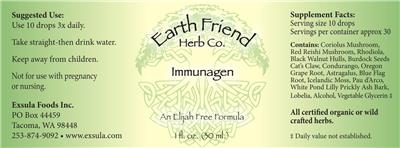
Suggested Use: Use 10 drops 3x daily. Take straight-then drink water.
Precautions
Keep away from children.
Not for use with pregnancy or nursing.
General Statements
An Elijah Free formula
Formulation
All certified organic or wild crafted herbs.
Is this label outdated? Report a formula or label change and our pharmacy team will review it.
Immunagen by Earth Friend Herb Co. label
The label scan from the NIH Dietary Supplement Label Database. Tap to enlarge.
Label images are published by the NIH Dietary Supplement Label Database for the version of this product on file. Always read your actual product label.
View the full label (PDF)The Ingredients in Immunagen by Earth Friend Herb Co.
These are the 15 active ingredients this product is made of. Select any to open its full monograph.
Serving size10 Drop(s) Dosage formLiquid Servings per container30 Amounts shown are per serving.
Most supplement products combine several ingredients, and a medication can interact with the product through any one of them. Each ingredient below shows whether it has known drug interactions.
Rhodiola
Interacts with1,271 drugs
Rhodiola is an herb traditionally used to fight fatigue and help the body cope with stress. Some small studies suggest it may modestly reduce fatigue...
Rhodiola monograph & interactionsBlack Walnut
No knowninteractions
Black walnut is a tree whose green hulls are traditionally used as a natural antiparasitic and digestive remedy, but solid human evidence for these us...
Black Walnut monograph & interactionsWhite Pond Lily
No knowninteractions
White Lily (Lilium candidum) is a flowering plant used mostly in traditional skin care, where its bulb- or flower-infused oils are applied for minor s...
White Pond Lily monograph & interactionsPrickly Ash
Interacts with36 drugs
Northern Prickly Ash is a North American shrub whose bark and berries have a long history in folk medicine, especially for toothache, joint pain, and...
Prickly Ash monograph & interactionsBlue Flag
Interacts with78 drugs
Blue Flag is a flowering plant whose root has been used in traditional and herbal medicine for skin and digestive complaints, but there is very little...
Blue Flag monograph & interactionsOregon grape
Interacts with1,219 drugs
Oregon grape is a shrub whose root contains berberine and related compounds. The strongest (though still modest) evidence is for topical creams that m...
Oregon grape monograph & interactionsLobelia
Interacts with1 drug
Lobelia is a traditional herb once used for breathing problems and to help people quit smoking, but reliable evidence supporting these uses is lacking...
Lobelia monograph & interactionsPau d'Arco
Interacts with122 drugs
Pau d'arco is a South American tree bark traditionally used for infections and inflammation, and it contains compounds like lapachol that show activit...
Pau d'Arco monograph & interactionsCondurango
No knowninteractions
Condurango is the bark of a South American vine traditionally used as a bitter to stimulate appetite and ease digestive complaints. Modern scientific...
Condurango monograph & interactionsBurdock
Interacts with122 drugs
Burdock is a traditional herb most often used for skin problems and as a so-called 'blood purifier,' but high-quality human studies are lacking and mo...
Burdock monograph & interactionsIcelandic Moss
No knowninteractions
Iceland moss is a lichen traditionally used as a soothing remedy for dry cough and throat or mouth irritation, mainly because of its mucilage (gel-for...
Icelandic Moss monograph & interactionsAstragalus
Interacts with208 drugs
Astragalus is a root used for centuries in traditional Chinese medicine, mainly to support the immune system and help the body cope with stress. While...
Astragalus monograph & interactionsCoriolus Mushroom
Red Reishi Mushroom
Interacts with375 drugs
Reishi is a traditional Asian mushroom widely used to support the immune system and overall wellness. Human evidence for most of its claimed benefits...
Red Reishi Mushroom monograph & interactionsCat's Claw
Interacts with964 drugs
Cat's claw is a South American vine traditionally used for inflammation, joint pain, and immune support. Some small studies hint it may help with arth...
Cat's Claw monograph & interactionsOther (inactive) ingredients: Alcohol, Glycerin. These complete the product’s ingredient list but are not active constituents.
Immunagen by Earth Friend Herb Co. Drug Interactions
HelloPharmacist Interaction Report
Immunagen by Earth Friend Herb Co. has documented interactions with a number of medications.
The most serious involves blue flag, which carries a Major severity rating for digoxin (a heart medication): overuse of this product increases the risk of adverse effects from cardiac glycosides.
Read the full breakdown — every affected drug type, severity by severity
Several ingredients interact with common drug types at Moderate severity. Rhodiola affects antihypertensive drugs (blood pressure medications), drugs metabolized by the liver enzyme CYP2C9, P-glycoprotein substrates, immunosuppressants, antidiabetes drugs, and losartan specifically.
Oregon grape interacts with CNS depressants (sedatives and similar drugs), antihypertensive drugs, multiple liver enzymes (CYP2D6, CYP2C9, CYP3A4 substrates), blood thinners (anticoagulants and antiplatelets), antidiabetes drugs, and cyclosporine. Blue flag also affects diuretics and warfarin (a blood thinner).
Other ingredients with Moderate interactions include lobelia and lithium, astragalus with immunosuppressants and antidiabetes drugs, reishi mushroom with antihypertensive and antidiabetes drugs and blood thinners, cat's claw with antihypertensive drugs, CYP3A4 substrates, blood thinners, immunosuppressants, calcium channel blockers, and nirmatrelvir/ritonavir (Paxlovid), pau d'arco with blood thinners, and burdock with blood thinners.
Rhodiola also carries Minor interactions with CYP1A2 and CYP3A4 substrates. Altogether, these interactions span 1,328 individual medications.
We could not check prickly ash or coriolus mushroom for interactions — we hold no data for these ingredients. To confirm whether your exact medications are affected, use the search tool on this page.
Check your own medications below · Editorial policy · How we use AI
Want to check YOUR meds against Immunagen?
Ask about interactions with your drugs in plain English — “Can I take it with lisinopril?” — and we find you the answer in seconds, ingredient by ingredient.
Go to the checkerIngredients driving the most interactions
Individual Drug Interactions
The ingredients in Immunagen interact with 1,358 drugs. Click any drug to see the details.
10 of the 15 ingredients in Immunagen interact with drugs. Each result below shows which ingredient is responsible. Rhodiola Oregon grape Cat's Claw Red Reishi Mushroom Astragalus Pau d'Arco Burdock Blue Flag Prickly Ash Lobelia
DigoxinDigitek, Lanoxicaps, Lanoxin
How Digoxin interacts with Immunagen — through 3 ingredients. Tap an ingredient for the detail:
Blue FlagDigoxin (lanoxin) Major
Interaction Summary
Theoretically, overuse or abuse of this product increases the risk of adverse effects from cardiac glycoside drugs.
Read the full Blue Flag + Digoxin interactionOregon GrapeP-glycoprotein Substrates Moderate
Interaction Summary
Theoretically, Oregon grape might increase serum levels of drugs that are P-glycoprotein (P-gp) substrates.
Read the full Oregon Grape + Digoxin interactionRhodiolaP-glycoprotein Substrates Moderate
Interaction Summary
Theoretically, rhodiola might increase levels of P-glycoprotein substrates.
Read the full Rhodiola + Digoxin interaction6-mercaptopurinePurinethol
How 6-mercaptopurine interacts with Immunagen — through 3 ingredients. Tap an ingredient for the detail:
AstragalusImmunosuppressants Moderate
Interaction Summary
Theoretically, astragalus might interfere with immunosuppressive therapy.
Read the full Astragalus + 6-mercaptopurine interactionRhodiolaImmunosuppressants Moderate
Interaction Summary
Theoretically, rhodiola use might interfere with immunosuppressive therapy.
Read the full Rhodiola + 6-mercaptopurine interactionCat's ClawImmunosuppressants Moderate
Interaction Summary
Theoretically, cat's claw might interfere with immunosuppressive therapy.
Read the full Cat's Claw + 6-mercaptopurine interactionAdo-trastuzumab EmtansineKadcyla
How Ado-trastuzumab Emtansine interacts with Immunagen — through 3 ingredients. Tap an ingredient for the detail:
Oregon GrapeCytochrome P450 3a4 (cyp3a4) Substrates Moderate
Interaction Summary
Theoretically, Oregon grape might increase serum levels of drugs metabolized by CYP3A4.
Read the full Oregon Grape + Ado-trastuzumab Emtansine interactionCat's ClawCytochrome P450 3a4 (cyp3a4) Substrates Moderate
Interaction Summary
Theoretically, cat's claw might increase or decrease the levels and effects of drugs metabolized by CYP3A4.
Read the full Cat's Claw + Ado-trastuzumab Emtansine interactionRhodiolaCytochrome P450 3a4 (cyp3a4) Substrates Minor
Interaction Summary
Theoretically, rhodiola might increase levels of drugs metabolized by CYP3A4.
Read the full Rhodiola + Ado-trastuzumab Emtansine interactionAbciximabReoPro
How Abciximab interacts with Immunagen — through 5 ingredients. Tap an ingredient for the detail:
Pau D'arcoAnticoagulant/antiplatelet Drugs Moderate
Interaction Summary
Theoretically, pau d'arco might increase the risk of bleeding when taken with anticoagulant or antiplatelet drugs.
Read the full Pau D'arco + Abciximab interactionBurdockAnticoagulant/antiplatelet Drugs Moderate
Interaction Summary
Theoretically, taking burdock with anticoagulant or antiplatelet drugs might increase the risk of bleeding.
Read the full Burdock + Abciximab interactionCat's ClawAnticoagulant/antiplatelet Drugs Moderate
Interaction Summary
Theoretically, cat's claw may increase the risk of bleeding if used with anticoagulant or antiplatelet drugs.
Read the full Cat's Claw + Abciximab interactionOregon GrapeAnticoagulant/antiplatelet Drugs Moderate
Interaction Summary
Theoretically, Oregon grape might increase the risk of bleeding when taken with anticoagulant or antiplatelet drugs.
Read the full Oregon Grape + Abciximab interactionRed Reishi MushroomAnticoagulant/antiplatelet Drugs Moderate
Interaction Summary
Theoretically, high doses of reishi mushroom might increase the risk of bleeding.
Read the full Red Reishi Mushroom + Abciximab interactionAbemaciclibVerzenio
How Abemaciclib interacts with Immunagen — through 3 ingredients. Tap an ingredient for the detail:
Cat's ClawCytochrome P450 3a4 (cyp3a4) Substrates Moderate
Interaction Summary
Theoretically, cat's claw might increase or decrease the levels and effects of drugs metabolized by CYP3A4.
Read the full Cat's Claw + Abemaciclib interactionOregon GrapeCytochrome P450 3a4 (cyp3a4) Substrates Moderate
Interaction Summary
Theoretically, Oregon grape might increase serum levels of drugs metabolized by CYP3A4.
Read the full Oregon Grape + Abemaciclib interactionRhodiolaCytochrome P450 3a4 (cyp3a4) Substrates Minor
Interaction Summary
Theoretically, rhodiola might increase levels of drugs metabolized by CYP3A4.
Read the full Rhodiola + Abemaciclib interactionAbiraterone
How Abiraterone interacts with Immunagen — through 3 ingredients. Tap an ingredient for the detail:
Oregon GrapeCytochrome P450 3a4 (cyp3a4) Substrates Moderate
Interaction Summary
Theoretically, Oregon grape might increase serum levels of drugs metabolized by CYP3A4.
Read the full Oregon Grape + Abiraterone interactionCat's ClawCytochrome P450 3a4 (cyp3a4) Substrates Moderate
Interaction Summary
Theoretically, cat's claw might increase or decrease the levels and effects of drugs metabolized by CYP3A4.
Read the full Cat's Claw + Abiraterone interactionRhodiolaCytochrome P450 3a4 (cyp3a4) Substrates Minor
Interaction Summary
Theoretically, rhodiola might increase levels of drugs metabolized by CYP3A4.
Read the full Rhodiola + Abiraterone interactionAbiraterone AcetateYonsa, Zytiga
How Abiraterone Acetate interacts with Immunagen — through 3 ingredients. Tap an ingredient for the detail:
Oregon GrapeCytochrome P450 3a4 (cyp3a4) Substrates Moderate
Interaction Summary
Theoretically, Oregon grape might increase serum levels of drugs metabolized by CYP3A4.
Read the full Oregon Grape + Abiraterone Acetate interactionCat's ClawCytochrome P450 3a4 (cyp3a4) Substrates Moderate
Interaction Summary
Theoretically, cat's claw might increase or decrease the levels and effects of drugs metabolized by CYP3A4.
Read the full Cat's Claw + Abiraterone Acetate interactionRhodiolaCytochrome P450 3a4 (cyp3a4) Substrates Minor
Interaction Summary
Theoretically, rhodiola might increase levels of drugs metabolized by CYP3A4.
Read the full Rhodiola + Abiraterone Acetate interactionAbrocitinibCibinqo
How Abrocitinib interacts with Immunagen — through 7 ingredients. Tap an ingredient for the detail:
Cat's ClawAnticoagulant/antiplatelet Drugs, Immunosuppressants Moderate
Interaction Summary
Theoretically, cat's claw may increase the risk of bleeding if used with anticoagulant or antiplatelet drugs.
Read the full Cat's Claw + Abrocitinib interactionBurdockAnticoagulant/antiplatelet Drugs Moderate
Interaction Summary
Theoretically, taking burdock with anticoagulant or antiplatelet drugs might increase the risk of bleeding.
Read the full Burdock + Abrocitinib interactionRhodiolaImmunosuppressants, Cytochrome P450 2c9 (cyp2c9) Substrates Moderate
Interaction Summary
Theoretically, rhodiola use might interfere with immunosuppressive therapy.
Read the full Rhodiola + Abrocitinib interactionPau D'arcoAnticoagulant/antiplatelet Drugs Moderate
Interaction Summary
Theoretically, pau d'arco might increase the risk of bleeding when taken with anticoagulant or antiplatelet drugs.
Read the full Pau D'arco + Abrocitinib interactionRed Reishi MushroomAnticoagulant/antiplatelet Drugs Moderate
Interaction Summary
Theoretically, high doses of reishi mushroom might increase the risk of bleeding.
Read the full Red Reishi Mushroom + Abrocitinib interactionAstragalusImmunosuppressants Moderate
Interaction Summary
Theoretically, astragalus might interfere with immunosuppressive therapy.
Read the full Astragalus + Abrocitinib interactionOregon GrapeCytochrome P450 2c9 (cyp2c9) Substrates, Anticoagulant/antiplatelet Drugs Moderate
Interaction Summary
Theoretically, Oregon grape might increase serum levels of drugs metabolized by CYP2C9.
Read the full Oregon Grape + Abrocitinib interactionAcalabrutinibCalquence
How Acalabrutinib interacts with Immunagen — through 3 ingredients. Tap an ingredient for the detail:
Oregon GrapeCytochrome P450 3a4 (cyp3a4) Substrates, P-glycoprotein Substrates Moderate
Interaction Summary
Theoretically, Oregon grape might increase serum levels of drugs metabolized by CYP3A4.
Read the full Oregon Grape + Acalabrutinib interactionRhodiolaP-glycoprotein Substrates, Cytochrome P450 3a4 (cyp3a4) Substrates Moderate
Interaction Summary
Theoretically, rhodiola might increase levels of P-glycoprotein substrates.
Read the full Rhodiola + Acalabrutinib interactionCat's ClawCytochrome P450 3a4 (cyp3a4) Substrates Moderate
Interaction Summary
Theoretically, cat's claw might increase or decrease the levels and effects of drugs metabolized by CYP3A4.
Read the full Cat's Claw + Acalabrutinib interactionAcarboseGlucobay, Prandase, Precose
How Acarbose interacts with Immunagen — through 4 ingredients. Tap an ingredient for the detail:
RhodiolaAntidiabetes Drugs Moderate
Interaction Summary
Theoretically, taking rhodiola with antidiabetes drugs might increase the risk of hypoglycemia.
Read the full Rhodiola + Acarbose interactionOregon GrapeAntidiabetes Drugs Moderate
Interaction Summary
Theoretically, Oregon grape might increase the risk of hypoglycemia when taken with antidiabetes drugs.
Read the full Oregon Grape + Acarbose interactionAstragalusAntidiabetes Drugs Moderate
Interaction Summary
Theoretically, taking astragalus with antidiabetes drugs might increase the risk of hypoglycemia.
Read the full Astragalus + Acarbose interactionRed Reishi MushroomAntidiabetes Drugs Moderate
Interaction Summary
Theoretically, reishi mushroom might have additive effects with antidiabetes drugs.
Read the full Red Reishi Mushroom + Acarbose interactionAcebutololRhotral, Sectral
How Acebutolol interacts with Immunagen — through 4 ingredients. Tap an ingredient for the detail:
Red Reishi MushroomAntihypertensive Drugs Moderate
Interaction Summary
Theoretically, concurrent use of reishi mushroom with antihypertensive drugs might increase the risk of hypotension.
Read the full Red Reishi Mushroom + Acebutolol interactionRhodiolaAntihypertensive Drugs Moderate
Interaction Summary
Theoretically, taking rhodiola with antihypertensive drugs might increase the risk of hypotension.
Read the full Rhodiola + Acebutolol interactionCat's ClawAntihypertensive Drugs Moderate
Interaction Summary
Theoretically, taking cat's claw with antihypertensive drugs might increase the risk of hypotension.
Read the full Cat's Claw + Acebutolol interactionOregon GrapeAntihypertensive Drugs Moderate
Interaction Summary
Theoretically, Oregon grape might increase the risk of hypotension when taken with antihypertensive drugs.
Read the full Oregon Grape + Acebutolol interactionAcenocoumarolSintrom
How Acenocoumarol interacts with Immunagen — through 5 ingredients. Tap an ingredient for the detail:
BurdockAnticoagulant/antiplatelet Drugs Moderate
Interaction Summary
Theoretically, taking burdock with anticoagulant or antiplatelet drugs might increase the risk of bleeding.
Read the full Burdock + Acenocoumarol interactionCat's ClawAnticoagulant/antiplatelet Drugs Moderate
Interaction Summary
Theoretically, cat's claw may increase the risk of bleeding if used with anticoagulant or antiplatelet drugs.
Read the full Cat's Claw + Acenocoumarol interactionPau D'arcoAnticoagulant/antiplatelet Drugs Moderate
Interaction Summary
Theoretically, pau d'arco might increase the risk of bleeding when taken with anticoagulant or antiplatelet drugs.
Read the full Pau D'arco + Acenocoumarol interactionRed Reishi MushroomAnticoagulant/antiplatelet Drugs Moderate
Interaction Summary
Theoretically, high doses of reishi mushroom might increase the risk of bleeding.
Read the full Red Reishi Mushroom + Acenocoumarol interactionOregon GrapeAnticoagulant/antiplatelet Drugs Moderate
Interaction Summary
Theoretically, Oregon grape might increase the risk of bleeding when taken with anticoagulant or antiplatelet drugs.
Read the full Oregon Grape + Acenocoumarol interactionAcepromazineAtravet
How Acepromazine interacts with Immunagen — through 2 ingredients. Tap an ingredient for the detail:
Oregon GrapeCns Depressants Moderate
Interaction Summary
Theoretically, Oregon grape might increase the sedative effects of CNS depressants.
Read the full Oregon Grape + Acepromazine interactionRhodiolaCns Depressants Minor
Interaction Summary
Theoretically, rhodiola might increase the risk of adverse effects when taken with CNS depressants.
Read the full Rhodiola + Acepromazine interactionAcetaminophen, AspirinGemnisyn
How Acetaminophen, Aspirin interacts with Immunagen — through 6 ingredients. Tap an ingredient for the detail:
Red Reishi MushroomAnticoagulant/antiplatelet Drugs Moderate
Interaction Summary
Theoretically, high doses of reishi mushroom might increase the risk of bleeding.
Read the full Red Reishi Mushroom + Acetaminophen, Aspirin interactionOregon GrapeAnticoagulant/antiplatelet Drugs Moderate
Interaction Summary
Theoretically, Oregon grape might increase the risk of bleeding when taken with anticoagulant or antiplatelet drugs.
Read the full Oregon Grape + Acetaminophen, Aspirin interactionPau D'arcoAnticoagulant/antiplatelet Drugs Moderate
Interaction Summary
Theoretically, pau d'arco might increase the risk of bleeding when taken with anticoagulant or antiplatelet drugs.
Read the full Pau D'arco + Acetaminophen, Aspirin interactionBurdockAnticoagulant/antiplatelet Drugs Moderate
Interaction Summary
Theoretically, taking burdock with anticoagulant or antiplatelet drugs might increase the risk of bleeding.
Read the full Burdock + Acetaminophen, Aspirin interactionCat's ClawAnticoagulant/antiplatelet Drugs Moderate
Interaction Summary
Theoretically, cat's claw may increase the risk of bleeding if used with anticoagulant or antiplatelet drugs.
Read the full Cat's Claw + Acetaminophen, Aspirin interactionRhodiolaCytochrome P450 1a2 (cyp1a2) Substrates Minor
Interaction Summary
Theoretically, rhodiola might increase levels of drugs metabolized by CYP1A2.
Read the full Rhodiola + Acetaminophen, Aspirin interactionAcetaminophen, Aspirin, CaffeineExcedrin, Excedrin Extra Strength, Excedrin Migraine
How Acetaminophen, Aspirin, Caffeine interacts with Immunagen — through 6 ingredients. Tap an ingredient for the detail:
Cat's ClawAnticoagulant/antiplatelet Drugs, Cytochrome P450 3a4 (cyp3a4) Substrates Moderate
Interaction Summary
Theoretically, cat's claw may increase the risk of bleeding if used with anticoagulant or antiplatelet drugs.
Read the full Cat's Claw + Acetaminophen, Aspirin, Caffeine interactionBurdockAnticoagulant/antiplatelet Drugs Moderate
Interaction Summary
Theoretically, taking burdock with anticoagulant or antiplatelet drugs might increase the risk of bleeding.
Read the full Burdock + Acetaminophen, Aspirin, Caffeine interactionRed Reishi MushroomAnticoagulant/antiplatelet Drugs Moderate
Interaction Summary
Theoretically, high doses of reishi mushroom might increase the risk of bleeding.
Read the full Red Reishi Mushroom + Acetaminophen, Aspirin, Caffeine interactionPau D'arcoAnticoagulant/antiplatelet Drugs Moderate
Interaction Summary
Theoretically, pau d'arco might increase the risk of bleeding when taken with anticoagulant or antiplatelet drugs.
Read the full Pau D'arco + Acetaminophen, Aspirin, Caffeine interactionOregon GrapeAnticoagulant/antiplatelet Drugs, Cytochrome P450 3a4 (cyp3a4) Substrates Moderate
Interaction Summary
Theoretically, Oregon grape might increase the risk of bleeding when taken with anticoagulant or antiplatelet drugs.
Read the full Oregon Grape + Acetaminophen, Aspirin, Caffeine interactionRhodiolaCytochrome P450 1a2 (cyp1a2) Substrates, Cytochrome P450 3a4 (cyp3a4) Substrates Minor
Interaction Summary
Theoretically, rhodiola might increase levels of drugs metabolized by CYP1A2.
Read the full Rhodiola + Acetaminophen, Aspirin, Caffeine interactionAcetaminophen, Butalbital, CaffeineEsgic, Esgic Plus, Fiogesic, Fioricet, Repan, Tecnal +1 more
How Acetaminophen, Butalbital, Caffeine interacts with Immunagen — through 3 ingredients. Tap an ingredient for the detail:
Cat's ClawCytochrome P450 3a4 (cyp3a4) Substrates Moderate
Interaction Summary
Theoretically, cat's claw might increase or decrease the levels and effects of drugs metabolized by CYP3A4.
Read the full Cat's Claw + Acetaminophen, Butalbital, Caffeine interactionOregon GrapeCytochrome P450 3a4 (cyp3a4) Substrates Moderate
Interaction Summary
Theoretically, Oregon grape might increase serum levels of drugs metabolized by CYP3A4.
Read the full Oregon Grape + Acetaminophen, Butalbital, Caffeine interactionRhodiolaCytochrome P450 1a2 (cyp1a2) Substrates, Cytochrome P450 3a4 (cyp3a4) Substrates Minor
Interaction Summary
Theoretically, rhodiola might increase levels of drugs metabolized by CYP1A2.
Read the full Rhodiola + Acetaminophen, Butalbital, Caffeine interactionAcetaminophen, Butalbital, Caffeine, CodeineEsgic with Codeine, Fioricet w/ Codeine
How Acetaminophen, Butalbital, Caffeine, Codeine interacts with Immunagen — through 3 ingredients. Tap an ingredient for the detail:
Oregon GrapeCytochrome P450 3a4 (cyp3a4) Substrates, Cytochrome P450 2d6 (cyp2d6) Substrates +1 Moderate
Interaction Summary
Theoretically, Oregon grape might increase serum levels of drugs metabolized by CYP3A4.
Read the full Oregon Grape + Acetaminophen, Butalbital, Caffeine, Codeine interactionCat's ClawCytochrome P450 3a4 (cyp3a4) Substrates Moderate
Interaction Summary
Theoretically, cat's claw might increase or decrease the levels and effects of drugs metabolized by CYP3A4.
Read the full Cat's Claw + Acetaminophen, Butalbital, Caffeine, Codeine interactionRhodiolaCytochrome P450 3a4 (cyp3a4) Substrates, Cytochrome P450 1a2 (cyp1a2) Substrates +1 Minor
Interaction Summary
Theoretically, rhodiola might increase levels of drugs metabolized by CYP3A4.
Read the full Rhodiola + Acetaminophen, Butalbital, Caffeine, Codeine interactionAcetaminophen, Butalbital, CodeineBancap w/ Codeine
How Acetaminophen, Butalbital, Codeine interacts with Immunagen — through 2 ingredients. Tap an ingredient for the detail:
Oregon GrapeCns Depressants, Cytochrome P450 2d6 (cyp2d6) Substrates Moderate
Interaction Summary
Theoretically, Oregon grape might increase the sedative effects of CNS depressants.
Read the full Oregon Grape + Acetaminophen, Butalbital, Codeine interactionRhodiolaCytochrome P450 1a2 (cyp1a2) Substrates, Cns Depressants Minor
Interaction Summary
Theoretically, rhodiola might increase levels of drugs metabolized by CYP1A2.
Read the full Rhodiola + Acetaminophen, Butalbital, Codeine interactionAcetaminophen, Butalbital, Codeine PhosphatePhrenilin #3
How Acetaminophen, Butalbital, Codeine Phosphate interacts with Immunagen — through 2 ingredients. Tap an ingredient for the detail:
Oregon GrapeCns Depressants, Cytochrome P450 2d6 (cyp2d6) Substrates Moderate
Interaction Summary
Theoretically, Oregon grape might increase the sedative effects of CNS depressants.
Read the full Oregon Grape + Acetaminophen, Butalbital, Codeine Phosphate interactionRhodiolaCns Depressants, Cytochrome P450 1a2 (cyp1a2) Substrates Minor
Interaction Summary
Theoretically, rhodiola might increase the risk of adverse effects when taken with CNS depressants.
Read the full Rhodiola + Acetaminophen, Butalbital, Codeine Phosphate interactionAcetaminophen, Caffeine, Chlorpheniramine, Hydrocodone, PhenylephrineHycomine Compound
How Acetaminophen, Caffeine, Chlorpheniramine, Hydrocodone, Phenylephrine interacts with Immunagen — through 3 ingredients. Tap an ingredient for the detail:
Oregon GrapeCytochrome P450 2d6 (cyp2d6) Substrates, Cytochrome P450 3a4 (cyp3a4) Substrates +1 Moderate
Interaction Summary
Theoretically, Oregon grape might increase serum levels of drugs metabolized by CYP2D6.
Read the full Oregon Grape + Acetaminophen, Caffeine, Chlorpheniramine, Hydrocodone, Phenylephrine interactionCat's ClawCytochrome P450 3a4 (cyp3a4) Substrates Moderate
Interaction Summary
Theoretically, cat's claw might increase or decrease the levels and effects of drugs metabolized by CYP3A4.
Read the full Cat's Claw + Acetaminophen, Caffeine, Chlorpheniramine, Hydrocodone, Phenylephrine interactionRhodiolaCytochrome P450 1a2 (cyp1a2) Substrates, Cytochrome P450 3a4 (cyp3a4) Substrates +1 Minor
Interaction Summary
Theoretically, rhodiola might increase levels of drugs metabolized by CYP1A2.
Read the full Rhodiola + Acetaminophen, Caffeine, Chlorpheniramine, Hydrocodone, Phenylephrine interactionAcetaminophen, Caffeine, CodeineGesic C15, Gesic C30, Gesic C8, Lenoltec 1, Lenoltec 2, Lenoltec 3 +1 more
How Acetaminophen, Caffeine, Codeine interacts with Immunagen — through 3 ingredients. Tap an ingredient for the detail:
Cat's ClawCytochrome P450 3a4 (cyp3a4) Substrates Moderate
Interaction Summary
Theoretically, cat's claw might increase or decrease the levels and effects of drugs metabolized by CYP3A4.
Read the full Cat's Claw + Acetaminophen, Caffeine, Codeine interactionOregon GrapeCns Depressants, Cytochrome P450 3a4 (cyp3a4) Substrates +1 Moderate
Interaction Summary
Theoretically, Oregon grape might increase the sedative effects of CNS depressants.
Read the full Oregon Grape + Acetaminophen, Caffeine, Codeine interactionRhodiolaCytochrome P450 3a4 (cyp3a4) Substrates, Cytochrome P450 1a2 (cyp1a2) Substrates +1 Minor
Interaction Summary
Theoretically, rhodiola might increase levels of drugs metabolized by CYP3A4.
Read the full Rhodiola + Acetaminophen, Caffeine, Codeine interactionAcetaminophen, Caffeine, Codeine, SalicylamideCodalan No.1, Codalan No.2, Codalan No.3
How Acetaminophen, Caffeine, Codeine, Salicylamide interacts with Immunagen — through 3 ingredients. Tap an ingredient for the detail:
Oregon GrapeCns Depressants, Cytochrome P450 2d6 (cyp2d6) Substrates +1 Moderate
Interaction Summary
Theoretically, Oregon grape might increase the sedative effects of CNS depressants.
Read the full Oregon Grape + Acetaminophen, Caffeine, Codeine, Salicylamide interactionCat's ClawCytochrome P450 3a4 (cyp3a4) Substrates Moderate
Interaction Summary
Theoretically, cat's claw might increase or decrease the levels and effects of drugs metabolized by CYP3A4.
Read the full Cat's Claw + Acetaminophen, Caffeine, Codeine, Salicylamide interactionRhodiolaCns Depressants, Cytochrome P450 1a2 (cyp1a2) Substrates +1 Minor
Interaction Summary
Theoretically, rhodiola might increase the risk of adverse effects when taken with CNS depressants.
Read the full Rhodiola + Acetaminophen, Caffeine, Codeine, Salicylamide interactionAcetaminophen, Caffeine, DihydrocodeineDHC Plus, Panlor DC, Panlor SS
How Acetaminophen, Caffeine, Dihydrocodeine interacts with Immunagen — through 3 ingredients. Tap an ingredient for the detail:
Oregon GrapeCytochrome P450 3a4 (cyp3a4) Substrates, Cytochrome P450 2d6 (cyp2d6) Substrates +1 Moderate
Interaction Summary
Theoretically, Oregon grape might increase serum levels of drugs metabolized by CYP3A4.
Read the full Oregon Grape + Acetaminophen, Caffeine, Dihydrocodeine interactionCat's ClawCytochrome P450 3a4 (cyp3a4) Substrates Moderate
Interaction Summary
Theoretically, cat's claw might increase or decrease the levels and effects of drugs metabolized by CYP3A4.
Read the full Cat's Claw + Acetaminophen, Caffeine, Dihydrocodeine interactionRhodiolaCytochrome P450 3a4 (cyp3a4) Substrates, Cytochrome P450 1a2 (cyp1a2) Substrates +1 Minor
Interaction Summary
Theoretically, rhodiola might increase levels of drugs metabolized by CYP3A4.
Read the full Rhodiola + Acetaminophen, Caffeine, Dihydrocodeine interactionAcetaminophen, Caffeine, IsomethepteneMigralam
How Acetaminophen, Caffeine, Isometheptene interacts with Immunagen — through 3 ingredients. Tap an ingredient for the detail:
Cat's ClawCytochrome P450 3a4 (cyp3a4) Substrates Moderate
Interaction Summary
Theoretically, cat's claw might increase or decrease the levels and effects of drugs metabolized by CYP3A4.
Read the full Cat's Claw + Acetaminophen, Caffeine, Isometheptene interactionOregon GrapeCytochrome P450 3a4 (cyp3a4) Substrates Moderate
Interaction Summary
Theoretically, Oregon grape might increase serum levels of drugs metabolized by CYP3A4.
Read the full Oregon Grape + Acetaminophen, Caffeine, Isometheptene interactionRhodiolaCytochrome P450 1a2 (cyp1a2) Substrates, Cytochrome P450 3a4 (cyp3a4) Substrates Minor
Interaction Summary
Theoretically, rhodiola might increase levels of drugs metabolized by CYP1A2.
Read the full Rhodiola + Acetaminophen, Caffeine, Isometheptene interactionAcetaminophen, Caffeine, PyrilamineMidol Max Strength Menstrual
How Acetaminophen, Caffeine, Pyrilamine interacts with Immunagen — through 4 ingredients. Tap an ingredient for the detail:
Oregon GrapeCytochrome P450 3a4 (cyp3a4) Substrates Moderate
Interaction Summary
Theoretically, Oregon grape might increase serum levels of drugs metabolized by CYP3A4.
Read the full Oregon Grape + Acetaminophen, Caffeine, Pyrilamine interactionCat's ClawCytochrome P450 3a4 (cyp3a4) Substrates Moderate
Interaction Summary
Theoretically, cat's claw might increase or decrease the levels and effects of drugs metabolized by CYP3A4.
Read the full Cat's Claw + Acetaminophen, Caffeine, Pyrilamine interactionBlue FlagDiuretic Drugs Moderate
Interaction Summary
Overuse of blue flag might compound diuretic-induced potassium loss.
Read the full Blue Flag + Acetaminophen, Caffeine, Pyrilamine interactionRhodiolaCytochrome P450 3a4 (cyp3a4) Substrates, Cytochrome P450 1a2 (cyp1a2) Substrates Minor
Interaction Summary
Theoretically, rhodiola might increase levels of drugs metabolized by CYP3A4.
Read the full Rhodiola + Acetaminophen, Caffeine, Pyrilamine interactionAcetaminophen, Chlorpheniramine Maleate, Dextromethorphan HbrVicks Formula 44M Cough, Cold & Flu Relief
How Acetaminophen, Chlorpheniramine Maleate, Dextromethorphan Hbr interacts with Immunagen — through 3 ingredients. Tap an ingredient for the detail:
Cat's ClawCytochrome P450 3a4 (cyp3a4) Substrates Moderate
Interaction Summary
Theoretically, cat's claw might increase or decrease the levels and effects of drugs metabolized by CYP3A4.
Read the full Cat's Claw + Acetaminophen, Chlorpheniramine Maleate, Dextromethorphan Hbr interactionOregon GrapeCytochrome P450 3a4 (cyp3a4) Substrates, Cytochrome P450 2d6 (cyp2d6) Substrates Moderate
Interaction Summary
Theoretically, Oregon grape might increase serum levels of drugs metabolized by CYP3A4.
Read the full Oregon Grape + Acetaminophen, Chlorpheniramine Maleate, Dextromethorphan Hbr interactionRhodiolaCytochrome P450 1a2 (cyp1a2) Substrates, Cytochrome P450 3a4 (cyp3a4) Substrates Minor
Interaction Summary
Theoretically, rhodiola might increase levels of drugs metabolized by CYP1A2.
Read the full Rhodiola + Acetaminophen, Chlorpheniramine Maleate, Dextromethorphan Hbr interactionAcetaminophen, Chlorpheniramine, Codeine, PhenylephrineColrex
How Acetaminophen, Chlorpheniramine, Codeine, Phenylephrine interacts with Immunagen — through 3 ingredients. Tap an ingredient for the detail:
Oregon GrapeCytochrome P450 3a4 (cyp3a4) Substrates, Cytochrome P450 2d6 (cyp2d6) Substrates +1 Moderate
Interaction Summary
Theoretically, Oregon grape might increase serum levels of drugs metabolized by CYP3A4.
Read the full Oregon Grape + Acetaminophen, Chlorpheniramine, Codeine, Phenylephrine interactionCat's ClawCytochrome P450 3a4 (cyp3a4) Substrates Moderate
Interaction Summary
Theoretically, cat's claw might increase or decrease the levels and effects of drugs metabolized by CYP3A4.
Read the full Cat's Claw + Acetaminophen, Chlorpheniramine, Codeine, Phenylephrine interactionRhodiolaCytochrome P450 1a2 (cyp1a2) Substrates, Cytochrome P450 3a4 (cyp3a4) Substrates +1 Minor
Interaction Summary
Theoretically, rhodiola might increase levels of drugs metabolized by CYP1A2.
Read the full Rhodiola + Acetaminophen, Chlorpheniramine, Codeine, Phenylephrine interactionAcetaminophen, Chlorpheniramine, DextromethorphanCoricidin II Extra Strength Cold and Flu
How Acetaminophen, Chlorpheniramine, Dextromethorphan interacts with Immunagen — through 3 ingredients. Tap an ingredient for the detail:
Oregon GrapeCytochrome P450 2d6 (cyp2d6) Substrates, Cytochrome P450 3a4 (cyp3a4) Substrates Moderate
Interaction Summary
Theoretically, Oregon grape might increase serum levels of drugs metabolized by CYP2D6.
Read the full Oregon Grape + Acetaminophen, Chlorpheniramine, Dextromethorphan interactionCat's ClawCytochrome P450 3a4 (cyp3a4) Substrates Moderate
Interaction Summary
Theoretically, cat's claw might increase or decrease the levels and effects of drugs metabolized by CYP3A4.
Read the full Cat's Claw + Acetaminophen, Chlorpheniramine, Dextromethorphan interactionRhodiolaCytochrome P450 3a4 (cyp3a4) Substrates, Cytochrome P450 1a2 (cyp1a2) Substrates Minor
Interaction Summary
Theoretically, rhodiola might increase levels of drugs metabolized by CYP3A4.
Read the full Rhodiola + Acetaminophen, Chlorpheniramine, Dextromethorphan interactionAcetaminophen, Chlorpheniramine, Dextromethorphan HydrobromideCoricidin HBP Maximum Strength Flu
How Acetaminophen, Chlorpheniramine, Dextromethorphan Hydrobromide interacts with Immunagen — through 3 ingredients. Tap an ingredient for the detail:
Cat's ClawCytochrome P450 3a4 (cyp3a4) Substrates Moderate
Interaction Summary
Theoretically, cat's claw might increase or decrease the levels and effects of drugs metabolized by CYP3A4.
Read the full Cat's Claw + Acetaminophen, Chlorpheniramine, Dextromethorphan Hydrobromide interactionOregon GrapeCytochrome P450 3a4 (cyp3a4) Substrates, Cytochrome P450 2d6 (cyp2d6) Substrates Moderate
Interaction Summary
Theoretically, Oregon grape might increase serum levels of drugs metabolized by CYP3A4.
Read the full Oregon Grape + Acetaminophen, Chlorpheniramine, Dextromethorphan Hydrobromide interactionRhodiolaCytochrome P450 1a2 (cyp1a2) Substrates, Cytochrome P450 3a4 (cyp3a4) Substrates Minor
Interaction Summary
Theoretically, rhodiola might increase levels of drugs metabolized by CYP1A2.
Read the full Rhodiola + Acetaminophen, Chlorpheniramine, Dextromethorphan Hydrobromide interactionAcetaminophen, Chlorpheniramine, Dextromethorphan, PhenylpropanolamineMulti Symptom Cold Relief
How Acetaminophen, Chlorpheniramine, Dextromethorphan, Phenylpropanolamine interacts with Immunagen — through 3 ingredients. Tap an ingredient for the detail:
Oregon GrapeCytochrome P450 2d6 (cyp2d6) Substrates, Cytochrome P450 3a4 (cyp3a4) Substrates Moderate
Interaction Summary
Theoretically, Oregon grape might increase serum levels of drugs metabolized by CYP2D6.
Read the full Oregon Grape + Acetaminophen, Chlorpheniramine, Dextromethorphan, Phenylpropanolamine interactionCat's ClawCytochrome P450 3a4 (cyp3a4) Substrates Moderate
Interaction Summary
Theoretically, cat's claw might increase or decrease the levels and effects of drugs metabolized by CYP3A4.
Read the full Cat's Claw + Acetaminophen, Chlorpheniramine, Dextromethorphan, Phenylpropanolamine interactionRhodiolaCytochrome P450 3a4 (cyp3a4) Substrates, Cytochrome P450 1a2 (cyp1a2) Substrates Minor
Interaction Summary
Theoretically, rhodiola might increase levels of drugs metabolized by CYP3A4.
Read the full Rhodiola + Acetaminophen, Chlorpheniramine, Dextromethorphan, Phenylpropanolamine interactionEach ingredient & the kinds of drugs it affects
For each ingredient in Immunagen with known interactions, here are the types of medications they can affect. Open any type for the detail — or search your exact drug in the checker above.
Rhodiola
Antidiabetes Drugs
Theoretically, taking rhodiola with antidiabetes drugs might increase the risk of hypoglycemia.
In vitro and animal research shows that rhodiola extract can decrease blood glucose due to alpha-glucosidase activity.
Antihypertensive Drugs
Theoretically, taking rhodiola with antihypertensive drugs might increase the risk of hypotension.
In vitro and animal research shows that rhodiola extract inhibits angiotensin-converting enzyme (ACE) and might lower blood pressure.
Cytochrome P450 2C9 (Cyp2C9) Substrates
Theoretically, rhodiola might increase levels of drugs metabolized by CYP2C9.
In vitro research shows that rhodiola inhibits CYP2C9. This effect is highly variable and appears to be dependent on the rhodiola product studied. Also, a clinical study in healthy young males found that taking rhodiola extract 290 mg daily for 14 days reduces the metabolism of losartan, a CYP2C9 substrate, by 21% after 4 hours.
Immunosuppressants
Theoretically, rhodiola use might interfere with immunosuppressive therapy.
In vitro and animal research show that rhodiola has immunostimulatory effects.
Losartan (Cozaar)
Rhodiola might increase the levels and adverse effects of losartan.
A clinical study in healthy young males found that taking rhodiola extract 290 mg daily for 14 days reduces the metabolism of losartan, a CYP2C9 substrate, by 21% after 4 hours.
P-Glycoprotein Substrates
Theoretically, rhodiola might increase levels of P-glycoprotein substrates.
In vitro research shows that rhodiola inhibits P-glycoprotein. Theoretically, using rhodiola with P-glycoprotein substrates might increase drug levels and potentially increase the risk of adverse effects.
Antidepressant Drugs
Theoretically, rhodiola might increase the risk of adverse effects when taken with antidepressants.
A review of adverse event reports in Poland identified cases of tachyarrhythmias, myalgia, arthralgia, gum pain, restless leg syndrome, swallowing disorders, and changes in consciousness when rhodiola was taken in combination with paroxetine, escitalopram, fluoxetine, sertraline, trazodone, and/or duloxetine.
Cns Depressants
Theoretically, rhodiola might increase the risk of adverse effects when taken with CNS depressants.
A review of adverse event reports in Poland identified cases of excessive sedation, myoclonus, hypotension, and hallucinations when rhodiola was taken with haloperidol, diazepam, or alprazolam.
Cytochrome P450 1A2 (Cyp1A2) Substrates
Theoretically, rhodiola might increase levels of drugs metabolized by CYP1A2.
In vitro research shows that rhodiola inhibits CYP1A2. This effect is highly variable and appears to be dependent on the rhodiola product studied. However, a clinical study in healthy young males found that taking rhodiola extract 290 mg daily for 14 days does not inhibit the metabolism of caffeine, a CYP1A2 substrate.
Cytochrome P450 3A4 (Cyp3A4) Substrates
Theoretically, rhodiola might increase levels of drugs metabolized by CYP3A4.
In vitro research shows that rhodiola inhibits CYP3A4. This effect is highly variable and appears to be dependent on the rhodiola product studied. However, a clinical study in healthy young males found that taking rhodiola extract 290 mg daily for 14 days does not inhibit the metabolism of midazolam, a CYP3A4 substrate.
Oregon grape
Anticoagulant/Antiplatelet Drugs
Theoretically, Oregon grape might increase the risk of bleeding when taken with anticoagulant or antiplatelet drugs.
In vitro and in vivo research suggests that berberine, a constituent of Oregon grape, can inhibit platelet aggregation.
Antidiabetes Drugs
Theoretically, Oregon grape might increase the risk of hypoglycemia when taken with antidiabetes drugs.
Clinical research suggests that berberine, a constituent of Oregon grape, can lower blood glucose levels.
Antihypertensive Drugs
Theoretically, Oregon grape might increase the risk of hypotension when taken with antihypertensive drugs.
Animal research suggests that berberine, a constituent of Oregon grape, can have hypotensive effects. Also, an analysis of clinical evidence suggests that taking berberine in combination with amlodipine (Norvasc) can lower systolic and diastolic blood pressure when compared with taking amlodipine alone.
Cns Depressants
Theoretically, Oregon grape might increase the sedative effects of CNS depressants.
Animal research suggests that berberine, a constituent of Oregon grape, can have sedative effects.
Cyclosporine (Neoral, Sandimmune)
Theoretically, Oregon grape might increase the effects and adverse effects of cyclosporine.
Berberine, a constituent of Oregon grape, can reduce metabolism of cyclosporine and increase serum levels. It might inhibit cytochrome P450 3A4 (CYP3A4), which metabolizes cyclosporine.
Cytochrome P450 2C9 (Cyp2C9) Substrates
Theoretically, Oregon grape might increase serum levels of drugs metabolized by CYP2C9.
Preliminary clinical evidence suggests that berberine, a constituent of Oregon grape, can inhibit cytochrome P450 2C9 (CYP2C9).
Cytochrome P450 2D6 (Cyp2D6) Substrates
Theoretically, Oregon grape might increase serum levels of drugs metabolized by CYP2D6.
In vitro research and preliminary clinical evidence suggest that berberine, a constituent of Oregon grape, can inhibit cytochrome P450 2D6 (CYP2D6).
Cytochrome P450 3A4 (Cyp3A4) Substrates
Theoretically, Oregon grape might increase serum levels of drugs metabolized by CYP3A4.
In vitro research and preliminary clinical evidence suggest that berberine, a constituent of Oregon grape, moderately inhibits cytochrome P450 3A4 (CYP3A4).
P-Glycoprotein Substrates
Theoretically, Oregon grape might increase serum levels of drugs that are P-glycoprotein (P-gp) substrates.
In vitro research suggests that Oregon grape extracts inhibit P-gp efflux.
Cat's Claw
Anticoagulant/Antiplatelet Drugs
Theoretically, cat's claw may increase the risk of bleeding if used with anticoagulant or antiplatelet drugs.
Cat's claw contains rhynchophylline and isorhynchophylline. Animal research suggests that these alkaloids can inhibit platelet aggregation. This interaction has not been reported in humans.
Antihypertensive Drugs
Theoretically, taking cat's claw with antihypertensive drugs might increase the risk of hypotension.
Cat's claw contains rhynchophylline. In vitro and animal research suggests that rhynchophylline can lower blood pressure. This interaction has not been reported in humans.
Calcium Channel Blockers
Theoretically, taking cat's claw with calcium channel blockers might increase the risk of hypotension.
Cat's claw contains various alkaloids, including rhynchophylline, isorhynchophylline, corynoxeine, and isocorynoxiene. Animal research suggests that these alkaloids can lower blood pressure by acting as calcium channel blockers. This interaction has not been reported in humans.
Cytochrome P450 3A4 (Cyp3A4) Substrates
Theoretically, cat's claw might increase or decrease the levels and effects of drugs metabolized by CYP3A4.
Cat's claw may affect the clearance of drugs metabolized by CYP3A4. In vitro research shows that cat's claw can inhibit CYP3A4 enzymes. In one case report, a patient taking cat's claw (at an unspecified dose) experienced increased serum levels of atazanavir, ritonavir, and saquinavir, all of which are CYP3A4 substrates. Levels returned to normal 15 days after discontinuation of the cat's claw supplement, suggesting inhibition of CYP3A4 by cat's claw. In contrast, animal research suggests that rhynchophylline, an alkaloid contained in cat's claw, induces CYP3A expression and accelerates the metabolism of nirmatrelvir, the active component in the nirmatrelvir/ritonavir combination product.
Immunosuppressants
Theoretically, cat's claw might interfere with immunosuppressive therapy.
In human and laboratory research, cat's claw has been shown to have immunostimulating activity. It stimulates phagocytosis and increases respiratory cellular activity and the mobility of leukocytes. Theoretically, this could interfere with the activity of immunosuppressant medications.
Nirmatrelvir/Ritonavir (Paxlovid)
Theoretically, cat's claw may decrease the levels of nirmatrelvir.
Cat's claw contains rhynchophylline. Animal research suggests that this alkaloid induces CYP3A expression, thereby accelerating the metabolism of nirmatrelvir, the active component in the nirmatrelvir/ritonavir combination product. This interaction has not been reported in humans.
Red Reishi Mushroom
Anticoagulant/Antiplatelet Drugs
Theoretically, high doses of reishi mushroom might increase the risk of bleeding.
A dose of 1.5 grams daily of reishi mushroom does not seem to decrease platelet aggregation, but a higher dose of 3 grams daily does.
Antidiabetes Drugs
Theoretically, reishi mushroom might have additive effects with antidiabetes drugs.
Animal research suggests that reishi mushroom decreases blood sugar. However, in patients with type 2 diabetes, taking reishi mushroom does not reduce fasting glucose levels, and its effects on glycated hemoglobin are inconsistent.
Antihypertensive Drugs
Theoretically, concurrent use of reishi mushroom with antihypertensive drugs might increase the risk of hypotension.
Reishi mushroom has shown hypotensive activity in animal research. Clinical evidence suggests that reishi mushroom reduces blood pressure in some, but not all, patients with hypertension.
Astragalus
Antidiabetes Drugs
Theoretically, taking astragalus with antidiabetes drugs might increase the risk of hypoglycemia.
Clinical research in humans shows that astragalus might have hypoglycemic effects. Theoretically, taking astragalus, especially in combination with other hypoglycemic agents, might increase the risk of hypoglycemia.
Cyclophosphamide
Theoretically, astragalus might interfere with cyclophosphamide therapy.
Evidence regarding the effect of astragalus on immunosuppression caused by cyclophosphamide is conflicting. Some animal research suggests that astragalus reverses cyclophosphamide-induced immunosuppression. However, other animal research shows no effect.
Immunosuppressants
Theoretically, astragalus might interfere with immunosuppressive therapy.
Astragalus seems to stimulate immune function. Theoretically, taking astragalus might decrease the effects of immunosuppressive therapy.
Lithium
Theoretically, astragalus might increase levels and adverse effects of lithium.
Animal research suggests that astragalus has diuretic properties. Theoretically, due to this diuretic effect, astragalus might reduce excretion and increase levels of lithium.
Pau d'Arco
Anticoagulant/Antiplatelet Drugs
Theoretically, pau d'arco might increase the risk of bleeding when taken with anticoagulant or antiplatelet drugs.
In vitro research shows that pau d'arco reduces platelet aggregation and may interfere with vitamin K. One clinical study shows that taking the lapachol constituent of pau d'arco in doses above 1.5 grams daily increases the risk of bleeding. The effects of whole pau d'arco or pau d'arco extract in humans are unclear.
Burdock
Anticoagulant/Antiplatelet Drugs
Theoretically, taking burdock with anticoagulant or antiplatelet drugs might increase the risk of bleeding.
In vitro research shows that lignans from burdock reduce rabbit platelet aggregation by inhibiting platelet activating factor. This interaction has not been reported in humans.
Blue Flag
Digoxin (Lanoxin)
Theoretically, overuse or abuse of this product increases the risk of adverse effects from cardiac glycoside drugs.
Diuretic Drugs
Overuse of blue flag might compound diuretic-induced potassium loss. There is some concern that people taking blue flag along with potassium depleting diuretics might have an increased risk for hypokalemia. Initiation of potassium supplementation or an increase in potassium supplement dose may be necessary for some patients. Some diuretics that can deplete potassium include chlorothiazide (Diuril), chlorthalidone (Thalitone), furosemide (Lasix), hydrochlorothiazide (HCTZ, Hydrodiuril, Microzide), and others.
Warfarin (Coumadin)
Blue flag has stimulant laxative effects. In some people blue flag can cause diarrhea. Diarrhea can increase the effects of warfarin, increase international normalized ratio (INR), and increase the risk of bleeding. Advise patients who take warfarin not to take excessive amounts of blue flag.
Prickly Ash
Antacids
Theoretically, northern prickly ash might decrease the effectiveness of antacids.
There are reports that northern prickly ash increases stomach acid.
H2-Blockers
Theoretically, northern prickly ash might decrease the effectiveness of H2-blockers.
There are reports that northern prickly ash increases stomach acid.
Proton Pump Inhibitors (Ppis)
Theoretically, northern prickly ash might decrease the effectiveness of PPIs.
There are reports that northern prickly ash increases stomach acid.
Lobelia
Lithium
Lobelia is thought to have diuretic properties. Theoretically, due to these potential diuretic effects, lobelia might reduce excretion and increase levels of lithium. The dose of lithium might need to be decreased.
Brand information
Manufacturer and brand details for Immunagen, from the product label.
Earth Friend Herb Co.
See all Earth Friend Herb Co. products- Name
- Exsula Foods Inc.
- Street Address
- PO Box 44459
- City
- Tacoma
- State
- WA
- ZipCode
- 98448
- Phone Number
- 253-874-9092
- Web Address
- www.exsula.com
Immunagen by Earth Friend Herb Co.: Common Questions
Does Immunagen by Earth Friend Herb Co. interact with any medications?
How can one product interact with so many drugs?
Where does this information come from?
What is rhodiola doing in this product?
I've heard good things about reishi and astragalus for immunity. Are they in here?
Is this safe if I'm pregnant or breastfeeding?
Can I get allergic reactions from this?
I'm taking a blood thinner — is this safe?
What does lobelia do in a supplement designed for immunity?
Written and reviewed by the HelloPharmacist editorial staff. Our editorial policy
Not sure if Immunagen is safe with your meds?
Our pharmacists answer your medication & supplement questions — free.
Label information is sourced from the NIH Dietary Supplement Label Database and reflects the product version on file; always read your actual product label. This page is for education only and is not a substitute for professional medical advice. Confirm with your pharmacist or doctor before combining supplements and medications.
The Full Monographs Behind Immunagen’s Ingredients
Every ingredient we hold a full HelloPharmacist monograph for — uses, evidence, safety, and the complete interaction list.
Rhodiola
Interacts with 1,271 drugsRhodiola is an herb traditionally used to fight fatigue and help the body cope with stress. Some small studies suggest it may modestly reduce fatigue and improve mood, but the evidence is li...
Read the full Rhodiola monograph → Herb & supplement monographBlack Walnut
Black walnut is a tree whose green hulls are traditionally used as a natural antiparasitic and digestive remedy, but solid human evidence for these uses is lacking. It contains a compound ca...
Read the full Black Walnut monograph → Herb & supplement monographWhite Lily
White Lily (Lilium candidum) is a flowering plant used mostly in traditional skin care, where its bulb- or flower-infused oils are applied for minor skin problems and soothing. Good-quality...
Read the full White Lily monograph → Herb & supplement monographNorthern Prickly Ash
Interacts with 36 drugsNorthern Prickly Ash is a North American shrub whose bark and berries have a long history in folk medicine, especially for toothache, joint pain, and sluggish digestion. Modern scientific ev...
Read the full Northern Prickly Ash monograph → Herb & supplement monographBlue Flag
Interacts with 78 drugsBlue Flag is a flowering plant whose root has been used in traditional and herbal medicine for skin and digestive complaints, but there is very little modern scientific evidence to support t...
Read the full Blue Flag monograph → Herb & supplement monographOregon Grape
Interacts with 1,219 drugsOregon grape is a shrub whose root contains berberine and related compounds. The strongest (though still modest) evidence is for topical creams that may slightly ease psoriasis; evidence for...
Read the full Oregon Grape monograph → Herb & supplement monographLobelia
Interacts with 1 drugLobelia is a traditional herb once used for breathing problems and to help people quit smoking, but reliable evidence supporting these uses is lacking. It can be toxic in higher amounts, cau...
Read the full Lobelia monograph → Herb & supplement monographPau D'arco
Interacts with 122 drugsPau d'arco is a South American tree bark traditionally used for infections and inflammation, and it contains compounds like lapachol that show activity in lab studies. However, strong human...
Read the full Pau D'arco monograph → Herb & supplement monographCondurango
Condurango is the bark of a South American vine traditionally used as a bitter to stimulate appetite and ease digestive complaints. Modern scientific evidence supporting any of these uses is...
Read the full Condurango monograph → Herb & supplement monographBurdock
Interacts with 122 drugsBurdock is a traditional herb most often used for skin problems and as a so-called 'blood purifier,' but high-quality human studies are lacking and most claims are not well proven. It is wid...
Read the full Burdock monograph → Herb & supplement monographIceland Moss
Iceland moss is a lichen traditionally used as a soothing remedy for dry cough and throat or mouth irritation, mainly because of its mucilage (gel-forming fibers). High-quality human studies...
Read the full Iceland Moss monograph → Herb & supplement monographAstragalus
Interacts with 208 drugsAstragalus is a root used for centuries in traditional Chinese medicine, mainly to support the immune system and help the body cope with stress. While early studies are interesting, strong h...
Read the full Astragalus monograph → Herb & supplement monographReishi Mushroom
Interacts with 375 drugsReishi is a traditional Asian mushroom widely used to support the immune system and overall wellness. Human evidence for most of its claimed benefits is limited or low-quality, so it should...
Read the full Reishi Mushroom monograph → Herb & supplement monographCat's Claw
Interacts with 964 drugsCat's claw is a South American vine traditionally used for inflammation, joint pain, and immune support. Some small studies hint it may help with arthritis symptoms, but the overall evidence...
Read the full Cat's Claw monograph →Sources & How We Checked
Immunagen's label data comes from the NIH Dietary Supplement Label Database; the ingredient interaction data is from the Natural Medicines database, reviewed by our pharmacists.
- NIH Dietary Supplement Label Database (DSLD) — The official product label on file for this supplement.
- Natural Medicines (Therapeutic Research Center) — Evidence-graded clinical reference behind the ingredient interaction data.
Content is written and reviewed by licensed HelloPharmacist pharmacists. See our data sources and editorial standards for how this information is built and checked.
The 117 references behind this product’s interaction data
Every citation that drives the interaction findings for this product’s ingredients, from the evidence-graded Natural Medicines (TRC Healthcare) database. Open an ingredient to browse its citations — links open the study on PubMed or the publisher’s site.
Rhodiola 13 references
- Kim SH, Hyun SH, Choung SY. Antioxidative effects of Cinnamomi cassiae and Rhodiola rosea extracts in liver of diabetic mice. Biofactors 2006;26:209-19.
- Kwon YI, Jang HD, Shetty K. Evaluation of Rhodiola crenulata and Rhodiola rosea for management of type II diabetes and hypertension. Asia Pac J Clin Nutr 2006;15:425-32.
- Bystritsky A, Kerwin L, Feusner JD. A pilot study of Rhodiola rosea (Rhodax) for generalized anxiety disorder (GAD). J Altern Complement Med 2008;14:175-80.
- Shevtsov VA, Zholus BI, Shervarly VI, et al. A randomized trial of two different doses of a SHR-5 Rhodiola rosea extract versus placebo and control of capacity for mental work. Phytomedicine 2003;10:95-105. PubMed
- Apostolidis E, Kwon YI, Shetty K. Potential of cranberry-based herbal synergies for diabetes and hypertension management. Asia Pac J Clin Nutr 2006;15:433-41.
- Hellum BH, Tosse A, Hoybakk K, et al. Potent in vitro inhibition of CYP3A4 and P-glycoprotein by Rhodiola rosea. Planta Med 2010;76:331-8.
- Skopriska-Rozewska E, Wojcik R, Siwicki AK, et al. The effect of Rhodiola quadrifida extracts on cellular immunity in mice and rats. Pol J Vet Sci 2008;11:105-11.
- Mishra KP, Chanda S, Shukla K, Ganju L. Adjuvant effect of aqueous extract of Rhodiola imbricate rhizome on the immune responses to tetanus toxoid and ovalbumin in rats. Immunopharmacol Immunotoxicol 2010;32:141-6.
- Li HX, Sze SC, Tong Y, Ng TB. Production of Th1- and Th2-dependent cytokines induced by the Chinese medicine herb, Rhodiola algida, on human peripheral blood monocytes. J Ethnopharmacol 2009;123:257-66. PubMed
- Mishra KP, Ganju L, Chanda S, et al. Aqueous extract of Rhodiola imbricate rhizome stimulates Toll-like receptor 4, granzyme-B and Th1 cytokines in vitro. Immunobiology 2009;214:27-31.
- Thu OK, Nilsen OG, Hellum B. In vitro inhibition of cytochrome P-450 activities and quantification of constituents in a selection of commercial Rhodiola rosea products. Pharm Bio. 2016 Dec;54(12):3249-3256.
- Thu OK, Spigset O, Nilsen OG, Hellum B. Effect of commercial Rhodiola rosea on CYP enzyme activity in humans. Eur J Clin Pharmacol. 2016 Mar;72(3):295-300. PubMed
- Woron J, Siwek M. Unwanted effects of psychotropic drug interactions with medicinal products and diet supplements containing plant extracts. Psychiatr Pol 2018;52(6):983-96. PubMed
Black Walnut 3 references
- Blumenthal M, ed. The Complete German Commission E Monographs: Therapeutic Guide to Herbal Medicines. Trans. S. Klein. Boston, MA: American Botanical Council, 1998.
- McGuffin M, Hobbs C, Upton R, Goldberg A, eds. American Herbal Products Association's Botanical Safety Handbook. Boca Raton, FL: CRC Press, LLC 1997.
- Food and Drug Administration. Food Allergen Labeling and Consumer Protection Act of 2004 (FALCPA); Public Law 108-282, Title II. Accessed on May 19, 2021. Available at: https://www.fda.gov/food/food-allergensgluten-free-guidance-documents-regulatory-infor
White Lily 2 references
Northern Prickly Ash 2 references
- McGuffin M, Hobbs C, Upton R, Goldberg A, eds. American Herbal Products Association's Botanical Safety Handbook. Boca Raton, FL: CRC Press, LLC 1997.
- Brinker F. Herb Contraindications and Drug Interactions. 2nd ed. Sandy, OR: Eclectic Medical Publications, 1998.
See these in context on the Northern Prickly Ash monograph →
Blue Flag 3 references
- Newall CA, Anderson LA, Philpson JD. Herbal Medicine: A Guide for Healthcare Professionals. London, UK: The Pharmaceutical Press, 1996.
- McGuffin M, Hobbs C, Upton R, Goldberg A, eds. American Herbal Products Association's Botanical Safety Handbook. Boca Raton, FL: CRC Press, LLC 1997.
- Brinker F. Herb Contraindications and Drug Interactions. 2nd ed. Sandy, OR: Eclectic Medical Publications, 1998.
Oregon Grape 21 references
- Wiesenauer M, Lydtke R. Mahonia aquifolium in patients with Psoriasis vulgaris; an intraindividual study. Phytomedicine 1996;3:231-5.
- Chan E. Displacement of bilirubin from albumin by berberine. Biol Neonate 1993;63:201-8. PubMed
- Janbaz KH, Gilani AH. Studies on preventive and curative effects of berberine on chemical-induced hepatotoxicity in rodents. Fitoterapia 2000;71:25-33.. PubMed
- Wu X, Li Q, Xin H, Yu A, Zhong M. Effects of berberine on the blood concentration of cyclosporin A in renal transplanted recipients: clinical and pharmacokinetic study. Eur J Clin Pharmacol 2005;61:567-72. PubMed
- Gulliver WP, Donsky HJ. A report on three recent clinical trials using Mahonia aquifolium 10% topical cream and a review of the worldwide clinical experience with Mahonia aquifolium for the treatment of plaque psoriasis. Am J Ther 2005;12:398-406. PubMed
- Zhang Y, Li X, Zou D, et al. Treatment of type 2 diabetes and dyslipidemia with the natural plant alkaloid berberine. J Clin Endocrinol Metab 2008;93:2559-65. PubMed
- Budzinski JW, Foster BC, Vandenhoek S, Arnason JT. An in vitro evaluation of human cytochrome P450 3A4 inhibition by selected commercial herbal extracts and tinctures. Phytomedicine 2000;7:273-82. PubMed
- Chatterjee P, Franklin MR. Human cytochrome p450 inhibition and metabolic-intermediate complex formation by goldenseal extract and its methylenedioxyphenyl components. Drug Metab Dispos 2003;31:1391-7. PubMed
- Shanbhag, S. M., Kulkarni, H. J., and Gaitonde, B. B. Pharmacological actions of berberine on the central nervous system. Jpn.J Pharmacol 1970;20(4):482-487. PubMed
- Wu, J. F. and Liu, T. P. [Effects of berberine on platelet aggregation and plasma levels of TXB2 and 6-keto-PGF1 alpha in rats with reversible middle cerebral artery occlusion]. Yao Xue.Xue.Bao. 1995;30(2):98-102.
- Peng, W. H., Hsieh, M. T., and Wu, C. R. Effect of long-term administration of berberine on scopolamine-induced amnesia in rats. Jpn J Pharmacol 1997;74(3):261-266. DOI
- Sabir M and Bhide NK. Study of some pharmacological actions of berberine. Ind J Physiol & Pharmac 1971;15(3):111-132.
- Tripathi YB and Shukla SD. Berberis artistata inhibits PAF induced aggregation of rabbit platelets. Phytotherapy Research 1996;10:628-630.
- Yin, J., Xing, H., and Ye, J. Efficacy of berberine in patients with type 2 diabetes mellitus. Metabolism 2008;57(5):712-717. PubMed
- Zhang, H., Wei, J., Xue, R., Wu, J. D., Zhao, W., Wang, Z. Z., Wang, S. K., Zhou, Z. X., Song, D. Q., Wang, Y. M., Pan, H. N., Kong, W. J., and Jiang, J. D. Berberine lowers blood glucose in type 2 diabetes mellitus patients through increasing insulin re
- Guo, Y., Chen, Y., Tan, Z. R., Klaassen, C. D., and Zhou, H. H. Repeated administration of berberine inhibits cytochromes P450 in humans. Eur J Clin Pharmacol 2012;68(2):213-217. PubMed
- Wei, W., Zhao, H., Wang, A., Sui, M., Liang, K., Deng, H., Ma, Y., Zhang, Y., Zhang, H., and Guan, Y. A clinical study on the short-term effect of berberine in comparison to metformin on the metabolic characteristics of women with polycystic ovary syndro
- Hermann, R. and von, Richter O. Clinical evidence of herbal drugs as perpetrators of pharmacokinetic drug interactions. Planta Med 2012;78(13):1458-1477. PubMed
- Chun YT, Yip TT, Lau KL, and et al. A biochemical study on the hypotensive effect of berberine in rats. Gen Pharmac 1979;10:177-182. PubMed
- Lan J, Zhao Y, Dong F, et al. Meta-analysis of the effect and safety of berberine in the treatment of type 2 diabetes mellitus, hyperlipemia and hypertension. J Ethnopharmacol. 2015;161:69-81. PubMed
- Fan Y, Zhou Z, Zhang L. Effect of Oregon grape root extracts on P-glycoprotein mediated transport in in vitro cell lines. J Pharm Pharm Sci 2024;26:11927. PubMed
Lobelia 6 references
- Newall CA, Anderson LA, Philpson JD. Herbal Medicine: A Guide for Healthcare Professionals. London, UK: The Pharmaceutical Press, 1996.
- Leung AY, Foster S. Encyclopedia of Common Natural Ingredients Used in Food, Drugs and Cosmetics. 2nd ed. New York, NY: John Wiley & Sons, 1996.
- McGuffin M, Hobbs C, Upton R, Goldberg A, eds. American Herbal Products Association's Botanical Safety Handbook. Boca Raton, FL: CRC Press, LLC 1997.
- McChargue DE, Collins FL Jr, Cohen LM. Effect of non-nicotinic moist snuff replacement and lobeline on withdrawal symptoms during 48-h smokeless tobacco deprivation. Nicotine Tob Res 2002;4:195-200. PubMed
- Stead LF, Hughes JR. Lobeline for smoking cessation. Cochrane Database Syst Rev 2000;2:CD000124. PubMed
- Plakun, A. L., Ambrus, J., Bross, I., Graham, S., Levin, M. L., and Ross, C. A. Clinical factors in smoking withdrawal: preliminary report. Am J Public Health Nations.Health 1966;56(3):434-441. PubMed
Pau D'arco 6 references
- Gómez Castellanos JR, Prieto JM, Heinrich M. Red Lapacho (Tabebuia impetiginosa)--a global ethnopharmacological commodity? J Ethnopharmacol 2009;121:1-13. PubMed
- Guerra, Mde O., Mazoni, A. S., Brandao, M. A., and Peters, V. M. Toxicology of Lapachol in rats: embryolethality. Braz.J Biol. 2001;61(1):171-174. PubMed
- Felicio, A. C., Chang, C. V., Brandao, M. A., Peters, V. M., and Guerra, Mde O. Fetal growth in rats treated with lapachol. Contraception 2002;66(4):289-293. PubMed
- Son, D. J., Lim, Y., Park, Y. H., Chang, S. K., Yun, Y. P., Hong, J. T., Takeoka, G. R., Lee, K. G., Lee, S. E., Kim, M. R., Kim, J. H., and Park, B. S. Inhibitory effects of Tabebuia impetiginosa inner bark extract on platelet aggregation and vascular s
- Block JB, Serpick AA, Miller W, Wiernik PH. Early clinical studies with lapachol (NSC-11905). Cancer Chemother Rep 2. 1974;4(4):27-8.
- Algranti E, Mendonça EM, Ali SA, Kokron CM, Raile V. Occupational asthma caused by Ipe (Tabebuia spp) dust. J Investig Allergol Clin Immunol 2005;15(1):81-3.
Condurango 1 reference
- Herbs at a Glance — NIH NCCIH Source
Burdock 11 references
- Iwakami S, Wu JB, Ebizuka Y, Sankawa U. Platelet activating factor (PAF) antagonists contained in medicinal plants: lignans and sesquiterpenes. Chem Pharm Bull (Tokyo) 1992;40:1196-8. PubMed
- Sasaki Y, Kimura Y, Tsunoda T, Tagami H. Anaphylaxis due to burdock. Int J Dermatol 2003;42:472-3. PubMed
- Rhoads PM, Tong TG, Banner W Jr, Anderson R. Anticholinergic poisonings associated with commercial burdock root tea. J Toxicol Clin Toxicol 1984-85;22:581-4. PubMed
- Rodriguez P, Blanco J, Juste S, et al. Allergic contact dermatitis due to burdock (Arctium lappa). Contact Dermatitis 1995;33:134-5.
- Kassler, W. J., Blanc, P., and Greenblatt, R. The use of medicinal herbs by human immunodeficiency virus-infected patients. Arch Intern Med 1991;151(11):2281-2288. DOI
- Chan, Y. S., Cheng, L. N., Wu, J. H., Chan, E., Kwan, Y. W., Lee, S. M., Leung, G. P., Yu, P. H., and Chan, S. W. A review of the pharmacological effects of Arctium lappa (burdock). Inflammopharmacology. 2011;19(5):245-254. PubMed
- Breed, F. B. and Kuwabara, T. Burdock ophthalmia. Arch Ophthalmol 1966;75(1):16-20.
- Bryson, P. D., Watanabe, A. S., Rumack, B. H., and Murphy, R. C. Burdock root tea poisoning. Case report involving a commercial preparation. JAMA 5-19-1978;239(20):2157. DOI
- <p>Fletcher GF<span>, </span>Cantwell JD. Burdock root tea poisoning. JAMA <span>1978 Oct 6;240(15):1586.</span></p> DOI
- Latif A, Fichadiya H, Abid F, Capo G. Herbal Teas and Thrombocytopenia: A Curious Case of Yellow Dock and Burdock-Induced Thrombocytopenia. Eur J Case Rep Intern Med 2022;9(3):003247. PubMed
- Niazi B, Ahmed K, Ahmed M, Ali S, Song K, Elias S. Drug-Induced Liver Injury from Herbal Liver Detoxification Tea. Case Rep Gastroenterol 2022;16(3):612-617. PubMed
Iceland Moss 3 references
- Tyler VE. Herbs of Choice. Binghamton, NY: Pharmaceutical Products Press, 1994.
- McGuffin M, Hobbs C, Upton R, Goldberg A, eds. American Herbal Products Association's Botanical Safety Handbook. Boca Raton, FL: CRC Press, LLC 1997.
- Gruenwald J, Brendler T, Jaenicke C. PDR for Herbal Medicines. 1st ed. Montvale, NJ: Medical Economics Company, Inc., 1998.
Astragalus 13 references
- Upton R, ed. Astragalus Root: Analytical, quality control, and therapeutic monograph. Santa Cruz, CA: American Herbal Pharmacopoeia. 1999:1-25.
- Khoo KS, Ang PT. Extract of astragalus membranaceus and ligustrum lucidum does not prevent cyclophosphamide-induced myelosuppression. Singapore Med J 1995;36:387-90.
- Chu DT, Wong WL, Mavligit GM. Immunotherapy with Chinese medicinal herbs. II. Reversal of cyclophosphamide-induced immune suppression by administration of fractionated Astragalus membranaceus in vivo. J Clin Lab Immunol 1988;25:125-9.
- Sun Y, Hersh EM, Lee SL, et al. Preliminary observations on the effects of the Chinese medicinal herbs Astragalus membranaceus and Ligustrum lucidum on lymphocyte blastogenic responses. J Biol Response Mod 1983;2:227-37..
- Ma J, Peng A, Lin S. Mechanisms of the therapeutic effect of astragalus membranaceus on sodium and water retention in experimental heart failure. Chin Med J (Engl) 1998;111:17-23.
- Matkovic Z, Zivkovic V, Korica M, et al. Efficacy and safety of Astragalus membranaceus in the treatment of patients with seasonal allergic rhinitis. Phytother Res 2010;24:175-81.
- Zhang, J. G., Yang, N., He, H., Wei, G. H., Gao, D. S., Wang, X. L., Wang, X. Z., and Song, G. Y. [Effect of Astragalus injection on plasma levels of apoptosis-related factors in aged patients with chronic heart failure.]. Chin J Integr.Med 2005;11(3):18 PubMed
- Chen, H. W., Lin, I. H., Chen, Y. J., Chang, K. H., Wu, M. H., Su, W. H., Huang, G. C., and Lai, Y. L. A novel infusible botanically-derived drug, PG2, for cancer-related fatigue: a phase II double-blind, randomized placebo-controlled study. Clin Invest PubMed
- Tian H, Lu J, He H, et al.The effect of Astragalus as an adjuvant treatment in type 2 diabetes mellitus: A (preliminary) meta-analysis. J Ethnopharmacol. 2016;191:206-215. doi: 10.1016/j.jep.2016.05.062. PubMed
- Hong KF, Liu PY, Zhang W, Gui DK, Xu YH. The Efficacy and Safety of Astragalus as an Adjuvant Treatment for Type 2 Diabetes Mellitus: A Systematic Review and Meta-Analysis. J Integr Complement Med 2023. PubMed
- Chan KW, Kwong ASK, Tsui PN, et al. Add-on astragalus in type 2 diabetes and chronic kidney disease: A multi-center, assessor-blind, randomized controlled trial. Phytomedicine 2024;130:155457. PubMed
- Han X, Yu T, Chen X, Du Z, Yu M, Xiong J. Effect of Astragalus membranaceus on left ventricular remodeling in HFrEF: a systematic review and meta-analysis. Front Pharmacol 2024;15:1345797. PubMed
- Jing P, Hongzheng H, Zhenqi WU, Meijuan Z, Zuojing LI, Gang C. Long-term efficacy and safety of Huangqi ()-based Traditional Chinese Medicine in diabetic peripheral neuropathy: a Meta-analysis of randomized controlled trials. J Tradit Chin Med 2024;44(2):
Reishi Mushroom 17 references
- McGuffin M, Hobbs C, Upton R, Goldberg A, eds. American Herbal Products Association's Botanical Safety Handbook. Boca Raton, FL: CRC Press, LLC 1997.
- Tao J, Feng KY. Experimental and clinical studies on inhibitory effect of ganoderma lucidum on platelet aggregation. J Tongji Med Univ 1990;10:240-3. PubMed
- Singh AB, Gupta SK, Pereira BM, Prakash D. Sensitization to Ganoderma lucidum in patients with respiratory allergy in India. Clin Exp Allergy 1995;25:440-7.
- Lee SY, Rhee HM. Cardiovascular effects of mycelium extract of Ganoderma lucidum: inhibition of sympathetic outflow as a mechanism of its hypotensive action. Chem Pharm Bull (Tokyo) 1990;38:1359-64. PubMed
- Kwok Y, Ng KFJ, Li, CCF, et al. A prospective, randomized, double-blind, placebo-controlled study of the platelet and global hemostatic effects of Ganoderma lucidum (Ling-Zhi) in healthy volunteers. Anesth Analg 2005;101:423-6. PubMed
- Wanmuang, H., Leopairut, J., Kositchaiwat, C., Wananukul, W., and Bunyaratvej, S. Fatal fulminant hepatitis associated with Ganoderma lucidum (Lingzhi) mushroom powder. J Med Assoc Thai. 2007;90(1):179-181.
- Seto, S. W., Lam, T. Y., Tam, H. L., Au, A. L., Chan, S. W., Wu, J. H., Yu, P. H., Leung, G. P., Ngai, S. M., Yeung, J. H., Leung, P. S., Lee, S. M., and Kwan, Y. W. Novel hypoglycemic effects of Ganoderma lucidum water-extract in obese/diabetic (+db/+db
- Chu, T. T., Benzie, I. F., Lam, C. W., Fok, B. S., Lee, K. K., and Tomlinson, B. Study of potential cardioprotective effects of Ganoderma lucidum (Lingzhi): results of a controlled human intervention trial. Br.J.Nutr. 2012;107(7):1017-1027.
- Jin, X., Ruiz, Beguerie J., Sze, D. M., and Chan, G. C. Ganoderma lucidum (Reishi mushroom) for cancer treatment. Cochrane.Database.Syst.Rev. 2012;6:CD007731.
- Kabir, Y., Kimura, S., and Tamura, T. Dietary effect of Ganoderma lucidum mushroom on blood pressure and lipid levels in spontaneously hypertensive rats (SHR). J Nutr Sci Vitaminol.(Tokyo) 1988;34(4):433-438. PubMed
- Kanmatsuse, K., Kajiwara, N., Hayashi, K., Shimogaichi, S., Fukinbara, I., Ishikawa, H., and Tamura, T. [Studies on Ganoderma lucidum. I. Efficacy against hypertension and side effects]. Yakugaku Zasshi 1985;105(10):942-947. PubMed
- Gao, Y., Lan, J., Dai, X., Ye, J., and Zhou, S. A Phase I/II Study of Ling Zhi Mushroom Ganoderma lucidum(W.Curt: Fr.) Lloyd (Aphyllophoromycetideae) Extract in Patients with Type II Diabetes Mellitus. International Journal of Medicinal Mushrooms 2004;6. DOI
- Jin H, Zhang G, Cao X, and et al. Treatment of hypertension by linzhi combined with hypotensor and its effects on arterial, arteriolar and capillary pressure and microcirculation. In: Niimi H, Xiu RJ, Sawada T, and et al. Microcirculatory Approach to Asi
- Klupp NL, Chang D, Hawke F, Kiat H, Cao H, Grant SJ, Bensoussan A. Ganoderma lucidum mushroom for the treatment of cardiovascular risk factors. Cochrane Database Syst Rev. 2015 Feb 17;2:CD007259. PubMed
- Zhao H, Zhang Q, Zhao L, Huang X, Wang J, Kang X. Spore Powder of Ganoderma lucidum Improves Cancer-Related Fatigue in Breast Cancer Patients Undergoing Endocrine Therapy: A Pilot Clinical Trial. Evid Based Complement Alternat Med. 2012;2012:809614.
- Pazzi F, Adsuar JC, Domínguez-Muñoz FJ, García-Gordillo MA, Gusi N, Collado-Mateo D. Ganoderma lucidum effects on mood and health-related quality of life in women with fibromyalgia. Healthcare (Basel) 2020;8(4):520. PubMed
- Kogure T, Koiwai A, Fukushi D, et al. Hypereosinophilia with hepatic nodule formation caused by Ganoderma lucidum. Intern Med 2021;60(24):3897-3903.
Cat's Claw 16 references
- McGuffin M, Hobbs C, Upton R, Goldberg A, eds. American Herbal Products Association's Botanical Safety Handbook. Boca Raton, FL: CRC Press, LLC 1997.
- Budzinski JW, Foster BC, Vandenhoek S, Arnason JT. An in vitro evaluation of human cytochrome P450 3A4 inhibition by selected commercial herbal extracts and tinctures. Phytomedicine 2000;7:273-82. PubMed
- Sandoval M, Charbonnet RM, Okuhama NN, et al. Cat's claw inhibits TNFalpha production and scavenges free radicals: role in cytoprotection. Free Radic Biol Med 2000;29:71-78.
- Müller AC, Kanfer I. Potential pharmacokinetic interactions between antiretrovirals and medicinal plants used as complementary and African traditional medicines. Biopharm Drug Dispos. 2011;32(8):458-70. PubMed
- Sheng, Y., Bryngelsson, C., and Pero, R. W. Enhanced DNA repair, immune function and reduced toxicity of C-MED-100, a novel aqueous extract from Uncaria tomentosa. J Ethnopharmacol. 2000;69(2):115-126. PubMed
- Lamm, S., Sheng, Y., and Pero, R. W. Persistent response to pneumococcal vaccine in individuals supplemented with a novel water soluble extract of Uncaria tomentosa, C-Med-100. Phytomedicine 2001;8(4):267-274.
- Sheng, Y., Li, L., Holmgren, K., and Pero, R. W. DNA repair enhancement of aqueous extracts of Uncaria tomentosa in a human volunteer study. Phytomedicine 2001;8(4):275-282.
- Chen, C. X., Jin, R. M., Li, Y. K., Zhong, J., Yue, L., Chen, S. C., and Zhou, J. Y. Inhibitory effect of rhynchophylline on platelet aggregation and thrombosis. Zhongguo Yao Li Xue.Bao. 1992;13(2):126-130.
- Flythe, J. E., Rueda, J. F., Riscoe, M. K., and Watnick, S. Silicate nephrolithiasis after ingestion of supplements containing silica dioxide. Am.J.Kidney Dis. 2009;54(1):127-130. PubMed
- Zhou, J. and Zhou, S. Antihypertensive and neuroprotective activities of rhynchophylline: the role of rhynchophylline in neurotransmission and ion channel activity. J.Ethnopharmacol. 10-28-2010;132(1):15-27. PubMed
- Zhou, J. Y. and Zhou, S. W. Isorhynchophylline: A plant alkaloid with therapeutic potential for cardiovascular and central nervous system diseases. Fitoterapia 2012;83(4):617-626. PubMed
- Hemingway, S. R. and Phillipson, J. D. Proceedings: Alkaloids from S. American species of Uncaria (Rubiaceae). J.Pharm.Pharmacol. 1974;26 Suppl:113P.
- Hilepo, J. N., Bellucci, A. G., and Mossey, R. T. Acute renal failure caused by 'cat's claw' herbal remedy in a patient with systemic lupus erythematosus. Nephron 1997;77(3):361. PubMed
- De Paula LCL, Fonseca F, Perazzo F, et al. Uncaria tomentosa (cat's claw) improves quality of life in patients with advanced solid tumors. J Altern Complement Med. 2015;21(1):22-30.
- Portalatin G, Shettigar S, Carrion-Rodriguez A, et al. Ketogenic-Diet Shake Containing Uncaria tomentosa-Associated Acute Interstitial Nephritis. Case Rep Nephrol Dial 2022;12(3):219-225.
- Lei S, Guo A, Lu J, et al. Activation of PXR causes drug interactions with Paxlovid in transgenic mice. Acta Pharm Sin B 2023;13(11):4502-4510. PubMed
Parts of this content are provided by the Therapeutic Research Center, LLC.
DISCLAIMER: Currently this does not check for drug-drug interactions. This is not an all-inclusive comprehensive list of potential interactions and is for informational purposes only. Not all interactions are known or well-reported in the scientific literature, and new interactions are continually being reported. Input is needed from a qualified healthcare provider including a pharmacist before starting any therapy. Application of clinical judgment is necessary.
© 2021 Therapeutic Research Center, LLC