
Ionic Copper 800 PPM Ingredients & Drug Interactions
by Good State
What is this page for?
First and foremost: checking Ionic Copper 800 PPM against your medications. The heart of this page is the interaction checker and the full interaction report — how this product’s ingredients may interact with prescription and over-the-counter medicines you may be taking.
Around that, we add a pharmacist’s high-level view of the product as a whole — what’s inside, the evidence for its stated use, how transparent the label is, and what safety data exists — so you can see the full picture in one place. It’s educational information from our licensed clinical databases and the clinical staff at HelloPharmacist — not medical advice — and we don’t sell or endorse products. Our editorial policy
Ionic Copper 800 PPM is a dietary supplement by Good State with 2 active ingredients. Its ingredients are commonly taken for preventing or treating copper deficiency, supporting red blood cell formation, bone and connective tissue health.Based on those ingredients, 288 medications have a known interaction with it, the most serious rated moderate. The ingredients most likely to interact are Fulvic Acid, Copper. Use the checker below to test your specific medication, or read the full HelloPharmacist Interaction Report.
Check Your Meds Against Ionic Copper 800 PPM by Good State
Ask about any prescription or over-the-counter medication and we check it for interactions with Ionic Copper 800 PPM by Good State — and tell you which ingredient is responsible.
AI summaries are generated from our interaction database for education only — always confirm with your pharmacist. How we use AI
Ask the Pharmacist
A licensed pharmacist will answer your question by email — free, usually within 24 hours.
Got it — thank you!
A licensed pharmacist will answer within 24 hours. Keep an eye on your email (worth checking spam, just in case).
HelloPharmacist Scorecard of Ionic Copper 800 PPM by Good State
Our pharmacy team’s full take, with four database checks built into the cards below — a summary of what is known, not a grade of the product itself.
What’s inside
Full disclosure
Ionic Copper 800 PPM contains 2 active ingredients: copper and fulvic acid in liquid form. Copper is an essential mineral your body needs for nerve function, immune health, and making red blood cells.
Fulvic acid is an organic compound derived from soil and plant matter. The product also contains inactive ingredients—water processed through reverse osmosis, additional ionic copper, and sorbic acid (a preservative).
Does it work?
Strong evidence
For copper deficiency—an actual shortage of this mineral in your body—the evidence is strong that copper supplementation works. For other uses listed in our data, the evidence is thin.
Alzheimer disease, acne, chemotherapy-related anemia, and brain tumors all lack reliable evidence to support copper supplementation. Fulvic acid shows insufficient evidence for respiratory infections, lead toxicity, eczema, fatigue, and hay fever—meaning these claims haven't been established in quality research yet.
How safe is it?
Well-documented data
Copper in food and standard supplement amounts is well tolerated, but excess copper can be toxic, so stay within recommended doses. Copper is needed during pregnancy, but stick to suggested amounts and don't take high-dose supplements without medical guidance.
Rare side effects from copper include contact dermatitis (skin irritation from direct contact). Fulvic acid appears well tolerated for short-term use, though high-quality human safety data is limited.
The most common side effects from oral fulvic acid are diarrhea, headache, and sore throat. A very rare serious effect is Kashin-Beck bone disease.
Fulvic acid is not recommended during pregnancy or breastfeeding because there isn't enough safety information.
Meds to double-check
Moderate interaction found
Double-check this product before taking it if you use blood thinners (anticoagulants or antiplatelet drugs like warfarin or aspirin), thyroid hormone, immunosuppressants, penicillamine, or birth control pills. These are the medication types with documented interactions—Moderate severity for all except birth control, which is Minor.
The bottom line
Scorecard at a glanceFully disclosed formula with clinical evidence supporting its stated purpose. Moderate medication interactions have been identified, and safety information is well characterized.
This product is worth considering if you have a documented copper deficiency and your doctor recommends supplementation. If you take blood thinners, birth control pills, penicillamine, immunosuppressants, or thyroid hormone, talk with your pharmacist before starting—the interactions documented here may affect how your medications work.
Fulvic acid isn't recommended in pregnancy or while breastfeeding.
Educational only — not medical advice; always confirm with your pharmacist. Our editorial policy · How we use AI
Assessment coverage: 2 of 2 active ingredients matched to our full ingredient reviews (monographs). Based on the product label dated Aug 22, 2025.
This Scorecard evaluates available label information, ingredient evidence, and known medication-safety considerations. It does not independently verify product identity, purity, potency, contamination, or manufacturing quality. How these ratings are computed
General information
Key facts about Ionic Copper 800 PPM, straight from the product label.
| Brand | Good State |
|---|---|
| Barcode (UPC) | X0004HKQLZ |
| Net contents | 8 Fluid Ounce(s); 240 Milliliter(s) |
| Market status | On market |
| Date entered into DSLD | Aug 22, 2025 |
| DSLD ID | 337441 |
| Product type | Other Combinations |
| Supplement form | Liquid |
| Dietary claims / uses | Nutrient, All Other, Structure/Function |
| Intended target group(s) | Children 4 or More Years of Age, Vegetarian, Adult (18 - 50 Years), No Allergies |
Everything in this section is reproduced from the manufacturer’s own product label — it’s the label speaking, not HelloPharmacist. We show it so you can see exactly what the maker states; we don’t verify or endorse those statements.
Supplement Facts
The label details for Ionic Copper 800 PPM by Good State, sourced from the NIH Dietary Supplement Label Database.
Supplement Facts
| Ingredient | Amount | % DV |
|---|---|---|
| Copper | 2 mg | 100% |
| Fulvic Acid | 2 mg | -- |
Other ingredients: double reverse osmosis Water, Ionic Copper, Sorbic Acid
Tap any ingredient to jump to its full detail below.
These statements are the manufacturer’s wording, reproduced from the product label — the label is saying it, not HelloPharmacist. We don’t verify or endorse them.
Formulation
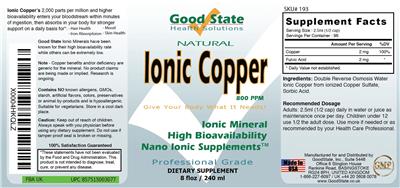
lonic Copper's 2,000 parts per million and higher bioavailability enters your bloodstream within minutes of ingestion, then absorbs in your body for stronger support on a daily basis for: Hair health Iron absorption Mood Skin health Good Stat Ionic Minerals have been known for their high bioavailability rate while others can be extremely low.
Note - Copper benefits and/or deficiency are generic for the mineral. No product claims being made or implied research is ongoing.
Contains no known allergens, GMOs, starch, artificial flavors, colors, preservatives or animal by-products and is hypoallergenic.
Contains no known allergens, GMOs, starch, artificial flavors, colors, preservatives or animal by-products and is hypoallergenic.
Suitable for vegetarians.
100% Satisfaction Guaranteed
Natural Highly bioavailability Professional grade
Storage
Store in a cool dark place.
Precautions
Caution: Keep out of reach of children.
Always speak with your physician before using any dietary supplement. Do not use if tamper proof seal is broken or missing.
FDA Disclaimer Statement
These statements have not been evaluated by the Food and Drug Administration. This product is not intended to diagnose, treat, cure, or prevent any disease.
General Statements
FBA UK UPC 857515003077
Give your body what it needs!
Formula
Ionic Mineral Nano Ionic Supplements
FDA Statement of Identity
Dietary Supplement
Suggested/Recommended/Usage/Directions
Recommended Dosage Adults: 2.5ml (1/2 cap) daily in water or juice as maintenance once per day. Children under 12 use 1/2 the adult dose. Use more if needed or as recommended by your Health Care Professional.
Seals/Symbols
Made in USA GMP Good Manufacturing Practice
Is this label outdated? Report a formula or label change and our pharmacy team will review it.
Ionic Copper 800 PPM by Good State label
The label scan from the NIH Dietary Supplement Label Database. Tap to enlarge.
Label images are published by the NIH Dietary Supplement Label Database for the version of this product on file. Always read your actual product label.
View the full label (PDF)The Ingredients in Ionic Copper 800 PPM by Good State
These are the 2 active ingredients this product is made of. Select any to open its full monograph.
Serving size1.25 mL Dosage formLiquid Servings per container96 Amounts shown are per serving.
Most supplement products combine several ingredients, and a medication can interact with the product through any one of them. Each ingredient below shows whether it has known drug interactions.
Copper
Interacts with31 drugs
Copper is an essential trace mineral your body needs in small amounts for making red blood cells, supporting nerves and bones, and helping enzymes wor...
Copper monograph & interactionsFulvic Acid
Interacts with257 drugs
Fulvic acid is a natural compound formed when plants and microbes break down in soil, and it is sold as a supplement for energy, gut, and overall well...
Fulvic Acid monograph & interactionsOther (inactive) ingredients: Double reverse osmosis Water, Ionic Copper, Sorbic Acid. These complete the product’s ingredient list but are not active constituents.
Ionic Copper 800 PPM by Good State Drug Interactions
HelloPharmacist Interaction Report
Ionic Copper 800 PPM by Good State contains two active ingredients—copper and fulvic acid—that together interact with a number of medications.
The most serious concern is fulvic acid's interaction with blood thinners (anticoagulants/antiplatelet drugs), rated Moderate severity. In vitro evidence shows fulvic acid can shorten clotting time in blood, which may reduce how well these drugs prevent clots.
Read the full breakdown — every affected drug type, severity by severity
Copper carries a Moderate interaction with penicillamine (a medication used for certain copper-storage disorders and rheumatoid arthritis): copper binds to penicillamine and decreases how much your body absorbs, potentially weakening its effect. Separating doses by at least 2 hours may help.
Copper also has a Minor interaction with birth control pills, which may increase copper levels in your blood—though most people who take oral contraceptives show copper levels above the normal range anyway.
Fulvic acid has two additional Moderate interactions: with immunosuppressants (drugs that calm your immune system), where animal research suggests it may reduce their effectiveness, and with thyroid hormone therapy, where it may interfere with getting your thyroid levels stable. Altogether, these interactions span 284 individual medications.
Use the search tool below to check your exact prescriptions before starting this product.
Check your own medications below · Editorial policy · How we use AI
Want to check YOUR meds against Ionic Copper 800 PPM?
Ask about interactions with your drugs in plain English — “Can I take it with lisinopril?” — and we find you the answer in seconds, ingredient by ingredient.
Go to the checkerIngredients driving the most interactions
Individual Drug Interactions
The ingredients in Ionic Copper 800 PPM interact with 288 drugs. Click any drug to see the details.
2 of the 2 ingredients in Ionic Copper 800 PPM interact with drugs. Each result below shows which ingredient is responsible. Fulvic Acid Copper
6-mercaptopurinePurinethol
How 6-mercaptopurine interacts with Ionic Copper 800 PPM — through 1 ingredient. Tap an ingredient for the detail:
Fulvic AcidImmunosuppressants Moderate
Interaction Summary
Theoretically, taking fulvic acid might decrease the effects of immunosuppressive therapy.
Read the full Fulvic Acid + 6-mercaptopurine interactionAbciximabReoPro
How Abciximab interacts with Ionic Copper 800 PPM — through 1 ingredient. Tap an ingredient for the detail:
Fulvic AcidAnticoagulant/antiplatelet Drugs Moderate
Interaction Summary
Theoretically, taking fulvic acid may decrease the effectiveness of anticoagulant and antiplatelet drugs.
Read the full Fulvic Acid + Abciximab interactionAbrocitinibCibinqo
How Abrocitinib interacts with Ionic Copper 800 PPM — through 1 ingredient. Tap an ingredient for the detail:
Fulvic AcidAnticoagulant/antiplatelet Drugs, Immunosuppressants Moderate
Interaction Summary
Theoretically, taking fulvic acid may decrease the effectiveness of anticoagulant and antiplatelet drugs.
Read the full Fulvic Acid + Abrocitinib interactionAcenocoumarolSintrom
How Acenocoumarol interacts with Ionic Copper 800 PPM — through 1 ingredient. Tap an ingredient for the detail:
Fulvic AcidAnticoagulant/antiplatelet Drugs Moderate
Interaction Summary
Theoretically, taking fulvic acid may decrease the effectiveness of anticoagulant and antiplatelet drugs.
Read the full Fulvic Acid + Acenocoumarol interactionAcetaminophen, AspirinGemnisyn
How Acetaminophen, Aspirin interacts with Ionic Copper 800 PPM — through 1 ingredient. Tap an ingredient for the detail:
Fulvic AcidAnticoagulant/antiplatelet Drugs Moderate
Interaction Summary
Theoretically, taking fulvic acid may decrease the effectiveness of anticoagulant and antiplatelet drugs.
Read the full Fulvic Acid + Acetaminophen, Aspirin interactionAcetaminophen, Aspirin, CaffeineExcedrin, Excedrin Extra Strength, Excedrin Migraine
How Acetaminophen, Aspirin, Caffeine interacts with Ionic Copper 800 PPM — through 1 ingredient. Tap an ingredient for the detail:
Fulvic AcidAnticoagulant/antiplatelet Drugs Moderate
Interaction Summary
Theoretically, taking fulvic acid may decrease the effectiveness of anticoagulant and antiplatelet drugs.
Read the full Fulvic Acid + Acetaminophen, Aspirin, Caffeine interactionAcetaminophen, IbuprofenCombogesic
How Acetaminophen, Ibuprofen interacts with Ionic Copper 800 PPM — through 1 ingredient. Tap an ingredient for the detail:
Fulvic AcidAnticoagulant/antiplatelet Drugs Moderate
Interaction Summary
Theoretically, taking fulvic acid may decrease the effectiveness of anticoagulant and antiplatelet drugs.
Read the full Fulvic Acid + Acetaminophen, Ibuprofen interactionAcetylsalicylic AcidEntrophen
How Acetylsalicylic Acid interacts with Ionic Copper 800 PPM — through 1 ingredient. Tap an ingredient for the detail:
Fulvic AcidAnticoagulant/antiplatelet Drugs Moderate
Interaction Summary
Theoretically, taking fulvic acid may decrease the effectiveness of anticoagulant and antiplatelet drugs.
Read the full Fulvic Acid + Acetylsalicylic Acid interactionAdalimumabHumira
How Adalimumab interacts with Ionic Copper 800 PPM — through 1 ingredient. Tap an ingredient for the detail:
Fulvic AcidImmunosuppressants Moderate
Interaction Summary
Theoretically, taking fulvic acid might decrease the effects of immunosuppressive therapy.
Read the full Fulvic Acid + Adalimumab interactionAdalimumab-adazHyrimoz
How Adalimumab-adaz interacts with Ionic Copper 800 PPM — through 1 ingredient. Tap an ingredient for the detail:
Fulvic AcidImmunosuppressants Moderate
Interaction Summary
Theoretically, taking fulvic acid might decrease the effects of immunosuppressive therapy.
Read the full Fulvic Acid + Adalimumab-adaz interactionAdalimumab-adbmCyltezo
How Adalimumab-adbm interacts with Ionic Copper 800 PPM — through 1 ingredient. Tap an ingredient for the detail:
Fulvic AcidImmunosuppressants Moderate
Interaction Summary
Theoretically, taking fulvic acid might decrease the effects of immunosuppressive therapy.
Read the full Fulvic Acid + Adalimumab-adbm interactionAdalimumab-afzbAbrilada
How Adalimumab-afzb interacts with Ionic Copper 800 PPM — through 1 ingredient. Tap an ingredient for the detail:
Fulvic AcidImmunosuppressants Moderate
Interaction Summary
Theoretically, taking fulvic acid might decrease the effects of immunosuppressive therapy.
Read the full Fulvic Acid + Adalimumab-afzb interactionAdalimumab-attoAmjevita
How Adalimumab-atto interacts with Ionic Copper 800 PPM — through 1 ingredient. Tap an ingredient for the detail:
Fulvic AcidImmunosuppressants Moderate
Interaction Summary
Theoretically, taking fulvic acid might decrease the effects of immunosuppressive therapy.
Read the full Fulvic Acid + Adalimumab-atto interactionAdalimumab-bwwdHadlima
How Adalimumab-bwwd interacts with Ionic Copper 800 PPM — through 1 ingredient. Tap an ingredient for the detail:
Fulvic AcidImmunosuppressants Moderate
Interaction Summary
Theoretically, taking fulvic acid might decrease the effects of immunosuppressive therapy.
Read the full Fulvic Acid + Adalimumab-bwwd interactionAdalimumab-fkjpHulio
How Adalimumab-fkjp interacts with Ionic Copper 800 PPM — through 1 ingredient. Tap an ingredient for the detail:
Fulvic AcidImmunosuppressants Moderate
Interaction Summary
Theoretically, taking fulvic acid might decrease the effects of immunosuppressive therapy.
Read the full Fulvic Acid + Adalimumab-fkjp interactionAlefaceptAmevive
How Alefacept interacts with Ionic Copper 800 PPM — through 1 ingredient. Tap an ingredient for the detail:
Fulvic AcidImmunosuppressants Moderate
Interaction Summary
Theoretically, taking fulvic acid might decrease the effects of immunosuppressive therapy.
Read the full Fulvic Acid + Alefacept interactionAlemtuzumabCampath
How Alemtuzumab interacts with Ionic Copper 800 PPM — through 1 ingredient. Tap an ingredient for the detail:
Fulvic AcidImmunosuppressants Moderate
Interaction Summary
Theoretically, taking fulvic acid might decrease the effects of immunosuppressive therapy.
Read the full Fulvic Acid + Alemtuzumab interactionAlteplase, TpaActilyse, Activase
How Alteplase, Tpa interacts with Ionic Copper 800 PPM — through 1 ingredient. Tap an ingredient for the detail:
Fulvic AcidAnticoagulant/antiplatelet Drugs Moderate
Interaction Summary
Theoretically, taking fulvic acid may decrease the effectiveness of anticoagulant and antiplatelet drugs.
Read the full Fulvic Acid + Alteplase, Tpa interactionAluminum Hydroxide, Aspirin, Codeine Phosphate, Magnesium HydroxideAscriptin Codeine #2
How Aluminum Hydroxide, Aspirin, Codeine Phosphate, Magnesium Hydroxide interacts with Ionic Copper 800 PPM — through 1 ingredient. Tap an ingredient for the detail:
Fulvic AcidAnticoagulant/antiplatelet Drugs Moderate
Interaction Summary
Theoretically, taking fulvic acid may decrease the effectiveness of anticoagulant and antiplatelet drugs.
Read the full Fulvic Acid + Aluminum Hydroxide, Aspirin, Codeine Phosphate, Magnesium Hydroxide interactionAluminum Hydroxide, Aspirin, Magnesium HydroxideAscriptin
How Aluminum Hydroxide, Aspirin, Magnesium Hydroxide interacts with Ionic Copper 800 PPM — through 1 ingredient. Tap an ingredient for the detail:
Fulvic AcidAnticoagulant/antiplatelet Drugs Moderate
Interaction Summary
Theoretically, taking fulvic acid may decrease the effectiveness of anticoagulant and antiplatelet drugs.
Read the full Fulvic Acid + Aluminum Hydroxide, Aspirin, Magnesium Hydroxide interactionAnacaulase-bcdbNexoBrid
How Anacaulase-bcdb interacts with Ionic Copper 800 PPM — through 1 ingredient. Tap an ingredient for the detail:
Fulvic AcidAnticoagulant/antiplatelet Drugs Moderate
Interaction Summary
Theoretically, taking fulvic acid may decrease the effectiveness of anticoagulant and antiplatelet drugs.
Read the full Fulvic Acid + Anacaulase-bcdb interactionAnagrelideAgrylin
How Anagrelide interacts with Ionic Copper 800 PPM — through 1 ingredient. Tap an ingredient for the detail:
Fulvic AcidAnticoagulant/antiplatelet Drugs Moderate
Interaction Summary
Theoretically, taking fulvic acid may decrease the effectiveness of anticoagulant and antiplatelet drugs.
Read the full Fulvic Acid + Anagrelide interactionAnifrolumab-fniaSaphnelo
How Anifrolumab-fnia interacts with Ionic Copper 800 PPM — through 1 ingredient. Tap an ingredient for the detail:
Fulvic AcidImmunosuppressants Moderate
Interaction Summary
Theoretically, taking fulvic acid might decrease the effects of immunosuppressive therapy.
Read the full Fulvic Acid + Anifrolumab-fnia interactionAnisindioneMiradon
How Anisindione interacts with Ionic Copper 800 PPM — through 1 ingredient. Tap an ingredient for the detail:
Fulvic AcidAnticoagulant/antiplatelet Drugs Moderate
Interaction Summary
Theoretically, taking fulvic acid may decrease the effectiveness of anticoagulant and antiplatelet drugs.
Read the full Fulvic Acid + Anisindione interactionAntithrombin IiiThrombate III
How Antithrombin Iii interacts with Ionic Copper 800 PPM — through 1 ingredient. Tap an ingredient for the detail:
Fulvic AcidAnticoagulant/antiplatelet Drugs Moderate
Interaction Summary
Theoretically, taking fulvic acid may decrease the effectiveness of anticoagulant and antiplatelet drugs.
Read the full Fulvic Acid + Antithrombin Iii interactionAntithymocyte GlobulinThymoglobulin
How Antithymocyte Globulin interacts with Ionic Copper 800 PPM — through 1 ingredient. Tap an ingredient for the detail:
Fulvic AcidImmunosuppressants Moderate
Interaction Summary
Theoretically, taking fulvic acid might decrease the effects of immunosuppressive therapy.
Read the full Fulvic Acid + Antithymocyte Globulin interactionApixabanEliquis
How Apixaban interacts with Ionic Copper 800 PPM — through 1 ingredient. Tap an ingredient for the detail:
Fulvic AcidAnticoagulant/antiplatelet Drugs Moderate
Interaction Summary
Theoretically, taking fulvic acid may decrease the effectiveness of anticoagulant and antiplatelet drugs.
Read the full Fulvic Acid + Apixaban interactionArgatrobanArgatroban
How Argatroban interacts with Ionic Copper 800 PPM — through 1 ingredient. Tap an ingredient for the detail:
Fulvic AcidAnticoagulant/antiplatelet Drugs Moderate
Interaction Summary
Theoretically, taking fulvic acid may decrease the effectiveness of anticoagulant and antiplatelet drugs.
Read the full Fulvic Acid + Argatroban interactionAspirinAngettes 75, ASA, Asaphen, Aspirin, Caprin, Cartia +8 more
How Aspirin interacts with Ionic Copper 800 PPM — through 1 ingredient. Tap an ingredient for the detail:
Fulvic AcidAnticoagulant/antiplatelet Drugs Moderate
Interaction Summary
Theoretically, taking fulvic acid may decrease the effectiveness of anticoagulant and antiplatelet drugs.
Read the full Fulvic Acid + Aspirin interactionAspirin, Aluminum Hydroxide, Codeine Phosphate, Magnesium HydroxideAscriptin Codeine #3
How Aspirin, Aluminum Hydroxide, Codeine Phosphate, Magnesium Hydroxide interacts with Ionic Copper 800 PPM — through 1 ingredient. Tap an ingredient for the detail:
Fulvic AcidAnticoagulant/antiplatelet Drugs Moderate
Interaction Summary
Theoretically, taking fulvic acid may decrease the effectiveness of anticoagulant and antiplatelet drugs.
Read the full Fulvic Acid + Aspirin, Aluminum Hydroxide, Codeine Phosphate, Magnesium Hydroxide interactionEach ingredient & the kinds of drugs it affects
For each ingredient in Ionic Copper 800 PPM with known interactions, here are the types of medications they can affect. Open any type for the detail — or search your exact drug in the checker above.
Fulvic Acid
Anticoagulant/Antiplatelet Drugs
Theoretically, taking fulvic acid may decrease the effectiveness of anticoagulant and antiplatelet drugs.
In vitro evidence shows that fulvic acid, formed from the oxidation and polymerization of protocatechuic acid, can shorten prothrombin time in human plasma, increasing the risk of clot formation.
Immunosuppressants
Theoretically, taking fulvic acid might decrease the effects of immunosuppressive therapy.
Animal research shows that fulvic acid stimulates immune function.
Thyroid Hormone
Theoretically, taking fulvic acid with thyroid hormone therapy might interfere with the ability to normalize thyroid function.
Animal research shows that fulvic acid increases the plasma level of thyroid-stimulating hormone (TSH) and decreases the thyroxine (T4):triiodothyronine (T3) ratio.
Copper
Penicillamine (Cuprimine, Depen)
Theoretically, taking copper with penicillamine might decrease the absorption of penicillamine; separate dosing by at least 2 hours.
Copper chelates penicillamine, which decreases its absorption and may reduce its clinical effects.
Contraceptive Drugs
Theoretically, taking copper with contraceptive drugs might increase the levels and toxic effects of copper.
A meta-analysis of clinical studies suggests that chronic use of oral contraceptives increases serum copper levels by a mean of 57 mcg/dL. In most people, this resulted in levels above the normal reference range for copper.
Brand information
Manufacturer and brand details for Ionic Copper 800 PPM, from the product label.
Good State
- Name
- GoodState Inc.
- Street Address
- Suite 5448 Office 6 Slington House Rankine Road
- City
- Basingstoke
- ZipCode
- RG24 8PH
- Phone Number
- 1-866-227-6097
- Web Address
- www.GoodState.co.uk
Ionic Copper 800 PPM by Good State: Common Questions
Does Ionic Copper 800 PPM by Good State interact with any medications?
How can one product interact with so many drugs?
Where does this information come from?
Is copper safe to take during pregnancy?
Can I take this while breastfeeding?
What is copper actually used for in the body?
What are the most common side effects I might experience?
Will this help my energy or clear up my skin?
Does this product have fillers or other stuff in it?
Written and reviewed by the HelloPharmacist editorial staff. Our editorial policy
Not sure if Ionic Copper 800 PPM is safe with your meds?
Our pharmacists answer your medication & supplement questions — free.
Label information is sourced from the NIH Dietary Supplement Label Database and reflects the product version on file; always read your actual product label. This page is for education only and is not a substitute for professional medical advice. Confirm with your pharmacist or doctor before combining supplements and medications.
The Full Monographs Behind Ionic Copper 800 PPM’s Ingredients
Every ingredient we hold a full HelloPharmacist monograph for — uses, evidence, safety, and the complete interaction list.
Copper
Interacts with 31 drugsCopper is an essential trace mineral your body needs in small amounts for making red blood cells, supporting nerves and bones, and helping enzymes work. Most people get enough copper from fo...
Read the full Copper monograph → Herb & supplement monographFulvic Acid
Interacts with 257 drugsFulvic acid is a natural compound formed when plants and microbes break down in soil, and it is sold as a supplement for energy, gut, and overall wellness. Human research is very limited, so...
Read the full Fulvic Acid monograph →Sources & How We Checked
Ionic Copper 800 PPM's label data comes from the NIH Dietary Supplement Label Database; the ingredient interaction data is from the Natural Medicines database, reviewed by our pharmacists.
- NIH Dietary Supplement Label Database (DSLD) — The official product label on file for this supplement.
- Natural Medicines (Therapeutic Research Center) — Evidence-graded clinical reference behind the ingredient interaction data.
Content is written and reviewed by licensed HelloPharmacist pharmacists. See our data sources and editorial standards for how this information is built and checked.
The 14 references behind this product’s interaction data
Every citation that drives the interaction findings for this product’s ingredients, from the evidence-graded Natural Medicines (TRC Healthcare) database. Open an ingredient to browse its citations — links open the study on PubMed or the publisher’s site.
Copper 11 references
- Murry JJ, Healy MD. Drug-mineral interactions: a new responsibility for the hospital dietician. J Am Diet Assoc 1991;91:66-73.
- Campbell IA, Elmes PC. Ethambutol and the eye: zinc and copper (letter). Lancet 1975;2:711. DOI
- Segal S, Kaminski S. Drug-nutrient interactions. American Druggist 1996 Jul;42-8.
- Kozak SF, Inderlied CB, Hsu HY, et al. The role of copper on ethambutol's antimicrobial action and implications for ethambutol-induced optic neuropathy. Diag Microbiol Infect Dis 1998;30:83-7. PubMed
- Food and Nutrition Board, Institute of Medicine. Dietary Reference Intakes for Vitamin A, Vitamin K, Arsenic, Boron, Chromium, Copper, Iodine, Iron, Manganese, Molybdenum, Nickel, Silicon, Vanadium, and Zinc. Washington, DC: National Academy Press, 2002.
- Cantilena LR, Klaassen CD. The effect of chelating agents on the excretion of endogenous metals. Toxicol Appl Pharmacol 1982;63:344-50.
- Babic Z, Tariba B, Kovacic J, Pizent A, Varnai VM, Macan J. Relevance of serum copper elevation induced by oral contraceptives: a meta-analysis. Contraception. 2013 Jun;87(6):790-800. PubMed
- Qui Q, Zhang F, Zhu W, Wu J, Liang M. Copper in diabetes mellitus: a meta-analysis and systematic review of plasma and serum studies. Biol Trace Elem Res 2017;177(1):53-63.
- Walker-Smith PK, Keith DJ, Kennedy CT, Sansom JE. Allergic contact dermatitis caused by copper. Contact Dermatitis 2016;75(3):186-7. PubMed
- Gallentine A. Third-degree burn on the neuropathic lower extremity in a patient with diabetes while wearing a copper-containing compression sock: a case report. Wound Manag Prev 2021;67(12):26-29. DOI
- Chung KJ, Chin YM, Wong MS, Sanmugam A, Singaravel S, Nah SA. Effectiveness of table salt versus copper sulphate in treating umbilical granuloma: A pilot randomized controlled trial. J Pediatr Surg 2022;57(2):261-265. PubMed
Fulvic Acid 3 references
- Lu, FJ. Arsenic as a promoter in the effect of humic substances on plasma prothrombin time in vitro. Thromb Res 6-15-1990;58(6):537-541. PubMed
- Vucskits, AV, Hullar, I, Bersenyi, A, Andrasofszky, E, Kulcsar, M, Szabo, J. Effect of fulvic and humic acids on performance, immune response and thyroid function in rats. J Anim Physiol Anim Nutr (Berl) 2010;94(6):721-728. PubMed
- Gandy JJ, Meeding JP, Snyman JR, et al. Phase 1 clinical study of the acute and subacute safety and proof-of-concept efficacy of carbohydrate-derived fulvic acid. Clin Pharmacol. 2012;4:7-11. PubMed
Parts of this content are provided by the Therapeutic Research Center, LLC.
DISCLAIMER: Currently this does not check for drug-drug interactions. This is not an all-inclusive comprehensive list of potential interactions and is for informational purposes only. Not all interactions are known or well-reported in the scientific literature, and new interactions are continually being reported. Input is needed from a qualified healthcare provider including a pharmacist before starting any therapy. Application of clinical judgment is necessary.
© 2021 Therapeutic Research Center, LLC