
Liferoot Ingredients & Drug Interactions
What is this page for?
First and foremost: checking Liferoot against your medications. The heart of this page is the interaction checker and the full interaction report — how this product’s ingredients may interact with prescription and over-the-counter medicines you may be taking.
Around that, we add a pharmacist’s high-level view of the product as a whole — what’s inside, the evidence for its stated use, how transparent the label is, and what safety data exists — so you can see the full picture in one place. It’s educational information from our licensed clinical databases and the clinical staff at HelloPharmacist — not medical advice — and we don’t sell or endorse products. Our editorial policy
Liferoot is a dietary supplement by Red Moon Herbs with 1 active ingredient. Its ingredients are commonly taken for menstrual complaints, easing childbirth (traditional), urinary discomfort.Based on those ingredients, 87 medications have a known interaction with it, the most serious rated moderate. The ingredients most likely to interact are Life Root Flowering Top Extract. Use the checker below to test your specific medication, or read the full HelloPharmacist Interaction Report.
Check Your Meds Against Liferoot by Red Moon Herbs
Ask about any prescription or over-the-counter medication and we check it for interactions with Liferoot by Red Moon Herbs — and tell you which ingredient is responsible.
AI summaries are generated from our interaction database for education only — always confirm with your pharmacist. How we use AI
Ask the Pharmacist
A licensed pharmacist will answer your question by email — free, usually within 24 hours.
Got it — thank you!
A licensed pharmacist will answer within 24 hours. Keep an eye on your email (worth checking spam, just in case).
HelloPharmacist Scorecard of Liferoot by Red Moon Herbs
Our pharmacy team’s full take, with four database checks built into the cards below — a summary of what is known, not a grade of the product itself.
What’s inside
Low disclosure
Liferoot contains one active ingredient: life root flowering top extract, derived from golden ragwort. The product also includes water and alcohol as inactive ingredients.
Does it work?
Couldn't assess
We hold no effectiveness data for this product in our records.
How safe is it?
Well-documented data
Golden ragwort carries serious safety concerns. It contains pyrrolizidine alkaloids — plant toxins that can damage your liver and lungs.
With regular use, these alkaloids build up and can cause veno-occlusive disease (a condition where liver blood vessels become scarred), leading to belly pain, vomiting, diarrhea, fluid buildup, and an enlarged liver within weeks. The product can also harm your lungs and raise blood pressure in the lung arteries.
The safety data advises against use during pregnancy or while breastfeeding; the toxic alkaloids can harm a developing baby or pass to an infant through breast milk.
Meds to double-check
Moderate interaction found
If you take CYP3A4 inducers (drugs that speed up a liver pathway) — which include certain seizure medications and others — check with your pharmacist before starting this product; it may increase your risk of toxicity from the plant's harmful alkaloids.
The bottom line
Scorecard at a glanceFormula with limited ingredient disclosure with no assessable stated purpose. Moderate medication interactions have been identified, and safety information is well characterized.
This product carries serious liver and lung toxicity risks from its pyrrolizidine alkaloid content. It is not recommended for routine use, particularly not during pregnancy or breastfeeding.
Talk with your pharmacist before considering it — they can help you weigh any potential benefit against these documented harms.
Educational only — not medical advice; always confirm with your pharmacist. Our editorial policy · How we use AI
Assessment coverage: 1 of 1 active ingredient matched to our full ingredient reviews (monographs). Based on the product label dated Dec 21, 2024.
This Scorecard evaluates available label information, ingredient evidence, and known medication-safety considerations. It does not independently verify product identity, purity, potency, contamination, or manufacturing quality. How these ratings are computed
General information
Key facts about Liferoot, straight from the product label.
| Brand | Red Moon Herbs |
|---|---|
| Barcode (UPC) | 857999002306 |
| Net contents | 1 Fluid Ounce(s); 30 mL |
| Market status | On market |
| Date entered into DSLD | Dec 21, 2024 |
| DSLD ID | 319293 |
| Product type | Botanical |
| Supplement form | Liquid |
| Dietary claims / uses | All Other |
| Intended target group(s) | Adult (18 - 50 Years), Children (All), Infants/Baby (0 - 1 Year), Seniors/Mature (>50 Years) |
Everything in this section is reproduced from the manufacturer’s own product label — it’s the label speaking, not HelloPharmacist. We show it so you can see exactly what the maker states; we don’t verify or endorse those statements.
Supplement Facts
The label details for Liferoot by Red Moon Herbs, sourced from the NIH Dietary Supplement Label Database.
Supplement Facts
| Ingredient | Amount | % DV |
|---|---|---|
| Life Root Flowering Top Extract | 0 NP | -- |
Other ingredients: Water, Alcohol
Tap any ingredient to jump to its full detail below.
These statements are the manufacturer’s wording, reproduced from the product label — the label is saying it, not HelloPharmacist. We don’t verify or endorse them.
Suggested/Recommended/Usage/Directions
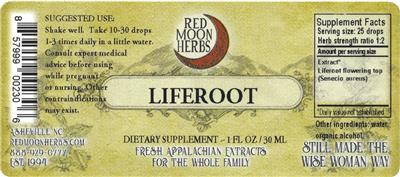
Suggested use: Shake well. Take 10-30 drops 1-3 times daily in a little water.
Precautions
Consults expert medical advice before using while pregnant or nursing.
Other contraindications may exist.
General Statements
Red Moon Herbs Est. 1994 Still made the wise woman way
FDA Statement of Identity
Dietary Supplement
Formula
Fresh Appalachian extracts for the whole family
Formulation
Fresh Appalachian extracts for the whole family
Is this label outdated? Report a formula or label change and our pharmacy team will review it.
Liferoot by Red Moon Herbs label
The label scan from the NIH Dietary Supplement Label Database. Tap to enlarge.
Label images are published by the NIH Dietary Supplement Label Database for the version of this product on file. Always read your actual product label.
View the full label (PDF)The Ingredients in Liferoot by Red Moon Herbs
This is the 1 active ingredient this product is made of. Select it to open its full monograph.
Serving size10 Drop(s) Dosage formLiquid Amounts shown are per serving.
Life Root Flowering Top Extract
Interacts with87 drugs
Golden Ragwort is a flowering plant once used in traditional and folk medicine, mainly for menstrual and female reproductive complaints. It contains p...
Life Root Flowering Top Extract monograph & interactionsOther (inactive) ingredients: Water, Alcohol. These complete the product’s ingredient list but are not active constituents.
Liferoot by Red Moon Herbs Drug Interactions
HelloPharmacist Interaction Report
Liferoot by Red Moon Herbs contains golden ragwort, which has one documented interaction with a medication type.
The product's active compound — a pyrrolizidine alkaloid (a plant toxin) — is processed by your liver through a pathway called CYP3A4. If you take drugs that speed up this pathway (CYP3A4 inducers — a group that includes some seizure medications and certain others), the liver may convert more of the alkaloid into harmful forms, raising the risk of toxicity.
This is a Moderate severity interaction.
Read the full breakdown — every affected drug type, severity by severity
Always run your exact medications through the checker below before you start this product.
Check your own medications below · Editorial policy · How we use AI
Want to check YOUR meds against Liferoot?
Ask about interactions with your drugs in plain English — “Can I take it with lisinopril?” — and we find you the answer in seconds, ingredient by ingredient.
Go to the checkerIngredients driving the most interactions
Individual Drug Interactions
The ingredients in Liferoot interact with 87 drugs. Click any drug to see the details.
1 of the 1 ingredient in Liferoot interact with drugs. Each result below shows which ingredient is responsible. Life Root Flowering Top Extract
MitapivatPyrukynd
How Mitapivat interacts with Liferoot — through 1 ingredient. Tap an ingredient for the detail:
Life Root Flowering Top ExtractCytochrome P450 3a4 (cyp3a4) Inducers Moderate
Interaction Summary
Theoretically, CYP3A4 inducers might increase the risk of adverse effects from the pyrrolizidine alkaloid (PA) constituents in golden ragwort.
Read the full Life Root Flowering Top Extract + Mitapivat interactionModafinilAlertec, Provigil, Sparlon
How Modafinil interacts with Liferoot — through 1 ingredient. Tap an ingredient for the detail:
Life Root Flowering Top ExtractCytochrome P450 3a4 (cyp3a4) Inducers Moderate
Interaction Summary
Theoretically, CYP3A4 inducers might increase the risk of adverse effects from the pyrrolizidine alkaloid (PA) constituents in golden ragwort.
Read the full Life Root Flowering Top Extract + Modafinil interactionNafcillinNallpen
How Nafcillin interacts with Liferoot — through 1 ingredient. Tap an ingredient for the detail:
Life Root Flowering Top ExtractCytochrome P450 3a4 (cyp3a4) Inducers Moderate
Interaction Summary
Theoretically, CYP3A4 inducers might increase the risk of adverse effects from the pyrrolizidine alkaloid (PA) constituents in golden ragwort.
Read the full Life Root Flowering Top Extract + Nafcillin interactionNafcillin SodiumUnipen
How Nafcillin Sodium interacts with Liferoot — through 1 ingredient. Tap an ingredient for the detail:
Life Root Flowering Top ExtractCytochrome P450 3a4 (cyp3a4) Inducers Moderate
Interaction Summary
Theoretically, CYP3A4 inducers might increase the risk of adverse effects from the pyrrolizidine alkaloid (PA) constituents in golden ragwort.
Read the full Life Root Flowering Top Extract + Nafcillin Sodium interactionNevirapineViramune, Viramune XR
How Nevirapine interacts with Liferoot — through 1 ingredient. Tap an ingredient for the detail:
Life Root Flowering Top ExtractCytochrome P450 3a4 (cyp3a4) Inducers Moderate
Interaction Summary
Theoretically, CYP3A4 inducers might increase the risk of adverse effects from the pyrrolizidine alkaloid (PA) constituents in golden ragwort.
Read the full Life Root Flowering Top Extract + Nevirapine interactionOlutasidenibRezlidihia
How Olutasidenib interacts with Liferoot — through 1 ingredient. Tap an ingredient for the detail:
Life Root Flowering Top ExtractCytochrome P450 3a4 (cyp3a4) Inducers Moderate
Interaction Summary
Theoretically, CYP3A4 inducers might increase the risk of adverse effects from the pyrrolizidine alkaloid (PA) constituents in golden ragwort.
Read the full Life Root Flowering Top Extract + Olutasidenib interactionOmaveloxoloneSkyclarys
How Omaveloxolone interacts with Liferoot — through 1 ingredient. Tap an ingredient for the detail:
Life Root Flowering Top ExtractCytochrome P450 3a4 (cyp3a4) Inducers Moderate
Interaction Summary
Theoretically, CYP3A4 inducers might increase the risk of adverse effects from the pyrrolizidine alkaloid (PA) constituents in golden ragwort.
Read the full Life Root Flowering Top Extract + Omaveloxolone interactionOritavancin DiphosphateKimyrsa, Orbactiv
How Oritavancin Diphosphate interacts with Liferoot — through 1 ingredient. Tap an ingredient for the detail:
Life Root Flowering Top ExtractCytochrome P450 3a4 (cyp3a4) Inducers Moderate
Interaction Summary
Theoretically, CYP3A4 inducers might increase the risk of adverse effects from the pyrrolizidine alkaloid (PA) constituents in golden ragwort.
Read the full Life Root Flowering Top Extract + Oritavancin Diphosphate interactionOxcarbazepineOxtellar XR, Trileptal
How Oxcarbazepine interacts with Liferoot — through 1 ingredient. Tap an ingredient for the detail:
Life Root Flowering Top ExtractCytochrome P450 3a4 (cyp3a4) Inducers Moderate
Interaction Summary
Theoretically, CYP3A4 inducers might increase the risk of adverse effects from the pyrrolizidine alkaloid (PA) constituents in golden ragwort.
Read the full Life Root Flowering Top Extract + Oxcarbazepine interactionPhenobarbitalLuminal, Phenobarbital, Solfoton
How Phenobarbital interacts with Liferoot — through 1 ingredient. Tap an ingredient for the detail:
Life Root Flowering Top ExtractCytochrome P450 3a4 (cyp3a4) Inducers Moderate
Interaction Summary
Theoretically, CYP3A4 inducers might increase the risk of adverse effects from the pyrrolizidine alkaloid (PA) constituents in golden ragwort.
Read the full Life Root Flowering Top Extract + Phenobarbital interactionPhenobarbital, PhenytoinDilantin with PB
How Phenobarbital, Phenytoin interacts with Liferoot — through 1 ingredient. Tap an ingredient for the detail:
Life Root Flowering Top ExtractCytochrome P450 3a4 (cyp3a4) Inducers Moderate
Interaction Summary
Theoretically, CYP3A4 inducers might increase the risk of adverse effects from the pyrrolizidine alkaloid (PA) constituents in golden ragwort.
Read the full Life Root Flowering Top Extract + Phenobarbital, Phenytoin interactionPhenobarbital, Sodium NitrateSoniphen
How Phenobarbital, Sodium Nitrate interacts with Liferoot — through 1 ingredient. Tap an ingredient for the detail:
Life Root Flowering Top ExtractCytochrome P450 3a4 (cyp3a4) Inducers Moderate
Interaction Summary
Theoretically, CYP3A4 inducers might increase the risk of adverse effects from the pyrrolizidine alkaloid (PA) constituents in golden ragwort.
Read the full Life Root Flowering Top Extract + Phenobarbital, Sodium Nitrate interactionPhenytoinDi-Phen, Dilantin, Dilantin Infatabs, Dilantin injection, Dilantin Kapseals, Phenytek
How Phenytoin interacts with Liferoot — through 1 ingredient. Tap an ingredient for the detail:
Life Root Flowering Top ExtractCytochrome P450 3a4 (cyp3a4) Inducers Moderate
Interaction Summary
Theoretically, CYP3A4 inducers might increase the risk of adverse effects from the pyrrolizidine alkaloid (PA) constituents in golden ragwort.
Read the full Life Root Flowering Top Extract + Phenytoin interactionPrimidoneMysoline
How Primidone interacts with Liferoot — through 1 ingredient. Tap an ingredient for the detail:
Life Root Flowering Top ExtractCytochrome P450 3a4 (cyp3a4) Inducers Moderate
Interaction Summary
Theoretically, CYP3A4 inducers might increase the risk of adverse effects from the pyrrolizidine alkaloid (PA) constituents in golden ragwort.
Read the full Life Root Flowering Top Extract + Primidone interactionRepotrectinibAugtyro
How Repotrectinib interacts with Liferoot — through 1 ingredient. Tap an ingredient for the detail:
Life Root Flowering Top ExtractCytochrome P450 3a4 (cyp3a4) Inducers Moderate
Interaction Summary
Theoretically, CYP3A4 inducers might increase the risk of adverse effects from the pyrrolizidine alkaloid (PA) constituents in golden ragwort.
Read the full Life Root Flowering Top Extract + Repotrectinib interactionRifabutinMycobutin
How Rifabutin interacts with Liferoot — through 1 ingredient. Tap an ingredient for the detail:
Life Root Flowering Top ExtractCytochrome P450 3a4 (cyp3a4) Inducers Moderate
Interaction Summary
Theoretically, CYP3A4 inducers might increase the risk of adverse effects from the pyrrolizidine alkaloid (PA) constituents in golden ragwort.
Read the full Life Root Flowering Top Extract + Rifabutin interactionRifampinRifadin, Rifadin Injection, Rimactane, Rofactor
How Rifampin interacts with Liferoot — through 1 ingredient. Tap an ingredient for the detail:
Life Root Flowering Top ExtractCytochrome P450 3a4 (cyp3a4) Inducers Moderate
Interaction Summary
Theoretically, CYP3A4 inducers might increase the risk of adverse effects from the pyrrolizidine alkaloid (PA) constituents in golden ragwort.
Read the full Life Root Flowering Top Extract + Rifampin interactionRifapentinePriftin
How Rifapentine interacts with Liferoot — through 1 ingredient. Tap an ingredient for the detail:
Life Root Flowering Top ExtractCytochrome P450 3a4 (cyp3a4) Inducers Moderate
Interaction Summary
Theoretically, CYP3A4 inducers might increase the risk of adverse effects from the pyrrolizidine alkaloid (PA) constituents in golden ragwort.
Read the full Life Root Flowering Top Extract + Rifapentine interactionRufinamideBanzel
How Rufinamide interacts with Liferoot — through 1 ingredient. Tap an ingredient for the detail:
Life Root Flowering Top ExtractCytochrome P450 3a4 (cyp3a4) Inducers Moderate
Interaction Summary
Theoretically, CYP3A4 inducers might increase the risk of adverse effects from the pyrrolizidine alkaloid (PA) constituents in golden ragwort.
Read the full Life Root Flowering Top Extract + Rufinamide interactionSarilumabKevzara
How Sarilumab interacts with Liferoot — through 1 ingredient. Tap an ingredient for the detail:
Life Root Flowering Top ExtractCytochrome P450 3a4 (cyp3a4) Inducers Moderate
Interaction Summary
Theoretically, CYP3A4 inducers might increase the risk of adverse effects from the pyrrolizidine alkaloid (PA) constituents in golden ragwort.
Read the full Life Root Flowering Top Extract + Sarilumab interactionSomatrogon-ghlaNgenla
How Somatrogon-ghla interacts with Liferoot — through 1 ingredient. Tap an ingredient for the detail:
Life Root Flowering Top ExtractCytochrome P450 3a4 (cyp3a4) Inducers Moderate
Interaction Summary
Theoretically, CYP3A4 inducers might increase the risk of adverse effects from the pyrrolizidine alkaloid (PA) constituents in golden ragwort.
Read the full Life Root Flowering Top Extract + Somatrogon-ghla interactionSotorasibLumakras
How Sotorasib interacts with Liferoot — through 1 ingredient. Tap an ingredient for the detail:
Life Root Flowering Top ExtractCytochrome P450 3a4 (cyp3a4) Inducers Moderate
Interaction Summary
Theoretically, CYP3A4 inducers might increase the risk of adverse effects from the pyrrolizidine alkaloid (PA) constituents in golden ragwort.
Read the full Life Root Flowering Top Extract + Sotorasib interactionTelotristat EtiprateXermelo
How Telotristat Etiprate interacts with Liferoot — through 1 ingredient. Tap an ingredient for the detail:
Life Root Flowering Top ExtractCytochrome P450 3a4 (cyp3a4) Inducers Moderate
Interaction Summary
Theoretically, CYP3A4 inducers might increase the risk of adverse effects from the pyrrolizidine alkaloid (PA) constituents in golden ragwort.
Read the full Life Root Flowering Top Extract + Telotristat Etiprate interactionTenofovir, Emtricitabine, EfavirenzAtripla
How Tenofovir, Emtricitabine, Efavirenz interacts with Liferoot — through 1 ingredient. Tap an ingredient for the detail:
Life Root Flowering Top ExtractCytochrome P450 3a4 (cyp3a4) Inducers Moderate
Interaction Summary
Theoretically, CYP3A4 inducers might increase the risk of adverse effects from the pyrrolizidine alkaloid (PA) constituents in golden ragwort.
Read the full Life Root Flowering Top Extract + Tenofovir, Emtricitabine, Efavirenz interactionZanubrutinibBrukinsa
How Zanubrutinib interacts with Liferoot — through 1 ingredient. Tap an ingredient for the detail:
Life Root Flowering Top ExtractCytochrome P450 3a4 (cyp3a4) Inducers Moderate
Interaction Summary
Theoretically, CYP3A4 inducers might increase the risk of adverse effects from the pyrrolizidine alkaloid (PA) constituents in golden ragwort.
Read the full Life Root Flowering Top Extract + Zanubrutinib interactionGivinostatDuvyzat
How Givinostat interacts with Liferoot — through 1 ingredient. Tap an ingredient for the detail:
Life Root Flowering Top ExtractCytochrome P450 3a4 (cyp3a4) Inducers Moderate
Interaction Summary
Theoretically, CYP3A4 inducers might increase the risk of adverse effects from the pyrrolizidine alkaloid (PA) constituents in golden ragwort.
Read the full Life Root Flowering Top Extract + Givinostat interactionTipranavirAptivus
How Tipranavir interacts with Liferoot — through 1 ingredient. Tap an ingredient for the detail:
Life Root Flowering Top ExtractCytochrome P450 3a4 (cyp3a4) Inducers Moderate
Interaction Summary
Theoretically, CYP3A4 inducers might increase the risk of adverse effects from the pyrrolizidine alkaloid (PA) constituents in golden ragwort.
Read the full Life Root Flowering Top Extract + Tipranavir interactionEach ingredient & the kinds of drugs it affects
For each ingredient in Liferoot with known interactions, here are the types of medications it can affect. Open any type for the detail — or search your exact drug in the checker above.
Life Root Flowering Top Extract
Cytochrome P450 3A4 (Cyp3A4) Inducers
Theoretically, CYP3A4 inducers might increase the risk of adverse effects from the pyrrolizidine alkaloid (PA) constituents in golden ragwort.
Golden ragwort contains PAs. PAs are substrates of CYP3A4. Theoretically, drugs that induce CYP3A4 might increase the conversion of PAs to toxic metabolites.
Brand information
Manufacturer and brand details for Liferoot, from the product label.
Red Moon Herbs
See all Red Moon Herbs products- Name
- Red Moon Herbs
- City
- Asheville
- State
- NC
- Phone Number
- 888-929-0777
- Web Address
- redmoonherbs.com
Liferoot by Red Moon Herbs: Common Questions
Does Liferoot by Red Moon Herbs interact with any medications?
How can one product interact with so many drugs?
Where does this information come from?
Can I take Liferoot while I'm pregnant?
Can I take Liferoot while breastfeeding?
What are pyrrolizidine alkaloids and why are they a problem?
What is veno-occlusive disease and how fast does it develop?
Written and reviewed by the HelloPharmacist editorial staff. Our editorial policy
Not sure if Liferoot is safe with your meds?
Our pharmacists answer your medication & supplement questions — free.
Label information is sourced from the NIH Dietary Supplement Label Database and reflects the product version on file; always read your actual product label. This page is for education only and is not a substitute for professional medical advice. Confirm with your pharmacist or doctor before combining supplements and medications.
The Full Monographs Behind Liferoot’s Ingredients
Every ingredient we hold a full HelloPharmacist monograph for — uses, evidence, safety, and the complete interaction list.
Sources & How We Checked
Liferoot's label data comes from the NIH Dietary Supplement Label Database; the ingredient interaction data is from the Natural Medicines database, reviewed by our pharmacists.
- NIH Dietary Supplement Label Database (DSLD) — The official product label on file for this supplement.
- Natural Medicines (Therapeutic Research Center) — Evidence-graded clinical reference behind the ingredient interaction data.
Content is written and reviewed by licensed HelloPharmacist pharmacists. See our data sources and editorial standards for how this information is built and checked.
The 4 references behind this product’s interaction data
Every citation that drives the interaction findings for this product’s ingredients, from the evidence-graded Natural Medicines (TRC Healthcare) database. Open an ingredient to browse its citations — links open the study on PubMed or the publisher’s site.
Golden Ragwort 4 references
- WHO working group. Pyrrolizidine alkaloids. Environmental Health Criteria, 80. WHO: Geneva, 1988.
- Chojkier M. Hepatic sinusoidal-obstruction syndrome: toxicity of pyrrolizidine alkaloids. J Hepatol 2003;39:437-46. PubMed
- Roeder E. Medicinal plants in Europe containing pyrrolizidine alkaloids. Pharmazie 1995;50:83-98.
- Wang YP, Yan J, Fu PP, Chou MW. Human liver microsomal reduction of pyrrolizidine alkaloid N-oxides to form the corresponding carcinogenic parent alkaloid. Toxicol Lett 2005;155:411-20. PubMed
Parts of this content are provided by the Therapeutic Research Center, LLC.
DISCLAIMER: Currently this does not check for drug-drug interactions. This is not an all-inclusive comprehensive list of potential interactions and is for informational purposes only. Not all interactions are known or well-reported in the scientific literature, and new interactions are continually being reported. Input is needed from a qualified healthcare provider including a pharmacist before starting any therapy. Application of clinical judgment is necessary.
© 2021 Therapeutic Research Center, LLC